Editor’s note: Any resemblances to actual celebrities — alive or dead — are miraculously coincidental. Celebrity voices channeled by Courtney Maum.
Oh, I can tell you about the American dream. The son of Armenian immigrants, I spent the early 1970s living in a friend’s walk-in closet on Venice Beach, working as a valet because I’d been fired from my secretary position at William Morris. And then I started selling posters beachside, except I already had an eye for added value. I sold mine framed.
Today, I’m at the head of the most expansive art enterprise in the world. So when Peter Brant suggested that I read a book about a man with a journey similar to mine (from arriviste, to demigod, to whatever it is I am now), I listened. I mean, the man is married to Stephanie Seymour. He’s got pretty good taste.
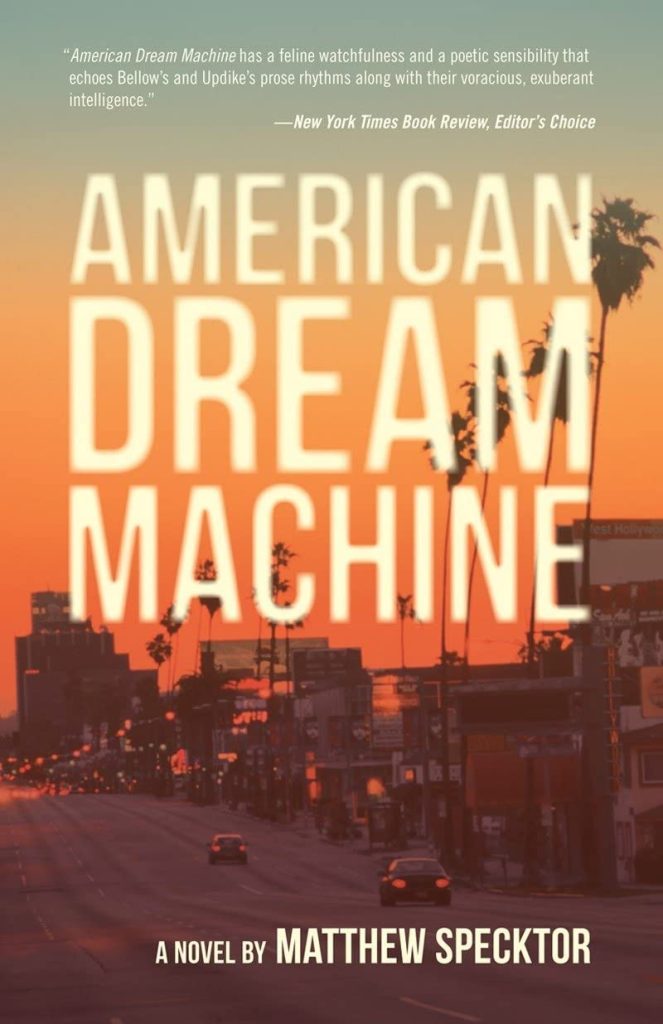
American Dream Machine is the name of the novel Peter’s secretary sent along. I’m not usually a reader, but the book’s arrival coincided with a trip to visit our Hong Kong outpost, so I had a lot of time to kill on the plane. I mean, you can only see so many rom-coms featuring Paul Rudd.
This rather large novel tells the story of multiple men’s lives, but focuses in on one of them, the story’s hero, a film agent named Beau Rosenwald. The whole thing is narrated by his bastard son, a fellow who doesn’t seem to have inherited his father’s wit, but he does strike me as judicious, which Beau is not.
The book documents the changing face of the Hollywood film industry as experienced by a set of close male friends. Because this is Hollywood, and because we’re talking about men, and because one plus the other usually equals money, Beau finds himself betrayed by the very men who facilitated his rise from talent scout to co-founder of a visionary production company, called “American Dream Machine.” By this time in my cross-continental flight, the stewardess had informed me that they were out of Citadelle gin, so betrayal was very much on my mind.
When I first arrived on the LA art scene, I was considered an upstart. I was an English major, a former bookseller, my father was a civil servant, an accountant for the state. I’d never even stepped foot in a museum before the time I turned eighteen. But what connects me to this novel’s protagonist is simple: energy. I’m not a forward thinker, but I’ve always had great instincts in the now. And so does our friend Rosenwald: signing actors that others let fall by the wayside, recognizing something in them that would translate, and transform. When I signed Andy Warhol in the early eighties, everyone thought his dollar painting signs were vulgar. Well, no one’s laughing at me, now.
Another coincidence between Specktor’s protagonist and I: we facilitate the businesses we’re involved in. Over the course of the narrative, Beau played every part but actor: writer, director, producer, casting agent, lover, bankroller, friend. I, too, have never been the person holding the actual paint brush, but I’m my clients’ biggest cheerleader — I sell, and I collect, and I go behind the scenes into the badlands of the industry to negotiate with the auction houses to protect my clients’ worth. Some people call me a crook, a controller, even “carpetbagger.” I prefer the nickname they gave me in my early LA days: “Go-Go.”
Great men are often destroyed by their own friends. Just as Beau was betrayed by his closest confidante, Williams Farquarsen, so too have I been deserted by my numero one client, Damien Hirst. You give a man all eleven of your galleries to fill up with pastel-colored dots, you expect he’ll stick around. You confuse loyalty for friendship. You take money instead of words.
You can read the accounts of my other defectors online and in the papers: Tom-Friedman, Philip Taafe — and now there’s word of Yayoi Kusama leaving me, too. They’re discreet in Japan, her people don’t like that I drive up her prices. But I got her a collab with Louis Vuitton, not a fucking WalMart. I aim for brand continuity, and everyone is shocked.
Beau Rosenwald, at heart, is loveable and likeable to the people who know him best. Interchangeable, contagious, his very flaws become a part of his friends’ makeup, like a skin defect you tolerate, even as it reddens and worsens in the sun.
Ultimately, American Dream Machine aims to create a bellwether for that great big word: success. Some people measure it by the legacy they’ll leave behind them. Others, like yours truly, judge it in terms of the life they’re living now.
It’s too bad that Beau doesn’t exist. We’re kinfolk, really, this bumbling fictional dreamer and I — we’re both restless, terrified of satiation. We have to keep moving through the ugliness to stay vital and alive. We have sequin cartilage. We are shining sharks.
At the Center for Fiction, on the occasion of the rerelease of Renata Adler’s novels Speedboat and Pitch Dark (in beautiful new editions by the New York Review of Books), Adler speaks not quite anecdotally, not quite aphoristically — and a crowd of readers and writers, apparently an endangered species, crane delicate necks, laugh well-timed laughs.
1. “Do you all write? It looks like you all write.” 2. Richard Avedon’s iconic 1978 shot of Adler in Saint Martin
“Maybe we are all the last generation of readers, and writers too,” Adler says, but I hope she doesn’t believe it. I must concede that she’s certainly at least considering it — like her narrators, Adler will not say what she doesn’t mean.
Every few minutes, Adler checks in — should she keep going with this weird hybrid thing, this reading, this conversation? Emphatically the audience says yes. We nod. We laugh. She continues. The books, those weird hybrid things we keep saying yes to.
1. First you await Adler’s reading (anticipation!) 2. Then you await Adler’s signing (contemplation!)
“Pitch Dark has more of a plot,” she says, “but people don’t seem to like it better.” The bits taken from life, she says, are often ridiculous, and the made-up ones are not unlikely to have happened. For instance — a passage from Pitch Dark, about Penelope, who couldn’t have been doing all that weaving and unweaving, not really: “we’ve known ever since we learned, not what love us, but what reporting is and what public figures are … how much more than we were ever taught to expect is really lies.”
Outside what was once the largest circulating library in the United States, night settles. We line up for autographs, all carry an image of an eternal braid outside with us, determined not to be the last.
***
–Elina Mishuris is in a perpetual state of cat-sitting.
PEN America has a sweet new website, and their World Voices festival, kicking off April 29, is truly stacked. Two perfect reasons to throw one raging party on Wednesday night at Chez Andre, the sexy basement of the East Village’s Standard Hotel. The room was packed with PEN friends and lovers from start to finish. F.S. Fitzgerald himself would have swooned at the sheer volume of gin and tonic among the crowd, courtesy of liquor sponsor Hendrick’s. And even from the darkest corners of our subterranean space, spring was springing in the form of pretty party dresses. Event co-hosts Lauren Cerand and Uzoamaka Maduka had two of the best. Adam Wilson and Tea Obreht played guest DJs for the evening, though there was no actual record spinning involved. Fear not, the DJ booth — complete with gaping mouth wall art in relief — still saw its share of action, serving as scenery for more than one outrageous photo series. PEN’s Paul Morris was doing his typical thing, somehow engaged with everyone at once. The whole thing was swanky without being stuffy and just the right amount of boozy to boot. If this is what the rest of the lit party scene looks like this season, we’re in for treats.
Editor’s note: Missed your chance to Party with PEN? Don’t fret, join them Monday, April 29 for the launch of the World Voices Festival. Use promo code PEN13 for 20% off your tickets.
*** — Kai Twanmoh is a sometimes contributor to The Outlet. You can find her here.
THEY WERE EITHER GOING TO BREAK UP, or they were going to buy this enormous house in the country. That was the choice. They did not admit this to each other, nor did either of them confide in their friends about it, but privately, each was trying to decide whether to break up or buy the house. On balance, he preferred buying the house, and she preferred breaking up. Or, more specifically, he did not want to break up and also didn’t want to buy the house, but believed that agreeing to buy the house would prevent the breakup that he really quite avidly opposed. Whereas she was ambivalent about every possibility: buying the house and staying together, staying in their apartment and breaking up, buying and breaking, staying and staying. What she really wanted was another version of her life in which she hadn’t made the choices she did, but this would have been difficult to admit. And so in the end he won the debate. They stayed together and bought the house.
He was right, actually — buying the house did prevent the breakup. It kept them very busy. She had a job in town, as an attorney representing recent immigrants to the area, and he didn’t need to work, at least for the time being, thanks to an inheritance that seemed very large by their usual standard of living. His job, as he saw it, would be to learn carpentry and other manual skills while making the house habitable, and to devise ways of making her happy. He was not good at either, but he got by for a while — he replaced floorboards, killed a lot of mice, painted, repaired broken windows. And he bought her flowers and cooked the food that she liked, and massaged her feet and legs, and did the sexual things she liked, although he didn’t like them as much as she did, and privately, she didn’t like them as much with him as she had with other men before him.
This state of affairs lasted a long time — nearly two years. During this time the house became not only habitable but quite nice, and they hosted several parties, to which they invited people she knew. They didn’t invite people he knew because he didn’t know anybody. His only encounters with other people happened at the supermarket, the hardware store, and the jazz club that was really a health food restaurant where he liked to listen to mediocre local music. The last of these was the only place where he was likely to make any friends, but he didn’t. He was shy. (She had liked that about him, at least at first, but now, she regarded it as a demerit.) He didn’t really need friends, he thought. He just needed her. He loved her — was obsessed with her, in fact. They were both thirty years old when the following series of events occurred.
At the beginning of autumn, the furnace went on the fritz; and, rather than pay to have it repaired, he bought and installed an enormous wood stove. She had approved, tentatively, after hearing his promise to handle, in all particulars, the acquisition, management, and burning of firewood. As long as she was warm in their house, she was game. He then ordered five cords, that is, an entire truckload, of firewood, which would be delivered to the house at some point in the next few weeks.
But before it arrived, she threw a party — a massive barbeque to which all her co-workers, friends, and clients were invited. This group was quite lively and diverse in age, education, race, and nationality, and he had a good time with these people, at his own house, and thought maybe some of them might become his friends. As the evening wore on, however, he noticed that his wife was spending most of her time with a man a bit older than she — a thin man, maybe Vietnamese, with an easy laugh and a sharp, assessing gaze. The man was handsome, and several times throughout the party he familiarly placed a hand on his wife’s shoulder or back, or brought her a drink.
Ten days later, he was trapped in town all day while the mechanic worked on his pickup truck, and two things happened during these hours: his wife left him, and the firewood arrived. She didn’t leave a note, but her closet and drawers were empty, and her cosmetics, phone, purse, and umbrella were gone. The firewood pile was enormous — roughly circular, taller than he was, and more than twenty-five feet in circumference. It blocked the entrance to the garage, so he had had to leave the truck in the driveway. His wife, surely, had run off with the handsome Vietnamese man. The way he touched her, the way he glanced across the party at him, as if in challenge — there was no doubt. He had no idea how he would manage to stack this firewood. He had to do it, though, if he was going to stay here. It would soon be cold, his money was running low, and his furnace didn’t work.
Instead of stacking the wood that night, he got completely drunk on leftover barbecue booze and smoked the entire contents of his plastic baggie of weed. Historically this had not been a wise combination, and tonight was no exception. He became confused, paranoid, and nauseated. Before he vomited on the kitchen floor and went to bed, he became convinced that his wife had not, in fact, left him, but had been buried underneath the pile of firewood when the firewood man came to drop it off. She was under there, and she needed him to save her. He wanted to do this right then, in the night, but his body was too weak and he was too sick. He fell asleep.
In the morning, sober, he cleaned the kitchen floor and administered aspirin for his head. But his conviction about his wife remained. She was under the woodpile. When he called her office, he was told she wasn’t in, and couldn’t get any more information out of the place. This only lent credence to his theory. He was aware that the theory must be wrong; nevertheless he knew it to be correct.
He went out in the yard in his jeans and work boots. It was raining. He stared at the pile of firewood. She was under there. He could almost sort of hear her crying. He was not drunk or high now, but he was certain.
He set to work. He stacked the firewood in the lee of the barn, crosshatching as he went. In his conception of events, the only way to save his wife, to rescue her alive from the bottom of the firewood pile, was to carefully stack the wood as he removed it. He could not fling firewood off the pile willy-nilly; he had to be careful and organized. He was still not physically well; his headache came back and he got sick again, this time in the grass. When he later passed by the spot where he’d been sick, he found a horrifying swarm of black beetles crawling over the vomit. This made him sick again. Somehow the beetles seemed akin to the firewood, he couldn’t put his finger on how. He was starting to cry now. The firewood pile was down to about four feet tall and every muscle in his body ached. He went inside and called his dealer and then drove into town for more weed, which he brought home and smoked. Then he ate some tortilla chips and a granola bar and some carrots and some cookies drank a glass of milk and a glass of vodka, then he went back outside, where it was dark, but where a spotlight affixed to the barn was trained on the firewood pile. His wife was crying more loudly now — or perhaps she was just easier to hear, due to the decreasing size of the woodpile.
He worked through the night. He felt terrible. Somehow he lost his work gloves and so his hands were soon lacerated and filled with splinters.
Eventually the ground showed through in spots, and then all that was left was kindling. His wife was wailing now — her cries were all he could hear. He carefully stacked the kindling, and then there was just one piece left, a thin strip of wood, mostly bark, about nine inches long and half an inch thick. His wife was underneath it. All he had to do was reach down and pick it up, and she would be restored to him.
Instead he went inside, collapsed, weeping, into bed, and eventually fell asleep. He must have kept crying during the night, because when he woke up the pillow was wet. The man from the party was standing in the bedroom doorway. He had just knocked on the open door. He said, “She send me for her other things.”
“What?”
“I come get her things.”
“What things?”
“She make a list.” There it was, in the man’s hand: a medium-sized piece of yellow paper, torn from a reporter’s spiral notebook. The opposite hand was inside the man’s jacket pocket, possibly clutching something, possibly a weapon.
“I’m sorry, I’m so sorry,” he told the Vietnamese man, starting to cry again, “I tried to save her. I worked all night. She was — she was just — I couldn’t pick it up. I couldn’t…”
The man said, “Maybe you go for a while, maybe couple hour. Not take me too long.”
He lay there in bed, getting control of himself, while the man stood there waiting for him. The man looked very patient. In the end, he managed to get up, fill a bottle with water, and walk off the property. He left the front door wide open. The Vietnamese man’s car was parked where the pile of firewood used to be; the piece his wife was under lay just ahead of the left front tire. He felt like a fool. He was a fool — that’s why she’d wanted to break up two years ago. He wished now that they had. He entered the forest thinking, fuck, all this wood, it’s fucking everywhere, everything’s made of wood, the house, the forest, fucking everything, it just fucking grows here. You can’t stop it. Yet he paid a guy to bring it to his house. The guy brought the fucking wood, killed his wife, and drove away. And now his wife was dead and another guy was robbing him. What the fuck. What the fuck!
A wind came blowing through the trees and he realized that he was cold. He wasn’t wearing a shirt! Jesus, how could he not have noticed that? He actually laughed as he scanned the ground around him for a good heavy branch, and when he found one, he hefted it in his hands. He couldn’t hold both the branch and the water bottle, so he dropped the bottle on the ground. Then he took a deep breath, and sprinted as fast as he could — not very fast, really — back towards the house.
When he arrived, he saw that the man was there, still there, standing in front of his car, hands on hips, facing the woods as though waiting. He stopped about thirty feet from the man, panting, shivering, clutching the branch in his hands. It truly was heavy — too heavy to swing. As if reading his mind, the Vietnamese man said, “Go ahead! Go ahead, buddy!”
“Get off my property!”
The man just shook his head. He reached into his pocket and pulled out a key ring.
The branch was hurting his arms, so he hefted it, trying to get a better grip. “Go back to where you belong!” he shouted, still unsure of what to do next. “Leave us alone!”
The man appeared surprised, then angry. “Fuck you, loony!” he shouted. “I’m from Binghamton! I’m a lawyer!”
There was a silence.
“How about you go back where you belong, huh?” the man continued, jingling the keys in his hand. “Where you supposed to be, huh? You standing in the cold with a stick, huh? Get a job!”
The man’s face was red and shining. He bent over and picked something up. It was a piece of firewood — the last one. The man flung it, ineffectually, so that it landed with a thunk on the frozen ground between them. Lying there, it didn’t look like anything special.
“Get a job, asshole!” the Vietnamese man repeated, and at last climbed into his car and, slowly and carefully, backed out of the driveway. Soon the car was gone, and silence descended over the yard.
He didn’t know how long he stood out there, shivering — probably not very long, actually. Everything in the world felt very real and very small. It occurred to him that maybe there was something wrong with him. He turned and walked back into the woods, to put the branch back where he found it and to find his water bottle.
No one disturbed the yard for a long time, then. There was only the pickup truck in the driveway, the neatly stacked firewood pile, and the silent, empty house. Eventually darkness fell and nothing was visible at all.
Yesterday we held a Twitter contest for the best #AuthorSexts, a tribute to Sam Pink’s sexting campaign to launch his new novel, Rontel. Participants sullied the voice of their favorite author or sexed-up a famous book title with a filthy pun. With hundreds of entries, it was a deplorable, shameful, wonderful union of highbrow and lowbrow.
The authors of our five favorite #AuthorSexts, and winners of free eBooks of Sam Pink’s new novel, are: @TheLincoln, @RRRubenstein, @Seasheila, @GuthrieK, and @SimonArcan. But since sext is always better with a partner, we’ve shared some of the highlights below. Definitely NSFW.
Hungry for more sexts? Read some Sexts from Sam Pink, who the LA Review of Books calls “one of the best, darkest, funniest, wildest, and touching writers we’ve got.” Or get Sam Pink’s Rontel here.
– Benjamin Samuel is the co-editor of Electric Literature. He never knew a job could be NSFW. Feel free to enlighten him on Twitter.
1. Attack of the book nerds. 2. Tod Goldberg wonders if these things are giant breast pumps.
Over 150,000 people converged this past weekend at USC’s campus in downtown Los Angeles for the 18th annual LA Times Festival of Books. A two-day affair, the event featured food trucks, exhibitors, family fun (apparently Lisa Loeb is doing the children’s music thing these days), and readings and panels with hundreds of writers and industry insiders. The weather was sunny and the crowd was varied; there were the expected literary hipsters, sweater-wearing book nerds, and sweaty genre-writer wanna-be’s wearing hats that said WRITER (“Finally, a reason to wear my writer cap!”), but there were also plenty of people who would look more natural holding a meth pipe than a book. God bless LA.
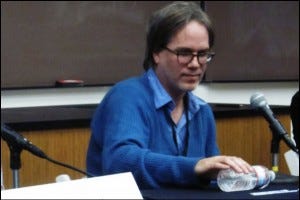
1. Jerry Stahl does not smile. 2. James Greer plays with his water bottle.
As members of the press, we got free reign to all the panels i.e. air conditioning. Highlights from our two favorites:
Tod Goldberg hypothesized that the title of Tremblay’s book, Swallowing a Donkey’s Eye, is also a popular activity at USC frat parties.
All panelists except for Tremblay admitted to having been arrested.
“Writing fucked up might involve narcotics… or it might just involve being a fucked up person,” said Jerry Stahl, who smiled exactly zero times during the panel, like a good little former junkie.
“I write so I can get away from myself. Most writers hate themselves. At least I do,” said James Greer, who fidgeted nervously the entire panel, like a good little agoraphobic.
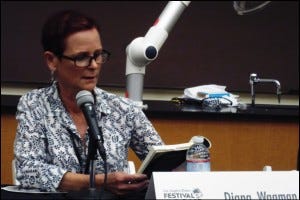
1. Jess Walter, living the dream: getting paid to be a professional smartass. 2. Diana Wagman: not sure why her agent made her delete the chapters from the iguana’s point of view in The Care & Feeding of Exotic Pets.
The power went out mid-panel and the entire auditorium went dark, but Fional Maazel kept right on rolling (ahem, badass), explaining that she started writing because she was a chronic liar with a bad memory . Once she put the lying down on the page, she was able to eliminate it from her real life.
Diana Wagman figured out how to write about the violent scenes in her book by throwing herself around her office.
An audience member with an especially genius question asked, “What do you agree and disagree with most in Stephen King’s book On Writing?” to which Jess Walter replied, “I didn’t read it, but I did hear he said not to use adverbs, which is something I agree with… wholeheartedly.”
1. Fiona Maazel wrote Woke Up Lonelybecause she’s “pathologically fixated on loneliness.” 2. Technical difficulties happen, even at prestigious & expensive private universities.
For more on everything related to the Festival of Books, go here.
***
— -Julia Jackson is an internet ghost and the contributing editor for The Outlet.
— Sunny Katzis a fucking cyborg, and provided assistance and LOLs.
A novel confronting the politics of apology, and the obstacles to redemption
On the surface, the plot of A Thousand Pardons is not unfamiliar: the breadwinning husband of a well-to-do household, mired in ennui, bursts into a fit of destructive, albeit temporary, insanity that lays waste to his home life. Drastic upheaval; everyone changes. Like its predecessor, The Privileges, Dee’s latest novel is about the disintegration and tenuous re-construction of a family, bristling with keen observations, sharply realistic dialogue, and propulsive sentences in which even mundane events are freighted with tension.
When a novel that plumbs the domestic sphere as a way to address larger societal issues is written by a woman, we call it a kitchen-sink drama; when it’s written by a man, we nominate it for the Pulitzer. But never mind; that’s not Dee’s fault — and anyhow, the book’s domestic minuet (and its subplot about a movie star who may, or may not, have done something unspeakable) is only a delivery system for a scathing indictment of the lack of personal responsibility that Dee sees as currently rotting every timber of Western life.
The point is not made subtly: our heroine, Helen Armstead, lands a job at a PR firm and quickly becomes sought after for her ability to get hardnosed CEOs, from Pepsi to the Catholic Church, to apologize for their wrongdoing — which they only do to evade bad press. But an astute reader will find that every detail builds further evidence in Dee’s case: a supposed good Samaritan is squeamish about touching a man that lays unconscious and bleeding. The head of a firm hides in his office posting comments on music blogs all day. An officious floor manager furiously demands that someone immediately clear an exit point she is blocking with her own body.
In Dee’s hands, selfishness assumes complex shapes. Helen’s child Sara, whom she is struggling to nurture while buckling under the pressure of her own responsibilities, has been deliberately and elaborately lying to her mother. Yet Sara tells Helen, spitefully: “I do not feel safe with a totally checked-out mother who has no interest at all in her daughter’s life.” Self-righteousness among teenagers isn’t new, but Sara is using the lingua franca of the modern American: I’m responsible only to myself; it’s someone else’s job to protect me from unpleasant feelings.
In another scene, Sara’s boyfriend Cutter, who is black, delivers a leaden lecture about racism. Just as Sara starts to feel that he’s being rather a drag, he accosts a pair of white kids, who hand over their iPods and cash without realizing he’s not mugging them. Like Sara, we’re shocked and chastened. But Cutter keeps the iPod, he keeps the cash. No one gets off scot-free here.
Truly facing up to responsibility leads one to dark places. The movie star simply can’t remember his crime (or was there a crime?). Helen’s husband Ben can only face himself by the most self-punishing means — he doesn’t perceive that there might be any other way. Only Helen, believer in apologies, reflexively takes on the burden for everyone.
In fact, her character seems like a heroine out of another era, extending a gloved hand and saying how do you do? with perfect elocution. These charm-school manners go unexplained, and at times feel downright archaic. It’s almost as if Dee can’t conceive of a modern woman so unfailingly polite, generous and resourceful; and initially her earnestness brings her perilously close to being a caricature. But by the end, when her integrity proves to be the glue necessary to re-construct a world fragmented by dishonesty, she seems more like a holy fool. It’s generous of Dee — a master at subtle savagery — to let us see this world through her eyes.
Recommended if you liked:Triburbia by Karl Taro Greenfield, Motherland by Amy Sohn
***
— Jenna Leigh Evans writes fiction in Brooklyn. You can find her here.
We all know that sex sells. And sometimes sexts sell books.
Last Valentine’s Day, anyone who pre-ordered Sam Pink’s latest novel, Rontel, received a special edition eBook containing Sam’s phone number. They could text him, and he’d sext them back. Now a decidedly NSFW transcript of those sexts is available on our blog. (We assure you, Hot Pockets have never been so, well, hot).
While we’re pretty sure that it was the publishing world’s first author sexting campaign, we’re absolutely certain that it was the last. But that doesn’t mean the fun is over.
Today we’re hosting an author sexting hashtag contest. Embody the voice of your favorite writer in a sext (or sext-up a title) and tweet it at @electriclit with #authorsexts before 8 pm tonight. We’ll give away a 5 free copies of Rontel to the author of the sexiest, hilarious, most perverse, or psychologically disturbing #authorsexts.
As a form of foreplay, below are a few examples to get your started. And remember, please practice safe sext.
“The Old Man Inside Me” — Hemingway #authorsexts
“A Tale of Two Titties” — Dickens #authorsexts
“A good man is hard to bind.” — Flannery O’Connor #authorsexts
“Two roads diverged in a yellow wood. Let’s go down that one and fool around for a while.” — Robert Frost #authorsexts
“I’m sorry,” says Jami Attenberg, pausing in the middle of her reading, “this is a little seedy for 10am.”
Yes, there was depravity this past Sunday when McNally Jackson and Housing Works Bookstore Café launched the inaugural Downtown Literary Festival. The first event, On the Grid: Stories on Our Streets, featured 14 New York writers reading work about New York and NYC nights. Maybe it was the daylight, but the darkside of New York seemed to shine.
1. Kris Jansma & Adam Wilson debrief 2. The magician himself: Lev Grossman
In Housing Works, Adam Wilson’s reading from Flatscreenput us in the head of a narrator standing on a drugstore line reflecting on his recent past as a time of “booze, barbiturates, and cocaine combos, twitching highs that almost didn’t make up for the after lows. Forearms sprung with shooting pain, body sweat and wet until I would wake in the soaking sheets whining whispering, ‘baby,’ stroking my stubble.”
What better way to start the day than to jump in to a mind that crushes on a black cashier and fantasizes about a paradise where they “could fornicate and drink as yet amenable Four Lokos …[and] bump out babies on mass: bi-racial, bi-curious — raised in the solar powered glow of Obama’s America.” Amen.
1. Boys about town: Ricardo Galbis & Ben Feibleman 2. Brendan Jay Sullivan, DJ VH1
Amor Towles nailed the trials and tribulations of native New yorker-ism in Rules of Civility “That’s the problem with being born in New York. There’s no New York to run away to.”
Kristopher Jansma, whose book launch was covered by The Outlet last month, read a scene from The Last Days of Disco. Outside, the line is “a tragic mob scene of rejection.” How do they behave inside? Well, “Drinking gives you the illusion of control, but, unfortunately, little of the reality.”
After a free bagel intermission, the readings continued across the street at McNally with a new set of readers and perspectives on New York. David Goodwillie read from an essay on the Bowery’s past and present, Gangs of New York-style, where you could see “the story of a city told by those that sleep on its streets.”
But where’s the magical realism, you ask? Lev Grossman answers.
Enter The Magicians. Imagine, after graduating Hogwarts, Harry Potter moves to the Lower East Side, shacks up with Hermione, carouses all day and all night, and instead of doing magic, does massive damage to his personal life: “After coming down from coke or ecstasy, his body felt strange and heavy, like a golem fashioned out of some ultra-dense star metal.”
On the Grid wasn’t a round of bloody marys, but it was still a good start to the new spring Sunday.
**
–Sean Campbell lives, writes, and occasionally updates his blog in Bed-Stuy
DON’T MISS OUT
Sign up for our newsletter to get submission announcements and stay on top of our best work.
YOUR INBOX IS LIT
Enjoy strange, diverting work from The Commuter on Mondays, absorbing fiction from Recommended Reading on Wednesdays, and a roundup of our best work of the week on Fridays. Personalize your subscription preferences here.