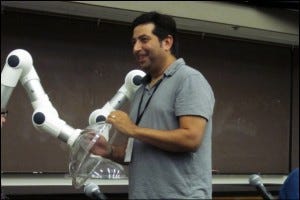
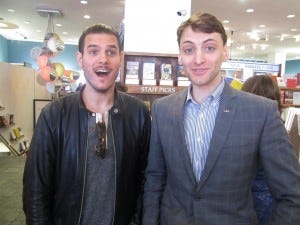
1. Attack of the book nerds. 2. Tod Goldberg wonders if these things are giant breast pumps.
Over 150,000 people converged this past weekend at USC’s campus in downtown Los Angeles for the 18th annual LA Times Festival of Books. A two-day affair, the event featured food trucks, exhibitors, family fun (apparently Lisa Loeb is doing the children’s music thing these days), and readings and panels with hundreds of writers and industry insiders. The weather was sunny and the crowd was varied; there were the expected literary hipsters, sweater-wearing book nerds, and sweaty genre-writer wanna-be’s wearing hats that said WRITER (“Finally, a reason to wear my writer cap!”), but there were also plenty of people who would look more natural holding a meth pipe than a book. God bless LA.
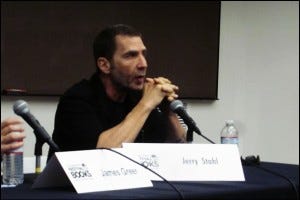
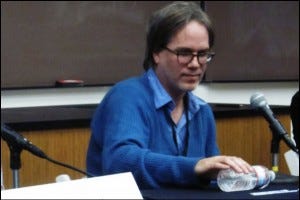
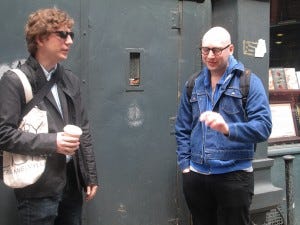
1. Jerry Stahl does not smile. 2. James Greer plays with his water bottle.
As members of the press, we got free reign to all the panels i.e. air conditioning. Highlights from our two favorites:
Tod Goldberg hypothesized that the title of Tremblay’s book, Swallowing a Donkey’s Eye, is also a popular activity at USC frat parties.
All panelists except for Tremblay admitted to having been arrested.
“Writing fucked up might involve narcotics… or it might just involve being a fucked up person,” said Jerry Stahl, who smiled exactly zero times during the panel, like a good little former junkie.
“I write so I can get away from myself. Most writers hate themselves. At least I do,” said James Greer, who fidgeted nervously the entire panel, like a good little agoraphobic.
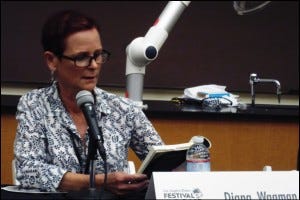
1. Jess Walter, living the dream: getting paid to be a professional smartass. 2. Diana Wagman: not sure why her agent made her delete the chapters from the iguana’s point of view in The Care & Feeding of Exotic Pets.
The power went out mid-panel and the entire auditorium went dark, but Fional Maazel kept right on rolling (ahem, badass), explaining that she started writing because she was a chronic liar with a bad memory . Once she put the lying down on the page, she was able to eliminate it from her real life.
Diana Wagman figured out how to write about the violent scenes in her book by throwing herself around her office.
An audience member with an especially genius question asked, “What do you agree and disagree with most in Stephen King’s book On Writing?” to which Jess Walter replied, “I didn’t read it, but I did hear he said not to use adverbs, which is something I agree with… wholeheartedly.”
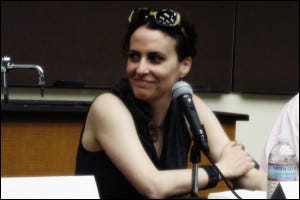
1. Fiona Maazel wrote Woke Up Lonelybecause she’s “pathologically fixated on loneliness.” 2. Technical difficulties happen, even at prestigious & expensive private universities.
For more on everything related to the Festival of Books, go here.
***
— -Julia Jackson is an internet ghost and the contributing editor for The Outlet.
— Sunny Katzis a fucking cyborg, and provided assistance and LOLs.
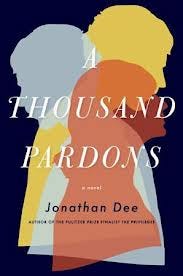
A novel confronting the politics of apology, and the obstacles to redemption
On the surface, the plot of A Thousand Pardons is not unfamiliar: the breadwinning husband of a well-to-do household, mired in ennui, bursts into a fit of destructive, albeit temporary, insanity that lays waste to his home life. Drastic upheaval; everyone changes. Like its predecessor, The Privileges, Dee’s latest novel is about the disintegration and tenuous re-construction of a family, bristling with keen observations, sharply realistic dialogue, and propulsive sentences in which even mundane events are freighted with tension.
When a novel that plumbs the domestic sphere as a way to address larger societal issues is written by a woman, we call it a kitchen-sink drama; when it’s written by a man, we nominate it for the Pulitzer. But never mind; that’s not Dee’s fault — and anyhow, the book’s domestic minuet (and its subplot about a movie star who may, or may not, have done something unspeakable) is only a delivery system for a scathing indictment of the lack of personal responsibility that Dee sees as currently rotting every timber of Western life.
The point is not made subtly: our heroine, Helen Armstead, lands a job at a PR firm and quickly becomes sought after for her ability to get hardnosed CEOs, from Pepsi to the Catholic Church, to apologize for their wrongdoing — which they only do to evade bad press. But an astute reader will find that every detail builds further evidence in Dee’s case: a supposed good Samaritan is squeamish about touching a man that lays unconscious and bleeding. The head of a firm hides in his office posting comments on music blogs all day. An officious floor manager furiously demands that someone immediately clear an exit point she is blocking with her own body.
In Dee’s hands, selfishness assumes complex shapes. Helen’s child Sara, whom she is struggling to nurture while buckling under the pressure of her own responsibilities, has been deliberately and elaborately lying to her mother. Yet Sara tells Helen, spitefully: “I do not feel safe with a totally checked-out mother who has no interest at all in her daughter’s life.” Self-righteousness among teenagers isn’t new, but Sara is using the lingua franca of the modern American: I’m responsible only to myself; it’s someone else’s job to protect me from unpleasant feelings.
In another scene, Sara’s boyfriend Cutter, who is black, delivers a leaden lecture about racism. Just as Sara starts to feel that he’s being rather a drag, he accosts a pair of white kids, who hand over their iPods and cash without realizing he’s not mugging them. Like Sara, we’re shocked and chastened. But Cutter keeps the iPod, he keeps the cash. No one gets off scot-free here.
Truly facing up to responsibility leads one to dark places. The movie star simply can’t remember his crime (or was there a crime?). Helen’s husband Ben can only face himself by the most self-punishing means — he doesn’t perceive that there might be any other way. Only Helen, believer in apologies, reflexively takes on the burden for everyone.
In fact, her character seems like a heroine out of another era, extending a gloved hand and saying how do you do? with perfect elocution. These charm-school manners go unexplained, and at times feel downright archaic. It’s almost as if Dee can’t conceive of a modern woman so unfailingly polite, generous and resourceful; and initially her earnestness brings her perilously close to being a caricature. But by the end, when her integrity proves to be the glue necessary to re-construct a world fragmented by dishonesty, she seems more like a holy fool. It’s generous of Dee — a master at subtle savagery — to let us see this world through her eyes.
Recommended if you liked:Triburbia by Karl Taro Greenfield, Motherland by Amy Sohn
***
— Jenna Leigh Evans writes fiction in Brooklyn. You can find her here.
We all know that sex sells. And sometimes sexts sell books.
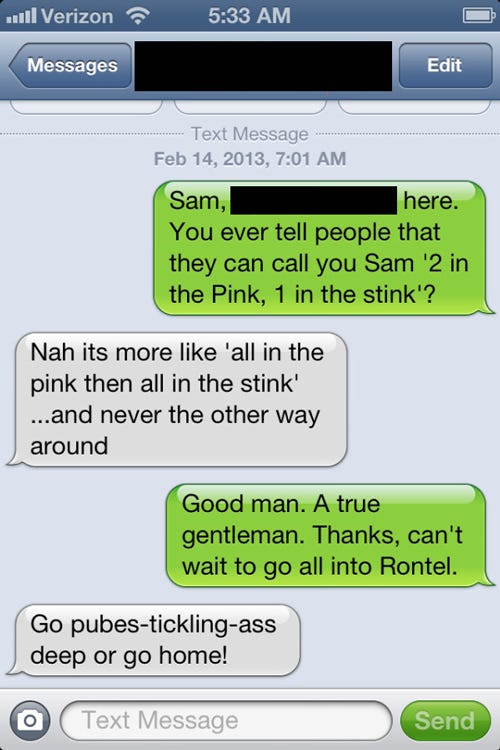
Last Valentine’s Day, anyone who pre-ordered Sam Pink’s latest novel, Rontel, received a special edition eBook containing Sam’s phone number. They could text him, and he’d sext them back. Now a decidedly NSFW transcript of those sexts is available on our blog. (We assure you, Hot Pockets have never been so, well, hot).
While we’re pretty sure that it was the publishing world’s first author sexting campaign, we’re absolutely certain that it was the last. But that doesn’t mean the fun is over.
Today we’re hosting an author sexting hashtag contest. Embody the voice of your favorite writer in a sext (or sext-up a title) and tweet it at @electriclit with #authorsexts before 8 pm tonight. We’ll give away a 5 free copies of Rontel to the author of the sexiest, hilarious, most perverse, or psychologically disturbing #authorsexts.
As a form of foreplay, below are a few examples to get your started. And remember, please practice safe sext.
“The Old Man Inside Me” — Hemingway #authorsexts
“A Tale of Two Titties” — Dickens #authorsexts
“A good man is hard to bind.” — Flannery O’Connor #authorsexts
“Two roads diverged in a yellow wood. Let’s go down that one and fool around for a while.” — Robert Frost #authorsexts
“I’m sorry,” says Jami Attenberg, pausing in the middle of her reading, “this is a little seedy for 10am.”
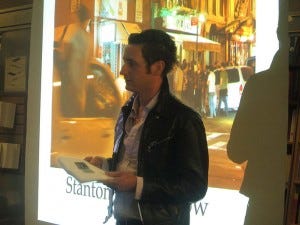
Yes, there was depravity this past Sunday when McNally Jackson and Housing Works Bookstore Café launched the inaugural Downtown Literary Festival. The first event, On the Grid: Stories on Our Streets, featured 14 New York writers reading work about New York and NYC nights. Maybe it was the daylight, but the darkside of New York seemed to shine.
1. Kris Jansma & Adam Wilson debrief 2. The magician himself: Lev Grossman
In Housing Works, Adam Wilson’s reading from Flatscreenput us in the head of a narrator standing on a drugstore line reflecting on his recent past as a time of “booze, barbiturates, and cocaine combos, twitching highs that almost didn’t make up for the after lows. Forearms sprung with shooting pain, body sweat and wet until I would wake in the soaking sheets whining whispering, ‘baby,’ stroking my stubble.”
What better way to start the day than to jump in to a mind that crushes on a black cashier and fantasizes about a paradise where they “could fornicate and drink as yet amenable Four Lokos …[and] bump out babies on mass: bi-racial, bi-curious — raised in the solar powered glow of Obama’s America.” Amen.
1. Boys about town: Ricardo Galbis & Ben Feibleman 2. Brendan Jay Sullivan, DJ VH1
Amor Towles nailed the trials and tribulations of native New yorker-ism in Rules of Civility “That’s the problem with being born in New York. There’s no New York to run away to.”
Kristopher Jansma, whose book launch was covered by The Outlet last month, read a scene from The Last Days of Disco. Outside, the line is “a tragic mob scene of rejection.” How do they behave inside? Well, “Drinking gives you the illusion of control, but, unfortunately, little of the reality.”
After a free bagel intermission, the readings continued across the street at McNally with a new set of readers and perspectives on New York. David Goodwillie read from an essay on the Bowery’s past and present, Gangs of New York-style, where you could see “the story of a city told by those that sleep on its streets.”
But where’s the magical realism, you ask? Lev Grossman answers.
Enter The Magicians. Imagine, after graduating Hogwarts, Harry Potter moves to the Lower East Side, shacks up with Hermione, carouses all day and all night, and instead of doing magic, does massive damage to his personal life: “After coming down from coke or ecstasy, his body felt strange and heavy, like a golem fashioned out of some ultra-dense star metal.”
On the Grid wasn’t a round of bloody marys, but it was still a good start to the new spring Sunday.
**
–Sean Campbell lives, writes, and occasionally updates his blog in Bed-Stuy
“Only God can make you cum… just to clarify, I’m God.” — Sam Pink
A couple weeks before Rontel came out, I was talking to the editors at Electric Literature, and they asked me if I had any promotional ideas. I kept saying, “I don’t know.” I’d never really done anything to promote my books aside from trying to make them good and do interviews. A couple days later they emailed me with the idea that I’d sext anyone who bought the book on the release date, which was Valentine’s Day. I said yes.
Electric Literature mailed me a phone to use, because I didn’t have one. It arrived the day before Valentines Day. I was up all that night and feeling shitty because I did some cocaine after not doing it for seven years. I was still awake when the first text came in. I expected maybe five people to text me, or even possibly none. But at about 6 am the phone started receiving texts, and it didn’t stop until 2 am the next day. I’m not sure how many texts I received, because I had to constantly erase the inbox to receive more. I transcribed the first hour and then gave up. What follows is some of the early texts (a very small fraction of the entirety). Overall, it was funny and nice. Some people wanted sexts and some people just wanted to say what’s up and thanks for the book. It was really humbling in a number of ways.
***
Other person: what’s up. Just picked up rontel. Since I’m currently between jobs I’m considering reading it, or going back to bed to work off my hangover. Hmm just read the first paragraph, seems like you know what I’m talking about. Have a good one, C____
Sam Pink: let’s engage in unprotected anal sex
Well it is valentines day
***
happy v day, do your worst…
I wanna spit down your asscrack and then use it to get just the head of my dick inside you…lightly choking you while I explain my favorite pokemon
Slowly I’ll whisper ‘pikachu Pikachu pika’
Then I’ll push my dick further in and put my fingers in your mouth to touch your tongue and I’ll say, “charizard becomes charmander I think”
We’ll try not to think about bulbosaur: that guy is a real boner killer
Baby my bulb will be mad sore…dig?
Haha. Dig dig dig.
***
oh baby
hey mama I wanna comb your hair with my fingers while you blow me in the bathroom of a denny’s after we both enjoy pancakes…on me!
As long as everything is “on you”
Baby you know I take care of that…provided it’s under fifteen dollars
Big spender, don’t know how to act being treated so well
That’s how I pay in advance for the terrible bite marks ima leave on your hips and ass and inner thighs
Oh yes, I like a little teeth. Going to scream out “shark week”
***
hey, happy valentines day ?
Happy vday babe, I wanna get you on your back and make your tits bounce and lick the make up off your face
Hahaha awesome thanks. This was a great promo for your book.
[an hour later]: What book
who is this
***
I’m ready
Ready to lie on your side while I work my dick into you…roughly handling your nipples and biting your shoulder
If only every morning started out that good
***
hey sam, happy valentine’s day! Looking forward to reading the book
And I’m looking forward to pinning your legs back with my hands behind your knees and rubbing my hard dick on your pussy until you’re wet enough
Wet enough for what? How are you going to fuck me?
Gonna fuck you like you deserve to be fucked…deep, slow…neck all scratched up from my stubble and your tits covered in sweat
Mm, that feels good, are you gonna make me cum
Only god can make you cum… just to clarify, I’m god
***
Happy v day sam, I’m gonna spend it with rontel, love XXXXXX
Ey baby girl…I’m take your panties off with my teeth (almost just earnestly typed “but don’t worry I’ll put them back in the right drawer”)
***
Arouse, offend, or amuse me please
Feel like, to do all three, I could just draw a face on my dick and make it do stand up comedy while I trace your pussy lips with my finger
Awesome
***
Thank you for being brilliant. If I were a wealthy cougar I would ask you to be my boy cub. But alas, tis not the case. Sext me, sext me or whatevs
Baby they call me the cougar killr because once I pull out and cum all over that pussy you’ll barely be able to stand
Technically, that would render me immobile, not dead
Oh yeah, damn you’re right…um, it was implied that you had a heart condition and eventually died
That’s the kind of dirty talk a 78-year-old heiress likes to hear, because it is both realistic and romantic
That’s assuming your bones don’t turn to dust when I pin you down by the shoulders to get better leverage
Well luckily, I’m an heiress to a dairy fortune… lots of calcium…strong bones and whatnot
Yeah but medically speaking you need to get at that calcium early, girlfriend, can’t just cram at the end
Fine, I guess I don’t need bones. I hope you like fragile sacks of skin
I do, in fact I have one containing my balls right now!
Oh yeah! We have so much in common!
***
I have a gerbil and some tinfoil with your name on it. Your writing makes me want to get really nasty. Will you be my valentine
Only if you let me funnel that gerbil into my dickhole then blast it into your gaping asshole (just imagined a gerbil surfing my cumshot)
Tough but fair, my gerbil is still learning how to keep his balance on a surfboard. Would I be crossing a line if I picked booger out of my nose and fingerblasted your peephole with my booger finger
Only if you didn’t ask first
Ok last one before I put my pants on and get back to work. Scenario: I bring home a wheel cheese and your favorite pinot grigio. I carefully sit down and say “what’s on the menu for tonight?” what do you do
I take out my dick
***
loved your sexy nude photos in the tub
be nice to drop handfuls of warm bubbly water over your chest and ass
Indeed and rub my hands on and in your ass that sticks out nicely in your pics
I want you to fist me and rip my heart out
Don’t tempt me, because I would definitely enjoy fisting you and riding your great ass
So then I shouldn’t return my assless chaps to target
Hot, sexy, and funny, you must have men competing for your hot ass
***
I spilled coffee on my shirt, what are you gonna do about that
why I’m going to bite your lips off and make you lick my nipples
***
Hi!
I want you to hold my ass and let me fuck your face…then I’ll make you a hot pocket and make sure it has properly cooled down before you bite it
***
heyy sexy! It’s a good day for necrophilia
hill yuh…let’s dig up a body and 69 on it
I’ll bring the shovel, you bring the broken condoms
I’ll bring the saw and the grill…you bring a hot place for me to blow this load
Ok, afterwards we can kill ourselves
Yeah I want to bite into your heart while it’s still beating and spit the blood all over my dick…then we can have someone bury us alive together
While we’re underground we can press our lips on each others’ and share oxygen. When we start to run out, I’ll gnaw your lips off and swallow them so I die with a part of you inside me forever
***
Hey big boy… ? what are u wearing
your pussy like an oxygen mask
***
hi sam, looking forward to what you got ?
what I got is a single kiss for your pussy before I fuck you heavy and slow for forty five minutes…or for however long it takes to watch law and order
I will take that! But…maybe dance moms instead?
Shit I don’t even care…whatever covers up the noise so the neighbors don’t think I’m killing you
Oh god, I’m wet
I want to taste the wetness through your panties…as we enjoy an episode of dance moms
I’m almost exploding down there. You’re a wondrous being
Go on and get it ma… put your fingers in deep then rub it on your nipples
I will I will!
***
how many ball sacks have you played with in the past 72 hours
Everyday my ball sack is born anew…so three
Wait does that number include the trannies from last night
Dude I only fuck with nutless trannies
***
hey rontel is so good. I wanna chop my ass off and mail it to you in a box of bloody packing peanuts
You know I’m eating that ass raw, sitting naked on the floor
Dammmmmmmmmmmmmmm. It is a lean ass. My diet is high in lentils and lean meats
That’s the only kind of ass my doctor says I can handle
I am imagining a porn scenario involving someone named ‘dr. lean ass’. Also could be a good name for a protagonist in a coming of age novel. It’s yours if you want it.
“When the dr. is in, da asses are thin.”
“When the dr. is out, the asses get stout.”
Just had a brief but graphic vision of me fucking an ostrich for some reason
***
Can I be your rubber ducky?
Hell yeah as long as you don’t make me use a rubber on my dicky
***
one text to sam, hoping for a great sext in return
Ima sit back and jerk off onto myself then hold the back of your neck while you eat it off me
Am I allowed silverware? Perhaps an ice tea spoon
No, you have to rub your own ass with both hands the whole time
I shall make slurping noises as if I am enjoying a bowl of ramen
I don’t have the data on this, but I think my jizz is healthier than ramen
Perhaps we should submit a sample to the FDA for testing
Imagined myself walking into FDA headquarters(?) with a saggy brown paper bag that I’m holding out away from me and I’m like “who want it”
You are directed into a windowless cubicle and asked to wait
Scientist comes out with a clipboard and says, “fssh, wow, you were right”
***
[first part edited out]
thanks for real. You’ve cheered my bi-polared ass up
I just thought “bi polar ass up, that’s the way we like to fuck’…like that one song!
*** –Sam Pink is 29 years-old. He lives in Chicago.
The old woman on the bed at the end of her life, the true, absolute end. In a faint flicker, she dreams a dream all in yellow. A yellow, hot summer’s day. The old woman lives there, in the faint flicker.
In her bedroom piled with familiar objects, all we know are the bits and pieces that have kept on piling up. On this day of absolute solidity, in our eyes, she has lived for so long. The curtains always half-closed, at times matching her eyelids. In our eyes, the old woman lies still. In our eyes, the old woman lies still for a long, long time. Very lying still on the bed.
No one comes to visit, save one. The caregiver trots in and out several times a day. Lugging a vacuum cleaner, fresh towels in hand. Comes over with a chamber pot. A pitcher of water, some medicine — familiar yet unfamiliar. Then breakfast. Greetings. Some soup and sticky bread. She liked the cool bit at the corner of the sheets stretched out. The square-shaped air breathed in and out. A word. Caress. Smile. Greetings. The tingling of the door closing. Clear liquid just within reach of the right hand. The caregiver is very kind.
A small chandelier hangs from the ceiling motionless, cloudy with dust. The leaf motif engraved on the hook of the hat rack, the round knobs on the chest of drawers, the walnut picture frame, the curling pattern of ribbons on the wall — none will fly into motion as they once did, no matter how long she stares at them. In our eyes, the old woman has lived for so long. So very long. No matter when now is, it can’t be stopped from being now somewhere — and that has become one of the few friends she has left. The true, absolute end, her eyes roam, they roam freely across that world. Without moving, the eyes walk and touch the world, taking along words as company. Lying flat, over the tiny shell-shaped buttons in the fold of her chest, lined up in six answering signals of raspy whistling. Beyond the strings that encounter one another in tiny embroidered laces frayed around the wrist. The back of the hand, the last surface where blood vessels and discolored skin swell and stroll in succession. Then, skim the dull swelling of two plump legs underneath the thick cotton cover, barely able to move. Then, takeoff. The eyes travel a great distance. Above the large silent mirror directly across. What lies on the other side — a dead end, still open, universally comprehensible.
The old woman on the bed at the end of her life, the true, absolute end. In a faint flicker, she dreams a dream all in yellow. A yellow, hot summer’s day. The old woman lives that day, in the faint flicker.
Waiting for the sound of the waves, fragments of piano melody, the soles of the old woman’s feet swell a little, then rapidly begin to shrink. The wrinkles fill out, squeaking. Limbs, hips, chest, head, fill to the point of bursting, then shrink, steadily tightening. The hair regains its warmth and moisture, expanding, curling, at last recovering its straightness, shining in youthful gold. The small feet, their soles yet to be hardened. Restored to a soft wholeness, the old woman is once again running on the beach.
The old woman is running in a tight two-piece bathing suit.
Running, the ends of her hair stick to her shoulder blades, the hair she is so proud of, unreachable no matter how many times she twists her arms to scratch her back. The irritating smell of the sunscreen her mother carefully rubbed onto her skin before coming down to the beach. Such a strong smell. She runs along, worrying it will stick to the shoulder straps of her bathing suit — her favorite thing this summer after her hair. Then she decides to walk, enduring the hot sand. Pressing the assembly of hot sand particles are the soles of her feet, brand new and freshly made.
On the sand lie many things still nameless, the only thing the old woman recognizes upon close reflection is a castle. She nearly trips over someone’s half-made tower. I wouldn’t mind finishing this up later, she thinks, but being on her way to meet the young man, mutters an apology in the back of her throat. Almost newborn, the old woman apologizes silently on any and every occasion. The strange face of that young man, her mother’s nagging, the lipstick on the straw — they all scared her. She recalls her mother busily chatting away these past few days.
Twisting her boredom, tying and untying a bow, she first bumped into the young man one Friday ago while walking around every nook of the big hotel.
Big ears, strange face full of lines, polite voice — she detected a thin slice of space. The little old woman looked up at the young man, Are you a recovering pianist? If only he would remain silent, or mutter until tomorrow in a dangling voice. I’ll come show you my bathing suit if it’s sunny, she makes a kind of promise, pleased with him at first glance.
Climbing into the warm dampening night, she shares a large plate of shrimp with mother, mother’s friend, and mother’s friend’s daughter, a little smaller than her. As mother and her friend become lost in conversation, chasing tails of words, their differences disappear. Stuck in between, the girl, even more a newborn than the old woman, smears her face with sauce in a very affected manner. Sucking the head of a shrimp, moving her clumsy fingers, she mutters something. To wit, are you aware of the young man who was playing the piano in the corner of the lounge yesterday and the day before? Yes, I am, my foot bumped into his just a little while ago, answers the old woman. Me, I played the piano with him, sitting side by side, she announces triumphantly, the shrimp’s whiskers swinging to and fro. I’m gonna play with him again. How about you? No, I won’t, the old woman answers. I mean, you do it with hands, right? Sorry, but that’s so boring — these last parts unuttered.
The summer, disliking solid air, mixes the pale yellow with hands and eyes, chop chops the hot sand. Aiming for the young man, the old woman remembers their second chance meeting by the piano. Countless cold marble pillars bloom, looking stupid, she thinks she wouldn’t mind playing tag with him, going round and round together. It’s the second time and all, let’s introduce ourselves, he says. The young man’s name slips and slides into her ears. At that moment, oh my. A beautiful array of letters glimmer around him like the second hand of a clock, within reach. They seem to be manufactured in the world, but actually not. And the meaning, where is it manufactured? Where are they usually made, if I may ask? Her feet move in cheerful steps. Everything floats in yellow, the insides rolled up in yellow.
Again and again, the old woman calls out the young man’s name, her favorite this summer surpassing her bathing suit, her superb bundle of hair. Every time she calls it out, she weaves her mother’s frown. The sound is so comforting, and the sensation just before the words become sound appears to her eyes like this: how sublime and wonderful! So she wants to say to him, but her newborn freshness thwarts her. Then the young man starts talking. He starts talking, I usually lie on the beach all alone. All we see are his bits and pieces always blown by the wind. In the irretrievable break of the afternoon, the sunny day covering the sky, the old woman decides, Let’s go to him and ask about the piano. In our eyes, the young man lies still on the sand. Lies still, long. The swimming tube just above his head. What a knowing look it has. It’s laughing in the shape of a ring, the inevitable sequence of coming in and going out. The chair with the girl passes by. The old woman repeats the young man’s name, and in between her breaths he calls out her name in return, and further in between, inspecting shells with his fingers, he skillfully displays how the scenes came about — the forest, his favorite wax, the wasteland, addresses, tigers, his fingernail biting. Clearly. Then mixing together. The yellow water melts the tiger. The trees burn like candles, the jagged tops bite into the sky. When the old woman kicked the wasteland, it rained, creating a mirror like a lake. The knot is clearly visible in the young man’s hand. The two gaze into the lakelike mirror in his hand. Who is reflected there, if I may ask? The old woman reaches her hand out to the young man. Who can it be? The young man reaches his hand out to the old woman. He picks up the knot glimmering through his cradlelike hand with the fingertips of his other hand and puts it in his mouth, swallows it without blinking. Her admiration enfolds the moment, all the sand particles of the summer day — the adorable old woman in a yellow bathing suit, tummy slightly protruding. Clearly, so very clearly.
The old woman on the bed at the end of her life, the true, absolute end. In a faint flicker, she dreams a dream all in yellow. A yellow, hot summer’s day. The old woman is alive there, in the faint flicker.
The young man and the old woman enter the sea. The waves are soft glass particles; they inhale, inhaling the rays of the sun all over, and exhale, exhaling, illuminate her supple skin, the aloof facade of the swimming tube, the dimple in his gigantic semicircular earlobe. I could squeeze myself into your ears forever! Her feet move in cheerful steps.
So when the old woman, almost a newborn, absentminded, heard from the young man’s mouth none other than that that that that bananafish, her body was about to explode. Bananafish! More than anything, bananafish was her forte.
Yet, with friendly intimacy, she determines to keep it a secret until the bananafish actually appears. Truly, absolutely, it was her forte, fortissimo, if it weren’t a bananafish it might as well have been a blue unicorn. Feigning ignorance to test him, she listened to the young man with curly hair and gentle wide-set eyes saying all kinds of correct things about bananafish. Neither too much nor too little, intimately, and above all, empirically!
Yeeeess, yeeeess. The old woman rolls up as far as she could the small mouth not of her bathing suit but of the puffed-sleeve blouse she was wearing just a moment ago, using her even smaller lips, and holding tight, she dips her face into the seawater, the sea enters, enters into every nook and cranny.
Then, at that moment, a bananafish passes before her eyes.
Oh, how boring, how boring it is.
She drops a tsk in the water, making it rotate. So like this, the unveiling ceremony and farewell address took place in just a few seconds, and oh, how boring, how boring it is. She tells the young man what she saw, and sure enough, he drops down to a boring temperature too, and without asking, Well then, let’s just get out of the water. Looking up at the sky all pale like a thin omelet, she saw a small bird approach from the long distant past. It was black and old-looking, like something made of iron. How can it fly, that thing, without wings, I didn’t call it over. The old woman sees a single dark shadow in her heart, turns toward the young man. Why does it come, that thing, it’s not necessary, I wish it would leave me alone. The young man, too, is looking up at the ancient bird. He smiles silently. The old woman’s shadow becomes darker. Gazing intently together with him, she forgets to say good-bye. After a few steps, she turns around and sees him lying on the sand in the same position as at the beginning.
The old woman on the bed at the end of her life, the true, absolute end. In a faint flicker, she dreams a dream all in yellow. A yellow, hot summer’s day. Though she lived long, she remembered that summer’s day only once — in this flicker. She has already forgotten her own name. She forgot, too, the lovely name of the young man from that yellow summer. Such a pretty name. All she remembers is the yellow-tinted “see more, feet, go numb.”
While she lived, she was always on the go. But — the old woman on the bed at the end of her life, the true, absolute end. What visited her in her last moment — it was the yellow, hot summer’s day. All we know are the bits and pieces that have kept on piling up, day by day. In our eyes, that place, that moment is alive.
The Lit List is a sometimes-weekly compendium of New York’s finest literary events and readings. Not on the list? Email dish@electricliterature.com
Monday, April 15
Fiona Maazel talks to Jennifer Gilmore — for real. At McNally J.
Tuesday, April 16
Renata Adler talks Speedboat and Pitch Dark at the Center for Fiction.
Josh Henkin and Josh Rolnick: the literary Joshes. They get talking at WORD about Rolnick’s Pulp and Paper and Henkin’s The World Without You.
Wednesday, April 17
Are you a Literary Upstart? Watch this literary smackdown, hosted by Brooklyn’s L Magazine at PowerHouse Arena
Handing out books for World Book Night?? Then celebrate yo-self at Greenlight. Readings by Paul Elie, Josh Farrar, Jessica Hagedorn, Paul Holdengraber, Dave Isay, Angel Nafis, Touré, and Matt Weiland
Renegade Reading Series, a series for emerging writers, wants you in Crown Heights. For cookies, wine and words.
What’s better than one great writer? Two! Sam Lipsyte and Nathaniel Rich talk, read and sit on wooden stools at McNally J
Thursday, April 18
Have you been to Guernica’s quarterly salon? Get this — no readings! Just sit back, relax and have a drink.
Friday, April 19
Are you a good nerd? Then it’s time for I, Reader: your favorite genre series at Singularity & Co.
1. The outside of the Gerding Theater. 2. Chelsea Cain, Suzy Vitello, Erin Ergenbright, Cheryl Strayed. 3. Elissa Schappell and Rob Spillman.
I’ve never been to a book award ceremony, so it seemed right that I go big for my first time. So when a friend arranged some tickets to go to the Oregon Book Awards, I jumped at the chance.
I started out at Indigo Publishing’s pre-awards party, where I chatted with some of the more active members of Portland’s literary community (who shall remain unnamed to protect us all). The conversation was lively and covered typical book event type topics such as Wordstock and food writing, then somehow dipped into recreational drug use in the ’70s (we’d been enjoying some wine), and finally landed, during the walk to the Gerding theater in NW Portland, on the subject of award ceremonies — in particular, David Foster Wallace’s essay on the AVN awards in Las Vegas. We all agreed that the Oregon Book Awards would most likely not resemble, in any way, the AVN awards but we were hoping that it would be a lively evening in its own way. We weren’t disappointed.
1. George Estrich, 2012 Oregon Book Award Non-Fiction winner for “The Shape of the Eye” with Matt Yurdana, 2006 Oregon Book Award Poetry Finalist for “Public Gestures.
Awards ceremonies can sometimes tend to drag, but that wasn’t the case for the Oregon Book Awards. Singer Laura Gibson opened with “La Grande”, a beautiful folk song that felt perfect for the Pacific Northwest setting, and set the tone for a comfortable and fun evening. Andrew Proctor, the executive Director for Literary Arts, gave an introduction reminding us that there had been 179 titles submitted, and from those, 31 finalists in 7 categories. And then he introduced us to Master of Ceremonies Elissa Schappell. Schappell’s work as an author is lengthy and distinguished, but if she ever gets bored with writing she would do well in a career as a host. Her sense of humor and tale-telling immediately set the audience at ease, and again reassured us that we would be having some fun.
1. Roberta Dyer of Broadway Books and Donna Kane of Powell’s Books. 2. Laura Gibson. 3. Scott Poole.
Rather than giving a play-by-play of the nights events — which would be long and tedious and not do it justice anyway — there were a few things that really stood out. Having never attended these awards before, I was happily surprised by how they announced the winners. Instead of simply reading the winners’ names, the presenter instead opened an envelope that contained a short excerpt from the winning piece. All of the nominees were gathered into the first two rows of the theater, so we could see them react as their work was read to them from the stage. I can’t think of a more fitting, creative, or unique way of going about it.
1. Rick Klaras and Hobie Anthony. 2. Pauls Toutonghi, Zachary Schomburg, and Sara Renee Marshall.
The acceptance speeches were gracious, filled with humor and some tears (I’m looking at you and smiling, Storm Large). None of the winners seemed to take themselves very seriously, but they did take writing and the literary arts quite seriously, each stressing the importance of keeping these traditions alive. This idea was most clearly reflected in the acceptance speech of Larry Colton, the winner of the Steward Holbrook Literary Legacy Award. Colton (who had twice failed an introductory English course in college and would now like to jokingly ask the “son of a bitch” who failed him how that guy’s writing career is going) founded Wordstock and served as executive director of Community of Writers, a program designed to improve writing programs for high school students. He pointed out that 1300 teachers could be employed using the salaries of the starting line up for the Blazers, and asked everyone in the theater to stand up and give teachers a round of applause.
1. Storm Large. 2. Ismet Prcic. 3. Larry Colton.
But the show stealer of the night was clearly Live Wire! poet Scott Poole, who had been asked to write a poem that included all of the finalists’ names, the titles of each of their nominated books, and the titles of each award category. The result, “LoveLetter to the Muse after a Long Silence”, was outstanding, as was his delivery. Poole got the only curtain call of the night, and treated us to a little impromptu dance in return.
I had a great time and found myself marveling again at the supportive and encouraging literary community here in Portland. This isn’t just a great community of writers, it’s a great community of people who really love what they do.
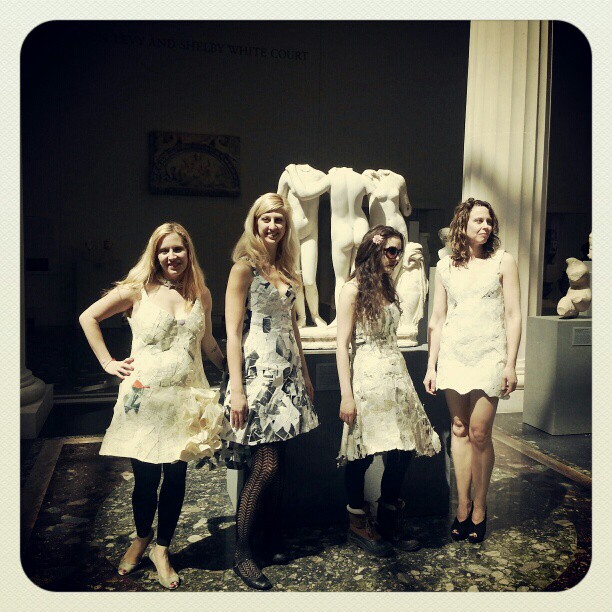
On Sunday, before most of us were awake, Leah Umansky was pulling a dress made out of her poetry collection, Domestic Uncertainties, over her head. She and three others — Rebecca Lawniczak, Gabriel Don and Holly Messit (l-r) — traipsed around the Met’s antiquities in their paper creations fashioned by Joseph A. W. Quintela. Quintela’s #bookdresses have appeared at The Strand and Project Space Envelope in the LES.
Paper dresses made a splash at the Lancaster Lit Fest in 2010 when author Claire Messey wore a fairy tale bridal gown. Will we see one of these at Lit Crawl in September?
Also, can you sit down in one of those? “I can’t sit in mine but it’s a month old,” Umansky told us. “I’m afraid of ruining it. Really, when I stop being so cautious it might get more flexible.”
How many months old is your poetry dress?
***
— Erika Anderson is one-half of The Outlet’s editorial team. (The other half is here.)
KARL’S WIFE, LYDIA, WAS NOT THE FIRST person in the city to have disappeared in this way. A dozen cases or more had been reported since January, according to Mr. Grolsch, who received inquiries for missing persons with surnames beginning with the letters R through zed, “though none with zed have so far come to my attention.” He was a self-important, overly fastidious man whom I hated instantly.
“It was a problem for us,” Grolsch said. “Writing our reports. We searched for a word to characterize the peculiar nature of these disappearances. We settled on ‘abruptly’ to define what in each instance seemed common to them all, though I was never happy with it. It’s descriptive but hardly rigorous: missing persons seem always to be abruptly lost from view, whether they were last seen going out to buy a newspaper or cigarettes, leaving for work or to visit a friend, or peeling potatoes at the kitchen sink. Whatever the case, they have been ripped out of their lives, no matter how ordinary the circumstances surrounding them. Don’t you agree?”
I said nothing, unwilling to reinforce the man’s good opinion of himself — of his scrupulousness. Karl seemed not to have been listening.
“There was something sinister about those cases — uncanny even,” said Grolsch. “But words of that ilk would be laughable in a government report.”
I looked out the window onto the street below my apartment, trying to say how it was that Lydia had vanished. It was not, as Grolsch had put it, as if she had been ripped out of life. I felt no violence attached to Lydia’s disappearance, and neither did Karl, who could scarcely bring himself to talk about it, so great was his anguish. (He had loved his wife steadfastly if not ardently, and who can say which is the more durable.) On the contrary, it was as though she had been fading gradually from view and also from memory. The feeling that this was so might have arisen in us abruptly. In retrospect, there was a moment when Lydia was no longer so vividly present to the mind as she had been only moments before. There was that much abruptness about it. Karl and I happened to be together at the time, in a small boat on the bay while I scattered my father’s ashes into the water where, as a boy, he had loved to sail. Neither of us ever saw Lydia again.
“I remember Lydia as I would someone whom I haven’t seen for years,” I said to Karl, who stood behind me at the window. (Surely, those awnings on the apartment house opposite had been blue!)
“Yes,” he said evenly. And already I could hear in his voice that he, too, had begun to forget her.
“Are you living with someone?” Karl asked after I had emptied the room of late afternoon light with the wand of the venetian blind.
I did not understand him immediately.
“The cosmetics and shampoos, and the pink disposable razor on the bathroom sink. And this.” He produced a strand of black hair, as if in evidence. (What hair remains to me is gray.)
Abruptly (yes, that is how it was), I recalled the oval shape of a woman’s face that, gradually but insistently, filled in with details. And as it grew toward completion, the idea strengthened in me that the face belonged — together with the cosmetics, shampoos, the pink razor, and the strand of dark hair — to my wife, whose name, I knew now with certainty, was Marie, a woman whom I had met shortly after moving to the city.
“They’re Marie’s,” I said.
Yes, it happened in this way, too. I mean, there was not only forgetting: there was also recollection; not only people vanishing, but people swimming into view as if they had been a long time underwater. (I did not realize then that the swimmer was I myself … that the images that gradually rose up in my mind like something seen through the wavering surface of the water were the result of my own submerged existence.)
I was walking to work down a street that ought to have been familiar. I recognized nothing. Where the office building should have been was a vacant lot surrounded by a barrier of many different-colored doors. I opened my briefcase to find something to confirm the address of the company where I worked as a civil engineer: a proposal or a drawing on which was routinely stamped the firm’s name and address. I found, instead, a thick book of actuarial tables concerning life expectancy for various trades and professions. The address imprinted on a stack of business cards was of a street in Chicago. I have never been in Chicago.
And this: on the way back to my apartment, I entered what ought to have been a commercial district nearby the river, but it was — not empty, but unfinished. A kind of ruin, although in actuality I could not tell whether the area was in the process of being built up or torn down.
Lately I have felt an urgency, as if conscious of a growing shortage of time.
Karl and I:
“I was riding the elevator up when I noticed the other passengers’ faces were …”
“What?”
“Like sketches, like photos on their way to being developed. They weren’t filled in.”
“Streets — entire neighborhoods are vanishing.”
“And then the elevator itself began to fade, and I looked down at my feet and saw nothing. Just my shoes and, beneath them, blackness. Nothingness. And when I looked up the faces were blank.”
“Some kind of sickness — we must, all of us, be falling ill with something.”
“I was riding up to the Missing Persons Bureau. To see if others who have reported someone lost described it in the same way — experienced it in the same way we did. No one had ever heard of Grolsch.”
“Grolsch?”
Marie is typing. She types incessantly. Why? What can she possibly be typing? I have asked her, but she doesn’t answer. She looks at me as if she were making up her mind about something. Night and day, she types. I don’t recall her having done so earlier in our life together. Yesterday she said we were only recently married. That we had met on one of the bike paths in Central Park. She had hurt her ankle, and I had stopped to help her. I disagreed. I said we’d met at the Tribeca Film Festival. I didn’t own a bicycle. I didn’t think I could ride a bicycle anymore even if I had one.
“You’ve been working too hard,” she said.
“I haven’t been working at all. The office is closed.”
“Closed?” she said, eyeing me with the interest of a jeweler who sees through his loupe an unusual stone.
“Well, I can’t seem to find it.”
Karl is dead. Abruptly dead. He died of an embolism in the subway waiting for the Q train. His mother lives in Brighton Beach near the aquarium. Yesterday I boarded a train that would have brought me within walking distance of a funeral home on Ocean Parkway. I wanted to pay my respects to Karl. The train got only as far as Manhattan Bridge before unaccountably returning to Midtown. I had no idea — not the slightest sensation — that the train was circling back to the city (an impossibility, I would have thought); but at the train’s farthest reach the world seemed to fall away from me. It faded — the impression it made on me weakened. It was just as Karl had described his elevator ride to the Missing Persons Bureau. That evening I telephoned Karl’s mother. The woman who answered had never heard of him.
This morning I went to report Karl’s disappearance (for so it is, now that I find no trace of him); but according to the owner of the news agency on the ground floor, there has never been a Missing Persons Bureau in the building.
I spend my days in bed while, from the next room, I hear the soft clatter of Marie’s word processor. I think how lucky I am to be dying in the age of advanced technology: the noise of an old-fashioned typewriter — with typebars clacking like castanets and bell tolling the end of each line — would have finished me.
After lunch, which Marie brings me on a tray as befits a sick man, I called on what strength I had left and limped to the desk drawer where she keeps her manuscripts. She had gone out to meet her publisher and no longer bothers to hide her work from me, whose dependence on her is almost complete.
I have been reading her novel’s resolutely increasing manuscript pages, alert to the thickets of handwritten changes she has made in the margins and between lines of type. I marvel at the many and varied revisions: characters that seemed important become less so until they are finally erased or metamorphose into radically different persons; streets that were meticulously rendered down to the color of the awnings over their pavements are eliminated or altered to suit the plot’s restless innovations. It is already thirty pages since Karl was deleted by a line drawn deliberately in red ink. I wonder how long it will be before my own name is struck out.
DON’T MISS OUT
Sign up for our newsletter to get submission announcements and stay on top of our best work.
YOUR INBOX IS LIT
Enjoy strange, diverting work from The Commuter on Mondays, absorbing fiction from Recommended Reading on Wednesdays, and a roundup of our best work of the week on Fridays. Personalize your subscription preferences here.