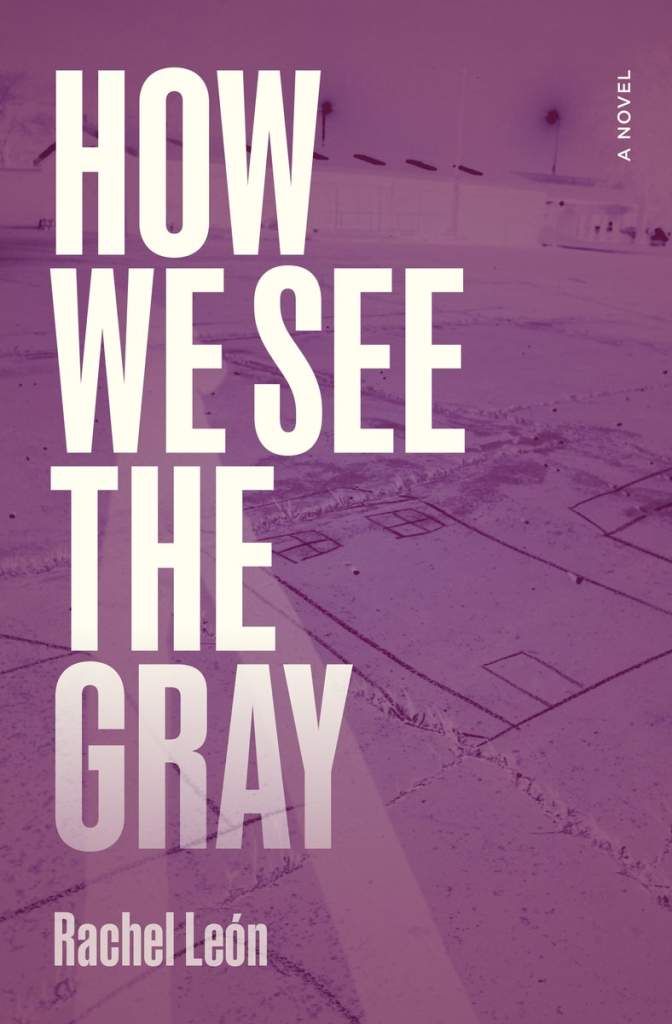
I drove a little over an hour past barns and water towers to Rockford, Illinois: home to Anderson Japanese Gardens, Pig Mind Brewing (best vegan food in the Midwest, according to the internet), and social worker/parent/editor/debut author Rachel León. I have long admired Rachel as my editor at Chicago Review of Books, and know her to be kind, intelligent, generous, and thorough. They have also worked in child welfare for almost two decades. So it came as no surprise to me that their Rockford-set novel about the foster care system, How We See the Gray, is a compassionate and nuanced portrayal of the people impacted by the system, its limitations, and its shortcomings. The story is also about second chances: who gets them, and who is wrongfully denied them.
With sharp, funny, and heartbreaking prose, Rachel builds a cast of characters readers will root for. Their disappointments and dreams are deeply felt, and the stakes of their stories tangle. If a completely happy ending is impossible in this web of stories about the trauma of fractured families, How We See the Gray delivers the next best thing, or perhaps something even better: satisfying, realistic paths towards forgiveness, healing, and hope.
I was eager to speak with Rachel about the many perspectives, vibrant characters, and not-so-miserable city at the heart of the novel. I was terribly grateful she met me at Pig Mind Brewing (which I can confirm is incredible) to discuss their book, out May 15th from Northwestern University Press.
Jen St. Jude: Let’s start with Rockford! The city is so clearly a character in the story as well; it hums behind all of the action and dictates the landscape of these characters’ lives. Why did you set it here?
Rachel León: When I began writing fiction, I set everything I wrote elsewhere. While I was born and raised in Rockford, and still live here, for a long time, I felt shame about where I’m from. Historically, the narrative about my hometown hasn’t been good—we’ve made national lists for our high unemployment and crime rates (higher per capita than Chicago) and [are] on a “most miserable cities in the U.S.” list. When I was in high school, the goal was to get the hell out. And when that didn’t happen, I felt like a loser for a long time. So when I started writing, all my stories were set in other Midwestern cities I knew: Chicago, Madison, Milwaukee.
But this novel deals with the foster care system, which I’ve worked in on and off for a long time—I started way back in 2004. And the foster care system varies widely from state to state, even county to county. I’ve had a few Cook county cases and was surprised how differently things were handled—in the same state! Which is all to say, despite my wealth of child welfare experience, I knew I couldn’t set this story anywhere but Rockford. Originally, I wrote it without mentioning place. I had a writing mentor Karen E. Bender who read a draft and noted I was avoiding setting—at times the characters seemed to be floating in space. I wasn’t conscious of my shame about writing Rockford until it was pointed out.
I’m ruthless with my own work. It makes me happy to tear it to shreds.
So I tentatively added Rockford. Not much—and that was still too much for some agents, who wanted mention of my hometown taken out. They felt that this story needed to feel like it could happen anywhere for it to have universal appeal for readers. But ultimately, this story and these people are very specific to this place. The characters are shaped by this town too.
Megan Stielstra is the editor who acquired the novel for Northwestern’s University’s Curbstone imprint, where they focus on craft-forward writing that engages with social justice issues, and in our initial conversation, her only real note about what the novel needed was more Rockford. I was thrilled. It gave me permission to lean in, offer specificity of this place, and in the process, it actually helped me get over my shame and become proud of where I’m from.
JSJ: I was so impressed by the way you layered the story and developed so many arcs over the course of the book. With so many stories intertwining and threads to tie up, how did you think about plotting?
RL: Obsessively! I know it’s not cool to like plot in literary fiction, but I love it. While I’ve enjoyed many plotless novels, the books I love best have strong narrative arcs, so I wanted to offer that to my readers. But plot is hard! Not formulaic plot, but authentic, character driven plot.
I don’t like outlining, but I did a lot of it to map out each character’s story on its own, but also outlines where I’d put everyone’s story together to look at the overall arc. I was also looking at emotional beats and the emotional textures of each chapter. I wanted to follow heavier moments with lighter scenes, so I did emotional outlines too. I used notecards with different color markers for different characters and emotions and filled my walls. At one point I had one room full of the character outlines, and in another room the emotional beats. It was meticulous and a little mad scientist-y. But that’s how I discovered what was missing from the novel, which helped guide my many, many revisions.
JSJ: Speaking of revision, I’ve had the best time working with you at Chicago Review of Books, where you serve as Managing Director. So I wanted to ask, how do you think being an editor shapes your work as a writer?
RL: I must admit, I love editing more than I like writing. And that’s partially because I don’t consider myself a very good writer! My first drafts are truly embarrassing in their awfulness. It’s through the work of shaping and refining that I turn what I write into something (hopefully) worth reading. I do think I’m a pretty good editor. I can see possibilities in drafts—I typically have no shortage of ideas on how to sharpen a piece. I love editing other people’s work, but I’m also hyper aware that the piece is theirs and it’s my role to help them make it the best it can be while maintaining their voice and intent. Maybe it’s the social worker in me, but when I’m editing someone’s work, I’m very cognizant of their feelings and the trust they’re putting in me so I treat the work with care. But I’m ruthless with my own work. It makes me happy to tear it to shreds. I’m always eager to just get a draft done, so I can get to the fun part.
JSJ: One of the main characters is Meredith, a case worker who, after drinking too much to cope with the stress of the job, almost loses custody of her own son. Did you see her as a bridge, from those scrutinized by the system to those managing it?
RL: Absolutely. Meredith’s character was the genesis of the novel. Like Meredith, I was a single parent who drank to cope with the stress of working in foster care. And at that time, I felt like the line separating me from my clients was so thin—I was only on my side of that line because of my privilege and support systems. I empathized with my clients but also saw how close I was to them, divided by my skin color and education. And other privileges too: Most people see me as cis and hetero, and I present as non-disabled. This novel made me really interrogate my privileges and my own complicity in upholding systems of oppression. Of all the times I’ve let people make assumptions about my sexuality and gender identity because it seemed easier or safer—even when it also hurts. Which brings us back to shame . . . I have a lot of internalized shame for not being out in different spaces. But again, it’s a double edged sword—which goes back to safety and privilege. Even though Meredith is living paycheck to paycheck and lacks family support, she still has a lot of privilege. The same privileges I do.
JSJ: Another main character is Ebony, a lesbian teen in foster care. I loved her scenes; they felt so close to a teen’s voice, and though I was rooting for her, I understood why she made some self-punishing choices. What do you think she brings to the chorus of voices in these pages?
This novel made me really interrogate my privileges and my own complicity in upholding systems of oppression.
RL: I had a lot of fun writing Ebony’s character. She felt really important to the novel. I wrote a draft where she was the one telling the story, but realistically, she wouldn’t have access to most of the characters’ stories.
What I hope she brings to the chorus of voices is a vital perspective in foster care. I mean, if my goal was to offer the reader a bird’s-eye view of the system, it’d be weird to only have adult characters. The system is built for the protection of these kids. And yet because of confidentiality—which is obviously critical—youth in care are faceless and nameless in the media. I wanted to humanize someone impacted by the system, and show that these are real kids with real stories. And like any real person with a real story, there is a lot of complexity and contradictions.
JSJ: Speaking of the bird’s-eye-view, how did you decide on whose perspectives to include, and how to show different sides of the foster care system and these characters’ relationships to it? I’m assuming you wanted to show people who played different roles: worker, birth parents, foster parent, etc., yes?
RL: The novel began as a dual POV story about a caseworker and her former client. As I dug into revisions, I tried pretty much every possibility with POV—I tried it as a single perspective, I wrote it in first person, added some sections in second, tried varying degrees of closeness in third . . . And I played around with how many perspectives to include. At one point there were 13 perspectives. Ultimately, I settled on nine.
It was important to include a range of diverse voices not only because I think it matters, but also because it reflects the reality of my life. Of Rockford. Of the foster care system. The novel’s diversity is reflective of my world. I grew up on the West side of Rockford, in a diverse neighborhood. In the single block where I grew up were people of different races, ethnicities—plus, two gay couples. That’s how I think neighborhoods should be (and books!): with different people coexisting. I notice in novels by white authors that every character is white. It seems odd and makes me wonder if that’s how they experience the world. Because I’m very aware when I’m in all-white spaces. They don’t feel normal or comfortable to me. I’d rather be the only white person in a room, and have had that experience many, many times. I’m grateful for those experiences.
So yes, diversity was a must. I was concerned about writing about the perspective of people who are different than I am, but they deserved their place in the story. I read as many books as I could find about the topic—Paisley Rekdal’s Appropriate: A Provocation, David Mura’s A Stranger’s Journey: Race, Identity, and Narrative Craft in Writing, Toni Morrison’s Playing in the Dark: Whiteness and the Literary Imagination . . . I approached it with a great deal of caution and anxiety. I really wanted to get it right and knew I had limitations, as all writers do. So, I wrote and rewrote the book many times. I did a lot of research and hired sensitivity readers. Some of my research actually helped me realize one character in particular was closer to me than I’d initially thought: Writing Nel helped me understand my own gender identity.
I still have a lot of anxiety about whether or not I got it right and how readers will respond to it. But I know I approached it with a lot of caution, and hopefully, sensitivity.
JSJ: You mentioned nonfiction books, what about fiction? What works were How We See the Gray inspired by? With which books is it in conversation?
RL: I was inspired by Justin Torres’s We the Animals, which might be obvious with the “we,” and also ¡Yo! by Julia Alvarez. (One of the chapters in that novel is actually set in Rockford!) ¡Yo! is a fascinating character study of one woman writer through the perspectives of other people in her life: family, friends, a stalker . . . you get a shifting—yet more complete—portrait of this character through the different lenses. I wanted to also let shifting perspectives complicate what the reader thought they knew about certain characters. Gloria Naylor’s The Women of Brewster Placeand Tommy Orange’s There Therewere two other touchstone novels for me.
As for which the book feels in conversation with, I like to think it talks to Kristin Arnett’s With Teeth, Jessamine Chan’s The School for Good Mothers, Catherine Hernandez’s Scarborough, and another novel Curbstone Books published called God Went Like Thatby Yxta Maya Murray.
JSJ: Another interesting voice in the story is the “We” POV, similar to one of the voices in We the Animals. When and why did this get added to the story?
RL: What’s funny is that I had the title even before a single “we” appeared on the page. The title just felt right.
For a long time the novel was written in third person, and a friend observed the narrator was super opinionated about the system, so much so that it was unclear whose opinion it was: the author’s or the narrator’s. She suggested I check out David Ambroz’s memoir,A Place Called Home, because it steps back and editorializes in the way she could tell I wanted to do. And after reading the book, I decided to lean into that. It was too hard for me to write about the foster care system without including commentary. Enter this chorus of opinionated caseworkers.
I see an interplay between both my roles: as a writer and social worker.
But I also wanted to show the limitations of narration. Foster care has influenced my writing even when I’m not writing about it, because as a case worker, I’m always collecting stories and looking for their limitations. One perspective stories are limited and fall short. It’s why I love multiple POV novels so much. My work in foster care has also been about shaping stories in a way that has a direct impact on my clients. The novel’s opening says it, but it’s true: This work revolves around stories. I see an interplay between both my roles: as a writer and social worker. I think I’m better at both jobs because of my work in the other. I believe being a writer makes me more empathetic in my day job.
JSJ: What I love so much about all of your characters is that they’re allowed to be flawed and human, and like you said, the line between the clients and the case workers is so thin.
RL: Right. The thing that I always go back to in my writing is the theme of mistakes, second chances, and trying to do better. I have perfectionist tendencies where I beat myself up over my mistakes, yet have no problem giving other people grace for theirs. But I believe most of us do the best we can in the moment. Second chances are an obsession in my work no matter what I’m writing about, especially because I think a lot about inherited trauma—substance abuse issues, mental health issues, and other very human struggles. These things also shaped the novel.
JSJ: Along those lines, the story made me think about support networks as a type of inherited wealth. Some people have folks they can call for support in their lower moments, and some don’t. It really matters, and that’s shown here with Meredith and many of the characters who are parents.
RL: It’s true. Community is something I hunger for and often realize I lack in my life, which is something that’s kept me working in foster care for so long. Because the job is so intense, you get very close to your coworkers. You can’t do it alone—I mean, you do most of the job alone, but there’s no way to do it without the support of your coworkers. Because of confidentiality, you can’t go around telling wild stories from your day—the dangerous situations you might find yourself in, the ridiculous things people say to you . . . But they’re too much to hold without processing. My coworkers and I have done a lot of trauma bonding and laughing—the kind of laughter that’s so intense it makes your stomach hurt. And we’ve cried together—there can be a lot of that too.
It’s the people that keep me doing this work—both the families I work for and the people I work with. Being part of a foster care team has been the strongest community I’ve ever been a part of. It’s found family—beautiful and messy. I can’t imagine launching this novel without the support of my coworkers. They’re really excited to see our work in the trenches portrayed in fiction—the incredible challenges and rewards this kind of work brings. I hope I make them proud.
Three years ago I broke my brain. Or, I should say, my brain was broken by grief. That summer my graduate mentor, the writer Aurelie Sheehan, died after a swift and truncated battle with terminal brain cancer. I first learned of Aurelie’s illness in June of 2023, but as I understand it, she received her diagnosis the previous December, and by August she was dead.
The death of a writing mentor is a specific kind of loss. In ways both quantifiable and unquantifiable, Aurelie had perhaps the most significant impact on my development as a writer. She was the only professor I studied under during all four semesters of my time in the MFA program at the University of Arizona, and she had served as my thesis advisor. In the seven years since I graduated, she had written me countless letters of recommendation for fellowships and grants and teaching applications. But more than any of this, my relationship with Aurelie was deeply personal, characterized by love and mutual respect for each other as people and as artists.
In the weeks following her death, I struggled to articulate exactly what Aurelie had meant to me. She was not my friend, though our relationship was friendly. She was not my mother, though she had behaved maternally toward me. When I called my friend Cat Powell to tell her about Aurelie’s passing, she used the term “art parent” to describe the role mentors play in the lives of young writers. That moniker was the most accurate description I’d heard, but even it felt like it failed to fully convey the impact Aurelie had had on my life, especially in my conversations with people who were not artists, and I grew increasingly frustrated by my inability to communicate the exact nature of our relationship. This, I’ve learned, is perhaps the most maddening aspect of grief—the persistent feeling that no one else understands what we have lost because the loss is particular to us.
In the rooms of 12-step recovery, I often talk about the fruitlessness of comparative suffering. I remind people that emotional pain functions in the body exactly like physical pain does. It lights up all the same pain centers in our brains. And because we carry our emotional pain in our bodies, because both emotional pain and physical pain are physiological experiences, our own pain will always be more real to us than the pain of other people. We may empathize with others, but empathy is an act of imagination: It requires us to imagine another person’s experience and call upon similar experiences we have had in order to relate to them. For this reason, other people’s pain is always an abstraction. It is not visceral, which is to say embodied, in the way our own pain is. And though it’s true that perspective can be helpful when discerning the difference in magnitude between our losses and those of other people, comparing our pain to theirs—and by extension our right to feel our pain—is not a productive undertaking. Everybody loses at that game.
But as frustrated as I was by the feeling that no one understood what Aurelie’s death meant to me, my frustration was compounded by the fact that my grief over her death felt inconvenient.
The summer Aurelie died, I was in the middle of what I hoped would be the final revision of a novel I had spent five years writing. With the exception of my sobriety, I had never pursued anything with the same degree of devotion as I had that novel. For 11 months of each of those years, I had written for at least two hours a day on that book. Some months, I wrote for eight to ten hours a day. I’d written the novel three times from scratch, beginning to end. And even during the months I took off between drafts, I was still conducting research for the project. I read thousands of pages of research in service of that book. And after five years, I was ready to be done. I was so close to being done with it.
And then Aurelie died.
One afternoon shortly after her death, I got on my yoga mat and pushed back into downward dog position, and at the edge of my peripheral vision, I literally saw my grief, a presence hovering at the corner of my mat, waiting for me to let it in.
“I see you there,” I said to the room. “I promise I’ll get to you when I can.”
But, I didn’t say. Not yet.
First, I had a novel to finish. I told myself I would grieve once I finished it.
Looking back, I think I convinced myself that maybe I could out-busy my grief. At the very least, I hoped to assign my grief a timetable that would be more convenient for me.
Needless to say, this did not go well.
In a letter for Jami Attenberg’s 1000 Words: A Writer’s Guide to Staying Creative, Focused, and Productive All Year Round, author Megan Mayhew-Bergman discusses her anxieties about producing a novel she felt she could stand behind. “I didn’t want to write an adequate book,” she confesses. “I wanted to write a good book. My first versions felt adequate, not outstanding.”
With the exception of my sobriety, I had never pursued anything with the same degree of devotion as I had that novel.
Reading Mayhew-Bergman’s words, I felt my own insecurities articulated. I had once told my mother, also a writer, that I would rather write a book that did the thing I wanted it to do and never see that book published, than publish a book that failed to do it. I am a competent writer, and I trusted my ability to write a competent book. But like Megan Mayhew-Bergman, I didn’t want to write a competent book. I wanted to write a great one. To settle for competency would have felt adjacent to failure. And yet, even after five years of drafting and revising, I still hadn’t produced a version of my novel I felt I could stand behind.
And so I persisted revising the novel in an attempt to outpace my grief, and as I did, something happened I could not have predicted. I began to experience an ever-present and unbridled rage. I lost patience for anything and anyone. When someone merged into traffic in front of me without using their blinker, I found myself screaming at them from the quiet confines of my car. I was short with customers at work. I became intolerant of my co-workers. And I knew—I knew—that my rage was my grief coming out sideways. My grief was telling me it would not be ignored. Still, ever the optimist, I tried my best to ignore it. I continued to revise the novel, and I continued to rage.
Then one morning my avoidance of my grief reached its limit. I was standing in my kitchen, feeding my tiny dog his breakfast. The tiny dog was 14 years old and the size of a kitten, and the vet had recently prescribed him a diet of wet food. But the tiny dog had become a bit neurotic in his advanced age, and that summer he had begun to refuse to eat his food unless I hand-fed it to him. Did I mention this was wet food? It was a disgusting process we performed twice a day, and it made for a terrible mess. That morning, I stood over the tiny dog and waited for him to eat his food from his dish, and all of my rage boiled to the surface.
“I don’t know what you want from me!” I screamed at him—though, of course, I knew. He wanted me to feed him from my hand. “I don’t know what you want!” I screamed again. “Eat your food! Just eat your fucking food!”
By then the tiny dog was mostly deaf. He just looked up at me and cocked his head. And in that moment all my resistance gave out. “This is not sustainable,” I said. I was so dysregulated, I felt like an insane person. I was so angry, I felt like I was on fire. So I decided to pause the novel revision and allow myself the time and space I needed to grieve Aurelie’s death. For the next month, I did very little. I read, and I slept. I went to work, and I wept on my yoga mat. And twice a day I got down on the floor of my kitchen and fed the tiny dog wet food from my hand.
“I guess this is just what we’re doing now,” I told him.
Slowly my rage subsided, and my patience returned to me. In some ways, this was the last gift Aurelie ever gave me, those moments with my dog on the floor of my kitchen, because one month later that tiny dog—the dog I got when I was 10 months sober and had lived alongside for the last 14 years—stopped eating altogether and died.
I cannot say for certain whether it was the consecutive losses of Aurelie and my dog, or the proximity of their deaths to one another, but whatever the case may be, the combined grief of those losses broke my brain. I don’t know how else to describe it. In the weeks that followed, I felt concussed. I moved through my days in a haze of distraction. I would arrive at my job and not remember driving there. I would stop people mid-conversation and ask them to repeat themselves because I could not follow what they had just said. It became impossible to read or do anything that required sustained concentration.
By then I had set the novel revision aside for more than four weeks, but there was other work that needed my attention. Earlier that year I had started publishing a series of essays about the intersection between the writing life and 12-step recovery and mindfulness practice. The first two essays in the series had been fairly easy to write. Each essay had taken a week to draft and another week to revise. The next essay was on the topic of rejection, and it centered around a piece of advice Aurelie had offered me post-graduation about the difference between the creative and business mindsets. The deadline for the essay was approaching, and I thought writing it might be therapeutic, a way to ease back into my creative work while accommodating my new cognitive impairment.
I was wrong.
An essay that should have taken me two weeks to write, took me more than eight weeks to complete. I struggled to track the logic of the argument, the progression from one paragraph to the next. The harder I pushed through my brain fog, the worse the brain fog became. This alarmed me for many reasons, not least of all because I knew I would never be able to finish revising my novel in that condition. Grief had broken my brain, and now even competent writing felt out of reach.
In hindsight, it probably would have served me better had I simply stopped writing altogether and allowed my brain more time to heal. But I’ve learned I am better when I am writing—engaging in a creative practice has become an essential component to my psychological, emotional, and spiritual health—and in the depths of my grief I was afraid to forego it. So I made a different decision.
I decided to put the novel revision on an indefinite hiatus.
And, in the meantime, I wrote a bad book.
We’ve all read them, have we not? The bad books? The books that sold for six or seven figures. The books that were heaped with critical praise and awards. The books that made the bestseller lists. The books that even our most trusted readerly friends recommended. I’m not talking about the books that are not suited to our tastes. I read a lot, and I don’t like the majority of the books I read. This is likely an unfortunate byproduct of my years working as an editor. I am generally inclined to think that most writing could be better, more thoughtful, more carefully developed, or more boldly executed. I also finish every book I start reading because I believe even books I don’t like have something to teach me about the craft of writing and the art of storytelling. I’m not talking about those books. I’m talking about the books that when we read them seem to us obviously and objectively bad. I’m talking about the books that leave us bewildered, wondering how they got published in the first place, or why they performed so well in the market. I’m well aware that none of these judgments are actually objective. I’m not delusional. And yet I remain convinced that everyone who reads enough has read a bad book.
By late October, I was still deep in my grief and my brain fog still had not lifted. If anything, it was worse. There remained a ceiling to the level of critical thinking I could access. I simply could not get my brain to switch over into a higher gear. I finished the rejection essay, but only with tremendous effort, and the difficulty with which I had completed it convinced me I did not have the mental bandwidth I needed to return to the novel revision. I called my friend Cat to complain about it.
In some ways, this was the last gift Aurelie ever gave me, those moments with my dog on the floor of my kitchen.
Cat was in a tight spot of her own. That fall her second novel had died on submission, the second novel of hers to die on submission in three years. There are many reasons a book fails to sell—anyone in publishing will tell you this—but Cat Powell is one of the best writers I know, and from my perspective, her novel’s failure to sell had very little to do with the quality of the work and more to do with the work’s representation. Either way, the disappointment was crushing. Cat had decided to part ways with her agent and was debating whether to throw in the towel altogether.
“I cannot imagine writing another book only for it to not sell again,” she told me. “I don’t think I’d survive it.” Then Cat paused and said, “But I have an idea—and it’s a good idea, I think—for a short novel I could write.”
“That’s weird,” I told Cat. “I had an idea for a short novel this past summer.”
This was true. Around the time I learned of Aurelie’s diagnosis, I awoke abruptly from a dream. That summer a family of foxes had burrowed into the hillside below my bedroom window, and in the early hours of the morning, one of the foxes had screamed and startled me out of sleep. I shot upright in my bed, and there it was: an idea for a short and spooky literary novel about a woman who travels to an artist colony to research a cursed play. As I lay in bed for the next hour, outlining the premise of the novel in my head, I felt that familiar mixture of excitement and dread. It was a good idea, I believed this, but I did not have the time to write it. I was still only a third of the way through the previous novel’s revision. The next morning, I jotted down a few notes in my journal about the plot and the characters. I hoped the idea would stick around. Then I promptly forgot about it.
When I told Cat this story, she got very animated.
“We should write our short novels together!” she said.
I laughed. “Maybe one day,” I told her.
Then I asked Cat if she had ever heard of The90-Day Novel.
A few years prior, during the early months of the COVID shutdown in the United States, I was taking my daily afternoon walk while I caught up with my friend T Kira Madden on the phone. I was two years into writing my previous novel and had just started the book over from scratch—again. I told T Kira if I ever wrote another novel, I would never write it the way I had written this one. At the time, T Kira was writing a novel of her own. She asked me, “Have you ever heard of The 90-Day Novel?” T Kira explained that though she had not completed Alan Watt’s 90-day novel writing program, she had found the first phase of the process, which consisted entirely of freewriting exercises, extremely helpful. I bought a copy of The 90-Day Novel: Unlock the Story Within shortly after our conversation and read it. The program Watt outlined was appealing, but I felt too far along in my own process to switch approaches midstream. Still, the possibility of using the program for a future project stayed with me. If I ever wrote another novel, I told myself, I would give The 90-Day Novel a try.
After my conversation with Cat, I continued to percolate on her suggestion that we write our short novels together, and I wondered whether using Alan Watt’s program might be a way for me to keep writing without doing any further damage to my brain. I brought the idea to my recovery sponsor during our next monthly meeting. Cathy had been sober for more than three decades and was herself a writer, teacher, and visual artist. She had watched me persevere through the years I spent writing my previous novel, and she understood the impact Aurelie’s and my dog’s deaths had had on my cognitive faculties.
“I think it’s a great idea,” she told me. “I think you’re too saturated with this other project, and you seem genuinely excited by the prospect of writing something new. At the very least, it might give your brain the time it needs to heal so you can return to the other book.”
By that point in my recovery, I had learned to follow directions, so after our meeting I went home and took a picture of The 90-Day Novel with my phone.
I texted the picture to Cat.
Okay. I’m in, I wrote.
The following week Cat ordered a copy of Alan Watt’s bookand we scheduled a phone call to make a plan. I like plans. I like setting plans down with paper and pen. It’s one way I’ve learned to clarify expectations and to hold myself and other people accountable for our actions. During our call, Cat and I made a list of agreements (with each other), commitments (to ourselves), and goals (for our projects) in preparation for The 90-Day Novel.
To begin, Cat and I agreed that for the next 90 days we would follow the program laid out in Alan Watt’s book. Every morning, we would read Watt’s entry for the day and complete the freewriting exercises and/or drafting as prescribed. In short, we would do whatever Alan Watt told us to do. Once we completed the day’s work, we agreed to text each other a short voice-message recording to confirm we had done our writing for the day, along with any insights we’d had or resistance we’d come up against. Finally, we agreed to a weekly phone call every Monday afternoon, during which we would process the week’s work.
In terms of commitments, Cat decided she would work on her novel for two hours a day, but I was concerned about my brain’s ability to sustain that level of concentration, so I committed to working on my novel for one hour a day during the initial phase of the program. Once we began drafting our novels in phase two, I would reevaluate my commitment and adjust it if necessary.
Lastly, we set down our goals for our novels. My goals were fairly simple. One, I wanted to write a spooky (and slightly wacky) literary novel. Two, I wanted to write a short novel. I would aim for 60,000 words. And three, I wanted to write the novel in brief, concentrated blocks of text in which none of the dialogue was offset. It was a narrative mode I’d used often in my short fiction, though I’d never attempted it in the longform before.
Clarifying these agreements, commitments, and goals from the outset proved invaluable—and prescient—because at any point in the process we could return to our lists and measure our progress by how well we were abiding them and gauge whether we needed to course correct.
At the end of the call, Cat and I set a date to begin, the seventh of November. If we followed Alan Watt’s program to the letter, we’d finish our 90-day novels on February sixth.
In the third installment of The Artist’s Way series, Walking in This World: The Practical Art of Creativity, Julia Cameron cautions artists against discussing work-in-progress. “Talk uses creative power,” she writes. “Talk dilutes our feelings and passions. Not always, but usually. It is only talk with the right person and at the right time that is useful. As artists we must learn to practice containment.” Cameron goes on to explain, “Both a person and a project need a roof over their head. Both a person and a project need walls for privacy. Just as it is uncomfortable to have people enter your home when it is in chaotic disarray, it creates embarrassment and discomfort to show a project too early to too many people. What’s worse, it’s risky. Projects are brainchildren. They deserve our protection.”
If I ever wrote another novel, I would never write it the way I had written this one.
I knew from experience what Cameron meant. During the years I wrote my previous novel, I discovered that talking about the work had two unintentional (and unfortunate) effects. First, when the writing was not going well—and the writing was often not going well—talking about my frustrations with other people kept me stuck in an antagonistic orientation toward the novel. I would say things like, This novel is going to be the end of me, or, If this novel doesn’t kill me first. These narratives begged the question: Why on Earth would I want to work on a novel I felt was going to kill me? And for that matter, if projects were indeed brainchildren, why would the novel trust me to write it when these were the stories I told about it? Giving voice to these narratives over and over only reinforced them, and they certainly didn’t leave me feeling remotely encouraged.
The other pitfall I discovered was that so long as talking about the novel was on the table, I experienced a constant low-grade anxiety in my interactions with people. When I met up with friends or family, I found myself bracing for the inevitable question: “How is the novel coming along?” Or worse, “When do you think your novel will be done?” The answer was always the same—“I don’t know”—followed by all the familiar stories and a resurgence of my frustration.
So as Cat and I neared our start date, I decided to take Julia Cameron’s advice. I reached out to all the important people in my life and informed them that for the foreseeable future I would no longer be discussing my creative work. For the next 90 days, I would only talk about my writing with Cat and my sponsor. I would tell no one else I was writing a new novel. This decision also provided me a convenient pivot when anyone else asked about my writing. In response, I asked them if they’d ever heard of Julia Cameron or The Artist’s Way. Then I described Cameron’s perspective on containment and told them I wasn’t currently discussing work-in-progress. If they asked me again at a later date, I simply said, “I’m still practicing containment.”
With our agreements, commitments, and goals in place, and the support of my intentional resting and containment practices, Cat and I embarked on The90-Day Novel. The program is divided into two distinct phases. The first 30 days are devoted to what Watt calls “imagining the world of the story,” and consists of daily free-writing exercises and structure questions designed to lead the writer to a loose outline of their novel. The next 60 days are dedicated to drafting the novel proper.
I bought a large yellow Moleskine notebook, and every morning I read Alan Watt’s entry for the day. Then I set a timer on my phone and responded to the five or six freewriting exercises for five minutes each, longhand. During the remaining 30 minutes of my one-hour commitment, I answered the structure questions.
I knew from my previous reading of The 90-Day Novel that Alan Watt relied on Aristotle’s classical three-act structure and the Hero’s Journey outlined in Joseph Campbell’s The Hero with a Thousand Faces as his models for novel writing. I have a lot of respect for the work Joseph Campbell did to popularize mythic narrative traditions, but I also recognize that Campbell was a product of his time, and the Hero’s Journey has always struck me as an inherently misogynist narrative framework. No sooner did I commence answering the structure questions than I found myself resisting them.
“I hate this model of storytelling,” I voice-messaged Cat.
Cat was sympathetic.
“It’s definitely problematic,” she messaged back.
Then, to her credit, Cat reminded me of our first agreement: For the next 90 days, we would do whatever Alan Watt told us to do.
Goddamnit, I thought.
But yes, I had agreed to this.
Throughout The 90-Day Novel, Watt advises the writer never to confuse the story of their novel with their idea of the story. “It’s not that our ideas are wrong,” he writes, “but rather that through inquiry, a more fully realized story emerges.” I was keenly aware from my years as a mindfulness teacher about the benefits inquiry can yield. I also knew that creative constraints could be generative precisely because they push against our habituated patterns of thinking. They produce friction. My agreement with Cat to do whatever Alan Watt told us to do was an example of one such constraint. So as I continued to reflect on the structure questions, I considered how I could adapt the three-act structure and the Hero’s Journey in a way that might sit right with me.
Early on, Cat had jokingly referred to my 90-day novel as an “art thriller.” I knew nothing about the thriller or suspense genres, but I began to think of the novel’s plot as a series of revelations. Some of these revelations would be uncovered by my protagonist as she researched this cursed play. Others would be revelations for the reader. As I envisioned it, each revelation would introduce a question that was only answered by a subsequent revelation, which in turn would introduce a new question. I began to wonder whether I could map these revelations onto the plot beats of the three-act structure and Campbell’s Hero’s Journey.
Why on Earth would I want to work on a novel I felt was going to kill me?
I bought a corkboard and a pack of yellow index cards (to match my yellow notebook) and commenced scaffolding the plot of my novel with this idea in mind. As I did, phase one of the process became something of a meditation on the many potential narrative arcs of the novel. Like T Kira, I discovered there was real magic in imagining the world of the story, daily, over an extended period of time. A loose outline for the novel emerged, and it emerged organically. I was surprised by how little effort it took. I just kept shuffling notecards around on the board as I answered the freewriting and structure questions and remained open to whatever information I received, like I was taking a kind of spiritual dictation. Even now, I maintain that the first 30 days of The 90-Day Novel are the most useful and brilliant part of Watt’s program.
By the time Cat and I reached the end of phase one, I felt like I had everything I needed, if not to write the whole novel, at least to begin writing it.
Then we transitioned to phase two and all of my openness evaporated.
I took back control of the process and immediately diverged from Alan Watt’s approach.
One of the benefits of belonging to a fellowship of other recovering people is that we’re not all insane on the same day. The same proved to be true about writing a novel alongside another person. With phase one of the program completed, Cat and I began drafting our 90-day novels. I had done the freewriting exercises longhand, but in phase two, I transitioned to drafting the novel on my computer, which has always been my preferred way to write.
This was a mistake.
In phase two, Alan Watt recommends writing 1,000 words a day. For me, this word count was incredibly high. When I write I do a lot of recursive drafting. I edit and refine sentences as I write them, so that the momentum of the narrative voice pushes one sentence into the next, until a block of text locks into place, not unlike George Saunders’s P/N meter approach or Gordon Lish’s concept of consecution. The benefit of writing this way is that my first drafts are usually closer to a third or fourth draft. It is slow, inefficient work, but it is the method I know best, and as I began drafting the novel on my computer, I defaulted to it.
The first day, I wrote 110 words. The next day, I wrote 250. I spent most of that first week finagling sentences. Should the novel be in the present or past tense? I wasn’t sure, so I kept revising between them as I attempted to shore up the narrative voice. By the end of the week, I should have been close to 7,000 words, but I had only written 1,000 words total. I knew what I was doing. I was trying to write the way I had always written, despite my current cognitive limitations, but I felt powerless not to do it. Thankfully, the decision to write the novel with Cat as an accountability partner saved me from myself.
On Friday of that first week of drafting, I sent Cat my daily voice-message recording and lamented the fact that I had fallen behind. Cat pulled no punches in her response. “You, Benjamin,” she told me, “you are not doing what Novel Daddy Alan Watt is telling you to do.” Cat was right, of course. Once again, I had balked at our first agreement. Luckily, she was there to remind me of it.
Cat advised me to return to the program as it was laid out in Alan Watt’s book. She told me to write 1,000 words a day, and she encouraged me to write them by hand to circumvent my inclination to edit sentences as I wrote them. Cat had determined that four of her handwritten pages amounted to approximately 1,000 words, and she suggested I do the same. I returned to the large yellow notebook I had used during phase one of the program and counted the number of words on a line, multiplied that number by the number of lines on the page, and multiplied that number by four. Again, Cat was right. If I wrote four handwritten pages, I’d hit roughly 1,000 words a day.
Finally, Cat offered me a piece of advice she referred to as the path to god.
She told me to work to the time, not to the task.
For more than a decade, Cat had tutored students preparing for the Graduate Record Examinations. In that time, the most important lesson she impressed upon her students was, “Work to the time, not to the task.” Cat told me her students often misunderstood their fundamental purpose when taking the GRE. Her students believed the task before them was to answer every question on the test correctly. “It’s a lot like being a writer,” she said. “If my expectation for accomplishment is to do it all and do it perfectly, I’m never going to show up for that, because the expectation for accomplishment is too overwhelming.” The goal, Cat told her students, was not to answer every question correctly. The goal was to answer as many questions correctly in the time allotted to them. Working to the time created what Cat called a “reasonable container” for the task. I understood what she was trying to tell me. Endeavoring to write 1,000 words a day and write them perfectly would be too overwhelming, but filling up four handwritten pages within a contained period of time might not be. With this in mind, I recommitted to our agreement to do whatever Alan Watt told us to do. But I also returned to my list of goals and added a fourth goal to it. This is when I decided I would write a bad book.
Most writers I know have heard of author Anne Lamott’s praise of writing “Shitty First Drafts.” As Lamott describes it, a shitty first draft is the draft in which the writer sets aside any and all expectations of writing beautiful sentences, or even a coherent narrative, in order to put down material the writer can later revise.
This is not what I mean when I say I decided to write a bad book.
When I write I do a lot of recursive drafting. I edit and refine sentences as I write them.
For context, my previous novel was the most ambitious project I had ever undertaken. It was narrated from an omniscient third-person perspective that inhabited the consciousnesses of a large cast of characters. It moved freely through space and time, pivoting frequently between the present action and memory, history, and backstory. It had a darkly comedic and muscular tone that relied on the discursive nature of the prose. And it had entailed an enormous amount of research into subjects ranging from botany, permaculture, natural philosophy, comparative mythology, homesteading, and—perhaps ironically—grief recovery.
This all made the previous novel an incredibly difficult book to write at the technical level. But like Megan Mayhew-Bergman, I believed the novel’s technical difficulty was what would make the book not merely adequate, but good. It also made revising that novel impossible, given my limited mental capacity at the time.
If I was going to draft a new novel and give my brain the opportunity to heal, I knew I would need to lower the bar. In fact, I suspected I would need to lower the bar as low as the bar would go. So I decided to write a novel that would allow me to rest on my laurels, to rely on every skill that came easily to me as a writer, and to capitalize on many of the narrative conventions and techniques I often found underwhelming, both as an editor and a reader.
This is what I mean when I say I decided to write a bad book.
To start, I decided I would do the opposite of everything I had tried to accomplish with the previous novel. I would write in the limited third-person perspective, hewing closely to the point of view of a single character. I would write in the present tense to keep the plot moving forward. I would prioritize plot over character. I would write little to no backstory, and I would conduct no research. I am not by nature a particularly descriptive writer, so I would write as little description as possible. I would not strive for a specific voice or tone. If the prose felt flat, I would allow it to be flat. If it was funny, I would let it be funny, but I would not aim to be. I would write popcorn dialogue. I would write lackluster narration that conveyed information and nothing more.
I bought another large yellow Moleskine notebook and an old-school visual timer, the kind designed for neurodivergent children who struggled to conceptualize the passage of time. The timer proved to be an artifact of magic. Unlike the digital timer on my phone, the visual timer allowed me to see how much time it had taken to write what I had written and how much time I had left to complete my pages. I soon discovered I could write two handwritten pages in 45 minutes, so I recalibrated my one-hour commitment, and every morning after I meditated and journaled, I set the timer for 45 minutes and wrote two pages by hand. Then I took a 10-minute break, and when I returned to my desk, I reset the timer and handwrote another two pages. I wrote quickly and poorly. Sometimes I switched tenses mid-scene. Other times I wrote scenes out of chronological order. I corrected none of these errors. I just kept pressing my pen forward until the timer went off.
For the next seven weeks, I did this.
This is how I wrote a bad book.
As it turned out, writing a bad book was not as easy as I hoped it would be. Mostly, because writing a bad book triggered a lot of my anxieties about scarcity and time and artmaking. When I write, I commit fully to a project—I’m rarely, if ever, writing more than one thing at a time—and during the years I wrote my previous novel, I had put off a number of other projects because the previous novel was the book I most wanted to write. But it was daunting. I was approaching 40, and though I felt relatively secure about what I had accomplished as a writer, the decision to continue postponing these other projects, in addition to the previous novel—which I had come to think of as the real novel—just so I could write a bad book felt like a risky endeavor.
Two of the projects I had long put off were ideas for nonfiction books that would have required me to compile a good deal of research I had conducted on and off over the years, as well as several months of personal correspondence, text messages, voice-message recordings, and journal entries. I knew I couldn’t begin either of those projects until I had first transcribed and organized that material, but I also knew that doing so would have demanded time and attention I didn’t have while I wrote my previous novel.
But I was no longer writing that novel.
I was writing a bad book.
So as I continued drafting my 90-day novel, I developed one final practice. I called this practice “20/20,” and it’s a practice I still use to this day.
In the evenings when I was not working my regular job, I began transcribing the research for those two nonfiction projects as one of my four tasks for the day. And here, too, I took Cat’s advice and worked to the time, not to the task. I set my magic timer for 20 minutes and transcribed the research for one project; then I reset the timer for another 20 minutes and transcribed the research for the other.
It amazed me how easily my brain accommodated the rote nature of this writing-adjacent work, and how much headway I was able to make on those projects in 20-minute increments, three or four times a week. But more than anything else, the 20/20 practice relieved me of any pressure I felt to make the bad book good.
I used to believe that as a writer who desired to build a body of work, it was important for me to feel equally invested in and satisfied with everything I wrote—that everything I wrote needed to rise to the same level of excellence. And it was in this spirit that I had pursued my previous novel. I first conceived of the idea for that book a decade before I even started writing it. Then I spent another five years working tirelessly to bring that novel into existence. But 15 years is a long time to emotionally invest in a project, and the longer I worked on that novel, the more invested in it I became. In some ways, this was an asset: It motivated me to keep writing and to hold my writing to a high and meaningful standard. But at some point my investment in the novel facilitated the exact thing Alan Watt cautions against: I began to confuse my idea of the story for the story itself. Not in terms of the novel’s plot, but in terms of the novel’s potential. I truly believed that novel could be great—and I still believe it—but my investment in writing it had warped into an attachment to its success, which impeded my ability to approach the novel with any semblance of equanimity. The stakes were simply too high if I failed to get the novel to do the thing I wanted it to do.
In fact, I suspected I would need to lower the bar as low as the bar would go.
The 20/20 practice helped prevent me from making this same mistake twice by distributing my investment of time and attention across a number of projects. Whenever I found myself entertaining fantasies about how brilliant the bad book could be, or how the book’s more commercial sensibilities might appeal to a broader readership, I reminded myself that wasn’t the goal. The goal was to write a bad book. And if nothing else, the 20/20 practice offered me the consolation of knowing that while I was writing a bad book, I was also making real and necessary progress on other projects that were important to me.
As Cat and I neared the end of our 90-day commitment, a problem I had not foreseen presented itself. I was closing in on the final scenes of the bad book a week before the program ended. There had also been a period of two weeks around Christmas when I’d gotten sick and could only write two pages a day. Combined with the false start of the first week of drafting, this meant I was more than 10,000 words behind my 60,000-word goal. If I finished the novel early—and I suspected I would—I’d be closer to 15,000 words short of my short novel.
Every day I did the math in my head, hoping to arrive at a different conclusion. And when I did in fact finish the novel a week early, I began in my panic to write these weird little scenes, spooky vignettes I hoped I could wedge into the book sometime during revisions, just to increase my word count.
Then something miraculous happened.
Three days before The 90-Day Novel ended, I physically recalculated my word count. I counted the number of words on a line in my large yellow notebook, multiplied that number by the number of lines on the page, and multiplied that number by four. With a shock, I discovered my original calculations had been incorrect. I had not been writing 1,000 words a day—I had been writing 1,750. I did the math one more time, just to be sure, and arrived at the same number. Despite the false start and the two weeks of sickness, I had written 90,000 words. I had written a bad book, but I had also written a full-length novel.
I picked up my phone and voice-messaged Cat.
“You’re never going to believe this,” I said.
After we completed The90-Day Novel, Cat and I took a month off from writing to rest and recover. When we returned to our novels a month later, my bad book was as bad as I expected it would be. But as I read through the initial draft, I could see that something about the novel worked. There was a coherent arc to the story. There was genuine tension and spookiness and humor. There was a real element of surprise as the revelations of the plot unfolded over time. And there was this: The novel trafficked in themes I found compelling about the commodification of artmaking—the seeds of which, I could see, had been planted by Aurelie and had served as the inspiration for the essay I’d written about rejection. The prose was atrocious, but there was something satisfying about the bad book despite its awfulness.
What’s more, the brain fog I had experienced that fall had finally begun to lessen. I still didn’t have access to my usual degree of critical thinking—the kind I would have needed to return to the previous novel’s revision—but I had enough of my brain back that I thought perhaps I could make the bad book a little less bad.
Cat and I scheduled another phone call and agreed to revise our novels together for another 90 days. We used the same agreements, commitments, and goals we had used during The 90-Day Novel, and I continued to implement my practices of intentional rest, containment, writing to the time (not the task), and 20/20. Once we completed those 90 days of revision, we took another month off and repeated the process. As we approached the one-year mark, my bad book was still bad, but it was improving, so I continued to revise the novel for another six months while Cat took a break from her project. With each revision I endeavored to make the bad book just 10-percent better than it had been in the previous draft. That was all the effort my brain could muster. Altogether I put the novel through 22 drafts in 18 months, stretched out over a period of two years, and finished the final revision in October of 2025.
The goal was to write a bad book.
To be clear: I did not set out to write a bad book and instead wrote a masterpiece. That is not the arc of this story. Even now, I remain agnostic about the quality of the writing and the value of the project overall. It is not a great book, but it is a competent one. I could try to sell it, or not. People could read it, or they could not. Either way, that no longer felt like a failure, because the bad book did the thing I wanted it to do: It kept me engaged in a creative practice when my grief had made it impossible to write the way I had always written, and gave my brain the time and space it needed to heal. By the time I finished the final revision, the sharp edges of my grief had softened and my brain had been restored. Now, when I look back on this process from my current vantage, I can see this was only possible because every agreement, every commitment, every goal, every practice, and every constraint I had engaged with had performed the same function.
They rightsized my expectations for accomplishment.
They created a reasonable container for the task.
Shortly after I completed the final draft of my 90-day novel, I received a newsletter from a writer I greatly admire, in which he stated that he wanted everything he wrote to be the best thing he’d ever written. There was a time when I would have related to that desire, but on the other side of having written a bad book, all I could think was, That is the path to suffering. Not everything I write needs to be the best thing I’ve ever written. It can’t be—at least not for this writer—because that expectation for accomplishment is not reasonable. But everything I write can serve a purpose. When I look at the bad book from this perspective, I can see its place in my body of work. Here is a thing I made once. People say that even bad books are hard to write. I know this is true from experience. But I also know now that the value of a bad book cannot be determined by the quality of the book itself. The value of a bad book can only be determined by what writing it did for the person who wrote it.
When writing about LA, people always assume you’re going to write about rich people at pools on the West Side. LA is not that. Los Angeles isn’t a stage set, and anyone who doesn’t know the difference hasn’t been in LA long enough or with enough hard-won intelligence. William Faulkner wrote, in Requiem for a Nun, that “The past is never dead. It’s not even past.” Los Angeles feels like that if that was about a city—LA is not even LA. Everything is still here, as a city it remains, but nothing holds still even while it’s happening, even once it’s over.
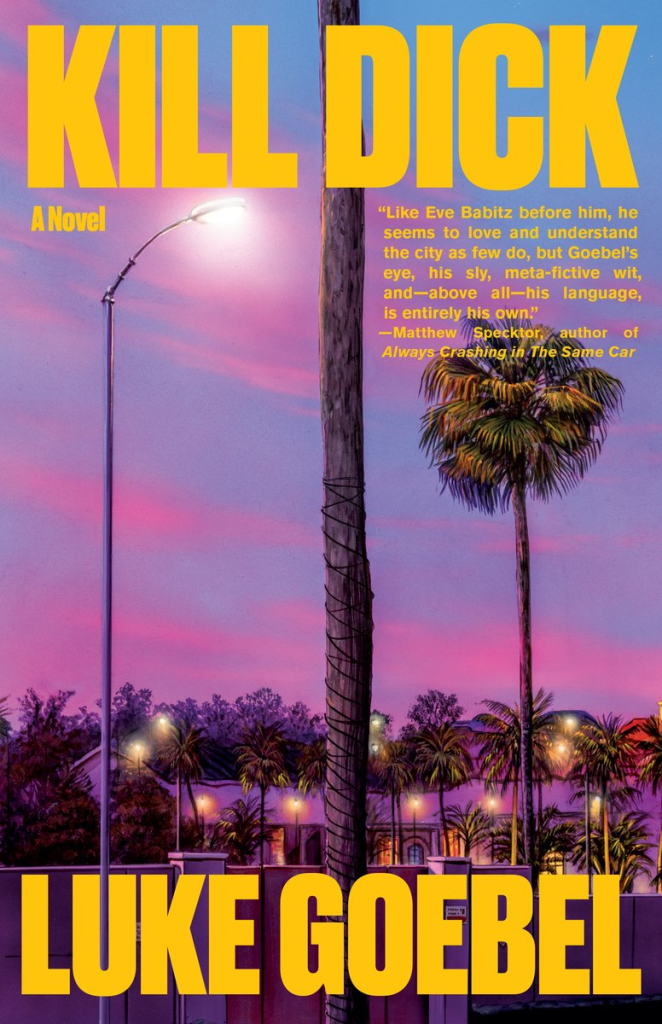
That said, you can also start writing from inside the illusion. My novel, Kill Dick begins poolside in Brentwood, before dropping fast and dark into the stratified streets of chaos where the poor and addicted are being hunted by a serial killer who is a stand-in for the worst actors on the stage of capitalism-run-riot today. While writing it I had to work to learn the town, as a screenwriter, as an author, as a transplant, as a visitor for the last decade. But the longer you stay, the more you lose your point of view. That’s LA. The LA novel is about losing point of view.
The best Los Angeles novels understand this. They drift. They double back. They sit in traffic. They ache, they lose their spirit, they try and try and try. Sometimes they succeed at making movies, money, and climbing the ranks of power only to find out how sad it feels. How fleeting the moment is when you look at your movie’s billboard for the Awards campaign. The city doesn’t run on proximity to power. It runs on complicity in losing it. At the end of the day—though there is no “end of the day” in LA—the LA novel understands that it’s selling the American Dream, only bigger. The American Dream is always about power, influence, and so the LA novel strives to make you believe that the mountains can be moved with just your mind. It’s all about the magic trick of point of view.
Didion strips Los Angeles down to its emotional bone in her second novel, and then saws into it with a scalpel of diamond sharp vacancy. Maria Wyeth moves through freeways, desert, and soundstages with a listlessness that feels like silence. The novel refuses conventional drama. Collapse is ambient. Everything is completed before the story begins. The cards were long ago played. LA doesn’t punish or reward—it simply absorbs. What remains is a portrait of disappearance, where identity sinks quietly away, without spectacle, until nothing is left to hold onto—the most terrifying part of one’s point of view is losing it.
Babitz doesn’t critique Los Angeles—she inhabits it completely. The insights in her stories move through sex, art, music, and social life with a precision that feels effortless but is anything but. Distinguishing her from other chroniclers of the city is her fluency in its codes: she understands access, timing, and presentation as forms of intelligence. Pleasure isn’t naïve here; it’s strategic. Beneath the surface—sunlit parties and beauty—there’s constant calibration, a sense that everything is being negotiated in real time. Babitz makes Los Angeles feel not just alive, but legible to those willing to pay attention. That’s a point of view worth selling. People now root for Babitz and against Didion. I love both. And root against anyone who pits women against each other.
The point of view here is so whacked-out and weird that the novel has to invent a merman just to make emotional reality manageable. Broder’s main character, a support-group-groupie strung out on love, drunk on affection, fantasy, and self-destruction, summons—or invents—a big sexy fish-man off Venice Beach to siren her away from her point-of-view-less life of bubblegum-chewing, ass-in-a-support-group-chair malaise. In LA, that almost scans as realism. The miracle of The Pisces is that its bizarre premise never feels like escape so much as recognition: Myth becomes the only language big enough for erotic despair. The fishy-man with the hot tail connects her back to something ancient, irrational, and primal. Myth, in this city, is often just the imagined meaning it takes to make something new out of yourself. Still, Abbot Kinney can only offer so much. In the end, you’re left with yourself. That’s the point of view we all want to escape. It stinks.
Chandler constructs Los Angeles as a network of power, secrecy, and corruption. A wealthy family would rather tear the entire city apart than talk about its little secret. Two sociopathic daughters and a rich daddy can’t just hang, and say, “Hey, where’s the Irishman?” Through Chandler’s seminal PI, Philip Marlowe, LA becomes a system to be discovered, where clarity is impossible and everyone is compromised. The plot resists resolution. Resolution doesn’t exist. What remains is tone: controlled, observant, and aware that glamour and decay operate as the same structure—it’s all surfaces, and under those, desperate little people and desperate big people. But where’s the hope? Where’s the light? It’s called Sunshine Noir because even the sunshine is dark.
Fante’s Los Angeles is fainter than the LA of Didion, Babitz, or Chandler. Arturo Bandini arrives with writerly ambition and encounters failure at every turn—the fun of the novel is his failures. The tale operates through contradiction—ego and insecurity, desire and resentment—the male pickle. The city amplifies everything and yet reduces him to nothing. What emerges is a portrait of aspiration without guarantee, where wanting something intensely only makes its absence more visible, its achievement more impossible. That’s the city, if there is an LA at all—aside from the infrastructure and the history of those who are generational and not on the West Side at the Jonathan Club.
Willis Wu is an Asian American actor of Taiwanese descent who wants to be a star. He moves through a Hollywood that has a point of view that doesn’t include him, except via typecasting and hierarchical denial. Interior Chinatown shows LA as a machine that assigns value, and Wu’s value is determined almost entirely through stereotypes and roles offering him limited visibility. One promotion in status might finally deliver personhood, that’s his fantasy—that’s the dream. Instead, Wu’s nightmare becomes his life sentence, and his identity becomes a joke sharp enough to pierce the Hollywood dream that’s always being blown, popped, and re-blown by someone else for him. The novel closes with an epilogue that questions if we ever stop acting out roles even when we’ve lost the big part and are trying to renew our conviction of becoming “real.” Can you have an authentic point of view once you’ve realized how points of view are bought and sold in a marketplace that undervalues you?
Fitch maps Los Angeles through the instability of Astrid, a teen who’s suddenly parentless in every practical sense when her mother goes to jail. She moves between foster homes and identities, adapting to survive each new environment. Beauty appears throughout the novel, but it offers no protection, like the relationship between mother and daughter that is both floral and poisonous. Still, flowers are pretty, right? Isn’t beauty a protection of its own? Isn’t beauty enough? LA sharpens some people and dulls others. In Fitch’s telling, LA becomes a sequence of tests, each one demanding a version of the self that may not survive the next transition.
Pynchon’s California is less about Los Angeles specifically and more about the systems that produce it—surveillance, paranoia, the residue of failed counterculture. Set in the aftermath of the 1960s, Vineland tracks characters caught between rebellion and absorption, where resistance has already been commodified and folded back into the structure it tried to escape. What makes it feel like a great LA novel is its understanding of image as control: media, myth, and memory all functioning as tools of power. LA isn’t just a place—it’s the endpoint of a process, where everything radical eventually becomes aesthetic. Plus, the great scenes at Pepperdine.
Real violence, the kind that Your House WIll Pay is concerned with-–specifically the shooting of a Black teenager in the early 1990s (echoing the real-world killing of Latasha Harlins)—is different from the fictive unrest and ultraviolence essential to the LA novel. Different from the fun and games of Pynchon or the riot-as-trope of LA literature that stretches back even before the riots we all know off the top of our heads. YHWP is about how the past resurfaces as fever pitch. Underneath are years of violence that never leave, never go anywhere. This LA doesn’t disappear, it gets glossed over by soundbytes. Steph Cha understands the way people look at each other beyond what they say. There’s less performance here, and no escape hatch. This novel isn’t about LA erasing you through illusion or ambition, it’s about how LA uses sleight of hand in POV when it comes to race and inequality.
Senna’s book was heralded as one of the best of the year This is the tale of Jane Gibson, who’s living in borrowed luxury and trying to finish her second book (no easy task). She believes she’s finally found stability and success in a pivot to Hollywood, only to have the illusion fall apart in Hollywood’s fickle and fast rollercoaster ride from promised land to disappearing dream. The town rips her shit off hard. At one point, we talked about adapting Colored Television, and I failed to pursue hard enough—I’m still kicking myself.
A fearless satire that stretches reality to expose it, The Sellout is about an urban farmer from Dickens—a fictional town in the LA periphery—who finds himself standing trial before the Supreme Court after reinstating segregation and reluctantly accepting a man who insists on becoming his slave. Beatty pushes America’s racial logic past the point where it can recuse itself. This is what a novel can do and Hollywood mostly cannot: put the dominant point of view on trial, then let satire dismantle vision itself. A razor’s-edge performance, The Sellout shows Beatty can push the limits of identity, sociology, and racism to reveal that the POV running the social program can be hit hard by the power of literary satire.
Body High is an oedipal wreck moving through addiction, grief, desire, and self-destruction, while performing a requiem for Leland’s dead mother. Leland is the narrator, a barely functioning drug addict trying to survive his mother’s death, while FF or Freedom Fighter, his best friend and Lucha Libre wrestler, drags him deeper into a city of pills, bodies, delusions, and need. In an attempt to help Leland’s 17-year-old aunt, or aunt-sister-cousin in the novel’s warped family math, they become grotesque tag-team protectors of a disappearing childhood. The novel doesn’t step back to analyze because it’s insanely propulsive and the characters are high as shit; it stays on the beat, tracking sensation as it happens, reality as it’s misperceived. The novel—like the city, like the dead mother’s apartment—burns. It shakes and takes its characters over the edge because there never was a stable point of view for this generation’s LA. It’s just Shakeytown shaking the kids loose.
While I sit at my desk to write, you shine a laser pointer through my window. With a fluid motion of your hands, I become segmented. Concentrated green light outlines my chest, my throat, my eyes. I feel the slice, skin turning cold, distanced. You act, and I react. You shine, and I shut my blinds.
Frustrated, I storm out of my bedroom. You follow, green light angled through the sliver of Venetian blind. I round the corner into the kitchen, crouching underneath the island. You know I’m here, projecting the light onto the wall behind me so I know too.
We do some iteration of this for months. Sometimes, I try to break the pattern. When you get particularly close to my eyes, I call the police, nervous that you’ll blind me. They ask you to stop; you laugh loud enough for me to hear it from my window. When I record you, trying to collect proof, you take your shirt off, resting your free hand near your waist. I find ways to navigate my apartment unseen.
To open a window is to perform for an audience.
Later, when explaining what happened, I’ll refer to these months as that time I was stalked by my neighbor. I mean this literally: as prey. Legally, your routine is a hobby, akin to bird watching. If anything, it was my fault. To open a window is to perform for an audience.
These are the things I think you know about me: I am tall. I have big, brown curly hair. Most days, I leave my apartment at 10 AM, walk to my white Subaru with out of state plates, and am gone until dark. I am old enough to not live with my parents but disappear along an academic calendar. I am visibly young. Based on past experiences, I assume you think I’m at least five years younger than I really am. I live with one roommate, who will eventually leave because of you. I do not bring friends home; the only other people you see through the windows are police officers. I am bothered by your actions. After two weeks, I stop opening my windows. You aim between the blinds.
Weeks after you started watching me, a woman pounds on your door. Fists keeping time, she screams through the glass, accusing you of pretending to walk your dog past her house as an excuse to watch her teenage daughter through her bedroom window. Fingers pinching the blinds open, I watch as you throw yourself out of your apartment. You scream denial, pronouncing yourself “the Superman of this bitch.” You are a man; therefore, you are heroic.
I am grateful to live on the second floor.
There’s a difference between looking and watching. I like looking. In New York, a particularly risqué top makes a man in the subway drop his ice cream. In DC, I wear low-cut shirts to free comedy shows, sit in the front row, and watch men with underperforming podcasts stumble through their sets, too nervous to glance up. A look is prompted by my action, by the way I’ve chosen to represent myself. A moment of recognition. Watching is prolonged, calculating. In parking lots, arms full of groceries, eyes track me towards my car. In streets, men honk and bark as I walk past. To look is to be appreciated. To watch is to be consumed. I want to be admired while remaining whole.
I want to be admired while remaining whole.
Though I invite looking in public spaces, at home, I change. I live in oversized t-shirts. I don’t sit on my balcony because it doesn’t feel private enough, the bars of the railing not offering enough protection. I’ve never adjusted to living in a city, a place with so many eyes. So, I keep to myself. I don’t have conversations with neighbors. I don’t look at them. In my apartment, I carve out a private space. I can only feel comfortable when I’m alone.
According to building code guidelines, a bedroom must have a window. “Habitable” is a classification: The space must have access to light, fresh air, and an emergency exit. In exchange for these conditions, I pay $1,200 each month.
When I complain to the leasing office, they calmly explain that you do not exist. There is no man on the lease; therefore, no man must live there. I show them the videos of you with your laser pointer, you performatively undressing to make me uncomfortable, you laughing at me as I rip my blinds shut. They shrug. Maybe I had the wrong apartment number. Maybe I was confused. Maybe I had secretly wanted the attention and didn’t know what to do now that I had it. I ask them to knock on your door. They refuse. This would be a breach of your privacy.
A few weeks in, I begin watching the History Channel’s Alone. Each season, 10 survivalists are placed into the wilderness with limited resources. Whoever is able to sustain themselves the longest wins.
I find myself drawn to seasons filmed in cold environments. Here, shelter outshines the need for food. The survivalists dig trenches into the ground or cut down trees to create cabins, insulate themselves with moss and pine needles. When they get hungry, many elect more passive hunting techniques. Snares balanced in fresh snow catch grouse while the survivalists shiver beside an open flame. In this way, a bird can be killed without humans watching.
You wouldn’t know that I shower in the dark because I’m sensitive to light. Chronic migraine distorts vision, intensifying color until it becomes overwhelming. At night, this amplifies to the point of nausea. Darkness blots it out.
Showering in the dark means shaving in the dark. Without seeing, I almost always manage to slice the skin at my ankles. Gravity drags the blood out, forces it to slide into the contour of foot. I hiss as shampoo slips into the exposed flesh, cleaning the cut. I rub Vaseline into my ankles to contain the bleed.
In my bedroom, I fall into the easy routine of wound care. My leg is dried and covered, elevated and rested. Yet sometimes, if the cut is particularly deep, I begin to worry. How much blood is too much? I defer to Google, stumbling through Quora threads, until I’m able to put myself to sleep, but it’s never restful.
In the moment between bouts of consciousness, I imagine bleeding out through a sliced artery. Alone in an apartment, hundreds of miles away from anyone who might miss me, how might my body be recovered? How many classes would I have to be absent from, shifts would I have to miss, before someone became concerned? Maybe a week or two or three of not responding to Slack messages, avoiding emails. But if I don’t leave my apartment for a couple of days, if I don’t turn on the TV and my car never moves, how long would it take you to tell something is wrong? If I were to die, would you be the first to notice?
On dewy mornings, you stand on the grass that separates our homes to practice your nunchucks. Shirtless and barefoot, you grunt, your body twisting through the exercises. The chain clinks as the handles flail, the sound of a dog pulling against its lead. For days, I try to analyze this routine; had you been trying to intimidate me or are all of your actions just rooted in violence?
I know who you are. You make your dog an influencer, frosting his Instagram @ onto the back right window of your car. I use this to find your other accounts: your personal page, your professional SoundCloud mumble rapper page, and a fake page where you pretend to have an agent that curiously writes with the same diction as you, spells the same words wrong. You are unoriginal in your usernames. I find your Facebook, your Tik Tok, your Reddit. I learn that you’re home all day because you self-identify as a day trader. When the market is down, you turn to the laser pointer. When my window is closed, you make unenthusiastic thirst traps.
Your space is offered. My mine is taken.
I dig through them. A video of you in bed, trying to flex. A video of you in sweatpants two sizes too small. A video of your dog slumped into the corner of your bedroom. I don’t find you attractive, using my thumb to censor out your body. Instead, I want to find you in the same way you found me. Mentally, I collage the backgrounds together. A bed on the left side of the room, mattress on the floor, five sticks of deodorant on a yellow wooden dresser, walls bare. I tell myself that this is only fair, that if you know what my bedroom looks like then I deserve to know what yours looks like too. Still, I know it will never be the same, that you consented to this intrusion.
Your space is offered. My mine is taken.
After two months, all of my plants die. Without sunlight, they starve.
My roommate, the only person I knew before I moved to Virginia, leaves a few weeks in. You shine the laser pointer at her too, but only when I’m not home. In a conversation we have before she moves out, she admits that sometimes she left bigger gaps between her curtains and her windows just to see if you would target her first. I’m confused; if you viewed women as prey, why should she be any different?
We’re sitting on our knees, bodies angled under the protection of the island while I’m on hold with the police. She shakes her head, looks off to the side, “It’s just that—you’re the pretty one.” On the other end, the hold music stops, and the officer asks for our address.
While we wait for them to arrive, still on our knees, I tell my roommate that she’s pretty, but you’re not trying to get my attention because you find me attractive. You want power, the type of temporary possession that men try to take when catcalling, when placing hands on the small of our backs to push past us in grocery stores. You don’t look. You watch.
There’s a pair of Mormon boys who live between our apartments. Their living room overlooks the path that separates us. They learn my routine too, peeking past their gaming monitors, through their glass patio doors when I come home from night classes. Sometimes they would be outside already, white shirts tucked neatly into khaki pants. We never speak, but I could feel them looking to see that your watching remains distanced. When I make it to the door of my building, they nod. I nod back.
After three months, you stop.
At a standup show two years later, a comic asks if a man has hurt me. I shrug, mention that one of my neighbors kind of stalked me, explain the laser and the hunting. With further prompting, I disclose the information about you that I found, the mumble rap, the fake accounts. The comic laughs, cavalier. “I don’t think you were the victim there.” For a second, my smile falters. “A guy shines a laser pointer at your tits, and all of a sudden, you have to fuck his life up? I mean, if anything, you were stalking him.”
I don’t clarify. I know there isn’t anything I can say to a man who thinks that silently screenshotting someone’s socials is enough to fuck their life up. The comic shakes his head performatively, murmurs “psycho-bitch” into the mic. Meeting his eyes, I laugh.
I’ve tried to write about this experience, but everything falls flat. Every couple of months, I scratch out a new piece. A hermit crab essay in the shape of a court case. A poem comparing my body to a kidney stone, another annoyance to be removed with a laser. A braided piece on non-physical violence against women. But nothing quite feels right. A professor refers to it as my defacement, and while the new language resonates, I can’t build something around it.
Somehow, it feels like the stakes are different. Normally, I don’t care what my reader thinks of me. Any analysis they draw from my work is only their reading, their understanding of what I’ve written. Here, I find myself invested in the reader’s perception of me. Can they see all the ways I’ve made myself smaller? Body folding to hide in the shadow of the kitchen island? Shoulders hunched as I walk to my car? When they look at me, my spine curved in on itself, face in my knees, do they think I’ve misread the situation?
I want my world to feel as big as everyone else’s. For weeks, I don’t shut my blinds.
At the thrift store, I buy a shirt that says, “BIRDWATCHING GOES BOTH WAYS,” neon orange letters against an olive green backdrop. It hugs me in the right places, the top snug against my chest without warping the text. Three years, 500 miles later, I know you will never see it.
Electric Literature is pleased to reveal the cover of Distortionby Kathryn Bromwich, which will be published on March 9, 2027 by Two Dollar Radio. You can pre-order your copy here.
A knife-sharp, deliciously sexy story about a young actress and the lengths she will go to fulfill her dream, under the guidance of a shadowy and eccentric auteur.
Natalie is prepared to give up acting forever before being abruptly cast as a leading role in maverick director Robert Langford’s secretive new horror film. It’s the opportunity of a lifetime, so while Natalie has questions about the actress who mysteriously dropped out of the role before her, as well as how her disability will be portrayed in the film, she brushes them aside. Natalie joins the star-studded production for weeks of rigorous rehearsals that employ strange methods and arcane talismans, leading to dangerously deep bonds between cast members.
Once shooting starts on location at a remote Scottish castle overlooking the sea, a series of unsettling phenomena haunt the set, leading to whispers among the local population that the film is cursed. As filming progresses, Natalie debates whether she is using Robert’s film or it is using her, as well as what must be sacrificed in the service of art.
Hypnotic, disquieting, and surprising, Distortion is a modern gothic tale of seduction and survival.
Here’s the cover, designed by Eric Obenauf:
Kathryn Bromwich: There is a mismatch in the way we see ourselves, the way we wish to appear to the world, and the way the world actually perceives us. In Distortion, I wanted to explore the friction and contradictions between these states, thinking about the limits of perception both in ourselves and others. The world of cinema and acting was a natural setting for these questions: the elevation of reality into something grander and stranger, the often fraught behind-the-scenes underpinning the mirage, film’s seductive appeal speaking to a deep and primal part of us. In the dark of the auditorium, the outside world temporarily ceases to exist and we willingly enter a game of make-believe with the film-maker, whose vision becomes the lens through which we experience the universe they have created, the characters they have breathed life into.
The moment I saw the cover I knew it was right: the uncanny Hitchcockian mood, the delicate crack in the veneer, the reflection that isn’t quite as it appears. I have always been fascinated by artistic representations of doppelgängers: a splintering of the self that threatens to undermine your sense of identity, the aspects of yourself you have kept so carefully hidden rising up and breaking through to the surface. Visually, the cover echoes the book’s preoccupation with doubling, and the lies we tell ourselves in order to survive. Growing up with a disability, mirrors have long been a source of trepidation, lest I catch a glimpse of myself unguarded; to counteract internalized feelings of shame, I choose instead to believe in an idealized version of myself, a futile game of self-deception that distorts reality into a shape of my choosing. There are few books that explore beauty, desire, and disability. I hope Distortion will force readers to contend with preconceptions they may not even realize they have: make them look in the mirror and be honest with themselves about what they see.
Eric Obenauf: I love Kathryn’s work. There’s something both very filmic and very Shirley Jackson about her books, while being completely her own distinctive style. I always thought her first novel, At the Edge of the Woods, would make a tremendous movie. Now the new novel, Distortion, actually takes place on a film set. I designed the hardcover and paperback covers for At the Edge of the Woods, and I believe I wanted them to invoke movie posters. The hardback design wants to convey a timeless, classic story, and a paperback thriller from the mid-20th century, when the book is set, while the paperback wants to be an A24 movie.
For Distortion, much of the design inspiration that Kathryn shared with me felt more contemporary while conveying a sense of the uncanny. There is the doubling in the story that Kathryn mentions, which felt important to represent visually, and while the book is a psychological thriller, it’s also a love story, and about self-perception, and acceptance. I really love the end design. It’s nice when it works out, isn’t it?”
says the pilot, voice sizzling
over the speaker like . . .  well, bees.

So we wait in our recycled air,
each of us singing silently

inside our minds, a buzzing round,
a silent, synchronous prayer

to break loose the colony
or cluster or whatever it is,

to shake free the hive and
let us depart. Dear nature,

how silly we are to think
you won’t eventually smear

over our metals and wires.
How silly to think that

in pursuit of the survival
wired tight inside you,

you won’t crawl into our
microscopic crooks and crannies,

won’t break our brilliant tech
bit by buzzing bit. We cover

our hybrid bumpers
with stickers for SAVE THE BEES

and tsk tsk tsk our cfc breath.
But reclamation

is the song I hear just now—
a faint whir building

in the rear of the jet.
Like erasure, black and gold

felting the last hues
of the human age.

Outside on the runway
a worker in yellow stripes

lets a leather suitcase fall.
A worker in sickly

yellow stripes points up at us
and flaps his tired neon wings.
Waxing Moon in Pinedale, Wyoming
All the way north
the sun sinks
like a broken boat
into a sea
of black cows.
Past Rawlins a song
of bikers splits
the highway,
their shadows
like bits of my past,
missteps and regrets,
stretched long
then obliterated
on the hot blacktop.
Later, in a cabin
south of Jackson,
another sunk ship—
the moon drips
through lace drapes.
Above us in bed
bare bulbs bloom
from bone,
a luminous elk rack
blessing our headboard
with bony questions,
casting skeletal spells
on the patchy quilt.
Beneath the quilt
her stomach is also
a waxing moon,
new life turning on
in the shadows
of ancient forms.
When we first
passed into town
the bent welcome
sign had read
like a prophecy
or a poem—
Welcome Home!
it said, You’ve found
all the civilization you need.
And who were we
to argue? How would
the rags of doubt
ever suit us now?
At age 12, Sara Nović went deaf, but not all at once. First, she lost the wind, then the dripping of a leaky faucet, and then certain consonants. She writes in her memoir, “What is a mother tongue, and how do you get one? What if your mother has no tongue? What if you have no mother?”
For much of her adolescence, Nović masked both her disability and her queerness, until an experience of spiritual humility led her to claim not only her deafness, but Deafness: the political act, the community. The book’s raison d’etre seems to be about honoring that experience, resisting erasure, and changing the sociopolitical landscape to be one that celebrates difference, rather than trying to stamp it out. Nović takes on the history of deaf ableism in America, including Alexander Graham and the invention of the telephone, as well as the Oralist movement, which grew out of a white supremacist Christian nationalist vision of America. An advocate for the disability community (check out her Instagram!), she pushes hard against threats facing the Deaf community: the closing of Deaf schools and the supplanting of ASL for cochlear implants, the dangers of medical documents being translated into myriad languages but rarely ASL, the suspicion that someone like her will give birth to a deaf child and their misguided, solipsistic hope that she won’t. But the book is also a tender examination of family, touching on Novic’s pregnancy and the sleepless nights when her first child S was inconsolable and she’d have to belt out her own rendition of “Take Me Home, Country Roads.” It ends, touchingly, on her adoption of her second son, K, a deaf child in Thailand living in an orphanage, and who lights up when he finally learns to sign. This crip-queer memoir, which reads as a Deaf manifesto on motherhood, shows us how far we have to travel to claim ourselves.
Over late-night Google Doc, Nović and I discussed being in Deaf community, motherhood, and her work as a disability advocate.
D/Annie Liontas: Is Mother Tongue a queer, Deaf manifesto about motherhood?
Sara Nović: I think it kind of is! It didn’t start out that way; it started out as a series of letters to my sons. The subject matter became more expansive as I realized how each part of my own identity, and theirs, was inextricable from the next, but the intimacy of the original drafts remains. I think intimacy is an overlooked component of a manifesto, too—people hear the word and expect some big, sweeping, shouty ideas, but really the emotional power comes from its specificity, just like it does in fiction. Ultimately I think “manifesto” is the perfect word, because nothing has radicalized me more than parenthood.
D/AL: I love that you are claiming intimacy as essential to a manifesto—and I can feel that coming through in the writing, especially when you’re sharing your experiences in adolescence.
You confess that you concealed your deafness for a long time, even from those closest to you, until you were in college. As someone living with a brain injury, this kind of masking is very familiar to me, especially when it comes to family, school, the workplace. Can you talk about the experience of passing and what it took to overcome the impulse to hide? What did it require to insist that the world meet you as you are?
SN: It’s so interesting talking about this book to folks, because the notion of passing or trying to hide my deafness seems to confound nondisabled people, but most disabled people get it right away (and have their own similar stories). But of course disabled people try to hide in a society that also actively tries to push out and segregate disabled people, where disability is stigmatized, even criminalized. It takes a lot to unlearn that. One of the most effective ways to dissolve that internalized ableism is to be in community with other disabled people, which I think is why certain rehabilitative programs and workers going back to AG Bell were and are so keen to keep us apart from one another. When we stop believing something is wrong with us, it makes their job of “fixing” us or getting us to comply with norms much harder.
I think intimacy is an overlooked component of a manifesto.
The other thing is that trying to pass is exhausting. There’s a moment in the book where I sing to S after not having sung for a long time, and in that moment it was purely a move of desperation. But out of that experience, I was then able to think about how I had been trying to compartmentalize my identities in a way that wasn’t serving me. I often say my kids radicalized me, and I think a lot of parents feel this way, that an investment in our better selves, and a better future, gets extremely real when you have kids. But also the kids wear me out! I don’t have the time or energy to dedicate toward masking for the comfort of other people anymore—which is ultimately for the better.
D/AL: You write beautifully about a moment in a church service when you move from identifying as deaf to identifying as Deaf. You describe it as a conversion. What has claiming deafness and the Deaf community brought into your life?
SN: I think the metaphor of conversion worked for this moment not because it happened in a church, or not only that, but because there was an element of spiritual humility that had to happen for me to cross into Deafness. I had to admit that I had nothing to lose and no idea what I was doing and put my trust in something bigger than myself, which in my case was the Deaf community, but certainly parallels how a lot of people come into spirituality and religion.
Being a part of the Deaf community has enriched my life greatly. It has given me a linguistic and cultural home wherever I go. Especially in those early days before the internet as we know it today, I became fast friends with folks with vastly different interests, careers, and life experiences simply because we were linked by language and happened to be in the same city. I really love that about the deaf world, that feeling of home inherent to the language.
D/AL: In “This Be the Verse,” your faith runs up against your queerness. You say that what you hated most about church was the dresses, “a sensation I wouldn’t be able to explain for another 30 years—like my skin was trying to flip itself inside out.” In one scene, you write about being at a youth group event—almost like a nightclub—which included fiery sermons and graphic depictions of the crucifixion. In that moment, you prayed for God to cure you of your queerness. Looking back, what do you wish younger Sara had understood at that time not only about herself, but how evangelical theology functions as a praxis of white Christian supremacy and ableism?
SN: There’s so much I wish I knew back then about the way people’s inherent need for connection and spirituality is manipulated by organized religion. I really left the links between the Church and white supremacy, racism, ableism—or any of the ways people use others’ faith as a way to wrest power—completely unexamined, and whether that was because I was slow on the uptake, or because deep inside I feared what I would find, I’m not really sure. I was pretty incapacitated by my own guilt and fear. That’s the thing I would tell Past Sara if I could—that you don’t have to be afraid or feel guilty for breaking some set of arbitrary and very tenuous “rules” with your existence. You don’t have to get back in that line every summer and pray the “cure” takes this time.
You also don’t need organized religion to be a good person, or even to follow the teachings of the gospel if you’re into that. I think we’re seeing that particularly right now, the behavior of the hardline Christian right or the megachurch industry has very little to do with the actual teachings of Jesus, and a lot more to do with hoarding money and control.
D/AL: There is so much Deaf history in these pages. Alexander Graham Bell used science and the invention of the telephone as a way to advance a white supremacist Christian nationalist vision of America, even as he relied on ASL on his deathbed to communicate his final wishes. “He understood that to exterminate a culture, one must come for the language. . . . and campaign for the removal of ASL from deaf schools.” What is his legacy and that of other oralists, and what do you think is required to take down such historical heroes and mythologies?
SN: Bell’s legacy is fascinating because it is still so prevalent throughout the fields of deaf education, speech therapy, audiology today. Many people see him as the father of this world-changing pedagogy that gets deaf kids to talk. And he is that, but not in the way people tend to think. Bettering deaf education and speech therapy wasn’t necessarily Bell’s goal—maybe it was a piece of it, and certainly the deaf education space was what he had access to given his father’s and grandfather’s work in the field. But ultimately his intent in deaf education doesn’t even matter, because the reality is that his pedagogy became the vehicle through which he could most effectively proliferate his xenophobia and ideas about eugenics.
Being a part of the Deaf community has given me a linguistic and cultural home wherever I go.
Some people, I think, are truly ignorant about Bell’s love of eugenics. Others know a little and want to fight about it. A friend of mine got into hot water with some moneymen at their university for saying Bell was a eugenicist, for example. Sirs, he was literally the honorary president of the Second International Congress of Eugenics! Optimistically, maybe this combativeness about his legacy is actually a good sign, because it means folks know on some level that what they’ll find at the root of Bell’s work is morally reprehensible. Deaf and disabled folks and allies have to be able to speak to that gut instinct. Money would also help. The oralist lobbies are very powerful.
D/AL: The raison d’etre of this book—the tender heart of it—seems to be about your experience with motherhood. You write lovingly about singing S, your firstborn, to sleep, as well as the joy you felt when he signed his first word (“finished”). How has motherhood surprised you? Opened up the world in a different way for you?
SN: It’s probably not a surprise that watching my kids learn and play with language has been the most magical part of parenthood for me. It’s like nerd Disneyland to get to watch language acquisition in real time. Being a parent has also changed the way I use language. When signing with adults, I think we increasingly have a tendency to fall back on the manual alphabet to spell difficult concepts, but that just doesn’t work as well with small children. You really have to embody your words and ideas, and that practice has in turn made me think about those words differently, and also made me more confident in my own use of the language, in my own body. That’s something I’ve always loved about ASL, and it’s magnified when you’re with kids.
Parenthood has remade me in the usual ways, in that it has irrevocably shifted my priorities. I think sometimes writers with kids project a layer of bravado about how they protect their writing time or how having a family doesn’t interfere with their career as a Serious Writer, and I get the impulse, but for me, having kids absolutely has changed my writing and my career, sometimes in ways that are hard, but often in great ways.
D/AL: You relay, very relatably, the anxieties around being a parent of an infant during the pandemic, especially after contracting COVID in the early days. Add to this that, as a Deaf person, you were fielding judgments and biases from the people and systems that were meant to support you. “How many strangers wanted to know, would I hear the baby cry?” Can you talk about the challenges you faced, and still face as a deaf mother from strangers and medical professionals?
SN: As you’ve probably experienced yourself, I think nondisabled folks really go one of two ways when they’re interacting with a disabled person: Either they panic and try to disengage as quickly as possible (having been told their whole lives “look away!”), or they really feel free to say the quiet part out loud. While the former is uncomfortable, they’re still bringing vulnerability to the table. The latter group I find frustrating, because they’re more set in their ideas about disability, so much so that they expect us to agree with them when saying ableist stuff to our faces. These are the, “I would kill myself if I couldn’t listen to music” folks and the “don’t worry, your kid probably won’t be messed up like you” people; they assume that we find only a deficit in our disability, and that there’s no other way to look at it, so they feel comfortable saying so aloud.
The microaggressions can be tiring, but larger biases in the education and medical fields are actually dangerous. Because of a lack of trust of the medical view of deafness and disability, deaf folks as a population typically wait until the last minute to go to the doctor, and end up in the ER more frequently and with worse outcomes. There are some real horror stories in the book, but it makes sense, too—why would deaf folks trust a system bent on our eradication? And then when we do get there, desperate, there are so many barriers to access. Hospitals and doctors’ offices are often the worst offenders of not providing interpreters, and that can mean dire consequences. (People asked me how The Pitt’s representation of a deaf person’s hospital visit was, and I kept saying, “Well, they forgot about her for a few hours, so that’s very authentic!”)
Another thing I’ve noticed is that whenever I take K to a medical appointment, healthcare workers assume the interpreter request is for him, and can’t really wrap their heads around the interpreter being for both of us. For a while I thought they just weren’t used to seeing two deaf people in the same room, which is maybe still true, but given the broader experiences I’ve had in dealing with the school system, I think the bigger problem is that people don’t expect or trust disabled people to be parents.
D/AL: You and your husband decided to adopt your second son, K, who is deaf and was living in an orphanage in Thailand. Can you take us through that monthslong journey of becoming K’s parents—from the application process to the delays with the state department to your first meeting?
SN: We came to the adoption process backwards from most people. More commonly people know that they want to adopt, and they fill out all the forms and get the required background checks and are placed in a queue, waiting for long periods to be matched with a child. Often these adoption journeys start because of fertility problems within the adoptive family, and those families are frequently looking to adopt babies.
Parenthood has radicalized me, in a time when being radicalized has never been more necessary.
But none of that applied to us. We had been discussing adoption because Z is adopted and had always wanted to adopt a child, too, but the decisive point for us was really learning about K himself. K was part of a population known as “waiting children”—kids over age two, often disabled or coming from difficult medical or social/emotional circumstances, whose placement options with relatives or in their country of origin have already been exhausted. His profile noted that he was deaf and had some other medical concerns, and for me being able to provide him with sign language access—something most deaf and hard-of-hearing kids don’t get in their homes even in the best of circumstances—outweighed some of the trepidation I had about the more nefarious nature of the adoption industry. It doesn’t ameliorate the harm and trauma that is inherent to adoption, but I am also a pragmatist, and at the end of the day I don’t think it makes sense to leave disabled kids in an orphanage with no home of reunification or in-country adoption just to prove a point. So we applied to adopt K, specifically, and worked in reverse.
The process was really grueling, and made worse by COVID, and a UPS nightmare that led to all our documents getting lost en route to the State Department. During the delta surge we lost contact with the orphanage for over six months, and when we did finally hear from them, their report was filled with stories of how traumatized the kids were from lockdown. For my part, the whole time I was panicking about the ways in which K was missing out on language, as it can become exponentially difficult to acquire language outside what’s called the “critical window,” from birth to around age five. By the time we met K he was months away from turning five, and he tested as having the language of an 18-month-old. Because of ASL, he was able to catch up quickly, in both signed language and now in spoken language, too. But it haunts me, thinking of how close he came, and how many other kids might be out there languishing in institutions at risk of permanent brain damage, when all they need is sign.
D/AL: Your sons, S and K, are very close. You’ve shared with me that, at times, they share their own private language of sign, and even teach you words. Can you tell us about the moment that, anticipating K’s arrival, S signed his name?
SN: We are so lucky that S and K took to one another right away. They’re a real odd couple, opposites in many ways, and they both challenge and support each other.
Before K was here, we had a picture of him on the fridge, and S would talk to him all the time. That was why K has a relatively generic sign name—not necessarily based on a personality trait like many sign names are—because we were always talking to and about him before we even met. S used to try and feed the photo spoonfuls of oatmeal, or he would express worry about how K didn’t have a coat on in Thailand. Across the ocean, we’d sent K a book of photos of family members and different rooms in the house and places we’d go in the city, so they were thinking about one another even years before we were together.
Later, when K came home, he learned sign and then started speaking English. Almost no one could understand his speech, but S always, always knew exactly what he was saying and interpreted for him. And K is kind of the same for S in a physical and social way—S is much more cautious and nervous about the way he moves through the world, and K is the ultimate wingman.
D/AL: What has it meant to you to make that space for them? To make this family?
SN: Parenthood is the best part of my life. Being a parent forces me to be present in my body and in the world in ways I just wasn’t before. Parenthood has radicalized me, in a time when being radicalized has never been more necessary.I think sometimes writers are cornered into talking about how they write despite their kids, or how having a family makes writing harder. And that’s true, but I also think I write because of them, and I write better because of them. I see the world like it’s brand new every day. There’s really nothing better for a fiction writer than that.
The year 2022 gave us #feralgirlsummer, which morphed into #bratgirlsummer in 2024 and then #messygirlsummer by 2025—all howls against the curated perfection of a hot girl summer. Chaos. Freedom. Truth with its crop top unbuttoned. Going beyond hashtags, these eras represent a refusal to be domesticated by societal expectations. Feral girlhood is a state of mind accessible to anyone who claims agency over their life. While we don’t yet know this year’s moniker, trust the feral girl will live on.
I experienced my first feral girl summer in 2023 by trading my bikini waxes, bleach-and-tones, and spray tans for a pen and paper. It was the year I wrote the first draft of my debut poetry collection,A Little Feral, though I didn’t know it would be titled that at the time. All I knew was that I wanted to write toward the grime, the grit, and the gall. I started posting some of my poems on my Instagram, and my DMs overflowed with folks connecting over our shared mess. I discovered a feeling I haven’t been able to let go of since: baring the worst of myself and having someone take it, hold it, and say, I see you—and then, remarkably, not unfollowing me. Perhaps leaning into this rebellion is what Ocean Vuong means by “embracing the cringe.” Is there any other way to truly be ourselves?
In the seven poetry collections below, you’ll find verses that could never be contained by a perfectly curated grid. These poets are stomping where others are tiptoeing, celebrating the imperfect, often rough sides of ourselves we’ve been taught to file down. Less focus on being palatable. Even less on asking permission. Poems from these collections are one-way tickets to the most honest, untamed version of our lives.
Amy Gerstler’s fourteenth book of poetry is a collection of shape-shifting poems that thrive in contradiction and obsession. Fluidity and agency are themes in these poems, so much so that the entire collection feels a bit like being on a rocking ship. What this collection of poems seems to dig at is the permanence or expectation of change. The speakers in Gerstler’s poems refuse to settle into a single, legible self and instead are floating, transforming, and cackling in delight between poems. Gerstler writes in a persona poem from the POV of a bird: “The best parts / about being a bird were absence of shame.”
A Bit Much is a humorous debut collection with maximalist, ferocious vibes (think leopard-print pants if poems had an outfit). In fact, throw in some glitter hoop earrings while you’re at it. For the poetry lover and the non-poetry lover alike, this book is full of surprise, delight, and aha moments. With poem titles like “Someone to Eat Chips With,” “Maybe Crocs are Okay,” and “Wet n Wild Geese,” Rush insists that saying the quiet part loud is how we survive womanhood, parenting, and the patriarchy. A Bit Much is a sparkly, defiant invitation to embrace your loudest, messiest, “a-bit-much” self.
Lexi Pelle’s wit is as sharp as her line breaks in Let Go With The Lights On. These poems explore the friction between ex-Catholic girlhood and the modern world. With a voice as candid as it is clever, Pelle reckons with the heavy (and sometimes sexy) intersections of faith, desire, and beauty. These poems offer a refreshing and poignant look at what it means to move through the world while still carrying the leftovers of a religious past. She writes, “the idea that someone somewhere could look / at a picture of me from the shoulders up / and think I was naked and be wrong about me.” Pelle’s debut challenges writers to look their shame in the eye without trembling.
the past is a jean jacket is a gritty, tender scrapbook of queer, Latinx adolescence set against a backdrop of indie bands, cigarettes, and late-night longing. In the titular poem, Cardona writes, “sometimes / i’m so lonely / i practice / small talk / in my car.” I love how Cardona uses white space and harsh enjambment to create pauses and a heavy breathiness in her poems, almost as if the speaker is winded while reciting them. These verses document the frantic, unpolished pulse of youth shimmering with the heat of South Texas. Cardona’s poems yearn, and they don’t apologize for it.
Rather than treating memory as a static or perfect record or archive, Callier uses theater to investigate the fluidity and ever-changing nature of our memories. When the Horses is a poetry collection that feels like parting the curtains of your own imperfect, fleeting life. In “The Broken Steps,” she writes, “The last night I tried to touch you / I mouthed your name to the door of your back.” Surprising diction like this persists throughout the book. Though some liken her work to walking through a haunted house, I find it carries a deeper, hypnotic quality—almost akin to sleepwalking in a feral state before waking.
This award-winning poetry collection writes the body as both a site of scarring and a source of song. greathouse writes structural poems that meet at the intersection of disability, transness, and trauma. With their invented form, the burning haibun, they invite the reader to reconsider letting the world aestheticize pain, offering instead a powerful reclamation of identity and resilience. The burning haibun form offers up an opportunity for the reader to watch greathouse’s poems “burn” away on the page. By eroding the narrative, these erasures mimic how trauma destroys memory while exposing a sharper, more honest survival story.
In Dead Girl Cameo, m. mick powell moves beyond mere eulogy to interrogate the spectacle of Black girlhood and the violence of the public gaze. The collection feels less like a traditional book of poems and more like a curated, cinematic haunt. In “dead girl chorus” they write, “i understand what I cannot love most: girl dead twenty-two / feet from the aircraft, balded by its brutal flame.” powell navigates the heavy static of archived trauma and ancestral ghosts with diction that is bold enough to raise fear from the dead. These poems are grief and celebration, slow dancing together.
I read Sarah Wang’s debut novel New Skinwhile still contemplating my own escape from postpartum depression. I call it escape because the mental gymnastics I had to perform to endure the asylum that was my mind—which involved blocking my own mother’s capricious “care”—in order to survive my ordeal was nothing short of miraculous. Like Linli’s mother, Fanny, my mother is obsessed with and conscious of beauty and society’s standards and aesthetics, though unlike Fanny, she is not obsessed with plastic surgery. Needless to say, I found in this novel a reflection of an often invisible view of a dysfunctional mother-daughter relationship, built on Fanny’s concept of motherhood. As she says, “mothers must always be a slave to their children.” She even adds, “There is no way out. You think I don’t wish for a way out everyday?”
New Skin is a satirical exploration of the obsession with the beauty industry, particularly with cosmetic surgery. At its core, however, the novel is about the fraught mother-daughter relationship of Fanny and Linli. Fanny tells yarns believing that she is making things better by transforming her face and that this is the course of evolution. She believes this course of evolution applies to her body as well—that the original should be augmented. But beneath this facade is also the performance of appearing to be loving and caring, especially during the America’s Beauty Extreme reality show segments where Fanny, in her desire to win, performs the most human and truthful versions of herself. Fanny’s obsession with plastic surgery began long before her daughter became conscious of it, when she was trying to fit in to survive. This is a different kind of immigrant and assimilation novel where evolution from immigrant to citizen is an involution of maternal debris, returning to the site of motherhood: the body.
I met Sarah in 2021 while we were both attending Tin House Workshop (now The McCormack Center) online. In this interview, Sarah and I talked over Zoom and e-mail about the mother-daughter relationship, therapy, colonialism, and hauntings.
Cherry Lou Sy: New Skin is such a different immigration/assimilation novel. Forgive me if I’m being too forward in classifying the novel that way. Even though a lot of the marketing is about the satirical and absurdist nature of the beauty industry through the lens of this mother-daughter relationship, eventually Fanny’s immigration story as well as her assimilation story are revealed. Was this intentional? How did this book start? Were you trying to do an assimilation story, or was it always a mother-daughter story?
Sarah Wang: The mother-daughter story is the heart of the novel. I think of the plastic surgery and reality TV subplots as Trojan horses for delving into the issues that are most important to me: immigration and the lives of those who are undocumented, debt, class, and women’s labor. The book is told from Linli’s perspective, a second-generation immigrant who, like many in their mid-twenties, is trying to figure out how to go out into the world to be her own person. Part of that is understanding where she came from, which is in some ways mysterious to her. Many of my friends who are second-gen have similar experiences. Our parents don’t really talk about the past and what their lives were like when they immigrated. Maybe it’s cultural or maybe it’s because they don’t want to revisit traumatic histories. But this unknowing leaves a gap in our understanding of our own identities. And beyond that, what Linli also longs for is to know how the person closest to her, her mother Fanny, came to be the way she is—a disfigured plastic surgery addict who will do anything she can to get what she wants. So you’re right in reading the novel foremost as an immigration story. Linli and Fanny’s story is one defined by their experiences as second- and first-generation Chinese immigrants. The novel is definitely informed by my own desires and questions about my family history.
CLS: I am interested in this idea of truth being presentational in this story. How does truth and fiction exist in the novel for you?
I think of the plastic surgery and reality TV subplots as Trojan horses for delving into the issues that are most important to me.
SW: The axis of truth and fiction is one of the novel’s main concerns. Linli doesn’t know who her father is or much about her mother’s life, except for these fragments of horrible stories that Fanny tells her. Despite these glimpses, Linli isn’t in possession of a cohesive narrative. On the reality TV show she sneakily auditions for, Fanny reveals some shocking stories, but it’s impossible to know if they’re true or if she’s just trying to win the competitive therapy sessions—which is the premise of the show, America’s Beauty Extreme. Fanny and her cohort are all botched plastic surgery victims competing in weekly group therapy challenges in a kind of death match to see who can make the most progress in the journey of healing. The contestants have to divulge traumatic stories in order to avoid elimination and out-therapy each other to win. Linli watches her mother on TV disclosing abortion attempts, criminal arrest, and living in the shadows as an undocumented immigrant. Linli doesn’t know whether this is true or not and neither do we. But she finds documents stashed deep inside her mother’s drawers that disclose a horrific part of Fanny’s past as an undocumented immigrant and her extraordinary path to citizenship. Readers, along with Linli, have to decide how to contend with not knowing if Fanny’s presentation—as you say—on reality TV is to be believed or not. Real life is similar in that we also have to figure out how to accommodate contradictions. If you ask different people in your family about what happened in the past, they’ll often have different accounts, or even discount that something ever happened. Who do you believe? Sometimes we have to hold space for multiple truths and possibilities, the absence of certainty, and lack all at the same time.
CLS: That’s so interesting because the stereotype in Asian culture is that we always think the elders know best, that we have to follow everything they say 100 percent etc. But in the book, the elder, Fanny, is an unreliable narrator of her history, at least in the story she tells her daughter, and this search for truth is what’s driving Linli. Do you think trauma makes unreliable narrators of people, and how is that reflected in this story?
SW: Fanny is an extreme person who does outrageous things to get what she wants. She manipulates people and tricks them—these are the skills that both ruin her daughter’s life and allow Fanny to be a tremendous competitor on America’s Beauty Extreme. But as wild as Fanny is, I’m not sure we can say she’s unreliable. She could be telling the truth. The way that traumatic memories are stored in the mind [differs from] other memories. They are extremely vivid and bodily. What if trauma made people reliable narrators?
CLS: How do immigrant women who are at the edges of society participate in or even want these black-market cosmetic procedures? They’re not safe, but they still participate in them. Why do you think there’s this obsession with that?
SW: People have the desire to keep up with whatever the latest trend is. Especially with globalization, the democratization of the internet, and virality of social media, the speed at which we want is accelerated, and therefore there’s also higher turnover. We want faster and we want more. Whether we’re wealthy or poor, there are things we all want and that are advertised to us in the same way. Beauty and youth are a mainstay; then it’s glass skin one season and turmeric pills the next. Cottage industries develop to make trends accessible. Just because you’re poor doesn’t mean you aren’t susceptible to wanting a Balenciaga bag. Just because you are undocumented and working in informal labor markets doesn’t mean you won’t want a facelift. The issue is that with fewer options and resorting to the black market to afford what many may want but few can buy, there are risks. That’s what poverty is often about, taking risks. Jumping the turnstile, not paying utility bills hoping that your lights will turn on when you get home, taking out loans and running up credit cards, getting Botox in a basement from someone who is not trained and with chemicals that are unsanctioned. These informal markets are fueled by the same desiring machines that capitalist systems demand, and subject to this speed, we’re just running on treadmills at inclines trying to keep up. We all want to have what everyone has and what we see around us and on our screens.But not everyone has the luxury of safety and support that comes with wealth.
Fanny’s mantra is: Look better, feel better, be better. Linli doesn’t care at all what she looks like. What she really cares about is having meaning and purpose in this world. That’s the privilege that Linli is afforded because she didn’t have to deal with the same kind of displacement as a second-generation immigrant. It’s not a condemnation of Fanny, though. It’s a condemnation of society and the ways in which society pressures people and women and immigrants.
CLS: In Asian culture, therapy isn’t traditionally considered a necessary treatment. It’s seen as very Western, invasive, and even self-indulgent. But it’s so important in the novel that you even use a psychologist’s words in your epigraph. I actually had to look up the psychologist that you quoted. Can you talk about this idea of mental health and therapy in your book?
We all want to have what everyone has and what we see around us and on our screens.
SW: I have been in psychoanalysis for 16 years, which at this point has just become a way of life for me. The role of psychoanalysis in my life is mostly a practice of noticing what I say and how I’m saying it, as well as understanding what I’m communicating to myself. This language isn’t just relegated to speech; it’s also written in mistakes, repetitions, interpersonal dynamics. People get into the same relationships over and over again. Why? What are you reenacting? All this is to say that I think my book is really an exploration from beginning to end of all of these different things. What do Fanny and Linli want? What do they want from each other and what do they want for themselves but can’t seem to achieve? Desire is confusing because on the surface, Fanny seems like she just wants to be beautiful but she ends up being the exact opposite. Like the Winnicott quote, “It is a joy to be hidden and a disaster not to be found,” Fanny is endlessly thrilled to be getting plastic surgery and hiding inside of her face, but she’s also in pain and needs help. She has had a lot to be very upset about, and the territory of her face is somewhere for her to express herself. The text is written on her body. Linli says she wants to get away from her mom and have her own life, yet she can’t seem to leave. Through her job working at a community clinic, which is called Another Horizon, she finds a foothold.
Another Horizon is based on the Crime Victims Treatment Center in Manhattan. People can get individual and group therapy there; legal services related to asylum, immigration, and orders of protection for survivors of domestic violence; art therapy, acupuncture, and narrative therapy. They offer a way forward—to heal. Healing can happen in a community with support, by learning, and through the imagination. When Linli is able to imagine different possibilities about what her mother’s life was like as an undocumented immigrant experiencing hardship and possible violence, she is confronting the unexplainable and unknowable. Among other things, therapy in New Skin is about how we might imagine through storytelling, poetry, psychedelic hallucinations, and dreams.
CLS: There’s a lot of haunting that happens in the book. There’s the haunting of history and there’s the haunting of Fanny’s face, especially because Linli remembers the image of her original face. Can you talk about that?
SW: I love that you classified Fanny’s old face as a haunting because it is true that it haunts Linli. There is this kind of haunting, then the haunting of histories of war and displacement, and also haunting as an act of subterfuge in the novel too—what Fanny does to her competitors on the reality show.
The people that we love the most in this world and that we’re closest to can be our hardest relationships.
Maybe it’s a good time for me to talk about this actually, especially with you as another Asian, how I wanted to use the reality show as a direct kind of transcription of my experience and the experiences of other Asian people around the world being scapegoated during Covid. There really was nothing we could do to resist or counter being blamed for a global pandemic. We could post, we could do mutual aid, but the world still needed to locate a villain for their suffering. We had to take it. If somebody yelled at us in the street, we just had to go home. What else could we do except that and hide? But for Fanny, because she’s a fictional character, I wanted her to do something about being blamed for someone else dying on reality TV. She thinks: If you ascribe to me this power, then I’m going to harness it and use it against you to defeat my competitors who are also bullying me. She takes that power and subliminally infects these men, the two people who are left standing with her at the end, to her advantage. Haunting is also culturally significant. Chinese people, and also other cultures, use the supernatural to understand our lives and our history. Fanny, endlessly and enviably cunning as she is, uses her culture as a weapon to vanquish racists.
CLS: You were able to metabolize that really horrific time into something useful for the novel. What would you want readers to take from the book?
SW: Fanny and Linli both learn and grow from being with each other and with the communities they start to become part of. The character DB says, “showing up is enough, sometimes.” He’s right, because showing up can lead to more. Other things happen when you show up. Fanny and Linli show up for each other in imperfect ways and they participate in their respective communities, the reality show and the community center. They start to learn and construe meaning, develop friendships, and understand the context in which they belong.
I hope that the accumulation of experience for them both can result in launching them into the next chapter of their lives, whatever that is. I hope the same thing for the reader as well. Real life is obviously much harder. The people that we love the most in this world and that we’re closest to can be our hardest relationships. I think, in a lot of cases, sticking with them and working through issues can be extremely productive and valuable. Not always, of course, but sometimes.
CLS: I know for myself as an Asian woman who has issues with my mom, this book really spoke to me.
SW: Thank you so much. It really is so meaningful to have another Asian woman read the book and to relate in this important way through shared dialogue.
Sebastian saw Emily’s internet search history on the afternoon before the dinner party. When he’d checked his email on the desktop in their home study, the browser had been open. He always closed it himself, which cleared the cache. Total transparency in relationships was overrated, he felt. But Emily had simply left her windows on the screen, the Google searches right next to the risotto recipes. He’d always thought mushrooms tasted like mildew. How had she forgotten that?
He could have challenged her, but they’d already had some minor friction about the menu. Buying a dessert was fine, he’d said. It could make a dinner seem fancier, less haphazard; he was only trying to be helpful and he couldn’t imagine that she wanted to cook every single course. The weather was too hot to keep the oven on any longer than necessary. Moreover, he wasn’t sure she had the kind of sensual touch he associated with gourmet cooking. Because Emily worked longer hours, Sebastian usually prepared their meals, although she sometimes made bland, virtuous breakfasts: oats, spirulina protein shakes, egg white omelettes.
Emily had rebuffed his dessert suggestions—she had a culinary theme, she said—but asked if he’d mind going out for another bottle or two. Sebastian thought they had more than enough wine. They really should be buying a dessert, he said again, but Emily smiled firmly: “Sweetheart, there is nothing worse than a dinner party that runs out of booze.”
Don’t sweat the small stuff, Sebastian thought. He’d read somewhere that relationships survive not through single dramatic gestures but through daily acts of kindness. So he gave Emily a pat on the arm, slipped on his shoes, and descended the stairs two at a time into the humid summer street. The late-afternoon sun cast a diffuse golden glow, and sex seemed to hang in the air like smoke—pairs of university students cluttered the sidewalk, their bodies taut as violin strings. None of the girls noticed Sebastian at all anymore, no matter how much he willed them to. He hadn’t been expecting to glide so quickly out of their orbit: aren’t older men supposed to be attractive? He walked slowly, watching the couples locked in embrace until a girl finally gave him a sharp look, the kind you’d give a pervert. He didn’t speed up, though: Emily wouldn’t become impatient if he was late. Impatience wasn’t in her nature. Her solid, dependable, reasonable nature.
Before Emily, Sebastian had always fallen in love with women who were easily upset and had urgent, sudden emotions. Electric, he’d thought, and feral. His friends had rolled their eyes, but Sebastian had believed that these girlfriends were good for his art. When they’d trapped him on street corners, arguing, their voices raised, mascara blacking their tears, Sebastian had felt calm and strong. There had been something invigorating about the way they’d seen everything as a matter of life and death. Especially when the fights had ended up in bed. Musicians, poets, fellow artists. They drank too much and left dirty dishes everywhere. They flirted inappropriately, they stayed out late, they didn’t give a fuck what people thought. And they often had short attention spans, which must have been why they’d broken up with Sebastian. Again and again. They weren’t cut out for commitment, he’d told himself.
Not like Emily. Emily was all tight skin, healthy flesh, and an orderly, efficient mind. You could almost see that mind alphabetized like a library when you looked into her eyes. She wore a wristwatch, paid her bills, and left for work punctually every morning at 8:15 a.m. She listened to TED talks on the subway, and had insisted that they get extra dental insurance because—she’d said—there was no guarantee you would never need a root canal. Sebastian had initially found it refreshing to wake and find her not sprawled across the bed in a chaos of limbs and the musk of discarded lingerie but rather showered and dressed, sitting in the kitchen doing the crossword. However he soon began wishing that they could spend weekends together with her clinging to him—a maenad whose hair hadn’t been blow-dried and flat-ironed—but Emily seemed to count sex as a type of irregularly scheduled exercise, part of healthy living. She certainly wouldn’t let it make her late for work, and she always got up immediately afterwards to pee because she didn’t want a bacterial infection.
Sebastian walked home slowly from the liquor store. The wine bottles clanked together despite the piece of cardboard the cashier had placed between them. The dinner party had been his idea: he’d thought they should start socializing more. His college friend Christopher, Monique from the artists’ book centre where he taught illustration classes, and Gabriella, a Brazilian painter he’d met at a gallery opening. To his surprise, Emily had loved the idea. She’d said it was the perfect excuse for her to take the foraging workshop she’d been interested in.
“You’re interested in foraging?” She’d never mentioned it before.
“Very interested,” she’d replied. “There are delicacies right out there in the park! Totally free from industrial agriculture.”
It was supposed to be a casual evening. He honestly hadn’t thought much about the guest list—simply the fact of other people warm and breathing in their dining room would be helpful—creative people, people he could talk to—but Emily insisted on micromanaging. Not only would she cook everything, she planned the seating in advance, asking him more than once why he’d invited Monique. She was a bit young for the group, wasn’t she? They’d be crowded at the table—even with three people seated on the bench—and wasn’t Monique just a work colleague? Of course, Sebastian said, but in the artistic sphere, work-life boundaries were fluid.
He got in the door just as the guests entered, everybody talking at once. Monique was wearing a voluminous silk dress that hung off one dark shoulder and her eyelids were iridescent lilac, as if a kindergartner had gone at her with crayons. Sebastian thought it looked attractive: unusual cosmetics had been a hallmark of his girlfriends before Emily. Gabriella the painter kissed him on both cheeks, her lips dampening his skin, and Sebastian made introductions: Monique’s friend Paul, this is Christopher and his girlfriend Julie, and has everybody met Gabriella? Monique waved her fingers in greeting and Paul and Julie continued a conversation they’d been having on the way up. Just having them all in the room energized Sebastian.
Emily’s images reminded him of Surrealist automatic drawing, but they were less childlike and, he realized with a slight bitterness, very original.
Emily wasn’t really the creative type. Not that she didn’t have a kind of talent: a few months earlier she’d shown him a series of big drawings she must have been working on for some time, in secret. Intensely patterned fields of weird interlocking figures, woven through with plants and animals: mouths and limbs and leaves and feathers all twisted together. Nothing like Sebastian’s own work, which he described as neo-conceptualism. Emily’s images reminded him of Surrealist automatic drawing, but they were less childlike and, he realized with a slight bitterness, very original. How had she made them?
She’d stood watching shyly while he studied them.
“Wow,” he said finally, shaking his head just slightly. “I had no idea you did this, Emily.”
“You don’t like them?” She’d looked unusually vulnerable.
“It’s not that.” Sebastian had tried to sound like a person being kind. “They’re very interesting. And I’m very impressed with how long you must have worked on them. But you’re not planning on exhibiting them or anything, right?”
She stared at him.
“Because the life of an artist is very hard. And anyway, you’re a fantastic archaeologist.” He’d grinned. “So why devote so much time to hobbies when you’re so great at your job?”
It was for her own good, he told himself afterwards.
Emily didn’t shake anybody’s hand. She waved stiffly from the stove where she was pouring water into the risotto, stirring hard with a wooden spoon. As the guests gathered in the kitchen and clinked glasses, she hefted the pot to the sink and ran the tap into it. Sebastian made small talk about summer weather, the beach, and his exciting new series of works on paper. Monique fluttered her glowing purple lids at him and told a story about swimming in the Mediterranean.
It was very hot in the kitchen. Gabriella the painter said that she hated air conditioning: it was always too cold, and so wasteful. Anyway, she said, perspiration cleansed the pores. Sebastian gave her an appreciative smile: sweat looked good on her, he thought. The guests began to fan themselves and when Sebastian picked up his glass, he found several fruit flies drowned in it.
Because Emily’s mushroom risotto kept sucking up liquid—more and more with a loud splatter of thick bubbles—everybody had to stand around in the kitchen eating olives. Sebastian poured another round.
“My God,” said Monique, looking at the gluey rice in mock horror. “Is it really supposed to do that?”
“Yes,” said Emily curtly.
By the time she ladled the rice into individual ramekins and topped them with slick yellow sautéed mushrooms, everyone was slightly drunk. Which Sebastian supposed was half the point of a dinner party, so he refilled the glasses. He went to help Emily pass around the risotto, but she stopped his hand. “No,” she said. “I’ll do that.”
Sliding onto the bench beside Monique, Sebastian jostled her and she laughed, pressing against him for balance. Her thick braid brushed his arm as she moved closer, near enough so that he could see the grain of her skin and the vellus hairs on her earlobe, an earlobe that he imagined sucking.
“What an interesting taste,” said Christopher.
“Wild mushrooms.” Emily smiled. “There’s such a great selection of fungi at this time of year—chanterelles, puffballs, meadow mushrooms, boletes—I was actually foraging a few days ago.”
“These mushrooms?” asked Christopher. “You picked them yourself?” He looked a bit worried.
Emily laughed. “Oh no,” she said. “I’m just a beginner. Most of these are from the farmers’ market. You really have to know what you’re doing with mushrooms. I stick with what I’m good at . . .” She met Sebastian’s eyes. The steam had flushed her cheeks, and her usually perfect hair clung damply to her neck.
“I think wild foods are fascinating,” said Monique.
“I think wild everything is fascinating,” said Sebastian recklessly.
“As opposed to boring,” said Emily. “Is that what you mean?”
Emily’s internet search had been about wild mushrooms—specifically the a-Amanitin neurotoxins found in certain species of agarics that caused minor to fatal gastrointestinal and neurological disruptions. Archaeologists had speculated that several Nordic and Steppe cultures had used them as aphrodisiacs. “Don’t try this at home,” quipped a blogger. Probably she’d googled them to be doubly sure her ingredients were safe. Those mushroom guys at the market always looked a bit stoned.
After the penultimate girlfriend—the one before Emily—Sebastian had realized that his bounce-back wasn’t as good as it’d once been. Single, he’d spent months watching crime shows on late-night television and eating from cartons and having cereal for supper because the girlfriend, a photographer named Kiki, had taken most of the cooking pots. She was, he’d heard from friends, doing extremely well. Looking fantastic, they’d said, and she had two upcoming solo shows.
Sebastian had wondered if his tolerance for pain was wearing thin. Maybe he needed to make better choices about what kind of life he wanted to have. Maybe he was finally ready for something stable, affirming; a house, a dog, a partnership that lasted. Not some bursting-into-flames situation with broken dishware and midnight screaming. He’d started to compose online dating profiles in his head, using adjectives like “straightforward” and “mature,” whereupon Emily had appeared and saved him the trouble of filling out the forms.
They’d met at a conference in Los Angeles. Sebastian was there to take part in a panel discussion on illustrated artists’ publications and the status of books as objects in the era of digital technologies. He thought his participation would be a good career move, but nobody in the room seemed to fully grasp what he was talking about, nor were they interested in finding out. Which was fine because he hadn’t gone to art school to sit on fucking conference panels with a bunch of mid-level apparatchiks.
The auditorium had featured a white drop ceiling perforated with black holes that had looked like negative stars. Sebastian had studied it instead of contributing to the discussion, which had continued without him. Afterwards he’d walked the carpeted halls aimlessly and had stood on a roof deck with some lone smokers, contemplating the blue-tinged glass of high-rise facades. He’d gone to Emily’s presentation because it was in the nearest room and he’d needed to sit down. When he slid into the back, Emily was blurry and far away, buttoned tight into a tailored navy jacket. She’d delivered a well-organized paper on the role of forensic archaeology in Renaissance history. Above her on the screen was a picture of two blue-gloved hands shaving bone samples into curls like grey cheese. Sebastian had closed his eyes and let the monotone of her voice run through him in the dark. Instead of the anxious thrill that usually accompanied his early moments of erotic interest, he’d felt sedated.
Emily stared across the table, her smile fixed, her gaze blank and inscrutable, and offered everybody more wine.
The dinner guests were discussing their apartments. Christopher and Julie had bought a place upstate and Julie was using a special kind of plaster on the walls imported from Europe because natural materials helped preserve the authentic historic character of the building. Christopher had done the windowsills himself with linseed oil paint. Emily stared across the table, her smile fixed, her gaze blank and inscrutable, and offered everybody more wine. The bottle neck dripped and a red trickle ran down her arm. She must have been slightly tipsy herself because she didn’t wipe it away.
“God,” said Christopher, “is it really hot in here?”
Sebastian let his leg rest casually against Monique’s thigh.
In the kitchen there were abandoned glasses, olive pits piled in cairns, and a mess of spilled risotto on the counter. Sebastian stood in the doorway and watched as Emily took two roast chickens out of the oven: they were huge, and their cooked flesh was swollen around the bikini suntans of their trussing cords. In the other room everybody laughed, Monique with a lovely throaty sound. Emily had tied the birds with neat loops of kitchen twine that she began to ease down the crisped skin like too-tight pantyhose.
“Let me help you,” said Sebastian and tried to take her hands, which shone with grease in the low light, but she twitched away. Tucking some of the browned crumbs back inside the first chicken’s interior, Emily slid a knife under the twine and the bird’s legs fell abruptly outwards. Back at the table she carved thin ribbons of meat and spooned sauce and vegetables over each portion.
“What an unusual taste,” said Gabriella, pink tongue probing red lips. “Like licorice?”
“It’s an early American recipe,” said Emily, smiling graciously. “With cattail stems, wild yarrow, and fennel blossoms that I picked this morning.”
She ate very little, hardly touching her food at all, just pushing it around her plate, picking up her fork, putting it down. Sebastian had never seen her look so distracted. He drank some of the wine she’d poured for him, and the conversation washed over and around him. By the time Emily served a pavlova she’d decorated with purple flowers and a slightly bitter fruit sauce—local huckleberries and chokeberries, she said—he was starting to feel quite good. When he wiped the moisture from his brow with his napkin, his arm brushed Monique’s and neither of them moved away.
When the guests finally left, flushed with heat and wine, Sebastian and Emily stood in the kitchen. It still smelled of mushrooms and the cigarette Monique had smoked out the window. Emily turned on the overhead light, which was searingly bright, and suddenly Sebastian’s pulse felt like a foreign thing inside his chest, beating as if going downhill and picking up speed.
“That went fairly well, didn’t it?” Emily said as she began stacking plates.
“They certainly stayed late,” said Sebastian. “Everybody seemed to be having a good time.”
“I didn’t make them wait too long for the risotto?”
Sebastian leaned against the door frame, which was sticky as if the apartment walls were leaking in the heat. Sweat trickled through his hair and his shirt dampened against his chest. He rubbed his temples with a clammy hand.
“You don’t look very well,” Emily said. “Are you drunk?”
It was true that he’d had too much wine, enough so that objects trailed when he turned his head, and he did feel strange, as if all of the extremities of his body were molten and newly alive. Emily smiled expectantly, then shook her head when he tried to smile back. His mouth wouldn’t move properly; it felt almost paralyzed.
“God,” she said, studying him carefully. “You’re trashed.”
“I love you,” he said. And all at once, as if for the first time, he really did love her. He loved her madly. He could feel it in his body, an actual physical pain burning inside his ribcage like a hot stone. His heart was on fire. His entire body was licked by flames. He loved her so much he felt he was going to die.
DON’T MISS OUT
Sign up for our newsletter to get submission announcements and stay on top of our best work.
YOUR INBOX IS LIT
Enjoy strange, diverting work from The Commuter on Mondays, absorbing fiction from Recommended Reading on Wednesdays, and a roundup of our best work of the week on Fridays. Personalize your subscription preferences here.