7 Books Set in Bookstores

I’m the type of person that plans their travels around bookstores. A new city to explore means a route through bookish haunts: a walking tour of shops dedicated to words, my maps app aglitter with saved spots waiting to be discovered. I went to Maastricht once just to see a gorgeous 13th-century church converted into a bookstore, planned an Austrian trip around abbey libraries, and packed every visit to London with a lengthy itinerary that weaves from shop to shop (and calls for extra baggage. And after, a spending freeze!). My closet suffers from bookstore tote bag overload. 

Few things compare to the joy and exhilaration of a good bookstore browse. That smell of crisp paper and wooden shelves, getting lost in stacks and pages, touching spines and palming stories, the delight of discovering a new author or title… entering a bookshop feels like leaving the world behind in the best possible way. Give me that papery perfume, that soundtrack of rustles and creaks, perhaps a windowpane streaked with rain, and endless tomes of words and worlds to rummage through! 

If you plan your travels around good bookstores like I do, if few things excite you as much as hours lost among shelves, if eau de bookshop is your favorite scent, then this reading list is for you.

[Editor’s note: We link to our affiliate partner Bookshop which supports independent bookstores, but we also encourage you to order directly from the stores featured below: Birchbark BooksThe Bookshop, and Shakespeare and Company.]

84, Charing Cross Road by Helene Hanff

When the joys of snail mail and bibliomania combine! This short, sweet, epistolary tome about book lovers is a classic to drink up in an afternoon. A true tale told through letters between a New York City writer and a London-based antiquarian book dealer, 84, Charing Cross Road is a charmer. Spanning a heartwarming 20-year-old friendship, the transatlantic correspondence delights with its varied discussions, surprises (Christmas gifts and food packages), and the ongoing suspense of will-they/won’t-they finally meet. Put the kettle on, pop a crumpet in the toaster, and savor these bookish dispatches as you daydream about British bookstores and the lost art of letter writing.

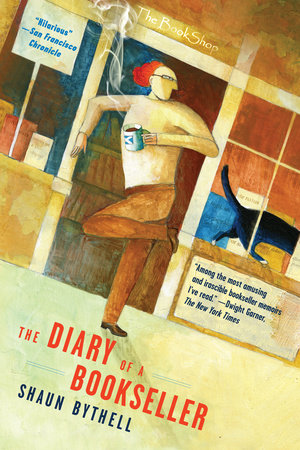
The Diary of a Bookseller by Shaun Bythell

The Diary of a Bookseller by Shaun Bythell

What would it be like to work in a bookstore in a wee Scottish town? Cold, for one. But reading Shaun Bythell’s descriptions of bookshop life is nothing but warm and cozy, with plenty of chuckles along the way. The curmudgeonly owner of Scotland’s largest used bookshop relays daily tales of customers (the cherished ones, the crotchety ones, and the fools), books read, books acquired, tasks and chores completed, conversations overheard, complaints raised, and stupid questions asked by book seekers. There always seems to be a kettle on, a fire stoked, a great big stack to sort through, a warming dram to sip with a visitor, a cat slinking around… If you can’t get to a bookstore, but you’re pining away for a good browse and a good steep in that wooden-shelved aura, read this. A warning, however: may result in a deepening desire to book a flight to Scotland!

The Bookshop by Penelope Fitzgerald

A widow opens the only bookshop in a small seaside English town, and problems ensue. The other shopkeepers are not too happy with her, she incites the wrath of the local arts patroness, and her dilapidated store creaks, leaks, and is haunted by a ghost. Take away the pesky problems, and the premise has the makings of a dream many of us bibliophiles may have—a sweeping coastline, a quaint town full of quirky characters, a charming bookshop, and a passion to inspire others by way of literature. But this is a melancholy tale, a slim tome about a kind, determined optimist who tries, despite the ugliness of the world, society, and people. Exquisitely crafted sentences and characters, powerful observations, and a bibliophilic bend: read it and weep.

The Storied Life of A.J. Fikry by Gabrielle Zevin

Another widower with a bookstore, another curmudgeonly bookish soul, another small town inhabited by quirky types… add a bit of mystery, a dash of romance, and you have the recipe for an enticing, escapist read (if it’s a bookstore that you want to escape to). A.J. Fikry is a depressed bookstore owner, a grieving grump with a drinking problem and a bookstore in a slump. There’s too much opportunity for spoilers here, so let’s just say that everything changes when he receives an unexpected package. If you favor grouchy, persnickety book nerds, you’ll get along swimmingly with A.J. Fikry.

The Sentence by Louise Erdrich

Louise Erdrich’s latest is a romp: an ex-convict works in a bookstore that’s haunted by the ghost of a former customer. Boisterous, poignant, powerful, stippled with richly colored characters… even on the sentence level, this book bristles with color and electric energy, building an absorbing flow that keeps you flipping the pages. This is a ghost story, a Native American story, and a mystery for the present day that touches on the pandemic and Black Lives Matter protests. At its core though, The Sentence is an ode to bookishness that name drops titles and authors galore, details the minutiae of operating a bookstore, and even features cameos from the author herself (who really does own a bookstore!). 

Shakespeare and Company, Paris: A History of the Rag & Bone Shop of the Heart, edited by Krista Halverson

One of the world’s most famous bookstores distilled into book form. This gorgeous volume is a must for any fan of the Parisian haunt or for those wishing to visit. A history of the shop that delves into its rich archives, resulting in a collage of memories and mementos, rare photos, essays and poems from the luminaries that stepped through its doors or even slept in the beds tucked between bookshelves, like Allen Ginsberg, Anaïs Nin, and Lawrence Ferlinghetti. Rifling through this tome feels a bit like walking through the shop’s hallowed book-lined halls, full of treasures and surprises, inspiring words emblazoned across stair steps and doorways, corners of poetry and handwritten notes, a magic well, a typewriter hidden away in a nook, someone plinking away at a piano somewhere… it is enchanting.

Mr. Penumbra’s 24-Hour Bookstore by Robin Sloan

A dusty old San Francisco bookstore is the setting for a rollicking adventure complete with teetering shelves lined with mysterious books, bizarre customers, and a 500-year-old secret society. Books and computers clash but ultimately co-exist in this love letter to bookishness and technology alike, an ode to both analog and high-tech, print and digital. A mystery to get lost in and a bookstore you won’t want to leave!

Unlike Miss Havisham, I Chose To End My Marriage

On Halloween morning when I was fourteen, I got up extra early and padded into my mom’s room, where she had left her wedding dress hanging for me on the closet door: Victorian-style, head-to-toe lace, with a high collar and a tidy line of buttons all the way to the small of the back. It felt out of place in the cold master bedroom of our house in central New Jersey, a relic from my mom’s previous life. She never talked about her wedding, but I had seen pictures: the ceremony on the broad deck of her and my dad’s house in Golden, Colorado, the steep mountainside sloping in the background. My mom beaming under a crown of wildflowers, my dad in a corduroy coat and aviator sunglasses. 

The rare times she talked about that life, her stories left a hazy gap where he might have been. It was as if she had been alone that whole time, in that other, more beautiful life she had before I was born. I imagined that had things turned out differently, I would have lived that life with her—where I truly belonged. It seemed a better fit than our lackluster suburb, where my mom referred to our neighbors’ houses as “McMansions” and the nearby Sourdough Mountains as “pimples.” Here, everyone thought I was a freak for preferring summer reading to Shark Week.

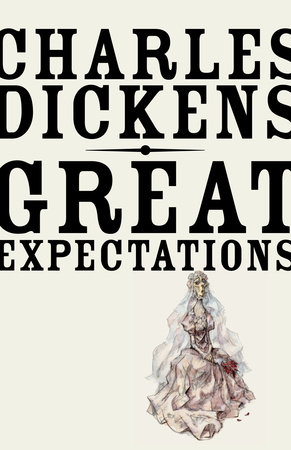
Great Expectations by Charles Dickens

I fastened the buttons, and the dress molded to my form. With my mom’s eyeshadow, I carved dark circles under my eyes. I powdered my hair white, pulled on opaque white stockings, and slipped into one white shoe. I hobbled back and forth in front of the mirror, the perfect Miss Havisham from Great Expectations. I was a little obsessed with her. The morning of her wedding, she received a note from her swindling fiancé informing her that he would not go through with it, so she chose to quit moving through time. She stopped all her clocks, refused to dispose of the food that had already been laid, and never removed her wedding dress or donned her other shoe. For the rest of her life, she wandered her cavernous mansion, her back crooked from wearing a single high heel for decades, the lavish dining room stinking of rotten cake buried under a thick coat of dust. 

Dickens framed Miss Havisham as a harbinger of revenge, raising her adopted daughter Estelle to settle the score by breaking men’s hearts. In my melodramatic fourteen-year-old mind, I interpreted her as a symbol of endless love—something deeply romantic, even if tragic. But I also felt a strange kinship with her.

At nineteen, I shared a fleeting exchange of emails with my father after a lifelong silence. For the first hour of my life, he told me, my mom was under anesthesia from a traumatic C-section. He stood over me, feeling empty, like I was his but he wasn’t mine. So he left and broke a year of sobriety. Later, my mom admitted that before she was fully conscious, she heard the nurses saying, “We have to kick him out, he’s going to hurt the baby.” She came to while he stumbled around, veering dangerously close to me before collapsing on the floor. It took her four months to pack me up and leave him, but their marriage was over as soon as she opened her eyes. 

I’ve spent much of my life trying to untangle why my father did what he did that day, but the reasons we lose things are often murkier, and less telling of who we are, than how we respond. No matter how much a situation might have gotten away from us, the choice to leave it behind is a choice to take control. We call it “change”; we applaud ourselves for growing, for making the difficult decision. On the other hand, the transitions that feel the most violent are the ones that aren’t our choice, the sucker punches that leave us gasping: Miss Havisham crushed on her wedding day, my mom waking to a new baby and a drunk husband on the hospital floor. That’s what we call “loss.”

No matter how much a situation might have gotten away from us, the choice to leave it behind is a choice to take control.

Few things are farther from our control than what happens to us in infancy. We are completely beholden to the people around us—for survival, yes, but more importantly, for love. The way we are loved shapes our understanding of what the world is: a safe place, where we will be wanted and comforted, or an unstable one, where we might be abandoned at any moment. My first experience of the world was the sorrow of abandonment by the person who is supposed to love you. I didn’t just lose my father or the life I might have had if we had stayed in Colorado. I lost my sense that the world was a safe place.

It’s not surprising, then, that for as long as I can remember, fear has followed me like a ravenous shadow at the edges of my vision. As a child, I developed the sense that the way someone arranged objects held their feelings in that moment. More importantly, I believed, it aligned the world’s cosmic order, preserving the good and keeping things stable. When I was eleven, my obsession with hawkishly guarding the placement of objects in my room led to an OCD diagnosis. But therapy never helped me shake the feeling that if I could keep everything around me in balance, I would keep the shadow at bay.

When I was 14, right before reading Great Expectations, I got dumped for the first time. For weeks after, I kept the half-full mug of tea I’d been drinking during our last good conversation on my desk, feeling that if I could just keep it there long enough, he’d call and tell me he’d changed his mind (he didn’t, and after a raucous power struggle with my mother, she dumped the tea and washed the stinking mug).

When I read Great Expectations, I was transfixed as Miss Havisham kept one shoe on her dressing table, exactly where it had been before she got her fiancé’s letter. As she made Estelle sit at her feet and patch together the tears in her dress because she refused to remove it even for repairs. In her, I saw the darkest part of me—never wanting to change anything, preferring to create living mausoleums of the moments when I had been happy. 

In Miss Havisham, I saw the darkest part of me—never wanting to change anything, preferring to create living mausoleums of the moments when I had been happy.

Perhaps more than that, I saw the fear of what happens after the moment when you think you have lost everything: as terrible as it is, there’s an instant when you think, I’ll just stop here. You keep the shoe on the dressing table, the mug on the desk, and you let yourself believe that, even if it doesn’t bring the good back, maybe you won’t have to figure out how to weather what happens next.

Though most people don’t go to Miss Havisham’s lengths, I do think that the urge to preserve the feeling of what it was like to live before loss is relatable. In that terrible moment after loss, some of us fall into one of two extremes: we cling, like Miss Havisham, or we discard the past. My mother chose the latter. She had a divorce to file, a home to find, a child to raise. She moved me to New Jersey to be close to her family, discarded the trappings of her old life – my father among them – and barreled forward, telling me stories that excised him out. 

On that Halloween, when a neighbor commented that she couldn’t believe my mom was letting me wear her wedding dress as a costume, my mom laughed and said, “It’s a divorce dress, it might as well get some use.” I grew up grateful for my mom’s sacrifices. She left everything – her home, her relationship, even her dog – because that’s what was better for me. But I resented her silence around my father because it left me few tools to piece together my origin story. At twenty-nine, however, I began to understand the power of discarding old lives when I realized that I, too, needed to get divorced. 

For years, I had whittled myself smaller and smaller to fit the whims of my own alcoholic husband, putting off his anger by becoming the person he wanted me to be. I had little control over the volatility of his addiction—and therefore, over my life. But, like keeping an old mug of tea on the desk despite the smell, keeping the marriage intact by keeping everything – even myself – the same felt like something I could do. At a certain point, my life felt like a prison.

In a toxic situation, your marital status sometimes begins to replace your identity.

People often ask me why I didn’t leave sooner. I try to explain that in a toxic situation, your marital status sometimes begins to replace your identity. Without it, who would you be? What shape would your life take? Losing it can mean losing everything that makes your life recognizable to yourself. The prospect of losing that structure is terrifying. 

Miss Havisham likely felt similarly. When her fiancé backed out of the wedding, she no longer had the option of becoming a wife, but the prospect of it had come to structure her entire existence. Who would she have been, if not for a bride? She even insisted that, when she died, she would be laid on the dining table in her gown: a bride for eternity in death—and that, nobody could take from her.

Leaving my marriage felt like jumping straight into the shadowy maw of uncertainty I’d been running from my whole life. But as my mom learned on the day of my birth, once you’ve looked the end of a marriage in the eye, you can’t unsee it. Instead of taking Miss Havisham’s path as I might have in my youth, I adopted my mom’s strategy. I discarded the life I was losing, and did  my damndest not to look back.

I moved into a ramshackle Brooklyn apartment lovingly dubbed “The Folk Hotel” because of its coterie of musician roommates who time-shared the back bedroom when they weren’t on tour. It was bedecked with a chaotic jumble of items left by previous residents: when I moved into my room, I was greeted by a mannequin wearing a rubber eagle mask and a tiny painting of a bulldog with a Jack of Hearts card wedged in the frame. I fell into an accidental stewardship of the place, ferrying subletters in and out, each of whom added something when they left: a purple handkerchief from the French girls on holiday, sheet music from the British modern dancer who I shared pots of coffee with on brief, radiant fall mornings. It felt like home in a way that no place had in a very long time. Every time I walked in, it was like the apartment whispered to me, this is your reward for taking back your life.

I adopted my mom’s strategy: I discarded the life I was losing, and did  my damndest not to look back.

I wasn’t used to this kind of chaos. Good chaos, where people left trails of objects ripe to be shared, nothing ever stayed in the same place for very long, and everything changed all the time. Change itself became familiar. I was living Miss Havisham’s nightmare. 

It had once been my nightmare, too. But despite my OCD, and my instinct to keep everything around me the same, lest the world spin out of control, it was a relief to be unable to control all the change around me. People moved in and out, left and took and moved things, and I felt liberated. Perhaps, I realized, I was less afraid of change than I was of loss. I decorated my room with tiny mirrors so I could watch myself change: I lost weight from biking in and out of Manhattan every day. I wore crop-tops my ex-husband would never have let me wear, dyed the tips of my hair purple. I spent long nights biking the city’s bridges, every stroke of my pedals reminding me that my body, my movement, my life were mine, mine, mine

To say this was easy would be to lie. That first winter, I spent most nights sitting in my windowsill, my legs dangling over the avenue, long after the laundromat across the street had closed. It was the only time of day when the world was empty and quiet enough to match how alone I felt. Constantly, achingly. I had never been so terrified. I had never felt so powerful. No time in my life had felt so thrilling, so precious as those nights I spent sitting in that window, relishing that I was there but for my own grace. In leaving my old life behind, I had chosen myself. Even the loneliness was precious because it was mine.

In leaving my old life behind, I had chosen myself. Even the loneliness was precious because it was mine.

I was about the same age my mother was when she packed me up and left my father. I couldn’t imagine doing it with a baby. I found myself more grateful and more in awe of her than ever. I began to understand how discarding the life she had before I was born was the only way she could get through. By leaving everything behind, my mother and I created new worlds for ourselves. We became powerful in the aftermath of gutting loss. 

I wondered if Miss Havisham felt the same way. She had slipped into a horror of her own making, but it belonged to her in a way that nothing else could.

I thought that my mother’s approach and Miss Havisham’s were opposed. But, just as clinging to the past wasn’t an option for my mother, starting anew wasn’t an option for a woman in Miss Havisham’s era. Perhaps stopping time was the only thing she could control, and she and my mom weren’t so different after all. Miss Havisham hadn’t just clung to the past, she had made a world in her own image when the world around her wouldn’t comply—a radical act for a woman then, a radical act for a woman now.


When the pandemic hit, I was on vacation out west. I felt like the rug had been pulled on a life I was just learning to own. This was true for everyone: whatever lives we were living before were gone in an instant. And, unlike other losses, where we could feel some power by putting one foot in front of the other and slowly building new lives, this time, we were caught in suspended animation. 

While she paced her rooms, her wedding dress caught fire. Miss Havisham died a victim of her own obsessions.

Hunkered down at my mom’s in New Mexico, I wrote obsessively about my life at The Folk Hotel. In my dreams, I grasped at things I couldn’t see and couldn’t reach, my fists curling around air over and over again. I couldn’t face The Folk Hotel the way I’d left it, when I thought I was off for a quick jaunt and would come home to the same old wild life. I was afraid I’d go full Havisham if I went back. The possibility of stopping time and pretending the world was not upended was just too tempting. But I ended up going the Havisham route regardless: I kept paying rent in Brooklyn even though I had no idea when I would return. I felt that if I could just keep The Folk Hotel the way it was, even from afar, maybe the life that had been so precious to me there would still exist. 

But there is only so much suspended animation a person can take. Six months into the pandemic, I found myself building a new life in Los Angeles, one that I was starting to realize made me even happier than I was before. Before I could accept that I was moving on, though, I needed to go back, even if just to pack my things.

It felt even more like walking back in time than I’d expected. A part of me was tempted to burrow in it. Then, as I sorted through my books, I found my high school copy of Great Expectations and spent one last evening sitting in the windowsill, skipping through to read all the Miss Havisham parts. 

Though I’d thought about her so much, it had been years since I’d read the book. I’d always known she was unstable and, though I didn’t think of her as a true model for how life should be lived, I had respected her as a badass who took control where she could. But I was shocked to find that the control was what killed her. She kept the curtains drawn to block the light (and, thus, the passage of time), so she always had candles burning. While she paced her rooms, her wedding dress caught fire. She died a victim of her own obsessions.

How had I forgotten that? 

I closed the book and looked down at my feet, dangling out the window like they always had. I had thought that, whether you cling to the past or discard it, any control in the aftermath of loss was a good thing. That’s what made Miss Havisham a legend, enabled my mom to give me a good life, and made me happy at The Folk Hotel. 

But it also killed Miss Havisham, draped a heavy silence around my mom’s former life, and turned out to be an illusion when the pandemic yanked any control from my life I thought I’d held. At all the times when I had tried to cling to the past or discard it, all I had really done was keep myself from facing the fact that I had lost something. All I had done was forebear grief.

If we’re not careful, the illusion of control can drive us crazy. There will always be losses where we least expect them, moments that leave us before we are ready to grow out of them. Perhaps the only control we have is in choosing how we grow from loss. Grieve, preserve what you can, and begin to build again.

In Los Angeles, I unpacked my things from The Folk Hotel and realized that they looked good in the Southern California light. That they hadn’t lost any of their magic in new arrangements.

Genderqueer Short Stories About the Ways We Mythologize Our Identities

A nonbinary teenager on their way home from an eating -disorder treatment center who tries to convince a stranger she is not a vampire, an aspiring fashion designer/dry-cleaning worker who develops an obsession with a customer, a community of people with Hansen’s disease that welcome and attempt to coexist with a newly arrived group of people displaced by natural disaster—these are only some of the inimitable characters Morgan Thomas follows in their stunning debut collection, Manywhere. These characters move through and navigate the complexities of their communities with immense precision and stayed with me long after the first time I read these stories. 

Manywhere interrogates the complications of constructing a personal narrative, especially those faced by queer and genderqueer people—How does our relationship to others affect our own identity-making? How have our own identities and history benefitted from the marginalization of others? What have we inherited from our ancestors, and what do we owe to them in how we live our lives?  

I spoke with Thomas over Zoom about using historical records in fiction, navigating inherited narratives, and the relationships people build not only with each other but with their environments. 


Matthew Mastricova: There’s a line in that story that served as a lodestar for me in reading this collection. It’s when the narrator Taylor says, “But I haven’t come looking for family. I’ve come to meet you, lightning man.” It signaled to me a repeating theme throughout this collection: the tension between inherited narratives and self-determined narratives. I was wondering if you could talk a bit more about how your stories manifest or are guided by that tension.

Morgan Thomas: All of the driving impulse behind the collection as a whole was a search for ancestry and lineage. It began as a search for a specific type of queer and genderqueer ancestry. I was in a space where I was trying to understand my own identities—my own gender, my own sexuality. I felt like I lacked language and models for identity on both of those axes, and I wasn’t really in a place where I could look around immediate contemporary environment for those models, and so I found myself increasingly looking toward history. And as I looked at historical figures and models, I realized both that they were abundant and also that those queer and genderqueer ancestors were really complicated. I think that Manywhere, is in large part, my attempt to wrestle with those complicated histories. By complicated, I mean that as a white settler who is genderqueer, it’s appropriative for me to claim as an ancestor an indigenous historical figure who had a gender identity that didn’t conform to settler colonial ideas of a binary gender. It’s appropriative for me to claim a Black gender-diverse individual in history, so I’m working with white lineages that are queer and genderqueer, and that means that these people are also often, I think actually without exception, complicit in projects of settler colonization and structures of racism. It’s wrestling with these lineages that I had searched for and these stories that I wanted to claim said something about myself, but together with those I was also inheriting more complicated and complex legacies.

MM: As we’re talking about looking through the archives for historical models of queerness, I was wondering how you navigated using the archive when so many of these historical figures are not identified as queer.  How does an author responsibly incorporate those models and narratives into their work?

MT: That was something I thought a lot about as I was writing. I think partially it’s why the collection has to be fiction. There are a lot of gaps in historical record. So, for example, the story “The Daring Life of Philippa Cook” is based on the life of Thomas/ine Hall, but all I know of Hall’s life is the earliest piece of it, up until the trial transcripts that served as the seed of that story. After that there’s nothing. In fiction, I’m able to write into and extend that story and that life. I also think that fiction allows me to avoid saying anything definite about the gender or sexuality of the historical figures that the stories are thinking about and writing toward. For instance, I deliberately used “you and I” in “Taylor Johnson’s Lightning Man” instead of any pronouns that would inscribe gender or suggest that I had a firm sense of what pronouns Frank Woodhull would have used if Frank Woodhull existed in 2021, and that was really important to me. I don’t want to take contemporary notions of what it is to be queer or genderqueer and force those upon a historical figure or insist that those applied equally a century ago, or four centuries ago.

I like the idea that the ways that we think about queer and genderqueer identities are fluid throughout time. That feels really hopeful to me, because I think it suggests the possibility for different ideas of queerness and genderqueerness in the future.

MM: So you have these stories that are based that are based on archival figures, and then you have “Taylor Johnson’s Lightning Man” where it’s explicitly Frank Woodhull. There is archival information about that person explicitly in the text. Is the Woodhull that Taylor talks to in the story the historical Woodhull or a characterized version of that person?

MT: I want the story to have space for both. I mean, clearly I think it’s fictional and that’s the benefit again of being able to have this narrator who, I think, is seeking something from Frank Woodhull, and so is creating a Frank Woodhull that satisfies their own needs and desires in that moment. Also, much of the dialogue spoken by Woodhull at the end of that story is taken from newspaper articles from the time and from interviews that Frank Woodhull actually gave. So it’s a blend of a Frank Woodhull that Taylor Johnson has created for themself and of Frank Woodhull in the past, and I think that blend is also filtered itself through Taylor Johnson’s experience. 

I don’t want to take contemporary notions of what it is to be queer or genderqueer and force those upon a historical figure or insist that those applied equally centuries ago.

That’s where I think fiction can get really interesting, because then there’s a second layer where there’s this blended character who is a Frank Woodhull historical and non-historical character and then there’s also Taylor Johnson, who has created that character, and then there is myself, the writer, who has created the character Taylor Johnson who created the character Frank Woodhull, and when I start to see that telescoping process of creation and narration, that’s when I get really interested in story and what stories mean to us, why we create the stories that we do and what they say about us.

MM: Do you think that process of blending fictionalization and research is also similar to how we relate to the people who raise us?

MT: Oh, I don’t know, possibly. I think all of all of the stories in Manywhere, both those that deal more with folks seeking ancestors that they are not descended from by blood and those that deal more with inheritance on the level of like grandparents and parents, are interested in constructed narratives and in the flimsiness and fluidity of the stories that we tell about our ancestors, whether we have sought and chosen those ancestors or whether we are descended from them by blood. 

I’m not sure, to be honest with you, whether the process itself, though, is the same. This makes me think again about being a settler and a white writer from the South and the fact that so much of what I inherit from the ancestors from whom I am descended by blood are legacies of Southern colonization and slavery and racial violence. In that regard specifically, the responsibility feels different to me. It feels somehow less about constructing narratives and filling in gaps and more about holding myself accountable for the narratives and beliefs that I’ve inherited. Thinking critically about those and trying to dismantle any aspect of those inherited narratives that is inherently racist or white supremacist or colonial in nature.

MM: Something that I kept thinking about while reading your book was the relationship between the healthcare industry and marginalized individuals, especially during “That Drowning Place” and “The Expectation of Cooper Hill.” I was hoping you could talk a bit more about that relationship and how it manifests in your stories.

MT: Manywhere is deeply concerned with our relationships with our environment and with the health effects of the places where we live, whether that be the fracking in “Surrogate” or how in “That Drowning Place” we’re seeing individuals have to leave their homes because of rising sea levels and then sort of come up against other communities.

So much of what I inherit from the ancestors from whom I am descended by blood are legacies of Southern colonization and slavery and racial violence.

Manywhere is really concerned with the body, and when I think about health care, I just know that current healthcare systems are not designed for queer or genderqueer people, and I think about myself, my partner, the many people in my community who have had to act as self-advocates. They’ve had to figure out how to navigate systems that are deliberately attempting to inhibit their access to care that they need from gender-affirming care to lifesaving care. I think that that is not something that I deliberately included in the stories, but I think that it’s a thread that is present.

MM: You’ve written about your history of attempting to write genderqueer embodiment and grappling with what it means to be a white genderqueer person. I was wondering if your relationship to that has changed it all in the process of writing this collection, because the physicality of these characters was one of the things I really loved.

MT: I think that what that essay highlights is how indebted I am to the writers who have come before me. I think about Rivers Solomon’s An Unkindness of Ghosts, which I think is one of several books that taught me how to write genderqueer embodiment. I think, also, about Freshwater by Akwaeke Emezi. I think about Joshua Whitehead’s work. I think about Abbey Mei Otis and I think about Billy Ray Belcourt’s memoir, which came out much more recently, but which has been a real guiding light for me. These are permission-giving books: they expand the ways that I feel able to think and write about both gender and sexuality.

I think it answer your question, yes, my ability to think through on the page and to write genderqueer characters who are fully realized as physical beings in the world has shifted since I began Manywhere. I understand now better how to inscribe bodies and complex relationships to bodies for my characters, and I think that that’s in large part due to the foundational and courageous work of those other writers, and I’m really grateful to them.

MM: You spoke about how humanity’s relationship to the environment was a major factor in Manywhere. I love the ways in which queerness and the environment were put into conversation here. There’s two questions I want to ask—One is what led you to explore this relationship, and two, what are the types of relationships you hope people see in this collection?

MT: One thing that is important to me as a writer when I’m thinking about ecology and environments is to remember that ecology is, just at its most basic definition, a word that we use to describe how we relate to each other as beings, and also how we relate to our physical environments. So it’s important to me that when I think about Manywhere as a book that’s engaging with ecology or a book that’s engaging with the environment, that’s different, I think, from saying that it’s a book that’s engaging with “nature”, as though it’s something that’s different from the places where people are living or congregating or from cities. 

The current healthcare systems are not designed for queer or genderqueer people.

When you’re asking like what relationships I’m hoping people see in the work, I’m hoping that people recognize that ecological and environmental relationships are happening everywhere and anywhere that people are interacting with one another and the people are interacting with their environment. I think there are ways in which the study of ecology and my own approaches to and study of queerness are very similar in that they both feel like they’re centered on relationships, and I’m trying to describe, understand, and expand the ways that we’re thinking about about relationships.

I hope that people see in Manywhere a few threads of environmental lineage. “Surrogates,” I think, is the clearest example where the embodiment is used in part to explore the effects of fracking on the health of people who give birth and infants, and it was sparked by an article I read in Rolling Stone about a midwife in Vernal, Utah, who had been speaking out about the health effects of fracking on infants in that town and received a lot of pressure from other people in the town as a result of those comments. So I was thinking a lot about the often binary and transphobic big ways we think about like childbirth and parenthood. I was also thinking about the ways that individuals and towns that are right up against industries that are polluting engage with those industries. And I was also thinking about, within that story, the many different ways that we can have intimacy with other people. So Brighton is in a sort of monogamous and to-some-extent heteronormative relationship with her husband and also has this different sort of intimacy with the other surrogates and with Doc Lacher. I think all of those questions and all of those relationships are ecological in nature, and in that regard, I think that Manywhere is a deeply ecological book.

MM: There’s a healthy tinge of fabulism throughout Manywhere. I’m thinking particularly of “Manywhere” where we have the other daughter and “The Expectation of Cooper Hill” with Sylvia falling into the bag. How did you come to fabulism as a storytelling tool, specifically in this deeply ecological and embodied collection?

MT: There are two things that are coming to mind, for me. The first is that, again, as a writer interested specifically in thinking about and writing into historical gaps that have to do with queer and gender-diverse ancestors, speculation feels like a necessary tool, and fiction feels like it offers a lot more space for speculation than, say, nonfiction. I think there’s a natural logical leap from that type of speculation that is necessary to fill gaps in historical records to what we think of now as speculative fiction. There’s something really interesting to me as a writer about blending deeply researched fiction with elements that are fabulous or speculative in nature.

I think the other thing that comes to mind for me is that when I have tried to approach queer joy on the pages as an author, or when I think about the way that the narrator of Manywhere at the end of that story feels this ephemeral sense of liberation from their father, and of joy, I realized pretty early on that I didn’t have in my life at the time many actual models of that type of queer or genderqueer joy, and I think that attempting to end up at that space required these leaps and moments of invention which I think also lend themselves directly to the fabulous elements that you see in the stories.

MM: I love that. I think queer joy is something that is largely missing from received cultural narratives surrounding genderqueerness and queerness in general. Which is another thing I loved about this collection, I felt like it inverted that received narrative of like, “Oh, when a child is queer they’re rejected by their families,” but so many queer people actively seek out joy and liberation. Was this a relationship you aimed to capture?

MT: I think probably the most honest answer is that often on the page I’m writing towards the place that I’m hoping to get in my life, and I think that place is not always a place of joy. It might be that space of full accountability, or it might be a space of deeper understanding of myself and my identities, and it also might be a space of joy. I think that I write narratives that I want to read and maybe aspects of the emotional tones of Manywhere, especially around joy, are things that I was writing into because maybe I had not, when I was writing the stories, experienced them and I wanted to.

The Daring Life of Philippa Cook the Rogue

“The Daring Life of Philippa Cook the Rogue” by Morgan Thomas

Wherein is treated how they came to be a Rogue, and by being so what happened to them. 

Deposition taken before John Pott, Esquire, Governor, James Town, on this 2nd day of April, 1629

I am Philippa Cook, and yes, I know something of devils. I am twenty years old, or thereabout. I am both a man and a woman, as I said already to the Captain Clayborne when he did ask, and as the three ladies sitting among you in the court might also attest, having after some bickering and contention amongst themselves come to a consensus of my sex based on three independent inspections. 

The court charges that I, on the Feast of St. Nicholas in the house of Captain John Clayborne, did lie with the maid of John Clayborne, the woman known as Great Bessie. As I, before and during this unfortunate lay, was attired as a man, the court proposes to charge me, as a man, with lewd misconduct before the jury, an unmarried servant being unfit to lie with any woman. 

I do not contest the charge that I, on the Feast of St. Nicholas in the house of Captain John Clayborne, lay with his maid, a woman named Bethany. I have loved in my life both women and men, and I have known the Goodwoman Bethany. However, I fail to acknowledge the court’s ability to try me as a man simply because I was clothed as one. I currently live so attired, because the Claybornes hired me as a man to work their tobacco fields. I still venture out on occasion in women’s garb to get a bit for my catt.

After this testimony, the court ordered that it shall be published in the plantation where Cook liveth that he is a man and a woman, that all the inhabitants may take note thereof, and that he shall go clothed in man’s apparel, only his head in a woman’s coyfe and crofcloth with an apron before him, and that he shall give sureties to the court of his good behavior from quarter court to quarter court until the court release him.

From: Shoo Caddick [shooflyshoo@gmail.com] 
To: Mo Silver [nomo4u@hotmail.com] 
Fri 12/5/2018 7:46:42 PM 

I received the scans of Philippa Cook’s letters and can’t wait to read them. To think they’ve been in the Netherlands all this time. Yesterday, I booked passage to Amsterdam on a cargo ship. I’d like to see the original letters in person and, if we can agree on a fair price, purchase them. I’ve wanted to visit Amsterdam for years now. I’ve heard it’s a great place to be queer. 

A bit about me: I’m an actor, not a historian, by training. I came across Philippa’s story while playing the servant in a manor home in historic Jamestown. Philippa fascinates me. My girlfriend, Reed, says I’m possessed by them, and I do think of myself sometimes as a sort of reincarnation. I’m not connected to them like you are, not an actual descendant, but I left home at sixteen, like Philippa did. I’ve worked half a dozen odd jobs, and I’ve left very one of them. Like Philippa I understand it’s impossible to make a life in Virginia. Philippa left Virginia and never looked back. That’s my plan, too. 

I booked passage without asking Reed. I don’t think you need to ask your girlfriend every time you decide to cross the Atlantic. Reed, apparently, does. When I told her you had two letters written by Philippa, and I was going to Amsterdam to get them, she said, Did you consider me while making this plan? I had. I’d considered her, and I’d considered the timing was shitty. Reed defends her thesis next month. Still, I thought she’d be excited. Philippa brought us together, once. Reed liked to remind me they were a colonist and had probably raided the Mattaponi and the Pamunkey. I liked to remind Reed they were indentured, so if they’d raided anybody, it was only because they’d been ordered to. Reed liked to remind me that didn’t absolve them. We agreed on one thing—we both loved a Rogue. 

Your letters didn’t interest Reed. Most likely forgeries, she said, which is just like an academic, so skeptical. I don’t understand why you want to be like Philippa, she said. Their life was a tragedy.

Tragedy. That’s a big word. You don’t see me going around saying whose life is or isn’t a tragedy. 

You need Philippa, Reed said to me. You need to believe you’re from somewhere. She’d said that before. She’d said that a hundred times, and I think we were both a little surprised to find ourselves, at the end of her saying it, uncoupled, facing each other across the threshold of her apartment. Me in the hall outside. Her with her hand on the door, closing the door, which was her right. She paid for that door. It was her right to close it and leave me to figure out my own shit in the cold. 

Before she shut that door, Reed said, I knew you’d take off. Like Philippa did. Like a man. Like the worst sort of man. I should have argued with her, but I didn’t, because when she said, Like Philippa, I felt a surge of pride. 

I should arrive in Amsterdam on December 20, assuming no delays. Hold the letters for me, would you? 

From Governor John Pott, James Town, to Peter Minnewit, Director, Dutch West India Company, on this 8th of May 1629 

Please be aware of the probable arrival of a servant of this colony by the name of Phillip Cook, who was judged by the quarter court of James Town to be guilty of misconduct with a maidservant, which did result in a child, and so sentenced to a probation with regular presentations at the quarter court. He has disregarded the presentations, the contract of his indenture, and the responsibility of his fatherhood, fleeing across the Chesapeack. We believe he intends to evade the law by taking up residence in your colony. 

Given his departure, it was thought fit by the general assembly here in James Town—the Governor himself giving sentence in Cook’s absence—that Cook should be branded a Rogue and stand four days with his ears nailed to the pillory, and I do ask that you make haste to return him that he might stand this penalty. 

I warn you also that this person Cook does wield his sex and clothes as another man wields a sword, striking with first one blade then the other, as is most convenient for him. Though I’ve not had the opportunity of inspecting him myself, I’ve heard from sources I trust not only that his sex is aberrant, but that at knee, where the leg joins the thigh, he hosts a pair of lidless eyes, and his feet are like the talons of a bird, which is the reason he avoids the bath. I trust you will undeceive him of the notion that your colony offers respite for the criminals of James Town and send him back at once. 

Jan Braeman, Secretary of Isaack de Rasieres, Provincial Secretary, dwelling upon the Heerengracht, not far from the West India House, to Governor John Pott, James Town, 18 June 1629 

Philippa Cook did arrive in this colony not three days after your letter. I appreciated the forewarning, as it saved us much confusion. Soon after she arrived, she presented herself at the church. She looked not unwell but weary from her travels, which she’d made without ample food or companionship. She denies the crime of which you accuse her, and she denies fathering any child—this latter point comes as no surprise, as she is such the woman in face and dress. 

I fear the days of the Director and members of his Council are much taken up with the managing of this colony. It’s been left to me, then, to translate your letter and determine how best to handle this matter. I hope you’ll give me leave here to unburden myself of a sorrowful circumstance. It pleased the Lord, seven weeks after we arrived in this country, to take from me my good partner, who had been to me, for more than sixteen years, a virtuous, faithful, and altogether amiable yoke-fellow; and I now find myself alone with three children, very much discommoded, without her society and assistance. 

I must see, then, this Philippa’s arrival as a blessing of the Lord. I have two small daughters, and there are no maidservants here to be had, which makes Philippa’s service invaluable and greatly decreases any concern she’d take up with one. She’s a fine seamstress and a good nurse to the children. They especially enjoy her tales of the Battle of Rhé, which she recounts with the blunt and bluster of a seasoned army man. She has determined to start a garden come spring and is planning the rows and the vegetables, which she calls by the queerest names: Sea Flower and Muske Melon. It’s a quiet life for her here, which helps an excitable woman. 

Whatever her guilt, I cannot recommend that she be returned, nor can I ensure that if you send men into this colony after her they will be welcomed. We at the Manhattoes have no men to escort back to James Town those pitiable servants which slip through the fingers of the English. 

From: Shoo Caddick [shooflyshoo@gmail.com] 
To: Mo Silver [nomo4u@hotmail.com] 
Fri 12/13/2018 2:24:07 AM 

I hope my last email didn’t put you off, as my writing was fueled not only by my excitement but also by a box of cheap wine. 

Philippa’s letters aren’t what I expected. Not bad, just unfamiliar. It’s like the sag I feel after I have sex with someone for the first time and realize we’re not perfectly matched, not two halves of the same whole. 

It hasn’t changed my plans to come to the Netherlands, though my ship’s delayed. Stuck in its port of departure. It might arrive three days or ten days from now. When I told Reed about the delay, she said I might have flown for twice the money and a tenth the time, which I think she could have kept to herself. I asked if I could stay with her until the ship came. She said she didn’t think that would be healthy. Unhealthy. Like I was the grease soaking into her gluten-free pizza. So I’m crashing with my friend Nina. 

It didn’t take as long as I expected to undo my life. In a few hours, I’d pawned my things worth pawning and packed the rest into a duffel I carry slung over my shoulder. With the rest of my time, before the ship arrives, I’ll busk as Philippa outside historic Jamestown, where Reed volunteers on the weekends. I’ve made myself a bonnet from a linen napkin. It was easier to make than I expected, almost like someone else was moving my hands. Like Philippa was moving them. Then Philippa moved them right over this dress of Nina’s, the front panel of which has become my apron. If Nina misses it, there’ll be the devil to pay. That’s what Philippa would say. 

Philippa Cook to Rupert Cook, 7th October 1629, Newcastle-Upon-Tyne, Westgate, third house on the left, use the side door, watch the top step, give my mother a kiss from me. 

Brother, I write to you from the colonies to describe the circumstances of my departure from my indenture, about which perhaps you have heard. This is the truth of it, whatever other tales you might encounter. I have seen the devil, brother. The devil is a babe. 

When Bethany came with it in a sack, I thought it was currants. She said it’s a baby. I thought it must have come stillborn, which would have been a blessing, given it’s not cheap to bring up a child in the colonies. She, being indentured, would remain indentured all her life for that child, then the child indentured also. Then I saw it move. It thrust one arm against the cloth. 

I asked to see it, which she allowed. There was nothing of me in the face or in the sex. Satisfying myself on that account, I handed it back to her. She said she wanted me to sew something for it to be baptized. Doesn’t have to be big, she said. I could have sewed her a swaddle from two handkerchiefs, that’s how big it was. I agreed. 

I asked her was it Clayborne’s babe. She said I had no business asking questions like that, which I contested given the nature of our relationship. It’s a devil, she said. I said it wasn’t, but now I think she had the right of it. Devilish, it was. Maybe it’s yours, she said, as if teasing me, but I heard the trick behind her teasing, and I said it couldn’t be. She said it had to be somebody’s, considering the natural laws of these things and the cost of a child, which she couldn’t bear alone. Somebody has to help me with it, she said, looking at me. I couldn’t do that. I couldn’t help her, and I said that. I wouldn’t allow her to put on me half the burden of this babe, tether me to the child and to this cursed place and to my indenture for all of this life and into the next one. 

I offered her another solution. I know how it’s done. You can use a rock or you can use a pillow or you can swing it against a post. No need for Clayborne nor any person of the house to know. She looked at me like I was suggesting an impossible thing. Do you remember the uniformed devils at Rhé, who knew the ladders were too short for the castle walls, but ordered us boys up them anyway? Do you remember how we set them up against the wall, and the boys went up one after another, climbing climbing like they didn’t know they’d end at a face of white stone? Her face was like theirs when I suggested ridding her of the babe. Like I was calling upon her to climb and climb, knowing it would lead nowhere. 

She said she’d bring the babe to Clayborne if I refused to help her. I said she should do as she wanted, as it was not my affair. I should have known by then the game she meant to play. She went before Clayborne with the child, and she told him it was mine. He agreed with her. He had reason enough to agree. He’s married with four sturdy children still in England. Clayborne is a man like a bull who once locked and charging must charge on until his horns meet some wood or flesh, and he locked those horns on me. He insisted the babe was mine, insisted I go before the quarter court to answer for it. The court made me a fool in all but name, so I left. 

The morning I left, I went to Bethany’s room, but the child was there beside her, its eyes open and watching me, old old eyes, no babe’s eyes those. I knew the way you know a thing in your bones if I took a step closer it would wail for Clayborne, call him down on me and watch with no pity as he swung the bully club into the backs of my knees. Bethany was peaceful, sleeping. Loath was I to disturb her. Loath was I to stay. 

Do not worry the family about me. They are kind enough here. Still, I’d give any limb to be home with you. If you have the coin, buy return passage on the next ship bound for the colonies and send word to me. I’ll await her at port. 

Give my love to mother, to father, to sister &c. 

From: Shoo Caddick [shooflyshoo@gmail.com] 
To: Mo Silver [nomo4u@hotmail.com] 
Wed 12/17/2018 11:45:14 AM 

Are you receiving my emails? Let me know as soon as possible, immediately if possible. My ship has come. We shove off in an hour’s time, and I can’t afford to pay for internet on board. 

I’ve made enough, busking, to buy the letters at the posted price. Raising that money took some doing. At the start, I kept to Philippa’s script. I recited the court transcript and the letters, which I’ve memorized. I improvised only when a boy tried to join me on my milk crate or a man tried to strip me of my apron. But the people walked right past me, turned their backs on me any time a carriage rolled by, so I elaborated. I hiked up my apron and jigged. I peppered in jokes from Philippa’s time, like the one about the captain who had his arm shot off and, as the wound was being dressed, started laughing. When asked what was the matter, he said, I’ve always wanted my penis to be longer than my arm, and now it is. Then, I had a crowd. Then, the bills dropped into my bonnet. One man left a hundred-dollar bill clipped to a note that said, Nice show, kid. Buy a corset. 

Yesterday, Reed came past right as I told that joke to a crowd off a Philly tour bus. Reed stopped in front of my miniature audience. Reed had once loved my jokes, had once laughed so hard she pulled a muscle. Now, she was serious, disapproving. She said, loudly, What are you doing, Shoo? The bus crowd, sensing a domestic altercation, fled without dropping so much as a dime into my bonnet. 

I stood there in front of Reed, a little out of breath from the routine. You ruined the show, I said. 

She said, You look ridiculous. I did, I’m sure. The Jamestown court ridiculed Philippa. That was the point. Still, just like that she punctured that warm feeling I had, that puffed-up feeling of performing for an audience that’s on your side, that feeling you could make them laugh or scream with a word, with a twitch of your shoulder. You look like a boy, Reed said. Reed doesn’t like boys. What are they good for? she’s asked me more than once. Why do we need them? 

I am a boy, I said, which was one of my Philippa lines. 

Philippa never dressed that way, Reed said. Philippa left Jamestown so they wouldn’t have to dress that way. 

What’s your point? I said. 

Are you making fun of them? 

I’m making money. I’m trying to get to Amsterdam. I pointed roughly east, to emphasize this. Reed knocked my hand away, and right there something glinted. She had started something, touching me that way, roughly. 

She said, There are other ways to make money. 

Are those my earrings? I said, pointing to her ears, and they were. A pair of silver hoops. 

Reed’s hand went to one earring. No, she said. 

I said, Bullshit, and a woman walking by paused to ask Reed if she was all right, like I was bothering her. Maybe I was. Bothering her. The earrings were mine, even if Reed wouldn’t cop to it. She stood there, the nerve of her, with her research grant and her downtown apartment and everything a person could want, refusing me a pair of plated silver hoops. I felt not anger but a ruthless sense of injustice. I walked right up to her, and she froze, startled. You’re scaring me, she said. This made me sad, but not sad enough to stop me reaching out when I got close and taking the earrings, quick but gentle, from her ears. She caught my wrist, and we hovered there for a moment, wondering would she twist my wrist, would I pull back, would we hurt each other? We didn’t. She let go. 

People think it’s brave, Reed said, picking up and leaving. It’s not brave. It’s the easiest thing to run away like that. 

I hadn’t found it easy—the delays, no place to stay. I hadn’t found it easy at all, I said. I couldn’t live all my life in Richmond, Virginia, and I said that, too. 

It’s a fine place to live, Reed said. That’s the problem with Reed, the real maddening thing about Reed—she’s content. She said, We’re not living in 1629. 

You’re not, I said. 

You’re not, either. 

I told her my ship was waiting for me, though it wasn’t my ship and it wasn’t waiting for me but for a load of cereal grain coming by train from Iowa. Still, I loved the sound of it. My ship. I could see it—the waiting ship, which in my mind was wooden and rigged for sailing. I walked away. 

They’re laughing at you, Reed called after me. Don’t you see that? 

That’s the point. 

You’re humiliating yourself, she said. She sounded so satisfied, like naming what I was doing solved something. Shoo, she called. I didn’t turn. You don’t have to answer when a person calls you, not even if they call you by name. Philippa taught me that. 

I rode the train back to Richmond. There was one baby on the train, and I tried to flirt with the baby. I made little faces, puckered my lips, wrinkled my nose. Usually, babies like me. I made a whir I thought it would like, a noise like a fire alarm. It started to cry, at which point the man holding it gave me a look like I’d ruined something that wasn’t mine to begin with. 

Let me know when you get this email. I don’t need any lengthy reply, just a note that you’ve still got the letters, that you’ll be there when I arrive. 

Mrs. Hendrina Demkis, New York, to Mr. Edward Gant, College of William and Mary, 22nd April 1710 

Yes, I am the Miss Demkis that Minerva Clayborne remembers visiting her estate in fall of 1665. I was just fourteen. I was there with my nursemaid, Philippa Cook. It’s astounding Mrs. Clay borne has any memory of that day at all, though I suppose it’s true that as the lanterns darken yesterday, they brighten yesteryear. I’ll share what I remember to help with your history, though I hardly see how Philippa Cook could feature in a history of Jamestonian indenture. Our servants are paid for their work, their every comfort seen to. I can’t say the same of our neighbors to the south. 

Jan Braeman was my great-grandfather. He was never a friend of the Claybornes, not that I knew. We’d actually gone that day to visit the home of an esquire, John Pott. Papa Braeman had some need to see him and some business at the courthouse as well. 

Papa Braeman always kept characters in his employ, found them at the courthouse or the church house or on the run from an indenturor. A better Calvinist you never saw, but he got airs, Papa Braeman, funny ideas, and when he got them there was nothing to do but go along. For instance, he was in the habit, when he wanted a diversion, of taking his employees out about the town or to prayer meetings, showing them off. That’s the reason I ended up traveling with Nurse Philippa down to Newtowne, Virginia. 

When I knew Philippa, she was well advanced in years, and it was difficult to get her to focus on a conversation or a sewing job long enough to finish it, but I have it from my grandmother she made the finest bone lace in all New York, and if the samples she showed are any proof, it’s true. 

My grandmother was brought up by Philippa, her mother dying not long after she arrived in the colonies, and her father busy at the council or at his books. She remembered Philippa as something of a fool, a jester, despite being always dour of countenance. Philippa had a habit of tossing her apron over her shoulder when she walked a distance, which gave her a man’s manner and caused my grandmother no end of embarrassment. She set a strange example for the Braeman girls. My grandmother had to learn the hard way not to bunch and tie her petticoat when crossing a muddy road. Philippa thought nothing of things like that. 

Philippa had the attic room, from which she would climb sometimes out onto the eaves. Aside from this perch, she rarely left the house. The ones in town did tease her mercilessly and I, knowing some of them from church or school, heard tales of her you wouldn’t believe—that she was on the run from the law in Virginia, that she killed babies and ate them, that beneath her coiffe her skull was broken in three places, and so she wore the coiffe always tied very tightly to keep her brain from spilling, that where a person should have feet, she had the claws of a bird. This last one I believed for a time, given the way she perched on our roof and the size of her shoes. To satisfy my curiosity I convinced her once to let me wash her feet in a salt bath, and though they were wide as a man’s and misshapen with corns, such that her boots had to be three sizes too large, they were human feet. 

Philippa herself told stories scarcely more credible—that she fought against the French on the Isle of Rhé and had gotten a silver medal, as did every man who survived the fight, that her brother went up the ladders to breach the wall, but the ladders were too short for the wall. All around her, she said, boys shouted to pull back the ladders, and the boys on the ladders tried to get down off them, leaping from the tops of the ladders to their death. She says her brother alone made it over the wall. She saw him make it. There was a great lot of smoke from the cannon fire, and when it cleared he’d disappeared into the castle of Rhé or into the sky. 

I told her that can’t have been, because only boys went to war, and she said, “Well, I was a boy,” which made me laugh. Sometimes I think she wanted to make us laugh. Other times she frightened me. If I’d been her child, she said, she’d have dashed my brains out against a rock. When I was little, she threatened to do so anytime I misbehaved, and this terrified me. When I was older, I told her it was a horrid thing to say. 

The visit Mrs. Clayborne remembers began when Papa Braeman promised Philippa a trip home to Virginia. She didn’t want to go. The whole day before, she was a flurry of nerves. She told Papa Braeman the Claybornes would expect her in men’s clothes. She’d been ordered to dress so, she said, by the Jamestown court. I told her that must have been ages ago and surely didn’t matter now, but she insisted. She said she didn’t want to chance it. Papa Braeman didn’t question it. He let her clothe herself from his own wardrobe, which I resented. I’d asked a dozen times to play that way and always been refused. 

When we got out to the Pott estate, the Master Pott said his father wasn’t able to speak with us, that he’d taken sick. It greatly disappointed Papa Braeman, I can tell you. I think he’d been quite looking forward to reuniting Philippa and Esquire Pott. From what he said they knew each other many years ago. Philippa, I think, was relieved. 

But here’s the part that will interest you. Later, Papa Braeman had business to attend to, so he left us—Philippa and me—at the old tobacco farm where she had worked, the Clayborne estate. “I worked in the fields,” Philippa said, which I suppose was another fib. The Claybornes would not let us inside. They said they had a child sleeping and asked if we could come another time. I said we’d walk the grounds, which we did. Philippa leaned rather hard on my arm, unused at her age to walking a great distance. We went out a little ways, but she tired quickly, so we turned back to the house. 

We found on the back porch a servant woman, with whom we passed the remaining time until my great-grandfather came to pick us up. Her name, she said, was Becca, but Philippa insisted on calling her Bethany, which was enough in itself to make me blush. Then what’s worse, Philippa started speaking to her as if they were the best of friends, saying, “Bethany it’s been such a long while since I’ve seen you, and so many things have happened in my life.” She went on, listing them. She said, “Do you remember the blouse I sewed for you?” The woman was no older than I and couldn’t have known the first thing about Philippa. She said she didn’t remember and was sorry. She said she never knew anyone named Bethany. She was perfectly polite, but you could see she had work to be doing, and Philippa was keeping her from it. Then Philippa asked her what she was going to do when she was finished with the Claybornes, and I blushed red as beetroot, but Becca only said she’d be singing with the angels then. She said she’d better get tea set on the table and escaped into the house. 

When I apologized to Philippa that Becca hadn’t remembered, Philippa said, “Well, I remember. I remember all of it.” Then Philippa took a small, well-crafted sack from a hook on the house wall. She folded it carefully and slipped it down the front of her pants. I told her she’d get us in trouble, stealing like that. She shook her head. “It’s not stealing. I made it.” 

“It’s not yours,” I told her. I thought of all the bone lace, all the dresses she’d sewn for us over the years, wondering if she thought herself the owner of every one. “It’s stealing all the same.” 

“They were never nice,” Philippa said, and in her face something surfaced bright and vindictive and terrible cruel, so that I thought she would have taken more than the cloth if there’d been more left out for the taking. I thought the Claybornes were right to keep us on the porch, to fear her. But a second passed, and the look was gone. 

I wish you the best with your history. The Clayborne place was lovely enough to my eyes. Philippa, I’m afraid, was none too fond of Newtowne as it is now. Too built up for her, too populated. 

It must be a quality of age, and I’m sure my grandchildren will say the same of me, but Philippa had a number of peculiar ideas. She once told me of a man shot in the thigh, who complained of unbearable pain. When they looked to see what was the matter—beyond his being shot—they found the bud-leaf of a Sea Stocke Gillowflower poking its green head up from his wound. They removed it, taking enough flesh they would not bare the roots, because the Gillowflower is a rare plant. They bound him up again and carried both man and plant home on the Rochel, where on arrival the one was buried in the potter’s field, the other in the Lord’s Garden at Canterbury. 

I told her that can’t have happened. It was a nightmare, probably. 

“We put them in the ground, and we left them there,” she said. “Not a nightmare, no, it’s just something I remember.” 

From: Reed Turner [rturner@virginia.edu] 
To: Shoo Caddick [shooflyshoo@gmail.com] 
Wed 12/17/2018 6:23:04 PM 

I don’t think we should talk anymore. 

I shouldn’t write any more than that, but here I am, hoping this reaches you before you reach the Netherlands. 

First, every historian with an interest in Philippa Cook agrees they were intersex and incapable of having children. Second, only one in thirty indentured servants could read; fewer still could write. Philippa Cook left behind no letters and no descendants. You’re crossing the ocean for a fake, Shoo. You have to know that. 

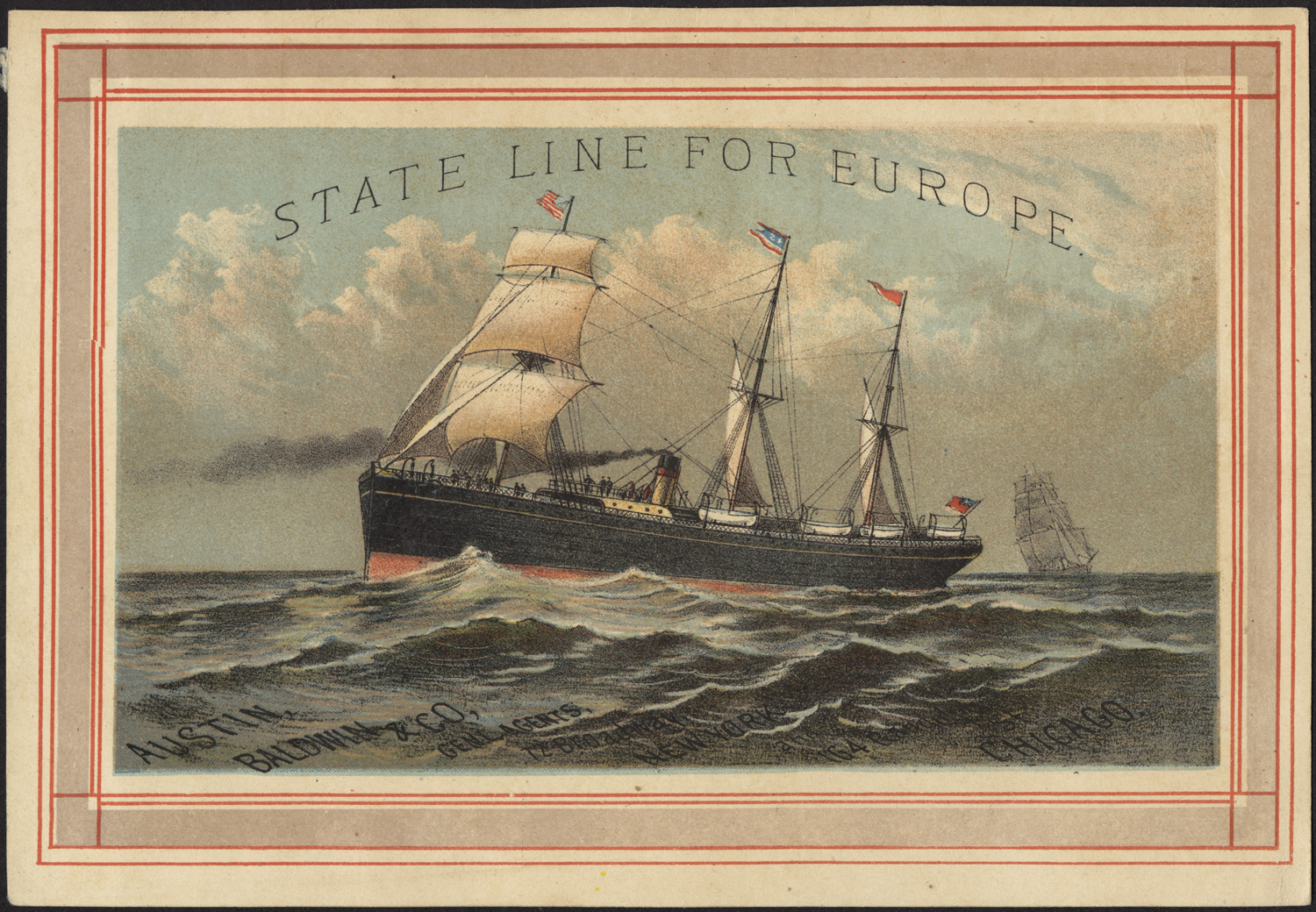
Shoo Caddick, SS Argus, Atlantic Ocean, to Mo Silver, Amsterdam, on this 31st December 2018 

20 December 

Reed and I are kaput. I’m sad, but I can’t say I’m devastated. I anticipate my recovery has been aided in large part by the air here, by that line where the sea meets the sky, which blurs in the early mornings; even by the smell of the ship, which is by no means pleasant, and the roar of the propellers on the A deck, which keeps me up at night. 

It’s a quiet life. I’m writing this by hand. Yesterday, I tried to spot a group of islands, but there were clouds. Today, I pocketed six biscuits in the mess hall and scattered the crumbs on the A deck for gulls. Even out here there are gulls. We take our meals on rubber place mats, in case the ship rolls while we eat. Yesterday, it was stew. Today, it was southwest chicken. Yesterday, the ship rolled fore to aft. Today, it’s rolling side to side. I’m nearly through the antacids I brought, which I expected to last the trip. 

31 December 

We pull into the harbor today. 

I know you might not be there at all. You might have traveled to London for work. You might have moved. You might have had a sudden death in the family. You might not be of Philippa’s lineage. You might have sold the letters. They might have been penned by another Philippa Cook altogether. I might have left Virginia, have left Reed, all for nothing. I lay awake last night, bedeviled by these concerns. 

I comforted myself with this thought: Philippa Cook lived a daring life, and I must be at least as daring. And here is another thing Philippa would understand. This morning, standing on the top deck in a light drizzle, watching the rain and wave spray darken the metal of the cereal containers, I was filled with a peace that lasted hours, hours before I could muster any sense of fear at all. 

Philippa Cook to Rupert Cook, 2nd April 1630, Newcastle-Upon-Tyne, Westgate 

Brother, I have had no reply to my last letter to you. I think they didn’t send it. I’ve given this one to the eldest girl in the house, who has promised to post it for me. I trust her more than her father, but I can’t trust her entirely, of course. 

Yesterday, I was sitting on the eaves just outside my window. I often sit there, looking out over the harbor. I thought I saw you. I saw a boy who looked just like you, and for a moment I thought it was your specter. There’s plague, I’ve been told, in Newcastle, and I wondered if you had taken ill and had come to visit me before trundling on to the stony vaults of Paradise. I called to you, brother, thinking you might rise up beside me, the pull of the Earth no obstacle for a haunt. Instead, the boy turned his face to me and went very still, and I recognized the eldest Braeman girl, dressed like a lad, headed off into town. 

I went after her, of course, dragged her home by her collar and paddled her. The nerve of the girl. If her father had seen, I’d be cast out for certain. He’d think it my example. The girl’s face after her punishment, streaked with mucus and wailing, was the face of a babe, and for a moment I thought of Bethany’s babe, of the life I’d fled. I never escaped it, is what I thought. I will die in this house a servant and a woman, a woman for all the rest of my days. A terrific thought, but I know the terror will pass, as terror does, into something sweeter, almost a comfort. 

I write to relieve you of any responsibility you may feel to find return passage for me. These days the salt burns my nose, and the wet aches my bones, and my stomach is none too fond of the upset of the sea. I’ll remain here, always your sibling and your friend, Philippa. 

I Needed to Know if My Favorite Books Were Products of Cultural Appropriation

Growing up in Manila, my idea of certain countries was shaped primarily by novels. I equated John Steinbeck’s California novels with the United States, Pearl S. Buck (The Good Earth) with China, and E.M. Forster (A Passage to India) with India. The only “Mexican book” I could remember was Steinbeck’s The Pearl. What’s wrong with this picture?

It took a recent visit to Steinbeck’s hometown of Salinas, California, to make me realize that the novels I cherish for depicting the struggles of “the other” were all written by white authors. At the National Steinbeck Center, a display on The Pearl highlighted the fact that it was based on a Mexican folktale the author heard about while visiting La Paz in northwestern Mexico. From Tortilla Flat to Of Mice and Men to The Grapes of Wrath, Steinbeck wrote about Mexican and Italian immigrants, laborers, and the downtrodden. An exhibit at the museum even featured pictures of Filipino field workers in Salinas.

On the one hand, I blame my limited literary exposure for my choice of books. On the other hand, it can also be attributed to the sheer global dominance of white literature then and now. I was a bookish girl born into a family of nonreaders in the Philippines, a former U.S. colony. What were the chances at the time that someone like me would have access to books written by authors such as Carlos Fuentes, Eileen Chang (also known as Zhang Ailing), and Khushwant Singh? Zero.

This is not to diminish the considerable talents and significant accomplishments of Steinbeck, Buck, and Forster. Steinbeck and Buck were winners of the Nobel Prize in Literature, while Forster was nominated for the prize thirteen times. They were such great writers that they succeeded in portraying characters outside of their culture and class. Indeed, they were lauded for writing characters who were not like them.

Evaluating classic books wasn’t just an intellectual exercise to satisfy my curiosity.

And yet the question nagged at me: Are my beloved books products of cultural appreciation or appropriation? To find an answer, I explored the concept of cultural appropriation. The term gets thrown around a lot, but what does it really mean? 

Evaluating classic books wasn’t just an intellectual exercise to satisfy my curiosity. I needed an answer as a writer of color living in America. I needed to understand what the boundaries are in my own writing. I want to be able to contribute to the Filipino American narrative, and that’s why my stories focus on my own culture. But am I supposed to write only about Filipinos and the Philippines?

Culture itself is arguably a result of all kinds of appropriation. Every culture is an amalgamation of various practices and influences that evolve as surely as life does. Who’s to say that the traditional Filipino lumpia isn’t an appropriation of the Chinese spring roll? Chinese people have immigrated to the Philippines throughout history, hence their cuisine and culture are ingrained in Filipino life. 

In terms of literature, the question typically centers on whether it’s acceptable to write “outside the lane” of the author’s own ethnicity and culture. As a writer, I say yes without hesitation. I agree with Toni Morrison when she defended William Styron’s “right” to fictionalize the life of Black preacher and rebel Nat Turner. But she qualified her comment with an important caveat.

In an interview with the Paris Review, Morrison shared her thoughts on Styron’s 1967 novel The Confessions of Nat Turner. “He has a right to write about whatever he wants. To suggest otherwise is outrageous,” said Morrison in the article published in 1993. However, Morrison criticized how Styron portrayed Turner as someone who felt superior to other Blacks. She questioned its accuracy because why would other Blacks follow a leader who displayed such a disdain for them?

“What kind of leader is this who has a fundamentally racist contempt that seems unreal to any Black person reading it? Any white leader would have some interest and identification with the people he was asking to die,” said Morrison.

Racism and cultural appropriation aside, every fiction writer aims to write a believable story.

Fiction writing requires the exercise of imagination. Writers should be able to write about anything—but they should depict people, places, and cultures with sensitivity and empathy. Racism and cultural appropriation aside, every fiction writer aims to write a believable story, and empathy is the one crucial ingredient in great storytelling.

So, are The Pearl (1947), The Good Earth (1931), and A Passage to India (1924) works of cultural appropriation? In an article published by Everyday Feminism, Maisha Z. Johnson defines cultural appropriation as “when somebody adopts aspects of a culture that’s not their own.” That’s only half the story.

Johnson lists nine things that make cultural appropriation so wrong. In addition to using the Morrison standard as a guide, I also used Johnson’s framework to assess the three classic novels in question. Did they perpetuate racist stereotypes? Did they trivialize historical oppression? Did the works show appreciation for a culture but remain prejudiced against the people represented by such culture? Did the white authors profit from marginalized people’s works?

Context always matters, so answering those questions required a closer look at the careers of Steinbeck, Buck, and Forster, especially as they relate to the three books in question. Did they write those books for gain or because they genuinely cared about the cultures represented in their novels?


Steinbeck was born on Feb. 27, 1902, to a middle-class family. He went to Stanford University but didn’t earn a degree. He worked different jobs as a laborer, which exposed him to immigrant workers. He was not affiliated with any leftist group, but he was known as a radical writer for his depiction of the oppression of the working class in his books. 

The Grapes of Wrath (1939), an instant bestseller and considered his finest work, offended many people. The board of supervisors in Kern County, California, banned the book for its portrayal of its citizens as “low, ignorant, profane, and blasphemous,” according to William Souder in Mad at the World: A Life of John Steinbeck. The novel was banned in some libraries in California, New Jersey, and Kansas. There were incidents of book burning in California and Missouri.

I’m convinced Steinbeck didn’t write The Pearl to add to his already established fame and fortune but out of a genuine affinity for the story.

The Pearl, like other Steinbeck books, focuses on marginalized people. But unlike his other stories, it’s told from a Mexican point of view. It’s about a Mexican pearl diver who can’t believe his luck when he finds the most perfect pearl. But instead of bringing him riches, the pearl causes envy and violence. The short novel was not as popular as Steinbeck’s other works. And yet he adapted it into a film (1948) featuring a Mexican director and cast. It was the first Mexican film to be distributed widely in the U.S.

Steinbeck traveled to Mexico many times, including a six-week, specimen-collection trip that became the basis of The Log from the Sea of Cortez (1951), a nonfiction book. He cowrote it with his friend, Ed Ricketts, a marine biologist. I’m convinced Steinbeck didn’t write The Pearl to add to his already established fame and fortune but out of a genuine affinity for the story.

I’m apt to say that in both novels and in A Passage to India, Forster was writing about ‘the other place’ more than ‘the other.’

Like The Pearl, Buck’s The Good Earth was written from the point of view of a person of color, a Chinese farmer named Wang Lung. The novel follows Lung’s struggles from rags to riches. Buck blazed a trail for writing a book from a Chinese perspective and for her portrayal of an Asian protagonist as a full human being with strengths and desires, but also many flaws. Buck didn’t romanticize concubines or trivialize slavery and opium addiction, but wrote about them in a detached third-person voice. Other books at the time portrayed nonwhite foreigners as “the other,” typically inferior or someone to be feared and generally less than human. 

Buck was born on June 26, 1892, in Hillsboro, West Virginia, but she grew up in China where her Presbyterian missionary parents worked. As an adult, she returned to China to take care of her ailing mother. She met her first husband, John Lossing Buck, in China. They lived there in the early part of their marriage. 

The Good Earth clearly stemmed from the author’s lifelong connection with China. Indeed, it was the setting for most of her work, including nonfiction books. She directed her humanitarian work toward helping disadvantaged children around the world, which the Pearl S. Buck Foundation continues to do today.

A Passage to India is unlike the first two books, which were written from a nonwhite character’s POV. Forster’s book presents the perspective of Dr. Aziz, a young Indian, alongside the POVs of white characters. Adela Quested, a young Englishwoman, accuses charming Dr. Aziz of attempted rape during their excursion to a cave. At the trial of Aziz, she ultimately admits her uncertainty of what really happened and withdraws the charges. 

Forster was born on Jan. 1, 1879, in London, to an upper middle-class family. His father was an architect who died when Forster was a baby, but he and his mother each had the advantage of an inheritance. He was educated at King’s College in Cambridge. Forster visited India twice and worked as a secretary of a maharaja for six months. I have no doubt that his long-standing interest in India was sincere.

Before A Passage to India, the author was known for his novels set in Italy (Where Angels Fear to Tread, published in 1905, and A Room with a View, published in 1908). I’m apt to say that in both novels and in A Passage to India, Forster was writing about “the other place” more than “the other.” Indeed, he didn’t write the latter solely from Dr. Aziz’s POV.

Like his “Italian novels,” Forster focused more on how the foreign landscape affects white characters in A Passage to India. The book’s title itself implies the perspective of an outsider, someone like Forster who’s just passing through the country. It was the last novel he wrote. 

Going back to white authors on the slippery slope of writing about “the other,” I have to ask: Did Steinbeck, Buck, and Forster have the right to write the three books in question? Yes, absolutely. 

Did they appropriate? Yes, they did. Did they show empathy for people of color in their novels? Yes, they did. Empathy is part of the reason the three novels, all of which have been adapted into movies, are popular. Putting the books within the context of their careers, the three authors showed a deep appreciation for the people and cultures depicted in their works. 

To gain a better understanding of those countries and their cultures, it’s best to read books written by native authors.

Did they profit from the works of marginalized people? No, the books arose from their own travels and experiences. They were not casual tourists either. Even The Pearl can’t be attributed to a single Mexican creator, just as you can’t attribute the sombrero to a particular Mexican designer. 

After my own assessment of The Pearl, The Good Earth, and A Passage to India, I still like them. There’s nothing wrong with enjoying books like them. But I no longer think of them as representative of the cultures of Mexico, China, and India respectively. To gain a better understanding of those countries and their cultures, it’s best to read books written by native authors. I’ll take this a step further by saying it’s only right to read the works of native authors.

As readers we’re lucky to have access to books from around the world today. Unlike the time of my adolescence in Manila, there’s no dearth of great books from far and near. We can borrow books from the library or buy them with just a few clicks on the computer or a smartphone. 

As readers we want to read all kinds of stories. For that to happen, we can all agree that writers should be able to write whatever they want. Period. As a writer, I will add that such freedom is ultimately a privilege that readers grant us. So, we should hold ourselves accountable for what we write, especially when we’re writing about people and cultures that are not our own.

It will probably take a long time for Filipino American stories to become part of mainstream American literature. Most likely, I will be writing inside my lane for the rest of my career, hoping to contribute to that effort. But I would like to think that if I can earn readers’ trust enough to suspend disbelief, I can also enjoy the privilege of writing something other than the Filipino experience.

Like Anne Rice, I Wanted To Pursue My Own Strangeness, Darkness, and Power

I get ready in front of the big mirror in the front, taking the black crushed velvet cloak from where it hangs between my mother’s fur coats and sweeping it over my black jeans and black t-shirt, fastening it under my chin, pulling up the hood. I set the fangs inside my mouth, feeling the familiar sensation of plastic against my gums and molars. With the tube of fake blood I always keep in my pocket, I draw two stripes beneath my lower lip, each extending from the approximate location of a top fang. I smudge the blood to make it more real.

My dad appears behind me in the mirror. “Ready?”

I follow him through the kitchen, cloak dragging on the tile as I gather a stack of thick hardcover books from the counter, and out to the gray Saab. We drive to the shopping development on the edge of our town with a Walgreen’s, a Coconuts Music & Movies, a Boston Chicken, and a Super Crown bookstore. 

It is August 29, 1996, and Anne Rice is signing books in celebration of the release of her latest novel. The line extends out the door of the Super Crown, under the El tracks, and around the corner. We make our way to the end of the line, but almost as soon as we take the last spot, a woman in a Super Crown polo approaches and tells us to follow her. Because I am eleven years old and dressed like a vampire, we get to cut the line. Inside the store, we approach Rice, who wears a frilly white shirt and her trademark blunt salt-and-pepper bangs. She smiles at me and tells me she likes my costume—”Nobody else dressed up tonight!”—as she reaches for our pile of books. Her signature costs $6 per book, $20 for the one we have her personalize to my mom, who is also named Anne. My mother is Rice’s great admirer, the reason my dad and I are fans, but she doesn’t come with us to Super Crown. 

To Anne, Anne Rice writes. Anne Rice.

When Anne Rice dies twenty-five years later, I will want to ask my mom why she didn’t come. How did she discover Anne Rice’s work? What about it so captivated her? Why did she make it such a big part of my childhood? And what is the connection between her, Anne Rice, and my career as a novelist? But I can’t, because when Anne Rice dies, my mother will be dead, too—for almost two years.

An obvious connection is that both Anne Rice and my mother had difficult, traumatic, peripatetic childhoods spent partially in Texas. It could be said that Rice’s incredible literary success—150 million copies of her books have been sold—was the product of transmuted grief. In childhood, Rice suffered first the death of her grandmother, the stabilizing force in a household rocked by her mother’s alcoholism, and then she lost her mother, too. After that, Rice and her sisters were placed by their father in a Catholic boarding school that Rice later described as “something out of Jane Eyre.” At twenty-one, Rice married the poet Stan Rice, and had a daughter, Michele, who died of leukemia at five years old. Her first novel Interview with the Vampire was written in the wake of all of these losses.

Elements of Rice’s biography—being raised by loving grandparents and then losing them, neglectful parents, being sent off to Catholic boarding school—line up uncannily with my mother’s childhood. But that alone can’t explain the link my mother felt to Rice’s work. After all, Rice’s vampires entranced millions and millions of readers.  

Interview with the Vampire came out in 1976, well before the vampire renaissance: before Lost Boys, before Buffy, before Twilight, before True Blood, before The Vampire Diaries, before Underworld and What We Do in the Shadows and Let The Right One In and A Girl Walks Home Alone at Night and Vampire Academy. Or perhaps it’s better to say that Rice’s vampires inaugurated the vampire renaissance. Before Rice, vampires were popularly understood to be Nosferatu-style monsters whose sexual charisma, if it was depicted at all, wasn’t seductive but instead was horrifying, explicitly connected to fears of rape and murder. Only Dark Shadows, the intergenerational vampire family soap opera that orbited the tortured Barnabus Collins and ran on ABC from 1966 to 1971, heralded an elegantly anguished vampire at war with his elemental nature and on an existential quest for meaning. (It was also my father’s favorite childhood television show.)

Before Rice, vampires were popularly understood to be Nosferatu-style monsters whose sexual charisma wasn’t seductive but instead was horrifying.

Rice said that she drew her inspiration from an earlier source, the 1936 film Dracula’s Daughter, when she created the tortured creole vampire Louis de Pointe du Lac, his Gothic love affair with his blond French maker Lestat de Lioncourt (Rice’s most famous character—my mother loved Lestat; all her life she had a taste for beautiful, foppish men), and Claudia, the five-year-old girl who Lestat turns into a vampire in an attempt to cheer Louis up.

In Claudia, Rice created a child with the complexity of an adult, a being who lived a whole Grand Guignol in a small body—a child who had the extraordinary story Rice’s daughter was denied, or perhaps the extraordinary life Rice observed in Michele’s short existence. Claudia dies twice in the arms of her mother: first when she is first bitten by Louis while clutching the corpse of her human mother who has died from plague, and again when the sun burns her to death as she is embraced by the vampire mother she has demanded Louis make for her. 

In Our Vampires, Ourselves, Nina Auerbach writes that “Claudia is an adult male construction, a stunted woman with no identity apart from the obsessions of the fatherly lovers who made her.” But I don’t think Claudia is made by men at all. She is a little girl made immortal by her longing for her mother—the bottomless hunger from which she derives her dark power—and created by a mother longing for her own lost daughter.

I first saw the film version of Interview with the Vampire when I was myself a little girl. I was curious to watch the movie my parents had so enjoyed. My mother showed me the movie in the manner she screened many films deemed inappropriate for children that she nonetheless wanted to show me: by starting and stopping the videotape, telling me to look away while she fast-forwarded to the next scene she wanted to show me. Sometimes this style of watching annoyed me, and sometimes it made me uncomfortable, but I never looked away. I always saw what my mother wanted me to see. I don’t remember liking or disliking the movie, but I remember the feeling of being so close to my mother, so deep in her world and mind and pleasure. I always loved being with her, even when I had trouble figuring out where she ended and I began. Togetherness with her was, and remains, the thing I wanted most in the world. It was automatic for me to emulate her tastes. I’m not sure it was even emulation so much as a kind of osmosis. Transfusion.

I don’t remember liking or disliking the movie, but I remember the feeling of being so close to my mother, so deep in her world and mind and pleasure.

I had my first experience with a vampire during another of these movie screenings. I was seven years old and my mom showed me a vampire movie from the 1970s with a heavy, innuendo-laden atmosphere. I fell asleep in her bed, but I didn’t rest. All night I was in and out of dreams of ravishment and fangs. I couldn’t escape. By morning I didn’t want to. After that it was automatic. Of course I loved vampires.

In a video assembled by the Associated Press in remembrance of Anne Rice following her death, there is a shot of the long, shiny, chrome tour bus she traveled in the summer I met her. I’ve attended hundreds of book signings and readings in the years since the night I met Anne Rice at Super Crown, including my own book tour following the release of my first novel, but I’ve never again experienced anything like the crowd, excitement, and money that she drew that evening. In the video clip, her tour bus is emblazoned with the words “ANNE RICE SERVANT OF THE BONES 1996 INTERSTATE BUS TOUR.” We bought a copy of Servant of the Bones that night—it was required for entry, and it was the one we had Rice sign to my mother—but I never read it. In fact, although my parents both loved Rice and read many of her books together, I only ever read one, a paperback of The Vampire Lestat that I received in a Secret Santa years later. 

Rice wasn’t my favorite author. She wasn’t even my favorite vampire author. That honor belonged to Poppy Z. Bright, whose work I discovered on the other side of puberty. But I think she was my originating idea of the author: a powerful and mysterious woman. Even without reading it, I knew that her work was dark and sexy and infused with the supernatural. It was also, both in the culture of my home and in the wider world, indisputably important. She was a far more interesting and accessible model of the writer than Ernest Hemingway, the hometown hero whose grizzled, black and white image decorated the walls of my favorite restaurant. It was from Anne Rice that I gained my sense of what writers were, of what a writing life could be.

I decided to be a writer when I was very young, for the simple reason that I was good at writing and enjoyed doing it.

I decided to be a writer when I was very young, for the simple reason that I was good at writing and enjoyed doing it. I read constantly, anything I could put my hands on, and I thought that the world was full of people like me, who adored books and considered their creation the highest and most important work. It wasn’t until I was an adult that I learned that the literary establishment looked down on horror, science fiction, fantasy, and comic books—the genres that my parents introduced me to, and that I most enjoyed reading. I didn’t know that there was a literary establishment that didn’t include Anne Rice.

Over the years of writing my first novel while supporting myself with a PhD stipend, a patchwork quilt of adjunct teaching jobs, and the occasional freelance assignment, I was haunted by the image of the writer I met that evening at the Super Crown: a woman behind a laminated folding table, receiving supplicants like a queen. I would think back to the way her supersized hardcovers asserted themselves on our bookcases, their shining gold and black dust jackets, their unquestionable importance. The idea of Rice made it seem not just possible but obvious that I would make a life telling stories, regardless of the pushback I might receive. This sense of artistic mission has sustained me through many low points.

But often, at those low points, I resent this innocent, grandiose idea for leading me into a line of work that, I have been surprised to discover, is neither glamorous, well compensated, or even interesting to most people. Did I become a writer for art’s sake? Or did I get myself into this mess because I thought that my career would be like Rice’s?

In a 2018 interview with Locus, the author and screenwriter Tananarive Due describes how, as a young journalist struggling with her desire to write fiction about the supernatural despite the disapproval her interest in writing genre elicited from peers and professors during her education at Northwestern University, she was assigned to interview Anne Rice.

I never told [Rice] I was a writer. I just slipped it in with my questions, like they teach you in journalism 101. “How do you respond to criticism that you’re wasting your talents writing about vampires?” I cringed and waited for her to answer. She just laughed. I think she literally laughed. She said, “That used to bother me. But my books are taught in colleges.” She went on about how freeing it is to write genre, and the way that big themes can play out in genre in ways that are harder to get away with in contemporary realism and smaller stories. She lit a fire under me. […] The interview was literally a pep talk, even though Rice didn’t know it.

Rice was an idiosyncratic figure: a serious, cerebral writer whose contemplative, over-the-top Gothic novels took genre mainstream. Her popularity defied the high-low paradigm and expanded what was possible for writers. Pursuing your own strangeness, darkness, and power, Rice’s career showed, could help writers tell stories millions were dying to hear. In its remembrance of Rice on Instagram, the literary agency Janklow & Nesbit (whose founder, Lynn Nesbit, was Rice’s longtime agent) remarked on the fact that Rice’s books “importantly, at the start of the AIDS epidemic in the early 1980s—allowed space for eroticism and sexual pleasure across straight and queer characters.” Many have followed in her wake, not least of all her son Christopher Rice, who himself writes supernatural, crime, thriller, and romance fiction.

Pursuing your own strangeness, darkness, and power, Rice’s career showed, could help writers tell stories millions were dying to hear.

The writer could be not just known but a star, and not just a star but an ideologue, a beacon of tolerance and openness, a glamorous—and for much of her career, fat—woman with a sense of humor and an unabashed appetite for sex and gore who understood her books to be novels of ideas and philosophy, concerned with the great questions of history. “My private life, my private adventures,” Rice said in a 1996 interview with her friend Michael Riley, “really are in this realm, sitting at home on the floor, cross-legged with books, trying to figure out why the Roman Empire fell.”

Maybe my mom didn’t come to the book signing because of her dislike of crowds. She often stayed at home, in the house she had decorated, where nearly every room bore a Rice book or two, while my father and sister and I went out into the world. But in the same way that Rice’s fans felt that she transformed their imaginations, my family understood that to be close to my mother was to gain entry to a world of magic and fortune where the impossible became real and dreams came true. We brought everything home to her, cast our spoils before her, waited for her to tell us what they meant.

“Look at Anne Rice,” my parents said, encouraging me to pursue my love of writing and, implicitly, suggesting that I could make a career of it. Both of them believed I had talent. Both read my writing and saw beauty and meaning in it. They made the sacrifices other families make for grueling sports schedules so that I could attend weekend writing workshops, pursue literary internships, and complete multiple graduate degrees.

From the beginning my writing was always about my obsessions, which included big moods, secrets, sex, and, yes, vampires. As I kept writing, a strange thing started to happen: as much as I wanted to write about magic and the supernatural, the worlds I evoked became stranger, surreal, propped between our world and others, concerned with labyrinthine and internecine interior landscapes, as a hidden order made visible. Like Anne Rice, I became a writer, but different, writing my own kind of stories, about my own kind of supernatural occurrences and ecstatic revelations.

Like Anne Rice, I became a writer, but different, writing my own kind of stories.

There is a ligamentous connection between my two Annes and my own writing. I find myself wanting to articulate the impact they had on me, how they made me a writer through the act of exposure, through the things they showed me, the way they encouraged my artistic reaction. I keep coming back to Rice’s definition of romanticism as “an abandonment to the realm of senses and feeling where you don’t restrain yourself, there’s nothing ironic or cynical holding you back in your art. You give totally.”

Her words describe not just Rice’s books but also the way my mother lived and taught me to live in the world. With the help of the example of her favorite author, my mother gave me permission and encouragement to live—and write—with generosity and sincerity and open-heartedness. She gifted me the freedom to follow Anne Rice, who said that to write well, all you have to do is “let the blood gush.” My mother taught me to smudge it, to make it more real. 

Job Opportunity: We’re Hiring a Social Media Editor

The social media editor of Electric Literature is responsible for ensuring the widest possible audience for Electric Literature articles, using both targeted outreach and organic sharing. You’ll be actively engaged with our 225,000 Facebook, 270,000 Twitter, and 36,000 Instagram followers: scheduling posts, interacting, and establishing a consistent, informed, and appealing social media voice. But you’ll also be a creative thinker, constantly coming up with new ways to get Electric Lit work in front of the readers who will appreciate it most.

Our mission is to make literature more relevant, exciting, and inclusive. Here’s how you’ll contribute to those goals:

  • Familiarizing yourself with every piece on the site and expressing its content in clear, engaging, motivating ways.
  • Keeping up with news, conversations, jokes, and the general zeitgeist so you can foreground content that’s on people’s minds.
  • Generating innovative strategies to reach and appeal to diverse audiences beyond Electric Lit’s existing fans.
  • Engaging with Electric Lit’s most loyal readers to foster a sense of community.

This is a part-time remote position. Electric Literature’s staff is based in New York, and the bulk of your work must be completed during east coast business hours. As a result, we can only consider applicants with a maximum 3 hour time difference from Eastern Time. Compensation is a monthly stipend based on a commitment of 20-25 hours a week at $20 an hour.

Qualifications 

  • You demonstrate a capacity for both voicey, funny posts and more straightforward presentation of serious work; you can entice people to read an article without flattening or misrepresenting it.
  • You’re an avid reader of contemporary fiction and criticism (being a writer of fiction, essays, or criticism yourself is a plus, but not required).
  • You thrive in a collaborative environment where you’re trusted to do your own work well, but may also engage in brainstorming or strategizing with your coworkers.

Skills and Expertise

  • You’re familiar with the technical side of Facebook, Twitter, and Instagram, including scheduling posts and monitoring stats.
  • You are able to adapt your strategies based on evidence and analytics.
  • You are comfortable with social management platforms such as Tweetdeck and Facebook Creator Studio. 
  • You follow news about popular social platforms and are able to draw actionable insights from that news.
  • You’re plugged in to new innovations and developments in social media.
  • You think conscientiously about how (and whether) Electric Literature can best use social media to respond to news in progress.

Responsibilities

  • Schedule tweets, Instagram posts, and Facebook posts for each article published on electricliterature.com, as well as sponsored posts, “evergreen” articles, and articles that can be tagged to current events at predetermined minimum intervals.
  • Create original social media content, including memes and graphics. 
  • Regularly monitor notifications on Facebook, Twitter, and Instagram, and engage judiciously with mentions, retweets, comments, and messages.
  • Share articles, posts, and information from other publications that connects to Electric Literature’s work and broader mission.
  • Stay informed on major literary conversations happening on social media and share information with staff.
  • Brainstorm, propose, and carry out special engagement campaigns.
  • Occasionally create press lists for special projects and marquee articles.
  • Monitor social media analytics and performance, including maintaining a monthly spreadsheet to track engagement stats; experiment with different posting times, formats, and framing to increase reach and engagement.
  • Stay informed about best practices for social media, and changes in platforms’ algorithms, tools, and policies.
  • Track engagement on sponsored posts and provide metrics for sponsorship reporting.

To apply, please send a cover letter and resume through Submittable by 11:59 PM ET on Monday, February 7, 2022. In a separate document, please write copy for 2 tweets for each article below. Please also create a sharable meme on a literary subject. 

“Would Taylor Swift Eat My Gimbap?” by Giaae Kwon 

“Doll’s Eyes” by A.S. Byatt

Link to apply: https://electricliterature.submittable.com/submit/215431/electric-literature-seeks-part-time-social-media-editor

John Darnielle Subverts the True Crime Genre in His New Novel “Devil House”

John Darnielle wants to get under your skin. His third book, Devil House, follows Gage Chandler, a true crime writer embarking on an obsessive downward spiral. Chandler, like Darnielle, is unbothered by the gory details of the crimes he covers. But he’s starting to be disturbed by the ethical implications of his work. Using true crime to look inwards, The Mountain Goats songwriter offers a procedural more immediately interested in the violence of the pen than it is the sword.

Searching for the truth behind a decades-old double homicide, Chandler moves into the Devil House itself, a former porn shop-turned-crime scene whose notoriety has been glossed over with a fresh coat of paint and new floors. No convictions were made in the case, even if those high schoolers that turned the scene into a Satanist art installation before fleeing fit the bill almost too cleanly. In telling the story of this unsolved crime, is Gage committing an act of violence in itself?

Speaking to Darnielle over the phone felt eerily similar to reading Devil House. He is a detailed and generous speaker, as willing to share the details of his Magic: The Gathering deck as he is to talking about the abstractions of storytelling. More than anything, Darnielle was eager to dig into the ethical questions of storytelling, and how readers might just be implicated in the true crimes they love to read.


Harry Todd: I get the sense that you’ve got some complicated feelings about true crime. Is that a fair characterization?

John Darnielle: The book is not a critique of true crime—it stands in place of storytelling generally. When you are telling stories, there are often real lives involved. There’s a sense in which any act of writing implicates people. In true crime, you’re writing about crimes that had profound effects on people. You’re doing so in order to publish your book, maybe you’re doing it to educate, but also you’re probably getting paid for it. And those are issues in play, but they’re not unique to true crime. 

HT: There’s a sense of voyeurism that goes into all forms of storytelling. I think it’s fascinating that Devil House is largely set in an abandoned porn shop. Tell me about the thematic connection there. 

When you are telling stories, there are often real lives involved. There’s a sense in which any act of writing implicates people.

JD: Our need to be entertained is, I don’t want to say it’s pathological, but it is a little weird. The forms of entertainment that we have developed seem like they’re meeting some needs that we’re not getting met elsewhere. That’s sort of how I feel about storytelling. 

It’s like Joan Didion’s line, “We tell ourselves stories in order to live.” That’s a big beacon for me. The side effects of that are considerable, of casting things as narratives that may or may not have a tidy narrative. When we frame a narrative around something, we’re always leaving a bunch of stuff out. Narrative is an imposition. It’s like you’re actually trying to put borders around what usually are almost always is considerably more chaotic and less tidy.

HT: You make explicit connections to our need to be entertained throughout Devil House. You often mention the movie River’s Edge, which is based off a real crime that took place in Milpitas. That’s the same town that Devil House takes place in. You frequently mention the community’s adverse reaction to that movie; what inspired that element of this story?

JD: I lived in Milpitas, briefly, as a kid. It was several years before Marcy Conrad was murdered. So much that is said [in Devil House] is true—I had a friend who would tell all these urban legends and would insist that they were all true. That’s where I became exposed to the way urban legends work, and how reality works among children. 

I saw River’s Edge when it came out and when I lived there. I don’t really know anything about that place because I was seven years old. So this was the earliest contrast between the story I’m telling myself about a town I once lived in, and the story that gets told in Hollywood about the same town. When I watch the movie, I don’t see anything that I recognize. It’s all about questions of perspective. Perspective is profound. It’s like the first time you learn to draw a cube on a piece of paper. 

HT: I dug up an article from the Los Angeles Times written by the reporter that broke the Marcy Renee Conrad story. It’s called River’s Edge Not Quite As He Recalls”, which grapples with the very same questions that Devil House does. Questions of perspective and entertainment that exploits true stories. 

JD: I read that story when it ran! I was living in Southern California at the time. When disaster hits someplace, everybody wants to talk about it. And I think the people who are closest to it often might have questions about whether their standing counts for something. Whether they might be justified in asking other people to tread lightly. That’s a lot of what this is about.

HT: There’s also the element of fully fictionalized characters made up for entertainment’s sake in River’s Edge, which is a point of contention in your book. 

Devil House asks questions about the consequences of telling stories, about the responsibility of the author. But it also asks, ‘what do you mean by responsibility?’

JD: The actual story is extraordinarily different from what was presented. In many ways, it’s a lot sadder. I’m not super intimate with the case, my main familiarity with it is seeing a story and then reading a story of people going, “Hey, you really portrayed our community as a place where people don’t care about their children.” It was part of the moral panic, when people would say that the kids are nihilistic and they’re not getting the values of their parents and all that.

That’s the thing that comes up reliably every seven or eight years. There’s always panic stories about whether the kids are losing their moral center. It’s practically a reflex of adulthood to fret about whether the kids have lost it when, in fact, it’s hard to be a teenager and it’s especially hard if you’re, if you don’t have the tools to deal with your friend who’s lost his mind. What is the adult’s responsibility when looking at that child? That’s where the responsibility rests.

HT: The ending of the book might be the most unsettling part, more than the more explicitly violent scenes. There’s a certain lack of finality to it that I think might be divisive. Is that where you started with the book?

JD:  I don’t begin with a premise as a general rule. I find out what I’m writing about as I write, and then I revise as I come to understand it better. The notion of sitting down and wanting to make a point here—that’s what a lot of 19th-century novelists really do. They’re programmatic, didactic. If I make up a character and once enough situations happen, the character is going to become more complex than originally envisioned. I don’t map them all out at first, I learn who they are, and what they’re doing as I write. 

And that informs how I think there’s a whole process, how I think of it as the posing of the question, instead of the answering of one. Devil House asks some questions about the consequences of telling stories, about the responsibility of the author. But it also asks, “what do you mean by responsibility?”

HT: Devil House has a lot of different sections that span decades and perspectives. We start with Gage, a true crime writer, before reading a section from The White Witch of Morro Bay, his breakout success. Later, there’s medieval scripture and vignettes written from the perspectives of the suspects in the murders. It’s a lot of spinning plates. 

JD: I came up with this idea of seven parts that would mirror each other with something in the middle. I had the idea of things being reflected at one another, showing you the inverse of the same thing. Another way that this was distinct is that the first part is in first person, the second in second person, the third in third person, and then the fourth is something different. Then mirror that backwards.

That’s how I built a framework. It’s open enough that you get to choose the wood you’re going to use for the doors, the types of windows you’re going to put in, the type of ceiling you’re going to have, or maybe no ceiling at all. You can do whatever you want. 

HT: The use of second-person felt very fitting for the true crime story Gage is telling. You use it in the book-within-a-book, The White Witch of Morro Bay. What prompted this choice?

JD:The fact that it implicates the reader is neat. This is supposed to be Gage’s book that made a splash, that they made a movie out of. So I thought, how can I assert that this book made a splash? Well, one way is that it has a style that’s unique, a style that sets it apart from other things in true crime. 

That would be quite a true crime to view, to get something addressed entirely to the perp. One of my favorite things that he says in the book is that the perp is the hero. And the perp is not the hero, but he is in most true crime books. That’s the epiphany Gage has: The perp is the hero of his first book, and now he’s interrogating that position.

HT: It haunts him. That certainly fits with the larger philosophy of Devil House—it doesn’t have many easy answers.

JD: What I’ve chosen to do with my writing is to sit with paradox. I resist tidy conclusions. At the same time, I’m obsessed with sonically and rhythmically ending on a note that feels like a proper stopping point. For the tonal aspect, I want it to feel that way, but from a philosophical aspect, I want every ending to feel like an opening.

The Best Sex Takes Three Loads of Laundry

Lint

Before my lover and I have sex, I cover myself in lint.

It’s not that we only have sex on lint day—as we call it—but it’s the best sex and on the days leading up to it, we get more and more excited.

It takes three large loads of laundry—only all-cotton, because we like to do things natural. We run the wash loads in the morning, one after the other, then take the screen and filters out of the drier and put the first load in. 

I go outside, naked except for shoes and a filtered painter’s mask, and stand in front of the drier vent. We live in the country, down a long dirt lane with no other houses around, so there’s no one looking. But the weather has to be just right—cool enough to make me want to stand in front of the drier vent for an hour without freezing or sweating.

Then I slowly turn like a rotisserie chicken, occasionally lifting my arms and legs, letting the moist hot air beat against my body. Of course, just standing outside naked on a cool day, having hot air caress my skin is pretty nice in itself. 

I don’t know how this all started exactly. I do remember one day my lover plucked the lint from my belly button and said how he liked the feel of it. Then he rubbed the tiny piece over me, as though he were buffing my skin with a tiny pad. It just evolved from there, I guess.

You might think that it wouldn’t work, that not much lint would gather on the skin, but it does. I don’t look like that hairy of a guy, but I heard that all humans have as much hair as an ape—it’s just finer. If you’ve ever seen the silhouette of a child’s cheek in the sunlight, you’ve seen them, hundreds of fine, silver hairs, like a wheatfield at dawn. 

It takes a while for the first lint to stick, but then it begins to cling to itself, like dust does as it forms cobwebs. I can feel it gather, a soft pink-grey fur slowly covering my skin. Sometimes I close my eyes as I rotate beside the heat of the drier and imagine that I’m a baby chick under an incubator, downy soft.

After each load’s done, my lover puts in a new load and starts the drier back up, quickly, so that I don’t get cold standing there naked. Then he folds our clothes as I return to turning slowly in front of the vent. 

It takes about two and a half loads to get a good coat. Once it’s thick enough, I take off my shoes and socks—and the mask, of course—and come inside. 

My lover is there at the door, already naked himself. He takes my hand, my incredibly soft, fluffy hand, and we walk together to the bed downstairs, which he has covered in a sheet, to gather the lint. Sometimes as we walk, I imagine that this was how he was as a child, heading off to bed with his favorite stuffed animal. 

On the way, we pass a mirror, and I can see myself, just for a moment. My head is easy to make out, full of detail—but my body is fuzzy, all its lines out of focus. It’s as though I have become a mere impression of myself, as though the edge where my body stops and the air begins has disappeared.

My lover lies on the bed on his back, and I gently climb up on top of him. He slides his fingers over my skin, his eyes gracing my grey furred body. I feel the softness I’ve become when he touches me, though I suppose he doesn’t exactly touch me. We are always aware, both of us, that he is touching something else, which is why, I think, we do this. We know there’s always that layer between us, the accumulation of tiny fragments of dust, the discarded fabric of our lives. And then as we have sex, we watch as it slowly sheds away, until we begin to feel again what it is that lies underneath.

7 Novels About Very Bad Rich People

If you spot a wealthy person in fiction, they’re very likely to be the villain—just like in real life!

Good Rich People by Eliza Jane Brazier

My novel Good Rich People is about a bored, wealthy couple who play games with disadvantaged people—just like in real life! 

There are many (allegedly) fictional stories about how privileged people take advantage of the less fortunate. You almost have to assume it happens all the time…

From a murder mystery unfolding in an elite private member’s club to a family road trip with an inheritance at stake, here are some stories about Very Bad Rich People.

Such a Fun Age by Kiley Reid

Privilege is at the center of this story about a Black babysitter with a wealthy, white client. When her client calls her in for a late-night emergency, babysitter Emira gives up her own plans to help. When she takes the child out to a fancy supermarket, she is accused of kidnapping. Emira’s client’s efforts to “make it right” only serve to underline the self-obsession and need for control inherent to privilege. 

Nanny Needed by Georgina Cross

This one is another story about the dangers of transactional relationships. When Sara Larson desperately answers an ad for “Nanny Needed, Special Conditions Apply,” she had no idea that she is walking into a world twisted by privilege, where her wealthy clients can ask for anything, and usually do. 

Quartet by Jean Rhys

An older book, but I had to sneak this in as it was one of my influences for Good Rich People. Based on Jean Rhys’ own experiences with Ford Madox Ford and his wife, this book tells the story of a woman in Paris who is taken in by a wealthy English couple after her husband is jailed. She is pressured by the pair to become their high society plaything. As usual with Rhys, the story contains devastating insight into human nature. 

Bittersweet by Miranda Beverly-Whittemore

When Mabel is invited to summer at a beautiful estate in Vermont, she is at first enchanted by the blue-blooded Winslow family. But as the summer unfolds, Mabel uncovers the dark lengths this family has gone to in order to keep their power, their home and their perfect all-American summer.  

Malibu Rising by Taylor Jenkins Reid

Taking place over the course of an epic end-of-summer party, this novel tells the stories of the uber-successful Riva family, who built their wealth on a stack of secrets so high, they can only come tumbling down. 

The Club by Ellery Lloyd

The Club is a murder mystery set in the exclusive world of a private members’ club. This story is told with such ruthless accuracy, you would swear it’s not quite fiction. The club at the center of the story was designed to protect the privileged from consequences, but over one wild weekend on a private island, nothing will go according to plan. 

He Started It by Samantha Downing

He Started It by Samantha Downing

The siblings at the center of this story are forced to take a family road trip in order to claim their inheritance.  Of course, everyone has a reason for needing the money—and everyone will do just about anything to get it.