When most people think of the Caribbean, they think of paradise or of poverty. One goes to vacation there or one donates to charities in the aftermath of hurricanes, earthquakes, fallen governments. It’s often difficult to entertain the notion that nations of the Caribbean contain more nuanced histories and communities than these two monikers suggest.
Haiti, for one, was the first independent nation in the region, the result of a long-waged war against French colonial powers from the end of the 18th-century into the early years of the 19th: Napoleon Bonaparte’s only other military defeat aside from Waterloo. The Haitian Revolution served as inspiration for many enslaved and colonized people throughout the Caribbean, the Southern United States, and Latin America. In Trinidad & Tobago, it fueled the “70s Revolution” as Black and South Asian citizens of the newly independent nation sought to affirm themselves. When I was born in Port-au-Prince in 1970, this illustrious history was obscured by the terror-filled reign of the Duvaliers, and has been made even more obscure today, after military interventions, assassinations, and two devastating earthquakes eleven years apart that have shaken Haiti’s fragile infrastructures to their core.
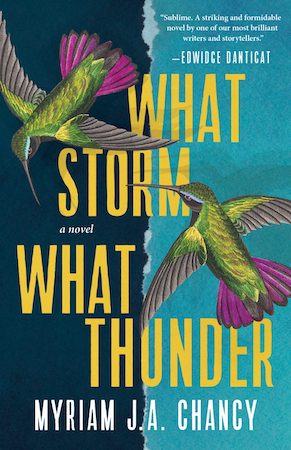
Like other Caribbean writers before me, when I wrote What Storm, What Thunder, a fictionalized account of the 2010 Haiti earthquake, in which over 250,000 people died, it was with the intent of creating a space within which the aftereffects of a long and complex history of both triumph and mismanagement could be peeled back to reveal its human pulse. My goal—through the voices of ten distinct characters and their very human response to calamity—was to illustrate both the beauty and the pain of what it might mean to be Haitian, especially in the shadow of a national catastrophe. My novel seeks to draw from Haiti’s contemporary history as much as it does from principles of vodou spirituality and community, like the konbit, or concept of collective good.
I also draw inspiration from other Caribbean writers, especially Caribbean women writers, who also seek to illustrate the wide range of human experience from perspectives particular to their home islands. The Caribbean writers I love to turn to, for escape, to learn, offer more than postcard versions of the Caribbean—they polish their memories like precious gemstones to reveal the multihued perspectives of Caribbean people in all aspects of their lives as they weather loss and love and strive for belonging within their home islands or in exile from them.
Paule Marshall’s classic tackles themes of lost love, ideals, and spirituality in the journey of her African American protagonist, Avey (short for Avatara) who finds herself compelled to leave a cruise ship in the middle of the Caribbean. Disembarked in the small island of Carriacou, Avey recovers her African roots through local traditions like the “drum dance” and recalls traditions from her childhood in Ibo Landing in Georgia. Fleeting references through sub-headings and epigraphs to Haitian vodou relate the story to a wider web of African retentions through the Francophone Caribbean.
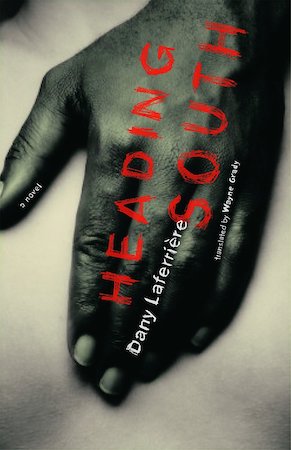
Heading South by Dany Laferrière, translated by Wayne Grady
In a series of interrelated stories, Haitian Canadian writer Dany Laferrière chronicles the transactional and parasitical nature of relationships between local Haitians eking out a living in service industries and foreigners coming into Haiti during the Duvalier régime. The stories were made into a film starring Charlotte Rampling, focusing on relationships between foreign women who, while on vacation in Haiti, take Haitian male lovers without concern for their tenuous lives beyond the enclave of resort hotels.
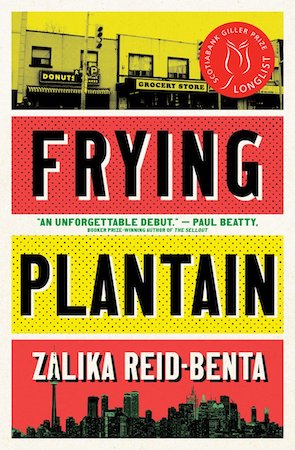
In a series of interrelated short stories, Reid-Benta tells the story of Kara, a Jamaican Canadian girl, torn between her desire to escape the authoritarianism of her grandmother’s household and wanting to still belong to the Jamaica of her mother and aunt, to which she only returns periodically.
Told in multiple voices, Condé’s tour de force novel re-imagines the entire history of the Caribbean through a wake given for a Cuban man, Francis Sancher who landed in a small village in Guadeloupe where he takes on many lovers as well as enemies. Haunting them all is Xantippe, the Haitian, who lives at the crossroads, where life and death come together and split apart.
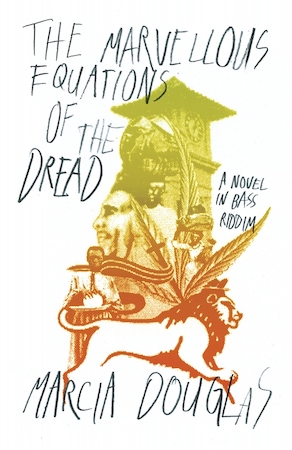
In this novel, Douglass weaves an indelible tale of Jamaican life from a deeply spiritual perspective, as she fictionalizes Rastafarian history into a tale for the ages. Bob Marley is reincarnated as a homeless man, Fall Down, who might be a Jamaican Everyman. An unknown deaf woman, Leenah, once Marley’s lover, is a seer who extrapolates the meaning of unexplored spaces between life and death. Told through multiple perspectives, including those of children, and what Douglass calls “bass riddim,” the author brings to life the rhythms of reggae through its many incarnations through her very prose.
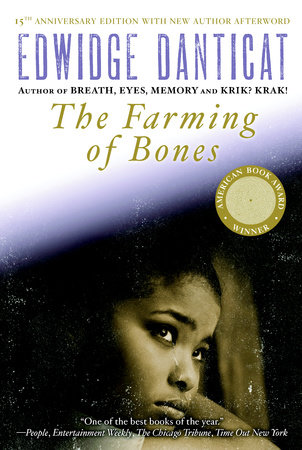
Much of Caribbean fiction attempts to retell effaced aspects of the history of the region; Haitian American author Edwidge Danticat does just this in a tale of an orphaned Haitian girl, Amabelle, living in the Dominican Republic at the time of the Trujillo regime and who must return to Haiti as a young adult in order to flee the 1937 massacre ordered by Trujillo in the border region between the two countries. Though a fictionalized account, the novel brought the massacre, which wiped out thousands of Haitians in the border zone, to broader light.
Moonbath by Yanick Lahens, translated by Emily Gogolak
Yanick Lahens—perhaps the best known Haitian female writer writing in French today—won the 2014 Femina Award for this experimentally voiced novel which introduces readers to aspects of Haiti’s colonial and postcolonial history by following the life of Cétoute Olmène Thérèse and that of other women in her family through three generations.
Winner of the 1997 Commonwealth Book Prize, Earl Lovelace’s Salt is the story of two Trinidadian men, one educated and the other not, both striving for the freedom of their people through very different avenues: education and sports. Told through the lenses of community members surrounding both men, the novel weaves a sonic tapestry of shifting narrative voices and linguistic registers that illustrates a world coming into its own within the context of Caribbean postcoloniality.
Blue by Emmelie Prophète, translated by Tina Kover
Haitian writer Emmelie Prophète’s Blue tells the story of a young woman who reflects on her life story and those of her mother and aunts as she leaves behind Haiti for parts unknown as she transits through Miami. Her memories are saturated with impressions of blue, from the color of the waters surrounding Port-au-Prince to the poignant nostalgia of her memories of a country and community she loves but must leave in order to have a better future.
The long-awaited prequel to The Sopranos,The Many Saints Of Newark, will be released in theaters and on HBO Max (where it will be available for 31 days) on October 1, 2021. This news has made fans rejoice; despite the fact that The Sopranos ended its run over 14 years ago, this television show about the deterioration of America, mental health, strained and extremely difficult family relationships, trust, betrayal, and the decline of organized crime, has retained its cultural relevance, especially considering the current state of the world.
Tony Soprano, the show’s star, is a lazy, depressed sociopath who always gets what he wants. Tony’s litany of sins is too extensive to recount, but his therapist summed it up best as: “You’re not respectful of women. You’re not really respectful of people.”
No one seems able to escape Tony’s orbit; characters repeatedly double down on organized crime rather than disrupt their cozy lives.
No one seems able to escape Tony’s orbit; characters repeatedly double down on organized crime rather than disrupt their cozy lives. See for example Christopher Moltisanti’s decision to turn on Adriana rather than follow her into witness protection. Recall Vito Spatafore’s decision to return to mob life rather than work a nine-to-five. Consider Carmela’s entire marriage.
The psychological burden of bearing this moral rot is akin to the misery the average person experiences every day under late capitalism’s brutality. Like the characters in the Sopranos, we are all negotiating ways to survive a soul-crushing economic system from which there seems to be no escape.
Here’s what your favorite character says about the deal you’ve made with capital and the depression that comes with it.
Carmela Soprano
Carmela resents Tony for controlling the money and therefore her. This chiefly manifests in her rage at Tony’s affairs. In objecting to his adultery, Carmela displaces her disgust with Tony’s lifestyle onto something at least loosely within her control. Tony’s failure to meet Carmela’s emotional needs is a real problem, but it’s also the only problem she’s willing to tackle because it doesn’t seriously threaten her livelihood.
You don’t like it, but you can’t break free from your patriarch, boss, or other wealthy benefactor.
If you’re Carmela, capitalism has provided you with a privileged life, but one with many strings attached and little emotional fulfillment. You don’t like it, but you can’t break free from your patriarch, boss, or other wealthy benefactor. So, you release your anger through small acts of rebellion and emotional outbursts.
Meadow Soprano
Meadow’s well aware of the ethical problems with Tony’s income, and this recognition manifests as embarrassment and defensiveness. When her boyfriend Finn tells her he’s afraid of Vito, Meadow offers a bizarre pseudo-intellectual justification of the mobster’s aggressive behavior. She deploys a similar smokescreen after Jackie Jr’s funeral when his sister coldly declares that Jackie’s fixation on joining the mafia was what cost him his life. This open acknowledgment of organized crime, in front of an “outsider” no less, causes Meadow to snap, although Meadow is surely aware that Tony was involved in Jackie’s execution.
Meadow chooses petulance when confronted with the truth about her family, which is particularly tragic because she clearly knows better. In the end, she marries a mobster’s son, binding herself more tightly to the world she seems ashamed of.
If you’re Meadow Soprano, you’re an ambitious, capable PMC striver who’s embraced the random good fortune of being born in the imperial core. Any real challenge or criticism feels like a personal attack, and so you stick close to those who understand.
AJ Soprano
Anthony Soprano Jr. is the spoiled, lazy, exceedingly sensitive breakout star of the show. The relatability of his melancholy, his difficulties finding and keeping work, his estrangement from his father, and his overall inability to function has made him popular among young people discovering the show today.
After an agonizing breakup, AJ develops a hazy countercultural politics. He frets about Israel/Palestine, United States wars in Iraq and Afghanistan, fossil fuel dependence, and the poems of “Yeets”, becoming politically engaged in a way that is emotionally paralyzing and unconstructive. His only option is to criticize his family’s indifference to issues that have little influence on their affluent lives.
AJ is the spitting image of today’s moderately politicized millennial, born into a collapsing empire with little motivation to organize for a better world. If you like AJ, you’re a disorganized radical, someone dismissed and ignored by friends and family despite being correct regarding how fucked up it all is. You cope by looking at Twitter, endlessly doom scrolling, incapacitated by the horror of it all.
Dr. Jennifer Melfi
Week after week, Dr. Melfi helps Tony improve his craft by making him more emotionally stable and strategic, allowing him to become a better mobster. Tony’s life of crime, the true source of his turmoil, is irrelevant to his treatment, and in fact, therapy allows him to justify and legitimate his choices. Only seeing Tony from afar, Melfi has the fewest reservations about working with him. For her, he’s a thrilling case study of a dangerous, troubled man.
Melfi is a comfortable, bourgeois cosmopolitan who is materially funded by organized crime. If the good doctor is your favorite, then you’re like a comfortable western academic, so abstracted from the actual struggle that criticizing society is a purely intellectual exercise.
Christopher Moltisanti
Christopher, Tony’s “nephew,” is Tony’s hand-picked successor—something both men come to regret as their relationship deteriorates. Christopher has dreams beyond mob life, dreams of working in the movie business, but he’s a made man, and once you’re in, you’re in all the way. In season six he films his first movie. It’s a supernatural revenge slasher with a staggeringly heavy-handed dig at Tony Soprano, who is so oblivious to Christopher’s feelings that he doesn’t see the parallels until Carmela spells them out.
Unlike many other characters, Christopher can’t passively benefit from Tony’s brutality while looking the other way. He actually carries out the violence that fills the boss’s pockets, then waits for the spoils to trickle back down. And it’s no bed of roses. Christopher visibly suffers in his career as a mobster, constantly enduring abuse, mockery, and exploitation even as he works his way up the ranks while developing serious problems with substance abuse. Nevertheless, Christopher never actually gives up on the mob, fantasizing about leaving but systematically sacrificing everything good in his life to stay in.
You might empathize with Christopher because you yourself are cracking the whip for capitalism, and it’s killing you.
No one respects or understands his attempts at sobriety, and it’s a lapse in that sobriety—provoked by other mobsters’ constant taunting—that gives Tony the opportunity to kill Christopher outright, for no other reason than that Christopher has become a liability.
You might empathize with Christopher because you yourself are cracking the whip for capitalism, and it’s killing you. Maybe you’re a manager or corporate executive, or maybe you’re a cop or soldier; either way, as little as you’re happy with your station and as much as it’s ruining your life, you can’t quite give up the power it brings you.
Paulie Gaultieri
Paulie “Walnuts” Gaultieri is probably the most reliable member of Tony’s crew, widely respected for his physical fitness and sense of humor. Throughout the series, things pretty much go okay for him.
If you’re like Paulie, you’re a pretty cool person who knows how to take it easy. You’ve basically got things figured out for yourself, so keep on keeping on.
So, What Now?
We’ve been pretty harsh to Tony’s entourage (and maybe to you), but it’s not like this shitty situation is their (or your) fault. Each character’s coping strategy is very relatable because coping is all they’ve been taught to do. CulturaltheoristMark Fischer argues that capitalism not only causes political instability but also psychological breakdowns and crises. Our entire political-economic system is designed to cause alienation, stress, and precarity while telling us our depression is as natural as the weather. None of us can extract ourselves from this psychic quagmire on our own – just when we think we’re out, it pulls us back in, because as awful as Tony is he also happens to be family.
The characters of the Sopranos are certainly flawed, but those flaws aren’t why they’re trapped in Tony’s orbit.
The characters of the Sopranos are certainly flawed, but those flaws aren’t why they’re trapped in Tony’s orbit. A more principled Carmela might lash out more or less or be a more conscientious realtor, but she’s still got to take care of her kids. A better-read AJ might have a sharper analysis of world events but not simply bootstrap his way out of financial dependence or mental illness. The bottom line is that all these characters are acting rationally because if any of them stood up for themselves they’d be standing alone. The same is true for most of us; if you spoke up against your shitty boss, wouldn’t you just get fired? If you tried to stop your neighbor’s eviction, wouldn’t you just be jailed? You know it’s bad, and you can see it fucking you up, but it could be even worse, so shouldn’t you keep your head down?
The problem isn’t that any of them, or any of us, are too dumb or weak or callous to escape their dependence on Tony. The problem is that none of them talk about it, build bridges to each other despite it, organize against it.
What if they did?
What the resources of someone like Carmela were channeled into mutual aid? What if the institutional expertise of someone like Meadow was utilized in a union drive? What if the AJs of the world shared their consciousness with comrades who could help them act on it? What if the theoretical knowledge of our Doctors Melfi was channeled into a movement that could act on it? What if every Chris you know just, well, quit, and put his skills and wealth to work for the good guys for once?
All of these people need each other because escaping exploitation—from either end—can only be a collective effort. None of the Sopranos’ characters could take out the boss on their own, but they all could if they worked together.
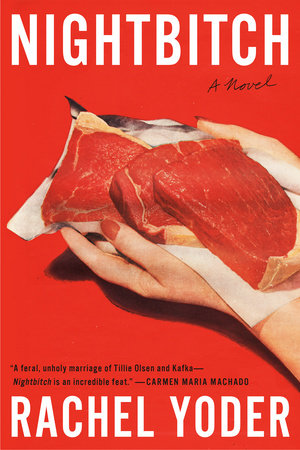
My partner was late coming home from work, again, and my daughter was flopped on the floor sobbing because she had asked for four grapes and I had given them to her. Then she wanted to nurse. I complied; she bit my nipple and laughed. I had the thought, She doesn’t need sustenance, or even comfort; she just wants to own me. When my partner got home I stood and said, “Your turn,” and he said “Can I just use the bathroom first” and I summoned the power of a hundred suns and told him calmly that he’d had all day to shit in peace at work. Then I sat in my car and read Nightbitch.
“In such moments, she could almost touch her loneliness, as if it were her second child.” Underline.
“Womanhood and motherhood are perhaps the most potent forces in human society, which of course men have been hasty to quash, for they are right to fear these forces.” Underline.
“Her problem was that she thought too much— “toxic thinking” and so forth—so she tried to stop, but a physical sensation of exertion remained.” Underline.
I began to feel better.
Rachel Yoder’s debut novel Nightbitch has teeth. And by that I mean it has authority, but also that it bites in a way beyond playful; it bites with anger, in a way that sucks out your breath. It’s about an artist, a mom, who hasn’t made art since her son was born two years before, and she hates having lost this part of herself. The boy’s father travels for work all week, so most of the time it’s just her and the kid. She is sick of playing trains. And don’t get her started on the perfect mommies who attend storytime at the library. Something has to give, and it does: She turns into a dog.
This is a novel about so many things: motherhood and womanhood and the clever cage of patriarchy; how, despite hard work and steady, hyper-rational intentionality, one may find oneself living a life that is unrecognizable. Yoder doesn’t shy away from anger, or loneliness, or confusion. She dives into them so deep, she transforms, and so does her main character, and so, too, does the reader. Did I mention it’s funny? Oh god, it’s really funny, and smart, like the writer herself.
I talked to Yoder about Nightbitch over email.
Kelly Luce: The novel reads like it poured straight out of you, like it was one of those books that an author channels. Is that at all accurate? What was the hardest thing about Nightbitch in terms of the writing process?
Rachel Yoder: I hadn’t written for two years when I sat down to write Nightbitch and, yes, it was that experience of having the words spill from me, as if I were channeling something that had been waiting very long to speak. The hardest part of writing a novel was the logistical keeping track of narrative arcs and so on. I didn’t have a system for plotting, so I sort of muddled my way through. A novel is so big it’s hard to keep the whole thing in your head. I definitely don’t know what’s in the book at this point. I should probably re-read it.
KL: I love how bluntly absurd the elevator pitch for this novel is. How can one not pick up a book that’s like, “hello I am about a burned-outpissed-off mom who turns into a dog”? That wtf-absurdity strikes me as a hallmark of your short stories, too. Everything you write feels so different from anything else that’s out there. Is that something you’ve consciously cultivated? Do you have an artistic philosophy?
RY: This absurdist vibe is something I’ve come into after writing a lot in more traditional modes and tones. And after getting two MFAs, I got antsy, I guess, and annoyed, and wanted to write things that went against all of the MFA propriety and seriousness and convention. I think Nightbitch and other recent-ish stuff I’ve written arises out of that, at least in part. I guess do have an artistic philosophy of sorts. For me, to write work that is perfect and everyone will like and is very safe would be a disappointment. I want to make big bold choices and see if I can make them work. I embrace bad ideas and see if I can make them work. I’m very much interested in impossible artistic experiments. Nightbitch feels like an impossible artistic experiment to me.
KL: I love the idea—and it makes total sense to me—that the more experience one has with MFA programs, the more one might want to write stuff that would make people in MFA workshops uncomfortable.
RY: I got my first MFA when I was 25. I had taken 1 creative writing class before I entered the program and written maybe 3 short stories. I loved reading and I wanted to write, but I knew nothing. I was very green. Only after those two years did I even know what I had gotten myself into, this writing culture and all that entailed, and I was only at the very beginning of knowing what I wanted to write. I worked for a little college after that MFA as the Managing Editor of their lit mag and I taught comp. I could barely afford rent on the salary I made. I was really lonely. I wrote a bit, but I had no community other than the indie lit folks I found online, who were a godsend. And I wanted to write more. So I told myself, if I could get into the best writing program in the country, on a full fellowship so that I would have tons of time to write, then I could indulge myself and get 2 MFAs. I only applied to Iowa, to the nonfiction program, and in my application I said, I can’t come unless you give me fellowship, and somehow this worked.
KL: What were your expectations around continuing your writing career when you were pregnant? Do you have any advice for writers who are soon to be parents, or are considering becoming parents?
It’s so important to hold tight to the most essential parts of yourself in parenthood, even if it’s hard. It will make you more sane in the long run.
RY: Oh, I thought not much would change about my writing after I had the baby. I could find the time for sure. And I really could have found the time, but every urge I had to write went right out the window when I had my son. I didn’t care about writing anymore, and this really terrified me. I wish someone would have told me, you should write even though you don’t want to. Just sit down and make yourself for a bit every day. I think it’s so important to hold tight to the most essential part or parts of yourself in parenthood, even if it’s hard. It will make you more sane in the long run.
KL: What other works (literary or otherwise) do you think of Nightbitch as being in conversation with?
RY: Normally when I write something, there’s a fairly clear inspiration that’s come from an author or book or style that I want to explore and expand. With Nightbitch, I just started writing without my usual “let’s try this formal experiment” or “I want to write something like X,” and now have to go back and think, ok, where did this bad bitch come from? So looking back, I see that a number of films were in the ether as I wrote: John Waters’s Serial Mom, Cassavetes’s A Woman Under the Influence, and Raw by Julia Ducournau. And in terms of books, Carmen Maria Machado’s Her Body and Other Parties was definitely an inspiration in that it gave me permission to write something that was slipstream with a bit more confidence than I had before. I also think Nightbitch is, if not in conversation with, then in psychic meditation with, The Vegetarianby Han Kang and Wild Milk by Sabrina Orah Mark and Dept. of Speculation by Jenny Offill.
KL: Did you toy with the idea of the main character transforming into anything else, anything other than a dog?
RY: Nope. It was dog all the way, from the very start.
It is midday, and table girls are just getting into the flow of their shift as punters come in, loosening their ties. Or it is 4 a.m., and a lock-in is about to go down; the club owner has to do a quick risk assessment of the people in the room before moving onto shadow hours. Elsewhere, a mob boss drinks at a bar while taking an urgent call from his mother as her house is suddenly aflame—the dancers slow down around him, briefly. Another time, a girl is jostled by a drunken clerk type until one of her companions stands and whispers in the drunk’s ear and he leaves within a flash. We know these scenes as they play out in varying shapes in our own experiences. Some of what I have described is directly harvested from The Sopranos, and some from my last time raving.
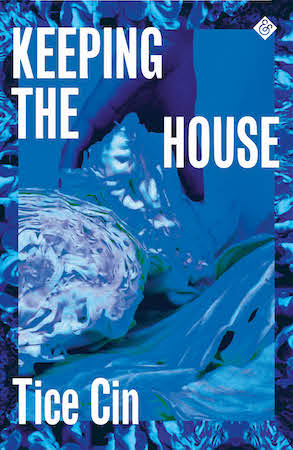
Something that shines in The Sopranos is the curated insularity of its club scenes. The viewer’s curiosity for the mechanisms around the moving forces of the story is parsed into an internal abstracted site, a club that carries on around the drama. This is something that always drew me in as a writer. With my debut novel Keeping the House, I wanted to show my characters taking a tour through a crowded site like a club and still stand out, the story still draws in towards them.
Orchestrating meaning-making moments to churn away amidst other people’s disconnected euphoria became an exercise to me. One of the earliest scenes in Keeping the House shows a group of underage teens that sneak into a club through the fire exit—it’s one of their final nights out together as the group. At the same time, a traumatic incident is taking place outside, one that will overlap into their lives. We can assemble these alternative and uncomfortable meet-cutes through the way we frame scenes in books.
To me, the literature that I enjoy the most thrums with that energy of having rooms built full of dominos, each micro-movement playing a yet untold role in the motion of the story. Something that binds many of these stories together is the way that they call attention to the hypocrisies in our everyday moments and emphasize the people who are surgically zoomed into those details. That is, indeed, how loaded these sites of tension feel to me. I want to have my antennas out in the chicken shop, as the person in front of me might be having his own main character moment by requesting 15 packets of ketchup. I want to look up from my phone at the security guard in Debenhams who is looking elsewhere as a girl stands audaciously close to his elbow and tucks a silk scarf into her pocket. How do we look up? I think these books do a good job of that.
“Jaehee’s fifth or sixth man had dropped out of a technical school where he’d been learning about fixing boilers and was now going from club to nameless club, allegedly a DJ. My eighth or ninth boyfriend had also been a ‘DJ’ in Itaewon. There were so many DJs in Seoul that I wondered if there ought to be some regulating association that handed out licenses in order to ensure quality spins.”
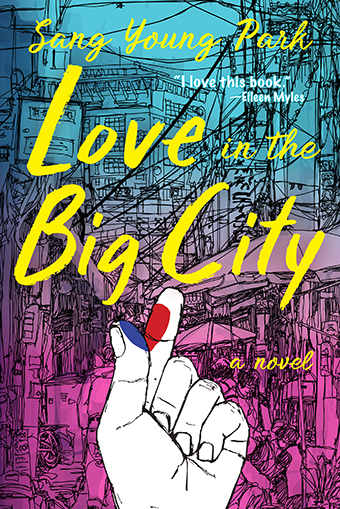
They say with DJs that you have the technical decks person and you have the vibesman. I think that Sang Young Park’s protagonist in Love in the Big City is the ultimate vibesman. We see him dumped because his lover couldn’t bring himself to love him whenever he’d had a drink (too much singing that would result in eventual crying) and start sharing encyclopedic takedowns of Seoul nightlife. We know the vibes. In an electric translation by Anton Hur, we feel the playfulness of the protagonist, with his roster of lovers from DJs to Tinder finds—while at the same time deepening our engagement with the sprawl of responsibilities that wrap around you while you are attempting to have a good time.
“right now we have enough energy to create our own path before we become locked to the ones already made. Flashing my lighter, I look around, move across the crowded space, peering into faces.”
An iconic book, in a brilliant reprint from Repeater Books that includes a new introduction by Sukhdev Sandhu. Junglist in a lucid, sensitive, rawthentic stream-of-consciousness from four young Black men takes us right into the Jungle music scene in London during the 1990s. It is hyperfocused, zooming us into the different peripheral camera shots of the intimacies of a point in time. Clubbers who keep their gear in their socks, kitchens with empty hunted cupboards and lover’s poetics. The book slides between voices and form in a celebration of Black British sound system culture and London’s different imaginations.
“People in their twenties, all tattoos and shiny teeth. Behind the bar stood a small zoo of taxidermy creatures: a huge fish, a baby boar, a yellow duckling under a bell jar. All across the ceiling, white satellite dishes had been converted into lamp fixtures.”
Sperling lingers on the absurd details that make up so many of the markers of a society questing towards perfection. In a book that looks at the economic and technological structures around start-ups, Viral calls us to look at uncomfortable characters and uncomfortable settings, and does so in a toying and knowing manner. The nightspot that is described in this extract could be any site of gentrification, springboarded out of nowhere with an armory of taxidermy mutations and upcycled toilet seats. I eyed up my reupholstered armchair with more suspicion after reading. Mostly though, throughout the tensing muscle scape of start-up culture, Sperling harvests from the all too often maniacal energy of the tech maverick.
“A municipal street-cleaning truck chugs up ahead, blasting the tarmac with a sheet of water to wash away the transgressions of the night. One of the transgressions in question dances back to avoid being sprayed.”
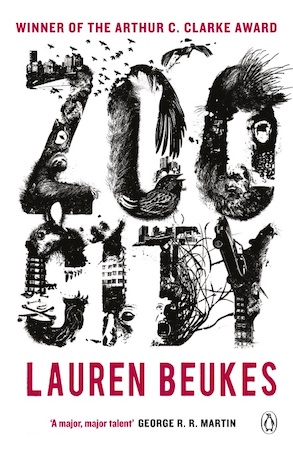
In this noir urban fantasy and science fiction novel from Lauren Beukes, we meet Zinzi, who has a Sloth on her back and uncomfortable work to fulfill, by way of finding missing people. In a pseudo-fantastical Johannesburg a fair few years ahead, we are introduced to a city that feels like a trap-wire, the topography of which is built around fluorescent lights and dingy apartments that commuters rush past to hail cabs. Beukes writes characters who are fluid and complex, the heroics of their actions often murky and dependent on the information that we are fed. It’s a fast-paced and atmospheric read, one that makes you want to slow down to linger within one of the vignettes, perhaps a courtyard full of “crazily beautiful boys and girls.. lolling, smoking and chatting.”
Permafrostby Eva Baltasar, translated by Julia Sanches
“If I crane my neck a little, I can see the beltway from the hospital room window. At night the cars look like comets driven by inscrutable mood swings. They appear this way, I think, because hospitals generate new levels of emotion that are more compassionate and nuanced.”
Eva Baltasar debuted with this novel, she is an acclaimed Catalan poet and it shows. Her style is visceral and brings you back to the body of both people and places, enhanced with a rich translation by Julia Sanches. With a sharpness that comes close to an alarm, this book’s lesbian narrator is self-aware, calling out the ways that people attempt to box her. She flits between lives, from Barcelona to Brussels to au pairing in Scotland. Readers are brought into a navigation of the infrastructures that make a space, to such an extent that we soon attribute her hatred of the color green to the green of Scotland itself.
All too often with queer narratives, they are rooted in a melancholia that feels angled towards the experience of coming out itself, whereas Permafrost’s unique melancholy comes from the protagonist’s gyrating in and out of the lives set out for her. The campness too, of the way that Baltasar’s narrator deconstructs the things she sees around her, feels like the camera lens of a Sopranos club scene.
“That initial mushroom-cloud bang yi feel as the MDMA takes hold n taes yi higher, yir breathin deepens n it’s got yi. The lightness, manoeuvrability, the anticipation, the power ae suggestion.”
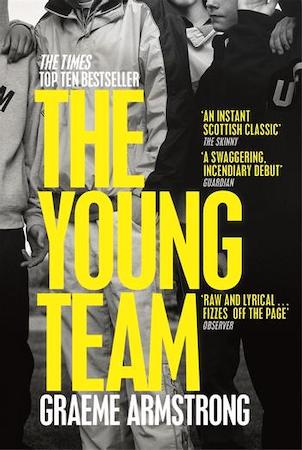
I had the pleasure of listening to Graeme read from the above section in Glasgow recently. The shamanic rhythm of his protagonist Azzy taking in life around him reels by, both to read and to listen to. Armstrong has woven a tapestry that feels years in the making, like photojournalism in its level of researched detail. Armstrong maps the urbanscape of the housing schemes of Lanarkshire and the experiences of Azzy, who joins the Young Team [YTP] in 2004 and quests towards another life in 2012. Tensions manifest as quickly as a Buckfast gets slugged down, and it is this careful balance of tension that keeps your eye right on the window that is yet to be smashed.
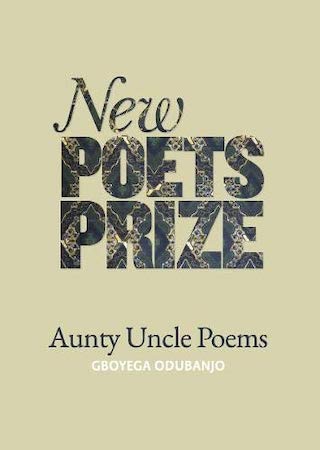
“knows this look to mean if she can distract Uncle with what he really wants then Dad can get what he wants and he can give Aunty what it is she really wants, which is –”
That snippet is taken from the poem “Diplomacy” in the Aunty Uncle Poems pamphlet. I think that the project is a uniquely stuffed elevator of family (the blurb promises family “by blood or by choice”)—and as that image might suggest, the air gets too hot sometimes and disruptions pop. In other spots, the cast of aunties and uncles orbit each other, providing solutions in the telekinetic ways that tight-knit circles often do. The solutions are necessitated by a dance between drama sounding off, and the quest towards the alternative euphoria of hearing your name on radio shoutouts and belonging found in pubs, and legs of lambs left behind in pubs.
Tommy wasn’t ready to go home. It had been six days since Donna and the baby were discharged from the hospital, and the house seemed to close up around them. For nearly a week, he woke with the sun and told Donna, doped up and perpetually naked, that he was going to look for a job. He didn’t tell her that there were no jobs, or that he spent the past four days with his uncles at The Office, a roadhouse off SH-54.
Now, a little drunk and dizzy from the heat, Tommy hooked a left at the creek and headed north to Dead Woman’s Curve. The narrow strip of road weaved dangerously around the hills, earning Dead Woman’s Curve the secondary title of Dead Indian Curve, but Tommy could field the bends with his eyes closed. He’d spent a good number of years drag racing up and down the two-mile stretch; back then he had a ’71 Camaro, but he lost it to some townie from El Reno.
The truck rumbled over the bridge, and the asphalt turned to gravel. Tommy pulled off into the ditch and popped the glove box, rummaging around for the tin of pot he kept there. There wasn’t much left, but he rolled a pinner anyway, throwing open the door and starting down the dirt path to the creek. It was June, and the Oklahoma sun bore down on him with increasing intensity. His dark hair, tied back in a loose braid, burned against his scalp.
Busted cement littered the creek bed, rebar twisting out at odd angles, leftovers from when the county decided to widen the bridge. Red silt washed around the blocks, staining their sides the color of rust. Tommy used them like stepping stones, using the rebar to hoist himself across. He settled himself on the largest slab that dug into the creek’s middle at the slightest incline, took out the pinner, and struck a match. He lit the joint and took a few drags. Thick plumes of smoke descended from his nostrils as he coughed.
The creek was bordered by a dense tree line, thick with leaves and creeping ivy. The locusts thrummed, their song echoing off the underside of the bridge. A flock of barn swallows had made their mud nests all along the bridge’s lip, and the mother birds dove low before returning to their nests.
He dragged on the joint and watched the birds. After watching the swallows for a while, he reasoned it wouldn’t be too hard to build a house out of mud. The Pueblos built whole cities from adobe, carving their plots out of the hillside. His own people, the Pawnee, had been here long before the roads and oil rigs, but they were all long gone, pushed northeast past the city. Donna’s family was Cheyenne, and he knew she’d never leave Caddo County, even though they were holed up in a two-room throwback to Dust Bowl deserters on an acre of dry, red clay. They were getting by on food stamps and the charity of Donna’s parents, who owned the land and the house and who kept the electricity running. When Donna got pregnant, his uncles told him to bail, to grab his shit and run, but he didn’t. He stayed.
When Donna got pregnant, his uncles told him to bail, to grab his shit and run, but he didn’t. He stayed.
He stubbed out the joint on the slab and sat up, catching the scent of a dead animal on the wind. Ignoring it, he closed his eyes, but the smell worsened until he found himself eying the banks for its source. Upstream, moving slowly with the rippling current, was the largest turtle Tommy had ever seen. The stench blew off its shell and, from a distance, he guessed it was nearly as wide as his arms were long. Its carapace was dark green and faceted like a prehistoric, geodesic dome. As it drew closer, Tommy scooted to the slab’s edge and waited for the turtle’s carcass to drift close enough to touch. He wanted to examine his unusual find. When it was within arm’s reach, he rocked forward on his heels and tried to get a grip on the shell’s edge. It was heavier than expected and when he pulled it from the water, what could only be the turtle’s remains poured from the shell as if from a sieve. Bits of rotten flesh splashed into the water. Tommy’s stomach heaved; his first instinct was to shove the thing into the water and let it continue on its way. But on the other hand, he wanted it.
“Damn near big enough for a man in there,” he muttered between his teeth as he held his breath and, tightening his grip on the shell, shook the last of the turtle into the creek.
Once emptied, he lifted it toward the sun and peered through it. The interior of the shell was flecked with waterlogged meat, and the underside shined with scum. Appraising the path to the truck, he knew he’d have to wade the creek if he wanted to take it home.
By the time he pulled into the drive, he reeked of sweat and decay. He unloaded the shell from the truck and propped it against the house. Leaving it there, he almost skipped to the house, he was so excited. The lights were off when he went inside, and the air was stale. There was an uncapped ketchup bottle on the kitchen floor. Donna’s pain pills were on the stove, and Tommy saw that she only had a handful left. The prescription was for thirty, and her mom had filled it for her the day after her caesarean section. He unscrewed the cap and reached for one of the round, blue pills. His fingers left greasy smudges on the inside of the amber bottle, and when he popped the pill into his mouth, it tasted faintly of creek water.
A soft whine came from the bedroom. He stepped across the linoleum and stopped just short of the door. Catching himself in the hall mirror, he laughed. His hair was tangled and wild, his arms and chest smeared with dirt and sweat. He clucked his tongue and quietly pushed open the bedroom door.
“Donna?” He whispered. “Psst, Don?”
Donna lay naked on the bed, her eyes hazy with medication and the baby nestled against her thigh. Her skin was bright against the jaundiced baby’s skin. She turned down her face, glimpsing her wound, and tears ran down her face. For the first time since the operation, he looked at her abdomen; he noted the intricacies of the purple and yellow bruises that blossomed from her middle onto her wide hips like a child’s watercolor. The surgeon told him that they used 200 staples to close her up. Tommy had thought her pregnant belly was beautiful, the way it swelled outwards from her long frame and how she could balance a bowl of popcorn on its crest when they watched late-night broadcasts of Dynasty. He stood in the doorway a moment before moving to sit on the bed’s edge.
“Hey,” she whimpered. The baby kicked in its sleep. “Hey,” he said. He ran his gaze up and down her body and recalled the names he gave the freckles on her thighs— names like Emmett and Petunia, but he couldn’t remember which was which. “You alright?”
“It hurts so much, Tommy,” she said. “I didn’t think it could hurt this much.”
“You need me to get your pills?” Tommy asked hesitantly.
“I already took some, and it still hurts,” she said. A sob escaped her throat. “And it’s ugly.”
“The baby?”
“No, this.” She waved her hand angrily at her stomach. She covered her face with her hand. “This isn’t what it was supposed to be like.”
He caught himself mapping her stretch marks with his forefinger. Withdrawing his hand, he searched for something beautiful about the jagged gash that ran from navel to pubic bone. His mouth began to water, and his esophagus tightened. He looked away. “Come on, Don, I gotta surprise for you,” Tommy offered. She uncovered one eye and sniffled.
“Really?” There was a pause. “What’s that smell?”
“Not really part of your surprise, but more of a necessary evil,” Tommy said. He stood up and offered her his hands.
She shook her head. “You stink, Tommy, you should shower before you do anything else,” she said.
“Come on, it’s really neat, it’ll only take a sec,” he said. He got up and motioned for her to follow.
“Look at me.” She stayed prone on the bed. “Whatever it is, you’re gonna have to show me from here.”
“It’s outside,” he said. “I think you’ll get a real kick out of it.”
She curled an arm protectively around the baby. Her dilated eyes narrowed.
“How’d your job hunt go?” She asked.
“Same as it has for the past year,” he said. “Now come outside, I brought you something.”
“Are you even trying, Tommy?” She began to cry again.
“You know, there was a time when a man would bring something home for his wife and she wouldn’t give’im any shit, hell, she’d be happy,” he said. He paced the bedroom, suddenly angry.
“This isn’t that kind of time.”
“Damn right, it’s not. Instead, I got you bitching at me, sitting there like a gutted fish.” His voice rose, and the baby stirred next to her. She sobbed.
The pill began to kick in, and the air around him went fuzzy. His body felt tired, and guilt washed over him with the pill’s warmth. It occurred to him that Donna must feel this way, too. He turned and left her and the baby there.
Outside, flies had made a home in the shell. He took off his shirt and used it to swat away the flies. Even without his shirt, he could still smell himself, so he stripped down to his underwear. There wasn’t a neighbor for miles, and if someone made it their business to drive all the way out here, then that was their own fault. He laid his shirt, pants, and socks on the hood of the truck, looping his boot laces over the ram’s head hood ornament. The burnt summer grass crunched beneath the soles of his feet. He bent low and examined the shell closely, tracing its contours with open palms. He fingered the thin bones that held the top to the bottom and, hooking one foot with the bottom half, he tugged upwards. The bones cracked loudly.
His toes slipped on the slimy interior, and his foot slid into the shell. The protruding vertebrae scraped against his heel. Wiggling his foot free, he tried again and managed to crack the halves at their bridge. He laid the two pieces side by side.
“You musta been one old son of a bitch, huh?” he said.
The wind rocked the shell’s top. It was about half the size of those turtle-shaped kiddie pools and twice as deep. Tommy stepped inside it carefully and crouched down, bringing his knees to his chest.
“Imagine living your entire life,” he said, “then you die, and some dick desecrates your body.” Something squelched between his toes, and he stood up.
He dragged the top half to the water spigot and turned it on full blast. The water pressure worked at the remaining bits of flesh as he scrubbed at them with his bare hands. Waterlogged and rotten, it was like scraping Jell-O out of a bowl. It wasn’t difficult work, and once he washed away the meat and its accompanying slime, the shell’s interior was actually smooth and gold, like tiger’s-eye. The bottom was a different story: Strings of muscle and sinew clung tight to the bone. He scraped at it until the tips of his fingers were raw. Satisfied that the shell was as clean as he could manage, he set them back up against the house. The sun had already gone down, and though he ducked his head under the spigot’s stream, he didn’t mind the smell. It had grown on him in the evening hours.
He leaned against the truck’s grill and examined his work. The shell didn’t resemble itself like that, dismembered and laid up. Tommy tried to count the rings, the years this cavern had seen. When he was a kid, his uncles told him you could guess a turtle’s age by counting its rings, or maybe that was trees, but he tried, and anyway, his turtle’s shell was covered in blunted domes, and the rings were indistinguishable from the knobby bumps that rose out of each dome.
“You’re a right dinosaur,” he said. “Been round longer than any of us.”
As far as he could tell, there’d been no movement in the house after Donna stopped crying. Inside, things were as they had been: The ketchup was on the floor, the pills on the counter. Tommy counted them: three less than before. He saw the breast pump in the sink, leaking the last of its bounty into the drain. He put the ketchup in the refrigerator and took out a beer. The door clicked as he shut it. It was an older model, one that locked from the outside. He took a drink of his beer. A few years back, he’d seen a story on the news about a little boy who went missing a few counties over. Someone found him six months later in a junk pile a quarter mile from his house, dead inside an old fridge.
He downed the beer and went to the bedroom. Donna lay curled in a ball at the far corner of the bed, her face burrowed against the wall. She slept under a short afghan, her bare toes on pointe. Beneath the blanket, he could see she hadn’t dressed. Her arms circled her stapled stomach.
You already know it’s no use crying around here, huh
The crib was quiet at the bedside. Before the baby was born, Donna’s friends went on and on about how little sleep they’d get, but he hadn’t heard the baby cry since the hospital. Gently, Tommy reached into the crib and picked the baby up. Its head fit easily in his palm, and its feet barely touched the crook of his elbow. At the hospital, Tommy had held the baby at arm’s length, but in the bedroom, he held it close like he’d seen Donna do when she breastfed. The baby was dark, but had a shock of fine, dark hair on its crown, a few strands of white at its nape. The doctor said the white would grow out. The baby jerked in its sleep, smacking its waxy lips.
“You already know it’s no use crying around here, huh?” Tommy whispered.
He lay down with the baby on his chest. He could feel its hot breath. Suddenly he swooned for the baby, his baby, and thought about reaching out to Donna, waking her, but he couldn’t bring himself to touch her. Her body was familiar, but she was as unrecognizable as his shell. As he began to fall asleep, he moved the baby beside him and draped his arm around its tiny form.
He woke in the middle of the night to what he was sure was the sound of steam coming off Donna’s piss. From a sound sleep he heard it: The pressurized stream against the porcelain bowl, the slow hiss that made him open his eyes in the dark, wide awake. The walls thinned, and he heard her padding down the hall to the kitchen—she ran her hand along the wall, her fingernails dragging along uncovered drywall—the pill bottle rattled, the faucet ran. When Donna crawled back into bed, she tried to curl herself around him. He pulled the baby closer and scooted away from her, pretending to be asleep.
When the sun started its ascent, he woke again. Mud had flaked off his back and legs in the night, and it itched. He was aware of the raw odor that came off him in waves. Beside him, the baby yawned and slept on. Its chest rose and fell ever so slightly with each shallow breath. He clutched the baby and got up. Donna, deep in a codone slumber, he imagined, slept on. He hadn’t diapered the baby before he fell asleep, and the baby had wet the bed.
Taking the baby to the kitchen, he wet a washcloth and wiped it down. The baby’s limbs were loose, and he raised each hand twice before letting it fall. It hardly stirred as he put on its diaper. Tommy grabbed a sheet from the closet and swaddled the baby.
“You’re safe with me,” he said.
Taking the baby in his arms, he ducked outside. The storm door’s screen popped out of its aluminum frame as it swung shut, but he ignored it. He smiled when he saw his shell, dry and free of the mess that had been at its center the day before.
“This is for you, little one,” Tommy said. He set the swaddled bundle in dewy grass, within sight of the shell. “Your own little shell to keep you safe. Just a few more touches and it’s yours.”
Sitting on his knees, he took the top half of the shell in his arms and ran his fingers over its surface. Cleaned of algae and creek scum, the top was still dark green, brown veins circling each ridge. He replaced it and stood, wiping his hands on his underwear. Mud and yellowed sweat streaked the band. He hopped from one foot to the other in an effort to take them off, but he slipped, and his bare ass hit the ground with a slap. Without getting up, he glanced at the baby. Its eyes were fixed straight up at the sky.
Your own little shell to keep you safe. Just a few more touches and it’s yours.
He pushed himself up, not bothering to brush off the dirt, and retrieved a hammer and nail from the toolbox in his truck. He returned to the top half of the shell and made a mental x on the thickest section of the bridge that held the shell together. Holding the nail steady, he brought the hammer down and felt the bone give a little. He brought the hammer down again and again, the third swing falling foul and busting open his knuckle. Not thinking, he wiped the back of his bloody hand across his face, tasting blood, sweat, and dirt. He could feel his heartbeat in the nerves of his hand as he pushed the nail through. He repeated the process with the bottom half, rocking back and forth on his heels.
“One more thing,” he said. The baby was still awake, and Tommy was surprised by how blue its eyes still were. The doctor said the baby would grow out of that, too.
He rolled the shell onto its top and lifted the bottom half to it. The two holes lined up, almost perfectly. He rummaged through his toolbox until he found some baling wire; he snatched it and quickly broke off a good-sized piece. He was beginning to feel the same excitement he felt when he found the shell. Giddy, he worked fast at winding the wire through the holes, tightening his loops. He bent the twisted end around the outside of the shell: He didn’t want the sharp points on the inside.
Reunited, the shell had large gaps where its former tenant had extended its limbs. Tommy tested his hinge: The bottom half of the shell swung open and closed.
“See? I’m good for something, huh?” Tommy picked up the baby, holding it over the reconstructed shell. Holding the baby with one hand, he stroked the shell’s underbelly. The sky already shimmered with heat, and Tommy welcomed the warm morning wind that washed over them. The baby’s fists fought against its cotton wrap; it was the most he’d ever seen the baby do, and it delighted him.
“Tommy?”
Donna sounded as if she were at the end of a tunnel. She called for him again, but he didn’t want to answer.
“Shh,” he said. He rocked the baby gently. “It’s alright.”
He lifted the shell’s lid and delicately lowered the baby into it. He made sure the baby rested to the side of the bony spine and that the sheet was tucked tight around its head. He touched the baby’s lips.
“Tommy?” He heard her footsteps in the hall. “Do you have the baby?”
The baby trained both blue eyes on him and stuck its tongue out.
The Indian Government decriminalized queer sex a little over two years ago. The law— section 377 of the Indian Penal code, a remnant of imperial rule—defined “carnal intercourse against the order of nature with any man, woman or animal” as punishable. The loose language of the code left it open to interpretation, and therefore open to misuse. Now, though the law has been repealed, queerness is still considered abnormal. My family members call it “unnatural.” There exist no human rights for the queer community, and as a whole my country is unable to accept queerness. Consequently, even though I have accepted my own sexual and gender fluidity theoretically, I continue to promise my mother that I will marry a man. I propel heteronormative patriarchy and push its violent agenda forward because I am afraid.
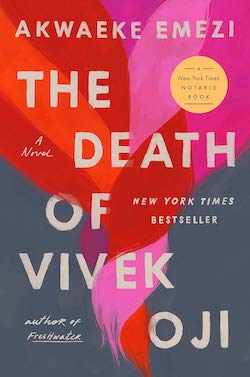
Nigeria is another such country where queerness is criminalized, rejected and feared. Akwaeke Emezi’s The Death of Vivek Oji, published in 2020, battles with transphobia and queerphobia in the Nigerian community. Emezi’s genderqueer protagonist, Vivek Nnemdi Oji, dies on the very first page and inhabits the afterlife, speaking to the reader from the beyond, but even as he lives, he is not part of the center, the “real,” the concrete. Vivek existed in liminal spaces even before his death, having never fully been part of the living world. He is used to being marginal.
When Vivek is 11, he is sent to an all-boys military school where he is frequently assaulted, both physically and sexually. He starts diving into fugue states in which he “would become very, very still, just stop moving while the world continued around [him].” As Vivek grows up and goes to college, a lack of community, love, and empathy drives Vivek into depression. The first time I read the book, self-isolating during the pandemic, I believed Vivek’s suffering resulted from his queerness. I questioned Emezi’s representation of genderqueer identity as a sickness because I considered Vivek’s fugues a consequence of his genderfluidity, in addition to the physical and mental abuse he suffers at the hands of the seniors at the all-boys boarding school. But as I delved deeper into queer theory and Emezi’s writing and reread the book, I understood that Vivek’s fugues are not a representation nor a symptom of his genderqueerness. Rather, they represent a safe space for him, a manifestation of his spirituality. The violence perpetrated against him is a symptom of the diseased society that surrounds him; it’s not connected with his queerness. His fugue states are a medium of communication between Vivek and his grandmother, Ahunna. Vivek is Ahunna reincarnate. Ahunna dies the day Vivek is born with a “dark brown patch shaped like a limp starfish” on his foot, just like the one on Ahunna’s foot, making Vivek two spirited—both a man and a woman.
The first time I read the book, self-isolating during the pandemic, I believed Vivek’s suffering resulted from his queerness.
When Vivek declares to his cousin and male lover, Osita, “I am homeless,” we are inclined to think that homelessness is the price of queerness in societies like mine and Vivek’s, and that the ultimate goal of queerness (read queerness as the umbrella term for all forms of divergent existence based especially on sexuality and gender) is to fight its way to the dominant center. Whereas “[q]ueerness is an ideality” as José Esteban Muñoz writes in Cruising Utopia: The Then and There of Queer-Futurity and like all idealities, queerness is yet to be fully achieved, will always be yet-to-be-fully-achieved and hence eternally homeless. “We may never touch queerness,” Muñoz writes, “but we can feel it as the warm illumination of a horizon imbued with potentiality.” Emezi teaches us that that “horizon imbued with potentiality” is not the margin of society, not a mirage at the end of the world. It already exists in the in-between. Vivek’s homelessness is a metaphor for his lack of a spiritual home. But it’s the liminal spaces he occupies—gender fluidity, his fugues, stolen moments with his friends and lover, and the spirit world writ large—that allow him to live a full life and actualize his queerness.
Vivek’s chosen community consists of children of Nigerwives—foreigners who had married Nigerian men. Vivek’s chosen family protects and loves him passionately. The safe space “the girls”—Juju, Elizabeth, Olunne, and Somto—provide for Vivek allows him to more fully develop his gender expression. Vivek begins wearing dresses and eyeliner; he also paints his toenails and lips red. He asks his friends to call him Nnemdi, the name Ahunna had wanted to give to her granddaughter. Vivek often goes to the local market as Nnemdi, until one day a riot breaks out and the whole market is burnt down.
I instantly fell in love with the fluid, the most beautyful Vivek. Vivek’s matted tangles falling below his shoulder blades, sometimes knotted in a bun atop his head, his loose curls of hair—a cause of concern for his family—continue to entice and haunt me. Vivek’s beauty fills me with desire, just like it does Osita. The moments that Osita and Vivek spend together are ephemeral, but they occupy a lifetime. Each time I read Osita’s words, “I died at [Vivek’s] mouth,” I die too, and I understand that as much as I love Vivek, it’s my curse to be Osita—a person afraid of being himself, a person who gives up on love and happiness in order to be accepted by the heteronormative dominant society.
When Osita hates himself and his own queerness, Vivek holds Osita, releases him from his agony, gives him pleasure, and calms him. The “abnormal” love between the two breaks me even as it heals me; it confuses me, confounds me, mirrors my tiny existence, but also expands it beyond the scope of this universe. That Vivek can speak to me from the spirit world, that he has become a spirit and is now light and free, untethered to this realm of humans, proves to me that liminal spaces are more real than any concrete reality.
The moments that Osita and Vivek spend together are ephemeral, but they occupy a lifetime.
But then I descend into my own reality, and I hear my dad say that Vijay, my best friend who is a gay man, will become normal, that I should marry Vijay, that we can beat it out of him, as if “it” is a demon that lives inside Vijay, very much like the demon Vivek’s aunty—Osita’s mother—tries to beat out of him. I don’t think my father actually means any sort of harm; Vijay and I often laugh at my father’s homophobia because beating kids is an often-joked-about phenomenon in north Indian households. But a larger truth lurks behind these statements: heteronormativity is the way.
Heteronormativity functions on a timeline where an individual must achieve milestones set by the society: get a degree, find a job, get married and then have kids. Perpetuate the cycle. Editors David L. Eng, Judith Halberstam and José Esteban Muñoz of What’s Queer About Queer Studies Now? argue that queer politics is also falling prey to a standard of normativity, creating a phenomenon which has been labeled by Lisa Duggan, a professor of Social and Cultural Analysis at New York University, as homonormativity. Eng et al describe homonormativity as the political pursuit of gay marriage in the Western society “while rhetorically remapping and recoding freedom and liberation in narrow terms of privacy, domesticity, and the unfettered ability to consume in the ‘free’ market.” Any form of normativity “collaborates with a mainstreamed nationalist politics of identity, entitlement, inclusion, and personal responsibility” and overlooks “capitalist exploitation and domination, state violence and expansion, and religious fundamentalisms and hate.” And homonormativity is no different in its pursuit of a place within the dominant construct.
I want to relate with Vivek; I want to search and desire a true home.
The day section 377 of the Indian Penal Code was decriminalized, I WhatsApp-called Vijay and congratulated him. I still thought the victory to be more important, more relevant to him. I still thought I was more straight than queer. While books were my safe space, the predominantly white literary world seemed to be rejecting me, and now there was another world that I was trying to get into but thought I didn’t really belong in. Being Indian, my fears were dual—I feared would never be able to experience the sweet fruits of homonormativity, and I feared that only homosexuality is queer. I thought that everyone else, including me, was just pretending. If I could be attracted to men at all, then I was not queer; if I had not slept with women, femmes, dykes, gender-nonconformists, then I was not really queer. Now I realize that I was in search of not queerness but queer domesticity. Much like the Western liberal politics lamented by Eng et al, I had limited my queerness to a form of domesticity that mirrored heteronormative ideals of marriage and rearing a family.
In the equation set by normative ideals, home is mistaken as domesticity.Riots and political unrest in Nigeria of the late 90s form the backdrop for the present day story of VivekOji. The reader and the characters assume that the cause of Vivek’s death is a hate crime, an inevitable end brought about by not having a place in the society. But Vivek dies of more liminal causes: unacceptance from his family, and Osita’s fear of Vivek’s two-spiritedness. The lack of such love causes the loss of a spiritual home. Emezi writes in their debut memoir Dear Senthuran, “I’ve been thinking about these earthly homes less as homes and more as places of origin for our embodied forms.” The chapter titled “Home|Dear Jahra ” describes Emezi’s struggle to find their way back to their deity mother, Ala, the Earth goddess, who takes the form of a snake. Vivek’s journey is similar to Emezi’s—a move away from “earthly homes,” and towards spiritual ones. Vivek never wants any form of domesticity. Rather he wants and finds home in his love for Osita, in his own corporeal existence as Nnemdi, in his best friend Juju and finally in the spirit world.
I want to relate with Vivek; I want to search and desire a true home. But instead I relate with Juju and Osita.They echo my fears. Juju is “scared that [either her girlfriend or she] would wake up someday and decide [the other] was tired of being with a girl.” On the other hand, Osita pines for normativity; hopes his love for Vivek proves to be an anomaly. He hides the relationship from everyone, even after his lover dies in his arms. He locks his queerness inside of himself.
Despite their fears, Juju and Osita love in the most queer ways possible. After Vivek’s death, in order to relieve each other of their grief, Juju and Osita have sex; arguably this act is not queer, as it’s strictly between a man and a woman, but it is an act of manifestation, an exercise to bring Vivek into existence. Vivek watches them from beyond, and achieves the peak of his happiness:
[T]hey were so beautiful together. I put my hands on the small of her back and on the stretch of his chest. I kissed the sweat of her neck and his stomach.
They were keeping me alive in the sweetest way they knew how.
The homage Osita and Juju pay Vivek shows that queer time is magical. It doesn’t need to function linearly. Non-linear time and liminal spaces are often seen as purgatories, transitory spaces of suffering through which one must pass to reach the final destination but queerness finds safety in transition, in purgatory. The dominant construct assumes that everyone desires to be the center, but queerness expands into spaces where no center is needed. Emezi says in an interview with Electric Literature that Osita lives “very much in this world with all its limitations,” and that is a character flaw that proves to be fatal for his lover. Vivek lives a much fuller life in a world that expands beyond the corporeal. Vivek, in his true spiritual and corporeal self, embodies the ideality that Muñoz says we might never achieve, but even he achieves it after his death. In a mortal life, I may not be able to achieve the peak happiness that Vivek finally achieves, but I also do not want to make the same mistakes as Osita’s. I am searching for something between domesticity and queer ideality. Meanwhile I read writers like Emezi and through their stories, I live multiple lifetimes and idealities. For even as Emezi’s words highlight the loss of queer domesticity from my life, a loss that burns bright, they also give me hope that my queerness will inhabit liminal spaces of my own making.
As a Filipino American immigrant, I’ve been aware of my invisibility from the time I set foot in the United States. I perceived it when coworkers looked past me, when store clerks and waiters talked to my white companions instead of me, and when editors and literary agents told me Filipino stories were unsellable.
Assertiveness became my armor, and adaptability, my best weapon. When people ignored me, I redoubled my efforts to be heard and seen. At work, I didn’t wait around to be noticed, but presented my ideas proactively. In hotels and restaurants, I spoke directly to people who were not inclined to wait on me. As a novelist, I set aside my unmarketable Filipino stories and “adapted” by publishing romance books about white characters.
I thought I only needed to work harder to gain visibility. It took Ralph Ellison’s Invisible Man to pierce my armor and dismantle my weapon. In the novel’s opening paragraph, Ellison’s nameless Black hero says: “I am invisible, understand, simply because people refuse to see me.” This line alone brought tears to my eyes. Ellison tells it like it is, and it hurt.
I was moved to read Invisible Man after George Floyd’s death at the hands of the police in May 2020. I read books by Black authors to help me understand their experience better. Ellison’s novel depicts one African American’s struggles against racial injustice in post-World War II America. It’s about the journey of the titular Invisible Man from the South to New York City, and his encounters with racism along the way.
Since I’m not Black, I didn’t expect Ellison to speak to me with the force of a spiritual awakening. The experience of Filipino Americans is inherently different from that of Blacks or other people of color. The United States colonized the Philippines in 1898 as an offshoot of the Spanish-American War. The first wave of Filipino immigrants arrived in this country between 1906 and 1935, back when the United States ruled the Philippines as a colony. Filipino immigrants worked in sugar and pineapple plantations in Hawaii, as well as in California farms.
Since I’m not Black, I didn’t expect Ellison to speak to me with the force of a spiritual awakening.
Filipinos came with a unique status as U.S. nationals, but their legal standing didn’t protect them from racial discrimination and injustice. Businesses banned them with warnings such as this: “Positively No Filipinos Allowed.” For five days in January 1930, white mobs terrorized and assaulted Filipinos in Watsonville, California. Fermin Tobera, a Filipino immigrant, was killed in the riots. His murder remains unsolved today.
My people have endured racism for sure, but unlike African Americans, we can’t claim to suffer from the effects of 246 years of institutionalized slavery. In reading Ellison’s novel, I was looking for enlightenment about Blacks, which I got and then some. He gave me the gift of existential reckoning.
I was amazed at how eloquently Ellison spoke to my immigrant experience almost seven decades after his book’s publication. Invisible Man toppled my misbegotten notion that I can make myself visible in spite of this country’s systemic racism through hard work alone. Worse, my unrelenting “adaptability” unwittingly worsened my invisibility over the years. I just didn’t realize it until now.
In Ellison’s book, the hero tries to be adaptable too. He follows the conventional path to middle-class success by pursuing higher education. He manages to get a scholarship to a state college for Blacks after winning a bizarre, blindfolded boxing match in front of his town’s leading white citizens, but gets expelled for exposing one of the college’s founders to the harshness of Black life. After moving to Harlem, he gets a job as a spokesman for an organization called The Brotherhood through the strength of his oration, except that the leadership eventually tells him that his job is not to think, but to do and say as the Brotherhood dictates. The protagonist realizes the Brotherhood only cares about power, not justice.
Invisible Man toppled my misbegotten notion that I can make myself visible in spite of this country’s systemic racism through hard work alone.
Just like Ellison’s protagonist, I took the traditional path offered by higher education to enter a space of visibility. It opened doors for me and gave me a professional identity as a journalist, and later on, as a marketing writer. I didn’t have to engage in a “battle royal” boxing match, but I won a spot in a competitive minority internship program as a graduate student. The internship led to a news writing job, which in turn led to other writing jobs in corporate America. I felt lucky to secure well-paid positions in companies where I was one of the few people of color and often the sole Filipino American. If visibility is like stepping into the spotlight on a stage, then I was in the wings catching the glare of the light.
I was comfortable in my place, until I started writing fiction. All of my novels focused on Filipino and Filipino American characters. For eighteen years, I wrote and submitted doggedly. I even managed to sign with two literary agents, first Black and then white. Both tried but failed to sell my manuscripts. The verdict: my novels were not viable because of the subject matter (Philippines, Filipino Americans) and the genre (literary fiction, historical fiction). It’s a fatal combination.
In 2013, my desperation led me to a eureka moment. What if I write a “sellable” novel?What if I write about white characters in a commercial genre? Without knowing what everyone knows today—that 76 percent of mainstream publishing gatekeepers are white—common sense told me that white equals publishing viability. I decided to write a white romance novel.
For four months, I wrote the book with the intensity of a woman climbing Mount Everest as the final act of her life. The result was a short novel about a blue-collar boxer, a beautiful doctor, and their knockout romance. Not an iota of my Filipino background leaked into my novel. I used a pen name in my unagented submissions.
I touted my experience as a reinvention of my writing career, and advised other writers to be similarly ‘adaptable.’
Within five months, a publisher acquired my novel. Twelve months after acquisition, In His Corner was published under my pen name Vina Arno. It brought me neither riches nor renown, but it gave me a bona fide publishing breakthrough. My old assumption that working hard and blending in will make me visible seemed spot-on. In an article I wrote for Forbes, I touted my experience as a reinvention of my writing career, and advised other writers to be similarly “adaptable.”
Publication boosted my morale, enough to make me pick up one of my unsellable Filipino manuscripts and give it another try. In 2018, I attended the San Francisco Writers Conference and mustered the courage to pitch my historical novel, My MacArthur to a publisher. The book is about Gen. Douglas MacArthur’s scandalous interracial love affair with Isabel Rosario Cooper, a Filipino actress, in the 1930s.
Two months after my pitch, Sand Hill Review Press (SHRP) acquired my novel. At the same time, my second white romance book was acquired by another publisher. I’m certain SHRP didn’t acquire My MacArthur because of my obscure romance novel, but it probably lent me credibility that made me more viable than unpublished writers.
That year, two of my novels were published, one after the other. Only one carried my real name and depicted a Filipino protagonist. But together they kept me in the wings of visibility. I was finally getting published.
It took Ellison’s book to open my eyes that my romance novels did not make me visible. On the contrary, they worsened my invisibility. I sacrificed my truth just to be seen, even though my first romance book barely sold enough copies to keep it available today, while the second book flopped outright so the publisher withdrew it from the market two years after publication. Both books represented a missed opportunity to tell meaningful stories that could help shape a Filipino American narrative I could identify with. Like Ellison’s protagonist, I acquired a new name but I remained nameless. I bought into the commercial “ideology” of publishing at the expense of my identity as a Filipino American. The real value of my romance novels lies in keeping my hope alive, so I may persist in writing Filipino stories.
If only I had read Ellison years before, I could have avoided contributing to my own problem. But in food as in literature, you are what you consume. Growing up in the Philippines, my American-style education fed me white literature. Books written by African Americans and people of color were simply outside of my literary exposure.
The Filipino educational system is a product of U.S. colonialism. American soldiers opened schools in the Philippines as soon as they took over from the Spaniards in 1898. For more than 300 years, the Spaniards withheld the proper teaching of Spanish language to keep Filipinos ignorant, and therefore, subservient. The Americans did exactly the opposite. Teaching Filipinos their language helped them win Filipino acceptance and made Filipinos abide more willingly. Given their motive in teaching Filipinos, the educational system they molded promoted only the dominant American culture.
It’s no wonder that my own education taught me only about white Americans. Invisible Man was published in 1952 to great acclaim, and won the National Book Award in 1953, but I never heard of Ellison while I lived in the Philippines. My required readings as a student in Manila included J.D. Salinger’s The Catcher in the Rye, Richard Bach’s Jonathan Livingston Seagull, and Ernest Hemingway’s The Old Man and the Sea.
I bought into the commercial ‘ideology’ of publishing at the expense of my identity as a Filipino American.
If only my so-called “American” education covered the depth and breadth of American culture—and included literature written by Blacks, Native Americans, Asian Americans, and other people of color—it might have prepared me better for my struggles as an immigrant in America.
At the end of Invisible Man, the hero falls through a manhole and into a coal cellar while fleeing from a race riot. It saves him from the violence aboveground, but it also traps him in the darkness below. He chooses to stay underground as a form of hibernation. “I’m invisible, not blind,” he declares. “No indeed, the world is just as concrete, ornery, vile and sublimely wonderful as before, only now I better understand my relation to it and it to me.”
But the Invisible Man isn’t hibernating for long. “I’m shaking off the old skin,” he adds. “I’m coming out, no less invisible without it but coming out nevertheless.”
Thanks to Ellison’s novel, I’m also shaking off my old skin of naiveté in the guise of adaptability. Self-awareness is my new armor, perseverance, my preferred weapon. I’m no more visible than before, but at least, I know better than to write another white romance novel.
In our series “Can Writing Be Taught?” we partner with Catapult to ask their course instructors all our burning questions about the process of teaching writing. This month we’re featuring Made in Chinaauthor Anna Qu, who will be leading a year-long Online Memoir Generator for writers of color at Catapult—to apply, please submit a chapter from your memoir-in-progress (up to 25 pages), or your strongest writing sample, with a short proposed project description attached. Qu talked with us about finding community, taking risks, and establishing trust with yourself.
What’s the best thing you’ve ever gotten out of a writing class or workshop as a student?
A community of fellow writers that continue to show up, support, and celebrate each other’s trials and success.
What’s the worst thing you’ve ever gotten out of a writing class or workshop as a student?
That my work was unbelievable and felt made up.
What is the lesson or piece of writing advice you return to most as an instructor?
JoAnn Beard once told me if a story isn’t working, start over or write something new. That felt brutal and profound at the time, but now, especially after I started teaching, that perspective feels necessary and true.
Does everyone “have a novel in them”?
Sure, if they want to have a novel in them.
Would you ever encourage a student to give up writing? Under what circumstances?
No. Maybe a hostage situation? Sounds like a writing prompt!
What’s more valuable in a workshop, praise or criticism?
Praise is an opportunity to assess the feedback you are receiving from fellow writers. From their praise, you can tell if your story resonated. Do they get it? Are they able to help you get your points across more fully? Praise is as much an opportunity to establish trust and mutual understanding as it is to encourage. If the writer agrees with the positive feedback, then they should look at the criticism. In my classes, we don’t criticize so much as raise questions, connect themes, strategize plot possibilities, etc.
Praise is as much an opportunity to establish trust and mutual understanding as it is to encourage.
Should students write with publication in mind? Why or why not?
Yes and no. Get the content down any way you can. A few drafts later, after you shape the structure, characters, and the reader’s experience, you can begin to think about publication. It’s important to remember that while we write alone, publication is when our work joins a much larger community. Once you move into the editing process, it’s smart to do research on lit journals, magazines, blogs, and understand the conversation your work will be joining. Publication is the last step in the overall process and one that does a great deal to energize and validate emerging writers.
In one or two sentences, what’s your opinion of these writing maxims?
Kill your darlings: Still useful in the context of focusing a large project, but there are no true do’s and don’ts in writing.
Show don’t tell: Show and tell are not mutually exclusive. Show is especially effective in writing compelling scenes, especially if we’re working with emotional arcs.
Write what you know: Yes, especially when it comes to identity, race, gender, disability, etc. And if you are writing about characters or situations that’s not familiar, make sure you find/pay a sensitivity reader.
Character is plot: This is true for my writing, but I wouldn’t say it’s true for all writers.
All these maxims derive from craft tools developed for the workshop model, and as we grow and evolve as writers so should the model. These maxims are a guide, not a rule. Once you have foundational understanding, trust yourself and take some risks. Figure out what does and doesn’t work for you as a writer.
Once you have foundational understanding, trust yourself and take some risks.
What’s the best hobby for writers?
Physically, the best hobbies are walking, hiking, or traveling. I also like to paint, and I always encourage my students to interact with other mediums of art and creation. Writing nonfiction can be intense emotionally and physically, and it’s good self-care practice to play with other art forms that can stimulate the same part of the brain.
There is No Chocolate Ice Cream in Stars Hollow or On Getting Help for My Obsession with Gilmore
I think of Lorelai’s love / of food and coffee and how whte
privilege is always finished bowl and feasting/ consuming
even the carton/never belly-room enough for
consequences/ I love all the ways I’m forced to bask in wht
bodies embracing/expected to cream from 2-ply paper lips
pressing together/ a nest of hair knotting
like dingy shoelaces/how she never thinks of her fifty flavor
choices—a multitude of men pining for her seen and centered
ass/ when you’re a straight whte woman, the love triangle is
your sweet inheritance/hand-spun in caucasian confection/
everyone wants to dip their tongue into her/ pop rox their
taste buds on anglo fizz ecstasy/ a fro-yo
of vanilla brain freeze/

while us queer Black women sit patient for our four
lines, 50 dollars, and a Sag credit/ waiting for sexual
tension to build between her and diner
boy/ meanwhile, I would have fcked him and her
and fled/cause I never know what’s good for me
and even when I do, I leave/was never taught
how to stay frozen/cone-gripped and candy-hearted/
but you, you learned/bcuz u are everywhere/ snow
white showed you a woman is only desirable
when she is immovable and waiting/ to be carved
into. while us brown girls never stick around
long enough for you to lick the edges /we know
we’ll melt if we stay still.
For God So Loved the WAP
Broken Sestina for Cardi B’s WAP ft. Megan Thee Stallion
And what is a woman but a cavernous pussy
collapsing after men made her a dam?
Rushing water above fractured oak, afraid
to land over the cliff and drop down finger-first.
scared the quake will leave us splintered.

What does it mean to push past the splintering
to reclaim the running water of pussy?
To say amen to the faucet spilling coins—
all the pennies you saved to toss and forget.
Now, she has reached a reservoir of fingers
gliding out and in. What is a woman unafraid?

She is a brook, a stream, a whole damn
ocean. And what becomes of the splintered wood? She builds
a home in the depth of the stroke—unafraid a home in the
mess of her gushing geyser. And what is a pussy but a boiling
spring? Hot eruption of minerals and salt-brine, spouting off
heat to melt the coldest coin. Damn

What is a woman but a stream of fingers
waiting to run off. To spill sediment salt
from fuck boys, who thought of us a damn
store-bought container, fish tank pussy
to hold his school of splintering trout.

When we say go deeper, we mean to dive unafraid to
the bottom an open mouth bass, to swallow the salty
seaweed. To run rough tongues over our bleeding pussy
stones. To drink and be full. Now, unsplintering
full-bellied and gaping, our floodwater fingers
rush alive and unafraid. Watch the dam

she will build from its splinters.
The grit and stone she will cleanse with salt.
Watch her wet and waiting, for pussy
pleasured oak. Spark a live-fire—
swear this fountain wasn’t home.
Swear the water.
Swear it fire. Swear it home.
I don’t want to read about mangoes. Their freshness, their sweetness, their broadleaf trees with laden boughs. I don’t want to read about their pickled tartness, or how their ripening smell signals approaching summertime. In fact, I don’t want to read about the Indian summer either, unless what I’m reading conveys how truly crushing its heat is. In essence, I don’t want to read India as written for its diaspora—the longing for an imagined homeland—or India written for a colonial imaginary, which, in my experience, often shows up on the page as the same kind of longing.
There was a time, though, when I lived for this stuff—and that’s also when I lived in the UK. Back then, I wanted to gorge on literary mangoes, on loss, on a simmering outrage at appropriation that was so perfectly caste-blind that it always already exonerated me. This was also, unsurprisingly, the sort of writing that was easier to find, the kind that made—and still makes—a variety of international bestseller lists.
But then, I moved to India; I lived, worked, dated, dreamed, sweated in India. And I knew I needed something else. I needed books that were sharp and true and felt, but most of all, that were less interested in the subaltern speaking back to empire than they were in writing without reference and deference to empire at all.
Here are seven women authors whose work is not nearly as widely read as it should be, but who write India as it feels: shorn of nostalgia, mythologized pasts, poverty porn, and for the most part, mangoes.
Shama Futehally
My mum lent me her copy of Tara Lane when I was at the peak of my frustration with South Asian fiction, and it was exactly what I needed. Shama Futehally’s debut novel—but by no means her first significant literary work—is a true treasure; a coming of age story set within an old affluent Muslim family whose world is beginning to fracture. As the narrator Tahera—or Tara (who shares a name with the small Bombay lane where their family home sits)—reflects: “When our house of cards collapsed, it would fall on all sides, in a single totter.”
Futehally’s graceful, precise prose navigates family dynamics, labor strikes, and Tara’s interior world with equally deft poise. In a long tradition of literature that elevates the ordinary to the extraordinary—Carol Shields, Anne Tyler, Rachel Cusk—Shama Futehally and Tara Lane deserve lasting pride of place.
Meena Kandasamy
I’m definitely trolling myself by including Women’s Prize-shortlisted poet, author and translator Meena Kandasamy on this list, but I came to her work so late that I want to rectify a similar potential loss on everyone’s bookshelves. Her 2017 novel When I Hit You; Or, A Portrait of the Writer as a Young Wife is a gripping story of a young woman living with her abusive Marxist husband.
As someone who has wasted too much time in thrall to socialist men, I loved this exploration of gender, idealism, and the seductive draw of politically engaged men. For example: “To fight the evils of capitalism, we required the staunchest warriors. He was one, and he could make one out of me.” Hard relate. Above all, though, Kandasamy’s novel is a story of one writer’s struggle to create work within and against incredibly oppressive odds. As her narrator says, “The number one lesson I have learned as a writer: Don’t let people remove you from your own story.” Kandsamy—in her poems, books, and even her tweets—never does.
Aditi Patil
My friend who loaned me her copy of Patriarchy and the Pangolin: A Field Guide to Indian Men and Other Species described it as “perfectly capturing millennial Indian women’s climate angst”—something we both share, but rarely see so well represented. Conservationist Aditi Patil’s debut 2020 book is part-memoir, part-field research; the story of two women making their way through Gujarat’s farms, fields, forests, and bureaucracy. Here they’re faced with every species of intractable Indian man as they seek to uncover stones usually left behind by data: women farmers, nonhuman life, indigenous peoples.
Describing herself as “the poor woman’s David Attenborough,” Patil’s book sparkles with a delightfully Indian humor. Roadside cows ‘”wonder… what failed questionnaire sheets taste like” and more than one potential conflict is diffused because “The moment passed, like all the millions of moments that have historically passed when men haven’t noticed what women said.” In Patil’s own words, Patriarchy and the Pangolin is a book “about what it means to be alive in India. And to be alive to India.” And it is just that.
Sharanya Manivannan
“Some days you sparkle like a teenage vampire. Some days you feel as though you’ve walked through the remains of an exploded dhrishti pusanika, which is to say, fucked.”
Unlike the other writers on this list, poet and author Sharanya Manivannan—who grew up between Sri Lanka, Malaysia, and South India—leans deeply into cultural and spiritual specificity, and invites her readers to follow. She’s the author of two poetry books, a collection of short stories, a novel, and most recently, a graphic novel about mermaids that she illustrated herself(!). Across genre, all of Manivannan’s work glows with a luminous depth and a thorough relishing of language at every turn. This includes my favorite, The High Priestess Never Marries, a collection of short stories about women living on their own terms that shines long after the last page.
Manjima Bhattacharjya
Can feminism and fashion be allies? This is one of the many questions Manjima Bhattacharjya (one of the best feminists I know) explores in her intrepidly reported book Mannequin: Working Women in India’s Glamour Industry. From going backstage at India’s most prestigious fashion event (thanks to meeting two models outside the hotel toilets—what Bhattacharjya describes as “the most significant day in my Ph.D. life”) to interviewing countless working women from a wide variety of backgrounds, this debut book uncovers the lives of women in fashion as existing, consistently, “between spectacle and surveillance.”
Spanning body politics, labor protests and feminist ideas of “objectification,” Mannequin leads us through an unflinching analysis of how neoliberalism has deeply shaped India; an economic system in which models serve as the very embodiment of globalization. Except the thing about globalization is that not everyone can participate in it —including, often, the women themselves.
Nisha Susan
Co-founder of the award-winning feminist website The Ladies Finger, Nisha Susan is a writer who I first encountered as an editor. She was the first person who showed me how to make writing that endures, and most importantly, what an editor can do for a writer. When I went on to become an editor myself, it was her smart, guiding hand I tried to channel. All this to say that I was entirely primed to love her debut short story collection The Women Who Forgot To Invent Facebook and Other Stories—and it did not disappoint.
Susan writes millennial India the way it feels for many of us: funny, painful, violent, absurd, and in turns bound together and fractured by digital technology. This sharp, witty collection also manages to feature pretty much every variety of Indian fuckboy I’ve ever encountered, which, given their expansive range, is no small feat.
Priya-Alika Elias
Speaking of desi fuckboys, my favorite chronicler of their insufferable ways is Priya-Alika Elias (see: “DJs are the root canals of people”), the author of Besharam: Of Love and Other Bad Behaviors. A collection of funny, fierce, heartbreaking essays, Besharam (the Hindi word for “shameless”) ranges in topic from internet culture to “aunties” to the problem with telling your friends to just “dump him.” In it, Elias writes:
“How can I describe the specific wound left on online dating sites by white women who say ‘only white men’ or that left by white men who say ‘you’re attractive for a (X ethnicity)?… We know what happens to a wound when it festers.”
“I was a brown girl in a wasteland of blinding whiteness and it never occurred to me that I was worthy of being cherished and loved.”
At every turn in her debut book, Elias takes our faces between her hands and tells us we are worthy, worthy, worthy.
Urvashi Bahuguna
Poet and essayist Urvashi Bahuguna is the voice in Indian writing I feel I’ve always been looking for: graceful, sharp, and most importantly, rooted in India without insisting on cultural identity at every turn. The young author of an exquisite debut poetry collection Terrarium (whose launch I attended at an indie bookstore in Goa, the Indian state where I live and where Bahuguna is originally from), it’s her 2021 bookNo Straight Thing Was Ever Made: Essays on Mental Health that announces Bahuguna as a literary force to be reckoned with. In it, she writes:
“We knew respectability was no antiquated need for most people around us, and that stigma and judgment were a stone’s throw from where any of us stood.”
Simultaneously soft and crystalline sharp, Bahuguna’s essays range in scope from family to fear to writing to birds— the attempts of a young woman to trace the patterns of her mind and her life, all the while remaining firmly rooted where she stands.
DON’T MISS OUT
Sign up for our newsletter to get submission announcements and stay on top of our best work.
YOUR INBOX IS LIT
Enjoy strange, diverting work from The Commuter on Mondays, absorbing fiction from Recommended Reading on Wednesdays, and a roundup of our best work of the week on Fridays. Personalize your subscription preferences here.