Natalie Diaz Unravels What It Means to Be American and Native

Natalie Diaz’s second poetry collection, Postcolonial Love Poem, explores the pain America has inflicted on indigenous people—and how desire and love are created or found despite that trauma. Postcolonial Love Poem also celebrates being Native American, while exploring—through desire or lackthereof—what the American part means. 

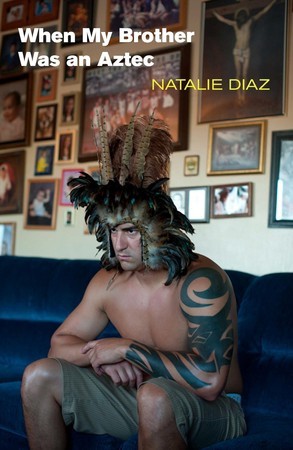
Diaz is the author of When My Brother Was an Aztec, winner of an American Book Award. She has received many fellowships, including a MacArthur Fellowship and a Native Arts and Cultures Foundation Artist Fellowship. She is Mojave and an enrolled member of the Gila River Indian Tribe.

I chatted with Natalie Diaz about devouring loss, the American Dream, and unraveling what it means to be American and Native.


Arriel Vinson: The epigraph, by Joy Harjo, that begins the collection is about losing a country. This sets us up for a lot of loss in relation to indigenous people. Loss of land, of tradition, of love. How does loss/things being taken away go hand in hand with love? 

Natalie Diaz: There is no such thing as nothing. (I don’t know how that is explained scientifically.) There is always something there to devour the loss. There is always something there to become the loss so the loss becomes something else. Or something more—it is still loss, maybe, but possibly something else—some energy, some memory, some possibility, some touching, some ions or atoms trying to make it across to one another and become a newness. 

While there is loss, my ancestors filled it for me with a thousand ways of love, with power, with dreams, with caretaking one another and this earth, with anger, with rage, with story. Our loss can’t exist—because it is so great it would kill us—if my ancestors and my community and family had not filled that loss with enough things to hold it, to handle it (though not always to handle it “well”), to exist within it or next to it. I can be the wound, or I can be what happens to the wound as it becomes something different, maybe not always something less painful, but something also new. The blood, the cicatrix, the scab, the scar, the thing after the wound. If you take the tuna or fruit from a prickly pear, or even taken its nopal, it will continue to grow more nopals. It will continue to fruit again.

AV: You often write about your brothers. But in Postcolonial Love Poem, they are both weapon and wound. There are poems about them discovering an ark, poems about them being bullet, etc. How does duality affect the relationship your poems have with your brothers? Does it allow you to see them more clearly off of the page? 

This is the nature of my country. That it hurts you so much you begin to hurt yourself.

ND: My brothers never make it to the page, but a story of my experience of them does arrive. My love for them. My worry for them. My inability to save them from a world that wants to break them. In this book, I was questioning not my brothers but this country who has held my brothers so roughly that they fought and continue to fight back in ways that harm them more. This is the nature of my country. That it hurts you so much you begin to hurt yourself. 

AV: Desire plays many different roles in Postcolonial Love Poem. There’s anxiety as desire, plenty of mention of love-making and/or having a lover, walking toward love despite dealing with grief. Tell me more about your different definitions of love, and how those function throughout the collection. 

ND: I know that what I was taught about love, the way it was given to me in English and in citizenship, is not what I have come to know and experience as love. In order for me to be possible, I have to create conditions in which love is always possible. I don’t believe that will happen through the state, or through my government. I don’t know how it will happen but am trying to find the practices (including the practice of language) that might make it possible. That I can be loved. That I can love. Love is so many things, and all of them are beyond love, or beneath it, or what happens just before or after it.  
AV: Mythology is also prevalent in this collection, with the speaker in some of the poems calling out/speaking to various gods or warriors. Why was mythology important in this collection and how did it relate to desire/love for you? 

It is hard for me not to become the things I have always been told that I am.

ND: It’s possible any word is a myth. A small myth. A large myth. A word is never what it is, but a desire for the thing to be, either for understanding or for want or for remembering. I grew up with story, stories that are days long to tell, stories that might never be told again, and English often refers to them as myths. So when I find things that people call myth, I’m interested, because I know there is a world there that once existed or might possibly exist again that is different from the world I live in now, which is a hard world. 
AV: In “Like Church,” the speaker mentions how indigenous people, but also POC in general, are expected to perform their sadness. Why was this significant to point out, and is that why celebration (playing basketball, attending church) was present throughout Postcolonial Love Poem as well?
ND: English is prophetic. Our Constitution is prophetic. Citizenship is prophetic. It tells us what to do, who we are, how to relate to one another, who is “us” and who is “them.” It is hard for me not to become the things I have always been told that I am. Especially when those words have been threaded into my words, into my language and thinking and touching. 

Basketball/sport and church are also ways of control, but like all of these shapes, some of us find our small freedoms in them, or at least get a taste of what it might be like to break these structures open and see what is on the other side of them. 

AV: Postcolonial Love Poem interrogates the idea of the American Dream, as most of the poems unravel the notion of what it means to be American. What did it feel like to dismantle this idea? 

America never meant for us to dream it.

ND: The American dream has always been in shambles, in pieces for my family, my community, and me. We never dreamed it. America never meant for us to dream it. And Mojave dreams are too strong for what is American. So they don’t match up. I don’t know that I’m unraveling what it means to be American, because I am American and the book explores the conditions in which I live and love, but maybe it unravels what was “meant” to be American. And we lived, so we are disrupting that American intention.

AV: There is a river flowing through the collection and of course, a lot of mention of land or landscape. Why was it important to make setting a theme in this collection? 

ND: These are the settings that I am made from—the desert and the river. I’m made from clay. It’s less setting and more a body, a relative, another part of how I know myself. How I know my family. Nyayuu ‘akanaav. One way of interpreting that is: I have something to tell. In this collection, I am very selfishly telling what was in me to tell. These are some of the things that were in me.

AV: What are you working on now? 

ND: I am working on being more intentional.

“Teen Mom” Reality Entertainment Has Been Around for 600 Years

When seventeen-year-old cheerleading captain Lexi performs at the first football game of her senior year on the opening episode of Teen Mom: Young and Pregnant’s first season, her third-trimester baby bump is unmistakable under her red uniform. “I already feel judged,” she says. “They all keep looking at me and talking.” Her baby’s father, sorely in need of a haircut, is in the stands, preoccupied with his phone. “My body hurts so bad,” she groans when the game is over.

Teen Mom: Young and Pregnant, whose second season just finished up on MTV, is one of a host of similar reality shows—including MTV’s 16 and Pregnant, Teen Mom OG, Teen Mom 2, the short-lived Teen Mom 3, the new Teen Mom: Young Moms Club, and TLC’s Unexpected—claiming to provide an unfiltered look at teenage pregnancy and early parenthood framed through the young women’s perspectives. One could dismiss these shows as trashy reality television voyeurism. But they share surprising parallels to popular medieval songs voiced by pregnant, unwed young women lamenting their unplanned pregnancies, showing that audiences have long been interested in narratives like these. Numerous medieval English songs feature a common scenario: a sexually inexperienced teenage girl meets a charming young man at a party. They dance and drink together before having sex—just like seventeen-year-old Brianna on Teen Mom: Young and Pregnant, who says “Where I got pregnant, how I got pregnant, was totally because of the partying and everything.” He then disappears, leaving her unexpectedly pregnant and alone. She attempts to hide her pregnancy, worries how her parents and employers will respond, and curses the man who impregnated her. Like Lexi reacting painfully to the crowd’s judgment at the football game, one medieval speaker sighs, “My friends now mock me for my misstep.” 

Both the medieval songs and the television shows emphasize unplanned pregnancy’s physical, social, and economic consequences.

Groups of young women sang these popular songs at village festivals or dances, giving them a mass appeal directed at their peers—not unlike reality television. The similarities don’t end there: Both the medieval songs and the television shows emphasize unplanned pregnancy’s physical, social, and economic consequences, and they depict young women encountering these consequences alone, with minimal help from their partners. One medieval speaker declares, “I curse the one who impregnated me, unless he provides the child with milk and food,” showing that she is well aware of the financial hardships she will face as a single mother, just as Teen Mom: Young and Pregnant shows Kayla applying for state assistance and trying unsuccessfully to make her baby’s unemployed father pay child support. Lamenting pregnancy’s toll on their bodies, the young woman in one medieval song observes how “my belt arose, my womb grew outward,” echoing Jade’s complaints over her size as she attempts to squeeze herself into an unaccommodating restaurant chair near her pregnancy’s end. “Welcome to the big bitch club!” her mom replies, cackling uproariously.

The medieval songs and Teen Mom shows do share one key difference regarding reproductive choice. Some of the medieval lyrics feature women who contemplate abortion or infanticide: “Shall I keep it or slay it?” one wonders in one particularly popular song that survives in multiple manuscripts. In another, she seeks herbal remedies “to be flat again” from the women in her community, listing a series of plants that were known abortifacients in the Middle Ages. In this respect, the medieval songs are surprisingly more pro-choice than their contemporary counterparts, which portray young women as unhappily resigned to parenthood when they learn that they’re pregnant, or else pressured by family and friends not to have an abortion: Kayla, facing a second unplanned pregnancy, says glumly to her one-year-old son, “I guess Mommy’s gonna have another baby, Zay,” while holding a positive CVS-brand pregnancy test with her long yellow fingernails. When seventeen-year-old Rachel finds out that she’s pregnant again when her daughter Hazelee is only five months old, her boyfriend of one month says, “I don’t want you to fucking kill it, obviously.” Her mom sobs on the couch while clutching a cigarette lighter when she sees the positive test, but then tells her, “There’s not options. You wouldn’t want to get rid of another little Hazelee. You’d regret it for the rest of your life.”

One of the things that has always struck me about both these shows and the medieval songs is their normalization of young men’s abusive behavior. In all the medieval songs, the women’s partners abandon them immediately after sex, leaving them to face the consequences alone. Some are even darker: in one, a girl relates how her boyfriend assaulted her while she was drunk after their date at the village ale festival. “You’re hurting me!” she tells him as he penetrates her, but he refuses to listen. In another, a priest rapes a girl next to a well and makes her promise that she won’t tell a soul. All five young men on Teen Mom: Young and Pregnant’s first season are habitually awful to their partners: Kyler, an inveterate lover of basketball shorts and puffy vests whose hair hangs down in greasy clumps like strands of over-boiled linguine, constantly insults and demeans Lexi. “I love you. Just kidding,” he says as he hugs her goodbye at her graduation party, smirking as her face falls. Stephan, the father of Kayla’s son Izaiah, steals her debit card and drags her from a car, hitting and kicking her until her friend calls the police. The next day, Kayla’s mother kneels on the ground, using her phone to photograph the plum-colored bruises on the backs of her daughter’s thighs. Ashley calls the police on her boyfriend Bar after he comes home drunk and attacks her. “I know that he shouldn’t put his hands on me. I know,” she says later, wiping tears from her false eyelashes. While driving past an Indiana Dairy Queen, Sean admits to verbally abusing his partner Jade in front of their baby and confesses to his sister, “Sometimes I say meaner things than I should.”

These narratives discourage rosy ignorance about the realities of teenage parenthood.

Why are these teenage pregnancy narratives so wildly popular in spite of the six centuries that separate them? Why, in spite of the advent of reliable birth control and condoms as well as the lessening of cultural taboos around unwed pregnancy, are we still fascinated by narratives of young women who are unmarried, unexpectedly pregnant, and struggling? Why do we watch them, and why did medieval people sing them at festivals and copy them in manuscripts? On one hand, these songs and shows could serve as educational warnings to other young women: don’t have unprotected sex, the implicit message goes, or this could be you. “For more information on preventing pregnancy and protecting yourself, go to itsyoursexlife.com,” a confident female voice declares during commercial breaks on all Teen Mom programming, implying that the show’s viewers are young women who do not want to get pregnant. These narratives discourage rosy ignorance about the realities of teenage parenthood by portraying the accompanying struggles in vivid detail: Brianna needing childcare in order to keep her job but wondering how she can pay a babysitter when she makes only $12 an hour; medieval servant girls terrified of losing their jobs once their employers discover their pregnancies; Kayla dropping all her college classes because she doesn’t have childcare, much to her advisor’s horror. The fact that these “lessons” about avoiding unplanned pregnancy are still necessary also point, more starkly, to the fact that things between the Middle Ages and now have not changed as much as we might think: birth control is not as widely available or accessible as it should be, young men’s abandonment and mistreatment is still portrayed as inevitable, and affordable childcare and other forms of economic support remain sorely lacking.

On the other hand, the shows are voyeuristic, featuring repeated scenes of teenagers in labor sobbing and screaming in hospital beds, their hair spectacularly disheveled. We see Ashley hobbling around painfully in a nightgown after giving birth. Jade declares, “My vagina feels like it is on fucking fire with, like, gasoline,” on the car ride home from the hospital. The men who copied these medieval songs into manuscripts were often clergymen, a detail that is particularly alarming because most of these songs feature clergymen exploiting, coercing, and abandoning young women. In this context, the songs could represent clergymen making fun of young women’s naïveté, sharing tips for how to take advantage of them, and mocking their distress. There’s a fair amount of potential schadenfreude in watching these shows or singing these songs: they depict teenage girls suffering after having unprotected sex with poorly-chosen partners, enabling us to feel better about our own lives and choices while seeing these young women “get what they deserve” for breaking the rules.  

Sixteen and Pregnant first aired on MTV in 2009, when I was midway through my six-year Ph.D. program. I spent way too much time watching episodes on my laptop late at night when I was supposed to be writing about medieval pregnancy laments for my dissertation. It seemed as though everyone my age was getting married, buying houses, going on vacations, and starting families while I was stuck as an eternal student in a tiny studio apartment. I found these shows to be oddly comforting, since they made me feel as though I had my shit together by comparison, and they reminded me that my issues were relatively minor. Sure, I might have to ditch the chapter I’d been writing for four months and start over from scratch because it turned out to be a dead end, but at least I wasn’t leaving my baby with my mom to do heroin with my new boyfriend, or sobbing in a Michigan parking lot after giving up my baby for adoption.

But I also knew that I could have been—and that idea may be the true heart of our centuries-long fascination with teen mom stories. As my sister pointed out in a late-night conversation about our mutual devotion to Teen Mom programming, these narratives encourage audiences to identify and empathize with the young women duped and abandoned by unsavory men. This is especially clear in the medieval songs, which feature young women doing activities that would have been shared by wide swaths of the population—completing everyday domestic tasks, dancing with their friends at holiday celebrations, drinking at church-sponsored ale festivals, accepting courtship gifts from attentive young men—in order to remind audiences that they, too, could just as easily be in their position. These narratives encourage us to think back to the losers we dated in high school, all the shaggy-haired assholes we were attracted to, all the poor judgment we showed, all the foolish risks we took. Kayla, facing the prospect of parenting two children under two years old and realizing that she won’t be able to return to school any time soon, says, “I feel like I’m, like, failing. Like I had a plan for my life and it just did not go that way at all.” These shows—and, even more explicitly, the medieval songs—serve as uncomfortable reminders that many of us, no matter how firmly we believed in our naïve bravado that we knew what we were doing and that our lives would go according to our plans, could have ended up as the center of one of these narratives.

Binge Drinking To the End of Innocence

“Champion Beasts”
by Jonny TwoxFour

Junie Gunn went home early from school because her armpits smelled bad. She called her mom and told her that she felt like maybe she would throw up and her mom said, “ok.” Junie went home and made five taquitos and ranch dressing for a snack and her mom said, “Don’t fill up. I’m making wraps for lunch.” Junie had lunch wraps with her mom and then went upstairs and played RollerCoaster Tycoon on her old computer.

Casey Kelly texted Junie while she was playing RollerCoaster Tycoon and said, “are you ok?” Junie said, “i threw up.” Casey said, “that’s so sad. can you still go to landon’s tonight?” Junie said, “definitely. you know me lol. i rally like a champ.” Casey said, “yeeesss. that’s why our senior quotes should be ‘fucking champion beasts.’” Junie said, “hahahaha.”

Landon Jackson drove away from school in a car with Bose speakers. When Landon got home, he cut up turkey kielbasa and reheated sweet potatoes. He brought his mom’s dinner to her room. She lay in bed, facing the wall. He touched her shoulder and said, “Dinner…” really quietly. And when Landon left his mom’s room, he left really quietly. Then Landon texted his dad and said “hey” and Landon’s dad texted back and said “can’t talk now bud I’ll call later” and Landon said “ok.” Landon went down to his basement with the pool table and the mini fridge and the mini bar and took a Boomerang video of himself opening a beer that he captioned, “who’s ready?”

Natalia World-Lee held the hand of her boyfriend, Alex McGregor. They walked to Natalia’s house, which wasn’t far from school. It was a house with a green door and planted bulbs. Natalia and Alex convened around her little sister’s Fisher-Price playground. Alex slid backwards down the yellow slide, which was half his length. He tumbled to the grass in a clump where Natalia sat picking purple weeds and tying them in knots. Alex said, “I’m all broken now.” Natalia touched his eyelids with one of her weed flowers and they were quiet for a little while. Natalia said, “I don’t know about tonight.” Alex picked her leg hair and said, “It’ll be fun.” Natalia said, “Ouch” and swiped at his plucking fingers. A few minutes later she draped the purple weeds she’d tied together across his face. 

“Ok, I fucking win,” said Casey Kelly to Junie Gunn. “What?” said Junie Gunn. “Oh my fucking shit. Alex is dating a black girl.” Junie Gunn put down her eyebrow wand. It wasn’t really an eyebrow wand; it was clear mascara. Casey had the Browwow gel that Junie wanted, but when Casey came over to get ready before the party and Junie had asked to use it, Casey told her that her mom preferred her not to share face makeup because your face has twice as many germs as the rest of your body. Junie’s makeshift eyebrow shaper was maybe Maybelline. Junie stopped putting on makeup and went to lay on her bed where Casey Kelly was looking at internet pictures of Alex McGregor and Natalia World-Lee. Junie said, “Is this her page?” Casey said, “Yeah, Ian and Leah liked it, so it showed up on mine.” They looked at a picture of Natalia and Alex in grass near a playset. The caption under the picture read “Feels like we’re seven again.” Casey said, “Like, I’m not being racist but this is insane. He’s weird now.” Junie clicked to open the comments. One comment said “grassssss.” Another said “goals.” 

Sarah Mitchell picked up her phone and read a message that said “ya bitches are getting ready at junie’s house. cooommmeee over.” Sarah texted back, “at austin’s. i’ll probably just leave with him from here.” Sarah looked up from her phone to see if Austin Lazodo was looking up from his. They were in Austin’s room. Austin looked up and said, “Sorry, I’m almost finished writing.” Austin was texting his brother who was in the Army. Austin didn’t get to talk much to his brother but he was texting him now. Sarah thought it was really sweet that Austin was talking to his brother that he missed but she also didn’t know what to do with herself, so she went to use the bathroom. Since his brother had moved out, Austin was the only child left in the house, and everything in the bathroom was his. Sarah smelled his hair sculpting gel. She thought about him peeing in the night, not really aiming. She cherished his blemish spot treatment zap stick and tucked it away in her heart as a secret they shared. When she got back from the bathroom, Austin wasn’t looking at his phone. Sarah said, “I like your shower curtain” and sat on Austin’s bed with him.  Austin’s shower curtain had a map of the world on it. Austin said, “Thanks. My brother picked it out when he lived here. He really wants to travel the world. He has a map tattoo on his back and every time he visits somewhere, he gets it colored in.” Sarah said, “That’s really cool. Where has he gotten it filled in?” Austin said, “Mexico, Canada, and Syria,” and then leaned in and kissed Sarah Mitchell. 

The kiss made Sarah’s chest and cheeks red. Sarah did her best to make it hot. She wrapped her legs around Austin and tried to turn over so that she was lying on top of him. They had to do some scooting because Austin had a small bed. Austin took Sarah’s shirt off but struggled with her razor back bra. She took it off for him. Austin said, “Whoa, you have big nipples.” That made the red on Sarah’s chest separate into splotches. She kissed him with a lot of tongue, switching her head around a lot. Austin pulled away and asked Sarah, “Have you ever been fingered?” Sarah said, “Once.” Sarah had never been fingered. She took off her pants which were tight and got stuck on her feet. Sarah had to pull hard to get them off. Austin took off her thong and held it up but Sarah quickly grabbed it and threw it to the floor. She was afraid that the brown boogers that were sometimes in her underwear would be there now. Austin said, “I really want to make you cum.” Sarah said, “Ok.” Austin still had on all his clothes. He rubbed Sarah with two fingers as fast as he could. It burned Sarah’s skin but she didn’t say anything. A few minutes went by and Sarah’s vagina was really starting to hurt. She grabbed Austin’s hand and said, “I think I came.” Austin, whose hand and wrist muscles were starting to ache said, “I think you did too.”

Natalia World-Lee kissed Alex McGregor goodbye. She confirmed with Alex that she’d meet him at Landon’s at 9 o’clock. Alex stuck his bottom lip out and said, “I wish I was driving you.” Natalia said, “I know but Tazaya is picking me up and her mom will freak out if she knows there are boys in the car.” Natalia could see that Alex didn’t get why Tazaya needed to come since she didn’t even go to their school. But Natalia didn’t need Alex to get it. Alex drove away with his windows down. Natalia went inside to her room and opened her windows. There was a nice breeze. Natalia’s mom knocked on her door and came and sat by her on her floor. Natalia was making a collage from magazines and sucked her teeth as her mom’s bottom moved towards the pictures she’d cut out. Her mom said, “Calm down I’m not going to mess up your serial killer art.” Natalia rolled her eyes and her mom laughed. Her mom’s name was Tori and when she laughed there were a thousand lines in her face but when she stopped they all went away. Tori patted her knees and said, “I want to talk about tonight. What’s the plan?” Natalia looked at the picture of a jackalope she’d cut out of a brochure for the Rocky Mountains her dad had brought her from a recycling bin at his work. Her dad liked her collages and stayed on the lookout for “interesting material.” The jackalope’s horns were thin and when Natalia had cut them out they kind of curled over. She smoothed out the curled waxy paper horn and said, “I don’t know. We go and then we come back.” Natalia’s mom said, “You go where? You come back when?” Natalia folded over, exasperated from the two questions and said, into her lap, “I’m riding with Tazaya to Landon Jackson’s house. He lives behind the Forest Run neighborhood on a bunch of land. We probably won’t be there that long.” 

Tori pulled her daughter back up into a sitting position. “You won’t be there past eleven. And why are you in a mood?” Natalia said, “Alex is going to want to stay longer than eleven. That’s only two hours into the party. And I’m not in a mood. I just don’t really want to go. I don’t know a lot of these people.” Tori said, “Then don’t go. I don’t trust parties that start after bedtime anyhow. I want you back by eleven.” Natalia started organizing her cuttings into piles. She looked at her mom and smirked and said, “Most people’s bedtime isn’t nine.” Tori World-Lee started to stand to leave and replied, “It’s happy and safe people’s bedtime. Benjamin Franklin said, ‘Early to bed and early to rise makes a man healthy, wealthy, and wise.’ What time will you be in our house?” Natalia said, “Eleven.” Tori smiled and said, “Don’t worry about these kids. Remember, everyone’s ears are thin and soft.” She left the room. Natalia didn’t know what her mom meant about people’s ears. Natalia’s dad always laughed with Natalia about the things her mom said. They’d joke about her engineer brain coming up with different ways to make the world turn metaphorically. Natalia glued the jackalope onto a cut out of a magazine telephone line. On the same line were other pictures of real bunnies that she’d cut out from different places. The breeze from her window unsorted her piles of pictures.

Landon Jackson plugged his iPhone into speakers that filled his basement with the easy listening sounds of Mac Demarco. His friends David and Seth were there and they played FIFA on a large television. They talked about how many people were coming tonight. They talked about if two hot girls from a rival high school that David had met at Jimmy John’s were coming tonight. They talked about smoking weed tonight. Seth asked Landon if his parents were home. Landon said his mom was upstairs and both his friends knew to leave that alone. Landon said, “My dad’s still on his business trip. But I’m pretty sure his girlfriend had like a cat or something at his apartment and so there’s possibly a dead animal in there.” Seth said, “Yeah, hasn’t he been gone for like two months?” Landon said, “Yeah, s’fucking ridiculous.” Then David scored and Seth said, “Fuck you, man.” David, Seth, and Landon ate hot Cheetos with San Pellegrino’s. Seth told Landon he loved his rich people soda. David said, “20 bucks Casey and Junie get here first.” Landon replied and said, “So fucking desperate. I can’t think of literally any actual chill girls coming tonight. Our whole grade is hoes.” Seth laughed and some San Pellegrino came out the side of his mouth. Seth could think of some chill girls coming tonight. He could think of Lauren Ford and Carin Jeong, the girls in his statistics class who last week came over to his house to do homework. Those girls and Seth had smiled at his mom with orange peels covering their teeth when she asked them how studying was going and if they were going to get a five on the test. Those girls were chill but around his bros they weren’t any fun. They never grinded, they never got drunk, they never were silly, and they never stayed long. Those girls weren’t fun to talk about. So Seth swallowed his San Pellegrino and said, “Chrissy told me that Casey, last month, was on the bus back home from the game against River Run and some girl dared her to stick the end of her pom-pom up her vagina and she did. Just on like a fucking dare.” Landon laughed and said, “That’s what I mean! They’re hoes just for the sake of being hoes.” David chimed in and said, “That’s probably why Alex broke up with her. He’s a chill dude and Casey is for sure going to be a sorority mindless slut in literally 8 months. Guar-an-teed.” Seth said, “Fuck you man, my sister is in a sorority.” David and Landon laughed. Seth said, “Whatever. Landon you gonna get with Junie tonight?” and they all laughed. 

Landon hated Junie and Junie was in love with Landon. Landon hated Junie because Landon knew that the reason Junie loved him was because she had seen him cry. Junie had been there at the 4th of July party on the lake when his sister Emily had died. Emily had been on the boat when his Uncle Mike, who doesn’t give no sissy rides on the tube, went too close to the edge of one of the lake’s cul-de-sacs and whipped Emily and her friend into the trees. Emily died immediately. Junie had told everyone that she knew she was dead right away. Junie was in love with Landon because she was there to see his mom fall down on the ground and scream and drool and tear out grass. She had seen Landon and his dad switch off giving Landon’s sister mouth to mouth. Junie was in love with Landon because she had driven him to the hospital once the ambulance had taken his sister. He sobbed with his face in his hands the whole way but she prayed out loud and had asked God for guidance and miracles and that had seemed to settle him a little. Junie wanted to comfort him the rest of her life. She felt like they had been through so much together. Landon hated the way she looked at him and he hated the way that after that day she seemed to be everywhere he went, looking at him, so available for whatever he needed. Landon rolled his eyes at his friends and said, “Fuck desperate hoes.”

Casey and Junie were the first to arrive at Landon’s house, but four other girls were pulling into his driveway at the same time. They knew to enter at the basement door. They said, “Hey girl” and touched the fabric of each other’s clothes and said, “This is really cute. I’ve been looking for something like this.” When they came through the door, they were all in conversation so that the three boys already there felt like a party was running them over and they didn’t know how to enter the conversation and for a second all three of them wished sorely that they were at home alone, but only for a second. David went over to the mini bar and said, “Yo, who needs a drink?” and then the girls were no longer in conversation with just each other. Casey said, “Fuck, yeah. Let’s get it, Junie.” David said to Junie, “Don’t you have to go to church tomorrow?” Junie held up her hands in gangster signs and said, “Yeah that’s the way fucking champion beasts roll!” And then Junie and Casey bumped chests and then started laughing and holding their boobs saying that the other’s chest had hurt their own. David watched and poured three shots. Casey and Junie and David took a shot together. Another boy and girl walked in while David and Casey and Junie were taking a shot, and the girl that walked in sort of yelled out, “Who gave y’all permission to do shots without me?” This girl’s friend who was one of the first to arrive let out a high pitch scream when she saw her and then tackled and straddled her. They got up and went to get drinks. Soon there was a drink spilled on the parquet. Soon some of the lights were turned off. Soon more boys and girls arrived. Soon Mac Demarco was switched out for a song about a wet pussy.

Austin Lazodo and Sarah Mitchell came to the party at the same time as Tazaya Felix and Natalia World-Lee. As they approached the door, Austin asked Tazaya and Natalia who they knew at the party. Natalia said, “I’m meeting Alex.” Austin said, “Cool, cool. Do you want me to go find him in there and tell him to meet y’all out here?” Tazaya rolled her eyes and crossed her arms. Natalia gave her a look and then said back to Austin, “That’s ok, we’re here for the party. We’ll just meet him inside.” Austin said, “Cool, cool.” Sarah Mitchell felt protected by Austin. They walked in to see Casey Kelly trying to flip a plastic cup on her back by bouncing her bottom without the cup falling off. They walked in to see Corey and Michaela making out by the fireplace. They walked in to see Thomas and Isaac whispering something to each other and then walking out through a door. They walked in to see four people sharing a bong, the girl who’d taken the last rip coughing and the boy next to her saying, “That’s how you know it’s working.” They walked in to see Alex McGregor playing beer pong with Dakota against two other boys. Alex saw Natalia and yelled, “Celebrity shot from Natalia!” Natalia and Tazaya walked over to the table to talk to Alex. Austin and Sarah went to the mini bar to get drinks. Austin showed Sarah how to pop a beer cap off on the edge of the counter. Natalia missed her celebrity shot. 

Alex lost a few minutes later at beer pong and the table was freed up. Landon was next in line to play and announced to the room he needed a partner. Junie volunteered. She knew sometimes what Landon needed was a little bit of fun. Landon was annoyed because he was hoping Stephanie would be his partner but he said, “Ok, Junie let’s get this done.” Junie excited by his excitement said, “Let’s get this done!” and pounded Landon’s knuckles. Landon said to her, “My partners, though, have to level up. Every cup anyone makes on either team—you take a shot.” Landon was messing with her. Sometimes he just liked to see what she would agree to so that he would feel better. For a second he wondered if he could get her to walk around the room naked. Junie said, “Hell yeah! We drink to all victories!” Landon said, “No, just you. I have work tomorrow so you have to represent the leveling up for the both of us.” Junie said, “You got it, partner.” 

Eventually the party started to feel blurry to the people there. The people who had gotten high were outside looking at the stars. The people who were drunk were dancing or were sitting and watching the dancing. Casey Kelly had walked out to the pool to see Natalia and Alex kissing. She drunkenly yelled that this was ridiculous. Tazaya had heard the yelling because she was also outside smoking a cigarette. Alex and Natalia walked away, but Tazaya confronted Casey and told her to stop making a scene. Casey said, “Who the fuck are you?” and Tazaya said, “I’m someone who got dragged to this boring fucking party and I’m going to help you out. You need to chill.” Casey scoffed and starting some rambling about how she didn’t need help from some ghetto ass—and then before she could finish her sentence, Tazaya pushed her into the pool. 

Casey came up from the water screaming some fuck yous. Tazaya then jumped into the pool, too, cannonball style. Casey screamed, “What are you doing you crazy fucking bitch?” Tazaya filled her mouth with water and then spit it onto Casey like a fountain. Casey was furious and returned the spitting. Tazaya started laughing. Casey splashed her and Tazaya splashed back. Casey looked at Tazaya and said, “I thought black people couldn’t swim.” Tazaya’s eyes got wide and she said, “You’re right I forgot! I can’t swim!” Tazaya swam on her back away from Casey, thrashing her feet so that Casey screamed and covered her face to block the water. Tazaya yelled, “It’s a miracle!” and Casey laughed. In a few weeks, someone would call Casey Kelly a racist and she would tell them that she actually had a black friend named Tazaya. In a few weeks, someone would ask Tazaya to go to another party like this one and she would say no. 

Alex brought Natalia back inside through the basement into a side room off the basement where Landon was sitting with Austin and Sarah and David and Seth. They were all giggling. Alex and Natalia sat on a wide seat near the others. Alex said, “What are we up to in here?” David, still laughing, said they were talking about their fantasies and that Seth was a fucking sicko. Seth was laughing with his hands up and said, “I don’t know what the problem is!” David, to fill in Natalia and Alex, said, “I said my fantasy was to have a room of Mexican virgins take turns sucking my dick and like fingering each other and shit and then Seth…” David had to pause to fold over laughing. David continued. “Seth said his ultimate fantasy was to have a girl spread her cheeks in front of his face so that he could see her butthole fart.” Seth, still raising his hands to protest his innocence, said, “To know if she’s real!” They all started laughing but truthfully only three of them found the conversation funny. Sarah was laughing but her attention was on Austin’s hand which was resting on her boob and pinching her nipple. No one was acknowledging it but she was afraid everyone had noticed. They had. Landon got up from the couch and said, “I’ve got the greatest fucking idea. Seth, I’m about to make all your dreams come true.” 

In the basement, Landon whispered to Junie to follow him. Junie’s face flushed and she said, “Sure.” She came into the room where his friends were waiting and Landon pulled her down to sit on his lap. Landon said, “Junie we were wondering if you would do something for Seth.” David and Seth started laughing really hard. Junie felt nervous. Landon explained Seth’s fantasy and Junie, who was very drunk, snorted and said, “That’s really weird.” Landon stroked her leg and told her they thought that, of every girl at the party, she had the cutest butthole, probably. Junie said, “Ew! Y’all are gross!” She tried to wobble and stand up off of Landon’s lap but he put his hands on her waist and pulled her back down. This made her feel sick. She had had seven shots during their beer pong game and had already thrown up twice. Landon looked at her and said, “Junie, who else could make this sexy but you?” His hands got tighter on her waist like he needed her. She looked around the room at two nodding heads and four—or was it five—still heads with wide eyes and said, “Maybe later. I don’t feel good right now.” Seth said, “A little toot may help.” Lots more laughter. 

Junie got up to leave and Landon said, “There you go Junie! She’s in!” She started to protest but Landon said, “I’ll help you. And pushed her head down and locked it between his legs. Junie was bending over and her trapped head was looking at Seth’s shoes and she remembered earlier in the summer getting trapped under a float at a pool when she couldn’t breath and felt like she might die but she also knew that wasn’t true, that she wouldn’t die and she really just had to wait until a little bit forward in the future when she’d not be under the float and she’d be breathing again. Looking at the mesh under the float was like looking at Seth’s shoes. She hated this moment but a little bit forward in the future it would be over.

Landon lifted up her skirt but Natalia had stood up and said, “What are you doing! Let her go!” Landon was surprised. He let Junie out from between his legs and was looking at Junie with disgust. Junie looked at Natalia and felt thankful but heard Landon mutter under his breath, “the fuck?” and knew she was in danger of falling into the category of things taken away from Landon. A girl standing by the door quietly slipped out. A boy scratched his ankle. Junie mimed a flippant hand gesture and said to Natalia, “Chill. We’re just playing.” Seth pouted and said, “Does this mean no toot?” Natalia was still standing. Junie could feel eyes. She could feel that they were waiting for her to say if it was ok or not ok. Junie said, “Maybe I’ll do it just for Seth in a room.” Landon replied, “And not let me see that ass too?” Junie kind of giggled and once more Landon forced her down between his legs. There were no protests. There was only the image of the mesh of the bottom float at the pool in Junie’s mind and remembering how it felt when she breathed again. Landon lifted up her skirt so that her bare bottom was in front of Seth’s face. Seth pulled her butt cheeks apart and was biting his lips to show the laughter he was holding back. Alex had pulled Natalia back onto the couch. 

Everyone’s eyes were on their own hands or Junie’s locked head or the side of her bare butt. Junie felt a little nervous that it would become more than a fart if she pushed it, so she didn’t rush anything. There was a lot of blood in her head now. There was a strain in her hamstrings. There was the mesh of the float. Austin pinched Sarah’s nipple harder. Seth hoped his chill statistics friends had left the party already. It took a minute for the fart to come but then it did. Junie’s butthole flexed and released and then all the boys starting screaming like hyenas. Landon fell over laughing which took Junie down with him. She pulled up her underwear on the floor and tried to laugh too but she felt like a joke. Through their laughing Landon and David and Austin asked Seth how that was for him. He was also on the floor laughing. He said, “It fucking smelled!” Junie left the room. 

Junie could feel tears coming and possibly throw up. She went back out to the main party and over to the mini bar and swallowed the rock in her throat with tequila and then five more shots paced poorly throughout the night after that. Back in the side room, Seth, who’d gained a little composure looked at Natalia and said, “I’d love to see a black butthole for comparison.” They all started laughing again and Natalia got up to leave. Natalia couldn’t imagine the soft parts of their ears. Alex flipped Seth his middle finger and followed Natalia out but was smiling as he was shaking his head. 

Natalia told Tazaya, who was swimming, that Alex was driving her home. Alex then drove Natalia home and Natalia cried a little. Austin danced with Sarah in the basement. As they danced they kissed and Sarah rubbed her hand on Austin’s crotch. Austin came in his pants and then went home. Sarah decided to sleep at Landon’s house in a corner with a beach towel as a blanket. Others started figuring out where they would be sleeping: on Landon’s basement floor or someone else’s. There were only a handful of houses with parents that were all right with drunk children in their homes. 

Landon’s mom wasn’t really one of those parents who was fine with drunk children in her home. She really wasn’t fine or not fine with anything. She felt only soreness all over and the weight of her dead daughter in her arms. Eventually, she stopped hearing the music downstairs. She let hours go by watching the fan and adjusting her eyes to see one blade going around and around or all the blades making one thing at once—a new portal to enter if you went fast enough. Right before the sun came up, she got out of bed and peeked down the basement stairs to look at the teenagers. It was like staring through the window in the hospital where people used to be able to look at all the babies and imagine things for them. She sat on the basement stairs and listened to them breathe and shift around in their blankets and sleeping bags. She heard the vent in the bathroom making its ticking noise and crept down the stairs to close the door so none of these babies would wake up. Inside, Junie Gunn was asleep leaning against the toilet. There was bruising around her neck where it had been resting against the toilet. She was sitting in her own urine. Junie had not asked for help. She had gone to sleep feeling afraid but also feeling that this was what this time in life was about. She had gone to sleep feeling afraid but also knowing that she was the only one at the party that could make a fart sexy and reminded herself that she would probably be recognized in the morning as one of the ones who went the hardest and even though it hurt a little it would be something that would precede her at future parties and people would know she was for real about fun. Boys would fist bump her in the hallway and think to themselves, “She really is that thing that she says she is.”

6 Debut Fantasy Novels Starring Black Women

I often talk about how I created A Phoenix First Must Burn, my anthology of fantasy stories by black women authors, for my younger self, a girl who loved fantasy and science fiction and so desperately wanted to see herself in those worlds. It’s a strange experience to create the thing you wanted as a teen, to be unsure how it’ll be received and then to find out that so many others crave the same thing.

I was an editor when I first came up with the idea for an anthology that would pull together some of today’s best-sellers, rising stars, and talent-to-watch. When it sold, we were just beginning to see Black-authored YA fantasy and science fiction novels get major traction, with novels like Children of Blood and Bone and The Belles and Dread Nation all becoming instant New York Times bestsellers. It said that these stories didn’t just matter to us Black girls who grew up reading and imagining ourselves in fantastical and futuristic worlds, but that there is a wider market than maybe even we ourselves realized. In the two years since A Phoenix First Must Burn sold, it has been absolutely amazing to watch the rise of rise of Black-authored YA fantasy and science fiction novels. And so, to celebrate other newcomers to the genre, I’m sharing six Black women–authored debut novels that I am so incredibly excited exist (or will soon exist) in the world.

Cinderella is Dead by Kalynn Bayron

I’m going to assume you know the story of Cinderella. Whether it’s the Grimm or the Disney version, the basic story is about the same: outcast girl gets a chance to go to a grand ball where she meets, and instantly falls in love with (supposedly) a prince. After some mishaps (which in some versions include her stepsisters losing some toes… yikes) they get married and live happily ever after, of course. Well, what if Cinderella’s been dead for years but her “love story” spurned an unfortunate tradition of having all girls of marrying age required to go to a ball and meet their beloved… or else? This story is set in that reality and follows Sophia who wants to marry her best friend, Erin, another girl—it is so delightfully queer. After an incident, Sophia runs away (classic) and then, well, a bunch of secrets come out and now it’s up to Black girls to save the day. If you can’t tell, I’m obsessed with this book, as a lifelong Cinderella fan. It’s such a wonderful twist on the old story.

A Song Below Water by Bethany C. Morrow

BLACK. MERMAIDS.

That’s it. That’s the tweet. 

Okay but for real, it’s actually about two Black girls who are sirens (yes, the ones from mythology who kill men with their voices). First, I have to comment on the cover. It is hands down one of the best I’ve seen—absolutely gorgeous. The story is set in modern-day Portland, except mythological creatures are real. Tavia and Effie are best friends who are basically sisters—Tavia is secretly a mermaid and Effie is exploring powers of her own—navigating their life, in that illuminating yet oftentimes painful cusp of emerging adulthood. There’s family drama, school drama, oh and yeah people are terrified of sirens—why, because now sirens are mostly Black women—so they have to deal with that too. What I really loved, aside from the emphasis on friendship—I’m always here for such tales—is the focus on the policing of Black bodies, especially Black women’s bodies. Bethany Morrow nailed that and it was so refreshing to read about so many issues facing Black women and girls but in such an captivating novel.

A Song of Wraiths and Ruin by Roseanne A. Brown

This book made me CRY.

On the surface, it’s about a Karina, a crown princess who is not ready to be queen. So she does what any reluctant heir would do: she offers to marry whoever wins a competition so that she can use their heart (specifically, a king’s heart) to resurrect her mother. Totally chill, right? And then there’s Malik, whose younger sister has been taken and in order to get her back, he has to kill the crown princess. Basically, two people, from different worlds, have to kill each other, and there are very real stakes, but… of course, they begin to realize they have more in common than they thought. I was really struck through by just how much of the story is about what it’s like to be a refugee, as Malik is one. And yet, given all he’s been through, he’s still is the most cinnamon-roll of characters. It broke my heart to see him trying to hard just to do right by his sister. And Karina, reminded me of my younger (and sometimes current) self: she really wrestles with how people perceive her, she can list all of her failures and remember none of her accomplishments. Seeing her grow to own herself was so damn rewarding. These characters have my whole heart. Not to mention, there’s magic and the world-building is fantastic.

Black Girl Unlimited, The Remarkable Story of a Teenage Wizard by Echo Brown

This book wrecked me. It’s autobiographical, but it’s fiction. The main character, Echo, is a wizard living on the East Side. At home, family members battle drug and alcohol addiction, and then her school is on the West side and it’s like a different world. There, she’s a straight-A student and dreams of going to Dartmouth. There’s so much magic infused throughout this novel, but what’s particularly strong is the exploration of mental illness, rape, sexism, racism, and abuse. It’s so specifically and wonderfully focused on Black girl and womanhood and a young girl’s powerful transformation.

Raybearer by Jordan Ifueko

I love it when characters are faced with impossible choices. Even better, add MAGIC. I was hooked from page one. I will pretty much automatically read or buy anything that has mother-daughter drama; I was constantly trying to live up to my mother’s expectations and impress her growing up and it was only by deciding to embrace being my own person that we started to have a good relationship. Similar thing here, only my mother didn’t compel me to kill the very person I’m supposed to be loyal to. Talk about needing therapy.

Tarisai is the only child of a powerful woman and has been given the finest tutors, etc. since birth. One day, her mom is like “it’s time for you to go out into the world,” i.e. you have to go compete against others for a spot on the Crown Prince’s council. Sounds great, right? No. There’s definitely a catch: if she becomes a council member, she’s going to be compelled by her mom to kill the Crown Prince. Yikes. The world-building is gorgeous, there’s so much throughout about colonialism and how an individual and an entire peoples’ identities and cultures can be erased. And I just loved the push and pull between her growing connection with the Crown Prince and her duty to her mother and knowing that this won’t end well no matter what.

The Year of the Witching by Alexis Henderson

Whew boy. Where do I begin. Okay well first, this is the one adult title on this list. A very important note. I think some teens are going to be totally fine with this (I mean, I read Anne Rice and Stephen King a as a teen…) and for some, maybe not so much. I’ve been excited for this book for a very long time, have been watching the author’s publication journey for a while, and I was just so incredibly excited when it sold. It’s one of the best books I’ve read in a while. The cover is stunning. Like that girl looks like she’s about to tear down a whole society, which is very fitting because it’s like The Village meets The Handmaid’s Tale—only its protagonist, Immanuelle, is ten times more badass. There are witches and there’s a super religious puritanical society and if you’re part of that society you’re taught that witches are bad. Emmanuelle, who is part of said society, has basically been suffering the repercussions of her late mother’s actions—an “unsanctioned union” which produced Immanuelle. And then she finds her dead mom’s diary and that’s when shit hits the fan. I mean, it gets so creepy dark. Loved it. So much smashing of the patriarchy and at the heart of it all a girl understanding her own power and realizing that her reality is made up of lies. If you like dark fantasy, and, of course, if you love witches, this book is for you.

7 Thrillers About Female Ambition

Thriller plotlines with a female protagonist often revolve around a child or primary romantic relationship (it’s right there in the subgenre’s name: domestic noir). And while I, too, love reading about the sweet-seeming husband you don’t know as well as you think, the marriage that seems just a little too perfect, or the infant snatched from a cradle at night, my own life doesn’t revolve around that kind of drama—and the same is true of my books. 

The Herd

In my novel The Herd, Eleanor, the glamorous founder of an exclusive, all-female co-working space, goes missing the night of a glitzy news conference; to find her, her closest friends must risk their careers, their friendships, and maybe even their lives. Eleanor’s crew—pragmatic, competent Hana, blunt, quick-witted Katie, and artsy, bohemian Mikki—has ambition in spades, but the women have wildly different approaches to getting ahead..and deep, dark secrets they’re eager to hide as they work to bring the truth to light. 

In an airy, light-filled workspace devoted to successful career women, these superstars (please, don’t call them ladybosses, HBICs, or fempreneurs) come face-to-face with the dark side of the societal pressure to Have It All—and learn what really happens when women’s “perfect” facades begin to crumble. These seven thrillers explore how far women will go to succeed in a culture that tries like hell to hold them back… and not one of their heroines needs a man to make her mark.

Image result for give me your hand megan abbott

Give Me Your Hand by Megan Abbott

In high school, ambition brought best friends Kit and Diane together: They were both overachievers, excelling at everything and competing over a renowned chemistry scholarship. Now, Kit is at the top of her game as a chemist, and after years of hard work and unimaginable sacrifice, she’s finally on the brink of achieving everything she’s ever wanted. She won’t let anything stop her. Or anyone—not even Diane, the one person from her past who knows what Kit is really capable of… 

Image result for necessary people anna pitoniak

Necessary People by Anna Pitoniak

After years of living in her best friend Stella’s shadow, Violet is finally in the spotlight, working her way up from intern to assistant producer at a fast-paced cable news show. Envious of Violet’s success, Stella reappears and charms her way into a job at the same network: in front of the camera, as the face of Violet’s stories. But Violet doesn’t shrink; instead, she rises to the challenge and kicks off a dangerous game in which the only path to success just might be destroying the other woman.

Temper

Temper by Layne Fargo

Chicago actress Kira Rasher believes working under a volatile director is a small price to pay in exchange for the role of a lifetime. Theater co-founder Joanna Cuyler, however, sees Kira as a threat to be removed at any cost. As opening day approaches, the pursuit of power brings each woman’s dark side to centerstage. 

The Banker's Wife by Cristina Alger

The Banker’s Wife by Cristina Alger 

Journalist Marina Tourneau is about to be married—but she doesn’t let that stop her from taking on a dangerous new assignment when her mentor dies. Her investigation takes her inside the lives of the financial world’s most powerful figures… including a few villains too close for comfort. 

She Regrets Nothing by Andrea Dunlop

Laila Lawrence’s new life begins when her parents’ lives end. At her mother’s funeral, the 23-year-old orphan meets three cousins from her father’s wealthy, long-estranged family. After learning why her parents were cut off from their relatives’ fortune, Laila becomes determined to reclaim what she sees as rightfully hers—even if it means inciting scandal. 

Image result for paper wasp lauren acampora

The Paper Wasp by Lauren Acampora

Films are Abby Graven’s escape from a solitary life as a supermarket cashier in Michigan; she aspires to a life like that of her former best friend Elise, a rising Hollywood starlet. Those dreams feel closer than ever when Elise returns for their high school reunion and invites Abby to Los Angeles. In California, however, Abby begins to see that Elise’s professional success cloaks personal isolation—a realization that doesn’t stop Abby from fighting for the fame she desperately desires. 

The New Girl by Harriet Walker

The New Girl by Harriet Walker

Plucky freelance journalist Maggie jumps at the chance to fill in for Margot Jones, Haute Magazine’s stylish fashion editor, who’s away for a year-long maternity leave. But when an online troll threatens to expose Margot’s secrets and ruin her reputation, the new mother begins to view her ambitious replacement as less of a helping hand and more of a hidden threat. 

This Is All My Fault

On a morning shortly after my office closed for the coronavirus pandemic, I woke up convinced that the reason for the crisis was that I had fully scheduled out my editorial calendar three weeks in advance. This was, at my small organization, almost unprecedented—a level of accomplishment and preparation for which I surely needed to be taken down a peg. Clearly the cosmos had obliged.

Other explanations for the pandemic that my brain auditioned: I had hoped that Boomers wouldn’t vote Joe Biden into the nomination (okay, bitch, what if they die then??). I had started planning for a belated honeymoon in May (joke’s on you!!!). I was too proud of finally regularly getting 10,000 steps a day (try doing it now!). I was, arguably, smug about enjoying my husband’s company even when we lived together in a small space; I had in fact just given him a Valentine’s Day card that said “I like being home with you.” (Oh you like being home? How about being home forever?) Friends admitted to similar magical thinking, ranging from “I dreaded the tax deadline too hard and a demon granted my wish” to “I promised my boss I wouldn’t let things go to hell while she was on maternity leave” to “I broke the universe by mistake four years ago when I accidentally stuck my hand in a sand mandala at a Buddhist ceremony.” 

We can’t avoid being the central characters of our own lives, and the protagonist usually has some kind of power.

This kind of self-blame in a crisis is both absolutely demented and the most natural thing in the world. We can’t avoid being the central characters of our own lives, after all, and the protagonist usually has some kind of power. Especially if you have always been mostly comfortable, mostly safe, the urge is strong to explain anomalies in some way; otherwise, you have to cope with the fact that the world is cruelly stochastic, and society, even crueler, is deliberately stacked against the most oppressed. There are a few proven ways to avoid this truth, all of them hinged on self-delusion. If you don’t have the upbringing or temperament to blame The Other, as many mostly-comfortable-mostly-safe people do, then of course you often pivot to blaming yourself. You’ve been in control of your life thus far, so why not now? (This instinct is not unique to the privileged. People who have been victimized or traumatized also use self-blame, paradoxically, to feel more in control.)

For me, the guilt is sometimes weirdly specific—I made the wrong joke, I chose the wrong priority, I had the wrong uncharitable thought—but more often general, a baseline conviction that if I were good the world would be good too. More than anything, the current crisis and every previous crisis is a referendum on my weakness and cowardice and selfishness, my habit of prioritizing my own happiness and ease, of letting myself off the hook. Because I have not tried hard enough to make things better, it must therefore be my fault when things are bad.

There are a few noticeable problems with this line of thinking. One, it’s wildly narcissistic, even solipsistic—a viewpoint I’ve heard shorthanded as “I’m the piece of shit the world revolves around.” Why should I be the main character in this morality play? Two, it’s simplified to the point of absurdity, a transparent attempt to manage anxiety by weaponizing it and turning it inward. This is not how disasters work, it’s not how causality works, it’s not how anything works.

But far and away the worst problem is this: it’s a little bit true. 


My husband and I met in what I now recognize as the waning days of an acceptable world. I say “acceptable” because it’s not like it wasn’t bad—it was just bad in a way that I and people like me could accept, and that we therefore largely ignored. It was 2014, and we had a president we liked, although nobody’s perfect and democracy is fundamentally flawed but what are you going to do, right? The president we liked had not managed to pass or even really try for universal health care, but had made it universal enough that I was able to quit my job and start freelancing, which let me become a better and more successful writer. I had upended my life in a number of ways just a few years before—getting divorced, moving cities—and now it felt like my personal winter was starting to warm up. Not everything was right, but at the same time, nothing was really wrong.

We moved in together in the spring of 2016. We expected to irritate each other, braced for it, but found that being together was the only thing we enjoyed more than being alone. In our tiny, windowless bedroom, with a door that was perpetually open because the bed blocked us from closing it, I read Jo Walton’s book My Real Children. It’s a book I haven’t been able to forget since, especially now.

The novel opens with a woman named Patricia sitting in a nursing home, sifting through what remains of her memories. Patricia has dementia—or anyway, she’s not always sure what’s real, which in this case isn’t the same. On some days, she thinks she spent her life happily married to a woman; on others, she was unhappily married to a man. She remembers seeing worldwide peace and seeing major cities lost to nuclear war, being poor in England and wealthy in Italy, living as a misused housewife and as a flourishing writer. She knows she gave birth to four children; she knows she gave birth to only two, and had a stepchild she cherished. 

It can’t be true, and yet it is. She has lived a fulfilling life, loved and loving and true to herself, as the world crumbles around her. She has lived a harried, fraught life in a stable and calm society. From her nursing home, 89 years old, she remembers both these lives in parallel, with equal fidelity, spinning off from a point of diversion where her ex-husband (or not?) proposed and she either said yes or no. The waveform has not yet collapsed, the particles are streaming through both slits, the cat is alive and dead. And now, it becomes clear, she has to choose.

You don’t realize right away, reading the book, what the tradeoff will be. You see Patricia’s life split in two—Pat who follows her heart and runs off to Italy with a woman, and Trish who follows her sense of duty and marries a man—but it takes longer to see how that crack runs through their respective worlds. In the time stream where Trish accepts a proposal from frustrated, closeted academic Mark, the U.S. and a more liberal U.S.S.R. cooperate on space exploration and global disarmament. In the one where Pat rejects Mark and goes on to have a fulfilling career and fall deeply in love with Bee, terrorist attacks and eventually nuclear attacks are common (even the moon is a nuclear base), and the couple lives in fear because their gay relationship is illegal. Which one will she make real? Which idyll—the personal, or the global—can she bear to lose? 

I loved My Real Children when I read it; I cried and cried. But it only truly carved itself into my brain in retrospect, when I could look back and see what felt like a similar juncture in my own life: a point where I made a selfish decision, went against my sense of duty, and was repaid with love and a measure of success and a disintegrating world. The selfish decision—leaving my marriage and city—was in the past when I read the book, but all of the fallout was in the future. I didn’t know how bad things would get; I didn’t even know how bad they were. 

In the meantime, we loved each other and worried from afar about school shootings and police brutality and talked about the psychology of Trump supporters in a way that still felt theoretical. We went canvassing together, but only once. We watched the news, but not all the time, and complained on Twitter. And then in November I cocooned myself up in the bedroom, shoving the bed aside to close the door, and sat on the bed sorting the contents of my change jar and watching Red Dwarf, ignoring frantic texts from my family about the election outcomes. I wasn’t surprised. I’d known for weeks what would happen—but I hadn’t done anything to stop it.

I did donate the value of the change, once counted and rolled, to the ACLU. It was $312. It was much too little too late.


I think about My Real Children so often, especially now, because the years on either side of 2014 feel like some kind of crisis point—in my personal life, making the ultimately selfish choice to leave my marriage and city and job, and also in the world, the beginning of an inexorable plummet from pan to fire. What if I, like Patricia, was at some point unwittingly asked to choose between my own contentment and global peace? If that happened, it’s clear which one I went for, and it’s ultimately no surprise; personal comfort over the greater good is a calculation I make again and again. If the question were posed again explicitly, I don’t even trust myself to choose a different way. I want all this to be over, to be better, for everyone; I want wrongs righted that I didn’t even realize were wrong six years ago, or that I understood were wrong but didn’t really think about because I didn’t have to. But would I give up everything good in my own life? Would I give up my partner, our home together, whatever I’ve made of my career? I want to say yes, but no.

What if I was at some point unwittingly asked to choose between my own contentment and global peace?

In reality, of course, that question is purely academic. I couldn’t fix everything with one grand sacrifice, even if I wanted to. I couldn’t even fix it with a lifetime of smaller ones. Most of the world’s ills are created from the top down, and can only be truly addressed from the top down. We tend to overestimate the role that individual choices can play, partly because that overestimation gives us an opportunity to be self-important or scoldy, but mostly because people like to feel as if it matters what they do. Tip well, call your senators, eat less meat, buy reusable replacements for your single-use papers and plastics: these efforts make us feel helpful, and they are helpful, to a point. At the same time, though, they will always be eclipsed by the inaction of the people who could really make a difference: the policymakers protecting the corporations and the corporations protecting themselves. You can’t flatten that curve on your own. 

But the system that props up this selfishness and greed didn’t spring fully-formed from some evil god’s skull. It’s an epiphenomenon of selfishness and greed on a smaller scale—the people who vote against debt relief because they worked hard and paid it off, for instance, but also the people who wanted to march but are tired and don’t do well in crowds, who would call but are scared of the phone. This is where I am. I’m not cruel, but I’m privileged and weak, and that’s enough to add up. And so when I think “this is all my fault,” I am wrong in every reasonable way except the one that matters. 

It would be such a comfort to fully dismiss this self-blame as self-delusion. I obviously did not directly and single-handedly cause a pandemic, or global warming, or Fox News. Trump didn’t get elected because I didn’t knock on enough doors. But he might have gotten elected because everybody didn’t knock on enough doors, and one of those people was me. I stayed home when I should have been canvassing, emailed when I should have been calling, donated $25 when I could have afforded $50, said I would look for a volunteer gig and did not. And I’ve been given chance after chance to reconsider, disaster after disaster that could have shocked me from complacency into sacrifice, and every time I have chosen the easy way, and every time it gets worse. 

It’s only magical thinking that makes me think these things are directly causal. I was never given the explicit, literal choice to trade a calm world where I was miserable for a timeline where I’m fulfilled and the world is on fire. But I’ve certainly sold out the public good for my personal comfort. I do that every day.


This week I turned 40 in pandemic seclusion. Though my husband and I still like being together more than being alone, having said so out loud now feels like yet another way I’ve cursed myself and the world. (Another curse: I said I was happy doing something or nothing for my birthday, as long as I didn’t have to be the one to plan it. Well, mission accomplished.) We are doing okay, we are as always doing better than most, but we have semi-permanently wedged the bed so the bedroom door can close, and I have spent a lot of time in there hysterically crying. Our jobs are still paying us, so far, but I am too afraid to leave the house even to do good for the community, so I’m just trying to disburse money to local service workers and businesses and friends who have lost their jobs. It feels deeply inadequate. It is deeply inadequate. Again as always: it is hard to know what to do. Again as always: there is so much more to be done than I can even process. 

Forty is a suspiciously-timed milestone—another piece of evidence, according to my subconscious, that all of this is just retribution for my lack of personal growth. I am running out of time to become a better person; I don’t really think I ever could have. Every year I care more, because every year I know more, and I don’t understand how you can know this world and not be wounded by it daily—but every year I am also more tired and overwhelmed. I still don’t think I have the strength to give up my comfort to save the world, but more and more, I wish someone would ask. If not that, then what?

The fantasy of being wholly to blame for everything is also a fantasy about being able to make it stop.

My Real Children sticks with me because it reflects my guilt—not only the ways that it’s rooted in truth, but also the ways that it’s rooted in self-aggrandizing fiction. When I blame myself for the ills of humanity, it’s because I am disappointed in my priorities and my complacency, the small but measurable ways in which I have contributed and continue to contribute to authoritarianism, white supremacy, colonialism, generational poverty. But it’s also because I want to believe in definable crisis points, in timelines you can swap like game cartridges, in ways that the world can be saved by one person’s choice. It sounds so much better than trying and trying and watching things crumble anyway. I guess I’m still looking for an easy way out.

But this is not a novel. Patricia is the protagonist of My Real Children—that’s why she has the responsibility, and the power, to collapse its waveform. I am not the protagonist of reality, nor is anyone. No single one of us gets to choose between a world where we’re happy and one where everyone else is, slamming the other pathway closed like a book. No one will ask me the question I ask myself every day—who or what in your life would you sacrifice to fix this? We are stuck making tiny, anemic versions of that choice, all day every day, like someone trying to tear down a wall with a pin.

The fantasy of being wholly to blame for everything is also a fantasy about being able to make it stop. Most of us will never get that chance—to choose the peaceful timeline or the content one, to make the brave sacrifice that saves the world, to warn the public in time or make a million bucks on insider trading. This is the purview of protagonists and villains. My purview is sitting inside, being more scared than I have a right to be, sending Venmos that will never be enough, watching people die anyway and not ever knowing whether it might otherwise have been just a tiny bit worse.

What if someone did offer me that choice—to give up everything safe and good and comfortable in my life to save the world? I would probably fail. But what a relief, what a gift, to be able to fail just once. 

Why Is Dying in America So Expensive?

In Megan Giddings’s debut novel Lakewood, desperation leads to a loss of self in a capitalist medical system bent on taking advantage of Black people and their bodies.

After the death of her grandmother, Lena, a college student struggling with overwhelming medical debt and taking care of her chronically ill mother, decides to suspend her studies and joins a very secretive medical research program in rural Lakewood, Michigan. The novel follows Lena’s experience as she agrees to participate in medical research experiments in exchange for a hefty payout and for all of her mother’s medical treatments to be paid for. The terms that Lena agrees to make her uneasy, especially the increasing severity of the experiments and how she and other people of color in the study are treated as test subjects. 

I recently spoke with Megan Giddings about the biggest lies in literary fiction, the American dream for people of color, and the horror stories that speak to the historic and current exploitation of Black communities.


Leticia Urieta: Where did the idea for this book begin for you?

Megan Giddings: The first initial idea is surface-level. Some of it was based on the small town where I grew up. The more revisions I did, I thought of things that happened in my life such as a family member going through a health crisis who was ultimately fine but we had to spend a lot of money to get a lot of tests done. Some of it comes from anxieties from my childhood, like when I was four and I was dragging my leg and my parents couldn’t figure out what was wrong with me and no one could tell them what was wrong. I had to do all of these tests and I had a lot of different diagnoses and the final one was anxiety. All of these experiences collided by the end of the draft. It’s one of those things where you don’t realize what you were thinking about until after you’ve written it. 

LU: You mention where you grew up and how that influenced the setting of the novel. The story takes place in Lakewood, a rural town in Michigan. This felt important to emphasize Lena’s isolation from her friends and her mother, to what is familiar, as well as to make her feel like a spectacle as one of the only Black people in the town. Why did this setting feel important to the story? 

MG: Some of it is me borrowing from what I know. I grew up in a rural Michigan town and my family was one of five families of color. It does make you feel differently—some of it is the experience of a young black person where your parents are well-meaning but they’re still telling you things like “you have to act this way because people are going to make assumptions about other Black people because of you,” or “you have to work twice as hard,” which I feel like anybody who is not white has heard that from their parents in this country.

Some of it is also because I was writing about the Midwest. Even among Midwesterners there is a division between people who grew up in a small town or a larger city. You can tell right away about someone if they grew up in a small town and how much more guarded they are around you. Small towns make a person hyper aware sometimes and they make you less willing to be vulnerable. I think that even if Lena’s character was White, people in town would be a little suspicious of her and not immediately welcome her. I thought it added more pressure to her as a character and reflected a Midwestern experience, because many of us grew up in small towns. 

LU: Do you think that making Lena immediately at odds with the people in Lakewood helped to create a tension from the beginning of the book? 

One of the biggest lies of literary fiction is that the characters don’t think about money.

MG: Maybe so. Lately, I rarely enter a new space without some feeling of anxiety, especially in a majority white space. I don’t go into these spaces thinking, “Oh, everyone here is racist.” But, I immediately tense up. I wonder, “Are you all going to be cool? Are you going to say something wild as hell to me?” It adds a necessary tension to the novel. I started this in 2014, and I didn’t necessarily feel that immediate tension everywhere I went, but it was still there. It’s something that I have learned over time. 

LU: What roles do sickness and desperation as they wear on Lena and her family play in this novel? 

MG: I think that they’re very rooted in the personal for the characters. It comes from real world analogues of being deeply in debt or watching someone in front of me that I deeply love who is hurting and there is nothing that I can do other than offer them the slightest solace. I think those pressures are pressures that a lot of people feel every day.

For so many of us, even if it is on an unconscious level, we are thinking about money. There’s that constant thought of, “I might not be poor, but I can’t not be concerned.” I don’t have that relationship with money where I don’t have to think about it. I sometimes think that one of the biggest lies of literary fiction is that the characters don’t think about money. That is fantasy, at least for me, to be alive in this country and not think about money. 

LU: That’s something I appreciated about this book. To begin this book with the immediate loss of a person who is so important to the main character and who has influenced who she is, but to also begin with the very extreme pressure of a young woman having to navigate debt is not something we see very often. 

MG: Even just the cost of dying in this country makes me so mad, to the point where it is almost hilarious, or absurd. A friend told me that his father told him, “when I die, I put this amount of cash away in a safe, and you’ll need this money just to get through this.” It’s so hard to navigate this loss, and you have to pay so many people right off the bat. 

LU: One of the things that is most compelling about Lena is how willing she is to endure physical pain and psychological trauma and manipulation during the Lakewood Project despite the red flags that tell her to turn back. Do you feel that you are addressing the legacy of how scientists and doctors historically used how much pain Black women could “endure” to justify “scientific experiments” that were really torture? 

Even just the cost of dying in this country makes me so mad. It is almost hilarious, or absurd.

MG: It’s both legacy and something that I am still reading and learning about, whether in news articles or medical reports, where they focus on the idea that Black pain is so flexible to most doctors. As long as you don’t see people as people, you’ll do whatever the fuck you want. It’s not just about seeing us as people, but about recognizing power, and where it comes from. 

LU: Right, and there is a tension from the beginning of the novel that builds as Lena navigates feeling on guard because of what this opportunity could mean for her but also considering what’s at stake, and the obvious power differentials between her and the people conducting the experiments. Throughout the novel, Lena loses sense of time and what exactly is happening to her during the experiments, especially as more and more unnerving things happen to her. As someone who gravitates towards speculative fiction, were you considering common horror tropes while writing? 

MG: The tension for me comes a lot from analyzing anxiety and the feeling of being so nervous, or frustrated or scared that you start disassociating. I think the horror tropes come in more when  building setting and scene, because I was thinking of a small town that is mysterious. That’s not an original concept. The setting of the woods that Lena visits contains a bit of horror, but I was thinking more about folklore when writing those scenes. The woods is a place where anything is possible and it is a very transformative space. Woods are also filled with natural death—the rot, the whole cycle of living.  

LU: That’s interesting. I was thinking of body horror in the novel and how the book reflects some horror films that incorporate medical experimentation, but I appreciate that you are also bringing elements of folklore into this. Were there any particular stories or traditions that you were drawing on? 

MG: Early on, I was reading and thinking about Ovid’s Metamorphosis. So many of those tales are about someone desperately wanting something, and then they become transformed—they become a swan, they become a shower of gold, they become all of these things and there is a destruction of who they were in the process of them getting what they think they want. 

LU: How do you think that that informs Lena? 

Don’t you think that the American dream, at least for people of color, is the ultimate destruction of who you are?

MG: Don’t you think that the American dream, at least for people of color in this country, is the ultimate destruction of who you are? You have to obliterate your Blackness, your brownness; you have to become a set idea of what a success story is in this country if you want money or stability in the traditional sense. And you are forced into these places that make you obliterate who you are because you have to fit into the kind of person who can “achieve” this kind of dream.  

LU: Would you say that this book is also about grief?

MG: Yes, this book is about grief, especially a young person’s grief, where it consumes you and swallows you and you don’t have the emotional infrastructure to not just do risky things sometimes. A much simpler version of this novel would be a young Black woman grieving and fucking up and trying to find a way to still be alive when someone that she loves so much is gone and the other person that she loves seems on the verge of leaving her in different ways. 

LU: The intergenerational love between Lena, her mother and her grandmother is a beautiful aspect of the book that shows how women often find strength and solidarity across their shared experiences. Why did that feel important to the development of the story? 

MG: There’s something deeply underrated about the culture of family. I was most interested in writing a book about the natural push and pull inside a person in relationships with their family, in people who are stunningly like you and sometimes disappointingly not like you. It was meaningful for me to think about these three women who loved each other deeply and how different their perspectives of their lives were. 

There’s this writing exercise that I’ve done sometimes that is useful for a novel or longer work. You think of an issue in the novel that comes up and you should be able to chart how the character’s responses are nuanced and different from each other. That’s how you know that the characters are starting to come alive, and are not just reflections of your own perspective. 

LU: I love that exercise, and I think that really comes through in the book. What are you working on now? 

MG: I am working on a second novel. It could change, because novels are strange, and they shift and surprise you, but it is about a mother and a daughter and witches. It’s about a world that is mostly like our own except that the witch burnings that have happened all over the world were often of real witches. In some ways it’s about a legacy of what it means to be a woman and about the push and pull between a mother and a daughter who might have different ideas of how to live. 

Sally Wen Mao Wants You to Write Into the Void

In our series “Can Writing Be Taught?” we partner with Catapult to ask their course instructors all our burning questions about the process of teaching writing. This time, we’re talking to Sally Wen Mao, an award-winning poet and author of Oculus. Mao’s upcoming class on speculative poetry—enriching poetry through the use of myth, folklore, and fabulism—is currently full, but you can sign up to be notified when it returns, or peruse Catapult’s other upcoming (online and social-distancing-compliant!) course offerings.


What’s the best thing you’ve ever gotten out of a writing class or workshop as a student?

It’s mostly a feeling: like I’ve got this, that my project doesn’t scare me, that in fact, it excites me—the best thing is feeling the many possibilities of the poem or the story. The most successful workshops and classes are those that make you excited to work on your project—they validate you enough to know what you write is worth pursuing, but challenge you enough that you see possibilities in your writing you never thought of before. 

What’s the worst thing you’ve ever gotten out of a writing class or workshop as a student?

The worst thing writing class I’ve taken was a screenwriting class—the professor just showed us different movies and declared her taste was the only one that was correct, and she was harsh on all the students—most of her feedback was not constructive and not helpful if your vision didn’t align with hers. 

Know your influences, so you know yourself. Then riff.

What is the lesson or piece of writing advice you return to most as an instructor?

The writing advice would be to figure out your “lineage” as a poet. Know your influences, so you know yourself. Then riff/experiment, do not get bogged down by comparing yourself to others. Form your identity as a writer. 

Does everyone “have a novel in them”?

No. 

Would you ever encourage a student to give up writing? Under what circumstances?

I’ve never done this. The only circumstances where this would be possible was if the student had no interest in writing, no desire in the first place. Then they’re already inclined to give up. 

What’s more valuable in a workshop, praise or criticism?

It needs to be praise combined with criticism so that the student sees their strengths in addition to what they could work on. I think of it as “what’s working” and “what you can challenge yourself with,” how you can push yourself further in your work. 

Writing itself is sacred—as a writer you have to be okay with releasing your words into the void.

Should students write with publication in mind? Why or why not?

No, I think that publication should be separate from the process of writing itself (only after a piece is complete, but in classes, most pieces are works in progress). Writing itself is sacred—as a writer you have to be okay with releasing your words into the void.

In one or two sentences, what’s your opinion of these writing maxims?

  • Kill your darlings: Take care of your darlings. If they don’t belong in a story or a poem, house your darlings somewhere safe. 
  • Show don’t tell: Yes—in most cases this is true, but occasional telling doesn’t hurt.
  • Write what you know: This one is ridiculous because writers are supposed to harness both their experience and their imagination. 
  • Character is plot: Sure.

What’s the best hobby for writers?

I think for me, the best hobby for writers is consuming other forms of art, such as visual art, films, photography, etc. I love seeing other people’s process and it informs my own. That and traveling… writers should find ways to travel.  

What’s the best workshop snack?

Oh, anything from an Asian grocery store. Pocky, or Hello Panda, or those Koala bears, or those muscat /strawberry gummys. 

7 Poetry Collections by Women Rewriting History

I am a novelist, but in my heart I know the grandest thing to be is a poet. We often mislabel poetry as being essentially presentist: the author/narrator gazes out the window, in a mirror, at wheelbarrows. But all writers have the whole scope of history to muck about in; the best historical poetry, like the best historical fiction, plays with the very premise of the past. 

My new novel, The Everlasting, leaps from today to the 16th century to the 9th century to the 2nd century, following a series of lost and loving souls in Rome. One of my narrators, the Devil, is what I might call a poet of history, in that he understands its accordion nature and takes pleasure in disturbing the humans’ sense of time and order. 

Those who dive into the rich waters of before know that meaning is made through questioning, comparison, rupture. Why bother dead bodies if we’re not going to poke at them? The seven collections here make just the sort of playground of history that causes this ex-historian to rub her hands together. The past is now; the dead are alive! 

Voyage of the Sable Venus by Robin Coste Lewis

The Voyage of the Sable Venus by Robin Coste Lewis

The eponymous poem of this collection, some eighty pages long, is a directly transcribed list of the titles of “Western art objects in which a black female figure is present” from the Paleolithic era to the present. That the titles are unedited contributes to the poem’s mounting sense of violence, both art historical and literal. “Statuette of a Woman Reduced / to the Shape of a Flat Paddle,” begins one catalog; “Partially Broken Young Black Girl / Presenting a Stemmed Bowl // Supported / by a Monkey.” 

Memorial by Alice Oswald

In this translation of the Iliad, British poet Oswald cuts out everything but the similes and the parts where people die. Sounds simple enough? Her radical vision of an “oral cemetery” feels like a truer accounting of the Trojan War than Homer’s. What is war but death repeating like a wheel, names swallowed by a wall of sound? 

The Afflicted Girls by Nicole Cooley

The Salem witch trials are always ripe for a retelling, and here Cooley injects her own archival journey, interspersing hair-raising and pitiable accounts of accusers and accused (“We’ll choke, hold our throats closed with our breath, until / the women disappear”) with the trial of saying anything new (“I fling / my voice . . . down history’s corridor / crowded with everything that has already been said”). 

Thrall by Natasha Trethewey

The always historically minded Trethewey (Bellocq’s Ophelia, Native Guard) picks apart the caste system of the 17th and 18th-century Spanish colonies, pointing to the origins of mestiso and mulato, those same blended cultures and colors that left her a legal anomaly in 1960s Mississippi. She is fearless here, confronting figures from Velázquez to Sally Hemings; “I’ve made a joke of it, this history / that links us – white father, black daughter – / even as it renders us other to each other.” 

Image result for american sunrise harjo"

An American Sunrise by Joy Harjo

Harjo’s lesson about time’s cyclical chaos is unflinching. In her preface, she links the 1830s Trail of Tears to the trails that indigenous peoples keep taking, are still forced upon, those paths that rupture homelands in the name of—what? Colonialism? False security? The toxic burn of dispossession? “History will always find you,” she warns, “and wrap you / In its thousand arms.” 

The World’s Wife by Carol Ann Duffy

History needn’t be so serious all the time; indulge in Duffy’s biting retellings of the lives of Great Dead Men from their wives’ perspectives: “Mrs. Sisyphus,” “Queen Kong,” and “Frau Freud.” Imagine a history where Mrs. Darwin observes, “7 April 1852. / Went to the Zoo. / I said to Him – / Something about that Chimpanzee over there reminds me of you.”  

Rice by Nikky Finney

The best history starts from the bud of the personal, and in Rice, Finney pays homage to her South Carolina heritage. In poems like “The Afterbirth, 1931” and “Making Foots,” she challenges the solemn distance of standard tellings of slavery and Jim Crow.

“Many a foot / was chopped / off an African high-grass runner / and made into / a cotton-picking / plowing peg,” she writes, adding, “If your Black foot / ever wakes you up / in the night / wanting to talk about something / aching there / under the cover / out loud / for no apparent / reason // There is reason.”

Kwame Dawes calls this book “herstorical”: it does not instruct, but reclaims. May we all approach history so humbly. 

The Powerful, the Soft, the Splendid

Ideas

 Ideas about where it was appropriate for women to exert 
 authority: American Fuchsia Society, California Spring 
 Blossom and Wild Flower Association, Business Men’s 
 Garden Club, Save the Redwoods League, Council for 
 the Protection of Roadside Beauty


Desire

 
 Attribute the practice to desire
 articulation of the visible proof of experience
 skin disrupts the distance
 the complete record of frontier 
 passing into history
 devotion to the task at hand
 
 Practice such expertise
 variant of the skin trade
 such doubts notwithstanding
 as I pause in the midst of this recital 
 Dear 
              Evidence of her desire 
 an artifact of its takeover  


Bones

Though all my bones collapse on the platform. How kind
they were to me. How careful for my comfort. Women!


Ah! As I have recently differed unapproached by railway.
Had not then the franchise better educated, better fitted,


well-too-do, cart to lecture. Antelopes and their native
neighbors form an attraction, even among the many


fascinations of the century’s gathered productions. On this
journal how thoroughly I approve her conduct. Where she


has done on the one hand rash not marked. Record my
view that it has been bravely done, and most usefully done.


Suggesting the altitudes at which they were found.
The powerful, the soft, the splendid.