They say it’s getting longer every year. Still, I thought earthquake season would be over by now. I was walking to work this morning when I realized it’s nearly April and they still haven’t announced the end. Distracted by this thought, I stepped into a crosswalk too early, just as a car was speeding up to make the yellow light.
“Get out of the goddamned way!” the driver screamed. I raised my middle finger at him. I hadn’t been yelled at since earthquake season started with that six-point-seven in July.
I talked to my coworker Sarah about it later that afternoon, in line for a coffee. She told me she’d noticed the same thing, when someone at the grocery store was cruel to an old man counting coupons too slowly. Sarah and I both speculated that this—the loss of goodwill, and not the official announcement on the news—this was the true sign that earthquake season was over.
On the other side of the coffee shop, a heavy-set woman in a wheelchair was struggling to move a chair out of the way to make space for herself at a table. Everyone looked away from her. Sarah and I were too far away to help, and it would have been awkward to walk across the whole room, so we stayed where we were. We shook our heads, and agreed we would miss the goodwill of the season.
Not twenty minutes later, we were gossiping about our upcoming annual reviews when our cups clattered to the floor.
We ran out into the street. People streamed out of the buildings on all sides. I realized I had forgotten about the woman in the wheelchair, but when I turned back she was already on the sidewalk. Two girls were helping her outside. I felt a little warm glow in my chest, watching the woman and the two girls hug each other and cry.
Then there was a sound like a shelf of wine glasses collapsing. The street-facing side of our office building was spilling down over itself like a waterfall. To my surprise, I started moving toward it immediately. Normally after an earthquake I’m paralyzed for a few minutes in shock. My slow generosity always embarrasses me—I’ve often been the last one running to help others. But today I was ready, and that made me feel proud.
Low wails rose as the dust settled. The front corner of the building had sheared off, leaving each floor open like a doll’s house. A figure stood on the edge of the fourth floor, peering out between stalks of rebar. I counted bodies on the rubble below—six—no, seven. Then another chunk of the floor collapsed and the figure from the fourth floor tumbled down with a cry. To think that just that morning I’d been dreading my annual review. I chuckled at myself as I grabbed a hunk of concrete from the edge of the pile where the front corner of the building used to be. The hunk was about the size of a microwave, but I hauled it up and aside easily. I marveled at my own calm strength. It’s taken me a while to get here, but I’m proud to say that today, for the first time, I became the best version of myself after an earthquake.
Then Sarah, working beside me, shrieked. She’d found a foot. A bunch of people rushed over to help, and we all worked together quickly, lifting rubble out of the way. We were careful never to disturb the pile; we’d all seen near-survivors crushed by tiny avalanches. We cleared space around the foot, and then the ankle, and then the calf and the knee. I soothed the emerging leg: We’re coming for you don’t worry hang in there.
An aftershock rumbled up around us. We all had to back away from the leg. We held our breath as concrete rained down and dust rose up. When it stopped, we rushed forward and exhaled loudly because the leg was still there, uncrushed. Almost there, you’ll see my face soon, I called out, until the buried person appeared.
It was one of our building security guards!
For a year this woman had greeted me by name every morning, and I always felt bad because I’d forgotten her name on her second day. I’d been too embarrassed to ask her again; I usually just said, “Oh, good morning!” Now, here she was covered in dust, and still I couldn’t greet her by name. “Oh, it’s you! You’re alright!” I said.
“I’m alright!” she said to me, amazed. In the shock I guess she had forgotten my name, too. “Angels!” she kept saying, looking at me and Sarah.
You rarely get to pull a whole person out of the rubble. But we did today. I stood on the security guard’s right side and Sarah stood on her left and we walked her out to where people were gathering, where the EMTs were already setting up pyramids of free bottled water. I’d heard on the news that the ranks of the EMT had swelled four hundred percent in the past five years, half of that in this last season. What a rush of human kindness. As I looked around today I realized why; those who signed up were only taking a small step by making it official; we are all first responders now.
We passed a man holding a mangled arm against his chest. I recognized the metallic smell of blood in the air, mixed with some chemical smell that always comes out of buildings when they collapse. We saw another leg, less lucky than that of the security guard. We saw a man put his jacket over a body on the ground. But what really matters is that we saw a lot of other people comforting the bloody and mangled. All of us were surrounded, comforting hands on all our shoulders. “What a beautiful world we have,” I said.
“Angels,” the security guard on my shoulder agreed. Sarah and I handed her over to a volunteer, who had a bottle of water and a place to wait until the worse injuries had been treated. We left her there, brushed off our hands, and walked along the street filled with people helping each other. It was beautiful.
And for as long as earthquake season lasts—and it’s getting longer every year; we’ve passed the point where we could have fixed it—but for as long as it lasts, we are all the best versions of ourselves.
Translating one medium into another is tricky. Music is music and art is art and dance is dance; to try to convey the power of another art in fiction is its own sleight-of-hand.
Buy the book
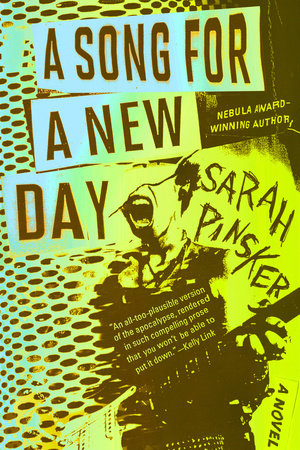
My own first novel takes on that challenge. In A Song For A New Day, musician Luce Cannon was on the cusp of making it big when escalating violence caused the government to pass congregation laws, preventing public gatherings of any sort. In the new After, she has to carve her own space, playing illegal shows. The second main character, Rosemary Laws, grew up on a remote wind farm in the After, and has never known anything other than virtual life–until she gets a new job that requires her to actually venture out in the world. It’s a novel of music and community, which to me are interconnected.
As a musician and an author myself, I love it when an author manages to convey music well in prose. I haven’t had a chance to read Annalee Newitz’s new book The Future of Another Timeline yet, which I’m betting should be on this list, but here are a bunch of novels and stories that I thought managed to capture music well in fiction, whether they’re talking about otherworldly bands, songs and collaborations that could’ve been, or the concert to end all concerts.
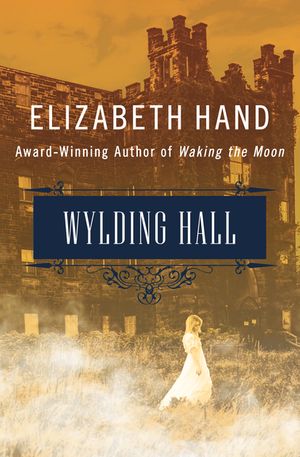
The rest of this list isn’t ordered, but I can’t imagine this book will ever slide off the top of my list of music done well in fiction. The book is told as an oral history of the Fairport Convention-standing Windhollow Faire, a band I found so believable that I looked them up at least twice while reading this, just to make sure they hadn’t actually existed. She perfectly captures the dynamics of a band holed up to record in a creepy English manor. I loved the combination of Gothic creepiness and “whatever-happened-to…”
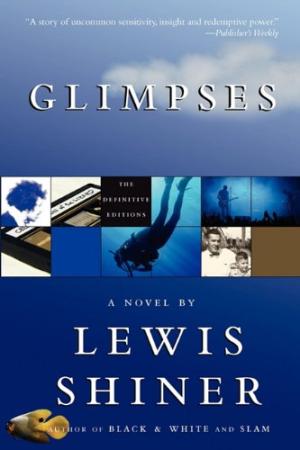
I haven’t read this since high school, but it had a profound effect on me at the time. The protagonist, Ray Shackleford, is a washed-up music lover whose own music career never happened. I don’t remember the time travel mechanism that takes him back to the sixties, but he is able to connect with a series of musicians including Jimi Hendrix, Jim Morrison, Brian Wilson, and the Beatles, and get recordings of their lost or misrecorded music as it was meant to be, starting with an acoustic version of “The Long And Winding Road.” This came out before some of these lost recordings ended up appearing in our world—I don’t think anyone anticipated Brian Wilson actually releasing Smile—but Shiner, a musician as well as an author, captures and conveys the musical moments well, even for those of us without 60s nostalgia.
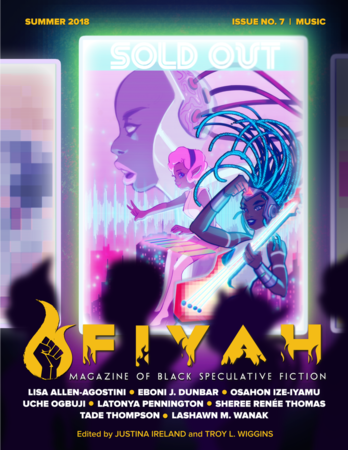
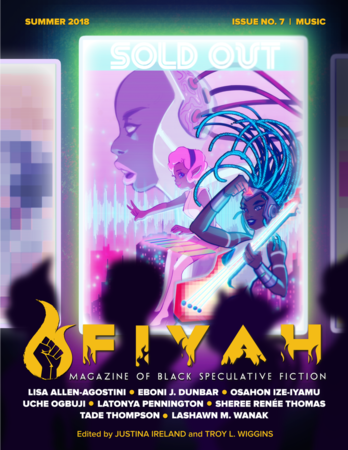
I’m going to cheat and include two short stories from Fiyah! Magazine’s excellent music issue last year. “Yard Dog” is about jazz musicians and a trumpet that maybe should not be blown. I love when music stories echo the genres they touch upon, and this story feels like 1940s jazz. It picks up some other things really nicely too, like the fact that most musicians see an interesting instrument and itch to get their hands on it. The description of the first time Yard plays his horn in the club echoes accounts of the first time New York heard Louis Armstrong. I love that this comes across like a tall tale, but also a story of joy and wonder. Some great lines too: “Open night is no excuse for bad jazz.”
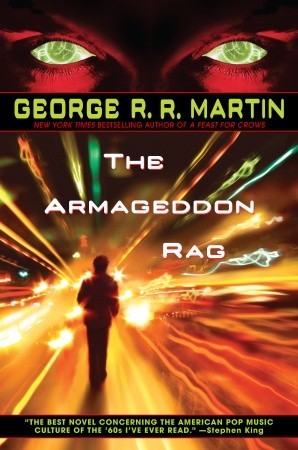
Some of this novel hasn’t aged very well, starting with most of its portrayals of women. Like Glimpses, it’s nostalgic for a bygone musical and cultural era. That said, it has some very cool elements, starting with the band at the center, the Nazgul, and the paths the various members take. The band dynamics are good, and the outdoor concert that serves as a climax for the novel is every bit as grand and bombastic as it needs to be.
Yes, this is the second story on my list from the excellent music issue of Fiyah! Magazine. Technically a novelette, I think. It’s an alternate history of real-life musicians Sister Rosetta Tharpe and Memphis Minnie, in which they are exterminators charged with destroying a seeming plague of fungal “stumps” that take on the likeness of people before exploding and killing everyone in the vicinity unless neutralized first. It’s a system accepted by all until Tharpe and Minnie start poking around the edges. Wanak recreates these two women, both of whom deserve to be better known, and conjures a great relationship between the two. It also uses the stumps and exterminators—and the related ban on singing—as a powerful metaphor.
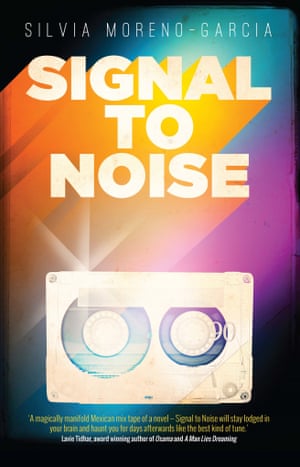
Moreno-Garcia conjures a powerful music-magic. I love the use of contemporary (okay, 80s) vinyl in the place where other novels have used ancient chants and madrigals. Music has power. I’ve never been to Mexico City, but the setting is used to excellent effect here too, as the narrative moves between the 80s, when the teen protagonists discover magic, and a second timeline twenty years later.
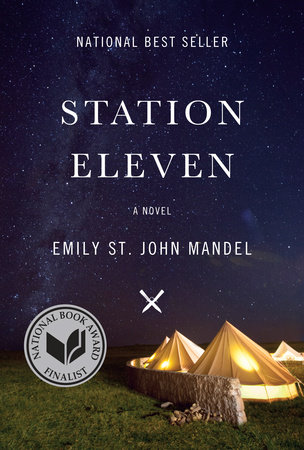
I’ve read a fair number of post-apocalyptic wasteland books, from McCarthy to Kunstler, and they are often joyless in a way that strikes me as deeply unrealistic. I loved that this book envisioned a dire post-apocalypse and still populated it with people who made art. The roving musicians travel under a credo lifted from Star Trek Voyager, stating “Survival is Insufficient.” I had a similar thought that I applied to my own novel, A Song For A New Day. People need music. People have always needed music. We clap our hands if we don’t have instruments; we raise our voices. This book leavened darkness with purpose.
“Three Voices” in Uncanny Magazine by Lisa Bolekaja
Composer Andre Irving stops caring that he was tricked by a friend into attending a street festival when a singer named Chocolate Tye blows him away. He knows she’s the only one to sing the difficult “Three Voices,” a piece his father had started and he had finished. Except the piece has plans of its own… Bolekaja does an excellent job of capturing both performance and the sweat that goes into getting music right.
I’m not sure if this fully qualifies as a music book, but it features a music exec and an aging rock star, so I’ll allow it. I’m also stretching things by calling it SFF, but parts of it take place in the near future, so again, I’ll allow it. I loved the strange non-linear structure and the way it somehow cohered, and the way the narrative flitted between characters, spotlighting one person and then letting her fade into the backing band until she appeared again in the background of someone else’s spotlight. I love the way we meet characters in their youth and their faded glory, and sometimes both at once (the goon in the title is time, and it isn’t a spoiler to say time visits everyone). On a further musical note, if I remember correctly, the powerpoint chapter manages to talk about songs that fade out until you think they’re over and then explode again, and then the book literally did exactly that thing, which I wouldn’t have thought possible for a book.
I am not a gamer. Not even slightly. I like Katamari Damacy but I’m not very good at it. I played about half of a farming game called Harvest Moon, but once I’d convinced the goth girl to be my bride, I lost interest in running my farm.
Which is why I was as startled as anyone to find my pulse quickening and my eyes transforming into hearts at every mention of Untitled Goose Game.
For those who don’t know: Untitled Goose Game is an indie game from the Australian games company House House. They’re a very small team—there are four main developers, and it looks like fewer than 20 people worked on the game in total. The game does not have a title, it’s simply being called “Untitled Goose Game” because they couldn’t come up with anything they liked better. And it seems to be a massive, massive hit.
I am ecstatic to honk about books that will fill that goose-shaped void in your heart.
The game play is simple. You are a horrible goose. You live in a bucolic English village (the creators said Postman Pat, Wallace and Gromit, and Hot Fuzz were big inspirations) and you wander from garden to café to town square, ruining people’s days by stealing their hats, interrupting their picnics, honking menacingly, and, in one case, trapping a poor scared child in a phone booth.
It’s hilarious.
This is, honestly, the first time in my life I’ve ever bought a game on release day. I have already spent hours playing it. I have spent hours talking about it in multiple Slacks and every group text I’m part of. I’ve retweeted fan art. Everything about the game makes me happy. I am ecstatic to take my goose-love into a new media, and honk about books that will fill that goose-shaped void in your heart.
If You Think the Horrible Goose Needs a Tragic Backstory
We all agree that the horrible goose is horrible. Personally, I’m fine with imagining him as some sort of inscrutable chaotic force, like the Nolan/Ledger take on The Joker, but maybe some people need an explanation? A reason that Horrible Goose hates everyone? Well…if you read this classic tale of a baby bird searching for his mother and allow yourself to imagine…what if that was the goose and he never found her? What if he grew up alone, his isolation twisting him into the sort of malcontent who would drop people’s sandwiches into a pond?
There is a long section in Lev Grossman’s 2009 hit novel in which several of the main characters, who are, you know, magicians, transform into geese and fly south for the winter. It’s one of the most affecting sections of the book, as Grossman really gets into the heads of the birds, as the students’ human personalities are subsumed by their new goose-natures. And unlike Horrible Goose, Grossman’s geese can actually fly!
If You Love the Village So Much You Want to Stay…FOREVER
In Year of Wonders, Geraldine Brooks takes us back to 1665, as an outbreak of plague hits the lovely village of Eyam. The villagefolk, terrified of succumbing to illness, decide to quarantine themselves and avoid all contact with the dangerous outside world. The book is narrated by a young widow named Anna Frith, who tries to raise her two boys while working for Eyam’s new, unsure rector as he attempts to provide pastoral care to his panicking flock.
Just pretend that the Bubonic Plague is a Horrible Goose.
If You Love Bucolic English Villages—But You Also Love It When Something Destroys Them
At its heart, Untitled Goose Game is a great example of rural folk horror. People are living their lives in a lovely village, safe in the arms of civilization, but not trapped in the isolation and modern terrors of a Big City. They have a community together, and together they will keep the dark at bay. But then a chaotic element of Nature Itself invades their village and reminds them that beneath that veneer of gentility chaos seethes, uncaring.
It’s just that in this case Chaos has taken the form of a Horrible Goose.
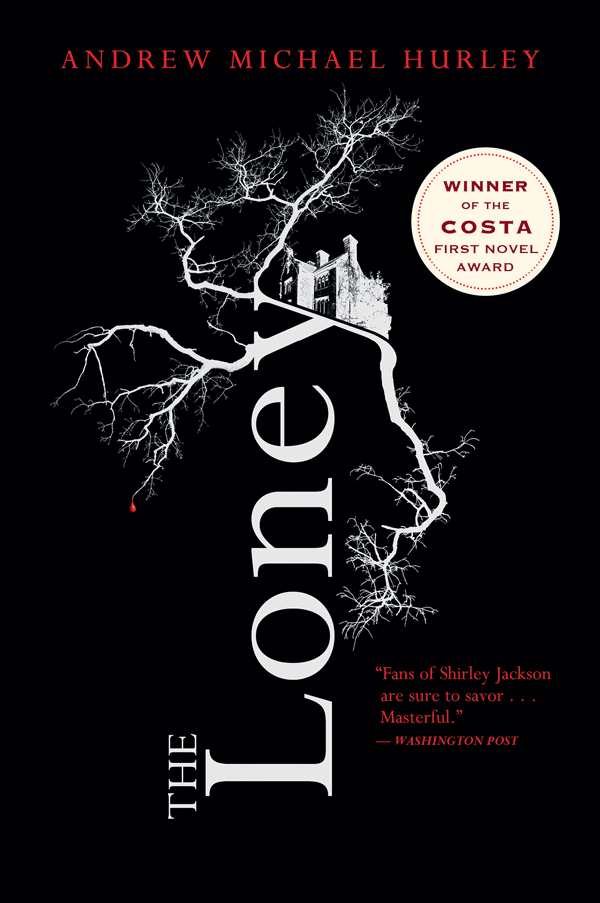
So if you like that sort of thing, you might want to read The Loney! Andrew Michael Hurley’s 2016 novel is a great modern horror novel, in which a family goes on a religious pilgrimage into the English countryside, stay in a cozy village, and soon learn that danger and weirdness can lurk beneath the most thatched of roofs.
If You Want Even More Animals to Run Amok in English Villages
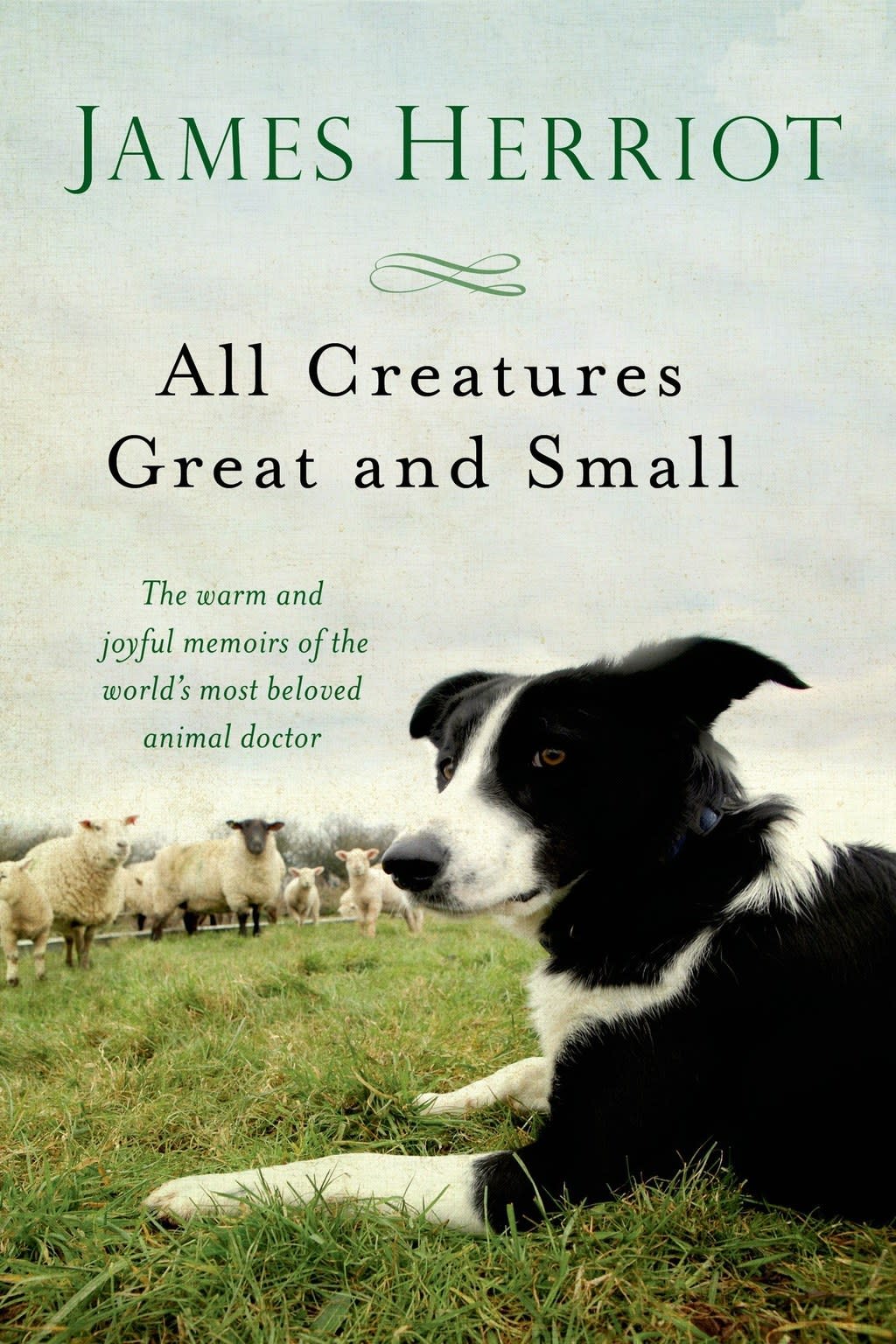
James Herriot’s classic tale of a village veterinarian has everything you can want: unruly beasts, a cozy village, wacky British people, and a warm, Hobbity love of rural English life. It also has a surprisingly detailed and informative look at changes in veterinary practice over the course of the 20th century…which has nothing to do with the Horrible Goose, but is pretty cool.
If You Wish the Entire Game Was Just Horrible Geese Fighting Each Other
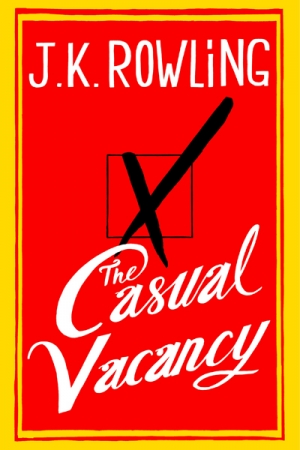
Idyllic English hamlet! Wacky villagers! Utter bastard-ness! Rowling’s first published work for adults is basically Untitled Goose Game if the entire village were nothing but horrible geese, except the geese are humans, and they all want to make each other as miserable as possible, and it’s darkly funny to read about. All the sandwiches are going in the pond, people!
If You Really Want to Enact Vengeance Upon the Horrible Goose
If you’re angry at the goose, want to see a comeuppance of sorts, and like mystery, might I recommend “The Adventure of the Blue Carbuncle”? There is a goose, who comes to a sticky end, but who also features in the resolution of one of Sherlock Holmes’ trickier cases. It’s also the closest Doyle came to giving Holmes a Christmas story? So if you’re looking for a Yuletide mystery that also feeds your goose yearning, this might be perfect.
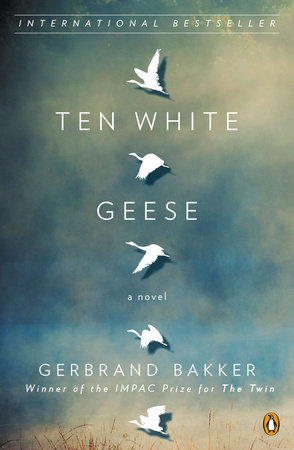
Gerbrand Bakker’s novel is titled De omweg in his native Dutch, The Detour in David Colmer’s British translation, and Ten White Geese in the U.S. edition. The story follows a Dickinson scholar who calls herself Emilie, as she takes up residence in a remote part of Wales after an affair. It’s possible she needs time and solitude to think; it’s possible she’s escaping her husband. What’s definite is that when she moves into the Welsh farm there are ten white geese waddling the property, but one by one, they disappear.
If You Seriously Just Want the Goose to Be a Metaphor
For symbolic rather than chaotic goose energy, you might want to try Mori Ōgai’s classic novel The Wild Geese. The book tackles the tumultuous times between Japan’s Edo and Meiji periods, exploring tensions between classes and the gulf between the opportunities for men and women in Japanese society. Young Otama becomes a mistress to a rich man named Suezo in order to buy security for her elderly father. She’s desperately unhappy about the situation, however, and becomes increasingly attached to a promising student, hoping that a marriage with him could lift her into a brighter future.
If You Wish the Horrible Goose Had Also Raided a Library
OK, this is my one moment of sentiment in a goose pond of snark: a billion years ago, when I was in first grade, my school had a convoluted book fair in which you earned tokens for good behavior and then got to spend them at the fair. (So like the Scholastic fair but with an utterly unnecessary moral component? Just let me get to the books, c’mon.) I doubt I earned too many tokens, but I had enough to buy Roger Duvoisin’sPetunia, a book about a vain goose excited to show off her “wisdom” after she finds a book. She can’t read it—she just thinks owning a book confers genius. While this isn’t quite accurate, it certainly spoke to my burgeoning book hoarding tendencies.
I’ll admit that ducks are not geese. I’ll further admit that this book is not even about ducks. However, Ducks, Newburyport rockets us through its narrator’s mind, taking us down a stream of consciousness journey not unlike the creek that winds through the village and empties into the pond that Horrible Goose calls home (or, more likely, “HQ”), and I’m going to posit that the bookitself is such an agent of chaos, with its whole “I’m one long sentence and I run for 1,000 pages come at me, bro” deal, that in its very existence it takes on the role of Horrible Goose.
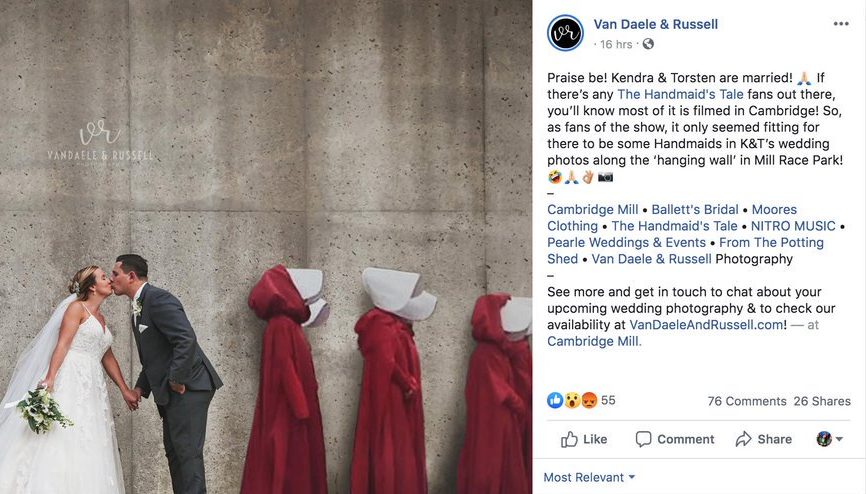
Like most people, your first thought after reading The Handmaid’s Tale was probably, “Ummm … this would be a PERFECT theme for my wedding.” And so like many people, you were probably horribly disappointed to find out that a Handmaid’s Tale-themed wedding had already been done—hanging wall photo backdrop and everything. No fair!
But not to fear: if you’re the type of person who both loves and yet deeply misunderstands books, we’ve got even more perfect suggestions for your literary-themed wedding.
Love in the Time of Cholera
Before you ask, yes, I have definitely read this book (title’s first word)! So I know that like weddings, this book is technically about love!
Also, Love in the Time of Cholera would make the perfect theme for a wedding if you’re the kind of person who has always, upon hearing the vow about “in sickness and in health,” thought, “Okay sure … but could you be much more specific? Like, graphically specific?”
We Have Always Lived in the Castle
Every little girl dreams of being a princess, so harness that with a We Have Always Lived in the Castle-themed wedding!
Every little girl dreams of being a princess on her wedding day, so harness those royal vibes with a We Have Always Lived in the Castle-themed wedding! Yes, I read this book and yes, my takeaway was that it’s a book about how dope castles are to live in!
A Storm of Swords
Any hardcore G.R.R. Martin fans will tell you that A Storm of Swords is, above everything else, a book about how to throw a wedding. Your Red Wedding-themed wedding will have your guests raving, “This music is too haunting to dance to” and “Oh God, are you wearing chainmail under your dress?” and “Why would you do this?” And the answer is: because I am confused by books!
The Catcher in the Rye
Now, hear me out. I actually have a lot of good reasons for choosing this one.
You can do a Catcher in the Rye Whiskey Signature Cocktail!
…
Fahrenheit 451
Some people will ask, is a novel about violent government censorship and the way that popular entertainment rots our minds really a great theme for a wedding? To them, I would say two things:
On the one hand, no
On the other hand … “It was a pleasure to burn, baby, burn” is a great way for a wedding DJ to intro “Disco Inferno”
The Bell Jar
I’ve been on Pinterest! So I know: everyone loves jars! A Bell Jar theme makes coming up with wedding favors easy-peasy: just buy a bunch of jars! Then give each guest a jar! And while you’re giving them a jar, thank them for coming by saying something sweet like, “You’re such a good friend” or “It means a lot that you’re here,” or “To the person in the bell jar, blank and stopped as a dead baby, the world itself is a bad dream.”
I am, I am, I am … crazy about this wedding theme!
Animal Farm
Something old Something new Something borrowed Something moo
Flowers in the Attic
Nobody understood the importance of family like V.C. Andrews—and no one would appreciate a good father-daughter or mother-son dance like her, either.
Infinite Jest
Uh oh … the best man showed up with 1,000 pages of prepared notes for his toast! Plus footnotes?! Oddly, this is the first—and will definitely be the last—wedding he’s ever expressed any interest in.
Admittedly, the bloody pig’s head on a stake makes this a hard sell for some brides.
Lord of the Flies
Admittedly, the bloody pig’s head on a stake makes this a hard sell for some brides. But we think she’ll come around when she sees everyone on the dance floor bumping to the “Kill the pig! Cut her throat! Spill her dub dub dub dub dub dub” remix.
Sophie’s Choice
Your red-eyed guests will weep with gratitude when they enter the ceremony and see your “Pick a seat! Not a side!” signage (painted in cursive on reclaimed wood). Alas, it is already too late.
The Jungle
A theme for a true foodie! Your guests will have a hoot choosing between meal options like “borax and glycerine sausage slop” and “the bread is moving because it’s rats” and “fresh-caught salmon (hint of child gristle).”
Moby Dick
This one is actually better for bachelorette parties.
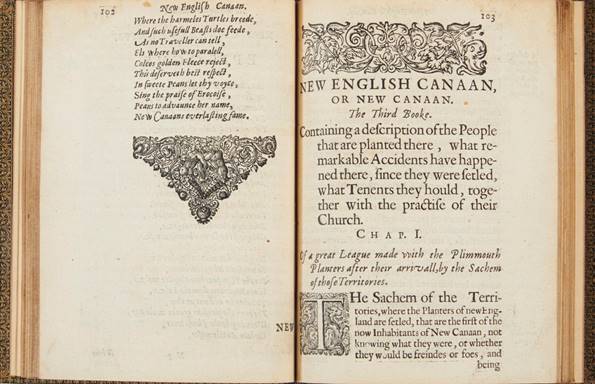
If you have a spare 35 grand or so, you now have a shot at a rare copy of the first book banned in America. Christie’s Auction House in New York recently announced that it will be auctioning a copy of New Canaan by Thomas Morton, a 1637 political satire that caused outrage among New England Puritans for its attacks on Puritan beliefs. As a result, the book was banned in America, and Morton became a celebrity overseas.
New Canaan was Thomas Morton’s revenge against Puritan colonists who had banished him from America. After attempting to start a free community in New England, Morton was arrested and sent back to England for inviting the native Alongquin people to a pagan maypole celebration in his new community. In response to his banishment, he wrote New Canaan, which satirized and reprimanded the colonist Puritans while elevating the morality of the noble Algonquin people. With the help of Ben Jonson and other literary figures of the time, Morton wrote and published his manifesto, which denounced Puritans and called for a diverse, free community called New Canaan to be settled in the New World. New Canaan made Morton a political celebrity, and was immediately banned in Puritan colonies.
This book’s material is a bit more forgiving than the Puritans were.
If you love the idea of getting your hands on a book that invoked the wrath of the Puritans, you might wonder what it takes to keep a volume like this in good condition. According to John Overholt, curator of the The Donald and Mary Hyde Collection of Dr. Samuel Johnson/Early Books & Manuscripts at Harvard, “The number one rule for taking care of rare books is that they want to live in the same space you do, not an attic, basement, or garage.” No matter how well a rare book might fit in your attic along with all your other haunted paraphernalia (dusty travel trunks, mannequins wearing moth-eaten ball gowns, strings of skeleton keys that don’t open any known locks), please remember that these books will do better in clean, temperature-controlled rooms. Luckily Mr. Overholt also states, “The good news is that when this book was printed, paper was made from rag fibers, not wood pulp like modern paper is. It’s usually very strong and soft—brittle, crumbly paper is more common in books from the 19th and 20th centuries.” This book’s material is a bit more forgiving than the Puritans were.
Ironically, the Puritans’ censorious attitude probably made this New Canaan sale a much bigger deal than it otherwise would have been. Mr. Overholt explains, “If there’s a campaign to destroy copies of a particular book or prevent it from being sold, that’s likely to mean it’s rare today, and often the things that made something forbidden in the time it was published make it especially interesting today.” While it’s not always true that every banned book is worth more, it’s certainly likely that taboo books will be more interesting to collectors. In the case of New Canaan, only two other copies of the book have been available at auction in the last 30 years, and this 1637 first-edition is valued at a cool $35,000–45,000. For reference, that’s about the cost of a decent-sized home in Cleveland, a tiny home in Sacramento, a month’s rent in New York, or roughly 700 tickets to Electric Literature’s Masquerade of the Red Death.
If you don’t happen to have that kind of money lying around, you can find the full text of the book on Project Gutenburg, or a digitized version on the Smithsonian Library website. If you’d like to see a copy of the book in person, visit the British Library’s English Short Title Catalogue for a list of libraries in Britain and North America with copies of New Canaan.
One evening in late July, I huddled in a Manhattan basement, battling radioactive creatures and trying to stay alive in a post-apocalyptic world. Afterward, my fellow survivors and I recapped the events over drinks at the karaoke bar upstairs.
For me, who avoids performing in public at all costs, spending time with people lined up to sing karaoke was far more unusual than fighting for survival in a post-apocalyptic dystopia. Despite having never played Dungeons and Dragons or any form of live action role playing, coming together with relative strangers to survive a hostile and dangerous world did not feel that unusual to me. The Bunker—part immersive theater, part live-action roleplay and part tabletop game—felt eerily prescient of my future—and the world’s.
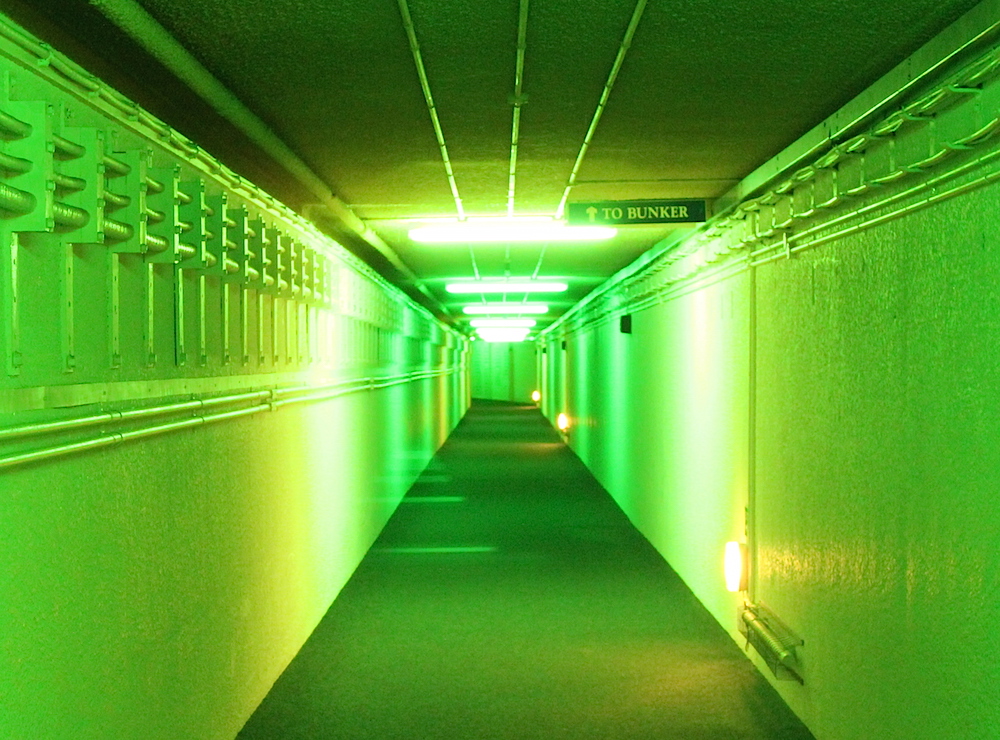
At the beginning of the evening, I was greeted the sidewalk by Ian McNeeley, artistic director of Broken Ghost Immersives and co-creator of the Bunker. Dressed in a hazmat suit, he led me down a steep, narrow staircase into an arts space called Wildrence. After introducing all the participants, McNeeley informed us of our circumstances: following a nuclear catastrophe, the world was uninhabitable and we had been kept in suspended animation for 114 years in a “deferred existence bunker.” Now we were awake—and running out of supplies. For us to survive, something had to change.
The post-apocalyptic situation felt familiar. But this time, I wasn’t reading or watching. I was part of it.
The situation felt familiar. There have been enough post-apocalyptic dystopian books and movies released in the past few years for me to read and watch until the real thing actually takes place. And given the current state of the environment, it might not be that long. But this time, I wasn’t reading or watching. I was part of it. Not only that, but I was a member of a group, and our group was in danger. Our bunker was stocked with some rations, but there weren’t enough for everyone and we were running out. There were 13 of us and just six hazmat suits.
I was nervous. I had walked into the room knowing no one, while almost everyone else had come in pairs and groups. I needed to find some allies, and fast. In situations like this, loyalties form quickly and just as quickly broken, and I was curious to see how these relationships would change as the night went on. I expected drama—fighting for survival would inevitably bring out everyone’s primal instincts. The question was: who would betray whom and how deep it would go?
The groups formed. Scattered throughout the room, which featured a couch, a few chairs and a table containing our rations as well as a place to create tabletop crafts, we began to plan. Some people ventured out of the Bunker wearing hazmat suits, seeking the supplies we needed to survive as well as fending off attacks from nearby bunkers. (The hazmat suits, as well as the supplies and most other important props, were represented by cards that we carried from place to place.) Different groups of survivors were scattered throughout the wasteland, communicating through electronic tablets. (The tablets were real.) One particularly hostile group informed us that if we did not meet their demands, we would be violently attacked. Reading threatening messages sent electronically, with no idea who it was writing them, was jarringly familiar, but interacting with the other survivors raised the stakes and brought us together. Nothing is more unifying than a common enemy. Even an epic catastrophe hadn’t changed that.
My actions could affect how this story ended and who survived. Did I really want that responsibility?
I had seen all of this before. I’d read it, too. But inside a small underground room, sitting next to fellow survivors on the touch, watching their faces and hearing their voices, was entirely different. It was more intimate, more dangerous—and I was a part of it. My actions could affect how this story ended and who survived. Did I really want that responsibility? And if I didn’t, could I really absolve myself of it?
Periodically the lights went out and the shelter’s artificial intelligence, DeBUNK, informed us that another day had passed, instructing everyone to consume another serving of the rapidly dwindling rations. Even though the rations, like everything else in the game, were extremely low-tech—the entire experience in the Bunker relied on one costume, tabletop game pieces, the tablets, and one computer—the atmosphere became more and more intense. As we lost members to mutant monsters and others returned wearing signs that proclaimed “HIDEOUS MUTATION,” informing us they now had missing limbs or newly-sprouted tentacles, the loss hit me hard.
I kept postponing my own venture out of the bunker, though I wasn’t entirely sure why. Being responsible for other people’s well-being made me cautious, and instead I found myself drawn to the notes that other “survivors” had left behind, most of them correspondence between two people. Another participant and I pored over them, seeking clues about how the disaster took place and how to survive. What had happened? Who had betrayed whom? What was this “goop” we so desperately needed?
Even in a make-believe apocalypse, I thought, I still want to tell stories. Sure, we might die, but I want to know why.
The clock ticked on, and the stakes were raised again and again. The more the risk, the more personal it became and the more uncomfortable I became. As I finally ventured outside (into the building’s hallway), I reminded myself that this was all a game but I was apprehensive. If I failed, who else would suffer? And would anyone help me, or would I be left to be eaten by the radioactive dogs?
The hallway hadn’t transformed, but the atmosphere had. Emotions were high as McNeeley, still dressed in his hazmat suit, informed everyone of their fates. Standing close and maintaining intense eye contact, McNeeley told me I had succumbed to insanity after witnessing the destruction throughout the world. I felt my stomach sink. Even as I thought, “That sounds about right,” I felt a sense of loss and even grief. All of the courage I had worked up to leave the Bunker had been for nothing. If I had stayed, I would have survived.
Rescued by pure luck, I rejoined my teammates for our final moments. Time was running out and we were about to lose power—and another Bunker was planning to attack us. I thought fights would break out, but everyone worked together peacefully as we evaluated our options. Why did I expect fireworks? I wondered. Perhaps I had been conditioned by entertainment or even American government to expect dramatic power struggles when the danger was imminent. Instead, even when two people of our group defected and attempted to run away with our getaway van, the group remained calm. There was no shouting or screaming, but the feelings of betrayal were real, as was the sadness when one member of our group was defeated in battle with a radioactive monster.
In this Bunker at least, peaceful, democratic decision-making could take place. If the apocalypse comes, it will probably feel a lot like this, I thought, listening to everyone talk. Participating in the Bunker didn’t include music, special effects or any real danger, but it was the lack of effects that heightened the tension and made it more real. In an actual dystopia, there wouldn’t be dramatic music or closeups of people as they give climactic speeches. There wouldn’t be costumes or gas masks; we’d probably all be dressed like we were tonight. In movies and books, you know when it’s the culminating moment, but here there was nothing to indicate that. It was up to ourselves to evaluate our decisions and their consequences. The weight of these decisions snuck up on us slowly, but there was hardly time to reflect on them as we continued to fight for our survival.
This is far more realistic than any book or movie, I thought. We’ll only know how important our decisions are after they happen.
This is far more realistic than any book or movie, I thought. We’ll only know how important our decisions are after they happen. A newscaster isn’t going to say, “This is what will cause the end of the world” or “The apocalypse begins today.” We’ll have to stop and think about what’s happening, weigh the consequences and make our choices—actions that often feel rare in a 24-hour Twitter-driven news cycle.
The night concluded with DeBUNK narrating how our story ended. Sitting together, listening to the story was charmingly old-fashioned, reminiscent of telling stories around a campfire—despite the story being told by a disembodied electronic voice—a throwback to the past but also potential foreshadowing of the future.
The Bunker left a lot to unpack, so our group climbed the stairs to adjacent karaoke bar to recap and discuss. Some were cheerful and some were unsettled. I was in the latter category. I joked that the group had been almost too mature and polite, and the lack of drama or power struggles resulted in the calmest dystopia I had ever heard of. I wondered if I had stumbled into a remarkably mature LARPing community, or had the state of the world caused everyone to take these situations more seriously.
Maybe the Bunker should be required for everyone as preparation for the future. The past three years have inspired so much fear about where the world is heading, but I hadn’t seriously considered how I would react if I was actually fighting for survival. The night had shown me some of what I could do, and what I was scared of. It also showed me that what could be my last day on Earth looked and sounded a lot like today did. It wasn’t going to be drastically different overnight—and because of that, it could sneak up without me or anyone else noticing.
Was The Bunker fun? In another time or political climate, I would answer yes without a doubt. Right now I would describe it as useful.
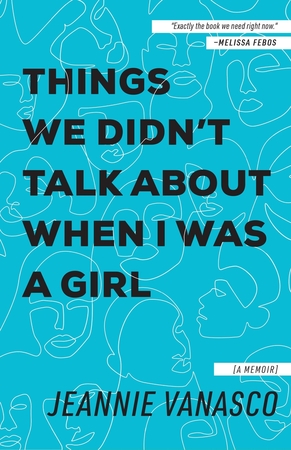
Note:Masie Cochran is Jeannie Vanasco’s editor for her memoir Things We Didn’t Talk About When I Was a Girl.
“I’ll tell him: I still have nightmares about you,” Jeannie Vanasco writes early in her second memoir, Things We Didn’t Talk About When I Was a Girl. The “him” in question is Mark, a man who was one of Jeannie’s closest friends. But when they were both nineteen, he raped her at a party. Fourteen years later, Jeannie is still asking herself why. With this memoir, she extends the why to Mark—interviewing him on the record about the rape and its aftermath.
Buy the book
When Jeannie and I first talked about her idea for this book, the follow-up to her 2017 memoir The Glass Eye, Trump had recently been elected and the #MeToo movement was building momentum. Both contribute to the story Jeannie tells in this book, as she explores the definition of rape; the ways women are socialized to tend to the comforts of men; the necessity of female support networks; and the many ways in which sexual assault is handled (and mishandled) in our society.
At the center of Jeannie’s book are a series of conversations she has with Mark—first over text and email, then over the phone, and then in person. There are no easy answers, but there is real power in Jeannie’s willingness to ask hard questions and dissect the language of sexual assault, pushing against its confines and unpacking its complicated history.
Masie Cochran: I’d like to start things off with the title, Things We Didn’t Talk About When I Was a Girl. Why do you think it is that we don’t discuss many of the issues you raise in the book? Do you think things have changed at all since you were a young girl?
Jeannie Vanasco: My undergraduates ask me the same questions I asked myself at their age: What counts as sexual assault? Was it bad enough to report? What’s the point of reporting if there’s no proof? And these questions usually come prefaced with “I haven’t told this to anyone else.” I wrote this memoir for a lot of reasons, but mostly I wrote it for my students—when I realized that, in a lot of ways, things have not changed. Men still overwhelmingly wield enormous power. I mean, a bunch of men added Clarence Thomas to the Supreme Court when I was a girl, and now a bunch of men (including two who voted for Thomas) hurriedly made Brett Kavanaugh a Supreme Court justice instead of pursuing a substantive investigation. His nomination arrived after I finished writing this book, as did a white noise machine that I blasted while crying in my campus office as I watched him shout about liking beer.
#MeToo is about empowering and supporting survivors, and holding perpetrators accountable.
But my belief, perhaps head-in-the-clouds, is that some things have changed. Americans definitely seem more interested in talking about sexual assault—more so than when I was a girl. But a lot of us feel silenced when our thoughts and feelings clash with how we’re encouraged to think and feel. For example, the shame that I felt in 2003 when the rape happened and the shame that I felt in 2018 when writing this book made talking about the rape really hard—yet the shame existed for different reasons. In 2003, I felt shame because my behavior conflicted with popular portrayals of the good victim: I’d been drinking that night, I didn’t fight back, I froze. And then in 2018, I felt shame because my thoughts and feelings conflicted with those voiced by #MeToo supporters I admire: I didn’t hate the guy, I didn’t want him locked up, I didn’t even know if I could call what he did rape—and I actually wanted to talk to him, to ask him how the experience had affected him.
MC: As you mentioned above, your memoir dovetails with many concerns raised by the #MeToo movement. What do you think it means to release a book during this particular moment?
JV: #MeToo is about empowering and supporting victims/survivors, and it’s about holding perpetrators accountable. Some of us may disagree about what accountability looks like. But #MeToo is massive enough and sturdy enough to hold different points of view. It’d be pretty weird if every #MeToo supporter agreed with one another about important subjects, such as statute of limitation requirements. Reaching a common goal results from passionate, messy disputes—within a movement—about how that goal can be reached.
And now, having written this book, I’m interested in the different reactions that it will elicit. Not every reader will agree with my approach. And that’s okay. That’s healthy. Though it won’t be healthy for me to comb the internet for reactions—so I’ll probably unplug for a few months and stick to in-person discussions. Mostly, I want readers to come away from my memoir with a deeper understanding of how they consume and interpret someone else’s story of sexual assault.
MC: Your female friends also play a large role in the narrative. How did talking with them enable you to work through this material?
Some of us may disagree about what accountability looks like. But #MeToo is massive enough to hold different points of view.
JV: Their questions and critiques helped me interrogate my own motives and reactions as intensely as I interrogated my rapist’s. They read the transcripts of my conversations with him, and they pointed out instances where he was manipulating me, whether consciously or not. My friends—all strong feminists—also made me feel better about sticking with this project.
MC: You see yourself as a feminist, but worry in the narrative that you might disappoint other feminists. Where you do you think this worry comes from? What do you hope your book might generate in terms of conversations amongst women?
JV: My friends often talk about perpetrators as irredeemable. And statistics point to perpetrators as being repeat offenders. So my friends didn’t think it was a great idea to talk to the guy who raped me. And I understood their rationale. But I wanted to believe—still want to believe—that people are capable of change, or at least capable of remorse.
I hope, too, that the book reaches readers regardless of their gender identity. I hope it helps any victims/survivors who feel guilty about feeling other than how they’re “supposed” to feel or have been taught to feel. And it’d be great if men would read this book and talk about it with other men as well as with teenage boys. This reminds me: I was recently on a plane. I had a notebook on my lap and was staring off into space, and the couple next to me asked if I was a writer. I thought, Oh great. But I told them yes, and then they asked what I write. And we ended up discussing the topic of this book. And the woman was incredibly interested in talking about it. The man seemed interested, but then he said of his partner, “She’s really into #MeToo.” I wish he’d said, We’re really into #MeToo.
MC: Outside of your interviews with Mark, your partner, Chris, offers a male viewpoint. How might the book have been different if not for Chris’ perspective?
JV: Women are conditioned to prioritize the feelings and wellbeing of others. Chris encouraged me to focus on my own feelings. But my female friends also encouraged me to focus on my own feelings. So I’m not sure if Chris’s perspective was particularly gendered.
I wanted to put the focus on my rapist, instead of having readers focus on me, on any perceived unreliability, on what I could have done to prevent or stop the assault.
Chris’s perspective helped, though, because he could offer insight about memories that I’d forgotten. For example, when I began writing the book in January of 2018, I thought that my nightmares about the rape had happened mostly after the last presidential election. But Chris said they’d been happening when he and I started dating in 2009, and would happen every few months after that.
Now this part risks sounding retrograde, like when somebody’s response to a man pushing a stroller is “What a good dad,” but I’ll mention it anyway—in case it inspires other men to step up: while I drafted the book and taught, Chris handled what were otherwise shared domestic responsibilities, such as the laundry, the cooking, the cleaning, the groceries. A telling anecdote: our local grocery store did some remodeling while I was writing the memoir. After I turned in the manuscript, I went to the grocery store and couldn’t find the entrance.
MC: Your first memoir, The Glass Eye, was a consuming memoir that took you more than a decade to write. Both that book and this one address events from your teenage years, but in very different ways. Did you feel you had to write one before the other? Did writing The Glass Eye help you to write this?
JV: The Glass Eye was a deathbed promise to my dad, and writing it became an obsession. Anything else I tried to write transformed into writing about my dad. My grief for him caused me to push aside my feelings about the rape—and about pretty much everything else. I didn’t realize how much the rape had stayed with me.
And after publishing The Glass Eye, which covers my experiences with psychosis, I felt extraordinary pressure to seem reliable in this book—and I hate that that’s the case. But on my tour for The Glass Eye, I was asked about my hallucinations all the time—how did I know that what happened had happened? I didn’t want to go through those kinds of questions again. I wanted to put the focus on my rapist, instead of having readers focus on me, on any perceived unreliability, on what I could have done to prevent or stop the assault. I wanted him on record saying that yes, he knew what he was doing was wrong. I wanted him to confirm my memory of that night. Which is messed up, sure. But as a writer, I’m interested in exploring complicated desires.
We are wading out, the five of us. I remember this. The sun an hour or two from melting into the ocean, the slick trail of its gold showing the way we will take.
Ahead of me my tiny sister sits regal and unafraid in the middle of the raft that Fynn has built of packing foam and empty chemical buckets, lids fixed airtight with caulk. He’s already tested it out in our neighbors’ pool and declared it seaworthy, but if the thing falls apart he has promised to carry Sara himself. Fynn is thirteen, older than me by five years, and the only one of us three kids who has been out to the island before. Our mother had long hair then, and Fynn’s dad was still around, hadn’t yet skidded his motorbike underneath a roadtrain one rainy December night. My dad—Fynn’s dad now too, Mum constantly reminds us—shoulders a picnic basket filled with Sara’s favorites, Fynn’s favorites, Mum’s favorites, mine: cheese-and-apple sandwiches, salt-and-vinegar chips, slivers of mango doused with lime and chili, ginger beer. Enough food to last a week, though we’ll be crossing back to the mainland this same night, lit by a quarter moon and a two-dollar torch.
The people around us hardly seem like people. More like a muster of herd animals. They move steadily through the water in ones and twos, feeling for the slope of the sandbar underfoot, the treacherous edge where the ocean floor falls away. That’s how people—tourists, mostly—get themselves drowned, snatched off by rips.
The sea the sea the terrible . . .
Yep yep, we say, we know; Dad gets wordy sometimes.
There are other families, some towing small children on boogie boards, inflatable li-los, nothing so fine as Sara’s raft. Coolers bob alongside clothes tied inside plastic shopping bags, silver jellyfish-balloons with Day-Glo guts.
We’re lucky, Dad’s telling us. Today is a neap tide—safest time to make a crossing. The highest tide not as high as normal, the deepest part not so deep.
Farther out the island looks like a rough dog slouching up from the ocean, muzzle pointed northwest. What’s out there? A lot of putrid birds, Fynn’s already told me, and some all right caves, mobs of bogans sinking tinnies of lager. Nothing awesome. But tonight, after sunset, the shores around the island will be aglow with the visiting swarm of bioluminescent phytoplankton, on their anxious, brilliant way to who-knows-where. We’ll perch along the highest bluff in a sprawl of blankets while the waves crash iridescent against the rocks below, sweeping away to leave lonely blue stars stranded here and there, then charging back in to reclaim them.
It will be spectacular, an eerie sort of magic, and I will never see anything like it again.
It will be spectacular, an eerie sort of magic, and I will never see anything like it again.
But whatever, this isn’t the point. In the end, the island is just a dog-shaped rock covered with birds and sunburnt gawkers, temporarily surrounded by terrified dinoflagellates.
It’s this wading out that matters, this crossing: the bright, migratory-animalness of it. Going waist deep, chest deep, waist deep again. What matters is how, halfway over, Fynn looks back at us, then ahead again, and says to no one, or everyone, or maybe just to Sara:
I reckon this is how the afterlife must look.
I see Dad look at Mum and mouth the word: afterlife?
Fynn is the palest of us, lighter even than Mum; blond all the way to his eyelashes, the only one who crisps up in the sun. He looks adopted. A thing we all know but know better than to say.
Anyway. There it is.
Do I make it through childhood without staking every possible biological claim on the man who calls us both my beloved savage? I’m ashamed to say I do not. I’m content to share him only in his lesser moments: it is my dad who used to play bass in an almost-famous blues band, but it is our dad who, before the blues band, used to play clarinet in a high school orchestra. It is my dad who promises to buy us a pair of albino axolotls, our dad who reneges when Fynn and I neglect our goldfish duties and Skeletor’s tank is all slime and fug.
(There was a time, some years, where it was just Fynn and Mum, and this is maybe what I’m getting back at him for. Or else I’m getting back at him for all the names he isn’t called in school, the way no one ever asks where he’s from, whether his parents are reffos. Or else it’s the fact that, even though one of them is dead, he has two fathers, doesn’t have to share his, and is allowed to wander off without telling anyone, to give reasons like just thinking or just walking, getting soft looks instead of strife.)
Does my brother find some spiteful way of getting even, of undermining my full-bloodedness? He never does. Maybe he never feels the need to. Fynn takes these pissing contests for what they are. In actual pissing contests, there is no competition, and really no point. He gets halfway to the bougainvillea tumbling over the top of the fence, while I try (no hands) not to dribble on my runners.
At the deepest point of the crossing, the ocean reaches my lower lip, and I hold on to Mum. Feel my feet levitate from the shell grit below. Become cargo swinging from her strong gold shoulder, safe in her smell of coconut oil and warm bread as she pushes on towards the island.
Around us the ocean thickens to an algaeic soup that stinks of dead things; proof that the plankton are here, though invisible for now—it isn’t dark enough to give them away yet. This is the point where Fynn’s raft begins to keel, the empty buckets unhitching, and Sara responds with a lot of high-pitched wailing and clutching at salty air.
When the raft breaks apart, Fynn keeps his word, and Sara scrambles up from the wreckage to ride his bony shoulders, her little grabby starfish hands clenching fistfuls of his tawny hair. It must hurt badly, his face like a cheap rubber mask of itself, but he says nothing while trying to shepherd pieces of the debris ahead of himself.
Waves slap at his face, trying to get in through his mouth and nose. He screws his eyes shut, snorts water, while higher up Sara sings, oblivious, her stubby little feet hooked under his wrists.
Hey mate, Dad offers, I can take her. But both Fynn and Sara shake their heads, so Dad just cruises alongside in a coast-guard-ish sort of way, until the ocean finally slips from Fynn’s shoulders and leaves Sara cheerily marooned up there.
There are no photographs of this day. Mum dropped the disposable QuickSnap crossing back to the mainland, and though we groped and kicked around no one turned it up. Perhaps that’s why I remember it so vividly. Fynn stumbling through the breakers with Sara, delivering her safely to the dry sand and waiting until Mum had led her off to squeak into some penguin burrows before he doubled over and gushed out all that swallowed seawater into a patch of saltbrush. Fiery stinger marks striped his quaky legs.
Years later, somewhere into adulthood, I’ll decide that this is a story to one day tell at my brother’s wedding. Or else his funeral. Possibly both—as with a certain kind of suit, it seems workable for either occasion.
I’ll decide that this is a story to one day tell at my brother’s wedding. Or else his funeral. Possibly both—as with a certain kind of suit, it seems workable for either occasion.
Instead of the wedding and/or funeral speech (though sure, there’s still time enough for both) I’m delivering this story to my wife. Trying to wrest my brother back from what local mythology has made of him. Careless Idiot at best. Murderer at worst. Ti has been driving past those crosses at the shoulder of Highridge Road for years, since before we even met. Shedmade, white as desert-bleached bones. Coated with a fresh layer of paint every spring, strung with teddy bears, ribbons, other sentimental lark. Trinkets refreshed each September. The grandparents’ work, we suspect; the father too modest for that sort of rubbish.
This is all Ti knows of my brother. This, and the couple-three cards he’s sent, and the shedful of furniture he left behind; all gliding teak curves and high-tension wires. Mid-century harpsichord, Ti calls it, explaining how their father was a luthier when friends admire the coffee table, the only piece that makes sense with the rest of our house.
My father, I’ll sometimes add. My father was the luthier.
Why, Ti wants to know, would your brother come back here?
I ask myself the same.
After the hearing, depending on who you care to ask, Fynn either ran, slunk, snuck, crawled, choofed off, fucked off, hauled arse, or simply went to the Northern Isles of Scotland, where the Atlantic charges in to meet the North Sea, and where he got some shit-kicking work at a whisky distillery. There he puts in five or six shifts a week, making nothing that anyone could put his name to.
I still draw sometimes, he told me once, glitchy at his end of our sole Skype attempt. His face freezing then catching up with itself.
I still sketch out ideas for things I might make one day if I ever [garble].
Last year Mum and Dad retired to Norfolk Island, from where Mum phones every Sunday to talk politics and weather and to ask what the hell she did wrong. Sara is twenty-fve, working as an image and style consultant in Sydney. Who knows what she thinks; she’s less scrutable than a butchy boy. She doesn’t remember that trip to the island, or the raft, and I’m not sure she remembers a time when she liked either of us, Fynn or me. Her first memories start at five, and by then Fynn was sixteen, flakey as a box of Frosties, and I was a monster. Long gone are the days when she would laugh along with whatever jokes we told, not understanding but not wanting to be left out. Sometimes we would laugh just to make her laugh, tell jokes that weren’t funny, or weren’t even real jokes but had the rhythm of jokes. Just to test her, to watch her go. Now she doesn’t find anything funny.
I think you ruined her, Mum says down the phone one weekend. You and that brother of yours.
When did he become mine? is a question I do not ask.
When did he become mine? is a question I do not ask.
Fynn arrives on a Saturday morning with one duffel bag, his blondness gone to seed, hair brushing the collar of the bomber jacket he wears in spite of the January heat. Dead pine trees still line the curb, flung out for green waste.
My brother lopes across the scorched front lawn, looking even older than he did in court, older than I figured possible. Walking taller than he wants to be, ghosting up the morning. Out on the street there’s his rental hatchback, some hairdryer, crouching as though it, too, hopes not to be seen. As though six years might be too soon.
I’m waiting behind the flyscreen, feeling everything I’d neatly fat-packed springing up in me. I will punch him, I think. No, I will bring him in close. I will tell him . . . I don’t know what.
Yes, I might’ve picked him up from the airport, traveled that eighty K with him—school doesn’t start back till February, the course is all set, no one needs a thing from me till then. But I was thinking, To hell with it. After this long and this much silence he can manage, at least, to make his own way back here.
He’s turning silver gray at the temples, and when he finally looks up his blue eyes waver as though he is gazing at something unstill. He reminds me of those huskies that people, out of vanity or stupidity, see fit to keep as pets in this climate. Ti’s hands ball into little fists when she sees them, these bewildered, patchy-coated animals paraded around Perth’s richer suburbs, humiliated wolves.
Fynn is humiliated, of course. He is beyond humiliated.
Hey! I say. Then, like an idiot, Welcome back!
Raf, is all he says, putting his hand forward like I’m about to go and shake it.
I step out into the glare and grab him around the shoulders, and he stands there stiffly for a few seconds, finally relenting to the hug.
Still in the doorway he rummages through the duffel bag. Brought you a gift, he says, but he says it like geft, this new lilt in his voice. Your wedding, he says, handing over a fancy wooden booze box. Sorry I missed . . . Then he waves a hand to mean: Everything.
Sorry I missed . . . Then he waves a hand to mean: Everything.
It strikes me that this is what strangers do. Make offerings before stepping over the threshold of each other’s house. That this is what we are now.
Get in here, would you?
Inside he shucks off the bomber jacket. His skin is the bluish white of those axolotls Dad never bought us.
Six summers, he explains, like an apology. A lot to make up for—mind if I go photosynthesize? Then he spends the next few hours just lying in our backyard, stripped down to his undies. Ti will be at work a few hours yet, dislodging pieces of Lego from the throats of small stupid dogs, treating pissed-off cats for gingivitis. Fynn keeps his eyes closed as we speak about nothing much: Mum and Sara synching up their mid- and quarter-life crises; the Perth mining boom; the resulting ice boom; the inevitable rehab boom.
I rant about my students, mostly write-offs. Teaching them the difference between Rhizaria and Chromalveolata when it’d be more use teaching them the difference between papillomavirus and chlamydia.
All the while my brother’s face is turned directly towards the sun. I study the frail red and gray blood vessels on his near-translucent eyelids, limpid as rock pool creatures down there in the deep set of his skull. The drive from the airport would have taken him past those crosses, the gleaming reinforced barrier.
What? he says from behind his closed eyes.
Nothing. You’re burning, you know.
Beaut. Fine by me. Six bloody summers . . .
Yeah yeah.
My wife falls in love with him, of course. Not in any way that could really be considered dangerous, just in the way I knew she would, the way people have always fallen in love with Fynn; quickly and easily and faithfully. It is so so so good to finally finally meet you, like a record jumping, and suddenly the crosses planted at the shoulder of the highway do not stand for two tiny girls and their singing-teacher mother. They stand for small-town intolerance, grudges borne longer than is fair or necessary, nourished by the kind of rural oxygen a larger city would have starved them of.
The two of them stand at the kitchen sink, elbow to elbow, de-bearding mussels. Cracking up over something I don’t catch. In high school the couple of girls I managed to bring home laughed just as easily for him, like they were trying to rouse some sleeping thing. Fynn, my older, whiter brother, who never felt the need to take me down a notch. Who’s always had everything going for him. Why do I still think of him this way? And why is there a moment, a flash in which I also think, skulked, snuck, hauled arse… after all the defending I’ve done in the years between the accident and here. Especially in the first months, with people murmuring and shaking their heads in the tinned-veg aisle, though all I have in common with Fynn is some blood.
I’m watching them over the top of my beer, my brother and my wife, somehow knowing, before it happens, that one of them is going to slice the paring knife through their palm, and the other is going to have an excuse to come at them with Dettol and cotton wool, and that I’m going to have to sit here and watch this. Then Fynn goes Ah Christ! but the gouge isn’t deep, doesn’t need Ti’s attention, and he gets on with the job of scraping away the hairy tendrils that once anchored the mollusk someplace it thought sturdy.
Soon enough we’re sitting around the table, butterflying shells between our fingers, using the halves for slurping up the briny liquor, the house filling with a fragrant, kelpy smell.
Ti has a theory about labor-intensive food, the kind where utensils are a waste of time and attempts at grace just make you clumsier. This theory holds: the empty shells pile up between us and the talk spills easy, as if we’ve been doing this every Saturday for years, the three of us.
The work’s mostly just menial stuff, Fynn says. Bottling, labeling. Keeping the mice offa the malt floor. Things I can’t mess up too bad. No hand in the art of it. But it’s enough to be in that landscape—that old, that immense. Part of you just disappears.
All of you just disappeared, I think.
Got a little boat, he’s saying. Take it out for sea trout on my days off. Bay of Isbister, Inganess . . .
When he says these names it’s with that glint, as though the words have been kept in the wrappers they came in.
We drink all the wine that wasn’t used to steam open the mussels, and when that’s done we crack Fynn’s wedding present. I uncork the heavy-based bottle, and the North Sea rushes into the room. I slosh out three glasses and we lift them to the wedding. We lift the next round to Dad’s bypass, then another to the cousin whose dive gear let him down, and all the things that Fynn shouldn’t have missed but did and oh well what can you do he’s here now, hey?
Ti’s giving me that watch it look. Fynn clears his throat and unfoots a mussel with a twist of fork, then goes back to seducing her with northernmost Scotland’s beauty and gloom. The peat slabs cut and lifted out of the ground, snaked through with heather roots and reeking of time. The salt air and natural violence that make their way into the bottle. The ocean and how it differs, how the memory of Western Australia shrinks right down to a pinhole. Standing at the edge of the Yesnaby Cliffs, clouds of guillemots beating frantic overhead.
Like the very ends of the earth out there, Fynn says.
Like the afterlife . . . ? I edge in, and I can tell from how he looks at me that he doesn’t remember ever saying that, that he thinks I’m taking the piss. None of us are quite drunk enough to not be embarrassed by this, so I refill our glasses and we drink to our sister, whose sense of humor we incrementally destroyed.
The bottle makes seven or eight rounds before it’s drained, and by that stage Ti has tapped out, her sturdy brown legs drawn up beneath her on the couch, her dark hair curtaining her from our nonsense.
Without her voice to anchor us there comes a drift, a silence so big and awful that it could be holding anything, but I know what’s lurking within. I try to head it off with small talk, but Fynn just nods. Here it comes, I think. Here it is.
You’ve seen him around, I s’pose?
Who?
Fynn shakes his head, as if I’m the coward.
Yeah. I see him sometimes. Not all that often.
And?
Look. Fynn. There’s nothing I can tell you that’s going to make you feel less shitful about it. Last year I saw him at the Farmers’ Arms, and he looked like a man whose wife and kids had died five years ago. A few months back I saw him at the post office, and he looked like a man whose wife and kids had died six years ago. What else is there to say?
It happened in a heartbeat. In a glisk, Fynn has since said. Swerving to miss the dog that came trotting out of the scrub. Swinging his ute into the oncoming lane, into the oncoming sedan. Just a glisk, then. And the safety barrier just for show, apparently, eaten through by salt air and melting away like bad magic at the first kiss of fender.
I met a woman, Fynn says. Sweet clever type from the library. When I’d stay with her overnight, there’d be the sound of her kids running around the house in the morning. Sound of them laughing downstairs or talking in funny voices to the cat. It was too much, Raf. I couldn’t tell her. And I couldn’t stay.
I keep looking for something, my brother goes on. Something that’ll fill up this scooped-out place but drink doesn’t do it. Sex doesn’t do it. I walk, I walk a great fucking lot, and the wind there wants to rip you open, but it isn’t enough. I’ll think maybe I can lose it in a roomful of people, like it’ll be made to seem smaller somehow, but no, it’s like everyone can all already see it, smell it on me.
I make to recharge our glasses, then remember there’s nothing to recharge them with.
You want to know the best it gets? Really, the best it gets?
Come on, I tell him, get your stupid jacket.
I’m further over than he is but I know the last thing he wants is a steering wheel to hold. I climb in the driver’s side of Ti’s Golf, fix the mirrors while Fynn hides his eyes behind a pair of aviators.
You don’t want those. Anyway, you still look like you, just more of an arsehole. Everyone looks like an arsehole in aviators.
Right, he says, flinging them into the lantana.
Since Fynn left, some Perth kids came down and reopened the Kingfisher Hotel. The smoke-damaged collection of taxidermied birds that made it through the 2009 fire—suspected arson—are still roosting about the liquor shelves. The fiber optic thing is still there, the pool table is still there. But the bar’s been refitted, a big slab of reclaimed red gum, and behind it the top-tier stuff is seven tiers up, and the bartender has to put down his copy of the DSM-5 or whatever and hop a ladder to get to it.
These boys don’t know Fynn. These boys will pour him his drink without asking just how he likes being back home.
We take bar seats opposite a singed black cockatoo, its glassy eye on the rum selection. Fynn wins the wallet race, the leather split like overripe pawpaw, gaping fifties.
You need to carry all that around?
From the Travelex. I closed all my accounts when I left Australia.
You really weren’t planning on coming back, huh.
Guess I wasn’t.
There are Fynn’s hands, threaded mangrove-like around his glass. Roughened by work that has nothing to do with him, work that carries nothing of himself. In my shed there’s a second table and a set of chairs and a bookshelf. In February it heats up to a million degrees in there—six bloody summers— all the wood has buckled and split along the joins, the wires gone slack or snapped, all that careful tension ruined. I should have kept them in the house. I should have driven into Perth this morning, been there waiting when he hefted his bag off the luggage carousel. Now it’s all I can do to lift my pint glass and meet his.
Lang may yer lum reek, Fynn says, rs rolling all over the place.
And may the mice never weep in your pantry, or whatever.
Close enough—where’d you turn that up, now?
Oh, y’know. I shrug and swallow beer froth. Scooped it out of the punnet.
Fynn grins down into his collar. Can ya move the Camira? I need to get the Torana out to get to the Commodore.
And the laughter that finally finds us feels very frail, but true enough, an echo rippling from the thousand family dinners spinning off lines from the same stupid shows while Mum cracked up in spite of herself, and Dad threatened to drive us out into the bush and lose us.
Of course the guy was always going to appear, company cap pulled low, eyes shaded from the glare of pool table fluorescents. It takes him a moment—I see it, my brother sees it—to register that it’s really Fynn sitting here, and when he does it’s as if all the doors have blown open at once, the air pressure changes that fast. And if the glasses in their corral don’t shatter, and the stuffed birds don’t take fight . . . if the tables don’t upend of their own accord, it’s only because of the steadying hand someone puts on the fella’s shoulder, guiding him back to the game, to his shot, to the rip of felt as he jabs too hard with the cue, the crack of the white against the five and the grinding roll in the belly of the table as the ball is captured there.
’Shot, someone says.
Fynn is already fumbling at the zip on his jacket.
Sit down, I tell him. Finish your drink.
Raf, we can’t stay here.
Well, I’m finishing mine. I take a long, purposeful swallow to show him.
Fynn doesn’t reach for his. Is he looking?
Christ, I’m not looking to see if he’s looking.
I can’t just sit here and pretend like . . . I should go say something.
What’s to say? I told you, there’s nothing. Just finish your drink, for fuck’s sake. (When what I’d meant to say was: Brother. Be still. We’re okay here.)
Just finish your drink, for fuck’s sake. (When what I’d meant to say was: Brother. Be still. We’re okay here.)
Fynn sits down, visibly shrinking inside the jacket’s bulk. I watch this, and I don’t know what good I’m trying to force. Or even if it’s good.
Right, I tell him, setting my glass beside his. You’re right. Jiggety-jig.
The way home is all roadkill and future roadkill—scarpering night creatures—streaking through the high beams. Bundles of fluff and mashed feathers at the side of the road.
Acquitted, I remind him. Everyone knew it was not his intention to run three quarters of a family off a sandstone bluff. Everyone understood that. At least officially.
Okay, yes, it’s awful, it’s tragic, but it wasn’t your fault.
How much quiet is there before Fynn clears his throat and goes, Listen. Raf? There never was any dog.
I say, How do you mean, no dog? Because I had seen the dog. Just as clearly as if I’d been riding shotgun for that nightmare. Fynn’s described it a hundred times—that mongrely, greyhoundish thing, ribs on display through its sorry sack of gray skin. The way it skittered out of the scrub like a wraith. Looking over its scrawny shoulder, as though something back there had spooked it senseless.
There just wasn’t. I don’t . . . Can we leave it at that?
No, I think. No, we cannot leave it at that. But I drive the dark highway and keep quiet. Where had it gone then, the dog? Fynn had looked for it, in the first hundred versions of the story. He’d stood at the mangled safety barrier and dialed triple zero—that part is fact; that part is on the record—and wondered, moronically, he said, where the fucking dog had got to. Because I wanted to kick it. His right knee bloody and ragged from where it had been crushed up against the ignition. A BAC of 0.03. Two beers, sober enough. This is also on the record.
If not the dog?
I roll us in, silent, to the driveway. Past Fynn’s rental car, which has been tipped up on its side, exposing its shiny undercarriage. We get out and stand beside it without speaking for a moment, the air full of insect and sprinkler music.
Happens all the time, I lie. It’s what these kids out here tip instead of cows.
How many people would that take?
Probably doesn’t weigh much more than a cow. Should we flip it back?
It only takes a halfhearted shove. The car lands with a crunch that brings about a furry of curtain movement all up and down the street but nothing breaks and no one yells. The passenger door is scraped up and the wing mirror is cactus.
Insurance?
Fynn just breathes in long and deep through his nose.
No way it’s connected, this and the blokes at the bar. They were still there when we left. Just one of those freak coincidences. I’m saying all this to Fynn and he’s saying nothing.
Inside, Ti has left the couch made up with sheets and pillows, and laid the coffee table—Fynn’s coffee table—with a glass of water and a pack of aspirin.
Keeper, Fynn says, with a smile so pissweak I have to tell him g’night.
Ti gives a little moan as I slide in with her, fit my knees into the backs of hers. My chest against her spine, face pushed into her hair. Her hair smells like the ocean. I slide my hand between her thighs, not really to start something, just to be there, and we stay tangled like that, drifting nearer to and farther from sleep, until headlights flood the room.
It’s nearly 3 a.m. when he shows up, swaying out there on the lawn. The father, the widower. So drunk he’s practically dancing, a boxer or bear.
He pounds the door fit to unhinge it, but his voice is surprisingly soft when he says, It’s not right. It’s not right that it’s me coming to you.
No, I hear Fynn answer. I know it’s not.
There’s the click of the screen door as he steps onto the veranda, before I can tell him, Don’t. Don’t say shit. About the dog. About the complete lack of dog. He doesn’t need to know. Don’t say a damn word.
I drag the sheet with me into the hallway, holding it around my waist. Through the flywire I watch the two of them cross the lawn towards the street, then farther on into the night air, away from the house. Away from help. My brother wading out into the dark and the dark folding over the top of him like a wave. No right thing now, no best thing. Nothing so easy as lifting a child onto his shoulders and carrying her safely above the grabbing sea.
Did you know that there’s an entire genre of books dedicated to white people going to Nepal to find themselves? I didn’t either! But it’s not so surprising since the release of Elizabeth Gilbert’s memoir Eat, Pray, Love, and its 2010 film adaptation, which has caused an uptick in tourism to Asia. Here’s the narrative: a wealthy white woman travels to “exotic” (brown) locales in to “slum” it with other expats in ashrams, only to leave with an Instagram post using local people as props without an actual life-changing epiphany (beyond the whole tired “these people are so happy with so little” white guilt mantra).
Instead of reading these cliched (and boring) narratives of poverty tourism, why not pivot to books relaying the experiences of American people of color going abroad? Let’s take the narratives of people of color and see how their experiences—whether it’s discovering their ancestral homelands or starting afresh in a new country—translate into new perspectives.
Eat, Pray, Love had its moment, but it’s time to move onto these captivating novels about Americans of color traveling and living abroad.
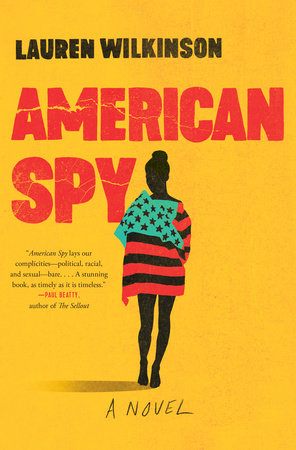
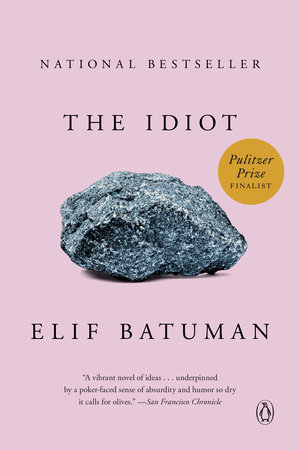
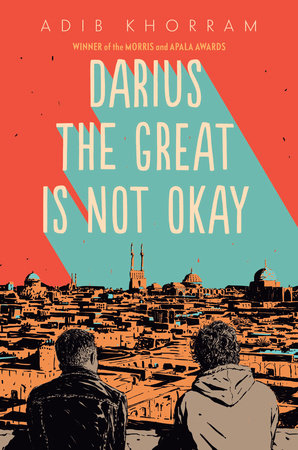
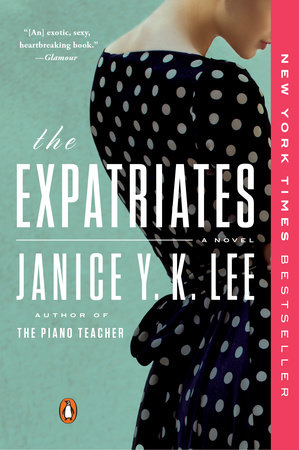
This enticing novel about espionage and seduction takes place in 1986 and jumps from New York to Burkina Faso to Martinique. A young black woman who works in the FBI is assigned to a case involving the president of Burkina Faso, Thomas Sankara, whose Marxist agenda is seen as threatening to the American government. With her fearless voice, Wilkinson examines patriotism, nationalism and sacrifice on an intimate level.
Caramelo follows the Reyes’ family’s annual summer road trip from Chicago to Mexico City through the perspective of the youngest daughter and only girl, Lala. Lala’s problems range from dealing with six, rambunctious older brothers to living between borders, but those become minuscule when she discovers her misunderstanding of her grandmother’s life. Cisneros dissects storytelling, tradition, and family in her seventh book, published almost twenty years after The House on Mango Street.
A gifted mathematician from the Midwest is scrutinized for her mixed-race background in both her personal and professional lives. She goes on to be one of the few women graduates of MIT in the 1960s and then to complete a fellowship in Bonn, Germany, where she plans on solving the challenging Riemann hypothesis. Math, family, and legacy are beautifully explored in Chung’s most recent novel.
What happens when a Turkish American freshman at Harvard attempts to flirt with her crush over email in 1995? Quite obviously, she follows her unrequited love all the way to Hungary! The Idiot is a funny, poignant novel about a perceptive, yet sometimes clueless, young woman navigating her way in Cambridge and the tiny Hungarian village where she teaches English for a summer.
Also a story about fleeing Chicago, Black Deutschland follows a young Black man recently released from rehab who is heading to Berlin with the hope of starting afresh and staying sober. Lusting over the queer, dreamy life in Berlin he’s been envisioning, Jed is quickly doused with a splash of reality. While he does indulge in nightlife, sex, and love, he also deals with a city wrought with racism.
Darius the Great Is Not Okay is a candid and tender story about a biracial high school student with depression. Feeling isolated from both his family and white classmates in Portland, Darius expects no different when he goes to Iran for the first time. This changes when he meets Sohrab, the boy next door who integrates him into everyday life in Iran by introducing him to local games and customs and helping him understand real friendship.
Three American women living in Hong Kong make up the expat community of wealthy people living in the city-state. One of them, a Korean American who’s recently graduated from Columbia, hopes to start anew after a mysterious tragedy. Her life converges with those of a rich housewife and a woman wishing to conceive a child in this novel about grief, identity, and connection.
Sometimes a story is too large or unwieldy to fit in a single, discrete package. Maybe the narrative at hand is too far-reaching to be crammed into a single book, or even a series of books (or films or graphic novels or insert-medium-here); sometimes a story can only be told by weaving together multiple formats. Such is the case with Dalton Deschain and the Traveling Show.
Dalton Deschain and the Traveling Show is a story universe, a band, a series of novellas, and a narrative that is still unfolding at the time of this writing. The first part of the story to be released was Catherine (a bookand EP), followed by Roberta (a bookand EP), and this month they’re releasing their latest entry, Casey, which will be—surprise!—a joint book and EP.
The titular Dalton Deschain is both a character in the story and a real-life human person, the latter of whom I sat down with to discuss this latest entry in the DDTS universe and the nuts and bolts of writing a cross-platform story.
Calvin Kasulke: I’m going to ask that you account for yourself on the record. Can you explain what Dalton Deschain and the Traveling Show is?
Dalton Deschain: We are a band. I think that’s first and foremost. We call ourselves a “pulp punk” band out of an aversion to genre labels, but also because there’s the allusion to pop punk, which we kind of are, but with pulpy-horror-sci-fi lyrics.
We follow a musician who is possessed by a demon who takes control of a circus and is a real bad guy.
We play regular rock shows but they tend to have a more theatrical bent to them, because all of our songs tell one continuous story about an alternate-universe 1940s United States after we lost World War II. We follow a musician who is possessed by a demon who takes control of a circus and is a real bad guy.
It’s this big, sprawling ensemble piece about circus “freaks” in the freak show and a demon and this girl that he sort of entraps into his orbit and a psychic janitor on the east coast—all these wild sci-fi horror elements just put in a blender, and that story is told through the music. We also release novellas with our albums that give you the entire story from front to back.
CK:How do you decide what part of the story goes into a song versus what goes into a novella?
DD: One of the first things I decided is that the songs needed to be accessible on their own, so if you weren’t interested in the story concept at all, you could still like the music. I don’t want to demand this dedication from every person that listens to the music, so I really wanted to avoid getting too in the weeds with the lore in the lyrics. There are some concept bands out there whose lyrics are just incomprehensible unless you know the whole story, and I definitely didn’t want to do that.
It almost comes down to the difference in opera between an aria and recitative, right? In an aria, it’s more a contemplative piece on the emotion that they’re feeling, while your recitatives are your less melodic, more fit-in-the-plot kind of things. That’s kind of where I draw the line: that these songs should be about primarily whatever emotional experience this character is going through in the scene, and that it should always be grounded in my reality or experiences. So I take whatever is happening to the characters in the story—whatever they’re feeling in that moment—and sort of write a song about both of us.
At the same time, I actually try not to cover the same ground in the story. Like in “Rabid,” which is on the EP, it covers the dog man’s traumatic relationship with a girl when he was in grade school. That’s not in the story. It’s kind of alluded to, but the way I see it, that ground’s already been covered in another section. If you know the music—which you probably do if you’re reading the book—you’re like, “oh, that’s someone in the song,” but otherwise it doesn’t detract anything from the story not to know that. I don’t need to spend five pages telling that story when there’s a song that does it already. I think they can sort of live together while each exploring their own little corners.
CK: Did you come up with the story first, and that then necessitated the band and the novellas? What was the order of operations in terms of creating the story, band and books?
DD: They fed off each other until they grew into an unstoppable nightmare. (Laughs)
Technically the story came first. I was writing music in college. I’d always wanted to write a concept album, but I never thought I would have an idea for one—I was like, “I just don’t have ideas.” And then I had this terrible nightmare this one night when I was a sophomore, and I couldn’t get it out of my head. I developed this story around it and I was like, “oh, I can make that a concept album.”
At the time it was way simpler. It was really two characters. It was Dalton and Catherine, and it was: Dalton is a musician. He gets possessed by a demon. He tricks Catherine into falling in love with him. He takes political power and hurts a bunch of people and something bad happens at the end. And that was it and I was like, it’ll be 12 songs and it’ll be done. I had the outline done, but I was in college and I didn’t have a band so I put it on the back burner.
When I came to New York I didn’t want to just drop 12 songs and be like, “oh, well that’s it, I’m done,” but have nobody listen to it because I hadn’t done any groundwork to get people into the story. So I started writing sort of auxiliary songs, and I would write a song and think, well how does this fit into the universe?
So I ended up writing about these characters and then the story got bigger. As I would write songs, new characters would work their way into the story and the story would grow and then they would introduce more new characters. Then they would introduce new songs and it all just kinda grew until I was like, “Oh I think I have like a very complete thing. I’m not adding onto it much anymore.”
The songs don’t actually tell the details of the story. They tell the emotional beats of the story.
As far as the books coming into it, that came in much later. Because the plan was still for it to all happen through music. It would just be a band thing. But as I said before, the songs don’t actually tell the details of the story. They tell the emotional beats of the story. And so people were interested, well, what is the actual story you’re telling?
I started writing these little journal updates I would send out to our email list—it’d be a little diary entry from one of the characters. But as I kept going, they kept getting longer and longer and longer until I was like, oh, this is too long for the mailing list.
But I was also starting to get more confident with every diary entry I wrote, I was like, well, actually this is much better-written than the one before. Maybe I can actually write this story. So that’s the idea for the EP trilogy that we’re concluding now, writing the novella for each of them, each focusing on a character—with the goal not yet to tell the entire story, but to introduce these characters. Once I was writing it, I was like, well this seems like the best vessel for it. We’ll write it like a series of novels.
CK:It sounds like everything you write helps inform the next thing you’re writing, not just in terms of the actual story, chronologically, but in terms of the structure of the next piece.
DD: Yeah, I’ve been figuring out the structure of this kind of as I go and every time I try something and I think it works, I go, “Oh we can keep going further in that direction.” I’ve definitely tried some things that didn’t work. The first email diary thing didn’t really work because it was too vague. People didn’t get a good sense of what it was.
Telling the story on stage has evolved a lot as well. We found a more narrative and engaging way of telling it that took years to find. I kept trying different weird little bits to try to make the storytelling palatable. And I kept trying to find obscure ways of doing it. I think I was afraid of telling it straight on. I thought I needed to find this abstract way of doing it, but it’s not what people wanted. Songs are the abstract way of doing it. People wanted to know, “Now just tell me the story, tell me what’s going on.”
CK: We should probably address that your name is Dalton Deschain, and also the villain of the story is named Dalton. When you had the initial dream in college, were you going by Dalton by then?
DD: No, I never intended to actually go by Dalton permanently. I named the character Dalton Deschain. As I was moving to New York, I was like, well, I should make that my stage name because when I perform, I have this character—not really grasping that when you move to a new city and start playing, there’s no wall between you and the audience. It was much easier for everybody to know me as Dalton, and so that just became the default.
Photo courtesy of Dalton Deschain
CK:Talking about concept albums, are there other bands or artists or other equally confusing nouns that are influences?
DD: I mean, I’m a David Bowie fan till I die. I always wanted to write my Ziggy Stardust. Probably the biggest obvious influence is Coheed and Cambria, who told their story over multiple albums, but also did the supplementary work, like releasing novels of their albums. My idea was to take that Coheed approach and focus it a little bit more. It always felt like they were music first, and tried different approaches to tell their story—a comic book with one album, a novel with another. I wanted to find a way to more consistently tell the story from beginning to end.
I had, it turns out, a story that was being told in two forms simultaneously. And I had one of those forms figured out and I didn’t know what the other one was, but I kept pushing on until it found itself.
CK:And it sounds like part of figuring out how to tell the story was audience feedback?
DD: At the beginning I wanted to be mysterious about it. David Bowie never came out on stage and was like, “This is the story of Ziggy Stardust.” It was all kind of ethereal, and I wanted to do the same thing where I could say, “The story is about these things,” but it’s all in the music.
And people wanted more, they were like, “Well, what is that about? Who is this character? What do they do like, what’s the thing that happened?” I really wanted to be mysterious about it, but what I thought was coming across clearly wasn’t coming across. If what I think I’m conveying is not being accurately conveyed, then I need to find another way for it to be delivered.
CK: I’ve got a nice question and kind of a mean question. Which one do you want first?
DD: The mean one.
CK: Why not just write a musical?
DD: No, this is a good question. This is the question I get most often. Literally everyone’s first reaction when they see the band is “you should write a musical.” And that’s legit. I would love to write a musical. But a musical is a different form, and I don’t think this story fits in that form.
It’s not one-to-one analogous with a rock show that has theatrical elements to it. Some things bridge that gap like “Hedwig and the Angry Inch,” which is another work we’re very influenced by. But the story’s too long. If I want to tell this the way I want to tell it, hitting all these emotional beats and letting you follow these characters in this ensemble piece from beginning to end, we’re looking at 35 songs and that’s probably too big for a musical.
I want this to tell the story but also be a fun thing you will jam to in your personal life.
The songs have to serve another purpose as well. I want this to tell the story but also be a fun thing you will jam to in your personal life, and be at a rock show and dance to.
I like the idea of this being a surprise to people. I like people not knowing what they’re getting into—maybe they’re going to a show to see a different band, they’re not planning on a night at the theater. They go in and they’re just expecting a rock show and they get us. They get the fun high energy hooks and music and they also get this weird comic book thing going on, and there are props and there’s dialogue and things like that. That may translate to the stage in some version, but that’s not the primary thing we’re going for.
CK: The nice question is: What are the advantages and disadvantages to writing this way, in multiple formats?
DD: The advantage is, just on a superficial level, that it helps us stand out. There’s a lot of music out there right now, and with streaming you have immediate access to any song you’ve ever wanted. You can find a song you like on a playlist and that may be the only song you ever listen to from that band, because there’s no reason to really seek out more unless you’re really in love with it or you want to know more about that person or that band. You need to have something more than just the music now. We’re not just the songs we make, we have an entire universe that if you want, you can get lost in it.
The disadvantages are keeping it clean and organized in a way that’s accessible. I think we’re finally getting to a point where we do just have the music and we have the books, with the mailing list is as a bridge. You started one, you graduate to the other—but I think that can be confusing to people, where maybe they do discover us on just like Spotify and they’re like, what’s going on with this band? There’s a worry of being impenetrable, and finding a way to make it clear to people what it is that we do. You’ve got to find a way to make it cohesive across the board, that’s a disadvantage.
But I get to write anything I want in a bunch of different ways. It’s more freeing as a creative person to not just be like, “I have this next thing I want to tell, I have to make it a song. Let me find a way to make this a song.” Instead, I can make it a song, but maybe the idea doesn’t need a song. Maybe it’s just part of the book. Or maybe I just wrote a part of the book, and I’m really turning the scene over. Maybe then I’ll want to turn that scene into a song.
It’s almost like having a whole creative community in your own brain. You’re feeding off yourself. You’d be like, “Ooh, that thing you did is cool. Let me take a spin on that,” you know? But both people are me. It’s more avenues for creation, which can be overwhelming, but it’s also way more fun.
DON’T MISS OUT
Sign up for our newsletter to get submission announcements and stay on top of our best work.
YOUR INBOX IS LIT
Enjoy strange, diverting work from The Commuter on Mondays, absorbing fiction from Recommended Reading on Wednesdays, and a roundup of our best work of the week on Fridays. Personalize your subscription preferences here.