Helen Phillips Turns Parental Anxiety Into a Gripping Speculative Thriller

A few months after giving birth to my son, a friend asked me how he was sleeping. “He’s sleeping,” I admitted, “but I’m not.” I kept waking up during the night, sure that I heard him crying when he wasn’t. My friend assured me that I wasn’t going crazy; she’d also heard phantom cries when her daughter was small—in fact she’d spent hours every night apprehensively staring through the bars of her daughter’s crib, monitoring her breathing.
The Need
Buy the book

Helen Phillips taps into this new parent anxiety in her second novel, The Need, the story of a young mother named Molly who is home alone with her two young children when she hears strange noises in her living room. As Molly confronts the intruder in her home, the lines between reality and interiority blur, and she finds herself grappling with her fears about parenting, her evolving identity, and the complex nature of grief.  

Phillips is no stranger to speculative fiction. Her previous books, including the widely praised 2015 debut novel The Beautiful Bureaucrat, also explore the intersection between literary fiction and psychological thriller. Phillips has a knack for using the uncanny and bizarre to uncover deeper truths about humanity, and The Need mines the dissociative state of early parenthood to talk about the experience in a refreshingly original way. However you don’t need to have children to be gripped by Molly’s experience as she tries to protect her family from harm; Phillips has executed a sharply written novel that will unsettle you as it deftly pulls you along. 

I had the pleasure of connecting with Phillips while she was on the California stop of her book tour to talk about living in a world filled with ominous anxiety, writing a book when you don’t have time, and why we need the great American breast pump novel.


Carrie Mullins: I’m always interested in where an author starts their book. What came to you first for this project? A character, a scene, a line?

Helen Phillips: I’m always fascinated by that question, too, because I feel like writers have such different answers to where they begin. I was on a panel not long ago, and one writer said plot and another writer said character, and for me the answer is image. I always begin with a series of images that I collect over a long period of time. And in addition to an image, I’d say there’s some kind of big question I have. To be more specific to this book in particular, there was a night when my daughter was a newborn and I was nursing her, and I thought I heard someone in the other room. It wasn’t anyone, but that flash of a feeling, that fear experience—I felt like OK, I have to write about this sensation of vulnerability. The book grew out of that moment. 

CM: The fear in the opening pages is so visceral. I have a one-and-a-half-year-old, so it was definitely something that I related to. 

HP: It’s gratifying to me that as I send the book out into the world, people can relate to it. Because there are moments when you feel like every other mother has it under control, and you’re the one who has these freaky thoughts. It’s been a relief to me that I don’t seem to be alone in that neurosis. 

CM: Not at all! One of the things that struck me about The Need was how many little moments resonated with me. I feel like we’re living at a time when the conversation around parenthood is a lot more open than it used to be. People feel more comfortable sharing their experiences and challenges. Do you think that’s true?

HP: I wrote this from 2015 to 2018, and there is definitely more space for someone to say something complicated about motherhood than there was in the past. In general, I feel like part of the reason I write books is because I want to have a conversation about something, and that conversation begins as a conversation that I have with myself as I write. When it goes out into the world—and that’s where I am right now—it becomes a conversation with you, with others, and that’s opened up the conversation about motherhood for me in a more targeted way. I’ve had anxiety about the book being published because I feel very vulnerable, very laid bare emotionally even though the book is completely fiction. 

CM: Molly is anxious about her children’s safety, but I feel like the theme of anxiety runs through the book and is treated in different ways.

HP: Yes, I don’t think it’s only a book for parents. An underlying feeling of ominous anxiety is something you can feel even if you don’t have children, and people connect to that element in the book. In a world where global warming is happening, aren’t we all feeling an ominous sense of anxiety rising all the time?

CM: In some ways I hope so because I wonder what the people who aren’t freaking out are thinking.

HP: I’m certainly freaking out. I’ve written a number of short stories with climate change as a theme, but my next book is really going to focus on that. And though this book isn’t about climate change, that underlying anxiety is the background. What you have in this book is everyday moments that are suffused with anxiety, and to me, that’s what climate change feels like. 

CM: Molly finds herself traversing that porous boundary between the real and the unreal. You’ve explored these surrealist elements in your work before. Can you talk a little about how you approach world-building?

There are moments when you feel like every other mother has it under control, and you’re the one who has these freaky thoughts.

HP: For this book one of my goals, aside from the magical or speculative elements, was for everything to feel extremely realistic. I really wanted to capture that texture of having young children, and the daily labor of that, the daily labor of having a job, those tiny domestic moments with coworkers. I wanted it to feel very realistic so that when the speculative elements arise, you’ve already accepted the reality of the book. My rule was to have everything else be completely convincing and believable to our world and then this one thing would be convincing by association. I think of the book Exit West by Mohsin Hamid. Everything is very realistic, but then there are these magical doorways that allow people to jump to different places on the globe. I like the idea of one magical element.

CM: That book is great. Are there any other authors who are working in this space who you find inspirational or exciting?

HP: A book that I talk about all the time, and I will talk about it here because I love it so much, is Fever Dream by Samantha Schweblin. I just can’t recommend it highly enough. It has the forward momentum of a thriller, which is something I was trying to achieve in this book, and is so viscerally unsettling and is really raising deep questions about how much you can protect the people you love. In terms of people who are writing books that have different realities, Octavia Butler, Karen Russell, and Kelly Link. Ursula K. LeGuin, Italo Calvino—I mean there are so many and I could go on with an enormous list, but these are all writers I think about a lot. 

CM: You just named so many fantastic and widely praised authors, but I still have to ask, do you ever find it challenging to sell people on this intersection between literary fiction and thrillers, or literary fiction with fantastical elements?

HP: We spoke about how space is opening up to offer more nuanced portraits of motherhood, and I think that, at the same time, space is opening up for more blending of genres into literary fiction. I think that someone like George Saunders has helped with that, and I feel like Colson Whitehead’s books do that, and it’s a very exciting thing. Even when I was in my MFA program from 2005-2007, I felt like what I was doing with the speculative elements was much more uncommon than it is now. 

But I’ll add that, from my perspective, I don’t ever feel like I’m trying to convince anyone to be more open because I can’t write any other way. It’s the only way that’s exciting and interesting for me, and it answers the questions, “How am I going to portray these emotions? How am I going to use all the possible tools at my disposal to capture this anxiety?” Or I decide this anxiety has to be in the form of a thriller, because that’s what it feels like to have young children sometimes. I wanted to write about how your identity shifts when you have young children and how you become vulnerable to the possibility of losing them. So it comes very naturally to me, and I don’t know any other way to explore the things that I want to explore. 

CM: I always love to hear that a writer is essentially writing for themselves.

If I wasn’t a mother, I couldn’t have written The Need.

HP: When my children were young—I mean they’re still young, they’re 7 and 4, but I feel like The Need really concerns the early years, which have their own special sleep deprivation and lactation situation—I wanted to read fiction about that. I’ve read some really great nonfiction about that time, like The Argonauts by Maggie Nelson and On Immunity by Eula Biss, but I wanted to read fiction that had breast pumps in it. 

CM: Did you find anything? I’ve had trouble finding novels that really captured early motherhood. 

HP: I don’t want to make a mistake, but at that time, I didn’t find fiction books that satisfied that need for me. People have recommended the book Afterbirth (by Elisa Albert) to me so that’s on my reading list, but I don’t think the great American breast pump novel has been written. We’re still waiting for that.

CM: I love that. I hope you write that book. And I agree—I mean I might definitely be missing something, but most of what I’ve seen has been in the non-fiction/memoir genres. It reminds me that I wanted to ask you about that infamous quotation by Cyril Connoly: “There is no more somber enemy of good art than the pram in the hallway.”  

HP: I haven’t heard that quote before, it’s so depressing!

CM: I know, and it’s such an ingrained cliché: that motherhood is incompatible with being an artist. 

I wanted to write about how your identity shifts when you have children and how you become vulnerable to the possibility of losing them.

HP: You hear that as a female artist and you feel like there are only two possible choices for your life, and you’ll have to give something up. I would counter that with a Sarah Manguso quote, which is along the lines of “I don’t want to read books written by people who have time to write books.” I love that so much and I think of it all the time.

I teach full time at Brooklyn College, and during my semesters if I’m lucky I get to carve out 5 hours a week, like one hour each weekday morning. I wrote The Need in these little scraps of time and I think that urgency is present in the book. I think there is an energy that comes from writing a book when you don’t really have time to write one, and if you write a book when you don’t have time, it means you care about it so much that you are making time. So when I think, “How can I call myself a writer if I’m only doing it five hours a week?” that quote keeps me going.

I also want to add that if I wasn’t a mother, I couldn’t have written The Need. My children are detrimental to my work because they take up so much time and energy, but they also bring such bounty to my work, and the experience of love that I experience because of them, I wouldn’t be the writer I am without that. 

CM: I agree. I’ve found that parenthood has put me much more in touch with humanity, with the universal, primal human experience, whereas before I was more enclosed in my own self bubble. The irony is that motherhood is often treated as an experience whose interest or importance is limited to females. 

HP: Right, and The Need is about motherhood but also about so many other things, like can you ever take someone else’s grief as seriously as your own grief? It’s about loss, and the way as a human your life shifts among different possibilities. 

CM: Have you felt gender bias with this book, for example how the publisher might want to market it?

HP: That’s an interesting question. I think the main thing is that I want the questions about motherhood to be taken seriously. The only other thing I can think of is the cover. The initial cover had pink flowers instead of ferns, and I really said no to that because it might be silly, but I think pink flowers are associated with women and it just felt like men would be less likely to pick up a book that has huge pink flowers. 

CM: I think book covers really do influence buyers. I’m so fascinated with them! 

HP: Me too. But I’m pleased with the ferns, I love the cover. 

CM: Have you ever thought about your kids reading The Need one day?
HP: I definitely have. They were at my book launch at Greenlight and they heard me read the first chapter. My 7-year-old daughter gave a cute introduction that night. When they’re older and approaching parenthood, if they decide to have children, I hope that what comes through is what that love feels like that you have for your children, because it’s really hard to articulate. I don’t know if I successfully articulated it in the book, but it’s a love that goes hand in hand with so much dread that something could happen to them. It’s so intense and scary, and it’s not just tulips and butterflies. It’s an intense, bloody, amazing thing. So I hope the force of that is what will strike them and not just, you know, all the scary things their mother thought when they were small.
9 Eerie Ghost Stories

If you’re like me, middle school slumber parties invariably found you hunched over the Ouija Board waiting to talk to the dead. Maybe you felt the same longing I did as your hands hovered over the planchette, pulse thrumming in your fingertips. If only someone would speak! I hungered to be in this way chosen and yearned for a life made golden by the presence of ghosts. Ghost stories still fill me with electricity. Ghosts, after all, are the opposite of mundane, an antidote to the quotidian. I’ll listen to your ghost-sighting tale anytime. I adore classic ghost stories like The Haunting of Hill House, The Turn of the Screw, Beloved, and Rebecca.  

Buy the book

My novel Goodnight Stranger is about all the things that haunt us—our secrets, our pasts. The book’s main characters live in a big, lonely house on Wolf Island, where, they joke, they don’t have any guest rooms, but they have plenty of ghost rooms. The stranger who arrives on Wolf Island feels like someone from a dream: charming, charismatic, and eerily familiar. “Good night ghosts,” the book’s narrator thinks as the stranger becomes more and more of a fixture in their lives. “Good night memories. Goodnight moon. Goodnight stranger in our ghost room.”

When I was writing the book, I sought out stories of hauntings, and I was surprised to find how many contemporary fiction writers seem to love ghosts as much as I do. Here are nine stories and novels to make you feel like you’re sitting around the Ouija board once more waiting for a sign, a word, an invisible touch on your shoulder.

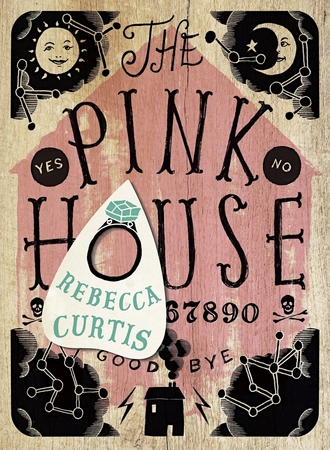
“The Pink House” by Rebecca Curtis

This isn’t the kind of gauzy, diaphanous ghost story you might be used to. This one has teeth. Rebecca Curtis’s uncollected piece from The New Yorker chronicles how the ghost of a young man, killed in a freak accident, returns to occupy the body of an MFA student so he can finish his novel and reunite with his fiancée. It involves UTIs, “quantum entanglement,” and a bar that used to be a funeral parlor. Rebecca Curtis’s writing has a kind of insolent swagger, and this haunted house tale is unflinchingly scary.

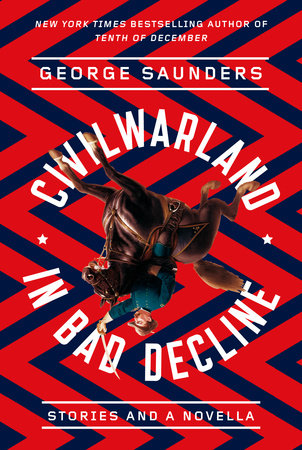
CivilWarLand in Bad Decline by George Saunders

“CivilWarLand in Bad Decline” by George Saunders

George Saunders’ characters seem to slip from one consciousness to another as easily as you and I walk from room to room, so it’s not surprising that ghosts play a sizable role in much of his fiction; Lincoln in the Bardo’s extensive cast is made up almost entirely of complicated, excitable ghosts. My favorite George Saunders ghost story is “CivilWarLand in Bad Decline” the title story in his 1996 debut. The first time I read this story, in 2001, I was gripped by the exhilarating conviction that here—finally—was a storyteller’s handbook for breaking the rules. I still delight at the madcap hilarity of the McKinnon family, compelled to reenact their own deaths in a whirlwind of bafflement and blame, as an underappreciated worker in “CivilWarLand” struggles to save the theme park, and his livelihood, from financial ruin due to marauding gangs. Sounds like classic George Saunders? It is. And the story ends with what I’ve come to think of as the Saunders crescendo, a final paragraph as lyrical, impassioned, and transcendent as the last bars of The Beatles’ “A Day in the Life.”  

Image result for her bodies and other parties

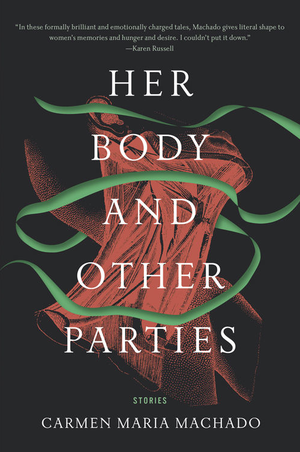
“Especially Heinous” by Carmen Maria Machado

“The Resident” is the best haunted house story in Carmen Maria Machado’s stunning Her Body and Other Parties, but “Especially Heinous” is the best ghost story. Told in 272 episode-descriptions of an alternate-reality Law & Order: SVU—like some glorious otherworldly TV guide written by poets and lyricists—every line of this 60-page story is incandescent. Like any great ghost story, the main characters are haunted by many things, including the ghosts of murdered girls will bells for eyes. With so many tangling threads, character arcs, and plot twists, you have to read this story as a series of luminous impressions, a brilliant collage of soundtrack and film clips.

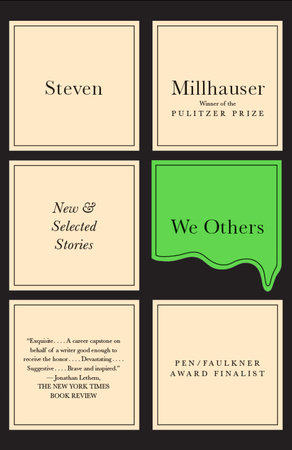
We Others by Steven Millhauser

“We Others” by Steven Millhauser

A desperate love triangle between two women and a ghost who spends most of the story slipping in and out of existential crisis, “We Others,” from his book by the same name, is a treatise for ghosts, about ghosts, compiled by a (recently dead) ghost. Millhauser’s sentences are crisp and surprising as lightning flashes, and his ghost-narrator’s reflection on metaphysical life will make you question your own impressions. “Have I spoken of the dawn?” the story’s ghost asks us. “We do not like the dawn. We object to its youthful radiance. We dislike its suggestion of new beginnings, or the uplifted spirit. We are creatures of the downward-plunging spirit, where hope perishes in black laughter.”

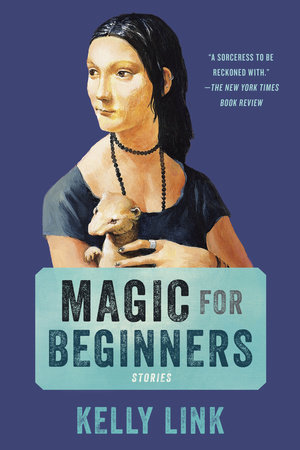
Magic for Beginners by Kelly Link

“Stone Animals” by Kelly Link

Kelly Link’s new book Get in Trouble is brimming with ghost and haunted house/spaceship stories, but my favorite Kelly Link ghost story is “Stone Animals,” from Magic for Beginners, about a house haunted by rabbits, a marriage haunted by a lie, and an armadillo purse haunted by I’m-not-sure-what. Actually, household items become haunted at an alarming rate in Link’s brilliant story: toothbrush, TV, alarm clock, toilet. What has haunted me as much as the story itself are Link’s word about the writing of “Stone Animals”: “Sometimes I think all good short stories function as ghost stories, in which people, themes, events that grip an individual writer occur again and again like a haunting.”

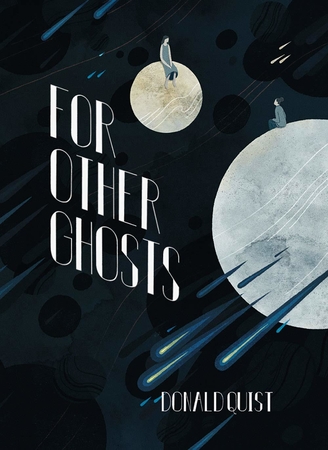
“The Ghosts of Takahiro Ōkyo” by Donald Quist

Set in Aokigahara, the haunted forest known as the most popular destination for suicides in Japan, Donald Quist’s “The Ghosts of Takahiro Ōkyo” from For Other Ghosts is ominous, severe, and haunting as a melody. In it we meet Daisuke, a young man so adept at finding dead bodies in the forest the other forest workers call him the “god of death,” and his uncle, haunted for years by a friend he left for dead in the heart of the forest.

Image result for poster

Heart Spring Mountain by Robin MacArthur

Robin MacArthur’s unforgettable debut novel follows four women in one family: Vale who returns home to Vermont to search for her mother who’s been missing since tropical storm Irene; Deb trying to find her path as a widow in middle age; Hazel slipping into dementia; and Lena, long dead, who we get to know through her charming letters to trees, bees, and owls. The book is about family, landscape, and deep intergenerational love—and the way the past resurfaces whether we want it to or not. The ghost shows up near the end, but the book is haunted all the way through.

Image result for st lucy's home for girls raised by wolves

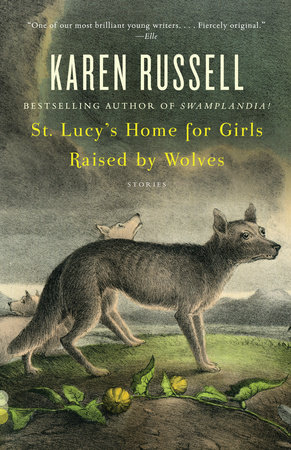
“Haunting Olivia” by Karen Russell

Bereft siblings Timothy and Wallow search the marina for their dead sister Olivia, who slid out to sea on a giant crab-shell-sled two years ago. With the help of magical goggles, the boys find the sea’s population of ghostly underwater life. Every line of this story from her collection St. Lucy’s Home for Girls Raised by Wolves is haloed by grief and regret; it’s bittersweet and tender as a bruise, and the writing is just plain gorgeous—especially the agile descriptions of bioluminescent creatures and murky aquatic light.

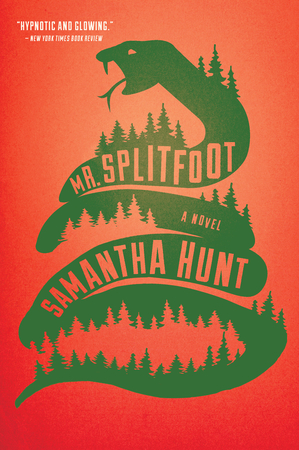
Mister Splitfoot by Samantha Hunt

This is my favorite contemporary ghost story, and maybe the most romantic book I’ve ever read. It tells the story of orphans Ruth and Nat, and a salesman, Mr. Bell, who helps the teens charge money for contacting the dead. It’s also the story, decades later, of pregnant Cora, who follows her mute auntie Ruth hundreds of miles north—on foot. The book is terrifying, and mystifying, and the love story is so pure and fierce and strange, it reminds you that love, like death, can be brutal or sublime.

A Literary Road Trip through Southern California

Tom Waits grew up in southern California, and “Going West” is probably the most famous of his California songs (“Little brown sausages / lying in the sand. / I ain’t no extra, baby / I’m a leading man”). But there’s a great early riff, “Diamonds on My Windshield,” that puts you in the front seat with the young, aspiring musician, driving all over southern California at night, presumably from gig to gig:

So 101 don’t miss it
There’s rolling hills and concrete fields
And the broken line’s on your mind
The eights go east and the fives go north
And the merging nexus back and forth
You see your sign, cross the line, signaling with a blink

“Diamonds on My Windshield” by Tom Waits

It could almost be another entry in the SNL series of sketches The Californians, what with the number of freeway references and city names he checks (“It’s these late nights and this freeway flying / It always makes me sing”). But there’s also a cast of characters and a noir mood that feel quintessentially of the region and of a certain time. 

Image result for The Churchgoer: A Novel
Buy the book

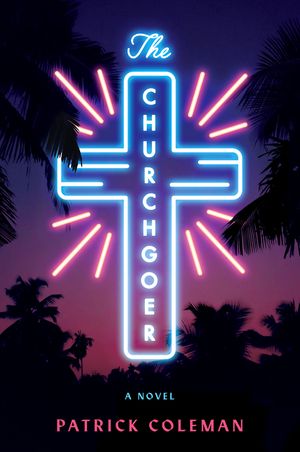
In writing a southern California noir, I came to realize: isn’t that one of the main pleasures they offer? Not the whodunnit but the excuse to hit the road: go to parts of town you don’t normally visit, talk to folks you maybe see but don’t understand, get behind the gate and knock on the rich guy’s door and check out his dirty laundry. Mystery novels are road novels, oftentimes, with moodier lighting.

There are the classic writers that get referenced when someone wants to introduce southern California’s place in literature—Chandler, Didion, Fante, West, Mosley, Ellroy, etc.—but if that’s your window onto our half of the state, there’s a lot you aren’t seeing. It’s like sticking to the freeways, instead of getting off onto some surface streets and fire roads. So here are a few idiosyncratic rest stops I’d recommend as you cruise the southland at night, trying to figure out how the hell you ended up at the end of the known world, with a front-row bucket seat and a sea-misted windshield as we hurtle toward the end of life on Earth.

Los Angeles, Part I: The Poetry of Wanda Coleman

There are so many writers on L.A. that choosing one is impossible, so I have to start with Wanda Coleman—not because we share a name—but because she gave voice in poem after poem to the many difficult aspects of life in southern California, deeply reflective of her experiences as a working class black woman. The language in her work is fiercely alive, wildly veering, containing a rich vein of multitudes. Take a look at “Requiem for a Nest,” which is as good as description of Los Angeles as one could hope for.

Still Water Saints by Alex Espinoza

Inland Empire: Still Water Saints by Alex Espinoza

It’s easy, if you’re only thinking about television and film, to forget that California is mostly away from the coast: suburban, rural, agricultural, desert—places like the Inland Empire. The shifting demographics and economic realities of making it in California (as Woody sang, “If you ain’t go the do-re-mi, boys…”) mean the Inland Empire is dynamic, quickly changing. 

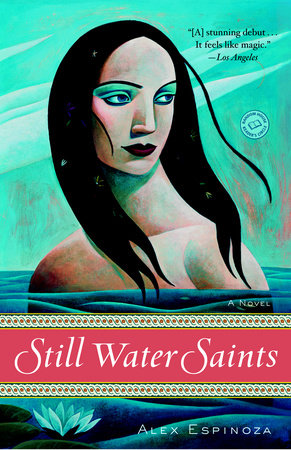
For an immersion into ways of life in the IE, you couldn’t do better than Still Water Saints. Centered around a botánica in the fictional town of Agua Mansa, the people who turn to the shop’s owner, Perla, and her remedies for their troubles each give a window into different aspects of life, especially Latinx and queer experience, in Riverside and San Bernardino counties. A stunning, sensitively written book.

Newport Beach: The Barbarian Nurseries by Héctor Tobar

I lived in Orange County for a long time—behind the Orange Curtain, as we’d say—and I recently read The Barbarian Nurseries, which brought me back to and inside some of the complications of that world. It’s so bright, so brilliantly sunshine-filled and overdeveloped with glass and fake grass, that it might as well be a black hole and all that glitter the event horizon. In The Barbarian Nurseries, we see the area through the eyes of Araceli, the undocumented housekeeper who lives with Scott and Maureen Torres-Thompson, wealthy OC suburbanites, and their children. Sweeping and thorough, incisive about race and immigration and money, it’s also funny and human and beautifully told.

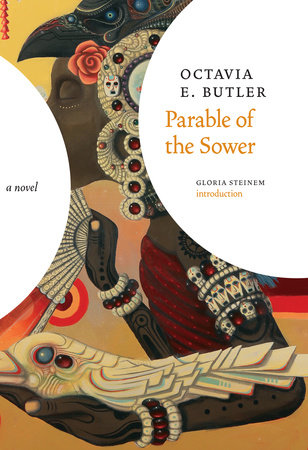
Parable of the Sower by Octavia E. Butler

Pasadena: Parable of the Sower by Octavia E. Butler

In Parable, a climate apocalypse has wrecked Los Angeles, making communities more insular, more tribal, more openly racist. Violence is common to protect resources and fight off threats, neighbors. It’s so close to where we are you can taste it. Which makes it hard reading—or did for me, when I tried to read it again after the last election. But as most science fiction is really about the present, Butler has a lot to say about the southern California the book’s future is extrapolated from (she was from Pasadena), how unevenly that future—and our present—is distributed, and what it may take to envision and enact something better.

Image result for walt disney the triumph of the american imagination

Hollywood: Walt Disney: The Triumph of the American Imagination by Neal Gabler

Disney is in the Southern California DNA, for better or worse, and Gabler’s biography—despite that “triumph” in the title—gives the better and the worse. The young man with an idea for what animation can be, slowly becoming an anti-union conservative stalwart and cultural icon who has a utopian vision for reshaping American life (the Experimental Prototype Community of Tomorrow, or EPCOT) left unrealized at the time of his death. He’s the blueprint for so many “visionary” men in California today, and the effect he had is hard to overestimate. (Don’t we all live in Disneyland now?). And yet I can’t read through the end without sobbing like a child, and I don’t exactly know why. That might be the most Californian contradiction I can think of.

Catalina Island: Catalina by Liska Jacobs

Elsa, the darkly charming protagonist of Catalina, enacts a road story of her own. She’s fled an upbringing in Bakersfield for a low-rung toehold in the New York art museum scene. When an affair with her senior curator boss goes south, she heads back home, then flees again to Santa Monica, at the end of her rope, before she goes a little farther still: to the titular tiny island off the coast (where Natalie Wood drowned, no less). Accompanied by prescription drugs and a few old friends (though “friend” is too strong by several degrees, and at the same time too simple), Elsa gives Jacobs room to make breathtakingly fresh and sharp observations about self-destruction, female anger, and the complexities of desire and pain.

Image result for The Sympathizer

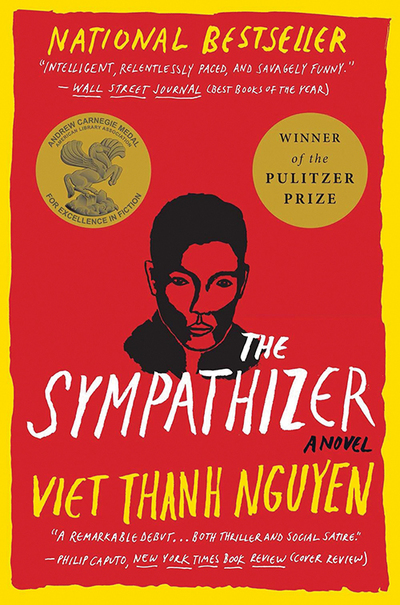
Los Angeles, Part II: The Sympathizer by Viet Thanh Nguyen

So much has been said about this novel, I’m wary of just saying it all again—but if you’ve had too much coffee, and you’re driving around LA until four in the morning waiting to come down, the audiobook of The Sympathizer might be the perfect company. With its portrayal of a half-Vietnamese, half-French double-agent during and after the Vietnam War and his eventual relocation to a community of refugees in Los Angeles, the novel is big and alive and endlessly rewarding. It also will change the way you see the Vietnam war, and Hollywood’s role in shaping it into a narrative for white Americans, in a profound and, I’d hope, permanent way.

Image result for sellout by paul beatty

Compton (and Other Coastal Cities): The Sellout by Paul Beatty

Hilarious and dangerous—like hazardous to your health and mental well-being—The Sellout is perhaps the most Californian book on this list.

It’s got everything: police violence, segregation, urban change (and outright disappearance), but also the fading fame of a Little Rascal, sociology, a lot of weed, and surfing. Just when you think the novel has left nothing untouched by its sharp eye, it finds new room to move, like it’s a VW Bus that’s secretly a pop-top Vanagon with NOS, a roof rack, full kitchen, built-in cooler, exterior shower, and no privacy curtains. 

At the time it came out, I’d been writing about San Diego surfer Evangelicals for a few years, but here was this very different narrator, talking about why he surfs Venice and Santa Monica: “No real reason. The waves were shit. Crowded. Except that every now and then I’d see another surfer of color. As opposed to Hermosa, Redondo, and Newport, which were much closer to Dickens, but the breaks were dominated by straight-edge Jesus freaks who kissed their crucifixes before every set and listened to conservative talk radio after the sessions.”

To exist in the same California as Paul Beatty!

Anaheim: A Scanner Darkly by Philip K. Dick

Philip K. Dick grew up in the Bay Area but spent the last ten years of his life in Orange County, living between Fullerton and Santa Ana and setting A Scanner Darkly in Anaheim—wildly hallucinatory, divinely touched years, which is oddly appropriate given the area’s support of both Disneyland and Crystal Cathedral (former broadcaster of The Hour of Power television show). In A Scanner Darkly, an undercover agent embeds with a house of addicts hooked on the drug “Substance D.” Self-dissociation, drug dependency, deception, recovery and the recovery industry all tangle, in a soulless, consumer-driven America. Okay. Sounds familiar enough. But it’s on loss and how institutions fail those they purportedly protect that A Scanner Darkly especially sings, and stings.

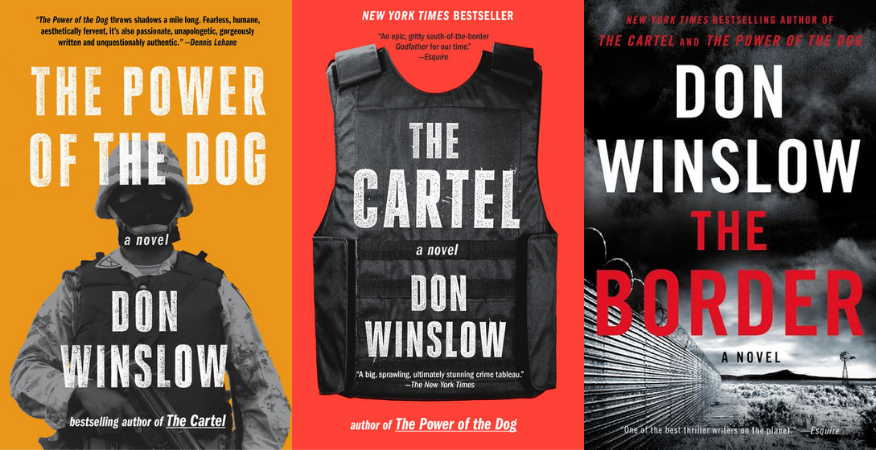
The Power of the Dog Series

San Diego: Power of the Dog Series by Don Winslow

Across three books—Power of the Dog, The Cartel, and The Border—Winslow has created a crime fiction epic about the drug trade and the war on it, US policy and politics, and the lives on both sides of the border with Mexico. Okay, fine: it’s not all set in San Diego—the story goes from Washington, D.C, to South America, with stops between—but the San Diego/Tijuana region comes into play often enough. It’s massive, and grim, and there’s so much to absorb here about how we understand a place like this in a larger cross-border and global context.

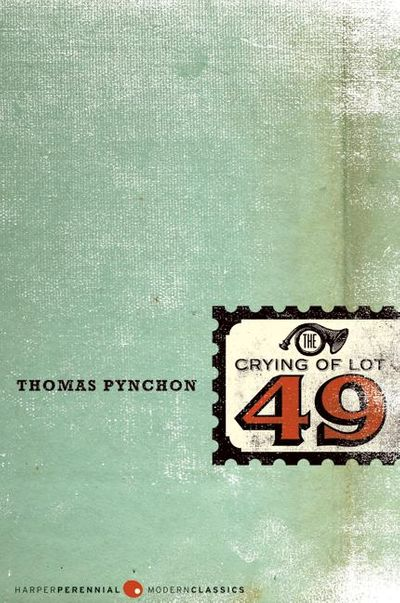
Los Angeles, Part III: The Crying of Lot 49 by Thomas Pynchon

Oedipa Maas hits the road from northern California after her ex, the real estate mogul Pierce Inverarity, dies and she’s named in the will. She spends most of the novel piecing together elements of a conspiracy by driving around San Narciso (a fictionalized LA) in the mid-1960s. There are sleazy men, psychedelics, too much pop music energy, countercultural scheming—and Oedipa, a brilliant character on a mission to find meaning in a chaotic world but riding an uncertain, paranoid edge through the U.S. postal system. It’s gonzo, I know—but, as Bob Dylan once said, every word of it’s true, except the parts he made up. A good guide to southern California then, southern California now, and America for the foreseeable future.

Image result for farewell to manzanar

Extra Miles: Farewell to Manzanar by Jeanne Wakasuki

Keep driving, technically just beyond the true border (whatever that means) between southern and northern California, and you’ll reach Manzanar. When I read this book about coming of age in the Japanese internment camp there during World War II, I was a kid, and I never expected that we’d need to read it as much as we do now. Concentration camps for children was once a part of the California story, the American story. They are again.

Who Needs an MFA When You Have This Literary Fiction Trope Checklist?

Writing literary fiction stories? Forget what you’ve learned about complex characters and earned endings. What you really need is to include the required tropes. To help you out, we’ve created this handy checklist.

Literary Fiction Trope Checklist

_____ 1. Starts with character waking up

_____ 2. Starts with character looking out of window, describing scenery

_____ 3. Protagonist is writer with writer’s block

_____ 4. Protagonist teaches English comp; hates self

_____ 5. Death of child/miscarriage in past no one talks about

_____ 6. Character describes self in mirror 

_____ 7. Character describes self in window

_____ 8. Character describes self in polished spoon

_____ 9. Taste of blood described as metallic 

_____ 10. Woman who looks good without trying compared to female protagonist who looks bad despite trying

_____ 11. Main character drives to ex’s house and watches through window

_____ 12. Shoebox of letters/keepsakes under bed

_____ 13. Story is a story protagonist is writing

_____ 14. Wise child

_____ 15. White savior

_____ 16. Villain who is kind to pet

_____ 17. Staring at floor/staring over shoulder/staring into middle distance

_____ 18. Refrigerator empty except for beer/spoiled milk

_____ 19. Scene in writing workshop

_____ 20. Scene in dirty trailer

_____ 21. Dogs bark in distance

_____ 22. Upset character barfs

_____ 23. Depressed character cuts/takes to bed

_____ 24. Therapist quoted 

_____ 25. It was all a dream

Need Writing Inspiration? Follow These Twitter Bots

You don’t know what to write and your Twitter feed is horrible? Kill two birds with one stone by loading up on weird, loopy, gently inspirational Twitter feeds that auto-generate plots, settings, and characters for creative writing. You’re going to be compulsively looking at Twitter anyway when you don’t know what to write; what if it gave you creative energy instead of making you want to lie down on the floor for the rest of time? If you follow these ten accounts, and unfollow everyone else, maybe it can.

Happy Ending Bot

Having a hard time getting your story started? Begin at the end, by lifting one of these bot-generated conclusions.

Magic Realism Bot

This bot by @chrisrodley & @yeldora_ describes scenes from a slightly off-kilter world. Some are funny, many are beautiful, and we’d read almost any of them as a short story.

Writer’s Block Bot

Sometimes trying too hard to come up with a story idea just burns out the words part of your brain—meaning that by the time you hit on one, you’ve lost the ability to actually write it. @nicfoley‘s bot does an end run around that problem by generating prompts using emoji.

Mythology Bot

Creator @BooDooPerson mashes up motifs from fairy tales and mythology to create a scholarly index of an alternate-universe folklore.

https://twitter.com/StoryPremiseBot/status/1153791039049568257

Premise Bot

This bot by @SolemnPhiz does what it says on the tin: creates premises for stories that range from the realist (“When a scandal rocks high society, a gangster throws a life-affirming party”) to the genre (“When the locusts return, a magician faces her worst fear.”)

poem.exe

This poetry bot remixes haiku (its source material is mostly English translations of poems by Kobayashi Issa) for tiny, sometimes surprising snippets of beautiful imagery.

British Gardens

Character is plot, but sometimes setting is character, and this bot that generates surreal, poetic garden scenes can put you in a fertile frame of mind.

Census Americans

Many of the best inspiration bots are slightly fantastical, but this bot (by @jiazhang) that tweets tiny portraits of actual Americans based on Census data is straight-up realism. These bare-bones sketches are perfect to populate your literary fiction.

Nerd Garbage Pitches

@NoraReed‘s bot plays on the idea that a lot of cultural properties catering to nerds are just two or more established cultural properties shoved together—but sometimes that’s all you need to find inspiration.

Pentametron

Why write your own work, when there’s a Twitter bot automatically compiling sonnets for you? Pentametron collects tweets that are coincidentally in iambic pentameter, and arranges them into couplets (more or less). Machines still can’t write poetry, but they’re not bad at finding it in unexpected places.

A Power Ranking of Sherlock Holmes Adaptations

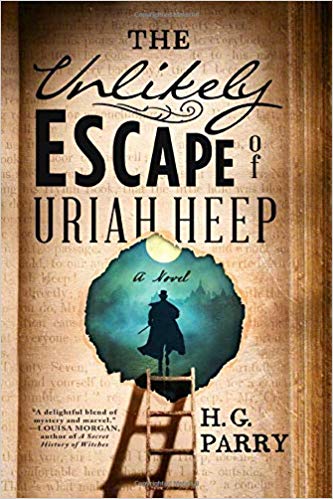
When I came to write The Unlikely Escape of Uriah Heep, a book peopled with famous literary characters, I was very excited to create my own version of Sherlock Holmes. I wasn’t alone. Since the publication of A Study in Scarlet, the first Holmes story, in 1887, there have been hundreds—perhaps thousands—of adaptations, retellings, studies, and spin-offs related to the famous detective. Something about Sherlock Holmes remains a perpetual well of inspiration. He is more than a detective; he is the Victorian equivalent of a superhero: both cleverer and physically stronger than a normal human, protecting England from murder and blackmail and spectral hounds through the power of science and deductive reasoning. And yet he is also more than an archetype: his mood swings, his love of the violin, his drug use, and his deep friendship with Dr Watson give him real complexity, and the fact we see him almost solely through Watson’s narration makes it impossible to judge what goes on beneath the surface of his mind. He’s irresistible.

With over 250 Holmes adaptations on screen alone (according to Guinness World Records), this list could never be definitive. Billy Wilder’s utterly bizarre The Private Life of Sherlock Holmes (1970), for instance, is equally deserving of a mention; so is The Seven-Per-Cent Solution (1976), based on the book of the same name, or Murder by Decree (1979), wherein Christopher Plummer’s Holmes investigates Jack the Ripper. And that’s without mentioning any of the radio dramas, or the stage versions, including two musicals and a ballet. (Yes, a ballet.) But these twelve adaptations, all iconic in their own way, explore different facets of Sherlock Holmes; together, they testify to the character’s infinite adaptability. Here they are, in order from worst to best.

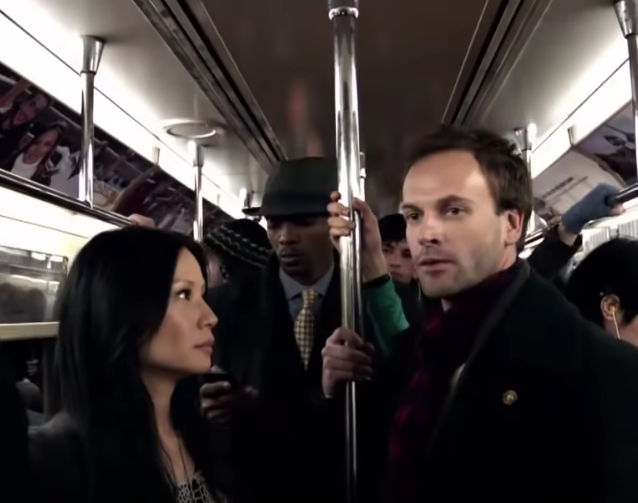
Lucy Liu and Jonny Lee Miller in Elementary

12. Elementary (2012–2019, Holmes played Jonny Lee Miller)

This is more of a U.S. version of Sherlock than a genuine Holmes adaptation (as signified by their decision to title the show after Holmes’s most famous quote-that-he-never-really-said), but it makes some bold moves of its own. The series reimagines Sherlock Holmes as a recovering drug addict and police consultant in New York, and adds a number of new elements to his persona, including a past with MI6 and numerous father issues. (His father is played by John Noble, who was also Denethor in the Lord of the Rings films, so issues are understandable.) Compared to Sherlock, the references can feel flat and obvious, even gimmicky. Yet Jonny Lee Miller’s performance is quirky and energetic, and the series makes commendable efforts to create and update roles for women, albeit in a way that arguably plays into a whole new set of stereotypes: from Lucy Liu as Watson, to combining the characters of Irene Adler and Moriarty into one “femme fatale” played by Natalie Dormer, to the inclusion of Kitty Winter, one of Conan Doyle’s most fascinating yet underused female characters. And, with seven seasons of 24 episodes each, Miller has long since become the longest-serving Holmes, making him an important contribution to the canon.

Tom Baker in The Hound of the Baskervilles

11. The Hound of the Baskervilles (1982, Holmes played by Tom Baker)

Dr. Who and Sherlock Holmes have always had a close literary relationship, from the Tom Baker-era Victorian pastiche The Talons of Weng Chiang to Steven Moffatt’s tenure producing both Doctor Who and Sherlock simultaneously. This is perhaps the closest brush between the two: not only does the Fourth Doctor Tom Baker star as Sherlock Holmes, but Doctor Who producer Barry Letts and script editor Terrance Dicks reunited to bring this multi-part adaptation to the screen. It ought to be better than it is, frankly, but what it is still works well. Baker delivers a compelling if subdued performance, and the script is faithful. It just lacks a spark.

Christopher Lee in The Deadly Necklace

10. Sherlock Holmes and the Deadly Necklace (1962, Holmes played by Christopher Lee)

This an odd West German/French/Italian co-production, loosely based on The Valley of Fear. Christopher Lee played Holmes twice more after this, in two television films; Thorley Walters played Dr. Watson in three further completely unrelated films (two of them comedies). I’m picking on this film because it was both actors’ first time at the roles, as well as their only time together, and they’re very good. Deadly Necklace itself is not a great film. The English version suffers from poor dubbing; the plot is serviceable but drags at times; the humor is often forced. I don’t know why Holmes is obsessed with The Times. But Christopher Lee has unmatched gravitas, and he uses Holmes’s disguises to great effect (even when the plot doesn’t really justify them). The confrontations with Hans Söhnker as Moriarty have real tension. It’s good fun.

Robert Downey Jr. as Sherlock Holmes

9. Sherlock Holmes (2009, Holmes played by Robert Downey, Jr.)

This film and its sequel A Game of Shadows (2011) take a different slant on Holmes, emphasizing his action-hero skills and bohemian eccentricity to create a larger than life, comic book version of Conan Doyle’s hero and world. It could have been a disaster, but Robert Downey’s charisma and the prickly chemistry between him and Jude Law as Watson mostly carry it over the bumps, and the villains and set design are gloriously over-the-top. It isn’t faithful or even particularly witty, and it isn’t trying to be—though the script’s focus on the conflict between science and magic pick up nicely on the themes of the Victorian gothic.

Dr. Dawson and Basil in The Great Mouse Detective

8. The Great Mouse Detective (1986)

Yes, really. This film is underrated as a clever, playful take on the Holmes canon, and moreover, it’s plain hilarious. Based on the children’s book series Basil of Baker Street by Eve Titus, Basil is a mouse who lives under the floors at 221B Baker Street—the real Holmes and Watson are glimpsed at points throughout the film. Their world replicates that of Victorian London, complete with smoky pubs and a mouse Queen Victoria. Basil (voiced by Barrie Ingham) homages Holmes’s quirks beautifully, from his mood swings to his enthusiasm for disguises to his discomfiture at strong emotion, while Vincent Price steals the show as the voice of the dastardly Professor Ratigan. Dawson, the Watson mouse, is frankly adorable. The climax takes places behind the clock face of Big Ben and there are clockwork robots. Who wouldn’t love this? 

Arthur Wontner as Sherlock Holmes

7. Sherlock Holmes film series (1931–1937, Holmes played by Arthur Wontner)

Arthur Wontner was born in 1875 (old enough to have read the Holmes stories as they came out), and was technically too old for the part even in the first of the five Holmes films he made. The later productions wisely lean into this rather than trying to disguise it: Wontner is a genial, friendly aging Holmes, and Ian Fleming is a likable Watson, though he risks disappearing from the plot at times. The banter between them is gentle and sweet. (For The Sign of Four Fleming was replaced by Ian Hunter.) 

Most of the films are very faithful to the source texts. The exception is the final film, Silver Blaze (U.S.: Murder at the Baskervilles), which is charmingly bananas. Holmes and Watson are doing a straightforward adaptation of “The Adventure of Silver Blaze,” albeit rewritten as a sequel to Hound of the Baskervilles. Meanwhile, however, Moriarty and Moran are sneaking around in the hedges like Dick Dastardly and Muttly trying to gatecrash the plot. They finally manage to derail “Silver Blaze” entirely by kidnapping Watson, whom they threaten to throw down a disused elevator shaft. But Holmes saves the day by (spoilers, I’m sorry, I can’t help it) fixing the elevator and descending to the rescue. If this sounds like something you would like to see, then you should.

Vasily Livanov as Sherlock Holmes

6. The Adventures of Sherlock Holmes and Doctor Watson (1979–1986, Holmes played by Vasily Livanov)

This series of five Soviet television films has become iconic for its accuracy to the source material, its atmospheric production design, and the performances of the cast, headed by Vasily Livanov as Holmes and Vitaly Solomin as Dr. Watson. In the U.K., Livanov was made an honorary MBE for his portrayal of Holmes, the only Russian actor ever to be so honored, while in Moscow a statue to Holmes and Watson as portrayed by the films’ lead actors stands near the British embassy. I’ve only seen fragments of this, but both actors’ commitment to the mannerisms of their characters (Livanov’s quicksilver energy and intellect, Solomin’s quiet composure) and the unmistakable chemistry between the two is impressive.

Peter Cushing as Sherlock Holmes

5. Sherlock Holmes TV series (1965–1968, Holmes played by Douglas Wilmer and Peter Cushing)

This series was beset by production difficulties, which contributed to Douglas Wilmer leaving after one series and Peter Cushing coming to replace him. If their performances suffer, however, it doesn’t show. Wilmer’s depiction of the great detective is still warmly regarded by Holmes fans. Cushing, who had played the role previously, is similarly a delightful Holmes: deceptively unassuming, yet capable of turning to steel when the villains are unmasked. He and Nigel Stock as Watson (who also played alongside Wilmer) have a touching friendship that underscores Holmes’s loneliness: in “The Blue Carbuncle,” Holmes’s delight at seeing Watson at Christmas and his overwhelmed surprise that Watson has brought him a present is very moving. Cumberbatch and Brett (to a lesser extent) have so thoroughly entrenched the idea of Holmes as a cold, calculating borderline-sociopath that it’s easy to forget how rarely he has in fact been played that way.   

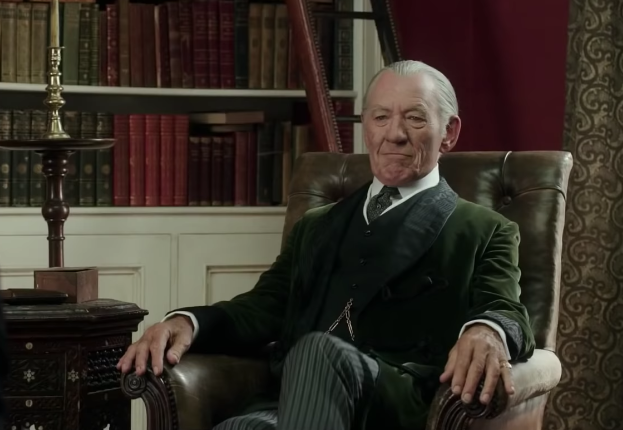
Ian McKellen in Mr. Holmes

4. Mr. Holmes (2015, Holmes played by Ian McKellen)

This is a controversial entry, especially as the film doesn’t even adapt Holmes canon directly but is instead based on Mitch Cullen’s 2005 novel A Slight Trick of the Mind. I don’t care. This film is a masterpiece. McKellen plays a 93-year old Holmes, retired in Sussex Downs and struggling with memory loss; the plot slides between the “present” of 1947 and Holmes’s unreliable memories of his last case 30 years earlier. McKellen’s performance in both times is exceptional, at times heartbreakingly vulnerable, and at others dry, witty, and keenly insightful. This film is truly about Sherlock Holmes: as a person, as a fictional character, and the line between the two. It explores the tension between Holmes’s passion for truth and his growing understanding of the power of story. It’s about loss (in one haunting sequence, Holmes visits Hiroshima), but it’s ultimately a gentle, joyful film about memory and legacy. I don’t know how they did this, but it’s beautiful.

Basil Rathbone as Sherlock Holmes

3. Sherlock Holmes film series (1939–1946, Holmes played by Basil Rathbone)

Basil Rathbone, with Nigel Bruce as his loyal Watson by his side, played Holmes across fourteen films (and over 200 radio shows), and he is arguably the first iconic film version of the detective. While the early films are set in Victorian England, the later films are often original stories and foreshadow Sherlock in being updated to the present day—in this case, WWII. These stories are imaginative and fun, stretching the limits of what Holmes can do and establishing him, as the opening titles state, as a hero “ageless, invincible, and unchanging.” Yet the real strength is in the performances. Rathbone is magnificent: commanding, gentlemanly, fiercely intelligent yet capable of warmth and kindness. Nigel Bruce reinvents Watson as a bumbling, sweet-natured comic sidekick—a characterization untrue to the Conan Doyle stories, but revolutionary in giving Watson a defined role and purpose that was often missing from earlier adaptations. (Besides, his duck impressions are funny.) And, as is true of all the best adaptations, the chemistry between the two actors is perfect.   

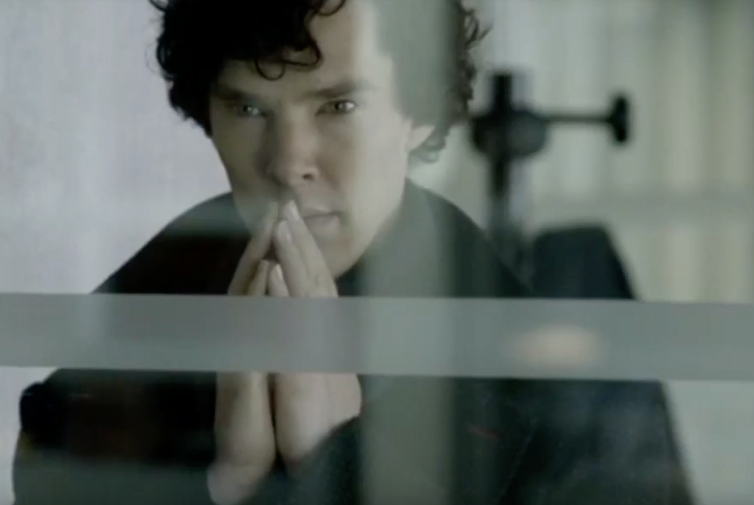
Benedict Cumberbatch as Sherlock Holmes

2. Sherlock (2010–2017, Holmes played by Benedict Cumberbatch)

If the Granada Holmes series is a study in faithfulness to Conan Doyle’s stories, Sherlock is a postmodern pastiche of those stories, bringing Sherlock Holmes into the modern world. Benedict Cumberbatch’s performance is electric, all tumbling curls and cheekbones and arrogance and intellect. Martin Freeman’s irritable, defensive army-doctor-turned-blogger John Watson serves as our viewpoint on Sherlock from the start, as Watson does in the stories, and the rapport between the two is one of the show’s many strengths: it’s perhaps the only adaptation where Watson seems to carry as much dramatic weight as Holmes. The production is revolutionary in the way it dramatizes Sherlock’s deductions, through various on-screen depictions of his “mind palace”: for the first time, we’re able to see him thinking. The best thing about the show, however, just might be the writing. When this show is at its best, it’s truly brilliant, not just in itself but in the way it constantly embraces and playfully subverts its own source material—at times, such as in the early acts of in Scandal in Belgravia and His Last Vow, the references to Conan Doyle stories and previous Holmes adaptations cascade so thick and so fast that keeping up with them feels like trying to snatch at falling snow. The result is something very special: at once homage to Sherlock Holmes canon, an exploration of that canon, and a definitive Holmes adaptation in its own right.

Jeremy Brett as Sherlock Holmes

1. Sherlock Holmes TV series (1984–1994, Holmes played by Jeremy Brett)

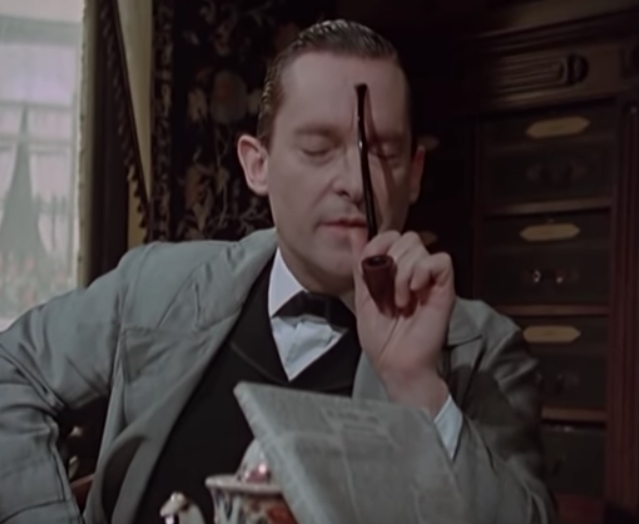
This famous Granada series teems with loving detail: from the scripts, which faithfully adapt the original stories, to the set design, costumes, and cinematography, which often replicate frame-for-frame artist Sidney Paget’s original illustrations. The most extraordinary details, however, can be found in Jeremy Brett’s performance. Brett researched the part meticulously, and delivers a portrayal that brings out not only Holmes’s intellect but his full psychological complexity. At times startlingly dramatic, at other times subtle and nuanced, Brett’s Holmes is a study in contradictions: prone to dark moods yet also flashes of contagious laughter, languid one moment and the next twitching with barely contained energy, majestic and arresting and brimming with charisma. When he’s on screen, it’s impossible to look anywhere else. He is ably supported by his two Watsons, David Burke in the first series and Edward Hardwicke from then on: Burke is a slightly younger, more sarcastic Watson, while Hardwicke brings a gentle kindness to the part. The later episodes were sadly hindered by Jeremy Brett’s failing health (he suffered from bipolar disorder and a heart condition), which led to his tragically early death before he could complete the series. His legacy, however, is a production which can quite rightly considered the definitive on-screen representation of Sherlock Holmes.     

Why Are So Many Women Rewriting Fairy Tales?

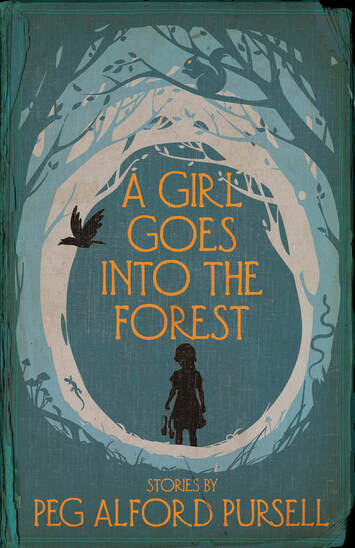
Peg Alford Pursell’s second book, A Girl Goes into the Forest, contains a collection of 78 short stories exploring moments in the lives of women. Pursell’s first book, Show Her a Flower, a Bird, a Shadow, was named the 2017 INDIES Book of the Year for Literary Fiction and an honorable mention in fiction for the First Horizon Award.

What captivates about Pursell’s work is how she uses brevity and specificity to fully immerse readers in the worlds of her characters, regular people facing everyday problems. Most stories feel like a flash into a world, a photograph, while others linger, giving their stories room to breathe into their fullness. She writes about loss, longing, frustration, and simple pleasures, tackling problems some might call small, but Pursell approaches her characters with reverence, honoring the depth of the pain we all carry. By darting in and out so quickly from each story, Pursell must use the compact details of each character’s world to help readers grasp onto. Some stories are under a hundred words, focusing on a cake melting in the sun (“Under the Accumulating Sunset”) or a woman facing down icy winds (“The Woman in the Winter Storm”), while others like “My Father and His Beautiful Slim Brunettes”) span pages and lifetimes.

Peg Alford Pursell and I sat down to talk about mother-daughter relationships, the impact of world events on how we tell stories, and the lines between poetry and prose and the nonbinary future of writing.


Parrish Turner: As I was reading through A Girl Goes into the Forest, I was struck with the question: What is the difference between poetry and prose?

Peg Alford Pursell: I definitely work with what I think of as hybrids, which includes prose poetry. It straddles a line between traditional short story writing or novel writing and poetry.

One of the main differences is in lyricism and I’m a writer who is driven by the sounds of language. I will frequently start something because a phrase sticks in my mind. Hybrids encompass flash fiction and prose poetry. There are so many different animals and I think mine are much more language based. 

PT: The language is so beautiful throughout. I have found that after readings, some people will compliment me on my poetry, which is not something I think I write. Where are we drawing this line?

It is just the nonbinary nature of this kind of writing. It doesn’t want to stay in this category or that.

PAP: I heard that with my first book in particular. It is a much shorter book and I didn’t include longer, full stories. Someone asked me why I didn’t publish it as poetry. This is why I refer to them as hybrids.

It is just the nonbinary nature of this kind of writing. It doesn’t want to stay in this category or that. It seems to be what I am able to write most naturally. I have a hard time with categorization.

In a way, we are starting to really pay attention to the fact that in nature, in people, these binaries really aren’t binaries. For example, there is not a point at which night becomes day. You can’t pinpoint any specific moment. It is always more or less night or more or less day. As a culture, I hope we are waking up more and more to the realities. It is only natural that our writing and our art forms will reflect that more and more.

PT: It makes me also think about how “traditional” fairy tales are often structured as poems. I wonder when the delineation began? But, speaking of fairy tales, your book is filled with those influences, which I have also seen pop up more and more. What do you think the value of fairy tales is today? Why this renewed interest?

PAP: I was thinking of this myself and there are so many theories. But the way it came to me, to use these epigraphs from the fairy tale, I had in the back of my mind: Which of these fairy tales do we find that the girl has agency? So “The Snow Queen” came to me because it is Gerta that saves little Kay, the boy.

I don’t know if revival is the right word, but there is something in the air where we are seeing a lot of people rewriting fairy tales. It is mostly women writers, people who identify as women doing this. Why is that?

There is an interesting desire to look back on what was and change it. Recreate it. Subvert it.

I have a lot of different ideas about it. It could be about getting back to our “roots.” A lot of these fairy tales are the kind of lore that is early, culturally [speaking]. Centuries ago. Maybe we are looking to see how this body of lore established itself. I see many women rewriting these tales in a way that is very much in keeping with what women are doing in this culture now. There is a lot of upheaval, certainly politically and in the environment. Our planet is changing dramatically and we are asking: Are we going to survive? There is a desire to look back on what was and change it. Recreate it. Subvert it. Make it ours for this day and age.

PT: How does the wider world influence what you write and how much does time interact with the two? Your book is so relevant today and aware, for example, I saw you thanked Dr. Blasey Ford in your acknowledgments, yet it takes time to write and publish a book. What is the tension there?

PAP: I submitted this book a year ago in March, so it followed quickly behind the first book. Most of it was written in a nine-month period. When I first start, I have no idea what I am writing. I like it that way. I like the mystery. I like giving myself permission to see where I will go. In some ways, it’s nerve-wracking, and in other ways, it is liberating too. I want to see what I really think about something. Once I get a sense of it, then the rest begins to aim for the same themes.

I did acknowledge Dr. Christine Blasey Ford. At the time I was finishing up the manuscript to go into galleys, the hearings were taking place. Like many, I was overwhelmed by her courage, what she had to endure, and very upset with the outcome. What she did took so much courage and I took so much inspiration from that. I didn’t want that to be forgotten. When we are living in such politically turbulent times; everything is happening so fast and it is easy for us to forget about these really monumental things. I wanted to have what she did acknowledged so that if we are still around, if books still exist a decade from now, someone will see and remember.

Christine Blasey Ford’s bravery parallels the characters in my stories—they have an internal moral compass.

I think that also her bravery parallels a lot of what I feel the characters in my stories are—they have a strong internal moral compass. They are very brave in situations that are a double bind and they are usually put in situations where there is no way out but these characters find their own ways.

PT: One of the things I loved was the variety of characters. So many of these stories center on the mother-daughter relationship and its difficulties. Have your views on that dynamic shifted over the years? What would these stories have looked like if you had written them 20 years ago, and what would you be exploring?

PAP: I think the mother-daughter relationships are absolutely affected by the fact that we live in a patriarchal society. Many women do not realize—I think this is true for a huge generation of women—they don’t realize that we have internalized the misogyny. I am very curious [about] what is going to happen in this next election. Well, it is a lot more intense feeling than curiosity. There are some women who cannot accept a woman president. That is internalized misogyny. This plays out in the mother-daughter relationship.

I try to get that across with my characters: there is a sense of betrayal. Why didn’t you let me know that this is the way it is going to be? As characters become teenagers, there is a real upset with the older women who, in their perception, haven’t done anything to change this situation. This is all a very subtle thing. It doesn’t speak across the board, but I do think, for myself, I had an older brother and I just remember that at a certain point I realized he was being treated special because he was a boy. He was 18 months older and I knew he wasn’t special because he was a boy. In kindergarten, I tried to talk to my teacher about this. I didn’t have the exact language for it. But essentially asked why does the boy get to be elevated simply because he is a boy and [I have] to accept that this is the way of the world? I wasn’t able to get answers when I talked to my teacher or my mother. I think they had their own anger or upset about it. But the idea is that you have to accept this in order to get along. When you get older you can do these things to try to make a difference but the bottom line is that, as a girl, you have to accept that this is the world we live in. That is a very difficult dynamic but I think it underpins the mother-daughter relationship. I think all women have had so much pain and how do mothers deal with and how do daughters see that. We are still dealing with the same problems.

7 Unconventional Missing Person Stories

Consider it the first mystery of the missing that they are said to “go” somewhere, somewhere called “missing.” Or maybe missing is less a place, more of a gerund. The abducted and kidnapped go missing the way the rest of us go running, skating, and skipping, making missing a sport you could almost imagine at the Olympics. But if to miss is to misdirect—wouldn’t an Olympic misser be able to land an arrow anywhere but the center of the target? Maybe a world-class misser would miss the mark so astoundingly as to accidentally assassinate the judge, or pierce her own heart?

Marilou Is Everywhere by Sarah Elaine Smith
Buy the book

Some hallmarks of the missing-person story: It’s told from the perspective of the people or community left behind, establishing a sane and true world as a foil for the unknowable negative space the missing person has stepped into. The missing person no longer speaks, except from their own past—in letters, found evidence, or their own words recalled by their intimates. And so very, very often the missing person is female, and her disappearance is somehow a referendum on purity and wholesomeness—not just her own, but the community’s as well.

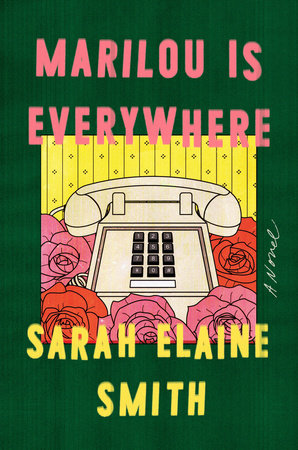
My novel Marilou Is Everywhere begins with a familiar plot: a teenage girl, Jude, disappears shortly after high school graduation. While the investigation (and gossip) unfolds, another teenage girl sees a chance to leave a precarious situation in her own home, and slips into Jude’s life. The book’s mystery wanders away from the idea of pursuing a single criminal responsible for the disappearance, instead asking how society has already failed to see these women. Maybe they were missing a long time before they disappeared.

I’m a reader who loves to turn the pages, and missing-person stories are my catnip. But I especially love books that diffuse the basic ingredients of this narrative in ways that point out how going missing can be merely the end result of a chronic absence—of care, attention, understanding, or visibility.

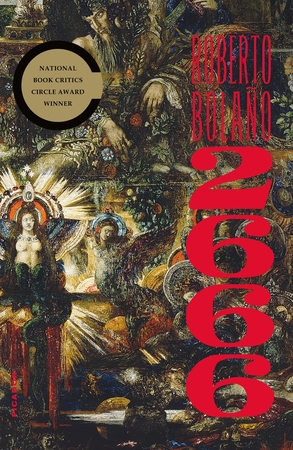
2666 by Roberto Bolaño, translated by Natasha Wimmer

All of Bolaño’s work, in my estimation, invokes the dread of emptiness or cosmic violence, but nowhere as brutally as in 2666, the fourth part of which recounts the disappearance of murdered and mutilated women in Santa Teresa, presumably the book’s proxy for Ciudad Juárez. It is by far the longest section in the book, both horrible and banal. 

2666 is a feast of genres: campus novel, love story, mystery, history. But the recitation of circumstances surrounding the missing women act as a counterbalance, an echoing pit beneath the rest of the book. The narrative does, in a way, bend toward a single evildoer, but it also hints at a broader culpability, asking how that cavernous violence undergirds art and the sublime.

Image result for nobody is ever missing a novel

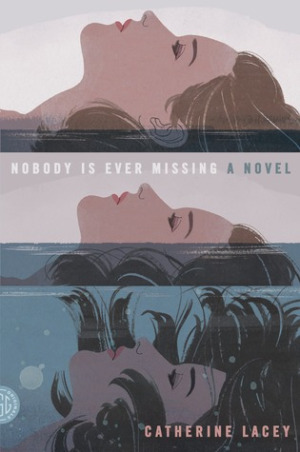
Nobody Is Ever Missing by Catherine Lacey

Elyria walks right out of her life one day, leaving Manhattan for New Zealand, leaving a husband and a job and all the materials of normal life for an acquaintance’s proffered spare room on a farm. Instead of tracking her disappearance from the perspective of those left behind, the novel follows her as she disappears—and she does so more or less continuously. Her elliptical observations eventually reveal that grief over her sister Ruby’s suicide may be what unfastened her from her life. Is every traveler merely in the midst of a constant disappearing act? In a sharp and wonderful reversal, it’s almost as if Elyria’s life has gone missing from her, not the other way around. 

Image result for jane a murder

Jane: A Murder by Maggie Nelson

Nelson’s aunt Jane Mixter was murdered while studying law at the University of Michigan in 1969, the subsequent investigation and trial further investigated in Nelson’s also excellent The Red Parts. But Jane: A murder undertakes a different kind of recovery project, one in which Nelson integrates text from Mixter’s journals—sometimes as interjections, and sometimes as whole poems. Occasionally the poems conjure the circumstances around Jane’s death as if they were portents—Jane, as a character in the sequence “The Light of the Mind,” dreams that she discovers a new freckle on her forehead that transforms into a gunshot wound. Another section recounts the circumstances of Jane’s murder, but Nelson structures the book so that interjections from Jane’s papers comment upon the reportage with an uncanny impossibility. Following the family’s shock at identifying her body, this note from her journals: “I can become a very tragic figure in my own mind/if I don’t make an effort to be gay.” Jane somehow seems to go more missing the more Nelson discovers about her.

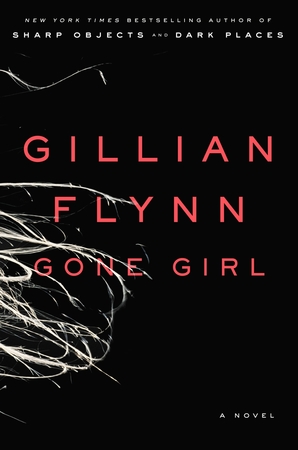
Gone Girl by Gillian Flynn

I confess, I thoroughly enjoyed watching my peers at the Iowa Writers’ Workshop fuss and nitpick over this book after it came out. It seemed that something so basic as a plot twist had been long discounted as utterly pedestrian, and it was delicious to watch so many people wonder, often with a note of panic, whether there might be something to these page-turners after all. Or perhaps I’m projecting? I like an obtuse German-language book-length meditation on suicide and wood ducks as much as the next MFA, but I also love compulsively readable books. And I had found it frustrating to hear (more than once) other writers dismiss popular books as some kind of collective delusion rather than a canny demonstration of narrative spellcraft. (And doesn’t everyone know that popular books are a combination of the two?)

It’s nothing short of gruesome, how powerfully the missing woman story baits a reader like me into racing through this novel, and I appreciated it for deftly closing the door behind me halfway through and confronting me with the blindness that so often accompanies a reader’s hunger for such a story. Despite the tricksy plot, Amy is still the missing girl in here, made so at first when her parents replace her with Amazing Amy, their idealized chapter book heroine, and then again at her own hand, when she conjures a Cool Girl version of herself to seduce her husband.

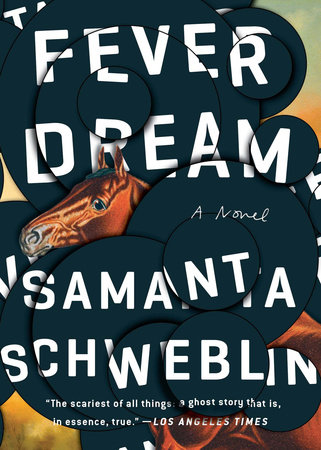
Fever Dream by Samanta Schweblin

Fever Dream by Samanta Schweblin, translated by Megan McDowell

The only appropriate way to describe this book is to note that it’s the first and only that made me check the deadbolt on my door multiple times while reading it. Like the best cosmic horror, it carries at its center a piece of knowledge which has contaminated and harmed the characters who encounter it, including David, who has been soul-swapped by a witch doctor, and Amanda, blind in a hospital bed. David relentlessly questions Amanda: she must remember the exact moment when the worms entered her body. Her recall grows flimsier as he nudges the story out of her. Some part of herself seems to be disappearing, the same part which disappeared from David. As a reader, I want to know what happened, but is it possible to know without falling under the same spell? It seems not, and every page turned feels like a step toward my own split from consciousness.

Disappearing Earth by Julia Phillips

Disappearing Earth by Julia Phillips

It’s supposed to be a nightmare scenario to discover that a book engaged with very similar materials as your own is coming out a few months earlier—especially if it’s like, really really good. But I was delighted to read this layered anti-investigation of the disappearance of two girls from the remote Kamchatka province in Eastern Russia. Functioning as a series of linked stories as much as a novel, the book slips the missing girls into the background of each subsequent section, ghostly and filtered through the discourse of other stories. They show up as cautionary tales, asides, metaphors, a rationale for bigoted lamentations about the presence of “outsiders,” but those other stories offer sly illumination of the broader cultural setting that makes their disappearance possible. 

Ban en Banlieue by Bhanu Kapil

In 1979, Ban is a black girl walking home from school during the beginning of a race riot in the Southall suburb of London where the anti-Nazi activist Blair Peach will be murdered by the end of the night. When Ban hears the first sounds of struggle, she lies down on the ground where she’s walking. But to call that a plot would be to miss, well, just about everything in this book. Some parts are notes for a performance piece. Some are refractions of the narrative, retellings, attempts which begin and begin and begin in search of something silent and crucial about what this violence does to black and brown bodies.

Ban disappears in the sense that she transubstantiates: “Ban is a mixture of dog shit and bitumen (ash) scraped off the soles of running shoes: Puma, Reebok, Adidas. // Looping the city, Ban is a warp of smoke.” She is everywhere. The sound of shattering glass, in turn, shatters her, and time becomes multiple. A summary is impossible because this book frustrates every hierarchical imperative imaginable. So fuck this attempt: Please just read it.

Where Is Revolution City?

“No One Knew That”
by Hadiya Hussein, translated by Paul Starkey

I sat down, after thirty years, on a wooden bench with crumbling edges. The square in front of me seemed empty and the colour of the buildings was fading . . . My clothes bag was opposite the bench, by my side was a bag with remains of food inside it. I looked at the still leafless bushes (despite the fact that we were in mid-spring), turning over in my mind the pictures my memory had retained. I could find no clear resemblance or similarity to what I was seeing. Everything had become old and worn out. I was coming back after thirty years with a skin whose cells no longer renewed themselves.

The bus that had carried me from Amman to Baghdad had dropped me in this place. Most passengers had got out, though a few stayed on. I had hesitated before getting out, staring from the bus window.

“I want to go to Madinat al-Thawra [Revolution City],” I said to the driver.

He looked at me without comment. I repeated what I’d just said, as perhaps I’d got the name wrong. When his eyes carried on staring curiously, I got out in a quadrangular square. 

A number of men were offering their services. Drivers, porters, and children selling mastic and water. Everyone was talking quickly, using vocabulary that hadn’t found its way into the dictionary of my memory before, so that it was difficult for me to distinguish the letters. The faces were strange and emaciated, and the place that was supposed to be the al-Alawi Bus Station bore no resemblance to its previous layout. The driver’s assistant got out all the luggage. After the passengers had gone off in their different directions, I started looking carefully at the place.

Four entry roads led into long streets that ended I knew not where. Entry no. 1 had a number of policemen standing by it and the way to it was blocked by concrete ramparts. I picked up my case and did not look at anyone, for I had uneasy feelings about the suspicious faces.

There was a woman about to get into a taxi. I hurried up to her and started to ask her: “How can I get to Revolution City?”

She looked at me without replying. Her look suggested that she hadn’t understood the question, so I repeated it a second time, but she had already got into the back seat and shut the door hurriedly as if she was running away from me.

The square had a low barrier around it, from behind which buildings could be seen – restaurants and cheap hotels. After a few minutes, the north corner filled up with skinny soldiers, smoking furiously. They sat down in a row on the barrier. They didn’t exchange any conversation, as if they had already said all they had to say on the way there, and were just waiting for the lorry to take them off – or perhaps they were too busy talking to themselves. Were they returning from their units in the far north and wanting to get to their homes in the south? Or were they on their way to those units?

I noticed a boy around ten years old, wearing coffee-coloured trousers torn at the knees, and a shirt that was too big for him. He didn’t say anything. I opened my bag and gave him an orange and a piece of biscuit. He carried on looking at me for a few moments before stretching out his hand and snatching what I was holding, then running off in case anyone saw him, as if he’d just committed a robbery. From time to time, people would come out of one of the entry roads and cross the square towards the other entries. Sullen, twitching people. Two of them started a fight, while a woman wearing a shiny dress stood beside them, her long red hair reaching to her waist. While they were trading blows and insults, she slipped into the entry labelled no. 2. Time was passing quickly, and night was slowly advancing, to cover the sky and everything else.

I said to myself: “I must find out where I am. To find that out, I shall have to walk a few metres to check the right way. And if I’m to avoid laying myself open to undesirable consequences, I shall have to avoid asking questions.”

I picked up my bag and walked towards the entry road that the woman with the red hair and shiny dress had disappeared into. I had to pass along some narrow paths before I arrived at a wide street lit by lanterns suspended from medium height poles. I don’t know whether the light they gave out was from paraffin, or if they were electric lamps in the shape of lanterns. I saw several signs invoking blessings on ‘Adherence to Principles and Great Victories’. The poles and house fronts were adorned with pictures of a single man with stern features, and decorations of palm branches and coloured paper. Some of the windows in the houses were lit but most were in darkness. While I was trying to take in the scene, a dog barked behind a mud barrier and threw fear into my limbs. I took a couple of steps back so as to be prepared if it attacked me, though I am not very courageous in circumstances like this. I was thinking of going back to the square when a middle-aged man came out of one of the houses. I was about to call him, but he quickly went back into the houses he’d come out of as if he’d forgotten something. A long time passed but he didn’t re-emerge. That meant that he hadn’t forgotten something. Perhaps he just preferred to stay in that house until morning.


The number of soldiers had increased, and others arrived a few minutes later. New passengers were getting off a bus, heading either for the entry roads or for the taxis lined up on one side. I walked towards entry number 3. As soon as I had passed through the stone-sided passageway I found myself in front of some wretched houses made of corrugated iron sheets, from which revolting smells were being given off. Smoke from stoves was wafting out from between the cracks. I walked on several metres, wondering: “Could the driver have made a mistake and dropped me at the wrong place?” But I remember my voice was quite clear when I told him I wanted to go to Revolution City.

It’s true that he had looked at me curiously, which led me to repeat what I had said in case the man was hard of hearing, but his assistant quickly unloaded the baggage, which meant that it must have been the last stop, as I knew it thirty years ago. The roads branched off from it to the smaller cities, including Revolution City. Nothing in the place had any connection with the al-Alawi Bus Station, or with anywhere I’d known before. Cities, like people, become old and worn out and change, and I knew that what had happened during these years was enough to obliterate what had been there before.

I ventured into a corridor that was almost dark, ending in a desk behind which was sitting a youth with unhealthy looking features. I had already read the sign ‘Memories Hotel’. The youth was surprised when I went in and even more surprised by my request. “A room, please!”

I didn’t enquire about the price for a night or the services offered. I simply wanted to rest my body after several hours’ exhausting travel, and save myself from the night that had found its way into every inch of the place.

“It’s not allowed to take women . . . This is a hotel that just gives quick service for soldiers.”

I couldn’t think of a reply, but he continued: “It looks as if you’re a stranger, so you can stay until morning, even though it’s against orders and I could face dismissal as a punishment.”

I was about to say that I wasn’t a stranger, I was a native of the country, but as soon as I started to speak, he started coughing violently. When he finished, he said: “Payment in advance . . .”

I took out a hundred-dollar bill. He looked at me, but before he could open his mouth I said: “I’ve just arrived and I haven’t had time to change it.”

He put out his hand and took the bill with trembling fingers. Then he got up from behind the desk to escort me to the room.


Ever since the Dutch doctor had told me that a malignant disease was creeping through my body, I had resolved to return to find myself a grave beside the graves of my family. Until this moment, I hadn’t fallen into the trap of nostalgia. I hadn’t carried photos with me when I left my country. Photographs sharpen the pangs of memory, and I wanted to start my life far from the sufferings of the past. I’d succeeded in keeping heart and mind away from everything that would make me prey to a slow death. I became acclimatised to the strange people in a strange country, and later began to boast of how well I could speak their language. I worked and loved. I dreamed of starting a big family to compensate for my own family that had perished beneath the rubble of their house during the second Gulf War. Ten years passed which I spent with my husband, but we stayed just the two of us, despite repeated attempts with the most famous doctors. 

God was not satisfied with that, but took my husband to him and left me to turn my memories into food to sustain me later. Despite that, I didn’t fall prey to the past. I launched into life after every fall with a stronger will. My life was punctuated by warm friendships and lots of journeys. The homeland used to come into my mind like a beautiful dream that didn’t stop for long and didn’t ask anyone to stop. It passed as men’s faces pass, brought together by the friendship of a journey which soon ends. In this way I trained my feelings and perfected the game of forgetting, or pretending to forget, in the crush of other years whose days I could not count. But, from the time the Dutch doctor told me the truth about my illness, memory opened its doors and cleared away the debris slowly, so that nostalgia arose from its resting place and announced its scourge of fire. The graveyard of Najaf began to appear to me as if I had left it yesterday, the day the corpses of my mother, father and younger sister were buried. I didn’t want my body to find rest amongst strangers. That is the decision I made, and this is what has brought me here. The driver must have got the wrong place. Tomorrow morning, when night disappeared, I would investigate the matter.
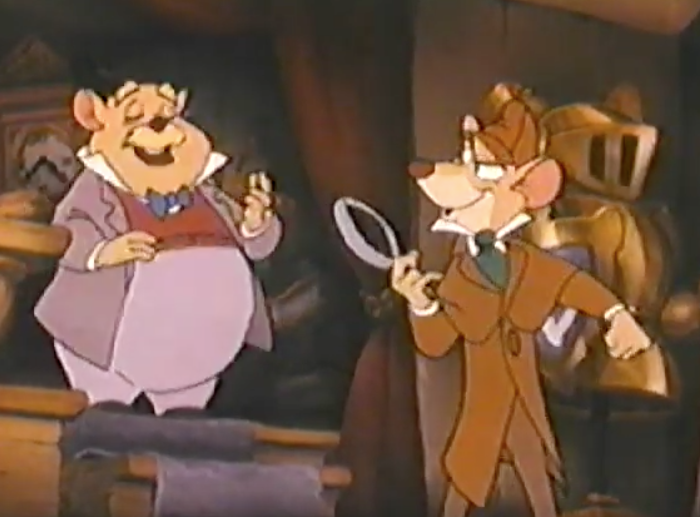
I pulled the cover over half my body and shut my eyes. The noise of soldiers going up and down the stairs. Whispering and singing getting louder and softer. I slept fitfully, and when the light of the sun came down on to my face, I was startled for the first few moments after waking, for I had been suffering a terrifying nightmare. A man was pushing me from a mountain peak to throw me to the bottom of a valley, while I screamed, but no one heard me. “Thank God, it’s the morning!” 

The soldiers came down the stairs yet again. Their voices rang out without my being able to pick up a single word. I hurried to the window and opened it. I was shocked by what I saw. The window looked out over an enormous, unending cemetery. The graves had no gravestones. I rubbed my eyes so as not to be still dreaming.

I wasn’t dreaming. I don’t remember a cemetery that big. Could all these people have died in Baghdad alone during the last thirty years? That means that the Najaf cemetery – the biggest cemetery in the world – must also have got larger. Perhaps it had stretched as far as the streets and houses. My God! Where could I find the graves of my family? And what about my other relatives? Who could bear the burden of a woman who had come to die amongst them?


I went back to the square. It was the only thing that would enable me to get my bearings. Women were scattered in the corners, serving tea and sour cream while crowds of soldiers continued to throng around. Fast food carts, cigarette kiosks, children selling mastic, and dervishes carrying copied prayers and begging people to buy them. Faces, faces, faces. Pale and yellow, gaunt and dusty. Accents of every colour and kind.

I sat down beside an elderly woman. I drank some tea and asked for a sour cream sandwich. There was no time to question her. Her fingers worked astonishingly quickly, and the soldiers drank the tea in a hurry. A military lorry came out of entry number 4, and the soldiers swarmed round it. It filled up and carried them off. Where to? I don’t know. A second lorry, and a third . . . 

When the woman had finished, I asked her: “What’s the name of this place?”

She answered me with another question: “Are you a stranger here?”

I hesitated, then replied: “Yes.”

“It’s the Revolution Bus Station,” she said.

I didn’t remember any bus station of this name, so I asked again: “Do you mean Revolution City?”

She looked at me in surprise, then said: “You are talking about a place that no longer exists.”

“How come?”

She turned round as if she was afraid of something, then said: “Since you are not from these parts, I’ll tell you a secret. I am from Revolution City. Or, to be more precise, I’m one of those who escaped the massacre.”

“What massacre?” I asked her, as terror gripped me. 

She pursed her lips and began to pour tea for a passer-by. She remained silent until he had finished and gone. She put her head to my ear and said: “Hasn’t the world heard? That is an incredible pity. We lost our lives and died before we were dead.” She turned around again and whispered: “I was out of town when the ruler’s men surrounded it and dropped poison on it from planes. Everything was over in a few hours. You’re quite near now to the city that was . . . Today it’s just a cemetery stretching further than the eye can see.” She pointed with her hand: “It’s behind that hotel. Graves that do not bear the names of those inside them.”

She was silent again. Her furrowed face seemed even more sorrowful and her eyes were sunken. Then she looked at me and said: “It’s a lucky man who finds a grave with a name on for himself.”

“Why did they do that to you?” I asked. This time she did not turn round. “The poor are always firewood for the rulers – despite the fact that they come to power carried on their shoulders.”


The graves there are decorated. They are shaded by trees and surrounded by plants that flower with the change in the seasons, so that the cemeteries seem like lush gardens. Wouldn’t it be wise to find myself a place near a tree, beside my husband? With my friends that I had lived among for thirty years?

I had buried my husband between two trees whose branches were linked above, as if making an agreement to protect him. I enclosed the grave in a frame of flowers and engraved on his tombstone ‘We will meet in Heaven’. Contrary to the hopes that I had in that strange country, it seems that I have gone to hell.