You Already Live in God Land—Lyz Lenz Helps You Understand It

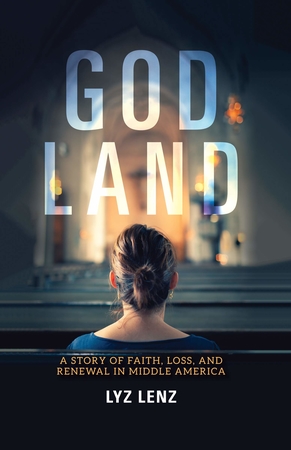
In her book, God Land, published by the Indiana University Press, Lyz Lenz asks the hard questions about rural life and Christianity in America. Combining personal essay with interviews, Lenz explores dying small towns, booming megachurches, and experiences of people shoved out of faith communities. She maps death and revitalization not only of the faith communities she explores, but within her own search for a church (including starting one in her own house), and the end of her marriage. At times both raw and hilarious, Lenz doesn’t shy away from speaking about privilege and the often unspoken topics of gender, sexuality, and race with her interview subjects. 

Lyz Lenz and I met via video chat for a conversation about faith, the current political environment, potluck recipes, and writing a book in a month (!).


Rachel Mans McKenny: How did you know God Land would be a book, not just an essay?
Buy the book

Lyz Lenz: In the book, I talk about a church [that I had started] that had ended in July 2015. In October or November, I pitched a story to Pacific Standard and I said, “Something is happening with faith in the Midwest. Here are some political implications. Here is how it seems to be changing.” I went overboard on the research. So often I emphasize stories that take place not where I am, but this was one of the few times where I could access it. It was published right before the caucuses and it ended up getting a good response. It wasn’t until March where I got an email from Indiana University Press and they said, “We think this could be a book.” I was really lucky that when we sketched out the outline it was really vague, because my life fell apart and that got incorporated into the book. 

RMM: Talk about the structure of this book. It’s not a long book, but it arcs beautifully. How did the essays come together? 

LL: I didn’t have a lot of time to write this book, and then when I did have a moment to myself I just cried a lot. I basically had a month to write this book.

RMM: Oh my gosh!

LL: Yeah. So when I sat down to write this book, I looked at the outline that I had and wrote, wrote, wrote. I was at this residency at St. John’s, and what I did was stacked my printed material and books by chapter in the outline. Then write, then next stack and next stack. But after I got it written, it occurred to me that there was a different sort of structure, and I could see in my mind that narrative arc. Someone called them episodic chapters. Someone called them essays, but I do think they flow into each other with the rising narrative of events, and I think they came to me in that way because of the way the personal narrative was intertwined. So thematically and research wise, things are definitely out of order. I’m working on my second book now, and I need to think about how it structures together. 

RMM: You talk often about the dichotomy of the open palm and closed fist, in the weather, churches, marriages, and the Midwest in general. Do you think these opposing forces exist simultaneously or switch off?

I didn’t have a lot of time to write this book, and then when I did have a moment to myself I just cried a lot.

LL: I think they exist at the same time. It’s something that’s very much felt. Especially here, people can be very warm and inviting, but still closed off. My mother grew up in the South and still has that Southern ethos around hospitality, how you dress—a very high feminine ideal of what the world should be. I remember her frustration with moving to Minnesota because she would say, “Everyone is so nice, but nobody wants to eat dinner with you.” I remember her saying that. I think they exist together. A kindness and a closed-off-ness. Charity, but also reserve. It’s a hard tension, but it happens all the time. I think it’s a very middle-of-the-country thing. This is my theory, that the openness of the land—this might be the stupidest thing I’ve ever said—in a land that’s really open you’re always exposed, so you develop a reticence. I do often think that geography and destiny are so often intertwined. That’s why I kept coming back to that image. It’s frustrating, but it’s all around. 

RMM: I absolutely get that. Much of your writing in CJR and elsewhere holds powerful men in media accountable. Was it different discussing the men whose power was more personally tied to your life: your father, former pastors, the men who started the church with you, and your husband? Did you have to approach that differently?

LL: I didn’t start profiling men in the media until I was writing this book. I had written an article about Chris Cillizza and then I got assigned the Tucker Carlson article, and there was a moment in editing it and I had felt it doing the research for the chapter on the Baptist Minister Rural Life training that was like, no matter how good you are and no matter how well behaved you are within the system created, you’re still going to lose. 

And so I was thinking about that as I was writing the Tucker Carlson article because I didn’t want to get personal in it. In my life and in my writing, when I started being honest and raw about things, when I started writing this book, something just broke. A friend told me that, “The lesson of your life is that you can do everything right and still get it all wrong.” and I was like “Oh shit.” All of these reckonings in me started happening all around the same time.  Up until very recently I had tried to operate well within the confines that I was given. “I will be Dad’s girl and impress him, and I will be a good wife, and I will make male editors happy.” Then I realized I’d been doing this for so long and not getting anywhere and I was just angry. Fuck it.

RMM: Building on that, in your essay for Not That Bad, edited by Roxane Gay, you talk about the idea of women’s anger not finding a home and flooding the streets. Do you find yourself more comfortable in homing that anger now?

When I started being honest and raw about things, when I started writing this book, something just broke.

LL: Yeah, I do. There’s this whole narrative that’s culturally getting pushed back against that anger is bad. Like “30 Days of Facebook Thanksgiving!” It’s that wide-eyed, gritted teeth, “Everything’s Fine and Everything’s Blessed!” And you’re like, “Girl, just punch a window.” Of course, culturally there is pushback against that, but I think that people individually aren’t comfortable with being angry.

In that essay, I talk about a women’s shelter that I work for. Its founding director and I were having coffee recently and she was like, “I don’t like to get angry but I know that’s your thing.” And I said, “Shouldn’t that always be our thing if we see justice and unfairness?” If you see something sad happen, you’re allowed to be sad. I also think that creating space for anger also lessens its power over you. Anger is a great motivator to get shit done.  

RMM: Much of this book tracks your personal faith journey. You talk openly about your homeschooled, deeply conservative background and your more current struggles against institutions as you tried to find a church home. You talk about it as being in a “womb of faith,” which I like. Many women with more politically liberal views don’t often openly discuss their faith (Nicole Cliffe being a notable exception). Are you met with surprise when you discuss religion with people?

LL: More than other people being surprised, I’m always surprised by how deeply these conversations resonate with people. I was joking with a friend recently who was raised Episcopalian, and I asked, “What is that culture, healthy sex talks and your parents smoking pot with you behind the bleachers?” And she was like, “Kind of!” (laughs) 

But even these conversations resonated with her. We’re a country where 80% of people still believe in a god, and so much of our cultural narrative is, “Faith is on the decline! Nobody cares about faith anymore!” But if you look at the statistics, the overwhelming majority of Americans still think about faith, still consider themselves spiritual, and are still struggling with it on a deeply personal level. 

RMM: Which interview experiences from the book stand out the most to you today?

The overwhelming majority of Americans still think about faith, and are still struggling with it on a deeply personal level. 

LL: Angela Harrington, from the “Church in the Air” chapter. I think about what a wonderful experience it was to sit down with this woman and have her open her whole life for me and see her struggle. 

And the week with the Baptist ministers was deeply impactful, and it’s a week I think about a lot.

RMM: That chapter. I was riveted. I was so glad you got your own hotel room, because I could not imagine not having my own space to retire to.

LL: I needed a place to recover! I knew the Baptist ministers were not going to be happy with the chapter. I knew while I was there they wouldn’t be happy with the chapter, because they weren’t happy with me while I was there. I started to do extra-fact checking, and so I emailed them. I sent them sections of the chapter, and the email I got in response was very long and very detailed about all the ways I had erred. They ended by saying, “You’re the reason America is divided.” And I felt very bad until I told one of my writer friends, and she said, “Don’t flatter yourself and congratulations. Now you know you did it right.”

RMM: One thing I really appreciated that you addressed was the “pink ghetto” in church communities, which isolate women into nursery positions rather than leadership. In your new church, how do they foster women’s leadership?

LL: Women are leaders. That’s the thing. Less than 1% of head pastors across America are women. Our head pastor is a woman, Pastor Ritva, who has all the best lines in the book. You only have to foster women’s leadership if men are at the head pushing down. Let women be leaders. They already know how to do it. It shouldn’t be so radical.

RMM: No, you’re talking to a Catholic, so I get it. 

Let women be leaders. They already know how to do it. It shouldn’t be so radical.

LL: But then the nuns are great, and there’s that whole radical arm of the Catholic faith that I love. Talk about interviews, this didn’t make it into the book but I went to a rural Catholic life retreat training Catholic ministers. I went in expecting it to be the Catholic version of the Baptist retreat. It wasn’t. They kind of just chilled and talked about Catholicism and we had wine and cheese every night. It was the greatest thing, but then it didn’t give me material. They were just Catholics. “I guess we’ll start some more Bible studies! More wine?”

RMM: What influences do you see in your writing lately, from other journalists, fiction writers, or poets?

LL: I don’t think it’s a surprise that I read Taffy Akner a lot. Fleishman is in Trouble. I’ve been reading her for a long time. She got started writing just a lot of personal essays. I think the way her pieces are structured deeply influences me. I’ve sat down and drawn maps of how she structures her articles. Her writing is a masterclass in how to intertwine research and the persona.

I love Jia Tolentino. She was an early editor of mine and she writes for the New Yorker. She has a book coming out. Her sentence structure is something I think about a lot. How she manages to be deeply funny and thoughtful at the same time. 

I read Kerry Howley a lot. It’s amazing what she does with non-fiction. She does a lot of fiction moves with nonfiction and uses structure to break open narrative.

Dumbest thing: I read Milan Kundera all the goddamn time. I used to be like, “I want to write fiction like Kundera.” I had a writing teacher one time who told me, “You know, sometimes the problem is if you love somebody too much then all of your writing ends up being a cheap imitation of them.” Which was not a very nice way to tell me to knock my shit off. 

RMM: In context of the 2020 Elections, do you think candidates have their own version of “rural education” that they try to do on the campaign trail? 

LL: Yeah, like eating an ear of corn at the State Fair.

RMM: Right? Does our political system uphold some of the fallacy of rural-morality, or as you put it, “the power of the Midwest is the sanctifying myth of America”?

‘The struggle of rural America’ gets deified in the political process.

LL: You can just see them feeding into it. You come to Iowa, you roll up your sleeves, you eat some corn, you talk about Casey’s Pizza. The word “folks.” It’s this superficial pandering which lacks an in-depth understanding. If you had a deep understanding of what’s going on with, like, ethanol subsidies, you would say stuff that would piss people off here. “The struggle of rural America” gets deified in the political process. We get talked at the time, but I wish they would just listen. I also do like it that people come here and that they have to pay attention. 

RMM: What would you have the candidates take from your book in thinking about their approaches to religious communities in the Midwest?

LL: The biggest picture of the book is: how do you come together? Is it possible? Sometimes it’s not, at all, and that’s okay. Sometimes it is and it’s beautiful. If, God bless, they read the book, I would want them to understand the difference between actual religion and cultural Christianity. That understanding, and the power of moral capital. Democrats will run on policies and positions that would make rural life better, but they fail to understand the pull of moral capital that makes some of their positions completely untenable. And that moral capital explains why a farmer that had his best years under Obama would willingly vote for Donald Trump, knowing that it would probably fuck him over. And it did fuck him over, and it’s only going to get worse and they know it. But they voted for him, and the reason why is the power of moral capital. What is seen as good and bad. I hope there is a vision of community in my book, but I don’t have practical how-to steps. It is possible to be a radically inclusive place and what that means, and politicians need that just as much as churches.

RMM: Last question. In your piece for Glamour, which I love, you talk about never cooking for a man again. But as one Midwestern lady to another, I have to ask, what is your go-to potluck recipe?

LL: I love cheesy potatoes, but with potato chips on top so they become party potatoes. My ex-mother-in-law gave me the blandest recipe and then I slut it up. It’s sour cream, cream of chicken soup mixed with hashbrowns and cheddar cheese. That’s the basic level. I put bacon in them, green onions or chives, top it off with sour cream and onion potato chips on top. Mix up the cheeses and play around with it so that it’s that molten pool of cheesy-potato goodness. It’s standard. Everybody loves it.

When I first moved to Iowa, I would try these crazy recipes from Ina Garten. “I made this tuna ahi whatever” and people wouldn’t even try it. I remember this watermelon, feta, and mint salad at a church potluck and literally nobody would touch it. Then I learned you can’t do that. Cheesy potatoes. I do a good deviled egg. Mac and cheese. Bring it, and nobody gets hurt.

7 Books about the Power Dynamics of Sex

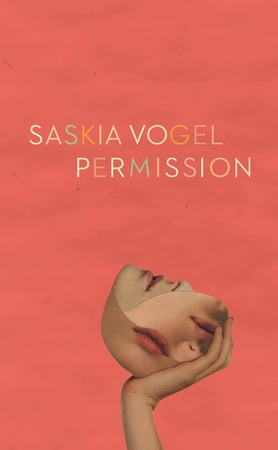
My debut novel, Permission, is about love, loss, and erotic awakening in a Los Angeles coastal suburb. When Echo’s father disappears in the ocean, the failing young actress moves back into her childhood home, only to discover that a dominatrix named Orly is setting up her business in the house across the street. In writing about Echo’s experiences with Orly and her clients, the carefully articulated codes and parameters of BDSM play are set in contrast to the interactions she has in the outside world where power is an unseen current that demands you play along, under the implicit threat of annihilation: landing outside of a framework that pretends to hold you, but in fact cares nothing for you. BDSM offers Echo an avenue of liberation or at least a moment in which she can understand what it means to have agency. Of course, this erotic play still takes place inside a capitalist, patriarchal system that, though superficially beneficial to some, ultimately fails us all. 

Buy the book

I’ve often wondered how it came to be that I’ve spent my entire adult life working with sex as a theme. At first, I allowed myself to think it was frivolous: that I was simply aligning myself with a topic that was more often than not treated as a curiosity or sensationalized, and finding corners of it that other people didn’t like to touch. But that notion doesn’t account for how earnest I have been in this inquiry,  and how much it has meant to me.

What we do with our desires and what our desires do with us are questions that go beyond the bedroom. They reach beyond the private realm and are in dialogue with the power structures that govern our lives. This is perhaps why sex games about dominance and submission can be so fruitfully used as metaphors in literature. The following are a set of books, new and old, that criss-cross between the forces that shape our lives and how those forces shape our desires. They also suggest strategies that can be used to contend with the powers-that-be and explore the ways in which we try to set ourselves free.

Image result for marketplace laura antoniou

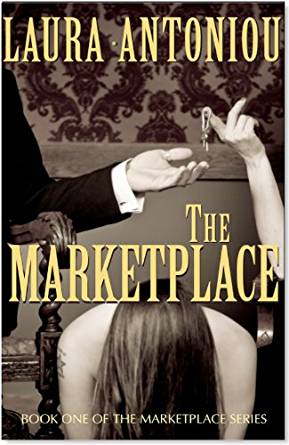
The Marketplace by Laura Antoniou

For an in-depth exploration of the pleasures, psychology, and structure of relationships, sexuality beyond the binary, power exchange, and leather culture, the six-part Marketplace series is a landmark of BDSM erotica that takes you into an underground organization that deals in the training and sale of sexual slaves. (Sidebar: One of the people whose work helps me think through the problematic terminology of kink and taboos is Mollena Williams-Haas.) I find the first Marketplace book particularly interesting to read while thinking about the forces that shape desire. In this sense, it’s a fascinating fantasy product of homo economicus and a culture in which we learn to speak of ourselves and our time in terms of commodities. Or as pornographer Stoya put it so well on Tina Horn’s Why Are People Into That? podcast: “[Antoniou] makes capitalism sexy…she has eroticized the main oppressive force in our lives.”

Image result for skin is the elastic covering that encases

The Skin is the Elastic Covering that Encases the Entire Body by Bjørn Rasmussen, translated by Martin Aiken

Rasmussen’s transgressive debut, among other things, looks at a wish for the erotic, that is sadomasochistic sex, to be a source of healing, the damage of broken social contracts, and the value of rituals of care. This challenging and poetic book focuses in on what it is to inhabit this narrator’s body, while coming to terms with the idea of us having infinite minds, but definite bodies.

The Confusions of Young Torless by Robert Musil

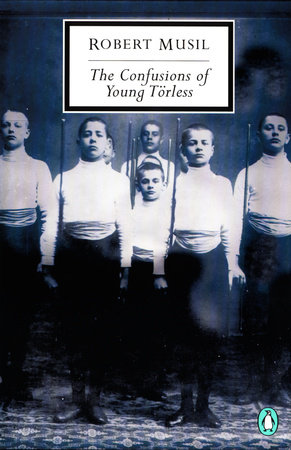
The Confusions of Young Törless by Robert Musil, translated by Shaun Whiteside

In the late 2000s when I first read Musil’s brutal Bildungsroman set in a military school in Hranice, then in Austria-Hungary, published less than a decade before the start of World War I, my reading was mostly focused on the modernist elements of the text, the idea of amorality and the author’s depiction of the erotic as a medium through which to experience the webbing between thought and feeling. I remembering linking the interiority of Musil’s voice in his debut with Clarice Lispector’s in her debut Near to the Wild at Heart. Today the exploration of psychological abuse, bullying, authoritarianism, and sadomasochistic psychosexual dynamics have a different feel: Musil’s exploration of power perhaps most urgently offers us insight into the mindset that enables the rise of fascism.

Image result for Netsuke

Netsuke by Rikki Ducornet

This is the story of a psychoanalyst who has sex with some of his patients: the ones he wants to seduce he sees in a room he calls Spells, the others are seen in Drear. It’s his folly in thinking that by compartmentalizing, the two impulses can be kept apart that make this slim, potent novel such a sharp study of lust, desire and the abuse of power. The analyst delights in dropping hints of his transgressions to his artist wife Akiko, a woman in pursuit of beauty who shares a home with a man who delights in beastliness, but deliciously, the analyst is not as smart as he thinks he is. 

Myra Breckinridge by Gore Vidal

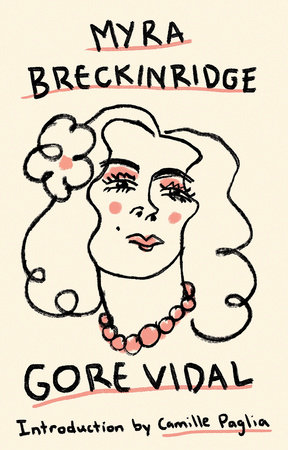
Myra Breckinridge by Gore Vidal

This bombastic work of satire from 1968 has one of the funniest and most outrageous narrators I’ve encountered. It begins: “I am Myra Breckinridge whom no man will ever possess.” Plotting world domination from a room with a view of the Chateau Marmont, glamorous, delusional, Old-Hollywood-loving trans-woman Myra is set on destroying traditional masculinity in order to “realign the sexes.” As part of Myra’s radical bid for gender equality, she points out the poison of a particular flavor of masculinity and in doing so foreshadows the support such hypermasculine young men would give to “any attractive television personality who wanted to become our dictator.” 

Image result for adrienne maree brown pleasure activism

Pleasure Activism: The Politics of Feeling Good By adrienne maree brown

Using Audre Lorde’s “Uses of the Erotic” as a touchstone, Pleasure Activism explores how pleasure can be used as a force to unravel oppression and living in a way that brings about social change. This book asserts the value of the erotic as a source of insight and the radical potential of pleasure. It has helped me think through my interest in sexuality in a wider context of politics and activism and along an axis of pleasure and pain.

Image result for we get free

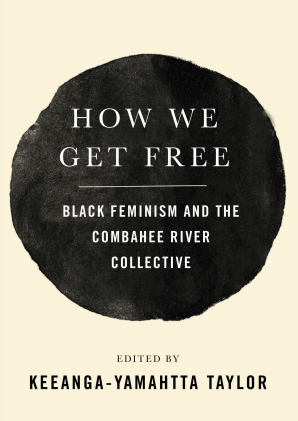
How We Get Free: Black Feminism and the Combahee River Collective edited by Keeanga-Yamahtta Taylor

What if we reorganized society based on the collective needs of the most oppressed? This is how the Combahee River Collective imagined that we would all get free. Looking at the legacy of this radical Black feminist group — whose 1977 Combahee River Collective Statement is thought to be the first to have introduced “identity politics” and “interlocking oppressions”—we can glimpse a vision of the world outside the structures that dominate our lives, creating space for us to imagine, if we were free, who would we be and what would our desires be then?

Is It Okay If I Don’t Care About Making Money from Writing?

The Blunt Instrument is an advice column for writers. If you need tough advice for a writing problem, send your question to blunt@electricliterature.com.


Dear Blunt Instrument, 

I’m a young writer who has spent the past three years learning to balance a full time job with writing. Last year I applied—unsuccessfully—to a few MFA programs. At the center of my personal statement was a writing group that has been an immense gift to me both as a writer and as a person. They were all saddened to hear that I didn’t get into any MFA programs, but one of the few perks of not getting in was that I got to continue being a member of this group.

Now, as I’m considering applying again, I’m stuck on something a friend, who has an MFA, said to me: that amateur writers are the enemy of MFAs (and by proxy, I read into this, the “professional” writers). This was said after the friend had read my personal statement and I couldn’t help connecting it to what I had written about the group. I know this was probably an offhand comment, maybe even a way of implying I was not an amateur, but in addition to making me feel a bit embarrassed for including a community writing group in my application, it’s made me think a lot about my professional aspirations as a writer. The problem is—I’m not sure they exist! While I love writing and see myself continuing to write all my life, I’m not sure if I see myself going the adjunct/teaching route and I know it’s extremely unlikely I could ever support myself through sales. I’m also struggling to find any writers who feel like career examples for me. For instance, over the past few years I’ve loved books and stories by writers like Kelly Link, Zadie Smith, Rachel Cusk and Alexander Chee, but none of these writers have career paths (opening a press, being a famous bestseller, professoring) I feel I could, or want to, follow.

I’m stuck on something a friend said to me: that amateur writers are the enemy of MFAs.

I’ve come to realize that the writers I actually see most of myself in are the other members of my writing group. Working professionals, a retiree, a journalist, a rabbi, a college student. All of them write around constraints. And while they achieve varying levels of success (one member’s first book was nominated for a Lambda award this year!) they are, in the scheme of things, small fry. Maybe I’d feel differently after years of unsuccessfully trying to get a book published, but part of me also feels okay with being a small fry, if it means I can write and share with at least a small community.

I guess my main question is: is it naive to think that I deserve a spot (and therefore implicitly a slice of the resources and support of the literary community) at an MFA program when I’m unsure if my future involves a long career in the literary world? When I don’t even know what kind of writer I want to be? Or do I need to get some career aspirations? 

Maybe you can also point me in the direction of some writers who don’t fall into the traditional career paths of teaching or selling books by the ton and are, like me, out here winging it.

Sincerely,
Winging it


Dear Winging It,

No offense to your friend, but what? That comment about amateurs makes no sense to me. The people in MFA programs are by definition students, not professionals, and most people who are already making a living off their writing wouldn’t bother getting an MFA. Maybe your friend was using “amateur” in the secondary sense (dilettante? inept?). But that still makes no sense! If you’re committing years of your life and any of your money to a writing program, then you’re not a dilettante, and you’re committing that time because you want to get better. MFA programs are looking for writers with promise, writers who can benefit from study and development. There’s no expectation that everyone in an MFA program is already working at the absolute top of their theoretical game. 

I see no reason whatsoever to be embarrassed about including your writing group in your application. MFA programs are basically institutionalized writing groups. The most valuable thing I got out of my MFA was a group of like-minded friends, people I’ve continued to talk about writing and reading with for years—we’ve gone to each other’s weddings and fortieth birthday parties; we’ve started presses and written books together. Your group sounds wonderful—cherish those people. If you don’t end up going the MFA route, they can provide you with many of the benefits you’d get from a program, for free. 

There are many writers who don’t work in academia or qualify as ‘professional writers’ by typical standards.

That said, there’s no reason you can’t get a master’s degree, or should worry you don’t deserve one. These programs, especially the ones with funding, are competitive, and it’s not rare for writers to have to apply multiple times before they get a spot. Note, also, that to my knowledge, your writing sample is much more important than your personal statement. A great statement or letter of recommendation can give you an edge, but in completing your applications, you should be most focused on making your sample as good as you can make it. 

I love that you’re looking to your group for models of how to be a writer. There are many other writers who don’t work in academia or qualify as “professional writers” by typical standards. I know a poet with a couple of full-length books and a bunch of chapbooks who is a partner in a law firm. I know a novelist who has a municipal job in a small town in Illinois. I know a poet and essayist who’s currently in medical school. I know a handful of writer librarians. And there’s me—I got an MFA fifteen years ago. Since then I’ve had a full-time, non-academic job. I teach a class here and there, but not for the money. Only in the past few years have I started making significant income from writing endeavors—but even so, it’s not enough to allow me to drop my other career. (It would take a lot to get me to leave it; it’s stable and lucrative and provides health insurance for both me and my husband.) I love writing so I work around work; nights and weekends are for my writing life.

Every writer has an uncertain future. In an interview published earlier this year, Maggie Nelson wrote:

For what it’s worth, none of my books have ever had more than one offer at a time. I’ve been lucky in that there’s always been one sucker willing to publish each one. But most of my books had to shop for a home for quite some time; some, like Bluets, were rejected all over town, despite my pleas to the world of mainstream publishing (well, my agent’s pleas) that it was PROSE and that it was GOOD. (Eventually I gave it to Wave, a poetry publisher, who did a perfect, beautiful job with it). Norton, who published The Art of Cruelty, passed on my next book, The Argonauts, so I had to move on from there as well. With the exception of The Red Parts, none of my books have sold for any money that mattered.

I recently looked at the Goodreads page for Bluets; that book has over 13,000 ratings. It has a higher average star rating than Hamlet. People love that book! My point is, there are different kinds of success. Nelson herself, in the same interview, says she feels “allergic to the word ‘success’” and cares most about writing good books. Nelson has been a useful model for me—as someone who bridges the worlds of prose and poetry, as an approachable intellectual. She does work in academia, but I don’t really care how she makes money; I’m interested in her books. 

Basically, I think your friend was wrong and you should get their comment out of your head. Think less about your “professional aspirations” and more about your writing aspirations—your writing is your career. You can have a full writing career even if you make net nothing in terms of money from your writing. If you love Kelly Link and Alexander Chee, look to them as writing models and forget about their jobs. 

What Writers Need to Know About Morality Clauses

In 1921, the silent film star Fatty Arbuckle was accused of raping and murdering the actress Virginia Rappé at an illicit gin party he’d thrown in his hotel room. Though Arbuckle was acquitted in court, the damage to his reputation ended his career and cost his employer, Universal Studios, a lot of money. As a result, Universal began to protect its investments by including morality (or morals) clauses in their contracts, which allowed the studio to simply fire any actor who acted badly off-set. 

While morality clauses became standard in Hollywood, the publishing industry never really followed suit. An author’s obligation has been to deliver their work, not uphold a certain standard of behavior. It was never a secret, for example, that Norman Mailer stabbed his first wife or that William S. Burroughs murdered his second. It didn’t need to be; for better or worse, an author’s book was seen as a thing apart from their personal life. Or insofar as their personal life was relevant, moodiness and depression or even abusive tendencies have long been considered part of the “artistic temperament” and didn’t detract from sales. 

In an era where publishers are still making big bets on individual writers but profits are strained, a single scandal can harm their bottom line.

But cultural standards are changing, and customers are more likely to let an author’s personal behavior determine whether or not they will read their book. This shift has become more visible since the beginning of the #MeToo movement, when allegations of sexual assault, harassment, or misconduct against authors, including best-sellers like Junot Diaz, James Dashner, and Bill O’Reilly, has led to author boycotts, rescinded or canceled prizes, and plunging sales. The stakes in publishing aren’t Hollywood-level high (in 2018 Netflix announced it had lost $39 million for unreleased content “related to the societal reset around sexual harassment”), but they can be considerable: O’Reilly was earning seven-figure advances for his best-selling Killing series before his decades-long sexual harassment history came to light. In an era where publishers are still making big bets on individual writers but overall profits are strained, a single scandal can harm their bottom line, and publishers—especially big houses like Simon & Schuster, HarperCollins, and Penguin Random House— have increasingly turned to morality clauses to protect themselves. 

These clauses are meant to empower publishers to easily terminate contracts without going to court. That means that they are manifestly set up to protect the publisher, not the writer. You only need to look at a morality clause’s vague language to see how wide the net is for an author’s misconduct: for example, if an author’s conduct results in “sustained, widespread public condemnation…that materially diminishes the sales potential of the work” (in the words of one publisher’s contract) or “ridicule, contempt, scorn, hatred, or censure by the general public or which is likely to materially diminish the sales of the Work” (in the words of another), a publisher can cancel a book and, in some cases, demand the return of any advance payments.  
For authors who are concerned about abuse within the publishing industry—which is unquestionably real and underaddressed—this can initially seem like a proactive move. The #MeToo movement has made clear that we are dealing with a culture of doubting women and pardoning men—a culture that morality clauses are trying, however ineptly, to correct. Yes, they’re vague and overly broad and point down a slippery slope, but when has our culture ever been in danger of believing female accusers too easily or punishing male abusers too much? Put another way, it’s a matter of balancing two aspects of the drive for justice: the desire to protect people from being penalized for their sexuality, lifestyle, or political beliefs, versus the desire to believe victims and hold men accountable for their crimes. As a female reader, it’s hard not to want to see publishers drop writers who have harassed or assaulted women—and in fact many publishers and agents don’t want to work with accused writers on moral grounds, either. 

But as much as I would like for such misconduct to have consequences, this isn’t the way to go about it. For one thing, the self-protectively vague nature of the offenses described in morality clauses means that there’s no reason to assume they will only be used to punish harassment or assault. Even more difficult to swallow is that morality clauses are triggered by allegations, not guilt. A publisher can let go of a writer who has been accused of a crime like sexual harassment or libel without there ever being formal charges, much less a conviction in court.  And the alleged misbehavior doesn’t have to have happened anytime recently. For example, in 2017 Penguin Press dropped journalist Mark Halparin, co-author of Game Change and Double Down, after women accused him of sexually harassing them during his tenure at ABC News in the early 2000s. Penguin Random House specifies in their contract that they can fire any author whose “past or future conduct [is] inconsistent with the author’s reputation at the time this agreement is executed.” Given that publishers aren’t hurt by the actual misconduct but by the backlash that undermines book sales, it’s irrelevant to them when the deed occurred—and anything in an author’s life becomes fair game.

Because morality clauses are relatively new to publishing and agents often handle contract negotiations, some writers aren’t even aware that they’re in their contracts.

Because morality clauses are relatively new to publishing and agents often handle contract negotiations, some writers aren’t even aware that they’re in their contracts. Others have refused to sign them, worried about a scenario in which publishers use morality clauses as a pretext for social policing or to repress free speech. This may sound far-fetched, but as recently as the 1940s and ‘50s, Hollywood studios used such clauses as cause to fire actors and screenwriters who’d spoken out against Senator John McCarthy and his House Committee on Un-American Activities during its witch hunt for Communists. At one time being a communist—or gay or a woman having extramarital sex—could have been grounds to be fired (and was, in Hollywood), and there’s no way to know how our definition of moral turpitude (the catch-all legal term for socially unacceptable behavior) will continue to change over time. 

It’s especially hard to know what will spur public condemnation in the age of social media. On Twitter and Facebook, small incidents can quickly grow into public outrage. The Authors Guild of America, which is vocally against morality clauses, points out that women and people of color, who are subject to more online trolling, are especially vulnerable and “may choose not to speak out in their own defense for fear of drawing internet fire that might result in a contract termination.” The wording of a morality clause is so vague that a publisher spooked by a coordinated online pile-on could theoretically cut and run even if the author says nothing.

So what’s an author to do? The best recourse for writers who are uncomfortable with morality clauses is to try to negotiate with their publisher on the terms of their contract. For example, writers can change the clause’s language to be more specific as to what constitutes actionable misbehavior, or they can ask that the clause will only apply to the period of publication. Of course not all publishers will play ball, and some writers will have to choose between staying with their publisher or signing a contract with a morality clause.

We need to find a way to address abuse, both in and outside of the publishing industry, but forcing writers to sign morality clauses poses a threat to literature that isn’t worth the risk. Publishers can’t be expected to be arbiters of justice when their motivations are complicated by profits. The authors who have been accused of “socially unacceptable behavior” might one day be found to have acted in the right—though if their work is never published, we’ll never have the chance to reassess. 

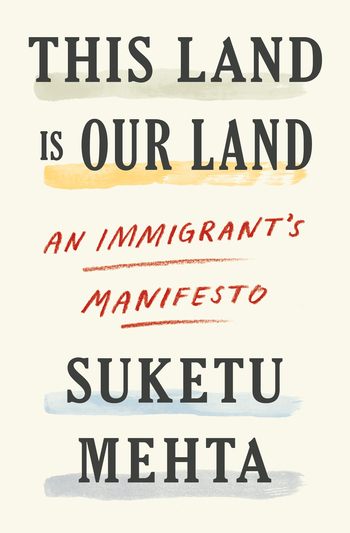
“This Land Is Our Land” Is the Manifesto We Need at a Time When Immigration Is Being Criminalized

Suketu Mehta’s latest non-fiction book, This Land is Our Land: An Immigrant’s Manifesto, takes its title from the Woody Guthrie song, which most wouldn’t associate as a protest anthem, or link it to today’s immigration debate. But Mehta, who was a Pulitzer finalist for Maximum City: Bombay Lost and Found, offers this additional verse, handwritten by Guthrie in 1940: 

Was a big high wall there that tried to stop me. 

A sign was painted, said “Private Property.” 

But on the backside, it didn’t say nothing.

This land was made for you and me. (pp.13) 

“This Land is Our Land” by Woody Guthrie
This Land Is Our Land
Buy the book

From this, Mehta goes in on the facts and reconsiders the narrative of contemporary immigration. The devastating question becomes: why are immigrants moving anyway? Mehta’s answer is that “we”—the West in its colonial, post-colonial, corporate, and climate change-causing incarnations—were/are there. Mehta condenses complicated histories to make the case that immigration is (and should be) a form of reparations for what has been wrought upon the Global South. The histories and numbers will enlighten and enrage but the personal stories Mehta collects, will rip your heart out. With meticulously researched facts (and a hefty footnote section for further exploration), he breaks down why immigration ultimately benefits everyone. 


J.R. Ramakrishnan: I want to start by asking you about the story of your mother not being allowed to enter Germany because of her British colonial passport (issued to citizens of Indian origin in pre-independence Kenya) while you were on route to migrating to America.  That must have been a traumatic experience.

Suketu Mehta: Yes, we were very young. I was fourteen and my sisters were seven and two. They wouldn’t even let my mother transit between two cities in Germany because she had this “alleged” British passport which they gave to its citizens when they got the hell out of East Africa. I remember watching this incredibly rude German immigration agent berate my mother. We had Green Cards and no intention of staying in Germany. I got my first taste of the indignity that having the wrong passport can have. I realized then that in this world, your humanity, your dignity is determined by your nationality.

JRR: What was your impression of America before you arrived?

I realized then in this world, your humanity is determined by your nationality.

SM: I got my idea of America through Archie comics. Maybe Westerns too but I didn’t know what to expect. I was completely unprepared for Queens. When we first arrived, there were five of us in the studio apartment. The superintendent of the building cut off the power to the apartment because there were too many people in it. That was his way of telling us to get out. This was our first night in America. I remember going out to Roosevelt Avenue in Jackson Heights, looking at the rusty old subway trembling by and wondering, where is the Statue of Liberty?

JRR: As we speak (July 2019), ICE is preparing raids. This creates fear for those without the right papers. But even with papers, as in your mother’s situation, and for minority populations in many parts of the world, there’s often fear of them being taken away or being deemed invalid. I wonder if there is a special sense of security that you have bearing an American passport that permits you to see borders and how people traverse them, and to opine freely?

SM: So let’s talk about this weekend’s raid first. They’ve been announced with great fanfare. They’ve been postponed and re-announced. There’s this ghoulish gloating on the part of the administration. Obviously, the idea is to create fear among families whose only crime is that they came here to make a better life for the children.

They came here to work and they came here because we Americans fucked up their countries and stole their future. They came here because we were there. In many cases, these are people who’ve been living here all their life and through some bureaucratic accident, they happened to not have the right paper. Now the government is going to swoop in on them with these uniformed soldiers pointing guns at them and throw them in prison. This violates every principle that this country was founded on. 

I think every patriotic American should stand up and fight. And this is what I’m doing. I have an American passport. I am protected by the Constitution. And it is my karma as a writer to speak out now. I’ve been writing a book about New York for a long time and I interrupted that book to do this now because I felt it as my calling. I am an immigrant and I have a platform. I feel that I have an obligation to speak out against this incredible contravention of human rights. It is un-American and it is stupid because it hurts the country in the long run.

JRR: The global breadth of the book is dazzling and you seem to have done an incredible amount of reporting. How long did the book take to write and report? 

SM: In some sense, I’ve been writing this book since I came to America. I’ve been thinking about the position of the migrant for a long time but I wrote it all in a white-hot rage in just a little over a year. I’ve taken longer to write individual op-eds. I just banged it out because I felt that it needed to come out now. I’ve been doing the reporting for years. I pulled some of the work I did for my New York book, as well as, for articles that I’ve been doing. There’s a lot of personal experience too, of course. 

I was very conscious that it should be a book about global migration, but also that it shouldn’t be a door stopper. I wanted this book to be read. I intended it to be a manifesto, something that people can look at as a first book when they want the numbers or when they’re confused about questions such as “do immigrants help countries or not.” They have all the latest studies, the footnotes, and the links where they can go and do further research. So this book is ammunition for people who believe that immigration is a good thing. It is also an eye-opener for people who believe that immigration is not a good thing.

JRR: What’s the most unexpected response you’ve had? 

SM: Well, I’ve had my share of death threats and people wondering how they can break into an NYU building. Some calling for me to be skinned alive. It’s just a crackpot white supremacist response.

They came here to work and they came here because we Americans fucked up their countries and stole their future.

I mean I’m glad they are taking notice but in terms of unexpected, I’ve gotten a number of letters from people who’ve grown up in the Deep South. They haven’t really known immigrants and get their knowledge from Fox News or Facebook groups. They’ve said that my book has really opened their eyes to this other side. A few promised to go to Thanksgiving dinner with copies of my book to fight their families about this topic. This is gratifying.

Then there are also members of my own family, who are pro-Trump and pro-Modi. I had a tense discussion with my aunt in Detroit, who actually sponsored my family to come here, about immigration at lunch once. She said, “No, there are too many people here already. America should only take skilled people.” I pointed out that we came here on the family unification program. Then she read my book and wrote me the loveliest letter, saying she saw my point because she saw the evidence. You know, my book isn’t just a rant, it’s evidence-based anger, but with a happy ending.

JRR: I appreciated the chapter in which a Border Patrol officer educates his colleague about American intervention in Central America. The colleague seems truly awed by how much he didn’t know despite having had history at school. Do you think there is a wider desire to fill in such gaps amongst Americans? 

Suketu Mehta: I think there is because I saw it with this border patrol agent you mention. I didn’t have space to include this part in the book. After our exchange, he asked me for a book recommendation. I told him about Howard Zinn’s A People’s History of America. He immediately ordered it on the phone while he was standing there at Friendship Park (which marks the U.S.-Mexico border at San Diego/Tijuana). There was this hunger in him because he realized after the other border patrol agent spoke that whatever history education he had was sadly deficient.

It’s always astonished people who come to America or when people transfer to an American high school from an overseas high school. Every single time, they are shocked at how ignorant Americans are of world history. But most of their ancestors came here to forget their history in the old world. Henry Ford famously said, “History is bunk.” So there is very little knowledge of things like colonialism and imperialism. In poll after poll, American students ranked at the bottom of the industrial countries in the knowledge of world history. The country is agog about STEM disciplines. To me, history is the more important thing that Americans ought to be studying because their survival depends on it. Those who forget the past are doomed to repeat it

JRR: In the course of working on this book, was there something you learned that truly surprised you? 

SM: The numbers surprised me. The staggering thing is how global immigration is good for everyone. The numbers prove it. In terms of GDP, if we truly opened borders around the world, world GDP would double. The world would be richer by $78 trillion a year. People talk about America and how we don’t have space. The U.S. ranks 23rd in the world for how many immigrants it takes in compared to its population. Even if we tripled our immigration intake from 1 million to 3 million people per year, we still won’t be in the top five immigrant-friendly countries. We can actually take in many, many more immigrants than we currently do and easily resettle them. We’d be a much richer country. The immigrants would be better off because the income and for many of them, their very lives would be saved. 

This book is ammunition for people who believe that immigration is a good thing. It is also an eye-opener for people who don’t.

The countries they moved from would benefit because of remittances. Remittances are four times the amount of all foreign aid combined, it’s three times more than the direct gain from abolishing all trade barriers, and a hundred times the amount if we were to forgive all debts of the developing world. People sending money back to relatives in $100, $200, and $300 sums through Western Union amount to a hundred times the amount of all debt relief!

As I started going into the numbers, this really surprised me because you know, even among centrists there is the idea is that we should let immigrants in but we can only take so many because we can’t cope. This is bullshit. During the age of mass migration, one-quarter of the population of Europe upped and moved to the U.S. and what happened? The U.S. replaced Europe at the pinnacle of world wealth and power as a result. 

JRR: But I guess that was different because it was European migration.

SM: Right exactly. But even then, there were the same voices using the exact same language except aimed at southern Europeans and Catholics. There were books like The Passing of the Great Race, which argued that Americans are a Nordic people and would be contaminated by the Italians and Irish people coming in. Ben Franklin in the 1700s railed against the people who wouldn’t speak our language and didn’t follow our customs. He was talking about Germans, the ancestors of the current president. He called them the “Palatine Boors.” 

JRR: I have read about the declining numbers of foreign students and tourists wanting to come to the U.S. Do you think the administration and its recent efforts have dented America’s reputation as a “Land of Opportunity” destination for would-be immigrants? 

SM: Definitely America’s reputation has taken a hit, but still even if there is a depression here, even if civil liberties are suspended, they will keep coming because we have made the rest of the world so unbearable. It’s not just the conflicts happening in Central America. Certainly, it’s true for parts of Africa too. And we ain’t seen nothing yet.

A populist is someone who can tell a false story well. The only way to fight him is by telling a true story better.

When climate change really kicks in, it will be staggering. In June, temperatures in northern India hit 123F. Last year, five thousand Indians roasted to death in the heatwave. If global emissions continue at the current rate, large parts of northern India and Bangladesh will be unsurvivable. It will be like Mars. You won’t be able to go outside and breathe outside for more than an hour or so before you literally roast to death. And whose fault is this? The United States has 4 percent of the world’s population but we put in one-third of excess carbon emissions. The EU another one-third. The U.S. was the only country that stormed out of the Paris Accord. So it’s our fault that there are these heatwaves, particularly the ones close to the equator. 

JRR: In the book, you write that white people don’t have a monopoly on racism, as your NYU Abu Dhabi experiences showed you. 

SM: It’s true. In the country of my birth, in India, the Modi government has shamefully turned away the Rohingya who have every claim to asylum. India has signed international covenants, obliging it to let in people fleeing from a genocide, which is what is happening to this group. It’s utterly shameful because Indians have sought political asylum too. During the Punjab troubles, there were a number of Sikhs that found political asylum in northern Europe. You never know when the tables will turn and you will need to seek asylum. The fear and hatred of migrants is universal. 

I must say that the majority of migrants don’t go from the Global South to the Global North. They go from a poor country to a slightly less poor or unstable country to a slightly less unstable country. Lebanon, Jordan, and Turkey have taken in enormous numbers of immigrants. They are strained to the breaking point and getting very little help from the West. The burden of this global migration is spread very, very unequally. The countries that have done the most to cause the problems are the ones actually taking in the least number of people.

If there was any justice, there would be immigration in the form of reparations. There would be a migration tax imposed on the countries that caused these problems. If each country had a quota for migrants depending on which countries they have despoiled, then the US should be taking in large numbers of Central Americans. The Brits, just about everybody, similarly for France, and Belgium would be awash with Congolese people. 

JRR: I really enjoyed (and related) to the stories of your family’s multiple migrations. You mention a South Asian writers group (which included Amitav Ghosh, Kiran Desai, and Jhumpa Lahiri) you were part of in Brooklyn and quite a few of them have hopped around the globe after their family’s original migration. What’s up with all these Indians not being able to stay in one place?

I have an American passport. I am protected by the Constitution. And it is my karma as a writer to speak out now.

SM: Well, once we’re set in motion, it’s difficult to stop moving, right? We left because we were ravaged by colonialism. Our ancestors couldn’t make a living or were actually picked up and transported to places like Malaysia. There were active British policies to move populations around different parts of the empire for economic reasons. The Rohingya story is all about that. Taking a Muslim group and setting them in a Buddhist area. Same thing with Sri Lanka. 

My family is Gujarati. We have learned that mobility is survival. I have family in East Africa, England, France, and all over America. We go around the world and we trade or are in the professions. My family really shows that migration is a good thing for everyone. It’s good for our family and it’s good for the cultures we go into and the cultures we have gone into aren’t destroyed as a result. When the East African Gujaratis started coming into England, Enoch Powell’s “Rivers of Blood” speech (1968) was a reaction to the influx. He thought that the Thames would be foaming with blood. That Britain would fall apart! And what’s happened? They are the single most successful group of any kind in the U.K.

JR Ramakrishnan: You go through these really wretched histories and the awfulness of how they play out in the contemporary moment very comprehensively. I found a lot of the book devastating. Yet, you hold on to hope and end on a very optimistic note.

SM: I do mean for people to get riled up. I was getting riled up as I was writing it. This has been a universal reaction from my readers, whether they agree with me or not. It’s a passionate book and meant to be passionate. But in the end, I really do believe that it is a story with a happy ending, that when people move, everyone benefits.

We, as a species, are really meant to move. Until recently, there were no borders. And I show, why I still have hope in this country because I saw it with my brother-in-law (Jay Chaudhuri) in North Carolina. He’s a Bengali American who ran for office in a district that is 70% white against a white opponent. He won in a landslide and sits right now as the first Indian American state senator in North Carolina’s history. He’s the democratic whip in the State Senate. A progressive in the American South. He did it because he went out and knocked on doors and took his argument directly to the people. It showed me that it is still possible to change hearts and minds. He’s doing it through politics. I’m doing it through this book. 

We have to fight the fight. Every generation of immigrants before us have fought this fight. It’s a contest of storytelling across the world. It’s not just here but all across Europe, and in places like India, Brazil, and the Philippines. There are all these populists, strong men like Duarte, Modi, Trump, and Bolsonaro. A populist is a gifted storyteller—someone who can tell a false story well. The only way to fight him is by telling a true story better.

Helen Phillips Turns Parental Anxiety Into a Gripping Speculative Thriller

A few months after giving birth to my son, a friend asked me how he was sleeping. “He’s sleeping,” I admitted, “but I’m not.” I kept waking up during the night, sure that I heard him crying when he wasn’t. My friend assured me that I wasn’t going crazy; she’d also heard phantom cries when her daughter was small—in fact she’d spent hours every night apprehensively staring through the bars of her daughter’s crib, monitoring her breathing.

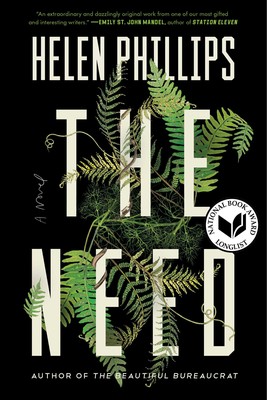
The Need
Buy the book

Helen Phillips taps into this new parent anxiety in her second novel, The Need, the story of a young mother named Molly who is home alone with her two young children when she hears strange noises in her living room. As Molly confronts the intruder in her home, the lines between reality and interiority blur, and she finds herself grappling with her fears about parenting, her evolving identity, and the complex nature of grief.  

Phillips is no stranger to speculative fiction. Her previous books, including the widely praised 2015 debut novel The Beautiful Bureaucrat, also explore the intersection between literary fiction and psychological thriller. Phillips has a knack for using the uncanny and bizarre to uncover deeper truths about humanity, and The Need mines the dissociative state of early parenthood to talk about the experience in a refreshingly original way. However you don’t need to have children to be gripped by Molly’s experience as she tries to protect her family from harm; Phillips has executed a sharply written novel that will unsettle you as it deftly pulls you along. 

I had the pleasure of connecting with Phillips while she was on the California stop of her book tour to talk about living in a world filled with ominous anxiety, writing a book when you don’t have time, and why we need the great American breast pump novel.


Carrie Mullins: I’m always interested in where an author starts their book. What came to you first for this project? A character, a scene, a line?

Helen Phillips: I’m always fascinated by that question, too, because I feel like writers have such different answers to where they begin. I was on a panel not long ago, and one writer said plot and another writer said character, and for me the answer is image. I always begin with a series of images that I collect over a long period of time. And in addition to an image, I’d say there’s some kind of big question I have. To be more specific to this book in particular, there was a night when my daughter was a newborn and I was nursing her, and I thought I heard someone in the other room. It wasn’t anyone, but that flash of a feeling, that fear experience—I felt like OK, I have to write about this sensation of vulnerability. The book grew out of that moment. 

CM: The fear in the opening pages is so visceral. I have a one-and-a-half-year-old, so it was definitely something that I related to. 

HP: It’s gratifying to me that as I send the book out into the world, people can relate to it. Because there are moments when you feel like every other mother has it under control, and you’re the one who has these freaky thoughts. It’s been a relief to me that I don’t seem to be alone in that neurosis. 

CM: Not at all! One of the things that struck me about The Need was how many little moments resonated with me. I feel like we’re living at a time when the conversation around parenthood is a lot more open than it used to be. People feel more comfortable sharing their experiences and challenges. Do you think that’s true?

HP: I wrote this from 2015 to 2018, and there is definitely more space for someone to say something complicated about motherhood than there was in the past. In general, I feel like part of the reason I write books is because I want to have a conversation about something, and that conversation begins as a conversation that I have with myself as I write. When it goes out into the world—and that’s where I am right now—it becomes a conversation with you, with others, and that’s opened up the conversation about motherhood for me in a more targeted way. I’ve had anxiety about the book being published because I feel very vulnerable, very laid bare emotionally even though the book is completely fiction. 

CM: Molly is anxious about her children’s safety, but I feel like the theme of anxiety runs through the book and is treated in different ways.

HP: Yes, I don’t think it’s only a book for parents. An underlying feeling of ominous anxiety is something you can feel even if you don’t have children, and people connect to that element in the book. In a world where global warming is happening, aren’t we all feeling an ominous sense of anxiety rising all the time?

CM: In some ways I hope so because I wonder what the people who aren’t freaking out are thinking.

HP: I’m certainly freaking out. I’ve written a number of short stories with climate change as a theme, but my next book is really going to focus on that. And though this book isn’t about climate change, that underlying anxiety is the background. What you have in this book is everyday moments that are suffused with anxiety, and to me, that’s what climate change feels like. 

CM: Molly finds herself traversing that porous boundary between the real and the unreal. You’ve explored these surrealist elements in your work before. Can you talk a little about how you approach world-building?

There are moments when you feel like every other mother has it under control, and you’re the one who has these freaky thoughts.

HP: For this book one of my goals, aside from the magical or speculative elements, was for everything to feel extremely realistic. I really wanted to capture that texture of having young children, and the daily labor of that, the daily labor of having a job, those tiny domestic moments with coworkers. I wanted it to feel very realistic so that when the speculative elements arise, you’ve already accepted the reality of the book. My rule was to have everything else be completely convincing and believable to our world and then this one thing would be convincing by association. I think of the book Exit West by Mohsin Hamid. Everything is very realistic, but then there are these magical doorways that allow people to jump to different places on the globe. I like the idea of one magical element.

CM: That book is great. Are there any other authors who are working in this space who you find inspirational or exciting?

HP: A book that I talk about all the time, and I will talk about it here because I love it so much, is Fever Dream by Samantha Schweblin. I just can’t recommend it highly enough. It has the forward momentum of a thriller, which is something I was trying to achieve in this book, and is so viscerally unsettling and is really raising deep questions about how much you can protect the people you love. In terms of people who are writing books that have different realities, Octavia Butler, Karen Russell, and Kelly Link. Ursula K. LeGuin, Italo Calvino—I mean there are so many and I could go on with an enormous list, but these are all writers I think about a lot. 

CM: You just named so many fantastic and widely praised authors, but I still have to ask, do you ever find it challenging to sell people on this intersection between literary fiction and thrillers, or literary fiction with fantastical elements?

HP: We spoke about how space is opening up to offer more nuanced portraits of motherhood, and I think that, at the same time, space is opening up for more blending of genres into literary fiction. I think that someone like George Saunders has helped with that, and I feel like Colson Whitehead’s books do that, and it’s a very exciting thing. Even when I was in my MFA program from 2005-2007, I felt like what I was doing with the speculative elements was much more uncommon than it is now. 

But I’ll add that, from my perspective, I don’t ever feel like I’m trying to convince anyone to be more open because I can’t write any other way. It’s the only way that’s exciting and interesting for me, and it answers the questions, “How am I going to portray these emotions? How am I going to use all the possible tools at my disposal to capture this anxiety?” Or I decide this anxiety has to be in the form of a thriller, because that’s what it feels like to have young children sometimes. I wanted to write about how your identity shifts when you have young children and how you become vulnerable to the possibility of losing them. So it comes very naturally to me, and I don’t know any other way to explore the things that I want to explore. 

CM: I always love to hear that a writer is essentially writing for themselves.

If I wasn’t a mother, I couldn’t have written The Need.

HP: When my children were young—I mean they’re still young, they’re 7 and 4, but I feel like The Need really concerns the early years, which have their own special sleep deprivation and lactation situation—I wanted to read fiction about that. I’ve read some really great nonfiction about that time, like The Argonauts by Maggie Nelson and On Immunity by Eula Biss, but I wanted to read fiction that had breast pumps in it. 

CM: Did you find anything? I’ve had trouble finding novels that really captured early motherhood. 

HP: I don’t want to make a mistake, but at that time, I didn’t find fiction books that satisfied that need for me. People have recommended the book Afterbirth (by Elisa Albert) to me so that’s on my reading list, but I don’t think the great American breast pump novel has been written. We’re still waiting for that.

CM: I love that. I hope you write that book. And I agree—I mean I might definitely be missing something, but most of what I’ve seen has been in the non-fiction/memoir genres. It reminds me that I wanted to ask you about that infamous quotation by Cyril Connoly: “There is no more somber enemy of good art than the pram in the hallway.”  

HP: I haven’t heard that quote before, it’s so depressing!

CM: I know, and it’s such an ingrained cliché: that motherhood is incompatible with being an artist. 

I wanted to write about how your identity shifts when you have children and how you become vulnerable to the possibility of losing them.

HP: You hear that as a female artist and you feel like there are only two possible choices for your life, and you’ll have to give something up. I would counter that with a Sarah Manguso quote, which is along the lines of “I don’t want to read books written by people who have time to write books.” I love that so much and I think of it all the time.

I teach full time at Brooklyn College, and during my semesters if I’m lucky I get to carve out 5 hours a week, like one hour each weekday morning. I wrote The Need in these little scraps of time and I think that urgency is present in the book. I think there is an energy that comes from writing a book when you don’t really have time to write one, and if you write a book when you don’t have time, it means you care about it so much that you are making time. So when I think, “How can I call myself a writer if I’m only doing it five hours a week?” that quote keeps me going.

I also want to add that if I wasn’t a mother, I couldn’t have written The Need. My children are detrimental to my work because they take up so much time and energy, but they also bring such bounty to my work, and the experience of love that I experience because of them, I wouldn’t be the writer I am without that. 

CM: I agree. I’ve found that parenthood has put me much more in touch with humanity, with the universal, primal human experience, whereas before I was more enclosed in my own self bubble. The irony is that motherhood is often treated as an experience whose interest or importance is limited to females. 

HP: Right, and The Need is about motherhood but also about so many other things, like can you ever take someone else’s grief as seriously as your own grief? It’s about loss, and the way as a human your life shifts among different possibilities. 

CM: Have you felt gender bias with this book, for example how the publisher might want to market it?

HP: That’s an interesting question. I think the main thing is that I want the questions about motherhood to be taken seriously. The only other thing I can think of is the cover. The initial cover had pink flowers instead of ferns, and I really said no to that because it might be silly, but I think pink flowers are associated with women and it just felt like men would be less likely to pick up a book that has huge pink flowers. 

CM: I think book covers really do influence buyers. I’m so fascinated with them! 

HP: Me too. But I’m pleased with the ferns, I love the cover. 

CM: Have you ever thought about your kids reading The Need one day?
HP: I definitely have. They were at my book launch at Greenlight and they heard me read the first chapter. My 7-year-old daughter gave a cute introduction that night. When they’re older and approaching parenthood, if they decide to have children, I hope that what comes through is what that love feels like that you have for your children, because it’s really hard to articulate. I don’t know if I successfully articulated it in the book, but it’s a love that goes hand in hand with so much dread that something could happen to them. It’s so intense and scary, and it’s not just tulips and butterflies. It’s an intense, bloody, amazing thing. So I hope the force of that is what will strike them and not just, you know, all the scary things their mother thought when they were small.

9 Eerie Ghost Stories

If you’re like me, middle school slumber parties invariably found you hunched over the Ouija Board waiting to talk to the dead. Maybe you felt the same longing I did as your hands hovered over the planchette, pulse thrumming in your fingertips. If only someone would speak! I hungered to be in this way chosen and yearned for a life made golden by the presence of ghosts. Ghost stories still fill me with electricity. Ghosts, after all, are the opposite of mundane, an antidote to the quotidian. I’ll listen to your ghost-sighting tale anytime. I adore classic ghost stories like The Haunting of Hill House, The Turn of the Screw, Beloved, and Rebecca.  

Buy the book

My novel Goodnight Stranger is about all the things that haunt us—our secrets, our pasts. The book’s main characters live in a big, lonely house on Wolf Island, where, they joke, they don’t have any guest rooms, but they have plenty of ghost rooms. The stranger who arrives on Wolf Island feels like someone from a dream: charming, charismatic, and eerily familiar. “Good night ghosts,” the book’s narrator thinks as the stranger becomes more and more of a fixture in their lives. “Good night memories. Goodnight moon. Goodnight stranger in our ghost room.”

When I was writing the book, I sought out stories of hauntings, and I was surprised to find how many contemporary fiction writers seem to love ghosts as much as I do. Here are nine stories and novels to make you feel like you’re sitting around the Ouija board once more waiting for a sign, a word, an invisible touch on your shoulder.

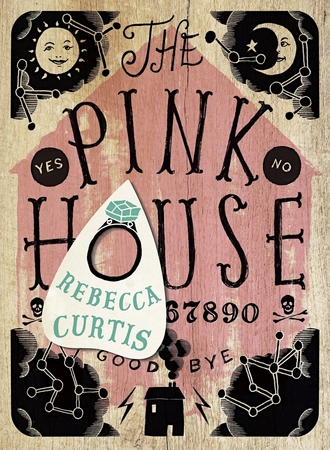
“The Pink House” by Rebecca Curtis

This isn’t the kind of gauzy, diaphanous ghost story you might be used to. This one has teeth. Rebecca Curtis’s uncollected piece from The New Yorker chronicles how the ghost of a young man, killed in a freak accident, returns to occupy the body of an MFA student so he can finish his novel and reunite with his fiancée. It involves UTIs, “quantum entanglement,” and a bar that used to be a funeral parlor. Rebecca Curtis’s writing has a kind of insolent swagger, and this haunted house tale is unflinchingly scary.

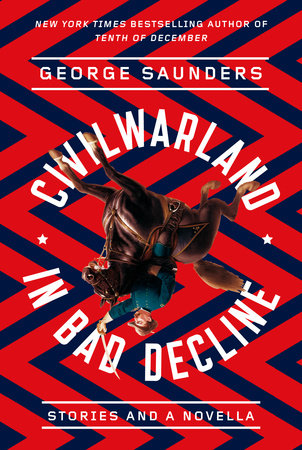
CivilWarLand in Bad Decline by George Saunders

“CivilWarLand in Bad Decline” by George Saunders

George Saunders’ characters seem to slip from one consciousness to another as easily as you and I walk from room to room, so it’s not surprising that ghosts play a sizable role in much of his fiction; Lincoln in the Bardo’s extensive cast is made up almost entirely of complicated, excitable ghosts. My favorite George Saunders ghost story is “CivilWarLand in Bad Decline” the title story in his 1996 debut. The first time I read this story, in 2001, I was gripped by the exhilarating conviction that here—finally—was a storyteller’s handbook for breaking the rules. I still delight at the madcap hilarity of the McKinnon family, compelled to reenact their own deaths in a whirlwind of bafflement and blame, as an underappreciated worker in “CivilWarLand” struggles to save the theme park, and his livelihood, from financial ruin due to marauding gangs. Sounds like classic George Saunders? It is. And the story ends with what I’ve come to think of as the Saunders crescendo, a final paragraph as lyrical, impassioned, and transcendent as the last bars of The Beatles’ “A Day in the Life.”  

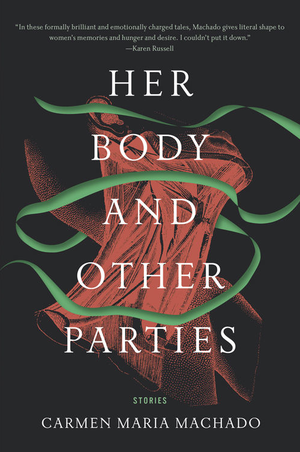
Image result for her bodies and other parties

“Especially Heinous” by Carmen Maria Machado

“The Resident” is the best haunted house story in Carmen Maria Machado’s stunning Her Body and Other Parties, but “Especially Heinous” is the best ghost story. Told in 272 episode-descriptions of an alternate-reality Law & Order: SVU—like some glorious otherworldly TV guide written by poets and lyricists—every line of this 60-page story is incandescent. Like any great ghost story, the main characters are haunted by many things, including the ghosts of murdered girls will bells for eyes. With so many tangling threads, character arcs, and plot twists, you have to read this story as a series of luminous impressions, a brilliant collage of soundtrack and film clips.

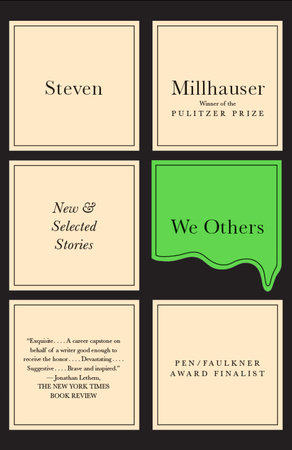
We Others by Steven Millhauser

“We Others” by Steven Millhauser

A desperate love triangle between two women and a ghost who spends most of the story slipping in and out of existential crisis, “We Others,” from his book by the same name, is a treatise for ghosts, about ghosts, compiled by a (recently dead) ghost. Millhauser’s sentences are crisp and surprising as lightning flashes, and his ghost-narrator’s reflection on metaphysical life will make you question your own impressions. “Have I spoken of the dawn?” the story’s ghost asks us. “We do not like the dawn. We object to its youthful radiance. We dislike its suggestion of new beginnings, or the uplifted spirit. We are creatures of the downward-plunging spirit, where hope perishes in black laughter.”

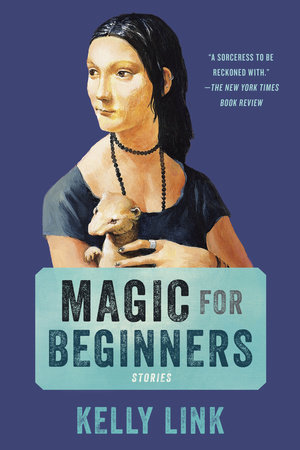
Magic for Beginners by Kelly Link

“Stone Animals” by Kelly Link

Kelly Link’s new book Get in Trouble is brimming with ghost and haunted house/spaceship stories, but my favorite Kelly Link ghost story is “Stone Animals,” from Magic for Beginners, about a house haunted by rabbits, a marriage haunted by a lie, and an armadillo purse haunted by I’m-not-sure-what. Actually, household items become haunted at an alarming rate in Link’s brilliant story: toothbrush, TV, alarm clock, toilet. What has haunted me as much as the story itself are Link’s word about the writing of “Stone Animals”: “Sometimes I think all good short stories function as ghost stories, in which people, themes, events that grip an individual writer occur again and again like a haunting.”

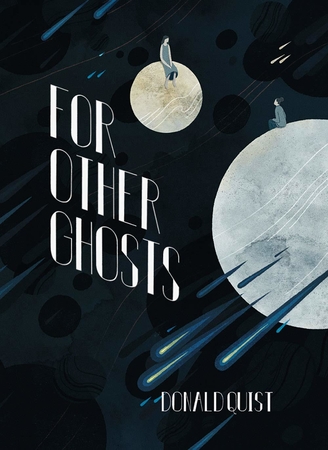
“The Ghosts of Takahiro Ōkyo” by Donald Quist

Set in Aokigahara, the haunted forest known as the most popular destination for suicides in Japan, Donald Quist’s “The Ghosts of Takahiro Ōkyo” from For Other Ghosts is ominous, severe, and haunting as a melody. In it we meet Daisuke, a young man so adept at finding dead bodies in the forest the other forest workers call him the “god of death,” and his uncle, haunted for years by a friend he left for dead in the heart of the forest.

Image result for poster

Heart Spring Mountain by Robin MacArthur

Robin MacArthur’s unforgettable debut novel follows four women in one family: Vale who returns home to Vermont to search for her mother who’s been missing since tropical storm Irene; Deb trying to find her path as a widow in middle age; Hazel slipping into dementia; and Lena, long dead, who we get to know through her charming letters to trees, bees, and owls. The book is about family, landscape, and deep intergenerational love—and the way the past resurfaces whether we want it to or not. The ghost shows up near the end, but the book is haunted all the way through.

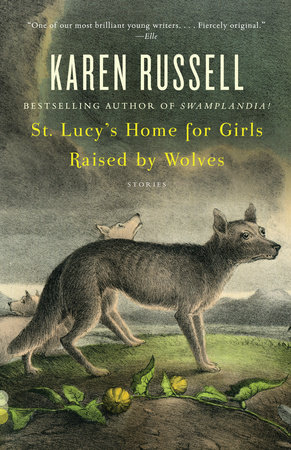
Image result for st lucy's home for girls raised by wolves

“Haunting Olivia” by Karen Russell

Bereft siblings Timothy and Wallow search the marina for their dead sister Olivia, who slid out to sea on a giant crab-shell-sled two years ago. With the help of magical goggles, the boys find the sea’s population of ghostly underwater life. Every line of this story from her collection St. Lucy’s Home for Girls Raised by Wolves is haloed by grief and regret; it’s bittersweet and tender as a bruise, and the writing is just plain gorgeous—especially the agile descriptions of bioluminescent creatures and murky aquatic light.

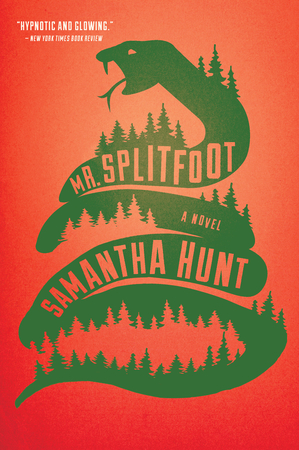
Mister Splitfoot by Samantha Hunt

This is my favorite contemporary ghost story, and maybe the most romantic book I’ve ever read. It tells the story of orphans Ruth and Nat, and a salesman, Mr. Bell, who helps the teens charge money for contacting the dead. It’s also the story, decades later, of pregnant Cora, who follows her mute auntie Ruth hundreds of miles north—on foot. The book is terrifying, and mystifying, and the love story is so pure and fierce and strange, it reminds you that love, like death, can be brutal or sublime.

A Literary Road Trip through Southern California

Tom Waits grew up in southern California, and “Going West” is probably the most famous of his California songs (“Little brown sausages / lying in the sand. / I ain’t no extra, baby / I’m a leading man”). But there’s a great early riff, “Diamonds on My Windshield,” that puts you in the front seat with the young, aspiring musician, driving all over southern California at night, presumably from gig to gig:

So 101 don’t miss it
There’s rolling hills and concrete fields
And the broken line’s on your mind
The eights go east and the fives go north
And the merging nexus back and forth
You see your sign, cross the line, signaling with a blink

“Diamonds on My Windshield” by Tom Waits

It could almost be another entry in the SNL series of sketches The Californians, what with the number of freeway references and city names he checks (“It’s these late nights and this freeway flying / It always makes me sing”). But there’s also a cast of characters and a noir mood that feel quintessentially of the region and of a certain time. 

Image result for The Churchgoer: A Novel
Buy the book

In writing a southern California noir, I came to realize: isn’t that one of the main pleasures they offer? Not the whodunnit but the excuse to hit the road: go to parts of town you don’t normally visit, talk to folks you maybe see but don’t understand, get behind the gate and knock on the rich guy’s door and check out his dirty laundry. Mystery novels are road novels, oftentimes, with moodier lighting.

There are the classic writers that get referenced when someone wants to introduce southern California’s place in literature—Chandler, Didion, Fante, West, Mosley, Ellroy, etc.—but if that’s your window onto our half of the state, there’s a lot you aren’t seeing. It’s like sticking to the freeways, instead of getting off onto some surface streets and fire roads. So here are a few idiosyncratic rest stops I’d recommend as you cruise the southland at night, trying to figure out how the hell you ended up at the end of the known world, with a front-row bucket seat and a sea-misted windshield as we hurtle toward the end of life on Earth.

Los Angeles, Part I: The Poetry of Wanda Coleman

There are so many writers on L.A. that choosing one is impossible, so I have to start with Wanda Coleman—not because we share a name—but because she gave voice in poem after poem to the many difficult aspects of life in southern California, deeply reflective of her experiences as a working class black woman. The language in her work is fiercely alive, wildly veering, containing a rich vein of multitudes. Take a look at “Requiem for a Nest,” which is as good as description of Los Angeles as one could hope for.

Still Water Saints by Alex Espinoza

Inland Empire: Still Water Saints by Alex Espinoza

It’s easy, if you’re only thinking about television and film, to forget that California is mostly away from the coast: suburban, rural, agricultural, desert—places like the Inland Empire. The shifting demographics and economic realities of making it in California (as Woody sang, “If you ain’t go the do-re-mi, boys…”) mean the Inland Empire is dynamic, quickly changing. 

For an immersion into ways of life in the IE, you couldn’t do better than Still Water Saints. Centered around a botánica in the fictional town of Agua Mansa, the people who turn to the shop’s owner, Perla, and her remedies for their troubles each give a window into different aspects of life, especially Latinx and queer experience, in Riverside and San Bernardino counties. A stunning, sensitively written book.

Newport Beach: The Barbarian Nurseries by Héctor Tobar

I lived in Orange County for a long time—behind the Orange Curtain, as we’d say—and I recently read The Barbarian Nurseries, which brought me back to and inside some of the complications of that world. It’s so bright, so brilliantly sunshine-filled and overdeveloped with glass and fake grass, that it might as well be a black hole and all that glitter the event horizon. In The Barbarian Nurseries, we see the area through the eyes of Araceli, the undocumented housekeeper who lives with Scott and Maureen Torres-Thompson, wealthy OC suburbanites, and their children. Sweeping and thorough, incisive about race and immigration and money, it’s also funny and human and beautifully told.

Parable of the Sower by Octavia E. Butler

Pasadena: Parable of the Sower by Octavia E. Butler

In Parable, a climate apocalypse has wrecked Los Angeles, making communities more insular, more tribal, more openly racist. Violence is common to protect resources and fight off threats, neighbors. It’s so close to where we are you can taste it. Which makes it hard reading—or did for me, when I tried to read it again after the last election. But as most science fiction is really about the present, Butler has a lot to say about the southern California the book’s future is extrapolated from (she was from Pasadena), how unevenly that future—and our present—is distributed, and what it may take to envision and enact something better.

Image result for walt disney the triumph of the american imagination

Hollywood: Walt Disney: The Triumph of the American Imagination by Neal Gabler

Disney is in the Southern California DNA, for better or worse, and Gabler’s biography—despite that “triumph” in the title—gives the better and the worse. The young man with an idea for what animation can be, slowly becoming an anti-union conservative stalwart and cultural icon who has a utopian vision for reshaping American life (the Experimental Prototype Community of Tomorrow, or EPCOT) left unrealized at the time of his death. He’s the blueprint for so many “visionary” men in California today, and the effect he had is hard to overestimate. (Don’t we all live in Disneyland now?). And yet I can’t read through the end without sobbing like a child, and I don’t exactly know why. That might be the most Californian contradiction I can think of.

Catalina Island: Catalina by Liska Jacobs

Elsa, the darkly charming protagonist of Catalina, enacts a road story of her own. She’s fled an upbringing in Bakersfield for a low-rung toehold in the New York art museum scene. When an affair with her senior curator boss goes south, she heads back home, then flees again to Santa Monica, at the end of her rope, before she goes a little farther still: to the titular tiny island off the coast (where Natalie Wood drowned, no less). Accompanied by prescription drugs and a few old friends (though “friend” is too strong by several degrees, and at the same time too simple), Elsa gives Jacobs room to make breathtakingly fresh and sharp observations about self-destruction, female anger, and the complexities of desire and pain.

Image result for The Sympathizer

Los Angeles, Part II: The Sympathizer by Viet Thanh Nguyen

So much has been said about this novel, I’m wary of just saying it all again—but if you’ve had too much coffee, and you’re driving around LA until four in the morning waiting to come down, the audiobook of The Sympathizer might be the perfect company. With its portrayal of a half-Vietnamese, half-French double-agent during and after the Vietnam War and his eventual relocation to a community of refugees in Los Angeles, the novel is big and alive and endlessly rewarding. It also will change the way you see the Vietnam war, and Hollywood’s role in shaping it into a narrative for white Americans, in a profound and, I’d hope, permanent way.

Image result for sellout by paul beatty

Compton (and Other Coastal Cities): The Sellout by Paul Beatty

Hilarious and dangerous—like hazardous to your health and mental well-being—The Sellout is perhaps the most Californian book on this list.

It’s got everything: police violence, segregation, urban change (and outright disappearance), but also the fading fame of a Little Rascal, sociology, a lot of weed, and surfing. Just when you think the novel has left nothing untouched by its sharp eye, it finds new room to move, like it’s a VW Bus that’s secretly a pop-top Vanagon with NOS, a roof rack, full kitchen, built-in cooler, exterior shower, and no privacy curtains. 

At the time it came out, I’d been writing about San Diego surfer Evangelicals for a few years, but here was this very different narrator, talking about why he surfs Venice and Santa Monica: “No real reason. The waves were shit. Crowded. Except that every now and then I’d see another surfer of color. As opposed to Hermosa, Redondo, and Newport, which were much closer to Dickens, but the breaks were dominated by straight-edge Jesus freaks who kissed their crucifixes before every set and listened to conservative talk radio after the sessions.”

To exist in the same California as Paul Beatty!

Anaheim: A Scanner Darkly by Philip K. Dick

Philip K. Dick grew up in the Bay Area but spent the last ten years of his life in Orange County, living between Fullerton and Santa Ana and setting A Scanner Darkly in Anaheim—wildly hallucinatory, divinely touched years, which is oddly appropriate given the area’s support of both Disneyland and Crystal Cathedral (former broadcaster of The Hour of Power television show). In A Scanner Darkly, an undercover agent embeds with a house of addicts hooked on the drug “Substance D.” Self-dissociation, drug dependency, deception, recovery and the recovery industry all tangle, in a soulless, consumer-driven America. Okay. Sounds familiar enough. But it’s on loss and how institutions fail those they purportedly protect that A Scanner Darkly especially sings, and stings.

The Power of the Dog Series

San Diego: Power of the Dog Series by Don Winslow

Across three books—Power of the Dog, The Cartel, and The Border—Winslow has created a crime fiction epic about the drug trade and the war on it, US policy and politics, and the lives on both sides of the border with Mexico. Okay, fine: it’s not all set in San Diego—the story goes from Washington, D.C, to South America, with stops between—but the San Diego/Tijuana region comes into play often enough. It’s massive, and grim, and there’s so much to absorb here about how we understand a place like this in a larger cross-border and global context.

Los Angeles, Part III: The Crying of Lot 49 by Thomas Pynchon

Oedipa Maas hits the road from northern California after her ex, the real estate mogul Pierce Inverarity, dies and she’s named in the will. She spends most of the novel piecing together elements of a conspiracy by driving around San Narciso (a fictionalized LA) in the mid-1960s. There are sleazy men, psychedelics, too much pop music energy, countercultural scheming—and Oedipa, a brilliant character on a mission to find meaning in a chaotic world but riding an uncertain, paranoid edge through the U.S. postal system. It’s gonzo, I know—but, as Bob Dylan once said, every word of it’s true, except the parts he made up. A good guide to southern California then, southern California now, and America for the foreseeable future.

Image result for farewell to manzanar

Extra Miles: Farewell to Manzanar by Jeanne Wakasuki

Keep driving, technically just beyond the true border (whatever that means) between southern and northern California, and you’ll reach Manzanar. When I read this book about coming of age in the Japanese internment camp there during World War II, I was a kid, and I never expected that we’d need to read it as much as we do now. Concentration camps for children was once a part of the California story, the American story. They are again.

Who Needs an MFA When You Have This Literary Fiction Trope Checklist?

Writing literary fiction stories? Forget what you’ve learned about complex characters and earned endings. What you really need is to include the required tropes. To help you out, we’ve created this handy checklist.

Literary Fiction Trope Checklist

_____ 1. Starts with character waking up

_____ 2. Starts with character looking out of window, describing scenery

_____ 3. Protagonist is writer with writer’s block

_____ 4. Protagonist teaches English comp; hates self

_____ 5. Death of child/miscarriage in past no one talks about

_____ 6. Character describes self in mirror 

_____ 7. Character describes self in window

_____ 8. Character describes self in polished spoon

_____ 9. Taste of blood described as metallic 

_____ 10. Woman who looks good without trying compared to female protagonist who looks bad despite trying

_____ 11. Main character drives to ex’s house and watches through window

_____ 12. Shoebox of letters/keepsakes under bed

_____ 13. Story is a story protagonist is writing

_____ 14. Wise child

_____ 15. White savior

_____ 16. Villain who is kind to pet

_____ 17. Staring at floor/staring over shoulder/staring into middle distance

_____ 18. Refrigerator empty except for beer/spoiled milk

_____ 19. Scene in writing workshop

_____ 20. Scene in dirty trailer

_____ 21. Dogs bark in distance

_____ 22. Upset character barfs

_____ 23. Depressed character cuts/takes to bed

_____ 24. Therapist quoted 

_____ 25. It was all a dream