How Online Confessional Columns Are Reinventing the Diary Book

As a pre-teen, I devoured books written in diary format. From the Royal Diaries series, which featured juicy details from the lives of famous nobles like Cleopatra and Marie Antoinette, to the wildly age-inappropriate Bridget Jones’s Diary, as long as each chapter started with “dear diary” and dangled the promise of outrageous oversharing, I was in.

Today, I’m a 20-something living in Brooklyn, and I’ve moved on to what I now view as the holy grail of first-person narrative: online diary columns. A sampling of my favorites include The Grub Street Diet, which gives readers a glimpse into the daily routines of gustatory greats; The Cut’s anonymous Sex Diaries, showcasing the sexually ravenous and the sexually chaste; Refinery29’s Money Diaries, which explores how people spend their hard-earned dollars; and The New York Times’ Sunday Routine, chronicling how “newsworthy New Yorkers” try — or, more often, fail — to unwind on the weekends. As a former anthropology major, I justify my habit as voyeurism lite, porn for those of us who wish we were Harriet the Spy, a non-creepy way for generally rule-following humans to satisfy our nosiness. I’ll see your Rear Window and raise you a Sex Diary.

The conceit of many diary-style books, including the Royal Diaries series, is that the authors use their journals as a much-needed respite from their examined lives. As Princess Victoria writes in Victoria: May Blossom of Britannia, England, 1829 by Anna Kirwan, “The reason I hide this ledger is that I do not wish anyone to know that it exists. Really, I must have a place to pour out my curious thoughts privately and sort through them. I never get to be truly alone.” Back when these books were published, in the late ’90s through early aughts, we thought that having access to someone was knowing them. Today, we have the exact opposite problem: despite our unlimited sharing via social media, we aren’t able to obtain an “authentic” glimpse into anyone’s life because we live too self-consciously for it to exist.

Back when these books were published, we thought that having access to someone was knowing them. Today, we have the exact opposite problem.

There is nowhere this is more apparent than in the land of online diaries: the diarists know their accounts are being read. The question is not what they do when nobody is watching but what they choose to do when they are aware that everyone is watching. In his Grub Street Diet, comedian John Early makes no secret of the fact that his dining habits are influenced by the assignment itself. He chronicles the low-grade hysteria he feels on his first day: “My daily cold-brew-induced panic begins, and I find myself immediately paralyzed by the performative nature of the whole endeavor. Will I accurately represent myself as the passionate eater that I know myself to be? Will I bring attention to the restaurants and small businesses that truly need it? Is it braggy to talk about my boyfriend? It feels so transparent to include him (‘I, too, am loved!’), but dishonest to leave him out!”

If the idea of the pre-internet diaries was to transmit a snapshot of a famous person’s actions, the internet diaries offer an outline of a famous person’s neuroses; readers witness them fret over everything from the quality of their writing to the quantity of food they consume. Alan Yang, co-creator of Master of None, prefaces his Grub Street Diet with this disclaimer: “What you’re about to read is a description of one of the craziest series of meals I’ve ever had…I love to eat good food, but this is not normal.” For his first feast, Yang orders: “three cheeses and blood-orange marmalade; salumi misti; a green salad with anchovies; roasted beets with whipped ricotta; burrata; white-bean soup; seared octopus with ramps; tonnarelli cacio e pepe; bucatini all’amatriciana; fettuccine alla carbonara; pappardelle alla Bolognese; malfatti with braised suckling pig; cavatelli with pork sausage; chitarra with charred ramps; chicken cutlet; poached trout; roasted carrots; and charred asparagus.” As can be seen by both Early and Yang’s anxious preambles, there is something incredibly meta about the whole ordeal: a week lived a certain way because the author is using it to market himself, curating a facade that he knows will leave an impact on his reputation and career as soon as the following day.

Bridget Jones in the Age of Twitter

While it’s easy to think that perhaps the diarists are overly self-conscious, all one has to do is scroll to the bottom of each article to witness its immediate impact IRL. Here, the comments sections function like the Wild West of yore, except the cowboys are internet trolls and their shootouts are executed with loaded words. The tenor of each showdown varies by site. Readers of The Grub Street Diet tend to be mean, declaring female diarists anorexic and each of their male counterparts more of a pretentious asshole than the last. Chronicling a trip to Los Angeles in his 2016 Grub Street Diet, the late Anthony Bourdain writes: “For dinner, I got a double-double, Animal-style, and a chocolate shake at the drive-through at the In-N-Out Burger on Sunset, and took it back to my hotel. I ate the fuck out of that thing.” Below, sport7 comments, “It’s amazing how fame has made him insufferable,” and EdsRevenge agrees: “Poor Anthony. It must be absolutely exhausting to work so relentlessly at trying to seem cool.” Lvlvlv is less forgiving: “WTF else would you do with your DINNER, Captain obvious…is he contractually obligated to tack on an obscene comment to everything he says?”

If judgmental reactions stem from the feeling that the celebrity in question is trying too hard, it follows that the attitude on sites featuring anonymous diaries is the opposite. On Refinery29’s Money Diaries, pseudonymous millennials compare meditation apps, empathize over grueling spin classes, and generally affirm each other. A commercial analyst in Houston, TX recounts a conversation with her girlfriend, “She tells me she thinks one of her friends is a Trump supporter — I tell her to get new friends.” Below, HOTWINE cheers her on with a: “yasss qween!” Similarly, the unnamed authors of The Cut’s Sex Diaries detail their most salacious sexual acts without fear of blowback. “The Man Planning a Thanksgiving Threesome” describes an extremely active week of his polyamorous sex life and Harveywallbanger voices appreciation: “I love the combo of hard core sex and participation in small business Saturday.” Nearby, dc10001 pipes up with a constructive editorial suggestion: “Lacks detail on the T-day menu. Was there stuffing?” It turns out WASPyJewess is similarly preoccupied: “No way he brined his turkey for 3 days!!! Now I don’t know WHAT to believe!!!”

What drew me to read about the daily practices of Marie Antoinette is the same thing that pushes me to skim an article about an intern sexting with her boss.

The majority of my online diary-reading takes place in the liminal state of post-3 a.m. insomnia, when I let the information wash over me as a sort of anaesthetic. Despite each narrator’s careful curation of the most envy-inducing events of their week, it’s often the mundane details that lodge themselves in my brain; a behavioral health counselor in Anchorage eats Starbucks’ eggs sous-vide for breakfast every morning; Neil Blumenthal of Warby Parker fame is “constantly chatting with peers” and does early morning push-ups with his daughter on his back; “The Interior Designer Cheating on Her Husband With an Actor” once masturbated under the table in a Tribeca café. While the lattermost is a morning ritual I don’t plan on adopting, the others intrigue me. Maybe I would be a more balanced person if I started my days with slow-cooked eggs. I can’t found Warby Parker but I do have peers — if I dedicated more time to chatting with them, would I come up with an idea that would lead entrepreneurs worldwide to revere me as an industry disruptor? Perhaps I could convince the toddlers who live in the apartment above mine to sit on my back while I do push-ups.

I make these tendrils of plans idly, telling myself I’ll start tomorrow. But by the time I scroll to the end of the page I’ve already forgotten, their novelty melting away like the wax on Icarus’ wings. Call them routines or addictions; the truth is that if we were so easily swayed from our patterns these diaries wouldn’t exist at all. What originally drew me to read about the daily practices of Marie Antoinette is the same thing that pushes me to skim an article about The Intern Sexting With Her Boss: we all pursue specific pleasures in order to quell our universal human needs. Like any recovering anthropology major, I’m fascinated by how people knowingly expose themselves to the world in order to gain favor. What do their “inner monologues” sound like when they’re aware that cyberspace is listening? How do choose to portray themselves? What will they cop to? Who sits on you while you do your push-ups?
Why Was Norah Lange Forgotten?

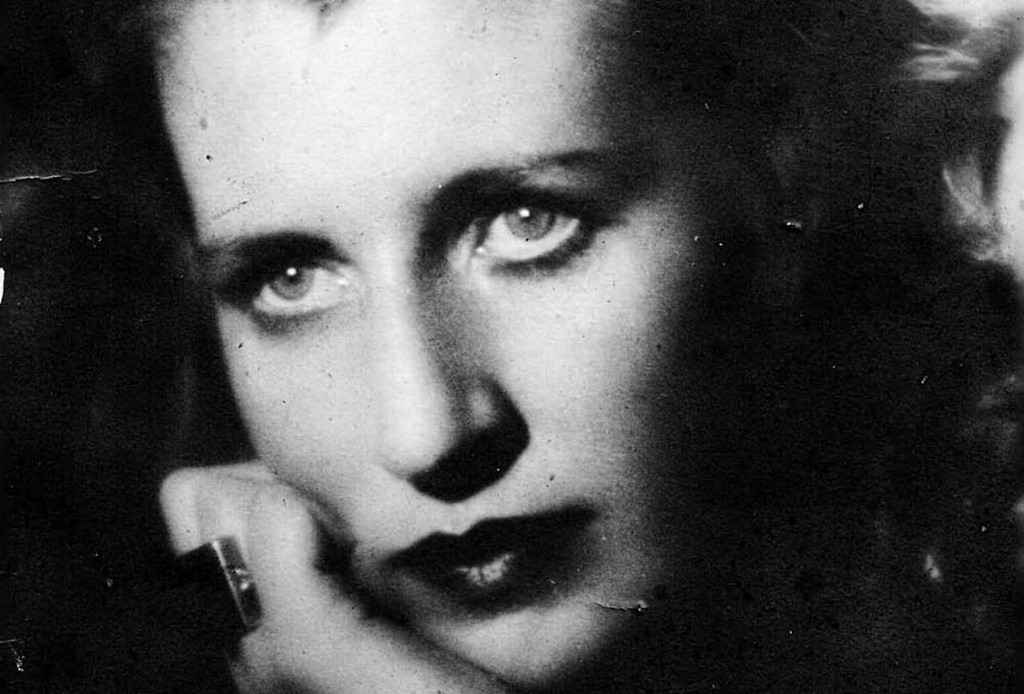
First published in 1950, Norah Lange’s People in the Room (Personas en la sala) is an intimate, intricate experimental novel that, despite Lange’s place at the center of the avant-garde literary scene in Buenos Aires at the time, was largely overlooked for more than half a century. Well, maybe not “despite.” As Leonor Silvestri observed when the second volume of her complete works was published in Argentina in 2006, Lange was a striking redhead known first and foremost as a muse and wife, whose “visibility as a character inhibited the legibility of her writing.” This writing, nonetheless, was extensive and profoundly innovative, sometimes pushing the bounds of propriety (as in her 1933 novel 45 Days and 30 Sailors, about a young woman who makes a transatlantic crossing alone on a ship full of men — an apt metaphor for the literary landscape at the time), sometimes adopting themes deemed “suitable” for female writers of her day (namely, anything having to do with the domestic sphere) and adapting them to disrupt those same norms. In his introduction to People in the Room, César Aira describes Lange’s novels as “strange meteorites unlike anything else that was being written at the time.”

Purchase the book

I met Charlotte Whittle almost three years ago when we were introduced by a mutual friend who thought we might have a lot in common — since, you know, we both translate from Spanish. They had no idea how right they were: at the first of our many two-person translation symposia (i.e. book nerdery over beverages), she mentioned that she was pitching a novel by Norah Lange, who was married to Oliverio Girondo, the poet I’d been translating on and off for ten years. That made us literary half-sisters! Or was it sisters-in-law? Cousins? I don’t know, but I do know this: the novel she was talking about is the haunting, enigmatic masterpiece People in the Room, which she brought into English with spellbinding grace and precision.


Heather Cleary: Tell me about People in the Room, and Norah Lange, and how you came to translate the book.

Charlotte Whittle: I first read Norah Lange when I was doing graduate work in Hispanic Studies. I had a friend called Nora Lange who’d just moved into an apartment with some upstairs neighbors from Argentina, who asked her if she was familiar with the work of the Argentine writer, Norah Lange. Nora Lange, an American writer of fiction, was captivated by the idea that there was a writer in the Southern Hemisphere from whom she was separated by only an ‘h.’

So Nora Lange asked me if I knew anything about Norah Lange: that was the first time I’d heard of her. I soon learned that Lange was associated with some key moments in Argentine literary history, that she’d participated in the founding of the influential avant-garde journal Martín Fierro, and that her childhood home was the site of some of the most legendary bohemian intellectual gatherings in 1920’s Buenos Aires. She began her literary life as a poet; her early work was influenced by Borges’s ultraísmo (and her first book was introduced by him), and she went on to write beguiling, poetic memoirs, and some incredibly striking novels. Despite all this, when I asked my academic advisor at the time — a major scholar of Latin American literature — about Lange, his reply was that she’d been “completely forgotten.” Needless to say, that really piqued my interest.

I was mesmerized by Cuadernos de infancia (Notes from Childhood), Lange’s only book to have remained consistently in print since it was first published. I remember thinking at the time, I want to translate this, I want to carry this gorgeous prose into English, but I wasn’t yet on the path to translation. Still, the seed had been planted.

It was on a trip to Buenos Aires that I was able to track down the complete works (which were finally published in 2005–6, but still weren’t very easy to find), and was really seduced by the haunting language and unique authorial gaze of Lange’s later work. The voice of the narrator of People in the Room captivated me, that sense of probing around in the dark, having only a partial view. I began translating it not because I had a particular plan, but out of a need to know how it would sound. I worked on it in my spare time while I was teaching, then proposed it to And Other Stories at the point when I realized I wanted to be a translator.

The voice of the narrator of People in the Room captivated me, that sense of probing around in the dark, having only a partial view.

HC: The novel is enjoying a fantastic reception right now, but it’s taken about 75 years for Lange to get any kind of mainstream attention. Why do you think people were so slow to catch on to her work — not just in English, but in Spanish, as well?

CW: I think the answer to that has several layers. The question of Lange’s reception in Argentina is quite vexing, because it’s not like she was unknown — she came of age surrounded by key figures in the Buenos Aires literary scene, and she did enjoy some recognition among her peers during her lifetime. But one gets a strong sense that she’s now known more as a character in literary mythology, as Girondo’s wife, or as this flame-haired Scandinavian bombshell who supposedly broke Borges’s heart. Even now, her outsized reputation as a figure in literary life tends to overshadow her work. K.M. Sibbald writes that Lange was “a victim of her own legendary literary status,” and I think that captures part of what happened. The reception of her work was often filtered through statements by the men around her, beginning with Borges’s prologue to her first book of poems, and her later books were sometimes described by male critics in extremely gendered language. And, of course, she was overshadowed by the male writers she associated with, simply because of the gender prejudices of the time, which meant that male genius tended to be revered, often to the exclusion of other voices.

Sylvia Molloy suggests that Cuadernos de infancia, Lange’s most widely read book, was successful and enduring not only because of its ground-breaking prose, but because it allowed readers to identify the unconventional Lange with the traditionally feminine subjects of domesticity and childhood. Lange was an eccentric, and some readers weren’t sure where to place her until then — writing about her journey to Norway by boat with 30 sailors, for example, was deemed inappropriate material for a young woman. Perhaps that’s also part of why she felt she needed to “unwrite” Cuadernos with the more opaque, avant-garde memoir Antes que mueran (Before They Die) — to undo the easy classification to which she’d been subjected.

Lange’s circumstances are obviously particular, but the same question could be asked about so many women writers only now appearing in English translation — some of whom, like Lispector, were canonical in their own countries, and others, like Amparo Dávila, whose work is now being reassessed in Mexico ((and whose searingly strange stories have just been published in English by New Directions). To answer it, we’d have to look more broadly at how the canon is formed in these writers’ countries, and in our own. Which works are chosen to be studied in universities, enshrined as classics, and considered “essential”? Which ones are kept in print beyond a first or second run? These are all contributing factors, and gender bias is present in all of them. People like Meytal Radzinski, Margaret Carson, and Alta Price have done a lot to draw attention to the gender imbalance when it comes to who gets translated. I also can’t resist mentioning A.N. Devers’s work with The Second Shelf, which approaches gender imbalance in the literary canon from the angle of collecting. There is so much work to be done, but projects like these, and the positive reception of People in the Room demonstrate that there’s a thirst for work by writers like Lange who might previously have been overlooked.

HC: What would you say to a reader unfamiliar with Lange — and the avant-garde literary scene in Buenos Aires at the time she was writing — who is interested in picking up this book?

CW: One of my favorite images of Lange is from a party celebrating her early novel, 45 días y 30 marineros (45 Days and 30 Sailors). Norah lies horizontally, dressed in a mermaid costume, holding a wine glass the size of a goldfish bowl. She’s surrounded by men dressed as sailors, among them Pablo Neruda and Oliverio Girondo. Norah’s friend García Lorca was also there that day. Norah was an unconventional woman who lived her life in a way that paralleled her work: she was a performer, known for the spirited speeches she gave about her fellow writers. Though she explored the limitations and the possibilities of domestic space, she herself didn’t spend her life hiding in the drawing room. The picture of her surrounded by men may accurately represent her situation as a woman writer, but she knew how to negotiate her objectification as a muse, and while she was working tirelessly on serious literary projects, she was also often having a lot of fun.

HC: Excellent. So, what is People in the Room about?

CW: The scenario is that a seventeen-year-old girl — the novel’s narrator — lives in a well-to-do suburb of Buenos Aires, and spends hours spying on three mysterious women, whom she assumes to be spinsters, and who live in the house opposite her own. One night, she is struck by the arresting image of their three faces arranged in the form of a “pale clover.” Lange said in an interview that the image came to her after she saw the famous portrait of the three pale-faced Brontë sisters by their brother Branwell, who erased himself, but whose ghostly outline can still be seen in the painting.

After several nights of gazing at the women through their window, spying them behind their gauzy curtains, the narrator sees them sending a telegram at the post office, decides to intercept the reply, and delivers it to them as a way of contriving to visit their house. The telegram alerts the women that a man will visit them, a man about whom the reader learns nothing. But the narrator’s plot to enter the house is successful, and she spends many evenings sitting with the women, hearing them utter enigmatic phrases, and imagining the stories they might be hiding. A sighting of a spider, a conversation about a blue dress, and a telephone call in which no one speaks all qualify as major events.

It should be clear from this summary that this is not a novel to be read for plot (Aira writes, somewhat provocatively, that it’s “not a novel to be read for pleasure”), but one to be read for language, atmosphere, and states of being. It’s hallucinatory and death-anxious, and contains shards of the gothic and of the 19th century novel, rearranged into something uncanny and wholly modernist. You could say it’s a book about voyeurism, or about domestic entrapment and female isolation during the early twentieth century, and it is about all of those things, but I think one of its many strengths, what for me makes it so compelling, is that it allows you to slip in between all these readings; each rereading generates new layers of meaning. I’ve also come to see it more and more as a novel about literary creation, with a narrator who replaces reading with voyeurism, and is herself a novelist in search of a story that continually eludes her.

HC: What challenges did the translation present? Is there a particular passage you could cite as an example of how you worked through some of these?

CW: Of course, Spanish can accommodate very long sentences, much more so than English, and often when translating from Spanish the tendency is to shorten them, to make them less unwieldy. I recently heard John Freeman talk about editing a series of young Latin American writers in translation and thinking, wait, why do they all write like Henry James? That may be an exaggeration, but there’s a kernel of truth to it. It’s a characteristic of Spanish. But with Lange, I felt that those long, meandering, and yes, Jamesian sentences were really part of her project, and needed to be preserved. But they had to be preserved in such a way that the reader in English didn’t feel completely untethered and adrift. That’s a risk because there are certain grammatical markers in Spanish — gender and adjective agreement, for example — that can function as signposts in the text and make those long sentences more navigable, and which get lost in English.

Another, related thing that was really interesting about this translation was Lange’s use of punctuation. We could say loosely that the narrator moves between two modes. One of them is controlled and precise, and another is almost unmoored. In this latter mode, Lange uses less punctuation. Take the beginning of Chapter 12, when the narrator hears of the fire. This is the first chapter where we have an inkling that the narrator’s obsession is making her unwell. We see the commas become less frequent as the narrator’s conscience is bombarded with simultaneous details.

It was so important, not just to make the punctuation work as English punctuation, but to listen for how it’s used to create the pauses and breathlessness that contribute to the narrator’s very particular voice. Maybe that was the greatest challenge of all — finding the voice. Balancing the complexity of the language and the intimacy and almost conversational tone, the atmosphere of suspense. The narrator is young, and as I mentioned, I thought of her as a reader and writer. The Brontë portrait was often on my mind, and the fact that Lange seems to be tracing this path between the nineteenth century and what we think of as Modernism. There are certain period markers in the novel — horses and carts, the novelty of the telephone. It’s a period of change, and the voice reflects that moment of transition. Certain choices I made were informed by that connection to the nineteenth-century novel. That’s why, for example, the narrator is so often “vexed” rather than “irritated” or “annoyed” — use of that word peaked in the mid-nineteenth century and often crops up in the Brontës and Jane Austen. At the same time, Lange’s language is innovative and daring, full of unexpected combinations. I wanted to resist the temptation to to tame it, and let her striking modernity come through in full relief.

Lange’s language is innovative and daring, full of unexpected combinations.

HC: Translation is a unique form of creative work, but it also draws on a wide range of skills. What is the most surprising job or activity from your past that has influenced your approach to translation?

CW: Once upon a time, when I was about 14, I spent a summer taking apart a nineteenth century log-cabin in Southern Idaho: strip off the siding, tear out the nails, develop a complex labeling system to mark each join in the logs, deconstruct, load onto a truck so the logs could be transported 500 miles, and the house rebuilt in a different setting. If we understand each novel as a house with its own particular architecture, that process of getting inside the log cabin’s structure, understanding how it was put together, then taking it apart, carrying it a great distance, and reassembling it in a different place, maybe with different tools, but with respect for the intentions of those who built the original, seems like an apt metaphor for what we do as translators. It’s translation made physical. I often feel like I was translating before I knew it.

HC: And what are you working on now?

CW: I’m working on Jorge Comensal’s The Mutations, a tragicomic novel about cancer and silence. There are some wonderful characters — a macho lawyer deprived of the power of speech, an oncologist obsessed with Bach, a psychoanalyst with a sideline in medical marijuana, a germaphobe, and a foul-mouthed parrot. In some ways it’s like Ivan Illich transplanted to 21st century Mexico City (with a hint of Flaubert, too — cue parrot), but it’s very much its own creature — witty and erudite, with an extraordinary balance of emotional wisdom and irony. It’s been a joy to work with a living author, someone with whom I can discuss the voices of the novel, the subtleties of Mexican slang. Is the parrot squawking “motherfucker,” or is it more of a “son of a bitch”? I haven’t decided yet, but right now my notes are very colorful.

I’ll also be working on more Norah Lange in the coming year, so watch this space.


About the Translator

Charlotte Whittle’s translation of Norah Lange’s People in the Room is published by And Other Stories. Her work has appeared in The Literary Review, The Los Angeles Times, Guernica, Electric Literature, BOMB, Words Without Borders, and elsewhere. Her translation of The Mutations by Jorge Comensal is forthcoming from FSG. She is also an editor at Cardboard House Press, a bilingual publisher of Spanish and Latin American poetry.

We Need to Talk About Whiteness in Motherhood Memoirs

I approached early motherhood like a research project. When I was trying to get pregnant, I read Nina Planck’s Real Food for Mother and Baby and stocked up on salmon, leafy greens, and whole milk. When the baby wouldn’t sleep, I googled relentlessly and read every baby sleep book I could find. Reading Pamela Druckerman’s Bringing Up Bébé, I was taken in by the ease with which the naturally maternal French women get their babies to sleep through the night (faire ses nuits, as her Parisian neighbors say) by two months old. When I tried, as French mothers apparently do instinctually, to observe my baby’s signs so that I might let him learn to sleep on his own, I saw that he was always screaming, nursing, or (occasionally) sleeping, so it was unclear what part of this might be instructive.

I googled and read and researched because I believed that the baby was a fixable problem. Each book, website, and expert promised that if I did the right thing, motherhood would be easy. The more I tried to follow their guidance, the more exhausted and downtrodden I felt. The baby refused all the experts’ advice, all their regimens and strategies, and all of it felt impossible. I had a beautiful, healthy baby, albeit one with strong lungs and a penchant for nighttime wailing. And I was convinced I was a bad mother.

A new crop of motherhood memoirs speaks back to this experience of motherhood as something that one can either fail or master. Against the confident advice-giving of a previous generation of parenting books, these new books — what Parul Sehgal, writing in The New York Times, called “a raft of new books on motherhood” — present a wide range of individual experiences of motherhood. Their approaches and stories vary quite a bit: Molly Caro May’s Body Full of Stars describes a serious birth injury and its aftermath, while Jessica Friedmann’s Things That Helped is a harrowing account of postpartum depression so severe she fantasized about walking to the river near the house where her infant slept and drowning herself. Laura Jean Baker’s The Motherhood Affidavits, in contrast, characterizes the postpartum period as a source of addictive calm, as, while nursing, “I lulled my babies, and they lulled me,” the oxytocin released by early motherhood counteracting lifelong depression. After spending her twenties trekking across the globe, Sarah Menkedick embarks on the new adventure of settling in one place with a husband and a baby on her family’s Ohio farm, and tells the story in her book Homing Instincts: Early Motherhood on a Midwestern Farm. Many of these books also reflect on the new mother’s relationship with her own mother, as in Laura June’s Now My Heart is Full, which follows the birth of June’s daughter and also June’s relationship to her mother, an alcoholic. Meaghan O’Connell’s And Now We Have Everything describes the challenges of an unexpected pregnancy and early motherhood in a manner so engaging and warm and disconcertingly honest that I felt both like I wanted to take her out for post-bedtime cocktails and also like I already had.

What these books have in common is their commitment to capturing the joys and challenges of life with small children in an unvarnished and unglamorous manner. None of these mothers presumes to tell her readers what they should do — how to have an easy pregnancy and birth, how to soothe a child to sleep, how to feed the right foods to ensure early genius. In fact, read together, they seem to reject the entire idea of expertise. Babies are crazy, they seem to be saying. Not one of us knows what we’re doing. Whether the story is somber, as in Friedmann, or occasionally madcap, as in Baker’s recounting of how she, overwhelmed by four, then five children, basically gave up on car seats, telling her children they were “now free to roam about the cabin” as she drove their minivan around their small Wisconsin town, the overall effect is a disavowal of expertise. Together they reassure their reader, likely a fellow anxious new mother: no one really knows how to do this, but we’re doing our best, and we’re muddling through somehow.

Read together, these books seem to reject the entire idea of expertise. ‘Babies are crazy,’ they seem to be saying. ‘Not one of us knows what we’re doing.’

These books make an invaluable contribution to the literature on motherhood. The more women are able to speak about the significant challenges of new motherhood, particularly in a country with so little material, medical, social, and emotional support for new mothers (not to mention the shameful lack of parental leave, rampant pregnancy discrimination, and an administration determined to strip maternity care out of health care coverage), the more likely women are to actually get the support that makes early motherhood survivable. Further, these books present a serious challenge to the (still-pervasive, amazingly) idea that motherhood is all saccharine joy, the stuff of Hallmark cards, or beneath the notice of serious writers. They crack open space for women to speak frankly about the rigors of early motherhood, to say both I love my baby and I’m really struggling or maybe I wasn’t cut out for this. If I had read them as a new mother, they would have helped me to feel less like a failure, and less alone. They do that for me now, years after my sons’ infancies.

And yet: every time boundaries are broken, new ones are inscribed.

I perceive these books as radical and brave. I see myself — my struggles and my failures and my wonder at my babies and my new mother-self — in these books. I feel seen. This is in no small part because I, like these writers, am white, straight, married, middle class.

(In case it seems like I’ve cherry picked the books that speak most easily to me, I’ll note that the motherhood books getting the most attention in the press have nearly all been written by white women. All of the memoirs listed in Parul Sehgal’s New York Times review are written by white women, though her list of novels is more diverse. Similarly, the “new canon” of books on motherhood listed in Lauren Elkin’s essay “Why All the Books About Motherhood?” on The Paris Review blog is exceptionally white. Angela Garbes discusses the overwhelming whiteness of this conversation in her recent essay, aptly titled “Why Are We Only Talking About ‘Mom Books’ by White Women?” That essay points toward many excellent books about motherhood by writers of color, and Garbes’s own book, Like a Mother: A Feminist Journey into the Science and Culture of Pregnancy is essential reading.)

Motherhood’s in the literary zeitgeist for the moment, and these books — along with the reviewers who discuss them as a group — are shaping the contours of a new genre. And currently it’s a genre steeped in largely unexamined whiteness. (I’m using white as a bit of a catch-all here for the normative experience of motherhood captured in these books, all written by women who are white, straight, partnered, middle class, college-educated.)

These books are shaping the contours of a new genre. And currently it’s a genre steeped in largely unexamined whiteness.

The two books that might have the clearest occasion for examining the insulating privilege of whiteness and middle class status — Menkedick’s Homing Instincts and Baker’s The Motherhood Affidavits — largely fail to do so. Menkedick spent most of her twenties living abroad and ultimately married a Mexican man. And yet she seems not to have thought a lot about her own white body moving through those spaces in the kind of casual bohemian poverty that’s possible when one’s family of origin can provide a landing space. When, newly pregnant, she and her husband make a trip back to her husband’s family’s village, she finds herself repulsed by her mother in law’s having raised her seven children in poverty, having continued to have children when she couldn’t adequately care for the ones she already had. (I probably don’t need to note for you that the structural forces that allowed Menkedick to live a life so rich in choices and travel — education, access to birth control and abortion, if necessary — were, of course, not equally dispersed to her mother in law during her own girlhood in rural Mexico several decades before.) Baker’s book is built around the conceit that at the same time as she finds motherhood addictive, her husband’s work as a public defender in a small town beset by drugs and the other ills of middle America regularly brings actual addicts and other criminals into their lives. And yet Baker never considers herself against the women — often mothers, sometimes also parents at her children’s school — her husband represents. She leaves largely unexplored the way her own “addiction” leaves her children sometimes vulnerable as, for example, a moment of inattention leads to a trip to the ER. The accident doesn’t make her a bad mother (although I find her admission that she doesn’t use car seats shocking), but black and brown mothers and poor mothers have had their children swept up into protective services for smaller infractions.

It’s striking, really, that not only are these books so white, but that their whiteness has gotten so little attention in what has otherwise been a really rich conversation about these new motherhood memoirs. (Garbes’s essay in The Cut highlights the whiteness of the books that have gotten most of the recent attention, as well as the fact that basically no one’s been talking about that whiteness. But her purpose is primarily to call our attention to books equally deserving of that spotlight, rather than to examine whiteness itself.) The most compelling discussion of whiteness takes place across two reviews of Ariel Levy’s The Rules Do Not Apply, a memoir of a harrowing year in which Levy lost a son, her marriage, and (as one reviewer somewhat mockingly notes) her home on Shelter Island during her divorce. Writing in The New Republic, Charlotte Shane makes a powerful critique of Levy as an exemplar of white feminism, as her book “buys into and therefore reinforces the corrosive lie that feminism was, is, or should be a promise made to each woman that whatever she wants, she can have.” Levy’s shock at her own misfortune is, Shane asserts, linked to her understanding of feminism as a force not for the collective but for the opportunity and happiness of individual (white) women. Judith Levine, writing for Boston Review, critiques the “we” Levy uses to invoke a universal of contemporary womanhood (“We were to use birth control and go to college and if we somehow got pregnant too soon or with the wrong guy, we were to abort,” Levy writes on the expectations for her generation of women), which is of course really a “we” made up primarily of privileged white women. Of course, Levy’s book isn’t precisely a motherhood memoir, and I think her reputation as a serious cultural critic is part of what earned her the additional scrutiny of these reviews. To flip that, the motherhood memoir may have escaped this kind of careful attention from critics because it’s not taken seriously enough as a genre.

Beyond missed opportunities for additional complexity in individual books, the more grievous problem here is the way these books together create a new dominant narrative about motherhood. The very pose — there are no experts here — that I found so appealing is one that’s likely inaccessible to women without the privilege that sustains these writers. The new dominant narrative of motherhood — women feeling like they are allowed to say about motherhood this is hard and sometimes I’m bad at it and sometimes I don’t like it — is inextricably intertwined with race and class. This freedom — to declare one’s self a “bad mommy,” as Ayelet Waldman famously did, following the Modern Love column in which she proclaimed that she loved her husband more than her children, or to admit to having not been ready, as Meaghan O’Connell does in the subtitle to her book — is harder for women without the insulating privileges of whiteness, husbands, middle class status to take up.

The new dominant narrative of motherhood   is inextricably intertwined with race and class.

Whiteness means that Waldman can call herself a bad mommy and, though she received plenty of internet censure for it, not actually risk having her children taken away from her. Women of color can’t expect the same response. Protective services, including the removal of children and court-mandated parenting classes, acts as a form of surveillance for black and brown mothers, giving rise to the nickname Jane Crow. Women crossing the border seeking asylum have been forcibly separated from their children, and blamed for their own victimization because they put their children in danger. If a woman of color declares herself a bad mother, there’s a very real risk that the state might just believe her.

When women of color face shocking disparities in prenatal care and maternal and infant mortality, as documented in Pro Publica’s excellent series Lost Mothers, which argues that hospitals are failing black mothers; when the trauma of racism itself is linked to higher incidences of maternal and infant mortality; when even Serena Williams is saved from dying after childbirth only because she was able to repeatedly direct her doctor in how to correctly treat the blood clots that settled in her lungs — it’s no wonder women of color aren’t rushing to join a genre in which writers downplay or even reject their own maternal authority.

If we’re building, as Elkins suggests, a “new canon” of books on motherhood, let’s consciously build a bigger canon. Camille Dungy’s excellent Guidebook to Relative Strangers: Journeys into Race, Motherhood, and History and Garbes’s Like a Mother both deserve a space alongside the motherhood memoirs discussed in The New York Times and elsewhere. Neither book fits quite so neatly into the motherhood memoir genre occupied by writers like O’Connell, Friedmann, and June — Dungy’s book engages, as its subtitle indicates, motherhood in the context of history, place, and race, while Garbes’s is as much reporting and research as memoir — but both make rich contributions to our understanding of motherhood. Both also take up notably different postures with respect to mothering. Dungy’s book recounts her work supporting her family through teaching and giving lectures, flying around the country nearly every week to visit campuses with her daughter — at least until she is two and can no longer fly for free — in tow. Dungy’s posture as a mother — calm and authoritative, as insistent on finding a way to navigate the pressures of writing, academia, and motherhood as she is on navigating the urban and natural spaces she travels, both alone and with her daughter — is starkly different from the personae created by the white women writing motherhood, who are often flustered, weepy, at loose ends. Dungy admits to being exhausted by motherhood, particularly by her rigorous schedule of teaching and travel with a small child. But she does not seem burdened by it. She does not seem to have been unprepared.

If we’re building a ‘new canon’ of books on motherhood, let’s consciously build a bigger canon.

Garbes’s book is remarkable both for its incredible depth of reporting and for her insistence on seeing pregnant women and mothers as people in their own right, rather than simply vessels for babies. She ranges from the history of prohibitions on alcohol for pregnant women to the science of how a breastfeeding mother’s body adjusts the contents of the milk in response to the baby’s changing needs. I’ve given birth twice, and I had no idea quite how remarkable the placenta was until I read this book. Further, Garbes recounts her postpartum refusal to see her C-section as a failure, arguing that “hating my body remains a waste of my time.” While many of the motherhood memoirs describe the new mother’s profound disconnect from their partner during the baby’s infancy, Garbes’s description of her strong partnership with her husband is one of the most memorable portions of the book. Against the isolation that is a hallmark of many of the motherhood memoirs, Garbes is connected to a web of friends, and she pays tribute to the many women whose texts, visits, and emails helped her navigate the early days of motherhood. Any woman who’s trying to make sense of the complex transformations of pregnancy and early motherhood should read this book.

Other books push against the normative experience of motherhood that’s begun to coalesce in the motherhood memoir genre. Emma Brockes’s An Excellent Choice: Panic and Joy on My Solo Path to Motherhood describes a somewhat unconventional household setup, as Brockes decides to have a child on her own and raise the baby in an apartment adjacent to her female partner, who is also raising a child on her own. Heather Kirn Lanier, whose Vela essay last year about raising a daughter with a rare genetic syndrome garnered so much attention, has a book under contract with Penguin. (It’s a sign of just how narrow the boundaries of the motherhood memoir as a genre are that these books, both written by white women, feel like they’re pushing against them.)

Looking beyond the genre of the motherhood memoir also reveals a more diverse set of writing mothers. There are really excellent essays being written by a much broader range of women, and The Rumpus’s Mothering Beyond the Margins feature this past May is proof of this. See, for example, Rona Fernandez’s harrowing story of losing her daughter to SIDS, or Serena W. Lim’s meditation on the complexities of wanting a child as a queer woman of color. (The whole series is worth reading.) It’s notable, of course, that The Rumpus’s series arose from a call specifically for stories of motherhood outside the boundaries of the stories we’re already hearing. I hope that we’ll see more of these essays expanded into full-length memoirs. Poets are also telling a much bigger and more complicated story about motherhood, and we’re hearing from a more diverse range of poets. Carmen Giménez Smith’s Bring Down the Little Birds: On Mothering, Art, Work, and Everything Else is a lyric memoir that recounts the challenge of pregnancy and parenting when also engaged in artmaking; it feels to me like the unacknowledged foremother of many of the books getting so much attention now. Aimee Nezhukumatathil’s Oceanic (and her other books) includes poems describing the wonder and joy of motherhood, while Rachel McKibbens’s blud is a stark and unrelenting look at parenting amidst intergenerational trauma and mental illness. Brenda Shaughnessy’s Our Andromeda presents a moving and raw view of parenting a disabled child.

The motherhood memoir is an important reemerging genre. For it to adequately represent and serve the mothers who are ostensibly its audience, I believe we need to see both white writers considering the role of whiteness in their mothering more explicitly, and we should also carefully look beyond the parameters of the genre that reviewers and essayists have begun to establish. I agree with Meaghan O’Connell when she argues in a recent Nylon interview that “personal stories create complexity.” What we need now is even more complexity, through a wider range of personal stories.

8 Old-Lady Novels That Prove Life Doesn’t End at 80

Meaningful roles dry up in Hollywood for women over 30, but for those over 80 it’s a wasteland. At best there is one of two grandmas: kindly or batshit. The same double-bind could be said for older women in literature, who arguably represent one of the most underwritten aspects of female experience. Even when they do manage to get into a book, they almost exclusively face sexism for being “unlikeable.”

Purchase the book

After the image of a 92-year-old woman, vital, working, came into my head, I began seeking out an old-lady canon. When the image of the woman didn’t go away, I wrote a novel around her. It wasn’t female aging that fascinated me as much as I wanted to swing into the viewpoint of a woman who had lived a long complicated life, deeply occupied by her work. I began to think of my book as a coming-of-death novel. The Germans, I thought, must have a word for this (as it turns out, they do: reifungsroman, literally, “ripening novel”).

Weirdly, the closer I delved into the closed-in days of looming death, the more I learned about living. Still, there is such a fear of female power in our culture that older women are ignored or infantilized, as though they are somehow less complex than us even though they are us, plus time. As Rachel Cusk put it, “I don’t feel I am getting older, I feel I am getting closer.” Late works in literature and art are often more radical, mysterious and profound, given that the creator, finally free of conformity, is brushing up against their own mortality. Now more than ever, we need to engage with these women, evolution’s wild ones, who not only survived, but managed to make world-altering work while they were at it. They might not need us, but we need them. Here are eight books unafraid to take on the full measure of a woman’s life.

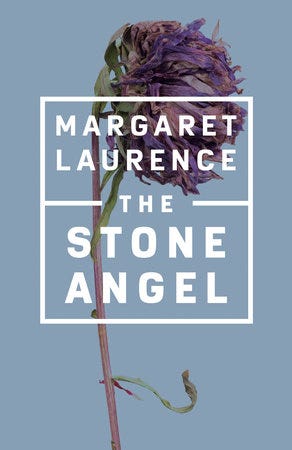
The Stone Angel by Margaret Laurence

Growing up in Canada, there were two famous Margarets, Atwood and Laurence. The latter’s 1964 self-proclaimed “old-lady” novel about stubborn, full-of-rage 90-year-old Hagar Shipley, completely indifferent to people’s feelings, was required reading in grade school. Shipley was the first truly great difficult woman I’d ever read and she fascinated me. Blinded by her own anger, she is incapable of accessing her emotions despite having a tidal wave of them inside. Her fight against being sent to a nursing home with the son she’d never let come close blows open the past where her stubbornness and pride grows into the rancor that animates her still. Near the end of the novel, a jarring incident opens up to a Flannery O’Connor-like moment of grace.

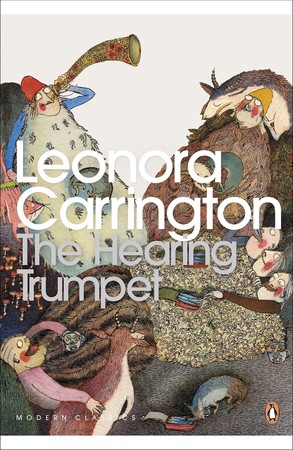
The Hearing Trumpet by Leonora Carrington

Being committed to a “home for senile females” writes Carrington — an artist and writer of extraordinary intellect and imagination — is the catalyst for more than one nonagenarian narrative (see above). But in this eco-feminist tale told by 92-year-old Marian Leatherby, with her dry unsentimental wit and “gallant” beard, conveys, the most fantastical story, hovering between surrealist fantasy and insightful social commentary, while celebrating the mythic power of women. “Most of us, I hope, ” Carrington wrote at the time of its publication in 1976, “are now aware that a woman should not have to demand Rights. The Rights were there from the beginning, they must be Taken Back Again, including the Mysteries, which were ours and which were violated, stolen or destroyed, leaving us with the thankless hope of pleasing a male animal, probably of one’s own species.”

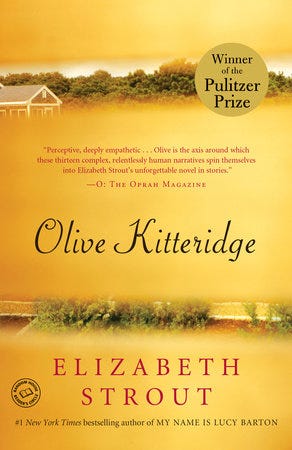
Olive Kitteridge by Elizabeth Strout

Another “not nice” female protagonist, the brusque, coastal-town Maine math teacher at the center of this book, belches, swears, is mostly angry and largely inaccessible, causing those around her to flinch with fear, and at times, disgust. A series of linked stories, they turn on bewildering shifts of emotion, including betrayal and grief, and offer a sustained exploration into the grand messiness of life, along with the revelation of self-knowledge. Strout perfectly undercuts darkness with bleak humor, like the moment Kitteridge deadpans to a stranger, “I’m waiting for the dog to die so I can shoot myself.”

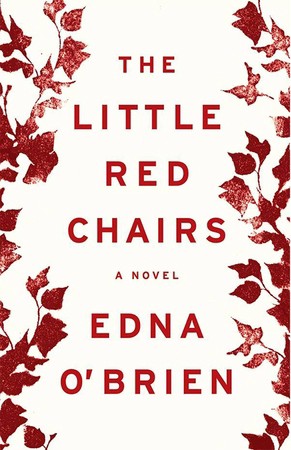
The Little Red Chairs by Edna O’Brien

O’Brien, at 85, wrote this astonishingly gripping novel that moves far from the familiar territory she mined 56 years earlier in Country Girl. What begins as light and pastoral, quickly turns into a dark, harrowing tale about a Bosnian Serb war criminal who, posing as a sex therapist, descends on a tiny Irish town, and begins an affair with the young, beautiful, married Fidelma. When he is discovered (someone writes in front of his clinic “where wolves fuck”), the results are disastrous for Fidelma, now pregnant with his child. The story continuously changes shape and tone, with the narrative shifting from third to first person effortlessly, sometimes within the same chapter. O’Brien’s writing is urgent, lyrical, and precise, and every single word matters.

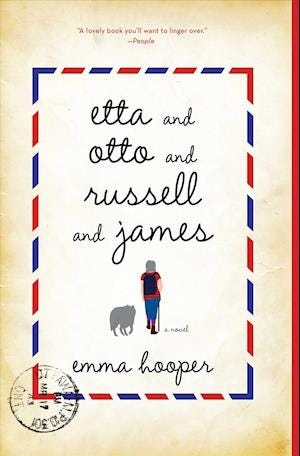
Etta and Otto and Russell and James by Emma Hooper

“I’ve gone,” 82-year-old Etta writes to her husband Otto, heading out on foot from the Canadian prairies to find the ocean, which she has never seen, rifle over shoulder. Eventually James, a talking coyote, joins her. As Etta slowly loses her memory, we get in striking contrast, glittering flashes of her past. Like many women who navigated war, she is resourceful, whip smart, full of empathy, yet unsentimental. With spare, precise prose, the story, like Etta, contains a powerful life-force. It reads part fairytale, part elegy to a former time and place, and to a generation almost gone.

Stet by Diana Athill

Stet, Latin for “let it stand,” is what Athill, a legendary British book editor who worked with such luminaries as Jean Rhys (“kept her manuscript in shopping bags under her bed”) and V.S. Naipaul (“easily the most difficult writer I ever worked with”) titles her brilliant memoir. “This book is an attempt to ‘stet’ some part of my experience in its original form. It is the story of one old ex-editor who imagines that she will feel a little less dead if a few people read it,” though, truly, no one could be more alive than Athill, now 101. She writes with humor, in crisp and insightful prose about egos, libidos, and literature, with an unusually frank tone, especially when it comes to the details of her own life (living with a Malcolm X disciple, and then a Jamaican playwright who, when she found he was having an affair with a much younger woman, invited her to live with them). Frustratingly, reviewers of this book often noted how hard it was to believe an 80-year-old had written it.

I’m Almost 40 and Still Getting My Stories Rejected—Am I Running Out of Time?

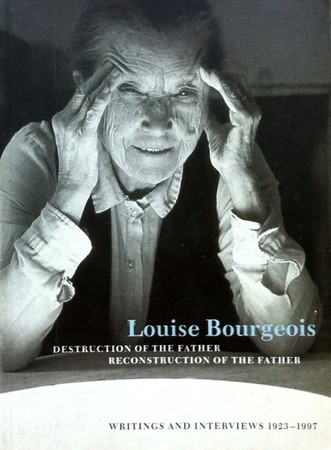
Destruction of the Father by Louise Bourgeois

We’ve seen the giant spiders and phalluses created by Bourgeois who died at 98, impossibly born in 1911 on Paris’ left bank. She figured out her own trajectory in an art world that “belonged to men.” Haunted and enchanted by her past in Paris as her philandering father’s favorite child, Bourgeois’ writing takes us through decades of radical work and self-invention. Her writing is full of hilarious and biting statements both pithy and enigmatic and often feels like a mantra for our times. “A woman has no place as an artist until she proves over and over that she won’t be eliminated.”

Writings by Agnes Martin

I packed this book in my suitcase when I lived nomadically for nine months in Europe with my husband and baby, carrying it everywhere with me like a totem. I was grossly underslept and unsure of who I was, and the general effect of her near-mystical perfection in thinking was like enforced meditation. Much like her paintings, her writing is lucid and uncompromising and almost forcibly demands an experience for the reader. The only concession Martin made to old age was to reduce the size of her paintings so that she could continue to move them herself given she never had an assistant. “We have been strenuously conditioned against solitude,” Martin observes, articulating what it means to be an artist alone in a room making something out of nothing.

Goodbye, Dead Girl—Hello, Killer Woman

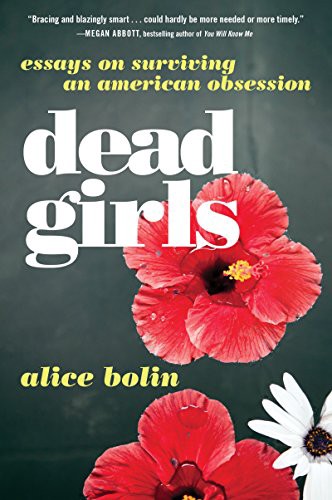
This was the year of the dead girl. Or, at least, it was the year that the phenomenon of the Dead Girl became the subject of cultural analysis, primarily in thanks to Alice Bolin’s book of essays of the same name.

Dead (usually murdered, usually white) girls have long been an American obsession as a pop cultural avatar for women’s oppression. “The Dead Girl Show’s most notable themes are its two odd, contradictory messages for women,” Bolin writes. “The first is to cast girls as wild, vulnerable creatures who need to be protected from the power of their own sexualities.” From Twin Peaks to True Detective (Bolin’s 2014 essay about which was the catalyst for her book) to Law & Order: SVU and seemingly lighter, frivolous fare, such as Veronica Mars and Pretty Little Liars, the dead girl serves as a cautionary tale: be hyper-aware of your surroundings, and know that at any time you could become a victim of harassment, assault or, indeed, murder.

But 2018 was also the year that the dead girl began to fight back.

The HBO series Sharp Objects, based on Gillian Flynn’s novel, is perhaps the clearest example of how the passive “dead girl” has been converted into a story of murderous vengeance. (This piece contains spoilers for Sharp Objects, as well as for the movie A Simple Favor and the novel Give Me Your Hand.) Reporter Camille Preaker (Amy Adams) returns to her sleepy, racist Southern hometown to cover the murder of two young women. Through Camille’s shoddy, unprofessional reporting, we discover that her alcoholism and self-harm are outward responses to being raised by her withholding and abusive mother, Adora (Patricia Clarkson), who in turn was abused by her own mother, and poisons Camille and her adolescent sisters Amma (Eliza Scanlen) and Marian (Lulu Wilson), the latter of whom died during Camille’s youth as a result of Adora’s Munchausen’s syndrome by proxy. It is implied that by making her daughters sick Adora makes them need her, highlighting the connection between society’s maternal expectations of women, especially in small towns where there are seldom other roles, and the lack of understanding and release of the sadness and rage when they break down. Amma’s climactic homicidal tendencies, too, demonstrate the inner turmoil that results from abuse and how it manifests when girls lack emotional support from others.

The big screen has also offered up an interrogation of how the abuse and trauma of girls can manifest as murder. This year’s film adaptation of Darcey Bell’s 2017 novel A Simple Favor stars Blake Lively as the enigmatic and mysterious Emily, who goes missing after asking a fellow mom, Anna Kendrick’s tightly-wound Stephanie, to collect her son from school. Through a series of dark comedic errors, we find out that Emily and her twin sister, Faith (also played by Lively), killed their abusive father in a house fire when they were teens and have been on the run ever since. Emily, whose birth name was Hope, remade her life as a fashionable, high-powered and high-functioning alcoholic PR woman, while Faith descended into addiction and only resurfaces to blackmail Emily/Hope for money. Emily, seeing no way out, kills her twin and uses Faith’s identical body to fake her own death, cash in her life insurance policy that she convinced her struggling novelist husband (Henry Golding) to take out on her, and attempt to disappear into obscurity While A Simple Favor is severely overlooked and underrated, a more sophisticated film (or series, which there was enough material for) would have explored further how Emily’s abusive childhood related to her adolescent and adult propensity for manipulation and murder. It could also be surmised that Emily’s pain, trauma and psychological issues have been dismissed because of her looks, her sexuality, and her success, leaving her to foist them on others.

Girls who might have ended up dead in a different era turn instead into fatal women.

A recent murder mystery novel, Megan Abbott’s Give Me Your Hand, is more successful at showing how girls who might have ended up dead in a different era or under a different set of circumstances turn instead into fatal women. Abbott sets her examination of female rage and murderousness in a laboratory where two prodigious young female scientists, Kit and Diane, under the tutelage of an equally brilliant woman professor, Dr. Lena Severin, are studying premenstrual dysphoric disorder, a debilitating form of premenstrual tension. In Give Me Your Hand, Abbott manages to present menstruation — inextricable from motherhood in the cissexist, heteronormative, and breeding-obsessed culture in which these pieces of pop culture reside — as inextricable from murder. Though it’s Diane who, after submitting herself to a hysterectomy to stem her lethal urges to no avail, commits the murders in the book, both Kit and Dr. Severin empathize with her plight. “Don’t we all feel we have something banked down deep inside just waiting for its moment, the slow gathering of hot blood?” Kit muses.

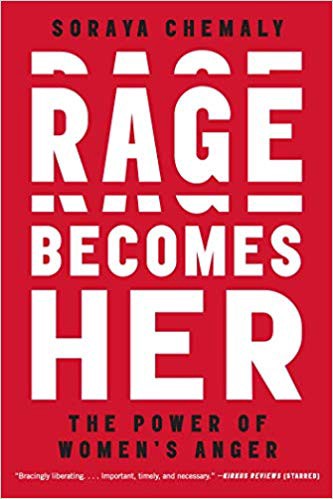
This calls to mind the misogynist taunts Donald Trump hurled at Megyn Kelly, in particular (“There was blood coming out of her eyes, blood coming out of her wherever”). Soraya Chemaly writes about it similarly in her new book, Rage Becomes Her: The Power of Women’s Anger. “There are some who believe that women’s humanity is actually not in question but rather that it is women’s humanity, taken seriously, that is the problem because it reminds us of birth, death and decay. Our physicality — the leaking, bleeding, lactating bodies that we manage — provoke terror, and the response, a defensive one, is to figuratively turn us into objects.” In the case of the dead girl, the defensive response turns her into an object literally: from a live body to a dead one. But while the dead girl is an object, the angry woman is a subject, acting and fighting back with the violence that is so often enacted upon us.

Rage Becomes Her is heavy on data mined from these experiences. Chemaly writes about how social norms for how girls and young women should behave under the male gaze — be polite, be quiet, don’t be aggressive, don’t be too ambitious, don’t wear that, don’t ask for it — have a direct correlation to how we suppress anger later in life. The murderous women above are direct, if extreme, examples of rebellion against these norms.

While the dead girl is an object, the angry woman is a subject, acting and fighting back.

Towards the end of Rage Becomes Her, Chemaly offers ways for readers to manage their anger, lest they turn into the murderous women illustrated in these fictions. But violent fictional female characters are a safe way of expressing our anger, not a cautionary tale. (It’s not unlike the way that shows like Law & Order: SVU have become a vehicle for real-life sexual assault survivors to work through their trauma; these stories give catharsis, either via justice or via retribution.)

Because look what happens when we do try to stem our rage: “The ability to… control oneself in situations that often generate a sense of risk or threat is a skill that sometimes results in women being described as ‘manipulative’ or ‘deceptive,’” Chemaly writes. I seem to remember a certain Democratic candidate for president doing exactly the same thing two years ago (and, let’s be real, for the last thirty) and having these words, along with “nasty woman,” leveled at her. And look at the vitriol faced by Serena Williams for deigning to challenge a referee’s decision about her game at the U.S. Open earlier this year.

This brings us to the current apex of women and girls’ anger, as expressed through the Women’s March, Black Lives Matter, #MeToo and gun reform. Note that many of the angry women leading the charge are women of color, and black women specifically. Women of color have been facing injustice and backlash for expressing their anger at it for a sustained period of time, not just because it’s “trendy,” as some have argued.

While depictions of white women’s anger are currently at the forefront of culture — both pop and otherwise — girls and women of color’s anger seldom is, even though the throughline between dead girls and angry women is pulled much tighter. For example, black women and girls represent 7% of the U.S.’s population but make up 35% of all missing persons but they rarely get the “missing white woman syndrome” treatment at work in Sharp Objects and A Simple Favor. If the dead girl is being reborn as an avenging angel, she has more evolutions still to go.

“There can be no redemption for the Dead Girl” archetype as Bolin sees it. But maybe there can be for the angry woman.

The Boys on the Block, and Me

“On Falling in Love with My First Love Again, The Boys on the Block Don’t Cry, When the Earth Can No Longer Protect You” by Barbara Fant

The boys on the block don’t cry
The boys on the block only cry in silence
The boys on the block don’t cry for their absent fathers
Their absent fathers don’t have faces
They wear their absent father’s faces
The boys on the block don’t cry

I grew up in Youngstown, Ohio, bottom of Tod Lane, Northside,
The trees bend themselves into the wind, hide from all the bullets
My momma used to tell me,
Bend down when the earth can no longer protect you
The earth will never protect you
Only God can protect the bones that He has created

I knew a boy once, fell in love on the last day of school, seventh grade,
He touched my booty in sixth grade
In eighth grade, he was my boyfriend
We held hands in the moonlight,
Broke up and got back together,
Whether he fell into me, or I landed into the crash of his thunder,
Nothing could put asunder this friendship
Freshman year, he needed to grow, different path,
But it didn’t last, and sophomore year, he fell hard,
and it all started and sparked all over again,
Every dance, every date, every wait, after football game, outside locker room, ready for him to take me back to his car, and then to his room,
maybe get some food, and then home,
And I found home in him,
Then momma had to go home,
And he was the first I called to tell when I got home,
Next day, he came over and became my cover,
And he covered me, through winter’s cold breath,
Every season that erupted into my life that my skin
was yet prepared for, he was there,
How he bent down when the earth could no longer protect me

The first time he said he loved me was the summer going into eighth grade,
I always wanted those stars on my ceiling that glowed in the dark,
My mom couldn’t find them,
So she found a lamp and surprised me with it,
It had stars cut out all over it and it rotated,
When you light it up, it lights up the whole ceiling,
Miraculously, starlight all across my bedroom
Instantly, my room is a solar system,
A collection of constellations,
And that day, he called, and said,
“Would you believe me if I told you I loved you?”
And I said, “Yes,” and he said he loved me that day,
and seventeen years later, my feelings are the same,
My feelings are the same on the block,
Where the boys don’t cry, I fell in love with a guy
Who understood the war outside,
so he made sure he was always the home I needed

“Bend down Barbara, I’ll be the earth that protects you”

And I want you to just be the boy
Let your past fall out of your eyes like the ocean’s gasp
And I’ll spit back to you, fistfuls of your innocence,
I want you to be that innocent again,
Before your grandmother’s hands lined the walls of a prison
Before your mother found the pill bottle,
Before my mother found the grave
I wish us sixth grade innocence
And a seventh grade summer love
I wish us summer
And bronze skin melting into a browner shade under the sun
Before the gun stole El from our lives
Before Shanice had to be found, with her boyfriend,
both of them, shot point blank range,
Did you hear, how they left the baby on the bed,
just swimming in all that blood?
I could not bring myself to go to her funeral,
Didn’t want to remember her like that
All plastic-faced and porcelain,
She will never be that innocent again,
I remember how me, Trina, Shanice, and Kia had a special kind of bond,
None of our mothers saw us graduate,
All their mothers murdered,
My grandmother, murdered,
How black girls in the hood bond in the bloodiest of ways,
How you and I bonded in the bloodiest of days

Branded our bad days into each other’s yesterdays,
And decided to hold onto each other,
No matter how aflame, or bloody, or frozen,
The block may be
How I never see the boys in the block cry,
How the boys on the block swallow the swelling oceans
back into their eyes, sweep the pain from beneath their lids
and call it the earth

Instinct of Extinct — on Leaving Black Men

Used to be so mad at your dad,
How he raised you to keep your head high, above women,
Put them in their place
Cream of Crop, boy
And then I think of your dad,
In ’58, wading through green blades, away from white fists,
And then again in ’68, swimming through Black Panther fists,
Wrists the cops want to lynch, handcuffs and silver gates,
Ask them, which way is Heaven? Is there a Heaven here?
I think of fear he must have kept swollen in his belly
As he raised black boy and spent every night on his knees,
Praying you made it home
And then you made it home,
Grew yourself a wife and career
Brought home the knife and fight,
Never learned not to bring the tornado into the house
When he brought the shotgun home, I buried my mouth
My throat, a choking target of surrender, or hiding
Why we never talk about these black women that
carry the weight of black men,
All this trauma growing in his bones,
Your hands, my throat, another birthing of racism,
bearing its teeth in our home,
Tyree loses his life, Marshawn, Eric, Mike,
all these brown men disappearing around me,
And I leave a black man at a time when black men are becoming extinct,
Why we cling to black men we want to run from
and cradle all at the same time
Was so angry at your mother,
How she birthed a myriad of sons and became shadow,
Danced the sway of a million brown women
wading their way through security and survival,
Your father could never understand all the chaos in me,
I tried to be the good Christian girl,
but her body would not fit into my skin,
Learned to swallow my own fins in obedience
Prayed to every altar I could bend myself into
How I shuffled through fields and river,
just to hold you with these charred limbs of a lover,
How I should’ve had no other gods beside you
Submitted to the sounds of your breath,
pulled pages of Scripture from my throat
And I was always the dumb, non-submissive
Perhaps I should’ve just rolled over, let you crawl on top,
Birthed you a tribe of hunters who grew to slice the voices of other women
Was I only good enough for this?
Like how your father felt he was only good enough for fields?
The ghosts of white men chasing him in the night?
I tried to understand the outstretched limbs of racism,
how she claws at backbone of children she births,
Remembers her covenant with America
And claws through every covenant that tries to escape her breath,
When she came to birth the sirens,
I tried to hold you, like a good wife,
But I pushed, released, waded my way through every blade
Of field and river gushing within me,
And let you go, like a woman

Watch Barbara Fant perform:

TEDx Columbus (2011)

Women of the World Poetry Slam (Final Stage — 2017)

About the Author

Barbara Fant has been writing and performing for 12 years. She has represented Columbus, OH in 9 National Poetry Slam competitions and placed 8th out of 96 poets in the 2017 Women of the World Poetry Slam. She is featured in the Greater Columbus Arts Council’s Columbus Makes Art Campaign and Columbus Alive named her in their 2017 People to Watch. A 2009 recipient of the Cora Craig Author Award for Young Women through Penmanship Books in NYC, she is the author of three poetry collections, a TEDx speaker, and has been commissioned by over ten organizations. She holds a BA in Literature, a Masters in Theology, and is currently pursuing her MFA in poetry at Antioch University Los Angeles, where she served as co-lead poetry editor on the literary journal Lunch Ticket. She works at The Columbus Foundation and teaches poetry at Transit Arts. Barbara believes in the transformative power of art and considers poetry her ministry.

“On Falling in Love with My First Love Again/The Boys on the Block Don’t Cry/When the Earth Can No Longer Protect You” and “Instinct of Extinct — on Leaving Black men” are published here by permission of the author, Barbara Fant. Copyright © Barbara Fant 2018. All rights reserved.

Why Doesn’t America Love the Novella?

What happens when “bigger is better” becomes an ethos for an entire society? From SUVs that will never see a dirt road to McMansions that could fit several families, American culture right now abounds with an excess of, well, excess. The normalization of this can distort priorities, creating a sense that something far larger than what we need is what we want. In arts and culture, the ramifications of this bigger-is-better ideal include the phenomenon of movies begetting franchises begetting expanded cinematic universes. But — more relevant to me personally — it also includes the trend towards bloated novels and multi-volume series, and its counterpart, the devaluation of the novella.

There are moments when being a lover of literary minimalism can feel like being part of a secret society. A particularly obscure secret society, and one that’s closer in tone to a bizarre eating club than, say, a revolutionary faction looking to burn it all down. Nonetheless, the novella (or short novel; I’ll be using the two interchangeably) can feel like an overlooked form: concise enough to be an exercise in restraint, and yet too short to be deemed commercially viable.

From SUVs that will never see a dirt road to McMansions that could fit several families, American culture right now abounds with an excess of, well, excess.

This is not to say that small novels are necessarily better than big ones. (I love a good novel that’s approximately the size of a human head.) But some novels are meant to be small — and small novels that are meant to be small are indubitably better than large novels that should have been. And yet, it seems that the U.S. would rather inflate novellas into tomes.

It’s not that there’s no market for standalone novellas — at least, there seems to be one overseas. That’s why many celebrated recent works in translation are notably slimmer than their American counterparts. Samanta Schweblin’s Fever Dream, for instance, uses a concise length to its strength, sustaining a dreamlike and surreal tone over the course of its pages. The resulting work ended up winning The Morning News’s 2018 Tournament of Books, no small accomplishment. But it’s also difficult to imagine this work being originally published by an American author, given its length.

The same is true for the concise and haunting novels of Patrick Modiano, winner of the 2014 Nobel Prize in Literature. Numerous novels being published in translation by up-and-coming presses like Tilted Axis and Two Lines Press are also far shorter than what might emerge from an American press: João Gilberto Noll’s Atlantic Hotel or Hwang Jungeun’s One Hundred Shadows both brilliantly sustain tension and atmosphere over the course of their pages–but they also don’t overstay their welcome.

The gulf in novellas being published overseas versus in the U.S. is noticeable if you’re looking for it. “When I was in Denmark and Iceland this summer, I saw so many slim novels and novellas from all over the world,” author Amber Sparks notes. It also raises the question of how many manuscripts are padded to reach a certain size—and whether a domestic publishing industry more amenable to novellas being novellas would lead to, ultimately, better works.

It raises the question of how many manuscripts are padded to reach a certain size — and whether a domestic publishing industry more amenable to novellas would lead to, ultimately, better works.

I am not without skin in this particular game: my 2016 novel Reel weighs in at around 40,000 words. When talking with agents, I was asked by one if I could add another 15,000 to it. Thankfully, Rare Bird Books, who published it, have a welcome openness to shorter literary works—a quality that they share with other independent presses, but not many of their larger counterparts.

I’m not alone in finding frustration with the American publishing market’s feelings regarding novellas. “I’ve never tried to get a novella published, because I just figured it was pointless,” says Sparks. “I’ve written a couple, and I ended up either canning them or turning them into short stories or longer novels.”

While Sparks’s collection does feature a novella, its evolution was unique among her works. “The novella in my last collection was sort of accidental; it was a novel that my editor and I thought probably should be a novella — and in fact it had been at one time — and when she read the novel she felt we should turn it back into a novella and include it in the collection,” she says.

It’s worth noting that the American publishers in question who seem to shy away from publishing shorter novels (at least outside of translated works) are largely the Big Five. When Big Five publishers have released novellas–Garth Risk Hallberg’s A Field Guide to the North American Family, or Penguin’s forthcoming edition of Ottessa Moshfegh’s McGlue–they’ve generally been new editions of older works by authors who have gone on to be widely read. And there’s also the case of novellas being paired with other novellas by the same author: A.S. Byatt’s Angels and Insects comes to mind, as does Joe Hill’s Strange Weather.

“I feel like in this country, generally speaking, it’s almost impossible to publish a novella unless you’re, you know, Denis Johnson or something — someone who publishers known will sell a book no matter what,” Sparks says.

There are some exceptions to this: FSG Originals has explored publishing shorter books, including Warren Ellis’s Normal and Jeff VanderMeer’s The Strange Bird. And there was a brief span in 2012 when ebook-only novellas from both Nick Harkaway (Edie Investigates) and Victor LaValle (Lucretia and the Kroons) were published in the lead-up to, respectively, their novels Angelmaker and The Devil in Silver. It’s probably worth noting that both the Ellis and VanderMeer books were published in digital editions first, with the physical versions following; there’s a sense of experimentation about both.

Arguably the most successful initiative in a major publisher releasing novellas has come via Tor.com, whose novellas have featured work from the likes of Brian Evenson, Victor LaValle, and Nnedi Okorafor. (Full disclosure: I am a regular contributor to the website Tor.com.) Though it’s probably worth pointing out that, even as the lines between “genre” and “literary” fiction blur, various genre awards maintain separate categories for novellas–thus creating a situation where a novella can be viewed as a standalone work on its own merits.

While independent presses may be more open to novellas, it can still be difficult for a writer to connect to one of these presses without an agent–creating a troubling scenario for writers whose manuscripts fall between, say, 20,000 and 50,000 words.

Doorstopper-sized books may have a marketing advantage as well: a giant novel is more of a conversation piece than a slim one. Though this, too, feels like a uniquely American tendency: on a recent visit to Waterstone’s in Edinburgh, I noticed a table display dedicated entirely to novellas, with a sign extolling the virtues of a quick, efficient read. I could find nothing comparable for books of 700 pages or more.

Unfortunately, there are numerous high-profile instances of some in the literary world conflating size with merit. For a prime example of this, look back about a decade to the reception afforded the release of Roberto Bolaño’s 2666 and The Savage Detectives in English translation–and the corresponding shorter novels of his ended up being classified by some critics as “minor works.” (Veronica Scott Esposito has written a good explanation of why this is troubling.) And a writer like Bolaño, whose bibliography encompasses both the sprawling and the concise, demonstrates the literary merit of both: By Night in Chile is appealing for its taut precision, while 2666 is appealing for its unruly sprawl. Treating the former as, essentially, secondary to the latter creates a situation wherein the gold standard for writers is tied to length, rather than how well the work exists as a whole.

Sparks also raises another crucial point about the importance of novellas: in minimizing them, is American literary culture also minimizing the voices of many writers who are drawn to shorter works? “Mothers (parents, really), working people, immigrants, many people of color — they’re often writing a different kind of book, slimmer but compressed, powerful,” she says. “And to dismiss that is to dismiss the diversity in literature that publishers say they want. I’m not sure why we’re so resistant to it in America but we really are.”

In minimizing novellas, is American literary culture also minimizing the voices of many writers who are drawn to shorter works?

The last year or two have brought some small signs for optimism. Lena Dunham’s advocacy for shorter books on Twitter –the #keepit100 Book Club — is one example. So too is the attention given Victor LaValle’s The Ballad of Black Tom–which includes great reviews, awards, and being optioned for television. And in pop culture, G.O.O.D. Music’s series of seven-song albums may help to convey the idea that shorter creative works are satisfying in their own right. Perhaps these factors will all help lead to a publishing industry that embraces shorter literary works for what they are.

A Reading List on Being a Black Man in Contemporary America

I was given the task of curating, yeah it’s that fancy, a reading list of books that portray black men in contemporary America in complex and nuanced ways — seeing as to how the majority of books being published are still overwhelmingly about white folks.

I’d like to believe that my collection, How Are You Going to Save Yourself, falls into the former category. My book follows a decade in the lives of four friends, Dub, Rolls, Rye, and Gio, from Pawtucket, Rhode Island as they struggle against themselves and the world that they’ve inherited. Much like Pawtucket and Providence, the four friends have been somewhat passed over, amongst their kin, their society, and institutionally (thanks Amazon). They are all grappling with different demons and the manifestations are varied. Throughout the decade the book documents, we witness their lives take vastly different shapes even though they are forever inextricably linked to one another. My aim with the stories was to evoke the flavor of a seasoned pan — layers of grease and seasoning, as we enter into their lives and pick up on the subtleties of their character. Some of the stories are controversial, some are quiet, but hopefully readers will find soul in all of them.

Making this list is important and I’m thankful for the opportunity. I also must acknowledge the shifting paradigm in publishing that gives me hope about the future of American lit. The doors are starting to be opened ever so slightly for the nerdy, self-proclaimed oddballs from communities of color — myself included. There are so many notable books, I won’t name any because it would take too long, (Heads of the Colored People by Nafissa Thompson-Spires, Welcome to Braggsville by Geronimo Johnson, The Sellout by Paul Beatty) from the past few years that are doing something different on the page that it gives me great joy.

These books in no way are solely about black men in America because that would be an irresponsible book since the web of human connection is too complex for us to not acknowledge the less than subtle tugging from multiple strands. This list also leaves out so many giants, but I tried to put together a list of my favorite American-centric works that disquieted me enough to stay forever lodged my emotional memory.

Some of the titles below will, or already have been canonized, and others, unduly, never got their day in the sun, but all have voluminous lungs and boy do they breathe. I tried to pick at least a few that have been slightly skipped over for some reason or another just to shed light on the multifarious voices in the black American tradition. Be forewarned, I’m a sucker for the blues, humor, and the untragic mulatto experience. I hope if you do pick up one of these titles, you open your hearts and surrender yourself to the vision.

Behold, my blacklist:

Erasure by Percival Everett

Erasure is a good place to start since it is in many ways about this very question of black art in white spaces. In the tradition of surrealist prophets, Everett deconstructs the flaws in the publishing world that typecasts black men as a certain kind of writer with a certain kind of story to tell. This book is hilarious, painful at times for its incisiveness and worth your time if you want to read something a little different.

Loving Day by Mat Johnson

Loving Day is a personal favorite: Majestic Mulatto power all day! Mat Johnson’s story speaks to some of the whiplash biracial folks in this country face — a familial love story about father and daughter replete with insight on identity politics and how it shapes our lives as people of color in 21st century America. A beginner’s and intermediate’s guide to mulattodom in the U. S. of A. if you will.

The Big Machine by Victor LaValle

The Big Machine is a book I stumbled on in Iowa. The first book I’d read after arriving there that made me say, “what in the holy hell did I just read”. LaValle is king of the “what did I just read literature,” cue a magical baby being born by injecting a hotshot of heroin into the stomach. This tale is part black illuminati, part page turning thriller, but the prose is magnetic and in the end, it’s a tale about community uplift and survival. I don’t want to say that race is an afterthought for Lavalle, because he clearly addresses it with intention, but it never overshadows all the other exploration he’s doing into the human condition. This one is a good start if you are thinking about getting on the Victor Lavalle train.

Beloved by Toni Morrison

Not to add a classic for the sake of adding a classic, and also not a novel that needs any further explanation, but because reading the scene where Halle churned butter stripped a gear out of my chest, Beloved speaks to the contemporary struggle of black men in America. Though not a novel about contemporary characters, the vestiges of slavery and how it effects manhood, love, and psychological/spiritual healing are all on display in Morrison’s classic. In keeping with the theme of contemporary black men in America for this article, Morrison raises the question — how do we get back our dignity? The question is so inextricably linked with our sense of self and manhood and both of which are constantly tested socially and institutionally.

Delicious Foods by James Hannaham

Back to another of my personal favorites, enter Delicious Foods. Hannaham’s second novel is another work that adds to the cannon of black alternate reality — a moving piece about family, politics, and modern day slavery packed with heart, adventure, and a heavy dose of the real. Hannaham delves into the vortex of drug abuse on the page and raises the most poignant question — how do we grow to love our addiction more than our kin?

Wind in a Box by Terrance Hayes

Switching gears to poetry, Wind in a Box by the juggernaut known as Terrance Hayes is a heavy hitting collection that dives into heartbreaking dance of what it means to be both predator and victim — an unpopular perspective when we talk about men in the current climate. I often open readings by reciting a Terrance Hayes poem, maybe because it’s always a haymaker, maybe because sonically you can’t help but be entranced, but almost certainly because I wish I’d written it. This collection of poems evokes the blues in such a tender and compassionate way it tests the limits of how we love.

Caucasia by Danzy Senna

Another work from a patron saint of the mulatto literati, Caucasia is a classic family story (or maybe just from my perspective) about how we love people across the bitter racial divides that have our country in a vice grip. It is a full portrait about a young biracial woman trying to reunite with her black father who is political, deified and elliptical due to his shadowy presence in her life.

Before You Suffocate Your Own Fool Self by Danielle Evans

And a story collection, in an age when collections are on the rise (shameless inaccurate promotion) to round out the list, Before You Suffocate Your Own Fool Self by Danielle Evans. Evans’s collection is largely about young women and soon to be women, but when she does write men, she captures the fragility of ego and the desperation of asserting one’s masculinity. You need look no further than the blockbuster hit of the collection, “Virgins”, to see the mercurial landscape black men must traverse in our efforts to claim our value.

Please, Margaret Atwood, Don’t Write a Sequel to ‘The Handmaid’s Tale’

Margaret Atwood announced on Wednesday that she is writing a sequel to The Handmaid’s Tale, to be published by Doubleday in September 2019. The Testaments will take place fifteen years after the events in The Handmaid’s Tale and will be narrated by three female characters. Nothing else was revealed about the plot, instead Atwood described her impetus for the work, saying, “Dear Readers: Everything you’ve ever asked me about Gilead and its inner workings is the inspiration for this book. Well, almost everything! The other inspiration is the world we’ve been living in.” We are living in the age of sequels (and prequels, and trilogies) and I’m sure that a lot of people offered Atwood a lot of money for this project. I wish she’d said no.

It’s hard to remember now, after 8 million copies sold, but the initial reviews of The Handmaid’s Tale weren’t universally positive. A common critique was that Gilead was overwrought and implausible—that, in short, it didn’t feel like a sign of the times or a warning about the future. In the scather which Mary McCarthy wrote for The New York Times, she argued that Atwood had created a scenario that was “powerless to scare.” “Surely the essential element of a cautionary tale is recognition,” she wrote, but recognition is “strikingly missing” in The Handmaid’s Tale. This timelessness, of course, turned out to be one of the novel’s greatest strengths. In many of the best dystopias, such as The Road by Cormac McCarthy, the adaptation of “real life” is so clearly tied to the present that this alt-existence feels terrifyingly plausible, but Atwood instead followed any number of real-world scenarios all the way down their slippery slopes to the worst possible outcome. In writing a book that didn’t tie itself to a specific cultural instance, Atwood gave us a text that remains relevant outside of the time it was created.

In writing a book that didn’t tie itself to a specific cultural instance, Atwood gave us a text that remains relevant outside of the time it was created.

That timelessness is threatened by proposing a sequel in this specific political moment. “Can [a cultural backlash] really move a nation to install a theocracy strictly based on the Book of Genesis?” McCarthy asked skeptically in 1985. These days, we aren’t as sure as we were that the answer is no. Atwood’s book, which has stood on its own for years as a critical text in many classrooms, has taken on fresh cultural relevancy. We can turn to it anew when Mike Pence says that he’ll only have dinner with Mother, or Betsy Devos tries to defend sexual assault on campus. I shivered seeing women dressed as handmaids hovering at the edge of Kavanaugh’s hearing, and hopefully some men did too. A book that wasn’t specific enough for 1985 turns out to be just the text we need in 2018.

Atwood risks all this by writing a sequel in direct response to the Trump era. For all that we are using The Handmaid’s Tale to help us cope, Trump’s America is not Gilead. It’s possible, if not likely, that the future will find women in this same situation of facing a threat to, if not an all-out assault on, our rights. Whatever she intended at the time, The Handmaid’s Tale isn’t political satire. The best thing Atwood can do is leave the handmaids as they are, open to future interpretations.

Misogynistic Dystopias, Ranked By How Likely They Are in Real Life

There is also the risk of undoing the power of Atwood’s creation through over-saturation, which has already started thanks to the popularity of the television show and the explosion of handmaiden memes. The book has been made into a movie, an opera, and a TV series; there is a point at which it becomes too cliche to be powerful. Which leads us to the worst case scenario, which is that Atwood is selling out. Is it possible she hasn’t been influenced by all the hype around Hulu’s award-winning television series? Maybe, though it’s telling that the press release included one sentence written in bold: “The Testaments is not connected to the television adaptation of The Handmaid’s Tale.” Atwood must be aware of the fact that people will assume she’s writing a sequel just to cash in on Hulu’s success, but even if it’s not a case where the lady doth protest too much, she’s inevitably dealing with the problem of creating original work after its source material has been adapted in a popular fashion: just look at the struggles of George R.R. Martin or Harper Lee. Add to that the simple fact that in any scenario, writing a sequel of a beloved book is tricky, and writing one long after the first book was published is doubly so, and the chances that this project is a success are slim.

Instead of writing our current predicament into The Testaments and risk creating a work that is overt political commentary and must grapple with other adaptations, Atwood should let her first novel stand alone.

10 Perfect Writer Gifts We Just Made Up

Step away from the astronaut pen. Put down the blank book. And for God’s sake don’t order another clever mug. Writers have it hard enough in this climate of low advances and little-to-no marketing budgets without getting the same tired gifts every year. This holiday season, try one of our completely fictional and guaranteed-to-please-the-literary-types-in-your-life presents, instead. Available in every price range. Money back if not completely satisfied (unless we already spent the money on vape cartridges and homebrew kombucha kits, in which case, you’re SOL).

Pre-rejected stories. Purchased from other writers just like yours, and already rejected by editors from more than 20 top journals. No need to send these babies out and have them come back with phrases such as, “Though there was much to admire here…” or “We receive many more fine submissions than we can publish.” They can simply be filed away with the writer’s other rejected stories without the hassle of actually drafting and sending them out. A gift every serious writer will appreciate. Available in a variety of typefaces. $29.95

Sweater that looks vaguely like the one Emma Thompson wore in Stranger Than Fiction. While wearing this, writers can pretend not only that they have a book deal and that someone actually cares about their writing, but that they’ve been knighted. Reeks of cigarette smoke. $59.95

Writers can pretend not only that they have a book deal and that someone actually cares about their writing, but that they’ve been knighted.

Cat named Dylan Thomas. The must-have accessory for every writer this season. Trained to knock coffee onto the keyboard, distracting writer from hopelessly flawed novel. Also chews query letters that contain the wrong agency name and contracts that specify world rights. We’ll pay you $25.00 to take him.

Reassurance cards. Preprinted with sentiments such as, “Of course you’re talented,” “That editor doesn’t know what she’s talking about,” and “I’m sure an agent would be interested in a novella about a writer living in Brooklyn who shares your physical features and neuroses and in which the main character spends the bulk of her time ruminating about whether to move to Queens to save on rent.” Comes with punch card for Bayside Dunkin’ Donuts and bus map. $19.95

Frozen sand timer. Gives the illusion time is not running out. Ideal for the older writer. Also available in analog and digital clocks that always show 5:30 a.m. $39.95

I’m Almost 40 and Still Getting My Stories Rejected—Am I Running Out of Time?

3D book cover that looks like a tablet. Her friends will think she’s on Insta and Snapchat but the truth is she’s reading an actual book! Perfect for the millennial writer in your life. $49.95

Hamster-wheel desk. For the midlist writer. Guaranteed to get her absolutely nowhere. $1,259.00 or the writer’s last advance. She did get an advance, didn’t she?

Album of random stranger conversations. Simulates working in a café, while allowing writer to drink cheap coffee at home. Includes classic tracks, such as Self-Congratulatory Business Partners, Couple Breaking Up, and Fellow Writers Name Dropping. Single-use license allows writer to incorporate dialogue into work-in-progress. $16.99

If the writer in your life is just starting out, give her a head start with the Beginner Affectations Kit.

Writer affectations kit. If the writer in your life is just starting out, give her a head start with the Beginner Affectations Kit, which includes tips for photographing a cat blocking a computer screen or sitting on a keyboard, a New Yorker tote, and images of a dozen “shelfies” featuring more impressive books than she actually owns. For the more advanced writer, consider the Advanced Affectations Kit, featuring our bestseller, The Fine Art of Humblebragging and Vaguebooking, and instructions for baking your own book cover cake. $29.95 each

Plain white mug with nothing on it. Your writer will thank you when she finally sends in that law school application and isn’t reminded by her cup every morning that she didn’t write like a motherfucker, never really cared about the Oxford comma, and never killed anyone off in a book because she didn’t write that kind of book, though if she had it would have had a much better chance of selling than the quiet domestic fiction she actually did write. Can be purchased, too, for the recovering lawyer in your life who never wants to see, let alone drink out of, another please-do-not-confuse-your-Google-search-with-my-law-degree mug. $5.99