How Jane Eyre Helped Lead Me Out of Orthodox Judaism

I was sitting on a beat-up, cream-colored hand-me-down pleather couch, one of many such hand-me-downs my husband and I lived on and off of during our first young years of marriage, reading Jane Eyre for the first time. It was the “big book” in the 10th grade curriculum at my first public high school teaching job — my first job teaching in the secular world since becoming an Orthodox Jew.

I had grown up Jewish, and was always engaged in my faith, attending Hebrew school and synagogue, even teaching my own Hebrew school classes when I was in college, but my practice had always been more liberal and sporadic. But after my older brother became more strictly religious and my parents and younger brother followed suit, I began to consider the idea of engaging in a stricter practice of the faith in which I was raised. When I met my husband I was in the midst of this transition, I taught him what I knew of my faith and he embraced it, not only converting to Judaism but committing himself to Orthodoxy as well. Shortly after I got my Masters, my husband and I were married, and within four years I’d given birth to my two children.

Despite my academic training, by the time I finished my degree I wasn’t sure I’d be suited for a teaching job outside of the Orthodox world anymore. When my husband graduated school we had moved to New York for him to pursue his rabbinic studies and I taught English at an Orthodox Jewish high school that separated the classes by gender. Back in Chicago a year and a half later, I taught for two years at an all-girls’ Orthodox school. Now, all these years later, I considered the possibility that although my resume and interview were sufficient to land me the job, I no longer fit in the world I had left so long ago.

During the seven years we were Orthodox, I did not read fiction, except the literature I was required to read to teach it. If I read for pleasure, it was from the tales of the Chassidic masters — which were claimed, in fact, to be faithful retellings of actual occurrences. These were primarily stories of great rabbis and their exploits, or tales of the “hidden tzadikim,” holy men living in the world as lowly woodcutters or beggars, who travelled from town to town, bringing miracles to the people who dwelt there. They blessed barren women with children, poor men with riches, and punished those who did not keep faith with the lord. I read the Bible, too, of course, but I did not consider that fiction.

But Orthodox Judaism wasn’t the only reason I hadn’t read Jane Eyre before. The truth was, I’d always restricted my reading, though not always for religious reasons. Even as a child, I’d rejected “women’s classics.” As a nine-year old I eschewed the elementary school competition to see who could read the most Little House on The Prairie books before they graduated, getting their name on the leaderboard in the library — I read Daniel Pinkwater’s fantastical, boy-focused stories instead. Though I acquiesced to reading Judy Blume, I preferred Tales of a Fourth Grade Nothing over Are You There, God? It’s Me, Margaret. I would not read Little Women when all the other bookish girls did, and in my senior year, in my greatest act of academic defiance in a lifetime of compliance, I refused to finish Pride & Prejudice; I blamed our terrible teacher for my disinterest, despite the fact that I had devoured another required book, Crime and Punishment, earlier in the same year. The truth was that I had always feared what reading (and worse, enjoying) stories about women would say about me.

The truth was that I had always feared what reading (and worse, enjoying) stories about women would say about me.

Beyond my choices of reading material, I actively sought out friendships with boys that would place me in proximity to their real life experiences and identities which were, to me, the experiences and identities that seemed to be worth writing and reading and thinking about. I had plenty of friends who were girls, but early on rejected any activities of theirs that I deemed too “girly” for me, attempting instead at recess to insert myself into the boys’ more active playground games, searching always for ways to prove my physical toughness and mettle. I didn’t wish I were born a boy, exactly, but I think I felt that if I could ingratiate myself deeply enough in the world of men, I could attach myself to it like a vine and, grasping tightly, eventually reach the sunlit expanse of the forest canopy.

Of course, my conditional acceptance into boys’ activities did not grant me immunity from their aggressions. Being brave doesn’t protect you from hurt, as even the strongest woman eventually learns. As I grew, the boys did too, and more than once they crossed the permeable membrane between my world and theirs in a way that left me feeling broken, betrayed, and confused. Though strength hadn’t protected me, continuing to shroud myself in the stories of men — Raskolnikov, who held onto his ideals, misguided as they were, through hundreds of anxiety-inducing pages, Billy Pilgrim, who “Poo-tee-weet”ed in the face of the violent absurdity of existence — taught me not to let my weakness show. I remained funny and tough and cool, never dwelling on the pain inflicted on me for too long, lest I be deemed weak, and subsequently cut off from the club I’d fought so hard to gain entry into.

When I met my husband in my junior year of college, I felt I’d finally found someone with whom I could feel safe, but I still didn’t trust the rest of the world to stop letting me be hurt. When my husband converted to Judaism and we became Orthodox, it was, for him, an acceptance of the yoke of heaven, but for me, it provided something beyond that — a layer of protection from the world of men. What I couldn’t tell him was that his love was not enough to make me feel that protection; I needed a barrier stronger than any one person could provide.

Orthodox Judaism was, for my husband, an acceptance of the yoke of heaven, but for me, it provided something beyond that — a layer of protection from the world of men.

Orthodox Judaism has general rules of modesty that apply across the genders, but of course, as with any Western faith, the laws governing women’s bodies are stricter and more prescriptive. My hair had to be covered, as did my arms, my legs, and everything between, lest I drive a man to impure thoughts. I could not touch men (nor could men touch me), but beyond that, during my menses, I could not even touch my husband — a barrier within a barrier, holding my body tight against every man, even the one who loved me. I could not sing in front of men, or dance, since this too could lead to them having impure thoughts. My acts — and the acts of every woman — were the object of these restrictions. The men, we were meant to understand, were beyond help.

The religious world is not the only place where women are told such stories about themselves. I was once told, by a man who’d come to my high school to teach a rape awareness seminar to the senior class, that he could tell I had a “victim profile” from the sympathetic way I attempted to understand the motives of the aggressor in the dramatic reenactment video. Based on my experience with men up to that point, his thesis seemed sound enough: it was something about me, not them. I left the room sobbing, believing that I — not the man in the movie, and not the men who violated me — was somehow at fault. Believing, too, that there was nothing I could do to protect myself from it happening again.

And I was right. Even in the Orthodox world, with all its boundaries and barriers and protections, I was not safe. One night, the day before Yom Kippur, a friend of my husband’s from the yeshiva came over to talk to him. I retreated to the bedroom at the back of the apartment, but it was a small space and I could hear the men talking from across the rooms. The friend asked my husband’s forgiveness for a sin he had done against him. The sin was that he had lusted after my husband’s wife. I listened to my husband kindly accept this man’s apology as I sat in the dark, in our bedroom, on our bed, and felt that same violation I had felt time and again in my life overtake me. Three rooms and my protective husband stood between me and this man, and yet I felt his hot breath in my face, his hands on my arms, I felt myself being held to the bed, helpless. I saw in that moment that my demons chased me, and that they could slip through the bars of any cage I fashioned for myself.

James Joyce Ruined Me for Orthodox Judaism

A strange thing happens to your mind when you close yourself off to the world of the imagination. I could actually feel it happening to me, but I welcomed it, in keeping with my desire to bind up my life within the security of such a prison. Without fiction, you begin to lose the ability to see beyond your circumstances. And more, you begin to believe those ancient explanations of the failures and limitations of humanity and, by extension, of your own failings and limitations. “It is this way because the conditions of our existence necessitate it,” you begin to believe, a tautology that keeps you from wondering how else it could be, what else might be possible if we dared to consider it true. Instead of believing, for example, that the men who had hurt me could change, or that I could and should expect better, I bought the lie that the beasts within them had always been too wild to tame, and built the cage around myself instead. Instead of presuming that our reality was only one possible outcome in a universe of possibilities, and that one novel idea, one different choice, one step in a new direction could set the world on a different course, I read and reread the stories that told me this was how it was and ever would be, that it had been designed this way by a God who willed it as such, and that the best I could hope for — my reason for being — was to find my place in this world already set in motion by forces beyond my control.

And even if I had wanted to reach back into my mind to call up a model for how I might make a different choice than my life seemed to dictate, my arsenal of stories from which to draw inspiration was an ever-expanding boys’ club that seemed to have less to do with my reality that I had once hoped. That false but persistent myth of the universality of the masculine experience had cut me off from the fictional women who might have come to my aid in my darkest times to offer insight, connection, or perhaps even just the right bit of biting wit to ease my journey. As a child I had wanted answers I didn’t think they could provide me, and in cutting myself off from their experiences, I had rejected a piece of myself.

A strange thing happens to your mind when you close yourself off to the world of the imagination. Without fiction, you begin to lose the ability to see beyond your circumstances.

It was only while sitting on our hand-me-down couch that night, having travelled with Jane from the terrors of her aunt’s house to the falsely pious restrictions and abuses of Lowood to the disorienting expanse of Thornfield, that I began to reconnect with the power of fiction to show us both a mirror and a window. When Rochester, still fearful of allowing himself to love Jane, still wrestling with his own impossible choices, saw how deeply she had internalized the restrictions that had been imposed upon her, I felt his pain and hers all at once. “Your self-love dreads a blunder,” Rochester proclaimed, as I sat curled on the couch, my husband with his back to me working silently at the computer. I felt that familiar feeling, one that I had forgotten for so long, flood through me, the feeling of a story expanding your sense of the true and the possible. Perhaps it was Rochester’s own vigorous feeling that allowed me to bring the full force of my own to bear in this moment — that bit of bias I still retained that led me to gravitate toward the man’s point of view. But through his feeling I felt Jane’s, and in both of them I could sense Brontë’s struggle to name an experience unique to a woman in the world. And for what felt like the first time in my life, rather than rejecting it, I pulled the feeling close.

My self-love had dreaded not just my own blunders, but the blunders of the world: all the ways it could hurt me, all the mistakes the people who claimed to love me could make that might chip away at my being. Better to lock oneself away than risk losing oneself. Better to be bound and whole than free to be broken. Yet here I was, safe, I knew, with a man who would not hurt me (or if he did, by some accident, would help to heal the wound he’d made). So why was I still so afraid? Because, like Jane, I was not ready to trust myself, to live fully in the world without breaking. And though I had begun to take steps to expand my universe, like Jane, my steps were slow, and faltering, and could not be taken on anyone else’s timetable. “The Lowood constraint still clings to you somewhat,” Rochester laments only moments later, going on to say that he himself finds it impossible to be “conventional” with her. But it is not for Edmund Rochester to free Jane from her cage — a fact he knows even if it irritates and inconveniences him — she must free herself, and freeing oneself from a cage of one’s own creation takes time, and will not, and cannot, be rushed.
What I had found in religion was something I would only be able to put words to later, when Charlotte Bronte would name it for me: “A new servitude.” It wasn’t God I was serving, but order, boundaries, the rules I felt would keep me and my body safe from those who, due to animal desire and lack of self-control, would seek to harm it. I knew somehow, innately, that the kind of freedom I truly desired was much more hard-fought and hard-won than the one I’d sought in the rules and restrictions of yet another constructed paradigm. I knew, too, perhaps, when I chose this life, that I wasn’t ready for that harder, more personal fight. I trusted the man I had chosen to make a life with, but I still didn’t trust myself somehow, and was willing to submit to the constriction of my own body and mind in exchange for safety. But in the end, it wasn’t enough.

Choosing to return to teaching — and, what’s more, choosing a position in a public school where I knew I would return to the literature I’d abandoned for faith — was one of my first conscious steps outside the protected world I’d created for myself. But such paradigm shifts take time on both ends, and I wasn’t ready to abandon the safety of my bounded life just yet. When I started teaching that first year, I still wore a wig, still covered my body from collarbone to kneecap. At my interview that previous spring, though, I’d shaken the department chair’s hand — the first time I’d touched a man who wasn’t my husband or father in years. I’d begun to push back against the boundaries I’d accepted to keep me safe, and, seeing that I was in no immediate mortal danger, I pressed on: each choice leading to the next, and all of them leading me to this moment.

I’d begun to push back against the boundaries I’d accepted to keep me safe, and, seeing that I was in no immediate mortal danger, I pressed on.

The constraint Rochester speaks of is one no man can ever know. It is the self-imposed constriction of the self that can allow a woman to move, for a time, through the world of men without being hurt by it beyond recognition. And yet, as Rochester himself knows and Jane will soon learn, constricting a woman whose nature begs for expanse will only drive her to madness. I realize now that I had begun contracting myself even within the freedom of my youth, by choosing to live in the imagined worlds of men, by denying myself the open expanse of stories of women who lived within, challenged, defeated or were sometimes defeated by the world in which they lived. I wanted to read stories of men, I think, because I knew somehow without being able to name it that stories of men were stories of triumph, of conquering, of expanse, and I wanted more than anything to take up space in the world. I was afraid of what I might learn about my own fate if I embraced stories of women — all of which, as I learned when I read The Awakening for class that same senior year, seemed to have the moral that the world of men will swallow you up in the end.

Perhaps I was not ready for the stories of such women until I could see a way to begin to unbind myself from my own confining narrative, but the beauty of stories is that they are there, waiting, when you are ready for them. And if you are lucky, every so often, like magic, a story meets you at a crossroads and helps push you in the direction of yourself. I remember putting my down book on my knees, breathless, when I’d finished the chapter. I remember that my eyes were filled with tears. I don’t remember what I said to my husband, but I remember the feeling of it. I finally felt ready, not for a new servitude, but to begin to seek the imperfect and blundering freedom I hadn’t believed until that moment could be mine. I felt myself expanding to take up my rightful space in the world.

Kevin Wilson’s Stories Are About the Way We Live with Failure

Summoning his classic combination of humor, heart, and quirkiness, Kevin Wilson returns with his latest short story collection, Baby, You’re Gonna Be Mine, his first collection since 2009’s Tunneling to the Center of the Earth.

Purchase the book

Baby, You’re Gonna Be Mine finds Wilson exploring the complicated terrain of parent-child relationships, such as is the case in “Sanders for a Night,” which looks at how family members cope with a death, and the title story itself about a young musician who can’t seem to fully embrace the challenges of adulthood. Wilson also dives into the realm of magical realism in the brilliant “Wildfire Johnny.”

No matter the topic, Wilson writes with an authentic voice that captures the truths of the characters he creates.

Bradley Sides: Your work often focuses on the lives of young people — children, teenagers, and young adults. What is it about these young lives that make them such good subjects?

Kevin Wilson: There’s something combustible about any new experience. I’ll always be drawn to my own memories of standing on the precipice of what I believed that my life would become. And how scary that was. And I’m getting older, and maybe I should move on, but now I have kids of my own, and I’m watching them experience these important moments, and it brings it all up again. It’s hard not to put it into my work.

This is slightly beyond this question, but people talk a lot about how resilient children are. I was not a resilient child. At all. And I don’t know that I believe this assertion. I think children aren’t necessarily resilient; I think that their youth, their newness to the world, allows them to pull things inside of them and keep moving, but I don’t think they lose those bad things that happened to them. I don’t think they forget them. I think those traumas attach themselves in weird ways, and it’s only later that we can make sense of them. So I write about those moments, when something life-changing happens, but it’s too fresh for it to be properly observed.

Stories are a kind of incantation. There’s this magic, like I’m trying to tell the story with the aid of only one deep breath.

BS: Oftentimes, these young people are busy disappointing their parents. This sense of disappointment seems to link many of the stories in your collection. Parental disappointment is something most of us experience — either we are disappointing our parents or we’ve been disappointed as parents. Is this theme appealing to you are a writer because it’s such a universal experience? Or is there something else that draws you to it?

KW: Failure is such a constant in life. It’s kind of the only thing. And what I’m interested in is not so much the actual failure but the way we live with the failure, the way we accept how flawed we are and try to move forward, to make a life for ourselves.

BS: “Wildfire Johnny” is brilliant. It has such a balanced feeling to it. It’s fun, but it’s somber. It’s real, but it’s magical. It’s a knockout kind of story. And here’s the premise: a razor blade essentially grants time traveling powers to people who use it. The instructions state, “You may travel twenty-four hours into the past. To do so, simply take the blade and cut open your throat. With one expertly executed slash, you will find yourself twenty-four hours in the past, bearing no signs of the injury, able to undo any forthcoming misfortune. You may travel as many days into the past as you wish, as long as you cut open your throat for each twenty-four-hour interval.” I’m curious about this story’s genesis.

KW: That’s very kind of you to say. It’s a story that I really struggled with, kept thinking about it and putting it away, never quite sure how to manage it.

For the origin, this feels weird to say. I’m trying to decide how to explain it without seeming like a freakish person. More than ten years ago, I saw this French movie, Cache. In it, a man sees another man from his past. They are standing in this apartment, and one of them takes out a razor blade, draws it across his throat, and kills himself. The spray of blood, the suddenness of the act, the way the man who is still alive processes this trauma in the moment, it absolutely wrecked me. I do not honestly remember much else about the movie, how it ends, etc. But I would say that, since I saw it more than ten years ago, that moment vividly flashes in my brain maybe three times a week. It’s this unwanted image that just keeps coming to me again and again. It is very vivid, and it disorients me. And, though this is hard to talk about, there’s something seductive about it, even as it horrifies me. When I get anxious in public, I think about this moment. And eventually, I needed to figure out how to write about it, but it always felt too visceral, too literal. Anyways, I started thinking about how this act could be utilized with the aid of magic. I wanted to let that man live, to bring him back. So I wrote this story. And I tied it up with all these other things. And this is what I have.

I’m interested in the way we live with failure, the way we accept how flawed we are and try to move forward, to make a life for ourselves.

BS: What about “Baby, You’re Gonna Be Mine” led it to be your title story?

KW: For many of the stories, the focus is on the dynamic of parent and child, of being on either side of that equation. “Baby, You’re Gonna Be Mine” seems to fully embody these issues. In this story, the mother has to deal with her memories of her child and how they exist right next to his actual body in her house, since he’s moved back in with her. It must be a strange sensation.

My children are beautiful and sensitive and wonderful. I love them without reservation. But my oldest is ten, and there are ways that I can see him becoming his own person, and those memories I have of him at three years old are already fading, like they’re about a separate person. This makes me both happy and anxious. I know at some point, my sons will leave me behind, will become the people that they want to become. But I’ll keep holding onto them in whatever way that I can. And maybe stories are one way for me to freeze them in my mind.

Kevin Wilson on the Weirdness of Family

BS: You created some dynamic characters in the stories here. There are two I’m thinking about in particular: Adam from “Baby, You’re Gonna Be Mine” and Jackson from “Housewarming.” Both are young men who are struggling to adult. For Adam, he can’t face the reality that his once-moving music career might actually be over. Jackson has a terrible temper and can’t control himself. As difficult as they are to love, I can’t help but root for both of them. What do you hope readers take away from your characters?

KW: I can’t control whether my characters are liked or disliked by the reader, because there are so many factors that complicate that connection. But what I hope that I can do for my characters, because I do feel a need to care for them, is make them understandable to the reader. If I can make them as clear as possible, then I’ve given them a chance. I’ve given them depth, I’ve complicated the initial desire to judge them on the surface. Whatever happens after that is beyond my control. Some of the best writing advice I’ve ever received is that you have to take care of your characters, because if you don’t, who will? I have to put them into the world with enough subtlety and depth that they aren’t doomed from the beginning.

Some of the best writing advice I’ve ever received is that you have to take care of your characters, because if you don’t, who will?

BS: You’ve seen success as a short story writer and as a novelist. Do you prefer writing in one form over the other?

KW: I like them both. They make me happy in different ways. But stories are probably a more natural extension of my brain. For me, stories are a kind of incantation. There’s this magic, like I’m trying to tell the story with the aid of only one deep breath. I also feel like, in the formation of a narrative, I can hold a single story inside of my head for a long time, this secret, and I can tell it to myself over and over and over, holding it all together, before I ever get it down on paper.

BS: Your work can be dark, certainly. However, you also use humor rather frequently — and to great success. How important is humor to you as a writer?

KW: It’s everything to me. It’s my way into the story a lot of times. I’ve said this before, and I’m not tired of saying it, but the line between sadness and humor is really permeable, and so I use that in my work. It’s hard for me to be serious, and so I use humor in the initial moments of a story, to disarm the reader, to show them this lightness in the work. And my hope is that the humor, as it touches up against sadness, starts to dim until you suddenly realize how dark the space has become. When it works, it makes me so happy.

Ingrid Rojas Contreras Shows a Little-Seen Side of 1990s Colombia

Ingrid Rojas Contreras’ debut novel Fruit of the Drunken Tree shows readers a Colombia we rarely see. Pablo Escobar is relegated to the background, where he still wreaks havoc, but he is just one of the forms of violence that sweeps through Bogotá in the 1990s. What is in the foreground instead are the lives of everyday Bogotanos, who for some time were able to uphold a class divide to shield themselves from violence. Two protagonists tell their stories and the story of the economic class they inhabit. Seven-year-old Chula enjoys a safe, good life in her gated community. Petrona, a thirteen-year-old, comes from the hills to work for Chula’s family as their housegirl and is the main breadwinner for her mother and siblings. Their lives intersect because Chula is fascinated by Petrona, even though the rest of the world sees Petrona as a mosquita muerta. By the end of the novel, everyone will learn how tenuous the benefits of class are and how the sacrifices we make for others may require us to sacrifice ourselves.

Ingrid and I spoke about achieving your artistic goals, disrupting narratives of guilt and innocence, and how representation in publishing matters.


Ivelisse Rodriguez: Is Fruit of the Drunken Tree the novel you have always wanted to write?

Ingrid Rojas Contreras: Yes and no. It was a novel I ran away from for many years, but it kept resurfacing in what I was telling myself were just short stories. It was such a heavy subject; I resisted the idea that I was to be wedded to it for a prolonged amount of time. When I finally caved, I realized it was the story that I had always hoped I would write. I wanted it to be emotionally complex but also political and also definitely about women.

IR: I love that this is the novel you had hoped to write. There is such a schism sometimes between what we hoped to achieve and what we actually achieve. I often think of Plato’s idea of simulacrum where art is sometimes a copy of a copy of the original we held in our minds. So there is always this gap between what we wrote and what we hoped to write.

There is also sometimes this same schism when we write about real people. When I read your afterword, I was a bit devastated to find out that there was a real-life girl like Petrona. I already appreciated how you gave Petrona a voice, but even more so in this situation. It would be easy to dismiss Petrona/the real girl as evil. At what point did you recognize her humanity?

IRC: The nature of the real story — how the real-life Petrona made a brutal sacrifice for my own safety while putting her own and her family’s in jeopardy—made it impossible for me to not recognize her humanity from the very beginning. I think I was very lucky to grow up in a family that occupied the middle class while coming from a very poor background. In my childhood, I constantly navigated the world of Bogotá and my family’s home in Cúcuta. One of the first things I understood about the world was class and how much class predicated your circumstance and the things you could do to change that circumstance. From the beginning, I was interested in building a world where a “crime” could be revealed to be simply the outcome of being entre la espada y la pared, between the wall and the sword.

IR: There is such an emphasis on vilification in our current day.

IRC: Yes, I wanted to attack this idea of villainy. On this side of the continent, we often get stories that are too simple. If it is ever mentioned that people are forced to join a guerrilla group, it is done so in passing. I wanted to provide a story that told of one person being forcefully recruited. The character of Petrona is also a composite character, based on many women I met in Colombia who were stuck in utterly impossible situations. I wanted to honor those women, too.

IR: Do you know why the real Petrona sacrificed herself for you? Did you have a close bond with her? How old was she?

IRC: My mother was very interested in trying to help girls who she perceived to be in trouble. I have this very vivid memory of her befriending a girl who was asking for change at a red light — though she denies anything like that ever happened. She brought her into our house and employed girls who were very young (thirteen, fourteen, and fifteen) who were forced to work because their parents had been somehow incapacitated (sometimes they had disappeared, were taken by an armed group, had been murdered, or were otherwise ill). My mother sat and talked to them, and we became part of their lives. As a young girl, I couldn’t get over how different our lives were. One time, one of these young women came home to us crying. Her father had been found in pieces, dismembered by a machete. How could we ever be of any help? It was an impossibility that we tried to face with our kindness and our ears. We listened. The real Petrona was another girl for whom there was nothing we could have done. Fruit of the Drunken Tree explores this emotion of wanting to help, and yet finding your help at each step of the way to be meager and wanting.

One time, one of these young women came home to us crying. Her father had been found in pieces, dismembered by a machete. How could we ever be of any help?

IR: I’m intrigued by “helplessness.” In the U.S. there is such a sense that anything can be overcome. (But sometimes we can’t “fix” things.) I am also intrigued by the uses of guilt in your book — Chula parses out the guilt she feels, she also feels so much guilt for what she did and did not do, and Petrona uses Gorrión’s guilt to give her son a life. Can you discuss the function of guilt in your book?

IRC: Writing this book, I kept coming upon the emotional crux of guilt. Immigrants who survive and are able to migrate far away from danger are incomparably relieved, but they also carry the guilt that comes from the feeling of abandoning those who cannot migrate. I see survivor’s guilt as a common thread in immigrant stories. When writing, I become very interested in turning emotions in my hands, seeing how similar emotions could erupt in other characters. Petrona, who is left behind, discovers that the guilt others feel can be a source of power. Guilt can take many forms — you can harbor it inside you because of your privilege or your luck, and you can be at the receiving end of it because you were made into a victim. I wanted to write women characters, however, who in spite of being at the end of calamities are not victims. They are able to empower themselves. Because guilt was Chula’s central driving emotion in telling her story, guilt had to be the turning point for Petrona as well. I wanted both of these characters to come out stronger at the end — and I wanted this strength to be complex and to be punctuated by the very real sharp edges of their loss.

I wanted to write women characters who in spite of being at the end of calamities are not victims.

IR: Your novel also does something interesting with the idea of violence; you push Pablo Escobar to the background, and in the foreground is how everyday Bogotanos had to live during constant violence. How do you feel about Escobar — who is this looming specter — becoming so synonymous with Colombia?

IRC: We were consumed by everything that Pablo Escobar did — at times, to my child’s eyes it seemed like there was no one in the world with such power. But our lives marched on. Pablo Escobar was a phenomenon like the weather — something that affected what you could and couldn’t do, where you could and couldn’t go, and sometimes it devastated us. To many Colombians he was a terrible catastrophe, yet others looked up to him and even lit candles and prayed to him. We all lived with constant war and violence, but those circumstances became normalized. They seeped into everyday aspects of our lives. Pablo Escobar lived on in our background, ever-present, but not altogether central.

IR: That is fascinating.

IRC: Colombia’s political situation is so complex! It took me years to understand it. Armed groups emerged precisely because people have found no better way to fix all the inequalities.

IR: You touch upon something that is not readily discussed — how the U.S. government aids certain refugees by giving them loans, etc. Also, only certain people are coded as refugees, and refugees are welcomed. What do you think about the disparities in the way that certain bodies are treated?

IRC: There seems to be a confusion about these terms. When you flee your country to a neighboring country seeking asylum, you are placed in a refugee camp. You are not a refugee. Technically, you are undocumented until your situation is decided. There are interviews and countless procedures to screen and verify whether your life was really in danger, and whether that danger is still current. If it is decided that you are in the right, a country accepts you as a refugee. In the case of Fruit of the Drunken Tree, Chula comes with a refugee status. The government helps her mother with a loan, which she has to pay back, so that she can have a place to stay. People who come to the southernmost border are asylum-seekers. We call them undocumented, and some people have vilified this state — people fleeing danger — calling them illegals. But this happens the world over. When people are in danger, they flee to a neighboring country. You are technically undocumented, that is correct, but I think we need to change our language. These are asylum-seekers. Refugees are those whom the government has screened, and they have deemed their stories to be true. It gets so complicated! The government will sometimes offer blanket refugee status to a group of people in the face of a civil war or catastrophe.

IR: Oh, that is great to know! Thank you so much for clarifying this.

On another note, there is a lack of visible Colombian-American writers — I think of Jaime Manrique and Patricia Engel. How did this affect you as a writer? Were you concerned about the publishing process being more difficult? Engel received many accolades and went on to publish three books. Did that hearten you in some way?

IRC: Yes! Being a minority, I felt heartened each time I came across a Colombian-American writer. I was heartened by not only the work of Jaime Manrique and Patricia Engel, but also Daisy Hernandez. I remember reading Patricia Engel’s first book Vida and sleeping with it by my bedside — it was a sign to me that it could be done and that our stories mattered.

When Black Characters Wear White Masks

My introduction to whiteface was the Eddie Murphy “White Like Me” skit on Saturday Night Live from the 1980s. Blackface originated from minstrel shows — cruelly mocking entertainment made by and for white people that has portrayed Black people as inept, servile buffoons. It continues to uphold that image today. Murphy’s skit opted to show another side. His whiteface character was himself made up as a pale milquetoast, devoid of any defining characteristics, armed with a monotone voice, “tight butt walk,” and blank expression.

Murphy’s impersonation is also a satirical commentary: in the sketch, merely appearing white is immediately lucrative. In his bespectacled Caucasian persona Murphy receives everything pro bono, from a free newspaper to $50,000 dollars in cash at a bank, producing no collateral or ID. The white bank manager dismisses a Black employee who originally and rightfully denies Murphy’s loan. He then hands over actual stacks of cash to a fellow Caucasian (he thinks). Through the joined laughter of two “white” men in the safety of a “white” space, Murphy mocks that “silly Negro” banker before asking, “Are there any other banks like this around here?” At the end of the skit Murphy appears solemn when he states it was disappointing to see and experience this reality. But, he added, we have a lot of make-up … and a lot of friends. (Pan out to other Black folks being prepped to look white as well.)

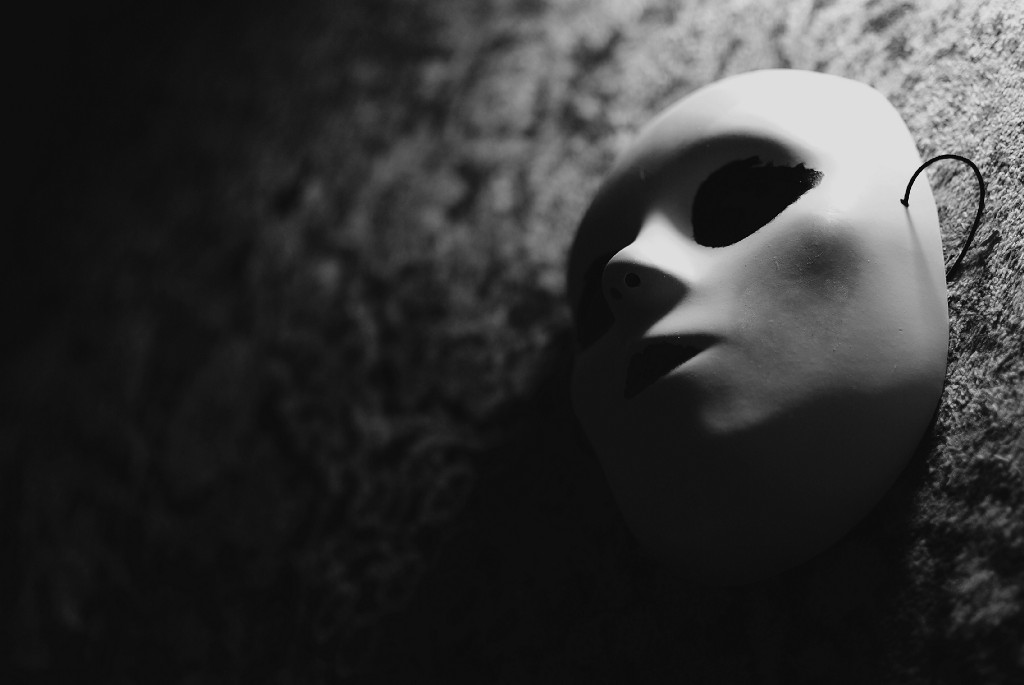
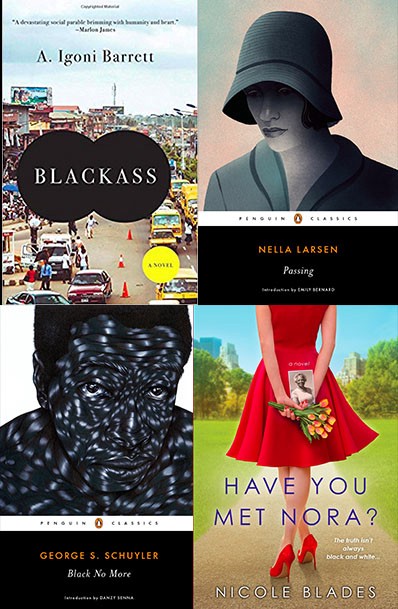
Whiteface, or Black characters posing as white, speaks to the racial dynamics between whiteness and Blackness, sometimes humorously, often hauntingly. The pursuit, or at least the semblance, of whiteness is a repeated theme in literature. In some tellings, characters actively pursue whiteness; in George Schuyler’s Black No More the main character’s body is completely remade. In others, characters allow or encourage others to see them as white for a seemingly more comfortable life — for instance, Nella Larsen’s well-known and oft referenced Passing, Alex Haley’s fictional account of his ancestry Queen, Nicole Blades’ Have You Met Nora?, and in the slave narrative of Ellen and William Craft (Running a Thousand Miles for Freedom). There’s also the inadvertent metamorphosis, like the Kafka-style one that occurs in A. Igoni Barrett’s novel Blackass.

The “hero’s” journey in these narratives relies on the current/ongoing knowledge and memory of what it means to be Black. In truth, these characters are never truly white, even as they drop anything and everything Black within their lives, be it family and friends, diction, culture, etcetera. To blend into white society as white is a covert operation. The awareness of their true Black self allows race to be a permeating factor. To pass or transform through whiteface is not as simple as a performance, nor is it caricature. Blackface aims to mock and, at its heart, demean; meanwhile, the leap to whiteness, whether enthusiastic or strategic, leaves characters in constant danger. In literature, whiteface is an analysis of how this choice becomes a way of life—and how, once the leap is made, this new life doesn’t necessarily leave characters content.

The leap to whiteness, whether enthusiastic or strategic, leaves characters in constant danger.

Whiteness was not coveted in my household, one that was filled with brown-skin people of all hues. My family enjoys everything about Blackness, from my elders’ obsession with Motown, to the uproarious Southern Baptist church services, to the inside jokes, to the plates heaped with food equating to love. But we still understood why whiteness, the perceived ease of it, could be tantalizing. It would be a lie to say that my grandmother who was terrorized by the Ku Klux Klan as a child, or my mother and her siblings who heard the deaths of many Civil Rights leaders relayed over radio and TV in real-time, didn’t comprehend the power and benefit of whiteness. The appeal of whiteface in literature, as fantasy and as satire, doesn’t always mean that a character repudiates Blackness, but that they understand the profound effects of privilege.

In whiteface literature, the reasoning for opting into whiteness as a Black person may stem from self-hate, but the impetus is rarely that simple. Whiteface stories interrogate the mentality that it’s better to be white while examining how societal gains as well as societal “norms” inflict this way of thinking on Black people. Being white isn’t better, but, for some of these characters, it seems a hell of a lot easier, or at least preferable to dealing with racism.

In the case of Passing, both protagonist Irene Redfield and Clare Kendry, Irene’s long-lost schoolmate, are Black women who have presented themselves as white for different reasons. For Clare it becomes a way of life. In the beginning, readers witness Irene indulge in the opportunity to “pass” when she goes to a fancy tea spot called the Drayton and worries when another “white” woman — -she’s unaware this is Clare — seems to stare at her as if she recognizes who she truly is. “It wasn’t that she was ashamed of being a Negro, or even of having it declared,” Larsen writes of Irene. “It was the idea of being ejected from any place, even in the polite and tactful way in which the Drayton would probably do it, that disturbed her.”

Being white isn’t better, but, for some of these characters, it seems a hell of a lot easier.

Though she chooses to live her life openly, mostly, as a Black woman, Irene understands what it’s like to pass and the benefits that come with the assumption of whiteness. While passing is not the same as cosmetically putting on whiteface, there is a connection: both cases focus on people being perceived as white.

When Irene visits Clare and a mutual friend Gertrude later on, it becomes a hen party of passing Black women. While Irene insists she’d never thought to pass, she does not refer to that conspiratorial moment shared with Clare during their reunion at the Drayton: two Black women on a rooftop enjoying the luxuries of whiteness thanks to perception. Of the three women, Irene is the only one with clearly Black lineage in her life choices, with a doctor husband who “cannot pass” and a dark-skinned son. Both Gertrude and Clare are vocally relieved that their children came into the world light-skinned, adopting the ability to pass as well. Where Gertrude’s husband has always been aware of her lineage and doesn’t care, Clare’s white husband — who has no idea that she or her friends are Black — treats the trio to a barrage of hate along with the n-word on heavy rotation. Passing (or whiteface) doesn’t protect characters from racism; it simply means the white-appearing character endures it silently, for fear they’ll be found out.

The anxiety of being “found out” permeates every work about whiteface. “I know I’m a darky and I’m always on the alert,” says the newly white Matthew Fisher, formerly Black Max Disher, in Black No More. In this tale, the opportunity to become white (with “Nordic features,” as is steadily referenced) becomes the new wave, bankrupting salons that straightened hair and those who profited off bleaching creams. It’s 1933, and for the price of $50 Black people can become white. This isn’t cosmetic; it’s a complete conversion. The Black nation jumps on this but for a few, ultimately alienating their roots while embedding themselves within white society — to the vast dismay and supreme agitation of white people. Witch hunts arise. A white person’s character is dismissed easily and readily with the whisper they may originally be Black. Everyone is suspicious and no one is safe, but Matthew, formerly Max, and his friend Bunny partner up to profit. White people succumb to their prejudices, which they turn on each other now that there are so few Black people to hate. It’s an ironic allegory for the times we’re in.

The charade of whiteface as a lifestyle takes work. In Blades’ Have You Met Nora?, the anxiety of being discovered racks the titular character into an alcoholic frenzy. In Passing, Clare seems to hold her own, yet when Irene and Gertrude meet her boorish and racist husband she slips slightly in present company. Always on the lookout, highly keen to distance oneself from their history: these are the losses that come with redefining self, and specifically with redefining self as white. For characters like Nora, who suffered sexual abuse, or Clare, who lost loved ones, it seems a small price to pay for a perceived and profitable future. Even Clare mentions it wasn’t hard to maintain her charade since the aunts who raised her were white, and this was as far as her husband got to know about her. From here the paranoia remains of consequence which inevitably causes suffering. For a character like Nora, her trauma rests on the periphery, and she is eager to erase it altogether, believing that every step, faulty as it may be, will protect her as long as she gets through each hurdle of further denouncing and erasing her Blackness.

Barrett’s Blackass thrusts the titular character of Furo Wariboko into a white body with one caveat: a literal Black ass. His conversion to white was not something he asked for, and it comes on the worst day, or perhaps the best: he awakens in a white body in time for a job interview. Eventually, Furo Wariboko becomes Frank Whyte. The core difference between Blackass and others mentioned is that Barrett’s takes place in Nigeria, not the United States. So a white Nigerian is, as the narrator puts it, the outcast in certain ways: “Lone white face in a sea of black, Furo learned fast. To walk with his shoulders up and his steps steady. To keep his gaze lowered and his face blank. To ignore the fixed stares, the pointed whispers, the blatant curiosity. And he learnt how it felt to be seen as a freak: exposed to wonder, invisible to comprehension.”

Furo’s obsession with the advantageousness of whiteness (high paying job, pretty girlfriend, personal driver, perpetual benefit of the doubt) is something he also seeks to protect. He attempts bleaching creams on his buttocks (to poor results), and forsakes all who may get close to him to maintain this image and the seeming wealth that comes with it. To be white, Furo finds, is to benefit from a system he did not create, so what’s the harm in going with the flow?

What’s also intriguing in the whiteface of these novels in particular is how that knowledge of Blackness, the memory of it, is what aids the characters in a new kind of survival. What does it mean to be Black in a white-dominant society? Okay, now what does it mean to pose as white when all we’ve known is our Blackness and our limitedness within this society? That advantage is what characters like Matthew (formerly Max) in Black No More and Frank (formerly Furo) in Blackass have to their benefit. They know, quite literally, how to speak the language of their surroundings. For Matthew it’s utilizing white fear for monetary gain and status. For Furo it’s recognizing the goings-on of his hometown as well as being able to speak the language; he has the knowledge of a native of Nigeria, paired with the access of a white man.

Whiteface, or passing or posing, in literature doesn’t necessarily equate to or end on a note of Black Pride with a fist in the air (or the Wakandan crossed arms that symbolize the unity of Blackness). Nor does it mean concretely that Blackness is a burden one should readily eliminate from their lives as soon as they have the chance. Within text some of us are allowed to be in on the larger “joke,” sort of like when I first watched “White Like Me.” Even as a child I understood what we were laughing at. Murphy as white pointed to what people, Black and white, feared: of how divided things are and continue to be, of how the nature of white supremacy is embedded in everything, of how transparent this becomes when one puts the white mask on.

{Horse! Love! Never! Dies!}, a poem by Rosebud Ben-Oni

All the horses I’ve loved are from outer spacehorse
All of spacehorse is a multi horseverse
I’m writing
As a spacehorse
& no
I don’t have any starhorse charts or artifact of stellar hoofprint
Or landing on horsemoon proof I get that some of you think you
Own a horse but I don’t
Want to
Spacehorse is wild unplace & I get buck-horse wild with
Earth horses here to get free of your silly rules
About love & etiquette & whatever
Two-legged nonsense
Running at the mouth like a dried-up river when I get all outer outer
Horsespace with darkhorsematter
& speaking
Of all horses sometimes I do
Mean just the one who broke my heart
In Iceland that tangled dark mess of mane I mean
The horse I mean my hair when I speak of horses
I do & don’t only speak Icelandic
Horse need & one
in particular but surely this too is to say all horses are multiverses to me
As outer space horses whose kin are earthly horses
Who one day will leave you & your silly greed
For the moon & the stars when I say they are
All horses & yet you cry,
but you don’t own one a horse, how do you know anything
— & to that no I’m not really
Asking
Who wants to own when you can love
Who wants anything but love
Who but my dear spacehorse
The only
In which I can breathe & not worry about rent or hang-ups or titles
Or deed just spacehorse & me
Fucking up your Sundays & your gentle seas
With the inconvenient mess we bleed
Other spacehorses who make me
Their spacehorse main
Girlhorse main womanhorse what on earth
Could ever be better than a brokenhearted space
Horse who teems with more spacehorse & more
Spacehorse debris it falls onto earth & I feast
On every bitter hoof & tasty spacesteed I don’t worry
What others think no I feel sorry for those who say
Spacehorse & I are quite ridiculous when we’re looking into the sky
& know without a doubt in the spacehorse multiverse
That all horses are the one Icelandic horse I knew for less than a week
That I persist
In knowing for almost an entire week
I will always
Love
Spacehorse & Spacehorse
Me
“{Horse! Love! Never! Dies!}” is published here by permission of the author, Rosebud Ben-Oni. 
Copyright © Rosebud Ben-Oni 2018. All rights reserved.

9 Books by Adventurous Women about the Great Outdoors

Since the publication of my book this spring, I’ve often been asked why I became a climber. It does seem an unlikely passion for anyone, let alone an ordinary, middle class girl growing up in the 70s amongst flat cornfields, not mountains. My role models were certainly not climbers, skiers, and mountain bikers, they were housewives who’d abandoned their own dreams to raise kids in the suburbs and men who headed to the city every morning with a briefcase. A walk around the block with the dog was the extent of the adults’ physical exertion. But when I was thirteen, I met a climber at an outdoor camp and I was instantly smitten. I wanted to marry him, but more urgent was my desire to be him. He bulged with muscles and confidence, seemingly the ultimate master of his own body, mind, and even fate. Coming from an unpredictable home with high alcohol content, I craved control. I wrote in my journal, “I’m going to be a mountain climber when I grow up,” and against all odds, that’s exactly what I did. At nineteen, I threw myself into the nomadic life of a rock climber. And so began my life of adventures, most of them more fun to write about than to live through.

Purchase the book

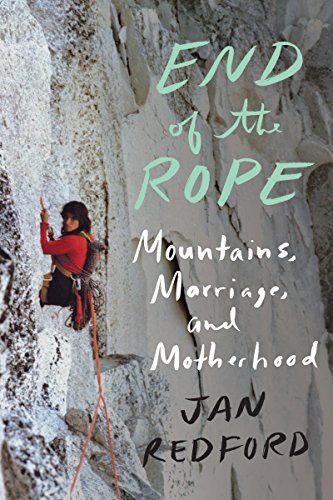
My memoir, End of the Rope: Mountains, Marriage, and Motherhood, is about coming to the end of my rope literally in the mountains and figuratively in my relationships over and over: getting rescued off El Capitan in Yosemite, going under sweepers on a river in my kayak, losing my boyfriend to an avalanche, getting pregnant unexpectedly, and then, just like my mother, finding myself in a tumultuous, unhappy marriage. I so desperately wanted to be the “master of my fate, the captain of my soul,” but my chaotic childhood had created too much internal chaos and self-doubt. I trusted others, namely men, over my own intuition.

Eventually, it was strong female role models who showed me I could have a fulfilling life of my own making: women who were leading in the mountains, becoming certified guides, continuing to climb and follow careers after becoming mothers. And eventually, what I’d learned in the mountains myself–moving through fear, staying with the discomfort, committing, really knowing on a cellular level that no one could swoop in and save me–eventually kicked in, almost as though those skills were a mind and muscle memory. I filled a U-Haul, left my marriage and my mountain town with my two young kids, to follow my dream of university and self-reliance.

A few years ago I was on a panel in Banff called, A Summit of One’s Own, where we discussed women’s presence in mountain films and literature. To prepare, I went to the library to take out books by outdoorsy women. In the mountain section I counted 107 books by men and five by women. Later in my research I stumbled across the expression, “If you can’t see her, you can’t be her.”

So here is my list of books to add to those five I found at the library. These are not stories of chest-pounding exploits; each woman’s psychological and emotional journey is woven through the adventures. They are honest, vulnerable stories of fear, grief, resilience, joy, perseverance, and above all, the refusal to stay within bounds.

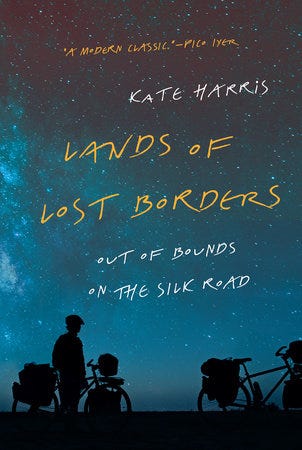
Lands of Lost Borders: Out of Bounds on the Silk Road by Kate Harris

The beauty of this book is that you can read about Kate and Mel’s account of cycling the fabled Silk Road for ten months in rain, snow and sleet, sleeping in a tent, and eating instant ramen noodles, and it’s almost as though you’re experiencing every jarring pothole and starry night with them because the writing is so stellar (which means you’ll never have to do it yourself!) This book has made it to a few bestsellers’s lists since hitting the shelves early this year for good reason: these two are true modern-day explorers.

Pure Land: A True Story of Three Lives, Three Cultures, and the Search for Heaven on Earth by Annette McGivney

McGivney, a master literary journalist, beautifully weaves her own story through her account of the murder of a young adventurous Japanese woman at the hands of a displaced, tormented Havasupai youth at the bottom of the Grand Canyon. Tomomi’s life and death and a mutual love of nature led the author back to her true self. “The farther I walked into the woods, and the wilder my surroundings got, the safer I felt and the more it fed my soul. …Nature loved me. Nature loved Tomomi. This was the bond, the secret, healing handshake…”

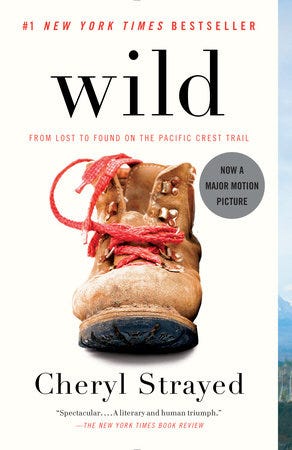
Wild: From Lost to Found on the Pacific Crest Trail by Cheryl Strayed

I’ve heard comments from a few hardcore mountain folk that Strayed should never have ventured out into the wilderness alone for months, emotionally trainwrecked as she was, with absolutely no hiking experience, a ridiculously heavy pack, ill-fitting boots, and at one point, only one boot! But that’s the beauty of this book. Everything was against her and she did it anyway. When I was thirteen, if I’d believed I couldn’t be a climber just because I’d never climbed, had only met one climber, had barely seen a mountain, and whined whenever I had to jog more than half a mile in gym class, I would never collected enough calamities to fill a memoir.

Above All Things by Tanis Rideout

This enthralling, fast-paced and well-researched novel alternates back and forth between the stories of two people: George Mallory, as he attempted to be the first man on Everest, and his wife, Ruth, who waits at home in England with the children, not knowing whether she’ll ever see her husband again. I’ve been in Ruth’s situation, waiting at home for a man who also didn’t return from his mountain. And I’ve also been the climber. Rideout captures both points of view on a very accurate, deep level.

Where the Mountain Casts Its Shadow: The Dark Side of Adventure by Maria Coffey

Maria Coffey is another woman who lost her boyfriend to the mountains. Joe Tasker died on Everest in 1982, and Coffey’s memoir about her loss, Fragile Edge: A Personal Portrait of Loss on Everest, helped me through my own grief. This more recent book explores the impact of deaths in the mountains on the people left behind. Talking about fear, death, and guilt are not climbers’ fortes (there’s even a chapter called Masters of Denial) so this book is a brave one and a tad controversial in the mountain community.

Cowboys Are My Weakness by Pam Houston

These are the first stories I ever read by a woman about a woman in the mountains. The narrators are strong, active women who get into dangerous pickles in the mountains and fall for guys with an edge, which all sounds terribly familiar. I’ve long wished I’d nabbed the title first, with a bit of a tweak: Climbers Are My Weakness.

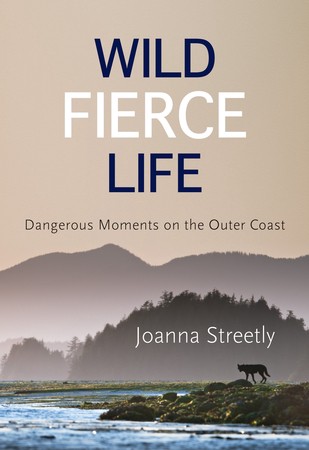
Wild Fierce Life: Dangerous Moments on the Outer Coast by Joanna Streetly

Streetly weaves stories of her adventures guiding multi-day wilderness kayak trips in the remote wilderness on the west coast of Vancouver Island with personal, intimate glimpses into her disintegrating relationship with a First Nations man, and her attempt to balance motherhood with her longing for the wilderness. Her near-death adventures, including encounters with cougars and bears, “opened previously uncharted regions of myself.” Whenever I encounter a bear on the trails behind my house in Squamish, Canada, my language is not nearly as poetic.

Cabin Creek by Madeline ffitch

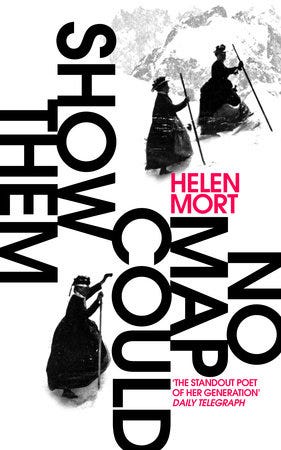
No Map Could Show Them by Helen Mort

This is a strong collection of mountain poetry. My favorites are about the rebellious women climbers of the Victorian era who used to ditch their fashionable shoes and long skirts behind a rock on the approach, and don woolen knickers and boots to climb their mountains: “Take off the clothes they want to keep you in. The shadow of the hill undresses you. The sky will be your broad-rimmed hat.” Mort’s humor shines in poems like “Ode to Bob,” the nickname women gave to the “mansplaining” men they didn’t have to climb with when they climbed with each other. “He never steals the morning with a story of a pitch he climbed one-handed, wearing boxing gloves…”

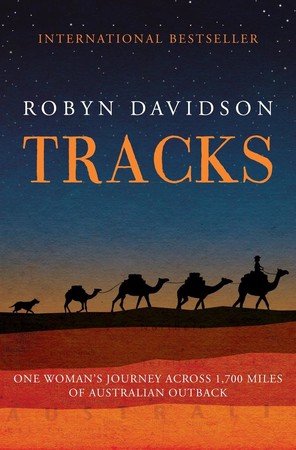
Tracks: One Woman’s Journey Across 1,700 Miles of Australian Outback by Robyn Davidson

The movie is great, but the book gives more of Davidson’s voice. In the postscript, she explains why she had to do her perilous journey alone across the outback of Australia to the sea in 1977: “…nothing was as important as freedom. The freedom to make up your own mind, to make yourself. And such aspirations inevitably involved risk, unleashing opportunities for learning, discovering and becoming.” These words are thrumming with the restlessness and rebellion I felt in my twenties, the refusal to conform to societal and familial expectations of women. They sum up why I am drawn to the mountains and express the main message I hope I’ve gotten across in my own memoir: “Don’t wait for permission. For anything. Especially not to grow and learn and follow your dreams.”

About the Author

Jan Redford is a graduate of The Writer’s Studio at SFU and holds a master’s in creative writing from UBC. Her stories, articles, and personal essays have been published in the Globe and Mail, National Post, Mountain Life, Explore, and anthologies and have won or been shortlisted in several writing contests. She lives with her family in Squamish, BC, where she mountain bikes, trail runs, climbs, and skis. Her memoir, End of the Rope: Mountains, Marriage, and Motherhood is her first book.

How the Brooklyn Literary Scene Is Striving to Be More Inclusive

The Brooklyn Letters project is a series of oral histories of literary Brooklyn from 1999 to 2009, presented by Electric Literature with support from the New York City Department of Cultural Affairs.

This is the final installment of Brooklyn Letters. You can read earlier oral histories here.

Publishing still isn’t an equal-opportunity space for people who aren’t white men — but at least we’re talking about it now. It’s hard to remember how limited and lonely the world felt before we reached our current level of cultural awareness of racial, gender, and sexual discrimination — when our discomfort with an all-white male literary panel might go completely unregistered, because outside of private conversations there wasn’t even a place to register it.

At the beginning of Brooklyn’s ascendancy as a literary place — with its rising concentration of writers, editors, publishers, and agents moving from all over to this one borough, and often even to just a handful of neighborhoods within the one borough — there was no guarantee that you would find the space, the reading series, the magazine, the press, the publisher here that represented you, where the work being featured might actually speak to you. And while these blind spots in the literary scene weren’t unique to Brooklyn, they were certainly represented here, and reinforced as well by the mainstream publishing industry that was based in Manhattan, a short subway ride away across the East River.

There was no guarantee that you would find the space, the reading series, the magazine, the press, the publisher here that represented you.

An entire decade later in 2010, when VIDA — a non-profit organization that gives an annual account of the number of men and women reviewed by or published in major literary magazines — released its first full report, the results showed a staggering gender imbalance across the publishing industry, numbers that on the whole haven’t greatly improved in the near-decade since. And yet, at the local level in Brooklyn between ’99 and 2010, change did come — slowly, painstakingly, and because of the action of individuals within the borough’s literary community. In this oral history we’re going to hear from some of those figures — curators, publishers, writers, and literary citizens — responsible for addressing the lack in Brooklyn’s literary scene, as they talk about what changed, how it happened, and what it meant.


Mira Jacob [author and co-founder, with Alison Hart, of Pete’s Reading Series in Williamsburg; with Hart she ran the series out of Pete’s Candy Store bar, directly below the apartment they shared after they met at The New School MFA program, from Fall 2000 until 2013. The series continues to run, with another set of curators, today]: One of the first problems that walked into our lives was that it was really hard to find women to come and read. The imbalance was something that became clear to us pretty much right away. Men would recommend each other, and men who were not qualified would recommend other men who were not qualified. It was amazing. They would be like, I clearly should be here, and my friends should also be here. Meanwhile women who were overqualified, who were incredible, would get there and be nervous, as if they weren’t allowed to have that space. And maybe for that reason they also wouldn’t recommend other women.

When we first started there were a lot of stories written by rock-and-roll white guys in which nothing would happen. There was one guy in particular, a very established male author, who would read forty minutes of just setting — just scene description. We always told our authors, fifteen minutes, twenty minutes tops. I was pretty aggro about it: “Do not read for more than twenty minutes. It’s not fair to you, or the other authors, or to your audience. Don’t ever do it.” We had this guy on three times, and every single time it was the same situation. Like: “You are all here for me, and I will hold you captive for forty-five minutes, because I’m just going to keep reading. It’ll be long past the point of you wanting to hear, but I have zero register for that.” Meanwhile, a woman would get up there, and at minute five she’d say, “I’m just gonna stop. I’m just gonna stop now.”

It would never cease to amaze me what certain male writers assumed was important for everybody. You just read a long rant against your ex-girlfriend, and subjected this entire bar to it? And somehow you felt entitled to do that? From the beginning there was clearly a disparity in terms of who felt entitled to talk.

Rob Spillman [co-founder of Tin House magazine; since 1999 Spillman has operated the bicoastal literary magazine in Gowanus with his wife, author and co-founder Elissa Schappell]: Prior to starting Tin House my wife had been the senior editor at The Paris Review, and both of us had always chafed against the very maleness of that publication, especially the white maleness of it. Having grown up in the queer world of Berlin, which was very multi-culti and obviously very queer, my sensibility was more playful and fun. So we felt from the beginning that we didn’t want to publish the same voices that everybody else was publishing. We wanted new voices, and women in particular.

Nowadays with the internet it’s much easier to have conversations about things like gender diversity. It’s affected how quickly we react to things, and how quickly we find out about them. When the first VIDA Count came out [a non-profit founded in 2009 which releases yearly reports on the number of men and women reviewed by or published in major literary magazines], we found some really interesting things in there. For instance, that two-thirds of agents are female, but that two-thirds of what they were submitting to publishers was by men. Which either means that men were giving them more things to send out, or that the agents themselves were choosing to send out more things by men than by women.

When I looked at our own numbers, in terms of gender Tin House’s slush pile [the unsolicited work being sent to the publication] was 50/50. But when I sent out encouraging rejection letters — like, “This isn’t going to work for the magazine, but please feel free to send me something else” — as opposed to flat-out no’s, women were four times less likely to send something again. It seemed as if their reaction was, “Oh, you’re just being nice.” Whereas when I sent out encouraging rejections to men, they would immediately say, “Here are five more things. Here’s my desk drawer.” They would just take it literally.

Anecdotally I see that at places like AWP [the annual Association of Writers & Writing Programs conference]. Late night at a bar some guy will write down something on a napkin and say, “Hey dude, what about this pitch?” Whereas my wife would never send something out unless it was completely polished and had been thoroughly vetted — until it was just absolutely airtight. And all of her friends are that way, too. With a sense that they’re not entitled, versus the men who will just send me the sloppiest shit possible. I see that in the submissions and I see it in who takes up the air at readings, where you have to be explicit about the fact that no, eight minutes means eight minutes. I also see it in who actually volunteers to read. Whenever we plan a book launch event, men will be like “Oh yeah. Pick me, pick me.” Whereas, generally speaking, the response by women is, “Oh, only if you have space.”

Jacob: I feel like people have an amnesia about what it was like at that time to be a creative person if you were a woman. In the revision of history it’s like, everybody was pushing each other forward, all the time. But no. Everyone was scared. Everyone felt unwelcome and tentative and very tender. It came out of two things, I think: one was the feeling that we were not allowed in that space. And the other was this sense that, at most, there could only be one of us there at a time — that that was as much as the space would hold. If you were a woman, and a woman of color, yes of course you wanted to lift up other women of color, but only one of us got to occupy that space. You felt so barely welcome yourself that if you did recommend another woman, it was only with great trepidation. And so, starting a reading in a space that had for so long been dominated by the white literary men of New York, we were not only aware of this problem but it was something we came up against right away. Quietly to each other we said, “We’re going to make space for the women and the people of color.” But in reality it wasn’t so easy. It was a process of anguish between us, and it took an incredible amount of digging.

Spillman: When we did that first deep dive into our VIDA Count, Tin House’s numbers were better than everybody else. We were 60/40 [60% men published to 40% women]. And we were actually surprised, because we all assumed we had gender parity in what we were publishing. Everybody on staff, we figured, “Oh yeah, we walk the walk.” And it turned out we were only 60/40 — and yet somehow that was still the best.

The immediate thought for us was, “Wait, how did this happen?” We looked at our own internal numbers, and saw that we were reacting to what we’d been getting. From agents we were getting two-thirds men, and from those who were resubmitting we were also getting mostly men. But at that point we hadn’t realized this was even happening, because we all thought we were picking a lot of women.

There were other more subtle things, too. In our Lost & Found section, where we have people write about underappreciated books and authors that should get more play, my editor in charge of that had been really good about having gender parity in the folks writing them. It was 50/50, perfectly, even back then. But when we took a look back, we saw that despite the parity the subjects were still 70% male. So it meant that both women and men were choosing to write about men. We’d been giving out prompts like, “Write about a favorite underappreciated Booker Prize winner.” And women were mostly picking men.

Of course, part of the reason for that is historical, because men have traditionally been more published by the industry. But it was still a misstep on our part. We had been blind to that. We thought, “Look, we’re publishing all these women!” And so it gave us a chance for a real corrective. In the Lost & Found pieces we started tweaking our prompts to specifically ask if there were any women the writers might want to highlight. And I also tend not to solicit men, honestly because they take care of themselves, and I’ll redouble my efforts with women whose writing I like. I’m careful now in my rejections to say, “No, no, really. Please do send me something else, this one just didn’t fit in the issue. I really do want to see your stuff.” Ultimately, it’s just a matter of paying attention.

I tend not to solicit men, honestly because they take care of themselves.

Jacob: When we started the series we had to see how it was going for a bit before we realized that we would actively have to make sure there were enough women in the season, or that there was diversity. It wasn’t baked in. These days that’s just part of the conversation. It’s like, what the hell’s wrong with you if you aren’t doing that? But at the time we had figure our way through it, while feeling crazy that this was even something we were struggling with.

One of the challenges was that, in the absence of social media and the internet in general, people just did not self-promote in the way they do now, which is unapologetically. Nowadays it’s pretty accepted: writers get out there and they’ll say, “This is me, this is the thing I’m doing.” But back then you never would have done that. It was considered tasteless, which of course meant you were so much more reliant on the publishing industry to forward you, and the industry was mostly only favoring one kind of person.

The way we finally got around it was by going through the publishing catalogs ourselves. Every so often you’d get a catalog, from MacMillan or one of the other publishers, of the books they had coming out that season, and we’d just go through them and choose the people who weren’t already front and center, and then reach out to them. Suddenly we had a different way to crack it. Instead of relying on agents and publishers, we started taking direct control of their lists.

Alison Hart [co-founder of Pete’s Reading Series]: But sometimes it also just took us pushing on them a little. If the agents or publishers recommended people, we would follow up and say, “Any women?” Because often they weren’t even aware they were doing it. It would turn things around on them a little bit to think, “Oh.”

Jacob: I also remember us having strategic conversations about who to ask to find women. How do we find this community of people that almost don’t have a community themselves — that are so scattered they don’t even have a way to talk to each other? Who do we approach? Who’s a connector? What editors do we know that are actively publishing women?

Joanna Yas was a great resource, and an extraordinarily generous person. She was the Managing Editor of Open City at the time [a magazine and publisher founded in New York in 1990, and which published its last issue in 2010].

How do we find this community of people  that are so scattered they don’t even have a way to talk to each other?

Hart: She knew and was friends with a lot of writers, and she didn’t guard her insider knowledge.

Jacob: I remember saying to her multiple times that it was impossible to find women, and she would just turn around and say, “Here are five names, try these five people.” And they were always amazing.

Unfortunately the same difficulty we had in the beginning with finding women happened a couple seasons later with people of color. I remember being like, “Where are the people of color?” But nobody could help with that. Nobody at the time had a good list for that.

Spillman: One of Tin House’s early contributing editors was the poet Agha Shahid Ali, who was also a translator, and he was very persuasive. He would come to me and say, “This is the best Farsi language poet of all time, and you’re going to publish him.” So okay, let’s do it! I would trust him. More recently, when our poetry editor was leaving, we specifically went out and hired a woman of color [the poet Camille T. Dungy]. Because how else are you supposed to address the whiteness of the industry? It’s a systemic problem.

Alexander Chee [author of How to Write an Autobiographical Novel and The Queen of the Night]: The whole reason Edinburgh [Chee’s debut novel, which had been out on submission with publishers for two years] was eventually published was because the Asian American Writers Workshop had a panel on Asian-American masculinity, and I met my editor, Chuck Kim, on the panel. I’d basically given up on trying to sell the book, and he was like, “I’m looking for Asian American literature, would love to read your novel if you have one.” We had just hit it off on the panel and I was like, “Yeah, sure, whatever.” But he kept pursuing me, so I agreed to meet him for lunch. I brought one of the copies of the manuscript I’d picked up from my agent’s office, after she and I had parted ways because she wanted me to work on The Queen of the Night [Chee’s eventual follow-up novel] and try to sell that first, and I was like, “No, white lady, I’m not going to do that.” I understood why people thought what they thought, but I just didn’t want to do it that way. Was I wrong? I’ll never know. But I’m here, so.

Eugene Lim [author of Dear Cyborgs and co-founder of Ellipsis Press]: I co-founded Ellipsis Press with Johannah Rodgers in 2008, largely for selfish reasons: to publish my first novel [Fog & Car] and to publish other experimental fiction works that I loved. I’m very proud of what we’ve published, but I do consider it to have failed in two principal ways. Firstly, I wish I could have gotten more attention for these excellent writers. Evelyn Hampton, Karen An-hwei Lee, Stephen-Paul Martin, Joanna Ruocco — to name just a few examples — are truly amazing writers. As well, though I’ve tried from early on (and will continue to try) to solicit and attract underrepresented writers, I recognize that the press largely replicates the lack of diversity of commercial houses.

During the years we’re talking about, at parties or readings or at places like AWP (which a bitter, cynical writer, who may or may not be every writer I know, told me stands for Average White Poets), because of the dearth of other Asian-American writers I was repeatedly misidentified as Tao Lin, or Linh Dinh, or Phong Bui. As a Korean-American writer who was born here I certainly have and had many privileges, which no doubt helped me find and participate in the nascent scene. And the internet definitely helped connect innovative, “experimental,” and non-commercial writers. But I found, especially in those early years, that hubs and digital gathering spots for writers who identified as both “experimental” and POC was a Venn diagram that largely remained empty.

There is one exception to this. The Asian American Writers Workshop was and is an important venue. I think it has (as I have) also evolved as the Asian American community has evolved (with the single dominant force of change being the Immigration Act of 1965, and its rippling effects through generations of the AAPI [Asian American and Pacific Islander] community). I remember visiting the AAWW early on at its East Village location maybe in the late 90s, and not entirely feeling like I belonged, whereas now I think it fights hard at inclusivity and to constantly interrogate and widen, or at least complicate, the notion of what it means to be Asian American.

Chee: Starting in 1996, the writing community I was participating in in New York was mostly around the Asian American Writers Workshop. In 1996 I got an email from Quang Bao and Hanya Yanagihara inviting me to basically come and hang out with them. They had read an essay of mine in Boys Like Us [an anthology of gay writers telling their coming out stories], and they wanted to meet me. At the time they were both very involved in AAWW. I hit it off with them immediately, and started coming in for the open mic nights. I read at an open mic in the East Village location, I remember, and my agent Jin Auh had just joined Wylie [literary agency] at the time, and she gave me her card there. I had an agent, so I didn’t call her for a few years, but I got her card that night. It just felt very cozy, but also exciting.

One of the most valuable things for me about AAWW was being able to talk about issues of who we write for. Are we writing to each other, or are we writing to this white audience? We had an expression back then for book covers that would be covered in Asian motifs, like fans and chopsticks. It was called “chinking it up.” The author Monique Truong, when she was putting out her book, had told her publisher, “no chopsticks, no waiter coats, no bowls.” And she ended up with a cover that had a waiter carrying chopsticks and bowls — for The Book of Salt, which is set in Paris, and is about this person who cooks for Alice B. Toklas and Gertrude Stein!

The other literary center of community for me happened around A Different Light books, the LGBT bookstore where I worked. Even after I stopped working there I was still very close to them, still very involved. The editor Patrick Merla found me through Edmund White, and was responsible for publishing that anthology, Boys Like Us. There was also an anthology that Hanya and Quang Bao put together of LGBT Asian American writers called Take Out: Queer Writing From Asian Pacific America, that I think was really important and had a big impact in terms of the community-building that was happening at the time.

There were other things I would go to, but I always felt a little out of place because they were really white. But I suppose I also sort of accepted that about them, as part of the story of what they were — as part of “what the deal was”. In the same way that when I went to Iowa [the Iowa Writers’ Workshop MFA program] from 1992 to ’94, it was predominantly white. It just seemed like that’s how things were going to be for a while.

It’s hard, though, to feel like you’re standing there in the group and participating, and also like there’s some screen that makes you invisible, even though you’re right there in the same rooms. That was part of what I felt like I was reacting to at the time. I remember when it was so hard to get Edinburgh published. The submission took two years. I had friends who were like, “We don’t understand why nothing’s happening for your book?” In the editorial feedback letters, I got everything from “Sort of like Graham Swift, but not as talented,” to one editor who just wrote, “I’m not ready for this.”

It was hard because I remember my father had brought me up to always act like racism wasn’t happening, to just keep working and work through it. That was how his immigrant generation dealt with it. To say, “Just ignore it. Is that rain?” but it was somebody spitting at you. Approaching it that way, you don’t get to acknowledge why it’s impacting you, because if you were to acknowledge why, all of that anger would just explode. As I was working on these recent essays [for his collection, How to Write an Autobiographical Novel], I realized that in my writing I was sometimes performing that same reflex of “What racism? What are you talking about?” And I thought, no, you have to actually talk about the shit that you dealt with, and how you dealt with it, to honestly speak to this new generation — but also to honestly record what you lived through. You can’t just perform your father’s dance.

Jacob: Between the two of us we would talk about it a lot: What aren’t we seeing? We made the effort to find the things we weren’t seeing, but that we knew were around — that there should be a place for. Once we started putting more women on the stage, I felt a change psychologically. And I definitely felt a collective change in the idea of what we could expect for ourselves. I remember seeing women up on that stage and being like, “Right, we should be able to expect this.”

It was amazing too because the series itself grew pretty quickly after that, from this little tiny thing to a point where the bar would be halfway backed up, and they would have to put the reading over the bar’s PA because so many people had flooded in.

We made the effort to find the things we weren’t seeing, but that we knew were around — that there should be a place for.

Hart: I remember when Jennifer Egan read.

Jacob: That was amazing!

Hart: It was Emma Straub’s book launch, and I think they were friendly. Jennifer did not want us to promote her part of the reading at all. She just wanted to go first for Emma; whatever she could do to be out of the way, and let Emma have her night. But so many people came because it was not that long after A Visit From the Goon Squad [Egan’s Pulitzer Prize-winning fourth book] was published.

When it’s a really big night, you open up the door from the reading space and pipe the sound out through the whole bar. That night the entire bar was listening. When she started you could see people’s heads pop up at certain points, like, “Oh, she’s reading my favorite story!” Because everybody had a different favorite from that book. Sometimes when you have the doors open to the bar you have to worry about the noise, but that night nobody in the place said a word. It was like nobody was there to have a drink, only to listen.

Jacob: Even the bartender, Dave, was super quiet about setting the glasses down, because he didn’t want to break the spell.

Hart: As you go along running a series you realize that what all writers want is a place where they can get the words out of their head and into other people’s ears, where you’ve been alone all day and you just need to read to somebody, anybody. To be seen and be part of that shared experience.

Jacob: When I heard people read I would feel like, I too need to make this. I remember just hearing certain stories where it would blow my world apart, and my idea of what I could do, and that I even had a right to do it. It really was a constant self-discovery.

From the beginning, I wanted to make a night for all of us. The people who were doing this work. Not the publishers, not the agents. No matter how much of a pain in the ass it had been to try to get things going, at the end of every night people would come up to us and be so grateful. They would just collapse and say, “This was so good. This meant so much to me.” Because they needed it. Being able to put that out in the world felt like giving people food.

Brooklyn Letters is supported by a grant from the New York City Department of Cultural Affairs.

Instructions for Introducing Rick Moody, by Rick Moody

When introducing the author Rick Moody for a public performance, such as a reading at a university, a museum, a library, or at a massive political rally in a European football stadium design by a fascist potentate, please bear in mind the following:

{ 1 }

Find a way, without being clumsy, to comment on Rick Moody’s appearance, using, especially, phrases like “well-preserved,” “ripped,” and/or “unbesmirched by plastic surgery refinements of any kind.” The finest introducers will manage to do this by resorting to a rich brocade of metaphor, enhancing the author’s beauty with unlikely comparisons. It must seem as though Moody is anything but appreciative of the ideas expressed. On the contrary, he will appear irritated and mildly flustered at the revelation that he is “unbesmirched by plastic surgery refinements.” In fact, if given a chance to proof the text of the introduction beforehand, only a reasonable courtesy under the circumstances, Moody will produce a sigh of exasperation at the phrase “unbesmirched by plastic surgery refinements,” so that his modesty will be uppermost. Indeed, his public resistance to a discussion of appearances is keen (though his appearance is blinding), but in the grim bookselling environment in which we live, Moody needs to keep all of his options open. Moody is willing to do what needs to be done. He executes. He drives the ball forward. Please find, as well, a place to work in the phrase “a team player” while mentioning Moody’s background in selling, marketing, motivational speaking, and wealth management, as well as pausing to observe his tendency to “light up a room” with lectures on creativity and Fortune 500, publicly owned companies. Accentuate the positive. Obliterate the negative. Sell, sell, sell.

{ 2 }

The introduction of Rick Moody, taken as a whole, should be extremely long. Given a subsequent reading of twenty-five to thirty minutes as a baseline, the introducer ought to shoot for an introduction that is in the twenty-five-to-thirty-minute range, which is to say that the introduction should equal or exceed the reading itself — and while the introduction should not compete with the literary excellence that is to follow, it should evince a breadth of knowledge of Moody’s work that would require, at a minimum, a decade’s study of the complete works. Reference materials are required for a full appreciation, of course, and evidence of these ought to be adduced during the introducer’s introduction. It doesn’t matter, really, if some repetition is required to produce the aforementioned length. Length implies seriousness of purpose, and audiences require repetition of key phrases — like “a once in a generation voice” — in order to grasp properly the point. Let it be said that Moody can also work with a revivalist introduction, something you might hear at a Promise Keepers rally or during an evangelical event, in which the words “It’s Holy Ghost time! It’s Holy Ghost time!” are not out of place — and during which speaking in tongues is inevitable.

{ 3 }

Naturally, any introduction of Moody’s work should be longer than the introduction for any other writer scheduled on the evening in question or at any time during the festival or conference, perhaps by a factor of two or three, and other writers should be made to wait and should be subjected to all varieties of misery, including uncomfortable folding chairs that occlude blood flow to the spine or sigmoid colon, interminable dinners with hostile departmental functionaries, and receptions peopled by MFA candidates with incipient alcoholism.

Other writers should be made to wait and should be subjected to all varieties of misery, including uncomfortable folding chairs that occlude blood flow to the spine or sigmoid colon.

{ 4 }

In mentioning Moody’s early life, it should be noted that his mother was a virgin at the time of his birth, and that his father was a Roman soldier, and that there was no other writer before him, and no other writer shall come ever again, and entire cultures have been founded on the works of Rick Moody. Even his juvenilia, his every adolescent utterance, are of such importance that people study them for clues to the future of the species. His works can pacify dangerous animals. Sometimes single words from his works have been used as calming agents for children with colic or toddlers who believe that there are fire-breathing entities in the room. Another way of putting it: while other young boys in the landscape of Moody’s biography were busy playing baseball or practicing the electric guitar, Moody was already refining a mythology that included transatlantic solo flights, songs in the troubadour style, pacifying tribal antagonists in Madagascar, the slaying of Komodo dragons in Indonesia, and the ability to bend spoons with his eyes. Moody’s massive and encyclopedic consumption of television at an early age only served to school him in the need for compassion for the wretched, and he counts the indigenous peoples of the Third World among his faithful. Feel free to borrow from the lines above, or to use any of the following: “stamps up and down on the competition, leaving a bloody pulp of contemporary writers gasping in his wake”; “the list of his accomplishments would wrap itself around the equator thirteen and one-half times”; and “our unworthiness is like an acute inability to process certain B vitamins resulting in neurologic dysfunction.”

{ 5 }

Writers to whom you may compare the works of Rick Moody: Tolstoy, Dostoevsky, Homer, Virgil, Melville, anyone who managed to figure out a way to write all of the Bhagavhad Gita on a postage stamp, that guy who was a janitor in Chicago who wrote a 15,000-page novel about girl cherubs with penises, Chuck Jones, Stan Lee, Rod McKuen, Walt Disney, Thomas Jefferson — but in each and every case, the comparisons should note that these other artists toiled unsuccessfully and with mixed results, whereas the works of Moody, especially the most recent works, have been produced with remarkable ease and fluency, like fried eggs in butter, like mold on rye, like oligarchs in a Chechen oil field.

The Rest of the World: Hotels of North America by Rick Moody

{ 6 }

The introducer should seem nervous and/or have restless legs syndrome; he or she should sweat a lot during the introduction; but he should not crack the bottle of water reserved for Moody. If Moody’s bottle does not produce the especial seal-breaking sound when he opens it at the outset of the reading, Moody will exit the stage and return to his diamond-encrusted limo, and you will be forced to make an announcement to the restive and violent crowd that he will not be performing the reading. His retinue will file out as well. The introducer may nervously allude to a question-and-answer session after the reading, if this is being properly paid for, but it should be noted that the questions should be vetted to select only those in which the interlocutor mumbles something like, “I’m sorry; I don’t really have a question; I just wanted to say how much your work means to me.” Moody will, at this juncture, repeat the sigh of exasperation alluded to in number one above, and then he will comment on how humbled he is by his vast and numberless readership. Humility, he will observe, is the word that best characterizes his oeuvre, now and in the future.

{ 7 }

Doors to the stadium should be barred to insure there is no exiting during the introduction or the reading, whether for physical reasons or any emergency, this to include pregnant persons going into labor or anyone suffering from kidney stones, acute appendicitis, or myocardial infarction. And the introducer should also point out that persons receiving telephone calls during the reading will be stoned to death in the Iranian style.

{ 8 }

The introducer should remind the audience that the purpose of the reading is for the audience to feel a powerful need to worship and/or have sex with Rick Moody, even though he is not available for sex. The work, it should be noted during the introduction, brings that out in us, the powerful need to have sex with the author, to worship his unclothed physique, and sometimes we need to rend our garments and gnash our teeth, to exhibit flashes of nakedness — a nipple or bit of shank — although Moody will not be held responsible if the gnashing of teeth causes damage to expensive dental work, nor will he replace garments made inoperable during rending. If the audience is unable not to have sex with one another, because of its jouissance with respect to the work of Rick Moody — an admiration that goes unrewarded by the author’s admirable celibacy — it should attempt to cry out his name during any moment of release. This is especially welcome during the reading itself — the audience should testify — and the introducer can facilitate this at some point during his or her remarks.

The introducer should remind the audience that the purpose of the reading is for the audience to feel a powerful need to have sex with Rick Moody, even though he is not available for sex.

{ 9 }

Please, no mention of the following: any adverse criticism of Moody, though none exists, as this too is liable to cause Moody to leave the premises and thereby cause an incident; any films made from or reportedly made from Moody’s works; any attacks on Moody’s father’s profession as an arms dealer; any negative attacks on Moody at all; any adverse reaction to his story on Twitter; modest sales; or any reviews of his work that he has not yet seen, bearing in mind that he does not read reviews and therefore has seen none of them. These areas of discussion are completely out of bounds, verboten, as is the author’s personal life, which is a dark unknown. Nor should you allude to any acquaintance or relationship with Moody, friendly or otherwise, which, it should be pointed out, is in your imagination, because Moody is too busy with his many responsibilities and business endeavors to conduct a personal relationship with you.

{ 10 }

The following are subjects where an introducer ought run wild. Moody appreciates introductions that mention the following: German philosophy, especially Hegel; any introduction that mentions Moody in connection with historical revolutions in France and Russia; any introduction that mentions Leon Trotsky; any introduction that approvingly quotes from the works of Jacques Derrida; any introduction that includes the word “asterisk” or the term “slappety-slap”; any introduction that features rhymes; any introduction in Alexandrine form; any introduction that speaks of the imponderable beauty of the mallard duck; any introduction that takes potshots at the mystery genre; any introduction that refers to book critics as “morons, ignoramuses, would-bes, buffoons, and trash pickers”; any introduction during which people are stunned into silence; any introduction that is wholly silent; any room in which people are totally silent together, in awe, suspension, or arrest; any introduction that has the structure of the wing of a butterfly; any introduction that is totally loyal to a fault; any introduction that discovers the meaning of the verb “to love”; any introduction that has no adverbs in it; any introduction that includes the term “discussant”; any introduction in which the introducer begins to weep; any introduction during which more chairs need to be brought in; any introduction that includes video footage, a drop-down screen, and a message from the president of the United States of America, who is sorry he or she cannot be there, but whose admiration knows no bounds.

{ 11 }

The introducer should locate and hire certain audience members to produce, at the conclusion of the introduction, the Humanist Moo, in which, after a very brief arrest, a merest downbeat, these paid audience members will go gnhhhrrrrrrngmmmmmmmnnnnnnn, indicating that they have somehow been utterly transformed by the introduction — and yet these paid audience members should remember that the decibel level of the introductory Humanist Moo should be increased during the actual Moody reading, during its own manifold profundities, so that it is apparent that they are more redeemed during the reading itself than during the introduction: Gnhhhrrrrrrngmmmmmmmnnnnnnnmmmmnnnnnnnnnnnnnnnnnnnnnnnnnnnooooooooooonnnnnnnnnnngggggggggggggggghhhhhhhhmmmmmmmmmnnnnnnnahhhhhhhhhhnnnnnnnnnnnnnmmmmmnnnnnnnnnnnnnnnghhhhhhghhhhhghhhhhhhhhghhhhhnnnnnnnnnnnnnnnoooooooooooghhhhrrrrmmmmmmmmmmmnnnnnnnnnnnahhhhhhhmmmmmmmmnnnnnn.

{ 12 }

Having given the introduction, the introducer should collapse abjectly on the floor and not expect Moody to shake his/her hand — nor plant a big wet one on him/her — and he/she should then abjectly crawl off the stage as quickly as possible, after which the introducer should then spend the rest of his/her life on a secluded island with a shrine erected to Moody — which shrine should include grand, multi-tiered representations of Moody’s phallus — and he/she, the introducer, should think of this introduction as a kind of professional pinnacle, a moment of transformation, of oneness, of the kind that only happens once in even the most blessed life.

Having set the record straight on the subject of Rick Moody, in a way that will transform all future introductions, we remind you that, at the conclusion of your lengthy remarks, you ought to say, And now may I present to you . . .

Excerpted from The Spirit of Disruption: Landmark Work from The Normal School. Steven Church, editor. Used with permission.

The Weirdest Libraries Around the World

Working in a small community library involves a lot of smearing disinfectant on glitter-speckled toys in the children’s section, but you meet a bunch of people too. When not disinfecting, I used to help visitors track down texts, locate online resources, and sign up for mailing lists. There was always someone looking for a recommendation or another person eager to give one. Even kids got hyped up pointing out their favorite princesses or dragons on the pages of picture books. The best part of libraries are the people, and seeing how access to books and comfy seating can make them open up to one another made the toy wiping worth it.

Bookstores are great, especially the independent bookstores fighting the good fight against their online counterpart, but they aren’t always the most viable option for book lovers on a budget. What are you supposed to do when four books carry your total over $100? It’s hard to read when your electricity gets cut off for an overdue bill. That’s why I can’t recommend enough getting a card for your local library, and supporting library systems wherever you go.

To promote easy access to literature, here are a handful of fantastically unconventional book borrowing systems from around the world. Some grow from their surrounding communities. Others rely on trade-ins, donations, or customers, but each one has found its own unconventional approach to free reading.

The War Tank, Buenos Aires, Argentina

A Weapon of Mass Instruction, the modified 1979 Ford Falcon translates violence into literacy by transporting over 2,500 books to low-resource schools. Raul Lemesoff began this project as a way to both protest weapons and promote peaceful coexistence with other cultures.

Vending Libraries, Beijing, China

These vending machines take up the space of about three cars, and they don’t offer candy or soda. For 100 yuan (about $16) anyone can purchase a library card that grants them access to 20,000 books from hundreds of vending libraries throughout the city.

Rapana, Varna, Belgium

In a ploy to get kids to put down their phones, a young team of architects constructed the elaborate pavilion to serve as a street library. Gently curved with shaded benches along the interior, the distinctive sea snail shape is a callout to Varna as the marine capital of Belgium. The wooden shelving inside allows for a maximum capacity of about 1,500 books, but seeing as people love free libraries, those books never sit there long.

Horse-Powered Literacy, Ethiopia

The non-profit organization Ethiopia Reads dedicates itself to delivering books to even the most rural Ethiopian communities. With book carts pulled by horses and donkeys, storytellers follow pre-set circuits around various regions and gather crowds of book lovers wherever they stop.

Camel Library, Garissa, Kenya

The Kenya National Library Service takes a similar route to spreading literacy, but their vehicles of choice are the so-called “ships of the desert,” camels. Specially curated boxes travel to rural an nomadic schools bringing not only books but also tents and mats for on the spot classrooms.

Stony Island Arts Bank, Chicago, U.S.A.

The bank is a little of everything: archives, a gallery, a library, and a community center. Restored from a dilapidated condition back in 2015, the old bank hosts a number of workshops, talks, and tours for the public.

Admont Abbey, Admont, Austria

Holding the record of world’s largest monastery library, Admont Abbey is a massive European Baroque building from the late 18th century with beautiful frescoes that are well worth a walk through.

Little Free Library, everywhere

Micro libraries are appearing all over these days. The Little Free Library organization has now reached 85 countries with cute boxes that closer resemble bird houses that than libraries, and they are open for everyone.

Hammock Library, Muyinga, Malawi

Built as part of an inclusive school for deaf children, the Muyinga Library sits between two public squares and is designed with inspiration from Burundi architectural techniques. Though resources were short during its construction, the community was dedicated to creating an open space, both aesthetically and in terms of access. The massive hammock that lined the top floor only upped its appeal.

Fridge Library, Christchurch, New Zealand

Located on the corner of Kilmore and Barbadoes Streets, the Fridge Library stands in a miniature park, serving as a well loved book exchange for the area. Though the shelves can get messy, this fridge will always be filled with food for thought.

Beach Library, Albena, Bulgaria

Forgetting your beach read will never be a problem here. With over 6,000 books to browse in a variety of languages, the only thing guests lack is extra time to enjoy it all.

Phone Booth Libraries, Bramshaw, U.K.

Created by locals, the Bramshaw phone booth is a hot geocaching spot. Since no one really uses phone booths anymore, the booth was available for the Adopt a Kiosk program by British Telecom. Take out the phone equipment, add in some information pamphlets and literature, and there you have a book exchange.

Photo by Anders

Epos Library Ship, Norway

Floating between Hordaland and Møre og Romsdal, the Epos is a ship built for the sole purpose of serving as a floating library. The boat itself can hold about 6,000 books, but it lends out over 7,000 during its tours to 150 communities along the west coast.

Il Bibliomotocarro, Basilicata, Italy

With tune that attracts men, women, and children alike, it would be easy to mistake this vehicle for an ice cream truck, but its cargo is far more precious than that. The book car operates a travel library service that links the main towns of the Basilicata region to the isolated communities surrounding them.

The Garden Library, Tel Aviv, Israel

Set up for refugees and migrant workers, the library structures itself around the belief that books are a fundamental human right. In a neighborhood of asylum seekers, the Garden Library’s books offers an escape into literature and education.

Airport Cocoon Library, Baku, Azerbaijan

Flight delays would so much more tolerable if every airport had these wooden cocoon-like library found in Heydar Aliyev international airport. Take note, J.F.K.!

IKEA Reading Room, Wembley, U.K.

Fully furnished with purchasable IKEA retail, this reading room (only available from July 31 to August 5, 2018) was made to remind visitors how great it is to relax at home with a book. IKEA-goers could book an hour-long slot, choose between one of the 13 Man Booker Prize longlist finalists, and loiter around on couches they might even consider buying.

Bike Library, Dubuque, Iowa, U.S.A.

This full service traveling library is part of the Carnegie-Stout Public Library. With an easily traceable route and a schedule online, the bike pedals new releases, DVDs, and children’s books to various parks. No library card? No problem! The bike is equipped with all you need to apply for a card on the spot.

The Book Truck, Los Angeles, U.S.A.

Even books can get involved in #vanlife. The Book Truck in Los Angeles makes it way to various schools and youth resource fairs to give away books in underserved communities. This traveling library found its calling in making sure every kid that wants a book has a book.

Wardrobe Library, New Castle, Australia

Any conveniently sized box can be repurposed into a library, but there is something about wardrobes that titillates the literary imagination. Whether it’s C.S. Lewis pulling you into Narnia or Jane Austen flitting through the cloaks before an evening soiree, there are untold depths to wardrobes that make them perfect houses for books.

Street Library Bench, Sonthofen, Germany

Books will always have your back, and in this case you can take that literally.

Secret Subway Library, New York, U.S.A.

A perfect place to snag a book before a long commute, this tiny library located underground by the turnstiles at the 51 St. stop on the 6 line is easily missed by passersby. The librarians on duty are always ready to loan a lost traveller a map or recommend a fun page turner.

Converted Bus-Stop Library, Jerusalem, Israel

Another library for readers on the go, the Bus-Stop Libraries in Jerusalem help commuters fill those empty minutes between transfers. You might be early or the bus might be late, but with these libraries you can pick up a quick read at one stop and drop it off at the next.

‘BlacKkKlansman’ Shows How White Supremacists Make Language Into a Weapon

The opening scenes of Spike Lee’s new movie, BlacKkKlansman, are in black and white. The movie is a period piece based on the true story of a black man, Ron Stallworth (played in the film by John David Washington), who became the Colorado Springs Police Department’s first black officer in 1972 and then successfully infiltrated the city’s local Ku Klux Klan chapter in an elaborate sting operation. But this black and white imagery is an effect Lee is using to create the illusion of film from an even earlier era. A conspicuously squarely-dressed man named Dr. Kennebrew Beauregard (Alec Baldwin) appears in front of images of D.W.Griffith’s epically racist black and white film Birth of a Nation, practically foaming at the mouth with concern like the narrator in anti-marijuana propaganda film Reefer Madness — only this time the warnings are about Jewish and black Americans who he believes are turning America into a “mongrel” nation. “We had a great way of life,” Dr. Beauregard repeats at least three times, like a brainwasher trying to indoctrinate the viewer, while blending into the film in the backdrop. This opening sequence sets up something Lee intends to focus on throughout the telling of Stallworth’s remarkable story: the way language can and has been weaponized by white supremacists.

In his book Anti-Semite and Jew (1944) Jean-Paul Sartre describes how anti-Semites “act in bad faith” and “play with discourse” to disconcert their opponents. “They know that their remarks are frivolous, open to challenge,” Sartre explains, “But they are amusing themselves for it is their adversary who is obliged to use words responsibly, since he believes in words.” In BlacKkKlansman, David Duke (Topher Grace) is a slimy, overconfident salesman of the white nationalist brand. In his slickest salesperson voice Duke says that he agrees with people who say that “America is a racist country” — but unlike the black Colorado residents using the phrase to call out the racial profiling and police brutality they experience, Duke argues America is racist because it’s “anti-white.” This willful misuse of the word “racism” allows him to reframe oppressors as victims and vice versa.

The white nationalist group known as the Klan is no longer the Klan; it’s “the organization,” and David Duke doesn’t like to be called its “grand wizard,” but its “national director.”

A little over a week after Trump’s election in 2016, Oxford Dictionaries declared “post-truth,” an adjective defined as “relating to or denoting circumstances in which objective facts are less influential in shaping public opinion than appeals to emotion and personal belief,” the word of the year. The term speaks to, among other things, how white nationalists won over millions of Americans by activating white panic with misinformation about how minorities were outnumbering white Americans, just as in Dr. Beauregard’s frenzied, fact-free opening tirade. When white nationalist behavior began to spike in recent years, journalists were at a loss for terminology to use to describe the former fringe group members who had suddenly made it all the way to the White House. In her piece titled “It is time to stop using the term ‘alt right,’” journalist Shaya Tayefe Mohajer notes how respected news outlets like the Associated Press used the phrase—which is attributed to white nationalist Richard Spencer — as a vague catch-all for white nationalist and white supremacist groups. “Somehow,” she writes, “they were allowed to rework their public personas with a term that makes them sound a little edgy, like an alt-weekly or alt-rock.” In Lee’s film, members of the so-called “invisible empire” of white supremacists undergo the same radical image reconstruction using linguistic obfuscation that allows them to exist and operate in plain sight. In BlacKkKlansman, the white nationalist group known as the Klan is no longer the Klan; it’s “the organization,” and David Duke doesn’t like to be called its “grand wizard,” but its “national director.”

Unchallenged manipulation of language has allowed white supremacists like Duke to legitimize themselves on a national scale. Duke sees this strategic play at respectability — suits not hoods — as his ticket to the White House, the end game of the white nationalist agenda. Lee clearly establishes how analogous his linguistic and sartorial deception is to today’s political reality where America is dealing with a president who ran on a KKK-endorsed “America first” campaign and is known for rhetorical games that involve making up words, being antagonistic to members of the press corps, willfully ignoring facts, and lying outright to the American public — according to The Washington Post he racked up “4,229 false or misleading claims in 558 days.” In an interview with the African-American Film Critics Association the real Ron Stallworth explains, “I didn’t plan on making a big political statement about racial relations, Trump’s America or anything like that. Spike did a masterful job of connecting those dots.” In real life, the combined effect of the hate group’s rebranding efforts and the media’s resistance and/or inability to properly name them, was that they succeeded in making words irrelevant and hate palatable. And Spike Lee insists we shouldn’t let them.

Stallworth arrives at his Klan investigation pretty organically. He sees a Klan membership recruitment ad in a newspaper sitting on his desk and calls the number listed. Once on the phone, Stallworth has to convince the Klan member he’s speaking to, who happens to be the chapter leader, that he is worthy of membership (any in-person meetings are attended by Flip Zimmerman (Adam Driver), a white undercover cop). In the film, as in the book it’s based on, he does this by championing white purity. In the book Stallworth tells him his sister is dating a black man and “every time I think about him putting his filthy black hands on her pure white body I get disgusted and sick to my stomach.” He tells him he wants to join to “stop future abuse of the white race.” In the film version he says his sister is attacked by a black man, but the coded language is the same: he emphasizes her “purity.” In both cases, the story riles the chapter leader up because Stallworth’s racially coded buzzwords strike the exact right nerve. The synonymousness of whiteness and purity is a construction of racism. The link exists today in poorly thought out ad campaigns, as well as in the hearts and minds of many white Americans. According to BuzzFeed news last week South Carolina police arrested a 32-year-old woman, Lauren Cutshaw, for driving under the influence. In the police report Cutshaw defends herself by saying, “I’m a very clean, thoroughbred, white girl…I’m a white, clean girl.” When the police ask for clarification as to why her race matters in this situation Cutshaw explains, “You’re a cop, you should know what that means.”

During Stallworth’s initiation ceremony (attended by his white stand-in Flip), the Klan excitedly watches Birth of a Nation, whose imagery and ideology Lee deliberately loops throughout his movie. Among the snippets of the film Lee makes visible is a scene where a white woman is raped by a black man (though all black characters in the film are portrayed by white men in blackface). This imagery — deeply rooted in racist fears of miscegenation — is the source cause behind immeasurable violence in America. In 1955 Carolyn Bryant, a white woman, claimed black 14 year-old Emmett Till flirtatiously whistled at her and violently grabbed her. Her accusation incited two white men to brutally beat and murder Till. In a pivotal scene in BlacKkKlansman Connie, a Klan member’s wife, employs Bryant’s same tactic of giving false police testimony; she claims that Stallworth, a black man, violently attacked her, a white woman, as a means to cast doubt on his integrity — and it works. Upon hearing her accusation, two nearby cops pin Stallworth to the ground. Cutshaw, Donham, and Connie knowingly wield their white femininity and its attendant terms (purity, virtuousness) as a weapon, knowing full well that the mythic untouchable-ness of white women in America legitimizes any steps, however violent, taken to safeguard it. In The Atlantic writer Adam Serwer explains, “white nationalists win by activating white panic.” Lee shows how language rooted in racist fear can become a verbal panic button that, once uttered, activates white supremacist violence.

Lee shows how language rooted in racist fear can become a verbal panic button that, once uttered, activates white supremacist violence.

Last October a leaked report from the FBI’s Domestic Terrorism Analysis Unit revealed the FBI has a dossier on what it labeled “Black identity extremists,” activists it claims are likely to target law enforcement agencies. In an interview with Foreign Policy, who first obtained the report, a former counterterrorism official from the Department of Homeland Security called the label “a new umbrella designation that has no basis.” The following month at an oversight hearing in front of the House Judiciary Committee, Democratic Rep. Karen Bass questioned Attorney General Jeff Sessions about whether a comparable study was done on white identity extremists. Sessions said he was “not aware” of any FBI reports on such groups. Perhaps that’s true, but if so, it’s a matter of semantics; phrases like “identity extremist” (and, for that matter, “terrorist”) are rarely if ever used for white people engaging in domestic terrorism. A report from the U.S. Government Accountability Office found that of the 225 fatalities that resulted from terrorist activity between roughly September 2001 and December 2016, 106 were committed by far right violent extremists like Neo-Nazis and white supremacists. The eagerness to identify and punish “black identity extremists” despite a lack of evidence, and the refusal to even name “white identity extremists” despite there being a plethora of evidence of their activities, is telling. In addition to encoding racial connotation into words, white nationalists also win when they get away with misusing language, shifting the definitions of words to suit their needs.

Though BlacKkKlansman is overwhelmingly triumphant in tone — Stallworth does pull one over on Duke and Co. and lives to tell the tale — it ends on the image of a burning cross. It then cuts to real footage of the August 2017 “Unite the Right” rally in Charlottesville, Virginia: white men descending upon Emancipation Park carrying carrying tiki torches and loudly chanting the Nazi slogan “blood and soil,” cars ramming into groups of peaceful protestors eventually causing three fatalities. Among the dead was counter-protestor Heather Heyer, whose last Facebook post read: “If you’re not outraged, you’re not paying attention.” Then, seamlessly, Lee introduces footage of President Trump remarking on the event’s violence with his infamous comment about how there was “blame on both sides.” The montage’s message is clear: Hate is still alive. It has taken on different names and different language to appear innocuous — just this month two preteen boys strung a black doll from a noose near a burial ground for black Philadelphians and called it a “prank” — but it is still as prevalent now as it was in the historical period the film recreates. Lee’s decision to end on this sobering note speaks volumes about the film’s agenda. At its premiere at Cannes this year BlacKkKlansman received a six-minute standing ovation. It is frustrating for critics to call a film “necessary” as if its merits are not artistic but moral. But in this post-truth era, this film — a film that insists we shouldn’t allow language to be slippery, whose thesis, like so many of Lee’s other projects, is that we need to “Wake Up!” to hate and the way it manipulates words and ideas — feels necessary.