How a Japanese Novella about a Convenience Store Worker Became an International Bestseller

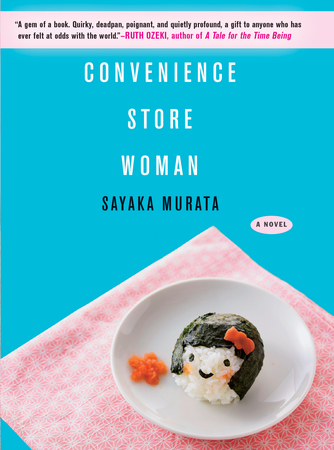
I f you’ve been looking in many bookstore windows recently, you may have seen a tiny hardcover whose sky-blue and cherry-blossom pink jacket features a rice ball made to look like a woman’s head on a plate. I recommend picking it up. Convenience Store Woman is Sayaka Murata’s eight novel, but the first to ever be translated into English. Following a hugely successful Japanese publication — Murata won the prestigious Akutagawa Prize and over 600,000 copies sold in two years — the novel went on to sell in seventeen languages in translation before finally coming out in the U.S. and U.K. last month.
How does a literary novel become an international sensation? Murata’s English translator Ginny Tapley Takemori sees the novel’s success as due, in part, to its “broad appeal”; it is written in everyday, approachable language, so that it might attract fans of manga and anime as well as the literary types, whereas “normally there isn’t much crossover.” And there’s also the fact of the book being knock-you-off-your feet good, sucking you wholesale into the strange brain of its narrator, Keiko Furukura, and carrying you quickly through a smartly constructed plot. But most of all, the book is “just so unexpected.” It’s shocking in Japan, but perhaps even more so to a foreign readership, defying all our stereotypes of Japanese literature and Japanese women.

Keiko is single at 36, and happy. She is proud of her extreme proficiency at a job typically staffed part-time by students. The store gives Keiko comfort and purpose, but it goes much further than that. At times it feels like a religious temple, glowing into the night; at others the store is an extension of Keiko’s self, its needs vibrating in her very cells. In one of many exquisite passages, she reflects:

When I can’t sleep, I think about the transparent glass box that is still stirring with life even in the darkness of the night. That pristine aquarium is still operating like clockwork…. When morning comes, once again I’m a convenience store worker, a cog in society. This is the only way I can be a normal person.

A single female narrator, uninterested in sex, completely focused on work that doesn’t constitute a “career,” is a departure from the norm in Japanese literature as much as it is in English. “I don’t think there’s been anyone, at least that I’ve come across, quite like Keiko,” Takemori tells me, “especially in not even missing having a relationship!” Sexuality as a woman is central to Murata’s work, and her novels often feature a lot of sex — though it isn’t necessarily pleasant. Murata is interested in the bizarre pressures society puts onto women. In her newest novel, out this summer in Japan, she is quite explicit: “She sees society as this big baby factory. When you become an adult you become part of this factory to create more humans.”

Takemori’s pet peeve is English editions of Japanese novels featuring elegant, frail-looking Japanese women on their covers. “The image of Japanese women in the U.S., the U.K., and elsewhere is usually quite dutiful, sexy, a bit downtrodden by men. It’s a fantasy.” So here is Keiko: “she’s not attractive, she’s not interested in sex at all — it’s just not on her radar — and she is working to live, in a very unglamorous job. It gives a different view of Japan all together.”

The beating heart of the short, haunting novel is the Hiiromachi Station Smile Mart. We enter Keiko’s world in the din of the morning rush: door chimes, advertisements ringing over the intercom, store workers yelling their greetings to customers, scanners beeping, items rustling, high heels clicking. “A convenience store,” we find, “is a world of sound.”

In convenience stores, restaurants, and shops of all kinds in Japan, store workers call out stock phrases, practiced in unison before work each morning. The greetings are so particular and so ubiquitous that no English correlate quite fits. Takemori decided to leave “irasshaimasé” — literally “welcome” — untranslated: “I decided, well, readers aren’t stupid. They can cope with one Japanese word.” She crafted other phrases to sound as formulaic as possible: “Certainly. Right away, sir!” “Thank you for your custom!” You don’t think when you say these phrases, she tells me; you just say them.

Literary translation is both a creative endeavor and a long and impossible series of problems needing solutions. Even if the language itself were your only concern, it isn’t possible to take something directly from one language into another, word for word, particularly between languages that function as differently as English and Japanese. But it’s not just the words that need to be carried over the gap. As Takemori puts it, a translator must recreate the novel’s “effect” — its atmosphere, voice, and impact on a reader.

This is where academic and literary translators divide. Academics tend to prioritize a more exact translation for scholarly purposes, whereas freelance translators like Takemori are more willing to play with the original in order to capture its impact on the reader. “By trying to be too faithful to the original,” Takemori believes, “you can actually betray it.” Convenience Store Woman is often shockingly funny. “There are parts that almost had me spitting out my coffee when I first read it, they’re so funny.” An exact translation — or as close to exact as possible — would be difficult and bewildering to foreign readers, necessarily riddled with footnotes. The humor would fall flat. The utter strangeness, distance, and charm of Keiko’s voice would be lost.

An exact translation — or as close to exact as possible — would be difficult and bewildering to foreign readers, necessarily riddled with footnotes.

So you get creative. You make a way in English for a voice that’s doing something that hasn’t been done before, even in Japanese. It’s a daunting task. “But that’s what I love about it,” Takemori says. I ask her how she did it, how she captured both the endearing and the creepy in the novel’s atmosphere. Like any art form, of course, there isn’t an easy answer. “I just had to keep plugging away at something, you know, like this is a bit flat, it’s not shocking enough… When you finally do get it right, you know you’ve got it, and that’s a really nice feeling.”

Reading Convenience Store Woman feels like being beamed down onto foreign planet, which turns out to be your own. Takemori confirms that the experience is the same in the original. “Sayaka Murata is shocking. Through this very strange character’s eyes, you see society in a different light. You know, what people think is normal is really not normal at all.” Keiko often sounds like a researcher, taking notes on her species:

My speech is especially infected by everyone around me and is currently a mix of that of Mrs. Izumi and Sugawara. I think the same goes for most people. When some of Sugawara’s band members came into the store recently they all dressed and spoke just like her…. Infecting each other like this is how we maintain ourselves as human, I think.

The morning I finished reading Convenience Store Woman, I walked around for hours in a haze, my mind eerily caught within Keiko’s voice. I took some pride in my productivity that morning, tapping away at emails like a small cog in the machine. I felt an inch apart from the racing life of the city in front of me, as if behind a pane of glass. I asked Takemori if she felt something similar while living immersed in Keiko’s voice, in the process of translating. “Certainly I started looking at things in a different way, seeing little details that I hadn’t noticed about Japanese society. I’d always just taken convenience stores for granted. I hadn’t even thought about them.”

Reading Convenience Store Woman feels like being beamed down onto foreign planet, which turns out to be your own.

But Takemori didn’t find herself as disoriented as I did. She reflects that as a foreigner in Japan, she already lives with “a certain distanced perspective.” She will never see things the way she might have if she’d grown up in Japan like everyone around her. I remark that this might have primed her to be Keiko’s medium—an outsider translating an outsider—and she agrees. Though, laughing, she adds: “I don’t think I’m quite as much of an outsider as Keiko.”


Sayaka Murata, the author, could easily be seen as an outsider herself. She writes from 2 a.m. until 8 when, until recently, she would go to work at a convenience store, which she found to be a useful anchor in her day before returning home to keep writing. In an interview with the New York Times, Murata credits the store as an antidote to her former shyness: “I was instructed to raise my voice and talking in a loud friendly voice, so I became that kind of active and lively person in that circumstance.” These days, she is close with a number of other prize-winning, radical young women writers, including Risa Wataya and Kanako Nishi. It’s worth mentioning them here because, though they’re celebrated in Japan, they aren’t well known elsewhere. Which brings us to the great gap in the English-speaking world’s knowledge of Japanese literature — and why it took so much and so long for one of Sayaka Murata’s novels to make it into English.

The Tale of Genji, widely considered the world’s first novel, was written by a noblewoman and lady-in-waiting, Murasaki Shikibu, early in the 11th century. Ever since, women have had a place in Japanese literature, which quite plainly has not been the case in English. The major prizes, the Naoki and the Akutagawa, are consistently awarded to women and men in equal numbers. Meiji-era short story writer Ichiyo Higuchi became the third woman to be featured on a yen note in 2004. Today, Japan is experiencing a great boom in extremely popular young women writers. Takemori shows me a 550-page volume of writing by women, published recently by the literary magazine Waseda Bungaku, which sold out in a week.

But most of those young women writers aren’t making it to America. Much, much less literature gets translated into English than the reverse, to begin with. But of the books that do make it into English, from all languages, the vast majority are written by men. This makes some sense in the history of Japan, Takemori explains: Japanese literature really began making it into English during the American occupation after World War II, thanks to translators like Donald Keene. The Americans in Japan during the occupation were in the military, Takemori points out, “and mostly guys!” The trend those guys began has proven doggedly persistent. Today, outside of Japan, we know of Haruki Murakami, Yasunari Kawabata, Yukio Mishima, Jun’ichiro Tanizaki — but besides Banana Yoshimoto, we might struggle to come up with another female author’s name.

This extreme disservice to the talent and vision of Japanese women writers is something Takemori is on the campaign to change. Last November, inspired by a worldwide movement among translators to create more visibility for women writers, she and fellow translators Allison Markin Powell and Lucy North held a translation conference in Tokyo: “We were deliberately provocative in calling it Strong Women, Soft Power.” It was a smashing success, with tickets sold out in advance. “It got a lot of people talking. I think we’ll be seeing more Japanese women in translation from now on, actually.”

I can only hope that this is true. In the meantime, may we buy out bookstores’ stocks of Convenience Store Woman, and yell Sayaka Murata’s name from the rooftops.

10 Fairy Tale Retellings That Are Deeper, Darker, and Sexier Than the Originals

In a wonderfully enlightening piece on the dearly departed Toast, Anne Thériault makes the case for the fairytale as feminist genre. “Fairytales” she argues, are “women’s tales” — but it’s hard for us to imagine that because the fairytales as we know them have been drastically revised over time. The first edition of Grimms Fairy Tales published in 1812 did not sell well. In the interest of attracting a younger audience, the collection was revised, cut down, and republished in 1815. What got the chopping block? Sex. In 1812 lots of it, and in 1815 no more sex. Mothers eating children, chopping them up into stew is fine. But sex, absolutely not. Thériault argues that the erasure of sex, when we look at it closely, does more than show us a prude sensibility:

Not only did they remove any mention of sex, the majority of it both consensual and premarital, but all sorts of other details defining and limiting the female characters were added in. With each successive edition, the Wilhelm Grimm added in more and more adjectives describing what they thought was the perfect Christian woman; female characters were suddenly “dutiful,” “tender-hearted,” “god-fearing” and “contrite,” where once they had simply been “beautiful” or “young.”

“Fairy Tales Are Women’s Tales” in The Toast by Anne Thériault

The women who followed the new rules were rewarded with Happily Ever Afters, and the women who didn’t were supremely punished. Thériault concludes: “And so fairy tales began to feel less like women’s stories and more like a guidebook for how women were expected to behave.”

Thankfully, we have a slew of brilliant contemporary writers who were able to read between the lines of the watered down, patriarchy-pumped fairy tales we grew up on, and turn them back into transgressive, queered revisions — where chance has its day and good women are allowed to be bad and sex is not a death sentence. Here, some of our favorite fairy tale rewritings that say “screw ever after: what do we want now?”

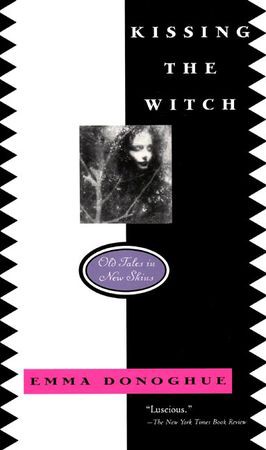
Kissing the Witch: Old Tales in New Skins by Emma Donoghue

Donoghue wrote 13 stories that queer the fairy tale as we know it. In the collection, Cinderella runs off with the fairy godmother instead of the prince, Snow White wakes up with her own damn desire, and Belle who thought she could be the one to change the beast, learns that beasts, like people, don’t change. But the titular story “The Tale of the Kiss” is the penultimate feminist remaking in which the Sea Witch aka Ursula of The Little Mermaid gets her day.

The Robber Bride by Margaret Atwood

Because everyone remembers the fairytale where the bachelor lures three women into his home, and eats them one by one, right? In Margaret Atwood’s reimagining of the tale of “The Robber Bridegroom,” Zenia is the debaucherous and “evil” woman ruining the lives of her three best friends. By way of Zenia’s desires, the men attached to her friends, we learn about the lives of Tony, Charis, and Roz — all riddled with loss, instability, and a wee bit of chaos.
The Bloody Chamber by Angela Carter

This list would not be complete without Angela Carter, the fairy godmother of feminist fairytales. Carter brings all the sex and blood and guts and rage back to the fairytale, and The Bloody Chamber gathers some of her best revisions together in one binding. In one story, “The Tiger’s Bride,” Beauty turns beast due to her throbbing, hot and heavy feels for the Tiger who, with “each stroke of his tongue ripped off skin after successive skin, all the skins of a life in the world, and left behind a nascent patina of shiny hairs.”

The Lady of the House of Love

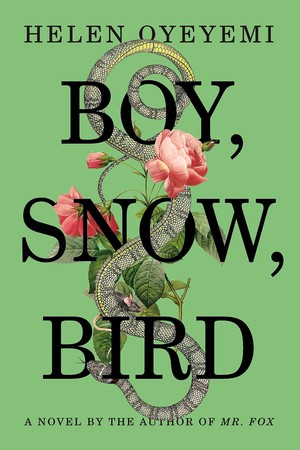
Boy, Snow, Bird by Helen Oyeyemi

Boy, Snow, Bird is a Snow White retelling. Set in 1950s New England, the stepmother is named Boy and the stepdaughter named Snow. When Boy and Snow’s father have a baby of their own, a family secret emerges in the skin of their daughter. It’s a story examining how race, class, and gender ideology made monsters out of “everyday” people. In an interview with NPR, Oyeyemi explained why she was drawn to the fairytale as a place to tease out the “wicked” part of wicked stepmother: “I wanted to rescue the wicked stepmother. I felt that, especially in Snow White, I think that the evil queen finds it sort of a hassle to be such a villain. It seems a bit much for her, and so I kind of wanted to lift that load a little bit.”

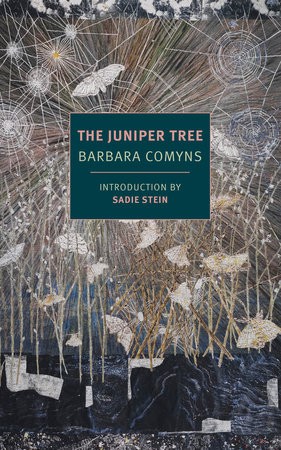
The Juniper Tree by Barbara Comyns

Because more modern retellings of fairy tales should trouble the whole “evil stepmom” thing. And what better way to do that than tackle another Grimms brothers fairy tale that marries infanticide with romance. In the original “Juniper Tree,” an evil stepmother kills her stepson, feeds him to his father, and then lets her stepdaughter believe she was the one who killed the boy. In Barbara Comyns’s retelling, the protagonist is Bella Winter — she’s homeless, without a job, and has a toddler whose father was a man she can’t really remember. Slowly, she endures enough to mend things, and marries a neighbor shortly after he’s been widowed. Comyns uses the grisly fairytale to problematize the clean lines between good and evil when it comes to domestic survival.

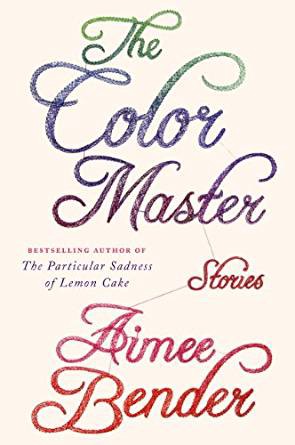
The Color Master by Aimee Bender

Aimee Bender imagines fairy tales where women have agency and don’t need anybody else to rescue them from their distress, thank you very much. “The Devourings,” for example, is a story in which a woman is married to an ogre. The ogre “accidentally” eats all of their children, which understandably ruins their marriage. So the woman decides to leave her husband, and does. As Happily Ever After as it can get after your children have been eaten, I suppose.

“The Doctor and the Rabbi” by Aimee Bender

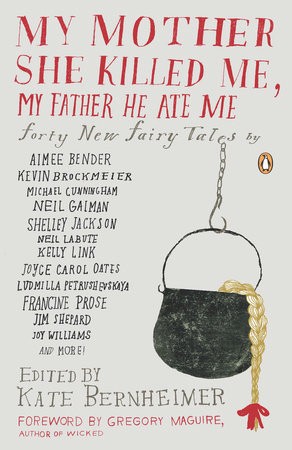
My Mother, She Killed Me My Father, He Ate Me edited by Kate Bernheimer

I don’t care if it’s cheating to put an anthology on this list, because this one is too good not to be included. Edited by Kate Bernheimer (who’s also written an exceptional essay in defense of the fairy tale as a legit study in literary form), this anthology not only has the best title, but it also includes exceptional writing by Kelly Link, Francine Prose, Karen Russell, Aimee Bender, Neil Gaiman, Italo Calvino, and others who take the word “spellbinding” seriously.

One Hundred Apocalypses and Other Apocalypses by Lucy Corin

This collection actually reads like a spell, if only for the way it’s structured. The story “Eyes of Dogs” is told in two voices — one in the center of the page, and one in the margins. It’s a retelling of the Hans Christian Anderson tale “Tinderbox” in which a young soldier is tricked by a witch. In an interview with Lambda Literary, Corin explained the tension between the voice retelling a story, and the reader who chooses how to listen: “I thought instead of doing just one retelling I would do a double retelling and each narrative would double helix and twist into each other. And then I thought, how would I tell the original story in the first person, in my voice? So the part that is in the margins is essentially my contemporary voice telling the original plot with a much more modern sensibility — that’s really different from a historical sensibility. I like the idea of those two stories, (the main one and the one in the margin) crossing [and] the reader having to make these choices about how to read them.”

The Merry Spinster by Daniel Mallory Ortberg

Toast co-founder Ortberg pioneered the series “Children’s Stories Made Horrific” and many of those stories are collected here. What if The Frog Prince were really a story in which we honored gender fluidity, and challenged the ways young and vulnerable people are manipulated by those who offer protection in exchange for something else? Enter Ortberg’s “The Frog’s Princess,” in which the sun falls in love with a young man’s daughter. The sun shines on them constantly, and they retreat into the woods only to find a frog who “offers” help and then demands things in return. Ortberg told Vox in an interview: “Any time you read a fairy tale, it’s very clear that somebody’s gender really influences the role they play in the story, whether they’re a daughter or a son…What would it look like if there were a world where there were still abuses of power, there was still violence and the threat of sexual violence and repression, that did not have the exact same gender roles and values as we do? So it’s not like this world is either better or worse than ours; it’s simply that power is ordered in different constellations.”

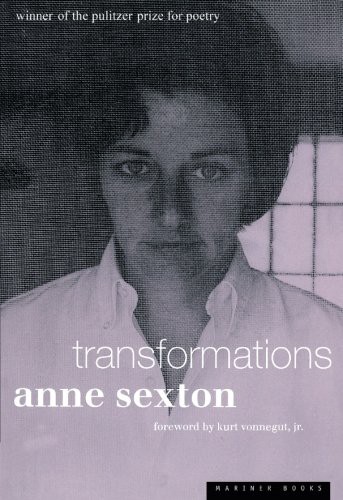
Transformations by Anne Sexton

Snow White seeks revenge, Briar Rose (aka Sleeping Beauty) becomes an insomniac, and the witch’s burning in Hansel and Gretel becomes “altogether a memorable incident.” Transformations is more faithful to the fairy tale mythos as we know it, but infuses each iteration with a little more rage and revenge in the Happily Ever After bit.

Jeff VanderMeer Explains How to Write a Haunted Book

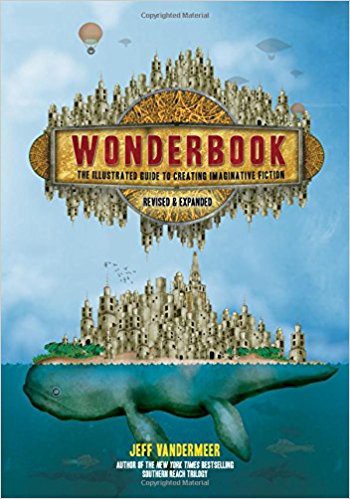
The following is adapted from a lecture given at Columbia University in April, 2018, and some of the images are reprinted from the author’s Wonderbook: The Illustrated Guide to Creating Imaginative Fiction. A revised and expanded edition of Wonderbook was published this month. Additional content can be found at the Wonderbooknow website. (Artist Jeremy Zerfoss created all diagrams reproduced here, unless otherwise noted. Click images to expand.)

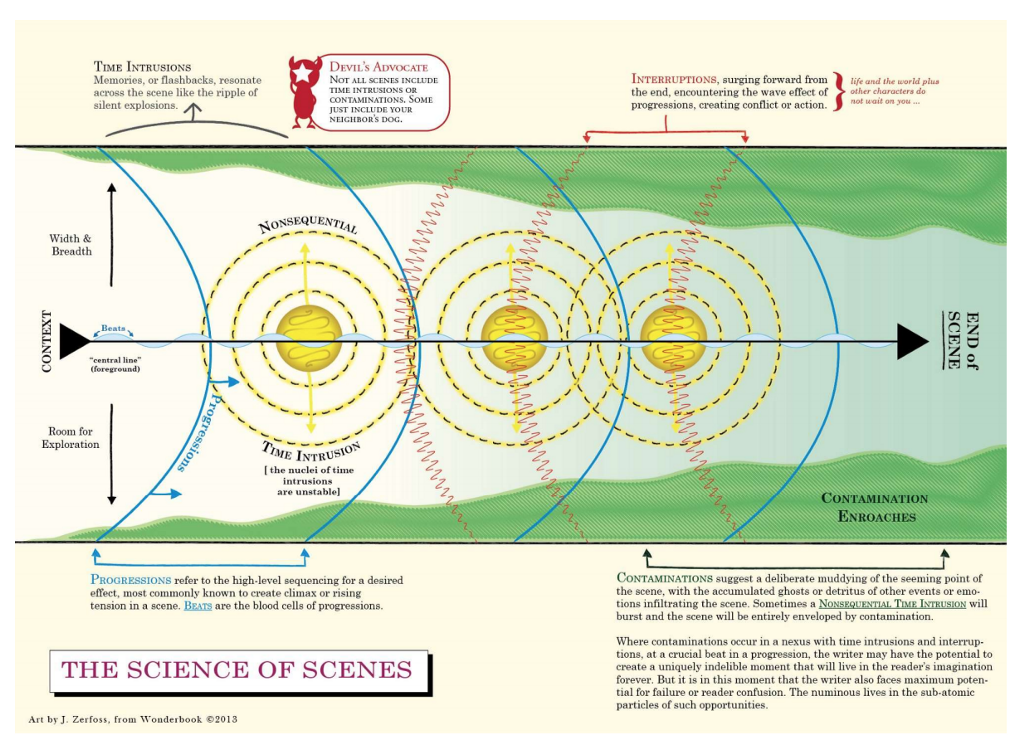
Hauntings, as I see them, are one way of destabilizing the text without breaking the fourth wall, and are meant to help create texture and richness that may or may not be consciously noticed by the reader. Nonetheless, because these effects are visible to the writer, they likely change the narrative experience for the reader. (If you destabilize the text by breaking the fourth wall, all other effects you are attempting are defined by that breakage. This is also a valid approach, but not one that appeals to me currently.)

The point, too, is that we can become too enamored of the smoothness or seamlessness of our scenes and mistake that for success rather than perhaps something too pat. We can believe we are adhering to a classical idea of unity of form, when in fact we are simply creating something that might have more life if it were in some sense rougher or messier.

“Disruption” as a term is currently revolving in a decaying orbit due to the tech industry and “contamination” a negative one due to ancient instincts and, necessarily, the CDC. But both terms are useful in the context of fiction.

“Disruption” is useful in terms of the idea of either having enough distance from your creation, or seeking it, to think of ways that this might organically push back against neatness or inertia in the narrative — and “contamination” because it suggests a transaction resulting in layered richness.

In a microbial sense, “contamination” is the condition of all living things — and occurs to all of us on an hourly basis, with invisible actions and reactions taking place that demonstrate there is less difference between outside and inside, between our bodies and the world the move through. That there is a hidden agency that is often connected to the human but is not the traditional idea of “agency” in a work of fiction.

Once you realized that just at face value “contamination” acknowledges a world that is much more invisibly volatile and teeming with life than most fiction is able to portray, it is only logical to move on to ways of removing the distance between “person” and “environment” and even narrowing the perhaps too-wide gap between “Nature” and “Culture.” As, especially, I try to write from nonhuman perspectives in ways that I hope are not overtly experimental, in ways that remove an emotional reaction…all of this thought feeds into that attempt, even though it could feed into more traditional ideas of fiction.

How do I then find and adapt the structures that will best support these approaches? Structures that will perform best under the stress of a foreign regard?

This is in the back of my mind as I think about how hauntings — disruptions and contamination of the text — will help. So is the question of how much of this is actual quantifiable effect of structure in the text and how much is the scaffolding my mind needs to attempt (what I hope are) invisible experiments. Radicalizations that still mimic the form, the structure, of something familiar to the reader.

Important to hauntings is something crudely articulated as “the rate of the strange to the familiar.” This is something I have to think about after I’ve finished a rough draft, given that very strange effects will seem normal to me as the writer that may not be normal to the reader.

Important to hauntings is something crudely articulated as “the rate of the strange to the familiar.”

The point is not to “commercialize” something personal by changing or deleting what is too strange. But the point is to think of how much space you’ve left for the reader’s imagination and what kind of space it is. Are you meaning to write a work in a particular instance that rewires the reader’s brain or one that allows the reader’s brain a gentler entry point? Sometimes the gentler entry point is actually better to achieve a stranger result.

In all ways and at all times, I guess what I’m searching for are the repurposed and new tools to build something that does not exist already or to create the right “renovations” in certain instances.

In this context, it’s useful to discuss two inspirations in particular, one internal and one external, that helped me to arrive at an interesting place regarding hauntings.

I first thought about transference of emotional resonance or other qualities in my early 20s, when I embarked on a series of formal experiments in my fiction. Since I was mostly working on interlocking stories set in an imaginary city, I figured that experimental texts could in fact shore up the reality of the city using the same techniques that in describing a real place would break the fourth wall. In short, that fantasy would normalize and make less experimental post-modern technique.

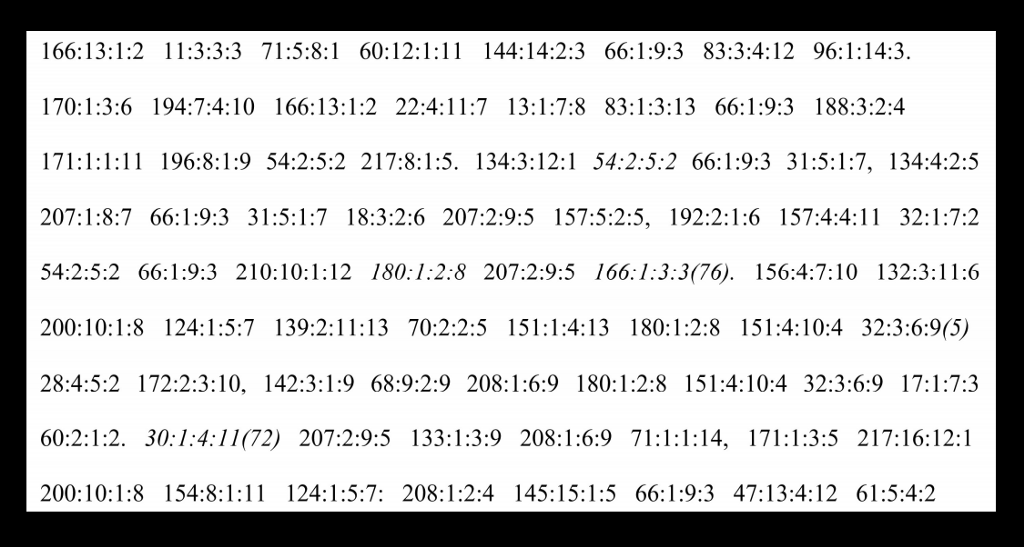
After a series of lesser experiments, I included a story in my mosaic novel or interlinked tales about the imaginary city that was all in code. A series of numbers, each set of which corresponded to the location of a word in a story elsewhere in the book. The reader had to decode the story using the rest of the collection.

The decoding in this case meant that reader was, to some extent, writing the story. And this process occurred on at least two levels.

The decoding in this case meant that reader was, to some extent, writing the story.

First, the unfurling of the plot of the story itself, word by word, and then the fact that I chose words from the rest of the book for their specific context and resonance. This was sometimes a neutral value and sometimes a very dramatic value, or a dramatic or quiet transference from the physical to the mental or vice versa. So, for example, taking the word “the” and other so-called invisible words from a scene in an unencrypted story featuring wide-spread destruction by fiery conflagration — and using these words in the encrypted story at a moment of great mental confusion and psychological drama.

The result is a story that unfolds in the reader’s mind in a way almost similar to some experiments with hypertext, but with the reader in a much more proactive imaginative position — and also adding a third mystery, which is, of course, why that particular story should be encrypted in the first place.

The audience for such a story is limited because it is a formal experiment, a kind of haunting of the text by itself that although transformative requires great patience and effort, and occurs at a slow pace. Over time, I’ve heard from about 150 readers who attempted the feat. There may be more, but I imagine not too many more. But it was a start. I began to think of how I could achieve similar effects in real time and without formal experimentation, and sometimes at a normalized tactical level.

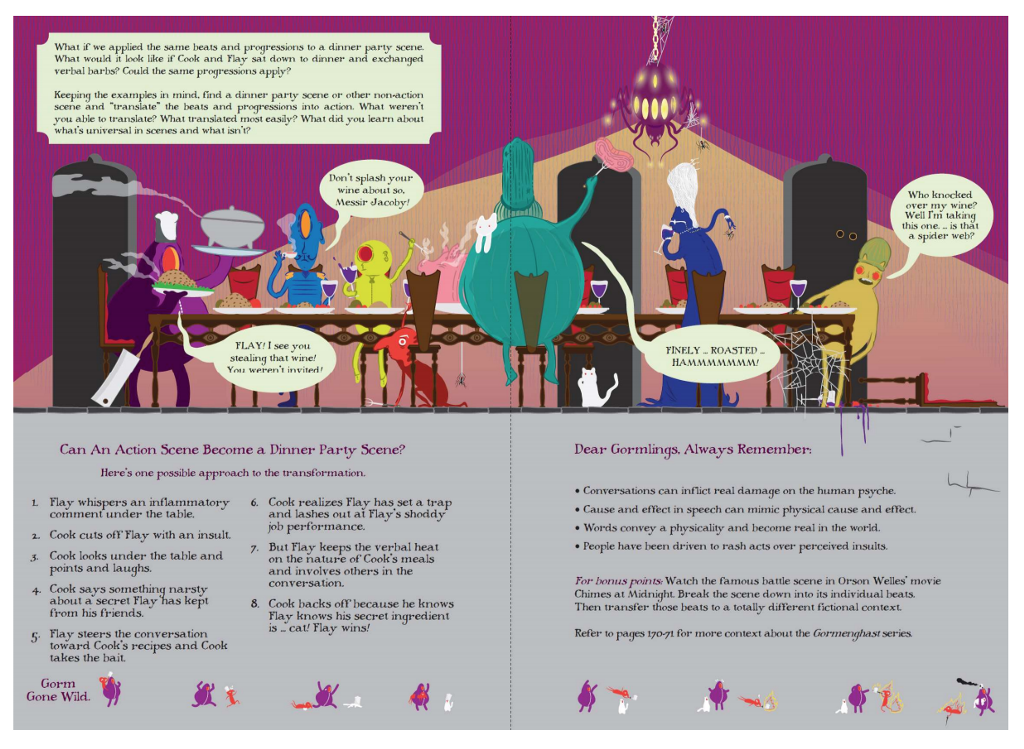
One way this ties into my prior comments on the study of structure can be expressed in an interesting way by a scene from Mervyn Peake’s Titus Groan, first book of the Gormenghast trilogy, which contains one of the great action scenes of all time. Set in a huge castle-like ancestral home, these books follow the often bizarre lives of the inhabitants — including Flay, servant to the lord of Gormenghast, who comes into conflict with Swelter, the Cook. In the chapter “Blood at Midnight,” their long-simmering feud comes to a boil — as depicted here. The long scene contradicts most rules about conveying action by using ornate language and complex sentences. It shifts point of view between Flay and Cook, which also shouldn’t work in this context.

Other fascinating attributes of the scene would be a whole different lecture. But for purposes of this lecture, I became interested in how you might find the level at which action-reaction summarized might be translated into a totally different context — for example, a dinner party. This question came into focus when I mentioned the idea at a literary festival, and the writer Victor LaValle asked me “How, exactly?”

I began to think both specifically and generally about this — generally in the sense of can you extract the structure of a scene at a certain level of hierarchy such that you can transplant it into any other context?

Specifically in the sense of the nuts-and-bolts of “translating” this particular Gormenghast scene. Could you structure the scene exactly the same way but transfer the weight from action to words? What would that look like? Would the urgency of the action scene make tension more easily expressed at the dinner party because of the source? In other words, would the fact the scene had begun life in a totally different register an context mean that the emotional residue of the original context would transfer? (Adding another layer of depth to the scene.)

Could you structure the scene exactly the same way but transfer the weight from action to words? What would that look like?

I’m still exploring the answer — even the diagram included here is just a start. But the further experiment is for me to take a scene I’ve written and apply the same transference, from action to words or vice versa, or perhaps an even more complex translation — and to see how that would not just bring in some residue or ghost of the original, but also to see if whatever personal resonance I brought to the autobiographical origins of the original scene now, at a different distance, manifests in a context that has perhaps no relationship to the first-hand thing I experienced that sparked the original scene in the first place.

One obvious reason this could be an important experiment is that finding the right distance either from one’s own life or from some element in the text is perversely enough often how a writer manages to fictionalize something in a useful way. The idea that you could “launder” your autobiography through a double-filter to get somewhere useful is fascinating to me.

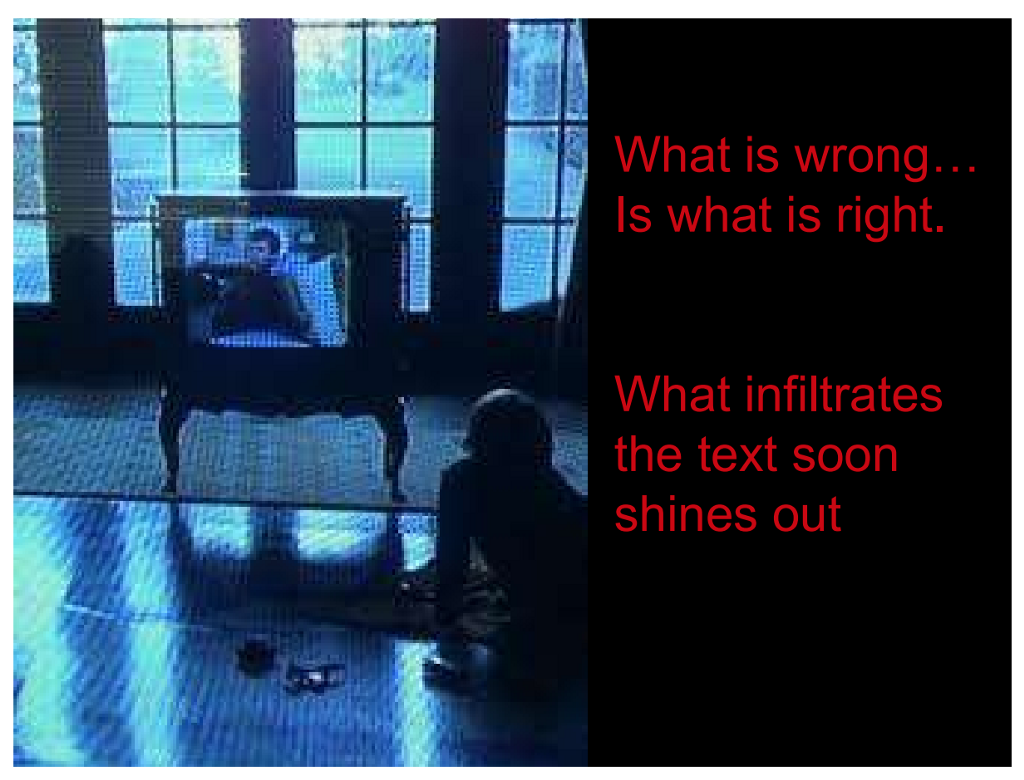
In addition to my encrypted story, I was also thinking about this image from The Shining quite a lot.

What’s wrong with this image? Well, try to put yourself in the position of a viewer from the 1970s or early 1980s.

The problem is that the TV has no cord. Now, today, a television can have no cord and still be playing, but not back then. So, the image is in fact uncanny. Being a fan of taking interesting film technique and translating it into technique for fiction, I thought what is the translation here?

In fiction, if you write a television that’s on and then say whatever the modern equivalent would be of “and it had no cord!”…that would be clumsy beyond belief. Kind of equivalent of reading that the “panther leapt like a big cat.”

I had thought about the encrypted story and that television with no cord for some time when I decided that the second Southern Reach novel required a contamination to reach the proper layering or depth.

Prior to this, I suppose the encrypted story had entered my process in at least one fairly crude way: if I felt a story was too smooth or I had somehow missed an opportunity, I would photocopy my handwritten pages and I would tear strips off of those pages, sometimes burn parts of them, and then, after a break of a month or so, I would go back to that now incomplete evidence and try to recreate the story. Usually this resulted in radical changes from the original.

If I felt a story was too smooth, I would photocopy my handwritten pages and tear strips off of those pages, and then, after a break of a month or so, I would go back to that now incomplete evidence and try to recreate the story.

But in thinking about the Area X novels, it came to me almost immediately that I could repurpose dialogue from Annihilation in Authority. Most of the incidental dialogue, then, that the main character in Authority hears while walking down corridors of the Southern Reach secret government agency is from Annihilation. In a context where the reader is already primed to uncover the next set of phrases that constitute hypnotic suggestion, as introduced in the first book.

The effect is meant to create a strong sense of directionless déjà vu in the reader. Conversely, this gave me the idea to retroactively contaminate Annihilation with Authority by using seemingly innocent phrases in Annihilation as hypnotic suggestions in Authority. An expedition back into Annihilation from Authority.

Ghosting dialogue may seem like a mere trick, but I think it is more than that. For one thing, for those readers who do notice “the trick,” source the dialogue back to Annihilation, each phrase brings with it the emotional resonance and context from that first book, until suddenly the corridors of the Southern Reach are not in fact inert, transitional environments, but ultra-alive places full of ghosts and full of words that have actual important subtext. It makes of incidental conversation something more central. It also conjures up for me, the writer, the idea of contamination and disruption in the sense of other forces at play in a very concrete way.

Performing this act in revision, a state in which I try to re-enter the fictive dream that is writing the rough draft as much as possible…this act made it easier to stick to the claustrophobic, paranoid style of Authority, a way of more or less by inhabiting the “character” of Area X as I wrote the novel, even as I also inhabited the actual main, human character.

Just as in Annihilation the physical environment impinges on and overwhelms the characters, then, via these devices that seem like a surface overlay but are in fact deep arteries embedded in the walls of the secret agency. In a sense, Authority also becomes a richer and more interesting ecosystem, even though embedded in the Brutalist settings of a secret agency building.

These then approach the density of the natural world in Annihilation, which itself used transformations that include the “trick” of blurring the difference between the animate and the inanimate — for example, a tunnel-tower that presents as stone but the biologist later realizes is a creature that is breathing. This idea too probably came from the cordless television — from my subconscious grappling with the translation.

Behind the scenes on the Annihilation movie set

In general, too, settings characters move through are more likely to change the narrative and even the plot if they are not thought of as inert backdrops but as opportunities for more useful complexity. This is also closer to the reality of the situation anyway. I like, for example, to know the total history of the settings of specific scenes, back as far as I can imagine it — back before conquest, and then back before human civilization, to prehistoric times.

Even in a brief spasm of the transformative in Nabokov’s Bend Sinister, in a sentence in which he bends time to go from fascist work camp to the Mesozoic and back to the present-day of the novel, we see the value of what you might call a geologic perspective in grounding the events in fiction.

I think you can tell, then, that although I used an uncanny technique in the service of reinforcing an uncanny thing in the text, you could use a similar mindset or perspective to destabilize and render more interesting any novel — especially if it seems something is lacking. Which may not be a character fault, but a failure to properly express environment through character point of view.

The idea of something that is both present and not-present has led naturally to other expressions of this idea. The one I would like to share comes from a novella I’m working on titled “Drone Love.” In the future of the novella, humans live on islands amid seas of garbage, stalked at times by made creatures meant to help stave off climate change that have taken on their own agency. In the air of these barren islands, molecules continually discharge bird song, although birds no longer exist — this false song the ghost of a new technology used to perpetuate propaganda by fossil fuel companies. In arid places, too, the molecules of the air convey the sound of falling rain. In all ways, the dead world coexists in this sense with the present-day of the novella. In an even more robust way, one of the biotech creatures is accompanied by the sound of a powerful aria, the molecules of the air identifying the creature by the music a composter created about it many years before.

Those on the island must now associate this beautiful music with a beast so powerful that even the presaged warning of music does not mean avoidance of death. Indeed, there is a transference, so that to the humans on the island the music is in fact a requiem, the music that will play at their funeral, so to speak. And, of course, it is, because in the future of the novella it is a kind of twilight for human beings in general.

Jeff VanderMeer on the Art and Science of Structuring a Novel

We are now a long way from an encrypted story written in numbers and as far from a television with no cord. But I guess my point is that without these specific entry-points and the questions and narrative puzzles they formed, I would not have come to these other “tricks,” which then became central in some works because they blossomed in strange and unusual ways.

My way will not be your way because you are a different writer. But my point is that your subconscious wants to solve these puzzles as much as your conscious mind does, and you may be both invaded by an impulse and rewarded with a translating thought that is seamless and metaphorically pure. You may find the scaffolding necessary to explore something new.

Your subconscious wants to solve these puzzles as much as your conscious mind does, and you may be both invaded by an impulse and rewarded with a translating thought that is seamless and metaphorically pure.

Part and parcel of this process is a kind of trust. First of all in your imagination and secondly in a willingness to fall on your face. For every experiment that has worked, there are five that don’t, but you still learn something.

Moreover, internalizing what manifests at first as external feels akin to a haunting, because I am trying to find those mechanisms that will allow me to be adjacent to the things that fiction can never express, and find ways to express an approximation of them, at least. In the process, I become the one being haunted, and a haunting changes you at a fundamental level, changing the stories, too.

I am not at all the same writer as I was before these experiments. I know something about narrative afterwards that isn’t just a conscious knowledge but something more satisfyingly mysterious, exhilarating, and liberating.

About the Author

Jeff VanderMeer is the author of the bestselling, critically acclaimed Borne and the Southern Reach Trilogy. His work has won the Shirley Jackson Award and been translated into 35 languages. His nonfiction appears in the New York Times, Los Angeles Times, and on the Atlantic’s website.

7 Books About Culture Shock

I moved to Mumbai, India almost three years ago so I’m intimately acquainted with the concept of culture shock. When I wrote my debut novel, America for Beginners, I was curious to see how immigrants and visitors responded to the United States, but the truth is, I was curious to see how being outside of one’s native space teaches people about themselves too. Culture shock is, I think, my brain’s resistance to adaptation to what is new and unfamiliar, and that is often a reaction to changing, to being forced or asked to change. What I mean to say is, it’s really more about me than the place I’m being shocked by! What I have learned the most through living in India is about myself, how much I want to belong, and how that desire informs my experience and identity.

Purchase the book

The list below are books that help me when I’m in my most, and least, culture shocked moments, sometimes because they advocate for acceptance, for adapting, for openness, and sometimes because they reflect my desire to just get away from it all. These books around all in some way about culture shock, when traveling abroad, when confronting one’s own country or a country one is from. Sometimes the hardest thing is readapting to being in one’s own country, and that disquieting feeling of being an alien in the place you are supposed to belong to haunts some of these novels, while others are about how much better a new place suits the characters, how really, although they are far from their homeland, they are also right at home.

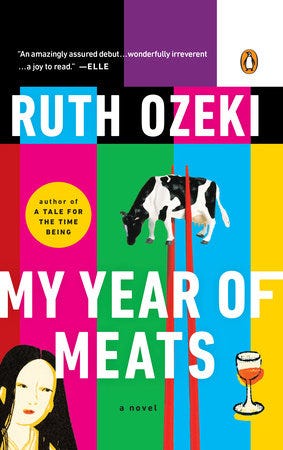
My Year of Meats by Ruth Ozeki

This hilarious and painfully accurate novel moves from biting criticism to sharp violence and back again as it follows two women, one a Japanese American shooting a television cooking show called “My American Wife” for the Japanese market, and the other an abused Japanese housewife whose husband produces the show. The pinpoint precision with which Ozeki underlines both Japanese and American cultures is excellent and the emotional resonance of the novel is hard to shake.

“Literature is a Kind of Mirror”: An Interview with Ruth Ozeki

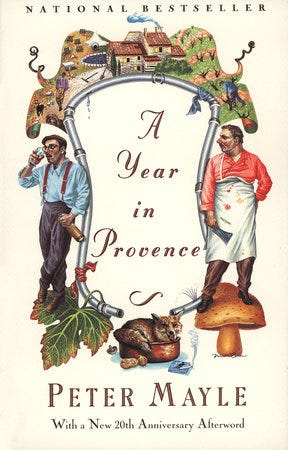
A Year in Provence by Peter Mayle

An incomparable classic, this memoir lovingly and hilariously recounts the trials and tribulations of a pair of British home-owners in France, and the struggles of adaptation and renovation. It gives you serious life-envy, but it’s worth the jealousy. I think of it often, whenever I’m trying to arrange a home repair in India.

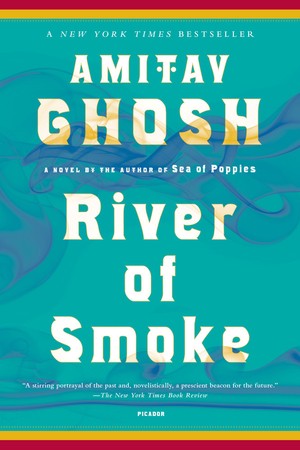
River of Smoke by Amitav Ghosh

The second in Ghosh’s masterful Ibis Trilogy, this novel focuses on a Parsi trader in the 1830’s whose yearly trips to China to trade opium grown in Bengal for the British reveal a double life. The way in which Bahram Modie, and the book’s many other characters, navigate (pun intended) their dual selves and identities as they transition between the mores and restrictions of each culture is as gripping as the meticulously researched history itself.

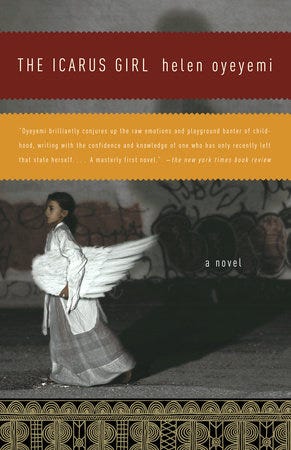
The Icarus Girl by Helen Oyeyemi

Oyeyemi’s magnificent first novel tells the story of a young girl whose mixed heritage and marvelous imagination makes it hard for her to connect with other children. A trip to her mother’s home in Nigeria unlocks a part of her identity when she meets a new friend, but the fact that her new friend might be more myth than reality is far more than she ever bargained for.

Stranger to History by Aatish Taseer

In this searing memoir, Taseer, the son of an Indian Sikh mother and a Pakistani Muslim politician, explores his own heritage and works to understand his father’s religion through the lens of a journey from Istanbul to Lahore. Trying to understand his own father’s accusation, that he is, in fact, a stranger to history, Taseer seeks out that history.

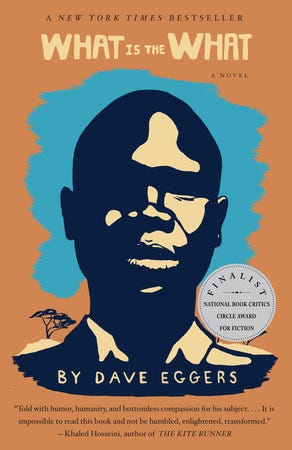
What is the What by Dave Eggers

A modern classic, Eggers’s chronicle of one of the Sudanese lost boys, Achak, as he flees civil war for life a refugee camp, and finally ending up building a new life in the United States. Achak’s resilience and curiosity about the world is inspirational and his construction of his identity as he shifts through stages of his life and struggles to survive unfolds in a way that cannot fail to move a reader.

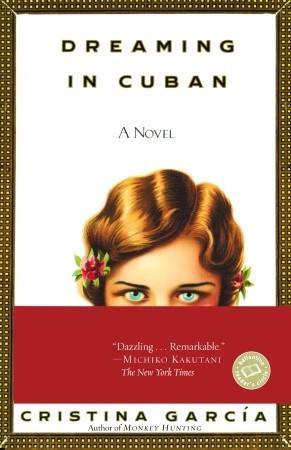
Dreaming in Cuban by Cristina García

Following three generations of women from the same family, García’s story is at once epic, shocking, funny, strange and sad. The many characters watch their country transform as they experience their own personal transformations. The longing for a past that never existed, the disassociation from a present that seems unlivable, and the desire for a future that might never come to pass haunts this family. Watching these women try to decide who they are even as the world around them suffers a crisis of identity is engrossing.

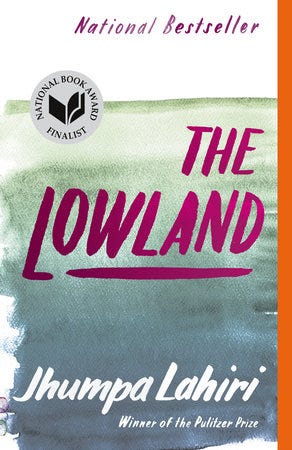
The Lowland by Jhumpa Lahiri

Lahiri’s story of two people during Bengal’s Naxalite revolution twines itself up with their concurrent story about adapting to America, to a marriage neither party desired, to a life that feels stuck in the past despite being transplanted across the world. Sprawling and melancholic, the novel is rife with the tension of people who cannot connect with each other, or themselves. Additionally, the description of Kolkata was my first real snapshot of the city where my husband was born.

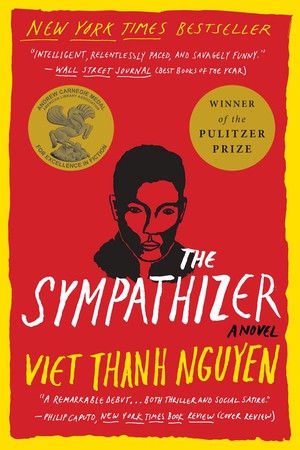
The Sympathizer by Viet Thanh Nguyen

One of the best novels I have read in a long time, Nguyen’s novel is masterful, hilarious, extremely well observed and heartbreaking, all at once. Every part of it is just magnificent as a commentary on Vietnam and the United States, but there is a special place in my heart for the passages depicting the bewildering experience the anonymous narrator has as the native advisor on an Apocalypse Now style Hollywood movie for it’s sheer absurdity that can only be actual truth. I have never seen my own country so clearly as through Nguyen’s eyes.

The Secret to Viet Thanh Nguyen’s Overnight Success

Interesting Times by Terry Pratchett

Pratchett is one of my all time favorite writers and his Discworld series is fantasy blending with satire to perfection. Interesting Times follows his recurring character, Rincewind a hapless wizard, visiting an old friend on the Counterweight Continent (which is not at all like China, not one bit, no). I have read this bitingly funny and insightful as hell book, like most of Prachett’s works, many times, and I always find something new to love. There is nothing like the comfort of a well loved book when you are far from home, or feeling far from your home while you’re in it, is there?

‘Sharp Objects’ Shows How Language Can Become a Wound

Vanish. That’s the title of the first episode of HBO’s adaptation of Gillian Flynn’s novel Sharp Objects. It is also, as Flynn tells us in her book, the last word Camille Preaker (played in the limited series by Amy Adams) ever carved on her body.

The fact that Preaker, a reporter tasked with writing up a story about a recent murder in her hometown, is a cutter is revealed to us in the final moments of the episode. As the rarely sober Camille preps a bath, we finally see why she prefers long sleeves even hot and humid Wind Gap, Missouri — and why her mother Adora (Patricia Clarkson) is so wary of her being near those sharp objects of the show’s title. Her body is covered in scratched and scarred words: “Definitely.” “Omen.” “Dark.” “Mother.” They adorn her arms, her legs, her back — every possible surface except her face. Camille may well want to vanish, but it’s clear from the start that Flynn’s tale is about the way you cannot escape what’s written on your body, the stories it holds and hides. Novel and series alike, in making that point as literal as possible, force those of us reading and watching to question the liberating power of language when it comes to dealing with trauma.

Flynn’s tale is about the way you cannot escape what’s written on your body, the stories it holds and hides.

“All I know is that the cutting made me feel safe,” Camille tells us in the first-person narration of Flynn’s novel. “It was proof. Thoughts and words, captured where I could see them and track them. The truth, stinging, on my skin, in a freakish shorthand.” Her compulsion to wound herself with words literalizes the way we’re taught to understand language: as both weapon and lifesaver. The way to overcome trauma — like, say, Camille’s loss of her sister Marian when they were young — is to put it into words. But Marian’s death merely deepened the hushed silence that had fallen over Adora’s sprawling house, leaving Camille to deal with her pain on her own.

Rather than lash out and hurt others, the tomboy-turned-town-sweetheart directed her anger at herself, turning those words into weapons that would presumably save her from her grief. The compulsion to write down words that bristled within her skin predated her sister’s loss: “I was nine and copying, with a thick polka-dot pencil, the entire Little House on the Prairie series word by word into spiral notebooks with glowing green covers,” she confesses, while later writing down everything everyone said in a tiny blue notepad. But she carved her first word (“wicked”) with a kitchen knife when Marian was already gone. Yet the safety that she found in those cuts came from the desire to mark herself, to own the words that buzzed in her head and threatened to undo her: self-harm as self-containment. In lieu of cutting (we learned she eventually got treatment at an institution and has not cut herself since), it makes sense she now dulls her senses with alcohol, another way of silencing that voice that compels her to make herself into a palimpsestuous canvas. “I called myself sweetheart,” she informs us. “I wanted to cut: Sugar flared on my thigh, nasty burned near my knee. I wanted to slice barren into my skin. That’s how I’d stay, my insides unused. Empty and pristine. I pictured my pelvis split open, to reveal a tidy hollow, like the nest of a vanished animal.”

There’s that word again: vanish. She’d scarred herself with it so as to quiet the others around her. “Vanish will banish my woes,” she sing-songs to herself at one point in the novel, “Vanish will banish my troubles.” The prospect of disappearing haunts Camille wherever she goes. The more she digs into the case of these murdered girls — both of whom disappeared seemingly in plain sight — the more she muses on what it might mean to vanish herself. Untethered from her work family over in Saint Louis (or Chicago, as it is in the book), her editor playing the role of hardened but loving father, and disengaged from her family in Wind Gap, her mother as much a haunted woman as she ever was, she careens through her daily life with an aloofness that constantly risks undoing her. She falls asleep, drunk, in her car listening to music, and awakes disoriented about where she is; she drowns out the world around her while taking a bath by reaching for her ever-handy headphones; she turns party-sized booze bottles and vending machine candy into her daily diet.

Whenever Camille is forced to be present — like when she interviews the town’s sheriff, the grieving father of one of the murdered girls, or the Kansas city detective who’s been brought down to help — she retreats into scripted, hollow words. Small talk, she bemoans, is not really her thing. Even her stilted interactions with her mother show that they never did learn how to communicate with one another; Adora had always required a malleable little doll and Camille proved to be much too unruly for such a role. Using and dulling her pain with razors and liquor becomes a way to anchor herself. “I’m here,” she says to herself in the novel, “and it felt shockingly comforting, those words.” She continues: “When I’m panicked, I say them aloud to myself. I’m here. I don’t usually feel that I am. I feel like a warm gust of wind could exhale my way and I’d be disappeared forever, not even a sliver of fingernail left behind. On some days, I find this thought calming; on others it chills me.” It chills readers and viewers alike for Camille’s near-deathwish cannot be extricated from both the physical violence she’s done to herself and the nauseating violence done to those vanished girls whose stories she is now telling.

Here’s where the show’s visual storytelling picks up Flynn’s nightmarish undertones and uses them to create the flickering, glazed feel that defines director Jean-Marc Vallée’s approach. On the screen, Sharp Objects aims to put audiences in a constantly dazed state. The first episode may lay out the central plot elements that will drive this neo-noir Southern Gothic whodunnit, but it privileges wordless scenes that do more to disorient than to guide you. Take its opening sequence where a pair of young girls (a teenage Camille and her younger sister Marian) rollerblade through Wind Gap, giggling all the way, before running up the lush green lawn that leads to their house where they hope their mother won’t notice them. As the make their way up the stairs they end up walking in on Camille’s current Saint Louis apartment and waking her with a pinch of a needle. You begin with a fairy tale set-up (two little girls wandering into an empty house in the middle of the forest) and end with a twist on an old favorite (Sleeping Beauty awakened not by a kiss but by a prick). Myth and memory immediately collide.

These ghostly words that flutter around and on Camille suggest that language itself can be a prison.

Camille’s hazy and groggy memories constantly seep into the show’s visual landscape, blending past and present, reality and daydreams, flashbacks and possibilities. In fact, the screen, in Vallée’s hands, begins to mirror Camille’s penchant for cutting commentary. In the show’s second episode, as the town grapples with the murder of yet another young girl, we not only get to witness the cringe-worthy moment when Flynn’s protagonist finally gets her hand on a needle; we also see words keep appearing near her in ways that suggest they’re only there for our benefit. At one point, as she exits the car to go to the home of the grieving family following the funeral, we see “SCARED” scratched on her car door. Later, when she drives off and opts to roam around the mostly-empty playgrounds by the woods, the word has changed: “SACRED,” it reads. And when Amma, her teenage half-sister (Eliza Scanlen), shows her the lavish dollhouse she’s been working on — an eerie replica of the gothic house they’re in — we see the word “GIRL” carved on one of the mini-paintings that hang in the upstairs hall. It’s a literal blink-and-you-miss-it moment; the camera switches to a perplexed Camille as she examines her childhood home in miniature, and the word is gone by the time the shot returns.

The ephemerality of these words, in contrast with Camille’s enduring scars, jolts us awake. If fairy tales structure Flynn’s Sharp Objects, they serve to upend the lessons those stories have taught little girls for generations. Where horror and violence get tidied up in happily-ever-afters, their clash with 21st-century true crime dramas and the Southern Gothic (Flynn’s words read like a blood-splattered Tennessee Williams play) make Camille’s story all about the permanence of trauma and the immateriality of words. These ghostly words that flutter around and on Camille suggest that language itself can be a prison. Trauma, as visualized by the show, pulses in images, never in words, and it’s unclear whether anything Camille puts into writing will ever free her from the pain she’s learned to live with. In making the leap to TV, Sharp Objects stresses just how inadequate words can be in the face of grief. It explains why Vallée (working off of Flynn’s own adaptation) so disavows dialogue in favor of music-driven storytelling. Camille’s inner torment becomes codified in the music she listens to: the loving self-destructive ire of “Ring of Fire,” the self-admonishing melancholy of “I Can’t Quit You, Baby,” the encroaching madness of “There’s A Key.” And it is in those moments, when we see Amy Adams sighing or groaning, that Flynn’s protagonist feels most present, the moments when she’s on her bed, staring up above, wishing she could do the one thing she knows she’s unable to do: just vanish.

How to Eat Well at the End of the World

Before

Again they cooked a meal, a good meal, maybe the best Benny had ever cooked, and they ate it slowly, with great delicacy, noting the mouthfeel of chives and onion, the muscularity of bone broth, laughing because not knowing which words would be their last had made them pretentious, and though there would be no one to document their words let alone be impressed by them, Elle wondered if the ash would remember, if she and Benny would be tossed and raked through and blended with the rest, if they would become mountain peaks, humpback whales, books — a clatter of Benny’s spoon against his bowl, and he peered up like a child, thinking what a gift it was that he and Elle could share a nice dinner behind soundproofed walls and blacked out windows, how despite growing up thousands of miles from each other they’d told the same story of the world they stitched together, only now he wanted to tell her something he’d done without her, something shameful, was that okay, he asked, and as she nodded with noodles in her mouth he began: long ago, in a McDonald’s drive-through, a nice old lady in front of him had paid for his milkshake and fries because the person in front of her had paid for her and the person in front of that person had also paid, etc. etc. and he’d wanted to keep the chain going, except that he had the stupid luck of having behind him an entire youth group packed into a monstrous van, all while the man at the drive-through window stared him down as if waiting for him to be a decent person, so he paid it forward, over $200 he paid it forward, and before he could allow himself to get on the road he did something utterly indecent: he re-entered the drive-through lane, he willed the goodness he’d launched into the world to boomerang back to him, and when he pulled up to the menu again he asked for five meals, at least three more milkshakes, a box of apple pies, etc. etc. and by the time he finished his four-movement symphony of an order, the truck in front of him had already driven off, and wasn’t that shameful, Benny said to Elle, I don’t know why I never told you, I guess I didn’t know you then, and Elle smiled because to her this was probably far from the most shameful thing he’d ever done, because the two of them might aspire to true accountability right before the trumpets rang but there would be no trumpets, the most she’d heard through the coded radio static was that it would all end in a matter of days in a literal flash, and if Benny gave all of himself away now she’d have to sit with him in the minutes or hours after, piecing together the wreckage as they waited — enough, Elle said, as she reached across the table to still his hands, did he remember when she used to give elaborate readings of his palms, and he said of course, like the time she predicted incorrectly that he would outlive her, and she said, well back then death was interesting and I didn’t want to be alone, and this made Benny quiet as he knew that in his company, Elle had at times felt the most profound loneliness of her life, and after all these years, he still could not separate the wars inside her head and the invisible anchors on her chest from how they had caused him suffering, and yet before the flash, when his comparative lack of suffering should have made him more terrified than her of what would come next, it was still Elle who looked the saddest; all this he told her, and Elle stared off at the hunting rifle by the sink and said that sad wasn’t the right word but she didn’t know what was, and before long they were sharing with each other their favorite words: woolgathering, zaftig, defenestration, 아련함, 孤独, working the sounds out of their throats and along the walls of their mouths and over and under their tongues and through the many shapes that their lips could still form as if they were chewing the words, as if words were for dessert when dessert was actually two vitamin gummy bears each, which Elle and Benny savored before throwing caution to the wind and devouring the rest in the bottle, and as they stood up and the nutrients drowned their bodies, they marveled at how long it’d been since they planted their feet like this, not to move from seat to seat but just to be upright, to let gravity run its course, though looking down at her feet, thought Elle, seemed to buck the natural order of things, an order she’d learned as a little girl when her mother died lying on her back the way most preferred to go, looking up, wasn’t that right, Elle asked Benny, and that may be true, he said, but who could really know which direction pointed to heaven, to which she groaned, realizing at the same moment that she’d forgotten the last words her mother had said or even what language they’d been in, a failure, Elle was calling herself now, she was one of the last representatives of humankind and should be giving the earth more to lose, but with a hush Benny handed over a stained dish that needed no instruction; she chucked it against the wall with the others, the crash no longer causing either of them to flinch, then she moved on to the jugs of water, the wind-up flashlight, the last of the liquor, Benny’s grandfather’s coin collection, the cards and letters they’d written each other and re-read together every time they packed up and moved, Benny always pretending for some reason that he’d never read them in private, and when Elle was done they stepped over the detritus, humming some tune, some soundtrack for their lives that they’d cobbled together over the years from pop hits and commercial jingles and even the weird demo song that came with their electronic keyboard, now overturned into a pool of cranberry juice, how they kept going, how their voices grew louder, how before Benny smashed his only working walkie-talkie he radioed their former landlord to say yes, Carl, you are racist and no, I will not forgive you, not even now, and after Elle went down her list as well and took a hatchet to the portable stove, there was a silence in the apartment so pervasive that they could hear each other blink; it was then, for the first time in months, that they unbolted the five locks and clasped their hands together and went outside, surely, they thought, to the sight of overturned cars, rubble pyramids, human fire pits, killing contests, and cannibalism, and there was some of that, but there was also in the former laundromat across the street a pack of strangers belting out separate cobbled-together songs, none of them in sync as they swung and shook and contorted also to the thumps of whatever objects were being cycled in the dryers — please god, let it not be heads, thought Benny, as Elle pulled him there over the broken glass and splintered chairs, toward the smell of sweat and piss and smoked outlets, and when she began to shimmy in front of him like a fool he could smell her too, a smell that had no other language but Elle — and there, bumping against these people, everyone the same age before the end, she looked back at Benny and thought how the earth would fold in on itself and the stars would combust and dazzling light would arc from the periphery of the eye causing a collective turn of heads toward a sight that no one would have the capacity to describe, and how for a breath before all of this everyone around her would still be alive, and not just alive, but dancing.

About the Author

Simon Han’s writing has appeared in The Atlantic, The Iowa Review, Guernica, and Fence. The winner of the Indiana Review Fiction Prize and the Texas Observer Short Story Contest, he is a 2017–2019 Tulsa Artist Fellow. Find him online at simonhan.net.

“Before” is published here by permission of the author, Simon Han. Copyright © Simon Han 2018. All rights reserved.

10 Books That Will Cure You of Wanting to Know the Future

If I had a superpower I would want it to be the ability to pause time, or teleport, or summon the TV remote with my mind so I don’t have to get up. I’m open to a lot of possibilities, but one power I would absolutely forgo is foresight. While horoscopes are fun and weekly weather reports keep me from wearing flip flops into thunderstorms, true mystic fortune telling only brings chaos. I have no desire to know the day the world will end, and I was horrified when a friend confessed to always reading the last chapter of a book before the first. Where’s the appeal of the unknown? The intrigue of taking in everyday as a plot twist? You may scoff at my ignorance is bliss mentality, but here is a list of titles that support my theory: Sometimes, it’s better not to know.

The Oracle Year by Charles Soule

Previously known for his comic books, Soule breaks into the novel world with the origin story of the Oracle, an everyday New Yorker who wakes up with the ability to predict the future. A guy can do a lot with newly found superpower and an anonymous internet persona, but between dodging assassins, turning down warlords, and ticking off televangelist preachers it’s hard to predict whether he’ll survive each day. This side-splitting satire takes “Knowledge is Power” literally while invoking questions of epistemology, faith, and the selfishness of human nature.

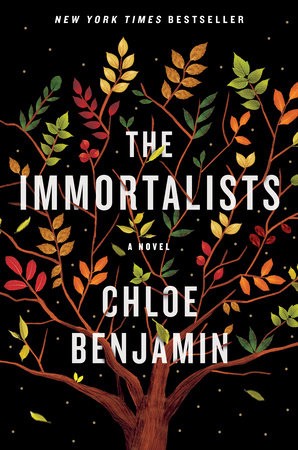
The Immortalists by Chloe Benjamin

As children, the four Gold siblings snuck out to meet a traveling psychic who foretold the day each of them would die. Varya, prophesied to live to an old, ripe age, discredits it as a trick but nevertheless finds herself counting days, Klara flirts with her inevitable death by becoming a stage magician, Simon flees to San Francisco in the ’80s, and Daniel confronts his own mortality directly as an army doctor. As the consequences of this knowledge compound, the boundary between fate and choice grows thin. Some prophecies are true only insofar as they are believed.

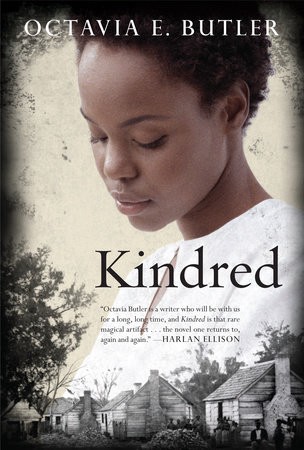
Kindred by Octavia E. Butler

Dana, an African American writer in 1979 Los Angeles, doesn’t see the future exactly—she’s lived it. She is transported back in time to an antebellum Maryland plantation, where she saves a red-headed child who would one day grow up to be slave owner and, through violence, her great-great-…-grandfather. Every moment in the past is a struggle as Dana has to reconcile her knowledge of who the young, misguided boy will grew up to be and her own identity as both a modern, educated African American woman and a pre-Emancipation object to be beaten, possessed, and coerced.

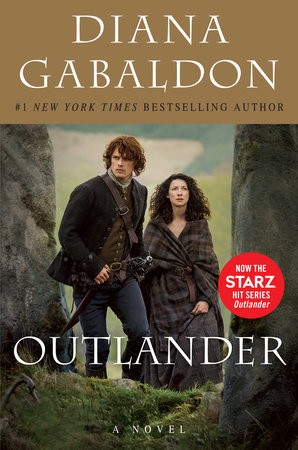
Outlander by Diana Gabaldon

Two hundred and two years is an odd distance to time travel, but Claire Randall, fresh off the front lines of World War II, has the misfortune to be transported exactly that far back. Her experience as a combat nurse is both a boon and a danger in 1743 when “germs” did not exist and leeches were still a favorite tool of modern medicine. Amidst the gruesome violence of raiding clans on the Scottish Highlands, Claire’s medical abilities make anonymity impossible, so instead she employs them to make herself useful. With a fiancé waiting for her in the future but a brawny warrior hacking down dangers in the past, the question of when Claire will return turns more into an if.

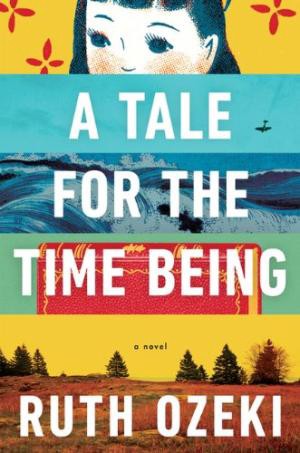
A Tale for the Time Being by Ruth Ozeki

In the aftermath of the 2011 tsunami, a novelist on the Pacific coast of Canada finds a diary washed ashore in a mound a debris. As she reads it, she finds herself growing attached to the writer, sixteen-year-old Nao in Tokyo, who is struggling with an unhealthy family life, school bullying, and thoughts of suicide. The swapping narration between Ruth and Nao makes it increasingly difficult for the reader and for Ruth herself to distinguish the present from the past — what is read or recalled and what is occurring in real time. As Ruth’s grasp on reality slips, she becomes increasingly invested in saving a girl who in all likelihood is already dead.

Eternal Life by Dara Horn

Rachel has grown used to the predictability of eternal life: she finds work, gets married, has kids, watches as they all die, and approaches death herself only to be restored to youth. After 2,000 years of more or less the same, the 21st century does not break the pattern, but it does come with unique tribulation of its own. Through the eyes of one who has seen and done it all, Eternal Life attempts to understand humanity’s obsession with immortality, digital to botox, and what makes life worth living.

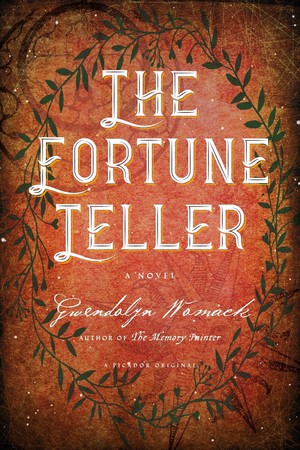
The Fortune Teller by Gwendolyn Womack

When your job is appraising antiques, you are bound to come into contact with an interesting object or two. For Semele Cavnow that interesting object happens to be an ancient manuscript foretelling thousands of years worth of disasters and a deck of tarot cards that may make a difference. Obsessed with rediscovering the deck and dodging an unknown enemy lurking in the shadows, Semele must use every tool at her disposal to unravel the truth behind the prophecies.

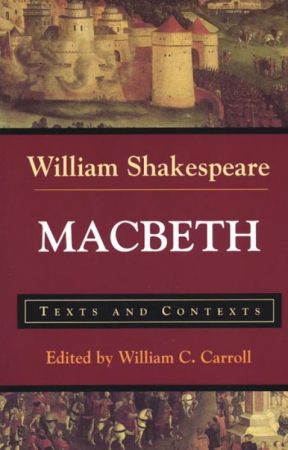
Macbeth by William Shakespeare

Most of us have already bungled our way through this play in high school, but few writers can pull of an everybody-dies tragedy as well as the Bard himself. Macbeth, a general in the King of Scotland’s army, receives a prophecy from a sketchy trio of witch who promise him a series of promotions as well as the Scottish throne. The only caveat is several people would have to die along the way. His wife says go for it, and his ambition urges him to agree. As the murder spree kicks off, more prophecies come to light that throw Macbeth and Lady Macbeth into a paranoia fueled madness. We all know how that ends.

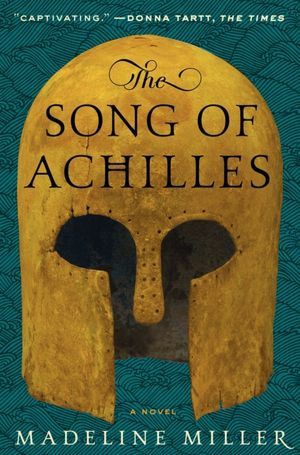
The Song of Achilles by Madeline Miller

In Homer’s Iliad: the hot-blooded warrior Achilles yo-yos back and forth between battle and pacifism, only later revealing his conflict over a prophecy that promises him either a long and happy life or everlasting glory and an early death. His hesitation claims the lives of countless soldiers. Madeline Miller retells Achilles’ story from the viewpoint of his lover Patroclus (it’s canon! Probably!). A mortal watching the grand workings of gods and demigods, Patroclus only wants to be with the man he loves; he recognizes Achilles’ great gifts and heroic destiny, but he also knows about the prophecy and fears his beloved’s death. Watching both of them navigate the tension between mundane happiness and fated glory is heartbreaking.

Agamemnon, Aeschylus

As long as we’re on the subject of mythology, I would be remiss to not also give a call out to Cassandra from Agamemnon, a woman blessed with foresight but cursed never to be believed. Her desperate warnings only gain her enemies and perceived insanity which drives her to death. If you ever wish for the ability to see the future, consult with the classics first.

Jeff VanderMeer on the Art and Science of Structuring a Novel

The following is adapted from a lecture given at Columbia University in April, 2018, and some of the images are reprinted from the author’s Wonderbook: The Illustrated Guide to Creating Imaginative Fiction. A revised and expanded edition of Wonderbook was published this month. Additional content can be found at the Wonderbooknow website. (Artist Jeremy Zerfoss created all diagrams reproduced here, unless otherwise noted.)

To learn, I love to be in conversation with interesting creators of all types, from many different narrative perspectives — and to also reflect this eclecticism in my reading. But I have learned the most from deep study of fiction itself: that which I have loved, that which I have hated, and that which has bored me. Boredom is not a neutral state and must be interrogated as thoroughly as any other reaction.

So, with that said, what I am going to present tonight is a series of thoughts on subjects that have been on my mind most urgently the past few years, which I find related for reasons that may or may not become apparent by the end.

As ever, I hope you find something of use, something you vehemently reject, something that bores you (why does it bore you?), and something you already knew before I made my remarks.

The first area I would like to address concerns structure — both in terms of the scaffolding I need as a writer to write a novel and how study of what is formally known as “structure” can allow a writer to access interesting options for storytelling in their own fiction.

This is generally a mechanical process in the beginning and, of necessity, an organic process in the end. Unless you do it wrong, which can itself be a feature not a bug. But the issue of structure is also an issue of not letting scaffolding or the idea of “architecture” stifle the text or remove a certain mystery from the text.

Structure should allow things to peer through and come free, not form a prison for the characters or the writer.

Structure should allow things to peer through and come free, not form a prison.

In part, this occurs naturally, if you think of structure as the musculature or skeleton of how the character moves through and expresses the story. A character creating a story and the residue or evidence of their passage, the structure. A kind of exoskeleton or cicada husk left behind.

This is another form of creating what your mind needs to write the story in your head in its purest form. Even as all stories lose some part of themselves in the transition from a liquid or metaphysical state in the mind to a physical or solid state in the world, a process that’s just part of the dissipation that is storytelling.

What do I mean by “a writer’s scaffolding”? I mean something in addition to what seem the basics of what I need to start writing after having first thought about a story for a long time. Those basics are pretty…basic. Knowing where the story starts; a character I’ve come to know well; a sense of where the character is going (either figuratively or literally); a charged image connected to the character; and an ending, even if that ending changes before I reach it. The charged image must be resonant and significant, but not one rendered dead or fixed by, for example, the prison of Freudian symbolism.

Without these elements in place, I’ve learned if I begin to write I will not finish a story or novel and I will likely be unable to backtrack and start over in a way that isn’t doomed to failure.

But, especially on novels, a kind of darkly glittering, revolving, usually architectural image also materializes in my mind that acts as a kind of compass — takes the form of some structure that speaks to theme and form, but is not the actual structure of the novel. It is instead a kind of scaffolding that I require and need to remember for the fiction to attain depth and originality. Thus, it is a kind of illogical creation, needing only to create a signpost for the subconscious, but in a way that has a dream-logic or perhaps novel-logic associated with it.

A kind of darkly glittering, revolving, usually architectural image materializes in my mind that acts as a kind of compass.

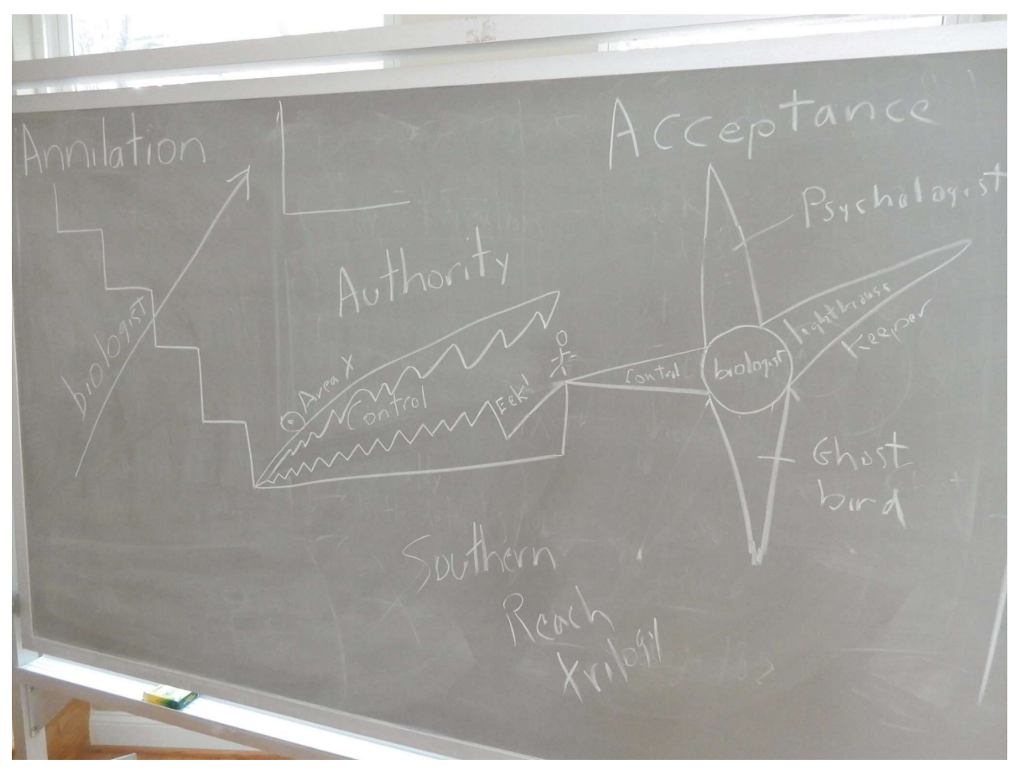
For example, on Acceptance, the third novel in the Southern Reach series, I imagined a four-pointed glowing star and at the center of that star, from which all else radiated outward, was the return of the biologist from the first book, Annihilation, and her further account of exploration.

From the rest of this account all else shines forth. The image likely occurred because of an intense study of different kinds of lighthouse lenses and different kinds of light emitted from lighthouses for specific kinds of communication or warning.

In my mind, this shining star revolved against a black background as I wrote the novel and at no time was it not present during that writing process. Yet it is in no way an accurate depiction of the novel’s actual structure. Even as it represents a kind of emotional and thematic structure, a resonance, in that the echo or ghost of the biologist could be said to permeate the other parts of the novel and, even if visible only to me on a literal level, and not to the reader, she is peering out from the blank spaces between the words in those (many) sections of the novel in which she is not physically present. Creating depth that the reader hopefully does experience, although they cannot see the light creating that depth.

If the structure here presented for Annihilation is cursory and more pragmatic, that is because I wrote the novel so quickly and almost without identifiable conscious impulse. I knew only that it was dangerously important that I must always think of the expedition in the novel as forever traveling DOWN even when proceeding physically across level ground or going up — and that this affected word choice, dialogue, and other elements as I wrote, some of which I later enhanced in revision and some of which I deleted as too obvious, but even in the deletion left behind a disorienting absence.

At the same time, however, I felt the biologist was always ascending, because, as the expedition disintegrates, she acclimates to the landscape they traverse.

In Authority, the main character all unknowing is already within the maw of a giant beast of sorts and the jaws are closing.

These constructs — this pseudo-structure or scaffolding, then — are completely organic for me and comes to me seemingly unbidden as a kind of hovering inspiration shining out over the more tactical inspirations that come over me at the scene, paragraph, and sentence level. I trust it despite its illogic because I’ve found the more I trust my subconscious and reward it, the more it rewards that trust with more ideas and characters.

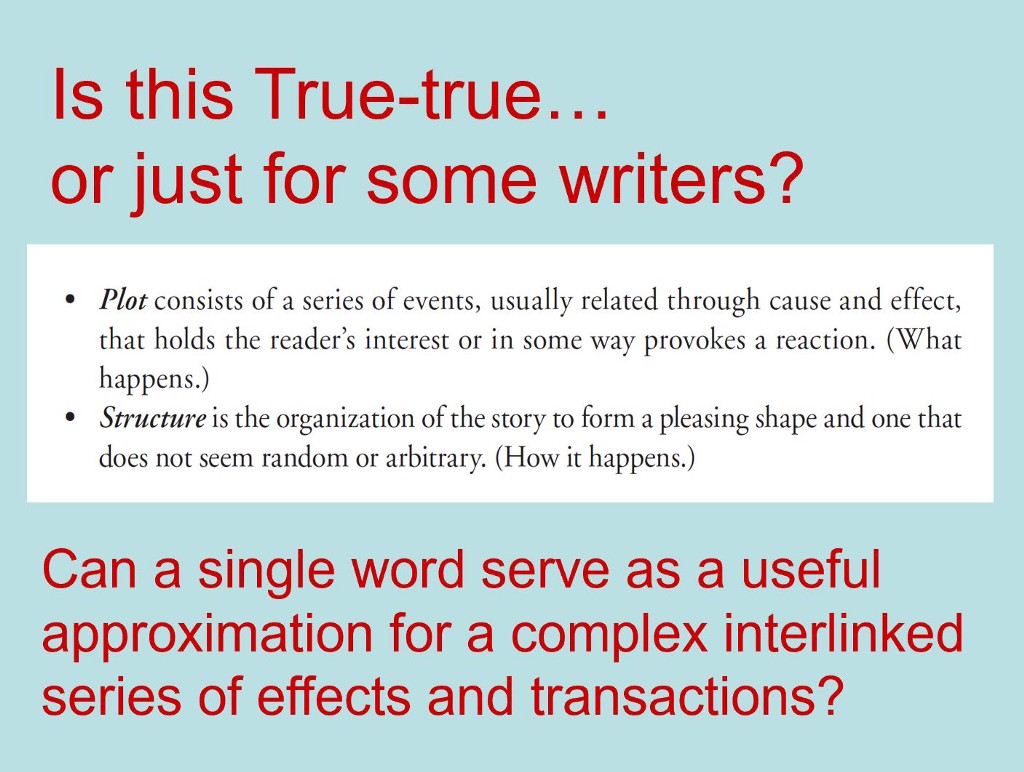
Scaffolding aside, there is also the conscious examination of structure in novels — both at the macro level of the entire novel but also at the micro level of scene. Yet even study of what is formally recognized as structure has an element of uncertainty because there is variation in how different writers perceive words like “plot” and “structure.” It is significant that even in Madison Smartt Bell’s excellent Narrative Design, he clearly defines plot as opposed to structure or form and then seems to, at times, confuse or use the two terms interchangeably anyway.

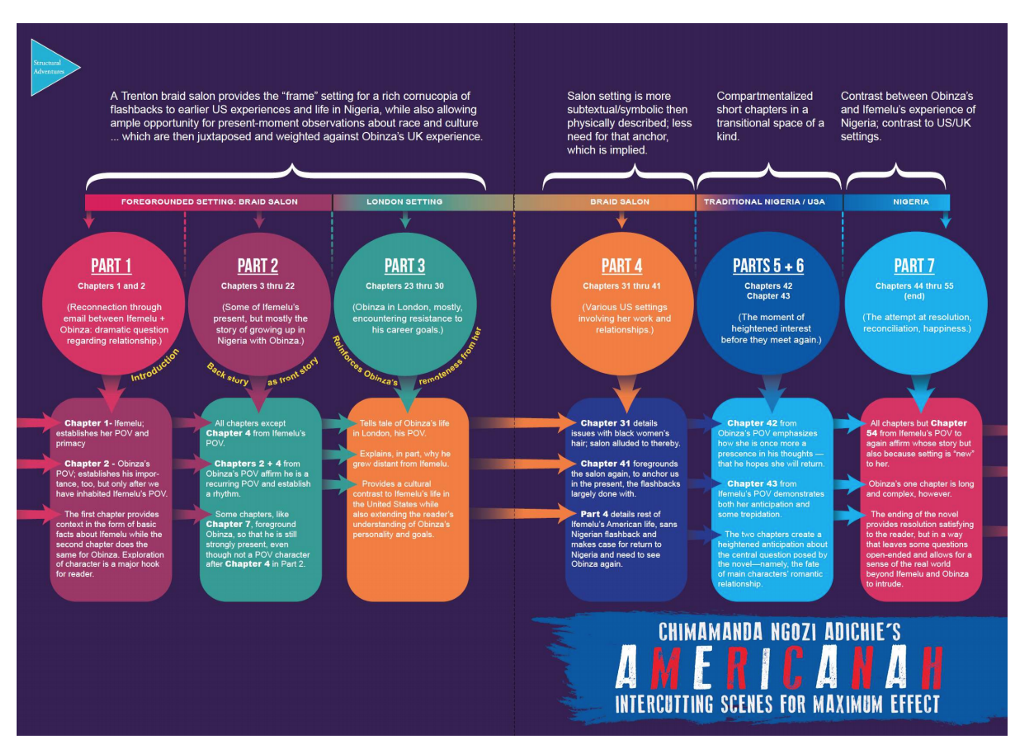
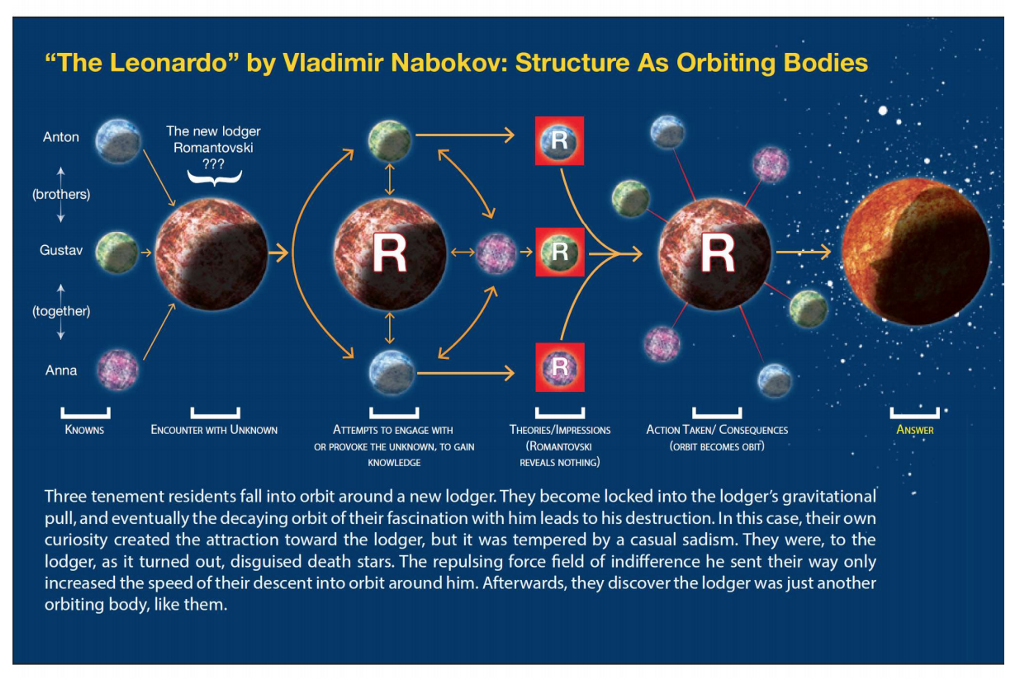
Some analysis of structure is more equal than others. For example, consider this diagram I made in studying Chimamanda Nogzi Adichie’s Americanah. The diagram breaks down the structure chapter by chapter and analyzes the effects created through use of two main points of view, going back in time in some scenes, and how it overcomes the potentially static quality of using one setting, a hair salon, for several scenes — incorporates the hair salon into the structure, in a way.

This diagram of Vladimir Nabokov’s story “The Leonardo” also shows a kind of structure, but in doing so I employed a metaphor — characters as planets orbiting another character-planet. This approach accurately conveys the effect of the story, but is not in any conventional sense the actual structure of the story.

This approach to analysis lies somewhere between the darkly glittering scaffolding I need for my own work and an objective view of someone else’s structural decisions. What is lost is a true seeing of the original writing of the story. What is gained is an idea about the use of characterization in the story — i.e., that in a sense the story elements are deployed in the service of showing what happens when three friends living in a tenement building encounter a fourth person, who is a stranger, and when in contact with this stranger the others basically have an allergic reaction and plot to destroy him, to drive out the other. In doing so, they themselves enter a decaying orbit as they are lessened and lose any sense of a moral compass in pursuit of their goal.

The point here is that analysis is often just one subjective view of the structure regarding a published work of fiction, with varying levels of quantifiable “objectivity.” The analysis inevitably reflects the point of view of the writing doing the analysis, based on their own view of fiction.

The best and most personal value to you, despite what you might (or might not) glean here…is to perform your own analysis of structure — of your favorite and least favorite works. And of the structures of the works I’ve diagrammed here. Because an instructor’s analysis will, to varying degrees, take the form of another kind of internalized, personal scaffolding.

This issue comes up in comparing the structure of Nigerian writer Amos Tutuola’s The Palm-Wine Drinkard (1959) and U.S. writer Ben Metcalf’s Against the Country (2015). I find myself wondering what is lost and gained even in the transition from this horizontal, chalk-scrawled version….

…and the final vertical version, which seems to compact the spine of the diagram.

Even as the main point remains: Just as the bones that comprise a killer whale’s flipper shock us with their similarities to a human hand, so too can we find unexpected kinship in the structures of what seem like vastly different novels. Metcalf’s novel and Tutuola’s are brethren in their deployment of the components of their structure or design.

Against the Country, haunted by the past, is the darkly hilarious tirade of a man against a childhood spent against his will in rural Virginia. The Palm-Wine Drinkard is the surreal account of a drunk man encountering actual phantoms, including “the complete gentleman,” a skull attempting to reconstitute his other parts (much like many fictions) and a monster that devours 4,000 babies and the narrator (for a time). Written in different eras by writers from vastly different backgrounds, they would seem to occupy spaces with no subset of similarities between them.

We can find unexpected kinship in the structures of what seem like vastly different novels.

Metcalf’s novel of absurdist humor and exaggerated hatred directed toward rural life is a narrative driven by the episodic and hyperbolic adventures of a boy’s life. The novel is deeply psychological but also satirical. Tutuola’s novel is a phantasmagorical account traversing a transformed landscape in Nigeria and driven by the surreal details of a drunken physical journey.

In fact, at the tactical level, they use the same units of measure, so to speak. The chapters, or cells, that comprise the two novels are surprisingly similar despite a very different animating impulse. A particular type of self-replicating chapter-cell occurs in both, one that short story writers wanting to write a novel for the first time should study closely.

Because in both novels, each relatively short chapter has the same structure, without a need to create a higher-overarching architecture to house or constrain the narrative other than what is stated at the beginning: Metcalf’s narrative will tell us about his childhood in Virginia; Tutuola’s narrative will tell us about a roving journey set across one night.

Both achieve momentum and maintain momentum by stacking exaggeration and hyperbole. Both avoid being simply a series of interlinked short stories by how, often just slightly, each chapter does build on the next by advancing the narrative while also featuring recurring characters of a sort. Absurdity is normalized so that tension can be retained in part by ever-greater absurdity that doesn’t seem ridiculous because we’ve already become accustomed to the prior level of absurdity. (The same principle applies to my novel Annihilation, but in terms of the uncanny impulse and stacking of tropes.)

But what lies at the opposite end from personal scaffolding (and equidistant from a more objective view of structure)? Perhaps this science of scenes diagram suggests one answer. The diagram attempts find the right level to extract useful generalities about structure — to express something that, admittedly, doesn’t apply to all fiction. It may fail in a sense to convey what it attempts to convey. Which is to say, what it wants to convey may not be communicable through a diagram. Nonetheless, I believe even ignoble failures can be more interesting and useful than staid successes.

Part of what led me to create this diagram is that I’ve become a little obsessed with how even a tiny change to where you start or end a scene can greatly affect how the reader perceives the scene and even how a reader or editor perceives the genre of the scene and thus the book as a whole. This thought suggests greater similarities between seemingly unalike pacing and styles, in that the actual difference is one of a missing cause to an affect or vice versa, to use a crude example. And once you can chart these similarities and differences at the right level of detail and hierarchy, you are much more able to control the effects of your fiction and even to shift modes within the same novel in ways that don’t seem jarring.

I do believe that with the right progressions — of a character’s emotions, of events in the story, to name only two types — anything is possible in fiction. I also believe that the idea of “beats” is often misunderstood as purely commercial consideration within screenplays. In fact, a serious, complex exploration of the way in which beats in a story support progressions or don’t support them can lead to serious break-throughs in a writer’s knowledge of the art and craft of writing. Showing these ideas in an almost cellular way helps to re-imagine them as organic, and thinking of them in abstract ways allows them to then be re-imbued in a flesh-and-blood sense on the page in a particular story or novel.

Image by Ninni Alto

Where the diagram becomes impractical, perhaps, is that not all scenes have time intrusions because they lack that kind of character interiority. Contaminations of the scene can reflect a writer’s awareness of possible fatigue on the part of the reader rather than an actual condition that occurs across all kinds of scenes. However, by articulating these elements as if they are constant, it forces the reader of the diagram to construct their own version in opposition — in a sense, to correct the idea at the same level of abstraction. Perhaps this proves that even inaccurate writing diagrams can be of use to a writer.

As should be clear from this brief examination of structure, I believe in letting what should be organic in fiction express itself organically — and to proceed mechanically with what can be made mechanical and achieved through analysis and study without harm to the imagination. Without this second belief, I wouldn’t participate in workshops or give lectures about creative writing. Even as I eschew a distinction between “art” and “craft” in fiction because they aren’t terms in disagreement — the craft of writing fiction supports the art.


About the Author

Jeff VanderMeer is the author of the bestselling, critically acclaimed Borne and the Southern Reach Trilogy. His work has won the Shirley Jackson Award and been translated into 35 languages. His nonfiction appears in the New York Times, Los Angeles Times, and on the Atlantic’s website.

What It’s Like to Stand Inside a Poem

I can’t resist a cryptic invitation. So last month, when I got an email about a “weird interactive storytelling digital art experiment,” I was there for it.

The email came from my friend Max Neely-Cohen, a skater-turned-novelist who I’ve long suspected moonlights as a spy due to his lengthy, unexplained disappearances from New York. “Some brilliant nerds are going to help me to make a space that visually responds to poetry and prose as it is read aloud,” he wrote. “Imagine giving a reading somewhere and having the environment change based on what you read. And being able to control those changes.”

I could not, in fact, imagine that, so I said I’d stop by.

The project formed as part of a week-long micro-residency at CultureHub, an art and technology center founded in partnership with New York’s La MaMa Experimental Theatre Club and the Seoul Institute of the Arts in Korea.

I visited the space in NoHo on a humid Friday, riding a rickety elevator into a large, black-walled studio. Several metal chairs lined one side of the room, facing a wide screen on the opposite wall. Toward the front, Max’s assistant, NYU ITP student Oren Shoham, manned a laptop surrounded by wires; toward the back, a microphone stood next to a table stacked with books.

Combing through the books, I found This Planet is Doomed, a collection of science fiction poetry by Sun Ra, the legendary Afrofuturist jazz musician (and composer, bandleader, poet, philosopher, and and and). Because my dad is a jazz guy and I was a kid who identified as an alien, I was introduced to Sun Ra at a young age. Even then, I recognized that Sun Ra was, if not the coolest person to have ever lived, definitely in the top five. His science fiction poetry seemed the perfect input for a spatially overwhelming poetry synthesizer.

I picked two poems: “The Government of Death” and “Planet of Death,” and stood behind the microphone with two cameras trained on my face. The room went dark, Sun Ra spotlighted. As I read, words flashed in my peripheral vision, though I couldn’t fully see the adjacent imagery.

As I read, words flashed in my peripheral vision, though I couldn’t fully see the adjacent imagery.

“[A]ll governments / on earth / set up by men / are discriminating / but the government of death is a / pure government,” writes Sun Ra. “I gave up my life and am here on / this planet / of death / in order to teach my enemies that their / life is nothing else / but death / and that their planet was isolated from / the cosmic spheres / whence I gave up my life.”

Including titles, “death” is repeated twenty-one times in the poems. After finishing, I saw “DEATH” in huge, all caps letters on a black screen. I was briefly speechless, then noted that the whole thing was Incredibly Goth.

Max Neely-Cohen says he’s long harbored the idea for this kind of project, but wasn’t sure existing technology could manage what he had in mind. “There are all these visuals that work off of different parameters of live music,” he briefed me over the phone, after my visit. “A lot of them are just volume, but more sophisticated ones can analyze pitch and all these different things. They create a visual space out of that. I wondered, can you do that with a reading? For a really long time, the answer I got was ‘no.’ And the reason is that speech-to-text sucks for live transcription. But it’s been getting better.”

Max and Oren used a speech-to-text API (application programming interface) from Google Cloud and hooked it up to EmoLex, a database compiled by computer scientist Saif Mohammad, that crowdsourced associations between words, emotions, and sentiments; this included color association. When I read “Government of Death” into the microphone, my audio went to Google Cloud for transcription, then into EmoLex for visualization, and then zapped a giant, gloomy DEATH screen back to the studio.

Writer Moira Donegan, who read a piece about a black and white film, had a particularly poignant experience with project’s chromatic element. “Seeing those words rendered in color — rendered as color — added a series of associations to the work that I hadn’t had before,” she said. “It was pretty stunning to see them rendered that way as I was speaking — ‘grief’ as green, ‘body’ as orange — whereas my experience of the material before had all been in greys.”

It was pretty stunning to see the words rendered that way as I was speaking — “grief” as green, “body” as orange — whereas my experience of the material before had all been in greys.

Other testers I spoke with responded to different aspects of the installation — perhaps dependent on what they were reading, or their professional backgrounds.

Bloomsbury editor Ben Hyman read a selection of Frank O’Hara poems, and noted that “O’Hara’s work is intricately linked to his particular social world of friends and collaborators, and to the contemporary art of his time — in addition to being a poet, he was a curator of painting and sculpture at MoMA. It felt like he’d be the perfect ancestor to introduce to Max’s clever machine. I think Frank would have gotten a kick out of it.”

“The exhibit felt like ekphrasis in practice,” said writer Becca Schuh. “Creating a new form of art via commentary on already existing works. It was an odd day in New York, humid and sad (Anthony Bourdain died the morning I went to the project), and it was both surreal and beneficial to step away from the oppressive air and into this new atmosphere.”

How to Write a 20,000-Square-Foot Book

Writer and editor Bourree Lam took a different route, and read a series of texts to her husband. “I write about economics, and originally I had planned to read something very mundane like a jobs report or Federal Reserve meeting,” she said, “but then when it came time I didn’t want to read something with so many numbers…I ended up reading an exchange with my husband that pretty much sums up our communication ritual every evening since we got married: When are you coming home? Is work crazy? Are you coming home for dinner? Who’s in charge of dinner? What’s the plan?…Standing in those texts, I felt like I was sharing a part of my relationship with the world. We literally have this exchange every weeknight. It’s really personal, but also really mundane. It was that banal/sublime tension of art that draws from the quotidian (not that I’m calling what I read ‘art’!)…seeing the texts on the big screen made me realize I don’t mind sharing some parts of my relationship.”

Standing in those texts, I felt like I was sharing a part of my relationship with the world.

Meghann Plunkett, a coder as well as a writer, was perhaps in a unique position to appreciate the project’s technical elements. “I was so thrilled to see that someone was using APIs for art’s sake,” she told me in an email. “Often we see technology utilized to solve problems and disrupt markets. My heart soared to see that Max was using an API to embellish an experience instead of trying to change that experience. I loved that the speech-to-text feature was coupled with an author’s reading without overshadowing it. With innovation like this, it opens up the possibility for other artists to view open source APIs as small platforms for literature, art and performance. It gives me hope that technology and art can co-exist in a symbiotic, balanced relationship.”

Max is returning for part two of the residency in the fall, and emphasized how much more is possible: “We could use the same dictionary database, or a different one, and control all sorts of parameters. We could use a reading to grow a garden, or build a city. This can get more sophisticated, more visually interesting. This was a super-fast initial prototype. All we did was make it work. The amount we can do past that is unbelievable.”

Guess the Book Titles Using Only Emoji

I tell people that I got a degree in English Literature so I would secure a high paying job at a literary non-profit with an unlimited salad bar, rosé on tap, and a personal chauffeur, but the real reason for my four (very expensive) years in university was to hone my bar trivia skills so I’m acing the book questions and bringing glory to my team (Team Billy, named after my dog, Billy the dog).

I’ve combined my love for bar trivia, my knowledge of literature, and a millennial penchant for communicating solely in emojis to present to you my life’s work: a “Guess the Book Titles Using Only Emoji” quiz. Can’t figure it out? No worries, you’re only a little bit of a doofus and I’m only judging you a a teeny bit for sneaking a peek at the answers listed at the bottom.


Answers

1. I Love Dick by Chris Kraus

2. A Clockwork Orange by Anthony Burgess

3. The Princess Bride by William Goldman

4. War and Peace by Leo Tolstoy

5. Fates and Furies by Lauren Groff

6. Norwegian Wood by Haruki Murakami

7. Old Man and the Sea by Ernest Hemingway

8. Eat, Pray, Love by Elizabeth Gilbert

9. Fahrenheit 451 by Ray Bradbury

10. The Waves by Virginia Woolf

11. Love in the Time of Cholera by Gabriel Marcia Marquez

12. Milk and Honey by Rupi Kaur

13. Animal Farm by George Orwell

14. Moby Dick by Herman Melville

15. Watership Down by Richard Adams

16. Girl with the Dragon Tattoo by Stieg Larsson

17. Do Androids Dream of Electric Sheep by Philip K. Dick

18. Crazy Rich Asians by Kevin Kwan

19. Murder on the Orient Express by Agatha Christie

20. The Particular Sadness of Lemon Cake by Aimee Bender

21. The Girl on The Train by Paul Hawkins

22. Flowers for Algernon by Daniel Keyes

23. Underground Railroad by Colson Whitehead

24. Swing Time by Zadie Smith

25. The Pisces by Melissa Broder

26. Made for Love by Alissa Nutting

27. Sweet Lamb of Heaven by Lydia Millet

28. Vampires in the Lemon Grove by Karen Russell

29. The Vegetarian by Han Kang

30. The Hitchhiker’s Guide to the Galaxy by Douglas Adams