William Carlos Williams’ poem “This Is Just to Say” has always somehow lent itself to parody. (See Kenneth Koch’s “Variations on a Theme by William Carlos Williams”: “We laughed at the hollyhocks together / and then I sprayed them with lye. / Forgive me. I simply do not know what I am doing.”) But never has that parody been more relentless than on Twitter, where every so often people just pick up the poem and run with it. The current iteration of this meme seems especially widespread and frenetic, perhaps because of the increase in Twitter’s character limit (or perhaps because of the increase in Twitter’s Nazis; we could all use a little break). And, to bring extra joy to our book-nerd hearts, many of the jokes are quite erudite.
Perhaps the best, or at least the most crowd-pleasing, examples of this meme integrate Williams’ 83-year-old poem with modern pop culture in a way that seems weirdly seamless. (Yes, all of these examples of “modern” pop culture are from 2000 or earlier, deal with it.)
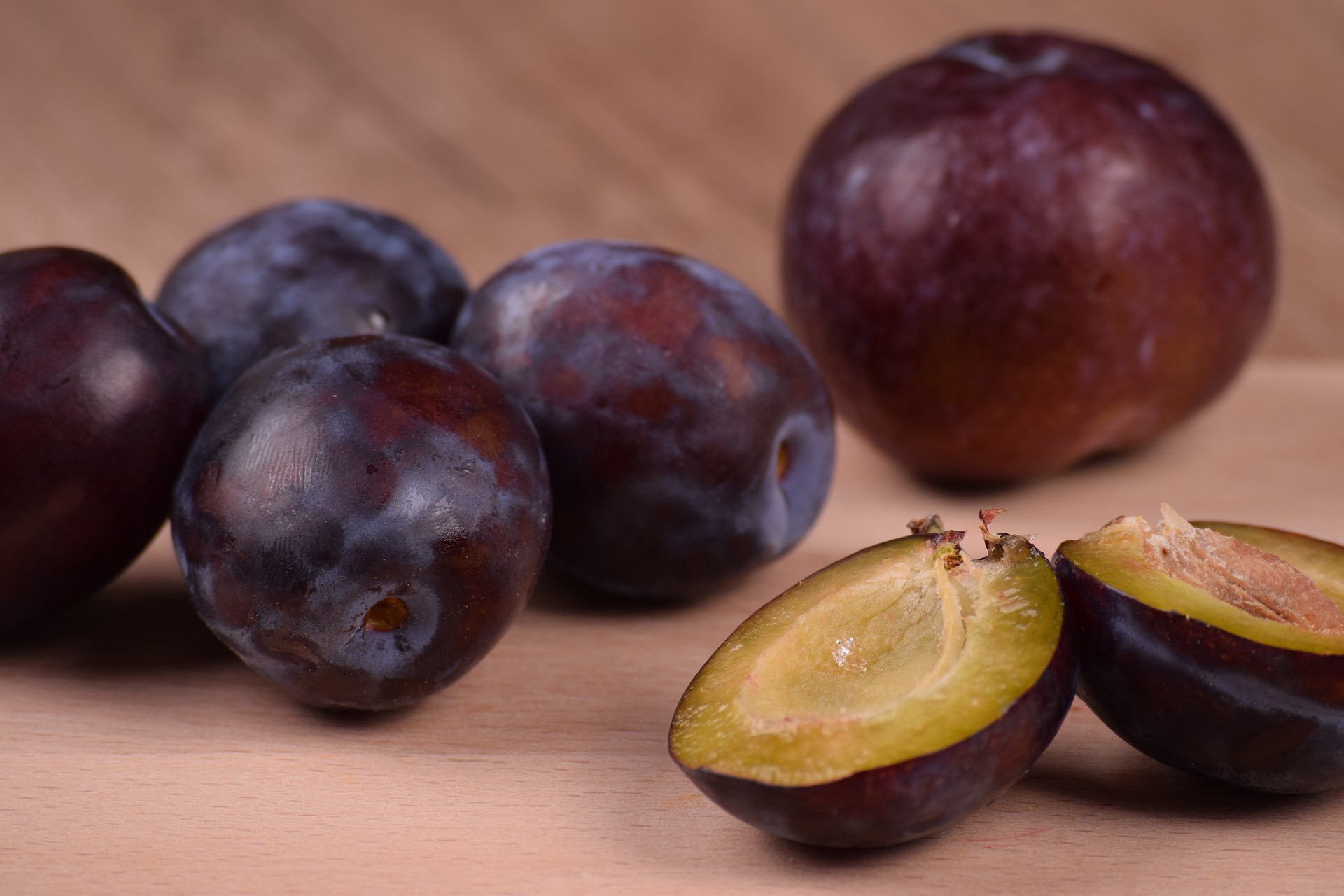
cut your plums into pieces they are so cold and sweet in the icebox I'm thievin give lots of fucks it's your breakfast I'm eatin
Now this is a story just to say That I ate the plums in the icebox today And I'd like to take a minute, just sit right there I'm sorry that the plums really weren't to share
@GretchenAMcC You had a little icebox, But now it's out of plums. They were so sweet and tasty And cold upon my gums. Oh, icebox, icebox, icebox! I ate from you today. And now you're bare and empty, And this is just to say. #WilliamCarolsWilliams
But our favorites are the ones that reference other poets and novelists, or even William Carlos Williams himself:
once upon a midnight dreary, while I pondered, weak and weary, over many a quaint and curious icebox of forgotten plums while i saved them, never eating, suddenly there came a bleating, as of someone gently tweeting using just their thumbs to inform me they'd consumed my plums
I saw the best plums of my generation destroyed by Williams, starving hysterical naked, dragging himself through the icebox shelves at dawn looking for a sweet cold fix
If you can save your plums for breakfast when all about you Are losing theirs & blaming it on you, Yours is the icebox & everything that's in it, And, which is delicious, so sweet & so cold.
I wish this was an article about bratwürsts, but alas, in my reading I haven’t come across many references to hot dogs in literature (if you have, let me know). Instead, I want to highlight some of the würst brats — as in the child kind — in fiction. Like hot dogs, they are the result of some gloriously congealed nastiness, but they don’t need any condiments to spice things up. Of course, if I came across any of these trouble-makers in real life, I would likely find them unbearable. Safely tucked away in words and pages, however, the pranks, cackles, and uproar these brats bring to their stories makes for some choice reading.
Brats always want what they can’t have, and they show their true colors when in a state of pursuit. Fred wants to live lavishly, while his father wants him to join the Church. The bullish son develops a gambling problem because of his need for a luxe lifestyle and then can’t pay off his debts — which are owed to the brother of the woman he wants to be his wife! (Good move, bro.) This puts him in quite the pickle, and he ends up working for his co-signer. And of course the whole time, he is whinging about not having what he wants.
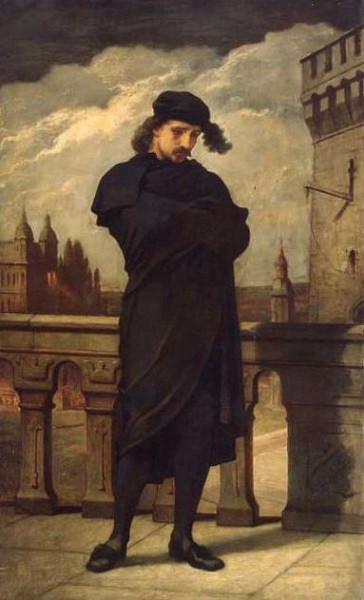
Hamlet’s brattishness is almost hidden by the play’s lush iambic pentameter, a kind of wrapping you might equate to a soft, chewy bun. His mood swings are out of control and he can never make up his mind. His soliloquies are wordy woe-is-me’s — it’s true that his new stepdad is a jerk and his father’s ghost is demanding revenge, but does that justify his treatment of Ophelia? Can’t a guy think of someone other than himself once in awhile? Like a proper tragedy, everybody dies at the end, and by the second act you’ve already decided that Hamlet is an obnoxious brat.
My next list is going to have to be “Best Insults by Narrators, Ranked,” because this description of Mary would take first prize: “As tyrannical and selfish a little pig as ever lived.” Mary is a product of her absent parents, but she doesn’t do a lot to encourage sympathy. Unlike the other brats on this list, however, Mary undergoes a change, becomes the kind child we all want to love. Better late than never, I suppose.
The classic brat, the ultimate brat, the mega brat — Huck Finn put the brat on the map. He’s the nightmare of every mother in town, smoking cigars and stealing livestock. Although the kid is kind of a jerk, it doesn’t feel like it’s all his fault. Society let him down, turned him into a rebel! If I’m honest, I’m kind of fond of this rascal, pranks and all.
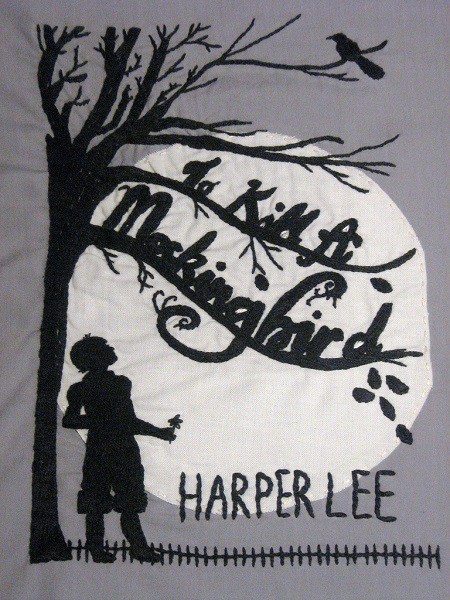
Nothing is worse than having to swallow your retorts to a jerk. Harper Lee had it right in her classic — Francis Hancock needed the good smack in the back of the head for the words he used about Uncle Atticus. Finally, justice is served.
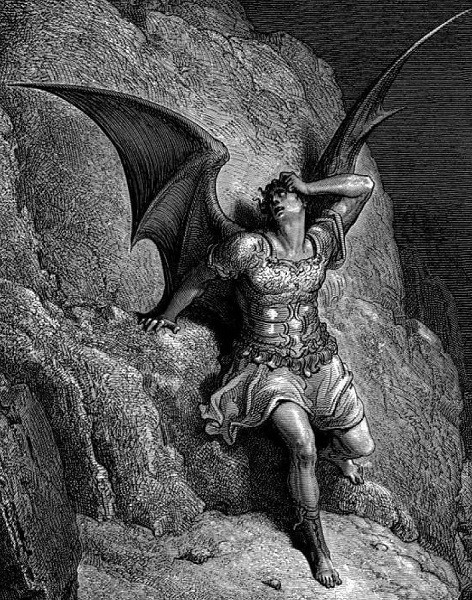
Satan is our ageless brat. Milton initially has the reader feel sorry for Satan, that is, until you realize he’s just a mope. His hatred of God is really a hatred of being told what he can’t do, and his temper tantrums rival those of a toddler who’s missed his nap. He hates God so much that he ruins the lives of the only two people on earth, thus ruining it for the rest of humanity. By the end of the epic, you’ll be surprised you ever felt sorry for him.
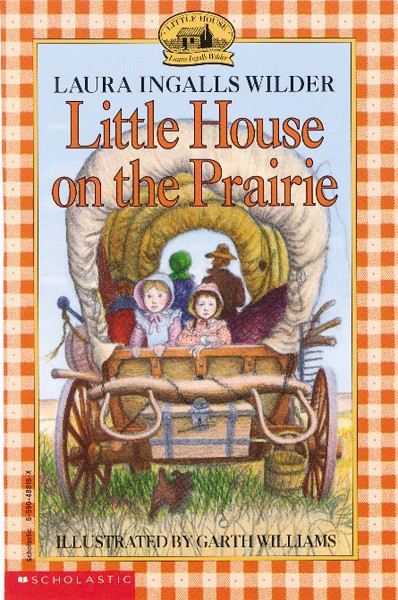
Nellie’s trouble to begin with, but let’s remember that the trouble she inflicts is on two girls whose parents are battling the fever ’n’ ague, have just moved across the county in a wagon, and who don’t know anyone in their new town. There is an argument to be made that Nellie is bigger than a brat — she is a next-level nemesis.
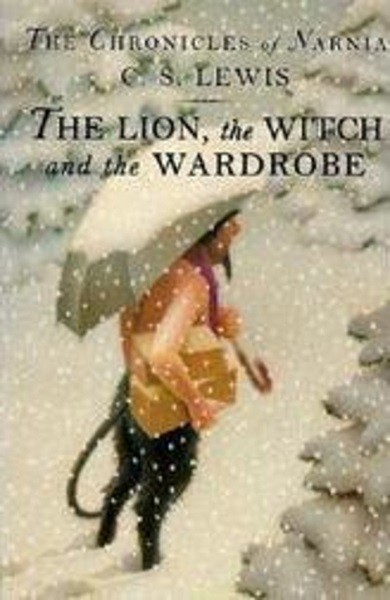
Edmund Pevensie is the typical, bullish older brother in The Lion, The Witch, and the Wardrobe. But his behavior eventually goes beyond your average sibling taunts and becomes inexcusable when he betrays his brothers and sisters to the White Witch in exchange for Turkish delight. The little taste of evil power, though, freaks him out. He’s not malicious to his core, just easily persuaded by sweets.
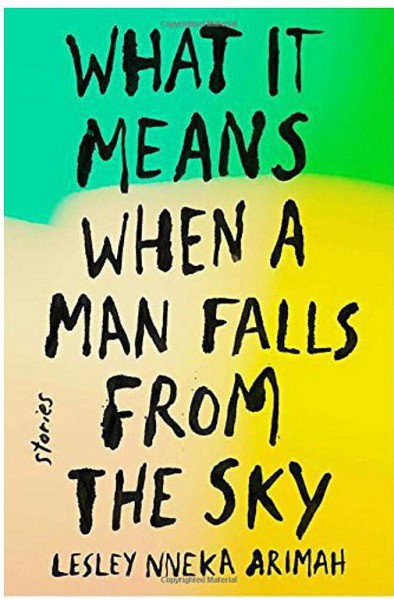
Behold! An adult brat! Lesley Arimah introduces us to Glory, a fully grown wet blanket who “has something rotten in her, her chi is unwell” (according to her grandfather). Her decision-making skills are terrible (for everyone), she’s constantly asking her mother for money, and worst of all, she steals food from the communal work fridge. Things work out for Glory, though, and she meets someone special. There’s someone out there for all of us, even the brats.
Originally named Joy, Hulga changed her name because she wanted to have the ugliest name possible (her words, not mine), one that reflected her true nature (those were mine). She earned a Ph.D. in Philosophy just to piss off her mother. When a Bible salesman shows up at her door, she decides she wants to seduce him. But at the end, Hulga loses her prosthetic leg to the salesman who is actually a nihilistic atheist, thus leaving Hulga stuck in a circle of irony.
These girls are bratty and creepy. They are in their 30s but their demeanor is still that of twelve-year-olds. The girls read and laugh at a personal diary, they have a strange fascination with their cats (I get the fascination of cats, but there’s a difference between taking pictures of your cat in cute poses and pretending your cat didn’t take the legs off a mockingbird). They are constantly talking trash about other people in the story, and they push their father into alcoholism. And without saying too much, there’s a certain death for which they might or might not be responsible. These are more than meddling kids.
I met Anna Prushinskaya in 2009, when we were classmates at Brooklyn College’s MFA program. I immediately fell in love with her writing, which is intense, precise, and lyrical. The next year, I began to work alongside her here, for Electric Literature—in the olden days it was still a print quarterly and the online presence was a blog called The Outlet. Working together, I felt annoyed at her, because not only did she have time to get all our coursework done, she was also quick and on top of things with her editing duties — and still found time to regularly attend yoga classes. In truth, I admired her passion, efficiency, and focus.
Purchase the collection.
These traits show themselves in her first book, A Woman is a Woman Until She is a Mother, an essay collection that was published by MG Press earlier this month. The focus of the book is, as you might guess, motherhood, but the compiled essays are about much more than that: the act of creating something, the act of defining ourselves in the world, the act of reshaping an identity. It would be easy for a book about motherhood to lean toward the saccharine and sentimental, but Prushinskaya doesn’t go down that easy route. As a result, the essays are relatable not just for mothers, but for anyone who’s ever had to redefine themselves.
Juliet Escoria: Pregnancy and motherhood are some of the most visceral and personal experiences a woman can go through. Did you feel it was a risk in making these experiences the focus of your book? Was there anything you wanted to avoid while writing it?
Anna Prushinskaya: Definitely, this book feels risky because I don’t necessarily like to reveal deeply personal things to the world. But when I bring this issue up to people, I am usually reminded that this vulnerable information is what makes books good.
JE: I remember you feeling reticent about writing about your son because he has no say in the matter, and also because to be a parent is to be vulnerable. An essay of yours that originally appeared in The Atlantic and mentions your son, “The Quantified Baby,” received some nasty and judgmental comments upon publication. Did that experience make you approach writing about being a mother and woman in a different way?
AP: Right now, I am thinking about this question in the context of the current heightened awareness of sexual assault, harassment, and rape culture. The title of the book is A Woman Is A Woman Until She Is A Mother in part because I was thinking about the categories of ‘woman’ that I have contended with in my life — motherhood being one of them — the broader implications of those categories, and about the power of a woman’s story. I keep this in mind when I review reactions to my writing, but being aware of that doesn’t change the fact that I still have work to do when it comes to nasty comments and how I process them.
JE: In between beginning and publishing this book, you had a second son. Does having another child change your perspective on being a mother in any way, or your sense of identity?
AP: It has been interesting to reread the book as part of the publishing process after having my second son. I added an afterword, the upshot of which is that my second son has made me a different mother. I feel like I knew abstractly that things would continue to change and develop, both how I think of myself as a mother, how I think about motherhood more broadly, and my relationship with my kids, and all that. Someone said to me that each time a baby is born, a new family is born, and I think that has also been true for me in that I felt re-born as a different mother.
JE: I feel like as a society, we’ve gotten better at looking at women’s roles, and mother’s roles, and family rights — but obviously we still have a long way to go, considering that when you were working at a prestigious university, you had to pump in a storage closet. What are some frustrations or annoyances you’ve had to deal with since you’ve had your sons that you were surprised by?
AP: Ha! Yes, the storage closet and I have gotten to know each other well. Well, it’s hard for me to answer in terms of frustrations and annoyances because I think there is much more to it than simply frustrations and annoyances. This is not a revolutionary point, but to me we should be thinking about universal leave for parents, access to quality medical care for all, and better support for women’s options across the spectrum of choices related to reproductive health, whether that includes having children or not.
JE: What are some books that you feel are similar to your own, in either tone, approach, structure, subject matter?
AP: Recently Facebook served me up a picture of M Train by Patti Smith that I took two years ago, pretty soon after my first son was born. Her writing about creativity and motherhood resonated then, and now I am re-reading to see what it’s like two years later. To be honest, with school and little kids, I wish I had more time for other reading. My guilty pleasures that I have been revisiting in this particular climate include Pema Chodron’s Heart Advice for Difficult Times and some Jack Kornfield.
JE: You and I went to school together, at Brooklyn College’s MFA fiction writing program. It’s now been six years since we graduated. What do you think that degree did for you, and didn’t do for you?
AP: I think the most valuable thing for me was to have the chance to live in New York City for a bit and to meet all you BC MFA writers. Right now I’m in the process of shifting directions professionally in a pretty significant way — I want to become a nurse. So, I can’t say that my MFA degree is directly contributing to my current professional life. I also still ask myself questions about the MFA in terms of student debt and degrees.
JE: That’s amazing — a lot of my English students are in the nursing. What made you want to switch? Do you know what type of nurse you want to be? And do you see any similarities between writing and nursing?
AP: I realized I had some passion for directly caring for people while I was working on a series of stories about the 1,4-dioxane pollution in the Ann Arbor area. I thought at the time that the best place for me to have impact might be to write these kinds of stories. But in talking with people who have been directly affected by this pollution, I realized I wanted to care for people directly. Does that make sense? It’s not an “aha” moment I can articulate very well, but it has changed my life pretty dramatically.
I’m just taking prerequisite courses right now, hoping to begin in a program sometime next year if I’m lucky. I’ve taken things like anatomy, physiology, pharmacology, etc., and have been learning a bit about the complexities of the body, both when things are working and when things are not working. (I’ve also been learning about this from fiction such as The Emperor of All Maladies). I don’t know what type of nurse I want to be. After thinking about birth and pregnancy as part of writing this book and having my kids, maybe something related to that. But what attracts me to nursing is that nurses hold space for people navigating all parts of life, and I have so much respect for that.
Writing and nursing — interesting question. Right now they seem like very different aspects of my life. For me, writing has felt very internal lately. Nursing feels the opposite. I have felt a growing urge to be of service more directly.
JE: The first essay in your collection, “Love Letter to Woody Plants,” talks about learning to identify plants in the woods around where you live in Ann Arbor. I got into the same thing this past summer where I live in West Virginia — I wanted to make some sense of the sea of green. It was interesting to notice how once I learned to tell the difference between plants, the woods and roadsides took on a whole other dimension. I see a connection to writing in that, the desire to give words to complicated ideas or feelings. Did you have a similar reaction to identifying plants? How did writing this book clarify your thoughts and feelings about your subject matter?
AP: I think the desire to identify plants was related to some aspect of what eventually led me down the path to considering nursing, actually. I think I wanted to be more grounded, and I thought that maybe learning the details of 300 plants or so would help with that. There is something about that degree of care in describing a plant, or in the context of a basic anatomy and physiology course, a bone or muscle, that anchors me to the moment.
Pregnancy, birth, and children have, for me, done the same thing. In a way, writing the book was a portal experience. I really felt like I could get through those months through writing, and I haven’t felt that same energy propelling me to write since then. Did the book clarify my thoughts? I think the book was the process of how I made my way through those experiences, not a clarification of them.
Daniel Alarcón’s short story collection, The King Is Always Above The People, longlisted for the 2017 National Book Award, is a triumph of understatement. Alarcón unspools tales of loners and drifters with dark secrets. Low-key and unemotional, his prose and plots prove that great storytelling doesn’t need to be filled with action and red herrings to pack a punch.
His first collection, War By Candlelight, was a finalist for the 2006 PEN-Hemingway Award. His first novel, Lost City Radio, won the 2009 International Literature Prize given by the house of World Culture in Berlin. His next, At Night We Walk in Circles (2013), was a PEN/Faulkner Fiction Award Finalist, a California Book Award Finalist and was named one of NPR’s books of the year. Feeding his ability to constantly create is Alarcón’s own life. He has lived around the world and been celebrated as reporter for The New Yorker and TheNew York Times Magazine. He currently teaches journalism at Columbia University.
Jeff Vasishta: Many of the stories in The King Is Always Above the People are about loners or those who seem to be running away from family discord. Some, such as “The Bridge,” are so unique and quirky they seem to be drawn from real life, or a newspaper headline. Were they?
Daniel Alarcón: Yes, actually. “The Bridge” is the anomalous story in this collection in that it’s based on true events. The anecdote of the damaged pedestrian bridge, the debris cleared from the highway, the entrances that no one blocked off, and the tragedy that ensued — a version of that actually took place in Lima. A friend of mine was working as a journalist in Lima and he covered it for a local paper. Years later, over a drink, he told me the story, and I was transfixed. It seemed to have everything you’d want in a narrative, elegantly exposing the pathos and absurdity that so often characterizes life in a city like Lima.
JV: You’re good at paying attention to the smallest of details, like the constantly spinning motorcycle wheel in “The Provincials.” Do these specifics come to you on a first draft or are they the embellishments you add at the end?
DA: First of all, thank you. That’s a kind thing to say. I don’t know where these details come from, or at what point they’re introduced into a draft. I can say that if there’s an aspect of being a writer that I take most seriously, it’s the task of observation. I look for those specific moments, gestures, physical details that reveal a place or a character. My revision process is slow, painful and involves a lot of despair — nothing ever feels good enough, worth publishing or sharing. I often have to let things sit for a while before I have enough distance to know whether it’s any good. Then I re-read. Rewrite. Cut like a savage. Rewrite some more. Let it sit. Show it to one or two friends. Talk about it endlessly with trusted readers. Write some more. Cut again, mercilessly. Then it’s done.
If there’s an aspect of being a writer that I take most seriously, it’s the task of observation.
JV: “The Auroras” is dark, unsettling, and brilliantly done. At first it seems that Hernán has fallen into a great situation — a place to stay and commitment-free sex — but of course the tables are turned. Are there writers that specifically influenced you in this kind of slow unveiling of the truth? It’s not easy to pull off.
DA: Nothing worth doing is easy to pull off. If it were easy, what would be the point? That story took me ten years to write. I’d come back to it again and again, never knowing quite what to do with it, how to make it turn in just the right way, at the right speed. The key ingredient in drama is when you, the reader, know more than the character, and you’re watching them slide inevitably toward misfortune. I read in order to be influenced, but I’ve never been able to point out where an individual strand of the narrative or one particular element of style comes from. Sometimes you let yourself down. For example, I read so much Borges when I was younger, but see almost none of him in my work, which, as you might imagine, is a tremendous disappointment.
JV: Having written both novels and short stories before, how do you decide which form you want to do? Some of your short stories feel that they could be developed into novels.
DA: I never decide before I start what something is going to be. It’s more a process of listening, of following the characters where they go. A novel is just a story that overflowed its banks.
A novel is just a story that overflowed its banks.
JV: You’ve lived in Lima, Peru, Birmingham, Alabama, New York and San Francisco — all quite different places. How did each place influence you as a person and influence your writing, if it is possible to make such an analysis?
DA: I’ve also lived in Accra, Oakland, and Iowa City. All very different places. Birmingham is where I learned to be American, a place I love, but where I never felt truly at home. Accra, where I lived for six months in 1998, was amazing as well; I’d never felt so foreign and I discovered I loved that sensation. New York is my home now, and has been since I moved here in 1995. I don’t mean that literally — I left a month before 9/11, but even when I left to live elsewhere, I thought of myself as a New Yorker, something in the energy of the place felt right. Like a lot of New Yorkers, 9/11 cemented my love for the city, made it concrete. The fact that I was gone when it happened only made me more determined to return. Lima is where my heart is, a city where I’ve spent much of my imaginary life since I was a kid. There’s no question that living there changed me, gave me an important part of my identity. You can draw a straight line from Lima in 2001, when I arrived as an adult in search of myself, and my work ever since. I wouldn’t be the same writer without that experience. Iowa City — I wrote my first collection there, and half of Lost City Radio — and I remember most a great sense of quiet, peace, a sense of being relaxed and having time to work. It’s where I discovered that the most important thing a writer did was go to the library every day and write. Talk less. Write more. My other love is Oakland, of course — a place with no pretensions, but so much history, so much personality, and a spirit that I’ve not found anywhere else. What a town.
But now I sound like a tour guide. You learn something everywhere you go.
JV: How do investigative journalism and fiction co-exist in your writing life?
DA: They feed each other. The clearest example of this comes from 2010, when I was writing At Night We Walk in Circles. By December, I’d finished a draft, and I was afraid it wasn’t any good. I showed it to a couple of friends, who agreed, and I was bereft. I had no idea how to fix it. Coincidentally, I’d pitched a story to Harper’s about one of the prisons in Lima, Lurigancho, and so I set my bad draft aside and went down there to report and write on this overcrowded prison that had developed its own idiosyncratic version of democracy. It was a bizarre, illuminating trip. I negotiated with the inmates to stay a night inside, and saw every aspect of the governance of this place from the point of view of those who are condemned to live inside it. I had so much material. I wrote my 7,500 word story, but could’ve easily written 10,000 words more.
So what do you do with all that extra material? You fold it into your fiction, of course. There were things I knew, but couldn’t prove. There were anecdotes that piqued my interest, but which I didn’t follow up on because I knew them to be tangential to the story I was covering for Harper’s. When, in the middle of 2011, I was finally prepared emotionally to deal with the wreck of my novel, having all this knowledge about the prisons helped tremendously. I re-read the draft, confirmed it was a piece of crap, and started thinking deeply about what I’d misunderstood about my characters. I realized one of them, Henry Nuñez, had spent time in a prison like Lurigancho. That he’d lived through these difficult years that many of the men inside had so generously described to me. His backstory, which was a minor part of the first iteration of the novel, became absolutely central. I wouldn’t have had the confidence to imagine any of that without having reported on it first.
So versions of this symbiosis between journalism and fiction happen all the time — and even in the opposite direction. I often imagine who might be the best characters to populate a piece of nonfiction. What are their profiles? What position do they have? What might I learn from them, and how would I recognize them? This imaginative work helps a lot. I start hearing a story in my head before I even report it.
I n the worst month of the most severe drought in California’s history, my parents built a swimming pool. Reserve your judgment for a moment: they also replaced the lawn with native planting and powered the thing with an Israeli solar-powered saltwater filtration contraption strapped to the roof. Their architect said Tom Brady and Giselle also used it; my dad wondered whether the Brady-Bundchens had as many problems with it as he did.
If you still question this choice for either hypocrisy or environmental irresponsibility, I refer you to Joan Didion’s 1977 defense of swimming pools written in the midst of the second worst drought in California’s history. Rebuking those not from California who took smug pleasure in the idea of Californians having to drain their pools during drought, Didion explains “in fact a swimming pool requires, once it has been filled and the filter has begun its process of cleaning and recirculating the water, virtually no water.”
I happened to read this vindicating passage in Didion’s essay Holy Water on a floatie in the new pool — a fitting first encounter with Didion’s work, whose life as an author, wife, mother, and Californian is the subject of the new documentary “The Center Will Not Hold.” Although she is now associated with the cool detachment of New York City, Didion’s native California served as her first inspiration and subject in works such as Run River, Slouching Towards Bethlehem, and The White Album. In her reflective later work as well, the character of California as a mood continues to emerge and evolve. And as another California native living in New York, the experience of reading, in later months from my apartment, Didion’s description of the Los Angeles summertime evening’s smell of lavender, filled me up; her often tender fascination with California warmly energized, and continued to stoke, my own.
Her often tender fascination with California warmly energized, and continued to stoke, my own.
So during that first interaction with The White Album in the swimming pool, I gleefully read on as Didion delved into an examination of the pool for its symbolic meaning to Californians like herself. But despite the connection with this author I was discovering, I was puzzled by her conclusion that pools symbolize “order” rather than the more commonly “misapprehended” symbol of affluence and a “hedonistic attention to the body.”
Thanks to their prominence in everything from tabloid photos to David Hockney paintings, pools are a focal point for imagining California for both residents and observers. But before reading Didion’s passage on swimming pools it never occurred to me that pools could mean different things to different… swimmers. I saw that pools represent more than just a small body of water common to California backyards; my dad’s pride in his new pool and the affectionate enjoyment I take from diving in make me sure of it. But where does the meaning different Californians attach to pools originate?
The California Joan Didion etches in her writing is a place both laconic and volatile, arid and abundant. Drawing on her heritage as a member of an Old Sacramento family, many of whose ancestors barely survived crossing the plains in covered wagons in order to claim an unruly coast as their own, she comprehends California’s existence as a perpetual state of struggle and contradiction. She says “California is a place in which a boom mentality and a sense of Chekhovian loss meet in uneasy suspension,” whose residents both revere and fear a “river running wild and undammed.” Despite the adversarial relationship between the land and its earliest (white) residents, Didion, in early writings like Run River, Notes from a Native Daughter, and Holy Water, invokes this pioneer-era California with affection and pride. Didion locates her identity in a romanticized era of California history defined by taming land and water.
Didion is her most true California self while either struggling with or marveling at mastery of the elements.
This California identity is Didion’s frame of reference when she assesses the symbolic meaning of swimming pools as a symbol “of control over the uncontrollable.” The same impulse, born from her heritage, for control, fuels her fascination with agricultural water systems, or causes her to envision the Hoover Dam while driving down Sunset Boulevard, and to venerate her home in Malibu, about which she says “I never loved the house on the Pacific Coast Highway more than on those many days when it was impossible to leave it, when fire or flood had in fact closed the highway.” Didion is her most true California self while either struggling with or marveling at mastery of the elements. In an interview with Michiko Kakutani after publishing The White Album, Didion says “order and control are terribly important to me,” a statement which surprises no reader; no wonder Didion’s swimming pool reverie ends with “a pool is water, made available and useful, and is, as such, infinitely soothing to the western eye.”
Late in Joan Didion’s career in the book Where I Was From, she reflects on her early writing about California and her relationship with her home state. Assessing her self-described “nostalgic” view of California in her earliest writings, she teases apart the ways in which Californians lament change. She cites California’s constantly booming population history, and, in contrast with other states that have longer institutional memory, finds that change is and always has been a constant in California; that there has always been “obliterating increases, rates of growth that systematically erased freshly laid traces of custom and community.” She deduces that because California has experienced many population transformations, the California of the time a person arrives will always represent the way things ought to be. Didion concludes “discussion of how California has ‘changed,’ then, tends locally to define the more ideal California as that which existed at whatever past point the speaker first saw it.”
I would amend this statement. The idealized version of California depends not upon when an individual first arrived, but instead, when that person’s family became Californian. Didion remarks in Where I Was From that the family events of settling California that most define her vision of California occurred before her birth. Similarly, my idealized version of California rests not so much in my own childhood — a good one, but still filled with the usual angst — as in my family’s stories of what becoming Californian meant to them: how my grandparents moved from the land-locked Midwest to Los Angeles, where, away from their immigrant parents, they got to buy homes and eat oranges. The easy haze I associate with California originates with my parents’ stories about cruising through the Valley on their bikes, or trekking over the Santa Monica Mountains to and from Zuma Beach, sunburned thighs sticking to vinyl car seats, relieved only by jumping in the swimming pool.
For me, as well as in the larger cultural imagination of California, pools do symbolize this coastal, hybrid urban-suburban dream that I imagine my parents and grandparents lived. Based in Los Angeles, the 1960s iconic film The Graduate communicates Dustin Hoffman’s character Benjamin Braddock’s resistance to that dream by putting him in a swimming pool in a scuba suit, essentially suffocating under the weight of family expectation. That expectation or dream of career, family, house did not repulse my father, who graduated at the top of his class at three California institutions of higher learning, married a girl from the Valley, and settled on the West Side of Los Angeles — a “native son” if I ever saw one. So he eventually built that swimming pool.
For me, pools symbolize this coastal, hybrid urban-suburban dream that I imagine my parents and grandparents lived.
Like Joan Didion, I call myself a “native daughter” of California, a statement with which I do not know that she would agree. Claims to this title aside, Joan Didion and I inhabit and idealize different Californias in our minds precisely because our families arrived at different times, and became Californian in different ways. The regular mention of swimming pools in Joan Didion’s writing about California indicates that, for Didion too, the swimming pool is significant in the imagination of California. But because of the difference between Joan Didion’s heritage and my own, we disagree on the meaning of its symbolic significance. As Didion says, pools are “soothing to the Western eye.” But the symbolic readings Didion rejects — pride in “affluence” and “hedonistic attention to the body” — are also aspirational elements of the California urban-suburban dream that pools symbolize. Perhaps, as Didion says, “the apparent ease of California life is an illusion.” But pools, for their owners and swimmers, help maintain that illusion within urban-suburban life, whether “real or pretended.”
Perhaps early in her career Didion would conceive of one symbolic interpretation as more valid than the other. Didion wrote in Notes from a Native Daughter “which is the true California? That is what we all wonder.” But comprehending California in Where I Was From as a generational palimpsest where the only constant is change, perhaps Didion could see that both conceptions — of control, and of leisure — are true about pools, and about California. In California, the truth of the place is not just “elusive,” as she says. It is, inherently, fluid.
Conscience prompts hallucination and weird phantoms make an end
Moonlight, slanting through the window, became a white pattern on the floor of the room in which Norman Bacher awakened. The carafe on his bedside table was empty; he had drunk often that restless night. Fumbling for his slippers, he got out of bed. The bureau’s mirror threw a reflection at him.
In the dim light, hair rumpled, face paler than ordinary, the face in the glass was too like Eric’s not to startle Norman. He brushed a hand across his forehead and blew his breath out sharply. What had for an instant been a dark stain on the mirrored brow was only a pendant lock of hair. He studied the face in the glass until his pulse was steady. Then he went for his water and returned to bed. But he could not sleep.
He knew that what remained of his brother would never be found, never searched for. He knew no one could suspect him of having murdered his brother. Eric Bacher and some fifteen thousand of the bank’s dollars had vanished simultaneously. Reckless spendthrift Eric, with his weakness for gambling, always deep in debt, taken into the bank a few months ago only because his brother earnestly requested it. There were people — many — in Bradton who preferred Eric’s society to Norman’s, but not even the fondest of them could suspect Norman of any part in the vanishing of his brother and the money. Thrifty, industrious Norman, with thirty years of sober drabness and twelve years of faithful service in the bank to his credit. Certainly there was little likelihood of disaster from without. From within — he had provided against that too.
He knew himself down to his least weakness, and he had planned his crime with adequate allowance for each quirk of his nature. Nights of sleeplessness, gusts of cowardice, even the occasional remorse that could be routed only by thinking of what the stolen thousands meant to him — they were not to buy folly, those dollars, but to start him toward the wealth and power of which he dreamed — all these things he had considered and weighed and measured before he had acted. But there was this thing he had not foreseen.
Neither of the Bacher twins had ever been mistaken for the other. The most casual acquaintance could not have made that mistake. Norman’s face was pale, grave, with the compressed, secretive mouth and steady eyes of the young man whose career is a serious thing. Eric’s face had color, was mobile, and his mouth was always either open or about to open — a great talker and laugher. Nevertheless, their features — seen when sleep, say, had robbed them of their daytime expressions — were much alike. The differences were all in the pulling here and there of muscles at the behest of two identities that were as far apart as only brothers can be. In unconsciousness one brother’s face was the other’s, except for coloring. Eric had pink skin and a red mouth.
But Eric’s face, just before the bullet had struck, and just after, had been twisted and blanched — first by fear and then by a spasm of brief pain, perhaps — into a mask that would better have become his brother. Norman had seemed to look into his own face dying with Eric’s body. In his mind had remained the impression of his own face distorted by the fear of death — no stranger to him — with a red spot in the forehead where a metal pellet had been driven into Eric’s brain. It was Eric who had been shot and who had died, but through Norman’s brow, the blood had trickled down Norman’s face.
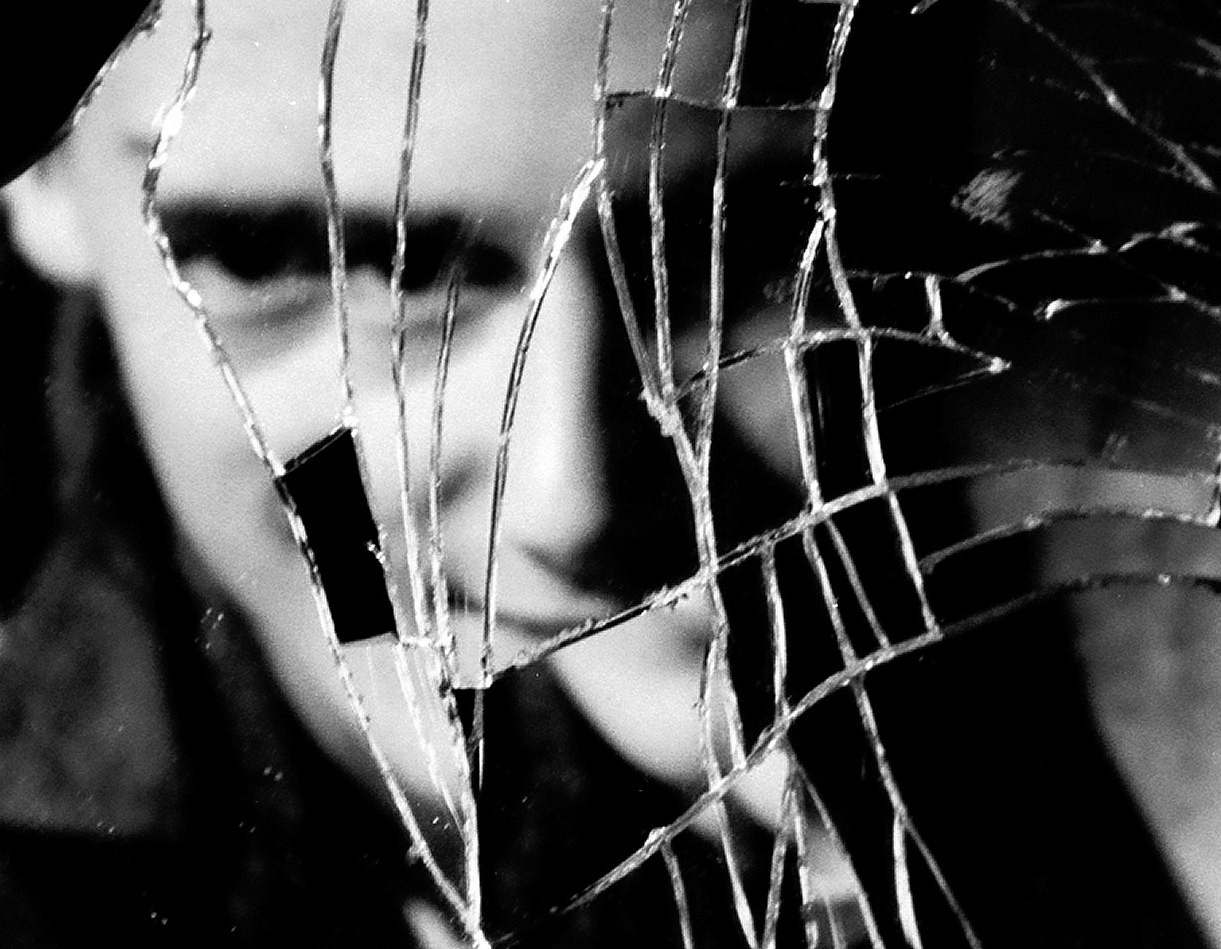
Twice within the day this dying face had looked at Norman; from a store window on Broadway this afternoon, and now from the bureau mirror, made terribly real this time by the counterfeit scar on the forehead. Hope said that this seeing dead Eric in his own likeness was a trick of overwrought nerves, a trick that would lose its horrible effectiveness as his nerves gradually relaxed into normal steadiness. Fear said that through this trick too-taut nerves would destroy themselves and their owner; that each repetition of the illusion would increase the tension, that the greater the tension became, the more frequent and real would the illusion be — until the inevitable collapse.
Were hope right, or were fear, Norman Bacher knew he could not hide from this thing. All his planning had been based upon the principle that shadows pursue fastest when fled from. He got out of bed and sat in the moonlight before the bureau, looking into the down-tilted glass. This illusion had to be forced down if disaster were to be avoided; he knew himself to the least weakness. After a while he slept, his head against the chair back. He had seen nothing in the glass except his own face. Later he awakened with a stiff neck and went back to bed.
Twice the next day he saw Eric’s dying face — in a window of the bank, and in a chewing-gum machine on First street. Each time he faced the reflection until he was steady-nerved in the assurance that it was his own and not his brother’s face. He bought a green eye-shade. His desk at the bank faced a window that became a dim mirror when the awning was lowered in the afternoon. He had not yet seen Eric’s face in that window, and did not wish to.
Coming home from the bank that same afternoon he took his first definite step in flight from his dead brother’s face. The mirrored chewing-gum machine in First street was in his path. Approaching, he kept his eye steadily upon it until he came abreast. Then he spied Mrs. Dunan, the bank president’s wife, coming toward him. He hastily looked away from the mirror. He feared that if he saw Eric in the glass this second time he might be startled into some momentary gesture of betrayal. So he turned his eyes toward Mrs. Dunan, and lifted his hat — but in the very act of averting his eyes from the mirror he had caught a flash of Eric’s face. He went on, walking fast, for the first time running from the illusion. After that he was never to be certain that it was an illusion.
That was Saturday. He stripped the house of its mirrors that night and piled them in the cellar. At midnight he went to the cellar again and brought four of the largest mirrors up to his bedroom, where he propped one against each wall. In the center of the room he sat on a chair, and turned his face from mirror to mirror, looking into the four reflections of a face that was unmistakably his own. It was after daylight when he gave it up and got into bed. As he raised his head to adjust the pillow more comfortably under it, Eric’s white face looked at him. It was not Eric’s face when he sat up in bed and peered through the thinning dusk at the glass. It was his own. All day Sunday he prowled through the house in which his brother had died; upstairs and downstairs, ceaselessly, aimlessly, he walked; from the dusty attic to the damp cellar, with its pile of broken glass where he had worked with an ax on the mirrors. Every light burned, and everything that could cast a reflection was covered by a rug, curtain, sheet, towel, or cloth of some sort. The tow attic windows had no blinds. He had turned away to find covering for them, but had been afraid of what they might show him when he returned. A candlestick lay on a trunk nearby. He broke the glass out of the windows with it.
Shortly after midnight he was in the cellar poking at the ruined mirrors until he had a triangular fragment large enough to give him back his face. Carrying it upstairs, he stood it against two books on a table. He sat down and stared into it, elbows on the table, face on hands. As he sat looking into the face that was so certainly his own and not his brother’s, his eyes became fixed with hypnotic rigidity. He could have wrenched them away only with severe effort, but he made no effort. All of him was centered on what showed in that ragged bit of glass. His breathing became heavy and mechanically spaced. His eyes turned upward and outward, though the lids did not close.
Sometime later he came to with a convulsive start. The glass reflected his own face, white and harried and unscarred of forehead. He resumed his staring — he had dozed for an instant, perhaps, dreaming. . . . Through the silent earliness of Monday morning came the striking of the City Hall clock. He did not hear it. His eyes were focused glassily, unswervingly on the glass. The clock struck again, later hours. The sun crept around the drawn blind and laid parallel strips of gilt on the floor. He neither heard nor saw.
An elbow slipped. His head dropped, knocking the mirror over. He jumped to his feet, upsetting the chair, crying aloud in crazy terror. Then he looked around the lightening room and laughed jarringly. The night had passed. Nothing had happened. He felt suddenly childish, silly, ashamed of the seriousness with which he had taken the illusions.
Something tickled the bridge of his nose. His hand came away red. A stinging was in the center of his forehead. He snatched up the mirror. Eric’s face, white and twisted by terror, looked at him. From the hole in Eric’s forehead blood still trickled.
Screaming, Norman Bacher bolted out of the house. Two men — a telegraph operator and a brakeman — were across the street, walking toward the station. He dashed over to them and began shrieking his confession into their astonished faces. He gestured wildly. The triangular piece of looking-glass — its dagger-sharp apex stained freshly red — sailed out of his hand, and shattered on the sidewalk with a tinkling that was like the distant laughter of children.
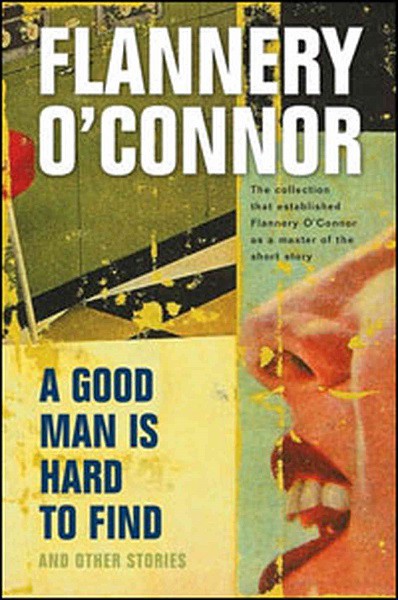
W e know that in real life, a good man is hard to find, but you’d think solid dudes would be readily available in the realms of fiction.
It turns out, though, that caddishness and ego are such universal heroic traits that it’s tough to identify thoroughgoing mensches even in novels—especially if you rule out characters who remain children throughout the book or series. (Sorry, Dickon from TheSecret Garden!) It’s even harder if you rule out dogs. This whole list could have been male dogs.
For our purposes here, a good guy is not necessarily “lawful good.” Breaking rules in service of the greater good doesn’t disqualify a character: Jean Valjean of Les Misérables steals a loaf of bread, but only to feed his family; The Hunger Games’ Cinna plots rebellion against a super shitty regime. Good guy qualifications that do apply: neither emotionally nor physically abusive; honest with and supportive of friends and lovers; doesn’t use people for money and/or sex; and finally, doesn’t predicate his affection on virginity. Not a high bar! You’d think.
During my research, I had trouble remembering all the crappy things characters I liked had done. C.S. Lewis’s Aslan, though not human, is alright for a Christ figure—but someone reminded me that he wouldn’t let Susan back into Narnia because she liked makeup and boys. I liked Zora Neale Hurston’s Tea Cake, but forgot that he beat and stole from Janie. I thought of Shakespeare’s Ferdinand, but realized his love for Miranda was explicitly virginity-based: “Oh, if a virgin, / And your affection not gone forth, I’ll make you / The Queen of Naples.” Bye.
To be fair, no one likes a Mary Sue (or Gary Stu). Bad Boys often do well in literature, whether you’re into controlling blood-suckers or condescending aristocrats, especially when they’re redeemed by a female protagonist. In real life, of course, we’re all flawed, and perhaps a lack of good fictional dudes suggests a lack of flesh-and-blood inspiration. But it’s worth noting that if I tried to make a list of “good women characters in literature,” the difficulty would be confining it.
Our list is obviously not comprehensive, although crowds have been sourced. In talking to people about putting together this list, the fact that it took so many women and men so long to think of characters to add to this list is reason enough to write one. With that in mind, here’s an incomplete list of Guys Who Can Hang.
Watson also invented the side-eye.
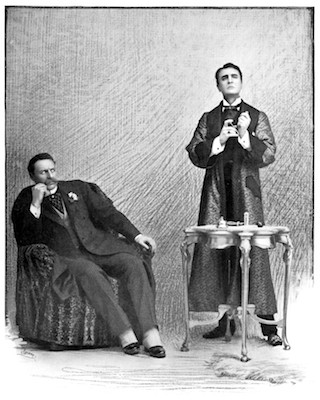
John Watson, the Sherlock Holmes stories by Arthur Conan Doyle: Watson is the thoughtful, sensible foil to Holmes’ dickish genius. Holmes gets the glory; Watson gets to be the one we actually like.
Jean Valjean, Les Misérables by Victor Hugo: He steals a loaf of bread to feed his family AND IT’S FINE.
Jem Carstairs, The Infernal Devices trilogy by Cassandra Clare: Despite his forced dependence on a demonic drug, Jem is encouraging, supportive, remarkably lacking in self-pity, and at one point rescues a cat from the clutches of evil.
Cinna, The Hunger Games trilogy by Suzanne Collins: Cinna is both an aesthetically brilliant stylist and a member of the underground resistance that topples a dystopian regime. His gold eyeliner is a bonus.
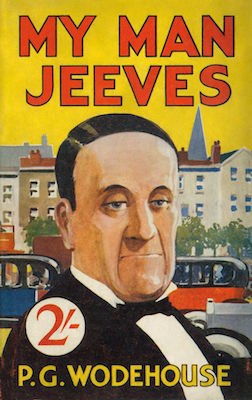
This image also appears in the OED’s entry for “superior.”
Reginald Jeeves, the P.G. Wodehouse universe: A self-described gentleman’s gentleman, Jeeves is so flawless that his name has its own entry in the Oxford English Dictionary.
Daisuke, And Then by Natsume Sōseki: Daisuke is decent if unmotivated, living off his parents’ money in Meiji-era Tokyo. He lives a chill life, reading, philosophizing, and writing letters. Even when he falls in love with his friend’s wife, he doesn’t do anything super creepy.
Ethan Figman, The Interestings by Meg Wolitzer: A nerdy and immensely talented artist, Ethan manages not to be a jerk after achieving success.
Gabriel Oak, Far From the Madding Crowd by Thomas Hardy: Farmer Oak stays loyal to our heroine, Bathsheba, throughout her life, respecting her independence and valuing her friendship despite her initial rejection of his marriage proposal. And he saves a bunch of her sheep from bloat.
Long live Bob Newby — another good man.
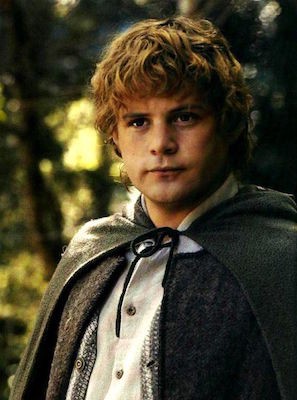
Samwise Gamgee, The Lord of the Rings trilogy by J.R.R. Tolkien: Sam is the steadfast best friend we all want. Motivated, too: he “burned with a magnificent madness, a glowing obsession to surmount every obstacle.”
Tengo Kawana, 1Q84 by Haruki Murakami: Writer, math teacher, and remarkable hand-holder, Tengo remains thoughtful and kind throughout an increasingly complicated tangle of parallel universes. When Tengo’s mentor asks him to rewrite a young woman’s manuscript, Tengo is so uncomfortable that he insists on meeting with the author before accepting the job. A male writer who doesn’t feel that a younger woman’s prose depends on him — imagine!
Captain Carrot Ironfoundersson, the Discworld series by Terry Pratchett: A human raised by dwarves, Carrot is one of the only literary law enforcement officers I’d trust. Honest, loving, and simple (but not stupid), he consistently places the needs of the public above his own.
George Knightley, Emma by Jane Austen: Mr. Knightley is a relatively down-to-earth guy and lifelong friend and confidante of our heroine, Emma. By Austen standards, he’s not even particularly classist. Per Zoë Triska: “Knightley is an actual nice guy, not a ‘nice guy.’”
The editor’s first choice image was actually this one.
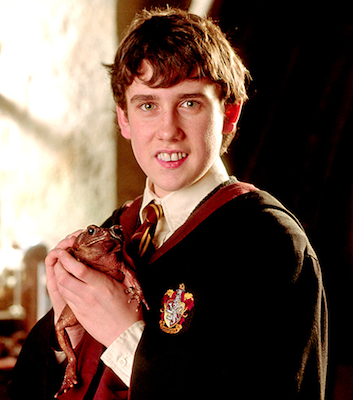
Neville Longbottom, the Harry Potter series by J.K. Rowling: A shy and awkward kid, Neville Longbottom grows into an underground organizer and snake-slaying badass. As Harry said, he’s worth twelve of Malfoy.
Philip Pirrip, Great Expectations by Charles Dickens: Pip is honest, hardworking, ridiculously forgiving, and a friend to escaped convicts.
Sandy Rogers, Not Without Laughter by Langston Hughes: In turn-of-the-century Kansas, Sandy Rogers grows up reading books and questioning morality, religion, and race relations. Hughes described the character as semi-autobiographical, and I think we all want to hang out with Langston Hughes.
Astrid and Paul in the movie of ‘White Oleander’
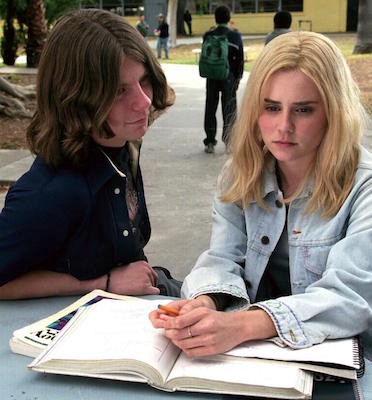
Paul Trout, White Oleander by Janet Fitch: Our heroine, Astrid, bonds with the artistic Paul in a center for foster kids without placement. Unlike many characters in White Oleander, Paul doesn’t try to manipulate or murder Astrid. When she leaves the center, he remains in touch from afar.
Gregor Samsa, The Metamorphosis by Franz Kafka: Gregor’s life as a traveling salesman sucks, and then he wakes up as a cockroach. In both unpleasant stages of life, he loves and cares for his family, and dreams of sending his sister to a music conservatory. Then he dies a monstrous vermin.
Novel Gazing is Electric Literature’s personal essay series about the way reading shapes our lives. This time, we asked: What book was your feminist awakening?
1. A Warning
I have to tell it slantwise. Straight on, you will not understand. You have not understood. You do not have the language.
Listen close, now. Listen and do not forget.
2. A Story
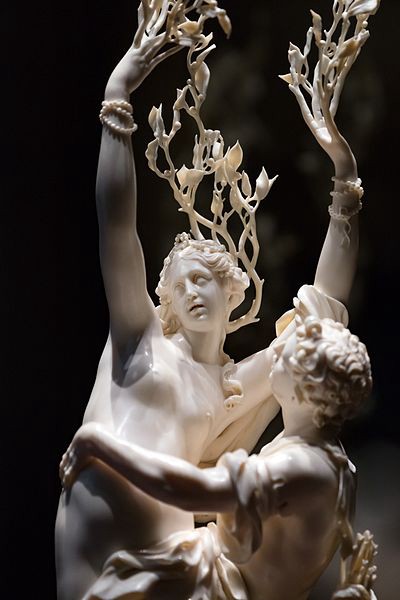
I read the story in a book when I am ten. There is a picture but I can’t understand it, not then: the woman tree, her reaching.
Once she was a nymph of Artemis. She roamed the woods. Free with her sisters. Freely alone. Once, the trees looked like shelter and she ran, naked, with the wind on her skin.
Then Apollo came into her woods. Shot with Cupid’s arrow, startling nymphs with his needing. He didn’t seem scary at first. He wasn’t Zeus, the woman-chaser, or Hades, kidnapper of virgins. He was the god of music and poetry. He was artsy. He was sensitive.
Still, he chased her. But who could believe it? So unlike him. Must be a mistake. Must be a misunderstanding.
Daphne, nymph of Artemis, roamer of forests, fleet-footed runner, is scared. She is running. He is chasing. She is tiring. She is sure she will be caught. She is calling for help. She is begging her father, the river god, to save her. We are no longer safe in these woods with the nymphs and the trees and the goddess — we are caught in the desires of powerful men. They make currents to sink us, whirlpools to swallow us whole.
What kind of father turns his daughter into a tree and thinks that is protection?
What kind of father turns his daughter into a tree and thinks that is protection?
She is changing as I watch her. I cannot look away. I feel her bark edging over my skin. I feel limbs grow long. I harden. I feel feet sink down until I cannot move them. The wood masks my face. I hear my leaves rustle. I see the man coming. I am frozen in place.
He steals a lock of hair, a branch of leaves to make a crown. He shouts apologies. He weeps for what he’s done. But I have lost my girl shape.
3. Twelve
When the first cat-call comes I am running, late, for my mother. Mothers wait and mothers worry and I don’t want my mother worrying. I run through the shadows of trees in a neighborhood that is peaceful and leafy and safe. The shout is out of place. The passing car is gone in seconds. But the shout lingers, a dissonance hung in the air. I won’t remember the words. I will always remember the feeling. Bark growing. The strangest sensation. Fear and strength at once. I stop running. Running makes them think that you want to be chased.
4. Fourteen
Breasts draw attention. Fleshy. Womanly. Escaping from barked-0 up neutrality. We are told even bra straps scream sex at the boys. Hide. Hide. Cover up. Eros is not to be toyed with. Keep the budding breasts concealed. What terrors they’ll bring if they blossom.
The kiss is quick, unwanted. The grab, the hold, the lurch of lips. New, wet, leach in my leaves.
Ass grab in bar. Who? Can we see? What would we do if we could?
The man lays himself in my bed and I curl myself small in the corner. Polite. Be polite. Good girl. Nice.
Come outside. Smile. Come with me. Smile. Kiss. Smile. Now. Smile. Fuck. Smile. Take it off. Smile. Smile. Smile. Hand
in hair on bus. Not mine. Stranger
hand. Eyes. Always
eyes. Always
wanting. Always
needing. Mom/whore
give.
6. Nineteen
Words do not mean what they mean. No means maybe means yes. Stop means maybe means go. Maybe is not a word. Maybe is something invisible. In between. Unsure. Not certain. These words do not exist. These words default to yes.
Bifurcate
language. Bind
the binarium. All this binomial business
bisected to
bipartite parts.
Bisexual
does not mean what it means, means different to you. You say this word means extra-sexual woman, super-sexual woman. It means woman wanting sex with any everyone. And if there are no bounds on potential desire then she must desire you desiring her. This word means woman wanting all the time. It means “she likes it.” It means “she wants it, bad.” It means she must invite your leer, your touch, your kiss, your grab, your hard, hard
hold.
Push that word down into roots. Bury that word deep in the deep underground.
7. Twenty
Father always said, tell women they’re beautiful. Had to come over and say it. Number now? Kiss? Fuck? Smile. I gave you a compliment.
8. Twenty-Five
Watching Titus. Smart women, grad school women. Watch a woman tied up, see her stand bearing arms replaced by tree limbs and blood. Such blood. There is Daphne in an image so inhumanly literal we cannot believe. Too fantastical, too familiar, too —
Roomful of women. Watch like witnesses. Can only try to talk about it after.
9. Thirty
The student — the adult student — is angry. Looms while he tells me I don’t know what I’m doing, don’t understand, am not correcting correctly. His brilliance. My stupid. Door blocked by his body. Does the window open? Could I move if I had to or am I rooted in place?
Other students walk in. Man moves away. Hands shake for the rest of the hour. I teach over leaf-rattle nerves that no one hears but me.
It happens every term. Some version. Some old/new iteration. Listen to a roomful of women talk teaching and you’ll hear it repeat. Again and again. We rarely tell anyone. We start to see it as part of the job.
10. Thirty-Three
All the men are talking. About sexual harassment. Good liberal feminist men meaning well. They are having a serious discussion. About sexual assault. They are mourning fallen heroes. They mourn men they admired. Good liberal feminist men meaning well just like them. Sensitive men. Artsy men. Men of Apollo.
There are women in this room. We do not speak in words. We rustle our leaves at each other. We
try to meet eyes around bark.
The men watch us, expect explanation.
11. A Question
What can we say to you? You rose up through different dimensions. You turned into creatures apart. Words mean different to you. What root whispers, what leaf rustles, what branch groans, could you hear? You speak a different language. You do not have our words.
What if our foundational story of difference isn’t Babel, not the sin of aspiring skyward? Not Adam and Eve and the sin of seeking knowledge?
What if our story is Daphne and Apollo? Tale of power unacknowledged. Sin of power misapplied. Sin of power made to harm until, dividing, we change to each other.
What if our foundational story of difference isn’t Babel, not the sin of aspiring skyward? What if our story is Daphne and Apollo?
Tell me what shapes you grow into. Men are animals. Chauvinist pig. Wolf in the hen house. Bear-wolf.
12. A Story
Our girls grow into trees. Subject to an ancient curse. Shaped by your burdens. Bearing those burdens in branches.
Too quiet. Too loud. Emotional. Bossy. Frumpy. Hysteric. Mom/whore. Smile/bitch.
We give you funhouse femininity. We give it just for you. Just because you threaten so nicely.
You don’t see the bark. You don’t see the branches. You don’t see the forests we make, the vast underground systems of roots we have built. Generation over fallen generation. Secret language
we push underground, so deep even we can forget it.
Fury of words. Fury of story. Fury that rends on the inside.
I dream in angry forests. Simmer of sap in deep winter. Awakening trees rising. Lifting battle
hardened roots to run. Not away. This time we run toward you. A whole forest of fury.
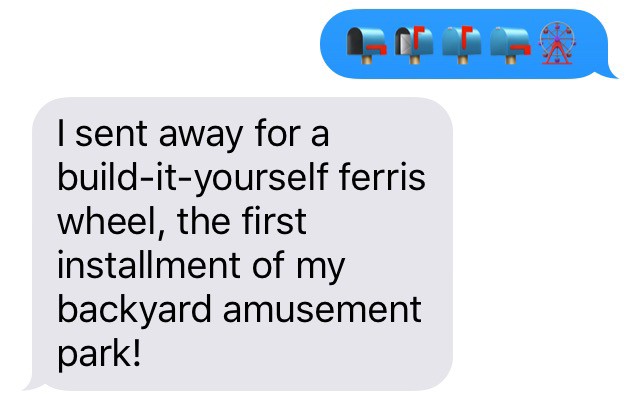
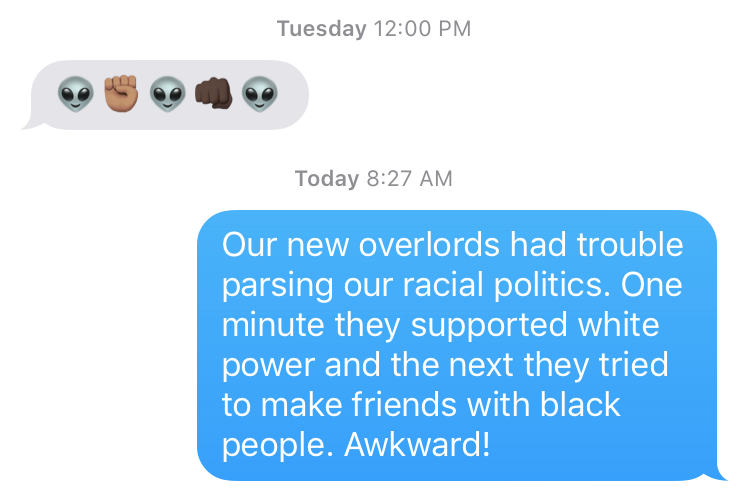
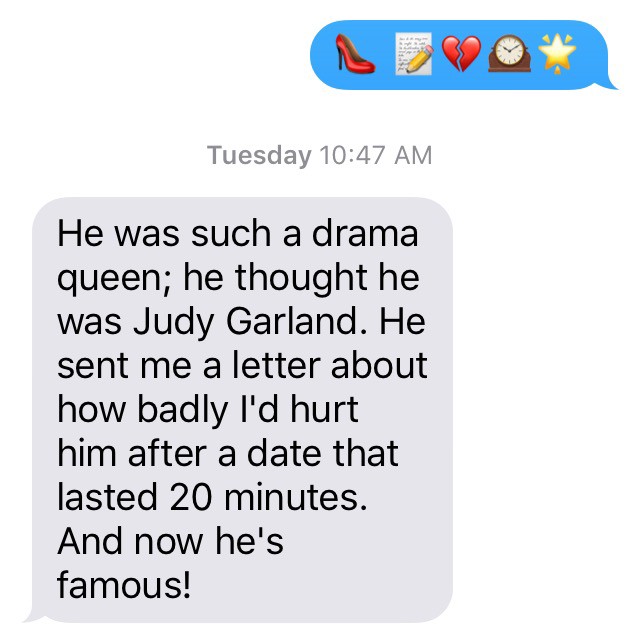
First, an origin story. In October of 2016, my friend John Bateman became obsessed with his iPhone. Of course, this did not make him unique. Specifically, he’d become fascinated with a new texting feature. Now, instead of just autosuggesting the word “bird,” your SMS also gave you the option of texting an emoji of a bird’s head!
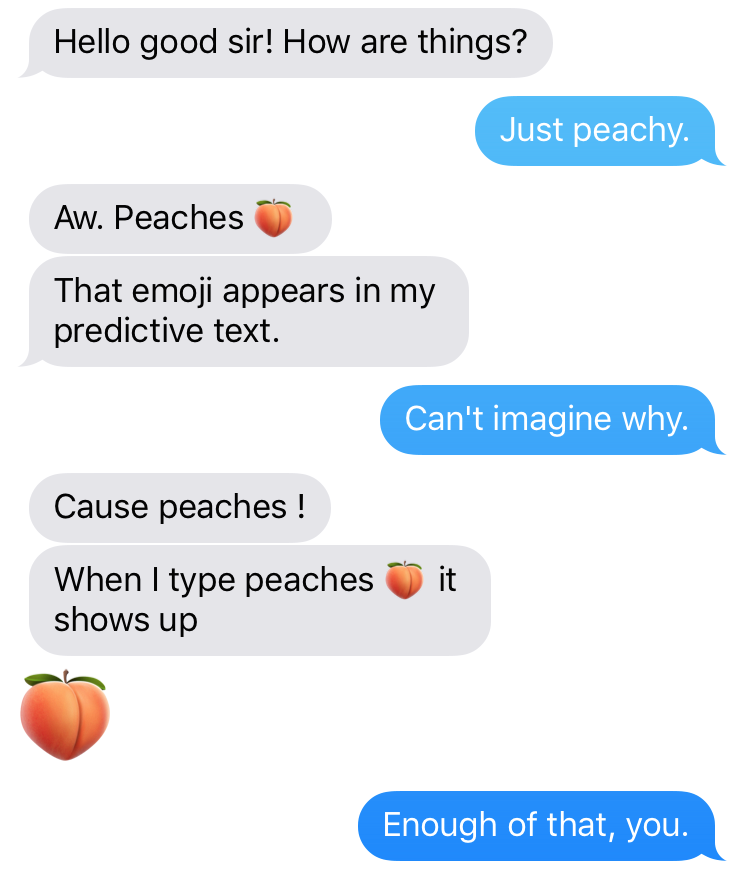
When I told John I was doing “just peachy,” he texted, “When I type peaches, it [Peach emoji] shows up,” and then sent a text of a giant peach. I wasn’t sure if John knew that sending a big peach emoji to someone was like showing them a butt, so I tried to discourage him, fearing a barrage of eggplants. This worked not at all. He texted me an apple! A cookie! A snake! A pile of books!
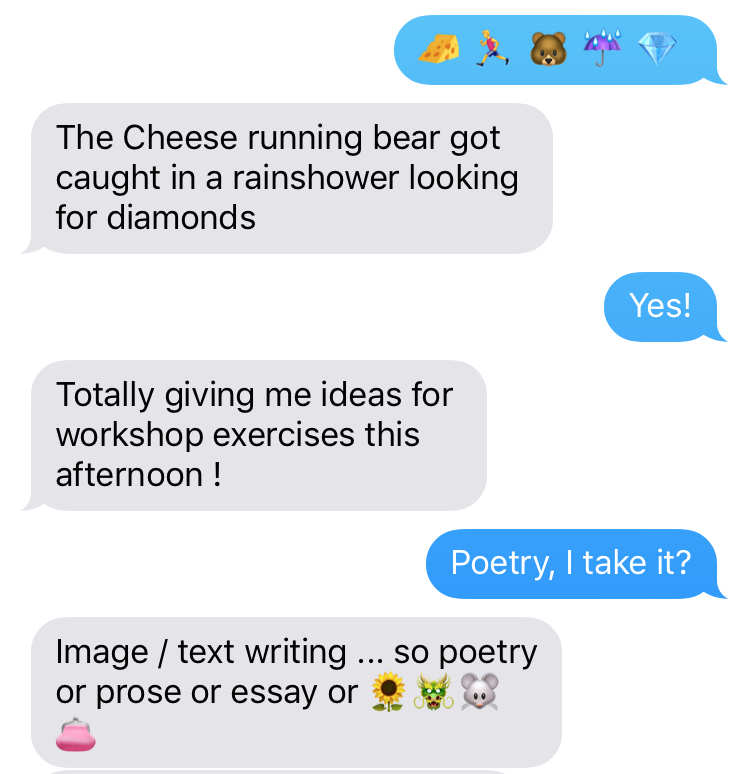
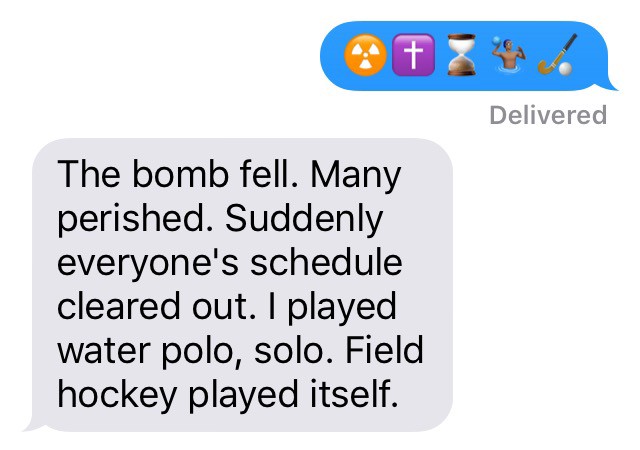
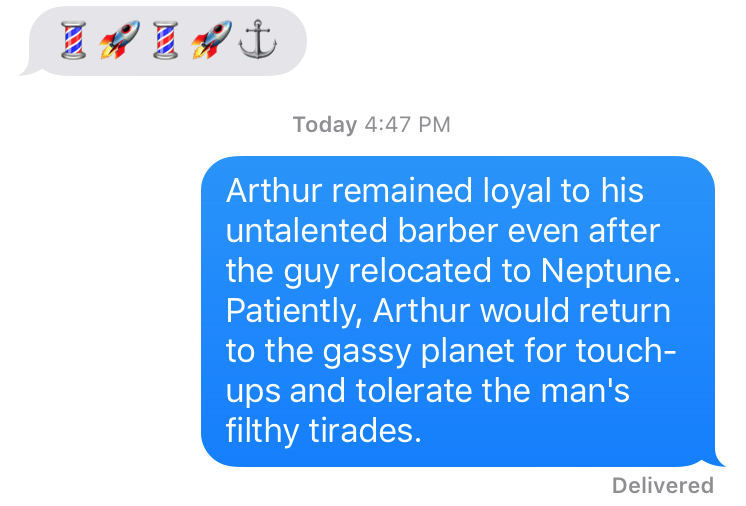
“This is kind of amazing” he wrote. I told him, “Knock yourself out,” and then sent a text consisting of a series of five emoji I had randomly discovered by typing in the words for them. John, who, like me, is a writer with an interest in the interplay of words and images, assumed I’d hidden a cryptic message in the random sequence of little pictures. “Write a package, spider earth cutting?” he asked. I only responded with five more random emoji. “The Cheese running bear got caught in a rainshower looking for diamonds,” he mused. And thus began a game that has continued to this day. One of us texts five random emoji to the other, and the recipient has to write a story (roughly of tweet length) to explain each of the emoji in order.
The cup, the gun, the doll, the cape, the button box and the scrap bag, the stick of candy savored and then gone, the carved shelf, the china shepherdess, the fiddle and its song, the story, the dress with blackberry buttons, the golden pin and the engagement ring, the new stove, the red mittens, the willow rocker, the string of Indian beads, the blue coat lined with swan skin, the butter churn and butter mold, the bullet mold and molten lead, the cow, the horses, the geese, the chickens, the kitten, the hand-knit lace, the shiny penny, the hay stick, the coffee grinder, the covered wagon, the sunbonnet swung by its strings.
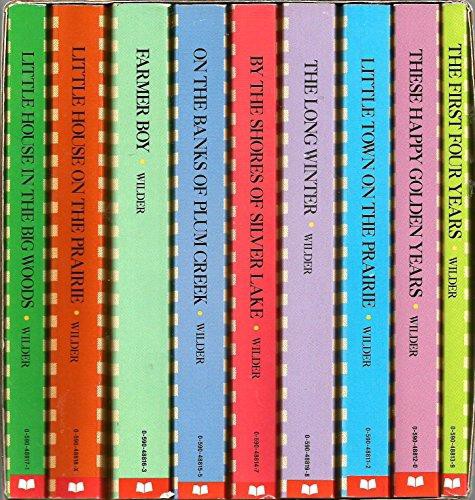
If you have read the Little House books, you recognize these things, the practical objects and the magical ones. Perhaps you, too, have coveted them, bought replicas in a gift shop, scoured Ebay, antique stores, and rummage sales for items like Carrie’s china dog, Laura’s glass box, or Ma’s thimble, then felt the connection spooling through the object straight home to the Little House. Perhaps like one historical archeologist, you have even allowed Laura’s “detailed, loving references to the family’s stuff” determine your choice of a career.
The Little House on the Prairie books
When I first read these books, I loved the practical objects and the activities they engendered. I wanted to churn butter and make my own rag doll, see a bullet made at an open hearth, prize new woolen mittens as a Christmas gift, rejoice as Laura did in receiving my very own tin cup for the very first time. I wanted to wrap myself in woolen veils to keep warm and wear layers of petticoats trimmed with lace I’d made myself. I wanted to grind wheat into flour and then bake it into bread, to dance to a fiddle tune. And I did do some of these things —baked rugelach with my grandmother Bertha, whose story of emigration from eastern Europe had always fascinated me, learned to knit, make jam, and square dance, sewed patches on my jeans if not the jeans themselves — as I searched for a more direct connection between what I consumed and what I produced, romanticized and idealized though that connection may have been. It was the 1970s, and even for a Manhattan teenager, the back-to-the-land movement had an allure.
I wanted to grind wheat into flour and then bake it into bread, to dance to a fiddle tune. It was the 1970s, and even for a Manhattan teenager, the back-to-the-land movement had an allure.
I longed for the pretty decorative things too — a golden bar pin etched with a little house, the gilt braid along the edge of a dark blue flannel dress, beads collected at an Indian camp and tied up in the corner of a handkerchief, Laura’s engagement ring and her oval glass bread plate saved from fire. I did not long for a single penny as Laura did, but I longed to long for one, longed to feel that in scarcity anything small and shiny would take on a special gleam.
Even the lovely and useless things were not magical, though. The magical things were so pleasurable that they could never be forgotten, so powerful and terrible that they could never be touched. Only these special objects magnetized my eyes. In Constructing the Little House: Gender, Culture, and Laura Ingalls Wilder, Ann Romines has called Laura’s longing for these objects a “transcendent desire.” The blackberry buttons on Aunt Docia’s dress, juicy enough to eat, the knick-knack shelf of vines, flowers, and stars carved by Pa, the china shepherdess always placed on that shelf, and Ma’s fine silk and wool delaine dress transported me, too: the object itself and the desire for that object coalesced into a tunnel or doorway or portkey and pulling me physically into the world of the books. These things are weighty — as Romine says, “heavy with stories.”
When Aunt Docia reappears, Laura recognizes her through the memory of those buttons, time-traveling back to the sugaring-off dance where she first saw and craved them. These magical objects push us, pull us, even as they command stillness and demand silence, a hand outstretched. Only Ma can touch the shepherdess. If Baby Carrie clutches her, she may shatter. If Laura tastes those blackberry buttons, she will find only jet or glass. (So long in mourning, Queen Victoria introduced the fashion of carved jet buttons; poorer folk would have mimicked her style with black glass). The knick-knack shelf’s carved vines, moon, and stars are traced by eye, not hand, and even Ma could be transformed into something “so rich and fine that Laura was afraid to touch her.”
I did not long for a single penny as Laura did, but I longed to long for one, longed to feel that in scarcity anything small and shiny would take on a special gleam.
The china shepherdess, most iconic of these iconic things, has a cameo in every book, described the same way each time — or nearly so, as if the hand of memory is turning the little figurine this way and that, as if narrator-Laura is saying “Oh yes, there were skirts,” then later, “Oh yes, the skirts were wide.” At first she’s a little china woman and then a little china shepherdess. At first she wears a china bonnet over her china curls. Her bonnet is never mentioned again, but her hair is often described — how it’s golden, how it’s curled. Her apron is pink right away; later, her cheeks are too. Her dress is laced across in front, and later those bodice laces tighten. Her little shoes are always gilt, but only later are her eyes called blue. Although Laura claims that the china shepherdess is always the same, smiling the same smile, her eyes as sweet as ever, her hair as bright as it was so long ago in the Big Woods, she changes and shifts in subtle ways. So static and solid, even so, she shimmers.
Through seven books, from the moment Pa places her upon the carved shelf in Little House in the Big Woods to the moment in These Happy Golden Years when Ma says their home is no longer a claim shanty but a real, four-room house, the china shepherdess is “the weird secret Ingalls signal that a house had become a home.” She gets packed away safely and taken out again when they have stopped moving, if only temporarily, and Ma has decided that they are no longer savages. She’s placed on the log cabin mantel in Indian Territory, in the board house Pa builds near Plum Creek, and finally in the claim-shanty-turned-farmhouse at Silver Lake but tellingly not in the Surveyor’s house which the family is only borrowing for the winter nor in the dugout where the family lives like muskrats rather than human beings, although Ma and the girls do their best to keep that earthen floor clean.
As Romines says, the shepherdess and the good dress, like the church newspapers she treasures, signify Ma’s hopes that her girls will grow up to be ladies, her belief in order and in God, and a lasting connection between her family and the whole civilized world she left behind when she followed Pa westward. I understand this, but for me, the china shepherdess and the blackberry buttons are not allegorical objects but magical ones (perhaps other Laura objects are magical for you). They serve no concrete purpose nor symbolic one. Instead, they are pure fascination and enchantment. Their force fields both attract and repel.
I find an image of blackberry buttons online, hoping to buy them although I’ll never sew them to a sweater or dress, but it turns out they’re dark red rather than black, plastic rather than glass. I learn about fine delaine cloth, and the probable make of Pa’s violin although I do not play. While the location of the original china shepherdess remains a mystery, one contender has turned up among Carrie’s belongings. Hurriedly I search for images of it on display in the Keystone South Dakota Historical Society, only to be disappointed as many others have been: photos show a faded little figure in gilt shoes and breeches, more courtier than shepherdess. A replica, available through the gift shop in DeSmet, is equally disappointing, despite the fact that it looks almost exactly as described in the books — perhaps because I know it’s not “the one.” This research is a grasping hand, but when it finally finds the objects, it turns out their magic depends on a constantly teasing desire that, once fulfilled, dissolves, like candy on the tongue. (Oh, how the Ingalls girls knew that saving their Christmas candy, parceling it out, would make it sweeter; oh, how they still couldn’t stop themselves from devouring it all at once. Ma knew something similar, parceling out those magazine stories to be read during the long winter.) And so I leave the ersatz objects behind and return to Laura’s words and images, objects themselves, their intense physicality, their magical aura.
A replica, available through the gift shop in DeSmet, is equally disappointing, despite the fact that it looks almost exactly as described in the books — perhaps because I know it’s not “the one.”
From my grandmother Bertha I mostly inherited costume jewelry — multi-colored clip-on earrings and gigantic cut glass brooches — and also a disintegrating wallet containing expired charge cards from Saks and Gimbels, postcards I’d sent her from my summer vacations, a bill for the upkeep of my grandfather’s grave. Only her shiny brass samovar was intriguing, the one thing that remained from her childhood in Russia. Its tall fluted urn sat in her home and then in my parents’. Dusting it, I marveled at the scrolled handles and spout, the chimney on which to warm the tea pot. I imagined my ancestors sipping tea through a sugar cube held between their teeth or drinking tea into which a spoonful of jam had been stirred, a foreign and glamorous custom.
After my parents both died, the samovar finally came to me, but in the years since, I have not unpacked it, despite its fairy tale promise, fearing that when I open the box and remove the crumpled newspaper, I will find only tarnished metal. No time machine, no repository of stories flowing as freely as hot water used to flow from its spout. I suspect that touching it will not magically allow me to remember more about Bertha or improve the memories of the two elderly women still alive who actually knew her.
Family stories leak into the world: instruction, entertainment, warning, history, savior, and sanctuary. Treasured and preserved, returned to again and again, they can themselves become magical objects.
Family stories leak into the world: instruction, entertainment, warning, history, savior, and sanctuary. Treasured and preserved, returned to again and again, they can themselves become magical objects. The Ingalls girls valued Pa’s tales so highly that the very last thing Baby Sister Grace did before Mary went off to The College for the Blind was beg to sit in her lap and hear the story of Grandpa and the panther one last time. Laura loved Pa’s fiddle tunes, and he ceremoniously left this instrument to her even though she didn’t play, but when he was gone, she missed the music, not the instrument. His stories about bears and panthers, about naughty children trying to escape the confines of a Sunday afternoon, and perhaps about Laura’s own childhood were never forgotten, she said, and “to[o] good to be altogether lost,” the most important inheritance.
The stories about my grandmother have themselves become talismanic, inscribed on my heart. They have taken on the apocryphal nature of the stories about saints. How she was a runner for the failed 1905 Communist revolution in Belarus. How she listened at the window to learn her brothers’ lessons and yearned for an education. How she came to America, alone, when she was twelve. How she escaped the Triangle Fire and started a union. I turn to these stories in times of distress, as if repeating them will bring good luck or strength, fortitude or vision; her actions serve as omen or oracle; the retelling of tales, an incantation.
DON’T MISS OUT
Sign up for our newsletter to get submission announcements and stay on top of our best work.
YOUR INBOX IS LIT
Enjoy strange, diverting work from The Commuter on Mondays, absorbing fiction from Recommended Reading on Wednesdays, and a roundup of our best work of the week on Fridays. Personalize your subscription preferences here.