On Monday night, National Book Award-winning novelist Jonathan Franzen competed on Jeopardy as part of the gameshow’s “Power Players Week,” a variation on “Celebrity Jeopardy” in which well-known journalists and politicians play for charities of their choice. Although he led going into Final Jeopardy, Franzen, playing for the American Bird Conservancy, wagered too much, answered wrong, and finished second.
An avid birder who has described bird watching as a religion, Franzen dominated the show’s “Birds” category and also nailed questions about quadriceps, sea levels in the Middle East, and the Detroit Free Press. It was nice, though, to see that even Jonathan Franzen doesn’t know all the answers. Along with the other contestants — Chuck Todd from Meet the Press and political commentator S.E. Cupp, who won — Franzen failed to answer the Final Jeopardy question correctly. Perhaps a little more embarrassingly, Franzen also missed questions about two of Shakespeare’s plays, The Taming of the Shrew and The Winter’s Tale.
When Franzen flubbed the Shakespeare questions, he behaved like an English major who’s stumped by a literary question at trivia night. Grimacing, he said, “Oh, God, I should know this,” and ducked behind his podium while Chuck Todd teased, “Glad the novelist missed that!” Similarly, when Franzen answered, “non” to the Final Jeopardy question (“Officials called Tribunes sat at Rome’s senate door and if they didn’t like what was going on, shouted this Latin word”) instead of “veto,” he smacked himself in the head.
Franzen’s wrong answers were probably more valuable for his image than his correct ones. As TIMEpoints out, the author’s public mistakes on Jeopardy — and his goofy reactions to them — painted a “humanizing portrait” that might help dispel his reputation for being a difficult curmudgeon. Although he sounded like the same old Franzen when he talked about the evils of Twitter at the start of the show, he was endearingly nervous in his pre-show interview. “It’s kind of a nightmare come true for me to be here,” Franzen admitted. “I’m not sure I’ve literally had nightmares of failing on Jeopardy, but it’s the kind of thing I would have a nightmare about.”
The following story was chosen by T.C. Boyle as the winner of the 2016 Stella Kupferberg Memorial Short Story Prize. The prize is awarded annually by Selected Shorts and a guest author judge. The winning entry receives $1000 and their work is performed live at a Selected Shorts show in Manhattan.
The winning entry receives $1000 and their work is performed live at a Selected Shorts show in Manhattan. “Head Over Knees” by Eric Schlich will be read at Symphony Space on May 25th, as part of an evening of stories inspired by the Twilight Zone, hosted by Robert Sean Leonard. Find out more about the event here.
Head Over Knees by Eric Schlich
In seventh grade, on the bus ride home from school, I heard what happened to the Stokleys. How late Friday night the oldest Stokley son, Jared, had driven home from a movie he’d seen with friends and parked the family van in the garage. Jared Stokley was sixteen, he’d just gotten his license. He was a careful driver. Hands on ten and two, mirror checks, all that. His parents trusted him to knock on their bedroom door to let them know he was back, safe and sound.
Which Jared did. He knocked on their door, tip-toed over, and kissed his mother goodnight. Maybe she turned on a lamp. Maybe he sat on the end of their bed and told them about the movie. After, he stumbled down the hall and crashed in his own bed.
Meanwhile, the Stokley van was running, running, running, filling the garage, the kitchen, the living room, and three bedrooms with carbon monoxide. Jared had filled the van’s near empty tank like his father asked him to. The van ran all night, killing the Stokleys in their sleep.
Kyle Stokley, Jared’s brother, was in my grade. He used to have sleep-overs at his house. The Stokleys had a finished basement, complete with pool, foosball, and air hockey tables. I was never invited. Maybe this was why the first thing I thought, the first thing I felt, when I heard the news that he was dead, they all were, was — good.
I didn’t say it out loud. What came out was — Oh.
Everyone had a theory about how it happened.
“He was drunk or high or some shit.”
“Maybe he had a girl. You know, they were making out in the backseat and…”
“No, man. He did it on purpose.”.
The bus came to my stop. When I got off — I don’t know why — I was running. I ran to my house like an idiot. Backpack thumping. Stitch in my side. I wanted to see my house. I wanted to see my parents in my house. But when I got there, I just stood in the driveway, heaving. I put my hands on my knees before remembering it was better to put them on your head. A counselor at summer camp had told me this.
Two campers at a time were made to chase each other around a circle on the gymnasium floor. My opponent, Ryan, and I were too closely matched. I wasn’t counting, but it felt like we’d gone around at least fifty times without either of us gaining. The other campers cheered us on.
“Craig’s got the legs!” the counselor yelled.
“Yeah, but Ryan’s got the speed.”
I don’t know if it was Kyle Stokley who said it. Might as well have been. The point is they were rooting against me. I lost heart. Ryan caught me.
High-fives all around. I couldn’t breathe.
“Hands on head.” The counselor lifted me up from my knees.
A car honked from the street. It was my dad, home from work. He pulled in the drive behind me. I was standing in his spot. He rolled down his window.
“Craig?” he said. “You okay?”
I moved out of his way. He parked. An Elton John song was playing on the radio. The car idled in the drive. My father waited for the song to end. This was a habit of his. He once made me sit in the car until Don McLean’s “American Pie” finished. That song is ten minutes long.
Our house does not have a garage.
This is what I have always thought happened to Jared Stokley. He pulled the van in, parked, closed the garage door. A song was playing. A good one. He sat listening to it. Maybe he snapped off his seatbelt. Maybe he drifted off for a second. Maybe he sang along. The song ended. He got out of the car. He went to bed. He died.
Who cares what the Stokley basement looked like? Who cares?
I did. At one point, it was all I could think about. I could see it. Flat-screen TV. Black leather couches. Those bar stools with the swivel seat. Dart board, liquor cabinet. I could see it so well, so clearly, it was like I’d been there myself.
Eric Schlichis a PhD candidate in fiction and Kingsbury Fellow at Florida State University. He is the Nonfiction and Production Editor for The Southeast Review. He earned his MFA in fiction at Bowling Green State University, where he was the Assistant Fiction Editor for Mid-American Review. Born and raised in Lexington, Kentucky, Schlich completed a BA in English and Spanish at the University of Kentucky.
Dedicated to the writers Amin Chehelnabi and Noah Keller
During the second half of the war, a cicada famously became regarded as the singer in possession of the most inspiring, most thunderous voice in either of the Canal or Butte camp divisions. Margaret Morri, as she became known, was the prized possession of Mieko Morri, the teenaged daughter to Yohiji Morri and Brownie Onitsuka. Prior to relocation, the Morri and Onitsuka families had made their livings in the orchards of the Stanislaus Valley carrying picking crates beneath branches bearing white and yellow peaches. When they were moved to Gila River, the Morris maintained one of Canal Camp’s vegetable gardens, and they packed mason jars of chopped cucumbers, carrots, cabbages, and turnips in a pickling broth of sugar, vinegar, and hot pepper to be sold at their neighborhood canteen. After the war, Mieko would own and operate the Morri and Onitsuka Farms Tsukemono Stand, all its labels bearing the insignia of a small group of trees and a luminous green-black cicada sailing over them.
When Mieko tells the story of how she and Margaret came together, it begins in 1942, just after nightfall in the Tulare Assembly Center, on a dirt pathway between the racetrack and the Morri family barrack. In the absence of overhead lighting, Mieko could not fully make out Margaret’s form. But there was the intermittent flash of cicada wings as they appeared to catch and retain moonlight in short bursts. She knew instantly she was in the presence of a rare cicada, because the songs resonating behind those wings were not in the key of any standard belligerent chirp. They were instead songs comprised of sustained and mournful notes. Mieko had studied music since girlhood, and friends referred to her as the “Thief of Lips” because if set before a piano, she could reproduce thousands of melodies she had heard hummed on a single occasion. Mieko followed the cicada song for what felt twice the regular distance of the path leading her into the light of her doorway. It was there Mieko found Margaret Morri perched atop the barrack’s wooden handrail.
She was the most enormous cicada Mieko had ever seen. Too much animal to fit comfortably in just one of her hands and armored with mesothoracic plates that resembled hide shields constructed for warfare, painted in a manner to be equal parts mesmerizing and terrifying. When Mieko tells the story, she concludes with this wonderment. Mieko describes the way she fell into sleep that night with Margaret Morri whirring in the blackness above her cot. To this day she never approaches sleep without hearing that sound.
On the morning following their union, Mieko discovered that during the course of the night, three people had been attacked by scorpions, all along the same dirt road leading away from the racetrack. The two who had been most severely envenomed were a married couple from Santa Maria, Mitt and Columbus Okawa. The other recovering patient was Kunio Itami, the barber from Turlock who cut her father’s hair monthly. Mieko arranged three sets of flowers, California jewelflower, Kern mallow, and larkspur, tied them in abandoned sheets of newsprint, and delivered them to Tulare Center’s hospital barracks. During her visit, Mitt, Columbus, and Kunio advised Mieko to treat her bond with Margaret Morri with the utmost respect.
“It is very peculiar for female cicadas to sing or to become attached to young people,” Kunio said. “It is usually the business of males. This can only be the most unique of circumstances. There is the strong possibility you and Margaret are members of the same bloodline. Did you have an uncle or aunt recently pass? It is possible a spirit has returned to protect you.”
Mieko named her cicada “Margaret Morri” after her only sibling who had died in infancy following a severe fever. Despite Brownie’s efforts, Margaret Morri’s headstone in the Turlock cemetery always overgrew with wood sorrel, and though the sourgrass was less common in Tulare, Mieko twice observed her cicada carrying a stem of it between her jaws. In August of 1942, Mieko transported Margaret Morri in a hatbox lined with fresh white sage, chamise blossoms, and her father’s silk handkerchiefs on the train from the Tulare Assembly Center to the Gila River Relocation Camp. The journey lasted four stifling days and four restless nights. There was no chance for bathing, and passengers filled blouses, trousers, and dress coats with their daily sweat. An earthy musk, a scent like sour flowers thickened the air. In cars that held newborns and infirmed were the acrid smells of urine and infection. Military police ordered every window blinded. There was fear that if locals observed a procession of trains transporting Japs, some would fetch rifles and fire at the cars. Mieko occupied her time by whispering songs into the hatbox and replenishing Margaret Morri’s bottle cap of cool water from her canteen.
In the Canal division where the Morri family was relocated, Margaret lived atop a small, richly embroidered throw pillow on a dresser beside Mieko’s cot. At night, Mieko transported the pillow to a desk beneath a barrack window so that Margaret was allowed to fly out, feast on tree sap, or flex the full power of her tymbals. The branches of the pinyon pine near their window became inhabited by an inordinate population of non-singing cicadas, and Mieko often wondered how many evenings Margaret Morri slipped out to seduce a mate.
Though the properties of the cicada’s song were common knowledge amongst older generations, it was months before Yoshikane Araki, Canal Camp’s resident hemipterologist, explained them to Mieko Morri. The first note of the cicada was said to be low and sustained, similar to a stroke of sandpaper moving across a long plank of wood. The first note would always be repeated, like a twin voice being squeezed back and forth from the bellows of an accordion.
The second note would be fibrous and staccato, not unlike when a vegetable-fiber brush is taken rigorously to a sink crowded with mussels. And the third was a shattering sound, like that of the mussels being emptied into a high, metal stockpot.
The fourth note was said to be the loudest of the cicada’s rattles, stirring and escalating its energy, before releasing into a fit of tiny hacks, the same as a broom full of grit being knocked against the floor planks.
Following the fourth note, the corrugated tymbals of the cicada were said to have buckled and relaxed, the song relocated to the abdomen where the cicada could produce its most complex notes. This was the home of the fifth and penultimate note, which most resembled the high-pitched wail of warm-blooded creatures. The song becoming battered against the inner walls of the abdomen, trilling, shivering. Spitting the breath past the cicada’s churning pool of acid, its tears and tree sap.
The sixth note of the cicada was the most highly debated among entomologists. It was said to occur when the song reached the last chamber of the tracheae. Hemipterologists and some orthopterists referred to the last chamber as its “terminating chamber.” But scholars of myth called it “the ghost chamber,” because while all cicadas bore it structurally, very few possessed the size, health, and strength to open it and produce the final note. The book explained human ears could not detect the sixth note consciously. But conscious or not, it was the sixth note that could produce inexplicable behaviors in people and other creatures including blindness, fever, amnesia, and madness. Songs utilizing the sixth note were also reputed to be able to be able to cure minor ailments and to ward off bad dreams.
At the end of their first winter in Gila River, Mieko began to become inundated with offers to buy or trade for Margaret Morri. Rumors circulated Canal Camp that the songs of the Morri cicada were endowed with powerful healing abilities. May Joyce Okada, a chronic insomniac, claimed that the nights she heard Margaret sing, she slept and dreamt easily. Canal’s eldest couple, Takashi and Shiori Oda, claimed when listening to Margaret Morri’s night songs, the arthritis in their wrists, hands, and knees disappeared. A neighbor, Ren Horibe, admitted to Yohiji Morri that due to an accident, he occasionally suffered from impotence. But on nights Margaret Morri’s song drifted between the barrack partition, his erections were firm, sensitive, and abiding.
The visitations of Canal residents were a daily affair for the Morris. Hulking billfolds of cash, jewelry, seashells, watches, clocks, dresses, hats, watercolors, and musical instruments were offered in exchange for Margaret Morri. Those without money or valuables offered to trade labor or tutelage. Keiko Hattori, the acclaimed ikebana artist from Kumamoto, was prepared to mentor Mieko in arrangements of petrified leaves, bones, pebbles, berries, seed pods, and the scooped-out carapaces of beetles. Tadanobu Gennosuke, the most skilled carpenter from Turlock, claimed he could construct a multi-level basement beneath the Morri barrack where, even during the harshest months, temperatures wouldn’t rise above seventy degrees. Yuki Funatsu offered to make Mieko her only student and recipient to over 60 years koto expertise. Minoru Fukami promised he would cast Mieko and her family members in any Gila River Kabuki production they wished. Manju, dried figs, cactus pears, and smuggled whiskey appeared on the Morri doorstep along with notes requesting an hour or two with the most famous songstress in camp.
When the offers to purchase Margaret Morri became more insistent, more confrontational, and Mieko began turning visitors away, the voices around Canal camp turned hostile.
“Why is it only the Morris who enjoy the company of the cicada?” their neighbors asked. “Isn’t a creature like this a gift from God? Was Margaret Morri not delivered to this desert for all of us?”
“You are monopolizing the time and energy of your cicada,” Mieko’s aunts complained. “You are a healthy, teenage girl. There are sick and aging people in camp who deserve her attention. Let us manage the cicada’s time for you. We promise there will be some profit in it for your parents.”
Mieko’s uncle, a man called Glenn L. Morri, claimed he could purchase homes and farmland for the Morri families in several Midwestern states should he be allowed to barter the services of the wondrous cicada.
“I know a wealthy hakujin whose son is deathly sick,” Glenn Morri said. “This man is willing to pay any amount for a cure. Should Margaret Morri’s songs provide even the slightest improvements to this boy’s condition, we may yield a reward of unimaginable size.”
“If you are in communication with the man,” Mieko responded, “you can tell him to bring his son to camp. It might be the will of the gods that he is cured for nothing. But I will never choose to part with Margaret Morri. My life is indebted to her and so I must serve her until she releases me from our partnership.”
“You mannerless, idiot girl!” Glenn Morri exclaimed. “You do not suggest a man of this esteem visits these desert barracks! The cicada must be taken to him directly for a demonstration.”
Yohiji had to forcibly remove Glen Morri from their barrack, and it took an intervention by Canal Camp’s police to stop his hammering upon their door.
“The creature upon your daughter’s embroidered pillow is holding an opportunity to transform our family’s prospects for generations!” he called out. “And you are pissing it all away!” Stories attempting to disparage Mieko Morri also began to surface. In the mess hall, Mieko was shocked when she heard people she had never met vilifying her. The name Mieko lathered thickly upon their tongues with poison and enmity.
“There is a snotty teenager called Mieko Morri who keeps a rare cicada tied up and in a cage,” she overheard someone say. “When she wants the cicada to sing, she threatens it with fire and dismemberment. And only after the song does she allow it to eat some thin broth and stale, tasteless crumbs.”
Mieko endeavored not to let these rumors intimidate her. Any offers that came her way she responded to by saying Margaret Morri did not belong to her. Margaret spent her days on a pillow by an open window. And if she ever wished to live with another person, she would make no attempt to prevent it. Near dusk, Canal internees came with folding chairs and beach blankets to sit and listen to the cicada songs emanating from Mieko’s window. A small party of pregnant women was invited to sit within Mieko’s nook of the family barrack, share handfuls of dried fruit and nuts, voice concerns over oblivious husbands and rub their expanding bellies. These women kept eyes upon Margaret Morri’s pillow and claimed the music of this cicada was a cure-all for the discomforts of pregnancy, including leg cramps, back aches, pelvic pain, morning sickness, swelling, and heartburn.
In spring of 1943, Mieko began arranging concerts of sorts for Margaret Morri. From the hours between dinner and nightfall, Mieko transported Margaret’s throw pillow to a makeshift stage in one of Canal’s recreation barracks. People set down mats at the foot of the stage where they shared caramels and other sweets while they listened. On some occasions it seemed Margaret did not produce any music at all. But those became her most renowned performances, as attendees claimed those were the occasions songs of the sixth note were played. Canal’s longing for Margaret Morri was evident. Some evenings when she fluttered in later than expected, her audience erupted into applause.
In place of monetary gifts, attendees placed popular records into Mieko’s hands. These included albums by Mills Brothers, Billie Holiday, The Song Spinners, The Ink Spots, Ella Fitzgerald. Some evenings Mieko played the records before Margaret Morri appeared, and those present sang together or danced. By the end of their second year in Gila River, the concerts of Margaret Morri were drawing crowds of hundreds of Canal and Butte residents. Despite the frequent gatherings, medical barracks in both camps reported significantly lower rates of communicable diseases as well as asthma, pneumonia, insomnia, rashes, chronic dehydration, and dysentery.
It was in the autumn of 1944 that Glenn Morri plotted to kidnap and sell Margaret Morri. Not everything is known about the confrontation that occurred between Glenn and Mieko. When interviewed by camp police about the incident, Mieko stated her uncle approached her beside her family’s garden just after nightfall and asked that she and Margaret Morri accompany him back toward Canal’s recreation barrack. As she walked past him, she was struck at the back of the skull by something broad and solid, perhaps a rock.
Mieko was unable to raise her hands to brace her fall. Her face cracked against the dirt before her, and for a moment she lost consciousness. When Mieko opened her eyes, she was flat against the ground. She could sense something hot and metallic in her mouth and saw her front teeth lying amongst the stones before her. She saw her uncle had cast a mesh netting over Margaret Morri and was attempting to stuff her into a gunny sack. Mieko rose and threw herself, shoulder-first, against him. He struck her twice more in the face. When her uncle leaned in to grasp Mieko by the hair, she took the opportunity to stab him twice in the groin and once in the foot with her penknife. The two of them fell back together, but she was first to her knees. She grasped a flat stone nearby and with all her weight, came down with it upon his hand, smashing all his fingers. While her uncle screamed nearby, Mieko untangled Margaret Morri.
Mieko’s claims following the moment after Margaret’s liberation appear on no official record. The only written accounts appeared in the private journals of camp authorities. Mieko claimed that as her uncle rose to charge her again, the air grew heavy and crowded with vibrations. And then came the overwhelming sound of thrashing rattles, and the space between them swarmed with cicadas. The air so crowded with noise and motion her uncle fell to his knees and began screaming. Mieko claimed there must have been ten thousand cicadas that interrupted their confrontation. Mieko ran into a neighbor’s barrack where camp police were alerted.
A more rigorous military investigation was never commissioned. Glenn L. Morri was discovered the morning after the incident at an offsite medical facility where he was being treated for various ailments. These included self-inflicted scratches, ruptured eardrums, disorientation. The official determination of his death was suffocation. From his autopsy report, it was noted that Glenn L. Morri had gone to sleep looking much improved than when first admitted. But when the first morning shift arrived to examine him, his mouth and throat were found packed with no less than two dozen live cicadas. Margaret Morri herself was the deepest embedded of them all. The records imply that considerable mutilation of Glenn Morri’s chest and throat was required to extract the colossal cicada, still moving within him.
PEN America hosted their annual Literary Gala beneath the iconic blue whale at the American Museum of Natural History in New York Monday night. During the black tie affair, figures such as Harry Potter creator J.K. Rowling were honored, and PEN President Andrew Solomon delivered the soiree’s opening remarks by announcing that this was PEN’s biggest gala to date, having far exceed their own goal and raised over $1.75 million.
Pulitzer Prize-winning author, Donna Tartt, presented the Publisher Honoree award to friend, editor, and Hachette CEO Michael Pietsch. While accepting, Pietsch shared a heartfelt message to his publishing colleagues, “All over the world, writers are living in peril… Let us be brave, but not too safe. Let’s publish wild voices, diverse voices.”
Lee-Anne Walters and Dr. Hanna-Attisha — the critical voices that exposed the lead poisoning water crisis in Flint, Michigan — were the 2016 recipients of the Toni and James C. Goodale Freedom of Expression Courage Award, succeeding the Charlie Hebdo staff in 2015. The room collectively welcomed them with the only standing ovation of the night.
J.K. Rowling accepting the Literary Service Award
Though it was clear — not only from the buzz in the room and the young children seated next to parents in tuxes and gowns, but from every speaker’s personal anecdotes — that guests came to hear, albeit briefly, the author who captured readers with the wizarding world of Harry Potter. In her introduction, actress and producer Sarah Jessica Parker said, “Books are magic,” and also referenced Rowling’s famed Twitter account. Moments later, Rowling accepted the Allen Foundation Literary Service Award and stood at the podium delivering some of the mightiest lines of the evening, including thoughts on freedom of speech and Republican presidential nominee Donald Trump: “Now I find almost everything that Mr. Trump says objectionable. I consider him offensive and bigoted, but he has my full support to come to my country and be offensive and bigoted there. His freedom to speak protects my freedom to call him a bigot.” Several in the audience greeted her address with applause and laughs.
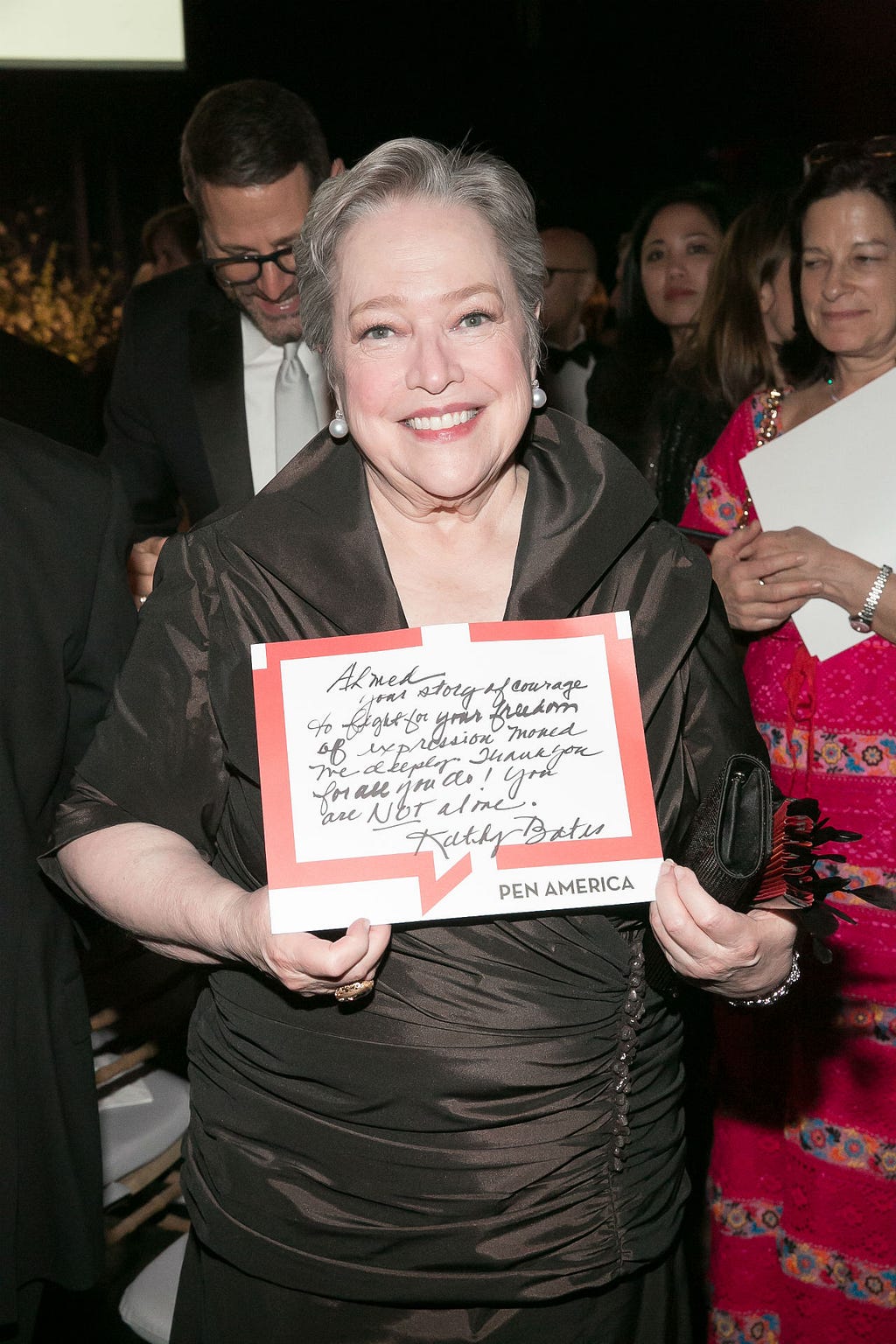
Actor Kathy Bates
PEN America Executive Director Suzanne Nossel closed the evening by presenting the Barbey Freedom to Write Award to jailed Egyptian novelist Ahmed Naji — who in 2015 was charged with “violating public modesty” after a private citizen complained of heart palpitations due to sexual content in Naji’s novel The Use of Life. After Najis’s brother accepted the award on his behalf, Nossel requested that those in attendance write notes of encouragement for Naji, stressing that PEN’s hopes are that the Barbey Freedom to Write Award will spur writers, readers, advocates, and world leaders to press Egypt to release Naji immediately and stop treating creativity as a crime.
— Photographs courtesy of PEN America, by Beowulf Sheehan
I met Rivka Galchen on the first day of Jaime Manrique’s writing workshop. I realized she had extended the sleeves of a too-short sweatshirt by sewing the cuffs from a men’s dress shirt into them and decided I had to make friends with someone that cool. Since then she has published the novel Atmospheric Disturbances, the story collection American Innovations, and numerous articles in the The New Yorker, Harpers and elsewhere. Her new book, Little Labors, is out from New Directions today.
David Gordon: The title is of course a clever play on the labor of giving birth to a little one, as well as the offering of small works: but it also reminds me of Adorno’s Minima Moralia, which itself has a double-meaning: Little Fables and, one might say, Minimal Morals. How much if any of this did you intend? And how does that work relate to yours?
Rivka Galchen: This was definitely the least ‘intentional’ work I have ever written, it literally evaded my original intention, of writing a straightforward essay about The Tale of Genji and The Pillow Book. Michael Barron who was at New Directions then had invited me to try to do something for their Pearl series and that was my idea. I don’t know why I thought the right title for that book, which wasn’t going to have much of anything about babies in it, was “Little Labors.” I mean, I do know, I thought I was very attached to the description of women’s writing in Japan in that time period being described as work written in the ‘little hand’ or ‘the woman’s hand’ which is to say, in Japanese, rather than in the language of power at the time, Chinese. That said, if my normal conscious controlling self is the power, then the book ended up being a series of tiny resistances. And I of course owe the presence of those Little Fables to you! I first read Minima Moralia with you, and I think part of our early friendship grew out of finding we underlined the same things, and laughed at the same bits.
DG: Yes! I especially remember us both loving his description of children playing, which I took as a kind of secret epigram to this book: “Unconsciously they rehearse the right life.” You just mentioned The Pillow Book and Tales of Genji — which are discussed at length in Little Labors, but really the Japanese connection seems to run everywhere though this text, from the 47 Ronin to the mean neighbor who just happens to be Japanese. Can you talk about your love of those books, and Japanese culture generally?
RG: There’s something embarrassing (and ethically troubling) about being enamored of another culture, all the more so in this case given that I don’t even speak Japanese. But, I don’t know! I used to love the stamps from Japan that would come in the mail to my father, a scientist. Also we had a few items in the house, presents from Japanese students, and these scrolls and bowls were so magic-drenched for me. And then, when I was in elementary school, they were building a Subaru factory near my hometown of Norman, Oklahoma and we did a special study section in school, on Japanese culture, the idea being — I’m guessing here — that we children could then better welcome the young Japanese immigrants we expected would come over with their Subaru executive parents. We learned about seaweed, origami, maybe other more straightforwardly substantive things as well… but the kids never came! Anyhow, I see now that I haven’t talked about the books yet….
DG: Do you imagine your daughter someday reading this book? Was it in any way addressed to her?
RG: She’s such a different animal now then she was then. The book was written while she was still the size of a human that is at once more predictable than bigger humans, but still more mysterious and alien. So, I think the book was maybe addressed to her, or had a future her in mind, but not because it would be able to tell her something specific, more like…a collection of leaves gathered in the year of her birth and pressed into a book? Not that I ever press leaves or flowers in books, but I remember that when I was a kid and would find pressed flowers in the books at friends’ houses, they seemed so telling! But telling of what, I don’t know.
DG: It seems to me you wrote this book in something like real time, reflecting on these early months of your child’s life while living them. Can you talk about that process?
RG: Many of the bits in the book are, literally, only slightly tidied up from small notes I made to myself in the first year of her life. I didn’t actually get the notes all assembled together and turn them in to New Directions as if they were a book until nearly a year later, but that was the process, which is definitely not my normal ‘process.’
DG: I wish the term “voice” didn’t have such an over-determined literary meaning, because I want to say how much this book “sounds” like you. Of course, all your work carries your voice, like your DNA, but I find that, unfiltered through a character or even the objective pose of the reporter, this feels remarkably like just talking to you. Did you feel that writing?
RG: Usually I don’t mind forgetting large expanses of my experience, but when I saw a note to myself about how I was reading from the newspaper to Georgie, and I read the word ‘phenomenon’ and she then interrupted to say, “Mana mana?” (from the Muppets short that we have watched together so many times) — well I had forgotten that by the time I read the note. And that tiny note didn’t go into the book, of course, because it fell on the side of Notes Really Just Interesting To Me, but I tried to keep notes in a way that I never have in my life before, as someone with a strong aversion to keeping a journal. And so maybe that’s why it sounds more like conversation, in the way that conversation with a friend is so often like the reporting of the random relatively unconsidered thought that just crossed one’s mind, like trading and reacting to each other’s trailing thoughts, being happy chatting regardless of whether the thoughts fizzle or grow.
DG: Actually, until just recently, I did think the Muppets were saying ‘phenomenon!” But following on the notational process you described, this book does seem to have a unique, organic form of its own. How did you arrive at it?
RG: I originally turned in an almost no space-breaks long associative essay that resembled most, I would say, the cramped handwritten notes sent to planetariums and other sorts of authoritative institutions, notes you can tell the writer feels bear an important message, but that are basically unreadable, no message gets across. It was a crazy compost heap, according to not only myself. So then I let time pass. And then, one week I finally was like, I have this energy. I feel like I have the energy to do this and I think I know how to do it. And then the whole book came together, from accumulated notes, and even from the old compost heap, pretty quickly.
DG: You also describe the difficulty of working, and even thinking, with a newborn, frustrating for anyone, especially perhaps a writer, used to grown-up intellectual activity. But you also say that being stranded in the present actually lifted your habitual melancholy and re-enchanted the everyday. This feels very much like the texture of this book itself.
RG: I don’t think I’m alone in somehow deploying sadness as a way to be isolated and just wander around in my own thoughts, a somewhat useful way to get words on the page, but also a sort of unpleasant way to live. It also leads one to the depressive delusion — albeit also truth — that, How can I even take human life — let alone whatever thing I’m working on — seriously, it all being this blip in the cosmos? Then a baby: it’s just like every self-help book says, once you’re not thinking, once you’re mostly doing, you’re relieved of the anxiety and melancholy, which is just a habit of mind. Or, at least, partly just a habit. The clouds shift somewhat.
DG: You say it matters that both Pillow Book and Genji were written by women. Can you say a bit more about why? I think of the fact that Genji is sometimes considered the first novel, or at least the first “classic,” which makes me think of the history of the novel as a “female form,” considered light women’s reading through to Flaubert. I wonder how this fits with the more recent view that it is a patriarchal or male-gazey form?
RG: I like what you said! I do think the novel, most often, is about what can be done with “lightness” and “smallness” and “diversion.” A lot can be done with those things, it turns out. And in terms of the novel being a female versus male form… obviously it’s shape-shift-y enough to accommodate any description of it, but I do think there’s something to what you once observed to me, about how cooking and making clothing were refined art forms always, or could be, and then it was just necessary, historically, for a man to become interested in those arts for them to begin to gain recognition as, well, arts? That said, part of the power of the novel is, I think, that it can move from gaze to gaze, with so much nuance that it always has more than its own voice’s perspective. Ideally, anyhow.
DG: You also have a very illuminating section on “women writers.” I love your story about thinking Denis Johnson was a woman — my version of that was Evelyn Waugh. To me, the very term “women writers” is suspect. If you need to clear up the gender of Denis or Evelyn, you say they are “male writers,” making “female writer,” the proper descriptive. So what does “women writers” mean to you? Did a certain definition of “femininity” make your instinctive alliance with male writers a kind of rebellion, and as such a paradoxically feminist move?
RG: Again, I like your read on it! I don’t know. In some imaginary ideal world, there would seem to be as much difference between one male writer and another, one female writer and another, that the gender of the writer would just be one, occasionally illuminating but not always illuminating, way of categorizing a work. And like you suggest, I don’t think it’s difficult to imagine that a young woman — me, I guess — might instinctively try to keep a distance from what has been categorized as feminine, Even as keeping a distance is just as flawed a strategy for being feminine as following the presented path for being feminine. That’s a slightly different issue from reading, from what we read, but they get easily tangled when you’re just a young person stumbling in search of finding out what all this stuff is that we’re told is great and which often is great.
DG: You pass into some dark territory when you note that having a child means that death or suicide is (theoretically) no longer an option: one is sentenced to life as a parent. I wonder if you could speak more about writing about motherhood, a subject that might resist the ambiguity that serious writing requires.
RG: Well, in that funny way, I felt like there was something intellectually compromised about not being totally bored by motherhood. In my tiny demographic, I felt like the socially acceptable story about mothering is that it is, you know great, but also dehumanizing, anti-intellectual and boring. I see how there’s truth in that perspective, but it really wasn’t quite like that for me. Definitely not boring.
DG: I loved the Barthesian un-tangling and re-tangling of “taste culture.” In the Orange section you both resist the idea of being part of a social “class,” while also admitting the advantages (at least in theory) of having your child be a member. But your next move is to brilliantly decode it, to find its link to Gitmo and prisons, fulfilling Benjamin’s Law: No document of culture that is not also a document of barbarism. However, equally interesting to me is the section “When the Empress Moved.” Here, unless I’m mistaken, Shonagon’s exquisite taste is a kind of brilliantly strategic move, the only one she had: and you conclude, “Taste culture always helplessly tells another story.” Hence “taste,” and by association style, even writing, become a way of resisting and subverting the dominant historical narrative. Or am I just imposing my own views and tastes?
RG: In Edith Wharton’s House of Mirth, there’s a way in which we can’t help but admire how Lily Bart just can’t bear to trade in her cultural and sexual capital for a safe, secure marriage to a wealthy man. She just keeps turning down the situations — unpalatable — that can literally save her life. Eventually, through a chance inheritance, she pays off her debt, but then takes an overdose of sleeping pills. She ends poorly in every sense. But the strange thing in that book is that there’s some sense of Wharton’s exasperation with Lily Bart, as if she deserved it, simply because she could have chosen otherwise. And we feel that twinge, too. Lily does get what could be expected, though it would be wrong to say that she gets what she deserved. Anyway, that’s a long roundabout on taste culture, and women, and its power, which we can see deployed well, and urgently, even as it carries, always, the trace of evil? That said, I can’t help it, I will always respond in my heart with a kind of joy to a room painted white all over, with an old-fashioned set of plates, and one bit of color somewhere, maybe in a soda bottle. And we all know what that means.
DG: Speaking of Japan, children and artistic brilliance, we are both big fans of the great animator Hayao Miyazaki. I understand your daughter has been watching his movies. What does she think?
RG: Among the things Georgie loved in My Neighbor Totoro was the way you could see the bits of cucumber in Mei’s mouth as she chews. Also she was curious about where the door on the cat bus was.
There is a place where it is hot bourbon, not cool water, that bubbles down the streams, and blood, rather than rain, drips as fertilizer onto the dying grass. It is here that kids know little of innocence, but they know a lot about guilt and toughness. This is America’s Appalachian underbelly. Such is where Nitro Mountain is — the titularly-named peak where Lee Clay Johnson sets his daring debut novel.
Johnson centers Nitro Mountain on a trio of oddballs. Leon, the heart of Johnson’s novel, is an unfocused, twenty-something dreamer. He lives with his parents and takes on jobs requiring little commitment. Even with a broken arm, he fantasizes about becoming a bass player in a country music band, and, for a while, he lives his dream. He is taken away to play at places outside of his hometown, but Nitro Mountain keeps calling him back.
Johnson seeks to ask his readers, especially those familiarly acquainted with a tinge of a dark past, to recall the pains of separation. Is it possible to ever really leave a dangerous love behind? Can we truly forget the name, the face, or the place?
Leon knows that he shouldn’t return to Nitro Mountain. He’s aware of what his home is. He says, “Do you know what growing up means? It means learning to beat a woman. Trying to kill a man. Posting up at a worn-out palace with a loaded gun and waiting to deal with the consequences.” For Leon, though, the scent is too strong.
Part of what keeps Leon at home is Jennifer, the woman he loves. Leon sees himself and Jennifer as two tamed outsiders who live among feral animals. And he’s partially right — at least about himself. Leon is uncomfortable around the intense masculinity that surrounds him. He tries to stay away from the fighting, the crime, and the general aggressiveness. He wants to separate himself, but he’s too weak to do so: “Choosing not to hunt around here was tougher than doing it.” He’s not strong enough for Nitro Mountain. Later, he remarks about how Jennifer sees him as being different: “She often said I was too soft, and out of everything she called me that hurt the most because it was true.” Leon might not fit in on Nitro Mountain, but Jennifer does.
Jennifer spends much of the novel oscillating as the girlfriend between Leon and Arnett, a psychopath reminiscent of McCarthy’s Judge Holden. With Leon, Jennifer plays sly and almost seductive, trying to fit into Leon’s fantasy world; however, with Arnett, Jennifer is vicious and vindictive. In fairness, she has to be to survive. Arnett, with his deceptively childish Daffy Duck neck tattoo, is violent and cruel. He’s also a voyeur with a “Toilet Bowl Guy” alias, as he sets up cameras in the local bar’s women’s restroom. He is easily the most dangerous man on Nitro Mountain. Jennifer must bend to expectations just to survive. While it might seem like an easy decision for Jennifer to join Leon and together leave Nitro Mountain, actually saying goodbye to the world that she knows and somehow loves is difficult.
Although Nitro Mountain is a debut work, Johnson shows an incredible control of language. The narration is simple, but it enhances the world in which he plants us. Much of the dialogue is clever — even cheeky at times, with these dangerous and often vile characters telling jokes at the same time that glasses are shattering or skulls are cracking. Johnson uses humor to cut some of the darkness. Leon, the broken-armed bass player, is a character who could just as easily appear in an O’Connor piece. In another scene, a character tells a story about a man who cut off his wife’s hands for touching his new car. The kind of car? A Ford Focus. Yes, it’s cruel and totally reprehensible, but it’s so bizarrely wicked that it somehow earns a chuckle.
Johnson’s novel stands as a worthy addition to the growing canon of contemporary Appalachian noir populated by David Joy, Bonnie Jo Campbell, and Ron Rash. In Nitro Mountain, the violence is palpable, the crime is widespread, the characters are immoral, and poverty and grit infuse the savagery that we know exists nearby. Through all of the darkness, Johnson never falls into the trap of making his characters cartoonishly evil or unrealistic. These are real, working people, dealing with what life has (or has not) given them.
Nitro Mountain, like the place itself, is hard to resist because it’s so easy to identify with it. I know these characters, and I hear of these same unfortunate situations. In describing Nitro Mountain, Johnson writes, “The town was shadowed by hills. One road this way, one road that way, and their unfortunate intersection was the main square with a brick courthouse that had seen nobler days.” Picture it. It’s not that unfamiliar is it? Nitro Mountain is like the home we failed to escape.
Hello, and welcome to my week-by-week review of the world. Today I am reviewing Little Orphan Annie.
There are a lot of orphans in the world but the most famous is Little Orphan Annie. She was first a cartoon, and later became a play and movie. Annie proved to be so popular that many other cartoon orphans followed, such as Batman and Superman. I asked a real orphan also named Annie what she thought of Little Orphan Annie. Real-life Annie said it was an unrealistic depiction of orphan life and asked me if I would adopt her.
It’s unfortunate that cartoon orphans take the spotlight off of real orphans like Annie. It makes real orphans feel insecure about their singing abilities, and it creates false expectations for prospective parents when faced with the harsh reality of what real orphans are like. I learned that the hard way.
In the original Orphan Annie strip, she is adopted by a man who — judging by his attire — I presume to be a butler. Why a butler would choose to take on the responsibility of a child when he already has so many other responsibilities is beyond me.
For the most part, Annie is an okay kid but I generally find her boring. I much prefer the spunkiness of Punky Brewster. If Punky is an orange soda, Annie is a glass of water with sand in it. Nothing against sandy water. Without sandy water we would never have mud or any of the enjoyable mud-related things. What I’m saying is, Little Orphan Annie is like mud to me.
I feel comfortable saying this because she’s not a real girl. If she should ever somehow come to life, I will have to delete this review. If orphans can read, I would feel awful if she read it. I suppose that’s one of the best things about her — she isn’t real, so I’m free to say whatever I want to about her.
Probably the weirdest thing about Annie is that she never changed her clothes. She always wore the same red dress. Some may see it as a bold fashion statement, or a lack of creativity on the part of her creator Harold Gray. I see it as a symbol of her steadfast inability to change. With a butler for a dad she could have had any dress she wanted because he could have sewn one. Traditionally, butlers can sew.
No one knows whatever happened to Little Orphan Annie. Did she go back to the orphanage like some orphans do when things don’t work out? Did she grow up and adopt some orphans of her own? If so, did she force them to all wear matching red dresses in some bizarre attempt to recreate her own childhood?
Maybe she hired a private investigator to find her parents and ask them what the heck. That was my advice to real-life Annie.
BEST FEATURE: Not having any parents makes her origin story a mystery! WORST FEATURE: Her hair. Have you seen it? It looks her brains were squeezed through the pores of her head like Play-Doh.
Please join me next week when I’ll be reviewing an envelope full of cash.
“Every landscape has its card-carrying genius.” — Juan García Madero
A few years ago, on Twitter, Guillermo Parra wrote, “Venezuela is a continuous goodbye.” Guillermo is a poet, a translator, and a friend. Maybe it’s the kind of offhanded aphorism that invites too much drama — that it portends to a sentimental perspective. But I never allow myself sentimentality, even when I should. I liked Guillermo’s words very much. It spoke to my experience, and to much of my family’s experience, too. Venezuela’s present moment is an erosion of a distant and imaginary country. When I first started writing this, there were tanks rolling down the streets of Caracas, outside of my father’s window. The tanks are gone now, but the situation is as dire as it was then. If our recent conversations are indicative of anything, he’s ready to leave.
My father’s uncle, Carlos Castillo, is a filmmaker. He’s made low-budget art films on 8mm film for years. A few of them have screened at Cannes, though I’ve never seen any. I’ve found stills on the internet, and the films sound interesting enough, but that kind of second-hand experience doesn’t amount to much. In the summer of 1972, the Austrian filmmaker Hans Müller spent a weekend with Carlos in Caracas. I believe Hans was directly responsible for the few European screenings of my great-uncle’s movies.
Venezuela’s present moment is an erosion of a distant and imaginary country.
I remember Carlos telling me about the first day Hans visited — they were walking down a hot, crowded street in Parque Central, eating ice cream. After exchanging a few nebulous remarks about the political situation in their respective countries, licking droplets of strawberry and chocolate ice cream sliding down their knuckles, Hans asked Carlos, “How do Venezuelan filmmakers approach reality?” Carlos responded: “Hans, this is a crazy country where anything might happen — mattresses could fall from the sky, and no one would bat an eyelash.”
After finishing their ice cream, Carlos and Hans turned the corner down a sleepy side street near the Teresa Carreño Theater, away from the oppressive heat of the sun. It was covered in mattresses. There was an accident; a delivery truck had overturned. A trail of mattresses littered the sidewalk up to the open container of the truck. I assume the truck was delivering them, maybe to a warehouse, or a department store. Hans thought that Carlos had planted the whole scene, like an elaborate set for a film, but he hadn’t.
Carlos Castillo (right) with Diego Rísquez (left). Carlos is holding flowers. Photo taken by Hans Müller.
I’m not sure how Carlos met Hans. I’ve asked him a few times and always got different answers. He said that Hans was a friend of Lissette, Carlos’ wife. He also told me that he met Hans in Iran, where Carlos once screened his most successful film, Hecho en Venezuela (1977), which takes place in a garbage dump, though he didn’t explain why Hans was in Iran. Another time, he said that they met on the Paris Metro, where the two struck up a conversation because they were reading the same book, Cortázar’s Hopscotch (1963), in English translation, a language they both spoke poorly. I can’t imagine either of them reading Hopscotch in anything other than their native languages, especially Carlos. They probably met through friends in their field, the most boring and obvious rationale, which is why Carlos didn’t mention it.
My mother used to tell me that a bag of cocaine cost about the same as a cup of coffee, if you can imagine.
Hans’ visit was during one of Venezuela’s last periods of economic prosperity. Even then, most of the country was still very poor, and mired in political corruption. My mother used to tell me that a bag of cocaine cost about the same as a cup of coffee, if you can imagine. Hans was visiting Venezuela for two reasons: he was on his way to Santiago to act in a few scenes for a noir murder-mystery directed by Chile’s most prestigious filmmaker, Raúl Ruiz. Ruiz had asked Hans personally if he would consider playing a small role in the film, because he admired Hans’ work greatly, and thought that Hans had a good face. Hans was staying in Caracas for a few days before filming because he was also doing research for a brief anthology on contemporary Latin American cinema. He wanted to interview Carlos for the book, and a few other filmmakers in Chile and Argentina, including Ruiz, of course.
I don’t know my great-uncle Carlos Castillo very well. In fact, I only have a few vague memories of him, from before I left Caracas for good. I left when I was eight, and while I used to visit in the summers, I haven’t been back in over fifteen years. When I think about my life in Caracas, I feel as if I’m remembering a movie I half-watched at some point in the distant past. I can see angles in the landscape — Mount Ávila presiding over the city in its valley. I can see the food and useless images of the beach. I can see the dirty, hazy city and the super markets that always smelled like raw meat. But it’s more or less indistinct, which to some may sound upsetting, though I don’t think so. I don’t remember my childhood, not really, just like Georges Perec. This gives me the great liberty of inventing much of it.
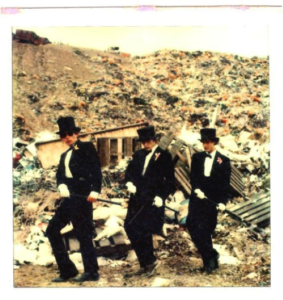
from Hecho en Venezuela. Standing in the garbage dump, blindfolded.
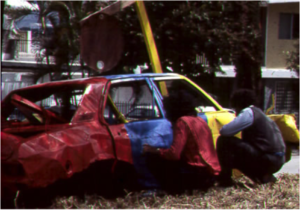
Carlos wanted to introduce Hans to Juan Loyola, a family friend, and a conceptual artist. In his lifetime — he’s dead now, sadly — he’d been arrested for his work and radical politics several times. Carlos thought it would be fun for Hans to participate in Juan’s chatarra project. In Spanish, chatarra usually refers to scrap metal, but it’s a word with a particular connotation in Caracas — a city that’s more like a country, and given as much deserves its own language. For Caraqueños, a chatarra is a rusted, decayed car, abandoned in the streets. Many stay in the same spot for years, if not decades. In the 1970s and 80s, the city was covered in chatarras, most of them in poorer neighborhoods. Juan’s project was simple in conception: he would find a chatarra and re-paint the car in the colors of the Venezuelan flag. He had to work at night, quickly and alone. The police had no problems arresting Loyola, punctuated by a casual beating for his vandalism. But he was essentially painting trash — reframing the public’s unwanted furniture.
The stories I love are usually told by other people. Each person invents a logic of their own when they begin a sentence with, “One day…”
The stories I love are usually told by other people. Each person invents a logic of their own when they begin a sentence with, “One day…” Watching that logic refract and swirl into idiosyncrasy is, for me, the pleasure of the story. The events and their significance are always debatable, if not entirely arbitrary. What matters most is who’s telling you what and for what reason. I won’t make an exception here. I would rather read along, and abandon writing for a moment. Hans was quickly convinced by Juan and Carlos to paint a chatarra during his stay in Caracas. Here it is in Hans Müller’s words, from his essay collection, The Opposing Light: Essays on Films and Filmmakers (1996), only recently translated into English —
Juan Loyola painting a chatarra with a friend. They haven’t yet added the seven stars of the Venezuelan flag.
The day I met Juan Loyola, Carlos took me out to dinner at what looked like an expensive seafood restaurant in Alta Mira, but none of it made sense. It was in the basement of an office building, and while the waiters were dressed in formal attire — almost too formal, maybe, it made me a little uneasy — they all yelled at each other as if they were living through an unending, collective marriage for years. While taking our order, our waiter punched another waiter in the arm for having made a mistake with a drink order earlier in the evening. Thinking it was a bit of aggressive camaraderie, I laughed, but Carlos didn’t. The waiter looked furious and didn’t hide his general animosity from us.
The menus were baffling. The food sounded delicious by description alone, though at the time my sense of Spanish was not as developed as it is today. What struck me as curious, however, were the covers of the menus: they were filled with pictures of disembodied asses on both sides — a collage of asses, all of them cropped at the cusp of the cheek and the small of the back. The various genders of the asses were indistinguishable, though I tried my best to guess while we were waiting to place our order. I remember the restaurant was lit by candlelight only; I could barely see Carlos’ face, even though he was sitting right across from me, smiling or whistling or folding his napkin like a piece of origami.
“Do the menus have something to do with the name of the restaurant?” I asked. We were waiting for our food and already had a few drinks. We started at his apartment.
“No,” Carlos said, “the restaurant is called Restaurante en el Sótano. Restaurant in the basement.”
I laughed. I felt that such literalism either augured very well for the food, or very poorly.
“So why the asses?”
“I don’t know. I think I remember a waiter telling me once that the owner’s son — an artist — won a bet with his father and the result was asses on the menu. Two or three years ago the covers of the menus were just brown leather. Now it’s asses. I think people like it. Either way, I wouldn’t believe whatever the waiters say.”
A man approached our table. It was so dark in the restaurant that I couldn’t see him for a moment. I thought that maybe our waiter had come back to say something disparaging to us. It was Juan. Carlos didn’t tell me he was joining us for dinner. There was a big, idiotic smile plastered on Juan’s face; I though that maybe he was high. I didn’t know if I should take it as a threat or as a welcome. He sat down next to Carlos, and introduced himself.
Carlos had been talking about him all day, so I had to feign ignorance when asking him the usual questions about his life and his work. I was essentially interested in his chatarra project — I thought that it risked the possibility of being too allegorical, that Juan was maybe attached to the easy cache of re-appropriating images of nationalism for protest. But Juan surprised me.
“What I find most interesting about what’s happening with the chatarras,” he said, “is that they only last for about two days or so, at the most three.”
“What do you mean by ‘last’?” I asked.
“The government sends a sanitation crew to tow the chatarras after I paint them. All of them. They erase them.”
I heard a loud smack on the other side of the room — another waiter communicating with his co-workers, maybe. I turned my head to look but it seemed as if no one else in the restaurant was interested, or had even noticed.
“He’s basically doing ecological recovery for our city. By accident,” Carlos said, laughing.
“More or less,” Juan said. “I wish they would let a few of them stay, but I guess that would compromise this unforeseen development.”
I thought it was brilliant. Juan was repurposing the city’s refuse — the government’s casual indifference at the environment of the poor — and instilling it with the specter of a symbol, opaque as it may be. The government in Venezuela essentially found this gesture unacceptable. So unacceptable, in fact, that they provided a service that would not have been granted without Juan’s trespasses… [86–88]
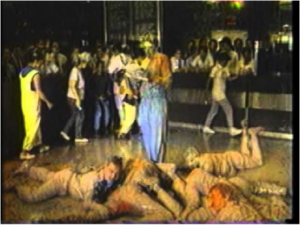
Juan Loyola performing a public reading in 1990. People on the floor and people walking around him.
The rest of Hans’ essay switches from narrative to theory. Carlos, Juan, and Hans paint a chatarra, though it’s an uneventful experience. They find one in Los Chorros, at the end of a dead-end street — close to where Carlos lives now, actually, and about a mile east of Alta Mira. The street is deserted, with the exception of a few listless, stray dogs, and the process goes uninterrupted. Hans sounds a little dejected, as if he wanted to run away from the police, or get into a fight, or experience some kind of simulacrum of art meeting activism in South America — a place many well-intentioned Europeans think of as a magical island filled with bleeding-heart radicals who play out Leftist political fantasies from a safe distance.
Films are particularly effective at achieving this type of narrative rest, because the images are always moving, even when they’re not.
But I shouldn’t let Hans inherit the naïve politics of some of his compatriots: he makes it work, at least in the essay. The story of his weekend in Caracas shifts into a contemplation of Raúl Ruiz’s poetics of cinema, one that’s distinctly opposed to what Ruiz calls the “central conflict theory.” Hans cites Raúl: “A story begins when someone wants something and someone else doesn’t want them to have it. From that point on, through various digressions, all the elements of the story are arranged around this central conflict.” Ruiz’s opposition to this method, one that dominates Hollywood films, is not rooted in a rejection of easy entertainment, or pop consumerism, but in a personal narrative ontology: to understand narrative not as a preoccupation with past or future concerns, but as an anchor to a total present which makes itself available for “an intense feeling of being here and now, in active rest.” Films are particularly effective at achieving this type of narrative rest, because the images are always moving, even when they’re not.
Hans mentions meeting Ruiz a few days later in Santiago, where he tells him the story of his weekend in Caracas. Ruiz suggests that it’s possible that Hans didn’t allow himself to be available to Loyola’s work — the chatarras were already being projected into an imaginary future, where something is always going to happen.
from Hecho en Venezuela. The garbage dump is a place of many endings.
I had my tarot cards read the other day. A friend read them for me. I don’t really believe in those kinds of things, but I was excited nonetheless. Believing in the future is embarrassing enough — I might as well listen to the cards. My last card, the card that’s supposed to tell you what’s to come in the next few months, was the five of swords. It doesn’t bode well. My friend told me that it usually means conflict and isolation — hurting people, pushing them away. It signifies difficult things from your past coming back to affect your future. If it sounds like it could mean anything, I think it’s because it does.
I was telling my father about it when I talked to him on the phone recently. I thought it mostly funny; it didn’t incite anxiety, though maybe I was looking for someone to legitimize my lack of concern.
“You know, it’s funny,” my father said, “I still have this painting that Juan Loyola made for you.”
I remembered it. Or at least, I remembered the memory of the painting, though I couldn’t recall what it looked like.
“It’s of a chatarra. A woman is painting it. It’s kind of dark, a little too gray. But it has your name on it, on the bottom. It says: “Para Sebastian, el futuro del siglo XXI.”
That made me laugh. I told him I was writing a story about Carlos and about Juan and about a few other things. I asked him if he could take a picture of the painting, but he doesn’t own a camera, or a cell phone. He said he would ask his neighbor if he could borrow one, but I’m still waiting for a photo. I told him I wanted to include it in my story. He asked me what else I was writing about.
“Parasitism. I want to write a story that’s parasitic in nature — writing that only exists through other work. It’s called “Hecho en Venezuela,” like Carlos’ movie. I think it makes sense.”
“It does,” he said, “though you don’t always have to make sense.” He paused. “What time is it there?”
What I find more interesting is that a person effectively changed the time for an entire country.
We had been talking for an hour and both lost track of time. He had to go to a friend’s party; I did, too. It was 8:45 in Philadelphia, so that meant that it was 9:15 in Caracas. In 2007, Chávez reestablished the meridian that was used in Venezuela between 1912 and 1967, setting their clocks back half an hour. There were several reasons provided for the decision, for example, that it helped farmers in the far west of Venezuela, so that they didn’t have to wake up as early in the morning. Many took it as a symbol of Chávez’s megalomania. I don’t really have an opinion either way. What I find more interesting is that a person effectively changed the time for an entire country. People who existed in one time were, one day, permanently moved to another.
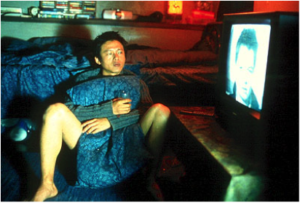
One of my favorite films, Tsai Ming-Ling’s What Time Is It There? (2001) is about a street vendor who sells watches in Taipei. He meets a young woman who’s moving to Paris in the next week, so the vendor sells her a watch before she goes. He doesn’t know her very well, but he forges a connection with her nonetheless, or maybe simply an obsession. The film exists in a narrative present, like Ruiz’s films, that doesn’t reveal the psychological conditions of its characters in a way that allows for closure, or even intelligibility. In fact, the street vendor never sees the woman again after she leaves. He watches François Truffaut’s The 400 Blows (1959) on repeat, perhaps as a way of maintaining a connection to the woman’s new life in France. Watching the film is a way through which the street vendor creates a living connection in disparate temporalities — however delusional it may be.
What I love about the film is that it frequently presents long, static takes of the street vendor at home, alone and in his pajamas, watching the Truffaut movie. We are effectively watching him watch the film. The 400 Blows, as you may know, is about a young boy attempting to make sense of the neglect and emotional apathy of the authority figures in his life. In the last scene — the movie’s most famous — he wanders the beach, dispossessed and uncertain of his future. The camera freezes on a close-up of his face, where he permanently lives. In What Time Is It There?, the street vendor’s gaze reflects a kind of permanence of its own. He watches the movie in a present that’s endlessly eroding, one that provides him an anchor to a different time, but which also functions as a closed gate between his time and another. Like the old man in Kafka’s “Before the Law,” he sits outside, waiting for the moment of entry.
I read Álvaro Enrigue’s Sudden Death (2016) a few weeks ago. It’s a stunning novel interspersed with obscure historical research, absurd fictions about its central personages (which include Caravaggio, Quevedo, and Galileo, among others), intricate structural play, and a lightness in Enrigue’s prose which makes it a total delight from beginning to end. Two-thirds through, the narrator — maybe you could even say Álvaro himself — interrupts the novel to tell the reader: “I don’t know what this book is about.” The admission is startling. I felt that I had never read something so generous in a novel. It reminded me of one of Enrigue’s earlier short stories, “On the Death of the Author,” where he concludes with the following: “Sometimes writing is a job: to obliquely trace the path of certain ideas that seem essential to put on the table. But other times, it’s to grant what’s left, to accept the museum and contemplate the sum while waiting for death…To put our little boxes on the table and know that what ended was also an entire universe.”
Two-thirds through, the narrator — maybe you could even say Álvaro himself — interrupts the novel to tell the reader: “I don’t know what this book is about.”
When I first started working on this, I wanted to write an essay that was filled with lies, one which placed the source of its affect (which is always a burden) elsewhere. The truth is that given its intent, its lack of narrative fixity, and its subject matter, a true ending is impossible. Or maybe I’m simply allowed to end wherever I place the final period, which is what always happens anyway. If I finish with any faith (which I’m allergic to), it’s that perhaps Ruiz, or Carlos, or Müller, or Loyola would accept this baggy museum. Maybe one day this will be a book. That way, I can forestall my punctuation a little while longer, for an imaginary future, where something is always going to happen.
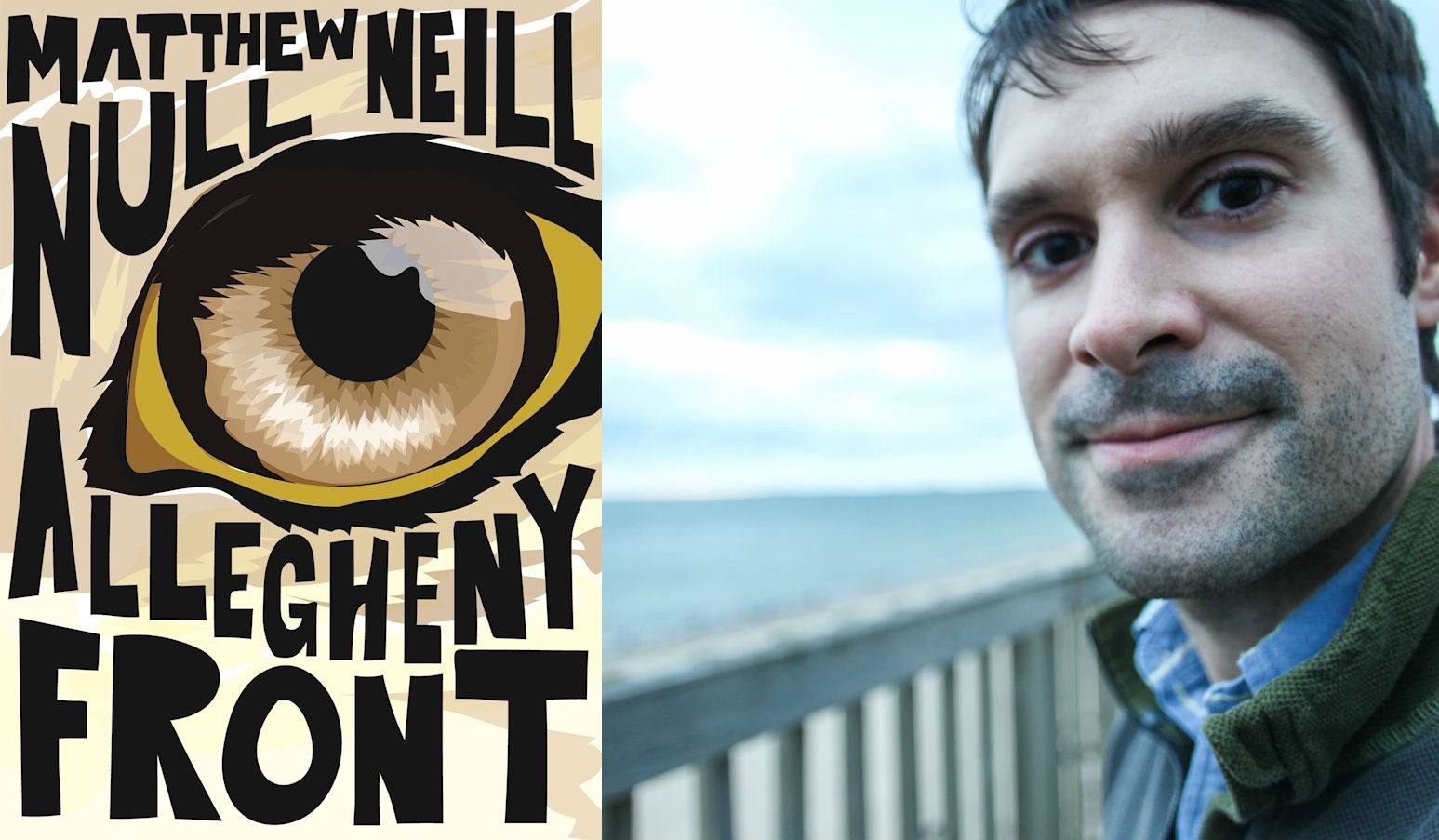
Matthew Neill Null’s collection Allegheny Front is as notable for the strength of its prose as it is for the ways in which it eludes expectations. One story focuses entirely on the shifting relationship between a group of bears and the humans living nearby; another story leaps ahead several decades at its conclusion to show how the aftereffects of its violent resolution are perceived in the decades to come by people with no knowledge of the events described. It’s a way of finding compelling drama in the spaces normally left blank in histories and stories, and it’s to Null’s credit that these stories never feel academic or dry. Instead, they’re as visceral and tense and the landscapes and relationships that they describe. I talked with Null via email about the roots of this collection, the influence of Henry Green and Shirley Hazzard, and how he found the ideal juxtaposition of humanity and the natural world.
— Tobias Carroll
[Read Matthew Neill Null’s story, “Gauley Season,” on Electric Literature’s Recommended Reading.]
Tobias Carroll: Landscapes, nature, and history all play a major part in the stories contained in Allegheny Front. Did you have an overarching theme in place from the beginning as you put the collection together, or did it become more apparent as you reviewed the stories?
Matthew Neill Null: Those are my concerns as a person from West Virginia, and predated my becoming a writer, so the theme cohered without my trying for it. My novel Honey from the Lion was dedicated For the land and the people. Allegheny Front is dedicated For the animals. Many of the stories pivot on fraught interactions between humans and animals. Too often the land is used merely as a stage, animals as props. For me there is a triangular relationship between humans, the land, and other forms of life. Without those three legs, the world tips over.
This is a landscape of ghosts more than one of the living…
This is a landscape of ghosts more than one of the living, as the population has cratered and the houses have gone to ruin. One’s gaze is forced backwards. My family has lived in West Virginia (and western Pennsylvania) for generations, from the colonial period on, so our history is imprinted on that land and vice versa, a legacy of settlement and decay. I could show you the creek-bed where my great-grandmother’s great-grandmother, a Huguenot woman, was scalped and killed. I helped a friend build a cabin there. We set up a portable sawmill and skidded pines off the flat. In order to pay off his mortgage, he had grand plans to sell it to a well-heeled person from D.C. along with some acreage, to someone hunting a rural escape hatch after 9/11, but ultimately it was too isolated to make good real estate. So he lives there now and takes his coffee where her body was found in 1786.
Those who live there experience the same struggle they had one hundred and fifty years ago: they love the land, yet are forced to destroy it in piecemeal fashion simply to get the money necessary to remain living there. Timber. Oil. Coal. Natural gas. It’s ghastly, but I don’t see any other way it could have happened. I’ve noticed that most people who criticize extractive industry live comfortable lives in suburban/urban contexts that are impossible without cheap sources of fuel. My family has taken part in all of it. If you live there, even if you aren’t directly taking part in extraction, you are providing services for the workers who do. Which has saved us from the sin of sanctimony.
TC: Over how long of a period of time were these stories written? Did you find that you had to be near the landscapes described in the stories in order to more accurately depict them?
MNN: Between 2008 and 2013. During the same period, I wrote my novel, Honey from the Lion, which was set in a very specific place and time (the high timber-camps circa 1904), so the stories served as a counterpoint as well as a rest. Now and again I craved to write about a time when people could use cellphones. Range around, you know? Also, the lumber camps were by definition a male world, so stories like “Telemetry” and “Mates” allowed me to explore female characters in a fuller sense.
The exception is “In the Second District.” I began toying with it as an undergraduate, overhauling it again and again, for nearly a decade. I tried many different perspectives, perhaps resisting the first-person voice, which is not my natural mode but ultimately suited the story. It’s funny, an ex-girlfriend read the book and told me she remembered certain images from the very first draft: the Chinese merchants measuring the bear’s gallbladder, the dogs boiling at the cave mouth. I write a first draft quickly, often in one go, then give it the Isaac Babel treatment over a number of years:
“The first version of a story is terrible. All in bits and pieces tied together with boring “like passages” as dry as old rope…It yaps at you. It’s clumsy, helpless, toothless. That’s where the real work begins. I go over each sentence time and time again. I start by cutting out all the words I can do without. Words are very sly. The rubbishy ones go into hiding.”
Actually, I wrote these stories at a great distance from West Virginia, in radically different landscapes. Most in an ugly, flood-ravaged, land-grant library in Iowa City. Others in Wyoming, Key West, and Provincetown, Massachusetts. But maybe I would have written the same stories sitting on a rock in Dolly Sods, playing the autochthon. Impossible to tell. I didn’t begin writing until I left the state. Next year I’ll be in Rome. I look forward to more cognitive dissonance.
I’d rather live in West Virginia than anywhere else, but like most of my generation, financial necessity drove me away. Which is a great shame. My family still has hundreds of acres of land. When I try to think of ways to live there, I’m flummoxed. In the other places I feel adrift, anonymous, without history.
TC: At the end of “Something You Can’t Live Without,” the narrative shifts somewhat and focuses on the way that the landscape changes over the decades that follow the story’s climax. What prompted that as a narrative conclusion? Did you always have that in mind, structurally speaking?
MNN: I did have that in mind, a leap forward through decades, following the decomposition of the drummer’s body, having it break apart and travel, letting the beasts scatter him, letting other people encounter his bones. I wanted to force the reader to reckon with the idea that the story never ends, not even with personal demise; the narrative leaves us behind; stories are minute rituals that prepare us for death. The land rolls on without us. The fields on fire. The maps burning with mold. The names we give lost. The buildings collapse. The closing of that story might be the most important passage I ever write. Which is odd, considering I did it at 24. It was the first story I finished for the book.
I’d rather take a risk and fall short than do conservative work.
At that particular time in my life, I was around people who would make silly pronouncements about what a short story must not do, must not be. “If your main character dies, the story just has to end. You have no point-of-view. By definition you can only tell a story through one character’s eyes.” Whatever. So I wanted to kill off the main character and let this disembodied voice roll out the last few pages, to defy these narrow confines. I often write in an omniscient mode, which has fallen out of fashion. I want a narrator that can go anywhere, perceive anything, indulge in prolepsis, reveal what the characters do not know. In this mode you’re writing without a net. Just willing up a world out of language, out of a handful of dust. If you write a stupid line, you can’t blame it on your poor marionettes. I’d rather take a risk and fall short than do conservative work. People tend to love or hate my writing. I’ve made peace with that. One esteemed novelist told me I should write for television, as he found my dialogue salvageable. But I don’t admire his work, either, so that rolled right off.
TC: “Something You Can’t Live Without” is one of a few stories in Allegheny Front set in a particular moment in the past. When you’re working on a historical story, do you generally begin with a moment and time and go from there?
MNN: Honestly, not at all. My stories are image-driven. I begin with visions that come floating up from my subconscious. In the case of “Something You Can’t Live Without,” the cave-bear’s skull imbedded in the rock, the man rubbing blood off his neck with a neck-tie, the shrieking cloud of passenger pigeons, and the twin boys holding dead foxes, one red, one gray. In “Mates,” for instance, I saw that eagle nailed to the barn siding like an emblem, something you would see on a flag or a coin. In “Natural Resources,” a bear rocking an abandoned washing machine.
This may be an unorthodox tack for a fiction writer. The story, for me, always begins with image, or, if not an image, a sentence, a scrap of phrase. My writing practice is the knitting of these disparate pieces together. All else comes later: character, setting, plot. I reason that if the visions haunt me, they must have some cryptic import. By stringing these images together, I build a narrative skeleton. I make no distinction between contemporary or historical stories. The time will cohere around the vision.
TC: Was there anything that you did while writing any of these stories that surprised you?
MNN: Yes, that a publisher took them and I signed the contract! My stories tend to be expansive, lush — this isn’t in tune with the zeitgeist. I had the pleasure of noticing that most editors who published my stories in magazine are poets, not fiction writers. I play better with poets. I’m unabashedly concerned with the textures and music of language.
Embrace messiness and difficulty, rather than trying to grab a coveted spot in next week’s New Yorker.
The slender tale well-told has never been my love. I’ve been told I’m a novelist masquerading as a short story writer, but now I reject that, as it implies there is a certain done thing. I like writers who are unruly and push at what short story can hold, can be. Eudora Welty. Babel. Gabriel Garcia Marquez. Mavis Gallant. James Salter. Ron Hansen. William Trevor. Annie Proulx. Faulkner. Primo Levi. Calvino. Cortázar. That said, when I wrote this book, I was purposefully trying out different modes and perspectives — I need that to hold my interest, some technical challenge goading me along like a splinter in my foot — and so “Mates” and “Telemetry” are the more classical, Chekhovian stories. Others expand. MFA-world has narrowed the idea of what the story can be. I’d like to see my generation blow it back open. Embrace messiness and difficulty, rather than trying to grab a coveted spot in next week’s New Yorker.
For me, the writer must be a stylist. This can take many forms. Mavis Gallant might not dazzle one as a Bellow does on the sentence level, but her paragraphs are so rich, supple, and alive. (In another fashion, Henry Green does it by creating a disconcerting web of language where the matter at hand is never quite discussed, where partial thoughts and sentences hang in midair.) I remember talking to another fisherman about “live water” in a trout stream — these transitional zones of conflicting currents where the very water seems a living thing. It can’t be explained, but it’s unmistakable, you know it when you see it. The same with good prose. You feel it even before your mind can articulate what makes the dead syllables come to life. Like the question in Ezekiel, asked in the valley of skeletons: “Son of man, can these bones live?” Yes. Living prose transcends setting, character, and the other workaday facets of fiction. You see this in writers like Evan S. Connell and Sam Lipsyte, Muriel Spark and Shirley Hazzard. Writers who do it on every page, rather than lucking into it. Before Cheever died, he said in a speech that “a good page of prose remains invincible.” No hyperbole. He believed that. It kept him alive through years when he shouldn’t have lived. It has meant the same to me.
TC: “Natural Resources” focuses mainly on a population of bears over time and their interaction with the humans who live nearby. How do you go about making a very dry subject into compelling fiction?
MNN: Oh gosh, I find interactions between humans and animals endlessly fascinating. I never thought it dry. In a place like West Virginia, where people hunt and fish and live close to the bone, animals fill out your world as there are so few people. I would lay in bed, wondering what the deer were doing up on the ridge. How the trout lived under ice. I still consider the world in this way. I live on Cape Cod, and the calendar of the year isn’t divided so much by the months as by the premonition of digging clams in winter, the return of the striped bass in spring, the time to jig for squid off the pier in high summer. All this to do with sustenance and light.
As in that story, we used to drive to the Clay County dump at night and watch the bears feed on garbage. We called it “the poor man’s safari.” Then a woman smeared her toddler’s hand in honey, so the bear would lick it off and give a good photo-op, but instead the bear took the kid’s hand off — and welfare took the kid.
Much of the book hinges on relationships between humans and animals. In contemporary America, we find animals bloodlessly shrink-wrapped in the grocery aisle, or we inflict Stockholm Syndrome on our pets and fetishize them. In my book as in my experience, the interaction is more immediate, without the filter of sentiment or the factory slaughter-house.
We prize the human perspective too much. I wanted to force the reader to think about the bears.
We prize the human perspective too much. I wanted to force the reader to think about the bears. Everyone seems to know the Bechdel Test, a concept I found fascinating and ingenious. So I wanted to create this other kind of test. Are the animals doing anything when people aren’t around? If so, what? Otherwise animals are merely props for humans. That is morally repugnant. Their lives have richness.
Also, in “Natural Resources” I wanted to write the type of story that has no discernible human characters, in terms of a single perspective, but wills up a world merely out of a disembodied voice, purely on language. Along with Borges, Gabriel Garcia Marquez’s “A Very Old Man With Enormous Wings” and “The Handsomest Drowned Man in the World” served as models, but I wanted to take it further, describing change partly from the perspective of animals, valuing that, breaking away from the narrow human realism that mostly characterizes our stories.
TC: “Natural Resources” and “Gauley Season” make use of unorthodox points of view: second person and first person plural, respectively. How do you best find what works for a particular story?
MNN: I don’t really think of point of view — for me, it’s a shorthand concept, too reductive as it concerns the merely visual. I think of narrative consciousness, a certain stance/personality the narrator takes toward the world. So I don’t consider “Natural Resources” second person. It’s unyoked from viewpoint, singular or plural. I doubt Faulkner, Joyce, or Tolstoy ever thought of point of view. It’s a concept that the MFA world began stressing as a teaching tool, which I understand, but now writers take it seriously. In a common workshop setting a challenge is taken as deviation. “Strike one! You dipped into another character there!” Rules are anathema. There are no rules. This ain’t golf. “Throw away your mind,” as Dr. Vigil says in Under the Volcano. I try to do what feels right.
As I said, a set technical challenge sometimes pushes me on like a wind-up toy. Like, “This story won’t have dialogue.” Eudora Welty fascinates me because she has a natural ear for speech, perhaps her greatest gift, yet she’ll write a story like “First Love,” with the deaf-mute boy Joel Mayes as protagonist, and she’ll deny herself the ability to feature human speech because she wants to explore that aspect of the boy’s experience. I adore that. She’s taking a risk. She cut out her own tongue and wrote toward her weakness, toward the unknown.
TC: Dynamics related to class and education both play a large role in “Telemetry.” How do you best integrate aspects like these into the wider scope of a short story?
MNN: Americans have never been good at talking or writing about class. One ignores it, or one becomes didactic and thumbs Das Kapital like a lunatic. There are better models. For example, Isherwood’s Berlin Stories is all about class, but that’s not the first aspect that comes to mine when one thinks of the book, or even the tenth. The book wears that concern so lightly, but class informs every page, rippling there, like the shadowy light a swimming pool casts upon a ceiling. Shirley Hazzard’s Transit of Venus is a more direct treatment of class, but even so, it’s so nuanced and fleet-footed — that vision of villagers tossing Clement Attlee in effigy on the bonfire! You get it in a sentence or two, then Hazzard moves on, dropping it. So deft.
Henry Green wrote:
“Prose is not to be read aloud but to oneself alone at night, and it is not quick as poetry but rather a gathering web of insinuations which go further than names however shared can ever go. Prose should be a long intimacy between strangers with no direct appeal to what both may have known. It should slowly appeal to feelings unexpressed, it should in the end draw tears out of the stone.”
Amen.
Robert Stone’s Hall of Mirrors is another fine model, I think, from someone who knew the underside first-hand, the child of a schizophrenic, out of orphanages and Marist homes. Class is all, yet is never spoken aloud.
TC: What would you say that you’ve learned from writing these stories that you’ve been able to apply to your subsequent fiction?
MNN: Writing, for me, is thinking aloud about the world. A story is the fossil record of that thought. After that, I move on. You could say I’ve learned nothing. I don’t look back except to say that I’ll never have to write a story like “Something You Can’t Live Without” ever again. No point in doing the trick twice. Of course, in a commercial sense, the world craves that you do the same trick over and over, but dedicated artists — say, Joyce, Faulkner — tore down their art and made it anew in each book. But the temptation is there. You even see a great writer like Flannery O’Connor repeating in certain lesser stories, doing imitations of herself.
After Allegheny Front I may never write another story. I may write a thousand more. I don’t know. The snake sheds its skin. So now I’m looking for a new syntax.
DON’T MISS OUT
Sign up for our newsletter to get submission announcements and stay on top of our best work.
YOUR INBOX IS LIT
Enjoy strange, diverting work from The Commuter on Mondays, absorbing fiction from Recommended Reading on Wednesdays, and a roundup of our best work of the week on Fridays. Personalize your subscription preferences here.