A Convincing And Compelling World: An Interview With Vu Tran, Author of Dragonfish

Vu Tran’s debut novel Dragonfish (W.W. Norton & Co. 2015) is more than a crime novel. It’s a story of displaced Vietnamese refugees who fled after the fall of Saigon and ended up in Las Vegas. When Robert, a white cop living in Oakland, is visited by two Vietnamese gangsters and ordered to Vegas to help them find Robert’s ex-wife, Suzy, he goes. Sonny, their boss and the book’s “villain”, is also her new husband. Through letters Suzy left behind, the reader learns of the ghosts that still linger from her past and the reasons she was never Sonny’s or Robert’s to lose.

Tran was the Fiction Fellow assigned to my workshop (led by Helen Schulman) at the 2015 Bread Loaf Writers’ Conference. He also teaches creative writing at the University of Chicago. Along with his abilities on the page and in the classroom, I can attest that Tran also manages easily on a dance floor. See: The Worm. I saw him again weeks later on the Los Angeles stop of his current book tour, but it wasn’t until the next day, when he was already parked in a rental car four miles from the Black Mountain Institute at UNLV, where he’d earned his PhD in literature, that I had the opportunity to ask him a few questions about Dragonfish.

Andrea Arnold: I loved this novel and how smooth your writing is. I finished it in a few hours. I had to find out what the hell happened to Suzy. How did you come to the story?

Vu Tran: Jarret Keene, a writer in Vegas, asked me to write a crime story for an anthology he was editing called Las Vegas Noir. My assignment was Chinatown. I’ve always loved the noir genre in literature and film, so I said yes, absolutely. I was also working on another book that was painfully going nowhere, so I was more than happy to put that aside. That’s how I came to write “This Or Any Desert.” I wrote it really fast and had a lot of fun doing it. Then it got into the 2009 Best American Mystery Stories, and since I was desperately looking for something else to write at the time, I thought maybe I should turn this short story into a novel. The characters still felt nascent to me, like there were layers to them that I hadn’t yet found, that I still wanted to excavate. They felt like the kind of characters that could flourish in a novel and open it up in exciting ways.

AA: I’ve heard you talk about your experience coming to the US as a refugee. Can you explain the journey your family took and how it led to the novel?

…we left on a small boat with ninety people…We spent over six days at sea, headed at first for Singapore until the captain got lost and we ended up in Kuala Lumpur, Malaysia. We were very lucky.

VT: I didn’t really find the novel until I reached into the backstory of one of the characters in “This Or Any Desert,” who talks about escaping Vietnam with his father by boat and being on a refugee island. That came from my own experience. When I expanded the short story and brought this same backstory to my protagonist, Suzy, it provided an emotional foundation for the rest of the novel, connecting the main characters to each other emotionally as well as literally. I was born in Vietnam in 1975, four months after Saigon fell and four months after my father, a captain in the South Vietnamese Air Force, fled the country. He had to leave the very day the communists took over Saigon and the South. He was going to take my mother, who was pregnant with me, and my sister, who was two at the time, but he ended up having to escape without us. For a year, my mother had no idea where he was, what had happened to him, or if he was even alive. She finally found out that he had settled in Tulsa, Oklahoma, where a Catholic priest had sponsored him. Five years later, in 1980, my mother bought passage for herself and my sister and me, and just like in the book we left on a small boat with ninety people. There was really only room for about twenty. We spent over six days at sea, headed at first for Singapore until the captain got lost and we ended up in Kuala Lumpur, Malaysia. We were very lucky. Thousands of Vietnamese were attacked by Thai pirates, drowned at sea, died of hunger and illness. I’m sure it was all terrifying and difficult for my mother at the time, but I’m always amazed by how lucky we were ultimately. The Malaysian and US government had established a refugee camp on Pulau Bidong, an island off the coast of Malaysia. We lived there for four months. Then my father sponsored us, and that was how I came to grow up Tulsa, Oklahoma. It’s where I met my dad for the first time and where I lived for twenty years.

AA: There are a lot of details about that island in Suzy’s letters. Did you remember all those details or did your mom fill in the gaps or did you have to look it up?

VT: I remember very little, only small details. Like the smell of the ocean. Or standing in the water up to my neck. I remember lying on thatch beds made of palm leaves and cardboard, which was how we slept at night in our huts. I also remember — and this is a weird detail — when you go to the bathroom you take a newspaper and squat under a palm tree. Everything else about the time I had to ask my mom or invent or research on my own.

AA: Was that experience something constantly talked about in your family or was it something purposely forgotten and avoided in conversation?

VT: My mom talked about it a lot when I was growing up and had a lot of stories, which I drew from for the book. I would call her all the time when I was writing and ask for more detailed accounts of everything. As a writer, you take some of those concrete facts and you run with them. You invent out of them. I’d say 99% of what’s in the book is invented, but their foundation is built on these facts from my life.

AA: Suzy’s letters are full of longing for Vietnam. Does your mom talk with the same type of longing when she tells you stories about Vietnam?

VT: My mom rarely spoke about it with melancholy or longing, at least not outwardly. She certainly missed Vietnam and her family, especially before she returned for the first time in 1992. We returned as a family twice in the late 90s, and she and my father have visited several times over the last decade, so maybe the melancholy has evolved over the years. I’m glad you ask this question because I haven’t thought enough about how my mom must have felt all these years, recounting this other life she had before we came here. It’s weird, but sometimes, as a writer, you value the material more than you value how that material is given to you, particularly by those who are very close to you. Even though the US is my mother’s home and she’s become used to the life she’s led here for 35 years, I imagine there will always be some melancholy in her for Vietnam. I don’t think you can ever shake the homeland, especially if you left it under such dramatic circumstances.

AA: For you, was it just super cool, exotic and fun to travel abroad, or did you feel a connection to Vietnam even then?

VT: When I first came back, yes, it was just really cool and exotic. I was twenty and hadn’t gone abroad until then. I was just an American traveling to a strange new place for the first time, even though it was the place of my birth. The experience was very fun and exciting for me, but I don’t think the emotional connection came until afterwards, when I got back to the States and had time to feel the impact of such an experience. I think the most significant thing was meeting — and I guess reuniting with — my extended family, who’d remained in Vietnam and had all these memories of me up to the time I was five. That reminded me that I’d actually had a life in Vietnam, even if I didn’t remember it, which gave me an emotional connection to my family and therefore to the country. That’s when I started writing about Vietnam, and writing about it solidified and deepened the connection.

AA: Is it typical in Vietnamese culture for people to believe in ghosts or were you simply using a noir trope?

You’re not just living for your immediate family; you’re living also for your extended and ancestral family.

VT: Ghosts are very much a part of many Asian cultures, whether you’re Buddhist or Christian or whatever. I was raised Catholic and taught not to believe in ghosts and demons, but my mother has always been a superstitious person, which is true of many Vietnamese. I don’t think you can escape that in the culture, especially when it’s been dominated for centuries by a Buddhist belief in the spirits of one’s ancestors, lingering in the reality of one’s present life. It’s one reason the family is so important in the culture, because of that connection to the past and to past lives. You’re not just living for your immediate family; you’re living also for your extended and ancestral family. American culture, it seems to me, is one of the least superstitious cultures in the world, which is why ghosts are usually the purview of pop culture instead of our everyday lives. Ghosts are alive in South American culture, in African culture, in European culture, but Americans generally don’t take the idea very seriously, and I’ve always thought this contributes to how the family is viewed here.

AA: So what was your research process like? Did you interview people in the Vietnamese community in Las Vegas?

VT: Not really. First of all, I’m a very lazy person. [Laughs] I try to do as little research as possible. Too much information can distract me from the true pulse and direction of a story. I also don’t think a book necessarily comes to life because of the concrete facts that come from hard research. It comes to life because of the emotional vibrancy and complexity of your characters, and that’s something that comes more from the imagination, personal experience, and observation. But of course, some research was necessary for Dragonfish, especially on the Vietnamese boat people and life in the refugee camps. So I did a lot of reading on that. I also talked a great deal to my parents, asking them as many questions as I could think of. For all the procedural, cop stuff in the crime narrative, I went to my sister and her boyfriend. They’re both police officers in Texas. She’s also a negotiator and he’s on the SWAT team. They were always at the ready with stories and information for me. But again, I didn’t want to clog my brain with extraneous material, so I was always looking for specific details and answers to very specific questions and scenarios.

AA: Were there any concerns about making Asian characters likable? Are you worried about stereotypes and being stereotyped? I’m thinking specifically about Happy’s dialogue and her affectations.

VT: That’s a good question. Happy was very difficult. The thing is, that’s how Vietnamese-Americans with a heavy accent speak. But the problem is that that accent, the Asian accent in general, especially on paper, can sound very cartoonish, and the scenes with Happy were serious scenes. So one of the difficulties of writing her was keeping her speech realistic while also making her sound serious without sounding cartoonish and making the scene unintentionally amusing.

AA: I thought you did a wonderful job, but there are Asian characters in my novel and I think if I did it that way someone would tell me I was being racist.

VT: [Laughs] I was concerned about that too, in many ways, but I also realized that focusing too much on that aspect could distract me from the more important question, which is whether the characters were convincing. The world you create in your fiction will only be convincing and compelling if the characters are convincing and compelling. A character who is cliché is cliché not because they’re too Asian or too whatever, but because they have no depth and aren’t convincing in the world you’ve created for them. I kept thinking that with my characters who were potentially stereotypical or maybe even offensive, like Happy or Sonny, that if I gave them depth and I made their behavior believable and utterly convincing and, most importantly, interesting, those concerns about cliché or racist representations would fall away. Hopefully they did.

AA: Were there any concerns about making Asian characters such bad guys

I don’t really care if my Vietnamese characters are “bad” or “immoral”. I only care about whether they’re believable and interesting.

VT: My editor posed this same question to me, not because it was an issue for me but because she was just curious how I would answer it. She asked me why the white protagonist is the good guy — the virtuous and heroic cop — and most of the Vietnamese men in the novel are gangsters and immoral characters. This becomes, I think, a question about likability as much as moral representation, and frankly I think that’s the wrong question to ask yourself while you’re writing. That’s how your characters become one-dimensional. I like the idea of readers constantly changing their minds about characters. That’s when you’re creating interesting people on the page. Sonny is the prototypical bad guy in a crime narrative. He commits violent acts and speaks in an aggressive way, so the reader is forced to think of him initially as a villain. But if you keep complicating a character like him, giving him more and more layers of depth, the reader will keep changing their mind about him. Think about the most interesting people in your life: they’re the kind of people you can’t fucking decide on. You can’t decide if you like or hate them, if you want to be friends or enemies with them. Those are usually the most interesting people you know, and those were the kinds of characters I wanted in the world of my book. So I don’t really care if my Vietnamese characters are “bad” or “immoral”. I only care about whether they’re believable and interesting.

AA: My favorite parts of the novel are Suzy’s letters. The writing is beautiful, emotional and full of longing. To me, it felt like Suzy probably had an MFA from Iowa! Can you speak to writing in the first person from a female perspective as a male author?

VT: [Laughs] First of all, that’s really funny. Thank you. I’m glad you like it. When I devised the letters that Suzy is writing to her daughter, I felt like I found the novel. And weirdly enough, I found that voice fairly quickly, and it was easy to maintain. I was obviously very aware that I was writing from a woman’s point of view, but it never felt difficult. I think when you understand what a character wants, what a character is afraid of, and what a character is confused by, that character will come alive on the page, even if you personally bear no similarities to them. They could be completely different from you — a different ethnicity, a different gender, a different age — but if you understand those three things about them on a deep level, you’ll find them. For example, I knew very early on that Suzy was a woman who regretted abandoning her child and at the same time knew that that was what she needed to do. She did not want to be a mother. But the emotional consequences of that act of abandonment never left her. Her motive in writing the letters is to explain her actions, not just to her daughter but also to herself, because they have always confused her. And I think that confusion has been a source of fear for her in the world, which she inevitably brings to her relationships — her marriage to Sonny and Robert, her relationships with other people. If I wrote her convincingly as a woman, it all comes out of me understanding those aspects of her character throughout my writing of her part of the novel.

AA: Vegas is an additional character in the novel. How long did you live in Las Vegas and did you begin writing the novel while you were still there?

There are few cities in the country that give you this moment, where you can see so many sides of it from one single view.

VT: When I was working on the novel, I had seven years’ worth of Vegas memories. I wrote the short story in 2008 and started turning it into a novel in 2009, which was when I sold it. Then I left in 2010 and didn’t return until after I finished the book four years later. I was very concerned when I first got to Chicago because I only had sixty pages and I kept worrying that I couldn’t write about Vegas well if I wasn’t there. And sometimes it did feel frustrating that I just couldn’t drive down to the Stratosphere and check on certain details. But I realize now that the distance was an advantage. I think a lot of writers will say this — that distance often allows you write with more insight and clarity about a place, a situation, or a people. The benefit for me in this novel was that I was not relying on concrete facts. I was relying on my emotional memory of the city. If I got Vegas right in Dragonfish, I got Vegas right emotionally. I could get all the concrete facts right about the Stratosphere Hotel, but I still might not be able to make that place come alive. But an emotional fact will. If you drive west of the Vegas Strip, on Highway 215 toward Summerlin, you’ll get to a point on the highway where you can look back and see the entire valley and the Strip right down the middle of it, and you can see the column of light that beams up from the Luxor like a guidepost in the sky. You feel like you can wrap your arms around the whole city and it kind of makes you feel safe. There are few cities in the country that give you this moment, where you can see so many sides of it from one single view. I also remember the mountains that surround the city, which are brown in the day, but at twilight, if you look at them at a certain angle, with palm trees in the foreground, the city almost feels like a tropical island. Things like that are unique to Vegas and can give you a more vivid sense of the city than concrete facts about the streets and casinos can.

AA: Did you write your way in until you found the story or did you outline the plot? Did you know the ending?

VT: I always had a vague direction of where I was going in the novel, but I didn’t know the ending until the last week before my deadline. This was different from how I worked on short stories. With stories, I always had an idea of the ending and the major plot points. The story wouldn’t always turn out as planned, but at least I had some idea of where I was going. With the novel, though, every time I tried to map out the specifics of the plot, I would slow down. I kept a word count every month and my lowest word counts were during the months I was trying to figure out the rest of the novel’s plot. So it ended up that I literally had to write the book word-by-word, sentence-by-sentence, scene-by-scene. I found that was the only way for me to find the story. That approach might change with my next novel. I don’t know. I have a feeling that each book will require a different approach.

AA: You earned your MFA from Iowa. Was there someone there you emulated?

VT: I really admired Marilynne Robinson. I’m honestly not sure how much I learned from her in workshop, but I learned a great deal from reading her novels, especially Housekeeping. Gilead was actually a big influence on Suzy’s letters. When I was writing the letters, I’d open up Gilead to a random page so that I could appropriate the voice of the narrator. I did learn a lot from my other workshop teachers: Chris Offutt, Ethan Canin, and Frank Conroy, who directed the program for 18 years. He passed away ten years ago. He probably changed me the most. I came to the workshop with a maximalist style. I wanted to be Faulkner. I wanted to be experimental. So I overwrote. My first workshop with Frank was a good one, and it was a story I was basically writing for him, which is never a good idea. And since that workshop went well, I thought, I’ll just be Vu now. And he totally destroyed me in my second workshop. It was the most important workshop I had at Iowa because I realized that I really had to work on my prose and be in control of it, whether I was writing in a spare style or an ornate style. I had to make sure that everything was meaningful and clear, that I wasn’t just hoping for meaning, that I was actually melding my form with my content. Frank taught me that. His lessons on language really burrowed into me as a writer. I am indebted to him for my sentences.

AA: What was the best advice an author ever gave you?

My best advice to any young writer is to be wary of all good advice, especially the kind that sounds universally and earth-shatteringly true.

VT: Dave Hickey at UNLV told me to “write fast.” [Laughs]. He meant it literally. Write intuitively and then go back and revise intellectually, deliberately. That’s actually the opposite of how I work, so I didn’t really listen to him there. But he also meant something else. What he really wanted me to do was know what I was saying and make sure I was saying it well, and just get to the interesting stuff and not be bogged down by less interesting concerns. He saw that extraneous things were slowing me down. Like my focus on making my language pretty. Or my focus on landscape details. He wanted me to cut all that shit out and write faster. So that, I think, was good advice. But honestly, I’m not sure if I’ve really gotten that much good advice over the years. My best advice to any young writer is to be wary of all good advice, especially the kind that sounds universally and earth-shatteringly true. Because there’s always an exception. Everyone writes differently just as everyone reads differently, so you don’t want to fall into the trap of following great advice to the point where you’re not seeing the exceptions to the rule, or the truth that might only be true for you.

AA: How does teaching affect your writing?

VT: I love teaching. It does affect my writing because I have the luxury at the University of Chicago of teaching what I want, and that inevitably becomes a way for me to work out things that are most on my mind. For example, for the last few years, I’ve been very interested in plot-driven narratives, in plot not only as a dramatic structure but also as a philosophical structure, a way of approaching our ideas in a work of fiction. So I taught a class on that and learned a great deal. I was also very interested in the love story last year because I was going through a breakup and had also just written a book about a relationship. So I taught a class on love stories, which was about, among many things, how we define what a love story is. And since I always learn a great deal from my students, it was particularly educational for me to observe how my students engaged with this topic. That’s when teaching really becomes an interesting part of my life — when it merges with my personal life and my artistic life.

AA: You said you wrote a first novel that you put in the proverbial drawer. Do you think you’ll go back to it and how did you decide that it was time to quit?

VT: When I was still working on that novel, a friend of mine asked me to describe it to her. She was German professor of American Literature. When I described it, she said, “No no, that’s sounds too much like every immigrant novel out there. Don’t write that.” And she was absolutely right! [Laughs] It was about a first-generation Vietnamese-American who travels to Vietnam for the first time to uncover a mystery about his family — a standard narrative, I realized. It’s weird how you fall into certain clichés without even reading the sources for those clichés. It’s like it’s in the literary ether and you just absorb it. Anyway, it was very much a first novel. The writing was good, I think, but I didn’t know what I was trying to say or where I was going. It’ll stay in the drawer.

AA: What are you working on next?

VT: I’m not sure. Two weeks ago I had an idea for another novel as I was driving on a long road trip, and I was so excited that I started singing. I’m not sure I want to talk about it yet though. I might also bring out my short story collection at some point, but I think I’d first have to rethink some of the stories. Maybe even toss out one or two. I’m such a different person and a different writer now.

Stephanie Meyer Celebrates Twilight’s Ten Year Anniversary With Gender Swapped Book

Instead of the customary new edition most publisher provide for a book anniversary, Stephanie Meyer did her fans one better and wrote a new edition of Twilight featuring a female vampire, named Edythe, and a human boy, Beauford. The new book is titled Life and Death: Twilight Reimagined.

Meyer, a self proclaimed feminist who has dedicated time and funds to promoting work by female writers (sometimes to strong reactions), took issue with criticism that the original Twilight’s Bella was too consumed with her love interest, and has rewritten the book to move the focus from “damsel in distress” to “human in distress”, as she puts it.

The details about the anniversary edition of Twilight have been left vague for a long time, and today’s new release ends speculations about Meyer rewriting the book from Edward’s perspective, ala Fifty Shades of Grey rewrite Grey, released this spring.

There are many questions to ask in light of this announcement, most of which are demonstrated perfectly in GIFS here.

Midweek Links: Literary Links from Around the Web (October 7th)

Looking for some interesting reading to get you through the week? Here are some literary links from around the web to check out:

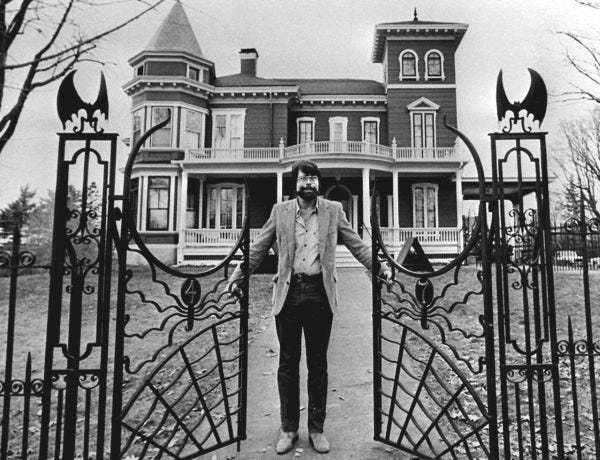
Stephen King house

Horror houses from literature that you can actually visit

Junot Diaz explains why you should read authors who don’t look like you

Why did Amy Schumer get so much money? New Republic breaks down how big book deals actually work

Jeff VanderMeer on the legacy of cult horror icon Thomas Ligotti

Is Kenneth Goldsmith avant-garde or the old out-of-date guard?

Iran might boycott the Frankfurt book fair because Salman Rushdie is giving a speech

A cyberpunk primer

Steven Pinker on how grammar rules aren’t nearly as important as clarity

Are you an emerging writer? Apply for the A Public Space fellowship!

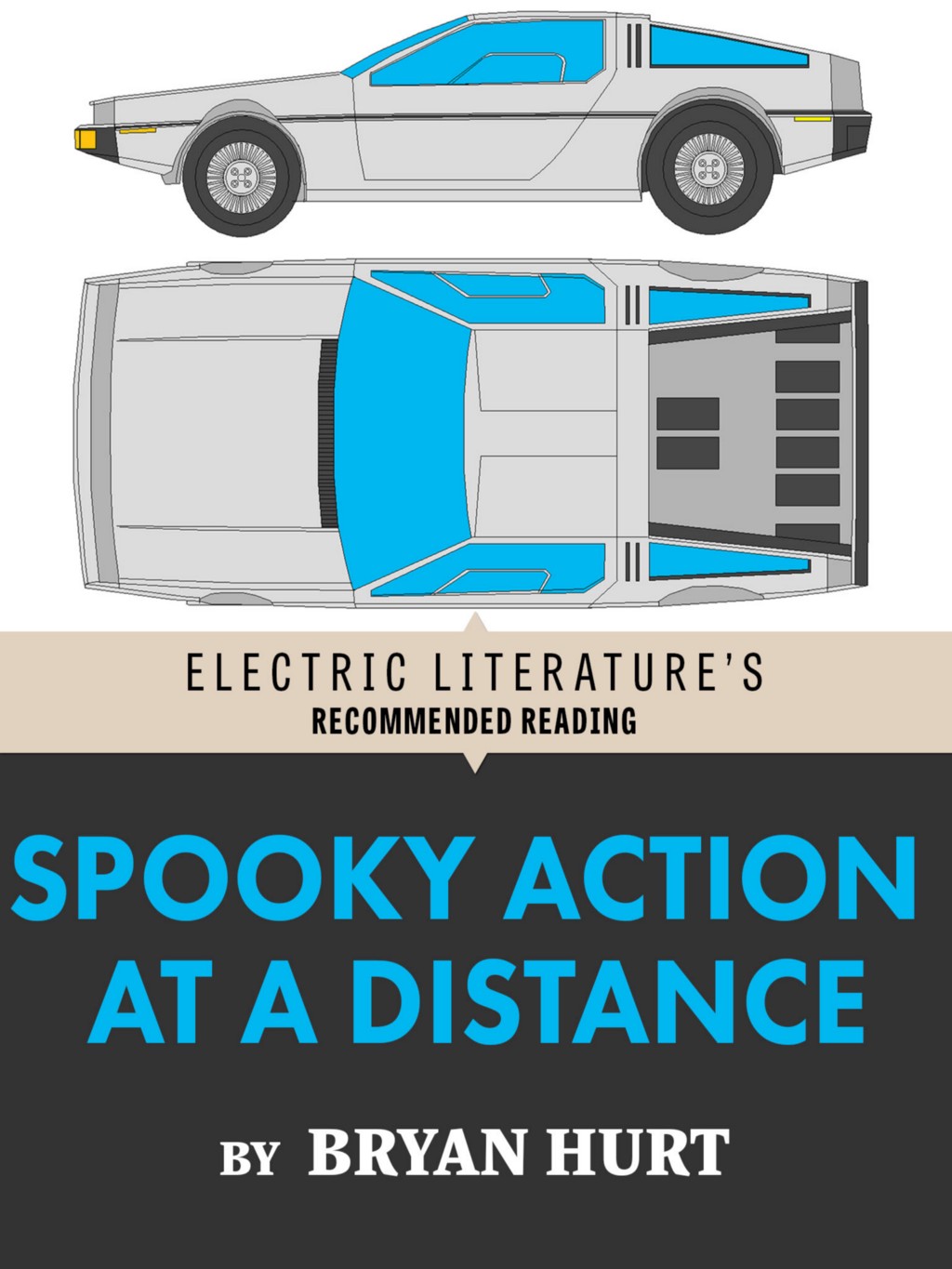
Spooky Action at a Distance

by Bryan Hurt

We were surprised, of course, that when we built our time machine it turned out to be a Delorean. We took it apart, put it back together, didn’t matter. Looked at the blueprints, looked at the silver car. Scratched our heads. A joke? A prank? Sabotage? If sabotage, then it had backfired. The Delorean worked.

We drove it out of the laboratory, into the parking lot, set the chronometer, and stepped on the gas. When we arrived we were exactly when we wanted to be. Thirty minutes earlier, our own past.

We parked the Delorean behind a Dumpster, hid in the bushes, and spied on ourselves. There we were, earlier Dr. Hu and earlier me, lab-locked and bending over our blueprints, scratching our heads. After that we did pretty much what you’d expect anyone to do with a time machine. We killed Hitler. Smothered him in his crib.

We smothered lots of history’s evil people. Bin Laden, Mao, Cheney, Robespierre, Attila the Hun. Even though we had the moral imperative it wasn’t easy killing babies, so we saved people too to balance it out. We saved JFK, RFK, MLK. Saved Franz Ferdinand, Marie Antoinette. You’d be surprised how many people can be saved just by pulling up in a Delorean and shouting duck.

Also surprising was that there seemed to be no negative consequences. No double occupancy problems, no grandfather paradoxes, no quantum entanglements. Fixing history was easy, like smoothing out the wrinkles in your bed.

This is how I explained it to my wife, the underwear model. I ran my fingers across our sheets. I told her that every time Dr. Hu and I returned to our time everything was pretty much as we’d left it except for a little bit better. History wasn’t something heavy that everyone had to carry around with them, a backpack full of broken parts.

For example, take you, I said. In another timeline you were you but not an underwear model. You were a kindergarten teacher. Your father died when you were twelve. In another timeline, I said, you were you but not someone you would recognize. You got pregnant in high school, drove drunk, got paralyzed below the waist. In another timeline you were never born.

What about you? she asked of me.

I listened to the cicadas singing their seventeen-year song.

I said that in another timeline Dr. Hu and I had won the Nobel Prize in physics. We went public with our time machine and now everyone had one parked in their garage. In another timeline Dr. Hu and I were villains. We did everything that we did in this timeline except exactly the opposite. Saved Hitler, killed Kennedy, ruled over all of creation from a throne of human skulls. In another timeline, I said, Dr. Hu and I were nobody. Our Delorean turned out to be just a Delorean. We blamed each other for our failure, stopped speaking.

In that timeline, I said, I’m married to you the kindergarten teacher. We live in a house just like this one and are probably lying together in bed just like this. But in that timeline, I said, we are not happy. I’m a failure and you’re a kindergarten teacher. We just had a fight. It doesn’t matter what we fought about because the gist is that I’m a failure and you’re a kindergarten teacher and you’re happy enough with what we’ve got.

But in that timeline I’m aware that there are other timelines where I’m not a failure. I’m aware that there are timelines where I’m a time traveler, a Nobel Prize winner, an evil dictator, where you’re an underwear model. In those timelines we made all of the right decisions, somehow, and didn’t go off track.

And when I think about those timelines I get so mad. Because what if I had done something differently, married someone else, gotten a smarter lab partner, done better on my college admission tests, and ended up a success?

Or what if it had been a decision that I had made even earlier, something small, that had screwed everything up? Like when I was in elementary school and made fun of Margaret for being adopted. For not being white? What if I’d chosen not to join in with all of the other kids who were teasing her? Or what if I’d decided to stand up for her, told them to stop because we were neighbors, we were in homeroom together, and she had always been pretty nice? What if there was one smallhearted decision from which all of my other wrong decisions came, these decisions growing and growing the distance between what I wanted and what I got until it became so unbreachable that not even a Delorean could cross?

For more, read Electric Literature’s interview with Bryan Hurt.

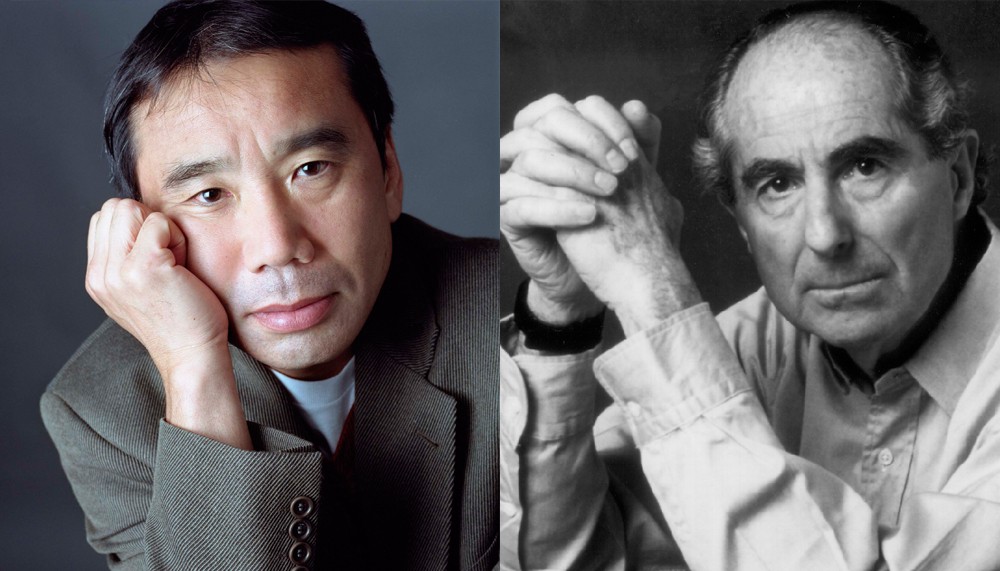
Haruki Murakami and Philip Roth Among Favorites for the Nobel Prize in Literature

The Swedish Academy is set to announce the winner of the 2015 Nobel Prize in Literature on Thursday, October 8, at 1pm local time in Stockholm. This year there were 198 nominations, including 36 authors who have never been nominated before. The members of the Nobel Committee for Literature have been studying the works of five authors, a list they whittled down from the 198 nominations.

The favorites to take the prize, according to betting firm Ladbrokes, are Belarusian Svetlana Aleksijevitj, Japanese Haruki Murakami, Kenyan Ngugi wa Thiong’o, Norwegian Jon Fosse, and Americans Joyce Carol Oates and Philip Roth. Another of this years betting favorites is Korean poet Ko Un, whose odds have shifted from 50/1 to 14/1. The 112th Laureate will join the ranks of Toni Morrison, Gabriel García Márquez, Tomas Tranströmer, and Derek Walcott. Although the prize is considered a great honor and comes with the generous sum of 8 million Swedish Kronor ($971 970), the list of literary greats snubbed by the Swedish Academy is as impressive as the list of the prize recipients.

Among the qualified nominators for the prize are members of the Swedish Academy, professors of linguistics or literature at universities and university colleges, and previous Nobel Laureates in Literature.

The 2015 Nobel season began on Monday with the winner in medicine, and continues today with the Nobel Prize in Physics. On Wednesday the winner in chemistry will be revealed, followed by the literature winner on Thursday, and lastly, on Friday the Nobel Peace Prize winner will be announced.

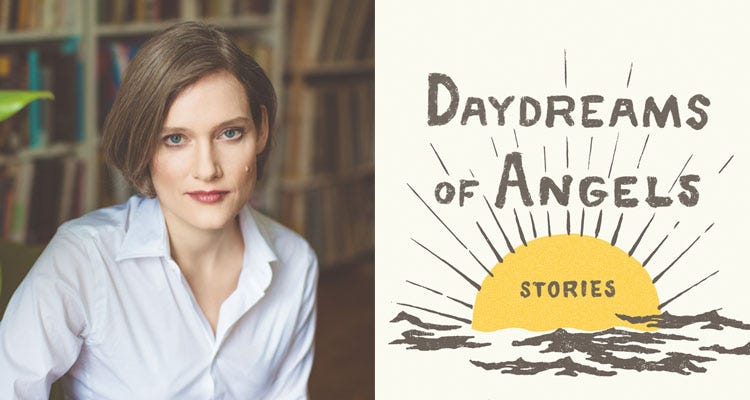
Looking for the Artistic Moment: An Interview with Heather O’Neill

by Melissa Ragsdale

“Swan Lake for Beginners” by Heather O’Neill is featured this week in Electric Literature’s Recommended Reading with an introduction from Diane Cooke. O’Neill’s new collection, Daydreams of Angels, is available in the US October 6th, 2015 from Farrar, Strauss, and Giroux.

Melissa Ragsdale: “Swan Lake for Beginners” and the many different Nureyev experiments ask the question, what creates an artist? With every variable the scientists manipulate, each generation of clones’ relationship to dance changes, and though they can recreate Nureyev’s body and mind, the scientists are ultimately unable to recreate his talent and passion. This evokes a debate that pertains to all artistic pursuits (including writing): the debate over whether success is the result of innate talent, or a result of hard work. And there’s another question there, about the role inspiration has to play in creating art. In your own experience, how do these apply to your life as a writer? How do you value them, on a more abstract level?

HO: This is a question that I’ve grappled with. I think that there is obviously a thing called talent. But that isn’t the only thing that makes an artist. There’s an illusion that art is easy.

There’s a sort of mad devotion that’s involved in becoming an artist. Artists make great sacrifices to do what they do. You can’t teach someone to be obsessive and passionate and consumed by their art. This is an absurd desire that has to come from within the artist.

It’s an act of resistance. You have to want to create something new. I think there’s something wild about that decision to live your life outside the box. It’s wonderful. That’s why we like artists’ biographies. It’s lovely to trace that original spark. We like to examine the artist as child — singing on a street corner in Paris, stuck in a workhouse, sitting in the back of a Chevrolet — and figure out when and where this child formed the determination to be great.

It’s always a mystery. The scientists in my story are looking for that moment and trying to recreate it.

MR: A follow up question, if it applies: do you see this story as having any kind of lesson or moral?

HO: It’s that there is a possibility that an artist may come from anywhere. I’ve always loved artists that appear out of nowhere, from unexpected circumstances, without anyone prompting them or encouraging them to take that path in life. We need artists coming from all sorts of backgrounds and classes — that’s how we understand the breadth of the human condition and all walks of life. So if there’s a moral, it’s that we have to look for and support and encourage artists who are coming out of odd backgrounds.

MR: Why did you choose Rudolf Nureyev as the vehicle of this story?

HO: I grew up in the 1980s. We all walked around as though we were ballet dancers, wearing leg warmers and our sweaters over one shoulder. I begged my dad to sign me up for jazz ballet classes above the grocery store. I’ve always adored the ballet. “The Dance of The Four Little Swans” in Swan Lake was a huge influence of me as a writer. I wanted to write in a way that was precise, repetitive, naïve, youthful, practically naked.

Nureyev was my favorite dancer of all. I was always obsessed with Nureyev. I remember him being on The Muppet Show as a kid. He was such a superstar then. And he always seemed cheeky and disdainful and arrogant. As a child you are always getting scolded for being openly miserable. Here was a man who was allowed to be dour and pissed off even though he was invited to be on such prestigious shows as The Muppet Show.

I loved his temperament. So part of the idea of choosing Nureyev as the figure to be cloned was that it was really funny to imagine a town that was filled with Nureyevs, all complaining about things and being vain and contrary and beautiful.

And then I chose him because he had the most wonderful and difficult biography. He was somebody who grew up under enormous hardship and had to struggle to be able to dance to be free. So it would be difficult for the scientists to discover how to recreate this tortured drive.

MR: Project Siberia takes place in such a curious setting: a French-Canadian town posing as a Siberian Russian town during the Cold War. What drew you to this particular cultural intersection?

HO: That was in part for humorous effect too. The landscape of Northern Quebec is a lot like that of Siberia. I liked the idea of the experiment being in my home province.

Each of the stories has a Montreal aspect or link. It’s a running theme. It’s because I spent my childhood in Montreal. And I think that every child — well, in a way every reader — when they are reading a text, supplies their own set of references. The meaning of any text will change given where it is read and according to the specific cultural references and beliefs or the reader. The attempt to find meaning in life is always going to be filtered by the cultural biases that we are seeing them through. So it was to make my authorship and the context and time that I was retelling these tales explicit.

I also liked the idea of a little kid from a working class Quebecois background finally reaching glory through the very refined art of ballet. Sort of mirrors the original Nureyev’s ascendance. And my own, really.

MR: In Daydreams of Angels, you use concoctions of fun/bizarre details to pull on real and serious threads of investigation. How do you balance the peculiar with the realistic?

HO: You don’t want everything to be randomly quirky and absurd. It’s more interesting if there is something real about the setting and the situations and the characters. And then the peculiar elements act as a sort of metaphor to highlight an existential question or conundrum that one of the characters is grappling with. Each story has to adhere to some magical laws. The worlds in the book applies the Laws of Physics of a seven-year-old girl. It was a world in which things that children believe to be real are actually real. Their dolls actually do get heart sick with grief when they are left alone.

***

Heather O’Neill’s first novel, Lullabies for Little Criminals, earned accolades around the world, including being named winner of Canada Reads 2007 and the Hugh MacLennan Prize for Fiction, and being a finalist for the Governor General’s Award for Fiction and the Orange Prize. Her second novel The Girl Who Was Saturday Night was a finalist for the 2014 Scotiabank Giller Prize. She is a regular contributor to CBC Books, CBC Radio, National Public Radio, The New York Times Magazine, The Gazette (Montreal) and The Walrus. She was born in Montreal, where she currently lives.

The Magic Behind The Artifice: An Interview With James Sie, Author Of Still Life Las Vegas

James Sie is a busy man. When he’s not writing, he’s acting and voicing characters in several popular cartoons and video games. His debut novel, Still Life Las Vegas (St. Martin’s Press, 2015), is a love letter to the mythical city in the desert. Sie’s work is interspersed with striking illustrations by Sungyoon Choi. In Still Life, Walter, 17, searches for the mother who abandoned him. Las Vegas provides a theatrical backdrop; Walter’s discoveries lead him to acceptance of himself, but also of the stories that his father told him so that they might survive. Details of deep human connection set this coming-of-age novel apart from others like it; Sie’s wit and wordplay also make it a treat for the ear.

I connected with James Sie recently over email to talk visions of Liberace, Lucy Liu’s accordion, and the mythical inspiration for his Las Vegas opus.

Heather Scott Partington: In Still Life Las Vegas, you write about tragedy without the story becoming tragic. How did the idea for this story come to you? Did you start with the accident that becomes a touchstone, or did you conceive of the novel some other way?

James Sie: First off, I’m glad you didn’t think it was tragic! Reading over it now, I do see that many dark circumstances befall my characters, but I honestly never thought of it a dark piece. It’s just kind of the way I see life.

Running, Vegas, accordion. It all unspooled from there.

I remember conceiving of the story through action: a woman, running away. Why was she running away? I had no idea. Then, I visited Las Vegas for the first time and thought that it would be a most interesting place to be running to. Then, I found out Lucy Liu played the accordion as a child, and the image of a little Chinese girl with a red accordion made things very interesting to me. Running, Vegas, accordion. It all unspooled from there.

HSP: This is a novel that blends many things: pop culture, art, mythology, and the relationship of fathers with their sons. Was there something from your own life as a parent or as a son that you felt it was important to include in Owen and Walter’s relationship?

JS: It’s funny — my father is almost the exact opposite of the father in the novel. My dad is sharp, decisive and almost maniacally positive, while Owen is fuzzy, plagued with self-doubt and mostly prone. So I didn’t look to him for example! I do think that when I began the book, I was a new father myself, and the instinct to protect your child at all costs, and the cost of not protecting your child, was always in the forefront of my mind. I have to say, I probably relate a little more to Emily as a parent than Owen — I am the one with the lists, the endless lists.

HSP: Liberace is also important to the story. I love that you included such an icon of Vegas opulence and, in a way, Vegas history. Talk to me about how that (and Emily’s vision of him) came to you.

JS: Liberace’s huge in my book! My first draft was actually titled “Liberace Under Venetian Skies.” I’ve made him the deity of Las Vegas, representing all the promise, and artifice, that Vegas has to offer. When I first visited the Liberace Museum (sadly, now defunct) I was struck by how emblematic a presence he was, back in his prime. He wasn’t the mincing punchline that many people think of today, but a much warmer presence. To Emily, he embodied both the hope of the past and a way out in the future. Because he was so much larger than life, it was easy for him to become the magical totem of the book.

HSP: Through Owen you are able to include a lot of Greek mythology. This gives some nice weight to the struggles of Walter to understand both himself and his place in his family. How does this connect to his understanding of his family’s mythology?

Because all family history is about storytelling.

JS: In a way, Still Life Las Vegas is all about family myths, our own origin stories, the stories that explain how we got to where we are. Because all family history is about storytelling. One of the big joys of writing the book was doing all the research into Greek mythology — not only the classic myths, like Orestes and Odysseus and Orpheus (I seemed to have covered all the mythological O’s!), but those from the more ancient, arcane religions in Greece. I loved layering these myths with family stories and even invented mythology to create a prism through which these characters view their past. Facts are their own kind of myths. And in order for Walter to break free from the past, he has to come to terms with that.

HSP: Still Life is filled with striking graphic art. Did you have a concept of how you wanted these pages before you found Sungyoon Choi, or was the artwork a collaboration that happened after she joined you to work on the novel?

JS: I had a clear idea of how I wanted the pages to look — the number of panels, where the captions would go, what the central images were — during my first drafts. I had pretty detailed scripts for those sections. But I realized early on that in order for me to sell this somewhat unique hybrid of prose/graphic novel, I had to have some finished samples to submit. I just happened to read a great graphic memoir called American Widow by Alissa Torres, and I was struck by the illustrations. On a whim, I emailed the illustrator, Sungyoon Choi, to see if she would be interested in working with me on the novel, and enclosed fifty pages. To my utter shock, she said yes. Sungyoon stuck with me for the years it took to find an agent, illustrating two complete graphic novel sections on spec. I might still be waiting around for an agent without those sections. And of course she instantly made my ideas better and more beautiful. It was a wonderful collaboration.

HSP: Vegas provides a rich backdrop and the opportunity to describe a cadre of colorful tourists and employees. Who was your favorite? What made it into the book that might surprise readers?

JS: Well, of course, I have to say that my personal favorite characters among the denizens of my Las Vegas is the brother/sister team of Greek living statue performers, Chrystostom and Acacia. The idea is that they are so exquisitely trained, they can change positions without anyone ever seeing them move; I’ve had fantasies about being able to do this. To have such control over your body… She is a diva and immensely fun to write for, and he is the beautiful, sexy avatar of every unrequited crush I’ve ever had.

I think the most surprising characters for the readers would be Little Bang and Big Bang, the flamboyant vandals of the Liberace Museum. They come out of nowhere, like they’ve stepped out of an Elmore Leonard heist, just as things are at their darkest, and take the book in a whole new direction.

HSP: Vegas is a place that’s false, but in a theatrical way — like what the tourists see is a staged environment created to keep them happy and not let them think too much about the real world. How did this factor into your story? Did it give you any particular opportunities or challenges?

Las Vegas is the ultimate city of reinvention. It creates its own myths fresh, daily.

JS: Las Vegas is the ultimate city of reinvention. It creates its own myths fresh, daily. When I visit Las Vegas, I am struck but how it appropriates every important cultural icon in the world for merciless exploitation — and yet, those icons still retain a bit of their potency. To be aware of the artifice and still find the true magic behind it, that’s the Las Vegas I wanted my characters to discover.

At the same time, I liked the opportunity to display what life is like beyond the Strip, where the only neon you see is in the distance: “Lady Luck turning it’s back to us.” That tension between the shiny, aspirational city we usually think of, and the grime of day-to-day behind it all was a great thing to play with.

HSP: I always like to ask this — a lot of people ask writers about their writing process, but I’m interested in your reading process, too. What did you read that influenced (or inspired) Still Life? What are you reading now?

JS: Like two sets of grandparents, my book found its roots in two genres. On the graphic novel side, I am beholden to Neil Gaiman, whose Sandman series serves up modern mythology of dizzying invention and soul-satisfying complexity (his examples of graphic novel scripts also helped me format a template for my own communication with the artist); and Alison Bechdel, who, in her memoir Fun Home, showed me just how emotionally complex and resonant a comic can be. On the prose side, John Irving’s The World According to Garp, a touchstone book for me, contains all the emotional darkness and wonder I strive for (plus amazing storytelling); and Margaret Atwood (Cat’s Eye, The Handmaid’s Tale) always dazzles in her writing — so poetic but so visceral at the same time; never an extraneous word.

What am I reading now? I’m a third of the way through The Paper Man by Gallagher Lawson — a strange, wonderful story about a man who is made of paper living in a fictitious quasi-European town where mermaid corpses are found on the streets and women smell of mushroom broth. It’s right up my alley. And I’ve just finished the graphic book called Here by Richard McGuire. It’s almost wordless, and it focuses your attention on one corner of a room from the beginning of time to the future — simultaneously. It’s pretty amazing.

HSP: What’s next for James Sie?

JS: I’m still doing a bit of touring for the book, and then I’m reworking an adaptation I did of A Wrinkle in Time for a production at Lifeline Theatre in 2016. After that, I hope to be settling down with a pack of Los Angeles coyotes and awaiting inspiration.

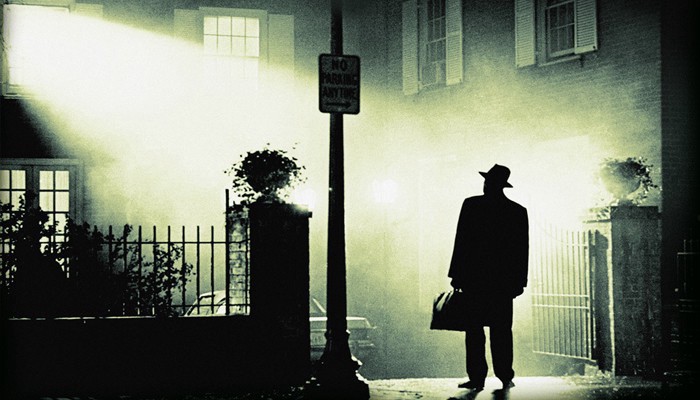
That Thing: A True Story Based on The Exorcist

I don’t know what my parents were thinking — somehow, for some reason, they let me watch The Exorcist when I was eight years old. When the movie first came out in 1973, there were stories about audience members fainting, puking, and fleeing the theater, but apparently my parents saw no problem with their prepubescent son taking a peek. We were all in the basement one night, channel-surfing, and there it was on TV. My parents put down the remote and for the rest of my childhood I failed to get a decent night’s sleep.

Needless to say, I grew up in a liberal household. Just like Chris MacNeil, the mother in The Exorcist, my mother was an actress. She was from a well-to-do Jewish family of doctors, lawyers, actors, and activists. My father, on the other hand, was the first member of his family to go to college. Determined to overcome his blue-collar background, he worked in an emergency room to pay his way through school. He studied literature, then went on to a doctoral program in music. He wrote his thesis on 17th century French Baroque opera, but at some point he gave up on the PhD. As he explained it, he got into advertising instead because “that’s where the money was,” but at home, his love for books and music endured.

Our living room was set up like this: all along the walls were shelves packed with books and CD’s; a pair of towering speakers, the size and shape of doors, stood at the far end. Bright golden wires snaked out the backs of the speakers and slithered under the carpet, leading to a wooden cabinet full of top-of-the-line audio equipment, blinking black boxes encased like relics behind the glass. Next to the cabinet sat a leather recliner — the old man’s throne. He’d sit there every evening, reading a thick hardcover and sipping a screwdriver while the sounds of the Classical, Baroque, and Romantic masters blasted through the house in high-definition. Every once in a while he’d set down his book, take off his reading glasses, and close his eyes, just listening.

It was dangerous to interrupt him, but not for the reasons you’re thinking. He wouldn’t get angry or tell me to get lost; he’d quiz me. “Who’s the composer, Ad?” he’d ask. I’d listen to the music for a while, then venture a guess. If the music was joyous: Mozart; if it was angry: Beethoven; regal: Hayden. If I heard an organ: Bach; a harpsichord: Corelli; a lone violin blazing up and down the scales: Vivaldi. If I guessed right, the old man would beam with pleasure and mess up my hair.

Conversations at dinner consisted mostly of lectures — music, literature, art, history, science. The old man knew everything. He even looked like a professor, stout and paunchy, with a huge, round head, and a thick multi-colored beard. He’d drone on and on about Winston Churchill or the big bang while both our eyes slowly glazed over, his from the screwdrivers, mine from boredom.

My father also had something in common with Chris MacNeil — he was an atheist. According to him, the universe was a well-ordered place, full of ugliness as well as sublime beauty, but knowable, adherent to certain rules. There was no god, no afterlife, no ghosts. I tried to keep this in mind when we finally retired for the night, but while the old man slept, comfortable and content with his understanding of the world, I was wide-awake in bed, absolutely certain I was about to be possessed by a demon.

My dreams were haunted by images from the movie. I’d see Linda Blair’s twisted, gnarled face and wake up in a sweat, unable to move, unable to sleep. A few times I was sure I felt my bed shake, just as Regan’s bed shook, and flee the room to go sleep on the living room couch. Some mornings my parents found me asleep on the floor of their bedroom. One morning I was missing completely, and after scouring the entire house they eventually found me crammed under my bed, fast asleep.

Why couldn’t I just understand, as my father understood, that it wasn’t real? That it was all in my head? I couldn’t shake the feeling that there was something real at the heart of my fear.

According to Carl Jung, dreams have a compensatory function. Recurring nightmares are the mind’s way of dealing with past trauma through repeated exposure. Clearly, I’d been traumatized by The Exorcist and was now reliving it night after night to diminish my fear. But Jesus, how long does that take? Why couldn’t I just understand, as my father understood, that it wasn’t real? That it was all in my head? I couldn’t shake the feeling that there was something real at the heart of my fear.

It probably didn’t help that one of the movie’s taglines was “Based on a true story.”

CHRIS:

Now, I want you to tell me you know for a fact that there’s nothing wrong with my daughter, except in her mind. You tell me for a fact that an exorcism wouldn’t do any good. You tell me that.

I went to college in Boston to study music, and continued living there after graduation. When I wasn’t practicing or in rehearsal, I’d go on long walks, listening to music on my headphones. One fall day I was walking around the Back Bay, the red, orange, and yellow leaves coloring the trees and crunching under my feet, when my mother called.

“Is everything okay?” I asked.

“Everything’s fine. We’re all fine,” she said, but I could tell from the sound of her voice that it wasn’t true.

“I just had a talk with your father,” she said.

My father had made a confession to her that day. He’d been getting the shakes — withdrawal symptoms from all the drinking. It was especially bad in the mornings, so he’d been sneaking sips from the bottle at work.

“He’s drinking at work?” I asked.

“Just a little. To stave off the withdrawal.”

“So, he’s an alcoholic.”

“He says not to worry, that he’s got it under control. He just wanted to let me know.”

The wind picked up and sent the fiery leaves swirling around me, and I felt the vertigo of revelation. I knew the real reason she’d called me. The old man and I were close. After a few years of estrangement, we’d recently rekindled our relationship. Unlike my brother, I’d come to share his love of books and music, and we’d bonded over these things in long talks and email exchanges. He loved to say how similar we were, how he was just like me when he was my age.

For most people, the old man was impossible to talk to. He believed he was smarter than everyone else, and was too proud and too stubborn to take anyone’s advice. Even now, finally admitting that he had a problem, he still insisted that he “had it under control.”

Even now, finally admitting that he had a problem, he still insisted that he “had it under control.”

My mother’s thinking was that if he were to listen to anyone, he would listen to me.

“Want me to call him?” I asked.

“Would you?”

After pacing aimlessly for a while, gathering my thoughts, I called the old man at work. I asked him about what I’d heard, and he admitted everything. He didn’t sound the least bit worried or ashamed. He voice was calm and reassuring.

“I appreciate your concern, Ad, but don’t worry. You’ve got your own life to worry about. You’re young. This is one of the best times of your life. Enjoy it. Don’t worry about me. I can take care of myself.”

In 2000 a new version of The Exorcist was released in the theaters, with never-before-seen footage and added special effects. I went, partly out of curiosity, partly to test myself. It had been a while since I’d last seen it, and I wasn’t sure how it would affect me, how much power it still had. My heart raced as I entered the theater and pounded as the lights went down. As the film began I felt the usual shivers and pangs of dread, but as it progressed my terror subsided. Something wasn’t right. In this new version, a few ghostly images had been added — flashes of the demon Pazuzu appearing in the dark corners of the house. They were unseen by the characters, solely for the audience’s benefit. To me, these flashes ruined the movie, and as the lights came up and I made my way out of the theater, I realized why.

Those images tell us right from the start what’s going on. If Chris MacNeil had known right away that a demon was the culprit and an exorcism the solution, it would have been like any other shitty, predictable Hollywood horror flick. But The Exorcist is different, because the emotional core of the story, the source of all that dread and terror and fear, is doubt.

But The Exorcist is different, because the emotional core of the story, the source of all that dread and terror and fear, is doubt.

No one believes that Regan’s troubles are supernatural; they are certain they are either physiological or psychological, but they can’t seem to pinpoint the cause. The root of Chris’s suffering is her helplessness in an absence of answers. Even Father Karras, her savior, doubts until the very end. Only during the climactic exorcism scene, when he sees Regan levitate above the bed, does he finally believe. Doubt is the demon that is vanquished in that moment. Until then, you could say that The Exorcist really isn’t a horror movie at all. At its heart, The Exorcist is a movie about illness.

My father confessed his problem to his partners at the ad agency. They suggested that he go to rehab, and of course the old man refused. He was the creative director and the sole copywriter; the agency needed him to function, but the old man didn’t budge. He assured them that he “had it under control.” But he didn’t, and the agency soon closed its doors.

Then the old man was at home, without a job, with nothing to do but drink. We fought and begged him to get help, only to be told, again and again, that he had it under control, while all the signs suggested otherwise.

For the MacNeils, the trouble began with booms and crashes in the attic. For my mother, the booms and crashes issued from the living room. The old man had fallen, she told me, resulting in a gash on his head. Then he fell again and broke his finger. One day he decided to clean his motorcycle. When my mother finally heard his cries for help, she ran outside to find him on the ground, pinned beneath the bike. She had to call the police to come lift it off. I decided it was time to come home.

The old man’s transformation seemed both gradual and sudden. His diet shrunk, his vodka intake increased. Walking became difficult, then dangerous. He continued to pass out mid-stride, suddenly turning white and collapsing. As he staggered from the couch to the kitchen, holding onto walls and bookcases for support, my mother followed behind him in a panic, carrying a chair to catch him in, asking again and again if he was all right. Eventually he stopped walking, for the most part. He spent most of the day in his throne, only now the stereo was silent. His eyes, instead of focusing on a book, wandered around the room in a daze.

No more screwdrivers, just straight vodka from two-liter plastic bottles stored in the freezer. They were empty in a day or two, and diligently replaced by my mother. “Why?” my brother and I asked. “Why in the hell do you buy it for him?”

“Why?” my brother and I asked. “Why in the hell do you buy it for him?”

Her answer was simple, and sounded well-rehearsed: she had no choice. If the old man tried to drive to the store himself, he’d kill somebody. If she hid the car keys, he’d have a seizure, and possibly die.

Before performing an exorcism, it must be determined by a qualified priest whether or not the possession is authentic. There are a few ways to do this. A victim speaking fluently in a language he or she has never studied, for example, serves as proof that an outside spirit is at work, as opposed to a disorder of the mind.

One evening, as my mother and I were serving ourselves dinner, the old man staggered into the kitchen. In a stained, wrinkled T-shirt and sweatpants, his hair plastered to his head with sweat, every part of his body swollen and mottled, he looked about eighty years old, though he was only fifty-eight. Wearing that dazed, content look on his face, he opened the freezer and refilled his glass, then slowly shuffled back to his throne.

I had to do something, but there was a question standing in the way. Was it was a conscious act, destroying himself like this, or was he powerless against the booze? If he was powerless, that meant we could help him. We could call an ambulance, get him to a hospital, check him into rehab. But what if he didn’t want our help? What if he wanted to die? I couldn’t tell if he was the victim or the perpetrator.

I put down my plate and followed him into the living room. He was on the couch, staring into space. There was no music playing, no open book in his lap, just the glass of vodka cradled in his hands. I pulled up an ottoman and sat across from him.

“Dad.”

His eyes floated around the room before landing in my direction. My mother quietly snuck into the room and sat silently in the corner.

“Dad,” I said. “Do you know how fucked up you are?”

His lips moved silently for a while before he managed a reply.

“Don’t… talk to me,” he said. He took the newspaper off the table and unfolded it.

“You’ll die if you keep this up, you know that?”

“Don’t talk to me.”

But I did talk to him. I talked to him at length, in great detail, telling him exactly what I thought. I yanked the newspaper from his hands and yelled in his face. I threatened to call the cops, to have him committed against his will. I told him that he was a sick, selfish, crazy bastard for doing this to himself and making us watch, for making my mother take care of him, for making her clean up his cuts and bruises and follow him around the house with chairs, making her go out and buy booze for him, even, hoping and praying that he’d stay put, that he wouldn’t walk around and pass out and crack his head open, wondering if she’d come home to find her husband lying facedown in a puddle of blood.

“That’s enough,” my mother said.

The old man was silent, his face blank. Locked in a dark room a million miles away. I gave up.

“Fine,” I said, turning to head out of the room. “Drink yourself to death if you want. I don’t give a fuck.”

CHRIS:

You show me Regan’s double, same face, same voice, everything, and I’d know it wasn’t Regan. I’d know in my gut. And I’m telling you that thing upstairs isn’t my daughter.

The old man moved from the couch in the living room to the couch in the den. Instead of reading or listening to music, he watched TV. He watched cooking shows, mostly, which was strange considering he never ate a thing except vodka. The room smelled like sweat and piss. He began wearing diapers, which my mother bought, and changed.

Illness is ugly. I learned that, watching my father deteriorate. Not just the bodily functions, although that was a big part of it. The real ugliness was the deterioration of his person. The things that came out of his mouth.

The real ugliness was the deterioration of his person. The things that came out of his mouth.

One day I went in to check on him, and he was watching a documentary about the Apollo 11 moon landing.

“You probably don’t remember,” he said. “You were just a baby.”

“I wasn’t born yet, Dad. I was born in ‘83.”

His eyes wandered around the room for a while, doing the math.

“So… you were just a baby.”

In horror movies the monster chases you, and you run. In The Exorcist the monster is just down the hall. It can’t chase you, because it’s strapped to the bed. You don’t run from it, you live with it. You walk down the hall and check on it.

“Did you know that your mother climbed Mt. Everest?”

“I think you were dreaming, Dad.”

“Nope. I heard it. They said it on TV.”

He once read for hours every day. He could rattle off the dates of every battle in WWII. He could explain quantum physics and general relativity. He could identify any piece of music after hearing the first three seconds. My father knew everything, and that thing in the other room was not my father.

One day the old man couldn’t stand up anymore. It scared him, and he finally agreed to go to the hospital. My mother called an ambulance and two paramedics came to the house. They moved the coffee table aside, brought in a stretcher and struggled to lift his massive, swollen body onto it. My mother and I followed them to the hospital, checked him into the ER, and waited.

A couple hours later the doctor brought us back to his room. Parting the curtain, we were shocked by what we saw. Under the blinding fluorescent lights, we could see for the first time how yellow his skin had become, how swollen his stomach and limbs.

“This is the final stages of alcoholism,” the doctor told us. What that meant, my mother explained on the car ride home, was that there was nothing they could do. Nothing but keep the old man comfortable, and wait.

After a week in intensive care, we brought him home. A hospital bed was set up in the den, facing the TV. We were given his medications, with instructions: benzodiazepines at regular intervals, and morphine for when it got really bad. Both were in liquid form, because his throat was too badly swollen for solids. He couldn’t eat, and was too drugged to speak. He slept, mostly, the TV remaining on at all times, to keep him company. Sometimes he coughed or moaned in pain. Sometimes he whimpered. Tears as thick as corn syrup rolled down his cheeks. A nurse came in the morning to clean him and check his condition. My mother and I watched, and waited.

Late one night I heard the old man groaning. My mother had already gone to bed, so I went in to check on him. In the dark room lit only by the blue flickers of the TV, the old man was struggling with the sheets, writhing in pain. I took the unopened glass bottle off the tray.

“Dad, are you in pain?”

He groaned.

“Do you want some morphine? I can give you some morphine if you want. Tell me what you want.”

“Morphine,” he whispered.

I unscrewed the bottle, measured out the dose with the dropper and put it in his mouth. He clenched it in his teeth and sucked it fiercely. I yanked the dropper away.

“Did you get it?” I asked.

“No,” he said.

I held the dropper up to the light of the TV. It was empty.

“You got it. You’ll feel better soon.”

“No I didn’t!”

His voice was suddenly clear, filled with a newfound strength that sickened me. I examined the tiny bottle, still full of purple liquid. The old man was in pain. We were all in pain. What was the point of letting it go on?

I’m still not sure why I didn’t do it. Maybe I decided it was wrong, or that it wasn’t my job, but more likely it was out of anger. It was that eagerness in his voice, reminding me that he wasn’t sick, was not a helpless victim. He was an addict. There was no evil spirit at work, just him. He did this to himself. To all of us.

KARRAS:

Why her? Why this girl?

MERRIN:

I think the point is to make us despair. To see ourselves as… animal and ugly. To make us reject the possibility that God could love us.

It wasn’t long before we went in to check on him and found a corpse in the bed. One look and it was clear that my father was gone. It was over, and I felt relief. Maybe that seems like a strange or horrible thing to admit, but it’s the truth. We knew there was no hope. There was nothing for us to do but watch and wait. It felt endless, all that watching and waiting, living day after day with that thing in the house, that sickness, that smell, that pain, that ugliness festering just down the hall, in that room I was afraid to enter. My worst childhood nightmares had quite literally come true, and now it was finally over. How could I feel anything but relief?

It’s been almost ten years since my father died. I try to remember him when he was well. I think about all his lectures about art and literature and history and science. I think about all those talks we had about books and music, how we used to sit together and listen to his favorite composers while he tried to convey to me the beauty of their work. I think about my first year of college, when my anxiety worsened and I began having panic attacks, how he reassured me. He told me that he had the same problem, that he’d had it his whole life, that it was one of the reasons he drank. He said it would always be with me, but I’d learn to cope, just as he had. He said life would be hard sometimes, but it would be okay because there is so much beauty in the world, in books, in music, in art, so many beautiful things to experience in life that make it all worth it.

I think about those words, and how little they meant in the end. How all the beauty in the world couldn’t compare to the bottle.

I still have nightmares, but they’re not about Linda Blair anymore, they’re about my father. The dream is always the same: he didn’t die; he recovered, but now he’s started drinking again.

Some say it’s a disease, just like any other disease. Others say it’s not a disease at all, because human beings have free will. Alcoholics have the power to choose to drink or not to drink, whereas true victims of disease have no choice in the matter. Some have compromised and called it “a disease of the will.”

A disease of the will — I find that label the most unsettling of all. We like to think of ourselves as separate from our illness. We like to blame an outside source, whether it’s evil spirits or microbes, anything foreign, anything outside ourselves. We love to pinpoint the cause, to point to that tumor, that gene, that trauma, and say, Aha! There’s your problem! It’s comforting, because it reminds us that we are not our illness. Its ugliness is not our ugliness. We have free will, but our bodies have wills of their own, and though your body will decay, as long as you retain your will, you will retain your humanity, your soul, that part of you that might still be loved.

But to think that even that can be infected, and changed, and taken away — that’s the thought that keeps me up at night.

Originally published at electricliterature.com on October 6, 2015.

The Edge of Our Own Horizons: The Heart Goes Last by Margaret Atwood

Margaret Atwood’s new novel, The Heart Goes Last, is set in a frighteningly possible future just over the edge of our own horizons. It features Stan and Charmaine, married and living in their car after a financial crisis so dire that it has torn whole cities apart, complete with downed power lines, depleted water supplies, and chaotic streets. The couple is afraid to venture out of their car at night for fear of being attacked and don’t leave it empty, as it might be stolen or vandalized. Their marriage survives on hasty, uncomfortable backseat sex and Charmaine’s work as a bartender in a surviving pub that caters mostly to the clients of the two prostitutes who’ve set up shop there.

It is at Charmaine’s job — hers, not his, a fact that Stan is acutely aware of — that she sees a commercial on television that seems to be speaking right at her: “Tired of living in your car?” it begins. Ed, the besuited talking head, is the founder of a new kind of city and advertises its comforts: neat little houses, king size beds, curtains, clean streets. “At the Positron Project in the town of Consilience… we offer not only full employment but also protection from the dangerous elements that afflict so many at this time. Work with like-minded others! Help solve the nation’s problems of joblessness and crime while solving your own! Accentuate the positive!” Striking a balance between practical and self-help, Charmaine is convinced, and she and a more dubious Stan apply to join, even though the two prostitutes at her bar don’t believe that anything could be so good. They believe there’s a catch. And, indeed, there is.

Stan and Charmaine ride a bus to the newly founded city where they are taken on a daylong tour of the place after which they have to decide whether to join or not. During the tour, men and women are separated at some parts, and as the novel alternates between Stan and Charmaine’s points-of-view, it is Stan we see during much of the tour, as he is the more skeptical of the two. He listens as Ed, the founder of the town, explains the model of the city: “CONSILIENCE = CONS + RESILIENCE. DO TIME NOW, BUY TIME FOR OUR FUTURE!” Ed admits that “the powers that be” have considered the model of Consilience/Positron to be an “infringement of individual liberties, an attempt at total social control, an insult to the human spirit.” Indeed, signing up is not like joining a gym; once you go in, you can’t come out. Ed’s reverse psychology is powerful, though — if he readily confesses to the criticism, it can’t be true, can it?

Ed begins to explain the dire situation of criminality in the country, using a PowerPoint presentation — all the more reason to see this world as close to ours — with graphs that prove his point, which is that prisons can be made to be useful. Rather than having convicts doing pointless jobs that often don’t contribute much, they could be working construction, cleaning, medical, agricultural jobs and more. And thus, the model of Positron was born, the brainchild of Ed and the silent woman who sits beside him. Her presence in this scene is foreboding, though it is only later that a reader will make this connection.

So what exactly is it that allows for the town of Consilience to be so perfect, so beautifully decorated and neat, so The Truman Show-, The Stepford Wives-, Pleasantville-, ‘50s-esque? The Consilience/Positron model is a switcheroo between prison and a life of comfort. Every person accepted to and entered into the city’s system spends one month in his or her luxurious family home or comfortable singleton apartment, where they have colored lockers. At the end of each month the residents put their personal effects into their own locker. Then they ride their scooters (the town is big on scooters — cars are for officials and high powered people only) to Positron, the prison, and voluntarily check themselves in. Men and women are divided into separate sections, where their jobs are helpful to the community. They grow food, take care of livestock, fold laundry, and are encouraged to take up healthy activities during their free time, such as yoga or knitting. During the month they are in prison, their alternates ride their own scooters to the house or apartment, unlock their own locker, and settle in for their month of living the luxurious and comfortable life. Alternates are never supposed to meet.

The system is seemingly perfect. Six months out of a year, you get to have a perfectly comfortable life. The other six months are still comfortable; Positron isn’t the kind of prison where stabbings occur, gang fights break out, and fear-mongering guards loom over every activity. No, it is a clean facility, with jobs aplenty, and the worst thing about it is that maybe it gets a little boring. But who isn’t bored half their life anyway? What could be so bad? This is where Atwood’s brilliance shines: she has us this close to being convinced to join ourselves.

Time is glossed over in the novel, and there is a feeling of urgency as Atwood sets up Stan and Charmaine into their steady life in Consilience/Positron, as if she’s just waiting to get to the good stuff, to the more powerful and painful moments. But when the curtain veiling the dramatic scenes to come finally drops, it feels, at first, like a cop-out. We find out that Charmaine has been cheating on Stan with a man who calls himself Max (she calls herself Jasmine). Max is Stan’s alternate, and his wife is Charmaine’s. A character cheating being used as a turning point is such an obvious narrative choice that it feels cliched. Skilled storyteller that Atwood is, however, she complicates matters very quickly, because Charmaine’s affair pales in comparison to the morally questionable job she holds at Positron as Chief Medications Administrator. In this position (more powerful than Stan’s, just as outside in the real world) she organizes shelves and makes sure everything is in its place, but her main responsibility is euthanizing former actual convicts, a role in which she sees herself as a benevolent angel of death.

Meanwhile, Stan begins to fantasize about Jasmine, whose note he finds under the fridge and which was meant to be for Max. When he eventually decides to wait at the house for her, certain she will tear his clothes off and schtup him silly since he’s created an erotic creature in his mind, he finds that there is no Jasmine. There is only Max’s wife, Jocelyn. Ed’s right hand woman. Stan sees her as being “on the short side, with straight hair down to her shoulders. Dark eyebrows. A heavy mouth, no lipstick. Black jeans and T-shirt. She looks like a dyke martial arts expert.” It is this woman, whose “sick fantasies” Stan has to enact (and which involves them schtupping each other silly, even though it’s not exactly what he imagined it would be like) who is the only true rebel of the flawed, dictatorial, and financially greedy Consilience. It is she who attempts to bring about a socially moral outcome. And it is she whom we, the readers, are programmed early on to hate.

From this point on, the novel becomes stranger, creepier, more disturbing, and as such more wonderful. Jocelyn uses Stan, keeps him out of Positron while making sure that Charmaine remains inside, but is deprived of her top level position as a kindly killer. Things begin to change in Positron as suddenly there are no real convicts to put to sleep anymore. What does a prison that euthanizes criminal elements do when it has no one left to kill? It begins to find the insurrection among its own people, of course.

Positron, central though it is to the novel and bizarre as it may be as a model for a perfect society, is not the creepiest thing about the whole enterprise. That honor lies in a warehouse where Ed has been developing a line of customizable sexbots. Even worse, he has developed a medical brainwashing technique that creates love and lust in a person’s brain by imprinting onto the first pair of eyes it sees (rather like ducklings, except not in the motherhood kind of way). One notorious example is femme fatale Victoria (one of the prostitutes from Charmaine’s bar) who falls for a blue knitted teddy bear instead of the man who had purchased her. She is considered a botched attempt, an accident. This makes her the perfect vehicle, however, to help Jocelyn, Stan, Charmaine, and the rest of Consilience, since she is unable to be seduced by anyone and has every reason to be furious, since she was the first to undergo this medical procedure which has rendered her a freak to most of society.

A citizen of the contemporary world, Atwood’s The Heart Goes Last is a riveting addition to her oeuvre in which she explores the idea of a powerful system and its discontents.

The Heart Goes Last

by Margaret Atwood

Powells.com