Novelette “A Guide to the Fruits of Hawai’i,” Alaya Dawn Johnson (F&SF 7–8/14)
Short Story “Jackalope Wives”by Ursula Vernon (Apex 1/7/14)
Ray Bradbury Award for Outstanding Dramatic Presentation Guardians of the Galaxy, Written by James Gunn and Nicole Perlman (Walt Disney Studios Motion Pictures)
Andre Norton Award for Young Adult Science Fiction and Fantasy Love Is the Drug, Alaya Dawn Johnson (Levine)
2015 Damon Knight Grand Master Award Larry Niven
Solstice Award Joanna Russ (posthumous), Stanley Schmidt
Co-dependency is the name of the game in Dasha Kelly’s novel, Almost Crimson. But there’s more to the story than the notion that Crimson, the novel’s main character, develops a co-dependent lifestyle in order to endure her mother’s long-lasting depression, or dysthymia. Crimson, or CeCe, as she’s called, is the child of an absentee father and Carla, a mother who struggles to function after her lover disappears. As a result, CeCe becomes the adult in her house at a very young age. Kelly tells this story in alternating chapters that show CeCe as a young girl, while looking ahead to her seemingly well-adjusted adulthood. Kelly offers her reader a chance for discovery, and this question drives the story: just how does Crimson come to survive her difficult childhood?
Kelly’s work is realistic in its portrayal of depression and its effect on a family, but the work is never sentimental or indulgent. Chapters narrated in a close third person from CeCe’s perspective have the quality of the young woman looking back. Kelly filters these observations through the poignant frustrations of the younger child. CeCe is bright, talented, and driven. But she’s handicapped by a mother that can’t drag herself out of bed:
CeCe knew her mother was being held down by the Sad when her eyes seemed to be searching for only faraway things. Her mother’s eyes were still seeing the closer-up things. In fact, her mother’s eyes were sharp, moving slowly from one passenger from the next. CeCe could tell from the hard lines of her jaw that her mother did not plan to love school like CeCe.
Kelly’s writing is an elegant mix of description and truth; she writes about a difficult family dynamic in a way that demonstrates her understanding of its complexity. Kelly respects her characters and treats them accordingly, even the damaged ones. There are no villains, per se, even in a story where characters’ bad choices make them easy to hate.
Well-meaning adults often try to offer bits of help to children leading difficult lives in broken homes. Almost Crimson shows us — with painful honesty — that sometimes these brief moments of assistance or care don’t amount to much. Though adults reach out to CeCe sporadically, she is mostly alone for the duration of her childhood. When she visits a summer camp — a temporary respite from having to be the adult at home — in the middle of the story, she finds that she doesn’t really fit in. “Befriending the girls made CeCe equally anxious,” we learn. “She couldn’t tell when she was having a conversation or being sized up.” What CeCe learns early in the story is to distrust intentions. Even the well-meaning grown-ups in her life don’t reach out enough — or for long enough — to change her confidence in adults.
Almost Crimson is about learning to survive in the system and working the system.
CeCe couldn’t list many things she’d ever been afraid of. Uneasy? Uncomfortable? Uncertain? Absolutely. All the time. But fear? She’d never had the luxury of being afraid. CeCe’d had to be brave and make complicated decisions for both of them her whole life. The thread of being ferreted away by social workers had made her afraid until she figured out how to answer their questions. CeCe hadn’t been afraid of much since.
The steadiest influences in CeCe’s life are the series of questioning adults who appear, ask questions, help for a minute, but eventually leave. Cece has to navigate even the checks and balances alone. Kelly shows us through her story that many of these kids’ coping mechanisms are merely responses to perceived threats — if not living with the dysfunctional parent, then the risk of being taken away from the parent. Neither is a good option.
Ultimately, Almost Crimson is a story about all the ways we handle anger and disappointment. Do we fight against it? Do we allow it to become a part of our being, driving us to bed as we withdraw from the world, like CeCe’s mother? Do we, as CeCe, allow it to move through us? As she progresses on her journey, CeCe first has to acknowledge her rage.
Cece also welcomed the fluidity of her anger. She sat on pained rocks behind the archer field where the six-year-olds tumbled and raced in the hot sun. CeCe allowed the rush of bitterness to course around inside her. CeCe didn’t hold her breath to stop it. She didn’t resist its steady leaning against her thoughts. She didn’t reject the way her rage sated her. By the time she boarded the yellow bus departing Camp Onondaga, CeCe had fury tucked beneath her tongue.
It isn’t until CeCe allows herself the indulgence of anger — of really feeling her feelings — that she begins to understand why her life has turned out differently than the lives of other children. This is a crucial part of her development, and a necessary step in the growth of character that she’s able to achieve in later chapters.
Almost Crimson becomes, eventually, a story of self-discovery and awakening. Though much of the book focuses on the damage done to CeCe in her childhood, Kelly writes a hopeful tale. CeCe is an example of how one can come from difficult beginnings and still blossom into confidence.
He describes the planet earth with its trees and low buildings wheeling past the sun
I picture him in the plastic lawn chair at the head of the driveway
a thistle growing in the crack beside his beer bottle
leaving a wet ring on the blonde cement
The tenuous frail night landing like a paper airplane in a field of high corn
Then fireflies Then mosquitoes pulling iron from his veins
Moon Seen Through Windshield
If you are anything like I am and I have faith that you are then you have already stepped out of your body and been irrevocably wounded
I was born in 1969 Chances are you were born during a different year It doesn’t matter if you were born three thousand years ago
or if you are born three thousand years from now we share what it means to live
Maybe you have gone back into your body
and found words the only guide into the known dark
We are both the living and the dead the stuff beyond theory
Sometimes it is too much and other times not enough
We wake to a morning fog We wake to morning sun
We sit in a cold evening thinking of the death of a parent During a different cold evening we think of our eyes and how they crawled out of our minds
at some point in the evolution of the self
It is the evening of the first day of a new year I ask myself what have you done The list is remarkable
Black Snow
From my mother’s funeral I brought back Illinois
I brought back a ring and a necklace I brought black snow
I brought a sense of cruelty and rage that felt fair to inflict on each moment
I brought back a new calendar where the days were ten times longer
and had to be opened using tweezers on a dial with a six digit combination
Moonlit Glass
I miss everyone. I miss my friend Matthew and his appetite for acceptance, his kindness, exuberance, his way of making me happy in a world that snows. I miss my mother, who’s first birthday after her death is today. I miss the red maple in her front yard giving its leaves to October. I miss my brother who says the kitchen, not the bedroom, is the great room of intimacy. I miss the sky because I once read Hikmet list the cosmos as something he didn’t know he loved. I’ve spent the day discovering things I want and things I don’t want wear the same clothes. I miss my ex, would still spend an afternoon with her talking, would still sleep with her if she wanted to lose her grasp of language in a mess of blue sheets. I spent my youth in church not believing but feeling unified after service, liking the white cars in the lot and the dogs behind the chain link. Tonight, on the shelf, a glass moose figurine holds in its left antler a tiny reflection of the moon that is somehow shooting through and illuminating its whole body. It reminds me of how I used to think of blood as its own being, as a creature searching for a way out. I take the moose from the shelf. It goes dark in my hand. It has no eyes, has no ears or mind. It has no mouth, but then it’s mother never had children.
Estrangement
I live in your umbrella standing on a sea of dirt. The white light of noon blasting like a bullhorn.
Hello, and welcome to my week-by-week review of everything in the world. Today I am reviewing Yelp.
As someone who believes strongly that a star-based rating system is the best possible method for communicating the complexity and inherent worth of something, I can’t help but love a review web-site like Yelp.
It’s everything the internet was meant to be — a democratic platform where all opinions are equal, from intelligent, educated professionals with well-rounded life experiences, to narcissists with undiagnosed emotional issues. Everyone’s opinion is just as important as everyone else’s. Except for convicted felons. That’s why they’re not allowed to vote in elections. I wish Yelp would denote which opinions come from felons so I could skip right past those.
My most trusted Yelp reviewer is Deborah H. You’ve probably read some of her work. She writes primarily restaurant reviews — paragraph after paragraph of her personal and intimate thoughts about each dish with clear and thoughtful descriptions such as “tasty” or “too much salt.” If she doesn’t like a restaurant she won’t hold back. Some of her anger-fueled reviews are her best work. They make me feel like I was right there with her when the waiter took too long to refill her water.
I can tell Deborah is dedicated just by the sheer volume of reviews she’s written. To-date she’s contributed over two hundred. I would imagine she’s put in cumulatively a few weeks worth of her life. Good job, Deborah! Yelp must be where a lot of professional food critics get their start.
Don’t be overwhelmed. If you want to find out if a business is worth your time and an eight-paragraph treatise is too much of a commitment for you, there are plenty of shorter reviews such as, “This place sux [sic] no easy parking.” Another helpful one I read was, “Never coming back worst ever.”
If you have opinions you want people to look at, Yelp is the place for you. There are people just waiting to hear what you think! In a way, it’s a disservice to the general public to not tell them what you think of something.
BEST FEATURE: Photo after photo of the exact same dish taken from a slightly different angle by a variety of cell phones. WORST FEATURE: No printed editions of Yelp, which would be perfect for reading in bed or while on vacation.
Please join me next week when I’ll be reviewing the worst spaghetti I’ve ever eaten.
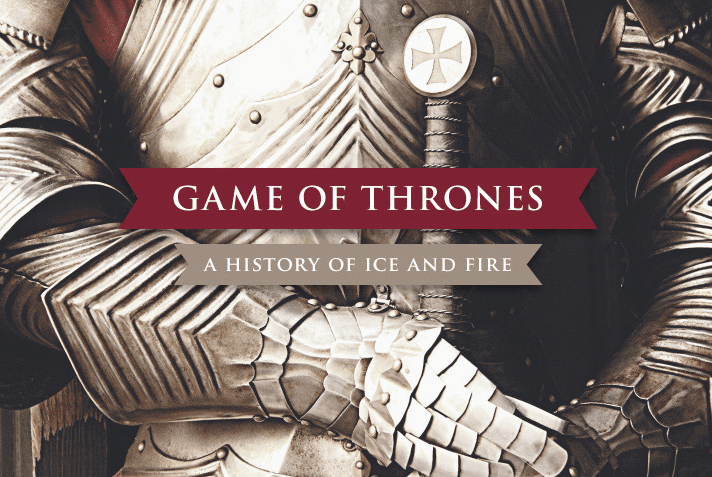
George R. R. Martin’s epic fantasy series A Song of Ice and Fire and the corresponding HBO show Game of Thrones feature perhaps the most talked about fictional world, but did you know that they both draw from actual history? This infographic from insideonline takes a look at what elements correspond to actual historical groups, people, and events (minus the dragons and evil ice elves of course):
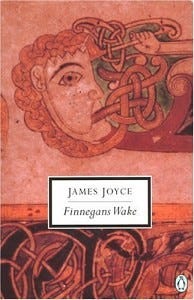
Dai Congrong spent eight years translating the first third of James Joyce’s Finnegans Wake into Chinese, a book the Guardian refers to as “famously opaque.” It’s so opaque that even native English speakers often struggle with it, making its Chinese translation seem nearly impossible to accomplish.
According to the Guardian, Joyce’s work was originally shunned under Mao Zedong as “bourgeois western literature.” A Portrait of the Artist as a YoungMan, for example,wasn’t translated into Chinese until 1975.
But Dai Congrong, associate professor of comparative literature at Shanghai’s Fudan University, watched in awe as her translation of Finnegans Wake — or “Fennigan de Shouling Ye” — hit number two on Shanghai bestseller lists and sold out its first print run of 8,000 copies in two months. Its appeal may be directly related to the book’s unconventionality and shock value. The NY Times reports that Chinese readers “love the way it lacks a coherent narrative and plot…”
Joyce’s first sentence (“riverrun, past Eve and Adam’s, from swerve of shore to bend of bay, brings us by a commodius vicus of recirculation back to Howth Castle and Environs”) takes up three lines in Dai’s Chinese translation, but requires 17 lines of footnotes. Dai writes footnotes for about 80% of words translated in order to explain their cultural background.
The entire book’s translation will likely take many more years to complete, but Chinese readers will eagerly anticipate its publication.
A writer or filmmaker or conceptual artist that renders serious subject matter seriously is said to possess gravitas. Such work asserts a strong gravitational pull, has mass, and often because of its own self-seriousness, can prove to be heavy lifting. But the effort involved in engaging such art will supposedly make the reader or viewer a better, stronger person, of bona fide moral fiber. Against this aesthetic, how could an Eric Satie or John Cage not assert their difference and independence, proposing instead a lack of weight, a lightness; and in place of egoistic assertion of artistic virtuosity, a relaxed playfulness? Lightness is an underrated virtue, after all. It often requires a more restrained application of skill.
The housing market and financial crash of 2008–2009 would seem a subject resistant to light, comic analysis. But the book under review here, Ryan Ridge’s American Homes, attempts to do just that, indirectly. A satire of The American Dream, as embodied by that archetypal carrot-dangled-before-the-American-Worker, the tricked-out suburban home, Ridge’s book explores the contradictions inherent in ideals of affluence and ownership, and does so admirably, without edging into sourness or satirical revenge killing. The humor is affable, and odd. Somewhere between Demetri Martin and Steven Wright, Jacques Tati and Wes Anderson, Ramόn Gόmez de la Serna and Georges Perec. Where his previous collection of stories, Hunters & Gamblers, owed much to the poetry and uncollected stories of David Berman, American Homes pushes beyond that early influence, and is the stronger for it.
A hybrid text divided into three parts (“Part III”, “Different Rooms/Different Voices”, and “Ideas”), the book combines poetry, aphorisms, cartoons, and prose. Though united by theme and a logic of progression, its disparate elements work off each other like players in a improv group: the emphasis, above all else, is on humor, quick sometimes-silly sometimes-biting one-liners.
It opens with a paragraph-long paratactic list of things it aspires to be:
American Homes is a book. American Homes is an idea. American Homes is a book of ideas. American Homes is just beginning. American Homes is about to end. American Homes is the foundation of all unions. American Homes is the soundtrack to our American lives…
The tone is flat, mimicking a variety of dead language sources, from sound-bites gleaned from political sloganeering, to the dud pitches of late-night infomercials. Here and elsewhere throughout the book, Ridge inserts groupings of such statements, satirizing the surfaces of affectless, contentless speech. The effect of reading these sections is deliberately self-defeating, the declarative sentences so featureless and bland, one can’t help but gloss over them.
Following this opening invocation, though, the book’s first and longest section, “Part III”, takes this ironized authorial distance and pushes it to extremes of deadpan, inspired nonsense. Divided up into sections addressing different functional parts of a home — porch, roof, garage, doors, windows, etc. — Ridge, working as an architectural mythographer of sorts, creates origin stories of their creation and their many uses. Under a section titled “Skylights”, for example, where a reader might expect a straight-laced matter-of-fact description of skylights and their function, they’re met with:
Skylights (also referred to as “Sun Tunnels”) are thresholds to the sky. During the Dark Ages travelling salesmen went door-to- door selling skylight bulbs. Later, in the primitive era of American Homes, Skylights were simply called “Shitty Roofs.” “I believeth there is a gaping cavity in your roof, gentle neighbor,” one colonist said to another. “Ah, but that is a Sun Tunnel,” said the other. “I purchased it cheap from a Frenchmen. It adds natural light to my American Home!” The first colonist stepped back, considered it; “I’ll be damned. Leave it to the French.”
Subversion of the mundane is Ridge’s basic approach. Proceeding like a taxonomist and archivist of suburban domestic space, he works to prove the promise of explanatory coherence is largely a goof and a red herring.
Except for a few passing jabs at rednecks and some brief references to the Civil Rights Movement or to symbols of executive power and grotesque displays of affluence, American Homes is less interested in exploring these themes directly than in creating perversions of semantic and logical connection between those ideas and symbols which represent them. In a section titled “Garage”, garages are defined as “havens for teenaged guitarslingers as well as middle-aged dreamers.” Yet also:
Garages are the places where wildly successful American entrepreneurs start out. Tragically, they’re also the places where severely depressed American Homeowners end up. R.I.P..
This is as sharp and direct as Ridge gets, a quick, muted reference to a reality many have or haven’t been able to live through, foreclosed, unemployed, bankrupt. “A Stairway is a metaphor for life,” the opening to one section reads, “but life is not a metaphor for a Stairway.” What follows, of course, is intricate, associative nonsense. But among the nonsense are gnomic references to capitalist ideals of “getting ahead” and “climbing the ladder.” Ridge’s final word on the matter is an illustration of an air guitarist slicing his wrists open, strumming a non-existent Les Paul. Beneath it, the caption: “One man’s Stairway to Heaven is another man’s Staircase to Hell.” Mortgage payments and gainful employment are silent partners here. Instead of elaborating the point, Ridge lets his fidelity to realism work its way to the surface through laughter.
The book’s second and third sections read as supplements to that larger first chapter. There are funny, weird turns of thought and phrase throughout. But after the polished, mock-systematic approach of what preceded them, they seem provisional, less focused.
The book’s second section, “Different Rooms/Different Voices”, breaks away from taxonomical prose to repurpose autobiography and history in free verse. Allusions to literary and pop culture icons appear as frequently as punchlines. The last section, “Ideas”, is less ornate, more direct: a list of suggested innovations and observations about home upkeep and ownership. The conceit of “Ideas” has strong potential, but on the whole, this section isn’t as perceptive or as developed. Then again, maybe it’s a latent desire for gravitas, which expects comprehensive, bold flourishes at the end of a book. Overturning such expectations, Ridge doesn’t finish things with large statements or sweeping gestures. Instead, American Homes’ final chapter is mostly given over to white space of the page, offset by a few tightly constructed, whimsical aphorisms. That he’d chose to end it with small phrases, too small to hold any serious proclamations, seems fitting, given his disregard throughout the book for any kind of patriotic heroism.
On its final page there is an illustration of a single story house, the living room curtains drawn back. A trail of smoke is rolling from the chimney. Above the house, no clouds, no stars. Beneath the drawing there is a caption, the maxim “Per aspera ad astra.” Following this drawing is a four-page index, listing everything of relevance to be found in the book; the final entry in the index: “Zen koan.” Comedy is more incisive than tragedy, ironic bemusement more thoughtful than outrage: Ridge understands this. He has a way of writing from this position, and has a book, American Homes, to show for it.
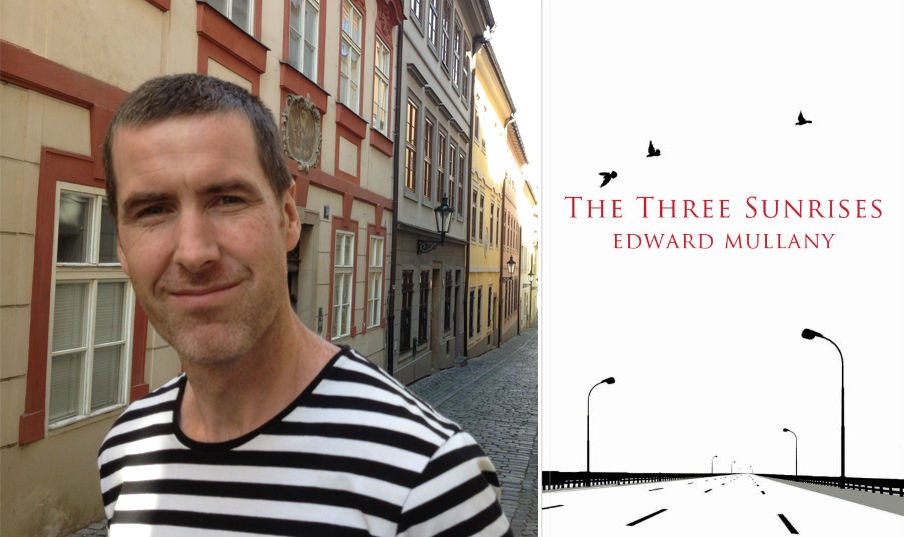
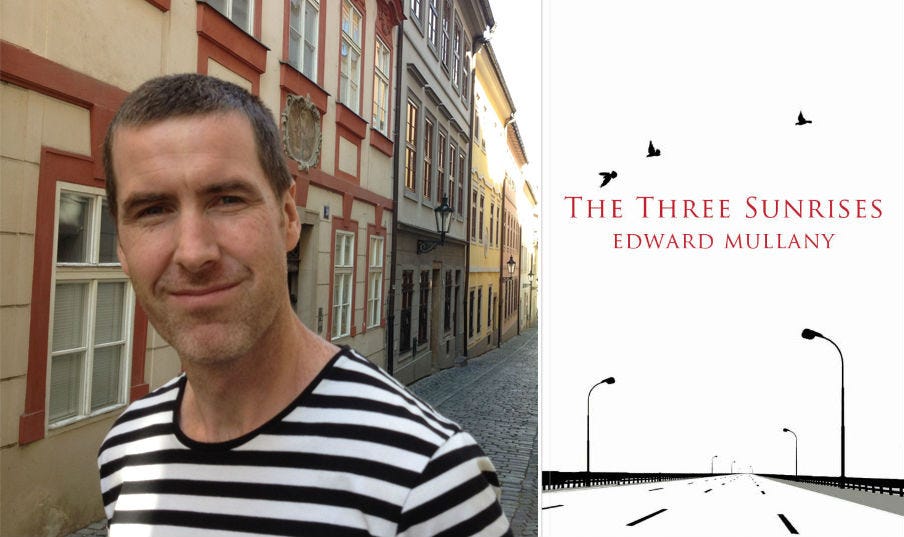
Edward Mullany’s third book, The Three Sunrises, will be published this month. A collection of three novellas, it is the final installment in a trilogy that began with If I Falter at the Gallows and Figures for an Apocalypse (Publishing Genius). Mullany is also the artist behind the online comic strip Rachel & Ben, which appears each Saturday at the arts site Real Pants. His writing has a philosophical and religious bent to it, much like his artwork. For several weeks, Mullany and I exchanged emails about his haunting new book. We talked about death, the afterlife, and the similarities and differences between ‘madness’ and mental illness.
Annette Hakiel: Your first two books (If I Falter at the Gallows and Figures for an Apocalypse) focused on poetry and micro-fiction as a form. What inspired the move towards the longer and more narrative forms you use in The Three Sunrises?
Edward Mullany: The voice that started talking out of me when I wrote The Three Sunrises had a lot to say — more, maybe, than the voices that spoke from me when I wrote the first two books. That is one way of looking at it. This doesn’t mean I was letting the voice talk willy nilly, or to ramble. There has to be a degree of control involved. A writer doesn’t control it, exactly, but hears what it is saying in absence of language, and then translates (or puts down on paper) that voice, in language. That is the difficulty, the art. The difference between someone who is rambling and someone who is practicing an art is that the artist shapes a chaotic impulse into order, whereas the person who rambles does not. (I believe this is true even when considering a writer like Kerouac, who described much of what he did as spontaneous writing). Talent always involves technique.
Also, though, to answer the question another way — I think I simply grew into the longer form. Meaning, until I wrote The Three Sunrises, the shorter form seemed most natural to me. Which might mean that the ‘voice’ I hear (as a muse or impulse or what-have-you) is always the same, and that what in fact changes, over time, is my mode of expression.
AH: As your mode of expression has changed, are there any themes or overriding concerns that you find have persisted in your work? For example, your books seem to convey a powerful sense of loss, or imminent disaster. Is this something you attribute to your voice/muse, or is this something you feel you have control over as an artist?
A writer’s obligation is to technique. Everything else arrives on its own.
EM: The themes that persist in my work I do attribute to the voice I hear, though I don’t think that voice operates entirely outside of my personality. By which I mean every artist’s muse is related to that particular artist, and maybe is a sort of psychic or spiritual appendage in which the artist has buried all the preoccupations that are too dangerous for him or her to encounter directly. I say “dangerous”, and I mean that in a relative way (for suicide or self-harm is the only consequence of these preoccupations that I can think of that could be practically described as dangerous). But I do think that the repressing or burying that almost all people do, and that artists more commonly allow themselves access to, suggests that something is at stake. The important thing to notice, in regard to the work itself, is that you don’t think about what these preoccupations are as you work — they simply arrive there, in the shadow or ghost of the plots that you write. A writer’s obligation is to technique. Everything else arrives on its own.
AH: Who do you consider to have influenced you? Is Paul Auster an influence?
EM: Paul Auster is an influence, though he’s maybe not the writer who has influenced me most. Of his books, I’ve read only The Music of Chance and the first two books of The New York Trilogy (which I love, even though I haven’t finished it) and which I knew about and thought about long before I began reading it. What I mean is that I’d heard of The New York Trilogy before I ever had a copy of it in my possession, which I know is not unusual (I’d heard friends discussing it or recommending it, the way people do). And during that time, whenever I heard it mentioned, I would think about the book and would wonder about it. And what I imagined that book to be, before I obtained a copy, had an effect on me, even if what it eventually revealed itself to be, when I began reading it, was different than what I’d imagined it to be.
Blake Butler tells a story (I think in his memoir about insomnia, called Nothing) about how he once kept a copy of IT by Stephen King in his bedroom, when he was a teenager, and how he never actually read the book but let it sit there in his room — maybe thinking he was going to read it, but never getting around to it. And so the book, as an object, assumed a kind of haunting power. And he describes how that situation or relationship (between him and the book, or between him and what he knew or imagined the book to be about) came to represent something just as potent for him, creatively or psychologically, as if he had in fact read the book. There is an influence, then, that can be a sort of imagined influence — between the person who feels it and the work of art that precipitates it. And the tone or vibe of this imagined influence is different than the influence that would result from a more direct contact with the artwork in question. Which is weird, I think, but also wonderful. Because it reveals how influence itself is a complex, varied thing.
AH: I find it very interesting about the concept that an artwork or book is significant perhaps just as much as the words within it. Perhaps this is true also of religious texts. How has Christianity influenced your work? The bible? The idea of the bible?
EM: There’s a branch of study in Christianity called eschatology (from the Greek — the study of ‘end things’, or ‘last things’). I feel like I’m a religious writer insofar as I’m an eschatologist. This doesn’t mean I think I’m a good person (I don’t), but rather that I tend to observe the world through this theological lens. It’s a consequence of how I was raised, but also of what I’ve come to believe. I qualify it this way because I know it isn’t true that how a person is raised always corresponds to that which a person comes to believe. A person can be raised Catholic, and, by adulthood, identify as an atheist. And faith cannot reach its fullness, either, unless it is doubted.
There is an urgency in my faith, even if my faith is also measly and inadequate.
My point is that Catholicism colors most of my conscious perceptions. Or, I should say, it colors the conscious processing of that which I perceive. Suffering has meaning to me mainly because I understand it in the context of what I believe about human history. If I didn’t believe in the Resurrection — that God was incarnate in the world, as the second person of the Trinity; that he suffered and died, and that he, the Son, was resurrected — I would be in despair more frequently than I am. There is an urgency in my faith, even if my faith is also measly and inadequate.
I recognize the arguments against faith in general, and against Catholicism in particular. But I’ve made my peace with those arguments. Or, rather, I’ve made my peace with allowing them to exist in a space in my mind that is reserved for things that I won’t be able to resolve, or reconcile. I accept that this is part of human experience — not being able to understand, or comprehend, paradox.
This is a long way of saying — yes, Christianity has influenced my work.
AH: I think I might ask something about mental illness and your book. I know I was coming out of psychosis when I was reading it, so my memory of it is shaded by voices, as well as the topic of mental illness (in terms of the Legion figure…I’m wondering if he’s mentally ill). Do you mind talking about that? Has your life been affected by mental illness?
EM: I think mental illness is thematically present throughout The Three Sunrises, though I would use the term “madness”, as it is less clinical, and therefore does not close itself off as conclusively to the spiritual realms to which I believe it is related. By madness I mean the consequence of not knowing whether that which you are experiencing is actual, or an hallucination — real, or paranoia. And by “thematically present” I mean that I think madness is the state in which all of the characters in my book at one time or another find themselves. And I think that this theme arrives in my work as a result of my own preoccupation with the fundamental problems of existence.
I say “problems”, and I guess you could call them that, though I don’t think, in the end, I actually see them as problems. Or, rather, I see them as problems only when I view them through that very human perspective that is not, to my mind, separable from original sin. I mean that even under circumstances that might be described as ‘fine’ or ‘everyday’, humans tend to recognize existence as a ‘problem’ because we are a fallen creature. We are no longer in paradise. And we have ‘knowledge’ — can observe, judge, and compare. Which is one reason we suffer. The further we return to a state of not wishing for that which we do not have, the less of a ‘problem’ existence becomes. A Christian is also a Buddhist in this sense.
The character in the novella, Legion, is perhaps the most obviously mentally ill. And yet is he mentally ill? The title of the story, as well as the epigraph from which the title is taken, suggests that he is not ill, but is, rather, demonically possessed. Which one might say is distinct from mental illness. In the former, maleficent spiritual beings take possession of one’s body, in order that they might have one’s soul for eternity. In the latter, the conditions of life (or of a personality) cause chemical imbalances in the brain; the soul is left untouched. Outwardly, the two cases might look similar. But fundamentally they are different.
I can’t speak to whether my intention, or design, with respect to Legion, succeeded. And I don’t mean to suggest that I had much of an intention or design to begin with. I do think all art is ordered — that it contains order within it — but much of the intention that reveals itself through that ordering originates in the subconscious. You see what you have made, and what you are making, but you don’t see it fully until you are finished. And even then you can never quite apprehend it.
AH: Death seems a prevalent theme throughout these works… what do you think of the idea of an afterlife — one that your own soul might possess as well as those of works of literature? My first impression when reading The Three Sunrises was that, with the dead mother figure, it was a signal towards a more (godless) existential philosophy (ala Camus’ The Stranger). Were ideas of fate or free will at work in your mind, even in the background, while working on this book? And finally, was it difficult to write the ending?
I tend to speak of my personal experience with mental illness in terms of religion, which I guess is weird?
EM: I wanted to say more about mental illness (in answer to your previous question), but I wasn’t sure how. Let me add this. I tend to speak of my personal experience with mental illness in terms of religion, which I guess is weird? I’m not sure exactly. I have a difficult time differentiating between guilt (which I think of as a genuine spiritual condition) and self-loathing (which, at best, is an unhealthy aberration of that spiritual condition). I often don’t know, in the course of any day, if it is my conscience that is speaking to me (for the right reasons) or if it is my mind attacking itself, like a poison. It’s a cause of distress and unease for me. And I think that’s probably another reason why I write what I write about. I often feel confusion, paranoia and sorrow.
A friend who has read the book has described it as “apophatic”, which refers to the belief that God can only be known to humans through negation — through an articulation of what He is not. I like this description, and I mention it in response to your question — “what do you think of the idea of an afterlife” — because I think it suggests that I do believe in an afterlife; insofar as a belief in God (even one that depends on knowledge obtained only through negation) implies that one also believes in an afterlife. And I do believe in an afterlife, though the Catholic theology I would profess does not happen to be apophatic (it is the opposite, in fact — cataphatic). But the way a writer writes, and what that writer believes, do not always mirror each other precisely.
It is through this of lens belief, anyway, that the book’s preoccupation with death might be understood. The presence of death is complicated by the presence, or possibility, of what awaits a person after death. This is evidenced by the reappearance of the mother (in Legion) after she has died. It is evidenced also by the ‘undeath’ of the skeletons throughout The Book of Numbers. And it is evidenced, finally, I would say, in The Three Sunrises (the last novella), by the presence of the Castle, and the epilogue that follows the narrator’s experience of the Castle. I can’t tell you exactly what the Castle means, because it is too ambiguous an image to surrender itself completely to comprehension, but I think its appearance in the story is infused with the supernatural. And throughout the book, I think, the horrors of the physical world are related to some groan, or mumble, that has its origins in a spiritual realm. In this way, temporality is harangued, even assaulted, by the nearness of eternity.
AH: The book is composed of three different novellas. Did you intend for them always to be together as you wrote them? Which one did you write first? What about the shifts in perspective?
EM: I wrote the three novellas during the consecutive summers of 2012, 2013, and 2014. I wrote The Book of Numbers first, though its placement in the book is second. I didn’t know what it was when I wrote it. I thought it was pretty strange to read, and I was conscious of how strange it had felt to write. So I thought at first that maybe it would not be published, and I was ok with that. I mean that if I had not written the next two novellas, and I hadn’t then seen The Book of Numbers in light of what those other two novellas were, not submitting it for publication might have seemed natural. But I see now that the meaning of the entire book (not just that novella alone) arises partly from the way the three novellas interact with each other. Their similarities and differences form a terrain that is made of the same dirt.
AH: I find writing can sometimes be a solitary exercise. Have you found a community of writers you share ideas with or respond to?
EM: Different parts of the internet are where writers respond to each other now. I mean instead of gathering in bars or wherever they used to gather, though they still do that too. But I think solitude is good for writers, because it allows them to confront their own conscience, and to dwell in their own imaginative space long enough that, when they approach the actual ‘making’ or ‘doing’ of their art, they do so in a way that is personal and original. Too much solitude can be bad, of course, but only insofar as the effect of that solitude is loneliness, as opposed to some inward, creative dreaming.
As a person, for relief of solitude, you need friendship and love. But in your capacity as a writer, what you need when you’re not writing are books to read, or other forms of art to encounter, so that, during the times when you have written all you can, your mind is absorbing things it can respond to, subconsciously, when you return to your work.
I guess it is possible to imagine a sort of hermetic writer who is holed up in a cave somewhere, writing not to be read by others, or for posterity, but only as a form of time-passing, or devotion. That kind of writer might have no need for reading, or for the history of art. They would be interested more in a conversation with themselves, or with God, conducting it in a language or with symbols that might be childlike and artless, significant only to themselves. But most writers are interested in artifice — in creating a thing that is separate from themselves and that reflects the times in which they live; a thing that is created with a consciousness of what previous writers have already done, and that speaks to other people (readers) in a way that feels not like journaling, or hymn-making, but like a dramatization of reality that has been arranged, or ordered, with an inward coherence, a design.
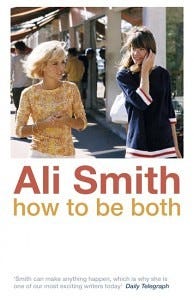
Three cheers for Ali Smith, the winner of the 2015 Baileys Women’s Prize for Fiction for her novel How to be Both. Sponsored by Britain’s favorite cream-based liqueur (“a brand loved by women”), the BWPFF aims to cast female writers into the literary limelight — a glittering circle of prizewinners that tends to suffer from a notable lack of estrogen. Before receiving the BWPFF, How to be Both had lost out on the Man Booker Prize and the Folio Prize, which ended up going to Richard Flanagan’s The Narrow Road to the Deep North and Akhil Sharma’s Family Life respectively.
Past recipients of the BWFF include Lionel Shriver in 2005 for We Need to Talk About Kevin, and Zadie Smith for her 2006 novel, On Beauty. This year, Smith bested Rachel Cusk, Laline Paull, Kamila Shamsie, Anne Tyler, and Sarah Waters to win the £30,000 prize (equivalent to about 2,088 bottles of Bailey’s Original Irish Cream).
The Shortlist:
Rachel Cusk, Outline Laline Paull, The Bees Kamila Shamsie, A God in Every Stone Ali Smith, How to be Both Anne Tyler, A Spool of Blue Thread Sarah Waters, The Paying Guests
Sign up for our newsletter to get submission announcements and stay on top of our best work.
YOUR INBOX IS LIT
Enjoy strange, diverting work from The Commuter on Mondays, absorbing fiction from Recommended Reading on Wednesdays, and a roundup of our best work of the week on Fridays. Personalize your subscription preferences here.