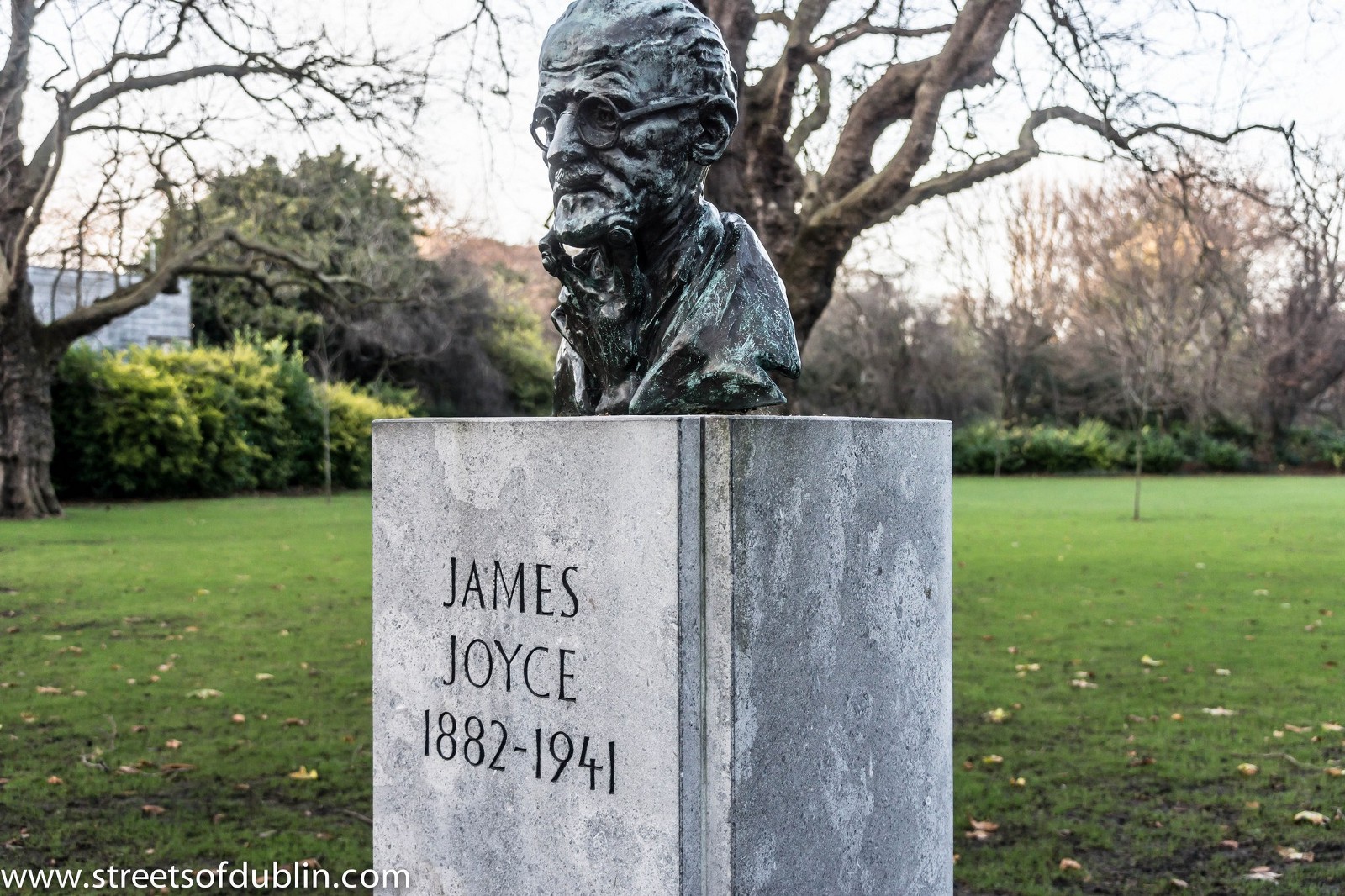
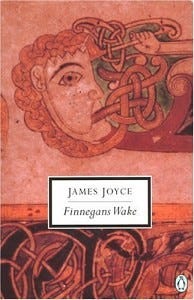
Dai Congrong spent eight years translating the first third of James Joyce’s Finnegans Wake into Chinese, a book the Guardian refers to as “famously opaque.” It’s so opaque that even native English speakers often struggle with it, making its Chinese translation seem nearly impossible to accomplish.
According to the Guardian, Joyce’s work was originally shunned under Mao Zedong as “bourgeois western literature.” A Portrait of the Artist as a YoungMan, for example,wasn’t translated into Chinese until 1975.
But Dai Congrong, associate professor of comparative literature at Shanghai’s Fudan University, watched in awe as her translation of Finnegans Wake — or “Fennigan de Shouling Ye” — hit number two on Shanghai bestseller lists and sold out its first print run of 8,000 copies in two months. Its appeal may be directly related to the book’s unconventionality and shock value. The NY Times reports that Chinese readers “love the way it lacks a coherent narrative and plot…”
Joyce’s first sentence (“riverrun, past Eve and Adam’s, from swerve of shore to bend of bay, brings us by a commodius vicus of recirculation back to Howth Castle and Environs”) takes up three lines in Dai’s Chinese translation, but requires 17 lines of footnotes. Dai writes footnotes for about 80% of words translated in order to explain their cultural background.
The entire book’s translation will likely take many more years to complete, but Chinese readers will eagerly anticipate its publication.
A writer or filmmaker or conceptual artist that renders serious subject matter seriously is said to possess gravitas. Such work asserts a strong gravitational pull, has mass, and often because of its own self-seriousness, can prove to be heavy lifting. But the effort involved in engaging such art will supposedly make the reader or viewer a better, stronger person, of bona fide moral fiber. Against this aesthetic, how could an Eric Satie or John Cage not assert their difference and independence, proposing instead a lack of weight, a lightness; and in place of egoistic assertion of artistic virtuosity, a relaxed playfulness? Lightness is an underrated virtue, after all. It often requires a more restrained application of skill.
The housing market and financial crash of 2008–2009 would seem a subject resistant to light, comic analysis. But the book under review here, Ryan Ridge’s American Homes, attempts to do just that, indirectly. A satire of The American Dream, as embodied by that archetypal carrot-dangled-before-the-American-Worker, the tricked-out suburban home, Ridge’s book explores the contradictions inherent in ideals of affluence and ownership, and does so admirably, without edging into sourness or satirical revenge killing. The humor is affable, and odd. Somewhere between Demetri Martin and Steven Wright, Jacques Tati and Wes Anderson, Ramόn Gόmez de la Serna and Georges Perec. Where his previous collection of stories, Hunters & Gamblers, owed much to the poetry and uncollected stories of David Berman, American Homes pushes beyond that early influence, and is the stronger for it.
A hybrid text divided into three parts (“Part III”, “Different Rooms/Different Voices”, and “Ideas”), the book combines poetry, aphorisms, cartoons, and prose. Though united by theme and a logic of progression, its disparate elements work off each other like players in a improv group: the emphasis, above all else, is on humor, quick sometimes-silly sometimes-biting one-liners.
It opens with a paragraph-long paratactic list of things it aspires to be:
American Homes is a book. American Homes is an idea. American Homes is a book of ideas. American Homes is just beginning. American Homes is about to end. American Homes is the foundation of all unions. American Homes is the soundtrack to our American lives…
The tone is flat, mimicking a variety of dead language sources, from sound-bites gleaned from political sloganeering, to the dud pitches of late-night infomercials. Here and elsewhere throughout the book, Ridge inserts groupings of such statements, satirizing the surfaces of affectless, contentless speech. The effect of reading these sections is deliberately self-defeating, the declarative sentences so featureless and bland, one can’t help but gloss over them.
Following this opening invocation, though, the book’s first and longest section, “Part III”, takes this ironized authorial distance and pushes it to extremes of deadpan, inspired nonsense. Divided up into sections addressing different functional parts of a home — porch, roof, garage, doors, windows, etc. — Ridge, working as an architectural mythographer of sorts, creates origin stories of their creation and their many uses. Under a section titled “Skylights”, for example, where a reader might expect a straight-laced matter-of-fact description of skylights and their function, they’re met with:
Skylights (also referred to as “Sun Tunnels”) are thresholds to the sky. During the Dark Ages travelling salesmen went door-to- door selling skylight bulbs. Later, in the primitive era of American Homes, Skylights were simply called “Shitty Roofs.” “I believeth there is a gaping cavity in your roof, gentle neighbor,” one colonist said to another. “Ah, but that is a Sun Tunnel,” said the other. “I purchased it cheap from a Frenchmen. It adds natural light to my American Home!” The first colonist stepped back, considered it; “I’ll be damned. Leave it to the French.”
Subversion of the mundane is Ridge’s basic approach. Proceeding like a taxonomist and archivist of suburban domestic space, he works to prove the promise of explanatory coherence is largely a goof and a red herring.
Except for a few passing jabs at rednecks and some brief references to the Civil Rights Movement or to symbols of executive power and grotesque displays of affluence, American Homes is less interested in exploring these themes directly than in creating perversions of semantic and logical connection between those ideas and symbols which represent them. In a section titled “Garage”, garages are defined as “havens for teenaged guitarslingers as well as middle-aged dreamers.” Yet also:
Garages are the places where wildly successful American entrepreneurs start out. Tragically, they’re also the places where severely depressed American Homeowners end up. R.I.P..
This is as sharp and direct as Ridge gets, a quick, muted reference to a reality many have or haven’t been able to live through, foreclosed, unemployed, bankrupt. “A Stairway is a metaphor for life,” the opening to one section reads, “but life is not a metaphor for a Stairway.” What follows, of course, is intricate, associative nonsense. But among the nonsense are gnomic references to capitalist ideals of “getting ahead” and “climbing the ladder.” Ridge’s final word on the matter is an illustration of an air guitarist slicing his wrists open, strumming a non-existent Les Paul. Beneath it, the caption: “One man’s Stairway to Heaven is another man’s Staircase to Hell.” Mortgage payments and gainful employment are silent partners here. Instead of elaborating the point, Ridge lets his fidelity to realism work its way to the surface through laughter.
The book’s second and third sections read as supplements to that larger first chapter. There are funny, weird turns of thought and phrase throughout. But after the polished, mock-systematic approach of what preceded them, they seem provisional, less focused.
The book’s second section, “Different Rooms/Different Voices”, breaks away from taxonomical prose to repurpose autobiography and history in free verse. Allusions to literary and pop culture icons appear as frequently as punchlines. The last section, “Ideas”, is less ornate, more direct: a list of suggested innovations and observations about home upkeep and ownership. The conceit of “Ideas” has strong potential, but on the whole, this section isn’t as perceptive or as developed. Then again, maybe it’s a latent desire for gravitas, which expects comprehensive, bold flourishes at the end of a book. Overturning such expectations, Ridge doesn’t finish things with large statements or sweeping gestures. Instead, American Homes’ final chapter is mostly given over to white space of the page, offset by a few tightly constructed, whimsical aphorisms. That he’d chose to end it with small phrases, too small to hold any serious proclamations, seems fitting, given his disregard throughout the book for any kind of patriotic heroism.
On its final page there is an illustration of a single story house, the living room curtains drawn back. A trail of smoke is rolling from the chimney. Above the house, no clouds, no stars. Beneath the drawing there is a caption, the maxim “Per aspera ad astra.” Following this drawing is a four-page index, listing everything of relevance to be found in the book; the final entry in the index: “Zen koan.” Comedy is more incisive than tragedy, ironic bemusement more thoughtful than outrage: Ridge understands this. He has a way of writing from this position, and has a book, American Homes, to show for it.
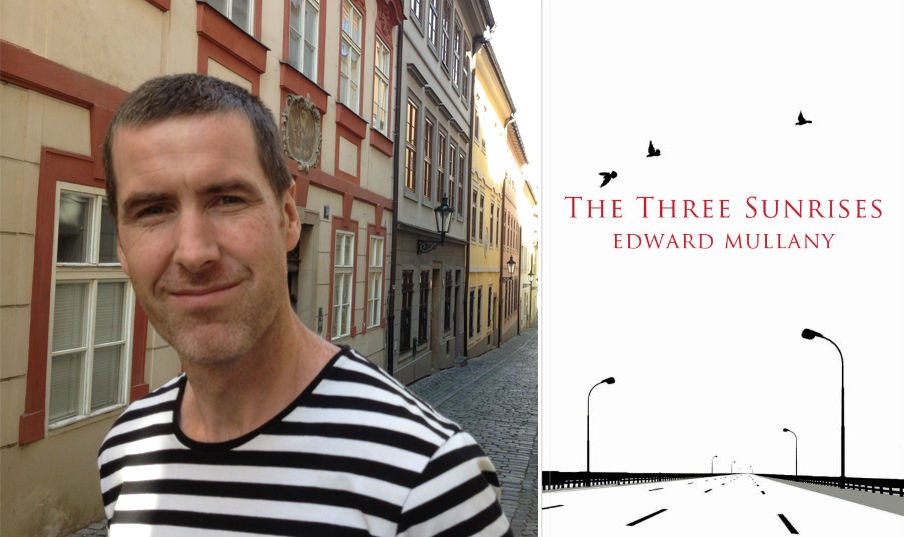
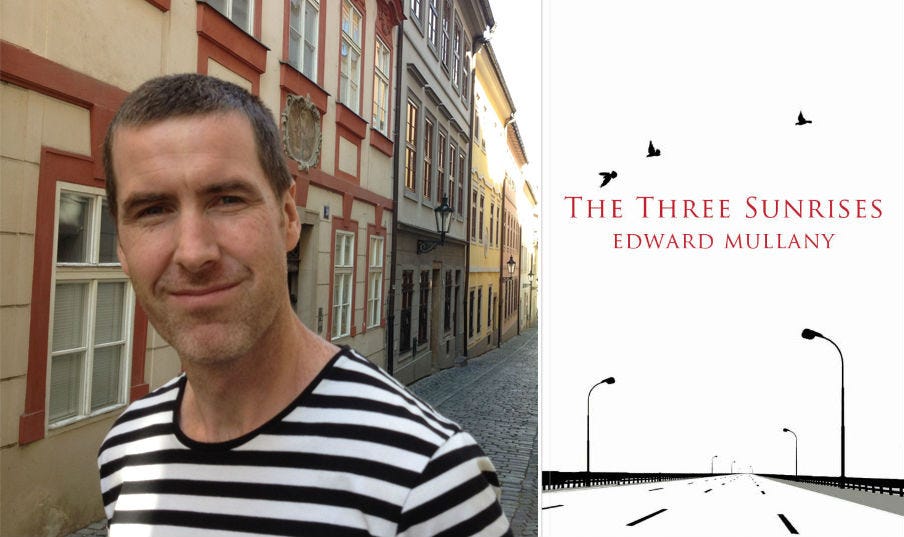
Edward Mullany’s third book, The Three Sunrises, will be published this month. A collection of three novellas, it is the final installment in a trilogy that began with If I Falter at the Gallows and Figures for an Apocalypse (Publishing Genius). Mullany is also the artist behind the online comic strip Rachel & Ben, which appears each Saturday at the arts site Real Pants. His writing has a philosophical and religious bent to it, much like his artwork. For several weeks, Mullany and I exchanged emails about his haunting new book. We talked about death, the afterlife, and the similarities and differences between ‘madness’ and mental illness.
Annette Hakiel: Your first two books (If I Falter at the Gallows and Figures for an Apocalypse) focused on poetry and micro-fiction as a form. What inspired the move towards the longer and more narrative forms you use in The Three Sunrises?
Edward Mullany: The voice that started talking out of me when I wrote The Three Sunrises had a lot to say — more, maybe, than the voices that spoke from me when I wrote the first two books. That is one way of looking at it. This doesn’t mean I was letting the voice talk willy nilly, or to ramble. There has to be a degree of control involved. A writer doesn’t control it, exactly, but hears what it is saying in absence of language, and then translates (or puts down on paper) that voice, in language. That is the difficulty, the art. The difference between someone who is rambling and someone who is practicing an art is that the artist shapes a chaotic impulse into order, whereas the person who rambles does not. (I believe this is true even when considering a writer like Kerouac, who described much of what he did as spontaneous writing). Talent always involves technique.
Also, though, to answer the question another way — I think I simply grew into the longer form. Meaning, until I wrote The Three Sunrises, the shorter form seemed most natural to me. Which might mean that the ‘voice’ I hear (as a muse or impulse or what-have-you) is always the same, and that what in fact changes, over time, is my mode of expression.
AH: As your mode of expression has changed, are there any themes or overriding concerns that you find have persisted in your work? For example, your books seem to convey a powerful sense of loss, or imminent disaster. Is this something you attribute to your voice/muse, or is this something you feel you have control over as an artist?
A writer’s obligation is to technique. Everything else arrives on its own.
EM: The themes that persist in my work I do attribute to the voice I hear, though I don’t think that voice operates entirely outside of my personality. By which I mean every artist’s muse is related to that particular artist, and maybe is a sort of psychic or spiritual appendage in which the artist has buried all the preoccupations that are too dangerous for him or her to encounter directly. I say “dangerous”, and I mean that in a relative way (for suicide or self-harm is the only consequence of these preoccupations that I can think of that could be practically described as dangerous). But I do think that the repressing or burying that almost all people do, and that artists more commonly allow themselves access to, suggests that something is at stake. The important thing to notice, in regard to the work itself, is that you don’t think about what these preoccupations are as you work — they simply arrive there, in the shadow or ghost of the plots that you write. A writer’s obligation is to technique. Everything else arrives on its own.
AH: Who do you consider to have influenced you? Is Paul Auster an influence?
EM: Paul Auster is an influence, though he’s maybe not the writer who has influenced me most. Of his books, I’ve read only The Music of Chance and the first two books of The New York Trilogy (which I love, even though I haven’t finished it) and which I knew about and thought about long before I began reading it. What I mean is that I’d heard of The New York Trilogy before I ever had a copy of it in my possession, which I know is not unusual (I’d heard friends discussing it or recommending it, the way people do). And during that time, whenever I heard it mentioned, I would think about the book and would wonder about it. And what I imagined that book to be, before I obtained a copy, had an effect on me, even if what it eventually revealed itself to be, when I began reading it, was different than what I’d imagined it to be.
Blake Butler tells a story (I think in his memoir about insomnia, called Nothing) about how he once kept a copy of IT by Stephen King in his bedroom, when he was a teenager, and how he never actually read the book but let it sit there in his room — maybe thinking he was going to read it, but never getting around to it. And so the book, as an object, assumed a kind of haunting power. And he describes how that situation or relationship (between him and the book, or between him and what he knew or imagined the book to be about) came to represent something just as potent for him, creatively or psychologically, as if he had in fact read the book. There is an influence, then, that can be a sort of imagined influence — between the person who feels it and the work of art that precipitates it. And the tone or vibe of this imagined influence is different than the influence that would result from a more direct contact with the artwork in question. Which is weird, I think, but also wonderful. Because it reveals how influence itself is a complex, varied thing.
AH: I find it very interesting about the concept that an artwork or book is significant perhaps just as much as the words within it. Perhaps this is true also of religious texts. How has Christianity influenced your work? The bible? The idea of the bible?
EM: There’s a branch of study in Christianity called eschatology (from the Greek — the study of ‘end things’, or ‘last things’). I feel like I’m a religious writer insofar as I’m an eschatologist. This doesn’t mean I think I’m a good person (I don’t), but rather that I tend to observe the world through this theological lens. It’s a consequence of how I was raised, but also of what I’ve come to believe. I qualify it this way because I know it isn’t true that how a person is raised always corresponds to that which a person comes to believe. A person can be raised Catholic, and, by adulthood, identify as an atheist. And faith cannot reach its fullness, either, unless it is doubted.
There is an urgency in my faith, even if my faith is also measly and inadequate.
My point is that Catholicism colors most of my conscious perceptions. Or, I should say, it colors the conscious processing of that which I perceive. Suffering has meaning to me mainly because I understand it in the context of what I believe about human history. If I didn’t believe in the Resurrection — that God was incarnate in the world, as the second person of the Trinity; that he suffered and died, and that he, the Son, was resurrected — I would be in despair more frequently than I am. There is an urgency in my faith, even if my faith is also measly and inadequate.
I recognize the arguments against faith in general, and against Catholicism in particular. But I’ve made my peace with those arguments. Or, rather, I’ve made my peace with allowing them to exist in a space in my mind that is reserved for things that I won’t be able to resolve, or reconcile. I accept that this is part of human experience — not being able to understand, or comprehend, paradox.
This is a long way of saying — yes, Christianity has influenced my work.
AH: I think I might ask something about mental illness and your book. I know I was coming out of psychosis when I was reading it, so my memory of it is shaded by voices, as well as the topic of mental illness (in terms of the Legion figure…I’m wondering if he’s mentally ill). Do you mind talking about that? Has your life been affected by mental illness?
EM: I think mental illness is thematically present throughout The Three Sunrises, though I would use the term “madness”, as it is less clinical, and therefore does not close itself off as conclusively to the spiritual realms to which I believe it is related. By madness I mean the consequence of not knowing whether that which you are experiencing is actual, or an hallucination — real, or paranoia. And by “thematically present” I mean that I think madness is the state in which all of the characters in my book at one time or another find themselves. And I think that this theme arrives in my work as a result of my own preoccupation with the fundamental problems of existence.
I say “problems”, and I guess you could call them that, though I don’t think, in the end, I actually see them as problems. Or, rather, I see them as problems only when I view them through that very human perspective that is not, to my mind, separable from original sin. I mean that even under circumstances that might be described as ‘fine’ or ‘everyday’, humans tend to recognize existence as a ‘problem’ because we are a fallen creature. We are no longer in paradise. And we have ‘knowledge’ — can observe, judge, and compare. Which is one reason we suffer. The further we return to a state of not wishing for that which we do not have, the less of a ‘problem’ existence becomes. A Christian is also a Buddhist in this sense.
The character in the novella, Legion, is perhaps the most obviously mentally ill. And yet is he mentally ill? The title of the story, as well as the epigraph from which the title is taken, suggests that he is not ill, but is, rather, demonically possessed. Which one might say is distinct from mental illness. In the former, maleficent spiritual beings take possession of one’s body, in order that they might have one’s soul for eternity. In the latter, the conditions of life (or of a personality) cause chemical imbalances in the brain; the soul is left untouched. Outwardly, the two cases might look similar. But fundamentally they are different.
I can’t speak to whether my intention, or design, with respect to Legion, succeeded. And I don’t mean to suggest that I had much of an intention or design to begin with. I do think all art is ordered — that it contains order within it — but much of the intention that reveals itself through that ordering originates in the subconscious. You see what you have made, and what you are making, but you don’t see it fully until you are finished. And even then you can never quite apprehend it.
AH: Death seems a prevalent theme throughout these works… what do you think of the idea of an afterlife — one that your own soul might possess as well as those of works of literature? My first impression when reading The Three Sunrises was that, with the dead mother figure, it was a signal towards a more (godless) existential philosophy (ala Camus’ The Stranger). Were ideas of fate or free will at work in your mind, even in the background, while working on this book? And finally, was it difficult to write the ending?
I tend to speak of my personal experience with mental illness in terms of religion, which I guess is weird?
EM: I wanted to say more about mental illness (in answer to your previous question), but I wasn’t sure how. Let me add this. I tend to speak of my personal experience with mental illness in terms of religion, which I guess is weird? I’m not sure exactly. I have a difficult time differentiating between guilt (which I think of as a genuine spiritual condition) and self-loathing (which, at best, is an unhealthy aberration of that spiritual condition). I often don’t know, in the course of any day, if it is my conscience that is speaking to me (for the right reasons) or if it is my mind attacking itself, like a poison. It’s a cause of distress and unease for me. And I think that’s probably another reason why I write what I write about. I often feel confusion, paranoia and sorrow.
A friend who has read the book has described it as “apophatic”, which refers to the belief that God can only be known to humans through negation — through an articulation of what He is not. I like this description, and I mention it in response to your question — “what do you think of the idea of an afterlife” — because I think it suggests that I do believe in an afterlife; insofar as a belief in God (even one that depends on knowledge obtained only through negation) implies that one also believes in an afterlife. And I do believe in an afterlife, though the Catholic theology I would profess does not happen to be apophatic (it is the opposite, in fact — cataphatic). But the way a writer writes, and what that writer believes, do not always mirror each other precisely.
It is through this of lens belief, anyway, that the book’s preoccupation with death might be understood. The presence of death is complicated by the presence, or possibility, of what awaits a person after death. This is evidenced by the reappearance of the mother (in Legion) after she has died. It is evidenced also by the ‘undeath’ of the skeletons throughout The Book of Numbers. And it is evidenced, finally, I would say, in The Three Sunrises (the last novella), by the presence of the Castle, and the epilogue that follows the narrator’s experience of the Castle. I can’t tell you exactly what the Castle means, because it is too ambiguous an image to surrender itself completely to comprehension, but I think its appearance in the story is infused with the supernatural. And throughout the book, I think, the horrors of the physical world are related to some groan, or mumble, that has its origins in a spiritual realm. In this way, temporality is harangued, even assaulted, by the nearness of eternity.
AH: The book is composed of three different novellas. Did you intend for them always to be together as you wrote them? Which one did you write first? What about the shifts in perspective?
EM: I wrote the three novellas during the consecutive summers of 2012, 2013, and 2014. I wrote The Book of Numbers first, though its placement in the book is second. I didn’t know what it was when I wrote it. I thought it was pretty strange to read, and I was conscious of how strange it had felt to write. So I thought at first that maybe it would not be published, and I was ok with that. I mean that if I had not written the next two novellas, and I hadn’t then seen The Book of Numbers in light of what those other two novellas were, not submitting it for publication might have seemed natural. But I see now that the meaning of the entire book (not just that novella alone) arises partly from the way the three novellas interact with each other. Their similarities and differences form a terrain that is made of the same dirt.
AH: I find writing can sometimes be a solitary exercise. Have you found a community of writers you share ideas with or respond to?
EM: Different parts of the internet are where writers respond to each other now. I mean instead of gathering in bars or wherever they used to gather, though they still do that too. But I think solitude is good for writers, because it allows them to confront their own conscience, and to dwell in their own imaginative space long enough that, when they approach the actual ‘making’ or ‘doing’ of their art, they do so in a way that is personal and original. Too much solitude can be bad, of course, but only insofar as the effect of that solitude is loneliness, as opposed to some inward, creative dreaming.
As a person, for relief of solitude, you need friendship and love. But in your capacity as a writer, what you need when you’re not writing are books to read, or other forms of art to encounter, so that, during the times when you have written all you can, your mind is absorbing things it can respond to, subconsciously, when you return to your work.
I guess it is possible to imagine a sort of hermetic writer who is holed up in a cave somewhere, writing not to be read by others, or for posterity, but only as a form of time-passing, or devotion. That kind of writer might have no need for reading, or for the history of art. They would be interested more in a conversation with themselves, or with God, conducting it in a language or with symbols that might be childlike and artless, significant only to themselves. But most writers are interested in artifice — in creating a thing that is separate from themselves and that reflects the times in which they live; a thing that is created with a consciousness of what previous writers have already done, and that speaks to other people (readers) in a way that feels not like journaling, or hymn-making, but like a dramatization of reality that has been arranged, or ordered, with an inward coherence, a design.
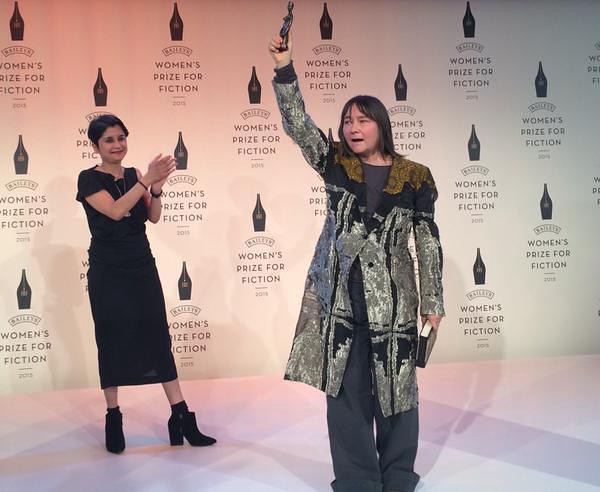
Three cheers for Ali Smith, the winner of the 2015 Baileys Women’s Prize for Fiction for her novel How to be Both. Sponsored by Britain’s favorite cream-based liqueur (“a brand loved by women”), the BWPFF aims to cast female writers into the literary limelight — a glittering circle of prizewinners that tends to suffer from a notable lack of estrogen. Before receiving the BWPFF, How to be Both had lost out on the Man Booker Prize and the Folio Prize, which ended up going to Richard Flanagan’s The Narrow Road to the Deep North and Akhil Sharma’s Family Life respectively.
Past recipients of the BWFF include Lionel Shriver in 2005 for We Need to Talk About Kevin, and Zadie Smith for her 2006 novel, On Beauty. This year, Smith bested Rachel Cusk, Laline Paull, Kamila Shamsie, Anne Tyler, and Sarah Waters to win the £30,000 prize (equivalent to about 2,088 bottles of Bailey’s Original Irish Cream).
The Shortlist:
Rachel Cusk, Outline Laline Paull, The Bees Kamila Shamsie, A God in Every Stone Ali Smith, How to be Both Anne Tyler, A Spool of Blue Thread Sarah Waters, The Paying Guests
by Tom Cho, recommended by the Asian American Writers’ Workshop
Someone is stalking Whitney Houston and I have been hired to be her bodyguard. However, I soon discover that guarding Whitney Houston is not as easy a job as I might have thought. It turns out that she and I do not get along very well. She complains that my protection of her is too strict and that she cannot do what she wants to anymore. As a result, even as she becomes more and more frightened of the stalker, she begins acting up. I do not take very well to her acting up so I start acting more aloof. This behavior soon becomes a pattern for us. Interestingly, even in times when strong emotions are present, I have a tendency–perhaps mechanistically–to call on my sense of logic. Thus, I express to Whitney Houston the following either/or statement: either she will continue to refuse my protection and end up being gruesomely killed by the stalker whom I will eventually track down and apprehend and then and only then will I write a bittersweet yet poignant song about my love for her such that her sister will become very jealous of my talent, or she will allow me to protect her and this will create a better dynamic between us and we will fall in love and one night we will end up having sex at my place and then and only then will I modify my body such that I will be able to defeat her stalker. Presented with these options, Whitney Houston decides that the latter scenario is best. Thus, we end up sleeping together the following night. Later that night, as we lie together on my bed, I hold her and she rests her head upon my chest and tells me that she has never felt this safe before. This makes me feel proud. Although I have never been the strongest or even the most fearless of my peers, I have always had romantic ideas about being the protector of all the girls. On the other hand, I cannot help feeling that, by sleeping with my client, I have breached the limits of acceptable bodyguard-client relations. So, the next morning, I tell Whitney Houston that we should not have slept together and that we must revert to a proper bodyguard-client relationship. Whitney Houston is very upset about this and we begin to argue and Whitney Houston soon begins acting up and so I start acting more aloof. Eventually, Whitney Houston falls silent for a moment and then she tells me that she is in love with me and that she wants to be with me. I do not know how to respond to this, so I say nothing.
Over the next few weeks, the tension between Whitney Houston and me worsens. She is hurt and angry, and she becomes increasingly uncooperative about receiving my protection. One night, she holds a party at a hotel after one of her performances. At the party, I stand in a corner drinking a vanilla protein shake as I watch her mingling with her guests. She looks truly beautiful, as always. It is then that I notice that Greg Portman is at the party. Portman is a bodyguard I have worked with before. I walk over to Portman and greet him. He says hello in return, and he tells me that he is guarding another one of the guests at the party. We begin chatting. As always, Portman starts talking about some of the recent technological innovations that have been changing the face of bodyguarding. He tells me that, thanks to major advances in the development of force fields, bionic limbs and cybernetic exoskeletons, his job as a bodyguard has become so much easier. I give Portman’s brawny bionic arms a sideways glance before launching into my usual response that I am not interested in adopting any of these technological advances into my bodyguarding work. Portman looks at my biceps and then he laughs at me and tells me that I am still the same old-fashioned guy with my bodyguard fantasies of being chivalrous and protecting women. Sometimes I regret having told Portman about my fantasies of chivalry. Just as Portman begins telling me that going bionic is the best thing that ever happened to him, Whitney Houston comes up to us. I smile at her but she ignores me and smiles at Portman instead. She places her hand on his arm and asks him to tell her all about bionics. As Portman begins to tell her about his very first experience with a neurostimulation implant, I walk away from them and head out to the balcony. On the balcony, I look out at the cityscape. As always, I find myself wishing that I was a stronger and tougher man&emdash;a man who is indestructible. After a while, I come to a decision: it is time for me to seek expert advice about my situation.
So, a few days later, I meet up with someone who has a special place in my life. I have always thought of him as a strong and tough man. He is also someone who has had many sexual adventures with women over the years. This person is my Uncle Shen. Uncle Shen has always projected a very physical and confident kind of masculinity. It is a type of masculinity that attracts many women to him and, as a result, I suspect that he is an expert on matters relating to women and desire. Over beers at a pub, I tell Uncle Shen about what has been happening between Whitney Houston and me. I then mention to him that I have always admired his masculinity and the way it attracts women. Upon hearing this, Uncle Shen confesses that he has modeled aspects of his masculinity on Marlon Brando’s animalistic, swaggering portrayal of Stanley Kowalski in the film A Streetcar Named Desire. He says that he saw the film as a teenager and was struck by the sexual power of Brando’s Kowalski. He adds that he loves the power of having women want him, and he begins talking about his experiences of having flings with girls he meets in bars. Smiling, he tells me that his favorite line from A Streetcar Named Desire is “I have always depended on the vaginas of strangers.” He says that he has adopted this line as his life philosophy. I do not have the heart to tell Uncle Shen that he has based his life philosophy on misquoting Tennessee Williams, so I simply nod and tell him that I understand. Uncle Shen then winks and tells me that he has had many pleasurable journeys on “the streetcar named desire.” Me, I can only think about how some of my deepest desires are unattainable, so I say nothing. Uncle Shen notices that I have gone quiet. He tells me that there are too many good things about desire for one to get too sad about it. He adds that the opposite situation–a life without desire–would be far worse. In spite of my mood, I can’t help seeing some truth in what he is saying. So, as Uncle Shen begins talking about some of the things he finds attractive in women, I smile and join in, and we spend the rest of the evening discussing our interest in “a streetcar named lingerie”.
After saying goodbye to Uncle Shen, I head back to Whitney Houston’s mansion. She is waiting up for me and wants to talk. She apologizes for her behavior towards me. As I look at her in surprise, she confesses that she is very scared of the stalker and that she wants my protection now more than ever. She also mentions that she has been nominated for an Oscar and that, even though it may be dangerous, she wants to go to the awards ceremony. I congratulate her on her nomination. She blushes and thanks me. I look at her and I realize that, tonight, among my many desires, I want to continue protecting her and being her bodyguard. I tell her that she can go to the awards ceremony and that I will look after her. She smiles and thanks me again. As she walks away in her baby pink satin slip with its lace detail, side split, and embroidered contrast trim, I also make a silent vow to myself that I will do whatever is necessary to ensure that she is safe.
On Oscars night, Whitney Houston is understandably nervous about her safety. Cameras and lights and crowds of fans and actors and technicians are everywhere, and she looks almost ill with worry. I look at her with concern and I realize that it was a mistake for me to have told her my theory that the stalker was going to strike tonight. Fortunately, the night gets much better for her when, four and a half hours later, it is announced that she has won her award. When the announcement is made, she raises her hands to her face in shock. The orchestra begins playing and everyone applauds as she makes her way to the stage. As she walks up to the podium to accept her award, I turn around and am surprised to see Portman standing near me. I greet him but he looks a little awkward as he says hello in return. It is then that I realize the truth: Portman is the stalker and he is at the Oscars to launch his ultimate attack on Whitney Houston. Sure enough, just as Whitney Houston is about to make her acceptance speech, I notice that Portman’s left bionic eye has begun to glow red. I immediately run out onto the stage and make a flying leap in front of Whitney Houston and push her out of the way. A laser beam from Portman’s eye hits me in the shoulder. Everyone in the auditorium screams. I stand up and face Portman, my shoulder wound closing in a matter of seconds. He is shocked to see my wound heal so quickly. I inform him that I have changed since we last met at the party and that, while I am still not the strongest or even the most fearless of my peers, I too have embraced some of the more recent technological innovations that have been changing the face of bodyguarding. I explain that I have always wanted to be indestructible and I have now acquired super-fast healing powers and had my entire skeleton laced with an alloy that is designed to withstand extreme pressures. Portman suddenly activates his personal force field and tells me that, as long as I can never land a hit on him, he will be undefeatable. In response, I flex my bionic hands into fists and I unsheathe three foot-long super-sharp metal claws from each fist. Everyone in the auditorium screams again as Portman and I begin to fight. However, it is not long before I have Portman on the defensive. Once he realizes how powerful I have become, his confidence begins to fade. Eventually, I am able to corner him and slash through his force field with my claws. Yet, just as I deliver the final blow to defeat Portman, he fires one last blast from his bionic eye into my chest. This blast is delivered from virtually point-blank range. As Portman sinks to the ground, I fall backwards, blood pouring from my chest. Whitney Houston screams and rushes over to cradle me in her arms. She cries and begs me not to die on her. Crowds of people are surrounding us as Whitney Houston holds my body. My blood spills onto her clothes and she pleads with me to hold on and stay with her. But, once again, my wound heals in a matter of seconds, and Whitney Houston and I look at each other and we smile.
A week later, Whitney Houston and I are saying our farewells on an airport tarmac. She is doing her best to not cry. We talk briefly but soon it is time for us to part so I kiss her on the cheek and we hug each other and tell each other goodbye. She walks away from me and enters her private plane. The plane’s engine starts and she sits and looks at me from her seat at the window. As I watch the plane slowly turn away and begin taxiing down the runway, I find myself feeling very sad. It seems that I am not indestructible after all. However, I also suddenly realize that there is something else that I desire more than pure indestructibility. Thus, I formulate the following either/or statement: either I will stoically watch the plane depart and Whitney Houston will get the pilot to stop the plane so that she can run out to kiss me and then and only then will I resume my life as a bodyguard without her such that she will end up singing a song about our relationship, or I will decide that there is no logical reason why I cannot be her bodyguard as well as her lover so I will make a flying leap onto one of the plane’s wings and unsheathe my claws and use them to rip a hole in the side of the plane so that I can climb in and grab Whitney Houston and we can kiss and then and only then will I tell her that I have come to realize that being a bodyguard who can also be her lover&emdash;and being a bionic man who can also be human&emdash;is ultimately what I desire such that she will let herself be held by me and she will offer me an ongoing contract to work as both her bodyguard and her lover. Presented with these options, I decide that the latter scenario is best. Thus, Whitney Houston ends up in my arms, smiling at me, and offering to discuss the terms of my contract.
SF&F legend and literary rabble rouser Ursula K. Le Guin has been speaking out directly and indirectly about Amazon and the state of publishing for some time. At last year’s National Book Awards, Le Guin was given a Medal for Distinguished Contribution to American Letters and bemoaned the state of publishing in her speech:
The profit motive often is in conflict with the aims of art. We live in capitalism. Its power seems inescapable. So did the divine right of kings. Any human power can be resisted and changed by human beings. Resistance and change often begin in art, and very often in our art — the art of words.
I have had a long career and a good one. In good company. Now here, at the end of it, I really don’t want to watch American literature get sold down the river. We who live by writing and publishing want — and should demand — our fair share of the proceeds. But the name of our beautiful reward is not profit. Its name is freedom.
I think corporate ownership and management of the big commercial publishers has grown steadily more misguided, to the point of allowing commodity marketers such as Amazon control over what they publish, which means what writers write and what people read. Dictatorship/censorship by the market or by government is equally dangerous, and crippling to any art.
Today, Le Guin spelled out her issues with Amazon in her most explicit terms yet. In a blog post titled “Up the Amazon with the BS Machine or Why I keep Asking You Not to Buy Books from Amazon,” she says she doesn’t have a problem with buying household goods or even self-publishing through Amazon. However, she is troubled by “how they market books and how they use their success in marketing to control not only bookselling.” She elaborates:
The readability of many best sellers is much like the edibility of junk food. Agribusiness and the food packagers sell us sweetened fat to live on, so we come to think that’s what food is. Amazon uses the BS Machine to sell us sweetened fat to live on, so we begin to think that’s what literature is.
I believe that reading only packaged microwavable fiction ruins the taste, destabilizes the moral blood pressure, and makes the mind obese. Fortunately, I also know that many human beings have an innate resistance to baloney and a taste for quality rooted deeper than even marketing can reach.
Le Guin echoes many of the fears that publishers big and small have had with Amazon in recent years. Although Hachette and other major publishers ended their public feuding, many authors and publishers still worry publicly and privately about the perceived damage the corporation is doing to literature and publishing. Can literature be healthy if a single corporation controls so much of the market? For Le Guin, at least, “Every book purchase made from Amazon is a vote for a culture without content and without contentment.”
Richard Sala’s books may feel out of place in the modern world of comics and graphic novels, and there’s a reason for that. His storytelling sensibilities come from a mixture of influences ranging from surrealist filmmakers to gothic artists to campy heroines like Emma Peel and Barbarella. If Sala is reinventing his childhood fascinations, he may be no different than many artists, but set his work next to any other comic and you will see it stands out from the crowd.
I have been a fan of Sala’s visual style and entertaining mystery romps for a long time, going so far as to track down a copy of the out of print Doctor Sax and the Great World Snake, by Jack Kerouac published by Gallery Six and illustrated by Sala. His work feels both vintage and fresh, a nod to its influences while managing to stand on its own. His work is instantly recognizable as his, perhaps the greatest benchmark of an artist.
Ryan W. Bradley: Your work is a cross-section of fairy tales and classic mystery cinema, the obvious comparison being Franju’s Judex (with a splash of The Avengers’ Emma Peel), which itself was a remake (the second, in fact). This melting pot echoes the interwoven nature of visual and textual storytelling inherent to the comic/graphic novel form. What interests you in this pairing of influences, what do you look for in telling these stories that have become the hallmark of your career so far?
Richard Sala: The element that appeals to me in a lot of what has influenced me over the years is kind of a willful sense of the absurd. It’s certainly on display in The Avengers TV show, but also, more subtly, in Judex, which flirts with surrealism (bird head masks, for example). It’s an element that might be variously described as “tongue-in-cheek,” “over the top,” “delirious,” “surreal,” “expressionistic,” “bizarre,” or even “campy.” What it is, most of all, is a lack of interest in realism or the mundane. From a very early age, I only related to the world with a sense of the absurd and black humor. For example, I suppose I can understand the impulse in so many people to want to make a story about a guy who dresses up like a bat to be dead serious and heavy — but that’s just not for me. It only makes sense to me if there is an embracing of the ridiculousness of the concept. I love mystery and horror — — all kinds — but when I sit down to write it always tends to veer toward a kind of silly fun — but silly fun with a dark side and a mean streak and a sense of the unreal. I think that’s because my formative years were the late 60s and early 70s — and that kind of humor (black comedy, spy spoofs, Barbarella) was everywhere. A good example of that kind of thing is the recent rerelease of Jodelle from Fantagraphics Books.
RWB: Absurdism gets discredited sometimes or dismissed as being over the top or ridiculous, but as a style it has been forgotten by many that its roots are in philosophy, that its cousins are existentialism and nihilism. Absurdism can be just as effective at examining the world as realism. For instance, you mention looking at the world only making sense in regard to this black humor, whereas for some people it’s purely escapism. Do you think that early predilection led you toward creativity, toward a more artistic path in life?
RS: Oh, yeah. The desire to create often comes from yearning for something that you can’t find — or longing to recapture a feeling you once felt. I wanted to be either an artist or writer early on, and in my teenage years I was interested in all kinds of genre stuff, so that’s what I tried to do. But I struggled to find my individual voice in that world. I just couldn’t do it with a completely straight face. I did these deadpan stories inspired by affection for old time thrillers and serials — tongue-in-cheek, but without any real parody or mockery. Some people would scratch their heads. I just wanted them to be fun! If anyone read my early Dark Horse comic “Thirteen O’Clock” or saw my MTV cartoon “Invisible Hands” — that’s what I mean. It’s similar to the way the 1966 Batman show was written, if it had been a lot darker, with words that could have come out an old comic book verbatim but presented in such a way that lets you enjoy it on an entirely different level. I guess that’s why I feel a kinship with “camp” humor, because it was everywhere when I was a kid.
RWB: Do you find yourself drawn into stories or characters first when creating a new comic or book? I wonder how this differs (or stays the same) from writers who work only in words. I imagine there has to be more forethought and planning, less stream of consciousness in creation, which seems like it would lend well to character development early on.
Logic, research? — I’ll worry about that later.
RS: I’m actually a great believer in letting my stream of consciousness take the wheel — at least initially, to get the thing flowing. I’ll often just start with some situation or set piece that has occurred to me in some flight of fancy. Then I’ll worry about building a plot and characters around it later. Logic, research? — I’ll worry about that later. The initial inspiration is usually a purely visual thing. I think creating comics is more analogous to making movies than writing books, so I often think in terms of a sequence of events, and concocting a set piece.
Drawing can be a lot of work, so it’s important to keep yourself interested and entertained, too, if you want your audience to be. I like the idea of creating bizarre circumstances just by combining elements that aren’t often combined. Like, what if a bunch of assassins had a confrontation in a closed zoo after midnight? Or, what if you were at the botanical garden and all the plants turned out to be carnivorous? Then I’ll build a section of a story around that. None of those kinds of things are necessary to the plot, but they keep things lively — and for me they keep the fun of creating alive.
RWB: I love the idea of stream of consciousness playing a role in your work. And as a reader I would most definitely think cinematically before connecting comics to written work in terms of creation. I think I tend to approach my written work similarly though, which leads to very concise prose and a focus on moving through the plot. How much of the story do you have in place before you start diving into the work of drawing and writing, or do you allow for the story to evolve as you begin working sequentially, as a writer might? What kind of evolution in your plots and characters helps spur the project along?
RS: I follow the outline of the plot I’ve written out which is pretty linear but also kind of sketchy and flexible, so I can allow the story to evolve along the way. I’m usually only certain of the very beginning (the words or images that kick off the story), the very end (though that can change) and one or two set pieces I want to incorporate into the story. And that’s all. I like to be able to let everything else develop as I go along.
With comics, you have to pay attention to the rhythm and flow of the panels on each page. Each page should feel self-contained and also move the reader along so they’re turning the page before they even know it. In my longer books I try to alternate the pacing — moving from slow, atmospheric, shadowy scenes to sudden bursts of craziness or delirium.
RWB: I’m interested in how this intuitive form of development translates to your characters. Many of your characters are female; in fact you have a folio book forthcoming that is all portraits of “dangerous” female characters, each of whom would be a natural fit in one of your stories. Do you make conscious decisions about your characters in terms of gender? What makes you gravitate toward female protagonists? It’s one of the aspects of your work that really stands out, that is unique in comparison to a lot of other comics out there, which is an increasingly important debate in the comic community as a whole.
RS: Yeah, long before it was an “issue” of any kind, I was baffled about the lack of interesting female characters. Maybe it goes back to my love of the Avengers TV show again where Emma Peel was such a strong and compelling character, who could be equally violent and witty, often at the same time. And I mentioned being influenced by the concept of Barbarella, too. Beyond the “sexiness” of the character, I liked the idea of a woman on a series of episodic adventures. She’d often be out of her depth, but always prevailed.
…I’m baffled when I watch a movie and in the cast there is only one major female character — I mean, literally, one single woman.
Then there was the influence of horror movies, where women are often the focus and plenty of times they emerge as the only survivor, due to cleverness and summoning a strength they didn’t know they had. I like the underdog aspect of that — overcoming the odds that are stacked against you. It’s weird — to this day I’m baffled when I watch a movie and in the cast there is only one major female character — I mean, literally, one single woman. Whose life has only one woman in it?
Besides horror, the other genre with multiple female characters who could be clever and ruthless or anything else were the many spy movies that came out of the 1960s. Those women were just as capable and dangerous as any of the men. So, yeah, I’ve had many lead female characters in my books. When I see all those ubiquitous articles asking why there aren’t strong female characters in comics, I have to remind myself that to most of the comics community and journalists, alternative comics are still mostly invisible or just unfathomable (although maybe it’s just mine!).
At least five years before the TV character Veronica Mars, I had my own updated version of Nancy Drew, named Judy Drood. Her story was originally serialized then released as the book Mad Night. She was also in a later book called The Grave Robber’s Daughter. Unlike the kind of bland TV character, Judy is extremely angry, slightly crazy and obsessive — I figured, why else would she pursue some maniac killer against all odds and common sense? She was a really fun character to write, but if I did a new book with her now, thanks to Veronica Mars, that whole concept seems played out.
I did a young adult book with First Second about a teenage girl cat burglar with kind of a grim back story and a few years later there was a similar character being published by another mainstream publisher to all kinds of awards and acclaim. It’s the same idea — a teenage girl cat burglar — but done “cute” with all the interesting, darker edges sanded off. Fine, but I can’t do another story with that character now because it will seem like I’m copying them. I realize that it’s all just pop culture, and it’s all out there for the taking. And I know that my work might be kindly called “an acquired taste” for many people, so I’m never surprised to see ideas I’ve already done being used by others with much more success. I’ve taken plenty of things from pop culture, myself — but I always credit my influences, because I love them. I’m still a fan at heart.
RWB: It definitely seems like the lack of female characters is a much bigger problem in superhero comics than in the more independent comic world, but even there, a lot of that growth has seemed to come in the last decade. I know when I was an undergrad and in grad school there was a lot of talk about men writing female characters, etc., and when men say, “well, I can’t be in a woman’s head,” my thought was always, we all have mothers, lots of us have sisters, and all of us have known plenty of girls and women in our lives, why not start there. Do pieces of people you know and have known find their way into your characters, do autobiographical tidbits factor in, as they often do for fiction writers, even though you’re telling stories that aren’t “realist”?
For me, it’s more of an exorcism of personal demons than an attempt to empathize with fictional characters.
RS: For better or worse, I’m not one of those writers who say “my characters take on a life of their own and do whatever they want and I just listen to them until I slowly understand who they are” and so on. I don’t write those kinds of stories. Sadly, my characters are pretty much all me. Every story I write and draw has the same “voice” and it’s mine. Every speck of curiosity, fear, fortitude, nastiness and gloom is conjured up out of some corner of my own brain, some darker than others. For me, it’s more of an exorcism of personal demons than an attempt to empathize with fictional characters.
My characters are all little psychological self-portraits to some degree, men and women. But, yes, it was certainly helpful to have had a mother and sister and many women friends in my life. I’m glad I went to art school where I met some of the most complicated and interesting women in my life. In art school, everyone lets their boundaries down a little, and, in those pre-internet days, it was one of the places I’d hear really personal stories about what women have to face on a daily basis in their lives. So, yeah, that helped. The personality of Judy Drood (my short-tempered girl detective) in particular is based on this wonderful, hilarious, strong, angry woman I knew who was a grand contrarian. She was like that Groucho Marx saying of not wanting to be a member of any club that would have her. She always “flipped” the script and surprised people. She simply couldn’t stand anyone agreeing with her about anything. So I used that in writing Judy, who never reacts the way any cliché damsel in distress is “supposed” to act.
RWB: People tend to think less about autobiographical influence when they aren’t reading something that is packaged like a memoir or realist fiction, even poetry. This makes me want to go back and re-read your books. Another thing people tend to analyze less with comics is the writer/artist’s relationship with place. You are from California, but grew up in Chicago and Arizona, right? How have the different locales where you’ve spent portions of your life influenced your work, whether directly or indirectly?
RS: Oh yeah, “place” has been a very important factor for me in my work. I was born in Northern California, very near to where I live now, but my family moved to Chicago when I was three. I think of myself as a Chicago kid because those really were my formative years. I was pretty happy. Then we moved to Scottsdale, Arizona when I was in the 6th grade — in the middle of a school year — and I never felt like I fit in there. It was complete culture shock. It was like moving to Mars. I think that was the beginning of my (since) lifelong feeling like an outsider, feeling like I didn’t belong. I had friends, but it took a long time to adjust. Meanwhile, I’d always heard my parents talk about the Bay Area and I’d see pictures of when I was a toddler there, and I felt a strong connection. So, when I got the chance to move back in my twenties, I did. Moving from the Phoenix area to Berkeley/Oakland was like culture shock all over again — but in reverse of the first move. I felt like I wasn’t always struggling to fit in, like I had found where I belonged. So here I was able to look back and start to make sense of the alienation I’d been feeling for years and years, of always feeling like a stranger in my own town — and use them in my work. So I probably have my years in Arizona to thank for all the existential dread and anxiety in my work! I mean, I have good friends who love living there — but it just wasn’t for me. I even wrote one of my few semi-autobiographical stories based on living in the desert there: Here Lies RICHARD SALA: Desert Night Drive.
RWB: I had a similar experience, growing up in Alaska, then going back and forth between Alaska and Oregon, even little bits of time in upstate New York, Pennsylvania, New Mexico, and northern California. I have always felt closest to Alaska, though, and I probably spend way too much time thinking about it. As a result it becomes the focal point of my writing. However, your work feels almost place-less, as in it exists outside of a place we “know.” When I read your work, I’m not reading a California or Arizona story, similar to the way your stories feel timeless, they have a throwback vibe, but there is no need for a defined era. Is that natural or contrived when you set out to create a story? Do you think of your characters, places, etc. as existing in a particular universe or universes?
It’s one gigantic psychological self-portrait.
RS: Yes, and that’s because, once again, it’s all inside my head — the whole world of my comics and all the characters in them. It’s one gigantic psychological self-portrait. It probably sounds trite for a writer to say this, but the places in my comics are based on my experience with dreams. In my dreams (and it’s probably not like this for everyone), there are very specific places that I return to again and again — places that don’t exist in real life. But they aren’t fanciful places or surrealistic landscapes like a Dali painting. They’re rather mundane. I know the layout of a large sprawling town, many of the individual shops and a certain college campus and its various buildings, none of which actually exist. I’ve tried making maps — but I can only get so far because it’s always kind of elusive. The places in my comics are like that, though it wasn’t intentional at first. But, for example, throughout various titles there are references to certain places. It started kind of whimsically. I think “Dr. Erdling’s Crime Museum” may have been the first place I made references to in different books. There are a lot of little “in jokes” (I guess what they now call “Easter eggs”) throughout my books, threads that connect things in various ways. The book I’m finishing up right now, called Violenzia and Other Deadly Amusements, has a reference in it to a place mentioned in another book, which, if you spot it, gives a little more background to a character.
Also, I did put together an online reference guide to some of the cast of characters in my stories. It’s called SKELETON KEY. Each entry contains a portrait of the character and “biographical” information. It barely scratches the surface of all the characters that have appeared in my books, but most main characters are included (at least the ones who existed at the time I did the guide a couple years back) along with minor ones and others that haven’t actually appeared in any published stories yet. It came out of a time when I was looking back, taking inventory of my accomplishments, good and bad, and decided to put together a readers’ guide before I left the planet — in case anyone might be interested after I’m gone! Of course, it contains more than anyone would probably ever want to know, but, if nothing else, it was fun for me to put together. You can find it here or here.
RWB: I’m probably going to get lost in the art again looking for hidden meanings! I used to have a hard time reading comics, because I would focus so much on the art I’d forget to read the text.
I think writing can be like acting. There are the method writers who really delve into the characters, who know them inside out, could tell you their birth-dates, etc. And then there are writers who get a feel for the characters as they go along, and don’t feel the need to know what each particular character got for his or her fifth birthday. I’m in the latter camp, but oddly when I thought for a brief time that I was going to go into acting, I was very much into the method side of things. This is all to say, does all this character development come naturally with the writing process for you or is it part of a preparation that goes into it? Do you learn more about a character’s backstory as a story you are telling progresses?
RS: Yeah, I think you embody the character while writing the story. That is, you’re inside them, like an actor, so when they face a certain situation, you know instinctively how that individual character will react. I tend to write my characters broadly and with tongue in cheek, so the way they react is where the humor comes from often. They don’t react in any kind of realistically believable way — there’s no entertainment in that, if everyone is always reacting to danger by calling 911 and waiting for the cops to show up. On the other hand, who needs another character reacting like a clichéd superhero or hard-boiled detective? Everyone’s already seen that a million times. I try to find some new direction to go in — but that’s more to keep myself from getting bored. Because I get it that people like reading traditional superhero or hard-boiled crime stories — I like them myself. But I’d get so bored if I had to write my stories straight, if I took them too seriously. I have to have fun writing the stories, or else, why bother? At this point in my career, I’m not winning any major awards for my work — and I couldn’t be less interested in that. So, I may as well just continue writing the kinds of stories my readers have told me they like.
Editor’s note: Any resemblances to actual celebrities — alive or dead — are miraculously coincidental. Celebrity voices channeled by Courtney Maum.
I have heard tell that Jim Shepard is the greatest living short story writer in the United States. Given the uncommon amount of print and airtime afforded him, I’d been operating under the impression that this particular honor was the burden of David Sedaris. Either I was misinformed (unlikely, as I don’t frequent the ignorami), or Mr. Sedaris is dead. In either case, Jim Shepard’s name comes with some renown. It is for this reason that I deigned to salvage his particular manuscript (the just-out The Book of Aron) from the pyre of Holocaust literature that gathers on my key table since I published The Zone of Interest in the fall of 2014.
There is a particular perversion among writers who eschew adverbs — such literary minimalism always makes me think of those ductile South Indian beggars who don’t have body fat. I’ve never had the occasion to converse with this Jim Shepard, but I imagine he is the type of man who doesn’t own a lot of clothes. I also surmise that he traversed what was either a very rich or very troubling coming-of-age period as he frequently adopts the first person point of view of pre-adolescent brutes.
No matter — a paucity of adverbs and adjectives, first person narrators who aren’t grown — not everyone can have the breadth of mind necessary to pen a three-hundred page tragicomedy between two Nazi officers, a death camp prisoner, and an SS commandant’s wife.
Listen — I’ve heard all about the new attention span so I know no one is actually reading this online. It’s something that happens when one moves to Brooklyn — one starts to blog. I would not even be writing this if I weren’t trying to get away from the near planetary responsibility of having six offspring.
In any case: review. Jim Shepard’s writing makes me sick. Yes — physically ill. To see him accomplish in a ten-word sentence what I budget a paragraph for is belletristic S&M. So compelling, so convincing, so utterly space-taking is his voice that it only took three pages for me to move my ego to a corner with a little cap. Rather incredulously, given the schlock of filth that’s come my recent way, I took an immense pleasure in the reading of this accomplished book.
By way of summary (which you could easily outfit via a “hyperlink”, but extraneous typing is judicious as I get seven dollars a word), The Book of Aron tells the story of the young, eponymous Aron who is forced to relocate into the Warsaw ghetto with his family from the Polish countryside during the German occupation. Already something of a disappointment to his persevering parents, Aron begins to both sustain and endanger them by trafficking contraband with a band of feral fighters. Now, this is the Holocaust. Most of these children end up dead. Aron’s chances at survival, however, will eventually be bolstered by the efforts of a certain Janusz Korczak who was a celebrated children’s rights advocate before fate (and irony, n’est-ce pas?) made him the warden of a Warsaw orphanage in 1940.
I’ve become somewhat bedeviled by this Shepard, and begun to read his press. I hope Shepard doesn’t indulge in this same rabbit holing brummagem because what I found available is both preposterous and inane. He’s heralded — yes, heralded, I tell you — as the greatest living writer you’ve never heard of. In one instance, his lack of financial acumen was chalked up to the misfortune of his not being me. When was it, exactly, that journalists ceased all attempts to write?
Let us go then, as it were, into the good night of Shepard’s newest novel. Let us serve up several examples of his art for the buffoons who “haven’t heard” of him. On page 180 of the hardcover (which is the only thing now out), we have the sniveling, two-faced Lejkin, head of the Jewish police, who has been blackmailing the small Aron for some time:
He followed me out onto the sidewalk. It had begun to snow and he pulled up his collar and then pulled up mine. Then he cleaned off his seat and got on his bicycle and rode away. Because of the snow it slipped and slid all over on the cobblestones and he had to put his foot out every so often for balance.
Name me a writer who would have thought to add the gesture of Lejkin adjusting his prey’s collar, or to illustrate duplicity with a bicycle slipping about the street. Richard Bausch? Perhaps, fine. Now name me an author who could have done this in sixty-three words.
And here again, on page 190, near the end of the book and thus of these Jewish lives, Korczak enlists the young orphans to write outside the ghetto for help:
He said to write that peaceably they run around and play, these children who so recently arrived wounded, frozen, abused, hungry, and hunted. Some of the kids asked how to spell peaceably and he told them it didn’t matter. He said to write that there was no food for them and a lot of the smaller children had stopped growing.
Stopped growing. This detail actually — quite actually — took my breath away. For I have six children, as I have mentioned, and have watched my various wives and mistresses distress over the way in which they do or do not grow. For a child to stop growing…it means everything, you see? In another scene, a visitor shows up with something more precious than bread, even: tablets of Vitamin C. In my latest book, (The Zone of Interest, which I repeat the title of solely for the benefit of your dulled attention spans) I focused on the periphery of dying bodies: in particular, the smells. Jim Shepard focuses on the innards, the softening muscles, the metabolic faults.
Janusz Korczak, by the way, might just be the most tremendous man you’ve never heard of, too. He actually did all of the things Shepard accords him in this, his eleventh book. In addition to refusing freedom in order to stay with his young charges, Korczak was hailed for creating the first bill of children’s rights.
Listen in once more: I am not a “fun” man. I am not “carefree”. But having children run about, careening, as it were — it causes even a stern man to have lighter thoughts. I cannot — it would be somewhat antagonistic of me to not divulge that this great book, did indeed, cause me to cry. Friends, fans, my enemies, I am sixty-five. The author of over twenty books to date. An expatriate, to date. A homeowner in Brooklyn, so help me, potential God. I am not, as has been suggested, exempt from being moved. In the end of The Book of Aron, Korczak whispers into Aron’s terrified ear his childrens’ bill of rights. After I had composed myself post-reading, I contemplated calling my youngest son to my side to share these rights myself. Contemplated telling him how much it used to please me to see him staring off into the woods, sizing up whether or not he was big enough to climb the alder tree that jutted out of our property in Wales. How much I enjoyed it when he was a child.
But I am not that kind of father, nor that kind of man. And so, by way of altruism, or maybe it’s contrition, I offer those words here:
“The child has the right to respect. The child has the right to develop. The child has the right to be. The child has the right to grieve. The child has the right to learn. And the child has the right to make mistakes.”
I am a white, male poet — a white, male poet who is aware of his privilege and sensitive to inequalities facing women, POC, and LGBTQ individuals in and out of the writing community — but despite this awareness and sensitivity, I am still white and still male. Sometimes I feel like the time to write from my experience has passed, that the need for poems from a white, male perspective just isn’t there anymore, and that the torch has passed to writers of other communities whose voices have too long been silenced or suppressed. I feel terrible about feeling terrible about this, since I also know that for so long, white men made other people feel terrible about who they were. Sometimes I write from other perspectives via persona poems in order to understand and empathize with the so-called “other”; but I fear that this could be construed as yet another example of my privilege — that I am appropriating another person’s experience, violating that person by telling his or her story. It feels like a Catch-22. Write what you know and risk denying voices whose stories are more urgent; write to learn what you don’t know and risk colonizing someone else’s story. I genuinely am troubled by this. I want to listen but I also want to write — yet at times these impulses feel at odds with one another. How can I reconcile the two?
— Anonymous
Dear Anonymous,
I have thought a lot about your letter. I know that you’re not the only white male writer asking these questions. As a white writer myself, I’m not necessarily the best person to answer. But this is my column, so I’m going to do my best, because I think it’s an important issue.
I want to come at your question from a different angle though. You ask whether the time to write from your experience — the “white, male perspective” — has passed. I think this is the wrong question. The white male experience was not more important in the past than it is now. In Western culture, the white male experience has been overexposed, at the expense of other experiences, for centuries. The only difference is that the culture — at least the subculture that’s important to you — no longer accepts the white male perspective as default. You can and should respond to this shift, but I don’t think the answer is to stop writing.
Instead, you should do what you can to make sure your own perspective is not getting more exposure than it deserves — that you’re not taking up more than your fair share of space. Many people have been angered, rightfully, by recent stunts in conceptual poetry that exploit real tragedies, like the death of Michael Brown, for the benefit of white artists. So I think you’re right to be concerned that persona poems could come off as a form of exploitation and appropriation; there’s also a risk of self-congratulation and unexamined complicity. Even if your goal is to learn and to empathize, one wonders why your act of inhabiting a woman’s or POC’s perspective would be more deserving of readership than writing by someone who has lived that experience? And the problem is, because of your status as a white male, whatever you do write is easier to publish, all other things being equal. Whether or not you or your editors and readers are aware of it, you get automatic bonus points. You’re at the lowest difficulty setting in the video game of life.
When the VIDA counts come out and multiple publications are shown to publish far more men than women (with the numbers for POC writers looking even worse), editors make excuses about their submission pools — they get far more submissions and pitches from men than women. Then people inevitably respond by telling women to write more, submit more, and pitch more. I think this is exactly the wrong response: Instead we should tell men to submit less. Pitch less. Especially white men. You are already over-represented. Most literary magazines are drowning in submissions. Instead of making things even harder for overworked, underpaid editors, let’s improve the ratios in the submission pool by reducing the number of inappropriate, firebombed submissions from men. You — white men — have all the advantages here, so you should work to solve the problem of imbalance, instead of putting all the burden on women, POC, and LGBTQ to fix it themselves. (And I’m suspicious in any case that perfectly balanced submission queues would always lead to gender parity on the other side.)
So here are my suggestions for things you can do — so you can “listen” while also writing, so you can write your own experience without denying anyone else’s or colonizing their stories:
Read more books by women, POC, and LGBTQ writers. Make their experience a bigger proportion of your reading, and learn that way instead of by appropriating their voices. Then amplify what you love — recommend those books to friends, teach them if you teach, give them away as presents. If you edit a magazine, make sure you’re not overexposing white male authors, giving them too much space because it’s what you relate to. Even if you don’t edit or teach anything, you can promote more diverse authors to editors and teachers you know.
Don’t be a problem submitter. When I edited a magazine, we got far more submissions from men, and men were far more likely to submit work that was sloppy and/or inappropriate for the magazine; they were also far more likely to submit more work immediately after being rejected. When you submit writing, you’re taking up other people’s time. Be respectful of that. I said in my last column that getting published takes a lot of work, which is true — but most of that work should take the form of writing, and revising, and engaging with people in the writing world, not just constantly sending out new work, which starts to look like boredom and entitlement.
Think of this as something like carbon offsets. You are not going to solve the greater problem this way, on your own, but you might mitigate the damage.
I’m sure some people would tell you to stop writing; I’m not going to. There is already more writing produced every day than anyone could ever be expected to read, and producing writing is not necessarily an imposition, since people have the option not to read it. I’m not even going to tell you not to write about race or gender; you might even be obligated to. There are surely non-exploitative ways to do so; I wish I knew the formula for how. The best approach is likely to work toward good writing regardless of your subject matter; to me that means choosing complexity over obvious, trite sentiments, and avoiding self-flattery — don’t cast yourself as the white savior.
The Blunt Instrument
DON’T MISS OUT
Sign up for our newsletter to get submission announcements and stay on top of our best work.
YOUR INBOX IS LIT
Enjoy strange, diverting work from The Commuter on Mondays, absorbing fiction from Recommended Reading on Wednesdays, and a roundup of our best work of the week on Fridays. Personalize your subscription preferences here.