Reading Lists
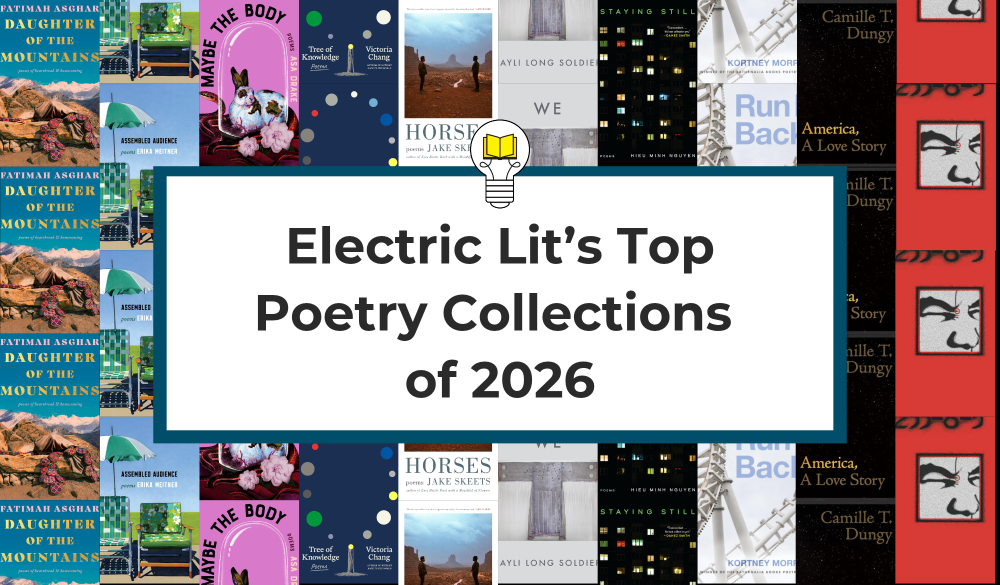
Electric Lit’s Top 10 Nonfiction Books of 2026
Books by Camonghne Felix, Joseph Osmundson, and Franny Choi are among our favorites of the year
This article is free to read. So is every article Electric Literature publishes. No limits, no paywalls—now or ever. Support from readers like you makes that possible.
We need to raise $60,000 to start off 2027 strong. Donate now to our end of year fundraiser to help ensure the future of free, accessible literature for all.
—————
This year, I read more nonfiction books than ever before. It wasn’t planned, though I suppose it had something to do with wanting to understand a world that seems increasingly fractured and confounding. For years, one political crisis has given way to another, each arriving with its own predictions of what terrible thing awaits us next. Reading nonfiction offered a way of making sense of it all, beyond the endless stream of news on my screen.
Curiously, the books that helped me best think about the future were often concerned with the past. In Turn (W)here, Chet’la Sebree reckons with America’s history of racism as she considers what it would mean to raise a Black child in a country still shaped by that history. The past can make the future feel all too predictable. These days, it’s hard not to imagine what’s coming in dystopian terms, from climate catastrophe to forever wars to—new fear unlocked—AI-driven human extinction.
And yet, history has a way of defying our expectations. The recent victories of the political left in this year’s midterm elections felt like a fulcrum—the whole country tilted blue and another future became imaginable. Of course, I am wary of getting carried away by optimism; the past is full of futures that never arrived. Hélène Giannecchini’s An Army of Lovers Cannot Fail recovers forgotten forms of intimacy and solidarity through the stories of queer people whose lives and ways of living have been largely overlooked.
If the past is riddled with unrealized possibilities, perhaps the task is not simply to recover them, but to imagine new ones. I ended the year reading Camonghne Felix’s Let the Poets Govern, which draws on Black radical poetic traditions to imagine new forms of collective life beyond the limits of existing political institutions. And while there’s no telling what the future might bring, this year’s crop of our top nonfiction books reminded me that the catastrophes we’re warned about, however real their threats, are not the only futures available to us. It is precisely this uncertainty that makes hope possible.
Here are our favorite nonfiction books of 2026.
–Evander Reyes
Communications Manager
Editor’s note: The following books were hand-selected by Electric Literature staff and interns, with the help of our community of contributors, readers, and friends of the organization. Books by current staff or board members are not eligible for consideration. The 10 titles below are presented alphabetically by title; they are not ranked.
An Army of Lovers Cannot Fail by Hélène Giannecchini, translated by Anna Moschovakis
In An Army of Lovers Cannot Fail, Hélène Giannecchini follows queer relationships that taught her a history her family could not pass down: friends, lovers, mentors, and strangers whose lives survive in photographs, diaries, and remembered gestures. Moving from Casa Susanna to Donna Gottschalk’s images and a record of a French man living with HIV, the book asks how people find one another across time. Giannecchini approaches research as an intimate encounter, letting uncertainty and the desire to locate herself among these lives guide what she discovers. You can read an excerpt of the book here, which is also the first translation published in EL’s Personal Narrative! It is a fitting place to begin: a hybrid work about how one life opens onto many others.
–Shandela Contreras, Editorial Intern
Feels Like Trouble by Helen Betya Rubinstein
By expertly weaving personal narrative with much-needed critique on academia and craft, Helen Betya Rubinstein has created a delightfully probing and compulsively readable collection of essays or, as the title (quite accurately) calls them, “provocations.” Feels Like Trouble takes a scalpel to the writing life, laying bare the problems at the center of how we teach and talk about what makes writing “good.” This book is a salve for anyone who’s been unmoored from their artistic instincts by instruction that harmed more than it helped. It’s also an instructive call to action for how we might rethink the status quo. Rubinstein may have experienced teachers who tried to quash her voice along the way, but in this book, it’s on full display: sharp, rebellious, and clear-eyed. Read an excerpt of the book in EL’s personal narrative.
–Katie Henken Robinson, Deputy Editor
The Flower Bearers by Rachel Eliza Griffiths
In The Flower Bearers, Rachel Eliza Griffiths navigates a season of devastating rupture: the sudden death of her closest friend, poet Kamilah Aisha Moon, followed swiftly by the public stabbing of her husband, Salman Rushdie. Through the catastrophe, Griffiths grounds her story in the sanctuary of Black literary circles and the lifelong practice of making art, framing this memoir as a profound mediation on witness. Moving from alienated graduate workshops to hospital bedside vigils, Griffiths shows that carrying love through grief requires stubborn, daily attention. She tenders a rare, vivid record of how we rebuild ourselves in the company of what survives.
–Shandela Contreras, Editorial Intern
Let the Poets Govern by Camonghne Felix
Having worked inside political strategy and speechwriting, Camonghne Felix knows intimately how institutional language sanitizes violence and manages dissent. In Let the Poets Govern, she turns away from legislative compromise to position Black radical poetics as an essential blueprint for liberation. Blending memoir, philosophy, and manifesto, Felix redacts oppressive legal codes and colonial white papers, literally carving freedom out of the grammar of subjugation. Felix demonstrates that form itself is where self-determination is practiced, offering an ethical compass for building collective life far beyond paternalistic power.
–Shandela Contreras, Editorial Intern
London Falling by Patrick Radden Keefe
This book starts as nearly all books about true crime do: On November 29th, 2019 someone dies. From there, however, the book unfurls into a sprawl of deception, corruption, and unjustifiable wealth. Keefe pulls off a masterful balancing act, layering the stories of a young man trying to make something of himself with tragic results, of parents grieving a child they didn’t know they didn’t know, and of London’s seedy underbelly. He sidesteps the darker elements of true crime by holding the deepest empathy for both victim and parents, always centering the human element of this tragedy while asking: Who, exactly, wove the web that caught their son? And who benefits from making sure it isn’t destroyed?
–Rachel Maybee, Editorial Intern
On Morrison by Namwali Serpell
This year, I found myself returning to Toni Morrison, as everyone should, again and again. Namwali Serpell’s On Morrison arrived as the perfect companion for a deeper engagement with her work. While Morrison’s political and thematic concerns often overshadow her formal innovations, Serpell’s meticulous close readings reveal how her literary techniques are inseparable from the meaning of her novels, and how their difficulty is deliberate, demanding, and deeply rewarding. It’s the kind of criticism I love, the kind that makes me want to become an ever more attentive reader.
–Evander Reyes, Communications Manager
She Was Wild Grass by Katie Bennett
Like every aspiring writer who once dreamed of living in New York, I went through a phase of obsessively reading the Beat Generation writers. I was captivated by their lives as much as their writing, though I knew far less about the women in their circle. In She Was Wild Grass, Katie Bennett recovers the story of Joan Vollmer, a voracious reader and intellectual force in the early Beat movement, whose legacy has been largely defined by her murder at the hands of William S Burroughs. Weaving Vollmer’s life into her own struggles to become a writer, Bennett examines the unequal freedoms afforded to men and women who pursue artistic lives. What stayed with me was her refusal to let Vollmer’s murder become the whole story, even as she reckons with how much of that story can never be recovered.
–Evander Reyes, Communications Manager
Spawning Season by Joseph Osmundson
In Spawning Season, Joseph Osmundson’s genre-bending memoir of his journey toward queer parenthood, we begin with a meditation on birth, followed by the introduction of Fry—his imagined, and deeply hoped for, progeny. Fry floats through the book, so much so that I wondered how a being who may, or may not, come to be can come across as ghostly? As though they had seen this world and left it? Osmundson’s National Book Award Finalist memoir is an extraordinary achievement, filled with questions of intimacy, legacy, whom we build families with, and why we build them. It’s quiet, but it’s heartbeat is powerful.
–Denne Michele Norris, Executive Director and Publisher
Turn (W)here by Chet’la Sebree
In her interview with Jordan Bolden Majewski for The Adroit Journal, Chet’la Sebree says, “One of the things that I enjoy most as a poet is to be abandoned inside something alongside the speaker.” This technique—placing the reader inside a moment and allowing it to unfold—is also at play in Sebree’s radiant essay collection, Turn (W)here. Sebree chronicles her search for an elusive home, merging her desire for transience with her hope for lasting stability. These questions come to a head during the COVID pandemic, and with the deaths of George Floyd and Breonna Taylor. Sebree asks what it means to move through a world laced with violence, especially as she grapples with the responsibility that accompanies bringing another life into that world. A hybrid text that blends personal and political history, Turn (W)here drops readers into its pages with abandon, but never leaves us without meaning and delight.
–Lennie Roeber-Tsiongas, Assistant Editor
We Radiant Things by Franny Choi
Franny Choi turns their mastery of poetic language toward cultural criticism in this debut essay collection about how technological progress intersects with the perception of who will play what roles in our increasingly automated future. Trawling through the collective American cultural consciousness, Choi pulls up examples of stories where cyborgs wear the faces of East Asian women before removing that mask to dissect the circuitry of oppression underneath. Drawing on their own experiences as a queer, feminist Korean American, Choi’s journey into the uncanny valley has never felt so personal. You can read an excerpt of the memoir here, where Choi pairs roombas and heterosexist (and racist) ideas about cleaning.
–Rachel Maybee, Editorial Intern