A Young Dancer’s First Glimpse of Her Future

An excerpt from The Archer by Shruti Swamy

For a time Vidya had not had a mother or a brother, she had only the idea of a mother and a brother: they were imaginary but real in the same way god was. For a time she had not had a mother but an aunt and not a brother but two cousins who had lived with her in the one room flat she shared with her father. The Cousins were girls, older than her, they were not cruel but it was clear they found her irrelevant. They did their schoolwork quietly in the kitchen, whispering to each other, glamorous secrets of movie stars and breasts. The Aunt had rough, worried hands, and yanked the comb through the girl’s hair, which got snarled even in braids. When Father Sir came home from giving tuitions she had gone to sleep but heard the door open and shut.

There was a woman in a room they went to visit every month, a woman with no voice and a face that turned toward the window, but that was not a mother, mothers lived at home with their children. And sang to them.

Now the Aunt-Not-Mother had been put away with the Cousins-Not-Brother, and the Room-Not-Mother had come to live in the house and answered Vidya’s question when is my mother coming home, which she asked out of habit more than hope, with the firm and sometimes angry response of I am your mother. The child put her hands curiously in the Room-Not-Mother’s hair but the Room-Not-Mother brushed her away as though she were a fly. She asked Room-Not-Mother to sing a song to her at bedtime (Aunt-Not-Mother did not sing to her at bedtime, as was expected: she was a not-mother) and Room-NotMother did not sing a song and instructed her to close her eyes. She closed her eyes. In the dark she could hear Father Sir talking to Room-Not-Mother, who answered his questions very simply with yeses and nos. Was the heat making her feel ill. No. Had she heard from her sister. No. Would she write to her again? Yes. Then her mind flattened like a coin and she was asleep.

Now Vidya studied (Room-Not-)Mother as she wiped her face again and again with her sari. Earlier she had been in a frenzy of chopping and frying, but she seemed not to know anymore what motion to provide her restless body. Her eyes were keen and dark and hard, like the eyes of a man. She wore a pale green sari with a pretty gold border, cotton, but her best. Skin pulled taut against the drum of her body, in the strip between blouse and skirt: ribs, like that of an unhappy dog. Outside she wore strange shoes of brown leather and real laces—shoes that made the neighbors whisper—inside her bare feet were big like Vidya’s were big, Vidya’s already three sizes larger than the other girls at school. Father Sir, emerging from his bath, gave a sharp glance to Vidya sitting idle on the divan, swinging her legs. “Are you helping your mother?”

She shook her head.

“Well?”

“I’m finished,” said the Mother.

“Before you sit down you must always say, mother dear, how may I be of service?”

“I said I’m finished,” said the Mother. “I don’t need help now.”

“The girl should learn.”

The Mother turned away. She was preparing the puja plate, and placed a whole laddu beside the tiny holy things necessary for the rite: a pile of uncooked rice, an oil lamp still unlit, kumkum and sandalwood paste to be smeared wetly, and a small brass bell. Vidya was glad that she had not been pressed into service in the kitchen, not because she disliked chores (though she did) but because the sight of so much food, so much food all at once, brought on a kind of fright in her. It was not time to eat yet and she had been scolded out of the kitchen several times—not even a taste—and sat on the divan swinging her legs with anxiety. Would there be enough? What would she eat first? What would this brother be like—would she know him? What if the Brother ate everything, and there was nothing left for her? Recently, the sight of food, food cooking in the stalls along the side of the road—jalebis, bhel, aloo tikki, sev puri—made her feel a wretchedness that was like falling ill. It was dulled only after the morning glass of milk, if she got the morning glass of milk, which, now that Aunt-Not-Mother and Cousins-Not-Brother’s hungry mouths had vanished, she was given every morning, and sometimes in the evening also. Father Sir left before she woke and returned after she was asleep, and on the weekends he would see her and say: well? This made her uncontrollably shy and she would mouse down into her dress and say yes sir.

“What time does the train get in?”

“One.”

“So go, na? You don’t want to make them wait.”

“I won’t make the train come any faster.”

But she was nearly pushing him out the door. He put his shoes on in the hallway. He was laughing and said again, “I won’t make the train come any faster.” Then there he was downstairs, walking through the dusty courtyard, straight through a cricket game of the chaali’s boys; they paused and watched him while he passed, in white, a dhoti and a clean kutra. When Father Sir was gone from the window, Vidya turned to watch the Mother again. She had forced herself down into stillness, sat with her hands folded and gripped hard on her lap. She was muttering something under her breath, barely audible, forbidding vowels. Then she fixed her eyes on her daughter and said, “Come here.” Vidya crossed the width of the apartment to the chair where the woman sat: a distance of no more than a few feet. The woman touched her daughter, fixing, smoothing what couldn’t be fixed or smoothed, the wild puff of hair that fuzzed up the girl’s neat braid, the wrinkles sweated into her good dress. “Do you love your brother?”

“Yes,” said Vidya dutifully.

“Then you must tell him. You must say, welcome home, my dear brother.”

Vidya nodded.

“And you must care for him like a mother.”

No. No. She was to be a not-mother. She looked at the woman with panic.

“I thought you were the mother.”

“Yes,” she said, her tone quickening. “I am the mother. But what I mean is you’ll have to help me take care of him.”

“Why?”

“Because he is your brother.”

“Will I be the mother?”

“No, no. I am the mother.” Then, exasperated, she stopped speaking. The apartment was filled with the smell of food. It was like a dream—or a nightmare—so many smells. Vidya had dreams where she was eating everything, kulfi and handvo and rotis and dhal and kheer. She fell upon her knees and ate like a dog, crying out with pleasure and joy. But in these dreams the food never filled her, it was like eating fistfuls of air. Woke with that hard pain in her stomach, and couldn’t sleep sometimes, until dawn.

She fell upon her knees and ate like a dog, crying out with pleasure and joy

Each minute ripened. It was incredible how much time could be contained in the increments measured by the clock. She thought she would ask again about the food but each time she looked at the Mother she was hushed by the look on her face—it was a terrible look. The Mother was folding herself inward and trying not to cry, and the effort to suppress this monumental emotion was making her eyes red. Vidya looked out the window. The cricket boys had resumed their game, they were calling to one another. Even the littlest ones would not play with her because she was a girl, and spoke to her, when they had to, with disdain. But brothers were different, she was confident of this. In fact, a brother could crack the world of the boys open, and invite her inside. They might never make her the batsman, but surely she could be a minor fielder until she proved her skill. They would rush her, chanting her, she would crow with them: king of the boys! But the Brother? The Brother was a blank, she had no notion of his face (there was a picture kept framed in the house of the Mother holding a baby, but the features were so indistinct it could have been any baby, including Vidya herself), yet she felt him in this moment looking up at her admiringly. King of the boys, she and her brother, but mostly she.

Then, there, on the far corner of her vision, a tonga dropped three passengers off in the street. They were as tiny as toys: the tonga pulled by a toy-donkey, and the three passengers—a man dressed in white, a dark woman in a parti-colored sari, and a child, an almost baby, carried in the arms of the woman. The girl watched them quietly as they crossed the courtyard. The game had to be paused, but it was paused good-naturedly. Father Sir called something out to the boys as he passed, a greeting of some sort, and there was joy in the sound of his voice if not the words it carried. The Mother heard Father Sir’s voice but remained where she was, as though calmed by it.

“Listen, now, when your mother’s sister comes you must tell her how much you love the beautiful dress she sent you.”

“But when should I kiss my brother?”

“After. Say my dress is very lovely auntie.”

“My dress is very lovely auntie.”

“Good, just like that.”

The Mother was smiling and wiping her eyes. The three toys were moving up the stairs but neither woman nor girl rushed out to greet them. The woman took the girl’s small hand and held it tightly, squeezing it. The feeling of being touched by the woman was so lovely, that the time that had moved for ages so slowly began, now, to quicken. Only moments, only seconds before she had a Brother, and her Mother touched her hair. The door opened. Slipping off their shoes in the hall—

The light coming from the doorway darkened them. They were just shapes. Then Father Sir stepped through the door and became himself, and the woman in the brightly colored sari holding the boy became herself, and the boy became himself. Who were they? Father Sir was self-evident, he was tall and thin with a high forehead and beady glasses like Gandhiji. The woman who must be her aunt had a dark face and was weeping. There was a stud of gold in her nose. The sari was checked with green and yellow, bordered in red, the colors that licked the eye. Before she got to the boy who was her Brother she performed her task to the weeping woman’s knees. “MydressisverylovelyAuntie.”

The Mother pulled Vidya away roughly. “Where is my sister?”

“Her son fell ill, madam.”

“So she sends a servant?” said the Mother.

“She didn’t want to leave her son, madam.” She had managed to stop weeping, but was holding tightly to the boy. The boy, the baby, the Brother. Vidya could see his little feet dangling down, bare feet, but he had folded his face into the chest of the woman and showed his sister only the back of his dark head. Sister. She said, “Welcome home, my dear brother,” and then looked at the Mother, now doubtful, to see if she had spoiled this task as she had spoiled the other one, perhaps she had muddled up the words, the order—an adult mystery. But the Mother did not seem to have heard her and was looking now at the boy, hard at the boy. On her face was a tightly concentrated fury. Fury at Vidya, at the Brother, at the other woman? Or, most unfathomably of all, at Father Sir? The Mother held out her arms. The expression on the other woman’s face trembled for a moment and the boy, who had been sleeping, began to wake, transferred from mother to mother: Vidya caught his face, gathering red and splitting open into a cry. He was saying ammu, ammu, as the dark woman relinquished him, twisting away from the woman his mother, back to the arms of the woman who had brought him, who cast her gaze down and squeezed her hands together. The Mother’s face became tender as she held the boy. She rocked him back and forth and whispered to him silly little rhymes, ones Vidya had never heard the Mother utter. He would not calm. He began to kick. Instead of setting him back in the other woman’s arms, which were stretched out to receive him, he was set screaming on the divan. Immediately the boy was up, tottering on his skinny legs, toward the parti-colored woman, who touched him, his head, and began to speak to him gently in a language that no one but he could understand.

The Mother was standing clenched, so upright. Her keen dark man’s eyes were full of red.

“Come, come, let’s eat,” said Father Sir. “We’re all of us hungry.”

Food! And Brother so small and fussy—he surely would not eat very much. But the Mother would not move from where she was standing to ready the meal and offer plates.

Father Sir said, “Wife!”

Fear—the room held it, that the Mother would crack. As she stood, holding her sari balled in each hand, so still, with only the vein at her temple flickering with pulse. Not a sound was made, even Vidya held her breath. And in an instant the room righted itself, an inexplicable shift in weather, the Mother said I forgot to do the puja, and the boy was held again by the woman, calm now, sucking his thumb, while his mother circled his face with the small flicker of light, ringing the small brass bell, then printing his brow center with a smear of red, and fragrant beige, and a single bead of rice, which fell off right away. She broke the laddu in two and pushed the sweet between the boy’s lips—he chewed at it distractedly with nubbly teeth. The other half was given entire to the woman who held him. Laddus: the ferocity of yellow sugar. If Vidya was given a laddu she broke it in her palm and ate each grain. The boy ate his oppositely, fast and unthinking. He looked calm now and didn’t seem to mind being at the center of so many’s attention, tugging the ear of the woman who held him, tiny, a baby, with none of the plumpness of baby, with none of baby’s glowing health. He looked yellow and somehow tough, his skin scaly with dryness.

“Are you hungry?” The Mother pointed her question at the other woman without seeming, exactly, to address her. Her voice was filled with a determined coolness, and she used the familiar, though not the most cuttingly familiar you.

The woman seemed to have trouble with the question and stood for some moments looking uncomfortably at the floor. Then she said,“No, no, please don’t trouble yourself.”

“Don’t be silly,” said Father Sir. “You’ve had a long journey. How many hours?”

“Thirteen.”

“Thirteen hours. Come, wash up, we’ll run some water for you. Then you can eat.”

The woman was brought a towel, she parted from the Brother with reluctance, pulling shut the curtain that demarcated the washroom from the kitchen. He screamed, the Brother, his eyes outlined in kohl: kohl gave his eyes the burning quality of a saint. The woman began to talk to him from behind the curtain as she washed—at the sound of her voice he quieted. The Mother was loath to leave him, but she did, immersing herself in the kitchen to prepare the food while Father Sir seated himself on the floor and waited for the plates to be brought to him. Vidya, reminded, rose to follow the Mother into the terrifying kitchen, which was filled with the noise of food. “Go give this plate,” and she carried it with care, heavy with food, sick with food, kadhi and raita and black chana, and shaak and rotis made fresh, one after the other, by the Mother who squatted by the stove with the shine of sweat across her brow and made them thin with the intelligence of her own fingers, thin as paper, puffed over the flame, fragrant of ripe wheat shined with ghee. Father Sir first, then Vidya was given her own plate, her own roti, while the Mother sat down by the boy and began to feed him with her own hand, food he accepted with a benign indifference. She was smiling now, the Mother, as the boy let her touch his face, though every once in a while he would turn away with an anxious look to the dark woman, who had emerged from behind the curtain and would smile at him, and then he would turn his face back toward the offered food.

Vidya was in an agony of indecision. Faced with so many dishes at once, she touched nothing on her plate, just stared at it—four little cups containing bright circles of food, the perfectly circular roti at the center, cooling. The smell of the food came up to her, it came into her, thrashed against her. Rice was brought out. But the food—her food. Her stomach hurt.

“Eat,” said Father Sir, who had already finished his rice. She knew better than to cry or say I can’t. She could see herself, her little brown hand, come quick down and tear the roti between her fingers, then dip into a dish—which dish, which food?—and bring the morsel into her mouth. But she could not will the hand to do it. She looked away from her plate, and then eagerly back at it, afraid that it had vanished. It was still there. She could not move.

“What’s the matter?” said the Mother. She shook her head.

“What’s the matter, don’t like?”

“No.”

“Don’t like? Don’t eat,” said the Mother, and lifted away the untouched plate.


The Mother did sing. Badly. But not to her. The notes felt curiously sour and wrong, even when there was no other music, and the voice that sang them was uncomfortably naked, like the voice one prayed with, or the body that one bared with honesty to the doctor. She practiced in the full light of day, loudly, after morning’s breakfast, and took lessons on Sundays at the Kalaˉ Sangam Bhavan Classical Music and Dance Complex, bringing the Brother and then Vidya to care for him.

Vidya discovered that the Brother was a good audience for jumping off the Bhavan’s steps; to him, even a jump from the first step was impressive. Gaining confidence she would climb, watching him watch her with admiration as she leapt down the second and then the third step, he laughing in delight at her neat landings. But the fifth was tall, as tall as her, she looked down over the edge. She had jumped from there last week but had forgotten how it felt to be so brave. The sixth! There was a thing called death: you went to another place. You jumped off the highest step in the world and were thrilled into flying. No, death was a bad thing, a lonely thing. A stern grandma had died, you didn’t see her anymore. The loved grandma remained. But death came for all, not only the very old. Death lived maybe on the tenth step.

Against the wall, half-dozing, a watchman in khakis and long wool jerked up and smiled at the Brother, and then at her. She didn’t return the smile. They looked at you like you were the same as other children, they always smiled at you as if you were the same: silly, clowning, social, unserious, playing make-believe or, worse, becoming precious for them. Some of her cousins behaved like this when trying to win the love of Grandma during summer visits and it disgusted her. Her Mother would whisper to her, with delicious scorn, look at that little liar; Grandma was never swayed, but aunties were, which made them not worth loving.

She thought it was the clapping and swirling of Navaratri, exuberant and ordinary.

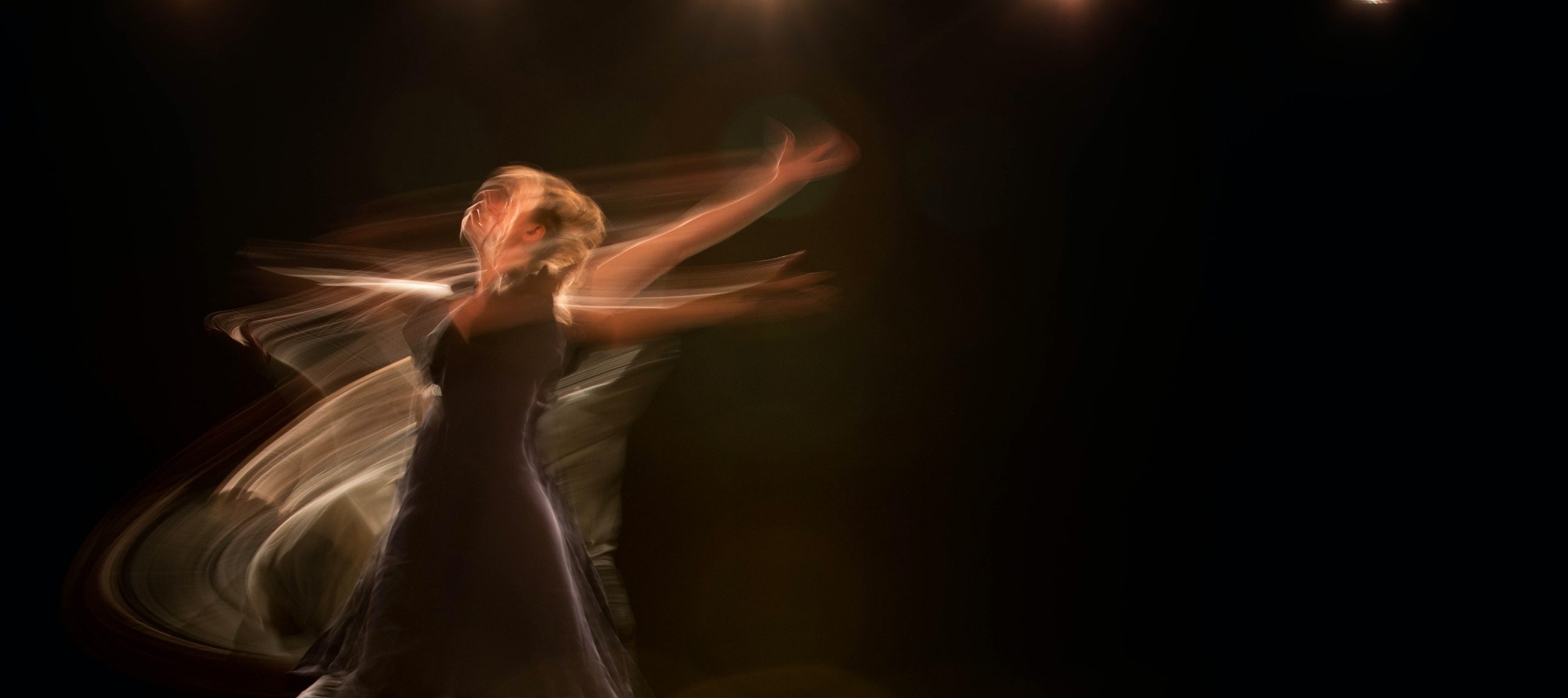
She skipped the sixth step and went directly to the seventh, where she always stalled; she could climb no closer to death. She sat for a while with her feet over the edge. The Bhavan’s courtyard seemed to exist outside the city, borrowing only its birds, which crossed in lazy flocks the rectangle of sky that capped the compound. Parrots showed green against the blue, but their scribbling noise was muted by the assonant chorus of music lessons, each individual lesson weaving into a new whole that contained an element of the Mother she could not quite hear, but still somehow sense. Through the door, she had seen the Mother’s teacher wince at the sound of her voice, but the Mother had not noticed or cared, and plowed on, heedless. Yes, though, there was another noise, a sense of rhythm, the shivering sound of rain. It was nearer, and then voices too, on the ground floor, and Vidya, now curious, followed the steps toward the sound: the level half underground and half above it, with windows that looked onto the courtyard and the street, letting in a dim yellow light: there were girls moving with purpose in this new secret room; their movements were described twice, by the rhythm of finger and palm against drum (a man played the drums, pulling from it a range of tones both heavy and light, his fingers springing away from the dark cores) and by spoken voice (a woman recited the rhythm in a language of single syllables, mysterious, expressive words both odder and more familiar than English)—and a third time by the bells wound thickly around the ankles of the best girls, and thinly around the ankles of the younger girls, some almost as young as her, some teenagers or even young women, moving with varying grace and control, but all moving with purpose, their bodies taut with the effort of correctness, their feet speaking and their eyes driven inward. Vidya, in the doorway, was not seen, was only seeing, her body lifting unconsciously, straightening itself, wanting to stand and move correctly as she watched a girl at the front of the room moving in a whirling yellow kameez, with short, swift limbs, who made a phrase with her body and was scolded by the woman who had spoken it, who made the phrase again with her body, moving this time her arms in concert with her legs, her bells glistening with hard noise, and was scolded again by the woman, who, in the dim light, had the fierce, kohl-made eyes of a leader and a ferocious bearing, not unlike the Mother’s, even while seated. This woman was beautiful, magnetically so. Her hair, striped with white, was parted down the middle and pinned into a low bun in a plain style so that her opulent face stood out in relief to it, pale and richly colored, her eyes a glinting black as though jeweled. Her hand slapped against her thigh, marking the same rhythm she spoke through that strange language of single syllables, and the moving girl again tried the phrase slightly refined and this time was not scolded by the woman—not praised, but her bearing became prouder, as if she had been praised. The room was incredibly hot: there was no fan, in the corner was a small shrine to Shiva with his foot lifted in destruction, a stick of incense burned to the nub for him and the room smelled of it, and loudly of sweat, the girls’ and the percussionist’s, whose hands seemed to take a precise effort regardless of how quickly or slowly the rhythm was that issued from them, and he held his arms very heavily in order to let his fingers be light. She could be tiny in the doorway: just eyes. Watching the girl move now made her want to be nothing. A thought came to her and it was like the first thought she had ever had: I am nothing. How long she stood there, fixed—moth: flame. Then suddenly coming out of a dream she remembered her Brother and ran up the steps.

Evening had deepened outside but the Mother was not finished. The Brother was sitting by himself on the step she had abandoned, a cry starting to bubble into his face, and she snatched him up and stood in the courtyard listening now to the sounds coming from the building, trying to parse and understand them. What was the language the woman spoke? And to whom were they speaking, exactly? Not with that odd spoken language, not just. With their bodies that they made follow a set of grace rules.

“Ah, you must be a dancer,” said the watchman.

“That was dancing?”

“Of course. What else would it be?”

She thought it was the clapping and swirling of Navaratri, exuberant and ordinary. She sat on the step. To be small was to be comfortable with the world being constantly upended: oh, but she wasn’t. The sun was going and the sky began to bruise from its absence.

“Vidya!”

There she was, the Mother, so tall, in her funny outside shoes, men’s shoes made of brown leather, with laces and too large, in her gray and red sari, descending the steps. The hour’s music had left sweetness on her tongue. In the fading light the Mother looked familiar and fragile, and Vidya ran up the steps toward her, heedless of the trailing Brother: wanting the Mother, wanting no harm to come to her, wanting her hand. She took it, cool, in her hot palms.

“Here I am.”

Holding Autumn in My Jewish Heart

In 2012, upon the publication of my first novel, Flatscreen, I was asked to write a short essay about Jewish identity for the website myjewishlearning.com. I chose, as my subject, a single line by the early 20th Century Russian Jewish writer Isaac Babel, whose short stories—particularly his autobiographical stories set in the Jewish part of Odessa where my family has roots—had greatly influenced my own work. 

The line I chose to write about is Babel’s lovely and cryptic definition of the Jew as someone with “spectacles on his nose and autumn in his heart.” I liked this definition for its figurative vagary—that is, its poetry—but also for its secularity, for its cleaving of Jewish identity from notions of religious practice or faith. As an infrequently practicing non-believer, Babel’s definition reinforced my personal sense of Jewishness as something more closely related to feeling than to doctrine. 

I wondered if there was something more intrinsically Jewish about autumn than, say, spring.

In my essay, I tried to unpack what Babel meant by “autumn in his heart.” I wondered if there was something more intrinsically Jewish about autumn than, say, spring. I suggested that perhaps it had something to do with the High Holidays’ occurrence during that season—the dying leaves, the open book of life, the dangling prospect of death—and also with our history as itinerant agrarians. I ended the essay with an anecdote about my favorite holiday, Sukkot, and the beautiful polka-dot sukkah my artist mother once built. I wrote about lying in that sukkah, feeling humbled by the cosmos. I concluded that this feeling was autumn in the heart.


Nearly a decade has passed since I wrote that essay, yet I find myself still thinking about Babel’s definition, and still attempting to parse it. And while, upon rereading that old essay, I’m not as embarrassed as I thought I would be, I’m not entirely convinced by it either. The essay’s ending feels slippery and evasive, offering lightweight mysticism in place of the concrete.

Julian is our first child, but he was not our first pregnancy.

 It also occurs to me, upon rereading, that though I pay lip service to the connection between autumn and mortality, I don’t linger on the subject. I was 29 when I wrote the essay, and, with the publication of my novel, I was on the cusp of what felt like the beginning of a life. I had just moved in with my girlfriend, who would later become my wife. Death was not on my mind. I am 39 now and, along with the rest of the world, as we watch the global death toll increase each day, it’s in my thoughts more than ever. But the thing that has most affected my thinking about mortality, and by extension, my thinking about Babel’s definition, was not the death of a friend or loved one, but a birth. Specifically, the birth, three years ago, of my first child, my son Julian. 

Julian is our first child, but he was not our first pregnancy. Almost a year to the day before his birth, my wife had a miscarriage. The miscarriage was early, just a few weeks into the pregnancy, but it was still devastating. We were living abroad at the time, in Amsterdam, which added to our feeling of profound vulnerability. We were in a strange place, far from family and community, far from home. 

We spent the summer after the miscarriage traveling in Europe. We visited beaches in the South of France, ate pasta in Italy, and took the Game of Thrones tour of Dubrovnik. The last stop before returning to the States was my ancestral homeland of Poland, where we visited Auschwitz on a sunny August day. Maybe it speaks to the state I was in—after the miscarriage— that what upset and surprised me the most was how pretty it was there, at Auschwitz, on this particular day: how green and florid; how scenic its vista of trees. This was evidence, it seemed to me, of nature’s indifference to human suffering. I had always pictured the camps in winter, but it occurred to me, for the first time, that the camp’s prisoners must have seen days like this, beautiful days, even as they were starved, and tortured, and murdered. 

The other image that sticks with me from my visit to Auschwitz, is a display case filled with suitcases, many of which had names and addresses handwritten on them. Some of the names were familiar—Adler is one I remember, the same surname as a friend of mine from college—and, in a different sense, the handwriting samples were too. One, with its whimsical curlicues on the tails of certain letters, reminded me of my mother’s. Another’s angled lefty scrawl reminded me of my own. These people had written their names and addresses on their luggage because they expected to one day return home.


When we found out we were pregnant again—we were back in Brooklyn by this point, without health care, or jobs, or an apartment—Sarah and I were understandably concerned about the possibility of another miscarriage. And though, as the pregnancy progressed, we breathed a little easier with each milestone passed—when we first heard the heartbeat, when we first saw our son’s human shape on the sonogram—we couldn’t completely shake the fear that the worst might happen at any moment. I’d hoped that my fear would subside after a healthy baby was born, but I now understand that the fear I’d felt, that omnipresent awareness of the fragility of human life, is simply a condition of being parent.

These people had written their names and addresses on their luggage because they expected to one day return home.

For the first week of his life, our son would only sleep while being held, not in his bassinet. So Sarah and I took turns sleeping in two-hour shifts, while the other sat on the couch watching Netflix and rocking the baby to sleep. When it was my turn to hold him, I’d lightly stroke his scalp, careful not to press too hard on the soft spot in its center which felt, to me, like a persistent reminder of that very fragility. And on one of those nights, at about five or six a.m., as the day’s first sun made itself known in my Brooklyn living room, creeping in shadow across the floor, I found myself reading aloud to Julian from the poem “Little Sleep’s Head Sprouting Hair in the Moonlight” by the definitively not Jewish, American poet Galway Kinnell. The poem, which is quite famous, at least for poem, is narrated by a father and addressed to his young child. It opens with the child’s scream as she wakes from a nightmare, at which point the speaker enters her bedroom to console her. Kinnell writes:    

you cling to me
hard,
as if clinging could save us. I think
you think


I will never die

For Kinnell, the small child lives in a kind of perpetual spring, having never seen the leaves fall from the trees or the flower lose its blossoms. His child has not yet learned about death and its inevitability, and so moves, to quote Rilke, “already in eternity, like a fountain.” 

It was not only my job, as a parent, I realized as I read this poem aloud, to protect the body of my child, but it was also my job to protect him from the horrible truth of my own mortality. It was my job to keep him, for as long as possible, alive in the illusion that I, his father, would always be there to protect him. And so perhaps, then, what I was faced with, as I cradled my son and read aloud, was not just Julian’s fragility, but my own, not just his mortality, but for the first time, in some deep sense, my own.

As I read on, I found myself weeping. Though I believed the words I was saying—I would “suck the rot” from my son’s fingernails, I would “scrape the rust” from his bones—I knew that these statements were also lies, that there were things in this world from which I could not protect him. And I felt, in that moment, that I understood what it meant to have autumn in my heart. 


The question remains: what, if anything, makes this a particularly Jewish feeling? Kinnell was not Jewish, and I’d imagine that the experience I’ve just described—this reckoning with mortality—is a universal one. And yet, I’m not ready to abandon Babel’s definition of the Jew, to cede tribal claim on autumn of the heart. 

The literary critic Northrop Frye posits that the biggest difference between the Old Testament and The New Testament is that the New Testament is the story of an individual—Christ—while the Old Testament is a story of a people, The Israelites. From the beginning, then, there has been such a thing as a collective Jewish identity. And though we live in a diaspora that accommodates an increasingly broad range of Jewish experience, something of that identity remains. In part, that identity is rooted in what I’ve just been talking about—this pervasive awareness of mortality—not just on an individual level, but on a cultural one as well.  

Babel wrote before the rise of Hitler, but he knew persecution—he was executed by Stalin via firing squad in 1940, at the age of 45. And before Stalin there were The Crusades, and before The Crusades, there was the Roman destruction of the Temples. And it’s not like Jewish persecution ended with the Holocaust either, as anyone who’s read a newspaper over the last few years is aware. 

The Jewish condition, then, I might argue, is not so different from the condition of the new parent. It is a condition of anxiety, of omnipresent awareness of the soft spot on the infant’s skull. Only the skull, in this case, is our culture writ large, and we remain in perpetual wait for the next threat to its existence to make itself known. 

It was my job to keep him, for as long as possible, alive in the illusion that I, his father, would always be there to protect him.

I keep thinking of another of my favorite Jewish writers, Grace Paley, and particularly of her story, “A Conversation with My Father,” which concludes with the line, “Tragedy, when will you look it in the face?” For the Jew, I think—the bespectacled and autumn-hearted Jew—the answer to this question seems to be: always. We are always looking tragedy in the face.


The day after Trump’s election, I found myself perusing the shelves of a used, English language bookstore in Central Amsterdam. We had arrived in the city a week before, and hardly knew a soul. Sarah was at a hair appointment that she’d made weeks before the election, planning to celebrate the commencement of our European sojourn by dyeing her hair lavender. She’d kept the appointment, not really knowing what else to do; radical stylistic transformation seemed as appropriate a response to the terrible election result as any. 

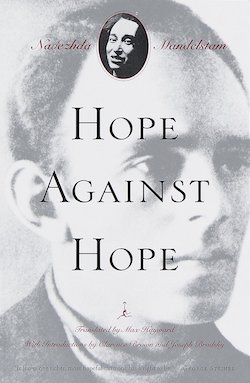
I didn’t know what to do either, so I did what I usually do in such situations, which is to seek out the nearest bookstore at hand. I walked there in the rain, and arrived soaking wet to find a handful of other Americans quietly, mournfully browsing the shelves. This gave me some small solace. In my own browsing, I came upon a battered, mass market paperback edition of Nadezhda Mandelstam’s autobiography, Hope Against Hope, which chronicles her years in exile from Stalin’s regime alongside her husband, the Russian Jewish poet Osip Mandelstam, and then her many more years alone after Osip was arrested and sent to a work camp where he perished. 

Osip Mandelstam is my favorite poet, and I had been interested, for a long time, in reading Nadezhda Mandelstam’s autobiography of their life together, but I felt daunted by the book’s length—not only is it nearly five hundred pages long, but the print is very small—and also by what I correctly presumed was its incredible store of pain and sadness. But finding it there, in this bookstore in Amsterdam, on that particular day, felt like fate. 

The Jewish condition, then, I might argue, is not so different from the condition of the new parent.

Let me start off by saying that, despite the promise of uplift offered by its title, Hope Against Hope is an incredibly depressing book, even more depressing than I expected it would be, and I was not surprised when I later found out that Nadezhda Mandelstam had followed it with an even lengthier sequel called Hope Abandoned. I found the first few hundred pages of Ms. Mandelstam’s memoir demoralizingly bleak. But while I wouldn’t say that things lighten up after that—the lives of the members of her circle who weren’t murdered by Stalin, often ended in suicide, such as that of the poet Marina Tsvetaeva, who hung herself, leaving behind a note that said, “Forgive me, to go on would be worse”—still, I began to draw inspiration from the author’s endurance in the face of such despair.

Under Stalin’s rule, Osip Mandelstam’s poetry was banned. Any copies of his works that were found were to be destroyed by the NKVD. Mandelstam, for the most part, was not a political poet, but he did write one poem about Stalin, a satirical poem called the “Kremlin Highlander”, which describes, among other things, the fascist leader’s stubby fingers, which Mandelstam compares to live bait.  It was for this poem that Mandelstam was arrested, and forced into exile, and later sent to the work camp where he died. Mandelstam wrote the poem —which incidentally, is not one of his great poems—knowing full well that it would lead to his arrest and his demise. He wrote it anyway, and he read it publicly at a number of small gatherings where Stalin’s spies were presumably in attendance, in what was, essentially, an act of suicidal resistance. During his exile in the Southwestern mountain town of Veronezh, Mandelstam would later write a poem that, it seems to me, addresses Stalin directly, and speaks to this act.

Having stripped me of my seas, my flight, my running start, 
And given my feet the platform of the violent earth, 
How’d you do? Just Great!: 
You couldn’t still my moving lips.

Even in exile, after his death, it was too dangerous for Nadezhda Mandelstam to keep copies of her husband’s poems, and due to the real threat that all known copies would be destroyed by Stalin’s forces, she set to memorizing the entire corpus of her husband’s work. She memorized the poems—three or four books worth—and she kept them there, safe in her mind, for roughly twenty years, until she was able to return to Moscow in the early 1960s, after Stalin’s death, and have the poems republished. 

This act of devotion—devotion not just to her husband, but to his work, which, I might add, is the work, in my opinion, of one of the twentieth century’s great geniuses—seems to me, to also be a great act of resistance. It seems to me to be an act, in fact, of greater resistance than the poem itself. Because, while the writing of the poem may have been the greater sacrifice, leading, as it did, to its author’s imprisonment and death, Ms. Mandelstam’s feat of memorization provides the greater reward, the preservation of a rare and singular voice, a voice that offers comfort, and beauty, and more than a bit of mystery in its surveys of the human condition. Ms. Mandelstam’s act carried out her husband’s promise that no one still his moving lips. And because of this act, I will one day share these poems with my son, and we will read aloud, to better hear their music, to better feel their rhythm. And when he asks me the difficult questions that, one day, he will inevitably ask—when he asks about love, and when he asks about death, as he pushes the spectacles up off his nose, and looks up at me as if, in my fatherly wisdom, I might have an answer—I will be able to look to these poems, as others might look to scripture, and I will quote to my son:

You can’t untie a boat unmoored.
Fur-shod shadows can’t be heard,
Nor terror, in this life, mastered.

Love, what’s left for us, is this: 
living remnant, loving revenant, brief kiss.*

And I will tell my son that resistance can take many forms, but that, ultimately, it is an act of endurance, the endurance of one’s singular voice. I will say to him that your voice, like your father’s voice, carries autumn in its heart, and that’s an okay thing, because, autumn leads to winter, and winter leads to spring, and in spring it will rain, and after the rain the flowers will bloom—let nothing, ever, still your moving lips.   


 *From Christian Wiman’s somewhat unorthodox translation.

Our Situationship Will Never Be Instagram Official

My favorite ex is not really my ex, technically speaking. He was never officially my boyfriend, and we were never in any kind of official relationship. For the eight months we “dated,” we never talked too much about what we were, never had the conversation that my college roommates called the dreaded DTR: the defining the relationship talk. Our relationship ambled on like a toddler in a field, wandering lopsided paths until it simply ran out of steam and plopped down. When my ex and I stopped seeing each other, we couldn’t even figure out how to phrase it. We weren’t “breaking up.” We were “done here,” as if our relationship was a meeting that had dragged on a little too long, until we finally called it. Ours was a classic situationship: all the entanglement, care, and intimacy of a relationship, but without its clear rules.

Given the fact that I have had many situationships and only one official relationship, I should not have been surprised I ended up perusing situationship TikTok recently. There are thousands of videos of mostly young women making jokes about the fact that they are in relationships that exist without the rules of a relationship. In one video, a woman responds no to every question: “Are you guys dating? Can you see other people? So you’re exclusive? So then you’re together? Like friends with benefits?” No…no…no…it continues. Not exclusive, but not seeing other people. Not together, but not single. Yet despite being a form of relationship purgatory, there’s an inherent potential in the situationship: it could become something new! It could transcend the model of relationships! It could become a new form of two people caring about each other with no outdated labels! It could get you really, really hurt. 

And although situationships often end by me getting really, really hurt, I still end up in them regularly. Certainly they are more than failed relationships or only relationships of short-term importance. On TikTok, straight situationships are mostly driven by men refusing to commit, holding out on their partner who longs to be official. “What’s a situationship like?” one video asks. “Constant mixed signals.” He calls you for six hours one night but doesn’t respond to your texts the next day. But maybe one day he will! Yet queer situationships, while not immune to power dynamics, are, in my experience, driven by friendship. There’s less will they call! drama and more actual talking, more being in the moment and less angst about not planning. Like Naoise Dolan’s Exciting Times, where Ava ends up in two situationships: one with Julian and one with Edith. Where the straight situationship leaves Ava regularly in tears, in overthinking mode, her situationship with Edith grows out of a deep friendship. Ava types out a text to Julian, which she deletes: “i think i’m flirting with edith. she seems like someone who flirts with everyone, and so doesn’t really flirt with anyone. i don’t know what’s happening. i’ve known her two months and it feels like she’s the only person in my life who has ever mattered or existed.” 

Yet queer situationships, while not immune to power dynamics, are, in my experience, driven by friendship.

It’s this kind of tunnel vision, of knowing someone for only a few months and feeling that they’re most important person in your life, that makes situationships so attractive. The situationship says no to many of the regular rules of relationships: no to “what are we?”, no to meeting your friends, no to planning ahead. Perhaps this is why the situationship gets a bad rap—it seems like the stereotypical casual relationship, where one partner wants to date and the other doesn’t. Romance novels and rom-coms love this trope, a situationship turned into a relationship after both parties realize their feelings. A situationship is the generative drama, a setback for our heroic couple, that leads into the clarity of a relationship. Take Jasmine Guillory’s The Proposal, where Carlos and Nikole fall into a situationship that starts to look awfully serious, full of meeting friends and going on actual dates, until Carlos realizes he is in love with Nikole. There’s a reversal of the TikTok narrative here: the man is in love and the woman has commitment issues. Nikole comes around and they’re happily committed to a Serious Relationship. Problem solved!

You can fall into a situationship, but a relationship requires some conversation, some work. A situationship is largely formless—without the guiding lights of a relationship, there is almost infinite potential. A relationship has a fairly clear trajectory: you talk, you grow to like each other, and then you make it official. It has a form that is societally acceptable, that is easily translatable in conversation. We know what a girlfriend or boyfriend or partner does, what their role is in your life. A situationship lacks all the clarity and translatability of a relationship, lacks the vocabulary to explain its own importance. A situationship leaves you with exes you aren’t even sure are your exes, an archive of texts and calls and moments that felt (that feel!) so important yet remain slightly indescribable to others. You simply had to be there.

Maybe this is why Sally Rooney is the patron saint of the situationship novel: her characters get in important relationships that are impossible to describe to others, except us, the readers. Like me, her characters backslide with their exes, they avoid big conversations, and they end up in situationships that have meaning, and actually make their lives better. In Normal People, Marianne and Connell’s situationship seems to defy the form of the relationship not because they don’t make it official, but because their care for each other transcends the labels of “girlfriend,” “boyfriend,” and “partner.” They are deeply invested in each other’s lives as friends, lovers, and everything in between. When the novel ends, it doesn’t tell us what happens next—did they break up when Connell moved? will they get back together someday?—but keeps Marianne and Connell’s relationship open to interpretation, leaving the reader wondering along with the characters.

Perhaps what Normal People illuminates is the situationship’s necessity for a potential outcome that’s greater than a mere official relationship. A situationship, after all, might be what happens when you execute no pressure on a nascent relationship. It might be what you fall into when one party is afraid of commitment or is holding out for a better romantic option. But also: it might be freedom from the confines of regular relationship rules, a way of saying yes to something for a season without planning for its continuance. A situationship is one way of being with someone without the drag of the past or push towards the future. Without the rules of form, how might two people be there for each other?

Perhaps what Normal People illuminates is the situationship’s necessity for a potential outcome that’s greater than a mere official relationship.

In Rooney’s newest novel, Beautiful World, Where Are You, the characters similarly fail to lock their relationships into concrete form. One character, Alice, reflects that “At times I think of human relationships as something soft like sand or water, and by pouring them into particular vessels we give them shape…But what would it be like to form a relationship with no preordained shape of any kind? Just to pour in the water and let it fall. I suppose it would take no shape, and run off in all directions.” A relationship without any preordained shape, running in all directions? Sounds like a situationship to me.

The situationship is by nature singular and particular: without a prescribed form, it can take many shapes. No two situationships are exactly the same, though as situationship TikTok makes clear, there are many common themes. For Alice, her situationship with Felix is confounding: “there is no obvious path forward by which any relation between us can proceed. I don’t believe he would describe me as a friend, because he has friends, and the way he relates to them is different from the way he relates to me…we’re in certain senses closer, because there are no boundaries or conventions by which our relationship is constrained.” This, to Alice, is “the absence of method,” a lack of intention in their relation to each other. There is no “obvious path forward.” There are no rules! But, she writes, “whatever happens will at least be the result of this experiment, which feels at times like it’s going badly wrong, and at other times feels like the only kind of relationship worth having.”

This last sentence is a bold claim, that this sort of experimental, non-labeled relationship might be “the only kind of relationship worth having.” And I agree: some of my most important and formative relationships have been the kind of situationship that burns quickly and dies out. Like the summer I spent with a man about to move across the country—the end date on our relationship meant we couldn’t ask big questions. Every day together was electric and exciting, even takeout pizza dinners, in a way no real relationship of mine has ever been able to approximate. It’s like the passion of Elio and Oliver in André Aciman’s Call Me By Your Name, a burning can’t last more than one summer in Italy. They have no rules, no boundaries, no future planning: only the beauty of the present moment. Or Lucy and her merman lover in Melissa Broder’s The Pisces, a passion that can’t last beyond her stay in Venice Beach, can’t really make its way onto land. There’s an incompatibility that means that these relationships are formative, important, life-changing—but only able to endure for so long. Perhaps it’s the timestamp that makes them so formative: its the right here right now of great sex, deep late night conversations, a summer I’ve never forgotten.

Every day together was electric and exciting, even takeout pizza dinners, in a way no real relationship of mine has ever been able to approximate.

This is the problem of the novel: plot. All these texts have to wrap the situationship up, and ultimately the options come down to break up or get together. Ava keeps Julian as a friend and gets Edith as a girlfriend. Carlos and Nik start dating. Alice and Felix and Eileen and Simon all couple up—so conveniently it’s almost unbelievable. Oliver goes back to America. The merman turns out to have a dark secret, enough to snap Lucy back to her land life.

Yet my real-life situationships rarely wrap up neatly, rarely make total sense when they’re over. You can be known and cared for by someone who just isn’t right for you in the long term. Perhaps this is why I keep getting into situationships: it’s an escape from the constant what next? of relationships. For me, the potential of the situationship is in its formlessness, in its plotlessness, in the escape from the long term. A novel has to end  neatly, and somewhere different from before. Real life rarely follows that neatness. A situationship lets you stay in the here and now for a little longer. If there is value in it, it is in experiencing intimacy without expecting a future—staying with an open question without worrying about it. A novel will move right along, wrap it all up, while the situationship might be refusing to commit, deciding not to decide, leaving the door open for the future.

The time of the situationship is always now. For me—an overthinker—situationships require a kind of presence in the world that I don’t usually give. It’s not about making plans for the next time you’ll hang out, or worrying what it all meant. And it’s definitely not about wondering how it’ll all turn out in the end. You can tune out the anxiety for the future and nostalgia for the past. You can simply let it happen. I am known right now, and that’s enough.

A Public Reckoning With the Truth About Yellow Rain and the Secret War

Thirteen years ago, I visited California for the first time as a published author. My first book The Latehomecomer had just come out. After a community reading in a Chinese restaurant in Fresno, a group of women came up to me, excited and proud. One of them said, “We can’t wait for you to meet Mai Der Vang. If Minnesota has produced you. California has created Mai Der.”

Our journeys were linked long before we met. We are both children of the Hmong diaspora, marked by the unnamed war in Laos between the Americans, their ethnic allies, the Pathet Laos soldiers, and the North Vietnamese Army. Our families’ lives were uprooted and ours here in America began because of the same forces: war, colonial greed, the disregard for human life. 

When we finally did meet: we knew we were different but we saw the ways in which the bigger world would read us as the same. I was a prose writer building a home in creative nonfiction. Mai Der was a poet finding her place in the world of poetry. We were both Native Hmong speakers writing in English, Hmong American women forging our way into a literary America that did not know it was missing our voices (and that of countless others). More importantly, we knew upon our meeting that our paths would cross many times over in the work we were both committed to doing, the explorations of the histories and realities that have shaped us and guided us.

It is a gift to be in conversation with Mai Der on a travesty where Hmong voices have never garnered place, to speak on Yellow Rain, Mai Der’s new book, and the ramifications of American warfare in countries around the world—little known places full of living people who loved and love each other, still. 


Kao Kalia Yang: Why did you decide to write your dedication in the Hmong language?

As a Hmong writer, it is sometimes hard not to talk about the war and its geopolitical implications imprinted into who I am.

Mai Der Vang: The dedication roughly translates as “to the Hmong people” or “to the collective who are Hmong.” To say, read, and write that phrase in Hmong feels so much more evocative for me as there’s a kind of presence and spirit of vitality that gets lost in the English. It’s also not often that we do or create things that we can then dedicate to ourselves and each other. I felt this collection of poems served as a tangible moment in which I could hope to offer that acknowledgement while calling the Hmong diaspora to the page.

KKY: Is there a more conscious international reach with this book that is perhaps different from Afterland

MDV: One might see it that way. Though most of the time when I was writing these books, I have to admit I wasn’t entirely focused on an international audience. I was trying to do what I felt the poems might need, versus what the audience or the “reach” might demand or expect of it. For any writer, that’s always a precarious balance to negotiate. In my case, doing what is in the best interest of the poem will always win out in the end. 

But because the matter of yellow rain happened within an international context, there is an absolute sense of a global reach taking place that naturally becomes entwined with the book’s intention. As a Hmong writer, it is sometimes hard not to talk about the war and its geopolitical implications imprinted into who I am. There will always be an innate sense of a place that is here now, and a place that was once there but is no longer there in the same way. Maybe that’s what imbues a kind of reaching in these works that transcend national boundaries. With Afterland, I was certainly interested in examining the larger spatiality of Hmong movement, but it felt more rooted in the geographic spaces of the spiritual world, which, interestingly, can even be thought to serve as a kind of borderland itself.

KKY: The opening statement to the collection: “I am a daughter of Hmong refugees…daughter who keeps looking back at the sky.” What does it mean to be a Hmong daughter, “among the fled” in these times?

MDV: I was born around the time when my parents were resettled in the States. If they had remained in the camps for at least another year, I would have certainly been born there. The words you cite here are a nod to that history. 

I still wonder what it means to be a Hmong daughter, and as I grow older, it becomes less literal and more embodied in the way I view and move through the world. Literal meaning that when I was growing up, there was the literal living as a Hmong daughter who was beholden to certain cultural expectations and duties within a Hmong family, whether it was carrying out household responsibilities or upholding the social decorum specific to my gender. A common experience for many Hmong daughters raised in a traditional family of the 1980s. 

I refuse to let these unreckoned histories dissolve into oblivion only to be forgotten or erased.

But as I grew older and where I find myself now, it’s no longer entirely about the quotidian expectations of living and behaving as a Hmong daughter (though that feeling is still very much there) as much as it’s more about how Hmong daughterhood has given me a complicated lens and perspective from which to see the world through, from which to make my own conclusions about what is just or unjust to me, about what hasn’t been heard and needs to be heard, and so on. 

KKY: The Radiolab interview you referenced in “The Fact of the Matter Is the Consequence of Ugly Deaths” is one in which I appeared as “niece” to the Hmong man being interviewed. It was a violence I cried to stop—to little significance. When I learned of this book project, I felt a relief in my heart I’ve been harboring since that dreadful day: September 23, 2012. How did the interview impact you and what role did it play in the writing of this book?

MDV: That interview happened during my first semester in the MFA program at Columbia, and I remember feeling angered and saddened after hearing it, but also feeling very emboldened and inspired by you, your bravery to express your truth, your uncle’s earnest telling, and how you stood in defiance of their attempts to invalidate the Hmong. We, as in all the listeners who felt enraged by what happened, were with you in that moment. 

So much contextual history had been left out of that interview, especially a proper framing of the Secret War, its genesis and residual consequences shaping the unstable climate in which the yellow rain issue was born into. Put simply, if the Americans had not started a war in Laos, there would be no need to debate yellow rain today nor would there be a need to put us through the grief of being accused and gaslit as “liars.” 

During my undergraduate years, when I was researching Hmong history and the Secret War, I had come across yellow rain briefly and felt so unsettled by it all. Years later, the Radiolab episode would happen, and it was then that yellow rain blew everything open in my life. I spent the bulk of that first semester in the MFA, and the following semesters, and part of the summers, scouring online library databases for and copiously reading through journal articles, government reports, books, media pieces, and other writing on yellow rain. It really consumed me because something about it just didn’t feel right. So much was missing, and we were only getting one version of the events. The book came out of a need to offer an extended rebuttal but also to provide another version amongst the many versions that I imagine are out there. 

KKY: There is a defiance in these poems, across them, a refusal to submit to death, to the forces that have killed us in the past and present. Can you share with us the emotional/intellectual/spiritual journey you’re on in this book?

MDV: I would agree with that. I did try for poems that were driven by kind of a generational fire in spite of the generational heartbreak that has been endured by our parents, elders, and ancestors over centuries of war, exile, and displacement. I won’t forget something you said in the Radiolab interview about the Hmong heart being broken, and I think it’s so true. When the war ended, the Americans evacuated and abandoned the Hmong to fend alone. It seems to me that war and collective heartbreak always got in the way of our autonomous right to live out, fulfill, and self-determine our futures as a diasporic people. From China to Southeast Asia, it feels like we’ve been continually subject to great upheaval, and never fully allowed to live in peace and flourish. I hope that in this idea of the refusal to die, my poems put up a resistance or an opposition to that heartbreak. 

Doing the research and writing the poems was a transformative experience. Years combing through documents, days sorting and categorizing data and other findings, nights drafting poems and visuals. Surrendering to confusion as well, trying to piece it together. I think I set out attempting to find some semblance of an answer to yellow rain not knowing what shape or form it might show itself as. I came out of it realizing that for me, personally, the book itself is my answer. It is my own explanation toward the reality that we may never have the “known” public answers about what happened. 

The book is my attempt to collate into one place everything I had been thinking about that I felt was part of the answer. It’s also the stark realization that the privilege of a definitive answer and of knowing, or the privilege to inflict uncertainty on someone or a community, is a privilege that continues to elude the Hmong people. To control, withhold, and obscure truths and answers—this is the work of empire.

KKY: Can you share with us the emotional/intellectual/spiritual journey you hope to take readers in this book?

MDV: I hope that readers walk away learning about yellow rain. There are some Hmong people who don’t even know about the issue, or perhaps they know very little, and I hope that this matter of an unreckoned history comes to the attention of both Hmong and non-Hmong readers. I refuse to let these unreckoned histories dissolve into oblivion only to be forgotten or erased. 

I also hope the book sheds greater light on the disparities that exist as it pertains to a community’s right to know something about itself or its history, versus what an outside group will choose to withhold from it. Who in our society has the power to perpetrate uncertainty on another group of people? It frequently is the case that those who are left in these states of not knowing, forced into spaces of constant worry and stagnation, forbidden the right to have an answer or denied the closure to properly mourn their losses are very often people of color, immigrants, refugees, Indigenous communities, and others whose basic human rights have been violated or put at risk. My book tries to reckon with this in its examination of yellow rain, and I hope that comes through somehow. 

I further hope that the book offers to readers a way to think about the doing of poetry in all of its wild forms and varied expressions to bring something to the page that can’t necessarily be answered, explained, nor discerned. For me, poetry is the act of pulling something in from the void and then witnessing that awareness make itself manifest on the page. 

KKY: The amount of research you’ve done in this book is staggering. How did the research inform the poetic form of individual poems and the communal whole?

If the Americans had not started a war in Laos, there would be no need to debate yellow rain today nor would there be a need to put us through the grief of being accused and gaslit as ‘liars.’

MDV: The research was an instrumental part of the process, and I had to allow myself to completely dive in, which meant having to compartmentalize my process for sanity’s sake. The research came first, and over the years leading up to this, I had already been reading through a lot of the documents. When I finally dove in, I committed myself to a whole summer of just more reading through and categorizing of the declassified documents and other reports. During this period, I didn’t force myself to write any poems, nor did I read any poetry, really. I wanted to create a space for myself to be immersed within the language, the details, the visuals, and the findings from the documents free from other creative entanglements. This process amounted to an accumulation of printed paper filling up multiple three-inch ring binders (I printed a lot of these documents in order to experience them in their most crude and obvious form; commiserations, however, to the environment, all the paper went to a good cause). 

What was also really exciting, and distracting at times, was how I would read something in a document, and then it would take me elsewhere, and I would spend the rest of the day investigating that other thing. The structure of the manuscript was driven by the structure of the documents along with some thematic elements that emerged during my assessment of the materials. Once I had arrived at a point where I felt had gone far enough in the research, I took my documents, the ones I wanted to use for the book, and sorted them based on a variety of factors (subject matter, perspective, year, individuals involved, type of document, etc.) to begin shaping the skeleton of the collection. It was difficult to decide what to use and there was certainly stuff I wanted to use that got left out. But I feel that what’s there now in the book represents, to the best of my ability, another way of thinking about the topic of yellow rain. At this point, with everything sorted and coded in its tentative order, I was ready to write the actual poems. And I did that for many months. 

KKY: Similarly to that opening statement at the front of the book, at its back, there are these words, “I circle. I pour into the rains. And I will chase them down until the seasons dry out and the clouds unfold before me the light of a new storm.” How do you visualize that new storm? 

MDV: I hope it will mean something for present, emerging, and future writers who come from communities that have experienced something traumatic and that which demands a public reckoning, a clearing out and honoring of ancestral grief. For the descendants of immigrants and refugees, for the children growing up now who are witness to the atrocities inflicted by western-backed governments. 

As I write this now, Afghanistan has collapsed to Taliban rule and there are chaotic masses of civilians spilling out onto the airport runways in Kabul. Both saddening and rage-inducing, the Afghan people are being left behind similar to how the U.S. left the Hmong behind in 1975. Out of what’s happened in Afghanistan, and anywhere else in the world, really, will come what I hope is a flood of new voices and writers who may choose to contend with the complicated and important histories that they or their elders have had to endure. Even as this work requires literary stamina and playing the long game against erasure, I hope it also creates the possibility for more things to come to light. 

KKY: In the closing poem, “And Yet Still More,” there is a great deal of “waiting.” As a refugee child from the same war and history, when I get to the repeated lines, “That wait is the refugee”—I find my breath held, a pause inside of me. You state in the opening, “firstborn in a new land”—how does it feel to be the outcome of the wait in some sense? To inhabit that place of new birth?

MDV: Thanks for pointing that out. I stated earlier that had my parents remained a little longer in the camps, I would have been born there, and yes, I am their firstborn in this country. It feels to me that the act of “waiting” has always been synonymous in some ways with the refugee experience. Waiting to see if conditions in the country improve, waiting for the right time to flee, waiting to make the crossing, then more waiting in a refugee camp with years going by before the possibility of resettlement. The wait goes on, compounded by government bureaucracy, and this idea of the wait endured by refugees was actually inspired by a talk I heard from ethnic studies scholar and educator Yến Lê Espiritu at a conference on Critical Refugee Studies. 

Borders are the product of the imperialist propensity to conquer, victor, subjugate, massacre, and displace people from their own land, for the gain of the empire.

To be the outcome of a period of waiting, to make it through after all that happened and could have happened, feels like a lifting and yet not at all, feels like I’ve arrived but haven’t. It’s a continual process of trying to “get there” with no idea as to whether “getting there” has already happened or will ever happen. I don’t know, maybe this particular feeling of limbo is an indication that the waiting is actually happening right now, unbeknownst to the person doing the waiting. 

Having been born right at the cusp of when my parents fled Laos to when they arrived in the U.S. feels like being both a refugee and not a refugee. For me, it’s an even more exacerbated version of statelessness that isn’t predicated by a desire to belong somewhere, but on the contrary, wants to resist the need to conform to the idea of belonging as a means to challenge the façade of western integration. Though my birth certificate shows I was born here, I’m tormented by another country I’ve never been to nor lived in, its history lingering in the periphery of my mind. 

KKY: If this book—in accordance with this dedication—is for the entirety of the Hmong speaking-reading people of the world, what does it suggest about the nation-state and national boundaries? 

MDV: The Hmong have largely been a migratory people throughout history, suffering displacement and fleeing from wars, so the relationship to the concept of “homeland” is a rather convoluted one. And because the orphan archetype is a common motif in Hmong folklore and folk singing, it also seems to me that we can draw connections between the sorrow from the loss of parental presence as possibly representative of the sorrow from the loss of a place, any place. In some ways, we are orphan citizens. 

To answer your question, I think it suggests that the notion of nation-states and national boundaries is very much a western-centric invention of the settler-colonialist imagination. Borders are the product and manifestation of the imperialist propensity to conquer, victor, subjugate, massacre, displace, and separate people from their own land, for the gain of the empire. As much as I appreciate the field of cartography and its practical contribution to our lives, I sometimes can’t look at a map nowadays and not consider the implications of who was given the authority to draw the lines on it and how those lines might have been fabricated and/or stolen. I sometimes can’t hear the words “adventure” or “exploration” or “uncharted” or “discovery” or “pioneer” without hearing how the words are all pseudo-forms of colonialism in disguise. This is my attempt to listen deeper, and I can only hope that others do the same. 

Incomplete Remains of a Millionaire Florist

For Aaron Fai

aila kageyama

Aila Kageyama had an obsession for the boneless creatures and objects of this world. An orange-blossom custard for example. Or a rubber swim cap. Or a jellyfish. Even boneless concepts were attractive to her. Cultural appropriation was one. And the myth of model minorities. Whereas inverted totalitarianism was a road covered in bones. She preferred the mouthfeel of words without bones. Words like Lillian and illiterate and willfully were like sardines packed with little un-removable bones. But oboe and mandarin orange were delicate and juicy. A nugget usually was boneless. A succulent lump of white meat she could dip into a tub of honey. Except those Denver Nuggets who were a talented family of bones. 

Those were the two classifications pervading her life. Either it was bones or no bones. Freddie Mercury was bones. The strawberry catsuit Britney Spears wore in “Oops!” was no bones. A t-bone steak was obviously t-boned. A portabella burger was a no-boner. It was less about a scientific definition. For Aila, sharks were bones, and dolphins were no bones, even though the opposite was scientifically true. But this was philosophy, not science.

A buttplug was a sort of flanged neoprene bone. But a human butt in and of itself was no bones. A human butt with a buttplug inside of it was definitely a bone-in situation. But a butt with only a tongue in it was boneless. She liked that one a lot. Also an oriental chicken salad was boneless. She ordered them whenever possible, as she liked to study the expression on the waiter’s face when she said oriental. She liked to say it a bit extra. I’ll have the oriental salad with the oriental dressing on the side. And I’ll add those oriental thigh meats on top. Are there mandarins in the oriental? Sometimes the salad showed up with wonton strips or upon a bed of uncooked ramen noodles in which case the experience was sort of semi-boned or bone-studded. A bed had bones, also known as a frame, but a mattress was boneless much like a colossal slab of calamari.

Aila had had sex on an inherited IKEA mattress thirteen times before leaving it with a FREE sign on the street corner. Twelve times at Azusa PU with Ranjit Roshan and the sex was like melting into butter pecan ice cream. The other time was a threesome she’d had back on senior prom night with the actors Sam Rockwell and Laura Linney. This had been in Aila’s sweaty post-prom dream, and she had climaxed twice, once into Sam Rockwell’s mouth, and once more riding atop Laura Linney’s multicolored strapon dildo. Why had she remembered that Laura Linney’s monster kongy-donk was luminous, almost kaleidoscopic, the way she imagined the skin of an archangel’s face? The detail had given the dream an amplified sense of realism. Even in her dream she remembered thinking, Laura’s dildo looks so expensive, so custom. Celebrities will spend on anything and have no regrets. Later while Aila was describing it all in her dream diary, she wrote, So strange to dream objects I have never seen, what does it mean to physically egggasm upon an object that was not physically present? And then she had skipped a line and written, Sex with ghosts possible????

Aila had been valedictorian of her high school. She had been voted Most Likely to Rule the World alongside Charles Rigaud Dalembert. She disliked the idea of ruling, but admittedly her favorite song was “Everybody Wants to Rule the World” by Tears for Fears. Roland Orzabal gave her all the lady-boners. There was a picture of Aila and Charles in the yearbook wearing royal mantles and holding plastic scepters. One girl plus one boy per Most Likely. Wasn’t this tradition a little odd? Who designed these ballots? There was something about it that felt like an arranged marriage.

Arranged or unarranged. Both could be beautiful. After Aila Kageyama dropped out of college she became a phenomenally successful florist. Flowers were the pinnacle of boneless beauty, and a florist did not have to remove bloodstains from her work clothes. “Aila’s Bloomsday” had three shops and thirteen delivery trucks. By her thirtieth birthday, her work had been featured in magazines and on the local news. She was the first of her friends to make ten million dollars.

But Aila’s success went unrecognized by her family. She was the youngest of six children. Five Kageyama children became heart surgeons. One Kageyama child became a florist. Aila was the butt of every joke at family gatherings. Could you cure a mangled heart with flowers? You could not. 

As her siblings began to die, Aila designed each of them a unique and exquisite funerary arrangement. Black clamshell orchids were dominant for Reiko. She had died vacationing in Belize. Yellow gladioli for Harry. He was the funnest drunk Aila ever met. He had belted out the Morrissey at karaoke. White daisies for Mariko. She had died a virgin. The saddest no bones of all. Aila’s funerary arrangements always contained four hundred and forty-three blossoms. Aila and her siblings had spent their childhoods like sardines packed into a two-bedroom one-bathroom apartment at 443 Mourning Cloak Way. Her parents had slept on bunk beds in the living room. The children slept atop each other as though skewered. On warm summer nights, Aila had pitched a tent on the Kageyama patio of dying plants. In that Kageyama apartment, the plants and animals were eaten down to their bones. The bones were boiled for stock. The stock was eaten down to its residue. Not much made it to their garbage bins. 

In her ninety-ninth year, Aila was the last of the Mourning Cloak Kageyamas to go. She had given careful instructions for how to tend to her remains. She did not want cremation. She wanted to be slipped naked into a thin biodegradable casket sack and buried beneath an apple orchard. She preferred Pacific Roses or Honeycrisps, but Fujis or Pink Ladies would be OK too.

Aila’s children promised to go along with the dead-nude-into-Fujis idea, but in the end they decided to cremate her anyway. Cremation simply seemed the faster and cleaner choice. And Aila’s senior living community was a bit of a one-stop shop. In the final years of Aila’s life, she was moved from one ward to the next, independent living to partial care, partial care to the Alzheimer’s bunkers. From all her apartment windows she could see the tall black concrete tower, the community’s cremation chamber. The air always smelled faintly like a holiday barbecue. 

On the afternoon of Aila’s death, her children had not checked the box asking if they wanted their mother’s “complete” remains. They did not understand this meant with or without the bone fragments that survived incineration. They were given the boneless remains, and they placed them inside an ornate cinerary urn. They had felt a little bad about cremating against their mother’s wishes, and so they sprung for the most expensive cinerary urn they could find on Etsy. It was about a four-hundred-dollar purchase, including the discount code for free shipping. The cinerary urn was placed upon a glass shelf in a curio cabinet beside an oil painting of an apple orchard. Aila’s son had done the painting himself, and it was very poor. 

Many years later, the curio cabinet and the painting and Aila were sold as a single item in an estate sale. The buyer was Reyansh Roshan, the great-grandson of Ranjit Roshan. Good old bones on this cabinet, he thought, patting it lovingly. Reyansh really hated the apple orchard painting though, and he placed it atop the trash bins with a FREE sign taped upon it. He presumed the cinerary urn was decorative pottery, and so he kept Aila there inside. 

7 Flash Fiction Collections You Should Be Reading

Flash fiction has never been hotter.

FABLES OF THE DECONSTRUCTION

A tectonic shift over the last 20 years in how narrative is conveyed—fueled largely by the online journal’s rise from (mostly) irrelevance to somewhere near the top of the literary fiction food chain—has created the perfect environment for disseminating shorter work. The subsequent constriction of literary attention spans and near universal adoption of mobile technology have made 1000-word (or less) stories both ubiquitous and imminently consumable.

At present, many of the best journals are online and even pedigreed print magazines are delivering highly-respected online offerings. But sometimes seeing just what can be done in a few hundred words serves to whet readers’ appetites for a full-length collection.

Here are seven collections of flash fiction you don’t want to miss. 

The Revenge of the Lawn by Richard Brautigan

While Ernest Hemingway gets credit (not undeserved) as one of the foremost progenitors of writing flash—the vignettes interspersed through his first story collection In Our Time are truly outstanding—the first and only full-length flash fiction collection from the in-and-out-of-fashion Richard Brautigan, Revenge of the Lawn, represents a spectacular introduction to the genesis of contemporary flash. Brautigan’s preternatural gift for conspicuous invention is on full display in stories like “The Weather in San Francisco,” in which a woman’s visit to a butcher opens up into a miracle of a tale in a bay city apartment cum apiary. Another high point, “Corporal,” represents a delicious lesson in class and the hard-earned pleasures of non-conformity. 

Whiskey Etc. by Sherrie Flick

Coming from one of today’s acknowledged masters of the form, it’s no surprise that Sherrie Flick’s Whiskey, Etc. could easily function as a “how-to” for aspiring flash fictioneers when it comes to technique. But even though Flick is inarguably a master technician, this isn’t the only or even the best reason why she’s an important writer. Flick’s Whiskey, Etc. serves up a series of worlds that can’t help but feel familiar as breakfast and yet at the same time spin off-kilter in a way that brings home something funny, sad and very profound about how we’re living now. Flick’s characters are fundamentally, but ever-so subtly, broken right down to their bones, but somehow still manage to move with hearts full of hope. Underneath the wit and flawless craft of stories like “The Paperboy” or “How I Left Ned,” Flick makes a powerful statement about emptiness, about a sense of longing that infuses all. Over and over in this collection, we are led to the realization that something important, maybe the only thing that’s important, is missing. What makes Flick’s balancing act so compelling is that even though its sense of emptiness underlies everything, it’s never in a way that feels sinister or maudlin. This collection is a treasure.

A River So Long by Vallie Lynn Watson

In the opening of No Country for Old Men, Cormac McCarthy’s Sheriff Ed Tom Bell opines, “I’d never seen a person like that and it got me to wonderin’ if maybe he was some new kind.” While an order of magnitude less sinister than anything out of McCarthy, Veronica—the disconnected protagonist of Vallie Lynn Watson’s flash collection A River So Long—may have readers of a certain age asking the very same question.

As its itinerant main character drifts between hotel rooms, cities, and lovers, Watson’s debut flash collection makes a powerful statement about the myriad dangers of an adolescence that dilates into one’s late 20s. This slight and spare book offers the occasional grace note, but rather than delight, Watson’s stories seem more interested in keeping readers at arm’s length. This, perhaps, shouldn’t come as a surprise, as it tends to be Veronica’s native posture when it comes to experiencing her own life.

For a certain segment of people born in the backend of the 1970s, the book’s Polaroids of attenuated plot, limited description and flattened affect are unsettling—not despite, but because, of their familiarity. Watson’s disturbing little book uses flash to deliver a generational update that serves to illuminate our shortcomings of both character and imagination in ways that can’t help but impel us toward self-examination. 

Ghostographs by Maria Romasco Moore

One of the qualities of flash that often entices readers toward the form is its ability to function as a forum for spectacular formal innovation. While Maria Romasco Moore’s ekphrastic collection Ghostographs delivers innovation in spades, it’s a quality that never feels forced or gratuitous, but rather utterly endemic to the world she is building.

Kicking off with one of the smartest and most memorable—one could say even say haunting—openings in American fiction, Moore uses flash pieces to build a ghost town that burns itself into our memories with the singularity of a wedding or national tragedy. Using nothing but found photographs, incandescent language, and her unparalleled imagination, Moore shapes for us a twilight world in which we’ll never quite feel at home. Replete with snake women, an unfathomable abyss and haunted dogs, it’s as if Dali traded in his brushes to turn writer and his first urgent order of business was to fashion a fabulist and strange Winesburg, Ohio. Don’t miss this debut. 

The House on Mango Street by Sandra Cisneros

The House on Mango Street by Sandra Cisneros

Novels written in flash can probably best be thought of as their own unique genre—as the impact of the flashes as individual pieces is often subsumed or overshadowed by the narrative gravity and arc of the overall plot. Sandra Cisneros’s classic The House on Mango Street somehow finds, or more likely invents, a middle ground in which each of its forty-four flashes shines (or by turns devastates) in its own right while at the same time advancing the narrative.

We follow narrator Esperanza on her emotional journey out of childhood after her family’s move to a house of their own that, like coming of age itself, is rarely all it’s cracked up to be. Cisneros’s rendering of Chicana girlhood in working-class Chicago is an object lesson in architecting moments that, while perfectly capable of illuminating a way of being on their own, hold together to shape a character and bring into focus a world.

Wild Life: Collected Work 2003-2018 by Kathy Fish

There’s a reason one of the leading flash fiction journals in the U.S. has named its Emerging Writers Fellowship for author Kathy Fish. Not only has her work been featured in a list of anthologies longer than the rap sheet of a south Florida politician, her stories consistently perform a delicious balancing act—their verbal dexterity supporting their considered narrative arcs.

Her most recent book, Wild Life: Collected Work 2003-2018 gives readers a chance to sample work from nearly 20 years of Fish’s writing. While many writers kick stories off with titles that may draw us in, Fish offers us threads that simply demand pulling. When confronted with “There is No Albuquerque, “Sea Creatures of Indiana,” or “Everything’s Shitty at Price King”—I know where my next ten minutes are going. A hallmark of Fish’s flash—and likely one of the reasons she has been an in-demand workshop instructor for the last decade—is her ability to deploy language that is by turns poetic, exacting or delightfully flat in the service of bringing us to the intersection of met expectations and wild-eyed shock.  

Flash Fiction Forward: 80 Very Short Stories, edited by James Thomas and Robert Shapard

If you have the time to read only one collection of flash fiction this month, this decade, or possibly for the rest of your life, the choice is surprisingly easy. Assembled by flash mavens James Thomas and Robert Shapard, W.W. Norton’s anthology Flash Fiction Forward: 80 Very Short Stories represents the ne plus ultra when it comes to assembling the strongest short short fiction written over a 20-year stretch.

Featuring work from literary luminaries like John Updike, Rick Moody, and John Edgar Wideman—you’ll never think of a banana in the rain the same way again—the book also includes flash royalty like Lydia Davis and Pamela Painter but in no way shies away from bringing emerging voices into the spotlight. Wonderfully engaging and inventive stories from G.A. Ingersoll and Jenny Hall delight.

It’s hard to stress enough the degree to which this is a collection to be savored. Each story is so strong that when I first encountered this book, I limited myself to reading two pieces each day. Not only didn’t I want the book to end, but two stories as good as these are… well, as a reader it will take you that much time to savor them. If you’re a writer, you’ll want that much time to learn from them. 

Stories That Wrestle With Black Girls’ Coming of Age

The flash fiction literary community is like an extended family. If you are a writer and reader of flash, it is in all likelihood that your inner circle of literary peeps are other flash fiction folks or, you at least, know of one another. Six degrees is more like one or two in this community. And if you are a writer of flash, you know who Venita Blackburn is. 

I became an admirer of Blackburn’s while working at SmokeLong Quarterly, one of the top literary journals that specialize in flash fiction. To me, she is one of those writers who has transcended the genre and placed it into the pathway of traditional fiction with her book Black Jesus and Other Superheroes, which was a finalist for the PEN/Bingham award for debut fiction, finalist for the NYPL Young Lions award and the recipient of the PEN America Los Angeles literary prize in fiction.

Divided into two parts, her new collection, How to Wrestle a Girl, extends the universe for two characters from Black Jesus but also explores new characters who are fighting to figure out how to navigate life as a girl, as a woman, and, often times, as queer person on the cusp of a transitional stage in their lives. The characters confront grief, sexuality, and uncertainty often with humor that works to undercut the emotions and make the moments feel even more true. 

I spoke with Blackburn via Zoom, of course, about flash fiction, of course, but also the young women of color she wrote this book for, and also Gen Z and what the “Zeds” are reading and writing these days.


TLC: How to Wrestle a Girl feels like two collections in one, and yet, also not that. Part I seems to be different and separate from Part II because Part II involves the same characters like a novella-in-flash or a novella-in-stories. But the parts share themes and a particular style and voice. Can you talk about the choice to combine these two parts in the same collection?

VB: All right, I’m going to spill all the tea for how this was designed. I don’t know if I’m supposed to be more dignified and keep mystery like it’s all very careful. 

Yeah, no vision, cloud, or whatever. I intended to write a novel-in-flash. That was my main goal when I sat down to write this, but I am very much a short story writer. I love the form. And also, I love flash fiction. So that too, it’s like a primary thing for me. 

So, all of the things that were written here in the book were written at the same time. And I kept focus on doing the novel-in-flash. But then other story ideas will come to me about similar situations, or a speech pattern, or some kind of idea, and I just had to honor it. I just got to do that. So, I will go write this 2000 word side story over the weekend, and just be with that—kind of like a meditation—and try to go back to the vision. 

I did feel very connected to this kind of exploration of girlhood. And I wanted to honor that with the two characters, the sisters that I was working with that were carryover characters from Black Jesus. I wanted to keep it going. But in the end, I had more stories. I had a hodgepodge of stories. And I was like, I know, they belong together? They are there and from this era of my mind, so I kind of see how I could arrange it. 

TLC: Yeah, I feel that sometimes you just gotta put it together in that document and then see what happens. 

There are so many topics here about events or themes that are, I don’t want to say “traumatic” but have very deep emotions, but with a distance. Some of that distance is through voice but also format. For example, the very gendered ways in which someone is being made fun of, or a grown man sending a dick pic to a young girl. Can you talk about writing such moments while not wallowing in the trauma of it?

VB: I think it’s part of how my mind works. I’m not a very melodramatic person. And I grew up with kind of a funny family. We do play with language, I’m kind of used to that. But still, tragedy is happening all the time. It’s just sort of how we look at it. 

This is the formula right for humor. If you combine sincerity and absurdity, you’re going to get hilarity. It’s just guaranteed. Like someone’s doing something weird, but they’re taking themselves seriously—it’s funny as hell. And that’s how I ended up sort of looking at tragedy. Like, wow, this is a mess. Yeah. Get here, and then I’m looking at what we’re doing in the midst of it. It’s just, yeah, sometimes you just have to take a step back, and kind of see the macro version of the world. And a lot of it is truly ridiculous. There’s also beauty, but a lot of it is just a total mess. And I think that is my natural kind of way of seeing things. 

And even though I only learned about this recently, I write about grief a lot. So a lot of loss, a lot of tragedy, and I feel that in my own personal life, it’s not a thing that you get over. It’s a thing that you just sort of exist with. And yeah, might have been coping, it’s sort of your living. And now this is this, this layer of your life, that is forever, but it doesn’t have to be miserable, it doesn’t have to be a telenovela. Or just like high drama. 

I do consider myself kind of a writer’s writer a lot. So I’m not going to sort of sit with the usual pattern of easy reads, quick, quick turns, or whatever. I’m more interested in form and language and the sounds and rhythms. And also alternative text. It’s not even experimental to me. If you’ve read people like Margaret Atwood, you know how form can look differently. And I’m interested in that. So I kind of think in those patterns of combining feelings and combining that we all share grief, but in a way with an eye that might be a little bit more unconventional.

TLC: I just tweeted something about the fact that your book is one of a few that I’ve been reading recently, where it’s like a collection of flash with some longer pieces in it versus a collection of long stories with a few flash in it. Amber Sparks’ And I Do Not Forgive You comes straight to mind when I think about this as well. What about flash that you truly enjoy? 

VB: I mean, I do love it. It’s been around for decades. And if you really think about it, even longer than that. But it’s still not quite normalized as much as I wouldn’t think so. 

I coordinated a flash form workshop for my university, for Fresno State, for the whole CSU system across California. I brought in a bunch of really talented flash fiction writers. I had Justin Torres and Rion Amilcar Scott, a bunch of them. And so they did this for two weeks for me. And I just was the coordinator. I just got to sit in the class and kind of take in the scene or whatever. And the students at the end, they told me, they had no idea what flash was. A lot of my other students that I’ve worked with in the grad program were saying that I introduced them to flash. Apparently, I’m the flash fiction propagandist of my time. 

This is the formula right for humor. If you combine sincerity and absurdity, you’re going to get hilarity. It’s just guaranteed.

How are you not loving this form? I mean, it’s really a way of learning structure. So it does help you think about the arc of things, and being easily accessible. You can visualize it clearly from a whole page of how one moment escalates into another. And also you can think about time in ways that you can’t think about as easily in a longer story because you’re forced to be very condensed. It can be a year. It can be a single moment. Or it could be generations. But that’s my favorite kind of flash, the kind that crosses an entire civilization or entire lifetime. It shows you how one sentence can just click into another and they have to work very, very hard over and over again, to do that, to show them the evolution of a character and I think it is magical. So I’m totally into it.

TLC: I’m trying to put my finger on what changed [in terms of the popularity of flash]? Do you have any sense of what has changed? What has made the general literary public more interested in this form than they were before? Because I remember when I first started writing — and I don’t know how you feel — but it was almost a shameful thing. Like “oh you write that.”

VB: You know, my former co-worker, but he’s my neighbor now, Joseph Cathar, he’s a novelist. He’s “I don’t get flash.” And no matter how, like whatever journals—I’ve just came out in a couple of pretty big ones like Harper’s and the NewYorker.com. And it is quite a big moment for flash fictions, for small stories, to kind of get that old school prestige, or whatever. 

But for me, it’s the poetry of it. 

Also, one of the obvious answers could be that we are just so declining intellectually, in terms of our ability to carry long narratives. Maybe, it might be that. I think it’s more so that people are starting to see the wonder that it’s possible within the form. And also there are writers that are willing to defy the expectations of the publishing industry. Like in my first collection, it didn’t do anything it was supposed to. They said you’re supposed to have nine stores or whatever, all relatively the same size, in a collection, that’s sort of a standard expectation. 

I did 22, all random sizes, or whatever. And I was like, you’re gonna send it out to a contest? And people were like, “okay, yeah, I like it.” So it’s a part of just the organic nature of what is working for the audience that exists at the time, and the willingness to push back against the expected norms of the industry that are sort of combining all maybe in the past 10 years to sort of see more of these types of collections. And also, it’s just not doing what collections are supposed to do. It’s just flowing on its own.

TLC: I remember reading this quote, and I can’t remember who said it, but it was about Sandra Cisneros’ House on Mango Street. And it was saying that vignettes—because that book is sort of vignettes, not necessarily flash flash, but I kind of think of them in the same way—is more reflective of the experience of a woman of color or person of color, rather than a traditional sort of narrative in that it captures life—especially microaggressions— and those moments where you can’t really put your finger on it, but you know, something important has happened. That flash is able to do that better than those sweeping, sort of Westernize narratives…

VB: And that’s a great part of the form like you could do the macro, which I really love, but you could do the micro that’s like all moment, in the day, or they only happened for two seconds, but it was just as piercing and devastating. That kind of interaction. Sometimes it’s small and people don’t notice it. It’s internal and flash allows writers to stretch that out. And in a reasonable scope. And yeah, that’s really cool. And it’s that undefinable genre, right? No more poems and fiction, it is its own kind of thing.

TLC: How to Wrestle A Girl is simultaneously a book that I can see someone my age reading and enjoying. But I also can see this being a book for a younger audience. It’s a book that, if I had had growing up, would have been really important to me, because it is about gay women of color. Was that your intended audience? If not, who did you intend to write this book for? Or were there different pockets of intended audiences? Were you thinking that maybe Part Two would be for someone else? And Part One will be for someone else? 

VB: Tyrese, you just gave me the biggest compliment. My dedication in the final copy is to “the mad mad girls.” Look, I did write for my former self. That thing where if I had a book when I was 16, what would that book look like? The one that would help me feel validated? Feel seen and entertained? And might be familiar and be able to laugh and all the weird things that I had, and I just didn’t have that book yet. You know, I love Toni Morrison, don’t get me wrong. But those are some heavy lifting. Beloved wasn’t for the teenage. Beautifully written. But you know, what would be the thing that I would have held on to? I sort of wanted to write that kind of book. So yeah, it is definitely meant for people that are sort of new to all life experiences, but also people that are familiar with things and might not have the language for it and really enjoy some truth bombs.

TLC: It definitely feels like a coming of age book.

You are a teacher and you work with college students, but you also conduct workshops. What are you seeing in terms of their interest and the things that they want to read and learn about that could affect the future of literary fiction, in general? Like, what are you seeing working with the public and these young folks?

VB: I call Gen Z, the Zeds. So the Zeds are really into witchcraft and astrology, and dystopian futures. So they are all about what the world is gonna look like—we’re a mess right now—rather than the sort of tumbling into it with this kind of chaotic, delirious sense of both joy and dismay. 

If I had a book when I was 16, what would that book look like? The one that would help me feel validated? Feel seen and entertained?

And it’s interesting to see. They’ve reached a kind of spiritual acceptance of chaos and dysfunction. They’re very puritanical about certain things. And then they can be very kind of rigid and certain philosophies and sort of a little bit didactic about the way they think the world should be or how we are, but it’s also very queer positive. 

And I’m interested, I’m fascinated with how they’re going to approach this. I’ve been talking about trans-trending terms or things like that, and it; just fascinating to see the queer positivity and all the different branches that it is turning into, and how much is sincere and how much of it is fear versus like trends. And that’s also fascinating.

TLC: What are you seeing when you do your workshops?

VB: So I’m seeing, like I said, witchcraft is coming up a lot. I’m a chair for a lot of thesis projects. So one is about a young girl who’s learning a lot of Wiccan processes and trying to figure out some psychological things that go into writing about anxiety, and how it manifests in odd ways and what they’re doing with their bodies in order to combat that. That’s interesting. 

The guys are writing a lot of violence. But I support it. I’m like, yeah, whatever you got to do. I work in a primarily Latinx kind of community, too. So there’s a lot of discussion about masculinity within that culture and sort of the expectations of femininity and the pressures. 

Also, I’m getting the usual from the undergrads, kind of mock Harry Potter stuff. So some things never change.

TLC: I’m here for it. I think I’m just ready for fiction to just not be so sad. And it’s funny, as I was reading your book, I was thinking about another book from a male writer who writes about male/male relationships in such violent ways. And I was just enjoying how the relationships in your book are just not that. They’re complicated, but they’re not antagonistic, if that makes sense. And I just felt like that was just so refreshing. I need more of that.

VB: And that’s true. Sometimes, like the violence, though, is not physical, it’s not external, the things that we encounter. If I am exploring some kind of violence, it probably is more psychological that I’m trying to work through. So you might look totally fine on the outside, you know, but there might be something else happening. 

And also there is this community. I really love the sisters, and I was just really drawn to that. I don’t have any sisters so it’s kind of my fantasy. They don’t really get each other, but they totally get each other and to think about femininity and the bonds that are not always disrupted, but also some that are.

A Master Class in Disrupting Realism and Making Magic

[Ed. Note: We also invite you to watch Marie-Helene Bertino’s master class on “Disrupting Realism,” with special guests Mira Jacob,  Mitchell S. Jackson,  Kristiana Kahakauwila, Tracy O’Neill, and Helen Phillips. The event is free, and we encourage donations to support Electric Literature’s mission to make literature more relevant, exciting, and inclusive, and to support future programming and articles like this one.]

If you wish to make an apple pie from scratch, you must first invent the universe.

Carl Sagan

On Magic

WHAT IS IT?

After years spent agonizing whether it was worth money and time, I applied to an M.F.A. program for fiction writing where, during the first year, I was dismayed to find no class offerings outside the realm of realism. Those of us who wanted to stray beyond realism were not-so-subtly discouraged. One professor, upon encountering a vampire story in workshop, told the writer, “I’m not the reader for this kind of thing,” and remained silent for the rest of critique.

An enterprising sort, I wrote a petition that lobbied for a magic realism class, and after my classmates signed it, the administration agreed. A large number of students signed up across genre—fiction writers, poets, and playwrights. I was sleepless the night before class, excited to finally have answers to: What was magic realism? How could I write stories like Aimee Bender, who evoked emotion while being funny?

I assumed the administration would hire the utmost expert on magic and fiction. Gabriel García Marquez himself, if he were available. (Now that I’ve been teaching on the under-and-over graduate level for over a decade, I laugh at my naivete.) During their introduction, the assigned professor admitted that they did not know much about magic realism. They’d looked it up online and couldn’t find many good resources. 

Lacking academic guidance and aware of the stigma—a barely imperceptible curdling of expression when certain authors were mentioned—I set about figuring it out myself. 

American magic realism was often dominated by the affluent, usually white men and women, so I ventured outside America, to Japan, for example, where I met writers like Yōko Ogawa and Taeko Kōno on the page, and to film, where filmmakers like Agnès Varda and Federico Fellini didn’t seem to struggle under the stigma against breaking realism’s rules.

The working definitions and methods contained herein are imperfect. They are, however, mine. They are tools I’ve invented to classify work that falls within the realm of what I consider the uncanny. They are intended to provide ways to build the uncanny into a new practice or bolster an existing one.


PICASSO WAS TERRIBLE TO WOMEN

Once upon a time a man reproached Pablo Picasso for painting surrealistically. 

“Why can’t you paint more realistically?” the man said. 

Picasso said, “Show me what you mean by realistic.” 

The man pulled a photograph of his wife out of his wallet. Picasso looked at it and said, “So your wife is three inches tall, has no hands or legs and is black and white?”

As soon as we make a mark on a page, we seek to control space and time. Perhaps before, when we go to our preferred writing mechanism, the computer, the notebook, or even before, at the inciting moment when our imagination begins to morph a lived experience into a narrative, we are already manipulating, editing, changing. However, controlling time is impossible and, perhaps most excitedly, doomed to fail. 

There is no such thing as accurately representing reality on the page. What a relief! 

These tools and methods are meant for writers who stray outside realism, which is to say, all writers.


THIS ESSAY WILL NOT

This essay will not offer definitive terms of categorization. It will not enter the debate on what is and what is not magic realism, the surreal, the uncanny, fabulism, speculative fiction, sci-fi, fantasy, etc… Whatever time I’ve spent debating what one of these genres is or isn’t, has felt antithetical to the inventive and expansive nature of that genre. It has also taken me away from my work trying to map new terrain within it. 

My working definition, when I explain my writing to myself, is that at some point in one of my stories or novels, a law of physics is broken. That could mean anywhere from a singular, discreet instance to the story’s entire fabric (more on that later). This essay will remain focused from a craft perspective on how and why to effectively implement elements that break the laws of physics on the page.

Though my work has been described as “magical realism” by others, I tend to use the terms surreal and uncanny. 

If you are a teacher or editor or reviewer or arbiter of writing—if you are in any way in charge of a process of merit and distinction—that includes a piece of surrealist work, I hope you will use this essay to help you more effectively meet, evaluate, and reward the piece where it is.


WHY WE BREAK THE LAWS OF PHYSICS

Because we want to imagine ourselves out of our circumstances. Because we’ve been handed these stories by our ancestors and it is part of our culture. Because we are a member of a culture or class for whom it is radical to imagine a future. Addressing the lack of Indigenous and characters of color in science fiction literature on NPR, N.K. Jemisin said, “They were set in these so-called futuristic settings where we were the myth.” Perhaps we want to break the laws of physics because it’s fun, because we want to reach a particular emotional resonance unable to be accessed through conventional methods. Because we do not think using the supernatural elements is out of the ordinary. Because the supernatural is our ordinary and to write realism would be, for us, stranger. Perhaps we venture outside realism because to express our understanding of life, because removing the middleman of simile and making the figurative real feels more honest. 

Once, I became so happy so fast that I balled my hands into fists and was certain I was about to take flight. 

Why then can’t I write in a story: She flew?


WHY BREAK THE LAWS: On humor, a personal story

Yesterday, I heard a particular laugh from a man in his 60s or 70s that meant he was surprised that someone like me (small, a woman) had said something he considered to be funny. I’ve heard this laugh my whole life because my whole life I’ve 

  • a. made a lot of jokes
  • b. have looked this way

Maybe it shouldn’t, but it always pleases me to hear this laugh. And annoys me. Equal parts pleased and annoyed.

Though they are tall and muscular, my brothers also make a lot of jokes. We do this because we had an abusive father. 

Among his other faults, my father was a literalist who, like many literalists, described his humor as “dry.” Also like many literalists, he considered himself to be funny and wasn’t. 

A five-year old is unlikely to be approved for a home mortgage. Since we couldn’t move out or protect ourselves against my father, my brothers and I did the only thing available to us, we made light of him. This allowed us to stave off the unseen injuries of trauma long enough to reach the next, hopefully more peaceful moment. 

Here is a line from “Free Ham,” one of my first published stories, that still makes me smile:

“The next time I see you,” my father says. “I am going to back over you with my car.”

“You’re such a bad driver,” I say. “You’d probably miss.”

Humor also changed my father from a real-life man into a subject. Though it would not shield against depression and PTSD, this seemingly small but crucial shift created a buffer, enabling me to distance myself from what was happening to me. People who have experienced trauma describe this disorientation as akin to a dream state.

As an adult, I no longer need humor to physically survive. Yet, its origins remain in survival.

As I got older, the sense of humor that had its origin in survival procured me access to certain clubs that would have otherwise never accepted my poor, weird, fucked up, ethnic ass. Friend groups, party conversations, writing industries. Noticing how this ability acted as social lubricant, I cultivated it, studying comedians, memorizing whole monologues. The literary canon is relatively humorless. When I abandoned poetry (and it me) and began to write fiction in my 20s, there was a conscious moment in which I had to grant myself permission to be funny. 

I’ve never wanted to write about my personal life. I am writing about it now because I saw this video of Patrick Stewart hugging a domestic abuse survivor and realized there are people in abusive situations who might benefit from a similar kind of permission. 

As an adult, I no longer need humor to physically survive. Yet, its origins remain in survival.  

I use supernatural elements in my stories and novels because they most adequately render what I notice about memory, trauma, disability, class, ongoingness, and what we mean to each other. Many of my stories are in present tense with present tense flashbacks because of what I’ve noticed about life and memory, that to remember something feels like reliving it.

Humor and magic work similarly. They allow us to escape our circumstances, if only for the length of a joke, a transmogrification. When you undervalue either, you are privileging easy and direct expression and failing to understand that the construction of a joke or a supernatural element is an act of survival by the oppressed. 


Illustrations by Leanne Renee

JUDGES WITH ONLY ONE RULER

Those of you who’ve watched a dog show will be familiar with the Best in Show round, during which a judge stands in the center of a ring, surrounded by different breeds of dogs and their sensibly shoed owners. One by one, the judge asks each dog to run around before kneeling or, in the case of smaller dogs, lifting the dog onto a podium for closer inspection.

Dog show judges are required to be up to date on the specifications and qualities of every breed. How the slope of a Shih Tzu’s nose should slant, or how pointy a Pointer’s pointer should be. At any given time, the judge maintains a mental card catalogue of the perimeters of, as of this writing, 190 dog breeds. 

It is important to note that even in the Best of Breed rounds the judge does not evaluate the dogs against one another, but by how good they are at being themselves. In the Best of Show round, before judging a new dog, we can imagine the judge shifting their mental yardstick in order to measure the dog in front of them with the correct, breed-specific ruler. 

Imagine instead if the judge memorized only the specifications of the Standard Poodle. When judging a Yorkshire terrier, they’d declare, this dog is too short! It doesn’t have coarse, curly hair! It doesn’t seem at all like a dog I’d want in my male pattern baldness medication commercial! 

I read many reviews and hear many conversations and have sat in on many editorial meetings judged by people who prefer their fiction stay in the realm of what is “realistic.” When a gatekeeper faults writing for containing rule-breaking elements or for being written by someone who does not look like what they are used to, the gatekeeper is saying: You fail because you are not a Standard Poodle.

But, it is they who fail. Because they only know one ruler, one method of classification. 


CLASSIFYING MAGIC 

While I’m not interested in classifying pieces from a marketing perspective, I am deeply invested in identifying how they work as a guide to writing them. Because I was occasionally taught by teachers who seemed to have only one method of classification, I had to develop my own. Over the course of many years I developed this scale.

Text

Description automatically generated

Imagine #1 is a story in which every single thing is possible (as much as it can be, remembering Picasso). And, #10 is a story where almost all if not 100% of the world is invented. #1 could be an Edward P. Jones novel, perhaps, and #10 might be “Blood Child” from Octavia Butler.

In the terrain around #5, things aren’t completely possible or completely impossible, they are highly unlikely. I consider the realm between numbers 5 and 10 to be The Uncanny. 

Timeline

Description automatically generated

This is where the work of some of my favorite writers resides. Yōko Ogawa, Ramona Ausubel, Toni Morrison, Lydia Davis, Joy Williams. In an Amy Hempel or Raymond Carver story, nothing technically impossible happens yet the ratio of known to the unknowing is so tilted toward the right that a feeling of unease grows. This unease is created by highly unlikely scenarios, omitting information other writers would deem necessary, and—especially in Hempel’s case—beginning stories in the middle of a thrust of thought or conversation. I teach them as surrealists.

Using this scale, however, we are still judging uncanny work in relation to the so-called “real.” The implication is still: This is or is not like the Standard Poodle. The time we spend weighing work against realism could be spent understanding and digging deeper into the possibilities of the uncanny.

So, I mentally lop off numbers #1 to #4.99, saying goodbye to realist works as reference, and elongate the scale. 

Timeline

Description automatically generated

Instead of referencing work by how it is or is not like realism, thereby still making realism the focal point, we make the entire scale uncanny. We are then able to dig deeper into and discover new things about that terrain without the unhelpful tether to the so-called real.

If I’ve just written a story that hovers around 10, I tend to want to write a 6 or 7 next. If I’m struggling to see a piece clearly in revision, I’ll ask myself where it seems to want to lie on the scale. This helps me revise toward where the piece seems to be going, instead of where I’m normally trying to inelegantly push it.


HOW DO YOU SOLVE A PROBLEM LIKE MARIA?

A note about the rigidity of the scale. As it is meant to “classify” the unclassifiable, it should be noted that the term “classify” and “scale” is being used loosely, in order to make the idea of it visible and accessible to as many writers as possible. The scale points are deliberately vague and up for interpretation to allow for each writer to populate them with their own understanding. 

Can you accurately classify the surreal? 

How do you hold a moonbeam in your hand?


Illustrations by Leanne Renee

MESSING WITH TIME

As I wrote earlier, whenever we make a mark on a page, we seek to control time. Every decision regarding tense, person, and the unsexy but totally revelatory ordering of scenes unfurls a list of pros and cons. Present tense charges a scene with immediacy while sacrificing a bit of perspective. Past tense offers a buffering distance that can assist or hinder resonance. I ask my students (and myself) to begin thinking about what their personal relationship with tense and person will be.

Reverse chronology, when a story moves backwards in time, can be valuable for, among other reasons, supporting characters who wish to recede from a painful event. In Lorrie Moore’s “How to Talk to Your Mother,” a woman retreats year by year away from her mother’s death, literally reverting to childhood. Grief can be encountered meaningfully in this structure.

A time loop story presents an ongoing condition of entrapment. Time is repeated in a whole chunk (one day over and over), or in segments, or one discrete character or idea is repeated. The Invention of Morel, a novel that represents one of the most inventive examples, the idea of the loop is upended when an island of partygoers turns out to be a recorded, endless projection. Loop stories bring this con: even the repetition of a wild day becomes a pattern that can bore the reader. I find it necessary to upend the expectation of the repeated element after one revolution.

Time can diminish and expand based on the needs of the character. In Tobias Wolff’s famous short story “Bullet in the Brain,” a moment of death is prolonged for four pages. Time may be condensed, a family history being truncated to three sentences. Present, past, future, implied, summarized, “real,” and imagined time can aid in rendering the human experience. 

The measure of time my students have most trouble with is collapsed time—when all time is present. Virginia Woolf uses collapsed time in her page-long sentences, and my novel Parakeet contains at least three that do the same. These effects work best when meaningfully connected to philosophical reasoning. Parakeet chronicles a wedding week, in which, during several uncanny episodes, The Bride falls to metaphysical pieces. When she is experiencing trauma, her understanding of memory is overwrought by the simultaneous and her senses compartmentalize. Collapsed time blooms in this climate. In a chapter titled, “A Wedding is an Internet Where Everyone Sees Themselves,” a solitary moth flies through the wedding limo, essentially halting “real” time and connecting her past, present, and future selves. The moth is a needle, stitching together all-time.

Punctuation marks are the sous chefs of time. Periods halt it, em dashes intrude and infuse the main thought with drama, commas seek to order it, semi-colons dice it, etc… Parenthetical expressions and footnotes can contain entire narrative strands. With practice, if you assign music terms to punctuation, rests to page breaks, then with a cursory scan of a page of prose, you can hear a scene before you read it.


MESSING WITH SPACE/STRUCTURE

Structure is a container that supports meaning, but structure can be shaped like anything. In 2018 at Institute for American Indian Arts, the writer Kristiana Kahakauwila gave a craft talk called “Clocks, Questions, & Canoes: The Vessel as Story Structure.” In it she described how a story’s meaning can order itself into vessels as varied as voyaging canoes, flower petals, and hermit crabs.

Time also moves within a page’s white space. Page breaks, chapter endings, blank pages do not have to impede narrative movement. Vignettes and flash fiction seek to crystallize time while shuttling the reader back and forth through time in the negative space that connects them. From one section to another, ten minutes may have passed, or a century, or no time at all. While revising, I go through, for example, the implied time between each chapter’s ending and the beginning of the next and list the amounts. Sometimes when a book feels uneven it is because I’m asking the reader to shuttle too far into space too quickly, too many times. Page space is a time machine.


MESSING WITH RELATIVITY: A few writing prompts

  • Give an impossible person a possible job or task

In the movie A Girl Walks Home Alone at Night, against the charged setting of teenagerdom, a female vampire balances twin desires: blood and connection to an almost-equally troubled boy. 

  • Give an impossible person an unlikely job or task 

In Ramona Ausubel’s short story, “You Can Now Find Love,” Cyclops writes a personals ad, riffing and deepening what we know about that mythical creature and the vulnerabilities of dating.

  • Give an impossible person an impossible job or task (all Greek myth)
  • Give a possible/unlikely person a possible job or task

In Aimee Bender’s short story, “Loser,” a boy with a supernatural knack for finding lost items must find a young boy who’s been kidnapped. Bender meaningfully engineers the character’s supernatural ability to play against his big desire—by the end the reader realizes that the thing he’s lost he will never be able to find.

  • Give a possible/unlikely person an unlikely job or task (every Yōko Ogawa story)

In Yōko Ogawa’s “Sewing for the Heart,” a seamstress is commissioned by a cabaret singer who was born with her heart on the outside of her chest to sew a leather holding case to protect this vital organ. As is true in most Ogawa stories, it does not go as planned.

  • Give a possible/unlikely person an impossible job or task

In Manuel Gonzales’s short story, “The Miniature Wife,” a man accidentally shrinks his wife to Smurf size. Though he and his wife are both realistic, their predicament is surreal, and through it Gonzales is able to elucidate darker truths about marriage and partnership.


Illustrations by Leanne Renee

GUIDEBOOK TO BREAKING THE LAWS

There is normally a moment in revision when I realize I haven’t fully committed to the supernatural element. There is a hedging on my part, an unwillingness to believe in my concept. I’ve found that the supernatural element works best in a story when it is meaningfully connected to the interiority of one of my characters. In this way, I implicate it, make it integral. 

In revision I check my work by imagining the removal of the supernatural element. If the story can function without it, I have more work to do.

Building legend

Building out the supernatural element means placing it into a society and writing out the real-life entanglements that would occur. The examples are limitless; stories, rituals, news reports, histories, museums…These entanglements could stay on a local level or could get as big as the universe. In the aforementioned Aimee Bender’s story, “Loser” the boy who can find things becomes infamous in his neighborhood, where naysayers crop up alongside believers. Language and lore grow around his ability.

Who are the protectors and believers of your supernatural element? Who are the detractors? Does the supernatural element have unintended consequences that become their own systems with their own hierarchies?

A common villain in supernatural stories is society in the form of a mob. Vampires, cunning women, troubled seamstresses, and more, have found themselves violently pursued by a community that seeks to tame them. Perhaps this echoes the experience of the unconventional person growing up in suburbia. 

In the Director’s Commentary of the movie Edward Scissorhands, director Tim Burton says the truly macabre scenes are the ones set around so-called normal barbeques in suburbia. These scenes were based on his Santa Monica childhood, and he goes on to say he can’t imagine anything more horrifying than these kinds of parties. In direct relation to the suburb’s varying fear levels, Edward’s scissor hands are perceived as deformity, then ability, then, ultimately, threat. He goes from feared to loved to feared again to attacked and destroyed. It is no wonder that supernatural stories like Edward Scissorhands have been championed by disability advocates for its inclusive themes.

The mob holds the discerning, self-congratulatory mandate created by fearful Group. It can take the shape of Missoula, Montana, a bachelorette weekend, one ruthless editor. Even when classically appearing as the innocuous suburb, the mob represents the status quo that characters like Edward’s “deformities” violate. 

Engineering a useful tone

Gabriel García Márquez famously had trouble with the tone of One Hundred Years of Solitude. The published novel—a terrain in which ghosts are commonplace— is driven by a nonplussed narration, but in early drafts the arrival of each ghost was accompanied by narrative fanfare. The supernatural was reading outlandish and disruptive. Garcia Marquez said the tonal disagreement was solved when he remembered that his grandparents considered ghostly visitations as quotidian events, and the novel acquired its iconic matter-of-factness. 

Labels are slapped on work that breaks the laws of physics, but for many of us, ghosts are not an event. Toni Morrison held similar sentiments regarding any “supernatural” elements found in her work. I think of this when reading Louise Erdrich’s first novel Love Medicine, where the dead seem to walk among the living with no fuss. Running beneath these ideas: the writer may not believe any of this is out of the ordinary.

Know what you’re in conversation with

Even supernatural elements bring reader expectations. It’s wise to know how everyone else has written about some of the more common ones so you can upend archetypes and patterns. For example, vampires have been done to death. (Pause for laughter.) Depending on the source, their mythology includes aversion to light (in some cultures the vampire turns to ash), toxic masculinity, death only by a stake through the heart, needing human blood to live. In the aforementioned film, A Girl Walks Home Alone at Night, the vampire lives in a depressed, crime-filled town in Iran. When the archetypes of the famous night dweller are seen through the new lens of a young woman feeling isolated in her teen years, new terrain is discovered in an old subject.

What are the common tropes of haunted houses, ghosts, werewolves, witches? I don’t believe there is anything that can’t be written in a new way.

Writing across experience

As in realistic writing, writers of the surreal must be respectful of existing systems of oppression. Certain myths and mythic creatures belong to closed cultures. For example, the rougarou is an Indigenous figure akin to the werewolf. Non-native writers wishing to participate in rendering it in story are writing into someone else’s lived experience and ritual. Afro-surrealism is an artistic form that Black artists use as an expression of survival and beauty. By definition, it cannot be created by non-Black artists. 

When considering writing across experience, the first question must be, Why must I do this? In which direction is the power dynamic going? If I were to write across my own experience, would I be participating in these systems of oppression? 

Engineer a character who would most benefit (or suffer from) the Supernatural Constraint/ Engineer a Supernatural Constraint that would most benefit or test your character

Addiction, like time loops, involves repeating the same behavior. I notice that many protagonists in time loop stories have self-defeating, narcissistic, or addictive natures. A useful narrator in a time loop story can be one who is ignoring something the structure is forcing them to relive.

To write a story in reverse chronological time, I ask myself what kind of character would be most opportunistically affected by that scenario? A grieving one? Perhaps one who wishes to leave their past behind? Perhaps one who desperately wants to forget a mistake? Reverse chronology can be a useful structure if a character wishes to distance themselves from an event.

Meaningfully dispense information

Many uncanny texts reveal themselves as uncanny in their first lines. Or, they subtly signal the questionable nature of reality within the first pages. This might be because readers aren’t always delighted (see: my Goodreads reviews (I won’t)) when the realistic story they thought they were reading suddenly contains a flatulent unicorn. An unseen contract to tell the “truth” feels violated. If withholding the supernatural element, it may be beneficial to ask, why? Does it help your story or is it to manufacture suspense that might be built more effectively another way? 


BREAKING THE LAWS OF PHYSICS WITHOUT BREAKING THE LAWS OF FICTION, WHICH ARE NON-NEGOTIABLE

The writer of the surreal is doubly charged to engineer their story to work on the literal and metaphorical levels, while reckoning with craft. Surrealism gets a bad reputation perhaps because readers worry that wild premise will flatten character and emotional resonance. The surrealist writer is still charged with developing complex, contoured characters who contain vulnerabilities and contradictions. Those characters are still charged with having big desires that force them to make decisions that put them in the path of other characters with their own desires. The line level is charged with being exact and surprising even when describing a supernatural character. Like many things, that’s the good and bad news.


OF MAGIC DOORS THERE IS THIS/ PORTALS

“…you do not see them even as you are passing through.” Charles Baxter refers to watershed moments in fiction as “one-way gates.” After a character passes through, they cannot return to the idea of themselves they held before. A kiss, a conversation, the mind of your brother-in-law, a wardrobe. Portal, portal, portal, portal. Anything can be a portal if a character or situation has changed after passing through it. When you adjust your way of thinking, every work of realism contains a portal. 


THIS ESSAY WILL 

Growing up, I received particular insight into the arbitrary nature of rules. My mother worked so many hours a week to support my brothers and me that she instilled mandates to take her physical place. I was not allowed to visit friend’s homes or go on sleepovers or overnight trips. It was her way to keep me safe. Many childhood structures seemed to impose maximum judgment while offering no substantive support or fun: The Roman Catholic Church, the suburbs, popular friend groups. Now, as an adult, I sometimes notice the same limiting in structures professing to be unconventional.

Sometimes rules originate from a desire to lessen the existential ache of the blank page. We fear what may happen if we are let loose in unhindered space. Rules provide helpful limits against which to creatively flourish, while ignoring the inevitability of death. However, fear cannot change the inevitable, it only hinders joy.

I wouldn’t allow my mother’s fear to prevent me from participating in life, so I began sneaking out of my bedroom window to meet up with boyfriends and friends who drove me out of the city. The particular combination of the radio and country roads at night was the most joy I’d known. As we drove past night meadows of sweetly feeding deer, each one lifted silently into the air. 

Books, Film, and TV to Inspire Surrealist Writing

In my essay, “On Magic,” published today on Electric Literature, I mentioned not being able to find much in the way of resources for work that fell outside of realism during my MFA. Below are some of the works that help me figure out how to write in the surrealist vein. It is meant to be a guide for anyone interested in beginning or enhancing their understanding of the uncanny. Like all lists, it is woefully incomplete, but is meant to be a loose guide to continue reading on the subject.

[Ed. Note: We also invite you to watch Marie-Helene Bertino’s master class on “Disrupting Realism,” with special guests Mira Jacob,  Mitchell S. Jackson,  Kristiana Kahakauwila, Tracy O’Neill, and Helen Phillips. The event is free, and we encourage donations to support Electric Literature’s mission to make literature more relevant, exciting, and inclusive, and to support future programming and articles like this one.]


Screenshot from “Russian Doll” on Netflix

Film/Television:

  • Eternal Sunshine of the Spotless Mind (For a few years I taught a class based on this film, one of the most successful reinventions of conventional love stories)
  • Cleo from 5 to 7
  • Reservation Dogs
  • What We Do in the Shadows
  • Russian Doll (Netflix)
  • La Dolce Vita 
  • A Girl Walks Home Alone at Night
  • Let the Right One In (both versions)
  • Paris is Burning
  • The Love Witch
  • Parasite
  • The Host
  • Beginners (collapsed time)
  • Jordan Peele’s Twilight Zone, Season One, Episode One, “Nightmare at 30,000 Feet”

Books:

Prerequisites: Adolfo Bioy Casares, The Invention of Morel and
Antoine de Saint-Exupery, The Little Prince


Stories:

  • Kazuo Ishiguro, “A Village After Dark”
  • João Guimarães Rosa, “The Third Bank of the River
  • L. Annette Binder, “Nephilim”
  • Toni Morrison, “Recitatif
  • Jim Shepard, “Proto-Scorpions of the Silurian
  • Raymond Carver, “Viewfinder,” “Why Don’t You Dance
  • Kelly Link, “Stone Animals
  • Kristiana Kahakauwila, “Thirty-Nine Rules for Making a Hawaiian Funeral into a Drinking Game” 
  • William Gass, “In the Heart of the Heart of the Country”
  • Lorrie Moore, “How to Talk to Your Mother”
  • Aimee Bender, “Loser”
  • James Baldwin, “Sonny’s Blues”

Non-Fiction:

Worshipping My Ass Doesn’t Make Me a Goddess

Becoming Amish by Rachel Ephraim

At age five people called me precocious, at twelve promiscuous, and now, at twenty, every Jim and Tom I walk by calls me Mamacita as if my ass could save the world. They say it like they are desperate for One Good Thing, as if my ass promises to take up room in their empty lives like an expensive couch in their dingy apartment. Something for them to press against, anyways. My boyfriend Joey says my ass is saving the world. He says it like, hey hot shit, if we go broke, we’ve got your ass. He says it like it’s a secret weapon I can pull out of my back pocket at any moment, and he isn’t wrong.

Already been down that road, I remind him, and then depending on whether or not he’s had a hard day at the station, he asks me to detail the highlights of my year at The Cha Cha Club in breathy whispers when all I want is to eat the egg salad I’ve just made while I leaf through The New Yorker.

I would go whole weeks longing to be a table, or a rock, or a little metal paperclip.

Why do you read that shit, he asks when he finds one of my magazines lodged between the Penny Saver and overdue bills. You think you’re someone else, don’t you? He rolls up the mail and whacks me lightly, a puppy in training.

Before we met, I was in a bad way, and I don’t mean doing all the stuff in the back room that can make a stripper rich. I mean I would go whole weeks longing to be a table, or a rock, or a little metal paperclip. Even after I moved into Joey’s apartment, even after I’d quit dancing, I couldn’t seem to shake old habits.

Mamacita, they still say as I run a few errands. I turn my head, take off my sunglasses, and ask where they eat their lunch. We go behind buildings, inside cars, into public restrooms.

“You’re pussy is perfect,” Anthony, or Mario, or Chuck will say. They will say anything.

“How perfect?” I ask.

“Like heaven.”

“Like a fucking Greek goddess.”

“Like a teenager’s.”

“Better than your wife’s?” I ask.

The good ones are practiced and say who? The first-timers look worried like I’ve babysat their kids or scrubbed their toilet. Like I’ve experienced their wife using that tone that’s brought us both here, the one where the wife knows everything and is exhausted by everyone else’s stupidity. Sometimes the men are so grateful they open up their wallets and unload every last bill. I let them be kind. It gives me a chance to take Roxy somewhere nice, somewhere we don’t belong where she can annoy me with questions about why I keep doing this shit. Depending on my mood, I might tell her to can it and enjoy her twenty-dollar shrimp cocktail, but sometimes I’ll put my hand on hers. Till my tits give up? Till the whole world stops telling little girls they are beautiful?

“You’re such a downer,” she says and then orders us both another Tito on the rocks, a drink we usually sip from a plastic cup but comes now in a glass tumbler. Roxy works at the local gardening center and it shows. She speaks with a big-picture long view and isn’t scared to deadhead a few feelings for the sake of a thick, full future. “Forget them,” she says. “There’s more for you if you can forget them.” We’ll make-out a bit on our way home, nothing big, just some feel-good vibes before we each go back to cockroaches fleeing the stovetop.

On a day where no one has looked at me, a day where I’ve emptied the bottle of mouthwash before noon because the gin’s all gone and I don’t know what else to do, I text Roxy. She comes over and tells me to quit being the stupidest person she’s ever met. It’s hard to explain my aching to transform into a lamppost or doorknob, so I say, “I wish I didn’t have a body.”

“He hurting you?”

How to tell her that shit hurts without anyone’s interference? I lie and make choking motions with my hands around my neck.

She puffs around the apartment and goes to the closet, rips some clothes off their hangers, and tosses everything in a garbage bag. We’ve done this dance once before, hiding from our boyfriends in some motel where we talk like sisters and then fuck like we’re praying the apocalypse would claim us already. Like, enough. Like, show us the worst thing so we can stop being scared.

But today we aren’t going to a motel; we are going to Roxy’s mother’s.

“Gladys doesn’t take bullshit,” Roxy says. “She’ll set you right.”

Gladys all but raised me while my own ma came and went, and I don’t want her to see me in this state. I’ve only seen Gladys angry twice before, once when Roxy fell off her motorcycle, and once after we’d thrown a party at her house while she’d been in the hospital for her heart. Both times, Gladys slammed her dimpled hand onto the nearest surface and told anyone who would listen that her daughter was a fucktard.

Before we leave, I dip my hand into the breadbox where Joey keeps the rent and slip the cash into my bra.


When we arrive at the tan ranch on Willowbrook, Gladys is on the porch in a mui mui fanning her cootch with a postcard.

I unfurl my body from the car, my legs shaky like a colt’s, but Roxy grabs a Bud Lite from the cooler next to her mom and begs me to drink it slowly. I sit cross-legged on the grass and pop the tab. The birds are talking in the birch tree, and I can see them set against the clouds, fragile and free.

“What’s wrong with her?” Gladys asks.

“She’s just tired,” Roxy says.

Gladys says, “We’re all tired.”

Sometimes, it’s hard to stomach that women aren’t being brought peeled grapes all day every day. It feels isolating thinking about all the work we must do just to stay sane, but then a fat woman with greasy hair says we’re all tired like she’s seen what I’ve seen and worse, and while it doesn’t make me feel better, it makes me feel like maybe some of us are in it together.

“Put her in Brian’s room,” Gladys says and gives me a wink. “You have two days, and don’t ask me for nothing.”

We go into the kitchen, and Roxy digs her hands into my bag and comes up with my phone. “Call him,” she says. “Tell him you’re not coming back. Not tonight, not ever.”

“It’s not like that,” I say. Joey’s the sort that gets to work on time, calls his mother, and occasionally throws a can of soup in the donation box. And yet.

“It is like that,” she says and squeezes my hand. Ever since eighth grade, Roxy’s been squeezing my hand. Sometimes, when I feel like it, I squeeze back. “We can leave,” she says. “You just say the word.”

“I have money,” I say. “Almost a thousand dollars.”

“Look at you,” she says, grinning. “Well, where are we going? What is it that you want?”

Truth be told, I just want to find a way to get ahead. Once, when I was in sixth grade, I won the school poetry competition. When the principal handed me the award in the cafeteria, she’d said into a microphone—a microphone!—that we’d all be seeing my name in print someday. But then seventh grade came, my tits and ass arrived, and the English teacher, Mr. Zaber, let me know with his hands that I possessed a different kind of potential.

Truth be told, I just want to find a way to get ahead.

Roxy stands, hands on hips. She’s been waiting a decade for me to declare myself.

“I’ve always dreamed of driving out to Pennsylvania and joining one of those Amish towns.”

“I’ll get the buggy ready,” she smirks.


After we eat some lunch, I tell Roxy I need a nap and step into Brian’s room, which hasn’t changed in years. Lots of motorcycle paraphernalia and broken electronics, but with odd feminine touches, as if Gladys tried her best to raise a boy without hard edges by slipping in an eyeleted dust ruffle and lace curtains. For the whole of eighth grade, until Brian went off to college, I’d sneak into his room when Roxy fell asleep. Brian welcomed me inside his closet, where he’d spread a blanket so the carpet couldn’t rub raw our thrashing bodies. It always looked like some makeshift camp site, as if the flashlight’s glow dancing off my body in playful rhythm was something I could stop wanting any moment I pleased.

I know I was young, but I never did anything with Brian I didn’t want to do.

After he moved out, he’d leave me little gifts in the closet. Once he left me a picture of him holding a kitten, another time a shot glass. The best: a gold-plated bracelet that turned my wrist green. The worst: a note that read I got nothing for you, kid. Even worse still: nothing. Last I heard Brian had taken a trip out west, and when I asked Roxy why, she’d looked at me as though no one around here ever needed an excuse to go any damn direction they pleased.

Now, I open the closet and graze my hand against Brian’s outdated, forgotten clothes. I’m fingering the toothy zipper of a cracked leather jacket when I see a little shoe box. I open the lid and find a bag of drugs, a hunting knife, and some photos of a tortoise the size of a boulder. There’s also some fireworks, nothing too big, just some Roman Candles and sparklers, but it reminds me of that Fourth of July smell—that summer moment where rain might come after a heatwave and make the air into a warm, soft beginning. Then, wrapped in a paper towel, there’s a studded strap-on, and I’m curious as to the occasion where Brian, with a dick of his own, ends up needing this.

My buzz is fading. I’m feeling soul-tired, feeling like going back to The Cha Cha Club, but I hear the front door slamming and then Joey’s voice in the hallway.

“Where’s she hiding?” Joey asks.

“I told you she’s not here.”

“You break it, you bought it!” Gladys shouts from the yard.

I can hear Joey going through the house until he’s in Brian’s room. The door to the closet is only half-way open, and I quietly move to the back to hide behind Brian’s funeral suit.

“Whatcha gonna do? Hit her again?” 

“Jesus, what’s she telling you?” Joey asks.

I’m wondering if it’s still possible for me to enter the room casually. Like, Oh hi! I was just thinking of you! Like, I wasn’t planning on being born, but oh well! I open the box again, the one with the drugs, and think maybe if I’m high enough, I can wait for Joey to wear himself out and go home. But maybe the knife is a better bet? Maybe I should take the lighter in my pocket and set off some fireworks? Instead, I fasten the strap on right over my jeans.

This is how Joey finds me: sober and dicked.

“What are you doing?” Roxy asks.

Joey tries to be mad. He tries so hard. He’s red in the face, and his fists are clenched, but he is speechless. He just keeps looking at my face and then my dick. He’s waiting for me to speak. I walk toward them, strutting a little, the rubber dildo flowing with the gyrations of my body, and I think of Brian, of all the things he once taught me about how to do the right thing in the wrong way.

“I’m not doing a thing,” I say.

Roxy laughs, and Joey—finding himself—grabs at my dick and pulls me forward to whisper in my ear. “I’m done messing around. Come home, now.”

I tell him I’m staying, and Roxy gives me the once over. Joey takes a step back, his hand releasing its grip on my shaft. His eyes rove my body, and when he meets my gaze, I try to send a psychic message: If I go back to our apartment, I’ll die.

Joey says, “Keep the cash,” says he doesn’t need it, doesn’t need me, but I know he’s just trying to find one last way to be kind.


After Joey leaves, I lay down on Brian’s bed while Roxy gets busy packing snacks from the kitchen. Gladys shouts, “Leave the chocolates!” and then we’re back in the car.

“Where are we going?” I ask, and Roxy looks at me like I’m nuts.

“Pennsylvania,” she says, and we head south. We take the scenic route and it becomes the kind of car ride that warrants a hand catching air out the window, the kind of telephone-wire-stretched-across-the-sky trip that makes a girl wonder what a life other than hers might look like. I imagine Roxy churning butter by candlelight. I imagine the clothes—dresses up to our necks—that we joyfully dirty making jams and then wash with a homemade lye until our hands grow rough. I imagine the smell of meat cooked on an open fire, the freedom of spending so much time outdoors that fireflies become a religion.

Who in God’s name will look at me when there are barns to raise and gardens to weed?

And yet, we’re not even half-way there and I’m bored out of my mind listening to the same five radio hits. I’ve counted and recounted the money and find myself wondering how long it will last. Who in God’s name will look at me when there are barns to raise and gardens to weed? In those frumpy frocks, who’s going to notice my ass?

“I don’t know, Rox,” I say. “It’s going to be hard to get work out here around all these decent people,” I joke.

“Don’t worry,” she says. “They’re always a job for a reliable woman.”

“Is that what we are?”

I picture bearded men gazing at my child-bearing hips, bearded men listening to my breathy whispers with the hope that I can discipline a child with grace. Roxy lets me go far off, to that place inside my mind that gets me in trouble, before she squeezes my hand. I squeeze back.