Paparazzi photos of Ben Affleck and Jennifer Lopez are proliferating in the tabloids. Teenagers are flooding stores to buy track suits, crop tops and low rise jeans. People are looking forward to Lindsay Lohan’s new acting gig. The Sopranos, Friends, He’s All That, The L Word, The Proud Family, Sex and the City, and Avatar the Last Airbender have all been rebooted. It’s hard to believe it’s 2021 and not 2002.
Time is cyclical, and this year is becoming eerily reminiscent of the late nineties and early aughts, now lovingly called “Y2K aesthetics” by the youth.
However, some things have changed in the last 20 years. According to GLAAD, LGBTQ representation is about as high as it’s ever been. Diversity in children’s media, both books and television, continues to grow each year. Stories that didn’t have the opportunity to be told around the turn of the century are being retroactively told now. For all of the disastrous trends—looking at you concealer lipstick and whale tails—that we tried to leave behind, these contemporary releases show us the worlds we shouldn’t have overlooked.
Taking its title from the Dostoevsky novel, this Pulitzer Prize finalist follows Selin, a Turkish-American Harvard freshman, who is bookish and naive. Upon starting college she is thrust into a world of emails, new class subjects, and a Hungarian mathematics major, Ivan. The charm of this book isn’t in a mystical world or outlandish plot, but instead that Selin is so realistically a young person figuring it out.
In 1994, Clemantine was an average child in Rwanda—until the genocide. Over the next 100 days, over half a million people died, and millions more were displaced, including Clemantine and her older sister Claire. After spending six years in seven different countries, the sisters are granted asylum in America, where they are forced to adjust to a vastly different culture. This memoir is raw, tragic and powerful, and it opens with the tear jerking tale of her reunion with her parents on The Oprah Show.
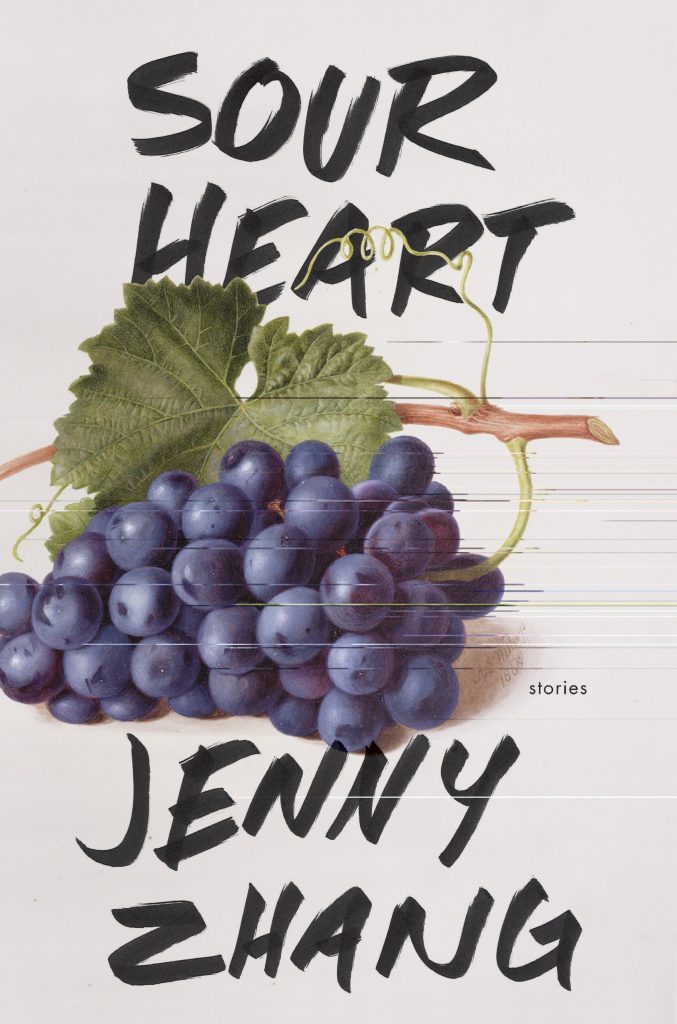
Set primarily in the 90’s in New York City, Zhang gives voice to a generation of daughters of Chinese immigrants. We Love You Crispina, the opening story,sets the tone for the rest: dark, humorous, vulgar, and filled with family. In it a young girl deals with moving from roach infested apartments to dilapidated hotels as her family struggles to save. In The Evolution of my Brother, a sister torments her brother, only to be horrified as he begins to inflict pain on himself. This collection is bittersweet and littered with pop culture icons.
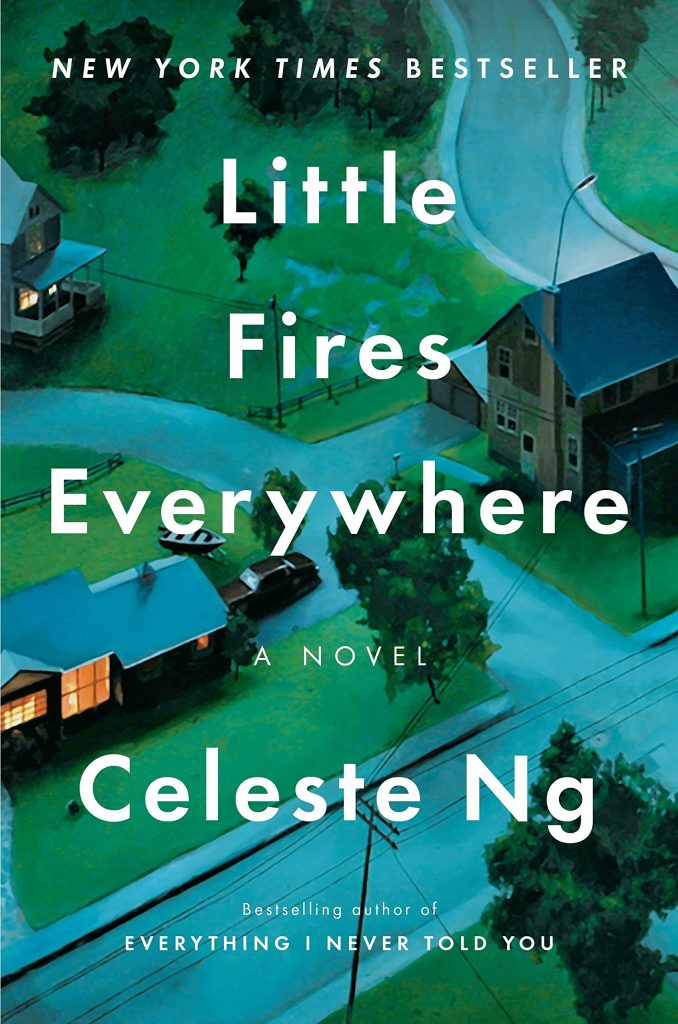
This web of mothers is set in the late 90’s in an upscale Cleveland suburb. Elena Richardson should be a suburban dream, but secretly she’s unhappy in her role. When Mia Warren, a single mother and artist, moves to Elena’s quaint town, their paths immediately cross. Their younger daughters find solace in the others’ mom. Elena’s daughter, an alternative outcast, loves Mia’s creativity, and Mia’s daughter craves the stability of the Richardson family. Then enters an adoption case that ignites everyone’s secrets.
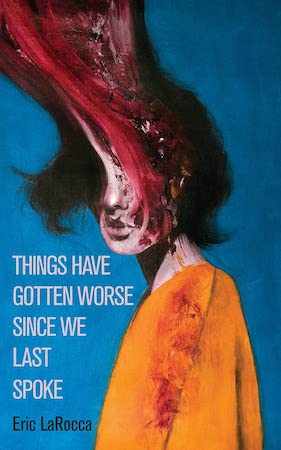
This novella might only be 112 pages, but it excels in creepiness. The book is composed of fictional transcripts between two women in 2000. When Agnes joins an LGBTQ forum to sell an antique apple peeler, she begins an exchange with Zoe. The two quickly become entangled in a BDSM relationship over email and instant messenger, where Zoe’s demands become increasingly deranged.
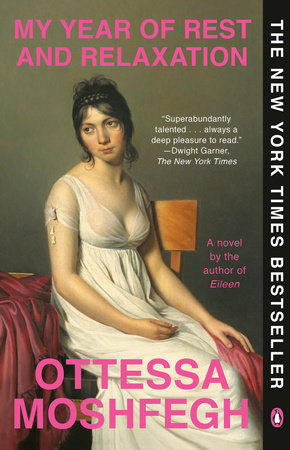
The unnamed narrator at the center of this novel is unlikable. She is all of the bad and vapid things white women could be at the turn of the century. She went to an Ivy League for an art history degree. She is undeservingly rich and refuses to work. She eats poorly but is thin. She’s a terrible friend, and she uses everyone to her own advantage. And yet, she is a product of the environment: Manhattan in the early aughts, and it’s easy access to eating disorders, prescription pills, and hiding away unseen.
Ahlam aka Ariel, the daughter of an Israeli waitress and a Palestinian cab driver, and Laura, the daughter of a rumored witch who has been dead for many years, are best friends. Meeting in the suburban desert of Arizona, they decide to run off after a string of deaths at their high school. They find a free place to stay to Brooklyn, where they immediately become entangled in partying, drugs, and sex. This poetic tale across landscapes and time addresses toxic friendships and what it means to find home.
In overlapping narratives, Red at the Bone slowly unveils a family’s history. The novel opens in 2001 on Melody’s sixteenth birthday, where she is surrounded by family and wears her mother’s old dress— a dress her mother never wore because she became pregnant with Melody before her sixteenth birthday. Considering the present, her parents’ past, and even her grandparents’ past, this book tackles generational trauma, racism, and how the past can define the present.
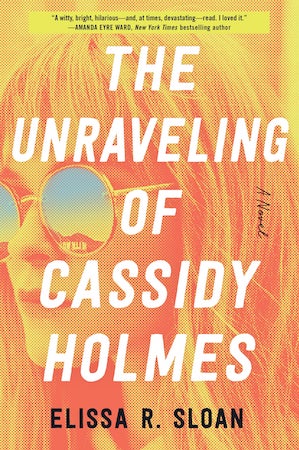
The early 2000’s loved nothing more than making young women famous. Cassidy “Sassy Cassy” Holmes was Britney meets Xtina, only hotter and in the most famous girl band around. But after a blow up in 2002, the group disbands.Years later, Sassy Cassy is found dead by suicide. Now, her old bandmates must reunite to process her death and make some meaning out of the tragedy. This novel also takes a critical look at the sexism and racism of pop bands from the turn of the century, and how that ultimately impacted the women in their lives.
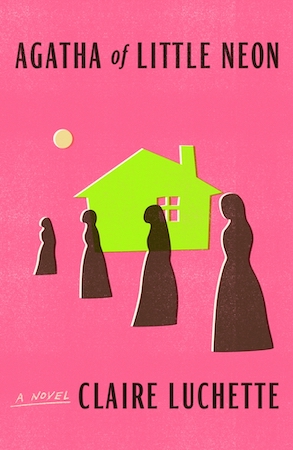
When a small parish outside of Buffalo closes, four nuns are sent to work at a sober living facility. One of the nuns, Agatha, decides to also take a job at a local Catholic school as a geometry teacher. The friendship between the nuns is at the center of this novel, and the hidden atrocities of the Catholic Church lurk in the background. Agatha finds herself within a cast of lovable misfits and all former catholics, especially the queer folks, will recognize the themes present here.
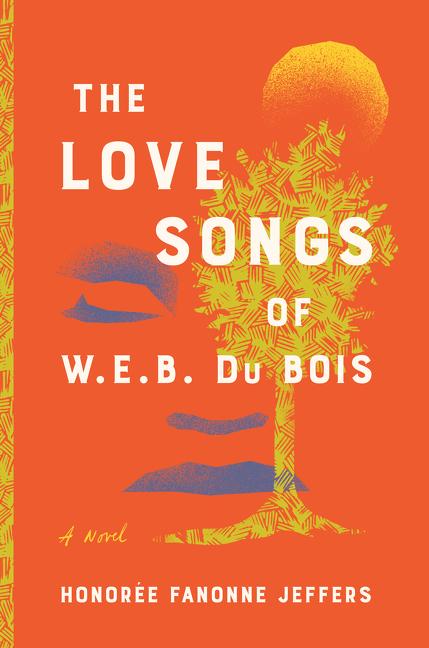
Set in Washington, D.C., and Chicasetta—a fictitious town based on Eatonton, Georgia, the birthplace of Jeffers’ mother—the novel relies on historical “songs” to trace Ailey Pearl Garfield’s lineage from the arrival of her first African ancestor on American soil and her Creek ancestors’ early encounters with Caucasians in America. The songs serve as a narrative of the land and what happens throughout the years to the inhabitants of that land.
Given the period, the novel touches on large issues—slavery, the removal of Native Americans from their ancestral lands, colorism, race relations—but for Jeffers, the heart of the novel is the growth of the messy, chubby, loud, and imperfect Ailey.
When we first meet Ailey, she is a preschooler, traveling with her mother and sisters to spend the summer months in Chicasetta. The coming of age novel follows Ailey through her teenage and college years. As Ailey grows older, the annual pilgrimage and her relationship with her elders take on a different meaning. Ailey’s Uncle Root introduces her to the work of W.E.B. Du Bois and gifts her a first edition of The Souls of Black Folk. Later, when Ailey attends university, Du Bois serves as a guide leading her to discover her life’s calling and forge a path distinct from that of her parents and sisters.
Donna Hemans: Where does your fascination with history come from?
Honorée Fanonne Jeffers: When I first learned about slavery, I didn’t learn about it in a history book. I am a child of the ’70s. Even though I went to primarily African American schools up until junior high school, we didn’t get a lot of that in school. You had to learn it elsewhere.
My grandmother’s father was born in slavery. And he was a little bitty boy—a toddler—and my great-grandmother Mandy was a teenager when freedom came. One of her first memories is of her father being sold down the river to Mississippi or where ever, sold deeper south. That was a very traumatic experience for her. She told that story to my mother. She was an old woman and my mother was maybe five and Momma would always despair that she hadn’t spent enough time when Great-Grandma Mandy tried to tell these stories. The kids wouldn’t listen; they wanted to go out and play. Great-Grandma Mandy would say “You got to hear this.” And then Momma would always say “I wish I had paid more attention.”
That made an impression on me. But you know when you are a child, you don’t have these sorts of critical thinking skills. But as an adult, I think there was something about that grief that Momma had had if she had paid more attention to her great-grandmother that made me pay attention to the older folks. So that’s how I first learned about slavery through family stories.
Later, when I first began reading the classic slave narratives—Frederick Douglas’ narratives, Harriet Jacobs’ Incidents in the Life of a Slave Girl—things began to click about the stories I had heard in Eatonton and then the history that was on the page. And that’s when the fascination really began.
The first time I was in graduate school, The University of North Carolina at Chapel Hill, had a big archive called the Southern Historical Collection. That’s where I first encountered the archives and I still have photocopies of letters written by enslaved Black people that I found in the Southern Historical Collection. Once I saw those letters I was just hooked. I couldn’t get those people out of my mind.
DH: I think of the focus of the book as building lineage. Ailey says to her white classmate that for white descendants of the Pinchard family “paternity is an a priori assumption.” But that’s not the case for Black Americans. Lineage of Black people in the Americas is such a complicated thing. Why did you want to write about the complexity of lineage? Is it tied to the fact that it is so difficult for Black folks to trace who we are and where we came from? And do you think the complexity of lineage is widely understood outside of Black communities?
HFJ: I definitely do not think that many people who are not African American understand that most of us have European ancestry, no matter what we look like. I am a cocoa-brown woman with coily hair and I have white ancestors on both sides, paternal and maternal. I don’t think people understand the violence behind white lineage in Black communities. I do think the half has not been told about Native American lineage in Black communities.
One of the reasons is that there is so much missing from the historical archives. In the United States, no one bothered to keep these sort of impeccable records. When you go to 1860, that’s basically where you’re going to hit a wall for Black lineage to be able to trace names, to be able to trace where people lived. If you don’t have bills of sale, if somebody wasn’t sold, typically you’re not going to have a paper trail. So lineage was very important.
But also I think that only within Black communities are we really aware of the way that skin color has been used as a hierarchy. Skin color, hair texture, all of that. But also only within Black communities are we aware that in one family with the same mother and father, you can have several different skin colors, several different hair textures. So within the family, you may be treated the same or you may not, but when you go out people will respond based upon phenotype.
The reason I found that to be fascinating to talk about is that we have always heard this sort of story about the house and the field slave, and that enslaved Africans who worked in the house were close in color to the master and many of them were related to the master. And so they had an easier time than people who worked the fields. What I hadn’t seen a lot of in fiction is an examination of what those people who lived in closer proximity with the master had to deal with in terms of sexual harassment and sexual abuse.
DH: On both sides of Ailey’s family, loss is prominent, particularly the loss of land. That kind of loss still remains a major issue for Native Americans and Black Americans today, right? Is that part of the reason you focused on that issue?
HFJ: I think that in a very real way—even though I don’t make overt gestures toward environmentalism—for African Americans and Native Americans, the loss of the land is an environmental issue. I have not met one African American—even if they don’t want to go back to Africa, even if they don’t want to visit Africa—where there is not this sort of grief in their family line about the loss of Africa.
Even if people take DNA tests, that is not going to give you closure. It’s not going to give you home. Home is lost.
Even if people take DNA tests, even if you know someone in your bloodline came from Nigeria or Cameroon or Senegal or the Gambia or Ghana, that is not going to give you closure. It’s not going to give you home. Home is lost. You will never be able to return to that place and have relatives that are there. You will always be a stranger. That is a grief that never subsides.
And in the same way with Native Americans, that loss of their homeland is a grief that never subsides. It’s always with the Creek, with the Cherokee, with the Choctaw, with the Seminole—there is always a grief that they have that the land that is in the east can never be recovered. I wanted to explore that connection to home.
DH: I thought the loss of land was tied to the importance of the annual gatherings in Chicasetta. Am I right about that? Is that why the annual gatherings in Chicasetta are so important?
HFJ: You are right about that. The loss of land and also they are making sure that Ailey and her sisters do not lose their culture. It’s very important. Going back home is to reconnect with the land and the land reconnects with the culture. It’s like a trinity: the people, the land, the culture. That’s incredibly important.
It doesn’t matter how educated Uncle Root is or Belle is or later Ailey. They always return to this place. This place is essential because it is the only place where everyone knows everyone. It’s the only place where you can trace back as far as you can until the archives don’t provide anymore. It’s the only place you have memory and you can’t lose that memory. Whatever color of skin tone, whatever hair texture, education you have or don’t have, this is the place where everything is tended, restored, and maintained.
DH: Uncle Root is such an endearing and generous man. He saves Ailey time after time. How did you come to choose his name and what does his name mean to you?
HFJ: It’s a couple of things. It’s that he has remained. After Dear Pearl, his big sister, passes away, Uncle Root is the oldest. He takes that place because his sister was the matriarch and he becomes the patriarch but he defers to all the women. It’s still very much a matrilineal family. The rootedness is essential to his name.
W.E.B. Du Bois devoted his entire life to the betterment of not only African Americans but Black people around the globe.
But the other part is, he has this almost supernatural charm. As we see in the songs, that charm of his is inherited. It goes all the way back to the first African who arrived in that area. He was charming. His son was charming. This sort of almost supernatural charm that Uncle Root has, the way he can predict how the women in his family are going to act so he is always prepared to sort of counter that if he doesn’t agree with what they are saying, but he does it in a loving peaceful manner. In the deep South when somebody has that kind of power, we say they have roots. They have supernatural power. They may know folk medicine, know how to put spells on people. That’s where the name also comes from—his almost supernatural charm.
DH: What role does W.E.B. Du Bois play in the novel? Uncle Root certainly talks about him and his experiences with certain figures. Can you tell us why you chose the title and why you focused on him?
HFJ: W.E.B. Du Bois is considered to be the most accomplished African American intellectual in the history of America. He grew up in Massachusetts and when he was 17, he went down South to Fisk University. This was the first time he had ever encountered a majority of African Americans. He fell in love with Black people at Fisk. That was a turning point in his life. Then he devoted his entire life to the betterment of not only African Americans but Black people around the globe.
He becomes a shadow character in the book. In the same way he devotes his life to African Americans, Ailey is on the path to devoting her life to African Americans. She is first introduced to Du Bois through the story of Uncle Root when he talks about the first time he met who he calls the great scholar. Later that same summer that she hears the story for the first time, he gives her a first edition of The Souls of Black Folk. So Du Bois’s words serve as a guidepost. He becomes this shadow character.
Whenever you encounter the story of different characters, first you encounter Du Bois, what he has to say about Black folks who leave the South and come North, what he has to say about the problems of Black people, what he has to say about the evolution of Black people, what he has to say about African American spirituals. All of this guides the book.
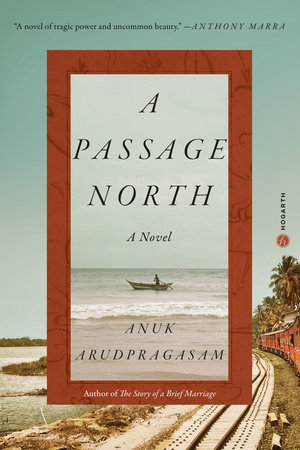
In A Passage North, the protagonist, Krishan, grapples with the legacies of the tragic Sri Lankan civil war between the Sinhalese and Tamil communities. Krishan travels from Colombo to northern Sri Lanka for the funeral of Rani, his grandmother’s caretaker, after hearing the news from his ex-girlfriend Anjum.
Through that reflective journey, the novel explores longing in the aftermath of a conflict in which upwards of 100,000 people may have died between 1983 to 2009.
Longlisted for the 2021 Booker Prize, A Passage Northis Anuk Arudpragasam’s second book. His 2016 debut novel, The Story of a Brief Marriage, was a devastating and poignant portrait of a day in the civil war.
I chatted with Arudpragasam over Zoom about the differences between writing for an English vs Tamil audience, the homogeneity of South Asian American writing, and how who we desire is connected to our aspirational selves.
Vignesh Ramachandran: What are the similarities between A Passage North and your first book, The Story of a Brief Marriage?
Anuk Arudpragasam: The first novel was very difficult to write. It involved daily immersion in a very violent world. I tried to expedite the finishing of that novel towards the end, because I had been writing it for three years, and it was not like a very healthy place or a very fruitful place to be immersed in for too long. So I tried to finish that novel more quickly than I otherwise would have.
When I was thinking about what kind of situation I wanted [this second novel] to unfold in, I wanted something that is very, very far from the war, something that was very far from violence. I didn’t want to think about those things for any longer. I wanted to write a book about desire and fantasy—or different ways of interpreting the world based on occupying different positions—the way the grandmother, for example, has to interpret the world basically on the basis of the little stimuli she receives. Or the way having desire might move you to see the world differently. It was supposed to be something very different. It was supposed to be about the relationship between a young man and his grandmother.
But as I was writing, all these little things kept popping up from the war, in accidental ways, in ways that were uncomfortable. And I would continue to edit them out, but they would continue cropping up, almost like Freudian slips. I soon realized that this novel, too, had to be in some way about the war. I have not finished thinking through that subject in my writing and what it means to me. When I realized that it was that I could not avoid it and that’s what my hands wanted to write about, I decided that I would try to make it more about spectatorship rather than participation.
VR: What are the themes that you would say a reader is going to encounter through the book?
AA: The book digresses in many ways, and it reaches into lives that take in and of themselves, very different from one another.
This idea that all four characters in the book, their lives on Earth are determined by a sense that there is something that they need that they either do not have access to or cannot articulate.
With the exception of Anjum, the other three there’s a way in which they desire, but they cannot act—either because of who they are or because of the structure of the world, they cannot obtain what they need. I think what ties the book is this kind of longing.
VR: When you talk about death in the book, you write:
“It was the fact, above all, that sudden or violent deaths could occur not merely in a war zone or during race riots but during the slow unremarkable course of everyday life that made them so disturbing and so difficult to accept, as though the possibility of death was contained in even the most routine of actions, in even the ordinary, unnoticed moments of life.”
As I read that, I kept thinking about that relevance to the current pandemic we’re in.
AA: I finished the book before the pandemic. But when you grow up in a poor country, a lot of people die in accidents. A lot of those accidents were preventable in one way or another. But a lot of people die in ways that they don’t have to die. In a sense, the pandemic has brought that condition, far and wide.
VR: To that point, you write this about Krishan:
“He’d never really stopped to consider the fact that people could also die slowly, that dying could be a process one had to negotiate over the course of many years.”
AA: We grew up seeing corpses of all kinds almost every day in the newspapers and all of these stories continually coming in of people dying in a tsunami or from shrapnel or a bomb blast. Where I grew up in Colombo, there was a period of a few years in which every month there was a bomb blast somewhere or the other. Every day on my way to school, I had to pass a road in which a suicide bomber had killed somebody and in which there was a memorial painted onto the tar of the road. I’d have to walk over there every day on my way to school. This idea of death being sudden—it was very much in the environment.
VR: What does Krishan’s former girlfriend Anjum—an activist who he had dated earlier in Delhi—represent in the book?
AA: There’s this discussion about why Krishan falls in love with this person that he doesn’t know at all. It’s this thing that often happens, and that it’s often harmful—projecting this personality or this ideal onto a kind of desired person. But then there’s this further discussion about how also sometimes a glance can be prophetic, how one can see in the movement or a gesture, kind of like a prophecy of who this person is or might be. Even if you don’t know a person in one of the more substantial senses, such glimpses might be enough to make somebody fall for another person.
Desiring is often connected to the aspirational self. What kind of person would I become when I’m with this person?
Often desire has to do with identity, or that the image of a person that you glimpse, whether it turns out to be true or to be false, is often connected to some idea of who you might want to be, or what kind of person you might want to be. Desiring is often connected to the aspirational self. What kind of person would I become when I’m with this person? Or what kind of person would I be if I had this or lived in this way? What it is about Anjum that so moves Krishan is that she is a conviction—the fact that she’s so earnestly committed to something that she’s willing to give herself up for.
VR: What do you want people to understand about the Sri Lankan civil war and the context of post-war Sri Lanka today?
AA: I don’t know if I have any particular desire for readers to come away with anything politically speaking about Sri Lanka, about our history.
One of the audiences that I’ve come to understand that I have—maybe the main audience—is the diasporic Tamil community because more than half of our population has left the country and is in exile, most of them as asylum seekers. There are [thousands of] Sri Lankan Tamils still living in refugee camps in South India, mainly in Tamil Nadu, who haven’t been given citizenship.
The diasporic Tamil community is mainly spread out across the West. Many of these people are my generation. But they’ve grown up removed from their homeland, unable to go back. They long for it intensely.
I was, in some sense, lucky not to have fled the country in that way and to have grown up the way I did. I see that desire in me resonates with this desire in them also to memorialize our community, our culture so that it doesn’t disappear. And to describe it with care and reflect on it philosophically, and what it might mean, and why it might be, why this way of being might be valuable, why it might be these rituals, these habits, these ways of speaking, these experiences and these histories, like why they might be important to keep close.
As far as the non-Tamil audience? Sri Lanka is a particular country with a particular history and if you get a sense of that history from reading my work, then that’s good, but it isn’t what I’m trying to do here.
VR: You have your doctorate in philosophy from Columbia University, and your books evoke a tone that I feel is a steady beat of contemplation. Considering your own background as a philosopher, do you seem to bring that into the voice of your work?
AA: It’s not actually at all how academic philosophers actually think or write—it’s very different. It’s much drier, it’s totally based on argument, and it is often highly focused on very rigorous logic, and it is very hesitant to make claims about the nature of life.
English is a language that no longer belongs to any specific piece of land, or any specific people.
So actually, I found in the novel a freedom to think philosophically in a way that I didn’t feel that I was able to within academic philosophy.
Generally, a novel is situated in something—it’s immersed in some kind of life form, and so therefore, if you think philosophically within the novel, you can think from the point of view, think philosophically from a situated perspective, rather than something that is disembodied, something that is abstract, something that has no particular starting point or particular identity, which is how a lot of academic philosophy is.
In a way, there’s less freedom because you’re always situating your thought in a very particular world, or person, or state. But it’s freeing in the sense that it allows you then to think through the particularity of life.
VR: You have said in the past that you want to write more works in Tamil. Is that something you still want to do?
AA: I do write more in Tamil now—not for publication, just privately. It is something I’d like to do. It feels important to me. There are ways that I can write in Tamil that I could not write in English. There are forms of intimacy available to me in Tamil that are not available in English.
English is a language that no longer belongs to any specific piece of land, or any specific people. It’s a language that—no matter what people from the U.K. might say—has no primary dialect. In all sorts of places around the world, there are all different kinds of native communities of English speakers, and it’s a language, therefore, that doesn’t have a center. Therefore, a language in which when you write, you can, in principle, be read by any kind of person, because there is no longer a history, a land, a specific community, or a specific set of experiences that defines the English speaker. The English language is no longer a situated language. And therefore when you write in English, you are writing to, in principle, any kind of person, and therefore, when you write in this language, you’re on your guard. You do not know how to relate to the audience. It’s like speaking into a certain kind of voice.
Because of this, there’s a certain kind of intimacy that’s lost for me in English. In Tamil, for example, there are many people who I don’t share a worldview, but just in virtue of the fact that we’re Tamil speakers, whether they grew up in Oslo or in a small village in Tamil Nadu, or if they grew up in Kuala Lumpur or Sri Lanka, just in virtue of the fact that they speak this language, they are tied by a certain history and to a certain region in the world.
Whether I disagree with them on any particular point or not, I have a sense of who they are. I have a way of approaching—I know already what kind of stances I might take towards that community and therefore I think in Tamil, knowing my audience, there’s more of a possibility for a certain kind of vulnerability. I don’t just mean that because I would show myself or reveal myself to a Tamil audience more than I want to an English audience—actually, in certain ways, the opposite is the case, they are certain things I wouldn’t talk about because Tamil society is conservative—but just knowing that society means that I will know what I am doing, I will know whether my speech act is something that bothers, annoys, subverts, angers, or soothes. I have a more intimate sense of this.
VR: Do you feel like South Asian diasporic voices are being better represented in literature these days, or not?
As far as I know, the South Asian American writing being published is all upper caste… So in that sense, it’s much less representative of the different cultures in South Asia.
AA: As far as I know, the South Asian American writing being published is all upper caste. In a way, this is reflective of the population of Indians in America, because unlike places like the U.K. or Canada, which have a long history of taking refugees—more varied across caste—and they have also a long history of taking in South Asians that are not necessarily academically or professionally qualified.
The demographic of South Asians that make it to the United States generally all have been high caste and they all generally have a very, very particular kind of relationship to South Asia and a very, very particular minority culture vis-a-vis the other cultures that exist in South Asia. This is also true of South Asian writers who write in English, because access to English, at the level of nativeness and sophistication that’s required to write an English novel that will be published in the United States or the United Kingdom, means you come from a certain kind of privilege. In South Asia, class privilege is always tied to caste privilege. So in that sense, it’s much less representative of the different cultures in South Asia.
VR: What are you working on next?
AA: It’s a novel set in the Tamil diaspora. In a way, I view it as the third part of a trilogy that deals with the war in the least direct way of the first and the second book of the other books in the trilogy. It’s dealing with people in the diaspora whose relationship to the war is inherited, rather than directly acquired.
It took us four years, but we cured all of London’s foxes of mange. Every fox in the greater metropolitan area was captured, tagged, and treated. We received awards from PETA and the urban planning department. In our acceptance speeches, we thanked the three pillars of our successful campaign: teamwork, perseverance, and a combination of Ivomec and broad spectrum antibiotics.
It should have been enough to see the gleam of thick vermillion coats under the weak city moon; it should have been enough to hear the foxes scream in the night, resplendently bepelted. But after the awards ceremonies, that achievement didn’t seem like enough of a reward. We’d had so much champagne. We’d had our names on custom-inked certificates. We wanted more.
What else could we cure the foxes of? Initially we thought we might target their diet, but this was laughed out of the first funding meeting. Do you want to open up a little fox restaurant? Spaghetti and meatballs? Accordions? We considered a program of mass sterilization, but PETA got wind of that project and threatened to take our award away. So we spun on our spinny chairs and crunched on the problem like a camel chewing a Pepsi can. What could we cure the foxes of? What still afflicted them, now that we’d made them so beautiful?
A post-graduate student hatched the earliest incarnation of the plan. The foxes had been cured of their physical ailment, but they still suffered a terrible, insidious sickness: an image problem. They shrieked in the gloaming, they ate refuse from people’s front gardens, they crapped on lawns. In the eyes of fastidious gardeners and keepers of domestic cats—London’s most powerful voter base—they were russet hoodlums.
Of course, we couldn’t simply provide the foxes with good PR. We were scientists. Dabbling in advertising was simultaneously below us and well above our pay grade. We had to think in terms of applicable, tangible, medical cures. That’s when we hit on the solution: we would cure the foxes of their rudeness.
We identified the rudeness as a spatial issue. Foxes had no understanding of how disruptive the sight of a glistening turd in a field of mellow green could be, how traumatic was the sight of a household’s garbage entrails when strewn across the street, because they had no understanding of the ritualized importance of such spaces. We had to imbue in the foxes a sense of place.
The latest and most disconcerting innovations in biotech were put at our disposal. We would build walls—literal cellular walls—in the brains of the foxes, marshalling their thoughts, focusing their perceptions.
It was easier to capture them the second time around, accustomed as they’d grown to our equipment, our rubber-gloved handling, tagged as they already were by the chips bought with the nostalgic remnants of our EU funding. It took only eighteen months for three-quarters of London’s foxes to pass through our program. It was, all things considered, another success. We eagerly awaited our summons to the summer awards ceremonies.
There was a fallow period as the foxes adjusted to their new sense of place. Its initial manifestation was of the all-according-to-plan variety. Introversion overcame the foxes. They mated quietly, and their scavenging became fastidious. They appeared to designate certain brownfield or abandoned sites as toilets. They appeared to learn to queue.
Our first intimation that something had gone very wrong came early that summer. A young vixen was spotted in the peonies of a pleasant suburban garden, digging industriously. Naturally the owners assumed this was a creature as yet unvaccinated against rudeness, unable to comprehend the sacrilege of unearthing the flowers. They went outside, banging wooden spoons against frying pans. They expected the vixen to flee.
Urban foxes have almost never been recorded attacking humans—they’re bright enough to know that it’s not worth the hassle. The peony-growers had no idea that the vixen would launch herself at their faces. Besides, humans retreat to suburbia because they don’t want to do any fighting more strenuous than a sharp note to a neighbor through the letterbox. Even armed with saucepans, their exposed flesh tears easily.
It transpired, in the ensuing panicked media coverage, that the vixen had a perfectly accurate sense that the peony bed was a cherished space. She simply had a different idea about what should be placed there, how homage should be paid. She planted rat skulls and green bottles. It must be said that she added a large chunk of human skin, hair and muscle.
Spates of fox vandalization—and fox violence—blistered across the city. We realized too late that by teaching the foxes the value of place, and of the rituals surrounding the creation of place, we had inadvertently taught them religion. In teaching them religion, we had taught them religious mania. We had taught them boundaries, and they had learned about borders. By the height of the summer, the foxes knew about nationalism.
Now we don’t know how to reverse it. The foxes have learned about bodily autonomy, and they evade our attempts to recapture them. They’ve learned about conformity and are ruthlessly eliminating the remaining vulpine population still rude, lewd and animal in the brain. We can feel their eyes on us. We can sense that something is simmering. We leave out choice cuts of meat and milk on doorsteps, as we might to a horde of murderous elves, but we don’t know if it’s going to be enough. We have taught the foxes what rudeness is, and with that we’ve taught them how to hate, and we can feel it, oh God, we can feel that they hate us so much.
Save me, I’ve been feeling so alone I keep waiting for you, but you never come Is this in my head? I don’t know what to think
Love Story (Taylor’s Version),” Fearless (2021)
When I make gimbap, I start with the rice.
I wash two cups in a pot, filling it with water and setting it to cook on the stovetop because I rarely have the foresight to let my rice soak as I should. As that cooks, I crack four eggs in a bowl with salt and a drizzle of half-and-half, using chopsticks to break the yolks and whip the eggs into a yellow slurry. I heat a pan on medium-high heat, lightly oiling it, and pour my egg mixture onto the pan when it’s hot, folding the egg into an omelette that I slide onto a pan to cool.
I cut my cucumber into long strips and de-seed them, then cut one carrot into a pile of matchsticks. I’ve made my danmuji (pickled Korean radish) and potato banchan (side dish) the day before, so I move on to prepping whatever protein I’m using — hot dog, Spam, bulgogi, whatever I’ve got — and warm it up in the pan, before slicing my cooled omelette into long strips, seasoning my rice with a pinch of salt, a tiny drizzle of sesame oil, and a toss of toasted sesame seeds, and setting up my mise en place. I get a little finger pot of water to seal my gimbap, my seaweed sheets from the freezer, the bamboo mat I’ll use to tighten my rolls from the drawer. I pull on a pair of disposable plastic kitchen gloves and cue up my Taylor Swift playlist on my phone, and, now, it’s time to roll.
And I never saw you coming And I’ll never be the same
“State of Grace,” Red (2012)
Most of the time, I have no idea what Taylor Swift is singing about. It doesn’t matter if she’s telling lyric stories about falling in love or breaking up or longing for someone — I really have no idea. But I can imagine it, can tap into universal human emotions to conjure up similar feelings, even though I’ve never directly experienced any of these things before. I’ve never been in love or been in a relationship. I’ve never even gotten close.
I can imagine it, can tap into universal human emotions to conjure up similar feelings, even though I’ve never directly experienced any of these things before.
A friend advises that I try dating, if only just for practice, and I know this friend is right. Dating is something you have to work at, too, and I was never properly socialized as an adolescent — I didn’t go to dances, wasn’t a part of clubs, didn’t have much of a social life outside of my small church. In college, I didn’t join a sorority, still wasn’t a part of clubs, often went days without physically speaking to anyone. As a young adult, I moved across the country from Los Angeles to Brooklyn, withdrew from law school to take on odd freelancing jobs while working on a novel-in-stories, and, again, often went days without physically speaking to anyone.
It wasn’t just that I was shy or that I liked my solitude. Starting in high school, I had been taught to link my self-worth to my body, which was average by American beauty standards, but too big for Koreans. Because of this, my own immigrant community shamed me for my body. That shame broke me down mentally as I spent the next ten years trying to whittle myself down physically, counting calories, exercising obsessively, and restricting, going further down the spiral of self-loathing that completely eradicated any confidence or pride I had in myself as a person. While I’m in a much better place now, I still can’t look in a mirror without feeling that familiar chill of repulsion shuddering down my spine.
All this meant that, by my early twenties,I basically withdrew from society because I couldn’t deal with how others reacted to my body, how I thought they would reject me because of it. I became resigned to doing life on my own, even convinced myself that I was okay with it, learning to dine alone, go to movies alone, move apartments alone. I told myself I was “independent” and didn’t need people; I was a misanthrope, an introvert, a writer who would rather spend my time reading than being social. I wasn’t a naturally gregarious person, anyway, so it didn’t matter if I didn’t talk to anyone that day.
I wasn’t a naturally gregarious person, anyway, so it didn’t matter if I didn’t talk to anyone that day.
Part of healing included breaking down these lies I’d come to believe about myself. As I gradually opened up to the world, venturing out to meet people, make friends, and learn how much I enjoyed human company, I started to feel the lonely pangs of my singleness, a feeling that had existed before but hadn’t lit up as pain. I still couldn’t think about dating, though, or let myself dwell on my singleness because I had other things to worry about first — becoming financially stable, selling my book, bringing my dog out to Brooklyn from L.A.. It wasn’t difficult, not when I’d already gone fifteen years assuming I’d be single and alone forever — until, one night in 2019, I’m having dinner with a friend and look up to see a stranger making a loop around the room, and I think, well, shit, you’re fucking cute, and, then, there’s Taylor Swift, singing about love in catchy melodies that keep worming their way into my brain and my heart.
I don’t wanna look at anyone else now that I saw you I don’t wanna think of anything else now that I thought of you
“Daylight,” Lover (2019)
The first time we see each other, it’s from across the room. She’s chatting with someone, and I happen to look up from my conversation when our eyes briefly meet, brushing gazes before returning to the person alongside us. It’s a glancing moment, inconsequential really, so I’m surprised by the electricity that runs through me, that spark of curiosity and wonder. I like the way she looks, the way she smiles, and I don’t know what this feeling is.
We’re never introduced formally, but our paths cross often enough that we learn who we are. I promptly follow her on social media, trying to glean what I can of who she is outside of her profession — she cooks professionally and makes gimbap — but she posts so sporadically, there isn’t much to learn. It’ll be months before we speak, months I’ll spend admiring her from a distance while avoiding her because, as I learn, I become neurotically shy when it comes to feelings. I throw myself in her line of vision as often as I can, even though I can’t get myself to make eye contact or say hello or initiate conversation, which frustrates the hell out of me because, at this point, it isn’t even that I want to date her — I just want to talk and get to know her. I want to know if we’d be compatible, if we share the same sense of humor, if she rolls her toilet paper from the top or bottom, if she eats the correct brand of Chocopie, if this, if that, if everything.
In the beginning, it’s enough to know that she is there, to have someone I even want to get to know. Her existence is enough, a kind of hope that I’m not totally dead inside, that maybe I, too, can experience the things that Taylor Swift sings about, from the magic of that first meet to longing for someone who’s in love with someone else all the way to heartbreak and healing and starting the cycle over again.
In the beginning, it’s enough to know that she is there, to have someone I even want to get to know.
On Valentine’s Day, she follows me back on social media, and I wonder why as I stare at the notification on my phone. I think, maybe, we could start to move beyond perfunctory, polite small talk if our paths continue to criss-cross in the future, but we don’t. I’m too afraid to try because what if she isn’t interested, what if she thinks I’m annoying, but, then again, what if she is interested and then she finds out how inexperienced I am, how much I’m flailing as a grown person, how bad my brain is? What if we talk, and we learn we wouldn’t even be friends? And, then, underneath all that, how sad is all my pining for a stranger I don’t even know, how creepy, how pathetic, when I could just approach her and say, Hi, can we get a cup of coffee, I’d like to get to know you?
As the months stretch on and we continue to orbit each other, the silences get louder, the neuroses in my brain deafening, and, in frustration, I turn to making gimbap, posting photos of my progress to Instagram in an attempt to say, Hi, I’m here, look what I’ve been up to.
Is the end of all the endings? My broken bones are mending with all these nights we’re spending up on the roof with a school girl crush
“King of my Heart,” Reputation (2017)
In her documentary, Miss Americana, Taylor Swift says that she didn’t eat a burrito until she was twenty-six. That’s the main thing that sticks with me from the documentary, not because it surprises me (Taylor Swift is a white American who was born in Pennsylvania and moved to Nashville), but because it fills me with a different wonder. Who first introduced her to a burrito? What else has she not eaten? What will she never have the opportunity to eat — like will she ever try gaejang or pork chop over rice or pork sisig? Maybe she’s had egg rolls, given the pervasiveness of Chinese American food, but what about spring rolls or lumpia shanghai? Has she had kimchi mandu? Pork buns? Pho? Has anyone made her gimbap?
Until 2019, I was fairly ambivalent about Taylor Swift. I was more cognizant of her than I was any other Western celebrity, but most of my curiosity about her centered around her personal branding, her ability to craft and embody her public persona and narrative so thoroughly. I was skeptical of so much she did — the Christmas gifts to her fans, the private listening sessions, her effusive concert monologues — because it all seemed too calculated, though that kind of image control is part and parcel of celebrity. Maybe it was Swift’s naked eagerness, her desire to be liked that got to me. I don’t know what flipped the switch in my brain, but, in 2020, deep into my crush in the midst of the pandemic, I had to say it out loud: I loved Taylor Swift. I even liked her because of her desire to be liked, her chameleon-like ability to adapt when others tried to throw her off her narrative, her doggedness to shine and remain at the top.
When Taylor Swift sings about love and desire, I think, I wish I knew how that felt. I wish I didn’t feel so half-formed, so stunted, and I admire Swift’s songwriting, her ability to tap into feelings that are universal even if I’ve never experienced them in the same way. The emotional core of her songs resonates, even if the story she’s telling in her lyrics has a specificity only she knows, and I wish I could put all my feelings into a song and send that out into the world to speak for me.
I can’t write songs, though, but I have food. I’ve been cooking for many, many years, mostly for myself because cooking has been the best way to manage my depressive, anxious brain, as well as a way for me to build a relationship with food that wasn’t built on shame. The more I cooked, the more I was able to piece myself together, the more people I started to gather in my life, people who came to my tiny Brooklyn apartment over the years for my thirtieth birthday dinner, book clubs, writing sessions, hangouts, a gimjang I hosted in 2019. I cooked for all these gatherings — miyeokguk (seaweed soup), tall New York cheesecakes, Dutch pancakes with buttered apples, dahkdoreetang (spicy chicken stew), so much gimbap. I started thinking of new combinations to try — like, could I take the elements of a bánh mì and put that into a gimbap, what about curry katsu, how would this combination taste, what about that? As I continued to roll gimbap for friends and family, I started to think that this, here, was my love song.
The more I cooked, the more I was able to piece myself together, the more people I started to gather in my life.
Taking photographs and sharing them on social media, too, have become a kind of love song, a way of one-sided communication that has to suffice, fill in for my longing to say, here, let me care for you. I know she’s there on social media, that she’s silently watching, but I don’t know how to coax her out. All I know is to keep trying to show myself as genuinely as I can, lay myself bare in my vulnerabilities, and hope she sees me.
Say it’s been a long six months and you were too afraid to tell her what you want That’s how it works That’s how you get the girl
“How You Get the Girl,” 1989 (2014)
Gimbap literally translates into seaweed (gim) rice (bap). Traditionally, in gimbap, you find a “main” protein, an egg omelette, danmuji, and an assortment of vegetables like blanched spinach, julienned carrots, and cucumbers. Gimbap is made for field trips, road trips, casual gatherings, and it’s typically for larger groups because gimbap requires a lot of work — each filling has to be made individually then each gimbap rolled — and that amount of labor is mostly worth it when you’ve got lots of mouths to feed.
Gimbap-making itself is an act of love — or, at least, if we are to try to avoid such sentimental generalizations, an act of care. Gimbap has so many parts, so, when I make gimbap for someone, it’s a way of saying that I love you, I care for you, here, I have made this roll of rice wrapped with seaweed and stuffed with things, all to make the perfect bite, just for you.
When I make gimbap for someone, it’s a way of saying that I love you, I care for you.
Gimbap, thus, became a secret language, a way for me to communicate with her through the internet. We’ve spoken briefly a few times in person before the pandemic shut everything down and I start spending months back in Los Angeles, and I know she’s there on social media, dropping in for whatever reason as a silent observer, no likes, no comments, no DMs. Occasionally,I try to chat with her, but she’s slippery and evasive, friendly enough to make me think she’s just shy, but elusive enough that I’m filled with self-doubt every time she doesn’t leave room for a conversation. Instead, with no other means of speaking, I fill the spaces of our silences with photos of gimbap.
I guess you never know, never know and it’s another day waking up alone
“the 1,” folklore (2020)
I want to tell her everything — how I made gimbap with eomook (pressed fish cake) and liked it even though I haven’t historically liked eomook, how I tried making a riff of samgyupsahl ssam (pork belly wraps) in gimbap form that confused my dad, how I save little scraps of egg to give to my dogs. I want to talk to her about how I love being in LA with my dogs but feel so alone and isolated out in California, how I would stay put in Brooklyn if I had someone here to ground me. I want to tell her I worry about her, especially in these times with the pandemic and anti-Asian hate crimes, but it doesn’t seem like my place, so I stay silent.
I can’t get a read on her, on our ambiguous interactions, but I want to ask how she’s doing, if she’s okay, if her days are passing uneventfully. I want to know if she goes home to someone, has someone who’ll help carry her burdens and fears, and then there are all the neurotic questions — why does she follow me on social media if she won’t engage with me? Is she ever only kind out of politeness? Have I annoyed her with my presence and would she like me to go away?
She has so much access to me, to my day-to-day, to my fears and insecurities and vulnerabilities given my constant over-sharing on the internet, but I know so little about her. I feel that it is up to her to initiate. All it would take is a reply to a story, a DM, something simple and casual that gives me an in because I’ve tried when I could, tried to coax her into a casual conversation, tried to make things more personal, but she’s always polite and then she falls away. There’s never room for more, so I scuttle back, keep my feelings to myself.
I wonder how Taylor Swift would sing about this. Are my hesitation and confusion, this fear that makes me want to die, things she would understand? How would she capture this longing, this want, this desperation not to be invisible? What is the story she would tell in this song? Would it make me feel less alone, less crazy-brained and pathetic, if she could package up my loneliness and longing in a catchy, heartfelt song I can try to learn on guitar?
I’ll spend forever wondering if you knew I was enchanted to meet you
“Enchanted,” Speak Now (2010)
The cycle goes like this — I pine for a few weeks, hating every time she pops up in my dreams and on my social media feed and in my life. I keep waiting to find out she’s dating some basic dude. I roll gimbap, share photos online, until the pining reaches a tipping point, and I slide into self-loathing and spend the next few weeks trying to remove her from my brain.
I pine for a few weeks, hating every time she pops up in my dreams and on my social media feed and in my life.
I roll more gimbap, share more photos, but as I think I’m moving along nicely, our paths cross again, and I’m thrown back to the top of the cycle, back to grumbling over how I wish we could at least be friends. If not that, then, could I get some kind of closure, no more of this oscillating between hope and despair?
I’m not brave enough for that kind of finality yet, so instead, I wash two more cups of rice. I prep my fillings, season my rice, get my seaweed sheets from the freezer. And, then, as always, when I’m ready to roll, I cue up my Taylor Swift playlist on my phone, and I shove my feelings to the side, lose myself in the rote motions of filling and rolling gimbap, and wonder if Taylor Swift would eat this, if she would prefer gimbap with bulgogi or Spam or tuna, if she would like any of it at all.
Everyone has something to say in Jaime Cortez’s debut collection of short fiction, Gordo. There’s Raymundo, the town’s openly gay hairdresser who has a gift of knowing exactly what each of his clients needs to look and feel beautiful; Fat Cookie, a high school chola with a political edge and disregard for authority; the lone gringo, Juan Diego, a man of few words, whose broken heart is stirred by the music of Vicente Fernández. And guiding the reader along through a terrain of machismo pride, queer self-discovery, notions of home, and harrowing tales of immigration is the earnest and precocious Gordo.
Set in and around a predominantly Mexican migrant workers camp in 1970s Watsonville, California, Cortez’s stories are filled with so much love for the characters who inhabit them. Cortez is unflinching in his portrayals of violence and threat, and still—no matter how tragic their backstories or dire their current circumstances, he holds his cast in perfect balance, allowing levity and humor to always be in focus.
I spoke with Cortez on the phone about nicknames, writing semi-autobiographical fiction, and inheriting humor as a tool of survival.
Christopher Gonzalez: I wanted to talk first about the concept of nicknames. They’re so prevalent throughout the collection with characters like “Gordo,” “Fat Cookie,” and “Shy Boy,” to name a few. I was fascinated by the way in which nicknames create this familiarity among characters but also a distancing. It’s almost like you don’t get to fully know the person behind the name.
Jaime Cortez: I was kind of surprised when I went to college—we were talking about nicknames way back when I was an undergraduate. I didn’t realize there were people who grew up without a lot of nicknames, and I thought that was such an interesting contrast culturally for me.
Working-class, Mexican people are very big on nicknames, and they do connote belonging and they do connote familiarity, and it certainly can connote a kind of tenderness. And then, on the flip side, there are people, for instance, who are called “gordo” or “gorda,” who might eventually lose weight and still get called that name because the name just sticks. And so, I think that the nickname can also be a kind of a flattening of all that a person can be. In the case of “gordo,” it feels like being a fat kid then becomes one of the overriding factors of life. There’s also something interesting in these working-class settings of Mexican people. The nicknames often have a kind of blunt truth to them.
CG: There’s so much violence in the book, and there’s so much bumping up against one another that happens, especially amongst the kids. I’m thinking of that moment with Los Tigres, the twins, in “Fandango.” All the men are drinking and the twins get into this physical fight over who is the best dancer. Then Gordo’s dad, who thinks the one twin is a little asshole, offers to take him to the hospital when he’s severely injured. While there is tension and not everyone gets along in the camp, there’s still a level of care they have for one another. Can you talk about that dynamic?
JC: That scene is a very poignant one to me. It was based on something that I actually witnessed. My father and his two younger brothers were drinking. My dad had just gotten the latest Bee Gees album. He put it on and I could hear the youngest of the three brothers stomping around in the living room, dancing, and they got into a fight over who could dance. It was terrifying to hear the sound of these three bearish men throwing each other around, fighting over who was the best disco dancer. It was absurd. It was terrifying and hilarious at the same time. The next day we were laughing, but in the moment we were pissing ourselves because it was scary to be a little kid, hearing this madness going on in the room. Los Tigres were based on what had happened and that intense brutality and tenderness of things. It’s a very male way of operating sometimes, where you have this brutality followed by tenderness.
I watch a lot of MMA and I’m fascinated by people putting themselves into a situation on purpose where they get hit. The thing that’s so intense for me, like the emotional kind of payoff, is at the end. They’ve been just trashing each other, battling each other, and MMA is really violent. And at the end, they’ll just embrace. And sometimes the embrace is so deep. That is so fascinating to me that those things can sit right next to each other. They’re bleeding from all over, from their noses, their mouths, around their eyes, and they’re covered in sweat, exhausted, drained, and they fall into this embrace, and it’s really intense to me. I don’t have that instinct of violence as a way of settling anything.
CG: Have you drawn any conclusions about why it is that mostly heterosexual men channel violence into a way of forming connection?
JC: I think that it is more comfortable than tenderness. It is more comfortable and acceptable. For men, there’s something to be lost within hypermasculine settings. There’s something to be lost when you’re seen as emotionally vulnerable. It is safer to be furious and safer to be violent and to risk being battered yourself than to be seen as soft.
CG: In this context, I’m thinking about the character Raymundo. He comes in and he deals with a familiar bullying because of his sexuality and his presentation. It was fascinating to read his two stories back to back because he sort of comes out on top. This town that both fought against his very existence in a way, learns to embrace him. Can you talk a bit more about Raymundo’s role in the collection?
For men, there’s something to be lost within hypermasculine settings. It is safer to be furious and safer to be violent and to risk being battered yourself than to be seen as soft.
JC: It’s an interesting thing. There is a way that “the queen,” the effeminate gay man, can have a place. I saw that in Latino working class settings, they can sometimes find a place working as a barber or a hairdresser in a men’s or women’s salon. That is a place you then have an “oficio,” which is a word that has always fascinated me. “Oficio,” in its simplest sense, means a job, but I think it also means something deeper. “Oficio” feels like you have a purpose, you have a utility and a service that you can provide. You become useful in that way. And I think that finding a place, finding a way to be useful, can sometimes [shield] some of the worst sorts of hatred and exclusion.
CG: How did you approach bringing in narratives about immigrant characters who aren’t Mexican?
JC: That wasn’t even necessarily by design, but I think it really jumped out at me when I was a child growing up. I realized Salvadorans were the first Latinos who I ever spent time around who were not Mexicans. And so I kind of had this interest in other people who felt cousin-like, but not exactly like siblings. Culturally, I think it was also just that realization—growing up in the setting that I did, I knew of a million hard, sad stories about migration and immigration—about the desperation and the hope that comes with migration.
When we first met [Delia in the story “Alex”]—because [Delia] is based on real next-door neighbors we had, and they were a lesbian couple, and her butch partner did become physically abusive, and we did help the femme partner escape to Chicago, so all of that really did happen—I think it was the beginning of understanding the difference between an immigrant and really a refugee. She was escaping a very dangerous situation.
CG: I want to ask about writing a main character who’s fat. As a fat writer myself, all my main characters are usually fat, and I always struggle with how much physical description to include. With Gordo, his name alludes to his appearance. How did you decide on when to explicitly mention his weight in the text?
JC: In “El Gordo,” the wrestling mask story, when Pa tries to pull Gordo’s shirt off, there’s this shame of having his shirt off, because my fat kid body was a place of great shame. And, there was an interesting thing that happened while remembering that when I put on that mask and I saw myself without the shirt, and I thought, oh, this is kind of how the masked wrestlers look. A lot of them are gordo. That was a common thing that you would see with Mexican wrestlers. They were a combo of fat and muscle. So, it comes through in other people’s comments, and it comes through in Gordo’s thoughts, but I don’t go a long way towards describing it. It’s almost kind of by association.
CG: The kids in these stories are so close to and surrounded by adults in a way I think kids not from working class families aren’t. There’s this backdrop of worrying about money and drinking and danger. What are your thoughts on that juxtaposition of childhood set against very adult circumstances?
I think that finding a place, finding a way to be useful, can sometimes shield some of the worst sorts of hatred and exclusion.
JC: Looking back on it, we were extremely exposed to a lot of dodgy, traumatic, dangerous things. We also knew that, compared to the rigors and the horrors that our parents and grandparents had endured, we were definitely positioned as having it relatively easy in comparison. That’s why I think it was really important for me that I didn’t want the stories to have a maudlin tone of woe-is-me, because these were all kids who knew how much worse it could be.
CG: There’s so much humor and life in these characters, in the way the stories are told. And these stories capture exactly what you’re talking about, that balance. While reading, I was reminded of sitting around with my family listening to their stories, and if you dissect what they’re talking about, you realize how fucked up things were!
JC: [Laughs] It’s really fucked up!
CG: But, from the way they talk about everything, it’s as if those were the best times of their lives.
JC: Well, I think there’s a kind of glee, of like, hey we survived that! Sometimes I’ll hang out with my sister and my aunts and uncles—we grew up next door to them for many years in the same migrant worker camp, and we were all about the same age because my grandmother had children too late in her life. So, our uncles and aunts were really kind of like our siblings, and sometimes we’ll remember back to the things we went through, and we’re laughing, and we’re saying, it was terrible, wasn’t it? Yeah, I mean we’re still laughing. And also, of course, the people who perpetrated all this craziness on kids were also family members, in some cases very beloved family members, grandparents, tíos, tías, moms. It was just the understanding that they had at the time. And they would have laughed if you told them that it was abusive or wrong to spank, for instance.
CG: How else has humor shaped your life? How do you approach it when you’re writing and when you’re editing?
JC: I was raised around a lot of laughter. That doesn’t change the amount of trauma that I experienced and that people around me experienced. It doesn’t change the amount of fear that we might have experienced, fear of violence, or even the looming threat of violence popping up at any time. That was something else I thought a lot about as I was writing, what it meant to feel that the world can explode in violence at any moment. But despite all that, I think that I just grew up with so much laughter. There were so many funny people. Mom was funny, Dad was funny, aunts and uncles were funny. Kids were funny. And we cultivated that and valued that and it’s very clear to me that it was about survival, like this was how we bear it. This is how we survive it.
Years later, as an adult, gay man in San Francisco, in the ’90s and kind of being involved in HIV prevention and education work, I was again struck at a certain point by the kind of gallows humor that developed over time. Around living with this pandemic that was threatening to kill most of us. Especially during the ’80s and in the early ’90s, it was a death sentence. It wouldn’t be an overnight death sentence, but the assumption was that it’s a death sentence. So, the humor around that was also really powerful to me and it felt so familiar. Felt so familiar to hear some of the humor, and some of it was harsh and cruel, but I understand it as just a survival mechanism. Humor can be used in so many ways. Sometimes it can be used to deflect from the truth and sometimes it can be used to penetrate more deeply into the truth of things. And so I’m interested in those modalities of humor as a way of trying to get at a certain truth. I’m constantly thinking about humor, and how it functions, and who has agency to use it. And when does it get used and, I think especially right now, there’s a lot of sensitivity about what is appropriate fodder for humor, and a lot of pushback about it, so it’s a really interesting and precarious time for humor in so many ways.
I suppose an unmarried woman just over thirty, who lives alone and has no apparent ties, must expect to find herself involved or interested in other people’s business.
—Excellent Women by Barbara Pym
As an unmarried woman just over 30, Barbara Pym is my patron saint of young “spinsters.” In her satirical novels published mostly in the 1950s, she draws colorful portraits of the overlooked British women of that decade—the unmarried, dutiful, Church-goers. Pym has the lived experience to render these spinsters accurately—she herself never married. Her first novel was published in 1950, and she earned acclaim for her second, Excellent Women, published in 1952. She went on to write several more, but by the mid-1960s, her work had fallen out of favor, with numerous publishers telling her that it was “too old-fashioned” and too difficult to sell.
Despite the criticism of the 60s, Pym remains a cult icon. To this day, there is an active band of Barbara Pym fanatics who meet annually to discuss her work. While I haven’t paid the $30 membership fee for this illustrious society, I consider myself a Pym-lover. I started reading her novels a year ago off the recommendation of a friend, as recent profiles in the New York Timesand The New Yorkerhave lifted her posthumous profile.She was known in her day for her wit and accurate portrayals of post-war Britain, and her work is often read in that historical context. But I strongly disagree that her work is old-fashioned—quite the opposite. In her novels, Pym highlights the essential paradox for single women that still exists today: society expects them to stay unattached because in singlehood, they are dutiful, and yet, everyone wants to set them up because they can’t imagine anyone is happy on their own.
Pym’s spinsters, specifically Mildred in Excellent Women(1952), Prudence in Jane and Prudence(1953), and Catherine in Less Than Angels (1955), who is not single for the entire novel but still functions as the novel’s spinster, care deeply about mundane deliberations such as preparing the Church for events, making tea correctly, and rationing meat. None of these activities touch my life, as a Cold-Brew-Vegan-Heathen, and yet, I am the Barbara Pym Spinster.
I’m a single 30-year-old, and while friends object to me calling myself a “spinster,” I object to their objections. I don’t know if I’ll be single forever, but I call myself a spinster to signify that a romantic relationship is not important to me. I intend to start a family with my best friend, I take issue with our coupling of romance and child-rearing, and I find most of my Hinge matches thoroughly unimpressive. I wouldn’t say I’m “happy” being single so much as I don’t think my mental health is tied to my romantic status, and I don’t see a relationship as an end-goal. Society, however, seems to disagree, a pervasive attitude Pym chronicles astutely.
I don’t think my mental health is tied to my romantic status, and I don’t see a relationship as an end-goal.
Pym’s coupled characters are obsessed with setting the single women up. In Jane and Prudence, Jane, the older wife of a vicar, is unable to stop herself from setting up Prudence, despite fear that she’ll upset her. “She knew that the pride of even young spinsters is a delicate thing and that Prudence was especially sensitive.” Prudence sees right through this, as I have many times when introduced to a man who “also liked TV.” In Excellent Women, the miserable couple downstairs devote themselves to finding Mildred a husband, despite their own relationship veering far from “aspirational.” The closer I crept to 30, the more assertive my coupled friends were about giving me dating advice, missing that I may prefer my single life to their relationship. The world seeks to set us up, even against our wishes.
Pym knows that as much as we try to set up our unmarried friends, we know that in staying single, they are fulfilling some sort of purpose. The title Excellent Women is a parody of this exact phenomenon; it’s condescendingly used to describe the single women without whom the Church would not function. Mildred is treated as a utility for those around her. A potential romantic interest asks if she’ll break up with another woman for him. She’s expected to sort out the furniture and communications of a newly separated couple. And the greatest expectation of all: that the single women will gladly comply. “I forebore to remark that women like me really expected very little—nothing, almost,” Mildred says woefully. Prudence’s married boss keeps her on hand at all times in case he ever needs a dinner companion. Polite society cannot function without women who express no needs.
Society expects single women to stay unattached because in singlehood, they are dutiful, and yet, everyone wants to set them up because they can’t imagine anyone is happy on their own.
I can’t pretend I’m treated as egregiously as Pym’s protagonists, but I’ve felt like an “excellent woman” before. I was once seated at a wedding table of strangers while the rest of my college friends, all in relationships, sat together. The bride later explained it’s because I was “so good at making conversation” that she had to place me with her awkward assortment of cousins and former coworkers. In retrospect, she should have paid me to attend, but instead, what did I get? No +1. But Mildred wouldn’t have complained, and nor did I.
Coupled friends are protective of single women, and they need not be. “Prudence’s flat was in the kind of block where Jane imagined people might be found dead, though she had never said this to Prudence herself; it seemed rather a macabre fancy and not one to be confided to an unmarried woman living alone,” Pym writes. Built in is the assumption that having a husband would protect someone from a murderer. I’m not quite sure what men have done to earn their regard as a necessity—more of a hindrance, in my opinion, but they have. How many times at the start of quarantine was I asked if I was “okay on my own,” as though I was not the proud owner of a protective baseball bat. In my last relationship, when I told a friend we’d become official, she asked if I was “relieved.” No, I was not “relieved.” I was happy, because I liked him. I was not desperate to avoid the awful fate of singlehood, though. He had not saved me.
Even more articulately than she captures the paradox of the single woman, she captures the limitations of bringing a man into a woman’s life.
But Pym knows that. Even more articulately than she captures the paradox of the single woman, she captures the limitations of bringing a man into a woman’s life. I related most to her spinsters in their cutting roasts of the male breed. While not entirely undeveloped, her men are notably simple. Jane speculates, “If it is true that men only want one thing, is it perhaps just to be left to themselves with their soap animals or some other harmless little trifle?” Mildred’s friend tells her, “Men are very simple and obvious in some ways, you know. They generally react in the way one would expect and it is often rather a cowardly way.” A character in Less Than Angels describes a relationship to the man’s lover as, “a reciprocal relationship—the woman giving the food and shelter and doing some typing for him and the man giving the priceless gift of himself.” Pym had no higher opinion of men than I do today, and she gives her spinsters the gift of insight.
Pym’s spinsters are the most independent and interesting characters. “I’m not asking you to live with me, thought Prudence, merely to have a drink.” Catherine is the most observant character among a cast of literal anthropologists. Her philandering partner Tom fails to appreciate this until he’s left her and returned to his hometown, at which point he wishes he had her hot takes. Mildred’s shrewd observations are the heart of Excellent Woman. I laughed out loud when she speculated on how many relationships had ended because of how challenging it was to eat spaghetti in an attractive way. “We, my dear Mildred, are the observers of life. Let other people get married by all means, the more the merrier. Let Dora marry if she likes. She hasn’t your talent for observation,” Mildred’s friend says. Perhaps they’re observant because they’re single, but perhaps they, like me, are single because they’re observant. They’ve observed that they’re just as happy, if not happier, without a partner.
Perhaps they’re observant because they’re single, but perhaps they, like me, are single because they’re observant.
Pym is on my side, the side of the spinsters. She doesn’t leave us out in the cold, estranged from society. She centers us. I couldn’t help but feel like Mildred, Prudence, and Catherine were all notably happier by the end of the novel. Mildred becomes aware that she “might be going to have ‘a full life’ after all.” Prudence so enjoys her single life that she envies Jane’s young daughter all the love affairs ahead of her. Catherine lovingly befriends the woman her partner left her for with no malice; her jealousy, if she ever had it, is gone.
I’m struck by how Pym’s spinsters don’t hate being single nearly as much as they reject their treatment as single women; the pity is far worse than the loneliness. Prudence laments that she’d like to visit her mother, but doesn’t want to be asked about her relationship status. In Mildred’s own words, women like her are, “for being unmarried…and by that I mean a positive rather than a negative state.” Like Pym, I believe singlehood is a positive state, an affirmative one, even. What is the point of adding a new man to my life? Have you ever met one?
Pym’s spinsters aren’t really spinsters, at the end. Mildred marries in another book, Prudence ultimately goes on a sex vacation with a hot coworker, and Catherine finds connection in the novel’s final pages. But by the time we get there, we’ve been with the women long enough to believe they’d be okay on their own. There are many joys to singlehood. I once built my own bicycle, and I always get to choose what I want to watch on Netflix (typically, I like to scroll for 45 minutes then go to bed, but still). I can’t say I’ve always been single or will always be single, but I can say I don’t see it as a stop along the way.
To remain single, as Pym did, is, to this day, an anti-establishment act, as was being a successful mid-century female novelist.
The problem is other people, not the spinsters themselves, and this social discomfort mirrors Pym’s own career. She was said to “disappear” in the 1960s, but she was there all along. Indeed, she came back into favor in 1977 when two men voted her the “most underrated” British novelist of the 20th-century, but Pym didn’t need their validation; she was writing the whole time. To remain single, as Pym did, is, to this day, an anti-establishment act, as was being a successful mid-century female novelist, but it’s not the responsibility of the single woman or female writer to make others comfortable with her choices.
The real problem is telling women they ought to desire a state of Unsinglehood. I see in her characters spinsters of the type I aspire to be: incisive, busy, and fine with or without a partner. Pym was ahead of her time in pointing out how inglorious coupledom was. So ahead, in fact, that we haven’t yet caught up to her. As we find out about Prudence’s potential partner, “she found him both boring and irritating. But wasn’t that what so many marriages were—finding a person boring and irritating and yet loving him? Who could imagine a man who was never boring, or irritating?” Certainly not I.
Yoon Choi’s debut short story collection has a striking cover: two figures, simply and starkly outlined in solid colors, embrace amidst darkness. One figure is the same color as the dark background, defined only through their hug with the other figure, who is glowing in yellow. One can almost feel the palpitating warmth and the tightness of the embrace. Reading the collection is a similar experience: I was struck by how Skinshipkept returning to the idea of caretaking and intimacy, depicted in Choi’s strikingly simple, beautiful prose.
There are stories centered on decades-long marriages that are not quite falling apart; sisters who tussle with motherhood in opposite ways; unhappy households that are still compelled to stay together. Even while Choi explores the ways in which we fail one another, those cracks and fissures of human connection, her stories are remarkable for their warmth and compassion.
Choi’s eight short stories present an array of Korean American narrators, as they experience life and create families in the modern-day America. However, while it clearly centers on Korean Americans, Skinship also shows how there is no singular definition, how this identity is formed of many different experiences—from hospice helper Happy in “The Loved Ones,” who’s adopted from Korea, to classical pianist Albert in “Solo Works for Piano,” who seems utterly unaware of his racial identity, to young immigrant Ji won in “A Simplified Map of the World,” who makes an active effort to assimilate into typical “American” culture.
In my conversation with Choi, we discussed familial intimacy, what the word “skinship” means for her, and the role of time in writing.
Jae-Yeon Yoo: To begin with, what a perfect title! I thought it connected the ideas of kinship, intimacy, and—for those who come from a Korean-speaking background—Koreanized English in such a concise, provocative way. [“Skinship” in Korean slang doesn’t have an exact translation; it can be about physical intimacy, how “touchy-feely” someone is, and/or sexual compatibility.] Could you talk more about why you picked “skinship” as the title for your collection?
Skinship is such a huge part of Korean culture—where you see schoolgirls holding hands or the way a parent would touch a child. And that feeling of physical closeness, which is so absent now.
Yoon Choi: I first heard the word, “skinship,” from my mom, and I did think that she had just kind of come up with that on her own for a while. To me, the word has to do with a sense of physical affection, which is not necessarily sexual. I think that skinship is such a huge part of Korean culture—where you see schoolgirls holding hands or the way a parent would touch a child. And that kind of feeling that you can have through physical closeness, which was so absent during this time. For example, my sister lives alone, so she was quarantining and not being physically near another person. Longing for that sense of touch became more and more meaningful to me, as time went on and as I sat with this title. One thing I wanted to convey through the title is a sense of intimacy and affection, which is bicultural [with these Korean connotations], but it can also be just shared among all these different kinds of people, who are not necessarily lovers.
JY: Absolutely. I loved how your collection explored the idea of intimacy, which was often physical but not always sexual. I was struck by how you made me see the word “skinship” in a new way—I never realized kinship fit inside of skinship. Which felt fitting, as there was such an emphasis on family throughout your collection. Can you talk about motherhood, or more broadly, parenthood and caretaking, and what it means to you as a writer?
YC: You know, I was surprised (and I shouldn’t have been) that it was so clear to all readers that the collection was so family-centric. I guess I just wasn’t aware that those were the relationships that I was choosing to depict. I think that there are probably two things going on here. One is that I feel that immigrant children—I’m an immigrant, I came when I was three—have a very particular relationship to the immigrant generation of their parents. Of course, everybody’s experience is different, but I do think that most of us do come to a point in our life where we suddenly realize the sacrifices that were made on our behalf. And then your experience [growing up in America] has made complete communication with that generation impossible. There’s that distance, where all of the privilege that has been given to you—the education that you were able to have, the experiences that you have under your belt—have, in this ironic way, created a distance. There’s still that strong family connection and yet there’s also this tension, in which your parents’ values or language or culture isn’t quite creating an open dialogue. That is really interesting to me.
Your experience [growing up in America] has made complete communication with your parents’ generation impossible. All of the privilege that has been given to you has created a distance.
I think the other part of it is that I began writing when I was much younger. I went into an MFA right out of college. At that time, I found it really hard to write anything and I realize now it’s because I was so against writing about Koreans. I wanted to write something very not defined by who I was. I didn’t want to be pigeonholed. Which is not to say that I feel like all writers need to write about their ethnicity or their race; that’s just the particular case for me and would have been such a rich source for me to draw on [during my program]. I was very blocked, very stuck and when I left my program, I didn’t write for many years.
But, during the intervening years, I became a mom. I’ve got four kids, and it’s just great. One after another, they came; I wasn’t writing. But after my fourth kid was born, I went back to the computer. I think the thing that motherhood did for me—and I’m sure it did other things for me in a more profound way—but one thing is that it helped me manage time and expectations. I sat down and I was like, okay, I’m not going to try to be all these things. I’m just going to sit for an hour, then see what comes out. I think that freed me. I also definitely think there is time [for publishing]. And I feel like that you should wait for the time, you know? I wonder if I had started publishing right away, how that would have shaped my identity as a writer and a person. I’m glad you know I took the detour, had the kids. I went to law school for a month; I taught English foreign language as a foreign language in Korea for like one semester.
JY: Another through-line of this collection is its exploration of Korean American identity—and I appreciated how nuanced and varied this exploration was. Connected to this emphasis on plurality, I was so impressed by your ability to shapeshift, to slip into completely different “skins” or voices. We see this perspective switch happen even within one story, like “The Art of Losing.” How did you decide on this array of narrators?
YC: As the stories began to collect, I did begin to think of it as a collection and make very deliberate choices. For example, to do a first-person narrator for one story, if I felt that I already had too many third-person narrators. I also was deliberate in trying to choose an array of ages and sexes. If I had a grandfather [narrator], I might want to write something from the child’s perspective. So, I did very consciously have that in mind. And I don’t know if I was entirely successful in doing this, but I did, on the one hand, want to touch on certain iconic moments of Korean immigration; for example, having somebody own a 7/11-style convenience store. I wanted to touch on those things because I think that they can be stereotypical, but they’re also extremely true to a certain kind of immigrant experience, in which there were strong commonalities in the jobs that were available and in the choices that people made. But, on the other hand, I didn’t want to veer too much into stereotypes.
I did want to reflect a range because, you’re right, I do think that there’s a huge range, not only in the way that different immigrants experienced immigration and their sense of identity, but also at the age at which you are evaluating yourself. I think that that can also change; like I was telling you, as a younger writer, I just really was not interested and only grew interested much much later [in writing about Korean Americans]. As soon as I realized that the stories would become part of a collection, I did really hope that the book would have that sense of being as multiple as possible, while still centering Korean Americans and Korean immigrants.
JY: Are there authors who have been particularly influential for you?
YC: I mean, clearly I love Alice Munro, who opened up the idea of what a short story could be. Because, for a long time—although I now realize it’s not that uncommon—I felt like I was the only one who could sit in a writing program and not really know what a story was. Everybody else seemed to know exactly what they were doing. But for me, I was [asking] what is a story? Like, what is the experience that I want a story to be? Reading Alice Munro really unlocked this for me: the sense that time could contribute to the idea of plot.
Chang-rae Lee was just a huge voice. Not just his novels but his few personal essays. I always want to give him credit for the kind of emotional response that I have while reading his descriptions—say, how his mom specifically makes the kind of be, or the different ways in which you would call his name. I might be misremembering here, but I think I remember reading Alexander Chee about watching a Korean movie; something about the way the Korean father stood or walked, some gesture he made, was so emotionally authentic to [Chee]. What reading an essay by Chang-rae gave me was a feeling that an emotional response is a valid one—which is almost a stupid thing to say, I guess, because why wouldn’t it be? I guess I often was looking for an aesthetic experience when I read, but when I read [Chang-rae’s] writing, my response is very visceral, and I thought, “Oh, that’s okay. And that’s good.” So, I think that permission to strive for this type of response came from him.
JY: It’s funny to hear you finding this visceral emotional authenticity in Chang-rae’s work, because I felt that way reading Skinship. To be honest with you, I had a hard time initially thinking of questions for this interview, because my immediate reaction was just: “Oh, yes. Period.”
YC: Thank you. I can’t think of anything better to hear than what you just said. I’ve said this before, but I do feel like I write for a Korean reader. That was mainly what I wanted: to have more books like this—not just mine, but others’ as well—for the person who loves reading and is Korean.
Naren was in sixth standard when Velinda arrived at Kalbadevi English Medium School, her salwar cuffs soaked through. She hadn’t bothered to fold them. The school was gray with mildew stains climbing the walls and smelled like sour fruit in the rains, a scent he hated.
She told Madam to call her Veli and that she was from Manipur, pointing to a tiny smudge on the faded map. It was 1972, and everyone Naren knew was either Gujarati like him or Marwari or Parsi or Marathi. Sometimes Veli came to school with a ribbon braided through her hair. Her eyes were small and elongated the way he imagined the eyes of Chinese people. Later, he learned that her pupils were enormous.
He tried hard to look at her only in passing. She sat at her wooden desk, her feet flat on the cement floor, her back straight, copying the unending notes that Madam scratched on the blackboard. She was a clear, definite point in a sea of tapping and bumping and scratching.
He learned that her mother cleaned houses for people who paid Veli’s school fees and her father sold betel leaves when he wasn’t drinking. She lived behind the Girgaon dump, not far from where his family’s domestic help lived, an old woman named Malini his father complained they couldn’t afford.
When Veli was called on, she stood and answered with no fear of being wrong. She had a habit of looking behind her to smooth her kameez over her hips. He tried to catch her eye, and when she ignored him, he felt stupid and slighted and silently criticized her. The hairs that made a dark arrow down the nape of her neck. Her dirty heels. Though the times when she saw him, when her cold eyes locked on his, his face lit up like a Diwali cracker and inside he turned with shame and relief.
They were in eighth standard the first time she spoke to him. “What did you write all day?” she asked.
Her voice vibrated through his chest. He wasn’t prepared for questions. It was dismissal, and they were the last to walk out into the overcooked air. No Madam had shown up that day, which meant most of the class had crowded together trading gossip. But Veli had stayed at her desk and written in her notebook, and because Naren didn’t want to appear foolish when the headmaster arrived with a ruler ready to rap them on their backs, he’d done the same.
“My notes.”
“What notes?”
“I was revising. Practicing formulas.” He concentrated on the beads of sweat collecting at her temple like cloudy diamonds. “And you?”
“Just dramas.”
“Dramas?”
“Television dramas.”
“But there are no dramas,” he said. “Just Doordarshan and politics.” This he learned from the radio.
“Do you have a television?”
“A television?”
“Yes, a proper television with signal.”
“We do,” he lied.
“Is it like watching films?”
He ran through the logic of his lie, how he could put off being found out. “It’s better to go to the theater for that.”
She nodded. It was impossible to know if she believed him.
“I’m going to Chowpatty,” he said, which wasn’t true either until just then. “You can come with me?” The uncertainty in his voice embarrassed him.
She followed him down the street, past the ear pickers and idli vendors, the Iranian sweet shop where he sometimes filled himself on rice puddings and salty tea. At that hour, Chowpatty was not yet crowded with evening strollers, and the fishing boats were still out at sea. She hummed a song as they walked, the gray waves to their right, crashing against rocks that had not yet eroded. The song was something he recognized but couldn’t place, and her humming voice was deeper than her speaking voice. His heart was pounding. She walked with her arms swinging despite the heft of her school bag, and soon she was ahead of him and he was following. She held herself differently from other girls, tilted to the sky. They passed street children and hawkers and a large, belly-up crab. She strode quickly to a corner of the beach, and they sat in the sand.
“All of Bombay smells like a toilet,” she said.
“Does it not smell in Manipur?” he asked.
“In Manipur my mother didn’t clean houses.” She worried a hole in the hem of her salwar.
“Did you live in the village?”
“We lived in the castles,” she said and laughed in a way that stung.
She said when her mother was ill she had to skip school to do jharu pocha in people’s homes. Said she squeezed cockroaches between her fingers and wiped their yellow pus on the walls. She was so sly no one noticed. “You can tell who is very rich and who is a little rich and then the people who aren’t rich at all.”
“How can you tell?”
“Oh, it’s obvious. The very rich are the most suspicious but the not-rich don’t even give you tea.”
She looked at him closely, as if to assess what he was, and he did his best to meet her gaze without wincing. He didn’t know if his mother offered Malini tea or even food scraps. She grew irritable if asked to wash anything extra, and he was careful to stay out of her way. He tried to think of something interesting to share, a distraction, but what? Glass laced kite strings had once cut his arm deep enough for stitches. There was his brother’s cruelty and his parents’ indifference, but these weren’t things he wanted to admit.
He could hear people splashing in the Olympic-sized pool at Mafatlal Bath a few meters away. Seagulls often defecated on the gymkhana’s signage, but by morning the white shits were washed clean. He assumed everyone inside wrapped plush white towels around their waists and dove like birds.
“How do you take such fast notes?” he asked. His brother Anoj had once explained to him, “Girls don’t need so much studies,” during a rare moment when he was being neutral instead of mean.
“Notes are nothing,” she said. “Sometimes I write the same sentence over and over again and Madam can’t even tell.”
They made circles in the sand with their feet. He offered to buy her a lime soda, but she shook her head. She buried her hand in the sand between them, and for some reason he did the same. Undercover, she grabbed at his fingers. He nearly pulled his hand away in surprise. Her fingers were little crabs pinching his palm.
It was the first real thrill of his life. Before, he had studied and secretly played with the curling hairs that had sprouted around his groin. When his mother was in the other room, he eyed her older copies of Filmfare, traced Vyjayanthimala’s outline, her thick, penciled in brow, the mole that was sometimes visible on her cheek. But he paid special attention to the heroes, how they tucked their shirts tightly into their pants and looked at the camera like the person on the other end had summoned them.
In school, nothing changed. The glances and Veli’s effortless industry. If anything, he tried harder not to look at her and ignored the quickening in his stomach. A month passed. They did not go to Chowpatty as often as he would have liked. Sometimes he had tuitions or she had to help her mother clean houses after school. When they did go, they continued the game with their hands under the sand, and later he tried his best to recreate the sensation of her fingers. It was a medicine.
“You could bring a blanket,” she said one day, pointing to a couple at the far end of the beach with a blue sheet over their legs.
Later he tried his best to recreate the sensation of her fingers.
He stole a blanket from the upper reaches of his mother’s metal wardrobe later that evening. Their flat was small, just two bedrooms. He and Anoj slept in the one that smelled like fish. Anoj got the largest cot furthest from the window, and Naren had to make do with the thin cotton mat where the smell was strongest. But the lane was quiet and leafy. If you leaned out the window at sunset, you could see the gold-plated ocean.
The blanket was green wool with pink mangos embroidered along the edge. It was itchy and coarsely made. An ugly thing.
“I guess this one is fine,” Veli said when he gave it to her. She placed it on the sand and instructed him to sit on one end. She sat next to him and wrapped the other half over their laps.
“Did you watch television yesterday?” she asked. He felt her arm against his arm and was afraid to turn his head, afraid of seeing her face so close to his.
“We can’t watch it every day.”
“Oh. Where do you put it?”
“In the sitting room. On a table. We keep it covered when it’s not turned on.”
She nodded like what he’d said was very sensible and placed a hand on his thigh, just above his knee. He focused his attention on the hand and on keeping his face completely still. The sea at Chowpatty wasn’t yet toxic. The foam was still white, and waste didn’t bob in the water, though even then no one swam in it. He placed his hand on Veli’s thigh, too, higher than he intended. Her leg was surprisingly fleshy. He squeezed and his thumb sunk in. When her fingers tapped, his tapped, too.
“Did you go to school in Manipur?” he asked.
She shook her head.
“Then how do you know all your sums?”
She rubbed his thigh. The blanket was thick enough that it didn’t move. “I’ve always been good at sums. You just think of it in your head. See the numbers move from one column to the next. Or jump from group to group. It’s easy if you make a picture of it.”
It was unfair that she was so clever. He was told that he was very good at sums, but Veli was always done before him, and Madam rapped her notebook with approval for her speed. He was not a fast thinker that way.
His hand was beginning to sweat under the blanket, but he didn’t dare move it. Soon he’d have to run home to complete his schoolwork before his father returned from the office and demanded attention. He shouted about the other clerks who wasted their time and counted so slowly. He poured his tea into a saucer and slurped loudly. Then he made each son read aloud the newspaper while he sipped his evening herbs and turmeric and bitterroot, oil floating on top like amoeba.
“I’ll have to go soon,” he said.
“That’s fine.” As she pulled her hand away it brushed his erection. He shivered. She wrapped a rope of hair around her finger, placed it in her mouth, and crossed her eyes. He laughed like he was little.
During the Diwali holidays, Naren slipped out of his building compound each afternoon to comb the beach. For days he didn’t see her and had no way to reach her. He brought the blanket and laid it out and pretended to read his textbook.
Anoj often made fun of him. He was light-skinned and quick with words and good at cricket. He said that in a film Naren would be cast as the villain’s weak and feminine jailer. It made no difference to fight back. Let Anoj think that he went to Chowpatty to throw trash at the monkeys and stare at the sea. Let him sneer, “He thinks he’s a poet.” Naren would focus on pitying him. This poor brother who read with a stutter and was susceptible to funguses. He leered, licked his cracked lips, gave wicked smiles to the girls who passed, but he couldn’t possibly know the things that Naren now knew.
On the last day of vacation, Naren was leaning against the mildewed wall that separated the beach from Mufatlal Bath, the chai vendors screaming with the gulls, when he saw her. She wore a bright yellow salwar kameez, and two oiled braids flanked her ears, tied with yellow ribbons. A large brown purse swung from her shoulder, and a silver cuff clasped her wrist. He’d only seen her in school uniforms, which were always old and frayed. She didn’t appear to be looking for anyone.
“I didn’t think you’d come,” he said.
She took the blanket from his hands. “Let’s go over there. By the rocks. The gulls give me a headache.”
He laid out the blanket behind a dome-shaped rock that smelled like piss and wet cement.
“We don’t need to cover,” she said when he tried to place it over their legs. “It’s so itchy.”
“What if someone comes?” The other couples with blankets over their laps were older, the women wearing marriage bangles. Should Veli wear marriage bangles? Where would he get them? Yet what were they doing except sitting on a blanket staring at the sea? He was indignant that anyone should judge them and swallowed his terror. It was possible she would want him to marry her some day. Pride mixed with acid in his belly.
“No one will come here. I don’t want to wrinkle my dress.” She took out a ball wrapped in foil. “I’ve brought you a new year’s ladoo. Sal Mubarak.”
The gesture did not match her face, which was stern and squinted. They passed the sweet back and forth and sat with their legs in front of them. He let his foot touch the edge of her foot. She pressed it closer. The fabric of her kameez was thinner than her uniform. He brought his face near hers and inhaled deeply.
“You smell like laundry soap,” he said.
He placed his lips on her cheekbone and left a wet mark that he wanted to wipe away. He worried she’d laugh at him, but instead she took his hand and positioned it under the kameez.
“I feel better with the blanket,” he said.
She sighed and let him drape it over their laps. Her hand carefully moved up his thigh until the silver cuff bumped against him and she held his erection over his pants. The feeling was hot like pain but also like falling. He moved his own hand up until it rested on her stomach. Her skin here was colder than he expected it to be. He also expected an undergarment, like the bandiyu he wore, but there was nothing. When he touched her nipple she gasped and it turned hard. She leaned her head on the rock behind her and closed her eyes. He did the same and felt pleasantly like he was disappearing.
“Oh, I’m sorry.” he said and pulled away sharply. “I didn’t mean—”
She giggled and opened the flap of her purse. With the tips of her thumb and index finger, she took out a folded wad of tissues. The mess was thick and the chemical smell stuck in his throat. She wiped her fingers with the tissue and threw it over the rocks. It landed near a gull that poked at it with its beak.
“Are you thirsty?” he asked, though he never wanted to drink anything again.
She stood up and pointed to the newly painted Ferris wheel down the beach. “I’d like to go on a ride.”
He shook out the blanket and rolled it carefully so it would fit under his arm. He felt both empty and full, and when he stood his vision went black and he had to steady himself. She hopped over the rocks and didn’t wait for him. They stood in line, and Veli said they should wait for a yellow cabin to match her dress. He paid one of the operators who looked at him like he was a small, inconsequential animal. The man helped Veli into the cart, stepped aside so Naren could get in, and then slammed the door sharply. Had his fingers been there, they would have been cut off. The man’s brown shirt flapped open as he climbed the lattice frame and used his weight to pull it down, while his partner climbed. Tufts of hair covered his belly and lower back.
The ride made Naren sick. The two men climbed and fell easily and each time the wheel flew around faster. Veli jutted her chin into the wind and the cords in her neck jumped when she laughed.
Once it was over, Naren swallowed the bile in his mouth and steadied himself against a trash bin.
Short strands of her hair curled in the breeze. She looked happy and bright-eyed, like everything was before them. A thin luster of sweat painted her upper lip. It was this image he returned to over and over again, like a keepsake.
Sundays he was allowed to sleep in. His father went out for his weekly walks up and down Marine Drive, and the flat was quiet until he returned with a paper cone of peanuts that smelled better than they tasted and a strand of jasmine for his mother’s hair.
Short strands of her hair curled in the breeze. She looked happy and bright-eyed, like everything was before them.
He heard his mother explaining how the teacups were supposed to be left on the windowsill to dry and not put in the cupboard still wet. “Otherwise they smell like sickness,” she said. It was not the voice she used with Malini, who she’d come to trust, but the one she used to cut someone down.
“Yes, Madam,” the maid said, louder than it should have been. A sure, solid voice. A girl’s. A gray lizard darted across his ceiling and then stopped for no reason.
He felt more caught than surprised. It was improbable and yet inevitable, fateful even, though he didn’t believe in such things. Malini asking Veli’s mother and the mother sending Veli to sweep their hall, squat on her haunches. Through his fear he felt a tingle in his stomach. He laid his hands flat on the cot and tried to smell something besides fish.
She didn’t have to know. He could listen for her, wait until she was sweeping in his parent’s bedroom and then hide in the bathroom. If he were very quiet, forgotten even, he could continue to be the boy with a television in the hall covered with a silky cloth. He could pretend, like he sometimes did, that he didn’t live here with these people who made up his family, like they were strangers to be studied. Though it wasn’t right to think these things directly. It could leave you with nothing some day.
“Sleeping beauty, get up.” Anoj nudged him with his foot.
“I don’t feel well,” Naren whispered and turned toward the window. He heard water running in the kitchen, the sound of steel cups hitting steel plates and the earthenware sink, like a rattling chain.
Anoj sat on the edge of the cot and placed the back of his hand against Naren’s neck. Outside, Marathis shouted for tilapia and pomfret and katla at less than market value. “There’s nothing wrong with you. Stop acting.”
“You don’t know anything.”
Anoj pushed him again but more gently this time. “Come. There’s a new jharu pocha girl who looks like a dark Vyjayanthimala with squinty eyes. I think she likes me.” He made a round shape with his hands and wagged his tongue. “We can follow her home. Make her lift her kameez.”
It was meant to cheer him. A kind of invitation that, despite everything, filled him with hope. He secretly longed to be friends with Anoj, like the Gandhi brothers on the fourth floor who never cut down each other’s kites during Makar Sankrati. They stole mangoes as a team.
Naren sat up on his elbows. “My stomach,” he said.
Anoj shrugged. “Your stomach is fine.”
Naren shook his head and stared at his feet. He hated the look of them, ashy and small, like a dirty child’s.
“You stupid boy,” Anoj said and pushed hard with both hands.
Naren hid in the bathroom. It had already been cleaned and smelled like Dettol. The swish of the broom came closer until it was just outside, ready to sweep aside the door altogether. He felt her weight against the flimsy wood and was tempted to push back, but he didn’t dare breathe until she continued down the hall. He pictured her lifting the mat in his room to find a cockroach underneath, its antennae fighting as she squeezed. Maybe she’d wipe her fingers on his bed where the stuffing poked through before covering it with a sheet.
He heard the front door open and shut and waited until the flat went quiet before stepping out. The floor was still wet and he left foggy footprints in the tile. He looked for Anoj but his brother was gone. From the balcony, he combed the street, then rushed down the hall, ready to chase after them, though which way could they have gone? Nothing felt right anymore.
At the door, his mother caught him roughly by the chin. “Staying in bed all day, like this is your father’s kingdom,” she said. “I should hit you.”
“Ammi,” he cried out, but she held tight, the pads of her fingers burning his chin. Her eyes went wide.
“Ere, baba, my ring is missing,” she said. “Help me find it.”
He pulled up cushions and searched under wardrobes, heat pouring through his face, misting his vision. When his mother cursed the young maid, and then cursed Malini for sending her, saying how such people could not be trusted, Naren began to cry and she put the back of her hand to his neck. Anoj returned, flushed and docile, and Naren wanted to reach inside his head, snatch what he’d seen.
“Ammi, he’s an actor,” Anoj said and grinned at him unpleasantly.
His mother frowned, licked her fingers, and smoothed his eyebrows.
Naren saw the lines around her eyes for the first time, the way her mouth became tight with judgment and self-pity. He was the youngest son and someday it would be his job to light her funeral pyre. Not Anoj’s. Not his father’s. But his.
On Monday, the blanket looked pathetic in his hands. Still he laid it out in the shadows of Mafatlal Bath, and they sat on it as usual. She hummed a tune from Prem Nagar, the new Rajesh Khanna movie, but did not fold the blanket over their legs. The silver ribbon in her hair glinted in the sun.
He played with the sand at his feet, drilling down until he felt the damp earth. He searched for some signal, a hint of guilt or shame or hurt or accusation in the weight of her face. But he could read her even less than before.
“For once, let’s do something fun,” she said and motioned toward the gymkhana entrance. “There are always people wandering in and out. No one will notice if we just take a look.”
“But our uniforms,” he said and stared at the blanket.
“You always want to be worried.” The edge in her voice cut through him.
She stood up and tucked their school bags behind a potted tulsi at the front of the club. Naren worried they’d be stolen but followed her to the entrance. The guard eyed them suspiciously. “Bhai Sahib, our parents are inside. We’re late for the party.” She spoke with the lilt of a private school student, making the soft syllables hard and the hard ones soft.
“What party?” the guard asked. Naren took a step back, ready to be shooed away.
But Veli had read the block letters on the board outside. “The Sabnanis’ party. Please find them for us, Bhai Sahib.”
The guard glanced at him. “This is my sister,” Naren said.
“You wait here,” he said gruffly and disappeared down a dark hall.
“Count backwards from thirty slowly,” Veli whispered and when the guard didn’t return she started down the same hallway. It smelled like chlorine and kebabs. The pool was bluer and brighter than anything he’d ever seen, as if light beamed through its surface. It was ladies swim hour, and they watched from under a tablecloth, women in caps and bathing skirts that clung to their flanks, their tiny ankles kicking behind them. No one was wearing towels or diving from the board. But he didn’t care. The water looked like every possibility.
“It’s like watching a film,” he whispered. “But you can touch them.”
“I dare you.”
“Dare me what?”
“Touch one.”
“What nonsense,” he said and picked at the flaking skin on his heals.
“Watch,” she said and slipped out from under the table. She collected an empty cup and then another and another, kept her gaze down and hunched her shoulders in a way he’d never seen before. None of the women stopped their swimming to notice her, and slowly she made her way to the pool, plastic cups clenched in her fingers. Naren held his breath as she skimmed the water with her big toe, like she was performing a duty.
They returned to the beach before the guard could find them. She was herself again, but he couldn’t look at her. “What did the water feel like?” he asked.
“Chi! Like warm piss.”
“That can’t be true.”
“Then you should have tried it yourself.”
“I don’t really care.” He shrugged.
Her eyes scurried over his face. “If you have a television then why don’t you invite me one day?”
“You wouldn’t like it.”
“Why not?”
“There’s really only one program. It’s always the same,” he said.
She folded and unfolded the hem of her uniform. “Don’t lie.”
“It goes on and on, just a man talking.”
“What does he talk about?”
“Everything. So many things that they don’t make sense and sound like gibberish and then you get tired of looking at him.”
“You’re lying to me. That’s what you’re doing.”
“You can believe what you want.”
“I don’t believe anything you say,” she said and spat in the sand between them. For a split second he thought it was true. He wanted to ask what had happened when the boy followed her down the road, what he had done, what he had asked for. And had she offered? Had she smiled? He wanted to lie and tell her he had chased after his brother’s sharp laughter dribbling down the road. He wanted to mention his mother’s missing ring and watch Veli’s face fold with guilt. He wanted to believe that she couldn’t have taken it. That she wouldn’t have. That his own lies were small and inconsequential. That if she didn’t live behind the big Girgaon dump where the rag pickers constructed mountains of trash, there might be something between them. That she couldn’t transform completely.
“Some day everyone will have a TV and no one will care,” he said.
Her upper lip curled in disgust. He felt a terrible desire to take her head and place it on his shoulder. He had never seen two people kiss on the lips and he wouldn’t be able to do it himself until he married. The idea hit him with such force he could barely breathe.
He felt a terrible desire to take her head and place it on his shoulder.
“Let’s ride the Ferris wheel,” he said and stood up without waiting for her response. He knew she’d follow.
The same attendants sold them their tickets but didn’t recognize them. They again waited for the yellow cart. He took her hand and placed it on his knee. She tried to pull away but he held it there until she stopped resisting. The attendants began to climb the spokes like artists, a loose-limbed sureness that made him long for the same.
There were few girls in his ninth standard class. Naren became the top maths student, though sometimes he felt so sleepy during lessons, like his entire body was stuffed with wet rags. At night he lay awake, his eyes aching from the effort of squeezing them shut.
His mother made him special drinks with jaggery and ghee that left his lips soft and warm for hours. She sometimes pulled below his eyes, as if seeing him for the first time. His father excused him from reading some nights and let him have his extra roti.
He did well on his tenth standard exams and while he did not get admission in IIT, he still earned a place at a good engineering program. He studied late into the night and sometimes he felt his father looking at him with a kind of wonder that pleased him. He stopped visiting Chowpatty entirely, and when his parents took the family for bhel puri on Sunday evenings, he was excused for the thick textbooks he was expected to understand. On those nights, he sat on his cot and stared at the dry wall under the peeling paint and let himself bring back her fingers on his skin, the way they left a trail.
Anoj became a bank clerk like their father, a job he earned through favors because he didn’t do well in Commerce. He married a girl from the same caste and jati, the daughter of a family friend. Overnight his brother turned into an attentive groom, a person with a wife. His sister-in-law wore a happy smile as she stepped in the vermillion and then onto a sheet of paper to mark her entry. Her footprints were fat and perfect, and his mother taped them to the door. When the missing ring showed up on her finger, the thin band newly polished, it made him sick to see it. Naren stared at his mother but found no shame there to absolve his own guilt. “Anoj found it swept under the wardrobe,” she exclaimed. She was exuberant—a daughter-in-law at last.
He shifted his cot to the living room while his parents took their old bedroom and Anoj and his wife moved into the master suite. At night Naren could hear her bangles moving long after everyone else was asleep.
He took to studying at the Iranian café near his old school, and during one of these sessions he spotted Veli. At first he wasn’t sure. Her back was to him, a bright lace salwar kameez that stood out in the dim café filled with men. But the set of her shoulders, the way she swung one arm back and forth while she waited for her snack. He only saw a sliver of her profile as she walked out, the hard bone of her jaw. He could have stayed where he was, let the moment go, but instead he packed his things to catch up to her.
“Veli!” he called and waved when she turned around.
Her arms were no longer skinny and her cheeks had filled. Her face was made up, each feature outlined for startling effect. Her jewelry looked real. But the way she stood with her feet planted and her neck long, anger and amusement just under the skin—all that was the same. Then he saw that her belly protruded to a point.
“Be happy for me, Naren,” she said with a laugh that chilled him. She placed a hand on her belly and then dropped it. “Come. Let’s go to the beach.”
They walked along the water that pooled in some places like sludge. She held up her salwar with both hands. They could easily have been mistaken as married and expecting.
“I think it will be a girl,” she said.
“She might look like you.”
“I doubt.”
The beach was crowded. A man walked next to them with a leashed monkey and a drum with a ball on a string at each end so it played like a rattle.
“You know, they now show films on Sundays,” she said. “On television. You must be watching them.”
“I don’t have time for films,” he said and immediately regretted it. “Too many studies.”
“The heroines are always too beautiful.” She spoke like he wasn’t there, like the thought had just occurred to her. “More beautiful than the heroes.”
“But in real life who knows,” he said.
“I’m going to America. All the way to California.”
“Really?” A child hollered from the Ferris wheel, her sandals flying out across the sand. “In America everyone has a television.”
She touched him lightly on his arm. She walked unsteadily in the sand, like a straight line was impossible, the distance between them growing and shrinking with each step.
Silvia Moreno Garcia’s latest novel Velvet Was the Night takes us to Mexico City in the ’70s where we meet Maite, a secretary oblivious of the political unrest and student protests surrounding the city. For Maite, what matters are the romance comics she buys every week and the rock’n’roll vinyl she collects. Her simple life changes when Leonora, the beautiful art student living in her building, appears with the keys to her apartment asking Maite to watch her cat for a few days. When Leonora doesn’t return, Maite sets out to find her and involuntarily entangles herself with a group of dissidents.
Author of the acclaimed novel Mexican Gothic, Moreno-Garcia breaks the Latinx stereotypes of the poor immigrant, the sexy Latina, or the delinquent in the media by providing a microscopic examination of the characters in this noir novel. The novel describes in great detail the flaws and insecurities that make the two main characters, Leonora and Maite, human, while juxtaposing the gulf between their lives as members of different social classes of the stratified Mexican society. Maite, despite her lower-middle-class status, manages to live independently during a time when women were expected to stay at home with their parents or get married. Then there is Leonora who gets involved in the student movement through her university, but her wealth enables her to get out of tricky situations, like being followed by government agents.
At its core, Velvet Was the Night is a novel about the clashes of Mexico’s political and cultural landscape of the ’70s. Moreno-Garcia uses the tropes of a romance novel juxtaposed with noir to create dissonance, just like how the student protests created ripples in Mexico that still reverberate to this very day.
Selene Lacayo: What inspired you to make your protagonist, Maite, so human and such a strong female character?
Silvia Moreno-Garcia: There are not many spaces for characters to be dislikeable nowadays in fiction, except for noir where you find these less likable characters. But it’s even harder to find characters that are, I think, more complex, and a little bit more polarizing when it’s women characters. For that reason, I wanted to create a character like Maite. I got a lot of pushback from editors because what they wanted to see was a domestic noir, which is populated by upper class or upper-middle-class white women and is centered around the home and their relationships, not a noir in the traditional sense, because they said people don’t read that anymore. To me, that seemed like saying that people only want the experiences of white women from a certain class, and I wanted to go in a different direction.
SL: Let’s talk about how you subvert the Latina stereotypes that we see all over: the sexy Latina, the poor immigrant, or the delinquent. Who inspired these two characters, Leonora and Maite? Anyone close to you?
SMG: For Maite, my grandmother was a secretary, so I know what it’s like to be a secretary. She started vocational school at age 12 and when she was 15, she began working until she got married in her early 20s to then live the life of a housewife. That was very typical of her generation. And for Leonora, I am aware of what some of the activist circles looked like and the difference in classes that existed in that time period. There were definitely wealthy students involved in the movement who could get out of a bad situation rather easily versus people who could find themselves in a real jam if the authorities zeroed in on them.
One of the things that people don’t realize, when they’re thinking about Mexico from the outside in, is that Mexican society is very stratified. One of the problems of flattening experiences is that you only see one. When people think about Mexican culture, they don’t think about the stories of women like Maite and Leonora, focusing on the stereotypes of the undocumented immigrant in the media, and that’s a problem because it would be like saying that everybody in the United States is a cowboy.
SL: I talked to my mom who was a teen in Mexico when the events of ‘68 and ‘71 happened. She knew about the student movement and protests, but in her little bubble, there was never this closeness to the activism of her time. I wonder if in writing this book, did you interview anybody close to you, anybody in your family who was an activist at that time?
There are not many spaces for characters to be dislikeable nowadays in fiction, except for noir.
SMG: No, people in my family were not activists, and that was one of the things that I wanted to get across. Because when you look at the newspapers and magazines of the time period, the news coverage is very negative against students. Most people tend to have stayed home. Activism is something that is happening, but it’s happening also in certain isolated clusters, so I wanted to give that sense with Maite, that the movement and the retaliation by the government is something that is happening and yet, society continues to go on as usual. I wanted to get this very unheroic view of what it’s like. So no, I didn’t interview activists. I read widely about what some people were facing, but I was also very interested in this other side, in exploring how life goes on.
SL: This makes me think of the current femenist movement in Mexico. Can you draw more parallels between this movement in your novel and the current one?
SMG: When any kind of disruptive force is taking place in society, there is this conflict between local and foreign values that takes place. There’s the idea that this way of thinking is being imported by a foreign power, which is trying to culturally oppress you in new and different ways. You have people saying well, you know, our women were happy and nice before they got all these feminist ideas from these white Americans, or these forums, who now are trying to invade us culturally in this kind of way. And there is some truth to that.
We know that the United States does have an overwhelming power over other cultures, and in Latin America we have grown up consuming and living in a world that is defined by the United States, both at the political and the cultural levels. A country like the US casts a great shadow that goes everywhere, so when activists do look at other nations and adopt certain ideas, mannerisms, and ways of thinking, the idea of cultural infiltration is not a lie. However, there are definitely real and tangible concerns at the local level about women’s rights in Mexico. This is not a case of Mexicans blindly imitating Americans.
SL: Do you have anything to add?
SMG: I think most people are not familiar with the noir genre so it’s a bit of a gamble, because readers either know thrillers, which are the ones where somebody is disarming a bomb or saving the world from something, or they know the domestic noir, which is the category I mentioned before with a woman whose husband is trying to kill her and she’s very wealthy and she’s very white and lives in a very fancy apartment. As a result, this novel is a bit of a gamble.
People [looking from the outside] don’t realize that Mexican society is very stratified. The problem of flattening experiences is that you only see one.
I wanted to juxtapose two different genres that seem opposites and one of them is the romance represented by the comic books, the literature of the masses. Romance was king. Romance comic books were extremely popular in Mexico at that time. They were very cheap. Housewives and young women bought an issue each week of these basically long soap operas on paper.
What I wanted to do was to make those two genres collide, to have characters and ideals from a romance novel clash against noir, and to see what happens when you get that kind of clash of forces, as you’re getting also a clash of different cultural forces going on within the story. I’m dropping somebody who wants to be in a romance novel into a noir, into the wrong genre. Maite would like to be dropped into a soap opera, and she ends up in a crime film that’s being shown late at night. But I also have these displaced characters, like Elvis, that don’t seem to quite belong in noir and also would like to be in a different movie with a different soundtrack.
That’s not what you get in life sometimes.
DON’T MISS OUT
Sign up for our newsletter to get submission announcements and stay on top of our best work.
YOUR INBOX IS LIT
Enjoy strange, diverting work from The Commuter on Mondays, absorbing fiction from Recommended Reading on Wednesdays, and a roundup of our best work of the week on Fridays. Personalize your subscription preferences here.