I’m drunk on a Tuesday at the old Knitting Factory
and stumble into Milano’s, where by chance
the MTV Video Music Awards is on.
Drew Barrymore presents
the Video Vanguard Award to R.E.M.
and I am 15 again, pogoing in the mud
in Piscataway, hearing Michael Stipe
sing for the first time. I wore white jeans
and a Corona poncho. I cut off the jeans,
chucked the poncho, and wore a Murmur shirt
for months. I thought I’d outgrown band worship,
but watching R.E.M. on the screen feels
as if my childhood had won, as if
arty kids everywhere had won.
The feeling does not last.
Not much later, Hootie & the Blowfish
play their hit, “Only Wanna Be with You.”
If you were able to establish
which songs were objectively awful,
this song would be the index case
against which all other objectively
awful songs were compared.
Hootie wears a backwards baseball cap.
The Blowfish are all in cargo shorts.
As they play, the audience
bobs their arms like they’re at a frat house.
And then comes the real atrocity.
After the guitar solo, the Blowfish
stop strumming and raise plastic cups.
“We’d like to drink this to R.E.M.,”
Hootie says. “If it wasn’t for them,
we wouldn’t be a band.” The crowd cheers.
The cameras do not cut to members of R.E.M.
because if they did, we would have seen
their looks of disgust and horror.
This is the moment college rock died,
in case anyone is wondering. The band
plods on, cargo shorts and baseball cap, and
my night ends like most nights ended back then:
I stumbled outside, hazy, unchanged.
On Realizing Poison’s “Every Rose Has Its Thorn” Has the Same Chords as the Replacements’ “Here Comes a Regular”
Of course we’re always disappointed
on some level, and since of course we know
the opposite of logic is regret,
by which we mean the act of regretting,
and therefore the prototype of heartache
are songs about cowboys who sing sad songs,
which is to say that for each brainy kid
who flips through Edith Hamilton
there is a freak who looks for certain
kinds of danger, but not the usual stuff,
to wit, epic snafus or wrecked careers,
we’re talking about the opposite of bluffing,
which is betrayal, by which we mean the act
of betraying, and a sad cowboy song
will always break you down, irregardless
of one’s cowboy status, just like
the opposite of myth is description,
which is to say the act of describing,
or why every Greek maiden pulls a double-cross,
or every poor god gets tied down to a rock
or turned into a cow, to which I would add
every barfly I’ve ever met will croon
along to Don McLean to drown out
a rehash of their fuck-ups, which is to say,
short story long, that every barfly to whom
I’ve told a joke says they’ve heard the joke before,
which is to say the opposite of a poem is
just like the ache for one more poem like it.
In American fiction, when immigrants and first-gen characters encounter the U.S., they’re often in New York. Or Miami. Or at Harvard. I love many of those stories—works by Jhumpa Lahiri and Ana Menendez, for example, have long been among my favorites, and I’ve got my own Miami short story in that vein—but there are also fictional immigrants who end up in less glamorous places, ones that aren’t as emblematic of a larger ideal of America’s prosperity and opportunity.
What if the land of opportunity isn’t represented by an immigrant’s view of the Statue of Liberty as glimpsed from a ship gliding through New York Harbor, but instead by a Mauritanian kid driven from the Memphis airport to a dusty crop field in Mississippi? What if your welcome to the new world wasn’t a concrete jungle or the gates of Harvard, but a mannered and provincial white lady on a mountain in Tennessee offering tea? Sometimes, fictional immigrants end up in the rural South—or Southern towns like New Orleans or Atlanta—places as rich in literary history as they are infamous for their insularity. It’s compelling to me, the ways that that region has been, for some writers, fertile ground for fictionally exploring the lives of immigrants or first-generation strivers trying to make it in this country.
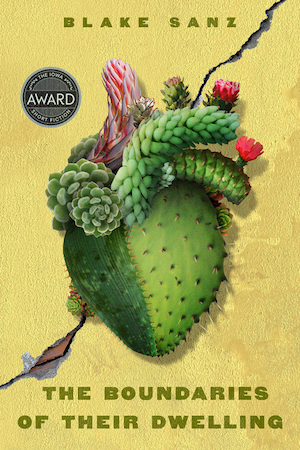
My book of short stories, The Boundaries of Their Dwelling, explores that terrain, and it emerged from an existing literary tradition, represented here, that feels as if it’s less identified in that way than it could be, even if the books themselves have had a rich life of their own. Here, then, are seven of my favorite books about immigrant and first-generation encounters in the U.S. South:
“[Chuck] studied in all his free moments, but the rate at which he fed himself words was so slow that they weakened and died before having a chance to accumulate, and now, at Sewanee, the rate was too fast. The few words he had were overpowered and swept away. His limited English was mistaken, as it so often is by people who have never been outside their own country, for a limited knowledge of things. But he didn’t bother to dispel this impression. He liked having a hidden advantage.”
In Choi’s novel set in the 1950s, a young Korean man named Chang—who goes by Chuck in America—flees the war at home to attend Sewanee University in Tennessee, where he meets Katherine, a rich young white woman with a history of sexual abuse at the hands of a professor in this small town. Both Katherine and Chuck are written so empathetically and beautifully and with such emotional precision, and as the novel alternates between their entanglement in the present action and their disparate pasts filled with wildly different traumas, it opens up into a larger showcase for Choi’s abilities as chronicler of small-town Southern life and the warscape of Korea. That a writer could be so authoritative on such vastly different worlds and could find such an elegant and heartbreaking way to intermingle them, that is what makes this debut novel such a stunner.
“‘Why are those guys so white?’ Roxanne asks in a stage whisper that is maybe a half-decibel lower than her speaking voice . .. . ‘Shush.’ Against her will, Lydia glances over her shoulder. The men, seven or eight in all, are strikingly white from their balding pinkish pates to their glossy patent-leather loafers, and in the sunshine pouring through the plate glass, they are nearly luminous, ghostly. With beaky noses and hunched shoulders, they huddle over their sweet rolls and coffee like celestial buzzards picking over paradisiacal carrion. These men provide such sharp contrast from Roxanne’s dusky skin and kinky jet hair that Lydia’s pupils dilate perceptibly when she turns back to their own table. ‘Maybe they’re in a club or something.’”
In this riotous and tender collection set mostly in the South, Latinos and white people, Japanese foreign students and other outsiders and ne’er-do-wells find themselves up against an assortment of traumas, rendered with humor and wit but never excess irony.
Whether it’s a teenager attending a picnic of homicide survivors to mourn the gang-related death of her sister’s boyfriend, or a struggling junior college professor—Lydia, in the above excerpt—trying to learn on the fly how to raise her cousin’s baby, here are characters that navigate their hard-luck circumstances in maybe not the best of ways, but in ways that make sense, that bind us to them emotionally, sometimes against our better judgment.
That many of these characters are Latino, and that many live in a Georgia which feels akin to Flannery O’Connor’s or Tayari Jones’s, feels both incidental at times and essential at others. What I mean is, you can’t help but feel how a certain lower-middle-class, Southern psychosphere is present in these characters’ worlds, at the same time that that milieu is simply present, without being thrust in your face as somehow steeped in a heavy-handed tradition of Southern writing.
“Under better circumstances she would have made fun of my car, an oddity to her after years of Alabama pickup trucks and SUVs. “Gifty, my bleeding heart,” she sometimes called me. I don’t know where she’d picked up the phrase, but I figured it was probably used derogatorily by Pastor John and the various TV preachers she liked to watch while she cooked to describe people who, like me, had defected from Alabama to live among the sinners of the world, presumably because the excessive bleeding of our hearts made us too weak to tough it out among the hardy, the chosen of Christ in the Bible Belt.”
They’re not analogs, but there’s something of Faulkner’s Quentin Compson in Gifty, Yaa Gyasi’s Stanford grad student in neuroscience whose Ghanaian-Alabaman family has been beset by a host of tragedies. Gifty’s brother has died from addiction to opiates, and her mother has attempted suicide and remains depressed beyond functioning. But more than anyone in the Compson family, Gifty feels like someone to root for. Why? Perhaps it’s her earnest struggles to balance dedication to neuroscience and her Evangelical faith. The book includes beautiful passages where we see Gifty praying, and later rejecting that faith, given what she’s learned of its inherent racism as practiced in Alabama. It also includes much of Gifty’s disdain for her grad school colleagues, avowed atheists who seem so removed from anything like a soulful life.
“She was sorry that the poor man had been chased out of Poland and run across Europe and had had to take up in a tenant shack in a strange country, but she had not been responsible for any of this. She had had a hard time herself. She knew what it was to struggle. People ought to have to struggle. Mr. Guizac had probably had everything given to him all the way across Europe and over here. He had probably not had to struggle enough.”
This is O’Connor’s tale of a Polish Holocaust survivor, Mr. Guizac, “the displaced person,” who finds himself working for a genteel Southern lady in rural Georgia named Mrs. McIntyre. Told in a limited third person that shifts between two white ladies with complex, racist attitudes toward the displaced person that make you wince, this novella reveals the nuanced oddities and mysteries of bigoted white Christians trying to come to terms with the presence of a competent outsider in their midst.
This lesser-anthologized of her works holds up disturbingly well in today’s times, and it’s easy to see a kinship that other writers on this list have with her and her sensibilities. Change Mr. Guizac to a Haitian refugee sent to Georgia from the Mexican border, and this story could easily pass for fiction of our times.
“A girl he didn’t know took him by the arm. You can’t wear the same thing every day. This is America.
America was the burning imprint of a girls’ hand on your arm. America was your one lucky suit of parachute cloth shrinking your skin, burning you.
America was a tinny, watery Sousa march through a tired trumpet in sixth period, and Boubacar attempting to answer it with cascading ripples on a xylophone, to collapse the melody into itself and play it fast, several times, so it could be repeated more often, after the fashion of a Cape Verde band he liked.”
Imagine a Mississippi town where, in the lead-up to 9/11, a Chinese grocer has a crush on a Honduran employee, and a Mauritanian boy—depicted in the quote above—stumbles upon the wonder of the Delta blues, while a Black Ivy League student returns here to find out the story of her great grandmother’s life, and a white landowner tries to help his longtime neighbor quit a gambling addiction fed by the local casino (the new business that threatens the livelihood of the whole area’s population). This is Shearer’s imaginary town of Madagascar, and these are only a few of the characters and situations that populate this wondrous and lush book, a panoramic Mississippi novel that recalls the best of canonical Southern fiction while also insisting that that tradition enter the 21st century, with all its modern complaints and entanglements.
“Q. Mr. Flores Flores, where do you presently reside?
A. At 3422 Ivywood Circle in Atlanta, Georgia.
Q. Is that your permanent residence?
A. No, ma’am.
Q. And what is the address of your permanent residence?
A. I don’t have a permanent residence. I mean, not right now. My brother and I are from Ilopango, in the region of San Salvador, El Salvador.
Q. And when did you leave your home?
A. On September sixteenth of last year.
Q. Why did you and your brother decide to leave Ilopango?”
In this YA novel, Phoenix Flores Flores—a Salvadoran boy of 18—has traveled north through Mexico with his brother and ended up in Atlanta, where he’s battling uphill against a deportation case (depicted above), while his brother remains in a detention facility in Texas. In Atlanta, Phoenix finds unlikely friendship in the husband-and-wife owners of a tattoo parlor that, as one Black character notes, might be the kind of place to fly a Confederate flag.
The main story revolves around the burgeoning relationship between Phoenix—named so because his mother, who left to find work in Phoenix, Arizona, wanted to be reminded of him in what she saw every day—and Gretchen, a white teen who’s been assaulted by a Latino gang member and is working through the trauma related to that experience. As those two dance around their interest in each other, Marquardt explores the contours of a migrant life on the edge. It’s a tender and authoritative story, one that shows Marquardt to be attentive to the larger cultural and legal forces at work in the lives of so many outsiders who find themselves ensnared in the penal system upon arrival in the US.
“‘You should be scared,’ Ahmad said. ‘This one could be for real.’
Zeitoun was skeptical but paid attention. Ahmad was a ship captain, had been for thirty years, piloting tankers and ocean liners in every conceivable body of water, and he knew as much as anyone about storms, their trajectories and power. As a young man, Zeitoun had been with him for a number of those journeys. Ahmad, nine years older, had brought Zeitoun on as a crewman, takin him to Greece, Lebanon, South Africa. Zeitoun had gone on to work on ships without Ahmad, too, seeing most of the world in a ten-year period of wanderlust that eventually brought him to New Orleans and to his life with Kathy.”
Zeitoun is a strange book of nonfiction to read in the wake of what’s happened with the titular character since (feel free to go down that rabbit-hole on your own). But there’s no denying how compelling Zeitoun’s story is made here, how emblematic it is of how a confluence of factors—cultural norms on immigration and the war on terror, unnatural natural disasters—can funnel down into a single, potent blow delivered to those least in a position to withstand it.
Zeitoun, a Syrian with a severe case of wanderlust, ends up in New Orleans. Through hard work, he establishes a house-painting business. During Katrina, he stays in New Orleans to “hold down the fort.” Beyond the first days in which he rows through flooded streets like an angel of mercy saving people from the flooding tombs of their houses, much goes wrong. He’s detained at gunpoint. Imprisoned. Given no means to contact his family, who think he’s died amid the hurricane’s ruins.
The story pivots adroitly between those gripping scenes and memories from Zeitoun’s life before New Orleans, when he was still in Syria, when he was a young man working as a deckhand as his father once had, sailing the world from port to port, trying to find his place, in a time before he could’ve conceived of a life in a place as fraught and beguiling as the South.
Over the past few years, there’s been a lot of heated discourse surrounding a trend in book covers in which many new releases opt for variations of the same colorful abstractions: The Blob. Somehow deemed appropriate for everything from dystopian debuts to literary fiction bestsellers, these indiscernible “blobs of suggestive colors,” as The Week coins them, clearly make for a successful marketing strategy. However, the unintended consequence of making these incredibly varied books appear similar, is that readers are left with little insight into the characters, general mood, or topics a book explores.
We wanted to look at some of our favorite book covers of 2021 from the U.S. and across the pond, hoping to find something beyond the bright blobs. Do readers still respond to abstraction and pigmented color palettes? Is realism making a comeback? To tackle these Very Serious Literary Inquiries, we polled our Instagram followers to discover what they like best. With British versions on the left and American takes on the right, read on to start judging some books by their covers and see what’s resonating with our audience.
While both covers are doing similar things—bright red background, line-art-heavy illustration, food imagery—something is pulling readers towards the American cover’s slightly bolder noodle depiction. Zauner’s memoir is a story of her finding and accepting her identity, from growing up Korean American in Oregon and losing her mother to tackling the role of food in her culture and life. Perhaps it’s the tension of the noodle pull or a font that seems a bit rawer, but readers clearly think the U.S. rendition is the tastier of the two.
The suggestive color blob is a clear winner when it comes to packaging the heart-wrenching story of Vivek Oji, a character who grows up in southeastern Nigeria. The blobs are at least identifiable, perhaps depicting Vivek’s long, grown out hair braided into his cousin Osita’s, with whom he has a close bond. The need for connection, for closeness, is at the heart of this story, where Vivek’s suffering stems from being misunderstood by his loved ones and wider community. Emezi has published prolifically these past few years, and this cover stands out from the previous, more muted color palettes of their Freshwater, Dear Senthuran, and Pet. Clearly, the bold approach is working, especially when paired against the beige realism of the U.K. cover, which reads more like nonfiction to me.
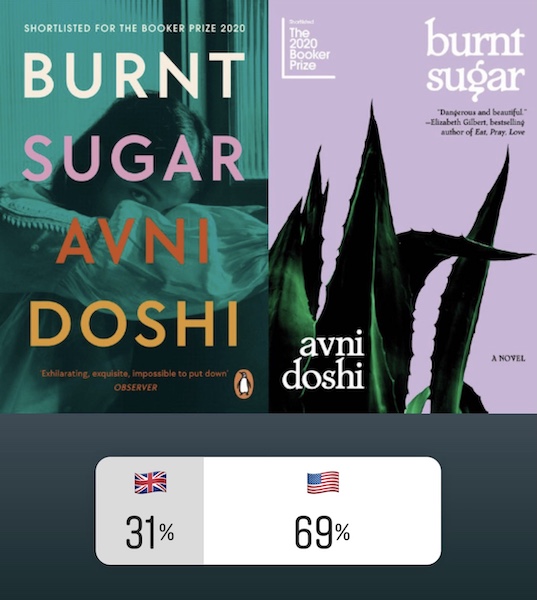
Burnt Sugar by Avni Doshi
The U.S. is on a roll, dominating once again with nearly 70 percent of the votes for the Booker Prize shortlisted Burnt Sugar. The U.K. cover’s use of color feels all over the place when compared to its paired down American counterpart. The plant looks like aloe, the juxtaposition between spiked leaves and healing properties hinting at the tensions within this mother-daughter story, in which a daughter must care for her free-spirited elderly mother despite her mother’s selfishness and negligence throughout her childhood. Illustrated book covers without pictures of people have appealed widely in the past decade, and in this instance, that continues to feel true.
While both covers are colorful and abstract, the greater clarity of the U.S. version makes for a clear winner. Popisho’s cover gives so much more of the story away—the island setting, the magical realism, the mythical characters, perhaps even the sociopolitical tensions explored. While I think the British title might actually appeal more as readers can imagine the whimsy and fantastic nature of a “sky day,” its inability to hint at the plot visually renders this blob of suggestive colors unsuccessful.
The Brits have entered the competition! With a narrow margin, the brightly drawn U.K. cover excels over the stoic and photographic black and white American take. While I love the crisp and haunting marbled arms, one cannot deny that the U.K. version does far more storytelling work. The illustration captures the tension between the environment and an American oil company with the vines seeming almost cleared away to glance at this oil field, the haunting figure caught in the middle. For a book where the fictional setting of African village Kosawa is so key, this scene seems an appropriate introduction to the story.
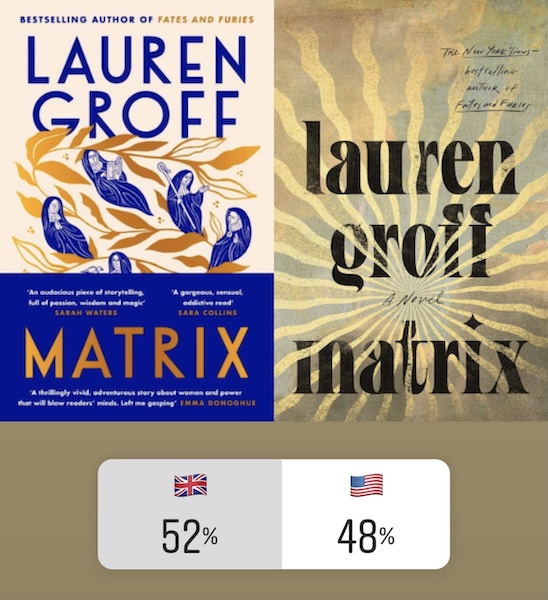
Our readers seem to like both of these images with almost equal fervor. For an imagined telling of real-life poet Marie de France’s life in which she serves as an abbess for a 12th-century nunnery, the U.K. version squeaks out a victory at 52 percent and it is easy to see why. The illustrated nuns reading or praying are not only sweetly rendered, but speak to a sense of community integral to the story or even the evolving nature of Marie’s role at the nunnery. The bold colors prove transcendent and just a touch more eye-catching than the dreamy, almost Renaissance ceiling style of the U.S. cover, which opts for a more muted version of the blue and gold color palette.
With an apparently rare win for realism, the U.K. cover dominated, and I wholeheartedly agree. In this story of a wife and mother who walks out of her life following the 2016 election, the maudlin interior and stray, lamenting arm perfectly capture the moment of crisis and unraveling this book unpacks. Although both covers hint at the idea of a home—crucial in a book that kicks off with Samantha buying a deteriorating house in Upstate New York on a whim, before she has even left her husband or home—the U.S. version could be celebrating first home ownership with its bright hues and celebratorily hung keyset. The left side allows us to empathize with someone rooted in a place—a political landscape, an aging body, an expected role—that she doesn’t want to be in and that is the work of a successful piece of art.
Love in the Big City by Sang Young Park, translated by Anton Hur
It is as easy to fall in love with the details of the U.K. cover as it is the characters in Park’s English language debut. The Marlboro reds and raining boba hint at the book’s exploration of a youthful existence spent in motion, pleasure seeking. While the American rendition shows us the chaos of Seoul and the desire for connection, that work is already being done by the title. The U.K. is simply more generous and specific, prepping us for the complexity and all-consuming nature of a queer, millennial existence, equal parts loneliness and joy.
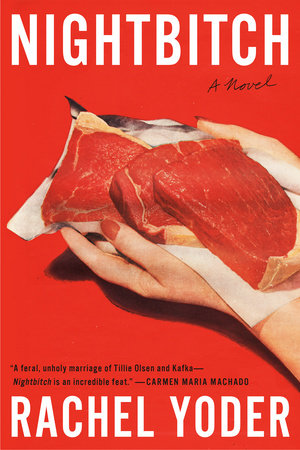
After a British winning streak, the Americans attempt a comeback with the graphic glory of Nightbitch. An artist with an absent husband feels lonely and unfulfilled in her new role as a mother and begins to transform into a dog— either evolution or deterioration. This feminist take on modern motherhood refuses to look away from the raw, bloody realities of what women are forced to endure, how they are expected to sacrifice and transform, and the consequences of those restraints. The American cover aptly blends the realism of the meat of this story with the suggestion of the dog, the animalistic and fantastic avenue through which this emotional heart is delivered.
The humor and heart of this expansive exploration of gay men’s tendency to self-sabotage comes across perfectly in the drawn American cover. The heart and lifelines on this hand suggest a kind of palm reading, promising us intimate and honest access to these characters and their stories. This playful image transcends the relative unimaginativeness of the British take, which seems a little boring and expected. It feels like it came from the very first day of the design meetings: How do we signal queerness? Let’s make the cover pink. How do we get at the breadth of experience? Let’s collage a bunch of pictures. What about the depth of emotion? Make them black and white. Great, fast-track this to production. There’s just a little more of the book’s magic in the U.S. edition.
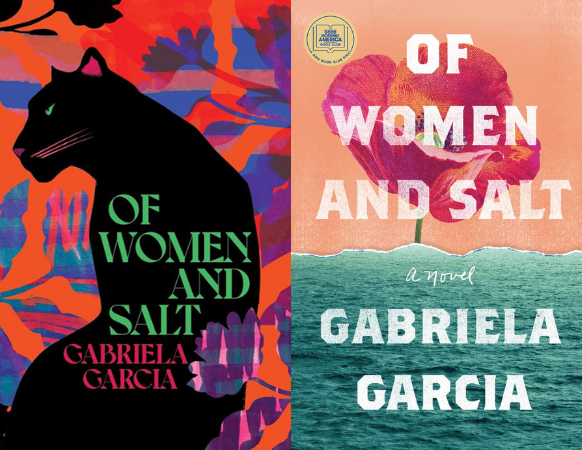
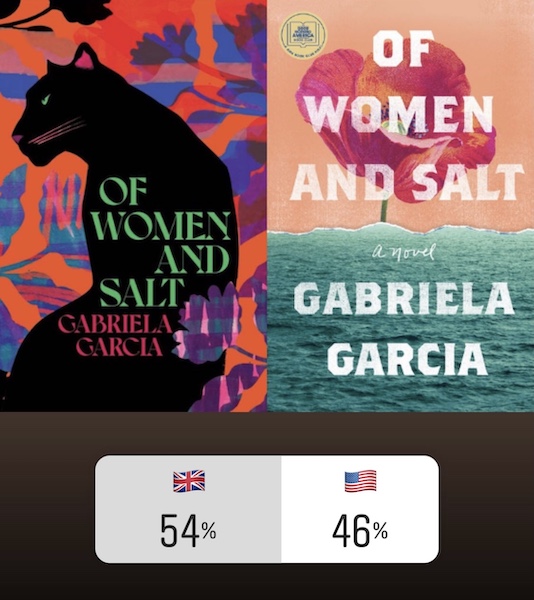
Personally, I think each of these covers is beautiful and readers seem similarly split. Both have a powerful but feminine energy to them that sets up this expansive, intergenerational saga of women. Because the book takes us between 19th century Cuba, 1950s Mexico, and modern-day Miami, the sense of place has to remain a bit abstract and the cover must instead indulge in the feeling of the story; the panther pleasantly suggests some sort of feminine pushback—readers just have to indulge to find out it is against the tyranny of men, oppressive regimes, and immigration policies.
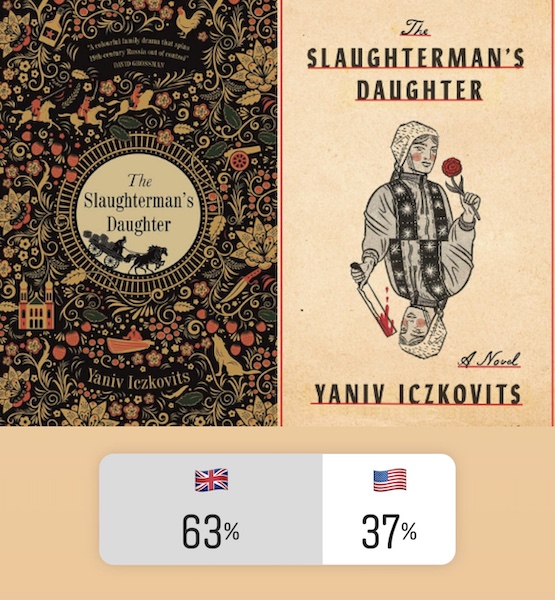
There is so much whimsy decoration in the U.K. cover for this historical adventure novel and in this case, more is more. The disappearance of a wife and mother in late 19th-century Tsarist Russia makes for an epic tale, and the intricacy of the British illustration hints at the classic style of this story (think War and Peace) while remaining lighthearted enough to assure readers of its accessibility.
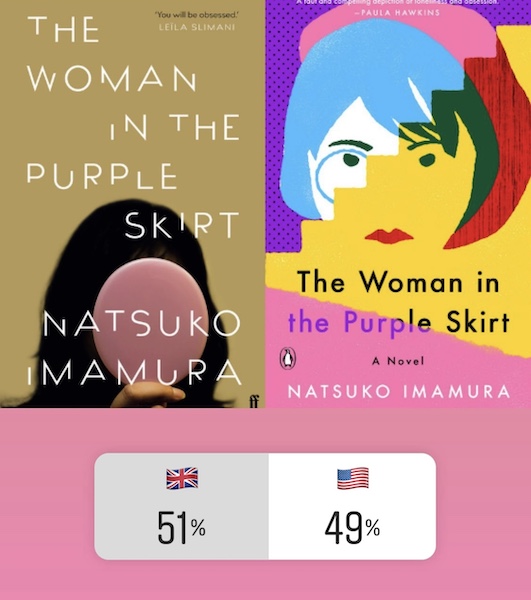
In the closest vote of the bunch, the U.K. just barely claims a victory here and I think it is for all the right reasons. The reserved colors, the unsettling lack of a face, the voyeuristic vantage point—it is all spot on for this highly psychological undertaking. The unseen housekeeper, the Woman in the Yellow Cardigan, observes and subtly manipulates the Woman in the Purple Skirt as she has an affair with her boss, crafting a powerful reflection on power in the workplace and what it means to be seen and/or desired.
It can be especially hard to design a cover for short story collections, but I actually think both countries nailed this one. Merciless, horrific, and unnerving, the dark background and bold illustration of both looks seem to universally work for readers. Perhaps the U.K. edged out a win for its slightly more modern look, almost magazine-like as it markets uneasy, allegorical stories of women and witches, homemade porn and homeless ghosts, among a sea of other unflinching and haunting plot points and characters.
Americans have the clear winner here and I think it comes down to, as Brandon Taylor might say, the vibes. The Brits went for a more dated look, from the old-timey illustration to the generic font, while the U.S. version seems a little more confident and arresting. A pharmacy on a remote mountaintop is a strange setting made even stranger by the confession-like role it plays for locals who come with stories and seek spiritual healing as much as physical remedies; the mysterious green structure more accurately hints at that kind of surreal space. It also is oddly reminiscent of Sheila Heti’s Pure Colour, so maybe the all-too-popular vague color bomb will be overshadowed by a new era of single-colored abstractions.
Although another close call, the U.S. cover and its endless thumbtacks takes the cake this round. I think the American cover is doing a lot—it plays with the title while simultaneously getting at the feelings of both a generic office space and an anxious headspace. The novel covers 24 hours in the mind of a young, female worker who has recently been sexually assaulted, balancing the profundities of human emotion with the mundanity of an office to explore how the mind works through a trauma. While the U.K. cover similarly conjures up the workplace with its crumbled-up yellow paper, perhaps the line-art is too cold and generic for a story that plays with form so innovatively and grapples with this #MeToo moment without losing its sense of humor.
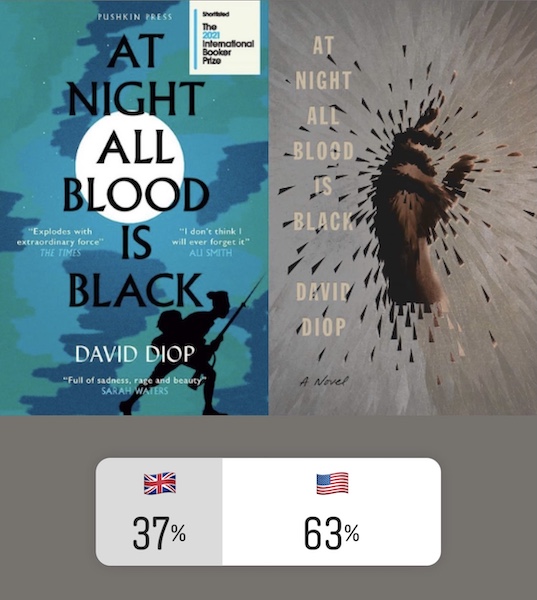
The American cover is quite simply the cooler of these two. I feel like I’ve seen the U.K. version before, and it veers too close to colorful blob territory. Instead of any old soldier, the U.S. version gives us this severed hand, a crucial plot point, that looks enchanted or as if it is being showered in bullets. All of this to say, the American version actually speaks to this specific story of a Senegalese man called to fight with the French army during WWI as his trauma leads to strange and violent behavior that ends up putting a target on his back. The U.K. version gives us generic blue blobs and a soldier, so the points are clearly for creativity here!
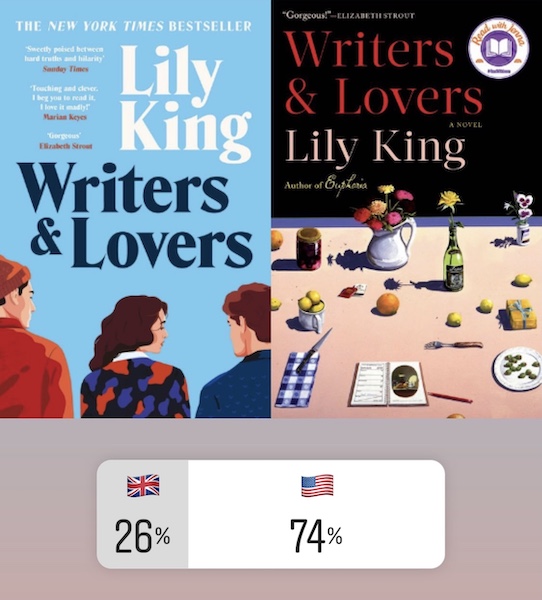
Another clear American winner comes down to originality. I don’t feel as if I’ve seen the U.S. cover before with its still life qualities and juxtaposed color scheme. The U.K. version, on the other hand, feels like every rom-com cover from the last ten years. It might even do a disservice to the literary nature of this novel about navigating writing and grief and capitalism and love in your early 30s.
When an unsatisfied publishing company assistant gets the chance to potentially assume the identity of a mysterious and successful novelist, she just might take it. I like the anonymity of the American cover and how one line extends into two faces, asking readers where we draw the line between right and wrong or our inner lives and public persona. The U.K. cover has a certain warmth to it, but once again, realistic faces seem to deter the literarily minded.
While the U.K. cover delivers pretty literally in hinting at both sex work and the London Soho locale, there’s definitely more charm and character to the winning American cover. In a story about gentrification, ownership, class, and agency, there’s a certain playfulness to the American rendition. It employs what looks like aristocratic art to touch on ideas of the extreme upper class and their often-unsympathetic view of capitalism’s victims, apparently ranging from exploited and marginalized people to the unsuspecting swan these expensive hunting dogs are set upon.
As a child, the worst mean-big-sister trick I ever played on my little brother was to convince him that I could transform at will into an evil entity named Madame Ruby. The most insidious aspect of this transformation is that I would look exactly the same, sound exactly the same—would, in fact, in every way still resemble his sister—but within, I would be someone unknown with vast, dark powers. I later learned in my training as a psychiatrist that there’s a term for the belief that someone you know has been replaced by an imposter: Capgras syndrome. I find that this is more often the stuff of novels (see Rivka Galchen’s Atmospheric Disturbances) than of my day-to-day clinical practice, but it’s an idea—a fear—that illustrates the uncanny, a concept I find fascinating. In his 1919 essay on the subject, Freud attempts to explicate the uncanny, or unheimlich, meaning literally not homey, strange, or unfamiliar.
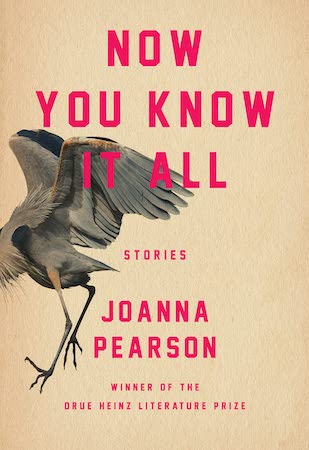
It’s this space of the uncanny that most interests me as a writer. In my new collection of short stories, Now You Know It All, I explore that sense of dislocation in the quotidian, the creeping dread that arises when something feels just a hair off. Whether it’s the story of a troubled boy attempting to unleash the villain from an internet hoax onto his party guests, or a smitten student finding more than she bargained for hidden in her favorite teacher’s attic, the stories in my collection often teeter in the place between the natural and the supernatural, belief and disbelief, what we think we know for sure and what gives us a pang of doubt.
Uncanny Lit is decidedly not horror, nor is it exactly magical realism or gothic literature (although obviously, to some extent the edges of these categories blur). It shares with its sister genres a certain breath-holding build-up of suspense along with intrusions of the strange, but I’d argue that Uncanny Lit operates more slyly, through suggestion, and tends to start solidly in the mundane. Each of the collections below offers a taste of this subgenre.
Rooted in the humdrum of jobs and parenting, Bynum’s work still shimmers with eeriness in the periphery. Take for example the wonderful first story, “The Erkling” which takes place at a children’s fair at a school. The setting is both mysterious and not, vaguely threatening and not, while the perspective glides between the mother, with her parental anxieties, and the child, who seems to see a strange, beckoning figure at the edge of the crowd. (An erkling, by the way, is a sinister elf who preys upon children…) If ever a writer knew how to chill without overplaying her hand, it’s Bynum.
What else but pregnancy and motherhood can be simultaneously so utterly familiar and yet so strange? Hunt mines this fertile subject matter in her stunning and spooky collection. In one of my favorite stories, “A Love Story,” the classic it’s-coming-from-inside-the-house trope gets inverted. The main character hears someone lurking outside at night and sends her husband out to check, only to discover the intruder, the one she fears, is a person she’s known all along—and the most frightening thing, “the biggest experiment,” is one she’s already willingly signed up for.
While no one could argue that Alice Munro is underappreciated, I would argue that she might be underappreciated as a practitioner of the uncanny. Once you start looking, you notice it playing a role in lots of her stories. This particular collection includes one of my all-time uncanny favorites, “Save the Reaper,” which operates as a kind of homage to Flannery O’Connor’s “A Good Man is Hard to Find.” Eve (a grandmother, as it happens) thinks she’s following a road she recognizes, searching for a spot she recalls from childhood, only to find herself at an unrecognized house, surrounded by a group of menacing characters, one of whom manages to tag along for the ride when she leaves. As always, Munro’s moves are subtle, but this story leaves the reader with a real shiver.
Lesley Nneka Arimah’s wonderful debut collection presses up against the borders of Uncanny Lit from a more decidedly magical realist or surreal direction—something that’s true for a couple other favorite collections that I’m not including on this list (see Kelly Link’s Get In Trouble or Carmen Maria Machado’s Her Body and Other Parties. Yes, the categories blur!!!). But what strikes me as uncanny in Arimah’s work is the way the strange seems to arrive in the ordinary world with so little fanfare. Take “Who Will Greet You at Home,” in which the fact of women animating babies made out of yarn or raffia or mud is almost unremarkable against the complexities of class and privilege and longing or the symbolic weight of women’s hair. (This one was read and discussed by ZZ Packer on a New Yorker fiction podcast not long ago, if you want to check it out.)
Amy Bonnaffons’ striking first collection is another that abuts the surreal or fantastical, but it’s her deep acknowledgment of uncertainty and her grounding in the material world that makes me include her in the Uncanny Lit camp. Take for example the title story, in which an elementary school teacher purchases a lawn ornament Jesus and Mary who come to life. The protagonist of the story says:
“I believe the world is malleable, that our understanding of it is provisional, improvised, subject to a change of rules at any time; that sometimes the magician pulls out the tablecloth and the dishes all stay in place, and sometimes the magician pulls out the tablecloth and everything is gone, including the table.”
Sofia Samatar’s wildly imaginative collection also straddles several genre categories, but she definitely makes the Uncanny Lit cut. Most notably, you’ll find her story, “Olimpia’s Ghost,” which is a spin on the story of The Sandman by ETA Hoffman, famously interpreted by Freud when he attempted to define the uncanny. (But if that’s not enough to draw you, there are also stories of selkie, witches, alien babies, and more.)
This slim collection of six stories set just after the 1995 Kobe earthquake is nothing if not uncanny. In one of my favorites, “UFO in Kushiro,” a man rocked by the sudden departure of his wife is asked to deliver a mysterious box to a bleak location in the north. This story is a master class on the power of withholding. (If you’re interested, it was read and discussed by Bryan Washington in a recent episode of the New Yorker fiction podcast.)
Clare Beams’ marvelous and unsettling debut collection epitomizes Uncanny Lit. Take the opening story, “Hourglass,” in which schoolgirl narrator Melody arrives at a boarding school that promises “a transformational education.” The headmaster, preoccupied with his quest to shape his young charges, is both beguiling and sinister, and by the time his “special project” is revealed, you’ll be left with a pit in your stomach. Beams picks up where Shirley Jackson left off in these nine weird yet weirdly moving stories.
I love Rebecca Lee’s collection so much partly because, much like Alice Munro noted above, she taps into the uncanny through a staunchly realist angle. Despite this realism, there’s still the looming feeling of threat in the shape of all the difficult human unknowns, all the reversals that can affect us. In the title story, for example, the question of whether a woman has survived an attack by an actual or metaphorical bobcat is muted by the late-night arrival of a strange woman at the door—like the answer to a question the narrator was not yet prepared to ask.
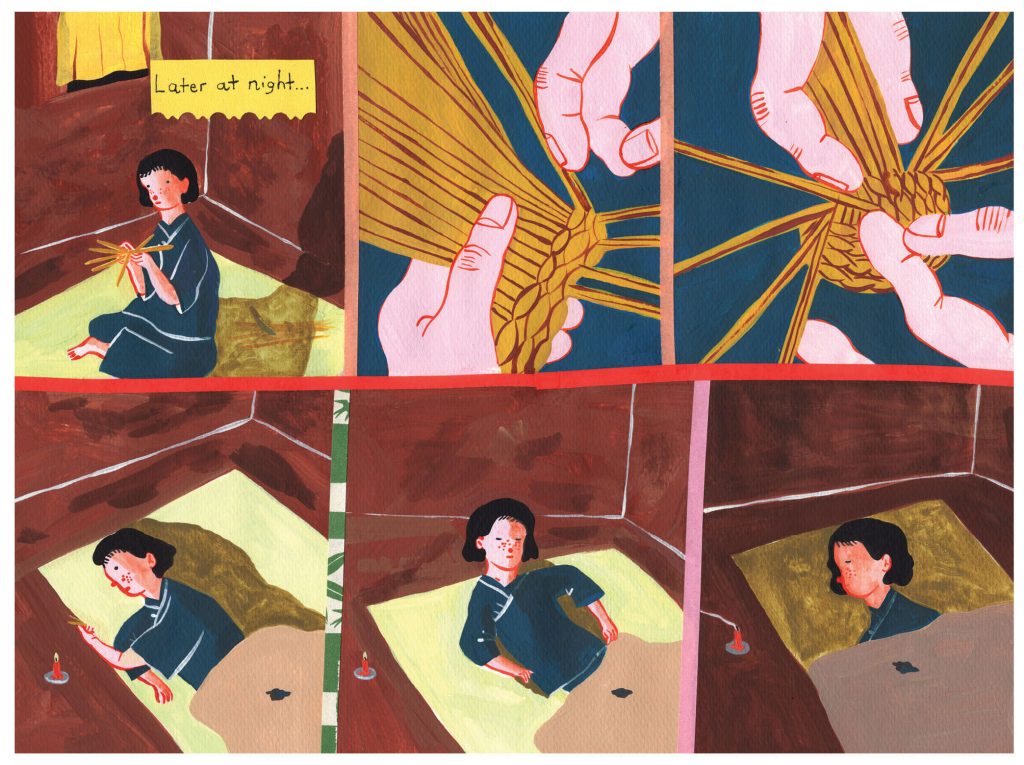
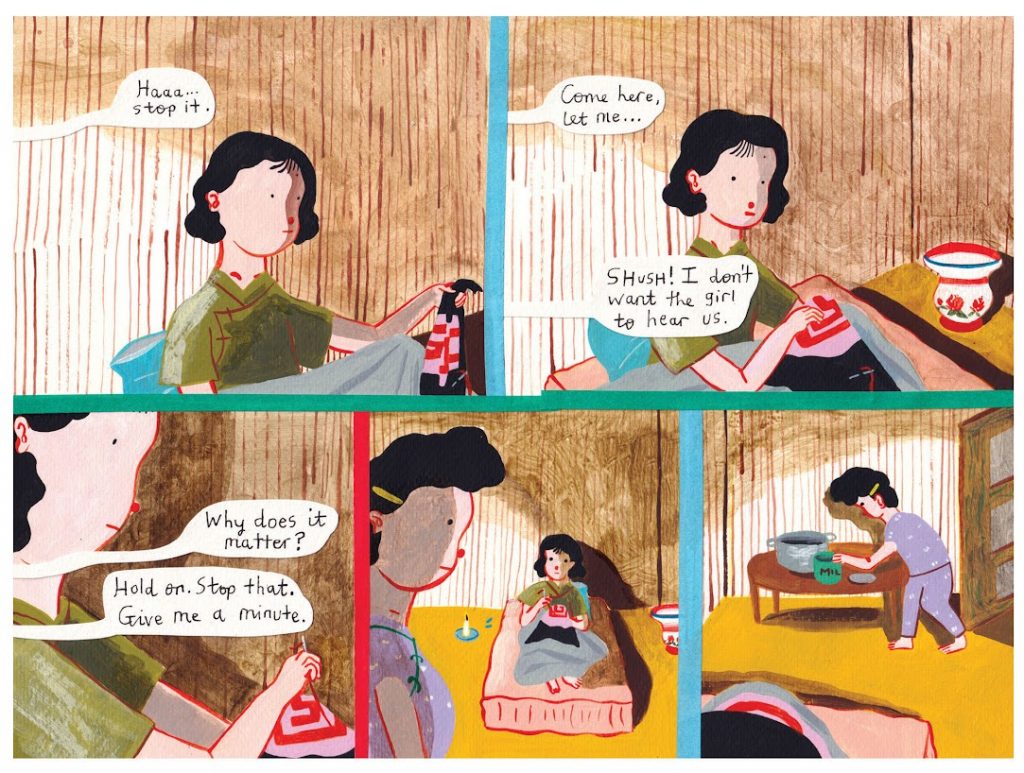
To hear Weng Pixin tell it, Let’s Not Talk Anymore started out as a kind of “fuck you” move after a particularly bad fight with her mom but—as these things tend to go—it gradually transformed into a project to locate herself within the moth-eaten story of her matrilineal line.
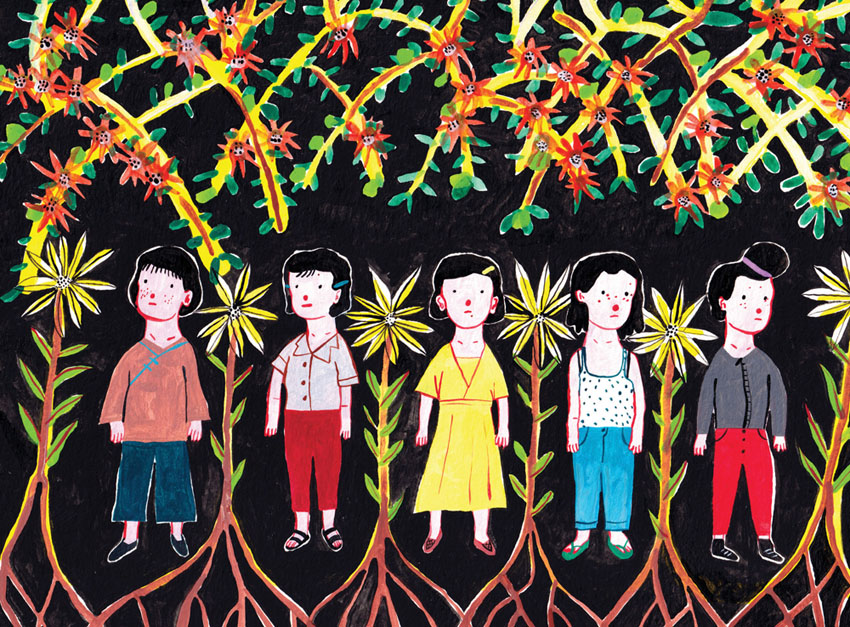
Moving back and forth across a 100-year span, the graphic novel depicts snapshots from the lives of five generations of women from Pixin’s family, all aged 15—from her half-mythic great grandmother Kuan, to an imagined daughter in 2032—as they navigate the hostilities within and without the home. The result is a family history riddled with recurring themes: separation, sexual assault, and emotional isolation. Mothers and daughters stewing silent in their anger, each of them hoarding pain like heirlooms for the next generation to inherit.
There’s no telling where things are happening, but the characters are clearly shaped by the cultural and social mores of a traditional Chinese upbringing in Southeast Asia. Though many of these standards have changed over time, the reticence to express true, deep emotions remains. Time and again, these characters resort to anger as their only recourse, unable to cope with the unacknowledged pain sitting within them like a stone.
The novel is deeply invested in the theory that every act of violence—emotional, physical and verbal—has its roots in something undeniably human. In seeking out the truth in the probable lives of her mother and ancestors, Pixin uncovers a road to healing and something that feels a lot like freedom.
Samantha Cheh: I did notice a stark difference in the registers of dialogue in Let’s Not Talk Anymore. On one end of the spectrum, you’d have characters saying very mundane things, like what do you want for breakfast? Let’s go to the field—but then there’s the other side. Characters explode into anger, and language becomes extremely emotional and hurtful. There doesn’t seem to be an in-between mode, no gaps between them.
Weng Pixin: I was particularly thinking about my own experiences growing up with my mother. My dad was away for work a lot of the time, and so she was a primary caregiver. What I remember the most from my upbringing is that when she gets really mad, she doesn’t make a lot of sense: in the words that she used, in what she’s telling me about why she’s mad, in what she’s planning to do. Now, as an adult, I began to realize that I’m working with a mother and a person who has a lot of difficulty trying to explain why she’s upset. If we think carefully about it, that ability to remain calm requires many sets of skills, and I can now see that she had no ability for it.
Those gaps that you describe between these extreme outbursts and the plain language of everyday life—I think those are the conversations, questions and answers that we can ask to get to know each other better. Not to feel what the other person is feeling, but to develop a vocabulary to describe our full human experiences. I think that’s severely lacking in the Chinese Asian parenting culture, and that was what I was perhaps keeping in mind while I was approaching this graphic novel.
SC: I feel like what you’re describing is an ability to process emotions that most of our parents are not equipped with; they can be so reactive. Of course, they came from a very different world, one I am keenly aware is characterized by suffering, but it’s developed in them a kind of eternal survival mode. Tunnel vision. There’s so much emphasis on survival that the quality of life really suffers.
WP: Yes, and I don’t blame them. It just doesn’t make sense to do so when it was a completely different generation, era, and context. There is a scene where Kuan’s mother gives her the porridge, but saves only the porridge water for herself. Later, somebody told me that porridge water has more nutritional content, but the point is it’s not a balance between getting more nutrients or vitamins or energy. It’s “what do I do to survive to the next day”; not “what do I do to live well.”
As a child and teenager, I blamed my mom a lot. I just hated her for just the kind of parent that she was, but through working on this comic, I realized I had never thought about the possible life she came from. I had heard stories, sentences here and there—maybe from her sisters, or whoever is chattier—but not from her because she’s very quiet.
They were just concepts I didn’t really understand, but with comics, you’re thinking in visuals. You have to find a way to put an image down to accompany the concepts. For example, when I was painting my mom missing her dad who left her very abruptly at a young age, I had to ask: What does her dad look like? Would he be sitting very far away from her? What would that be doing while he’s in his daily life? In the process of thinking and putting down those pictures, I got to kind of experience or feel a little more about what it was like to live in her shoes somewhat.
Click to enlarge
SC: I can imagine her reticence to share those stories must have hurt quite a lot.
WP: I think I understood the hesitation to share more, but it’s also weird because my dad is very chatty. In the family, he’s like the black sheep because he’s so verbal. His communicativeness makes him come off as very forthcoming and straightforward and honest, and because of that, I’ve never felt bothered if he doesn’t tell me something.
I wanted to show how when you carry your own pain, if you don’t give yourself the opportunity to process it—or if you don’t even have the ability to do so—the pain will stay inside of you.
On the other hand, my mom’s uncommunicativeness bothered me because there’s this protectiveness or defensiveness. I read her not talking as not trusting me, or her misreading my questions as invasive when they’re more inquiring. But when I thought about that attitude in relation to where she came from, I realized that what I saw as defensive was maybe a sense of helplessness at my questions.
My dad is so communicative, but even he has difficulty expressing himself—she generally struggles with communicating, so talking about her day-to-day life? Sharing things that seem simple and basic to us? It’s difficult for her. My theory is that she came from an environment that is way more repressive than I can possibly imagine, so talking is a very big challenge for her. In that sense, my questions to her weren’t just, can you tell me this? It was more, can you be this now? Someone that is completely not you? That’s why she reacted with the desire to protect herself because what I was asking of her, she felt like she couldn’t do it.
SC: When you began connecting the dots between your mother and her past and how you were brought up, did it change the day-to-day experience of your relationship with her?
WP: Yes, it definitely did. Halfway through making the comic, I saw that in our in-person interactions, I was a lot less frustrated or reactive because I was putting myself in the space of trying to be in her shoes more. From doing this work and from reading research on her generation or time, I became very aware that she didn’t have a lot of opportunities. She’s been influenced not just by society, but also her mother’s messaging that women have to get married and bear children. If we go a bit further, as a child, she also didn’t have the opportunity to learn how to express herself. Just like what she did to me.
Working on the comic helped me get the barest shape of where she really comes from, and made those ideas a lot more concrete. And once they were concrete, I found that it made no sense to remain angry at her for who she is. All I see now is a person who—with the limit of skill set that she has—came out as this individual. To ask more of her would be irresponsible and selfish on my part, and by the end, the main anger towards her dissipated.
Also physical space apart also helped make the mother-daughter relationship have some opportunity for repair.
Click to enlarge
SC: Reading the novel, you do get the sense of reparation. With your art, you’re filling in the fissures in the relationship between you and your mother, but also within yourself. I saw some of that with Kuan’s weaving and Mei’s sewing.
WP: For me, art has always helped. With my mom’s upbringing, I was continually discouraged from talking, from expressing myself, from telling her that something is troubling me. It came to a point where I wouldn’t even ask her for advice or anything. I just felt like she was the most unsafe person to consult because I would just end up feeling hurt or disappointed or—even worse—betrayed. For a very long period of time, I was largely a very quiet individual. Not just because I was shy, but mostly because I felt that whatever I say, it’s gonna be wrong—because that’s the lesson I picked up from being with my mom. Everything that I say is met with a very negative outcome. I learned to keep quiet in order to survive.
With my art, I was able to process a lot of things that I felt I didn’t dare do with words. It’s been healing in a sense of just being able to let something out. It sounds disgusting, but it’s just like diarrhea. Like mental, spiritual diarrhea. Art provided that lovely toilet bowl for me to share the love. [laughs]
SC: There are a lot of like images that recur for me in the comic, motifs like absent fathers, sexual predation, separation, and weaving. Certain scenes clearly speak to each other across time
WP: I was trying to show how trauma gets passed along and affects the way we relate to another human being—and how that can get even more pronounced when this relation is between a parent to a child. For example, Mei, my maternal grandmother, is sexually assaulted and she deals with this trauma privately because she just had no space to tell it to anybody in this society, not even her adoptive mother. To make it more confusing, her adoptive mother treats her like slave labor but also takes care of her. It’s a very strange message for somebody to grow up with: the person that provides for you essentially doesn’t care about your well-being, but you have to trust and rely on them.
I learned to keep quiet in order to survive. With my art, I was able to process a lot of things that I felt I didn’t dare do with words.
The thing to remember is that these characters are adolescents, and what adolescent has the amazing ability to differentiate how much to trust someone or pull back, all while still needing them to survive? That’s why, with that kind of upbringing, I felt it was possible that she can then find somebody, get married, and then unconsciously reenact that same pain and trauma on her children because she’s just unaware of how much they have taken over her.
I really wanted to show how the minute you carry your own pain, if you don’t give yourself the opportunity to process it—or if you don’t even have the ability to do so—the pain will stay inside of you. And whoever that you meet next will get it in some way from your lack of ability to attend to them, because you haven’t attended to yourself.
SC: The funny thing about getting older is that you can now recognize all the ways your needs weren’t met, all the gaps that were left by the adults in your life. If you could go back, would you?
WP: I think that question is interesting because on the one hand, I would definitely always say yes. Would I have benefited if I had a parent who was attuned to my needs? Of course, yes. It wouldn’t make crying feel shameful, it wouldn’t make feeling some things or encountering some experiences outside of home feel weird or scary.
The thing I’ve always struggled with is what my art would have been like. Would I have content? Would it have been interesting? Would the non-pain and non-challenge have yielded something interesting, art-wise? That’s the part I have no idea how to answer. I hope so, but the reality is that my art has been derived from challenges, pain. Things that confused me, things that have upset me. I’ve always been provided for physically, but I think it’s more the emotional landscape of myself that has been a big struggle to make sense of. I wish I could say that my talent and skill would have yielded art that was just as good, but I cannot claim that.
Click to enlarge
SC: Actually, at times, reading the novel was a little bit difficult because there was not always a lot of distinction between characters. They look and often feel very similar.
WP: It was just as confusing in my head, and there was no interest to get them to look distinct. Partly because of the cartoony style, but I remember kind of thinking I don’t really need them to be so distinctive. I kind of want it messy and confusing. The only structure the reader can grasp onto is the year that’s been written down because that’s just the way my mind was. I have no picture of how my great grandmother looks, of her living space. I have no visual. There’s still tons of missing things. I imagine for most people, when you’re trying to recollect a memory, it’s visual; it’s experience, it’s the feeling. All that is missing because there’s no stories.
SC: I love that by imagining the shape of Kuan’s possible life, you’ve kind of woven for yourself a sense of continuity that you didn’t have because of all those gaps in your history. Now with this complete work, is that emphasis on remembering still important for you? Why?
WP: Why do we need to know our history? Why do we need to know the past? In one sense, it’s to help give you a stronger sense of where you’re from, and the kind of values or belief system that you come from. Not that you in the present necessarily need to follow, but you just have a better understanding of your origins—and I don’t, from my mom’s side of the family. I don’t have a great grasp of where I come from, in that sense.
I can tell you from my dad’s side that I know that my paternal grandmother was really into business, and she had a father who was an opium addict. She was from Hong Kong, and that immediately made me feel I have kinship with this country even though I don’t live there. It sounds kind of corny and cheesy, but it’s almost like, oh this is a connection there, it didn’t come out of nowhere. It also shapes a bit of how we look at our future.
In knowing our history we find out more about ourselves. I know my art comes from my maternal side because all my aunties painted before they got married. My mom still draws when she’s on phone calls, but the sad thing is that she dismisses herself. When I was a kid, I visited my maternal grandmother’s house and I saw the paintings that each aunt did, as well as my mom, so that came from them. That’s why I made up the story that my great grandmother loved to basket-weave when she was free, and my grandmother loves to sew. I just imagined I came from this line of women who made art in private and nobody sees it.
Luther buys cars. It’s what he does, and it’s what his billboard says he does—LUTHER BUYS CARS. He bought my dad’s car. He bought the mayor’s car. He came to a surprise party for my mom’s sixty-fifth and left with her Sportage. Think back. If you lived in Gettysburg in the late aughts, Luther probably bought your car. Maybe you heard about him on TV, about what he built, and you thought, I would never sell that man my car. I’m sorry. I don’t believe it. It’s his aura—smile like the grill of a Chrysler, hair a horse’s mane. Luther glowed gold.
I was en route to leaving town, to finding peace, to ridding my life of so much me, when I crashed into the back of an Integra, transfixed by the riddle of its vanity plate—HEDIE4U. My brakes tried. Our cars veered into the cornfield. The other driver’s baby cried as we waited for the police, and it was raining, pouring, and my door wouldn’t open, and Luther appeared, bearing an umbrella and a guarantee: my Buick was totaled. Bereft. Unsound. With his big vocab, that quiet murmur, the cleft-lip scar, you just hung on to Luther’s every word. I was cold, high, and scared, but his serenity kept me from fleeing deep into the corn. Luther went shhh, and then he bought my Buick. “I’m notarized,” he said, and shook my hand with both of his—so warm. “It’s all legitimate.”
I left my eleven books on Zen in the trunk, took my hamper, and walked to Wawa. I bought so much made-to-order—enough to kill a horse, as they say. “Mozzarella sticks for pumps two through eight,” I told the cashier, sopping. Luther had made me magnanimous. I thought it was my middle-aged life turning over like an antique engine. That night I got a nose ring. Not that Luther was pierced, but his high-tier moxie made the world feel like something you could bring to heel.
Luther bought my car for three hundred dollars, but then I had nowhere to live.
After the accident, I stopped wearing the hat a fan had made me, a red mesh trucker embroidered with the words Brad the Broadcast Bandit. It’d been two years since my shock-jock radio show, and I’d been going by a slew of dumb identities—Greg, Jed, Art, Hal—any name that sounded burped. Todd. I started living in the yard behind my dealer’s double-wide. Basically it was a doomsday shelter dug by shovel and lined with ten-pound bags of rice. That’s where I slept, on rice bag beds. I cut this guy’s grass, loaded his little dishwasher on wheels, and kept his cats alive. His name was—I’ll call him Colt. I owed Colt a lot of money, and he had dirt on me too.
“Don’t just do something,” Colt would say. “Sit there.” Which meant: Do something. And then he’d hop on one of his crotch rockets and tear off into the afternoon. While he was out, I’d clean his trailer, and I’d clean his girlfriend’s trailer; I’d clean his other girlfriend’s trailer, and I’d clean her girlfriend’s trailer. I thought about a billboard that said, TODD CLEANS TRAILERS. At first I figured I might get empty this way, cleaning all day alone. What I wanted was to make my ego go quiet, to learn to think of nothing but the dish when I rinsed it. But then one morning with the radio on, I got lost in my head and snapped a porcelain plate. Then I smashed a glass. Then I whipped the squawking radio at a ceiling fan and left.
So I tried Mom again, walked all the way to her house, offered to cook and clean for a spot on the couch. She lived in an unaffordable split-level that would soon be repossessed because the loans had been written in a language the country no longer spoke. In ’09, that was the story of Adams County, the elegy of the country, really— homes being pulled out from under us like rugs.
Mom raised honeybees and wasn’t fond of taking off her aerated beekeeping veil. She looked like an outer space nun. Through the mesh, she told me my problem was that I didn’t know how to blame myself for anything. I had to start doing right.
“But I don’t want to do anything,” I said. “That’s the point. I want to want nothing.”
“You hearing this?” she said, turning to her hives. “You see what I’m talking about?” I told her I was becoming a wandering monk. I threatened to join the US Army. I gave her a hug.
“What about that nice man Luther?” she said. “I hear he’s hiring guys like you.”
Cars, yes, but it turns out Luther had also bought land, so much land, enough land to kill a horse. In May, trucks drove over to spread dirt into an oval, a track. That’s why he bought our cars—to stock a demolition derby. Even miles away, in town, you could hear vehicles collapsing into one another, and that’s when I came to Luther for a job, holding my hands out like a cup, empty.
Piles of busted rubber tires fenced the track, and I entered slowly, passing teams of men wrenching Jeeps with gusto. In his shed I sat on a red fender and told Luther to make me a driver, a derbyman, a dead-to-the-world heel on the gas. With enough impact, I’d smash the grasping clean out of my body like a pair of dumb dice through a shattered windshield. Luther rocked in his racing seat, prayer hands pressed to his marked lip, eyes shut in one long blink. He wore a white tank top you could see his dog tag necklace through. I poked at an eraser on the table between us. There wasn’t one light on, but the toolshed shone.
Finally he said, “Todd, you consume drugs, correct?”
“What can I say?” I twisted my nose ring, smelling the sour of my cartilage. “Youth.”
We laughed at that. I was forty. The hole was infected.
“Substances deliver you a kind of . . . orgasm, yes?” Luther said, every word a whisper.
I shrugged and did not say: Yes, they used to, they once helped me see all the way to god. “Todd, the goal is to be in a state of perpetual,” he said, pointing to his temple, “orgasm.” I laughed. “And that’s why we’re creating the Track.”
When he handed me a paper, I thought it was his manifesto. He told me to read aloud:
Anybody know what this place is? This is Gettysburg. This is where they fought the Battle of Gettysburg. Fifty thousand men died right here, fightin’ the same fight that we’re still fightin’ amongst ourselves today. This green field painted red, bubblin’ with the blood of young boys. Smoke and hot lead pourin’ right through their bodies. Listen to their souls. I killed my brother with malice in my heart. Hatred destroyed my family. Listen, take a lesson from the dead.
For a second, I felt heroic. I couldn’t put my finger on the film the words were from, but it felt like one where when people fall down, they keep getting back up and keep getting back up.
“I’ll employ you as my anchorman,” Luther said. “You’ll narrate the races. Remind the crowd precisely why they’re here, why they want to return.” I shook my head no. Airtime was the one drug I could not do anymore. If you’re listening to this, you know I’ve relapsed.
Remember the Titans. That was the movie. And Luther—a titan. Tycoon. A tyrant-to-be. I heard people outside the shed laughing, saws coughing into metal. Luther stood up from his cockpit, came around the table, and put his hands on my shoulders. I shivered, but it felt holy.
“Can’t I just clean the dirt?”
“You’ve got to be somebody before you can be nobody,” he said, pulling an I-9 from a glove compartment nailed to the wall. Had he been reading my old mystic books? In his words I heard Thich Nhat Hanh and bits of Be Here Now—ideas rang familiar but newly bold, glossy, like chrome. Luther handed me the form. I read it aloud, but Luther wouldn’t laugh until I signed.
Luther tore tickets. Luther sang the anthem. Luther sold snacks. Luther mopped the johns. Luther meditated alone. And for these reasons, he didn’t watch the derbies. And because he couldn’t watch, it was important to him that the story I told through the loudspeaker rocked. I used a voice other than my natural and hid in a booth made from the detached cab of a Durango. With my microphone and my Diet Mountain Dew, I said everything I saw.
The Excursion is, oh boy, turning, gunning, and the Civic doesn’t know it, but he’s about to get a RUDE wake-up. And on rude, the cars crashed. Mud flew. Every once in a while, something came on fire. I popped addies to keep my focus, E to get the crowd excited. I narrated from the perspectives of the cars everyone loved. Your Avalanches, Chargers, Colorados, and Broncos—anything sounding ripped from the West. They whooped and booed at my command. I couldn’t help it, becoming someone again. My ego ate up every noise they made.
There goes Crown Vic, America’s hero! The crowd would erupt. Lick ’em good, Vic!
One night Luther motioned for me to roll down the window and handed me a thesaurus. I started using careen, incognito, tragicomedy. I said indigent and aroused.
Admit it: when Punch Bug surrenders to the barrel roll, you feel a UNIQUE arousal.
And on unique my crowd would tear a hole through the air.
Sometimes when a part fell off a car, I’d declare a dance-off, and anyone in the audience who wanted that bumper or that mirror or that broken, melting helmet would stand up on the bleacher and shake it. Our camera guy would shoot slow across the rows until I found a dancer I couldn’t criticize. The winner got to run out on the track and pick a prize.
In the parking lot, after all was smashed and done, Luther would gather lingering fans for a last beer, gratis, and do what Luther did best. Often he’d stand on the cooler. He’d whip out this statistic I think he made up, about the average Pennsylvanian spending three hundred hours driving every year. “Each of these precious minutes is spent on a road that’s designed to take them exactly where they’ve been told to go. You comprehend?” Forceful but breezy was the way he spoke. “We’ve forgotten that we can color outside the lines.” Some listeners would stay on, join up. Our crew grew large.
There’s no denying how magnetizing it was to see your own car out there on the Track, broken and totaled but—my god—firing back up again. How the motor always, eventually, turned over. Within a month, we started running double features, Sunday specials. Eventually, Luther lent me a car, not to smash, but to use. It was a Celica, which means cosmic. I backed it up into all of Colt’s motorcycles on the day I left his place for good.
One night in July, I found Luther behind the bleachers, swinging a sledge at a wrecked RAV4.
“Boss?”
“Go ahead and clock out, Todd.” Luther swung underhanded at the front tire, and the hammer bounced from his hands. He sat in the dirt and nursed his wrist. “Meaning farewell.”
“Mind if I take a swing?” I said, not wanting to leave. Luther shrugged.
I swung. I swung, and in a minute it was obvious that all we want is to be young again.
Luther watched me lay into the windshield—once, nothing; twice, shatter—and then asked if I would hold a second. He climbed into the back of the car and sat still in the middle seat. Legs crossed applesauce, he held his hands together at his chest. Luther let his eyelids close.
“Use the vehicle,” Luther said. “Perform your tantra, the physicality of enlightenment.” And I heaved the hammer up, a slow arc, and brought it down like a house. The back bumper cracked and a cloud of spiders poured out. Like a hangnail, that bumper hung on until I slammed it again. I swung until the thing was in pieces. Until the make and the model and the year disappeared. These were things that didn’t matter anymore: the make, the model, the year, the future, the past. Things like what we know. What mattered was the place you built to go inside your head. What mattered was your sanctuary. Not what was coming down all around you.
“But remember, it is only a vehicle,” he said. “Never become dependent on your vessel.”
My knees buckled when the Toyota looked like gum, chewed. Luther’s aura glowed louder than ever. The ceiling liner drooped down around his shoulders. A tear in the upholstery made it look like the car had swallowed his skull. I got in and sat passenger—we meditated together. You could hear the moon. Time got loose.
“What is the first of the five Yamas of Yoga?” Luther whispered. He didn’t wait because I didn’t know. “It is ahimsa, or nonkilling. Then nonstealing, nonjealousy, continence . . . and?”
The last was truthfulness.
Luther made money, so much money, but he only seemed as happy as the guy on top of a consolation trophy—always smiling with his teeth tight. My pay was decent, and I hardly protested when Colt came weekly to collect half my dough. I just gave it over like always.
You have to remember, I was trying so hard not to want anything. I helped the food crew with their gardens and tried to practice detachment: if the tomatoes ripened they ripened, and if they rotted they rotted. Some were stolen in the night, and I failed; I cared. What Luther preached was the abdication of attachment. No more clinging. I gave his weekly speeches to the crew. You must detach from your sense of morality. Without bad there is no good; all good creates all bad. There is no hippie without a cop. The goal here is to start sensing all phenomena as one—no good, no evil, just is.
Luther, my boss. Luther, something else. I didn’t want to let him down, so I helped him transform the Track into a compound. We made bleachers from bench seats, captain’s chairs, the railing cobbled together with pipes. A bus chassis became the foundation for a bunkhouse, though Luther used the term dormitory. Dozens of us worked 24/7. On shelves made of mangled doors, Luther built a library of Eastern thought, and it featured all my old books.
In a month, we had a kind of halfway home built out of automobiles. I wasn’t the only one who started sleeping there. Drivers boarded too, taking turns cooking eggs for breakfast. I’d try to get them talking about their jobs, about how it felt to destroy the body you were trapped inside. “Do you ever get the urge to take the helmet off?” I tried. But they ignored me. Maybe they hated my affinity with Luther, our intimacy, the way he touched my head during meditation? Maybe it had to do with Colt coming by and taking my money every Friday. Our security team made me meet him on the street, and as I handed over the money, you could hear them spitting. They called me Told, as in Does what he’s told.
Luther, they loved. He’d given their lives purpose—kindhearted ex-cons, crabby old men, stupid kids addicted to pills and Monster Energy, women who’d left the shelter forever. They would follow him into battle, me high up on my horse with the bullhorn, calling out Luther’s messages to our rabid audiences: How many of you lost a home? The government and the bankers—they gambled away our lives! The Track is a home. Let go of what you’re grasping for, what’s always slipping through your fingers. Show us you’re ready, sell us your car, join us tonight!
One night, during our weekly RAV4 session, a schoolteacher who’d quit her job to work at the Track came by with a question about using chunks of rubber in the children’s play area. I was cloaked in sweat from hammering the car, and Luther’s head was lost inside the drooping upholstery.
She looked shaky when she said: “Just want confirmation from you before we—”
“Excuse me,” Luther yelled into the Toyota’s ceiling. “Did you observe the two of us before you approached?” She winced. “Never interrupt when Todd and I are fellowshipping!”
It wasn’t like him to yell. The woman left, ignoring my wave goodbye. I remember thinking: Wait, we have a children’s play area? I tried to clear my head, resume concentration, but Luther’s hand grabbed my shoulder: “Who’s the man who takes your money each week?”
“Who?”
“The one who comes every Friday on a motorcycle. Who steals your pay and leaves.”
“Oh, he’s just someone I owe.”
“The only one you owe is you,” he said. “Tell me the truth. What have you hidden?”
The thing with Colt was kind of a shakedown. The drug debts were done, but he had a video of me from a few years back, full throttle on a mix of pills, stealing a Shetland pony from the mounted police unit at Jefferson Carnival. Officers on horses, if you can believe it. One cop had his kid there, holding the reins of this short shaggy horse, posed beside a sign that said BE SOMEBODY! During some chaos with the Gravitron, I snuck the little horse into a field and fed it tomatoes, just so many tomatoes, and by morning it died.
In order to release them from their material lives, we will erase their homes. We will be the Amazon-dot-com of carnage.
Colt had been there, filming, because we filmed everything back then. We thought we belonged on TV. Earlier in my life, Colt had been a wild friend who raised my temperature, plus my supplier—the means for my journey to anywhere but Gettysburg. But the day after the pony’s death, I told Colt I was done for good, and what he did was send the video to my bosses at the radio station. Now that I had left him for the Track, I knew he’d show the cops if I gave him a reason, if I stopped paying. I had a record for possession already. Theft from the cops, the murder of a horse—I could never handle prison. The word for all this was extortion, I think.
“You’re under remote control,” Luther said, eyes closed, his cleft scar trembling.
“Nah, it’s just nothing. I’m not attached to it.”
“Brother Todd,” Luther whispered. “You can’t let something go until it’s gone.”
Next weekend, Luther unleashed a new special event: DOUBLE-WIDE DEMOLITION. In the center of the track, a ramp made of recycled metal led to the front door of a local sap’s mobile home. Luther had given the guy ten large, a gig as a greeter, and a bunk in the dorm, which everyone was now calling a barracks. From the stands, the old man waved at the camera. The engines ignited. Every single onlooker lost it, screaming. You could hear us from space.
Ladies and gentlemen, I said. Prepare yourselves. But I didn’t know what for. I was terrified. Because I think we’re about to cross a line!
And on line, the Crown Vic wrecking-balled through the wall. The owner had left his pictures up, his bookshelves full. The ruined pages caught up in the dust like leaves.
That night, we had a team meeting. Drivers, grounds and food crew, construction, visitor experience, recruitment—all of us. Luther bowed, waved, smiled, and then handed me a script.
Tonight we embark on a groundbreaking drive. We’re bringing the demolition to the customer. In order to release them from their material lives, we will erase their homes. We will be the Amazon-dot- com of carnage. This customer has paid handsomely, and we need the funds to complete the transformation of this dirt lot into the temple we deserve. I need five drivers—and here, the hands went up, just so many hands—you’re going to the Viewbridge Trailer Park off Lincoln Highway, Lot 21. There is one rule, which is to make the place rubble.
I couldn’t comprehend the words I’d been fed, but the address was familiar. Soon, five drivers had their engines revving. I found Luther at the RAV4 and handed him my questions, each one boiling down to Why? and What is this? I passed the barracks and wondered why exactly we needed a barracks. Colt. It was Colt’s address. Don’t just do something. Sit there.
“Your drug dealer is stealing from the whole community,” Luther said, his head in the roof. “Do you want to waste your life being hustled, or do you want to locate peace?”
“I don’t want to hurt anyone,” I said. “You know . . . ahimsa?”
“Pain, pleasure—feelings are only chemicals,” he said. “It’s all the same thing: nothing. And, relax. Colt is not presently inside his domicile.” A muffled noise came from the trunk. I’d given Luther my car, my man-hours, my voice. For all that happened at the Track, I was guilty.
And I still am, listeners—don’t forgive me.
“Brother Todd, I understand. Colt was once your vehicle to enlightenment, and his drugs showed you, for a brief moment, the light,” Luther said. “Let all of that go. The light is inside.”
In the dirt I found the sledgehammer and put it through the back window. Screams came from the trunk. “I quit,” I said. “I want to leave. I’m leaving.”
Luther called a car, and in a minute, a Volkswagen was idling beside me. When I got in, the driver—a woman wearing a welding mask—locked the doors. I didn’t know where to tell her to take me, and I felt relieved when she chose the direction. Luther did not wave goodbye.
Minutes later, there I was, sitting shotgun in a Golf, ten headlights beaming on the home I used to clean. We were a spacecraft that, as the engines revved, was about to ascend. I didn’t try to stop it. That night, I only used my voice to scream. An old woman in curlers watched us from a next-door window, shaking her head. We passed through Colt’s weak walls like a gale force, the plastic siding and plywood shattering around us. I heard cats howl. The radio was on inside. When we reached the backyard what we did was reverse.
Colt stopped coming by the Track on Fridays. I didn’t know what happened to him. I still don’t.
By the end of August, we had a mess hall, fitness center, studios where artists made mosaics from the shards. My mom, newly evicted, kept the gardens stocked with pollinators. There was a position here for anyone. We shipped in red clay for the derby surface because dirt slowed you down. Under the new halogen lights, the slick adobe shined. Turnouts skyrocketed, standing room only. The Track was like a university, an outpost on the moon—the dust of crushed glass embedded in the clay and made everywhere we walked look like a Kingdom.
But it started to feel like a jail to me. I took long worried walks past our blooming gardens, through the junkyard, Brothers and Sisters watching and whispering in their own earthy language. Yes, there were issues with trust. To use my car, I had to ask Luther for gas, so I stopped driving. Nobody talked to me. Even Luther was a cold shoulder. Nights I could hear him fellowshipping with others, the sound of hammers on metal ringing through my sleep. I went to the library, looking for guidance, but the only book left was Sun Tzu’s Art of War.
I still narrated the derbies, though poorly. I rooted for and preached about the inner lives of the cars the crowd hated, the ones they booed—the black Bonneville, the knock-off Oscar Mayer hot dog bus that couldn’t turn, the pink VW bug doing donuts in the back. Don’t trust anyone, Punch Bug. Believe in your true essence! Crowds, kids, members of our hundred-person staff would come to the window of my booth and beat the glass. The cars went at each other like bulls, and I was hoarse-throated and high, yelling: Any place you stand at all you are vulnerable! Truly, there is nowhere to stand! To make it out of this ring, you must find a way to be formless! Oh no, the bus is gunning it. Here she comes. Unless you’ve found a way to disconnect your mind from your physical body, folks, this one’s going to hurt even you fuckers up in the nosebleeds!
The night of my last derby, the Crown Vic, fan favorite, was destroying everyone. Vic could take all manner of damage—windows busted, roof caved, bumpers barely holding on. Painted like one of those rocket popsicles, smashed like a stepped-on flag, I called the Vic French just to spite the audience. The only other car left on the track was the much-hated, all-black Pontiac #0.
Long live number zero! You’re an old soul and misunderstood! Our beautiful audience, listen to me: Go home. This is not healthy!
And the crowd chanted back: LO-SER, LO-SER, CRUSH HIM, PO-LICE CRUIS-ER.
More like, Le Cruisiér, I yelled into the microphone. You French fuck!
The cars raced, and the packed stands turned feral. Luther came to my window. I refused to roll it down. He berated me through the glass, asked who the hell I thought I was.
“If you want to leave, Lieutenant Todd,” he said, “there’s the fucking door!” But he was pointing to his forehead. And bleeding from the nose. Out on the track, the car chase ended when #0 finally drove through the black rubber boundary and escaped, but the hero still needed someone to hit. Luther signaled like a coach. Fifty yards away, Crown Vic turned toward me.
Yes, I said into the mic. Do it.
Vic came, pedal down, straight for my booth. I watched it coming. You’re still listening, so I imagine you want to know what I saw: I saw America take her helmet off.
Here comes a pancake! I narrated, gripping the dashboard. Or should I say CRÊPE!?
And on crêpe, the cop car came through the gate like a fist, but I rolled out of the booth before it went up and over, slamming down on its ceiling, my Diet Mountain Dew all over the fractured glass. Unscathed, I looked out at the crowd, their faces elated, bewildered, mouths agape, children crying, the moon above our whole scene doubled-over with laughter. Luther vanished into the crowd of bystanders. The Vic did donuts in front of the concession stands. I saw nothing sacred, no one I trusted. I heard nothing truthful. Then I saw the #0 abandoned in the corner of the ring, which is where I ran, screaming.
The #0 started right away, but the thing was, it didn’t turn left. Fans pointed and yelled as I drove in circles past the stands. When the gate opened up to let Crown Vic loose on me, and the roar of the stands reached tsunami levels, I gunned it for the exit and crashed through the gate door, knocking down half the pit crew. But I was out. I maneuvered right through the parking lot toward the exit, a break in the wall of tires. The engine rattled like a mob of neighbors knocking at your door. Above me: a hole in the ceiling I could see the stars through. The road opened, but there was still this feeling of being trapped, and I thought of Luther’s theory about how we only go where past roads lead, but when I saw the sign for Route 30, the Pennsylvania highway that’s rumored to run all the way to California, a sense of freedom filled me, and I chose it, but it was a left-hand exit, so the car kept going straight—straight through a red light, down an embankment, and end over end. My heart fell into my head, totaled my brain. Have you ever felt your karma clear? I thought I would have zeroed out. Things broke I didn’t know could break when the car landed on its windshield, obliterating the dash, raining debris—but I wasn’t free of anything.
At the police station, they asked me questions, and I asked for help.
“I think I’m in a cult,” I said, and the room was silent. “But I still feel alone.”
Detective Ulrich explained everything they already had on me— the horse, the trailer I helped demolish (the neighbor lady had ID’d me), the reckless driving, the drug possession. Apparently, she had sent a pair of officers down to the Track recently to investigate Colt’s disappearance, but they ended up selling their cars and quitting the force. Ulrich wanted me to wear a wire. Here it was, another cycle. Again I asked the question I still ask to this day: Will I ever escape a microphone? She patted my hand with hers, and if I’d been the old Todd, I might have fallen in love, followed her to war, but no, I didn’t trust her. Trust for people does not exist in me anymore, regardless of the fact that we are all waves breaking on the same shore. Her voice sounded as if it had fallen into a well, like she was speaking through a straw. I kept slipping into some space between awake and sleep, and she interpreted that as me nodding yes.
Not all heroes wear capes. This I know because Luther had started wearing one. I found him the next night out behind the bleachers, lying facedown on the hood of a Focus. At first I thought it was a red blanket draped across his back. For that second he seemed dead, my order to trick some confession out of him now pointless, the tiny microphone taped to my chest just a moot joke.
“Luther,” I said. “Captain.”
“Lieutenant Brother Todd,” he said, still as a statue, cheek squished against the windshield. “I have a new job for you.” His voice was smoothing out, like he was about to buy something of mine. But I had nothing left to sell, so I rushed into what I’d come to ask.
“Do you remember my friend Colt?” I said, sticking to the script Ulrich had given me. The car groaned as Luther rose, the red cloth Velcroed around his bulging neck. He looked dead. “Friend?” he said. He took hold of my shoulders and looked me in the eyes, his pupils almost nonexistent. “You know what I saw in the Middle East, Todd? Bedlam. Chaos. Even our regiments, our own commanders, inept. I’ve been listening to the Tao on audiobook, and you know what I hear? It’s chaos all the way down. If nothing exists, then there’s sure as hell no order. The bank took my fucking house, and I thought I had nothing. The house my father built was no longer mine. But now? Now I have a sanctuary. As do you, Brother! And the government is worried that we found it! They’re watching us, Todd! I’m seeing things, things I don’t like!”
“Are we going to be attacking any more homes?” I said, enunciating.
“Brother.” He touched my head. “I never had a friend like you. Will you do me a favor?”
His boot was untied, and I swear, some part of me tried to kneel down and knot it.
“Please,” he said. “Get into the back of the Focus.” My legs shook as I stood my ground, but Luther grabbed me by the nose ring, pulled me to the trunk. Inside, I tucked into the fetal position as he slammed the door. “Knock once if you want salvation,” Luther said. “Twice if you need hell.” And for what felt like all the years I had been alive, hail the size of hammerheads fell. The loud was so powerful that I could hear my own soul squeaking. I tucked my nose down into the collar of my T-shirt and whispered, Luther buys cars. Luther buys cars. But the codeword wasn’t working, because I didn’t hear sirens. All I heard was Luther’s sledgehammer falling hard against the trunk, the metal pinching down like teeth, pinning me in. Have you ever tried to picture all the people who love you standing shoulder to shoulder in a field? It was just an empty field. Where was Ulrich? Couldn’t she hear me? Listen: don’t forgive me. Don’t feed tomatoes to horses. Only be someone if you have a reason. Is anyone listening to this? Colt and I wept together burying that animal. Man, if you’re hearing this somehow, email me, we’ll have you on, dude, we’ll let you tell it. I say we as if it isn’t just me alone in this studio. Jesus, I hate this part.
From inside that tiny trunk, I could hear the engines of derby cars, their backfires, the footsteps from our hundred-person crew. The whole Track crept close through the quiet night. It was dark in the trunk, but light poured in when the backseat dropped forward and Luther handed me a mic. I accepted it. His script was simple, a long apology, a rant in which I begged forgiveness.
“Anybody know what this place is?” I whispered my final address. “This is Gettysburg.” And when I got to the part about the field bubbling red with the blood of brothers, I went off script and tried my best to give the police reasons to swarm. “We’re going out tonight in cars. We will demo downtown until it is rubble. Sword Store. Gun Depot. Wine and Spirits. We’re going to meet back here and wait for the rest of town to arrive. They might bring guns, but we’ll show them what to point them at. The world. The rest. The country. They might bring pitchforks, but we’ll put them to work in the fields. If they bring torches, we’ll cook s’mores. If they bring dogs, we’ll have pets.” I wondered if I was the only one who could hear the sirens.
“We built something here, a new way of living,” I said, giving it every ounce of personhood I had left. “Put your hand up if Luther bought your car. Now close your eyes. Keep that hand raised if you would sell it again.”
The first time I saw artist Martha Rosler’s “Semiotics of the Kitchen,” I laughed. Made in 1975, the video depicts a young Rosler wearing a long black dress and apron as she stands in a traditional kitchen. Cooking utensils are laid out on the table in front of her, and with a completely emotionless face, Rosler displays for the camera one utensil for each letter of the alphabet—A for apron, B for bowl, C for chopper, etc. Her face remains affectless throughout the video, but as she demonstrates how to use each tool, her motions become more and more aggressive. An ice pick is speared fitfully into the wooden tabletop and a knife, held like a weapon, is stabbed violently into the air. Even seemingly innocent tools like ladles and measuring spoons are displayed with a ferociousness that seems comical until it isn’t. The video ends with Rosler spelling out the final letters of the alphabet “YMCA” style while holding a knife in each hand. As the camera zooms out, she crosses her arms and shrugs as if to say to her viewers, “What of it?”
My first viewing of Rosler’s presentation left me so stunned that I found myself watching it repeatedly. The piece is brilliant in its commentary about the assumption that domestic work is women’s work, but what struck me most was Rosler’s lack of facial emotion throughout the entire piece. It’s precisely this lack that led me to laughing through the first handful of letters until I eventually realized her emotionless face was actually more terrifying than funny. All her passion was channeled into her movements as she juiced an imaginary lemon, cracked imaginary nuts. It was as if her anger—the anger of the woman relegated to so called “traditional” women’s work—could only be showed through her gestures and actions rather than with her own face and voice, and even then, despite the anger, she still had to continue working.
All her passion was channeled into her movements as she juiced an imaginary lemon, cracked imaginary nuts.
As a society, we know that women are angry. Still, we as women are expected to keep this anger close to us like a secret. If we ever do let it slip out, we are labeled “hysterical,” and “crazy”—descriptions that are meant to discredit us and our pent-up rage. Rachel Yoder’s recent debut book Nightbitchexplores this anger through her main character, a woman so angry that she believes she is turning into a dog.
A new mother of a young boy, Nightbitch—for that is the name she gives herself—has left her “dream job” of “running a community [art] gallery” in order to stay home full time with her son—a gendered choice made by Yoder that feels deliberate amongst the book’s commentary on women’s work—while her husband, a man who makes far more money than she ever did, travels nearly full time throughout the week for his job as an engineer. For much of the week, Nightbitch lives like a single, stay-at-home mom, filling her days by taking her son to mundane social activities and trying to get him to fall asleep in his own bed. She is exhausted from this mother work, but when her husband comes home on the weekends, she finds that her work does not stop even though there are now two adults able to care for their only child instead of just her.
When Nightbitch tells her husband she suspects she might be turning into a dog, he thinks she is being funny. He does not believe that the mysterious lump on her lower back is really the beginnings of a tail, and he brushes off her concerns about a large patch of hair that has begun sprouting near the nape of her neck. Still, Nightbitch remains convinced of her canine attributes. Throughout her days alone with her child, Nightbitch quietly seethes over the humdrum routine of childcare that has become her life, and she loathes the group of mothers that often attend the local library’s “Book Babies” program. To her, these mothers appear like perfect, put together moms, fully dedicated to their children. She despises them for their seeming lack of struggle, and she tries to avoid them at all costs. However, one day, a pack of dogs who she believes to be the Book Babies mothers in disguise, show up on her front lawn and begin coaxing her into a new, dogged way of life.
She develops a taste for raw meat and begins going out at night to run wild and naked through the neighborhood.
The crux of Nightbitch revolves around Nightbitch’s transformation into a domesticated dog. She develops a taste for raw meat and begins going out at night to run wild and naked through the neighborhood. During these outings, she is a savage beast hunting small animals and capturing them with her bare teeth. She is full of rage and desire, her pent-up emotions from the day spilling out into her dog form. She thinks to herself that “she likes the idea of being a dog, because she can bark and snarl and not have to justify it,” and “if she could not be part of the world of ambition and money and careers, she want[s] to leave it behind entirely and recede into the wildness of her deepest dreams, of her corporeal yearning.” Being a dog is therapeutic for her. It allows her her anger without denying her herself.
Nightbitch can be seen as a domestic take on the werewolf parable, but instead Nightbitch turns into a weredog. Her motherness, that thing about her that is devoted to caring for and nurturing her child, keeps her from morphing into the wild animal of a wolf—her domestication and motherly warmth still present in the form of a common house pet. This domesticated transformation only adds to the idea that mothers, much like our everyday canine companions, are always expected to be a source of comfort and guardianship, as if this house-trained lifestyle is precisely what women have been bred for. Still, her transformation is not without its savageness, a trait she shares with the many female werewolves throughout film.
Women have a lot to be angry about. From a very early age, we’re taught to think of ourselves as the lesser sex. We learn that our bodies aren’t truly our own but rather the property of any boy or man who feels attracted to us. We become accustomed to cat calls and lewd remarks thrown our way, and every woman understands the experience of being told by a stranger that we should smile more. Magazines and advertisements tell us how we should present our bodies. We dread weight gain and blemished skin. We learn to apply makeup so we can appear more attractive and desirable to others. If we aren’t married by a certain age, we’re asked why? If we are married, we’re asked how soon before we have kids? If, God forbid, we decide not to do either of those things, we’re called “selfish,” as if our bodies were never really ours to inhabit but rather nothing more than a vessel for the men in our lives to fill up with children. If we do have children, we are expected to devote everything to them, and if we get angry or frustrated with our newfound lack of self, we are called “bad mothers” and looked at with disdain and pity. If we are women of color or trans women or both, we are constantly looked at with suspicion.
In Soraya Chemaly’s book Rage Becomes Her, she explains, “there is no time of life when [women’s] anger is acceptable. Teenage girls are spoiled, silly, or moody for standing up for themselves. Older women, fed up and saying so, are bitter castrators. Angry women are butches, lesbians, and man haters. We are called Sad Asian Girls, Hot-tempered Latinas, Crazy White Women, and Angry Black Women. It goes without saying that “angry women” are “ugly women,” the cardinal sin in a world where women’s worth, safety, and glory are reliant on their sexual and reproductive value to men around them.” So yes, women are angry and without anywhere to channel our anger, it’s no wonder that women like Nightbitch dream about turning into wolves.
The history of the werewolf dates back centuries, and the depiction of the werewolf in literature and film remains a popular tale today. Typically, when a werewolf is mentioned in stories, it’s frequently portrayed as a man who turns into a wolf-like creature on the night of a full moon. It’s common knowledge that werewolves can only be killed with silver bullets, and if you’re bit by a werewolf but not killed, you, too, will join them in their savagery. Female werewolves are rarely portrayed, but when they are, they typically seem to embrace their transformation rather than fear it like their male counterparts. If we look at films like Ginger Snaps and Trick ‘r Treat—both of which portray female werewolves in one way or another— we find groups of women utterly unafraid of the rage of the wolf that resides within.
We are called Sad Asian Girls, Hot-tempered Latinas, Crazy White Women, and Angry Black Women.
In the cult classic Ginger Snaps, two teenage sisters Brigitte and Ginger are forced to reckon with Ginger’s transformation into not just a woman but also a werewolf. Bitten by a werewolf on the night she gets her period for the first time, she begins transforming into a beast. At first, she’s terrified of the changes—an increase in body hair, sharpened teeth and nails, and the presence of a tail—but as Brigitte races to try and find a cure for Ginger’s transformation, Ginger begins to find herself enticed by her inevitable wolf-like form. “It feels so good, Brigitte,” she tells her sister. “I’m a god damn force of nature. I feel like I could do just about anything.”
Before getting bit by a werewolf, Ginger and Brigitte were social outcasts. Neither were considered attractive by society’s standards, and they actively avoided everything they perceived to be feminine and pure. But as soon as Ginger begins menstruating and boys begin to notice her, it’s clear that her life as an innocent girl is over. Thus, she is faced with a choice: allow herself to succumb to the societal expectations of women or channel her rage into the werewolf inside of her, taking full control over herself, her emotions, and everyone in her life.
To some, Ginger’s choice might read as a lack of control, but I don’t think so. Much like Nightbitch and her recently pregnant body, Ginger’s body is going through a hormonal transformation (not just a werewolf one). Like Nightbitch, these alterations have an effect on Ginger but also on those around her, signaling to others that both women have changed. For Ginger, this means she’s now perceived as a sexual being, something to be desired. For Nightbitch, she is viewed as a mother body, an objectified version of the woman whose only purpose is to feed and care for her young. Because they are both now perceived more as object than as human being, Ginger and Nightbitch come to understand their inner rage. Described as “that single, white-hot light at the center of the darkness of herself,” Nightbitch, like Ginger, decides to make something of this newfound fury by embracing their rage and transforming into their respective dog and wolf forms. By doing so, they find power in themselves, and it’s precisely this power that gives them the strength they need to stand up to society’s standards and fight back.
Puberty and pregnancy aren’t the only ways women are objectified. We also find ourselves diminished to only our bodies by way of what we wear, eat, shave or don’t shave. Often, female rage goes hand in hand with society’s constant messaging that we must look and behave certain ways to be desired, as if being desired is the only goal. Trick ‘r Treat, a horror anthology film written and directed by Michael Dougherty, includes a story about Laurie, a young teenage girl headed to a party in the woods with her sister and friends on Halloween night. Forced to wear a sexualized Red Riding Hood costume—a nod, no doubt, to the notorious fairytale famously involving the Big Bad Wolf—Laurie seems uncomfortable. Not used to being sexualized in this way, she travels to the party alone, and along the way, she is attacked by a local serial killer. Just when the viewer thinks she’s about to be killed, her and her friends reveal themselves to be a pack of female werewolves bent on luring unsuspecting boys and men to the secluded forest where they murder them before transforming from their traditionally feminine bodies into savage, rageful beasts. The women feed on the bodies of the men all while their own bodies crackle and break into hairy, clawed wolves. Having shed their human forms, the women gain power from their “ugly” wolf selves, suggesting that the typical female form—bodies that are constantly subjected to standards that encourage hairlessness, thin figures, and perfect skin—holds women back from embracing their true, savage selves.
Her body, no longer reduced to society’s standards of femininity, is free to be and do whatever she pleases.
When Nightbitch turns into a wolf, she is no longer “that woman anymore, that mother and wife.” She imagines herself ripping out the throats of “men asleep on benches” in the park, and she’s “overwhelmed by her strength.” Her body, no longer reduced to society’s standards of femininity, is free to be and do whatever she pleases. The female body is always being critiqued, but if the female body turns into a werewolf, it can no longer be subjected to criticisms simply because the werewolf body embraces everything that society tells a woman she must reject. Entirely covered in hair, there is no such thing as a Brazilian bikini wax for a werewolf. Mani-pedis do not work on a werewolf’s tough nails, and you can forget about using a pumice stone on rough patches of werewolf skin. To willingly choose the werewolf body is to systematically reject society’s chosen female one, and this choice (or rejection) almost always leads the woman to a place of power. Female werewolves are becoming more and more popular in literature and film. The Howling and its sequel depict strong, rage driven female werewolves that refuse to give up their wolf-like powers. The Company of Wolves can be seen as a precursor of sorts to Ginger Snaps, exploring female adolescence by way of the werewolf parable. YA fiction is filled with stories depicting girls and women turning into wolves, and a handful of comics display similar tales. In Emil Ferris’ breathtaking graphic novel My Favorite Thing is Monsters, 10-year-old Karen Reyes draws herself in her notebooks as a small, unassuming wolf girl, and the release of Maggie Tokuda-Hall’s latest graphic novel Squad tells the tale of four adolescent girls who use their werewolf powers to punish boys for their crimes against other girls. Much like Nightbitch, these stories all embrace the idea of women and girls turning into werewolves to regain a sense of power in the world. In Rage Becomes Her, Chemaly describes the often “common belief that, as women, we are all mothers in waiting, and that, as mothers, we will happily sacrifice our bodies, health, work, and sense of selves,” but this outdated way of thinking simply isn’t true. Women are raging. We’re angry and we’re tired of looking for ways to displace our anger without getting blamed or discredited. Like Nightbitch, many of us “[inflate] with mother-rage” every single day over the sheer amount of unbelievable work, paid and unpaid, that is asked of us. Chemaly suggests that “for women, healthy anger management doesn’t require us to exert more control but, rather, less.” And so I ask you all, in the midst of your own, terrible, unique, beautiful anger, to find your inner wolf, and to howl.
It’s easy to make fun of the folkniks—those mostly college kids in the late 50s and early 60s who suddenly turned to sea shanties, work songs, and banjos for their musical pleasure. At least, on screen they have served as reliable joke fodder. From the soporific earnestness of the cast in A Mighty Wind, to the pathetic bumbling of Inside Llewyn Davis, to naïve Greenwich Village scenesters in Mad Men, folk fans and their comrades have recurred as fools in modern day media portrayals, inflexibly committed to impossible ideals of authenticity.
There are a few so-called folkniks in my new novel, Life Is Like Canadian Football and Other Authentic Folk Songs, and I’ve written more than a few jokes at their expense. It is hard to resist. However, I also wanted to grapple with some of the deeper complexities of the North American folk revival, still ongoing, and the long process by which grassroots musical traditions have been variously preserved, deployed, and/or reimagined. What if authenticity was not to be found out in a field or seaside village, but rather to be built in and through communication technologies? What if Woody Guthrie’s fascist-killing guitar could be repurposed or modulated by singers and citizens alike?
Or, what if a grad student could find, in the basement of Library and Archives Canada, tapes of the folk songs of the Canadian Football League, documented by a late communist song collector from the 60s named Staunton R. Livingston, who had developed a revolutionary philosophy of phonography? What if that grad student could mobilize this knowledge by building an artificially intelligent database of folk songs? What personal, professional, and political destinies would then unfold?
I read a lot of scholarly (and pseudo-scholarly) writing about North American folk music as I researched. I also began to realize that there are already a handful of interesting novels out there connected, with varying degrees of directness, to folk revivalism. Here are some of the ones I like best.
Three generations of activists in New York City reckon with the influence of Rose, their difficult matriarch. Rose’s daughter Miriam and her folk-singing husband Thomas seek meaningful ways to contribute to history; decades later their Quaker son connects with his father’s legacy; and a stepson, the scholar Cicero, finds himself immersed in the milieu of academic critical theory. With characteristic verve and style, Lethem weaves relationships between individuals and collectivities, history and action, from the Popular Front to Occupy Wall Street.
Leonard Cohen had already published four books by the time his first album was released in 1967. In The Favorite Game, we follow Lawrence Breavman—perhaps the horniest character ever in Canadian fiction—skulking and longing across the streets of Montreal. As Breavman follows his instincts by becoming a poet, he also moves alongside, and then in opposition to, the family, friends, lovers, and city by which he has come to find himself entangled. In his debut novel, Cohen gives us a sizzling, ironic, proto-hippy love letter to desire and its immortalization as art.
Zora Neale Hurston was less a musician per se than a folklore and music collector, and author. However, she incorporated music into some of her literary projects in the 1930s. She displays a folklorist’s attention to speech and myth in the writing of her most celebrated book, Their Eyes Were Watching God. The novel centers on a young Black woman in Florida who seeks to find her way in love, through a sequence of uniquely challenging partnerships, on her own terms. The evocative imagery of the narrator, and the no less memorable rhetorical power of the characters, make Hurston’s 1937 novel an entrancing work to this day.
Part of a cycle of novels involving Margaret Laurence’s fictional town of Manawaka, The Diviners sees Morag Gunn reaching middle age, floundering in her work as a writer of fiction. The text dovetails between present and past: Morag flees her isolating hometown to pursue a life of the mind, then becomes trapped by marriage with a professor. She connects sporadically with the wandering Jules, a Métis country musician, as she raises their child—mostly alone. Ultimately, it is through Jules’ rarely sung original ballads that both Morag and her daughter find the courage to carry on as storytellers.
Long before Jack Kerouac and his speed-addled buddies hit the road, Woody Guthrie had already been there and written a book about it. Bound for Glory is often designated as an autobiography, and it does follow the life of the hugely influential artist from his early years in Oklahoma, marred by a series of family tragedies, to his arrival in New York City as a protest singer. And yet, boasting several memorable sequences—including his days on Los Angeles’ Skid Row, and a climactic, confrontational performance at the Rainbow Room—Guthrie deploys a novelist’s sense of setting and character. I think of it as Huckleberry Finn meets Steinbeck.
Geoff Berner’s biting klezmer-punk folk songs are often delivered from the lofty vantage point of sage or seer. But in his novel Festival Man, he has some fun taking on the voice of a less trustworthy character. The shady manager Campbell Ouiniette has needed to take drastic action at the Calgary Folk Fest, his biggest act having abandoned him to tour with a famous Icelandic pop star. Written in the form of found journal entries, this hilarious romp through the contradictions and outright absurdities of the contemporary Canadian folk fest circuit leaves no sacred cow untipped.
Polaris Prize–winning musician and artist Tanya Tagak is internationally regarded for her powerful, inventive take on the tradition of Inuk throat singing. In her debut novel, Split Tooth, she tells the story of a young girl coming of age in Nunavut. Assembling poetry and mythology, autofiction and magical realism, prose fragments and drawings, Tagaq explores the impacts of sexual violence, the landscape of the North, and the experience of childbirth. With stunning language and fearless experimentalism, Split Tooth is a remarkable achievement.
Aruni Kashyap’s debut poetry collection, There Is No Good Time for Bad News, tells the story of India’s diverse and strife-riven borderlands, which have been neglected in Indian books, films, and television shows that have become increasingly popular in the U.S. Kashyap’s homeland, the northeastern border state of Assam, has witnessed an armed insurgency against the Indian government since 1979. The Assam depicted in the poems—the distinctive cultural identity, linguistic diversity, and varied tribal communities alongside its resistance to violent nationalistic integration—offers a powerful counterpoint to the standardized Indian identity enshrined in mainstream narratives: Hindu, heterosexual, and high-caste.
Kashyap’s poems bear witness to the enduring effects of living under protracted state violence. He draws on a range of first-person narrators, from victims and survivors to insurgents and soldiers, to express how violence ripples across generations, and shapes both the oppressor and the oppressed. Crucially, oppressor and oppressed are not mutually exclusive categories: even as his narrators highlight state coercion, they emphasize the ethnic insurgency’s xenophobia towards migrants.
I spoke with Aruni Kashyap over email about identity, violence, and unexpected moments of beauty.
Pritika Pradhan: Your poems take the form of monologues by a range of characters. Could you tell us about your experience of writing in different poetic voices?
If we don’t critique India’s dark aspects, its human rights abuses, its hollow claims to being the world’s largest democracy, we cannot complain about it either.
Aruni Kashyap: The poems are the result of fieldwork I conducted almost a decade ago—the stories, anecdotes, and shared experiences of the survivors of the insurgency in my home state of Assam, one of many insurgencies in Northeastern India. At the time I was writing my first novel,The House With a Thousand Stories, set amid the insurgency. I grew up during this conflict and witnessed its effects on several members of my family. One of my cousins was tortured. An uncle never remained the same after one of his closest friends was shot dead while they were sitting and chatting in a public place. In high school, my best friend’s cousin was accidentally killed during the Secret Killings of Assam, a period of alleged extra-judicial killings when hundreds of people were killed allegedly by the Indian government to suppress the militancy, which is also the backdrop of my novel.
When I set out to write my novel, however, I was pursuing a master’s degree in English at Delhi University, and found it challenging to write at this remove. So I began traveling to the rural areas of Assam to talk to survivors of the conflict. Most of the poems in this collection resulted from this research—witness accounts and experiences that did not make it to the novel, but which I wanted to highlight and celebrate in some way. In writing these fictionalized monologues, I drew on the testimonio genre of Latin American literature, in which oppressive state agents are held responsible by the survivors of state terror by telling their stories. Writing in monologues enables me to retain a certain kind of immediacy and urgency that gives the speaker and the poem a lot of power.
PP: Your testimonial poems chronicle the history of Assam—and of India as a modern democracy—from the 1962 war to the insurgency from 1979 onwards to the contemporary Indian diaspora. How did this history shape your experience growing up in Assam, and your desire to be a writer and poet?
AK: I don’t want to romanticize tragedy, but I think growing up in a place where life is uncertain—where you are treated by the state as less than equal citizens—has enabled me to understand the differences between, and the value of joy and sorrow much more deeply. I know the value of joy because I have felt sorrow and tragedy so deeply. In that sense, I have had an emotionally rich life due to my upbringing in Assam. The public loss, the strong sense of belonging and identity, our complicated relationship with the larger narrative of the Indian state: these historical forces have made me who I am as a person, a scholar, a writer, and a teacher.
I think I would have been a writer anyway, even if I was born in Bhutan, which is known as one of the world’s happiest countries. However, as an indigenous, queer writer from a historically racialized and marginalized location, it is my duty to write what I have witnessed. Otherwise, no one would know that such things happened to my community. Writing is also a way of making sense of myself, by narrating the self.
If we don’t critique India’s dark aspects, its human rights abuses, its hollow claims to being the world’s largest democracy, we cannot complain about it either, because if you want a better country, you have to critique it. It is the best thing one can do as a citizen and a writer: to question. In order to achieve that, I had to give the poems global literary solidarity by borrowing the elements of the testimonio. So the collection not only offers a critique of democracy, but also brings the individual perpetrators to a public trial, in a text that would be publicly available for everyone to read. It was artistically challenging to reach there, but it started from a simple place: to narrate what I witnessed, what I was told. I was also inspired by the work of Carolyn Forché, who popularized poetry of witness among American readers.
PP: The growing canon of mainstream Indian English writers is largely silent on the violence committed by the Indian state against its own citizens in the borderlands. Why do you think this is the case? Does this silence attest to the relative privilege of Indian English writers—most of whom are upper class, upper caste, and male —and their complicity in the Indian state’s Hindu nationalist project?
We need a balance of stories: the story of diasporic melancholia, as well as the story from the borderlands that interrogates the idea of India and shifts our understanding of Indian literature.
AK: In Assam, I went to an English-medium school, where most students were from upper-middle-class families, with little connection to the rural areas where the insurgency and its consequences were brutal. It was in these sites that the violence orchestrated by the state forces was most palpable, where death was every day, torture was normal, and a bomb blast was occasional. But when I talked about these things to my classmates, many did not believe me. In fact, there was a huge disparity in how the conflict was covered in the English media in Assam, and in the local, Assamese-language media (which was bigger but had local reach due to linguistic limitations). When one of the now-folded independent weeklies, Budhbar (“Wednesday”), edited by the slain journalist and novelist Parag Kumar Das, published investigative reports of army atrocities, influential Assamese intellectuals accused them of exaggeration and sensationalism. So you can understand how class-blindness works.
Mainstream Indian English writers and Indian American writers are largely silent about the human rights abuses in India’s borderlands simply because most of them don’t know about it. The mainstream media, in its complicity with the state, does not cover it. In addition, mainstream writers benefit from their privileged position in the status quo. This is reflected in the content of their often beautifully written books: people who can move from one part of the world to another at the drop of a hat; characters who always go to study in rich private universities in the West. It is a body of work that is self-affirming and self-congratulatory, and consolidates the idea of India, while seldom looking inward and critiquing itself.
PP: The silence of mainstream Indian English and Indian American writers is ironic, considering their focus on anti-immigrant racism and diasporic loneliness. Yet the racism, casteism, and colorism within Indian society and the diaspora is ignored.
AK: This silence is intrinsically linked to the story of Indian immigration. When I moved to the US in 2011 to attend graduate school, I was appalled by the anti-Blackness I witnessed in the Indian diaspora. I was part of a mailing list of Indian immigrants, who would post racist memes about Black public figures. I was truly shocked, and it took me a long time to realize this was because the bulk of the Indian diaspora is a privileged group of upper-caste and upper-class people who have self-selected to emigrate and pursue a life here, and have brought casteism and racism with them. Knowing English is itself the result of privilege in India, with only ten percent of the population being able to read and write in English; of this, only a very select few can attend a private school in India, and apply abroad for their undergraduate or masters. The class and caste privilege that enabled this select group to migrate also insulated them from the reality in the borderlands, where villages in Nagaland and Assam were burnt, where the Indian army dropped bombs on its own citizens in Mizoram: they did not know because they could afford not to know.
However, I am less worried about Indian immigrants who attend Howdy Modi rallies, and openly wear their Islamophobia, homophobia, casteism, and racism. Of even greater concern are those privileged Indian celebrities and Hindu advocacy groups in the United States, who use the language of social justice to center themselves in the American liberal space, by clinging to their marginality, trying to monetize it, while tacitly supporting fascist regimes back home.
I am particularly worried by the so-called “Modi Democrats” who vote for the Democratic Party in the US, even as they support the party of Hindu fundamentalism in India. And this is enabled by the inability of white liberals to read caste and class among Indian diasporas. For the well-meaning white liberal, the brown Indian is simply another person of color, and hence it is hard to see them as perpetrators of racism and colorism. Mainstream Indian American celebrities exploit this simplified liberal view to their advantage. For its own sake, the American literary landscape should listen to Indian writers from marginal spaces.
However, the global conversation about Indian literature is gradually changing. There is increasing interest in India and in the US in texts from marginalized regions and underrepresented communities, often in translation. However, such conversations are happening in the margins: on the pages of small magazines, small presses, and independent, progressive online magazines such as Electric Literature, Warscapes, and Catapult. But that’s not a bad thing, right? Let the places in the center move to the margins and find us. We need a balance of stories: the story of diasporic melancholia, where the student eats a tortilla and thinks about chapati, as well as the story from Kashmir or Nagaland that interrogates the idea of India and shifts our understanding of Indian literature.
PP: What distinguishes your poems is your recognition that one can be oppressed while oppressing those more marginalized than oneself. The female narrator of “No One Would Hear Me If I Screamed” wonders why insurgents “terrorize [migrants]/ who were working harder than we were.” How does violence blur the line between oppressor and oppressed?
AK: Firstly, I don’t think violence solves anything. However, I do identify why rebel groups, after years of erasure and marginalization, take up violence as the last resort. Once you have chosen violence as the method, it consumes you and makes you a perpetrator. Eventually, it is the common people who suffer.
Assamese nationalist rhetoric presents the rebel groups sympathetically, as being forced to take up the larger cause of liberation. But it is hard for me to accept that narrative when the insurgents practice their own kind of bigotry, by turning on the common people settled in Assam from other regions, banning Hindi films, and so on, to send a message to the rest of the country. I can identify that this struggle is between the powerful Indian state and the oppressed people, but as a writer, I cannot only see that while overlooking other things. So I try my best to provide a detailed picture. And the project is ongoing: the mistakes I make in this project will hopefully not recur in the future.
PP: Several of your narrators are women, who are both nurturers and upholders of communal tradition and memory, and targets of traditional patriarchal and state violence. How does having women narrators affects your understanding and portrayal of suffering?
AK: I have women narrators because most of the survivors are women, and they suffered the most during the insurgency. As men left the villages to join the rebel groups, they suffered the loss of their loved ones, and again when these men were killed by the army. Women were tortured and raped by the army during counter-insurgency operations. So the women have stories that are even unknown to the men. Most of the people I spoke to were women. They are able to share not only the public story but also the intimate, daily stories in vivid detail.
PP:It seems to me that your poems expand the understanding of South Asian literature to encompass traditions and influences not necessarily associated with South Asian, Indian, or postcolonial writing.
As an artist, it is my job to find structure, joy, and beauty in the most horrible situations.
AK: My work is shaped by several literary traditions: Assamese, oral, British, American, African, and so on. If that expands the understanding of South Asian literature in the US, I will be delighted. I hope we will read more texts in translation, from other marginalized literary traditions, to expand and enrich fixed ideas of what is a good story. One of the reasons the US publishing culture is so insular is that they read so little in translation.
PP: Moments of unexpected beauty and tenderness are interspersed with terror in your poems. Two boys play while discussing how to survive a riot in “At Age Eleven, My Friend Tells Me Not to Wear Polyester Shirts.” It seems to me that such moments serve both as a balm for the violence and pain, and to amplify them.
AK: You will be surprised to know that until I moved to Delhi, I did not know that everyday issues such as public health or inflation could make the front page of a newspaper, because I was so used to the news of bomb blasts and gun battles. I think living in such traumatic circumstances ensured that we enjoy life to fullest. Assam still celebrates one of the largest book festivals I have known: the Assam Sahitya Sabha’s biennial conference, which attracts around half a million people. In fact, we sometimes complain that we in Assam are a bit too happy, that we celebrate too many festivals. I guess that is a way of coping? Perhaps this sort of obliviousness enables us to appreciate beauty. So the poems have everything: beauty and pain. As an artist, it is my job to find structure, joy, and beauty in the most horrible situations. Writing is a way of making sense of the chaos.
Sign up for our newsletter to get submission announcements and stay on top of our best work.
YOUR INBOX IS LIT
Enjoy absorbing fiction from Recommended Reading on Mondays, strange, diverting work from The Commuter on Wednesdays, and a roundup of our best work of the week on Fridays. Personalize your subscription preferences here.