


I inherited my love for tennis from my dad, who was at one time the number one player in Ireland. He raised his kids on the court; I have memories of trying to get away with hitting forehands double-handed because my racquet still felt heavy, since it was probably bigger than me. But my dad didn’t have to teach me to love the literature of tennis. I came to that on my own.
It was, however, a story from my dad that put me on track to the literary secrets of Wimbledon.
As a literature nerd and a tennis nerd, I’m not surprised that literature is woven through Wimbledon, the greatest tennis grand slam. The Championships live, after all, in the land of Shakespeare, an hour from the legendary Globe theater at the All England Lawn Tennis Club in southwest London. As much as Wimbledon is a temple to sport, it’s also a place that celebrates a subset of writing that doesn’t get enough attention on its own: tennis literature.
As a literature nerd and a tennis nerd, I’m not surprised that literature is woven through Wimbledon, the greatest tennis grand slam.
Tennis and writing have a long and harmonious history together. In fact, in my opinion,tennis literature deserves to be considered its own niche genre. When it is good, it is exquisite, because the game lends itself to narrative, demands creativity, offers endless fodder for analysis. And more than other sports, the subject translates from court to page because of the parallels between a tennis player and a writer: the strokes of a rally, the strokes of a pen; the lines on a court, the lines on a page; both must consider angles, anticipate response, and find something expansive and creative within the limitations of form. There are metaphors enough between the two figures that, to me, there is a kinship.
Tennis lit is primarily nonfiction: superlative sports journalism from the likes of Brian Phillips, Xan Brooks, and Louisa Thomas. But essayists, poets, and novelists have all explored their fascination with the game through their writing. In the contemporary era, highlights of that group include Claudia Rankine, Alvaro Enrique, John Jeremiah Sullivan, Martin Amis, Geoff Dyer, and, indelibly, David Foster Wallace. (His String Theory collection and more specifically the Michael Joyce piece are not only some of my favorite tennis essays but some of my favorite essays, period.) Journals dedicated to tennis have been around for almost as long as the lawn version of the game. Pastime launched in the 1880s, and the new publications that proliferate today are much more than stat and ranking roundups. The beautiful quarterly Racquet released its first issue in 2016 and showcases the likes of Ivy Pochoda, Sarah Nicole Prickett, and director Sam Mendes.

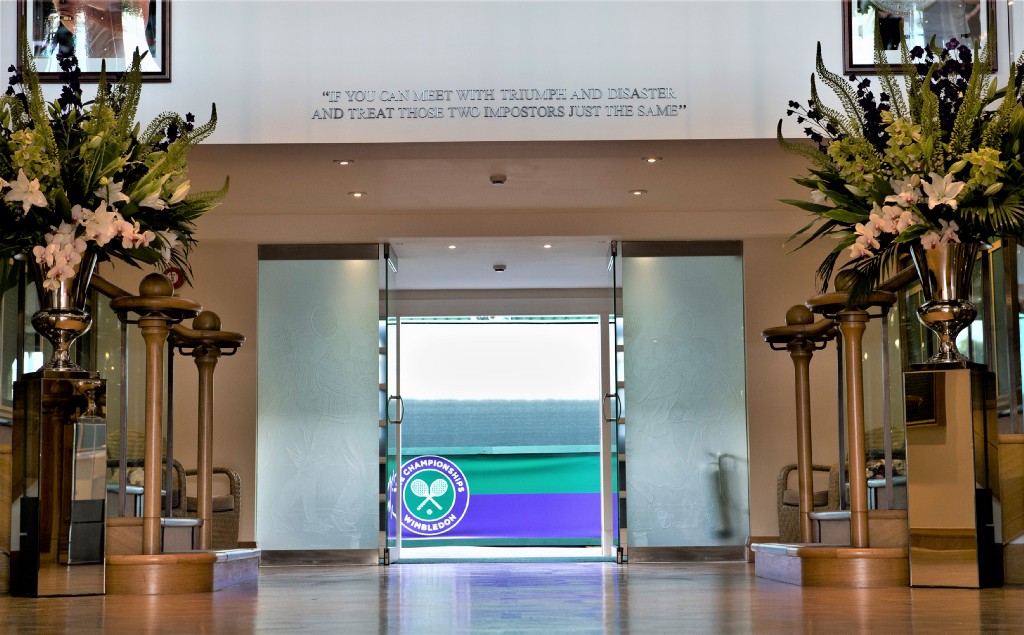
But the literary nature of Wimbledon isn’t a recent invention. As a reader, dad is a crime fiction guy, but he has a mysterious ability to pluck the odd poetry couplet from somewhere in the recesses of his mind and drop it into conversation, often changing the words to fashion an award-worthy Dad Joke. There’s this one line that he really likes, from Kipling’s “If — ”: “If you can meet with Triumph and Disaster and treat those two impostors just the same…” Where he remembers this one from is not such a mystery. It’s inscribed above the players’ entrance to Centre Court at Wimbledon, and he spotted it there when he played the Championships as a junior in 1976.
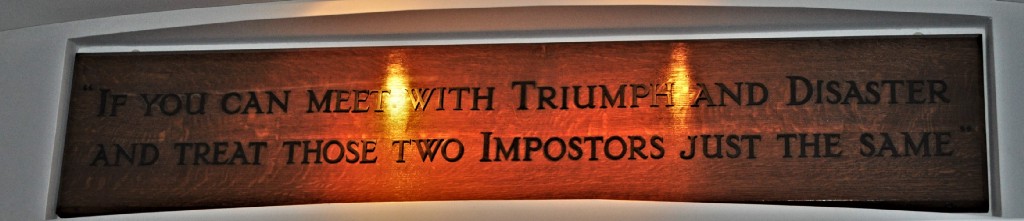
The sign has become well-known, but it was my first indication that there was a literary presence around the All England lawns. Rudyard Kipling, the imperialist poet, christens the gateway to one of Britain’s most famous battlegrounds, one on which the empire’s soldiers have historically struggled. Such resilient pride, such proud resilience — how fantastically British, how typically literary! (Nota bene: This year, in the absence of the brooding Scot and world No. 7 Andy Murray, the UK’s hopes were with South African-born Kyle Edmund. On Centre Court, he fell to a Serb, Novak Djokovic, in the round of 32.) Kipling’s placarded words were presented to the club by one Lord Curzon, the last Victorian viceroy of India, in 1923. That first wooden inscription has been replaced twice due to refurbishments, but The Jungle Book author’s original lines still have an honorable, if rather hidden, place at the club: they arch the gallery in which the Rose Water dish and the trophy are displayed. I found them with the help of the most knowledgeable of guides: the Wimbledon librarian, Robert McNicol.
Wimbledon has the largest tennis library in the world. It’s located between the Draw board and the soon-to-be-roofed Court №1, but the entrance is subterranean. Housing more than 15,000 texts from about 90 different countries, the stacks are full of everything from Tennis Das Spiel Der Völker (“Tennis, the Game of the People”…questionable) by Burghard Von Reznicek, to Death on the Center Court by George Goodchild, which a reviewer panned in the New York Times in 1936 but which I still want to read, to Zimbabwean coaching instruction books.
A significant amount of shelf space, almost three walls worth, holds bound periodicals. This section contains complete sets of titles such as The American Cricketer, first published in Philadelphia in 1877; the original Il Tennis Italiano, which, as a visiting Italian writer told our librarian Robert, cannot even be found in Italy; the popular contemporary Tennis magazine; and items closer to the All England club such as the aforementioned British publication, Pastime. Eventually, Pastime became Lawn Tennis and Croquet, and later again, Lawn Tennis and Badminton. The magazine ceased publication after 1967, but its final year of circulation led to the very library in which its issues are housed: that year, they published an open letter from Alan Little who said that Wimbledon needed a library, found it outrageous that they did not have one already. About 10 years later, in 1976, when my father saw Kipling over Centre Court, the Kenneth Ritchie Wimbledon Library was opened by librarian Alan Little.
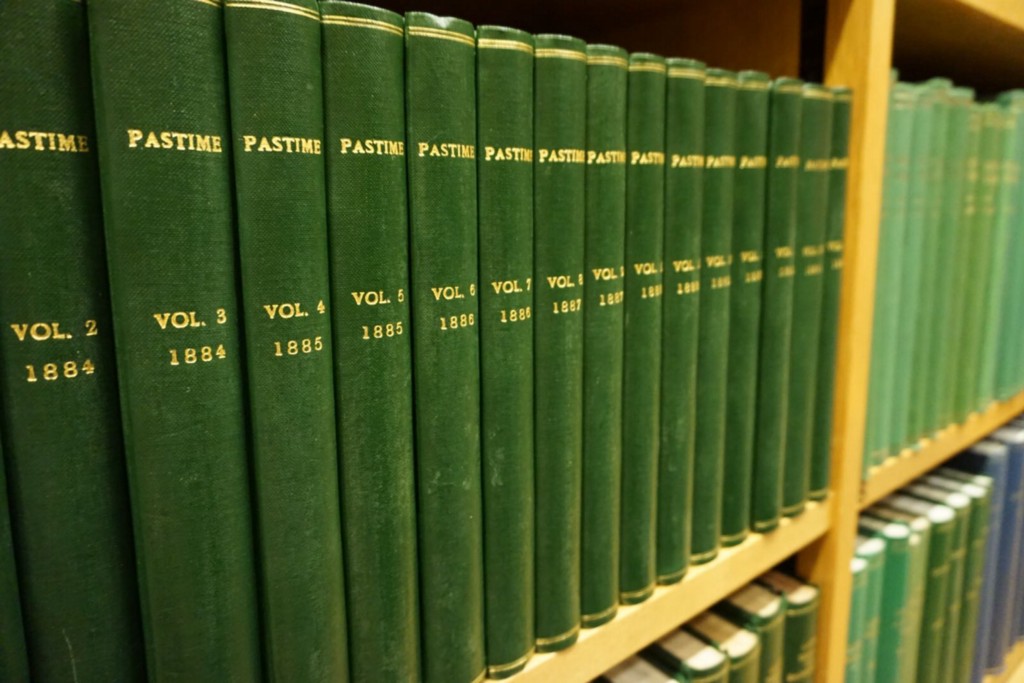
Robert was mentored by Little, who kept working in the library almost up to his death in 2017. Little was particularly proud of the periodicals collection. He felt this kind of writing captured tennis contemporaneously, with none of the fog of retrospection. Little’s service to preserving the story of tennis cannot be overstated. (He was knighted for it in 2014.) As a historian, Little was an assiduous collector of the hard facts of the sport. He launched the Wimbledon compendium, which now runs at 664 pages and contains every factoid and anecdote about every year of the Championships that you can and cannot fathom: the first woman to play without stockings (Ruth Tapscott of South Africa in 1927); the first year they had female line judges (1949); a list of “Champions who wore headgear in a singles final.” As a writer, however, Little had a taste for the more salacious and scandalous tales of the game. Of his own writing, his personal favorite was St. Leger Goold: A Tale of Two Courts. The book, one in a series of four, explores a true story about an Irish champion who, after his tennis success, moved to Monte Carlo in 1879 with his wife. They gambled, lost everything, and decided to murder a wealthy Danish woman to steal her riches. They packed her hacked-up body into a suitcase, got on a train to Marseille, and checked the luggage into a cloakroom to be forwarded to London. A porter got a whiff of the bag, though, and they were discovered. Goold died in a convict’s settlement in 1904. To me, this is a story deserving of the Netflix treatment.
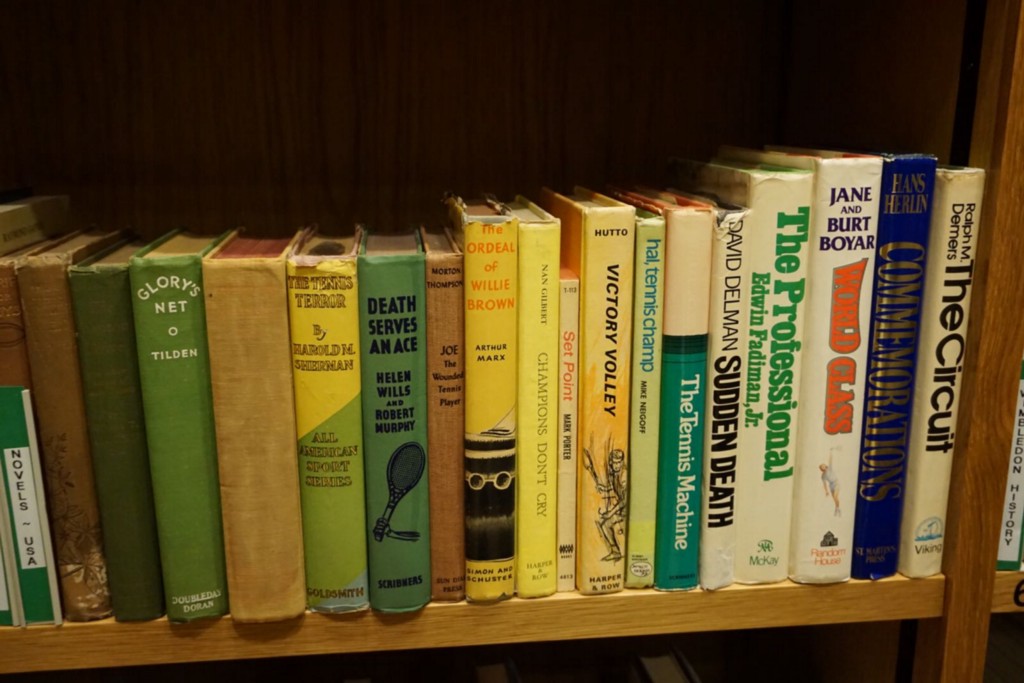
The library is primarily visited by writers doing research — not necessarily the literati that sprinkle the royal box. Books can be used but not taken from the premises, and an appointment is needed to visit. As Robert showed me around the collection, I realized the place was a visual representation of something that I have bemoaned alongside other tennis lit fans: the dearth of tennis lit in fiction. I was standing in the place where I was most likely to find all of it, and the novels take up just one stand of shelves. The spines, however, are enticing. A few players are represented; among them is Helen Wills, holder of 31 Grand Slam titles and apparently one fiction title, Death Serves an Ace. The under-celebrated Bill Tilden, who wrote 30 books and was the first American to win Wimbledon in 1920, appears with Glory’s Net, It’s All in the Game, and elsewhere. I picked up Nelson Hutto’s Victory Volley but the summary sounded a bit like a tennis version of Updike’s basketball-focused Rabbit books so I moved on. Sudden Death is on the shelf, but it’s a book by David Delman, not Alvaro Enrique’s recent (and excellent) novel with the same English-language title, about a not-necessarily-factual game of real tennis between the painter Caravaggio and the poet Francisco de Quevedo. Perusing led me to a few questions: what are the eligibility requirements for a place on the Wimbledon shelves, and how does acquisition happen? Is this a Library of Congress situation, if you write about tennis are you required (or would it at least behoove the work) to submit the book? Is there a hidden room of networked computers that beep and print a page of code whenever a book is published that uses the word “tennis”?
“The book has to be about tennis,” says Robert when I ask how they gain entry. This sounds intuitive but vague. Perhaps there are secrets that can’t be shared, because more nebulous still is the acquisition system. After years as the only person doing what he was doing, Alan Little has built quite a network of rare book collectors, fellow tennis enthusiasts, publishers, and writers. This web of people and relationships is the system of discovery that leads to acquisition — there’s no secret computer room. During my tour, two of Robert’s colleagues worked at a nearby table cutting newspaper clippings and pasting them into a large book of bound blank pages. I find it encouraging that an institution can modernize its infrastructure so thoroughly — the new, state-of-the-art roof for court 1 is hanging out like a giant, dead tarantula beside the Aorangi pavilion while it waits to be mounted — and still preserve its soul, the little human details. It’s like Pimms on tap: tradition meets modern demand.
When the Wimbledon tournament began in the 1870s, it more or less solidified the rules of the game as we know it, so there really isn’t a better place than Wimbledon for tennis’s literary history to be preserved. The Brits really do love a Bard — in 2010, Wimbledon partnered with the Poetry Foundation and that year’s Championships Artist was the first Official Wimbledon Poet. (Sample verse, about the interminable Isner-Mahut match that year: “High performance play / all day yet still no climax / it’s Tantric tennis.”) Unfortunately, he was also the only; the haikus have not continued.
13 Tennis Books That Weren’t Written by David Foster Wallace
Stories swirl through this place — matches that changed the game, player histories that make their success seem superhuman, smaller anecdotes like Ilie Nastase and Jimmy Connors’ heated backgammon games at the players lounge. On Saturday the female victor will hoist the beautiful Rose Water Dish, and on Sunday the man will receive a trophy that I learned this week is, in fact, meant to look like a pineapple. (Apparently, back in the day, pineapples were considered rare and glorious enough to be emblemized on a trophy. It is amazing to me that Wimbledon chose a fruit other than a strawberry for the ultimate pride of place.) I love how tennis is written, but on finals day on Centre Court, two players represent all of the heartbreak and triumph of the defeats and victories during the two-week tournament, years on the tour, lifetimes of dedication and sacrifice. And this, to me, is still the most thrilling tennis story of all.
Rachel Heng’s Suicide Club takes place in a near-future America, where technology has made it possible for the people to live for hundreds of years — and is approaching the point where immortality is inevitable.

In a world where the pursuit of immortality is not only considered moral, but is also supported by law, inevitably a small group of people known as the Suicide Club form.
The novel follows two women — Lea, a “Lifer” who is all but promised immortality — and Anja, a violinist who must watch her mother’s body kept alive via machines despite the fact that her consciousness has long since disappeared.
I chatted with Heng over Skype, about capitalism, the wellness industrial complex, fear of mortality, and more.
Karissa Chen: We’ve long had this obsession with living forever — and it appears in a lot of books — but the interesting twist in your book is that it’s not just about living forever but it’s about the opposite, this idea of suicide. Where did the idea for this book came from?
Rachel Heng: I’ve been obsessed with the idea of living forever since I was a kid. I’ve always been really terrified of death, both that of my own and of my loved ones, and I think a lot about loss and death and people growing older. This book was my way of facing my fear head-on, so thinking of what it would be like if that didn’t happen, and how great would it be if we could all live forever, and then taking that idea to the logical extreme and realizing, of course that it wouldn’t be that great. Particularly given the world we live in, the constraints we have, and all the inequality that already exists and that would persist under these circumstances. It was really about taking this idea to its logical conclusion and realizing that it would be not at all like what the 6-year old me would have wanted.
As for the question of suicide: in a hyper-sanitized world where immortality is within grasp and people are almost unable to die a natural death, suicide seemed like the terrible and logical antithesis. That’s where the idea came from — it came from fear of death and wanting to live forever, and then realizing that wouldn’t be so great after all.
KC: There’s a sanctimoniousness in the world of Suicide Club that I think we already see today, especially in America where being healthy is considered a moral good. Like people fat shaming because they believe that if you’re fat, it’s because you’ve personally failed at working out a lot or you didn’t eat your quinoa and kale or something.
RH: Totally, it’s that same bootstrapping mentality, like if you are sick, then you deserve it because you didn’t do the right thing. And underneath that, there’s so many layers and questions of access and classism. We have these ideas of wellness that involves things like SoulCycle and eating quinoa and organic fresh fruit. People might ask, why do people eat fast food and so on, but what some don’t realize that in many cases it’s a matter of fast food just being a lot cheaper than a $7 cold pressed juice. There’s so much inherent judgment and classism in that.
So if we lived in a world where immortality was within grasp, who would actually be able to access that immortality and how would we judge the people who couldn’t? I imagine society would see the non-immortals as bearing some kind of moral failing, because that’s so much easier than admitting to the fact that we live in a deeply unequal world.
KC: The book also becomes a cautionary story about capitalism, because not only is it about immortality being moral, but also something that people are making money off. I thought it was interesting how you chose to brand all of their skin, their blood, all of their replacements. It makes sense that in this very capitalist world that there’s this branding that is going on. I wondered if you thought this might actually happen, because I don’t feel like we’re that far off, we already have things like Restylane and Botox.
RH: Yeah, that is where I got it from. I think it already happens today, like the way that private enterprise basically controls pharmaceuticals in the US (in other countries not necessarily). Recently there was a report that was released from a Goldman Sachs investment memo that contained this line that said something like, they weren’t sure that curing patients was a sustainable model of business. It was this notion that if you cure everyone, then you wouldn’t be able to make any more money. I think, unfortunately, that’s the reality of certain types of business. When you have capitalism intersecting with healthcare, I think the outcome can be pretty dystopian.
Suicide seems like the terrible and logical antithesis in a hyper-sanitized world where immortality is within grasp and people are almost unable to die a natural death.
KC: The other thing I noticed about the book is that while it takes place in America and this is happening in America, it’s said outright that in other countries this wave of immortality isn’t happening. And Lea’s father and Anja both come from outside of the United States. As I myself am someone who splits her time between the US and Taiwan, I notice that the healthy food obsession and stuff like Soulcycle and everything is just not that big here in Taiwan, and that’s probably true of many other countries. That kind of obsession seems to me to be very specific to America, although maybe there’s other Western cultures that are also into it too. I was wondering if there was something about that that you could speak to, especially since you yourself have lived in several countries.
RH: From personal experience, I’d agree with you that I saw it most strongly in the US. But I was also living in the UK when I wrote the book and that wave had definitely come over to the UK as well. In Singapore it seems to be starting but it’s still some way behind. Like when I told my mother that I’m trying to eat more salad, she looked at me and she said, “You’re not eating meat? That can’t be healthy.” There’s a very different notion of what’s healthy and what’s not healthy in Asian vs. Western cultures. So there is that element of cultural difference.
But also I think what struck me the most about living in the US was the fact that health insurance is so expensive, and if you don’t have health insurance, you could end up in the hospital and go completely bankrupt from paying medical bills. I’d never lived in a country like that before, because in Singapore you have pretty good government sponsored healthcare, and even though it’s not a universal healthcare system, you can always get some help, so it’s never as if you’re just on your own. Capitalism hasn’t quite seeped into healthcare and affected people’s lives in such a visceral, medical way to the same degree that it has in the US. So just that level of inequality is something I have always associated with America. And to your point, that kind of whole wellness industry — soul cycle, green juicing and all of that stuff — I associate it very much with the US.
KC: Was there a reason why you decided to make both Anja and Lea’s father people who didn’t originally come from America?
RH: I think one reason was because I do not come from America, and that was my personal experience. I think the other thing, a more technical craft reason, was if they were just from America, then it would be harder for them to have an external perspective. Having them come from different places gave the opportunity to show what things were like in other parts of the world, as well as having them be outsiders and not fully buying into society’s beliefs.
KC: When did you move to the States?
RH: I came here for undergrad and I went back to Singapore for about a year. Then I was working in the UK for about five years. I just came back to the States last year to start my MFA.
KC: So what was it like for you to write about America, ostensibly from an American perspective, as someone who did not grow up in America?
RH: When living in New York, I often imagined what it would be like if I had grown up there, thinking about the kind of pressures I would face, and what being in that society would feel like. But also, it’s speculative America, so you already have to stretch your imagination quite a bit to get to Lea’s character in this dystopian world.
This reminds me, in another interview I was talking to a Singaporean reporter and she said, “Your book is set in America and your characters are American but I see a lot of Singapore in this world, such as being metric driven and the somewhat controlled life with a narrow vision of success. Those feel like themes that are familiar.” And I thought, oh yeah, that’s true. I guess that even though it’s set in America, a lot of the themes in the book are things that I drew from my own life growing up in Singapore. The book seems to resonate across cultures. When Americans read it, they seem to see it as American even though so much of it came from my own life.
KC: I was even wondering if maybe you are able to see America more clearly in some ways because you are coming from a perspective where you didn’t grow up in America. I think sometimes Americans can be blinded to the absurdity of the way things are, like having cold-pressed juices on every corner and paying $10 for it is normal.
RH: Or like paying $5000 for dental surgery. To me this is out of this world but to Americans it seems normal.
KC: Totally. So I was like wondering if maybe the fact that you grew up in Singapore allows you to see certain things for what they are in America and having a more absurdist perspective. In some ways, we’re already living a capitalist dystopia in America, but we don’t see it because to us it’s normal. I think the best dystopias allow you to see the parallels with your real life drawn to this horrible conclusion. So while reading your book I thought, I already see this. For instance, the whole fact that she’s working for this financial firm where they’re basically banking on organs and lives, and I thought this is totally something that would happen in America.
RH: Yeah, I think that’s already happening to some degree. I just wrote a piece actually, for Catapult, about the death bond market, which is this financial product that allows people to speculate on the life expectancy of individuals. And I’ve had conversations with people who believe that kidney trading should be legal because they think it would make the market efficient and it would give people access to kidneys. So it doesn’t seem that far-fetched unfortunately.
My book came from the fear of death and wanting to live forever, and then realizing that wouldn’t be so great after all.
KC: So what is your own relationship to the health industrial complex and how did that influence this book?
RH: Growing up I had always been pretty unhealthy and I never outgrew not wanting to eat vegetables. My friends make fun of me for it — literally last night I was having dinner and my friends were like, “Are you taking all the pieces of basil out of your Thai fried chicken?” and I said, “Yeah, I am doing that. I do not want to eat those pieces of basil.” Which, by the way, I wouldn’t recommend, I’m not advocating for people to be unhealthy. But I enjoy a lot of unhealthy foods and I don’t like running; I like to enjoy myself. But after I started working, there was one year where I did a health checkup and I found out I had high cholesterol at the age of 24. It was pretty shocking, and I had this revelation where I was thought, I guess I should take care of my diet and start exercising more. At the time, I was working in finance in the UK and people in that industry are really into wellness and maintaining this image of health and physical perfection. It’s interesting because you associate finance with Wolf of Wall Street excesses right? Like people drinking, doing drugs, staying up all night to party, but that’s no longer the case. Now it’s more like people comparing which Ironman they did and which Arctic Trek they’re going on next and which place has the best cold pressed juice. So it’s a very different kind of competitiveness, and that’s something I tapped into for the book. It was both amusing and slightly terrifying. I think when I got my high cholesterol result, I freaked out slightly and I thought, Okay, I need to change my life completely. So I went the other way and started doing yoga and running to work everyday and eating salads, making myself completely miserable. Thankfully my health results came back much better the next year, and then I sort of just went back to my old unhealthy ways.
KC: Yeah, I hear you. I am also someone who enjoys herself and can’t do the whole health complex thing.
RH: Yeah, what’s the point? It’s horrible! I mean maybe some people enjoy it, I don’t know.
KC: To me it’s interesting because you’re doing all this stuff for the sake of being “healthy” but is it really healthy if it’s an obsession? You know, you’re not doing it in a way where it’s natural, where you’re like, I’m eating because I enjoy that particular food and it happens to be good for me, or I go out and ride my bike every weekend because it’s fun and it’s something I like to do. It’s more like let me sit in a room with other sweaty people for an hour and go nowhere on a bike and then I feel healthy, you know?
RH: It’s almost like a self-punishing kind of compulsion, like this sense of “if it feels bad then it must be good for me.” It can be quite self-flagellating and there’s something somewhat morally judgmental about the whole enterprise.
KC: Oh and — wait, I forget the term you use for when people are cooking salads.
RH: Oh — trad.
KC: Yeah, trad, it took me awhile to understand, I kept wondering, what’s trad food? And then I realized, Oh my god, it’s just normal food, because they don’t eat food, they just drink things out of pouches like baby food.
RH: Some people are already doing that. Have you heard of Soylent?
KC: Yeah, I have.
RH: So I feel like Soylent just epitomizes so much of that kind of Silicon Valley health-obsessed culture, this Master of the Universe mentality where it’s like, I can control everything, I will optimize every single nutrient that goes into my body and because of that, I will conquer death.
KC: Yeah I was disgusted by that, I thought, these people are not enjoying their life at all, they’re just eating baby food. To that point, the other thing that I found interesting in your book was that music and the arts were somehow “unhealthy.” As someone who really loves music, I think of music as something that takes stress away. Like if we’re having a bad day, we might listen to a song that makes us happy or makes us feel things or calms us down. I thought it was really interesting that in this world, music and other forms of art are considered bad because it raises your stress levels, that people would take it to that extreme and be like nope, we can’t enjoy anything because joy makes you feel bad, joy is too good, it’s unhealthy. So I’m curious where that came from.
RH: That was quite Brave New World inspired. You know how in Brave New World Shakespeare’s banned and they no longer listen to orchestras and so on. The idea is that certain types of music are too stimulating or too cortisol-generating, because they arouse deep emotions like you say, and there’s a certain level of existential transcendence that makes you question things or makes you feel deep feelings of joy and dread and it’s too much. So in the book, they only listen to elevator music, and it’s kind of this soothing spa music, whale calls and bird calls and tinkling triangle music, but no rock, no jazz, no intense music, no Beethoven, none of that.
If we lived in a world where immortality was within grasp, who would actually be able to access that immortality and how would we judge the people who couldn’t? Society would see the non-immortals as bearing some kind of moral failing, because that’s easier than admitting that we live in a deeply unequal world.
KC: While I was reading this, I thought, okay, this all makes some sort of scientific sense to me, like raising your cortisol is maybe bad for you. But joy is also supposed to make you live longer. I thought, these people have really sad lives, they live very long lives with very little joy in it.
RH: Yeah, it’s the idea that just as much as you try and protect your body from physical harm or toxins or whatever, you create this shell around your emotional self. Like being in one of those floating pods where you meditate and you don’t feel your body at all. So I think it’s kind of that way. You don’t have this artistic stimulation that could, even though it brings you joy, also throw you off, make you think uncomfortable thoughts or make you feel uncomfortable feelings that then push you off into these existential crises. And they’d rather keep this soothing picture, like human beings sealed into plastic bags floating around in warm water.
KC: At the heart of this story is a child-parent story, both in Lea’s relationship to her father and Anja’s relationship to her mother, and also a little bit of Lea’s relationship to her mother as well. I think a lot of the emotional aspects of the story centers around that, the ways that they’re disappointed and worried and worried about disappointing their parents. There was also a relationship between Lea and her fiancé, and I think the easy thing that many people might have done would be to focus on a romantic relationship, but I think it was the smart choice to focus on a parental relationship. What do those two parent-child relationships mean to you?
RH: I think many people’s first encounter with mortality is the mortality of their parents, like everyone has that experience of realizing that one day that your parents are getting older or even when you’re a kid and you realize what death is. I remember being a kid lying in bed, freaking out and not being able to fall asleep, and thinking, oh my god, one day my parents are going to die. In a book about mortality and what it means to let go of those you love and also facing your own mortality, it makes sense to me that the relationships would be parent and child because that is the most common experience. That’s what I’m most familiar with as well, losing a parent and having your parents grow older. Actually Anja’s relationship with her mother came to me first and that didn’t change, that was a strand I knew from the beginning, that of having a parent who is technically not there anymore — she’s not able to speak or move, but she’s still alive — and what do you do? That’s one of my deepest fears for when I grow old, and I also know it’s one of my own mother’s fears. Every older person I speak to, no one wants that. So that just struck me as an incredibly heartbreaking conflict, such a sad situation to be in. It’s just so difficult to wrap your mind around. That was the image that anchored the whole parent-child theme to the book, I suppose.
Lea’s relationship with her father wasn’t as prominent in the first few drafts. It was something I found as I developed and redrafted because I realized that was kind of the main emotional thread that really resonated with me and I wanted to bring it to the foreground. My dad left when I was really young and he passed away recently, so it’s something that’s quite close to my heart, something I write about a lot, about loss and family, so on. As for the romantic stuff, I don’t know why, but none of my stories every have romantic themes to them. I just never write about romantic relationships. I guess that’s a good thing because I write about the things that trouble me the most. Family relationships are one of the things that preoccupy me the most and always have.
KC: The fact that Lea could live forever and her brother couldn’t was really poignant. It created a really interesting family dynamic where clearly she had a mother who very much believed in this way of life and her reaction to the son’s death was to become more extreme whereas her father had this complete opposite reaction which was to become more cynical about the whole thing. It becomes a very central sadness in the book. Was the relationship with the brother always in the original novel? How did you decide to put that relationship in?
RH: It was always in the novel. I needed a reason for why Lea was so committed to this lifestyle. Because, as you can see, it’s not fun, it’s not like they’re having a great time living forever, it’s pretty sterile and depressing. So I needed a reason for why she’d be so committed to that. It would make sense if you were dedicated to it because you had someone in your family who couldn’t have that and you felt that you needed to make the most of what you had. I think this can so often happen if you lose someone, that sense of survivor’s guilt, where you feel, If I do anything wrong, I’m letting down that person. So that was pretty fully formed from the early drafts.
KC: The other interesting thing was that she decides to go for this lifestyle despite the fact inherently she has some more violent tendencies. She does that thing to the bunny rabbit, which is alarming, but it’s more as if she wants to see if something can actually die.
RH: Yeah, that’s exactly what it is, thank you for putting it that way. It’s about mortality and wanting to see something die and trying to understand what a body really is because she’s so protected, because everything is so controlled.
KC: I think it comes through really clearly. She’s like, how do I pour out this rage and frustration I have that I can’t express these things, or, I want to feel something physical, so she just squeezes a bunny to death. Although you could just read it as she’s just a really violent girl at heart, I don’t think it is. I think her actions are just a manifestation of her repression, but if she lived in our world, maybe she wouldn’t be like that, maybe she would just like pick up soccer or something. It doesn’t feel like she’s going to be a serial killer or anything.
RH: Yeah absolutely, that’s exactly what it is, thanks for putting it that way. Someone else said to me that she’s just a sociopath and I said, no she’s not a sociopath, she’s just deeply repressed in a world that is incredibly constraining and controlled. She has never had like any outlets, and she has never seen anything die. Everything is so sanitized that it’s this morbid curiosity of what would happen if something did die, and how does that happen.
At the heart of every dystopia is a failed utopia.
KC: Who are some of your influences?
RH: It’s such a tough question, there’s so many — everyone I’ve ever read, pretty much! But for this book in particular… a lot of the books I loved as a teenager were dystopian, The Handmaid’s Tale, Brave New World, 1984, kind of the standard ones. I also loved Clay’s Ark by Octavia Butler. Things in that vein, the older dystopian works, I always loved while growing up. It just really excited me to read stuff that was set in a totally different world that was so similar to our own.
The thing that always fascinated me about dystopia is that at the heart of every dystopia is a utopia, and it’s a failed utopia. It’s always so poignant because everyone is trying so hard and they want to do it well and they have this dream, but then it become this dark mirror of itself. That always struck me as very ironic and sad. I think that’s why I wrote this book in a way. I also love Michael Cunningham and 19th century novels. I also really love a lot of Japanese writers — Yoko Ogawa, Natsuo Kirino especially. I recently read a Taiwanese author who wrote this ecological novel —
KC: Oh, The Man with the Compound Eyes, Wu Ming-Yi? I just started reading it! I haven’t finished it yet but I just started it.
RH: I loved it. It’s a slow burn, but when I finished it I felt like I had been hit by a truck. It just accumulates so well and has this like amazing sort of layering ability. It’s so subtle and so beautiful and moving. So I love writers like that who do something kind of different, like it is magical realism but it’s not quite magical realism. And I love writers like Diane Cook. Her book Man v. Nature came out in 2014 — I think I actually first read her on Electric Literature, in Recommended Reading. She writes these kind of funny, sort of surreal but really dark stories that are sort of speculative. Like you never know what world you’re in but they’re usually sort of dystopian worlds that she builds really quickly, so when you get into them, you’re there right away. They’re always really strange, post-apocalyptic situations.
KC: Are there any books that are coming out soon that you’re excited about?
RH: I’m super excited about Thea Lim’s An Ocean of Minutes. She’s also a Singaporean author, and she lives in Canada. People describe her book as Station Eleven meets The Time Traveler’s Wife. It’s essentially a love story set in a world where time travel is possible. There are companies that allow people to travel, but there’s also a flu pandemic so they allow people to travel to the future in order to pay for their medical fees in the present. It deals with themes of displacement and immigration and also healthcare, and it’s also post-apocalyptic. And then I haven’t read Jamel Brinkley’s A Lucky Man yet but literally everyone I know who has read it has been super into it, so I’m really excited to read that. I have it on my to be read pile. I’m also hugely excited about Ingrid Rojas Contreras’s Fruit of the Drunken Tree, Ling Ma’s Severance and Nana Kwame Adjei-Brenyah’s Friday Black. At the moment, I’m reading Chang-rae Lee’s On Such a Full Sea, but that’s not as recent.
The plot goes something like this: a twenty-something WASP who, in her own words, is “hot shit,” lives in her own apartment on the Upper East Side in the year 2000. An orphan, she enjoys fabulous wealth and doesn’t feel the need to work. As the poster child of consumer desire, a walking advertisement, the girl’s supposed to have it all—but what do you know, she feels empty inside, hates the world. Armed with a barrage of drugs—all happily prescribed by possibly the worst therapist in literature—she sleeps the year away, hoping that by the time she wakes up, she’ll be renewed from the inside out. She turns to stronger meds, cleans her apartment of mostly everything but a mattress, and, after successfully sleeping for several months, “came to in a cross-legged seated position on the living room floor […] I was alive.” Informed by this new philosophy of absolute detachment, she records the Twin Towers attack as it happens, to be watched whenever she feels bored or sad.
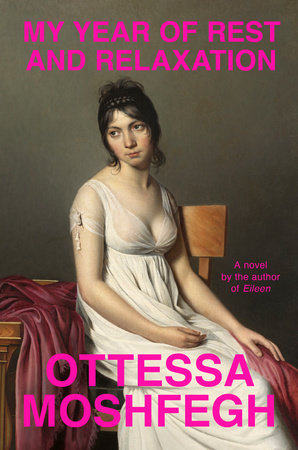
At first, you’d think that it would be impossible to read this tar-thick postmodern irony as anything other than an incisive, cynical commentary on the capitalist alienation of the pre-9/11 era. If this were the case, though, the novel would just be a ‘90s throwback, another retrospection. I’d like to think that’s not the case. Ottessa Moshfegh’s My Year of Rest and Relaxation examines the late 1990s in all its late-capitalist munificence, for sure, but it also prods, questions and ultimately uses the tropes of the literary movement of its time (post-postmodernism, headed by one of the age’s titans, David Foster Wallace) in order to infuse the novel with pathetic sincerity, or “New Sincerity,” as the movement would have it. New Sincerity prevents us from dismissing or mocking the narrator outright. She earns our pity; in her flaws we see a portrait of a city, of a culture that didn’t end with 9/11. In fact, I think the book’s a double novel, a comment and analysis of both the late ‘90s and of 2016–2018—the same way Philip Roth’s The Plot Against America functions as a critique of the Bush administration through its portrayal of Charles Lindbergh, the way Arthur Miller’s The Crucible criticizes McCarthyism through the portrayal of the witch trials. Moshfegh uses the late ‘90s to look at the evolution of late capitalism; her characters hold up disturbing mirrors in which we see ourselves only too clearly in 2018.
The period known in scholarly circles as the “long 1990s”—between 1989 and September 2001— was an interregnum between the Cold War and the age of terror, a “life between two deaths,” according to literature professor Philip Wegner. It was a decade deeply concerned with its own historicity, with the question of “how did we get here,” as evidenced by the amount of excellent historical fiction published in 1997 alone—Mason & Dixon (Pynchon), American Pastoral (Roth), Paradise (Morrison), Underworld (DeLillo). It was also a period known for its ahistoricity, an absence of political consciousness particularly evident in popular culture: think of Seinfeld, the “show about nothing,” or the easy, apolitical drift of life in FRIENDS and Sex & the City. There is a reason why we return to these series in endless reruns, particularly now—ahistoricity is comfort food. No one is murdered. No one is forcibly separated from their child and placed in a concentration camp.
Ahistoricity is comfort food. No one is murdered. No one is forcibly separated from their child and placed in a concentration camp.
The ahistoricity of the ‘90s famously finds its symbol in the (white) slacker—think of The Dude in The Big Lebowski, for instance. Moshfegh’s narrator, appropriately, is a blasé slacker too: “The only news I could read were the sensational headlines on the local daily papers at the bodega. I’d quickly glance at them as I paid for my coffees. Bush versus Gore for president […] This was the beauty of sleep—reality detached itself and appeared in my mind as casually as a movie or a dream. It was easy to ignore things that didn’t concern me.” It is easy to be ahistorical, after all, when one is white, able-bodied, rich and privileged.
Divorced from historical or present context, sick of the world, she decides to actively remove herself from it by sleeping. Crucially, I believe, she sleeps because she feels she has no agency, no power to cause any kind of change, since everything is determined by the market. She’s a reflection of her period’s concerns: the ‘90s, after all, famously questioned whether we have any agency and power left. There was even a consensus that the long ‘90s marked “the end of history,” after an infamous 1989 essay by the same name by Francis Fukuyama. He subscribed to the Hegelian view of history, whereby history is created through the struggle of contradictory forces. Fukuyama claimed neoliberalism and democracy had wiped out fascism and communism. With no opposing forces, therefore, capitalism had seized the day…forever. Fukuyama’s a right-wing pundit, but the late capitalist idea that ‘no change is possible’ was also advanced by Marxist political theorist and literary critic Fredric Jameson: In “Five Theses On Actually Existing Marxism,” he writes that “there can have been few moments of modern social history in which people in general have felt more powerless.” We aren’t presented with any choice in how we live: we’re forced into neoliberalism, presented as the greatest solution. The left and right agree: The culture dictates that there is no longer any way to move forward.
Moshfegh’s unnamed narrator is deeply unhappy with this. An art student, she loses all hope from the start that art has any possibility of redeeming a world controlled by the market. She gets into Columbia by writing a “mediocre” essay on Anton Kirschler, an artist concerned with “a humanistic approach to art facing the rise of technology.” The artist is a figment of her imagination. She can’t create art, because she “has no talent,” but what kills her is that, in this day and age—as her friend Reva tells her—talent isn’t necessary. She works in a gallery, Ducat (get it?), where art is no longer art, it’s entertainment: “the art […] was supposed to be subversive, irreverent, shocking, but all was just canned counterculture crap, ‘punk, but with money.” the art world “had turned out to be like the stock market, a reflection of political trends and the persuasions of capitalism, fueled by greed and gossip and cocaine. I might as well have worked on Wall Street.” Natasha, Ducat’s director, tells the narrator that “the market is moving away from emotion. Now it’s all about process and ideas and branding.” Her star artist, Ping Xi, likes making art out of his semen and crayons. He titles his works “Decapitated Palestinian Child” and “Bombs Away, Nairobi.” He kills dogs in an industrial freezer so he can use them as objets d’art.
Literature isn’t redeemable, either: she seethes at the “hipster nerds […] reading Nietzsche in the subway, reading Proust, reading David Foster Wallace, jotting down their brilliant thoughts into a black Moleskine pocket notebook […] The worst was that those guys tried to pass off their insecurity as ‘sensitivity,’ and it worked.” Irony and sincerity are just a brand, an aesthetic. She prefers her kind-of boyfriend, Trevor, for his crude tastes and abuse, because at least he’s an honest douche with “the sincere arrogance to back up his bravado.”
So if everything is meaningless, and art has been taken over by Wall Street, and linguistic expression itself is hypocritical—a posture of cynicism, or a posture of sincerity—what is left? It’s a question that strikes a metatextual chord, too—how exactly is Moshfegh going to tell this story of late capitalism without it seeming trite, without it being another example of Neiman-Marcus Nihilism? Will she resort to pure irony? And if that’s the case, why on earth is this story so moving, for all its incredulity? (Moshfegh really does excel at crafting deeply unlikable narrators).
In the ‘90s, “New Sincerity” was touted as the literary movement that had replaced postmodernism’s ironic ennui. To quote the already-overquoted 1993 E Unibus Pluram essay, by Wallace:
The next literary “rebels” in this country might well emerge as some weird bunch of anti-rebels, born oglers who dare somehow to back away from ironic watching, who have the childish gall actually to endorse and instantiate single-entendre principles. Who treat of plain old untrendy human troubles and emotions in U.S life with reverence and conviction. Who eschew self-consciousness and hip fatigue.
New Sincerity didn’t involve writing from an elevated moral high-ground, though, like a supremely sincere being shaking its head at the mess of the masses. In his essay David Foster Wallace and the New Sincerity, Dr. Adam Kelly explains the technique as follows: “[Wallace] agreed that the effect advertising had of highlighting the complexity and impurity of all discourse could only be responded to by acknowledging one’s own implication within this ‘system of general writing.’ One must begin by recognizing the lack of any transcendent, absolute, Archimedean point from which to judge the authentic from the inauthentic, the sincere from the manipulative, truth from ideology, and so on.” So you’d need a narrator enmeshed in the system, who recognizes it a little for what it is but who tries to keep some sort of value system alive in the face of it all. Enter our protagonist: an ironic narrator who believes she’s “awake” and sneers at the fake Manhattan life everyone else strives for, but is also a victim of late capitalism’s insidious reach (who knew!)
In brief: if irony tells the reader I know you know, New Sincerity says I know you know I know, but this girl really doesn’t know, and isn’t that kind of sad?
New Sincerity as a literary movement was a hallmark of the 1990s. It’s pretty meta that Moshfegh writes about the ‘90s while adopting its literary mood, even cleverer that she uses New Sincerity to create a double novel by using one of the movement’s crucial techniques: addressing the reader. Here’s Dr. Kelly again: “In Wallace’s terms, the greatest terror, but also the only true relief, is the passive decision to relinquish the self to the judgment of the other, and the fiction of the New Sincerity is thus structured and informed by this dialogic appeal to the reader’s attestation and judgment.” It’s why, in Brief Interviews with Hideous Men, Wallace uses “you,” involving the reader. Moshfegh doesn’t have to use “you” to obtain the same thing: by placing the reader as quasi-therapist, stuck reading the narrator’s diary-narrative for over three hundred pages, you’re involved, you know what’s up, recognize that she’s trapped in neoliberal binds and confines that are multitudinous and exhausting. You are forced into this therapist position, because the unnamed narrator is, you guessed it, unreliable—she’ll tell you one thing whilst awake, then does the opposite when unconscious. She rambles and tries to explain herself, but you know she’s just going round in an endless solipsistic whirlpool with no closure. Your judgements, frustrations and pathos inform the way Moshfegh presents the late ‘90s. You are an important part of the tale as it is told.
Your judgements, frustrations and pathos inform the way Moshfegh presents the late ’90s. You are an important part of the tale as it is told.
You pity her traumatic, schizoid condition: her posture of fighting late capitalism through alienation, and her desire, Forsterian as it is, to “only connect.” At her conscious mind’s meticulous planning that unravels while asleep, because of course she wants to shop (neoliberalism has thoroughly structured her mind), to party, “pushing towards the ecstasy of the dream of tomorrow,” to loveshe writes love letters to Trevor, who, when she told him she loved him pre-hibernation, replied “how is that relevant?” She was pretty much doomed from the start, Moshfegh suggests, since her parents were spectral figures of ‘80s glamour capitalism, providing nothing but money. Her father “was a kind of nonentity,” her mother a monster who gave her valium as a baby so she wouldn’t cry. When her parents die, she isn’t left with a house full of memories; she is left with the husks of memory-less objects. She sobs “over piles of my mother’s unopened packages of pantyhose. I cried over my father’s deathbed pajamas.”
Sleep is her only authentic agency in a time where she can’t escape consumer culture, even in language. She grinds at how Reva’s speech “sounded as though she were reading a bad made-for-TV movie script.” That Reva’s clichés carry “real” meaning made trite is anathema to her: “Watching her take what was deep and real and painful and ruin it by expressing it with such trite precision […] turned everything, even hatred, even love, into fluff I could bat away.” She mocks Reva, but doesn’t realize that her own language is forged from advertising, media, and film and their clichés. “I looked like Amber Valletta,” “Natasha had cast me as the jaded underling,” “I should have felt something – a pang of sadness, a twinge of nostalgia […] that—if I were in a movie—would be depicted superficially as me shaking my head slowly and shedding a tear. Zoom in on my sad, pretty, orphan face” (italics for emphasis).
She’s victim of a culture that bombards her with the message that she is in control, as long as she buys the necessary products, looks a certain way. In one of the most poignant moments of the novel, she doesn’t realise that this agency is a false god: when the narrator is molested by one of her father’s colleagues, she believes she was “letting [him] kiss me” and is confused as to why, since after all, as the epitome of desire, she must be responsible.
As an antidote to this life the narrator nurtures a (misguided) “Passion for the Real”—a key feature of the twentieth century, which the philosopher Slavoj Žižek explains as “the direct experience of the Real as opposed to everyday social reality—the Real in its extreme violence as the price to be paid for peeling off the deceptive layers of reality.” It’s not like the 1990s weren’t aware of its ahistorical, hyper materialist bubble: look at the movies produced in that time—The Truman Show, Fight Club, The Matrix, all concerned with “unveiling.” Her passion for the Real is what makes her stuff her own poop in Ping Xi’s dead dogs exhibit. While unconscious, it leads her to send strangers “snapshots of my asshole, my nipple, the inside of my mouth.”
Fully conscious, after her months spent in deep sleep, the passion is what leads her to record the Twin Tower attacks as they happen, to “soothe” herself, to be “overcome by awe […] There she is, a human being, diving into the unknown, and she is wide awake.” The attack is the ultimate kick of the Real that she’s been searching for all along, one she couldn’t find in films, and so she fetishizes the event, the one definite moment of Meaning that she’s found in an empty world. Here’s Žižek again: “Does the same not hold, on a different level, for today’s fundamentalist terror? Is not its goal also to awaken us, Western citizens, from our numbness, from immersion in our everyday ideological universe? […] the fundamental paradox of the ‘passion for the Real’: it culminates in its apparent opposite, in a theatrical spectacle.” A spectacle that seemed to come straight out of a movie screen.
In the aftermath of the September 11 attack there were talks of a wake-up call, of making more time for nurturing relationships and so forth. Meanwhile, people on the other side of the world were getting killed from screens, for the sake of an ambiguously named “War on Terror,” for a reason—Weapons of Mass Destruction—that turned out to be spurious. Seventeen years later, a man who existed almost purely on the screen has been elected president. Violence—terrorist and otherwise—broadcast through screens is almost routine. We were naïve to believe that some kind of fundamental rupture happened in 2001. Disturbing as it is, the final page of My Year of Rest and Relaxation mocks the idea, touted at the time and still upheld by some, that the ‘90s in all its frivolity imploded the day of the attack. The ending suggests that the attacks were just a violent continuation of our spectacle-obsessed culture. The rest of the book makes clear that this culture continues into today. We recognize these late-’90s capitalist evils as our own.
My Year of Rest and Relaxation mocks the idea, touted at the time and still upheld by some, that the ’90s in all its frivolity imploded the day of the attack.
It is impossible (to me, anyway) to read about Trevor without thinking of Donald Trump. The fact that the narrator prefers his “honesty” to the poseur-like quality of “intellectual” men, though Trevor himself is built out of artifice, smacks of the president and his (dubiously financed) campaign of “real” values and “honest” patriotism, his attack of “liberal élites” issued from the hard-working, struggling position of a daddy’s-boy billionaire. Trevor’s apartment could be a parody of Trump’s Versailles-inspired condo: “It reminded me of the loft Tom Hanks rents in Big […] the wall above his bed was decorated with horrifying African masks. He collected antique swords.” Like Trump, Trevor collects objects devoid of history, rendered as pure, empty aesthetic.
There’s another reason why New Sincerity, not irony, is the chosen mode. There’s a danger to irony, one that none other than Nietzsche recognized in his Untimely Meditations (I discovered this not by reading Nietzsche but through Mark Fisher’s Capitalist Realism, which should be required reading in my opinion, but I digress). In an age oversaturated with history, he notes, the age in question may be led into adopting “a dangerous mood of irony in regard to itself, and subsequently into the even more dangerous mood of cynicism,” where “cosmopolitan fingering,” a detached spectatorialism, replaces engagement and involvement—you point to an advert and mock it, but you keep buying the product advertised, because nothing matters. (In the ‘90s, irony was used in advertising to great effect, so it became practically useless as a tool for deconstructing/mocking consumer culture).
New sincerity was supposed to make you feel something; it carried the ethos that some parts of life were still worth it. To quote Wallace (again, I know): “in dark times, the definition of good art would seem to be art that locates and applies CPR to those elements of what’s human and magical that still live and glow despite the times’ darkness.” Of course that’s not Moshfegh’s style: rather, you’re motivated to apply CPR to the world as the reader because you’re so utterly infuriated by the narrator from start to finish, but also – crucially – because she uncomfortably reflects a fantasy we all have at the moment: to switch off the TV, stop reading the news and devote our time to cat videos instead, hibernate in the warmth and comfort of our beds until the inferno that is the Trump administration ceases to exist. We all want a year—maybe many years—of rest and relaxation. Respite from anxiety that rattles us almost hourly, the push notifications informing us of concentration camps, genocide, the frenzied erosion of human rights, police brutality, hate crime, murder. It’s comforting, in a way, to read a novel that indulges in such a fantasy at a time when retiring from the world was sort of acceptable, when neoliberalism—not fascism—was the menace of the day. Yet the epochal context of our reading can’t be escaped. You cannot separate the act of reading the novel in 2018 from the narrative that unfolds in 2000. Moshfegh has established the parallels between both periods so well, the connective tissue that sees one epoch emerge monstrously from the other.
The novel was written around 2016–2018; its effect has been precisely calculated. This could have been the story of a Croatian-Iranian girl living in Manhattan, with all its attendant problems. This could also be a book, like Ali Smith’s Autumn and Winter, that shows white female protagonists taking a stand against oppression, racism and violence in their own, small ways. But it’s no such novel. It’s the story of a woman giving in to the temptation to hide, a novel of alienation in a time when isolating yourself just isn’t possible if you’re able-bodied, mentally healthy, and able to protest—and alienation is certainly immoral if you’re white and privileged. Reading the book is like seeing a frail, misguided, naive version of yourself but only to an extent. You can’t identify with her completely because you pity her and, to a degree, she disgusts you, because she represents an opt-out version of life that the rest of us can’t afford, ethically and financially speaking. It’s the rage you feel reading stories of millionaires camping out into the woods to get away from the news. “You poor thing,” you sneer.
You pity her and, to a degree, she disgusts you, because she represents an opt-out version of life that the rest of us can’t afford.
While you’re reading, you want to tell the narrator that for god’s sake, she could always volunteer at an NGO or something. You’d tell her—and of course, you’d be talking to yourself—that the solution isn’t to alienate yourself in your fricking apartment. There’s a whole world out there where you can help make a small difference. You want to tell her that meaning can be found outside of yourself. You want to tell her that sleep isn’t resistance. There is agency left. There was agency then. You question whether everything was really gilded perfection; this would have been a radically different narrative if it were written by a person of color suffering from Clinton’s war on drugs and the administration’s policies of mass incarceration. A different story, if it charted the way black communities struggled with severe unemployment due to globalization. A whole other novel, if it showed her on the streets, protesting. Your disgust for her motivates you to do better.
The narrator can’t reach out beyond the text, not even to address the reader with a “you,” and you obviously can’t shake her from within it. You’re left with yourself, your outrage, your pity. You refuse to sleep.
What happens first is people in hospital masks come banging on our doors before it’s even light out. They herd us out of our houses and down the block to what used to be the football field of Paige Clifton Senior High School. They make us strip and pile our clothes on the bleachers. It’s August but the mist hasn’t burned off the morning yet and we shiver. Especially Mrs. Todd shivers, who’s eighty-two. There’s like two hundred of us, everybody who lives on James Row plus 12th Street plus whoever they could prod out of the Amorcito apartments. Megaphones all over blaring state of emergency, please proceed in an orderly manner, this is a matter of public safety.
They push us naked into the field.
Near me are the Naylors who never come out of their corner house, the Sherman sisters I’ve known all my life, Trini with her baby who always cries but is dead quiet now. People hunch like peeled shrimp with giant scared eyes. “Man, what is this bullshit?” asks Dean, my little brother, he’s twelve and I should smack him for that kind of language but that’s when they turn the fire hoses on us.
Everyone lifted off their feet, everyone hurled into everyone else. Legs hair ribs nails. Mrs. Todd folds in half. Dean goes facedown so hard his nose snaps on the mud. I want to scream but I think if I opened my mouth I’d be filled with water, windsock-in-a-hurricane style. Somebody’s wet foot tangles with my shin and I smack down into the wet earth. Mouthful of torn-up grass and grit and slime. I roll over. Lying on my back I can see past the wreck of water and bodies. Way above us the sun’s coming up. The rising spume fills the sky with rainbows. On a normal day I’d be awake by now. I’d be about to take a shower.
People stumble down next to me, over me. The hoses blast away everything, dirt, skin, memory. I’m starting to disintegrate just like the earth. My brain is going to mingle with the soup. Bye Trini, bye baby, bye Dean, you were so right, what is this bullshit? I for sure don’t know.
The hoses go off.
Your clothing will be incinerated, the megaphone says. You can fill out a form for compensation from the Office of Toxin Containment. You’ll get an information packet detailing Follow-Up Action in seven to ten business days.
We’re all shaky trying to get out of the muck. People pull on each other to stand and slip and drag someone else down with them. Everybody’s got a painted camo warrior face and some of us have red streaks where our noses bled or our skin flayed away. Someone is like, “Well, guess we better get cleaned up,” and someone else has the balls to laugh.
Where Dean and I live is the downstairs left side of a fourplex with linoleum floors even in the bedroom. They call it a fourplex but really it’s five because they put some plywood around the water heater in the basement and rented the extra space out to an immigrant family. The only window they have down there is the hole in our kitchen floor where sometimes I peek through and see them all clustered around a hot plate. What’s in front is weeds and the spot where Mrs. Todd couldn’t get any squash to grow and a Jobs With Justice sign some little guy came by and stuck in the yard five years ago. What’s in back is kind of a deck but the boards are sagging in the middle so it’s shaped like a U. You might think there’s more weeds under the deck but wrong: Just concrete. And beyond the concrete there’s some chain link and beyond the chain link there’s this enormous dirt field and way out in the middle of the dirt is the low-down grey building everybody calls the Magic Factory.
Why it’s called that is because that place puts on better shows than Fourth of July, I’m serious. Fourth of July only might be better because you always know when it’s coming: right after the third, duh. Magic Factory shows are always a surprise but once it gets going somebody will yell and then everybody comes out to watch. The Sherman sisters have a whole set up with folding chairs but mostly people just stand in their backyards or press faces to the chain link or climb it if they’ve got tiny feet. (You can’t climb all the way over because of the razor wire.) Back when Mom lived with us and Benning was sniffing after her, he’d lift me or Dean up on his shoulders so we could see better. The best thing was when someone was doing a cook-out the same night as a Magic Factory show. Like you’re chomping down, boiling hotdog juice squirting into your mouth, and then you look over and there’s glitter pouring out of the smokestacks on top of the building. I say glitter but every time is different. Sometimes big spreads of color that hover over the roof pulsing like heartbeats. Or sometimes just rivers of stars gushing up and up and spreading across the night and then falling. You clamp your hotdog in your mouth and stretch out your arms but just when the stars are about to land on your wrists they disappear, they always disappear.
Or sometimes you’ll be picking corn out of your teeth and suddenly the air is full of sound. Like music but no tune and no words so maybe not like music. Always it’s way too loud to talk over and it kind of hurts your ears, but also it kind of hurts your heart in a way I think everybody secretly enjoys. Like the most beautiful animal in the world is trapped in a cage somewhere inside there. And we are the ones who have to listen to it, and we are the ones who get to listen to it.
The day after they hose us down there’s a bunch of caution tape wrapped around the Magic Factory. And down on Marion Street there’s a big padlock on the gate that leads into the dirt field. The sign that said Property of the Federal Government, No Trespassing is gone and now there’s just one that says Decommissioned. I’m going to be honest there’s definitely no geniuses living on this block, but you don’t need to be a genius to figure out everyone who got hosed lives in a house that backs up against the Factory. I think probably you could even be a little, I know I’m not supposed to use this word but, retarded, and still make something of that.
What happens next is an email comes with a list of drug prescriptions and a pharmacy voucher for fifty bucks. Consumers in the listed neighborhoods may have come into contact with dispersed agents (see notification 103C). The following regimen is recommended but not endorsed by the FDA.
At the drug store the pills come to sixty-four forty so I start counting out change.
“You got a day off for these?” The drug store lady taps a bottle.
“What’s that?”
“This one’s gonna keep you at home for a day. How come everybody’s asking for these? Tell you what I don’t envy none of you one bit.”
“Like what do you mean?”
“You got a question you call the number. Number’s on the receipt.”
“What — ”
“Sweetheart there’s a long line behind you.” She points and it’s true. Old man and lady and a woman with a baby on each hip and everybody’s clutching their printed-out voucher.
So I’m walking out past them and I get this idea to be like, “Oh I think I remember you from somewhere? You were the one all muddy and screaming? Maybe you remember me, I was all muddy and screaming too?” But nobody laughs.
Little brother is on the sofa when I get back to the apartment. “Oh Dean I know you did not get sent home the first day of school.”
He rolls his eyes because obviously. “Mrs. Shipley lied. Mrs. Shipley said I was in the hall after bell but she saw me coming and she shut the door early. She slammed it in my face. Why does she hate me so bad?”
“You need to quit the excuses and start the explainings. Like now.”
“What she said was I was banging on the door threatening her. Like yeah Mrs. Shipley you think I care about your dumbass study hall? Like shit. She hates me.”
“I’m serious if you swear one more time — She doesn’t hate you. You’re making trouble for yourself.”
Instead of listening he gathers his limbs together in a gangly bouquet. He digs at the sole of his barefoot, peels off a big nugget of callus and flicks it onto the rug.
“Omigod Dean gross pick it up pick it up!” I smack his head with the bag of pills and he skitters into the bathroom.
Now I’m alone. The room is still. The basement family isn’t rustling around. Late afternoon sun turns everything gold, even the dead skin crumbs on the floor. I line up the pill bottles on the table. They all have long names full of Xs and Zs, and I know that’s how you trust something’s authorized scientific but it still makes me kind of nervous. The labels say something about don’t take on an empty stomach so I put two patties in the microwave. “Dean? Come out here. You got to take some of these.” He doesn’t answer so I count out pills for myself, line them up in my hand. Little blue moons, pink circles, orange-and-white ovals. One deep breath then they all go down together. I wash them down with red juice out of the bottle, so sweet I kind of stop being able to breathe for a moment.
“Dean? Seriously come here.”
The bathroom door stays closed.
There’s too much to do in the mornings. There’s do we still have enough minutes on the prepaid, is there enough money left in checking, where’s the credit card, the other credit card, does Dean have his bus pass, back-pack, shoes, homework. There’s has anyone messaged for a nail appointment, because don’t laugh but I’m still hoping this small business thing will take off. I can do all these things at once, I’m a multitasker like that, but it’s a dance, if I get messed up I can’t start again.
What happens this morning is, right in the middle of counting out a dollar for Dean: pain. No joke pain. Like someone tangled their hand deep in my guts and yanked. I shriek in Dean’s face and his hand that was held out for a nickel instead gets a big gob of my spit.
“The hell, big sister?” But I can’t do anything except double over and make noises like someone’s pulling saws out of my throat. There’s a fat python clenched around my insides. There’s a cat hanging by its claws from between my legs. I shriek and shudder again and see Dean staring at me, mouth open, still cupping my spit in his palm.
“Noma — are you — ?”
He looks younger when he’s afraid. There’s a seeping warmth in my underwear and I’m pretty sure I don’t want his help on this one.
“It’s okay. Get out of the way.”
Somehow I get into the bathroom and pull my jeans down and wow is my underwear a mess. Rust and pink and bright red jelly down my legs. All I can do is collapse on the toilet and hunch over my knees. The pain rolls through in spurts and I bite the heel of my hand so Dean won’t hear me yell. Spit slicks down my wrist.
I wrench my brain away from panic and try to get my breath to slow down. Blue light filters down from the high up window. There’s the plink plink of the sink leaking and the sigh of the toilet tank and no other sounds. It smells like how I imagine a cave smells. I lay my forehead against the cool of the toilet seat and peer between my legs. The cramps turn everything blurry like Vaseline smeared on a camera lens. Every task I was trying to finish falls away. Nothing to do except inhale, exhale, and watch the blood fall out of me in ropes.
When Dean inches open the bathroom door and peeks around I’m in a numb ball on the tile, pants still around my ankles. He puts his hand in my armpits and lifts me like a child.
“Dean? You missed school?”
He doesn’t say anything. He gets a washcloth and runs the water until it warms. He gathers up my ruined clothes and carries them away.
I sit in the tub until I stop shaking. Then I tell Dean to go get the bottles on the table. He still doesn’t speak.
“Just pour them in the toilet.”
He doesn’t ask why. The toilet bowl is scattered with pastel constellations. I think about how such tiny things can have such long names. I think about the constellations that rose out of the Magic Factory. I think about the spray from the fire hoses that made bruises on our bodies and rainbows on the sky. I push the lever and the toilet glugs and everything disappears.
“Like hell I took them.”
Trini and Trini’s cousin and Georgia Sherman and I sit on Georgia’s front porch, and I’m working on Trini’s cousin’s nail beds. Trini’s joggling her baby on her knee and explaining why she didn’t take her pills. “He’s still nursing, you know? Like I’m all about natural weaning. And I don’t ingest nothing unless my doctor says. And you know my doctor hasn’t called me back in a year, so.” She clicks her tongue and shrugs.
I’m thinking come on Trini, you were feeding that baby chicken poppers before he had teeth. But I like that she’s with me on the pill thing so I just keep pushing her cousin’s cuticles.
“Well I took them.” Georgia says it in her I’m-old-and-I-don’t-have-time-for-this voice. “Just to be on the safe side. They still won’t even say what happened to us. I think I’m having a reaction, though. I got this spot.” She pulls up her shirt. Above her hip there’s a red bump wide as a quarter. Trini is going “Uh, yeah, what’d I tell you?” but then she looks and goes “Oh. But I — I got one like that.”
Hers is on the small of her back, to the right of her spine. “That is so weird, you know?”
I stop in the middle of applying a base coat and ask can I touch them. The bumps feel hard and round like everybody’s got ping-pong balls buried inside them. Trini giggles. “Dang Noma your fingers are ticklish.”
Then I lift up my shirt and show them the three bumps on my stomach and Trini stops giggling. “Oh what. Oh what the. Oh wow.”
Trini’s cousin is from the coast and she’s looking at us like she doesn’t even want to know what’s going on in this neighborhood. I reach out to finish putting on her enamel and she hesitates before giving me her hand.
The sun is going down and painting the sky so pretty someone should put it in a museum. I make each of that cousin’s nails disappear under three strokes of Copper Wildfire. Nobody gets up to go into the backyard. Nobody looks for magic shows anymore. We never said anything about it to each other but we all just know.
So like you expect a lot of things to be hard in life. Like there will always be bills and always landlords and your mom’s always gonna have creepy boyfriends and fake friends are always gonna be stabbing you in the back. Like even when you get fired from the nail salon where you’ve worked for two years and you weren’t even ever late except that one time, even that isn’t too surprising. But having weird bumps sprouting up all over your body, and now there’s way more and they’re growing bigger — that’s the kind of thing you just don’t really plan for.
At this point I have nine and Dean has fourteen. I don’t know how many other people have because it would be weird to go around counting but I’m sure it’s a bunch. Hardly anybody sits outside on James Row anymore. Dean’s quit making up excuses for skipping school. I’m supposed to be mad about that but it’s like the mad part of me has shriveled up and blown away. Instead this afternoon I’m like let’s treat ourselves, why not. We walk down to the carry-out by the highway and get shrimp fried rice and wings and crazy fries and we don’t even wait to get back to the house to start eating. We shovel orange rice into our mouths with our hands.
Dean wipes his fingers on his shirt and rubs the lump swelling on his neck. Then he drops his hands to his sides and stares out at the eighteen-wheelers charging down the highway. “Nothing like this has ever happened before.”
His voice is so empty that I swallow a whole shrimp without chewing at all. I keep coughing for longer than I need to because I’m trying to figure out what to say back.
“Hey. You don’t know that. Maybe there’s some fancy doctor somewhere and all he does is study this. Maybe we find him and he fixes us.”
Dean doesn’t look away from the highway. “Seriously, big sister? You think I got lumps on my brain?”
“You shut up. I was just trying to think positive or something. I don’t know.”
We finish the fried rice without speaking. We start on the crazy fries. So many cars fly by. I wonder what would they think if they slowed down to look at us. What if they saw what was under our clothes.
“Naw,” Dean goes, “This is something new. We got to start thinking totally different about this.”
“Different like putting a fry in your nose?”
“What?” But he’s too distracted and I get one in each of his nostrils before he can duck, and then it’s just like when he was six and I was twelve and he’s yelling “Fry monster, fry monster!” and chasing me all the way home.
I lose him going up the hill, he’s still faster even with fourteen lumps, and so I’m walking and huffing toward home when I see a car parked on the corner of James Row and Marion Street. Little hatchback, shiny red like a toy, no exhaust pipe — nobody around here owns one of those cars. I stare at it for a moment but then Dean is yelling for me to come unlock the door, so I go on.
For a while Trini had this guy friend but now he says he’s not going to come around anymore. Just to be safe, he says.
“What a useless coward, you know?” Trini holds both her eyes open with her fingers. “No way am I going to cry over him.”
I pull her hands away from her eyes. I get out my little soak tub and set her fingers in hot water. “Honestly I think you’re kind of lucky. Like if I was betting on which of you was going to be giving out diseases, I would not put my money on you. Just saying.”
“What is that, supposed to make me feel better?”
“Yeah.”
“You know what Noma? You are pretty cold sometimes.” She’s tipped way forward on the couch because by now the lumps are all over her back like little mountains. “That coward said it was his ‘survival instinct,’” she goes on. “Said I couldn’t blame him for just following his survival instinct.”
The baby sits on the floor in front of her. He’s got just this one lump between his shoulder blades. It makes it look like maybe he’s about to sprout wings. I lift Trini’s hands from the soak and start to massage her wrists. I work my way over the tendons in the back of her hand, feel them shift over her bones. I’m standing up because the lumps make it hard for me to bend in the middle. Our skin is stretched shiny in the places where the domes grow. Sometimes I think I can feel them rasping against each other inside me.
“They’re kinda like elegant, you know?” Trini says. “Like better than some tattoo or something. And, I’m serious, way better than being pregnant. No offense baby.” She tickles the baby who breathes funny now that his lump is basically as wide as his whole back. I rub moisturizer into Trini’s knuckles, knead each of her fingers, our hands are fragrant with cucumber-melon. Then without really thinking I reach up and stroke the lump below her shoulder. Her skin slides just a little bit over the hardness. I imagine them all hidden in the darkness of her, baseball-sized diamonds buried in black earth. White hot lumps of star stuff buried in black space.
Now that I’ve seen it once I see it every day, that little red car parked on Marion Street. This time it’s right by the taped up magic factory gate, and through the back windshield I notice a silhouette in the driver’s seat, upright and still.
I walk up along the sidewalk and tap on the passenger window. “What you still doing here?”
Inside there’s a man looking like a lawn gone to seed. Wrinkled dress shirt done up wrong and stubble patching his jaw. His head jerks when I knock. “Huh?”
“Yeah, huh. What are you still doing here?”
His eyes are big and dark as holes and his mouth works soundlessly.
“What, you can’t hear me? How about you open the window?”
Long hesitation and then, without taking his eyes off me, he raises his hand and toggles the window down.
“That’s better. Look I was just curious, I guess. What are you doing here?”
“I’m sorry.” He brings a thumb to his mouth and gnaws on the nail. He still hasn’t blinked. “I don’t know what you’re talking about.”
“You worked in there.” I jerk a thumb at the Magic Factory. “I used to see your car go in. Plus my girl Trini was first shift security guard, that little booth right there. But you know, it’s closed now. So why are you still here?”
He so slowly raises his hands, turns them palm up like he’s about to receive a present from the steering wheel. Then he methodically, mechanically lowers his face into those palms.
I hold on to the door rim and use one big toenail to scratch an itch on my other ankle. I wait.
He slides his hands down an inch. “I don’t know. I ask myself. I can’t — I can’t seem to let it go.”
“What’s it?”
“I was a researcher. I was helping to — ” Then his eyes change like he’s remembering other things about me, “ — But you know already. You must have seen.”
“We saw the magic shows, yeah.” I put my elbows down on the door rim and lean through the window into his car. “Tell me.”
He starts to laugh. “It’s all gone! Poof! I never worked here. Your memory must be tricking you. Check the records, there was never even a lab.”
He’s not really getting it. “Research-man I don’t have a lot of time.” I lean farther into his car and smell the unwashed smell. “You didn’t call it magic show, I bet.”
“We had longer words. We thought that meant we understood it better.”
“But you didn’t.”
“No.”
“You didn’t know shit.”
He reaches for my face, stops his hand halfway across the distance between us. “Look at you. It glows inside you. Even I can see that.”
His dark hole eyes widen like he wants to take in every inch of me. I try to imagine him in lab coat, ironed, clean-shaven. Probably at one point he was the kind of person I’d be scared to talk to, which almost makes me laugh. Like imagine you spend your whole life afraid to look on the face of God, and then you finally do and it turns out he’s just one more eyes-nose-mouth combo, just another blur to be learned in a minute, remembered or forgotten without much work.
Instead I hiss. “If I dragged you out the car right now and stomped your head into the curb, would you fight me?”
He shakes his head and I can hear small dry things rattling in his hollow body. “No.”
“Would it change anything?”
His eyes meet mine and between us we hold the answer unspoken.
“Why don’t you leave us alone, then? You didn’t before. You could now.”
He flinches. “I — I wanted you to know. I had to tell someone. For whatever it’s worth. I’m sorry. It was a mistake. I’m so sorry.”
I don’t really sleep anymore. Kind of I just lie in bed and sweat and imagine shapes in the dark. Once in the deepest part of the night I hear a weird noise coming from the front of the house. A shivery kind of croon. I coax the orbs of my body into a standing position and feel my way to the living room. Dean sits up on the sofabed, shaking. I turn the lamp on and see his face shiny with tears.
“Little brother? You okay?”
He can barely get out words between sobs. “It was — just a dream.”
I haven’t seen him cry so hard since he was three. “Aw, shh. That’s right. Just a nightmare. It’s gone now.”
He’s still crying but he manages to shake his head. “It — it wasn’t — wasn’t a nightmare.”
“Oh yeah? What was it?”
“It was — so beautiful.”
“Oh. Well, like, that’s not so bad then, huh? What was beautiful?”
He snorks a big load of snot back into his head. Wipes his face on the edge of my t-shirt. “The things — the things that are growing in us. That are getting ready to come out.”
And it’s like all my insides have vanished which is good because otherwise I might throw up. “But I didn’t — but I never said — ”
His sobs have stopped and now he’s just laughing really quiet. “Noma I wish you’d quit acting like I’m in diapers. It won’t do you any good. Everybody can feel it. We’re the Magic Factories now.”
Next morning Dean is gone. He spends most of his time now by the dumpster outside the Amorcito Apartments, passing roaches around with high rise delinquents. I always thought those kids were kind of dead in the eyes but whatever, I guess so are we. I walk down there and find him laying into this pale kid with more lumps than anyone I’ve seen.
“What are you, sad? You think this is some kind of therapy session?” Dean kicks the dumpster to punctuate his sentences. “There isn’t a thing to be sad about. There’s never been anything like us. We’re the next stage. The whole world is going to pay attention.”
The wispy kid has a hard time stringing together a response. “I know. It’s just. It’s scary. Sometimes. When you think about it.”
“Scary?” Dean’s voice goes all smooth. “I know. But you can’t be scared either. You have to welcome it. Think how pretty a butterfly is.” I get shivers listening to him talking like an adult while his voice still seesaws between high and low. His voice that used to beg me to go to the splash park or call me over to look at some weird bug he’d found. He’s almost six feet tall now though he doesn’t look it. Just a jumble of elbows and shins and Adam’s apple and hair that hasn’t been washed in too long. It makes his lumps stand out even more. Now he reaches out and strokes the kid’s bumpy head. “When you see the butterfly, you understand why the cocoon rejoices as it breaks.”
Rejoices as it breaks, rejoices as it breaks, I start walking and the words churn around my brain, faster and faster as my steps speed up. I see the little red car parked by the lab gate and I head straight for it, blood rough in my ears. The passenger side door is unlocked, of course it’s unlocked, and I get in and slam it behind me. I stare straight ahead. Outside the sun is going down and the sky is a smooth creamsicle field.
After a moment he says, “Is something happening? Do you feel different?”
Yeah I knew he’d ask this, and I wanted him to, except now it only pisses me off. Out the corner of my eye his hands are folded in his lap; he scrapes the cuticle of one thumb with the nail of the other.
“Can you describe the sensations in your torso right now?”
Now I look at him. “You’re serious?”
“If you can tell me what you’re experiencing, I might be able to get some sense of the progression of — ”
“Jesus, mister scientist man, I don’t fuckin know.” I kick my sandals off and arrange my feet on his dash-board. “How about you drive already?”
He is still and silent for a moment, then he pushes the ignition. The car hums to life quieter than an electric razor. In the side mirror the Magic Factory slides away behind us. I don’t say anything until we’re coming down the ramp onto the highway. “You want to know how I’m feeling? I’m feeling like I want to see someplace pretty. You know anywhere like that? Take me someplace really fuckin pretty.”
We stand on the edge of a river. The water is cloudy and clogged with floating islands of sticks and muck and lost flip-flops. On the far bank the sunset licks the trees with copper. I exhale and feel something more than air flow out of me.
The scientist grazes my wrist with his bitten up fingernails. “They found it near here, you know. In a field. Not far away. Not out in space. It fell right here. And we thought we were so lucky — we got to name it. We got to do something wonderful for humanity. We weren’t bad people.” He twists toward me. “If you had the chance to touch something utterly unknown, something not of this world — wouldn’t you take it?”
I keep my eyes on those far bright trees. “I didn’t have a choice.”
Like he was struck, “Right.”
We stand next to each other for a long time. He keeps opening and closing his mouth. Finally he goes, “I wish you could have seen how beautiful it was.”
There’s something in his voice I recognize. His hunger chimes with mine. Like maybe if we devoured each other, deep inside the other’s gut, we’d both find peace.
He puts a hand on my waist, doesn’t flinch when he feels the lumps. He lays two fingers on my face. “You’re so beautiful.”
I start to shake. “You should get me home.” I’m feeling full of fire, I’m feeling untouchable, I’m thinking no, no, he couldn’t kiss me anymore than he could kiss the hot edge of a knife.
Our lips meet.
One of his hands slides between my legs. We both gasp. He kisses my neck.
“You don’t deserve pain,” he says to my skin, “you don’t deserve any of this. Let me — please?”
There’s some sad little part of me that thinks he’s offering to undo it all. The rest of me knows this is a stupid weak hope, not God nor Jesus and certainly no scientist has power like that. But still. The huge sweet-ness of this thought, I lean into it.
He peels off my clothes there by the river. I pull or he pushes us back against a tree. The bark scrapes my back and I shiver like way back on that cold morning in August. My heart is exploding blood through me. Every beat hurls the globes against my skin. He stares at me for a minute and I think he’s forgotten how to breathe. Then he pulls me to him, wet kisses down the center of my chest and each rib and my belly. His knees press into the mud.
“So beautiful, so beautiful.” His breath tickles my stomach. “I’m so sorry, so sorry.”
He kisses the lumps, lips brushing the crest of each dome. His kisses make them churn. “Whoever deserved to see beauty like this?” He lays his cheek against them, nuzzles them with his nose. “I don’t deserve it. I don’t deserve this.”
I stare across the river at the trees though the sun is almost down now, their fire smoldering out. The river under its sluggish skin runs fast and cold. They brought me here when I was little, once, they taught us about the water cycle. The scientist enters me like a plea, like somewhere at my core lies the promise of his own absolution. He seeks it again and again.
What happens the next week is pale blue slips show up tacked to our doors. Properties in the indicated area have been designated unfit for habitation. Domain is hereby transferred to a redevelopment firm. Current residents have two weeks from notification date to complete relocation.
I know there was a time when I would have gotten mad about this. When I would have looked around at the apartment — the view through our window and the spot where Dean rollerbladed into the door and the Eiffel Tower picture I taped to the wall — and gone wild at the thought of leaving. But now it’s like someone’s yelling at me from very far away, almost too far for me to hear, and I just can’t see how it could be that important.
“They’re tearing down our houses?” Trini says from the couch. Trini doesn’t get off the couch anymore. Then she just starts laughing and laughing except her laugh sounds basically like a grunt.
Dean and I start to pack our stuff. At least I think we’re packing but I can’t tell if we’re really getting any-thing done. I keep putting things in boxes and taking them out and refolding them. Dean finds mom’s clothes crammed onto a high shelf and pulls them all down, fluttering avalanche of rayon and polyester over his head. He presses his face into her dresses, gasps in like he wants to pull the fabric into his lungs.
Out in the street we show each other the blue notices, we ask where are people headed, we shake our heads. One thing that’s changed is we touch each other more. Even people I barely know, instead of saying hi we just brush our palms over the hills in each other’s skin. We move like people who are sleepwalking, we move like people who are about to wake up.
The only person who doesn’t act like they’re dreaming is Dean. He stands on the bleachers in Paige Clifton field wearing one of mom’s old nightgowns. The dead-eye kids crowd the grass in front of him, reach up to touch his hem.
He howls, “We are the mothers of new creation! Do you feel the power growing inside you? Why do you think they want to drive us out?”
His face is unspeakable. More people pause at the edge of the field, listening.
“They fear us. They fear our children.” His voice climbs up to a shriek. “They may cast us out of here, but we will spread across the country! We will spread across the planet! When it comes it will come to all of us, and it will not be denied, and every place on earth will know our glory!”
Everyone listening starts to whoop and sway. A breeze picks up and Mom’s nightgown billows around him and fills with light and his bony lumpy body is silhouetted through the white fabric. Really I have no idea anymore, who can even say, he could be my little brother or he could be a goddess born in the center of the sun, come to walk with us through the fire of these last days.
On our final night in the fourplex I go out into the back yard. It really wasn’t that long ago that we stood here and whooped for the Magic Factory to get going already. There’s no glitter or glow anymore. Only the plain sky, filthy with regular stars. For every one I count, there’s one more. For every world that lets you down there’s another, and another, promising redemption. It’s strange looking up at them. They flicker and pulse and from inside me come answering pulses and I know without knowing that what’s inside me is the same as what’s up there. I’m flayed down to nothing but a thin boundary of skin between two fields of stars.
You know when I think about my life there’s not really a lot I got to choose. Mostly what I did was because we’d be evicted otherwise or because there was a coupon for it and I never spent too much time freaking out about that. But now I have this new feeling like something has loosened I didn’t even know was tight. Like the gentlest stream ever is carrying me away. Like I don’t have to worry anymore about anything, no regrets or what-ifs, because before I go, I’m going to make something beautiful.
Maybe I’ll be the sound, the music that was never music. People all over will hear me and freeze and just start crying where they stand. Or I’ll be the stars that gush up into the sky and rain down over the highway. All the cars will come screeching to a halt and everybody will reach out their windows for the lights falling around them and laugh and know that there is love everywhere in the world even where you don’t imagine it could survive. Or I’ll pour into a spring of clear shining liquid, I’ll flood the streets and wash away the sticks and trash and broken glass and you can come out and dip your Dixie cup in and gather me up. One drop on your tongue and your scrapes will heal, your teeth will straighten, your feet will soothe. One sip and your daddy will come home. A cupful and, come close now, no one will ever lie to you again. The world will be set on fire with justice. All the things you hunger for will fly close like tame hummingbirds. Just reach out — oh God — just take it.
This article was adapted from a talk presented at Drunk Education: A Tribute to Magic Mike XXL. Video is available here.
Tolstoy once said there are only three stories in the world: A man goes on a journey, a stranger comes to town, and Big Dick Richie’s dick is too big.
Ok, so one of those is actually a secondary plotline of the greatest work of art of the 21st century, Magic Mike XXL. Also, technically, Tolstoy may not have said any of this, even the first part; it’s one of those quotes so widely attributed to so many different authors by people trying to make generalizations about literature that it might as well be attributed to Marilyn Monroe. But there is a beloved idea that most stories can be distilled down to a few underlying plots, and that maybe all great, important narratives are ultimately each just a retelling of a single myth. As Magic Mike XXL is the greatest journey story of our time, it would then be fair to assume that it must, too, be a retelling of this same myth.
In 1949, Joseph Campbell published The Hero with a Thousand Faces, a book that popularized the idea of the monomyth, which says that all great stories — the large narratives by which cultures understand their origins and their heroes, from our small everyday lives to way civilizations are founded — map onto the same basic, repetitive plot. All hero myths, claimed Campbell, are really the same hero myth, across time and cultures. The Hero With A Thousand Faces remains as popular with high school English classes as it is with men in Reddit forums who think the fall of Rome is somehow illustrative of why women won’t sleep with them.
The Hero’s Journey to this day underlies a lot of our most famous popular culture: the big, heroic, and usually extremely male stories such as Star Wars (George Lucas talked in numerous interviews about having actively based his trilogy of films on Campbell’s work) and Harry Potter and Moby-Dick and The Odyssey, the grand stories of grand men on grand journeys. Big Dick Richie’s journey to find someone for whom his dick is not too big, and Mike’s quest to accept his calling as a male entertainer, are — at least in my mind — no less noble than Odysseus’ striving to get home or Frodo’s task to bring the ring to Mount Doom and destroy it. These are the stories of great men doing great things, and Magic Mike XXL is also the story of great men doing great things. So, if we hold with Campbell’s idea of the heroic monomyth, MMXXL, like all great epics and legends, must map onto the Hero’s Journey. Magic Mike’s road trip to a Myrtle Beach stripper convention is a story for our time to rival The Iliad, The Odyssey, The Lord of The Rings, and Star Wars. In fact, it could probably replace any or all of these things and the culture would benefit.
Magic Mike’s road trip to a Myrtle Beach stripper convention is a story for our time to rival The Iliad.
The reason the Hero’s Journey remains a prominent and popular way of understanding stories is not because it’s accurate to something fundamental about storytelling — far more stories exist outside this template than conform to it — but because these stories center men, and therefore appeal to a certain type of man who wants confirmation of his own importance. Campbell’s hero appeals both to capitalism and to the misogyny built into our capitalist society and others like it. Magic Mike, on the other hand, is a story about men doing great things that manages to avoid all the traps of the great man narratives, and the specific ways in which it deviates from these narratives demonstrates exactly what is so useful and maybe even revolutionary about it.
Campbell divides the Hero’s Journey into three parts, each with five or six subsections; supposedly most hero myths, from ancient religious stories on down to Star Wars and Harry Potter, follow these same steps. In the first stage, the hero hears the call to adventure and sets off on his quest. Magical Michael is but a simple furniture maker, trying to run a business, attempting to gain enough financial stability to provide healthcare to his one employee. But then — he hears the call.
Luke Skywalker cannot deny that the Force means he must have a greater purpose. In much the same way, Magic Mike dances to ‘Pony.’
The call comes in the form of a fake invitation to a funeral, and in the (more compelling) form of a butt-naked Joe Manganiello pushing Mike into a motel pool. But in the next step of the Hero’s Journey, the Refusal of the Call, Mike does not want to give up his simple, hard-earned life of artisanal furniture making. He heads home, not taking the invitation for one last ride. Once home, however, he hears the call again, this time in the unignorable strains of Ginuwine’s “Pony” in his woodworking studio. Mike is called — to dance. He cannot help but dance, his nigh-magical skill at sexdancing taking over against his conscious wishes. This might be seen as one of the next steps on the Hero’s Journey, the crossing of the threshold, in which the hero accepts that he must undertake the mission, and leaves his regular, familiar life behind to venture into the unknown. Often, this takes the form of an acknowledgement of his own powers — Luke Skywalker cannot deny that his ability to use the Force means he must have a greater purpose; Harry Potter learns from a shaggy stranger that he is not a normal boy, he’s a wizard. In much the same way, Magic Mike dances to “Pony,” and Big Dick Richie finally declares that he is not a fireman, he’s a male entertainer.
This is where we see our first hiccup: Mike’s story lacks the stage Campbell calls The Meeting of the Mentor. There are no mentors in Magic Mike XXL, one quality that distinguishes it both from the early film to which it is a sequel and from the traditional Hero’s Journey. We’ll come back to this, as it’s crucial to explaining how Mike ultimately doesn’t just enact the Hero’s Journey, but transcends it.
But from here, this modern Florida man Odyssey seems, again, to follow the required patterns to be a Campbellian hero narrative. The final stage of the first part of the narrative is what Campbell refers to as The Belly of the Whale. The hero is now fully embroiled in his quest, and it proves harder than he expected, and begins to transform him. It is clear at this point that the only way out is through. This might be the drag show that the crew attends in Jacksonville, where Mike and Ken work out their differences through a cathartic ball-punching and the gang share their hopes and fears — Tito wants to open an artisanal frozen yogurt truck — around a campfire on the beach. The next morning they set off on their quest again, struggling with how to plan their acts for the show and whether they are all truly committed to this endeavor.
The second section of the Hero’s Journey begins with a stage called The Road of Trials, which applies perfectly to Mike and his buddies’ journey, since they literally set out on a road and encounter difficulties driving on that road. (It’s hard to drive a truck while rolling on molly.) The Road of Trials is where the hero proves himself by fighting through any numbers of tests or difficulties on the way to his ultimate goal. The gang undergoes the trial of the gas station, in which Big Dick Richie learns what it truly means to be a male entertainer (and not a fireman) by making a bored, unimpressed employee smile with his dancing. They undergo the trial of the car crash caused by taking molly and doing a prayer circle while driving, and the trial of the hospital and the trial of the comedown.
The next stage in the Hero’s Journey is the Meeting with the Goddess, which obviously tracks, as the next place the gang goes is Rome’s, Jada Pinkett Smith’s magical subscription membership brothel in Savannah. Jada Pinkett Smith is, both in the movie and in real life, obviously an actual goddess, and Mike receives advice and help from her when he’s at a low point, in much the traditional manner of this juncture in the Hero’s Journey. (Think Circe, Galadriel, or Athena.) But the stages that follow are where Magic Mike undeniably parts ways with Campbell’s template.
The next section of part two of the Hero’s Journey includes such stages as Woman as Temptress, Atonement with the Father, and Apotheosis. Here the hero resists temptation, often in the form of a woman or some other kind of sinful female-figured hedonism, and then confronts, struggles against, and ultimately makes peace with, his father (sometimes his literal father and sometimes the larger idea of his origins or inheritance), in order to triumph at the quest he set out to do. These stages reveal some of the reasons of the Hero’s Journey is so popular with a certain type of man, and why it’s stuck so deeply into certain sections of culture: its engine is deep-rooted ideas of traditional masculinity, coupled with misogyny. This particular type of sin-and forgiveness, dads-and-bros narrative is deeply ingrained in our culture and has a lot to do with much of the sickness in it. And it’s completely absent in Magic Mike.
The sin-and forgiveness, dads-and-bros narrative is deeply ingrained in our culture. And it’s completely absent in Magic Mike.
There are no dads in Magic Mike. Oh, there are daddies; Mike, at a moment in the movie that is deeply important to me personally, himself calls Big Dick Richie Daddy, and every man in the film could be said to be a daddy in one way or another. It is a story full of daddies, but it is utterly free of dads. We spend time with a room full of older women, most of whom are moms, but their husbands are absent and, as is revealed, pretty much useless. The Hero’s Journey, on the other hand, is the daddest of all possible narratives, by and for and about dads, full of dads, littered from end to end with dads dadding. Dads are our link to the past, to things as they are and as they have been; dad stories are stories about doing things the correct way because this is the way things have always been done, about accepting traditions as correct, about achievement that gains validation and praise because it fits into the systems that already exist. Most heroes are dads because most heroes uphold the status quo. The heroes of Campbellian narratives seem to be rebels, but they are usually only the central figure in a story meant to teach us why the king is the king.
Magic Mike has no interest in dads, or kings, or achievement. The primary point of the Hero’s Journey is that the quest leads up to a decisive victory that can be won; the day can be saved, good can triumph over evil. But Magic Mike, although it seems like a quest, is a story totally uninterested in victory or in achievement. Do Mike and his crew win the stripper contest? It’s never discussed. Is the convention they travel to actually a contest? Mike’s crew’s envy of the success of the other group of strippers who perform the Twilight routine might imply that it is, but besides that very dim implication, nothing else would lead us to believe that their goal is to win rather than simply to enjoy performing, to be the best male entertainers they can be. Magic Mike is a decidedly anti-capitalist story. It doesn’t want to gain anything but joy, and has no interest in the upward progression of a narrative any more than it is interested in the approval of dads.
Magic Mike XXL is a story full of daddies, but it is utterly free of dads.
Similarly, the way Magic Mike treats the women in the movie is quietly astonishing. The hero in the Hero’s Journey is very specifically male, and many of the stages of the journey Campbell documents are specifically about female figures, all of whom are there either to tempt the hero away from his purpose, or assist him in achieving it. Women are, canonically, not individuals in these stories, able only to exist as they influence a man or signify his trials and redemption. But because Magic Mike is free from the relentlessly goal-achieving shape of the kinds of stories that people who get angry on the internet about Star Wars love, the women in it don’t have to represent either a victory or an obstacle to victory. Nobody gets a girl in Magic Mike XXL, or even tries to, because women aren’t achievements—which means instead they can be people, with the kind of backstories and varied human desire only given to men in traditional stories about male heroes.
The third and final part of the Hero’s Journey is the Return, in which the hero must go back to his community, the home from which he set out, and bring the lessons he learned and abilities he gained on his quest back into the regular life he lived before. The hero in the end returns from the magical to the un-magical, and must learn to square one with the other. Odysseus’ slaughter of the suitors, winning back of his wife, and pilgrimage carrying his oar is one version of this; the roughly 52 interminable endings of Lord of the Rings are another. This cyclical nature of the journey is meant to teach us that life goes on, that doing great and noble things does not undo or overthrow the established pattern of our days. We might be called to greatness, but we will still have to go home. We may rise to great heights, but we cannot fundamentally change who we are, and part of the hero’s responsibility is to be loyal to his place in the world.
Magic Mike doesn’t subscribe to any of this. The magic doesn’t have to give way to regularity and the status quo; nobody has to go home. There’s no return, no reconciliation, no journey back, no anxious reassurance that despite this one-time foray into the realms of legend, Mike is but a humble furniture-maker who knows his place in the world. We’re never reassured that quietly dancing to “Pony” alone in his studio is enough for him. Instead, the movie ends with a preposterously long four-way dance-sex routine, a male entertainment performance that in no way advances the narrative. Rather, the movie just grinds (literally) to a halt, giving up on narrative in favor of some extremely adult, and incredibly joyful dancing — because Magic Mike XXL cares about joy instead of victory.
Imagine, for a moment, that all the big traditional Hero’s Journey stories replaced their turgid third acts with an extremely adult and incredibly joyful extended sexdance sequence. Imagine if instead of everyone growing up to be some kind of resigned 35-year-old cop, the Harry Potter books just ended abruptly a few chapters into Book Six and everything else was replaced with pointless sexy dancing. Imagine if two-thirds of Moby-Dick was replaced with a massively extended version of the sperm-squeezing scene, in which the men on the ship, harvesting the sperm from a whale they’ve caught, find themselves ecstatically joining together in a (arguably extremely homoerotic) celebration of shared humanity through the task, squeezing both the sperm and one another’s hands joyously. If all but maybe a hundred pages of the book were just that scene, you’d have Magic Mike XXL. Imagine if, instead of the interminable, lugubrious 14 hours of endings at the end of the Lord of the Rings movies, there was just a hot dance-freaking scene of comparable length. Imagine, instead of the entirety of Return of the Jedi, a movie-length semi-erotic choreography routine.
Imagine if the Harry Potter books just ended abruptly a few chapters into Book Six and everything else was replaced with pointless sexy dancing.
Ultimately, Magic Mike isn’t a hero’s journey, because it doesn’t believe in heroes. It believes in sexy dancing, and joy. Nothing is achieved because the story is not trying to teach us anything. Women are people rather than objects to be won or evils to be defeated; oppressive morality is completely absent, as are authority figures. Instead of heroes, sexy dancing. Instead of dads, sexy dancing. Instead of telling the story of why the king is the king, sexy dancing. While most people would acknowledge that Campbell’s idea of the hero is outdated and ossified, it hangs around persistently in our culture because it is a story men can tell themselves about why things should stay the same, and why the people in power should remain in power. Magic Mike offers the opposite: an unfamiliar story that hints at a better world.
Like vampire romance before it, sea creature sex is having a moment. It’s been most notable in the buzz around Melissa Broder’s debut novel, The Pisces, which published this spring to plenty of press and favorable reviews. Much was made of the novel’s eroticism; specifically, the fact that this eroticism focused on a merman. But Broder’s debut is just a drop in what’s become a bucket. From Oscar-winning movies to recent reissues, 2018 is shaping up to be the year of women doing it with fish. It’s a strange departure from our usual romance tropes, and one that, in its strangeness, may reflect the eerie place women find themselves at this juncture in society and politics.

To be fair, human–sea creature romance isn’t an entirely new trend. The Pisces borrows from a long tradition of mermaid–human (dangerous) liaisons, with the protagonist, Lucy — a Sappho scholar — particularly attuned to the mythic heritage she finds herself embroiled in. Most human–seaperson myths and folktales reverse the genders — a besotted man and a tempting siren, a husband and his selkie wife — and the sex is generally less graphic than what Broder offers. But the romance between Lucy and her fishman follows our understanding of, and expectations for, a merperson–human love affair, right down to the potentially fatal consequences.
Then there’s this year’s Best Picture winner, The Shape of Water, which takes a more amphibious approach. The historical basis for frogman–human relationships isn’t as robust as mermaid–human ones, though a couple notable exceptions come to mind: Mrs. Caliban, the 1982 novella reissued late last year by New Directions, is a prime example. In fact, it has a strikingly similar plot to Shape: In both stories, a male sea creature is captured and tortured in the name of science. He causes some carnage in retaliation. He escapes and hides out with his human lady-love, who is inexplicably attracted to the gigantic frogman. Love blossoms. Escape plans are hatched. Things go awry.
Plot’s not all these stories have in common: there’s also the sex. In each of these examples, it’s passionate and often graphic. Which inevitably leads to a technical question: how, exactly? The Pisces gets around the confusion by starting the merman’s tail a bit lower than we’re used to. Dorothy of Mrs. Caliban never describes exactly how, or where the necessary equipment is, though in her initial description of Larry — the frogman — we get the gist: “as for the rest of the body, he was exactly like a man — a well-built large man — except that he was a dark spotted green-brown in colour and had no hair anywhere.” And one of Shape of Water’s best comedic moments involves Elisa, who is mute, pantomiming to her coworker how she and the creature were able to — you know.
Still, there’s more to these fish relationships than what happens between the sheets (or in the bathtub). The women form a deep emotional bond with their sea-lover, one that’s missing in their human relationships. In fact, we can read a second-wave feminist angle into the stories: if a woman without a man is like a fish without a bicycle, what about a woman with a fish? Constrained by society’s expectations, disappointed by the men in their lives, lonely, and depressed, the women find sexual expression and freedom by shucking conventionality and doing it with sea creatures.
The women find sexual expression and freedom by shucking conventionality and doing it with sea creatures.
And this can be fairly overt. Two of the stories — Mrs. Caliban and The Shape of Water — are set in the middle of the last century. Their protagonists are isolated by circumstances including death, disability, and infidelity, but also by midcentury American values and limitations on the roles of women. Pisces is a more contemporary story, but Lucy is nine years into her Ph.D. and only becoming more assured of its absurdity. She learns during the novel that her boyfriend of eight years has impregnated a new girlfriend just months after their breakup, and that she has lost her scholarly funding. She is notably not young. None of the women are; and they are all lonely, childless, more or less career-less, and facing ever-increasing invisibility as they age.
It’s hard to see these similarities and not interpret them as the beginning of a new trope in supernatural stories. In monster tales of old — King Kong, Dracula, The Creature From the Black Lagoon, etc. — women are victims of the creatures: kidnapped and terrified, left awaiting rescue. Any implied sexual tension has a notably rapey vibe, the better for a (human) man to swoop in, rescue the (still virginal) lady, and kill the beast. In more recent examples, the attraction between monster and woman has been mutual, though its expression notably old-fashioned. Twilight and its cohorts trade in a chivalrous notion of men struggling to control their lust — blood or otherwise — around the ladies in their midst. Traditional gendered qualities are amplified: the woman isn’t just physically smaller and weaker than the man; she is mortal, and he is not. The overly protective male so commonly found in romance novels therefore has better-than-usual justification for his extreme possessiveness. That chivalrous component remains even in more adult interpretations of the story: A show like True Blood is much more overtly sexualized — it was on HBO, after all — but still traffics in very genteel notions of romance.
But our tastes have grown up — evolved, even. Our new monster stories don’t stop shy at sex or at first blush of romance. And it’s noteworthy that the sea creatures aren’t glamorized the way vampires are; they are amphibians and fish, warts, scales, and all. Still the women love them, and care for them. And that’s another departure: these relationships have a strikingly maternal note to them. It’s a reversal of the usual protective man found in romance; now the women are the rescuers, keeping their lovers — who are, quite literally, fish out of water — safe from the dangers of a narrow-minded world. They care for their wounds, feed them, clean up after them, transport them to and fro. They find romance in these relationships, but also a sense of purpose, a feeling of being necessary that their lives had hitherto lacked. These aren’t damsels waiting for rescue — they’re women looking for ways to make their squandered agency mean something.
Now the women are the rescuers, keeping their lovers — who are, quite literally, fish out of water — safe from the dangers of a narrow-minded world.
These stories are rejections of our most common narratives, and it’s notable that the medium of that rejection is so dramatic; something has to be deeply wrong with the status quo when women choose for their companions not men, not even dapper vampires or burly werewolves, but frogs and fish, thoroughgoing rejections of masculinity. And maybe that’s why these stories resonate so well right now. Could we read — in our desire to save rather than be saved — a reflection of the current political environment, in which the fairytale that our system is impervious to demagogic influence has crumbled? (In reclaiming the girl-kisses-frog narrative, perhaps we’re picking up a new fairy tale that suits our purpose.) As long-standing norms of political conduct fall, we’re increasingly aware that no one is coming to save us. It’s this awareness that informed the Women’s Marches and the Families Belong Together marches — both attended primarily by women — turned toward fiction, a genre that has historically been the domain of women. The shadowy sadism of the governments in Shape and Mrs Caliban, seen in their treatment of foreign creatures, seems especially pertinent in light of the current administration’s fear-mongering of “animal” immigrants that — they insist — must be housed in cages. That our current administration is treating families seeking asylum in a manner reminiscent of a fictionalized government attempting to control gigantic frogmen adds another layer of horror to the already grotesque. How could Eliza, or Dorothy, or Lucy, stand idly by? How can we?
The political fight is far from over, and neither, it seems, is the trend of sexy fish: in fact, Tin House re-released Samantha Hunt’s ambiguous mermaid–human love story The Seas this week. It should make for a great beach read.
Update: After social media outcry, the wines have been cancelled. You know what this means: clown on Brett Kavanaugh on Twitter as hard as you can without stopping for any reason!
I f contemplating the increasing plausibility of The Handmaid’s Tale makes you want to drink, we have some (sort of) good news. Hulu, which airs the extra-violent TV adaptation of Margaret Atwood’s classic, is putting out a line of three wines that People.com describes as celebrating the series’ “strongest female characters,” a phrase that has absolutely lost all meaning. These characters are two Handmaids, women used as sexual and gestational surrogates by the upper echelons of a fundamentalist regime that views them as walking wombs, and the wife of a Commander, one of the privileged men afforded the use of a Handmaid due to his complicity in the repressive society. We’ll drink to that! But only because we really feel like we have to right now!
This is not by any means the first incidence of disturbing Handmaid’s Tale merchandise. In Vulture, Laura Bogart detailed some of the more tin-eared examples of packaging Gilead as a female-empowerment opportunity. The Wing, the relentlessly millennial-pink network of private women’s coworking spaces, launched a line of products in cooperation with Hulu that reimagine the novel’s desperate battle cries as go-girl encouragement.
Or, you could swaddle yourself in a red cape and hood, literally the symbol of brutal oppression under a religious regime that values women’s fertility but not their humanity!
Last year, to coincide with the show’s debut, Hulu commissioned the gritty chic label Vaquera to design a Handmaid-inspired line: This line includes a red hoodie with the novel’s signature catchphrase, Nolite te bastardes carborundorum (or “Don’t let the bastards grind you down”) printed, in a Sex Pistols–esque torn-magazine font, on the front, an extra-long spin on the white bonnet, and a red jacket with the word Maidez stitched across the shoulders. According to the designer, this capsule collection addresses “poignant social issues” and seeks “to reverse cultural norms, celebrate individuality, and empower oppressed individuals.”
The splayed-leg pose really makes it:
But at least the clothing line pegged to a rabidly misogynist dystopia that reduces women to sex and pregnancy slaves isn’t lingerie, right? Lol psych it’s lingerie too.

There’s something almost more sinister about the Handmaid’s Tale wine, though; it’s attaching the Gilead brand to a tool of numbness and forgetting. A gendered tool, no less—think about the “wine mom” archetype and all those jokes-not-jokes about getting bombed on wine with your girls (or alone) to forget about the pressures of dating, motherhood, career, or living under capitalistic fascism. It basically begs for the tagline, “Tired of living in a society that’s hurtling towards dystopia? Forget all about it for one evening with Handmaid’s Tale wine!”
If there’s anything we’ve learned, or should have learned, from The Handmaid’s Tale, it’s that complacency lays the groundwork for tyranny. But wine lays the groundwork for complacency. (Also, not for nothing: the wines named after Handmaids are called Ofglen and Offred, even though these are possessive monikers enforced by their status as non-person possessions. Why not Emily and June?)
Hulu, if you’re looking for a more appropriate marketing opportunity, we have some suggestions: Handmaid’s Tale the pepper spray. Handmaid’s Tale the foamcore protest sign. Handmaid’s Tale the IUD. Handmaid’s Tale the enormous donation to the National Network of Abortion Funds. But while we can’t say “Handmaid’s Tale the despairing attempt to anesthetize yourself against the terror of living every day in the face of encroaching despotism” is off-brand, exactly, it may not be the message you most want to send.
Despite a number of back-asswards decisions that were eventually redressed in slightly more enlightened times (Dred Scott, Plessy v. Ferguson, Korematsu), the Supreme Court has on many occasions been an engine for civil rights and freedoms. But recently, for no reason at all, we found ourselves wondering: what might happen if some of those decisions were reversed? What if we had to learn to live without the rights and freedoms the Supreme Court has, however grudgingly, handed out over the years: the right to desegregated education, to birth control access, to legal abortion? Well, as with all good “what if” questions, we can find some possible (though not always plausible) answers in the world of speculative fiction. Here are seven books that imagine the rollback or non-existence of certain key rights granted by the court. Sometimes there are also zombies.

The Supreme Court has determined that laws can’t be intended to promote (or inhibit) religion, but Jordan’s dystopia has thrown that ruling away. In this faith-directed America, protagonist Hannah has her skin “chromed” red as a marker that she’s been convicted of having an abortion. It’s an updated Scarlet Letter that relies on some fanciful science (if we had the technology to change people’s skin color I can think of some very serious pranks I’d like to pull), but is otherwise not as far-fetched as we might want to think.
Ireland’s alt-history actually takes place before the case in which the Supreme Court ruled against segregated education, in a Civil War–era America in which the course of the war was altered by the sudden appearance of zombies. Protagonist Jane has constrained access to education: black and Native young people can study only how to fight and how to serve. Oh, and how to put the dead back in their graves.
In McCafferty’s young adult novel, contraception is illegal, and teenage girls can be coerced or bribed into providing children for wealthy couples. What an inventive science fiction novel that is definitely not based on things that are extremely plausible or already happening! (What makes it speculative is that in this case a virus has made everyone over 18 infertile. The contraception part is barely speculative at all.)
This case ruled that children in school still have rights to free speech, which they don’t give up once they enter the classroom. But that was 1969 in Iowa; this is a near-future fascist Japan, and the students of Shiroiwa Junior High have no rights to free speech, the pursuit of happiness, liberty, or life. They’ve been transported to a remote island, where their positions and conversations are monitored as they’re forced to murder each other for sport. It’s a harrowing read that is also, to be fair, not a likely outcome in any country, regardless of the makeup of the highest court in the land.
If you’re a straight person struggling with envisioning what it might be like if the Supreme Court rolls back cases protecting LGBTQ populations from discrimination, try this switcheroo: a world in which heterosexual sex is discouraged by the government and discriminated against by society. Sound dystopian? YEAH, IT IS.

Plessy v. Ferguson, which ruled that segregation is constitutional, has already been overturned. But Beatty’s satirical novel asks: what if it were re-un-overturned, again? This Man Booker Prize winner actually involves a (fictional) Supreme Court case: the narrator, whose sociologist father subjected him to all sorts of probably-not-IRB-approved race-related psychological experiments when he was a child, sets his sights on the high court with the goal of reinstating segregation and slavery. (The character is black; the layers of satire are deep.)

By far the least speculative speculative novel on this list, Red Clocks is a chillingly realistic account of what would happen if abortion were outlawed (right down to the fact that abortions, of course, still happen — they’re just more likely to be deadly). The novel follows the intertwining histories of a pregnant teenager, an herbalist hermit providing natural remedies, a depressed mother, and a childless woman trying desperately to get IVF before that’s outlawed too. Red Clocks is speculative fiction now, but it could easily be the literary fiction of 2019.
You know people don’t eat any more, right? They cure. They juice. They fast. They are pescaterians. Pollotarians. They are flexitarians, but only if they have looked the meat in question in its eyeballs, first.
Deciding what to eat and sourcing it takes a certain class of Americans hours every day. And then they need to spend additional hours working the food off. Enter areo-yoga, paddleboard yoga, yoga for your dog. Skin tautness and follicle integrity are also very important. There’s facial yoga, cold sculpting, dermaplaning, microneedling, prejuvention, injectable nose jobs. We are told by glossy bloggers to wash our hair reverently, and we are told by the same bloggers not to wash our hair at all.

Once you’re looking good and eating right, you have to invest substantial effort into the maintenance of your social life, as well. It is not enough to quietly enjoy the company of your companions any longer, you must broadcast the proof of friendship to the digital rooftops — I am re-taking this selfie with this person because I like them very much!
What a time to be alive, even our procrastination necessitates panache! It takes hard work to think of the tweet that will telegraph our boredom while also making it evident that we are very BUSY. It takes artistry to snap just the right photo to communicate your “mood.”
I am exhausted writing this diatribe, and I’m exhausted living alongside it — the unrelenting march to the place (or follower count) where we’ll be livin’ our best lives. And yet, the world feels so hopeless, the sense of right and wrong so conjoined, that perhaps the only thing that feels controllable is our social media posts and our digestive tracts. Is this how the valid message that self-care is not just permissible, but necessary, mushroomed into an excuse to put self first, self second, and hell, also on third?
Enter into this age of self, a nervy mike-drop of a novel from beloved author Ottessa Moshfegh that throws scatological-level shade at our culture’s quest for betterment. The unnamed heroine of Moshfegh’s latest, My Year of Rest and Relaxation has but one goal: to sleep the year away. To achieve this, she will enrage her best friend Reva by letting her bikini body soften, consume VHS cassettes instead of solids, and enlist a magnificently incompetent psychiatrist, Dr. Tuttle, to play pill pusher to her sleeping beauty for twelve inactive months.
In these times of #silenceiscomplicity when concerned citizens are donating, marching, cold-calling, and campaigning, all the while visibly incorporating these efforts into their larger “brand”, Moshfegh’s profile of a privileged, beautiful white urbanite’s decision to hibernate feels especially provocative, catapulting My Year Of into a new and darker category of guilty pleasure reads.
A committed Moshfegh admirer, I will follow her cutting intelligence and sardonic humor wherever she puts it to work, so I was especially pleased to have the opportunity to speak with her by phone about her delectable fourth book.
Courtney Maum: Kirkus called your latest novel “The finest existential novel not written by a French author.” What do you think, Ottessa? Is My Year Of existential?
Ottessa Moshfegh: That’s pretty apt, I definitely felt like it was existential. I wonder if other people will see it that way? It is a grappling with an existential question of consciousness and being and the trap of being. From the outside, the book is about a pretty woman who has everything but is miserable, who decides to sleep her troubles away. Which I guess in a mundane sense is exactly what she’s doing, but as a writer I think it’s a little more profound than that. What exactly is uncomfortable about this, what are the reasons for human misery? Loss, purposelessness, difficulty with human relationships, alienation from human society, loneliness. The usual. These questions are essential questions that interest me, inherent in everything I write.
CM: I read in The White Review that Newton — your hometown, right? — has the highest number of psychiatrists. Is that true, and if it is true, do you have an idea why that is so?
What are the reasons for human misery? Loss, purposelessness, alienation, loneliness. This essential question is inherent in everything I write.
OM: I don’t know if it’s still true now, but it makes perfect sense. Newtown is a very wealthy suburb of Boston, a hub of education in the northeast. The values in that culture have a lot to do with achievement and a higher echelon of human interest: academia, science, philosophy, art… It isn’t a place that really embraces human nature in its more spiritual component. There’s a lot of pressure. Kids do SAT prep when they are twelve, they’re working on their resumés, their extracurricular shit. Most families in Newtown have two high achieving parents, so how much time do you actually get to spend with your kid when he’s not with the tutor, at a cello lesson…I think the lack of human connection is exactly why people develop mental illness. Psychiatry works perfectly in a culture like Newton’s because it’s a substitute for love and care. It makes me think: what is an education actually getting us? It’s not giving us tools to actually deal with our humanity. It gives us tools to use our brain in ways that allow us to be more productive and make us more alienated with each other.
CM: Your writing is revered by many people, including me, because it’s blunt and dirty and smart and it doesn’t seem to give a fuck, which isn’t to say that it comes off as careless, but that your writing seems to fly in the face of what it means to be a good citizen, a clean person, a useful person, and perhaps even a “good” woman in our culture. What is it like to be in promotion mode for My Year of Rest and Relaxation? You kind of have to be in “good girl” mode to promote books, but you’re sometimes seen as writing “bad girl” literature.
OM: I don’t see it as good girl/bad girl. I’ve given a lot to my work and I want it to have a life outside of my apartment, so I have to share more of myself more than is comfortable with the public and journalists. It can seem degrading when I’m misunderstood or reduced or put in a box, or when my work is used to speak to some kind of political idea that I don’t stand for or feel divorced from, or disinterested in. Sometimes, it’s a negotiation — promotion — but mostly it feels like a job. I try to be honest, and in the course of trying to be honest I might feel like I reveal too much, and I feel invaded, and I need to do what I need to do to regain my sense of privacy. But you know, I’m not like…Jennifer Lawrence. I’m a writer that many people will not read. They’re not going to read whatever I say on the Internet, so the stakes aren’t really that high.
CM: I wasn’t going to get into this, but I feel compelled to. You’re completely off of social media. What’s that like?
OM: I don’t have the energy for self-promotion, I have an amazing publicist for that. Liz Calamari. I completely trust her. Social media for me as a living person is toxic, and it’s exactly the opposite of how I want to live as a writer. The internet in general feels like a very toxic place to me for the past couple of years. I don’t want people to see pictures of me with my nieces or my partners. You have to protect yourself psychically from other people. There are probably a lot of people who don’t like me, and I don’t want to have that juju. You give them an inch and they make a hundred million assumptions. I’m not interested in connecting with people over the Internet. I write books to connect with people. For me, social media is a mind fuck, time suck. If you don’t look at it, you won’t have to think about it.
CM: You said in another interview that you think sports would have been good for you. Why is that? Weirdly, I often think that myself — I feel like I’d be a less selfish person if I’d grown up playing more team sports. But I convinced my high school to consider “the piano” as a sport…
OM: I was a pianist, too. I devoted many hours of each day to practicing — I had two two-hour lessons a week; I was very serious. My mom is a violist, and she felt sports were dangerous because I could hurt my hands. Moving your body is such an essential part of being alive. When I was nine, I got in put in a back brace called the “The Boston Brace.” It was supposed to inhibit the development of my scoliosis. It was very difficult and very, very painful and restricted my movement in a lot of ways. Having to wear that brace for two or three years, I developed chronic back pain. I wish that I grew up with a better relationship to strength and to agility, a better relationship to my body and to flexibility.
CM: You’ve also said that writing “My Year of” made you insane. How so?
It seems really sad that we have to make up ourselves to look like inhuman beings who don’t shit and piss and fart and wake up looking like anime porn stars.
OM: I think there’s a necessary level of insanity when you are writing a novel. I don’t know anyone who can write a novel casually. You know, have a cup of tea and sit and look out the window and type. It was a very difficult book for me. Every project you take on is in a karmic sense exactly what you need. The lessons I learned from this book were very difficult and hard won. I wrote it without a home, I was leaving one place, going from this residency to that residency. It was a difficult time. After finishing it, I knew I needed a year off from writing a novel because I felt like that was really fucking intense. But now I’ve forgotten the treachery and the suffering! I’m excited about a new novel. Like it’s an adventure I’m going to go on and discover all these things.
CM: Let’s talk about the very specific year that this book is sent in. The year 2000 — about what, 9 months before Sept. 11th? Did you try the book out in any other time period first?
OM: If I had written the book in 2018, it wouldn’t have made sense. Some of my stories happen in contemporary culture, but writing about past, it just feels like there is so much more room. The book I’m hoping to write takes place in Victorian San Francisco. I like that distance, the hindsight, the separation between my consciousness and the consciousness of my characters.
When I started the first ten pages, I didn’t know what time it was, but once the story actually began, it was obvious to me. The book had to be set in the age before digital news because it infiltrates everything. You can’t ever be away from it. My narrator needed to be isolated, but also, I was thinking how misinformed we are. I was thinking about 9/11 and in the course of writing the book I was learning things that were really upsetting. We spend all this time tweeting distractions from what is actually the truth, and the truth is extremely horrifying.
CM: Whoopi Goldberg has a pretty big inspirational role to play in this book. Can you talk about her role?
OM: The admiration of Whoopi Goldberg in the book is my admiration for her. She has always stood out as the real person in the fake scene. She is always Whoopi Goldberg. I think she’s a fucking genius. Her karmic role is to break through the fog of delusion and she very rightly chose the medium of on-screen entertainment, which is a machine of delusion, a delusion-making machine. I think she’s been important culturally, and an important figure for me. She’s black, she’s a woman, she’s not a sex symbol. She’s opinionated and totally, totally singular and I grew up watching her movies on VHS in the 80s. She resonates with me. I love her.
CM: All of your characters, perhaps without exception, have pretty sketchy hygiene. What’s your feeling on hygiene, specifically American hygiene?
OM: I take a shower once a day, I wash my hair every day, wash my face 5 times a day, brush my teeth 4–5 times daily, I’m insanely hygienic. I can never feel clean enough. It gives me pleasure to feel clean — the world is so dirty.
I spent a lot of time in my protagonist’s Upper West Side apartment, having her break down her old habits. In the exposition, I get into it: she’s done colonics, highlights, facials and all that shit. All of the money that women are paying through the nose so they look attractive for a man who probably doesn’t brush his teeth in the morning. The discrepancy is so insane. Especially now, women are turning into an ideal of femininity for the patriarchy that looks like an avatar of a woman. The Kardashian thing with the make-up, what’s it called?
CM: Contouring.
OM: Right, contouring. Don’t we have fucking contours in our face? All of that, it’s such a fucking waste of time, and it seems really sad. People are wasting so much time on their vanity which makes them less of a person, what’s the pay-off? What do you actually want? It seems really sad that we have to make up ourselves to look like inhuman beings who don’t shit and piss and fart and wake up looking like anime porn stars. I think it’s really poisoning us. We live in such a pornographic culture, that look has become so mainstream. There’s nothing wrong with wanting to feel beautiful and loved, but the level of artifice seems really ridiculous.
CM: Your main character is considered “beautiful” in that she’s tall, thin, stylish, blond. Was it important to you that she be beautiful in this way?
OM: Making her beautiful was partly a “fuck you” to all the people who came up and asked how I could write a female character as disgusting as Eileen. So I thought, if she was blond and tall and wore fashionable clothing, would you still call her that?
CM: We’ve spoken a little off the record about my own struggles with insomnia. While I was reading your book, I was actually in a bad situation because I was out of sleeping pills and my regular Doc was being sued and couldn’t prescribe any more for me. He was someone who was frankly pretty terrible, someone I found on the Internet, the contemporary equivalent of the Yellow Pages, where your narrator finds her psychiatrist. My doctor was so incredibly incompetent that I actually felt bad for him, so I just kept going, I felt like someone had to. Accordingly, I feel worlds of affection for Dr. Tuttle who is operating in her own passionate world of glorious medical blundering. Can you tell me a little bit about her origin?
OM: How did she come into being? I can’t say too much about it exactly. She seems to embody psychiatry — psychiatry is an evil industry. It saves a lot of people but I think at the heart of it, it is an evil industry. It pathologizes people’s struggles and creates these labels that they can make money off of by selling people drugs. And it’s so fucking dark, the book. There had to be levity. It couldn’t all be dark. Dr. Tuttle was so fun to write. Whenever I would be like, it’s time for me to see Dr. Tuttle! It was like she was waiting for me with some ridiculous new thing. She was the joy.
CM: Your cover is spectacular. Were you the genius behind it — did you have any involvement?
OM: I have to say I will take credit for the image and the hot pink font. Working with Penguin Press is always great, it really feels collaborative. The pink type face is important!
CM: Is there anything that you think no one else might ask you about that you would like to add?
OM: I would want to say that by having given an interview about what I think and what I did, that I also hope people that people enjoy the book if they want to, and get what they can out of it. I don’t matter.
 Thank You!