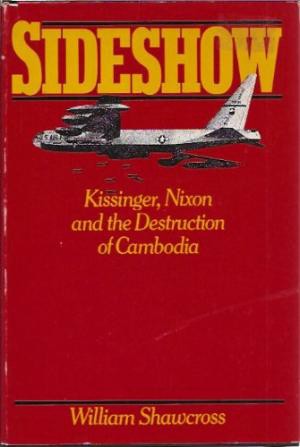
My Year in Re-Reading After 40: Sideshow by William Shawcross

Author Court Merrigan’s fortieth birthday led him to take the philosopher Seneca’s advice and spend a year re-reading books already in his possession. The books chosen contain some spark of brilliance, howsoever questionable, that have stuck with him throughout the years. The caveats: these are books he’s only read once, that he still owns (no Amazon!), and he can’t read any commentary about them before or after re-reading. How will they measure up? And should they?

BEFORE RE-READING:

No one much cares about Cambodia. Once, a section of its most famous monument was in the backdrop of an Angelina Jolie movie fifteen years ago, and there was that one other movie about fields of killing. But otherwise? Cambodia? What does anyone in America have to say about Cambodia? Nothing.

Mission accomplished, Henry Kissinger.
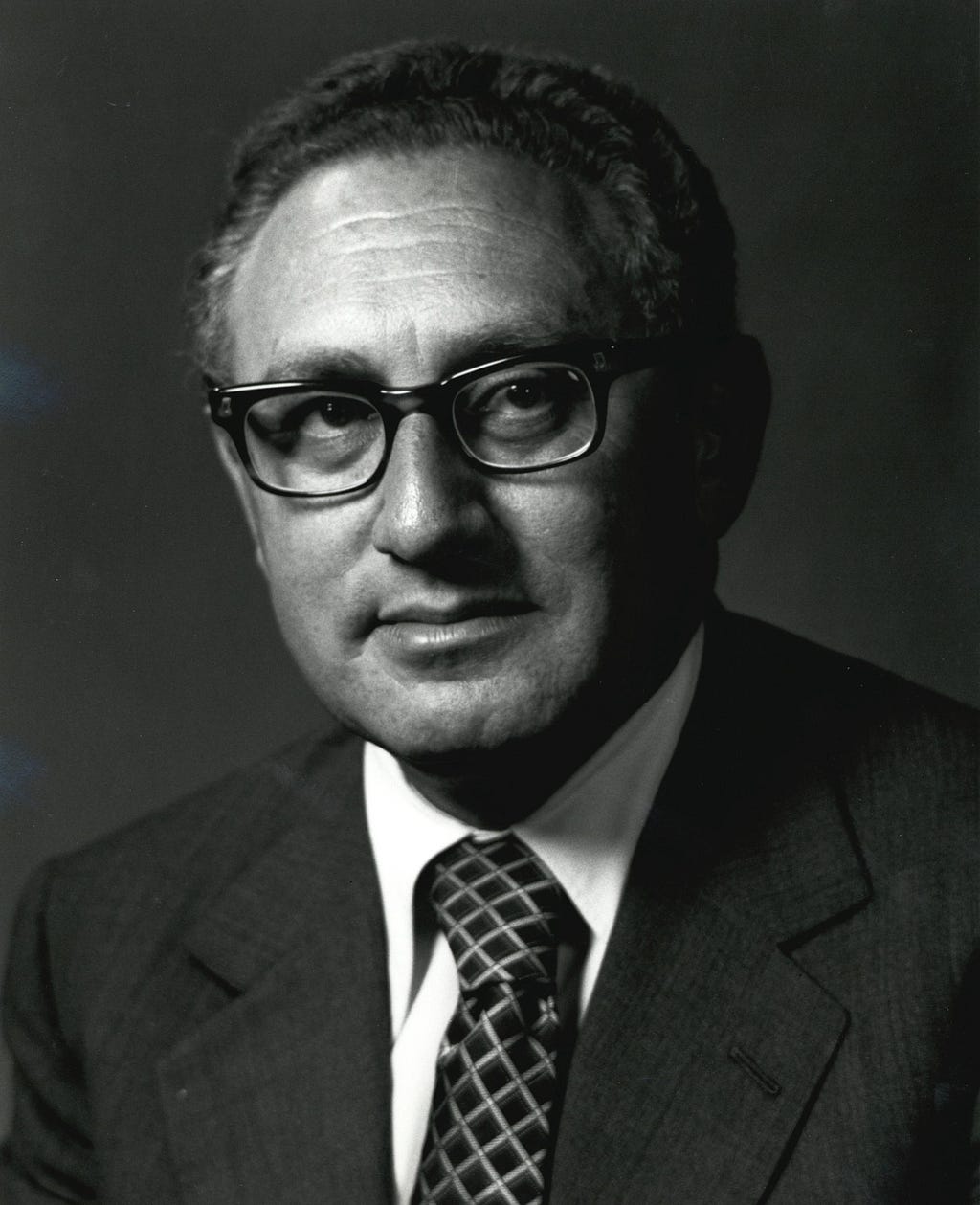
Look at that punchable, punchable face.

I first visited Cambodia in 1999. The place was something of a free-for-all for Western tourists back then. Piles of ganja littered the guesthouse tables, every moto-taxi driver asked if you wanted a boom-boom girl, a mango shake cost about ten cents, and there were no such things as fences or signs anywhere at Angkor Wat so you could literally climb the stairs to the sanctuary with your bottle of Angkor beer. Just don’t pay too much attention to the amputees in rags begging for change at the entrance: land-minevictims, we were told. We carried on, sweating tourists.

I got there before Angelina Jolie did.

A group of us took the river boat up the Tonle Sap from Phnom Penh to Siem Reap, the city outside Angkor Wat, watching the Cambodian countryside roll past thatched-hut villages and emerald rice paddies awash in tropical heat washing past. Back in Phnom Penh, we rode on the back of hired scooters across the red-dirt countryside, gorged on freshly-butchered chicken in the shadow of a temple that still bore the machine-gunned pockmarks of the Khmer Rouge’s hatred of Buddhism. A bit of real-life foreshadowing for the dark turn the trip was about to take.

Our scooter drivers took us to a nondescript-looking spot in the midst of the rice paddies a few miles outside Phnom Penh. I didn’t quite understand why we’d been brought there. Until we walked through a rusting gate inside to confront this:

That’s a small portion of the estimated 1.7 million (21% of the population) killed during the Khmer Rouge’s brutal regime. On a percentage basis, the Khmer Rouge genocide dwarfed that of Hitler, Stalin, or Mao. This pagoda of skulls stood as one small monument to the slaughter.

Sobered now, a good deal less the carefree Western tourists ogling Third World exotica from behind the shield of Western passports, our guides then took us to Tuol Sleng prison. Now a museum, this former elementary school served as the Khmer Rouge’s interrogation center where 17,000 men, women and children were tortured and killed.
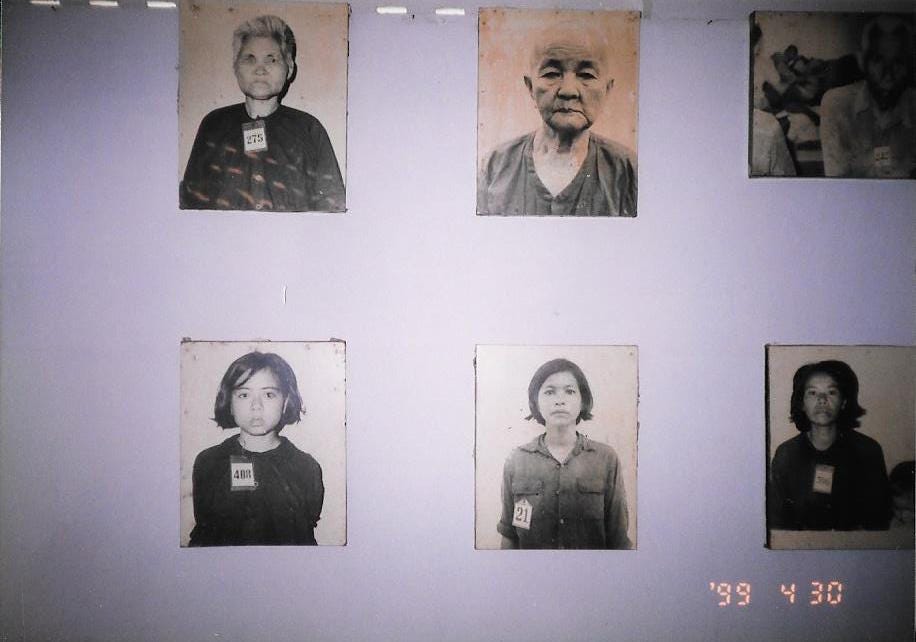
Victims young and old in Tuol Sleng prison.
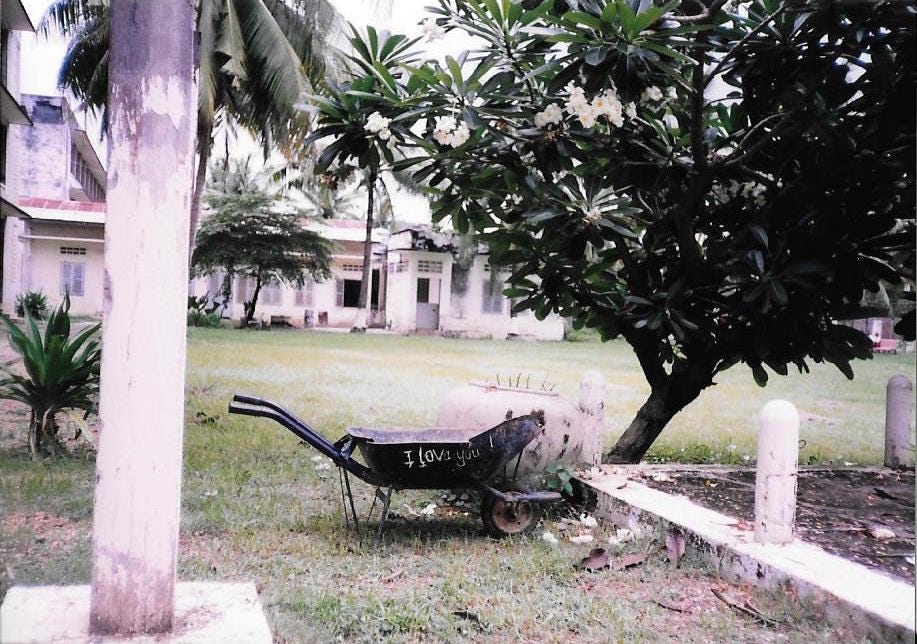
This wheelbarrow was inexplicably parked outside the prison that day — it says “I love you” on the side.

Which brings me to Sideshow. In those misty, AOL-internet days, you could buy bootlegged books in markets throughout Southeast Asia. I mean actual, physical books, poorly xeroxed on cheap paper and stapled together between a grainy manila cover. I found my original copy of Sideshow: Kissinger, Nixon, and the Destruction of Cambodia in one of those market stalls.

I can’t say that this copy of Sideshow was the definitive edition; whole chapters might have been missing. It also leads me to confess that I cheated on my own rules for this series, namely that I only re-read books I have in my actual possession. Somewhere along the line I lost that bootlegged copy. The copy I have now, though it bears the original 1979 copyright, came from Abe Books.

I recall devouring Sideshow in several large and shocking gulps. I had no idea. My God. My country — with the tacit approval of President Nixon and under the guidance of Henry Kissinger — made a very real attempt to bomb Cambodia to the Stone Age. For five years, as I recall, the US Air Force conducted an indiscriminate bombing campaign of the Cambodian countryside in an attempt to disrupt the North Vietnamese Army and the Viet Cong from conducting end-around attacks on South Vietnam. No one knows how many Cambodian civilians in the villages below were killed; hell, the US Air Force didn’t even have maps of the where the villages were.

I knew from history books about our firebombings of German cities in World War II and of course the nukes we dropped on Japan, but that was total war against implacable enemies. Cambodia was a neutral, non-belligerent nation that just happened to be next door to our dirty little war in Vietnam.

As I remember it, in the process of this bombing campaign, we managed to turn the populace against the Cambodian government, itself a US puppet, in favor of the rebel Khmer Rouge communists. When the US withdrew completely from Indochina in 1975, that puppet government collapsed, the Khmer Rouge took over, and four years later, 1.7 million people were dead. Did Henry Kissinger pull the triggers out on the killing fields? No. But he did create the conditions that allowed that genocidal regime to take over, and for that he is little better than a war criminal.

I returned to Cambodia this summer, 8-year old daughter in tow. The ruins of Angkor Wat remain wondrous, though economically speaking the country remains mired decades behind its neighbor to the west, Thailand. Perhaps this has something to do with the fact that the US didn’t secretly drop hundreds of thousands of tons of bombs on Thailand? Henry Kissinger’s legacy lives on in the dirt-poor villages whose inhabitants scrape out a subsistence from red-dirt rice paddies.

But of course it’s not that simple. Cambodia is wracked with endemic corruption, an autocratic government, and the fact that a mere 40 years ago its entire culture was razed to the ground by its own people, the fanatics of the Khmer Rouge. I know it can’t all be Kissinger’s fault. Right?

If there’s one thing I remember about Sideshow, it’s that it provides context. Lots and lots of context. It names the names, it gets the dates right, it has the maps. Trouble is, I don’t recall the specifics of that context. I think our memories of books like Sideshow — provocative, laying claim to truth — are important to re-evaluate. After all, years later, the details are forgotten. As with any book, what you take with you is the general impression. But over a course of years the details of the book transform into personal touchstones. Oversimplified, devoid of context.

For me, from Sideshow, I took the idea that Henry Kissinger is a war criminal, and that our dirty little war wrecked a once-beautiful and peaceful country. I wonder if these personal memes will stand up to a re-read. You shouldn’t go accusing someone of war crimes unless you’re awful sure those charges could stick.

AFTER READING:

If Sideshow is accurate — and given the exhaustive range of its research, there’s no reason to suppose it’s not — then that little touchstone I’ve been toting around all these years about Henry Kissinger being a war criminal is correct. Under the pretense of breaking up North Vietnamese supply lines, President Nixon authorized — and Henry Kissinger orchestrated — a massive secret bombing campaign of Cambodia, lying to Congress, the Pentagon, and the American people along the way.

Tough luck if you happened to live under any those red dots.

The bombing campaign culminated in a short-lived and doomed ground invasion of Cambodia itself in the early summer of 1970. Unnumbered Cambodian civilians were killed (no attempt was made to keep a tally) along with some Communists, American troops, and South Vietnamese soldiers. All these efforts failed as spectacularly as similar efforts in Vietnam. The Viet Cong and other Vietnamese troops simply retreated further into Cambodia, destabilizing that country, alienating the populace, and clearing the way for murderous Khmer Rouge cadres to emerge from the jungle when, inevitably, American troops retreated.

When Shawcross asked the deposed King of Cambodia, Sihanouk, about the lessons of recent history, the king said:

There are only two men responsible for the tragedy in Cambodia, Mr. Nixon and Dr. Kissinger. Lon Nol [Cambodian President, 1970–75] was nothing without them and the Khmer Rouge were nothing without Lon Nol. Mr. Nixon and Dr. Kissinger gave the Khmer Rouge involuntary aid because the people had to support the Communist patriots against Lon Nol. By expanding the war into Cambodia, Nixon and Kissinger killed a lot of Americans and many other people, they spent enormous sums of money — $4 billion ($17.8 billion in 2015 dollars) — and the results were the opposite of what they wanted. They demoralized America, they lost all of Indochina to the Communists, and they created the Khmer Rouge.

The king is himself deeply complicit in that tragedy — he allied himself with the Khmer Rouge in hopes of getting his throne back. Indeed, there is plenty of blame to go around. The puppet regime of Lon Nol was deeply corrupt and hopelessly incompetent at defending its own people; the Chinese shipped arms to the Khmer Rouge, as did the North Vietnamese; the Soviet Union supported chaos in Cambodia as an anti-American policy; the Khmer Rouge themselves were murderous ideologues. But the King is right: it all goes back to those two men, Kissinger and Nixon.

Nixon’s personality and history is, of course, well-known. Kissinger, once world-famous, occasionally surfaces from retirement for occasional op-eds and to be criticized by hopeless presidential candidates. These days, however, Kissinger is no longer a household name. Lucky for him, all things considered.

Most generously, you might consider Kissinger an intellectual “freak” and thus, in true intellectual fashion, incapable of understanding the actual world as it actually is, which led to his bloody blunders in Cambodia and elsewhere. Blunders such as:

The pilots of the 8th Tactical Fighter Wing actually complained that their maps “lacked sufficient detail and currency to pinpoint suspected enemy locations with some degree of confidence.” … [An embassy official] cut out, to scale, the “box” made by a B-52 strike and placed it on his own map. He found that virtually nowhere in central Cambodia could it be placed without “boxing” a village. “I began to get reports of wholesale carnage,” he says. “One night amass of peasants from a village near Saang went out on a funeral procession. They walked straight into a ‘box.’ Hundreds were slaughtered.”

More likely, it seems to me, Kissinger’s enormous ego and Trump-like penchant for self-aggrandizing rendered him indifferent to the consequences of his policies:

When asked about the exacting way he treated State Department officials, Kissinger once replied, “Why, Thomas Jefferson was a fine Secretary of State, and he had slaves.”

I, however, am prone to a more emotional response. This happens when you’ve gazed on a pagoda of skulls, sweltering under a washed-out tropical sky, or upon a bed frame where children considered enemies of the state were tortured to death. I do not think there is or ought to be forgiveness for the men who carried out such atrocities, no matter how strongly they believed in the pure truth of their creeds. Ought there be forgiveness for the man who created the conditions under which such atrocities were carried out from an office in the distant capital of a far-off superpower?

The end of the road for America’s Indochina policies.

Perhaps you are kinder than I am. Perhaps you think so. I’m not. I can’t.

Sideshow showcases the American political and military establishment at its nihilistic worst; lives destroyed, treasure wasted — and for what? What did we gain in Cambodia? What did anyone gain in Cambodia? Save a few years of blood-soaked power for the Khmer Rouge leadership — nothing. No one gained a goddamn thing.

And certainly the American establishment appears to have learned very little (nothing?) from the lessons of Cambodia. We’re still engaging in endless war (see: Terror, the Global War on) and the executive branch continues to flout the Constitution with its virtually unchecked power (see: Obama’s drones, Bush’s Guantanamo and black sites, Clinton’s cruise missiles). Meanwhile small countries and their people continue to suffer from the aggression of fanatics, powered by American weaponry and under conditions created by American geopolitical maneuvering (see: Afghanistan).

But it’s not the geopolitical fallout that got me most about Sideshow. For the most part, Shawcross stays laser-focused on the policies and the big figures. But sometimes he breaks from the political to the personal, and this the book at its most heartbreaking. Here he is on Khmer Rouge foot soldiers:

That summer’s war provides a lasting image of peasant boys and girls, clad in black, moving slowly through the mud, half-crazed with terror, as fighter bombers tore down at them by day, and night after night whole seas of 750-pound bombs smashed all around. Week after week they edged forward, forever digging in, forever clambering slippery road banks to assault government outposts, forever losing comrades and going on in thinner ranks through a landscape that would have seemed lunar had it not been under water.

Even amid the carnage and the corruption, there are moments of great courage and grace. Here is high government official and royal prince Sirik Matak refusing the American ambassador’s offer to join the airlift out of Phnom Penh as the Khmer Rouge closed in to conquer the city:

Dear Excellency and friend. I thank you very sincerely for your letter and for your offer to transport me towards freedom. I cannot, alas, leave in such a cowardly fashion.

As for you and in particular for your great country, I never believed for a moment that you would have this sentiment of abandoning a people which has chosen liberty. You have refused us your protection and we can do nothing about it. You leave and it is my wish that you and your country will find happiness under the sky.

But mark it well that, if I shall die here on the spot and in my country that I love, it is too bad because we all are born and must die one day, I have only committed this mistake of believing in you, the Americans.

Please accept, Excellency, my dear friend, my faithful and friendly sentiments. Sirik Matak.

America did abandon Cambodia. The prince was later executed by the Khmer Rouge.

And yet, for all the death and destruction, Sideshow throws out rays of hope in spite of itself. When the book was published in 1979, it must have very much seemed like Cambodia was destroyed. It was not.

I can report that thankfully, and despite Henry Kissinger’s best efforts, Cambodia still stands. The slice of Cambodia we saw this summer is booming. Thriving, even. Millions of tourists visit Angkor Wat every year and there are shiny buildings everywhere. True, it’s no paradise. There is still a great deal of grinding poverty, and the political system is rife with corruption and violence. While my daughter and I supped at a restaurant in Siem Reap with waiters and cooks and tour guides at our beck and call, we saw saw street kids , no older than her, huffing gasoline out of plastic sacks and begging for money at the tables. We spent some time talking about what a wonderful job she did choosing her parents.

We also met a remarkable man. Stephane de Greef, aka the Bug Man, has spent 13 years in Cambodia. A forest engineer from Belgium, he originally came to Cambodia to assist in de-mining efforts (another legacy of the Khmer Rouge). He’s also a cartographer, and has been heavily involved in efforts to map newly-discovered sections of the ancient city of Angkor. But de Greef’s true passion is insects. As is my daughter’s — the two were simpatico from the first minute they met.

In the Cambodian forest de Greef has discovered insect species wholly new to science, and documented dozens and dozens more. That is, when he’s not busy flying drones over that same forest, chasing down new ruins. The Guardian rates him as one of the Top 10 tour guides in the world, and I can report from the day my daughter and I spent with him, he lives up to the billing. He is a walking treasure house of knowledge on Cambodian flora, fauna, history and culture.

I mention de Greef because it’s pretty remarkable that a country that not 40 years ago was being ravaged by genocidal ideologues can now host a scientist, who in turn can lead an 8-year old into the forest to explore for insects utterly without fear. I’d like to think someday my daughter will be able to take children of her own into the mountains of Afghanistan. And more to the point, that the Afghan people, like the Khmer people before them, will be prospering despite the ravages of the past.
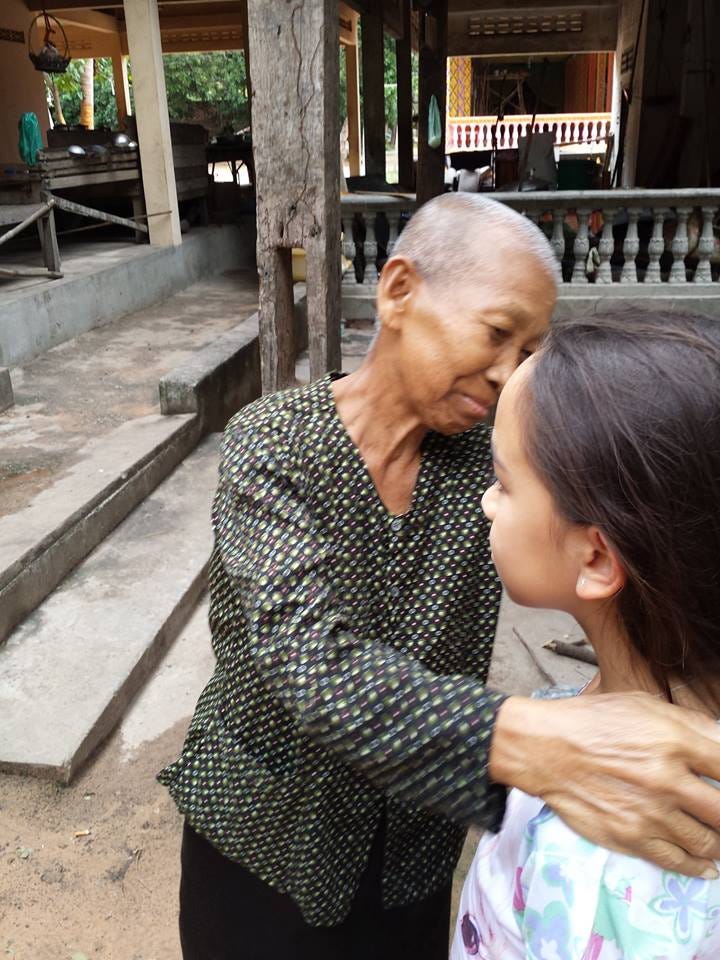
This old woman gave Ada an impromptu blessing.

I suppose such a view is hopelessly starry-eyed and naïve, and perhaps tinged with neo-colonialism (“I want these exotic places to be pretty and neat so my kids can visit!”). I’ll own both of those critiques; I do want the wonderful places of the world to be peaceful and prosperous enough for my children’s children to visit. And ultimately, I do have faith in humanity’s ability to weather the worst of what we can do to ourselves.

The alternative, it seems to me, is to let the Henry Kissingers of the world rule the world, spouting grandiose plans and raining down bombs. I decline to let such men go unchallenged. I choose to believe in a better world that can emerge from the wreckage they create.

My daughter, in Cambodia, 2016.

DOG-EAR REPORT:

Kissinger on his role in Cambodia:

“I may have a lack of imagination, but I fail to see the moral issue involved.”

Yes, Henry. You lack imagination. And a good deal more.

Sound familiar?

The invasion not only was disastrous for Cambodia, but it also had serious long-term effects on Vietnamization and on the nature of the Nixon administration itself. The way in which it was conducted broke rules of good policymaking, ignored vital intelligence, and disregarded political realities. Congress, to whom the Constitution assigns the power to declare war, was totally ignored. So was almost everyone else.

Republican Congressman Pete McCloskey after a tour of Cambodia shortly before it fell to the Khmer Rouge:

I can only tell you my emotional reaction, getting into that country. If I could have found the military or State Department leader who has been the architect of this policy, my instinct would be to string him up. Why they are there and what they have done to the country is greater evil than we have done to any other country in the world, and wholly without reason.

Next: A retreat to the pastoral.

Imagine Daniel Johnston Beating Your Ass with a Lead Pipe

Over-glorifying creative genius is dangerous. Virginia Woolf, Sylvia Plath, and Ernest Hemingway all killed themselves. Mark Rothko cut his wrists open, and Vincent van Gogh shot himself in a wheat field. Elliot Smith stabbed himself in the chest, Nick Drake overdosed on antidepressants in his childhood bedroom, and Kurt Cobain, well — maybe these particulars are overly morbid.

When it comes to creation, beauty and terror tend to go hand-in-hand — not just in the tension in the work, but typically in the lives of the artists themselves.

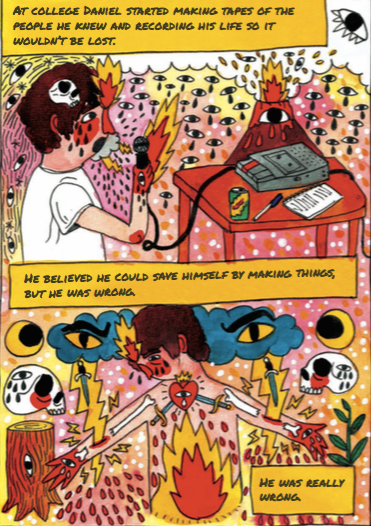
Songwriter Daniel Johnston tragically embodies the artistic relationship between the light and the dark. “Daniel had bi-polar disorder,” Scott McClanahan writes in The Incantations of Daniel Johnston (the new graphic novel illustrated by Ricardo Cavolo). “Sometimes it’s heaven, and sometimes it’s hell. And sometimes you don’t even know.”

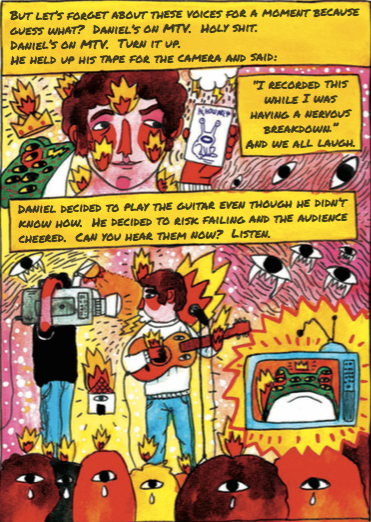
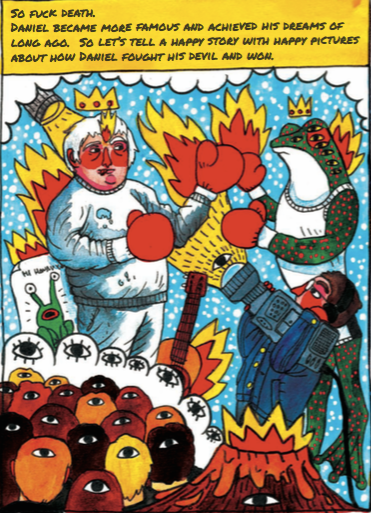
In the novel, Cavolo animates his paintings with madness — tears of fire, eight-eyed frogs and devils, superheroes and Caspar the Ghost. Almost every page in the novel blazes with flames, conveying the thrilling energy of Johnston’s impulses, as well as their danger. Johnston wrote and performed songs that were frightening in their level of tenderness — in their simultaneously amateurish quality, and their unprecedented brand of naive genius.

In The Incantations of Daniel Johnston, McClanahan describes how Johnston performed a 15-minute set at South by Southwest, “cast his spell,” and became the most famous McDonald’s employee in Austin. Getting on MTV was Johnston’s lifelong dream, and he even achieved that.

But as McClanahan writes, “Lay not up your treasures in MTV. I repeat. Lay not up your treasures in MTV. The things we hope and pray and wish for sometimes… Destroy us. Dreams are dangerous things.” Johnston went to New York City, and was arrested for painting a Jesus Fish on the Statue of Liberty. He was kicked out of CBGB for talking too much about God and devils. He stopped taking his medication, and started taking LSD. One night, he assaulted his manager with a lead pipe. “If you think this story is a cute mixture of mental illness and art,” writes McClanahan, “then imagine Daniel beating your ass with a lead pipe.”

Among other brilliant and tragic elements of The Incantations of Daniel Johnston, McClanahan and Cavolo inspect what we — as an audience — do to an artist like Johnston with our fascination. Is there just sincere appreciation in our attention, or is there also something exploitative? On MTV, Johnston held his tape up for the camera and said, “I recorded this while I was having a nervous breakdown,” and everybody laughed. There seems to be good and bad, light and dark, in the attention we pay to an artist like Johnston. Like the relationship great artists have toward their work, it’s complicated.

McClanahan writes, “Daniel found out that half of all people with his condition will attempt suicide and half of those will succeed.” McClanahan is referring to bi-polar disorder, not Johnston’s role as a creative genius, but the two share dangerous things in common. Both feature such bright light, and such profound darkness. “Daniel knew only this,” McClanahan writes, “If you do not bring forth what is within you, what you do not bring forth will destroy you.” Unlike some of his creative forefathers, Daniel Johnston — at 55-years-old — is still alive, and still singing. For the sake artists and audiences everywhere, let’s hope he makes it safely to his natural end.

Uncommon Creatures: Selected Letters to Tatiana

09/14/13
Pohang, South Korea

Dear Tatiana,

You asked what it’s like here? It’s like clawing my way toward being happy for maybe the first time. But perhaps you meant what is Korea like, not what are your deep-seated psychological issues like?

If so:

Korea is a hundred places at once. Our little neighborhood is a mix of the brand new and very old. We had dinner tonight in a restaurant I can only describe as ramshackle. It was obviously constructed as a small, shed-like structure and then expanded over time. Imagine a building of brick and drywall and concrete and wood beams and corrugated metal. The food was pretty good. A block away is the posh (I’m not being sarcastic) Dunkin’ Donuts where I had coffee this morning.

There are mountains everywhere. There are tiny villages and sprawling cities. Sometimes people realize we don’t speak Korean and speak to us more vehemently, like something will click in our minds and we’ll suddenly be able to understand. I’ve had the strange experience of reliving what it was like before I could read. I see words everywhere that carry no meaning. They are pictures, decorative.

Friends hold hands in the street. Yesterday I saw three men in their sixties linked together. And yet there are many topics that are considered impolite to discuss. It’s a place of opposites, I guess.

I like opposites because I think that’s what people are made of,

Caitlyn

06/18/14
Greenbackville, Virginia

Dear Tatiana,

Since getting back from Korea, I work Wednesday to Sunday and my days off are Monday and Tuesday. Sunday night, covered in grime from the garden center I’m managing, I drive to Derek’s mom’s house to spend my faux weekends with him. I listen to a local country station during the hour-long drive. The deejay has a Diane Rehm quality to his voice and often seems baffled by the equipment he uses to broadcast. Sometimes he restarts songs after about thirty seconds to interject corrections to his previous statements: “We are not broadcasting live on 97.5.” Once he shifted gears for ten minutes to play only theme songs to old television shows. After each theme song he gave a short, priceless synopsis of the show: “That was the theme song to the Rockford Files. The Rockford Files takes place in modern day.” Once he started playing one song on top of a different song like a drug-crazed rave deejay. And of course, he plays classic country songs. “That was ‘I Wish I Was a Teddy Bear,’ specially requested for Kathy. It’s her favorite song.” I have questions about this. Has Kathy heard any other songs in her lifetime? Does she collect dolls? She collects dolls.

It’s local election season, so I see a lot of signs endorsing candidates in people’s yards. Beau Oglesby is running for State’s Attorney. Dale Smack is running for Orphans’ Court Judge. It’s so rural where I live that everyone’s names sound like they’re a villain tying some poor girl to a train track.

Derek and I gallivant around and kayak and cabin camp and take long walks and fight and have sex. It’s a pretty good life.

Work is work, but I’m learning a lot and only one-third of our employees have quit since I started in March,

Caitlyn

10/31/14
Salisbury, Maryland

Dear Tatiana,

Hearing from you made my day. And yes, I’m living my dream — writing for a little money, living closer to Derek. If there’s one thing I deplore, it’s getting what I want.

Also this week:

– My mom had surgery

– My sister’s work project — a space rocket — exploded

– I developed a cluster of zits on my neck that I put a Band-Aid over. Then, when I took it off, I had a bunch of sticky stuff in the shape of a Band-Aid that turned black and looked worse than the zit cluster.

Has any of this ever happened to you?,

Caitlyn

11/10/14
Salisbury, Maryland

Dear Tatiana,

I’m sitting alone in a darkened room eating Greek yogurt (strawberry banana). I’m lonely and want to call you but prefer imagining you out doing something glamorous, wearing that shiny shell purse you like. You are unavailable to take my call.

If you were around, I’d tell you about what I saw on my run today. It’s fall so every other family has exterminated their existing lawn to start over; they believe they’ll finally achieve perfection this year. The next-door neighbors hired a team of people who worked tirelessly to coax up tiny tufts of fescue. The result is a lawn electric. It’s an ocean of green, green grass. It’s so close to a crayon color that it gives my body a weird feeling when I look at it.

Derek and I are house- and cat- and dog-sitting for his mom and stepdad. Yesterday a lost dog came to the house. It felt like that horrible scene in Fantasia. I had visions of the animals in our care multiplying in perpetuity. The lost dog had a tag with his owner’s phone number and his name: DOG. Dog spent the night in the garage. He just about clawed the shit out of me when I went to check on him this morning. His owner picked him up at 7:30 a.m. His owner also owns the orchard up the street. He expressed remorse.

Meanwhile, the cats have been (in Derek’s words) “stress vomiting” quite a bit,

Caitlyn

02/05/15
Salisbury, Maryland

Dear Tatiana,

I was just thinking about what we’d be doing if you were here and decided I’d take you to the zoo. Not because it’s “one of the best small zoos in the country,” but because they have two capybaras with glorious overbites. Derek and I go to see them a lot. He wistfully calls them majestic, and we linger by their enclosure, give all of the other animals a cursory glance, and finish by checking back in with the capybaras. Sometimes they aren’t in full view, and I consider that to be a wasted zoo trip.

This is the same zoo that used to house an emotionally disturbed brown bear. The sign on his pen read, in part:

ODD BEAR BEHAVIOR

What’s this bear doing?

You may notice our male spectacled bear behaving “unbearably.”

This bear has some habits we’re trying to understand better. Sometimes the bear may look like he’s hurting himself, but don’t worry — our zookeepers are keeping a close eye on him. They are trying different ways to change some of his behaviors.

I know this from a photograph I just transcribed — one I’m glad I took. It seems like they have successfully rehabilitated the bear, and the sign is no longer posted. Great for the bear, sad for me because that was probably my favorite Salisbury landmark.

Also, the flamingos are deafening,

Caitlyn

08/14/15
Guanajuato, Mexico

Dear Tatiana,

The ice cream here is not good. I don’t know enough food words to describe it, though I’m not sure I want to learn more. It disturbs me when people say “umami” with a mixture of reverence and pride. I think Mexican ice cream is a mixture of natural flavors and disappointment.

I just finished reading a new book that taught me a lot of new words unrelated to food. I’m carrying them in my pockets like marbles.

How are you? I read the story you sent while I was rushing through my tea, which I spilled the majority of because I snatched the mug out of the microwave so that I could chug the tea while it was still very hot. And when I spilled it, I was angry because it did not burn my hand, and was thus not hot enough. That’s a true story. Nonetheless, I’m lucky to have this time to read and write while Derek studies Spanish. I guess I’m also lucky for the unscalded skin I’m sporting.

Sometimes I wish I could trade lives with you anyway because you seem to have it all figured out.

If this is an illusion, please do not shatter it,

Caitlyn

12/09/15
Salisbury, Maryland

Dear Tatiana,

The self-harming bear at our zoo has died. He fathered a daughter bear, which is a huge deal because spectacled bears are endangered and rarely born in captivity, and because he was 24 years old (600 in dog years if my conversion is correct). But here’s the other thing about bears: they aren’t good fathers. They get jealous and try to kill their babies. So the dad bear had to spend what turned out to be his final months in quarantine. He never got to meet Alba. She’s cute and playful and likes to eat carrots and tear the bark off of trees. Derek and I went to the zoo last week (one of the first visits of our marriage) and had yet another mystical capybara experience.

Capybaras communicate with longing looks (as do I),

Caitlyn

President Obama’s Summer Reading List

Earlier today, the latest Obama family dispatch dropped out of Martha’s Vineyard, and we learned what the POTUS is reading on summer vacation.

You know these books. You love these books. You and the President are basically halfway to sipping cheap chardonnay and dishing on plot twists.

Here’s the agenda for your fantasy book club with the coolest man on earth:

1. Barbarian Days: A Surfing Life by William Finnegan

He was born in Hawaii, after all.

2. The Underground Railroad by Colson Whitehead

Shaping up to be the year’s most important book.

3. H is for Hawk by Helen Macdonald

Because grief and birds of prey are universal passions.

4. The Girl on the Train by Paula Hawkins

We are all obligated to read/buy this one. There’s a law somewhere.

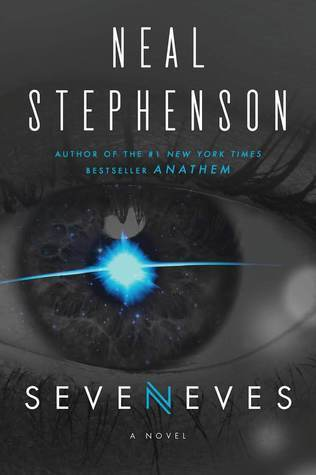
5. Seveneves by Neal Stephenson

It might be frightening to dwell for long on the reasons why…

In the Reflection That Is You, No One Is Looking Back but You

In Christian Kiefer’s novella One Day Soon Time Will Have No Place Left to Hide, Frank Poole is building a subdivision in the Nevada desert. It is to be entirely devoid of color and inhabited by no one. It will have its insides filmed from many angles and will last forever. Frank can do this because he is a famous installation artist; someone has given him the resources to do so. It would be a thing both disturbing and wonderful to behold, this white behemoth. For Frank, it is the antidote to a disintegrated childhood. I imagine the Artic, but manmade and without the need for fancy subzero clothing. Either way, it is fantastical and must be viewed from afar.

“Perhaps from the early years of suburbia, but nonetheless of a design we recognize. White roof tiles. White stucco walls. White doors. Through the window … white interiors … white sofas. The televisions are not yet powered, but they will be tuned to white static. … It is like a landscape constructed entirely of powder.”

Frank’s wife, Caitlin, has given up her own art career to handle Frank. A familiar scenario (see: Jackson Pollack and Lee Radzwill, Paul and Jane Bowles, Robert Smithson and Nancy Holt). Caitlin and Frank’s relationship is — sadly or not — timeless, and as such, worthy of investigation. Like Frank’s project, they are very much of the conceptual art world: inward, cerebral, and prone to melancholy. Just as there have been countless retellings of the tension between father and son, children with absent mothers (thank you, German fairytales), and the drab-but-brilliant and therefore misunderstood daughter, the couple’s unequal dynamic feels familiar. Kiefer rescues the duo from trope hell by his method of presentation (more on that in a moment). He writes a couple the reader can recognize, maybe even have a working familiarity with. In this way there can be anchor against all of the elements of the story that are so brilliantly askew.

The story unfolds with a plural, distant omniscience. Soon enough, the reader finds they’re looking at the text of a documentary. Not a script per se, but rather, One Day Soon Time Will Have No Place Left to Hide reads as if a transcription of the narration and dialog from rough video footage, adding in bone-bare scene descriptions. Kiefer has the reader form their version of the installation based on the text that purports to be the raw material for another art form, one which is inherently biased (regardless of what documentarians say). This mode is curious indeed, but also makes sense, in the way that many successful oversized conceptual works do. In many cases, we do not experience works of art in their original mode, but rather, through their documentation: a video of a performance piece, images of an earthworks, or residue of process art. At best, the craft of the thing falls away (it must), revealing the idea itself. The force of the work comes from the viewer’s response to what the piece or the performance might have been like, which to me, sounds like the experience of reading. As with most formally-inventive works, you can think about it until your head splits, or you can hop aboard and see what happens.

Meanwhile, Caitlin is pregnant. Frank is drinking again. To top it off, the contractors on the project think he’s a madman. Real-world problems, like money, the skankiness of cheap casino hotels, and frantic phone calls from the mother-in-law ground this otherwise heady book. Kiefer’s attention to detail tamps down the lives of the “subjects” of the documentary. In somehow proving the “reality” of these lives, the massive installation (which feels impossible, even within the fictional world) becomes totally doable. If Caitlin and Frank are eating eggs from the buffet at the Lucky Hotel Casino, then yes, a pristine, chalk-white development will soon arise from the desert.

The project itself refers to voids in Frank’s history, which the documentarian/narrator offers up in fragments. The viewer/reader is directed towards cracking open ideas of home, while for Frank, the project might provide catharsis. Caitlin and the contractors just want it to be over.

Occasionally, the narration takes a fourth wall-style flip. It was at these moments that I felt the least convinced of the documentary mode, despite the fact that a number of documentaries do exactly this. I felt most aware of my position as a person with a certain amount of experience in the art world, and slightly less in the literary one, assessing something that is meta both of them.

“Frank sips a martini awkwardly, nodding as a woman he will never remember tells him stories he does not care about.

Can we go now? he says.

He turns to look at you now, right through time and memory and into your eyes.

Can we just go home?”

Frank and Caitlin hole up in a crummy hotel to work, living like nomads, tooling around the Nevada casino wastelands. The concept behind this book, both its form as well as the art projects it contains, are so innovative that it could be possible to overlook the writing, which is quite lovely. Kiefer is adept at noticing and describing, qualities integral to the visual arts.

“Winnemucca, Nevada is part of this same landscape: a scattering of houses and steel- roofed buildings and fast food restaurants flung upon a flat tableland between the high treeless mountains of the Santa Rosa Range and the Sonoma. It is a place perpetually howling with wind, the force of which sweeps down through the passes and across the yellow-tipped sagebrush that manages to hold, at the base of each plant, a small hillock of black dirt.”

While Frank may claim that his project is about home, I would argue that the book is also about intervention and the impossibility of control. Snippets of Frank’s youth appear throughout the text. Psychotropic, poetic and very slippery, they are the opposite of Frank’s work.

“And there is water. So much water pouring across the floor in streams now, in rivers, spraying through the cracked glass of the windows. The sofa adrift. The chairs toppling into the swirl. … You would reach into that current to grab hold of them — a shirt, a hank of hair, perhaps a thing pale wrist — but there is nothing to hold in that swirl, nothing but water, loose bits of trash, scraps of sodden newsprint. Your hand would curl around such things nonetheless.”

This book is the opposite of a graphic novel, which pairs images with text to form the motion and shape of the story. It’s more like a drone camera with a keyboard. Or, maybe a TTD machine manned by Werner Herzog, who is taking transcription from Yoko Ono. Or, Bob Ross painting John Cage’s 4’33” using only white. Frank glances up at you briefly, his eyes flickering across the lens, a gesture so fast you do not know if you have seen it at all.

What if this book, besides being a story, is a conceptual artwork, that just happens to be made of words? Think about it.

Ted Wilson Reviews the World: The 2016 Olympics

★★★☆☆ (3 out of 5)

Hello, and welcome to my week-by-week review of the world. Today I am reviewing the 2016 Olympics.

Every so often the world’s most obsessive athletes come together to see who is the best. This is called the Olympics.

Personally, I’m not that impressed. I can do everything an Olympic athlete can do, but I just can’t do it as well. If you film me swimming or running or whatever and then speed the film up, it will look just the same. The only real difference is it will look more impressive because of my advanced years.

But that brings up a good point: There are no senior citizens at the Olympics this year. I’m pretty sure I saw some last time. I’m not unrealistic. I don’t expect to have an 80-year-old competing against Michael Phelps — someone in their eighties would have way more experience than him. It’s like how in baseball women aren’t allowed because they aren’t as good as men. To make competitions fair, people need to be separated by age, gender, and probably socio-economic circumstance.

If the Olympians stopped being so competitive and played for fun instead of to win, the Olympics would be a lot nicer and less stressful. Anyone could join in.

As it stands today, a lot of people are going to go home when these games are over without having won anything at all. What a disaster that’s going to be. I try not to think about it. I know what it’s like to work really hard for something, day in and day out, and to still not win.

That’s what happened with my hair. I’d been combing my hair for several hours a day for years, trying to keep it smooth and silky, devoid of tangles and bugs. But all the combing irritated my scalp and caused a lot of bleeding which turned to scabs and only attracted bugs. There was no way to avoid hair loss under conditions like those.

One of my favorite Olympians this year is 20-year-old Chinese swimmer Fu Yuanhui. She’s a goofy kid having the time of her life and isn’t afraid to show it. I wish more people were like her — genuine, happy, hardworking people who would devote their lives to a pursuit strictly for my entertainment.

Whichever country wins the Olympics this year, I hope it serves as a lesson to all the other countries that some are simply better than others.

BEST FEATURE: The Olympics appear to always be on. It doesn’t matter when, just turn on your TV and there it is.
WORST FEATURE: I saw one athlete win a bronze medal and when they placed it around her neck I could see how badly she wanted the gold. She was probably wishing it was a noose they were slipping around her neck.

Please join me next week when I’ll be reviewing a noose.

Midweek Links: Literary Links from Around the Web (August 11th)

Science fiction writers predict the future of the Olympics (spoiler: cyborgs)

Science says book readers live longer lives than their non-book reading friends

Why diversity in publishing means more than just writers

Does the popularity of Stranger Things mean we don’t want original stories?

Speaking of Stranger Things, here are some great books to read if you did like the show

Is J.K. Rowling killing her own franchise?

The Guardian picks 10 books every writer should read

The best fantasy books that you won’t find in the fantasy section

Do we read books for the plots or the characters?

10 writers who did what you wish you could do: quit their day job

Nonsense, Cartoons, and My Post-Soviet Adolescence

The hero of the first book I ever read on my own, Dr. Aybolit (literally translated, “Dr. Damn it hurts!”), was a straightforward figure who could cure everyone and everything. It didn’t happen to matter if you were a crocodile or a bandit, his remedies — which sometimes tasted like chocolate, other times like Leningrad spice cakes — would nurse you back to your feet in no time. I still attribute my present-day iron persistence to the effect of Dr. Aybolit on my early stages of development. As it is with anyone, the stories and images of my childhood came to form the foundations of how I assumed things must be.

I was a rather smart little girl once. According to one folk theory my intelligence came as a result of my rebelliously curly hair, which resembled an explosion beneath a pasta factory. As an adult I straighten my hair ruthlessly, which probably accounts for my somewhat lowered IQ. The fact is, the type of theories I prefer these days have little to do with logical relational connections, and much more to do with nonsense. I instruct my friends about the effect of moon phases on the rates of petty crimes. I blow smoke into their pensive faces, declaring that only people statistically likely to die from lung cancer are inclined to actually start smoking, and so they have little to worry about. I routinely mock my economist friends’ first premise about humanity, which is that people are essentially rational. It’s a wonder that I have any comrades left.

But how did this come to be, you might ask? I certainly do. What would cause me to abandon a childhood of storybook sense, to champion instead the anarchism of absurdity and nonsense?

I was not only a smart, rational little girl once, but cultured too. When my mom took me to see a play concerning the adventures of a worldly lion, who eventually returns home by the time the velvet curtains fall, I summarized it for her afterwards with a single, pithy line: “Only by leaving home can you find out where it is.”

Perfectly logical. Of course, I was accustomed by then to the idea that the point of stories was to teach me how to be. Take for instance this tale, of an unhygienic little boy who is punished by what else but an enormous sink come alive:

Phantasmagoric as the situation might be, the moral itself is perfectly clear, and naturally involves a good deal of soap. As a voracious cartoon junkie in the early 90s — just as Soviet animation was ironically coming into wider consumption, with the growing availability of televisions now that the Soviet era had ended — I became, without knowing it, a five-year-old critic of Russian Formalism, a school of literary thought that looked on works of art as independent of their cultural or historical background. Had I possessed the vocabulary back then it’s possible that I might have joined Trotsky in advocating for the contextualization of social and psychological reality in cartoon form. Which is to say that all my favorite animated films at the time were rooted in sobering and unglamorous reality:

Apparently, my favorite childhood cartoon involved a manic, suicidal chain-smoking screenwriter; a pill-abusing film director; endless bureaucratic delays; the most obnoxious girl actress in the animated world; and a finale in which the entire crew weeps over their reward, a scrawny and unsightly bouquet. Once again the intended message is clear: filmmaking, as with much else in life, is a great deal of hard work in return for the superficial prize of fleeting applause––the real value lies in the work itself. In other words: do the work, but don’t seek prizes.

This was hardly the only moral lesson to be found in Soviet cartoons. Here is little Antoshka, whose adamant refusal to join with the other child laborers as they dig for potatoes predictably results in feelings of starvation and regret:

Or the lazy blonde-haired student and his cat, magically transferred to the Country of Unlearnt Lessons, where he comes to learn the value of work:

Or perhaps this hippopotamus, who in preferring not to get properly vaccinated ends up with jaundice:

Or, on a marginally brighter note, a domesticated feline and a hunting dog from Prostokvashino, who mutually learn the value of sacrifice and friendship after sharing a household:

Obedient to the dogma, I believed myself to be a model elementary school kid, sharing crayons with those friends of mine in possession of less notable crayon collections. My perspective radically changed on the day that my grandfather, a natural contrarian––anti-USSR during the time of the union and pro-USSR after it fell — fatefully told me to turn off the television. In its absence I discovered Alice in Wonderland.

My grandmother’s room had always been, for me, a passage to strange realms. Dimly illuminated and with a distinct smell of perfume gone bad, it allowed me to imagine, when I wrapped myself up in her enchanting shawls, that I was a Parisian dancer, or a goddess of various different seasons. On that particular day it was a book on her nightstand, rather than a piece of ancient jewelry, which produced a transportive effect. When I finally emerged from binge-reading Lewis Carroll’s story it was as if no time had passed. What weighed on me after––what inscribed itself into me and made that book my favorite from then on––was how drastically different the tale was from what I regularly encountered in the Soviet cartoons. Unlike with their insistence on rationalism and logic, the confusion of my looming adolescence made much more sense alongside the book’s thrilling absurdism.

Alice in Guantánamo: Reading Carroll in the Gitmo Age

According to my parents, in the world they had grown up in––the world reflected in the cartoons––there was little room for uncertainty or anxiety. Almost everyone was employed and everyone had enough money (although if anything was lacking it was having sufficient ways to spend it). Women hardly gave a thought to their careers, encouraged to find more meaning in family. Everyone respected collared workers and professors, and looked down on those who made their living importing, reselling, or representing products. The “hustlers”––those who somehow else got by (scornfully called “speculators”)––were figures of especially low regard.

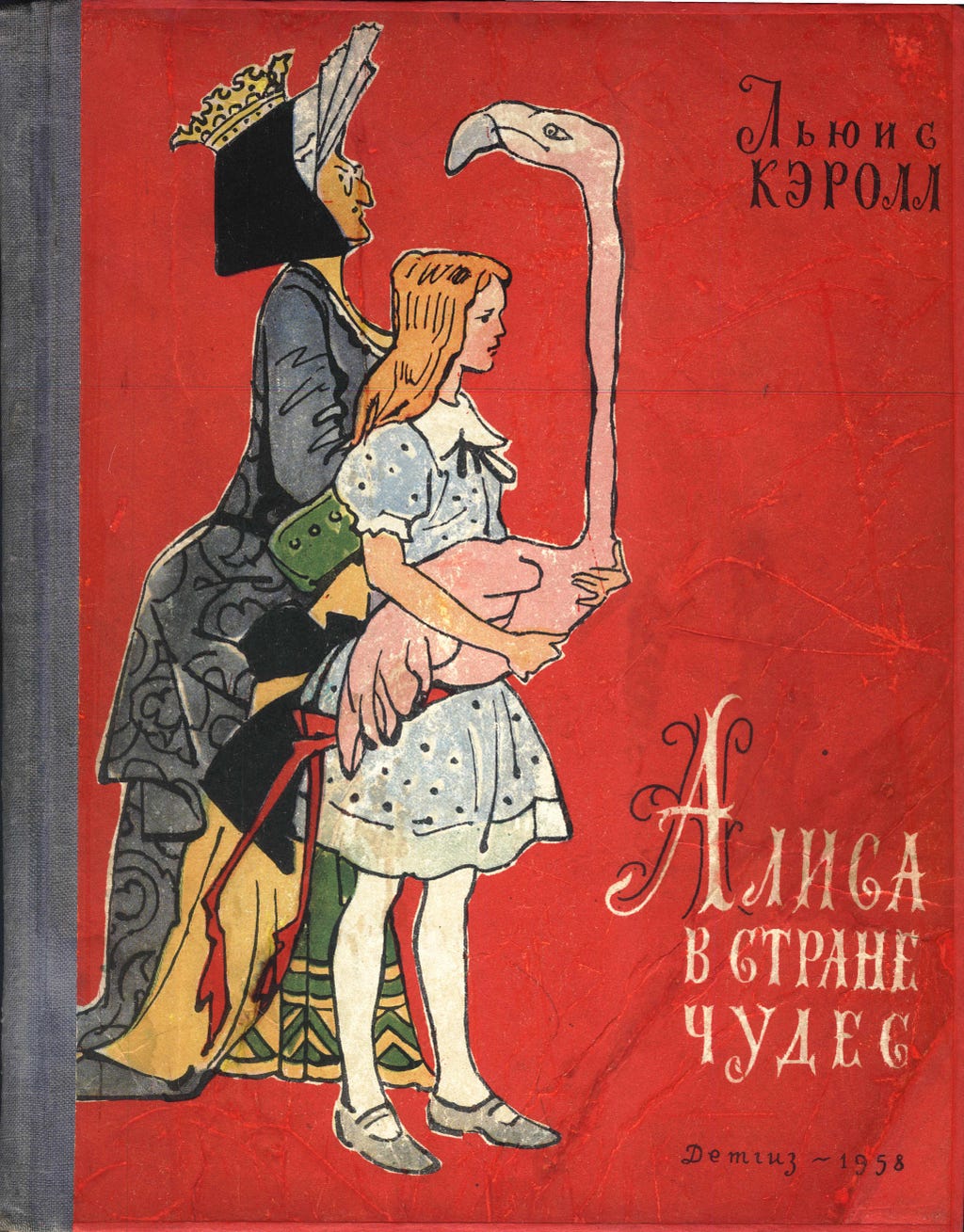
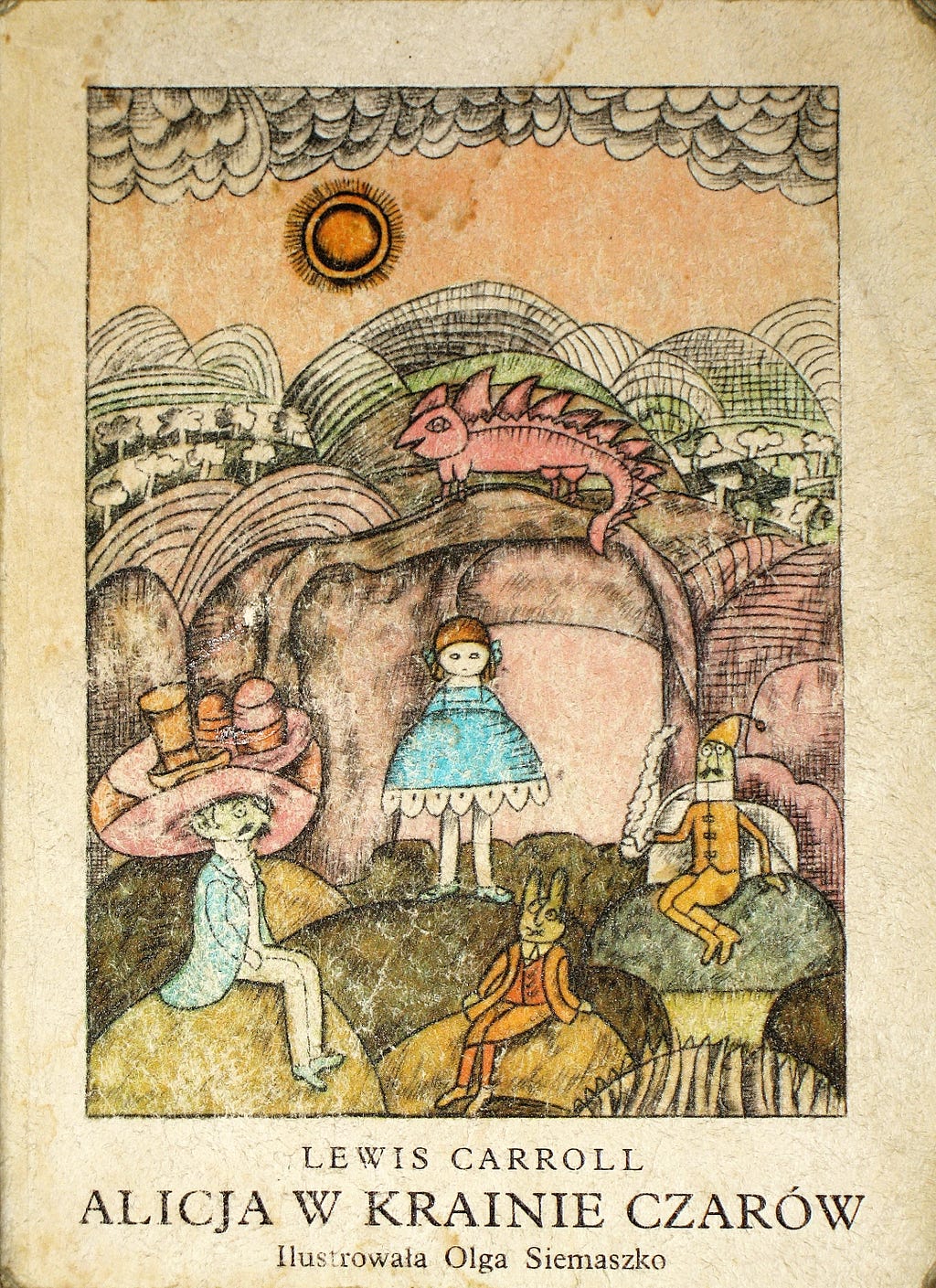
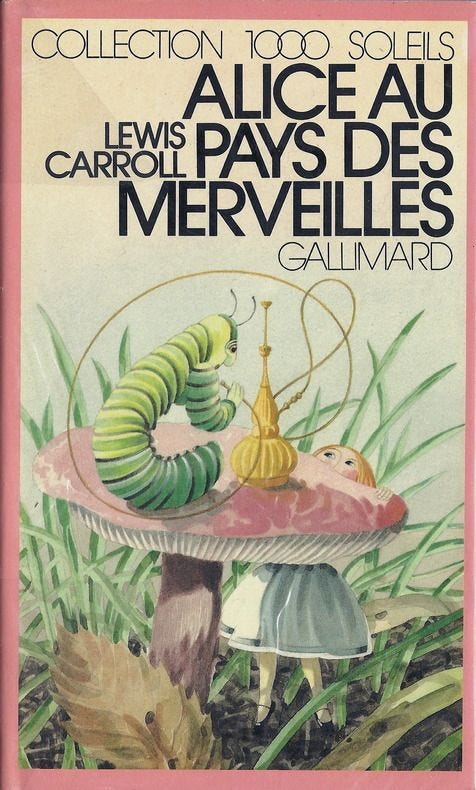
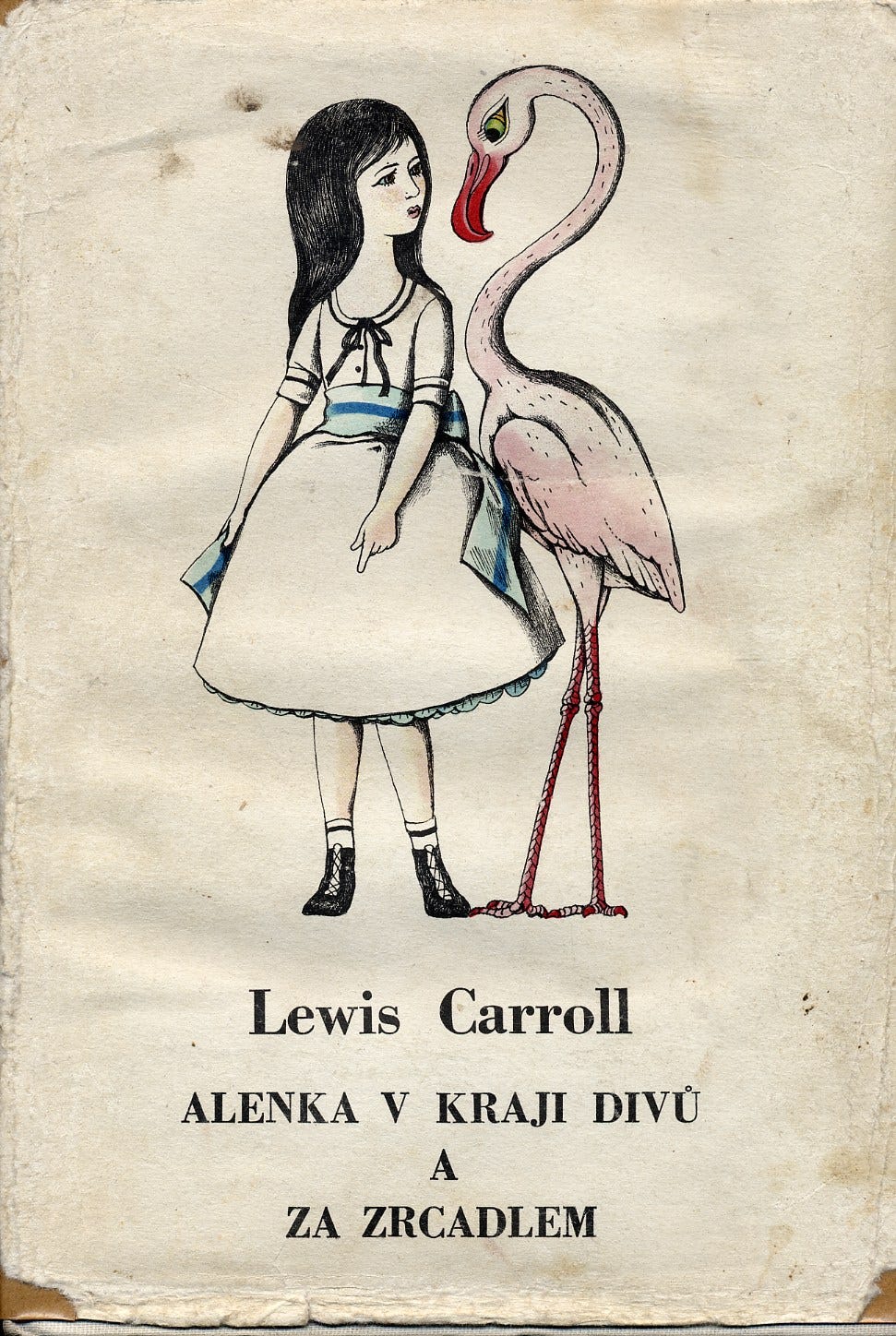
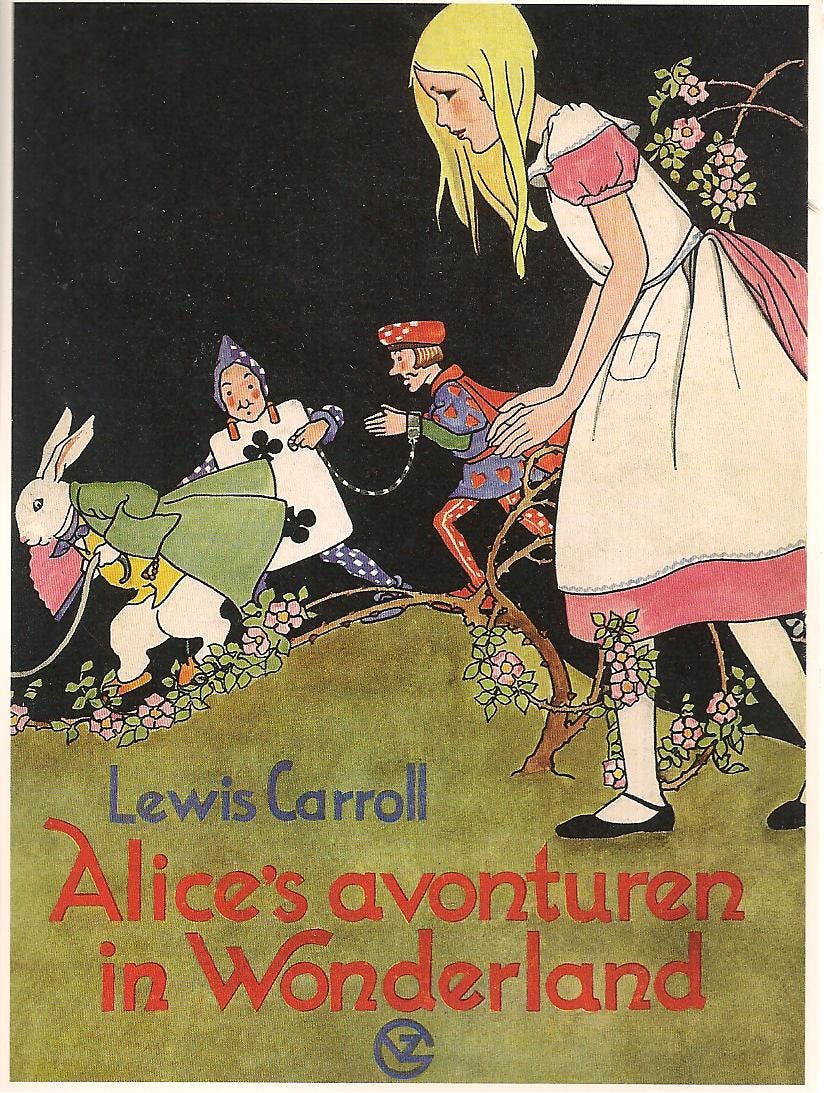
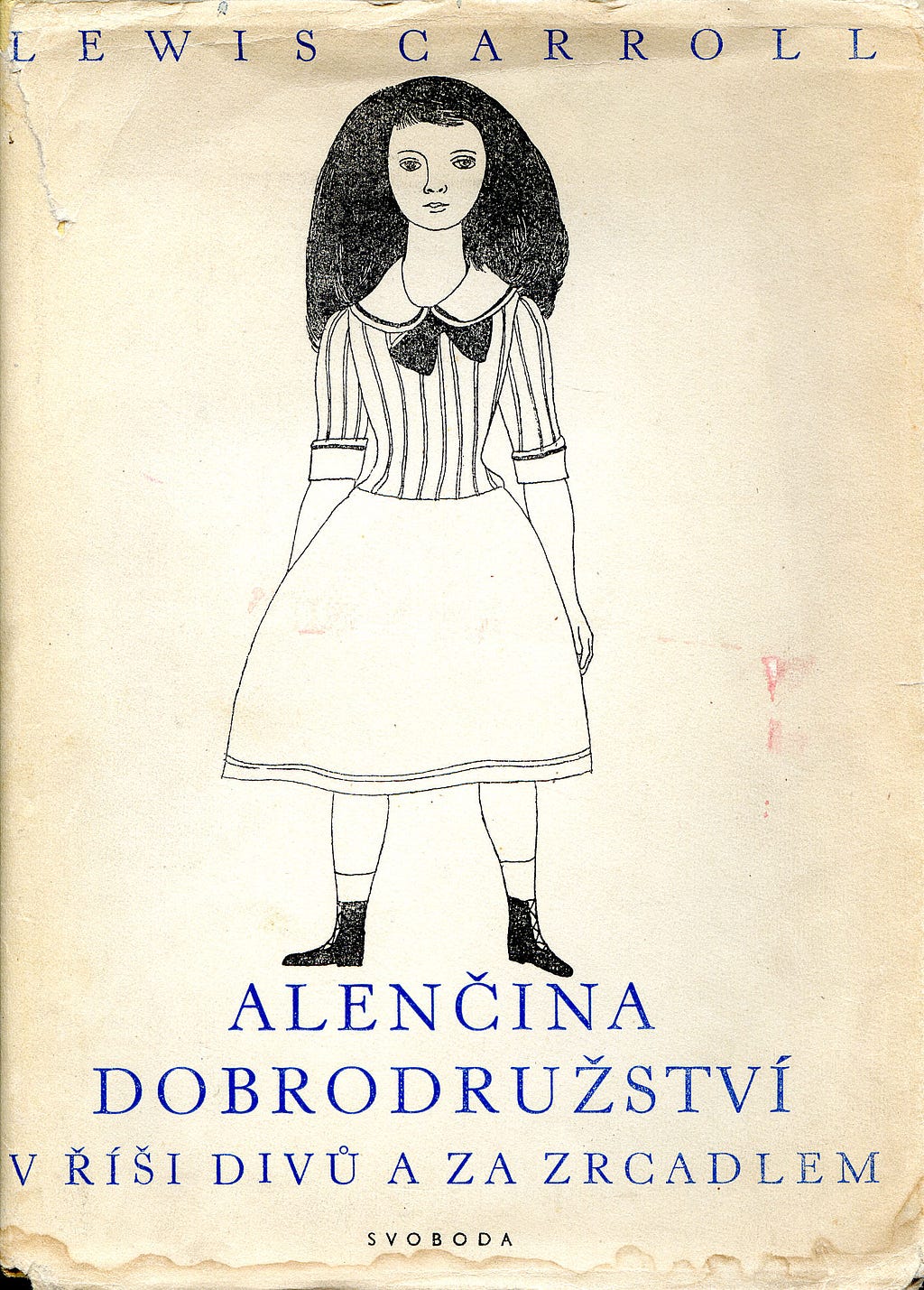
Cover Gallery — Alice Around the World:

Russian edition, 1958 (left), Polish edition (center), French edition, 1980 (right)
Czech edition, 1961 (left), Dutch edition, 1979 (center), Czech edition, 1949 (right)

So it was to my great shock and comfort when I read that book to find that Alice chooses the White Rabbit, the deviation. She has no noble quest to fulfill, seeks neither tender reunion nor exemplary friendship, and finds nothing to praise in the idea of societal order (especially as presented by the monarchy of the King and Queen of Hearts). In a world that seems topsy-turvy, she swiftly adapts. Otherwise, she relinquishes control: as she says to the Dormouse, she can’t stop herself from growing up.

By contrast there was nothing altogether wrong with my Soviet cartoons, only that they came too late, trying to prepare me for a world which no longer existed. Hand-drawn and stylistically lovely they told of an anachronistically slow-paced and easily digestible life, a life that didn’t particularly resemble mine––and perhaps not anyone’s. As I eventually grew older and came to the decisions that would determine my path through — such as where and what to study, who to befriend and who to become — Alice was the perfect companion, making no promises about the effects of any of life’s potions.

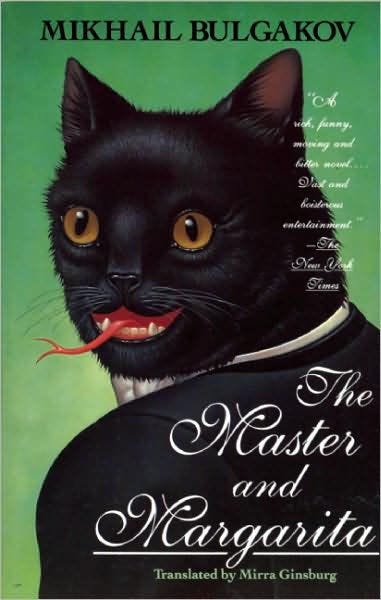
Cover of 1995 edition, trans. Mirra Ginsburg

Years after Alice in Wonderland I came to fall in love with Mikhail Bulgakov’s The Master and Margarita, a surreal Moscow tale about censorship, self-sacrificial love, and diabolical parties in the urban underbelly, which had been banned by the Soviet authorities during the author’s lifetime. Bulgakov’s novel caused me to think about nonsense not just as an absence of sense, but as a call for sense and order’s abnegation — a call only allowed under systems that make room for nonsense and uncertainty in the upbringing of its citizens. The Soviet system was very particular in the role it assigned to art, to both define and enforce social functioning. It was an irony that in the case of the cartoons the message reached its intended audience too late, arriving only after the onset of capitalism, to indoctrinate impressionable young minds with outdated, ill-fitting ideas. Thankfully for me, Alice came to the rescue––and just in time––offering an assurance that nothing in the world makes sense, so long as you let it.

Queering Gender, Queering Genre

I think I’m a woman, because I know I’m not a man.

I also think I’m an essayist because I know I’m not a poet (or a short story writer).

Whenever I submit my writing, I say I’m submitting weird essay/poem things and that feels most authentic. My pieces are probably closest to lyric essays, or prose poems, and have been published as either. Sometimes I submit a piece as an essay and it is called a poem upon publication. Sometimes, the opposite occurs. I never care, because I don’t understand labels when it comes to literature.

When binary is the norm, when she/her means woman, when line breaks mean poem, I am who I am perceived to be more often than I am who I am — especially when I have no idea who I am, and don’t completely care about it.

This is not the first time I’ve felt like two hypocrites live in my body.

Gender is a complex and nuanced thing and there is no way to make a sweeping statement about what it means to everyone. Some say it doesn’t exist. Some say it is a means to control. Some say it is empowerment. Some say it is everything. For me, it is not everything, not just because I’m cis (well, I guess?) and have cis privilege and am ignoring the role gender perception plays in society. I’d be ridiculous to act as if gender doesn’t matter in the world. But it doesn’t matter in my small, small world, in my body, in my head, not mine, not to me.

I feel the same way about genre. To some people, genre is everything. They are a poet in a big way, or a novelist. I write novels and poems and essays and, to me, they are all the same and different at the same time. I am into contradictions because I am one. I guess that being mixed but called Black made me ready for such an existence. This is not the first time I’ve felt like two hypocrites live in my body.

In Excluded: Making Feminist and Queer Movements More Inclusive, Julia Serano complicates long held understandings of gender. Defining gender as “an amalgamation of bodies, identities, and behaviors, some of which develop organically and others which are shaped by language and culture,” Serano greatly disagrees with binaristic and even much of third-wave feminism’s gender isn’t real and is only oppression understanding of gender and believes it to be an oversimplification. Too, it is extremely dismissive of the experience of trans people who identify as men or women. The idea that gender is only ever oppressive results in a lot of the “but trans women perpetuate stereotypical femininity!” and femmephobia that we see on a regular basis within the feminist community.

The idea that gender is only ever oppressive results in a lot of the “but trans women perpetuate stereotypical femininity!” and femmephobia that we see on a regular basis within the feminist community.

Serano pushes us to accept the messiness of gender instead of trying to cut it down to a single answer, as cutting down to a single answer often means cutting out the most marginalized of people.

What empowers one disempowers another. Both can exist at the same time — no one understanding has to win. Just as I identify as black and mixed, queer and bi, I know I write poems that are essays and essays that are poems. There is, for me, validity to be found in space less easily labeled.

In the introduction of Lori B. Girshick’s Transgender Voices: Beyond Women and Men, Girshick writes, “As for gender-variant people, no conceptual framework fits their experience, and no individual words adequately describe it.” The section goes on to describe Reid, a FtM person seeking to communicate his identity. Reid’s quoted saying, “I now say that, rather than transitioning from female to male, I’ve transitioned female to not-female. English is inadequate to the task!”

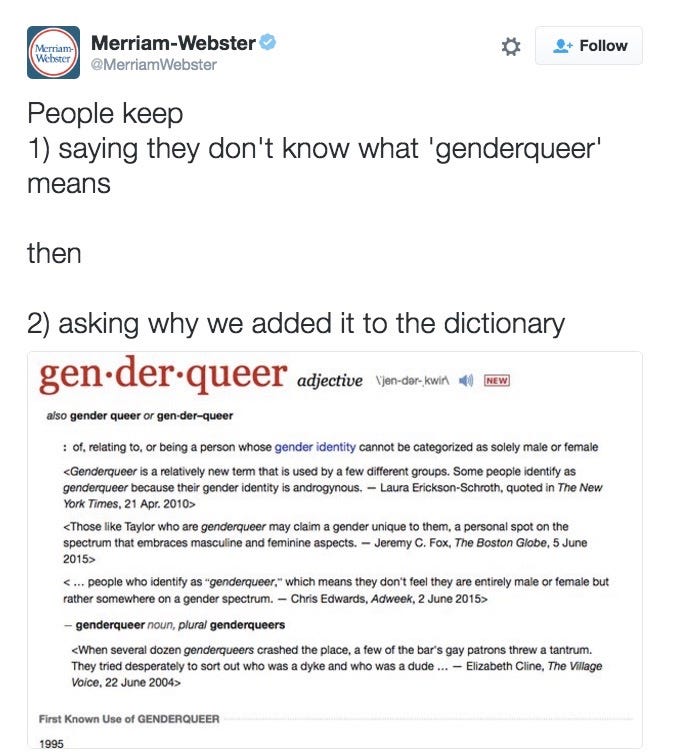
Remember the snark that went down when Merriam-Webster added “genderqueer” to the dictionary?

Words fail, especially when it comes to giving voice to experiences of marginalized people. English was not developed to empower all, and we see, regularly, the backlash against the creation of new words. From bae to pansexual, people pretty much freak out any time a new word is introduced to mainstream vocabulary. Remember the snark that went down when Merriam-Webster added “genderqueer” to the dictionary?

And this snark comes from writers, too, those writers we sometimes loathe and sometimes are, battling for the “right” words not to be taken down by the “made up” words we just aren’t used to, yet. Scoffing each time a new letter is added to LGBT doesn’t make you a true proponent of the English language — it makes you an asshole.

I was in a nonfiction workshop when my professor began mocking me for using too many words. I was writing about what it means to be both queer and mixed, and to constantly feel in-between and invalidated by language and mainstream understanding of identity. My professor was frustrated by my refusal? Inability? to “just say what I mean.” To be simple. Why complicate everything? If the only power I have as a writer is my pen, why muck things up by beating around the bush? I was flustered and unable — literally, as is the workshop model — to explain that I am found solely in the “around the bush area,” not within the bush itself.

I was in a nonfiction workshop when my professor began mocking me for using too many words.

If I say, “I’m a woman,” I feel as inauthentic as I do as I do when I say, “I’m gay.” Not because I’m not either of those, but because it doesn’t mean what other people think I mean. What is writing if not a means of mucking up language and syntax and fusing words to create new sound to better illustrate a lived experience rarely verbalized?

Why are we so afraid to let things be complicated?

I dropped the workshop, and still haven’t written that piece.

In Excluded, Serano defines essentialism as “the belief that all members of a particular group must share some particular characteristic or set of characteristics in order to be considered a legitimate member of that group.” I am interested in the ways that a non-essentialist approach to gender, meaning one that recognizes the space for duplicity of gender, gives room for someone to be both non-binary and a woman. As a gender-questioning woman writer who has tagged much of my work as queer (but meaning only sexuality, not sex or gender) and woman, I see a sort of comfort in this concept. If it is possible to be both non-binary and woman, than a non-binary writer does not need to be kicked out of a community of women writers, or out of spaces for women’s writing. They/we are, simply, both.

Just as I don’t want to identify as non-binary, regardless of the potential room for accuracy, I don’t want to identify as a “writer of neither genres.”

I wonder about this in terms of genre. Just as I don’t want to identify as non-binary, regardless of the potential room for accuracy, I don’t want to identify as a “writer of neither genres.” But how much does want matter when perception is what labels us in the mainstream?

If I am published, will anyone find my work if I don’t label it within a genre? If I am published, will I be known as a lesbian black woman writer? Or a queer person of color? Does it not come down to the most marketable term? Who am I if who I am depends on how many hits my identity would garner online?

In a 2012 Brevity essay, “The Craft of Writing Queer,” Barrie Jean Borich talks about finding space for queerness within the inherent strangeness of creative nonfiction.

What I’ve loved, from the start, about CNF has been the ways this genre is creatively weird, much like myself — both misunderstood and claimed by more than one constituency, attentive to form but difficult to classify, with quirky yet intentionally designed exteriors, slippery rules, a mutating understanding of identity, a commitment to getting past the bullshit and making unexpected connections, and a grounding in an unmasked, yet lyric, voice.

This is the piece that convinced me that maybe, if I hadn’t found my home as a fiction writer, I may do so in the “queer city” of creative nonfiction. It was that, the “unmasked, yet lyric, voice” that I knew I could write. It is a thing that frustrates other writers who tell me my essays are prose poems or that my poems should be essays or that my narrator should have interacted with more men throughout the piece to tamper down the emotions. I am told I cannot do what I do, but I do it. Again, contradictions make up my understanding of what it means to write.

I wonder what it would be like to write within a genre, to read the rule books and to value the canon and to do what I am told, just like I wonder what it would be like to have remained straight, to have dated men and just wondered about women the way I wonder what a line break and an indent and a smudge of erasure would do to my essays. I wonder about the space between rules of writing and rules of sex, and gender. I wonder about my space within that space, and whether I’ll always be okay existing within grey matter. I am not sure.