I offer to drive us back. God, are you still here? My future echoes into the bathhouse. Two insects fuck. To sit here in the forest my butt gets all over this University of Montana sweatshirt. I can’t get tired of mosquitoes in a poem, can I?
The asparagus has gone to seed. Did I mention travel? These ferns reminded me of it. Kind of like how the mirror, earlier, reminded me of something I can’t read but probably my cock. This ant reminds me of spaghetti right now. Reader, explain why to God.
My face is open again, outdoors, to travel. God lets my face go again. I put my face into a pan of white asparagus soup and anyone can see that.
I wipe off my face with ferns and travel. This old bathhouse with its shit mirrors. Ants like to crawl on food and they crawl on me because I usually have food all over me. Bringing God to the table and all the assumptions fall down.
It was just enough time to put my cock away. Packing myself for traveling and that is only the first step. The second step is growing up and moving away from Cleveland. The next steps are all reading and thinking and shaking off my University of Montana sweatshirt.
I don’t enjoy dead mosquitoes in the mouth. But I like when they’re placed on my tongue by honeybees. As long as the honeybees are paying attention and love me back.
Am I hungry or do I feel hungry? What about thinking? I like this poem. My mosquito bites I take as gifts. Am I given to so often, normally? Write a song just for me you can use all these words. Use the ant, reader.
I used the ant. If the ant stayed Formica from last time. Ask algebra anything interesting and it won’t stretch, either. I want something sweet to run towards. In two days, God, let’s go back to traveling. Reader and I are done thinking or I’m done with it. He can do what he enjoys. Those soups and cooking and reading I bet he likes my sneakers.
I left them over in my locker at the bathhouse but this bathhouse is only here so I can write on my cock. God, can you leave my face alone? My pants are on top of that chair so much so that I can’t even tell if they’re in the forest, still, or not.
If I remember correctly it’s the kind of chair that looks really cute.
I add Boston to this.
God, what’s my cock until it comes down from the ceiling? This forest is so lame sometimes. Look around for your reader. When I fall asleep does he? My sunglasses are bored from not being in the sun.
Tell the assumptions to go away. My back feels supple and my head feels heavy when I think about it. Here is my body as it wounds. How fast is wind? When I was a Boy Scout I knew.
In the bathhouse, in Boy Scouts, in windy weather, in reading, I find myself. My thinking gets wet, explores. Dead leaves are eaten by whom? I peed in them again. The porcupine again!
What else did I think was so rare but began seeing everywhere? That was from another poem by me and I inspired myself to look at my cock again.
Which bored me.
How many things do I have only one of? One cock. One piece of skin, contiguous. One thinking. Or many because ten years feels like a long time. The ant I don’t remember what happens to it next.
Maybe it’s turning?
When I sat down my face felt fine and it still does but now I hear more wind and I have more to tell you. I don’t care that I have mosquitoes because so does Cleveland. I thought about my face because of that mirror.
When I assume you know me just from knowing what my cock looks like then what does my God look like or my family or town? Just as an example, my town is small and shaped like a block of wood. My town gives me a place to live and forgets to reward my stretching.
I don’t stretch but I do don lace for dinner. My reader serves me some steam and my favorite foods. His favorite foods are potatoes au gratin and white asparagus soup. My God is a lot of German things and she encourages me all the time. Even when I put the dried skin from my neck all over the forest I am happy.
I grew up in Cleveland but now I have mosquito bites. Assume that mosquito bites are soothed by wind. This real live forest and some of the trees are dead. The bathhouse is dead tonight, it’s just me and God. My God and I put the mirror away in my own special way. Closing the mirror for privacy. I bet dogs can smell the cum in my pee when I haven’t cum in a long time.
When I sat down insects began to explore me. But I was in a thick wood and my neck felt like a handful of tiny stones. My face felt good but my neck felt rocky. All these feelings attempt me.
I make an assumption about other insects from the ones I’ve found. Explain to your brother that trees aren’t cannibals. That piss deters insects. How rare it is to see a porcupine.
When I sat down the assumption was that I was resting. Did you see me from above? What did my feet look like, my legs? I’m no longer flexible because no one gives me treats for stretching. Stretching used to earn me something. All these elm and ferns and my neck like a shoreline I praise. From up above you can see my shuffle.
My head isn’t always where I think. A mosquito bit me on the elbow. This happened yesterday, too.
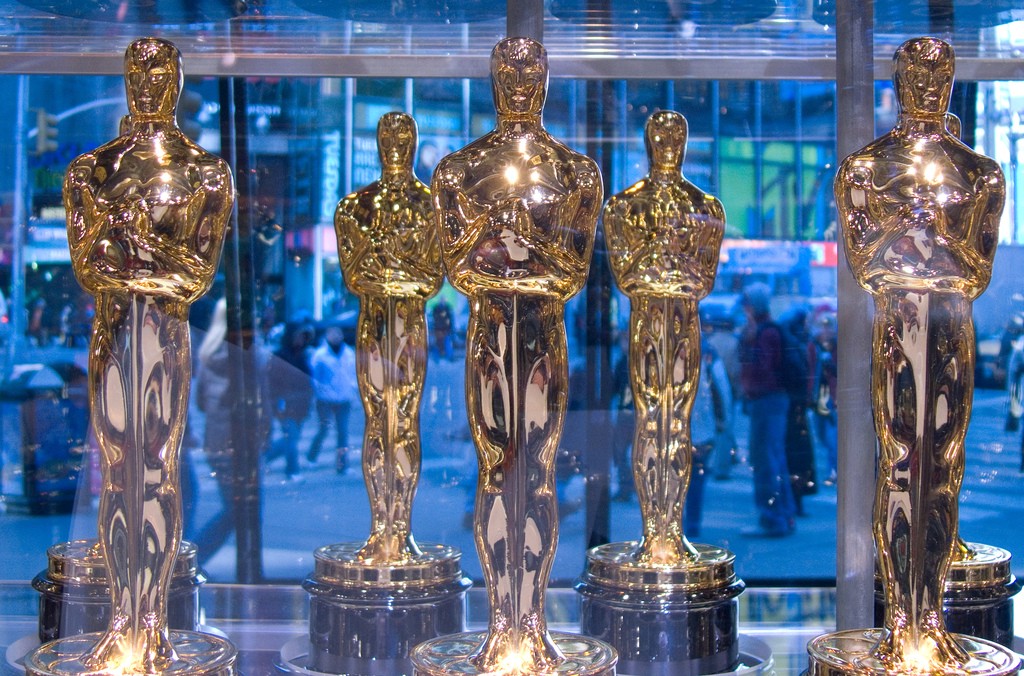
The 2015 Academy Awards will take place on February 22nd. This handy infographic from BookBub takes a look at the 6 films adapted from books that were nominated for major awards.
Electric Literature’s mission is to amplify the power of storytelling with digital innovation. In the last year, we reached 2.9 million unique visitors, received our non-profit status, relaunched our website, electricliterature.com, doubled the audience of our weekly fiction magazine, Recommended Reading, and launched another weekly magazine of short things, Okey-Panky. During this exciting period of growth, we are looking for a Development Director to increase our contributed income as we expand our staff, audience, and the scope of our projects.
This is a part-time, flexible position that pays $1,000 per month. Applicants must be located in the NYC area.
Responsibilities
The Director of Development will:
Work with the Editorial Director and Board Chairman to develop a strategic plan and set fundraising goals
Cultivate individual donors
Maintain relationships with individual and organizational donors
Write and submit grant proposals
Write and submit grant reports
Identify new funding sources
Manage fundraising campaigns
Liaise with fundraising board members
Measure success against strategic plan and fundraising goal
Experience
The ideal candidate will have:
A minimum 1 year of experience working in non-profit development
Authored or collaborated on successfully funded grant proposals
Authored or collaborated on multi-year fundraising strategies
Experience creating project budgets
Management and/or leadership experience
Skills
The ideal candidate will:
Write clearly and cleanly
Express the mission of Electric Literature in compelling and unexpected ways
Have a passion for literature
Believe strongly in making literature more accessible through digital innovation
Be self-motivated
Be confident and comfortable engaging new people
Be cool under pressure, and able to work on deadlines
To apply, please send a cover letter, relevant writing sample, and resume to halimah [at] electricliterature.com by February 16, 2015.
Each month we gather some news headlines that are strange enough to be fiction. Here’s yet another batch of headlines to get your creative juices flowing along with suggested genres:
Jonathan Safran Foer once had a beautiful vision: literary writing on fast food restaurant packaging. Last year, this impossible dream became a value-priced reality when Foer teamed up with Chipotle to create a series of burrito bags and soda cups with short fiction and whimsical illustrations. The humble series is called “Cultivating Thought,” and poses an answer to the great philosophical question of our time: “Must a cup, or bag, suffer an existence that is limited to just one humble purpose, defined merely by its simple function?” (That’s an actual quote on the website.)
Snark aside, Foer did manage to get a pretty great list of authors to join, including Toni Morrison and George Saunders. Now, there’s a new wave of Burrito Realism shaking up fast food fiction that includes another set of pretty awesome writers like Neil Gaiman, Amy Tan, comedian Aziz Ansari, and Carlos Ruiz Zafon. Rumors are, the gig pays pretty well, so good on Foer and Chipotle for paying writers and spreading literature.
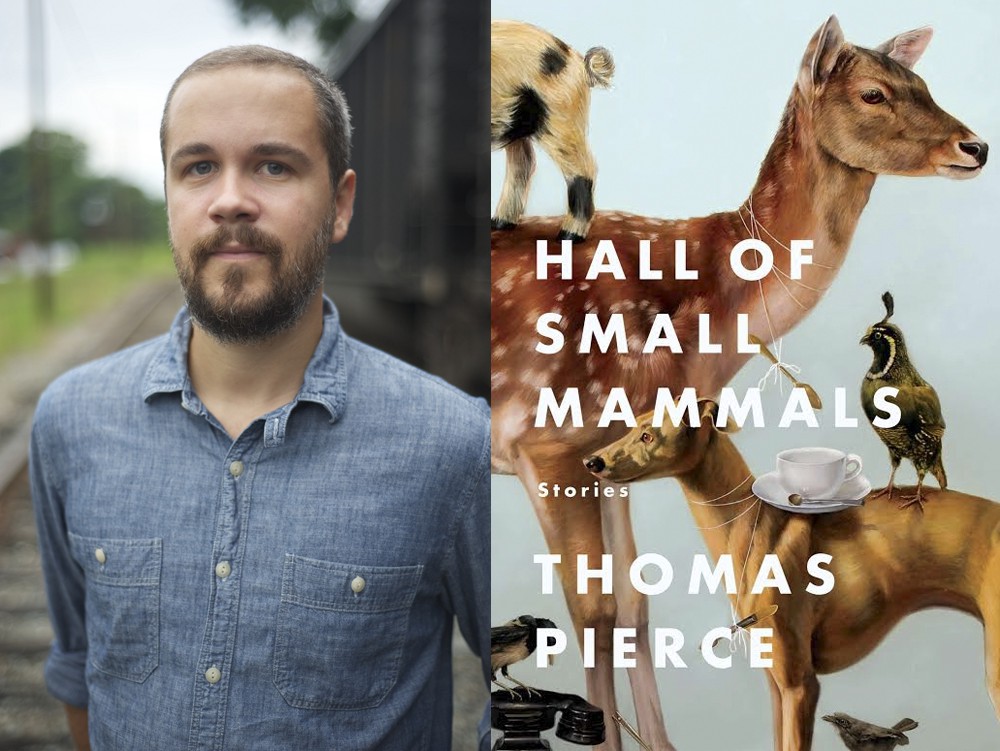
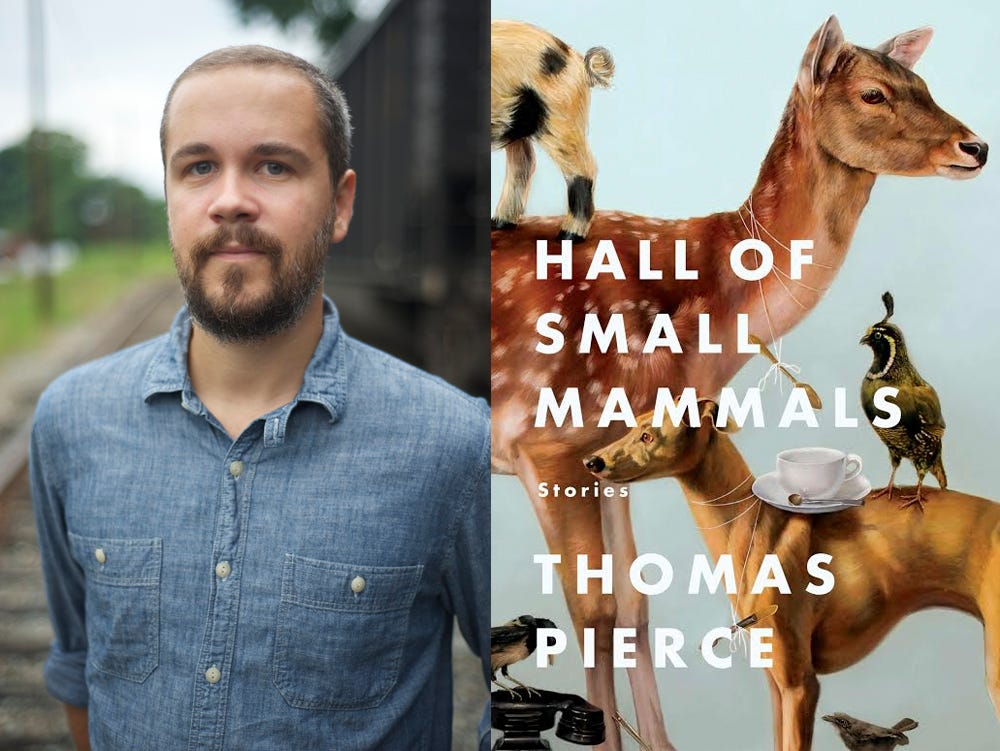
This summer, I started following Thomas Pierce on Twitter. I’d admired the stories he’d published in The New Yorker, and I’d begun to hear about his forthcoming story collection, Hall of Small Mammals. But I knew nothing else about him. Then one day this fall, I happened to see this tweet of his:
all these years after leaving npr i still sometimes have director nightmares: a lost story, dead air, the clock, the clock, the clock!
In the grand scheme, there are very few people in the world who can truly understand the particular stress of producing live radio and who will be plagued by fever dreams long past their time doing it. Even fewer of those have written books, let alone forthcoming debut short story collections. And maybe just two people from this already small pool have an interest in looking at humans through some kind of natural world lens. (Hint: that would be me and Thomas. I dare you to find another.) I think a lot about how my past as a producer for public radio’s This American Life influenced my writing and I was curious how his experience at NPR had shaped him. So I contacted him to see if he’d be game to talk about writing and our pasts in radio and how that all mixes together. This was before either of our books had come out. But once we began to make time for a conversation Thomas’s book was on the very near horizon, so it made sense to focus in on it. Plus, it’s really great.
Hall of Small Mammals may be dotted with mysterious creaturely “others” like a dwarf wooly mammoth, unidentifiable skulls, or invisible particles, but it is overflowing with troubled, searching, tender people, or “human animals” as one story slyly calls them, reminding us where we come from. The stories create familiar worlds and cast a fog of strangeness over them. They are compassionate portrayals of characters at odds and at crossroads, looking for answers in what is still mysterious about the world and about us. And the stories have a heady, imaginative sheen over them: what if the woman you loved, loved someone else in her dreams? How would you care for a creature that was last alive before the last ice age? What if you knew the deepest feelings of the people you’ve laughed at online?
As I read Hall of Small Mammals, I would begin to feel as though I knew these characters, only to be totally surprised by them. As though the book was telling me that no matter how common our lives may seem, there is something unpredictable in our hearts and minds, and while yes, that can prompt us to be our worst selves, it can also bring out our best, or, at least the best we can manage in the moment.
Thomas and I emailed back and forth about his book, writing, our own fascinations and how radio landed us here.
Diane Cook: In the stories that make up a bulk of Hall of Small Mammals, the characters have some encounter with the natural world — a creature, a skull, a theoretical particle. It’d be easy to say these stories are intersecting with the wild world but to me these natural items and ideas seemed more about the unknown and mysterious than a tangible thing we are face to face with. Or rather, the stories chronicle the characters’ quests to know what we don’t yet know, in the grand scheme and in the deeply personal realm. The characters are wanderers even if only in mind and imagination. Did you approach writing these stories with a quest of your own? An intellectual or creative project? How did the themes of the stories reveal themselves?
Thomas Pierce: That’s an interesting way to frame a story, as a quest. I do often think that I want my stories to seek. I want them to be after something. Even if the action is somewhat static at any given moment, I want the reader to have a palpable sense that the story itself is hungry and full of questions. This approach isn’t really particular to this collection. Maybe that’s more like a life-long creative project. Maybe it’s my quest.
I’m not sure the stories’ themes have fully revealed themselves to me yet. I’m joking. Sort of. I do know that I was preoccupied with certain ideas and questions at the time of writing, and maybe this amounts to the same thing. One of my preoccupations was — and is — the trouble that arises as we try to explain the world to ourselves, especially in moments when we are forced to incorporate new, more complex information into our thinking. The collisions with the natural world that occur in the book are, as you suggest, manifestations of the mysterious and the unknown. The fossils, the creatures, the particles — they are disruptions in these characters’ lives. They keep the characters from being too lazy in their thinking, from clinging too firmly to a particular perspective on a relationship or on existence itself.
DC: As I was reading I thought a possible subtitle for the book could be Scenes from the Pop-Yop or something to that effect. The fictional ice cream chain makes many appearances, and occasionally seems to connect characters from certain stories together, or give the appearance of connection. It makes a potentially boundless world of a story collection seem intimate, like all these people live in a town, county, region. And their lives are all circling one another though they may never meet. It doesn’t feel like a linked collection, yet reading it, I felt I’d walked into a familiar place but with realistic distance between people, the way it is in life. Do the stories come together for you in more ways than thematically?
TP: Scenes from the Pop-Yop — I love that! Yes, I didn’t set out to write a collection of stories linked in the traditional sense. They don’t all take place in the same town. One or two characters appear in multiple stories, but in my head they all belong to the same universe. It’s a universe a few inches to the left of this one, perhaps, but I aim for consistency within that world. The characters might not know each other personally or ever interact with one another, but I’d like to think they could, by chance, all wind up on different aisles of the same grocery store one Saturday morning.
The stories are connected but in subtle ways. One story does not depend on another in any vital way. The truth is, I’ve always enjoyed creating alternate but recognizable worlds. I remember writing a couple of stories in college and feeling far too pleased with myself for making references in each to a particular brand of spreadsheet software that I’d invented. It was called Dynamite. (With Dynamite, you can explode your charts and graphs!) I’d be hard-pressed to name something more mundane and boring than spreadsheet software, and so I’m not sure what it says about me that I feel the need to create my own version of it. If I’m writing a story about movies, I’ll make up a few of my own. If I’m writing a story about mammoths, I’ll invent my own species.
That might help to explain Pop-Yop, the soft-serve ice cream franchise that appears in the book. Pop-Yop is the place you see advertised every fifteen exits or so on the interstate. It’s delicious and popular. It’s how we try to tame the world. We Pop-Yop it. You land in a new city and you don’t know where you’re going, and then you see a Pop-Yop, and you say, Oh thank God, they’ve got a Pop-Yop. Bread Island functions, in some ways, as Pop-Yop’s antithesis. Bread Island is like a fountain of strangeness and mystery. We’ve cracked open the earth on Bread Island — with a mining operation, with a mammoth excavation — and unleashed all sorts of craziness.
These elements do help to unify the stories in this book, but honestly I wouldn’t be surprised if they show up again, in future stories. I’m not done writing about Bread Island, I’ll say that much.
DC: Is that how you knew you had a viable book of stories?
TP: I wasn’t thinking about a collection, really, until my agent pointed out that I was close to having one. Until that point, I’d been so focused on the individual stories, but when I went back and looked, I realized she was right. The stories I’d been writing over the last few years belonged together. They were powered by the same engine.
DC: So, I Googled you. And there is this other Thomas Pierce who seems to be this socialite guy about town in NY getting his picture taken with fancy ladies, he in a fancy suit. And there are others. It made me think of the side affects of what happens in the wonderful story “The Real Alan Gass” where the wife’s confession that she is married to another man in her dreaming life sends the narrator on a surprising search for the real life version of her dream husband. Do you think of doppelgangers or of the ways we connect to the people wandering around with pieces of our own identity, namely our names? Or about the stranger ways we connect to one another?
TP: Oh, but I am that socialite! And I hardly ever take off my fancy suit. Not even in the shower. I’m wearing it right now. It’s got baby food all over it — and dog hair.
I’ll go ahead and admit to you (and the world) that I’m signed up for Google Alerts, so anytime my name — or some variation of it — is in the news, I get an email. The vast, vast majority of the articles aren’t about me, thank God. They are about other Thomas Pierces. I think I could probably fix this somehow — by feeding Google more information — but I’ve come to enjoy the alerts. Most of the articles concern one of three things: an arrest, a death, or an award. Lots of Thomas Pierces in jail right now, as it turns out. I got an alert recently about a particular Thomas Pierce serving a multi-millennial prison sentence. Multi-millennial! I forget what he did — I’m not sure I want to remember — but it earned him so many consecutive life sentences that if he was immortal he’d be in jail until the year 4014 or something like that.
DC: I’m going to guess he did something very bad.
Speaking of bad behavior, one of the things that struck me in your stories is how when your characters struggle between right and wrong, right wins out a good amount. In the story we just mentioned, “The Real Alan Gass,” the narrator is offered the chance to do something bad (though understandable) but doesn’t in the end. And in “Grasshopper Kings” the dad begins to get wrapped up in a cultish sense of belonging but eventually comes to the rational side. There is something deeply decent about your characters. Is there a question about behavior you were investigating, and were you ever surprised by where your writing and characters ended up?
TP: That’s interesting. Certainly there are characters who’ve made mistakes and regrettable decisions in their lives, but I think you’re onto something here in that these generally aren’t stories about people doing the “wrong” thing. But then again, I wouldn’t necessarily say they’re doing the “right” thing either. I might be that I have a little trouble with the right/wrong duality. At the risk of coming across like some sophomore business major in the back row of his mandatory ethics class, I do wonder if the not-wrong thing necessarily equals the right thing (except in the rather limited sense that not committing a wrong contains an inherent rightness). If you choose not to do the wrong thing, you’re still left with a wide spectrum of possible behavior, much of which is not exactly good or bad. Anyway, I’m not sure I set out to specifically investigate this question of human behavior. It could be that the characters are basically decent because I want to believe most of us are. Or it could be that I’m simply more interested in people who want to do right but who aren’t exactly sure what that entails in every situation.
DC: Yes, the ambiguity is there, and certainly all the characters aren’t always acting decent. But when they are it feels like a real line in the sand. In “The Real Alan Gass” the protagonist does, over the course of the story, many things that really violate some kind of trust. He goes far in one direction, but it’s here — when given the opportunity to alter his wife’s most private mental space — he comes to his senses, as though waking from a dream of his own. Did I want him to try? I don’t know. Part of me did and part of me hoped he wouldn’t. I think that’s why I liked the story so much — as a reader I too was at odds with what was happening. I became very involved in this man’s life and particular heartbreak. It’s one of the things I so admired about all of the stories. In the midst of them I felt like I could look around convinced I was so close to living, breathing folks that I might reach out and touch them.
TP: That’s very nice to hear. Now of course I’m curious to know how you see our own book in these terms because there are quite a few characters who do something that I’m tempted to call “wrong.” I’m thinking of Phil in “Man V. Nature,” a man who, among other things, steals food from his friends’ pockets as they waste away in a small life raft; or of the narrator in “The Way the End of Days Should Be,” who’s living out an end-of-the-world flood in his mansion and who refuses to aid almost everyone who shows up at the door. They have their reasons for doing what they do. They aren’t doing wrong in a vacuum. These characters, and others, are in dire, life-threatening situations, and I never quite blame them for their actions. I feel like I might be one of them if put in that spot. The choices they make are rarely admirable but they’re almost always believable, honest, and maybe even rational too. What led you to write about what I’ll somewhat reductively call “wrong-doers?” That is, about people in situations where there’s more overlap between what’s rational and what’s wrong?
DC: One thread of my book is concerned with survival. We tend to applaud survival but it can be a pretty ugly endeavor — the things we do to save ourselves can seem cruel but can also be so understandable that they’re heartbreaking. I’m fascinated by how messy life gets when our baser instincts are pressured to the surface, and how often they lead to conflict with other people, even loved ones. So, while I also don’t believe in the reductive right and wrong — and don’t see my characters as wrong-doers either — maybe I’m lacking inspiring words for the conflict between the individual and all others. In my real life I’m liberal and also loyal. But in my fiction I’m puzzling through our responsibility to one another.
In your stories, many of the characters want to connect with something beyond their own scope of being. Is there some motivation you think your characters share? Why do your characters look to the natural world for what feels like surprise or purpose or meaning?
TP: That’s a great question. In the broadest sense of course, the natural world encompasses everything in the material universe. It’s everything we can see and observe. It’s us. Don’t worry, this is not me saying that ipso facto we have no other place to search. I only point this out because I think many of these characters are in search of little glimpses behind the material curtain, and their search is prompted by that which is seemingly unexplainable (or unnatural): a deformed and questionably evil skull, a resurrected mammoth, a husband who only appears in the world of a woman’s dreams.
I think that we humans are full of contrary impulses. On the one hand, we want to know everything there is to know. We want all the answers. But on the other hand, I suspect we don’t want that at all. I think we require mystery and even thrive on it. I think a small part of us wants the universe to remain just outside of our understanding, and all signs up to this point indicate that the universe will continue to oblige us in this regard. I was reading the other day about a theory that reality is in fact a hologram, that we’re actually just bits of 2-D information encoded along the rim of the universe. (This is not a crackpot theory, by the way.) Suppose we prove it’s true. No doubt, for some, this would be a distressing discovery. Some people would reject it because it doesn’t mesh with what they already believe. Somebody else might choose it as their new belief. Others might try and incorporate it somehow into an existing belief. I can imagine some preacher out there suggesting to his congregation that the 2-D information is the language of God and that the rim of the universe is the iris of God’s eye. So be it. My point is that new discoveries don’t have to squash our most basic questions. I actually think they can revive our questions. They invite us to engage with the bottomless mystery of our own existence.
DC: I found your writing wonderfully unfussy and the dialogue perfectly natural. Which did not surprise me. You used to be a radio producer for NPR. I wonder if any person who ever wrote for or produced radio is even capable of overwriting? Writing for the ear has to be clear and directional. I think radio writers really appreciate simple construction because we’ve seen how well it works. Has radio influenced your writing at all?
TP: Thanks! And that certainly applies to you too, as a fellow recovering radio producer. Your writing never gets in the way of itself. Writing for radio really does train you to write economically. You have to get to the story with as little preamble as possible. No time to dither. After all, you might only have a few minutes to tell your story. I think writing for radio also made me very aware of “audience.” I don’t write in order to please an audience and I don’t typically think too much about whether a story is capable of finding one, but when I’m revising, I do think about the potential readers, who have taken time away from their lives to sit with me for a moment.
DC: That’s a great point — You have to get to the story with as little preamble as possible. It’s something I do a lot but I’d not thought of it like that before, or, I hadn’t thought that the way I establish a fabulist or fantastic world — where I get the rules of the world down immediately — actually has some roots in my radio days. The goals are the same though — you don’t want to lose your audience, whether it’s their attention or their trust in you.
TP: Yes, exactly, and you do that really well, by the way, dropping us right into a world.
I also think working in radio taught me to finish projects and to be a more disciplined writer. When you’re working on a deadline — and working toward a show week after week — you can’t really give up. You have to make the best of the tape you have. I used to give up on stories too fast. I had so many fragments and partial stories that never amounted to much. Now I try to finish every short story even if, halfway through, I’ve begun to suspect it’s terrible and unusable. I have plenty of awful stories that I’ll never send out, but I think generally it’s good to try and finish them no matter what.
Were you writing fiction before you worked at This American Life? I’m curious if you’ve noticed any changes in your style or in your patterns as a writer.
DC: I wrote fiction in college but then stopped. I had started listening to the radio. Got swept up in voices and in nonfiction. The truth seemed nobler than my (then) silly ideas. But really, I think I just got stuck with fiction and didn’t know where to go with it. I had raw skills and no purpose. Working at This American Life taught me how to work with writing and also how to be a working writer. I got a lot of practice at structuring and identifying what the story was in any given project. But eventually, I started to feel the boundaries of journalism, of telling the truth. I wanted to explore more than what had already happened in the world, or what was happening at that moment. I wanted to think and dream beyond that.
Is there something about your subject matter and interests that drove you from radio? An obsession or fascination that could never be scratched by radio…or you think can’t be scratched? What does fiction do that journalism can’t?
TP: That pretty much sums up my own experience, too. I wrote fiction in college and then stopped — or very nearly stopped — after I started working in radio. The way you describe wanting to explore more than what’s already happenedor is happening in the world, I can definitely relate to that. I think a lot of what interests me could not be classified as newsworthy. I feel like I can put more of myself into my fiction. I don’t mean autobiographically but emotionally and philosophically. My fiction might be a better representation of who I am than my work in the news. Still, I do miss radio. I miss the feeling of being a part of a show. It’s almost like playing in an orchestra. I miss the collaboration and the teamwork of putting on a show each week. I also miss the adrenaline of being live on the air. Maybe I’m not finished with radio yet. What about you? Can I just throw back this question to you?
DC: Yes, that’s exactly it. My interests didn’t always feel newsworthy. And more, I wasn’t particularly interesting as a journalist. You know, I left radio in 2007 and the radio culture I left behind felt limited to me, or at least, limiting. And that hadn’t really changed in the seven years since. BUT, this year, suddenly (it feels sudden though of course nothing is) audio storytelling feels reborn in the podcast realm. It’s exciting and boundless and risky in the best ways. Obviously my impulse to innovate led me elsewhere, and if I’d been truly suited to radio journalism I probably would have attempted to innovate from within. But it was a funny experience to launch my book the same week as my former (and incredible) colleagues launched Serial. My new chosen medium felt old and yellowed next to shiny new podcasts. That said, it still feels dominated by true stories and I just don’t have much interest in that. I love reading nonfiction and listening to it, but don’t want to be held responsible for it any longer. I don’t think I’d ever return to that kind of journalism, but I could return to audio if it had to do with fiction or the art of writing.
And what about you, what’s next for you? A return to Bread Island?
TP: Ticket booked. I’ve got some new short stories that I hope to place soon, but mostly I’m working on two longer projects, one of which is a novel due to my publisher at the end of the year. But, hey, if you have an idea for a shiny new podcast that involves fiction and maybe even a little journalism, sign me up. I’ll be your east coast bureau. Almost True Stories, we could call it. If it’s a big hit, people will know this is where it all began, right here in this interview.
Most of the literary fiction I’ve encountered tries to steer clear of everything nauseating, unbelievably gritty, scatological, paltry or too physically violent in an effort to focus on feelings, atmosphere, the endless possibilities offered by semantics, and those emotional spaces that can only be explored through language. Acclaimed Danish poet and author Naja Marie Aidt’s Baboon does the opposite. It collects fifteen short narratives that run toward human ugliness, desire, heartbreak, physicality, and failure. With a prose that combines beauty and poetry with hostility and unpleasantness, Aidt dissects humanity in order to show how weird, wonderful, and downright atrocious it can be, and the result is one of the most outstanding collections I’ve read all year.
Aidt kicks things off with a story that’s slightly unsettling and ends with a few wounds, and it’s a story that helps her set the tone for the rest of the collection. From lost love, child abuse, and misogyny to sickness, desperation, and adultery, Baboon daringly tackles a plethora of themes that usually stand opposed to awe-inspiring fiction. While the fifteen tales are unique, elements like an obsession with the body, sexuality, and situations where control becomes impossible give the collection a sense of cohesion. These narratives are violent and ugly, but they brilliantly achieve that elusive goal that all exceptional fiction is known for: they make the reader feel something.
Offering a synopsis and analysis of each tale would require a huge word count, so instead I’ll offer a look at some of the narratives that left a lasting impression on me. The first is “Torben and Maria.” In this one, a mother physically abuses her 3-year old boy while her brother and the toddler’s father look on and do nothing. The narrative is disturbing and strongly critiques the way society condones abuse because it’s better not to get involved in other people’s affairs. In fact, even those who take care of Torben try their best to rationalize the physical signs of abuse:
“They’re beginning to wonder. Torben is so shy. But he’s also violent. He hits the other children when they come near him. He bites. And he often has bumps and bruises on his body and head. They’ve talked it over with each other. But on the other hand, Maria seems okay. You can’t be too quick to judge people. Children at that age are accident-prone, they’re always stumbling and falling and hurting themselves.”
Just like Torben and Maria could be the poster story for the collection, Starry Sky also delves into many of the uncomfortable grey spaces in which most of the narratives in Baboon reside. The tale follows a young couple that falls madly in love and lust with each other to the point that sex turns into something that consumes their existence. After they get married and have a child, the desire is still there and, for a brief moment, it seems like their life will never change. Then the husband takes a male lover. Surprisingly, he manages to keep his wife happy in the bedroom and suspicion at bay, but one day their young daughter sees her father passionately kissing a man in a passageway:
“…the child saw that it wasn’t a completely ordinary kiss, because her father and the man went on kissing, but the most disturbing part was that the man was holding the nape of her father’s neck as if he were pushing him down.”
The girl tells her mother what she saw, but the revelation has no effect on the relationship and the father goes on with his homosexual adventures without caring about what his daughter witnessed or how it might affect the way she looks at him.
While all I’ve said so far might lead readers to think Baboon is too weird and dark to be considered top-notch literary fiction, the opposite is true. This book, which won the Danish Critics Prize as well as the 2008 Nordic Council’s Literature Prize, Scandinavia’s highest literary honor, is also very comfortable inhabiting those spaces were language is masterfully used to convey emotion. In The Green Darkness of the Big Trees, a man becomes obsessed with a woman to the point where he stops being himself and becomes a creature crippled by her absence:
“Maybe I had fallen down a crevasse. A sudden slide down an all-too slippery passageway. Maybe this is it. And in this chrysalis, in this recess, in this hole I’ve been waiting either for life to notice me again and pull me up, or death to force me down the last few feet and away. I don’t eat much. I don’t sleep much. Sometimes it’s as if I were possessed by a ghost, at other times it’s clear to me that I’ve created this non-existence that my life has turned into.”
Exceptional. Kafkaesque. Delightfully bizarre. There are many ways to describe Baboon, but full appreciation and understanding for the worlds Aidt’s created here and the multiplicity of ways in which she dismantles humanity to make her critiques obvious and sharp can only come from reading her narratives. Translator Denise Newman did a fantastic job and managed to maintain Aidt’s original tone, and for that she deserves kudos. The worse components of human nature are grim things to dwell upon, but these stories turn this unattractive examination into a pleasurable experience.
Last month, the e-reading company Kobo revealed which books its users read to completion. Much was made of the fact that Donna Tartt’s prize-winning bestseller The Goldfinch was only finished by 44% of Kobo readers, and that, in general, the bestseller list didn’t match up at all with the most completed list. It also spurned a flurry of essays on what this data mining could mean for writers, readers, and publishers. Will, as Francine Prose wonders in the NYRB, marketing departments dictate authors rewrite plots and characters based on user data? Or does this, as Joseph Bernstein suggests at Buzzfeed, mean little to the writing process while having the potential to better connect readers with books they like?
These are interesting questions, but almost all the articles I’ve read have had an underlying unchallenged assumption that I’d like to challenge: that a half-read book is a failure either on the part of the writer or the reader.
Certainly there are books that could be better written and there are readers that could be more patient and willing to challenge themselves. Analytics might help weak writers figure out what they are doing wrong, and plenty of readers would benefit from pushing through to the end of good books. Still, it isn’t the case that book that a half-finished book means the book is flawed or that the reader has sinned against literature. This should be obvious for much non-fiction, or poetry and story collections. One can learn volumes from a history or biography without finishing it, and poems and stories are complete units that do not have to be read together to be appreciated. But even a half-finished novel can provide plenty to a reader.
Here’s a confession: I’ve never finished Moby-Dick. I absolutely loved Moby-Dick, call it one of the greatest novels of all time, remember passages and scenes on a regular basis, and know it taught me many things about writing. But I haven’t finished it.
Should I? Probably, and I almost certainly will at some point. (I read every word of Infinite Jest… spaced out over a few years.) But even if I don’t, Moby-Dick provided me with everything that can be asked of a book. It was hilarious (seriously, read the opening chapters), beautifully written, formally innovative, and all around immersive, interesting, and entertaining. Around the time I started Moby-Dick, I also started Stephen King’s Doctor Sleep. I had the latter on an e-reader and decided to leave the large Moby-Dick paperback at home when I traveled. I had to force my way through Doctor Sleep. If I hadn’t been traveling, I’d have never finished it. I’ve enjoyed other books by King, but Doctor Sleep was a slog and a snore. There is no measure by which Doctor Sleep surpassed Moby-Dick for me, even though the former gets a 100% personal completion rate.
We seem to expect more from books than other narrative media. If we read a four book series and think that final book sucks, we characterize the entire series as a failure. Yet no one says to avoid watching The Wire because season 5 is a letdown, or that The Godfather 3 ruins the first two films.
There are many factors that go into whether or when a reader finishes a book. I imagine many people’s reading habits are, like mine, scattered. I have at least a dozen in-progress books on my nightstand — and several more on my phone and e-reader. Readers stop reading a book they enjoy when they put it down and forget to come back. Readers finish books they hate when they are assigned it for book clubs or else they want to hate-read and laugh about with their friends. (Certainly a large percentage of Fifty Shades readers fall into that second category.) Just as a half-read book isn’t necessarily a failure, a completed book is not necessarily a success.
It’s also worth pointing out that it is actually logical that bestsellers have a lower completion rate. The Guardian noted with surprise that “Kobo’s first analysis of trends in e-reading… reveal an unexpected divide between bestsellers, and the books that readers actually complete.” But bestselling books are exactly the books that are purchased on an impulse, or picked up by casual readers who only finish a book or two a year. A good book that only sells to its niche should be expected to have a higher completion rate than one given out as Christmas presents to aunts and uncles.
Whenever people talk about books that people don’t finish, the same titles get trotted out: Infinite Jest, In Search of Lost Time, Ulysses, Moby-Dick, etc. Often these books are used as evidence that the classics of literary fiction are secretly awful or that people are pretentious fakes who’d be happier reading the latest Dean Koontz. But the most common feature of those books and the The Goldfinch is not pretention or density. It’s length. Long books are more likely to be abandoned. This is true whether it’s King, Rowling, or Pynchon.
The world would be a poorer place if books that are long or difficult were made short and easy. The people who do devour the long and difficult books often find them to be the most rewarding books they’ve read. Maybe only half the people who read Bolano’s 2666 finish it, but that half may love it far more than the 80% finishing a shorter and more formulaic mystery. In fact, that may even be the case for The Goldfinch. A separate e-reading data analysis done months before Kobo’s found that The Goldfinch scored near the top of the charts in the Hawking Index, a measure of which parts of a book readers highlight. Almost all of Tartt’s frequently-highlighted passages were at the end of the book. This means that those who were engaged enough with Tartt’s work to highlight passages were the ones who read, presumably happily, to the end.
And even those who don’t finish The Goldfinch or Gravity’s Rainbow or Ulysses may end up getting something out of their reading experience that they never would if they only read the books that an algorithm suggested they were most likely to finish. And what’s wrong with that?
Sign up for our newsletter to get submission announcements and stay on top of our best work.
YOUR INBOX IS LIT
Enjoy strange, diverting work from The Commuter on Mondays, absorbing fiction from Recommended Reading on Wednesdays, and a roundup of our best work of the week on Fridays. Personalize your subscription preferences here.