The following story was chosen by Simon Rich as the winner of the 2026 Stella Kupferberg Memorial Short Story Prize. The prize is awarded annually by Selected Shorts and a guest author judge. This story will be performed by an actor this spring. To hear more great short stories performed by great actors subscribe to Selected Shorts wherever you get your podcasts.
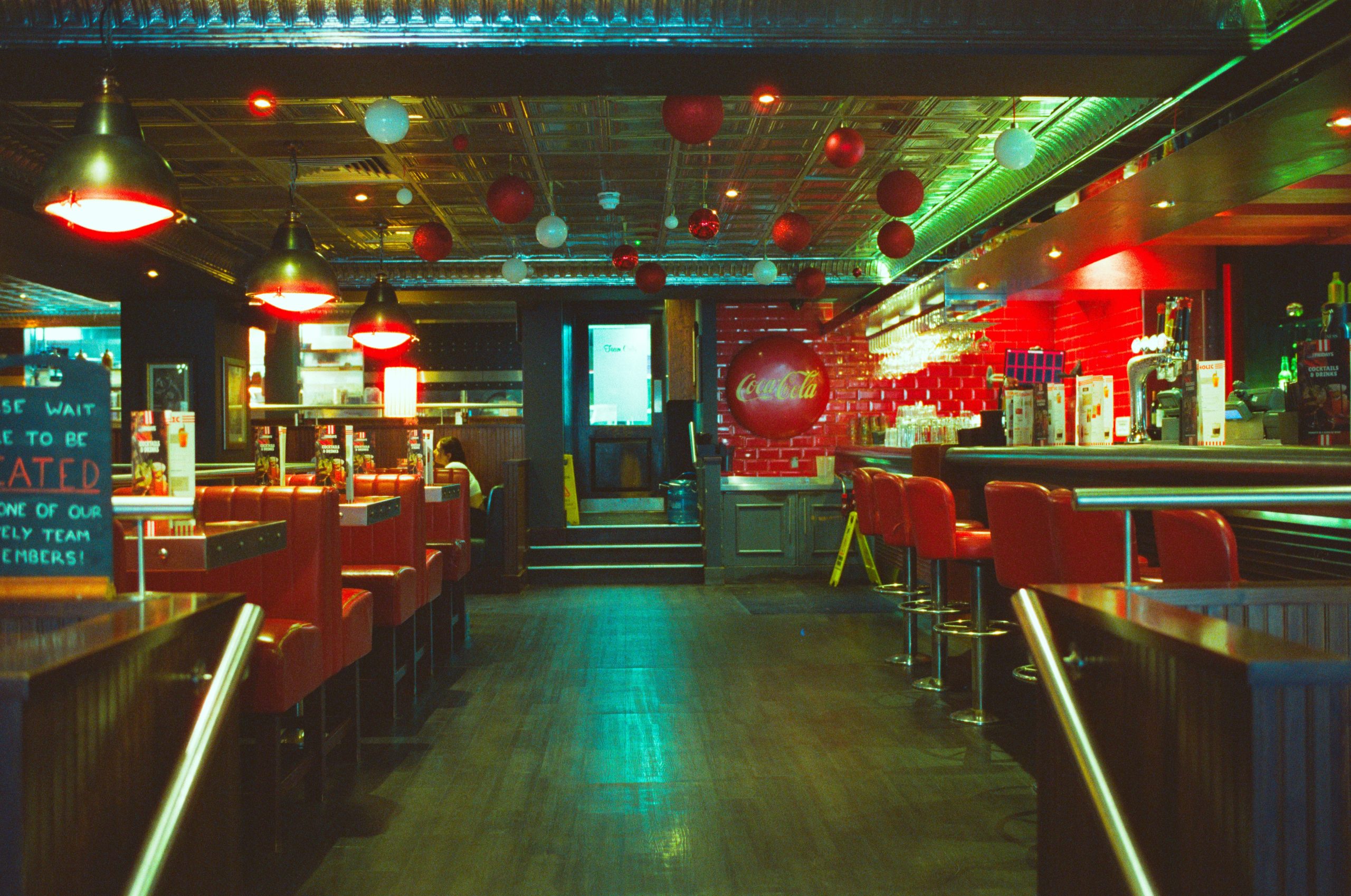
The Flamingo Café
There is nothing worse than working breakfast. The breakfast people, they’re in a hurry, they’re usually alone, which means they allow themselves all kinds of behavior, and they are very specific. Dark toast, toast lightly burnt, runny eggs, overcooked eggs, crispy bacon, burnt bacon, bacon on fire.
I bet the lunch people are OK with whatever color the toast is. Not that I would know. And I bet they use whole sentences. Not like the guy who comes in at the peak of the breakfast rush and when he wants more bread he yells, “Hey, Miss! What, bread?” This is how he asks for more bread. It’s not even a sentence. You see what I mean, they would never do this at lunch, not that I would know.
Petie is a waitress who cries all the time. She is four feet ten inches tall and weighs sixteen ounces. You fear for the health of her brittle, little bones, and her hair looks like it is falling out, from stress, probably. Also, she is always apologizing even when things are not her fault. If you step on her foot, she’ll say, “I’m sorry!” If, when she is balancing six plates of eggs Benedict on one arm, you plow into her and send the plates flying, she will say, “I’m sorry!” I worry about Petie all the time. When the Bread Guy yells for more bread, Petie cries. When the manager says the eight-top needs their check, she cries. Every day I think Petie is not going to make it and every day she somehow gets to twelve o’clock and then shows up the next morning with a little less hair, a little less of her dignity.
One day, it’s a mad rush at seven-thirty, every table’s full, everyone’s yelling, and I already smell like fermented ass mixed with bacon grease. I can see Petie starting to tremble. She drops a whole tray of drinks all over the guy at the deuce in the corner—Bread Guy. And now he’s wet and mad. The manager yells at Petie to clean it up and what the hell is wrong with her is she a simpleton or what, and I think this time she’s really going to crack, she’s going to go into shock or have a seizure.
But she goes all stony and serene. She gets taller and her neck gets long and curvy. When she starts to turn pink is when I believe what I am seeing, not sunburned pink, but hot pink. Neon pink in places, lighter pink in others, almost white in others. And the pink—it’s feathers. Petie has pink feathers on her arms and her back that look so soft I want to touch them. They are everywhere but her skinny, white, funny-looking legs. And now she’s standing on one foot. Everyone in the place goes quiet, Bread Guy, the manager, some people have little bits of sausage spilling out of their open mouths. And no one knows what to say because Petie is a seabird in the middle of the diner. I start to cry, and I see other people start to cry too, because what did we do to deserve her, you know? Petie stands there on one foot, the other one tucked up under her proud, pink rump. She turns her beak this way and that like she is looking way off in the distance and she doesn’t care about any of us. And why should she? She is the most magnificent thing in the whole world. And she knows it.
We didn’t know then if Petie would ever turn back into Petie, or if she would turn into a flamingo every time things got hairy, or what it would cost her, or if it would give the place a certain class and maybe people would quiet down at breakfast. We didn’t know that word would get around, or that there would be imitators—the Real Flamingo Café, the Original Flamingo Café—and that we would be OK with that.
But that day, as we started moving again, we moved around her because no one would dare ask a flamingo to bus a dirty table, because we didn’t want to spook the bird, to find out if she could fly. The sound was a puff, a wing seeing what it could do. A pale feather rose. It hovered pink in the light, and we waited, watching, wanting to believe it could last.
Lorraine Boissoneault spent her twenties and thirties getting sicker. Her thyroid dysregulated. Her heart became arrhythmic. Doctors told her to manage stress and lose weight, but the diagnoses kept coming—inflamed joints, then endometriosis—and the medical advice never changed. Meanwhile, Boissoneault was working as an editor for The Weather Channel, tracking hurricanes and atmospheric changes.
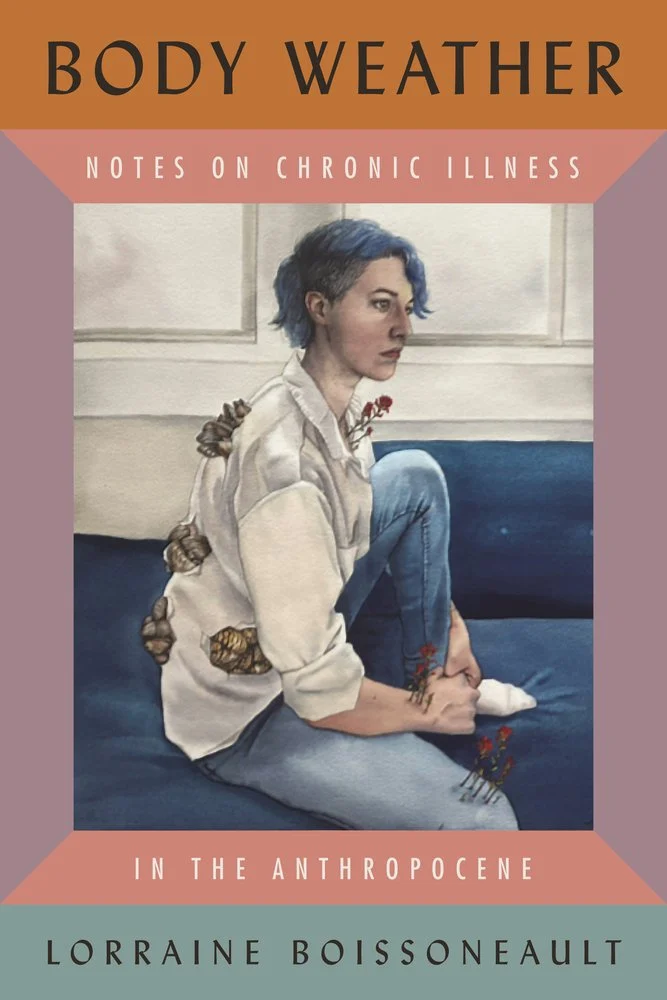
After being diagnosed with six autoimmune diseases, Boissoneault began mapping her body’s systems onto weather patterns—thyroid onto temperature regulation, heart onto storms, uterus to floods, guts to landslides, and joints to wildfire. In Body Weather: Notes on Chronic Illness in the Anthropocene, Boissoneault argues that chronic illness and climate chaos connect: Regulatory systems that once self-corrected are breaking down and warnings are dismissed. Those most affected are told we’re overreacting.
Since 2025, the Trump administration has terminated and frozen thousands of climate science and medical research grants, while gutting the Environmental Protection Agency. Meanwhile, chronic diseases are rising worldwide. People are getting sicker while the infrastructure meant to cure them is collapsing. Boissoneault’s book lands in that collision.
Boissoneault’s book gave me a way to talk about my own experience with illness. I was diagnosed with lymphoma at 29 and spent months convincing doctors that something was wrong before they found tumors the size of baseballs crushing my heart and lungs. I’m in remission now, but I still wake up checking what hurts, or wondering if today is the day something will appear on a scan. Body Weather gave me a way to talk about that: My body is weather I cannot predict. We spoke over Zoom in late March, a few weeks before her book’s release. She was smiling inside her home near Chicago on an unseasonably warm, sunny day—the type of stable weather, she told me, that her body responds to best.
Leslie Nguyen-Okwu: You’ve published in The New Yorker, Smithsonian, JSTOR Daily, and more—a lot of science and history journalism. When did you decide to turn inward and write about your own body instead of reporting on other people’s stories? I spent years as a foreign correspondent covering displacement and statelessness, and that pivot from external reporting to internal experience feels like crossing a different kind of border.
Lorraine Boissoneault: Yes, absolutely. I love that way of putting it. It is crossing a different border, and I was very resistant to crossing that border. When I started envisioning writing about health, I was interested in the question of autoimmune diseases and why women are so much more likely than men to develop them.
At a certain point, it started feeling very disingenuous not to disclose that I have, depending on how you’re counting, five or six autoimmune diseases, [and] that I have a personal stake in the issue. Even after I made that realization, it still took a little longer to feel comfortable sharing my experiences and writing about them.
I started with shorter things, essays like the one for The New Yorker, and I did a couple for Catapult to get a sense of, do I feel okay emotionally putting this information out in public? Because there’s a lot of stigma still around talking about illness, especially chronic illness. I wanted to see what the reaction would be. The reactions were overwhelmingly positive, and I felt pretty good about it.
One of the most challenging parts of being human is that we’re alone in our bodily experiences.
The other thing was, at the point when I started writing this book, I had been living with chronic illnesses for a decade. So it was not something new to me anymore. It’s not that all of my feelings were perfectly cemented, but I wasn’t so fresh to it that writing about the experiences would be retraumatizing. Whenever you’re crossing from being an outside observer to being the observer of your own experience, feeling in a place where you’re emotionally ready to do that—to me, that’s almost the first thing that needs to happen before you can start.
LNO: You’ve structured the book roughly around the stages of grief—denial, fear, anger, grief, and radical love—and mapped body systems onto weather patterns. When did you first recognize this connection between your body’s dysregulation and our climate systems breaking down? And what made you organize the book around the stages of grief?
LB: When I started thinking about what was happening at the same time around me in the world, that’s where the weather aspect came up. I was having these heart issues at the same time as I happened to be living through a lot of intense storms, tornadoes, hurricanes, and that’s an interesting coincidence. That was the first piece of putting the body and weather systems together. And from there, it was like, oh, that might be a useful organizing principle for writing about this.
As for the stages of grief, I realized that there was an emotional aspect to each of the sections in how I was thinking about my body and climate change and the weather. I hadn’t meant for it to be the stages of grief initially, but there was something about denial in the first part, and in my experience with first getting diagnosed with thyroid disease—it was real, and I also almost couldn’t believe it, I couldn’t absorb it. I’ve heard from other people with chronic illnesses and disabilities that that’s a common experience. You don’t know how to process it at first.
That immediately reminded me of the ways people talk about climate denialism and even how we go about our daily lives a little bit in denial of it, because for most of us, it’s hard to grapple with, to know what to do. And from there, it was easy to pull out the other emotions like anger and grief. I think it also helped with forward momentum, so it doesn’t feel like disparate essays but like an emotional journey.
LNO: Let’s talk about “body weather.” The phrase itself captures something that clinical language can’t. What does that term mean to you? How is it different from how doctors talk about chronic illness? When I was diagnosed with lymphoma at 29, my oncologist used words like “aggressive” and “dysregulated,” terms that sounded more like storm warnings than medical explanations.
LB: I love that reframing of medical language as weather warnings, that’s awesome. Body weather was a way to capture both the hugeness of what I was experiencing and what I felt like the world has been experiencing with climate change and the individual nature of it.
One of the most challenging parts of being human is that we’re alone in our bodily experiences. We can try to use language to convey what’s happening, and with medical technology, we have so many ways to see inside the body. But it’s like with the [1-to-10] pain scale: Everyone I know who has used it says it sucks. It doesn’t communicate very well what our physical experiences are like.
For me, body weather is finding nonmedical language to express what it’s like to be alive in this moment. And I don’t think it’s limited to chronic illness or disability. I think everyone has their own body weather. It’s a matter of paying attention to it. We live in a culture where we’re so often meant to be distanced from our bodily experience, separated from it, whether that’s because we have to push through work or childcare or illness because we don’t have good health insurance, or other different things. I want body weather to be a way to reintegrate with the way we experience the world outside of us, and the way we experience our bodies and our inner worlds.
LNO: You spent years being told your symptoms were psychosomatic while your body was genuinely breaking down. The book connects this medical gaslighting to climate denialism. When did you first see that parallel?
LB: What it came down to for me is recognizing power systems, because medical gaslighting is a lot about maintaining power for those who are at the top of the systems. This is not to say that all doctors are bad or nefarious or unwilling to see their patients, but a lot are. A lot do not take seriously the fact that patients are knowledge holders of their own bodies and experience.
Any time war is waged, that is always ecological damage as well as human damage.
I think it’s similar to climate denial. The science has been there for a long, long time that this was happening, and there were powerful forces in the oil and gas industry trying to sow doubt about that, because they have the power to do that. They have the money and the lobbying groups to go to the government in a way that individual citizens don’t. They want to keep that power. They want people to be in doubt, so that the large majority of the population that is not oil and gas executives won’t use our concerted energy to push back against this and demand change. And so far, it has worked.
I think a lot about how, in both the energy and environment sectors and the medical sector, systems of power are upholding structures that are damaging to the people underneath but beneficial to the people who are on top.
LNO: The final section includes essays on “Colonial Control” and “Our Disabled Ecologies.” You’re connecting chronic illness to larger systems of extraction and control. How did you make that connection feel concrete when you’re writing from lived experience rather than theory?
LB: One of the hardest parts of writing this book, apart from the emotional side of it, was recognizing that I have colonizer ancestry: French Canadian, German, a few other things. I am part of the story of the environment being ravaged for resources, and of other people being subjected to horrible displacement, to murder, to slavery. It was hard to figure out how to situate myself as experiencing the harms of the medical system and [also] wanting to highlight all of the ways that people who aren’t me, people who look different than me, have very different life stories than me, are harmed even more. The system is bad for pretty much everyone except the people who are at the very, very top. But it’s worse for a lot of people than it is for me, and that’s important. It’s not necessarily that I think those are my stories to tell, but I don’t want to ignore or downplay them either.
That’s the part of the book I’m honestly most nervous about. I don’t know how people will react. Some people might get angry. Some people might feel I’ve done it wrong. And I have to be okay with that. The writing process is a continuous process of changing and growth.
LNO: How do you make meaning from something that’s ongoing, that doesn’t have an endpoint or resolution? I’m writing a memoir about cancer, and I keep running into this problem—the experience won’t stay in the past tense.
LB: I love this writerly question, because I think it is something that anyone writing a memoir about ongoing issues, especially sickness, has to grapple with. I wish I had a better answer. When I wrote the first part of the book about my thyroid disease, there was nothing about me having hyperthyroidism—where your thyroid is overactive—because it hadn’t happened yet. Never in a million years did I think I could develop Hashimoto’s and Graves’ disease. I still don’t understand it. When it did happen, it was like, oh, I guess I have more to add to the story. It fit well with the Death Valley material I had been writing about already. It’s not that I wanted to have another thing go wrong, but for the sake of storytelling, it worked well.
But I also didn’t include anything about developing a vocal cord disorder because I didn’t know what to say about it. It was so fresh and raw when it happened. The disorder is called spasmodic dysphonia, and it’s rare. People generally haven’t heard of it. I didn’t know how to talk about it. I felt a little embarrassed.
In writing, because it’s a static thing—once a book is in the world, you have to decide where the narrative stops for your readers. That’s a personal decision. And making meaning out of your experiences, that’s also personal. I know a lot of people who completely reject any sort of meaning in their experience of chronic illness, because it’s suffering and it sucks. That’s totally fair. It is suffering and it sucks.
For me, it felt very psychologically healing, if not physically healing, to find a way for it to mean something. I still don’t exactly know what it means, but I think it gave me a different lens through which to view the world and the environment, and I’m grateful for that. I still wouldn’t choose to get sick. But I am grateful for that.
LNO: It’s empowering, I think, to tell your narrative in the way you want to tell it, especially if you haven’t been able to do that for whatever systemic reasons—the medical system, the racism of this country, or the immigration system. With that, your book doesn’t offer false comfort. It also ends with radical love rather than despair. And it publishes on Earth Day. That timing was intentional. What does it mean to you?
LB: I love Earth Day, so it’s an honor and exciting that my little book gets to be paired with this bigger connection to our planet. But to what you were saying—the moment that we’re in, where these crises are accelerating—it’s hard not to feel depressed sometimes, because we’re seeing such a wanton desire for destruction and harm, both in the U.S. and abroad.
Any time war is waged, that is ecological damage. That is always ecological damage as well as human damage. I think of the black acid rain falling in Iran because of the bombs on oil refineries. That’s terrible for the people. That’s terrible for the ecosystem. It’s almost always both things.
What gives me hope, and why I want the book to end with radical love and not doom and gloom, is that there are so many people resisting these destructive forces. I’m in Chicago, and there were ICE agents here last fall, and people were joining brigades and showing up for their neighbors. Community members standing up and saying, we don’t want this. That gives me so much hope.
Disability and illness will happen to everyone if you live long enough. That is as inevitable as death.
It’s easy to be despairing of the human race, but I think most people are doing their best on any given day and are deeply in opposition to the things that are happening, even if they don’t fully understand a lot of the connections between climate change and human health. I think we have to make the choice to turn away from despair, because that means giving in and becoming complacent with the terrible things that are happening.
LNO: What do you want readers who are living with chronic illness to take away from this book? What about readers who aren’t yet sick, but might be?
LB: For readers living with chronic illness or disability, I want them to feel less alone, because there were moments when I felt so alone in it. I want them to understand the frameworks of ableism that can make us feel terrible about our bodies, about what we can and can’t do. And to not be afraid of considering themselves disabled or thinking that they might never get better, because for a long time that tormented me—the idea that if I did all the things right, I wouldn’t be sick anymore.
Once I started developing a disability community, it was so much easier to accept that I have chronic illnesses. They’re not going away. I’m doing the best I can, but I don’t have to solve them. I don’t have to fix them. My life is just as valuable and worthy as anyone’s regardless of what I do in my day.
For people who aren’t sick yet, my number one message is that disability and illness will happen to everyone if you live long enough. That is as inevitable as death. Pretending otherwise is willful delusion. It’s not that you have to be thinking about it every minute of every day, but upholding ableist values and beliefs about what a good life is, what a good body is—I want people to start rethinking that, because you don’t know what’s gonna happen to you tomorrow, a week from now, three years from now. Nobody knows.
If we as a society are more willing to view all bodies, all people, all life experiences as equally valuable, dignified, worthy—I think we would save ourselves, individually, a lot of pain and suffering when bodily change comes for us.
My life is harder than it was before I got sick, and some days are definitely worse. But I have a good life. I try to emphasize this to everyone. I have a good life. I’m lucky in a lot of ways. I have health insurance and a partner who’s very loving and supportive and stable income, and all of those things make a huge difference in the experience of illness and disability. But getting sick, having a new disability, does not mean your life is over. It means learning a new way of living.
Queer and trans people have always existed on the prairies, among First Nations prior to European colonization and among the tapestry of nations that call the prairies home today. In Canada, the prairies stretch from east of the Rocky Mountains in Alberta, through the grasslands of Saskatchewan, and past the rivers and lakes of Manitoba. The land where we reside is mostly flat, our winters harsh and summers sometimes harsher as forest fires and floods become an increasing danger. It can feel as though there is nowhere to hide amidst the terrain that surrounds us, and yet many of us hide out of necessity, out of survival. In doing so, we rely on each other.
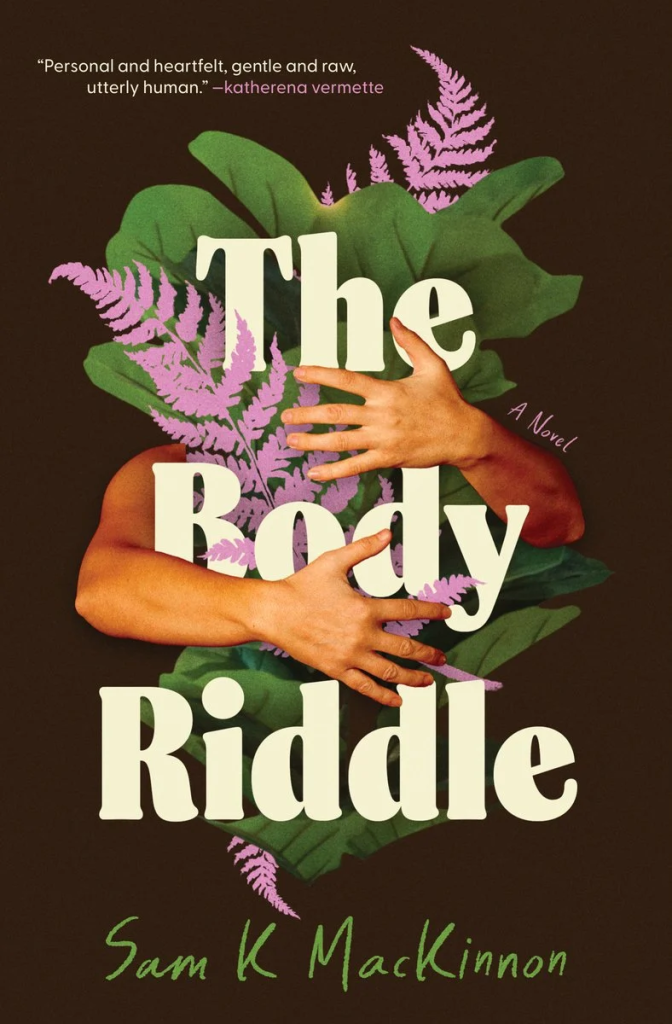
The characters in my book,The Body Riddle, grapple with isolation and connection, and what it means to build a chosen family in Winnipeg, a prairie city of over 850,000 residents situated in the longitudinal middle of Canada. The protagonist, Lex, changes in tandem with Winnipeg’s weather. The story opens in winter, when everything feels unbearable, only to move through spring and summer, where Lex begins to hope, and eventually savor, the world around them. I wove specific Winnipeg experiences like the Winnipeg Folk Festival through Lex’s story, where, for Lex, the mind-bend of heat and music and throngs of people leads to dizzy experiences and questionable decisions.
The below books examine what it means for queer and trans people to weather coming of age, falling in love, finding and losing family and community, all on the Canadian prairies. They challenge the notion that community can only be found in cities, they search for hope amidst hardship, and they celebrate the magic of queer joy.
Jonny is living in Winnipeg and saving up money from cybersex work to return to the rez for his step-father’s funeral in seven day’s time. The book moves fluidly through time following Johnny’s reflections on his life and growing up on the rez as a young gay boy. As he unravels his past, Jonny weaves a narrative of desire, kinship, hope, and place. He reminisces about his beloved kokum, her humour, her lessons and stories. A bath brings thoughts of his relationship to water, the nearby Red River and the Peguis rapids he had sat on the banks of as a child and imagined life as a crawfish. He gravitates toward Tias, a childhood friend and lover who loves and understands Jonny deeply, and is also in love with a woman. Jonny is endearing, heartfelt, and deeply human.
Wendy is a trans woman living in Winnipeg who, upon her grandmother’s death, hears news that suggests her grandfather might have been trans. Questioning her family of origin and the Mennonite culture she grew up with, Wendy navigates obstacle after obstacle during the frigid Winnipeg winter: The gift shop where she works is closing, and her future income uncertain, she returns to sex work; her friend Sophie goes missing; she and her roommate are about to be evicted. Wendy finds solace in alcohol and in a group of trans women who care for each other when the rest of the world doesn’t. Little Fish is dark—through both long winter nights and tragic circumstances, but its story is honest, and engenders hope through the power of community.
27-year-old Issac Funk was excommunicated from the fictional town of Newfield, Manitoba when his father caught him kissing a boy at his high school graduation. But when he gets word he’s slated to inherit his grandfather’s farm—but must stay at the farm for six months to receive it—Isaac returns to the place that once rejected him. While staying with his emotionally distant father, Abe, Isaac begins reckoning with the difficult memories of his youth and how they shaped the person he is today. To his surprise, Isaac realizes things have changed in Newfield, people included. Not all those from his past are who he once thought they were. The longer Issac spends in Newfield, the more he realizes there could be a place for people like him in this small prairie town—but it’s up to him to create it.
Arielle Twist’s poems tackle sexuality with unflinching honesty. In the poem “Dear White, Cis Men,” Twist examines both her desirability to and desire for white cis men from her perspective as an Indigenous trans woman, noting the thin line between validation and violence. Examining the ongoing effects of colonization on the body and the poet’s sense of home, “Prairie Beneficiary” is a brief but powerful poem, and “Is This My Home?” questions where home truly lies for the poet, pairing childlike wonder in the “never-ending fields of flowers and grass” and moments of youthful freedom, with pain and violence while growing up in the intersection of queerness and Indigeneity.
With razor-sharp precision and an inviting sensibility, Undi’s poems examine Winnipeg in all its contradictions, with poems navigating love, despair, desire, and injustice. A standout poem is “Ode to 200 from Each of my Tits,” a glittery, love-filled ode to dancing and togetherness at Winnipeg’s longest standing queer bar, Club 200. The poem “Girls Who” examines the narrator’s complex feelings towards other girls, from high school hallways to queer clubs, how awe, fear, and desire can sometimes be isolating, other times invigorating. “Auto-Epithalamium” tells the story of a new and deepening romance with memorable, intimate lines, like “I am glad to be the thing under your finger”.
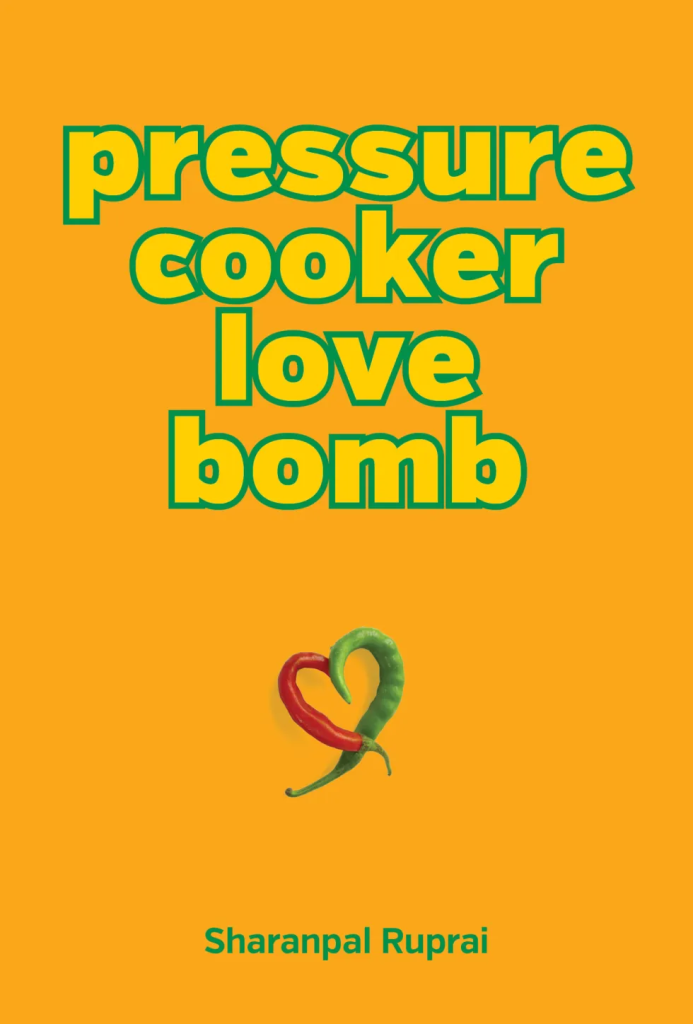
Playful and enticing, Sharanpal Ruprai’s poems in Pressure Cooker Love Bomb turn cooking into a sensual act. Family history and recipes are intertwined, morality rules are given but silently questioned. Full of cheeky “loopholes” to these rules, like “nobody said anything about gender,” Ruprai examines Sikh marriage customs and how they might apply—or not apply—to the poet herself. In “pride march,” Ruprai paints a joyful scene of queer South Asian love at a pride march, lovers walking “in the middle of the road” and taking up space. Some poems reflect back to childhood, to when role-playing a Bollywood movie at a sleepover led to a first kiss. Other poems are situated in the present, delighting in the magic of the poet’s “love bombs” and tabla escapades. All the while, Winnipeg is a background pulse: “learn how to survive in place / is the only option for us on the prairies.”
The indie rock/pop duo Tegan and Sara, twin sisters from Calgary, Alberta, narrate their teenage years in alternating chapters in the memoir High School. Their individual discoveries of their queerness happen alongside each other, though they initially keep their identities secret from one another. Their growing love for making music is a constant thread as the twins navigate drugs, sexuality, and friendship drama, with their deep connection as sisters and twins holding them together. This memoir tells the story of the start of Tegan and Sara the band, but it is also a mid-nineties queer coming of age story filled with nostalgia.
An excerpt from Attention-Seeking Behavior by Aea Varfis-van Warmelo
You should know that when I found the body I did not scream.
On the phone, I feigned humanity. I performed the inflections of a person overwhelmed and confused, but the fact was ‘no, he is definitely not breathing and there is no pulse.’ I stood by him patiently as we waited for the police to arrive, hoping no dog walkers or joggers would amble near. I admit I drank my coffee, though I put my croissant in my bag for later.
The police asked their many questions and I was pragmatic in my answers. I felt like I was their colleague, my memory was so clear and my recounting so efficient. I felt like I answered in a way that suggested I was inured to horrors—humbled by them, perhaps, but no longer frightened. I said the precise time I had found the body (I’d checked), I indicated what footprints in the snow were mine and I described his original position, before I’d moved him to check for breath and pulse. They said I’d been very helpful, but I think they say that to everyone.
The man had frozen to death, this much was obvious to everyone.
I did not tell them that there was an immaculate beauty to the scene when I’d first found it, nor that I’d felt a weightless intimacy between me and this man as we’d waited for their arrival. I did not say that I felt like my life was supposed to be altered by this chance encounter, but it hadn’t in the slightest. If anything, I felt like this was meant to happen to me.
You should know that on the way home I ate my croissant.
I have never told this story before.
I think of the body most often at parties, when I miss a social cue or I am strange and sharp. In the second of silence and my rude, polite smile that follows, I think of how this happened to me. That one icy morning in December, likely hours after he had slipped away privately and quietly, I was the person who found the dead man, I was the person who penetrated the secrecy of his death and now I am the one who carries it. So in cold moments, when I have not been right as a person, I know it is because I have a death inside of me. This thought is very comforting to me.
I have never told anyone about this before. There is no way to prove that it happened, but why would I lie?
You should know that I was born a normal child and my parents loved me as best as they could, which is all you can ask of parents.
You should know that when I found the body I felt sick.
The helmet was cracked but his face was concealed. Blood had pooled around him already—glassy and still, catching my headlights like a perfect mirror. His limbs were wrong.
I put my hazard lights on then called the police.
The second time we slept together, Normal Ben lay in my bed, soft and supine. After his practiced gesture of tucking my hair behind my ear, he told me that, on some level, I remained a mystery to him. He asked me to tell him something private, maybe something I’d never told another soul. The question was obviously rehearsed, and its obviousness was endearing.
I told him about when I found the body. I told him what he needed to know about it, I told him I cried involuntarily while waiting for the police, I told him about the enormity of feeling grief for a stranger. He asked if I was telling the truth. I asked who would lie about something like that.
You should know that when I found the body it was bloated beyond recognition. I smelled it before I saw it.
He looked disquieted. Said, ‘That’s a lot.’ Then, ‘Did it fuck you up for a bit?’
I asked if I seemed fucked up.
The signs are all over your face, apparently. That’s where you can see it. But you can’t spot it without formal training.
You should know that the body was warm, once.
Allegedly the amygdala, that small almond structure in the limbic system, the seat of your brain, knows the truth and it reveals itself in microexpressions. You can try to lie—make your gestures and expressions match how you should be moving—but apparently the amygdala knows the truth and will always give you away in a split second. Anyone could read the signs, with training.
This is not true, but many people believe it, therefore it is as true as any other fact may be.
Normal Ben said I seemed to be managing okay.
You should know that the first time I found the body I was five years old. He was lying on my bed, silent as a stopped clock.
You should know that the first time I found the body I was five years old.
I felt about it as I should have done and the feeling lodged itself in my stomach.
His mouth tipped open when I adjusted his head and with that motion air slipped into him. When I placed him back down on the pillow he sighed. It sounded living. I repeated the gesture twice and each time there was the same release. The air was ignorant of its passage through this object.
The moment was changed, like many are, by a thought crossing my mind—a recognition. I couldn’t touch him anymore. I slid under the bed and felt his great weight hovering above me, then slept there for the three days it took the body to leave.
I liked Normal Ben because he made me laugh as much as I made him laugh. He cared about language as much as I do, but with a hobbyist’s ease and pleasure—he only really cared about language as the natural byproduct of being devoted to laughter and flirtation.
I also liked Normal Ben’s arms, which were firm and beautiful. He approached his body the same way he approached language. He didn’t have a love of sports, but he did love his friends and he wanted to play whatever sports they loved, so every weekend Normal Ben would either play football, go climbing, cycle to Richmond Park or play tennis, each one until he was satisfyingly drenched in sweat. Then he and his friends would drink enough to make a day feel complete, go their separate, meandering ways and then Normal Ben would reach his flat, have an efficient shower, and sleep face-down in a room with the windows open as wide as possible. The result of these athletic habits was that Normal Ben’s body was a relief map of the various ways he showed physical devotion to the people he cared about. That none of this beauty was contrived meant that when a gesture revealed a graceful muscle ridge or sinew I had an insurmountable urge to ravish him.
Normal Ben had been born as he was and he had never doubted that. His parents had loved him as best as they could, and I always suspected that his parents were better at loving than mine.
We had a hundred running jokes, but my favourite was the one where we’d start a statement with ‘you should know this about me’ and follow it with something either innocuous, absurd, or universal. ‘You should know this about me, I have to sleep a certain number of hours to survive’, ‘You should know this about me, there was a brief period when I was a baby where I couldn’t walk or talk’, ‘You should know this about me, I was the guy who shot JFK and I’m worried I will kill again.’
I started it on our first date, but he made it last. As I slid out of the pub booth to head to the bathroom I announced, very seriously, ‘I’m leaving my bag here, but you should know this about me: I really hate it when people I’ve just met steal my wallet and commit identity fraud.’ I made this stupid joke on every date and it always got a stupid laugh. That Normal Ben did not even smile helped persuade me to like him. He said, ‘Okay, but you should know this about me: those are my two favourite things to do.’
At the end of our first date we stood at his bus stop as he said things about work and waking up early and I said that was fine, of course. Then in the heavy, silent beat that is the cusp of indulgence, I took his hand and ran my nail from his wrist down to the centre of his palm where I pressed just hard enough to hear him take a shallow breath, which meant I’d won.
In my bedroom I did not feel like his body would be a unique and new discovery, nor that what it would do to me was unique to him alone. I thought that, at last, he was on my level, no one could be a better person than I was here. So I stroked his neck and chest the way I did everyone else’s, and he tugged at my jumpsuit the way everyone did and said the customary ‘how the fuck do you take this thing off’ it had been subjected to so many times before, and when I reached down and he wasn’t hard yet I said ‘are you Catholic or something?’ between coating him in kisses and before he could answer I said ‘because I give you permission to sin. In fact I insist on it, you can go to confession later’ and as he started speaking I said ‘I can sense your remorse! I can sense your hesitation! But it’s allowed, you’re allowed to get hard! You’re allowed to fuck my brains out!’ and his laugh was so sexy it made me grateful God made me funny and especially grateful that Normal Ben found this arousing because now successful I kissed him deeply, placed my hand around his throat and pressed against his cock which was reliably hard, pressed his jugular and asked what the worst thing about him was and before he could answer I said ‘I think it’s probably that you’re so good looking you don’t have to try very hard at all do you, people just give you things don’t they’ and batted away his hand as it tried to resolve my jumpsuit, ‘I think it’s probably that you’re too secure’ and he groaned and grabbed my waist, pulling me hard against him, said he fucking hated me and then I said ‘what’s your mother’s name?’ to which he flipped me over, in his swift and athletic way, so he lay on top of me and finally clamped his hand over my mouth and told me to shut the fuck up but faltered again at the jumpsuit and I wriggled smugly under him as he struggled to undress me until he rolled off, defeated, and I kissed his neck in that soft way you’re supposed to and stroked his unrewarded penis and said ‘tell me her name’ and he sighed deeply, eyes shut and defeated, and whispered ‘Maggie’, and I peeled my jumpsuit off in an instant, went down on him and let him grip my hair like everyone does and then when he’d grabbed and moved me and was inside of me, eyes shut and rough, I gasped and grabbed and said ‘call me Maggie’ and with the briefest pause in his thrusting he said ‘I have literally never met someone I wanted to fuck more and less simultaneously’ and muted my laughter with his hand again and then there was hardly any talking and later when he came it was very good, it was like a punchline, it was like being understood.
Then in the pause, the space of clean up, heads on shoulders and eyes shut with deep contented breathing, a laugh rumbled through him slowly until he indulged in it fully, and after it had infected me and we were both laughing and I asked him why three times he took a deep breath and admitted, serenely, ‘Her name is Sally. And yes, I am Catholic, but lapsed. And you should know this about me—I will never say my mother’s name when I’m hard.’
Normal Ben never thought about language, but he knew how to play its game with me. This is why he was allowed in my bed, why I held his hand in public and why I fully surrendered to his kiss.
It didn’t seem to worry him that the more a conversation is filled with laughter the less is truly said, nor that every story about my life was narratively smooth and ended with a neat conclusion. I suspected only a subconscious awareness, the slightest suspicion, of the fact that every time he laughed at my jokes he validated the character I’d invented for him and encouraged me to continue performing her.
That he believed me is not his fault; everyone does.
This slight suspicion must have been what led to him asking, the second time he’d met me, for something real.
To stop that suspicion growing I had to tell him about finding the body.
That he believed me is not his fault; everyone does.
This notion that the amygdala secretes truth in the flickers of eyelids and the twitching of lips is almost comforting—it suggests that no matter what I say and no matter what people believe, there will always be this impenetrable lump of truth inside of me. When I’m overwrought and sick with self-hatred, I’ve felt it throb, hot inside my skull. I picture it as a gold and glowing gland, inhibited by some kind of blockage from secreting its truth throughout my body. I used to feel there must be a simple cure and it was my fault for not wanting it hard enough.
After I told him about the body, Normal Ben reclined and gazed at my ceiling for a few silent seconds. In his eyes I saw the visible outline of a corpse, my footprints in the snow, my broken breathing as I phoned the police. He pulled me into an embrace and pressed his chin to the crown of my skull. It was too intimate a gesture too soon into knowing each other. His embrace tightened. I liked it.
Everything I had told him until then led to this moment. An act of kindness I didn’t deserve. I liked it so much.
He fell asleep shortly after, still holding me. I slipped out of his grasp to get a glass of water. On the way out of the room I was struck by how little his face was changed by sleep. Apart from a minor loosening between his brows, it seemed to me that Normal Ben’s unconscious might be indistinct from his conscious.
I stood in the dark kitchen watching the shadows and light play across the brick of the opposite building, watching a neighbour pacing in his bedroom. My skin prickled where Normal Ben’s arms had been wrapped around me. As I swayed in the dark my amygdala throbbed in protest. The neighbour opened his window and climbed onto the ledge. I looked away before he jumped. You should know I heard the impact.
This is what happened when I told Normal Ben about finding the body.
He kissed the back of my hand, our fingers interlocked, sat up and asked me to tell him something I’d never told another soul. It thrilled me. I rested on my elbow, so I could look him in the eyes, and asked ‘Why do you want to know something like that?’
I wanted to offer symbols of resistance, so when I gave my confession he felt like he’d earned it.
‘Well, you’ve interrogated me about my relationship with my mum enough, so I think it would be fair for you to tell me something too. And, I don’t know, you’re doing this whole mysterious and aloof thing, and it’s working, obviously, I’m here. But you are actually still a bit of a mystery, and,’ he shrugged, ‘I guess I just want to find out what else I should know about you.’
‘Isn’t premarital sex enough? What more could you possibly want from me?’
‘I could get that anywhere, you’re not special.’
I could have felt pity for the fact that he wanted me to trust him—it could have been pathetic, but I also sensed that if I rejected him he wouldn’t try again, and the integrity of that was very appealing. And a surprisingly large part of me wanted to receive his trust. I knew it would feel good, maybe better than anyone else’s.
It didn’t even occur to me to tell him something true.
I told him that I was walking through Battersea Park two months ago, in December, and that when I found the body I didn’t scream, though I’m not sure why. I told him I’d never called 999 before and felt surprisingly nervous about it so I practiced what I had to say before dialling and then when I did I was surprised by how quickly they answered, and surprised they asked me what service I needed. I hadn’t realised I would have any choice in the matter. I said police and told them where I was, what I’d found. They said they were on their way. And then I waited. I avoided Normal Ben’s eye contact when I admitted to crying, very briefly, while I waited. That I’d cried because a thought had crossed my mind: I’d wondered what the body’s name had been. That it seemed silly to cry over that. Then I said it was an irrelevant detail, I wasn’t sure why I mentioned it. I paused. I inhaled deeply. I looked back at him when I said the police were very nice and sensible and it was reassuring actually. That after they’d asked me all their questions I walked out of the park in a daze, feeling incredibly aware of myself and my surroundings. That I came home and had to join a work call, so I did. That I felt like I was being weird on the call, but slowly remembered how to be normal. That by the time the call ended I felt like myself again. That I decided I shouldn’t really talk about what had happened that morning, because I wasn’t sure how I felt about it. That I still wasn’t sure how I felt about it. But I was relieved to talk about it now, actually.
As he listened to me I saw him learn what he needed to know about me: that I was someone who had encountered enough pain in my life that when I experienced a new grief it touched me to the quick, joined the rest of my history, rattled me, but did not compromise my humanity. Perhaps it even deepened it. He learned that I was someone who could look after herself. He saw an opportunity to look after me too.
I said I was sorry and laughed and said ‘oh god, I’m so embarrassed, that was way too heavy.’ I said he probably wanted a different kind of confession, like how often I stole chewing gum from Sainsbury’s. Which was ‘every day, by the way. Every single day.’
He didn’t laugh. He looked at me with a fold of concentration then let out a deep breath. ‘That is intense, yeah,’ he said, still frowning. ‘That really happened?’
I laughed. ‘What, like, did I make it up? Who would lie about something like that?’
‘No, I don’t mean . . . It’s just. Yeah, it’s a lot. Did it fuck you up for a bit?’
I gave an exaggerated shrug. ‘Do I seem fucked up?’
He still refused to smile. ‘Well. I mean, every day is too often to be stealing chewing gum, if we’re being honest. There’s something pathological about that.’
He reclined into my pillow. I was excited to watch every beat of my story replay across his face, chased by the thought of my dead mother. He looked like he was about to speak but instead pulled me into an embrace, pressed his chin into the crown of my head and said, ‘No, you don’t seem fucked up.’
As I fell asleep I thought of Normal Ben’s arms. I thought of my neighbour’s body. I wondered when it would be found.
You should know I’ve never told anyone I am a liar before. You should know I know the consequences of making this confession.
In the morning Normal Ben paused as he was putting on his shoes. He asked me why I’d said I needed the police instead of an ambulance. I tugged and undid his shoelaces with my toes and said I didn’t know why, but as soon as I’d arrived it felt like a crime scene.
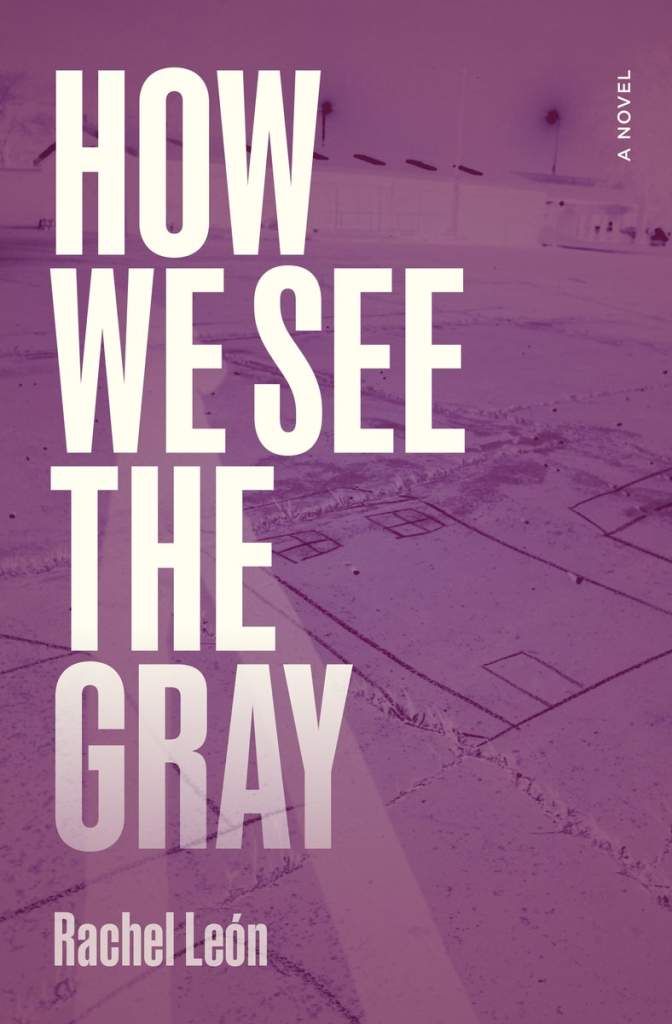
I drove a little over an hour past barns and water towers to Rockford, Illinois: home to Anderson Japanese Gardens, Pig Mind Brewing (best vegan food in the Midwest, according to the internet), and social worker/parent/editor/debut author Rachel León. I have long admired Rachel as my editor at Chicago Review of Books, and know her to be kind, intelligent, generous, and thorough. They have also worked in child welfare for almost two decades. So it came as no surprise to me that their Rockford-set novel about the foster care system, How We See the Gray, is a compassionate and nuanced portrayal of the people impacted by the system, its limitations, and its shortcomings. The story is also about second chances: who gets them, and who is wrongfully denied them.
With sharp, funny, and heartbreaking prose, Rachel builds a cast of characters readers will root for. Their disappointments and dreams are deeply felt, and the stakes of their stories tangle. If a completely happy ending is impossible in this web of stories about the trauma of fractured families, How We See the Gray delivers the next best thing, or perhaps something even better: satisfying, realistic paths towards forgiveness, healing, and hope.
I was eager to speak with Rachel about the many perspectives, vibrant characters, and not-so-miserable city at the heart of the novel. I was terribly grateful she met me at Pig Mind Brewing (which I can confirm is incredible) to discuss their book, out May 15th from Northwestern University Press.
Jen St. Jude: Let’s start with Rockford! The city is so clearly a character in the story as well; it hums behind all of the action and dictates the landscape of these characters’ lives. Why did you set it here?
Rachel León: When I began writing fiction, I set everything I wrote elsewhere. While I was born and raised in Rockford, and still live here, for a long time, I felt shame about where I’m from. Historically, the narrative about my hometown hasn’t been good—we’ve made national lists for our high unemployment and crime rates (higher per capita than Chicago) and [are] on a “most miserable cities in the U.S.” list. When I was in high school, the goal was to get the hell out. And when that didn’t happen, I felt like a loser for a long time. So when I started writing, all my stories were set in other Midwestern cities I knew: Chicago, Madison, Milwaukee.
But this novel deals with the foster care system, which I’ve worked in on and off for a long time—I started way back in 2004. And the foster care system varies widely from state to state, even county to county. I’ve had a few Cook county cases and was surprised how differently things were handled—in the same state! Which is all to say, despite my wealth of child welfare experience, I knew I couldn’t set this story anywhere but Rockford. Originally, I wrote it without mentioning place. I had a writing mentor Karen E. Bender who read a draft and noted I was avoiding setting—at times the characters seemed to be floating in space. I wasn’t conscious of my shame about writing Rockford until it was pointed out.
I’m ruthless with my own work. It makes me happy to tear it to shreds.
So I tentatively added Rockford. Not much—and that was still too much for some agents, who wanted mention of my hometown taken out. They felt that this story needed to feel like it could happen anywhere for it to have universal appeal for readers. But ultimately, this story and these people are very specific to this place. The characters are shaped by this town too.
Megan Stielstra is the editor who acquired the novel for Northwestern’s University’s Curbstone imprint, where they focus on craft-forward writing that engages with social justice issues, and in our initial conversation, her only real note about what the novel needed was more Rockford. I was thrilled. It gave me permission to lean in, offer specificity of this place, and in the process, it actually helped me get over my shame and become proud of where I’m from.
JSJ: I was so impressed by the way you layered the story and developed so many arcs over the course of the book. With so many stories intertwining and threads to tie up, how did you think about plotting?
RL: Obsessively! I know it’s not cool to like plot in literary fiction, but I love it. While I’ve enjoyed many plotless novels, the books I love best have strong narrative arcs, so I wanted to offer that to my readers. But plot is hard! Not formulaic plot, but authentic, character driven plot.
I don’t like outlining, but I did a lot of it to map out each character’s story on its own, but also outlines where I’d put everyone’s story together to look at the overall arc. I was also looking at emotional beats and the emotional textures of each chapter. I wanted to follow heavier moments with lighter scenes, so I did emotional outlines too. I used notecards with different color markers for different characters and emotions and filled my walls. At one point I had one room full of the character outlines, and in another room the emotional beats. It was meticulous and a little mad scientist-y. But that’s how I discovered what was missing from the novel, which helped guide my many, many revisions.
JSJ: Speaking of revision, I’ve had the best time working with you at Chicago Review of Books, where you serve as Managing Director. So I wanted to ask, how do you think being an editor shapes your work as a writer?
RL: I must admit, I love editing more than I like writing. And that’s partially because I don’t consider myself a very good writer! My first drafts are truly embarrassing in their awfulness. It’s through the work of shaping and refining that I turn what I write into something (hopefully) worth reading. I do think I’m a pretty good editor. I can see possibilities in drafts—I typically have no shortage of ideas on how to sharpen a piece. I love editing other people’s work, but I’m also hyper aware that the piece is theirs and it’s my role to help them make it the best it can be while maintaining their voice and intent. Maybe it’s the social worker in me, but when I’m editing someone’s work, I’m very cognizant of their feelings and the trust they’re putting in me so I treat the work with care. But I’m ruthless with my own work. It makes me happy to tear it to shreds. I’m always eager to just get a draft done, so I can get to the fun part.
JSJ: One of the main characters is Meredith, a case worker who, after drinking too much to cope with the stress of the job, almost loses custody of her own son. Did you see her as a bridge, from those scrutinized by the system to those managing it?
RL: Absolutely. Meredith’s character was the genesis of the novel. Like Meredith, I was a single parent who drank to cope with the stress of working in foster care. And at that time, I felt like the line separating me from my clients was so thin—I was only on my side of that line because of my privilege and support systems. I empathized with my clients but also saw how close I was to them, divided by my skin color and education. And other privileges too: Most people see me as cis and hetero, and I present as non-disabled. This novel made me really interrogate my privileges and my own complicity in upholding systems of oppression. Of all the times I’ve let people make assumptions about my sexuality and gender identity because it seemed easier or safer—even when it also hurts. Which brings us back to shame . . . I have a lot of internalized shame for not being out in different spaces. But again, it’s a double edged sword—which goes back to safety and privilege. Even though Meredith is living paycheck to paycheck and lacks family support, she still has a lot of privilege. The same privileges I do.
JSJ: Another main character is Ebony, a lesbian teen in foster care. I loved her scenes; they felt so close to a teen’s voice, and though I was rooting for her, I understood why she made some self-punishing choices. What do you think she brings to the chorus of voices in these pages?
This novel made me really interrogate my privileges and my own complicity in upholding systems of oppression.
RL: I had a lot of fun writing Ebony’s character. She felt really important to the novel. I wrote a draft where she was the one telling the story, but realistically, she wouldn’t have access to most of the characters’ stories.
What I hope she brings to the chorus of voices is a vital perspective in foster care. I mean, if my goal was to offer the reader a bird’s-eye view of the system, it’d be weird to only have adult characters. The system is built for the protection of these kids. And yet because of confidentiality—which is obviously critical—youth in care are faceless and nameless in the media. I wanted to humanize someone impacted by the system, and show that these are real kids with real stories. And like any real person with a real story, there is a lot of complexity and contradictions.
JSJ: Speaking of the bird’s-eye-view, how did you decide on whose perspectives to include, and how to show different sides of the foster care system and these characters’ relationships to it? I’m assuming you wanted to show people who played different roles: worker, birth parents, foster parent, etc., yes?
RL: The novel began as a dual POV story about a caseworker and her former client. As I dug into revisions, I tried pretty much every possibility with POV—I tried it as a single perspective, I wrote it in first person, added some sections in second, tried varying degrees of closeness in third . . . And I played around with how many perspectives to include. At one point there were 13 perspectives. Ultimately, I settled on nine.
It was important to include a range of diverse voices not only because I think it matters, but also because it reflects the reality of my life. Of Rockford. Of the foster care system. The novel’s diversity is reflective of my world. I grew up on the West side of Rockford, in a diverse neighborhood. In the single block where I grew up were people of different races, ethnicities—plus, two gay couples. That’s how I think neighborhoods should be (and books!): with different people coexisting. I notice in novels by white authors that every character is white. It seems odd and makes me wonder if that’s how they experience the world. Because I’m very aware when I’m in all-white spaces. They don’t feel normal or comfortable to me. I’d rather be the only white person in a room, and have had that experience many, many times. I’m grateful for those experiences.
So yes, diversity was a must. I was concerned about writing about the perspective of people who are different than I am, but they deserved their place in the story. I read as many books as I could find about the topic—Paisley Rekdal’s Appropriate: A Provocation, David Mura’s A Stranger’s Journey: Race, Identity, and Narrative Craft in Writing, Toni Morrison’s Playing in the Dark: Whiteness and the Literary Imagination . . . I approached it with a great deal of caution and anxiety. I really wanted to get it right and knew I had limitations, as all writers do. So, I wrote and rewrote the book many times. I did a lot of research and hired sensitivity readers. Some of my research actually helped me realize one character in particular was closer to me than I’d initially thought: Writing Nel helped me understand my own gender identity.
I still have a lot of anxiety about whether or not I got it right and how readers will respond to it. But I know I approached it with a lot of caution, and hopefully, sensitivity.
JSJ: You mentioned nonfiction books, what about fiction? What works were How We See the Gray inspired by? With which books is it in conversation?
RL: I was inspired by Justin Torres’s We the Animals, which might be obvious with the “we,” and also ¡Yo! by Julia Alvarez. (One of the chapters in that novel is actually set in Rockford!) ¡Yo! is a fascinating character study of one woman writer through the perspectives of other people in her life: family, friends, a stalker . . . you get a shifting—yet more complete—portrait of this character through the different lenses. I wanted to also let shifting perspectives complicate what the reader thought they knew about certain characters. Gloria Naylor’s The Women of Brewster Placeand Tommy Orange’s There Therewere two other touchstone novels for me.
As for which the book feels in conversation with, I like to think it talks to Kristin Arnett’s With Teeth, Jessamine Chan’s The School for Good Mothers, Catherine Hernandez’s Scarborough, and another novel Curbstone Books published called God Went Like Thatby Yxta Maya Murray.
JSJ: Another interesting voice in the story is the “We” POV, similar to one of the voices in We the Animals. When and why did this get added to the story?
RL: What’s funny is that I had the title even before a single “we” appeared on the page. The title just felt right.
For a long time the novel was written in third person, and a friend observed the narrator was super opinionated about the system, so much so that it was unclear whose opinion it was: the author’s or the narrator’s. She suggested I check out David Ambroz’s memoir,A Place Called Home, because it steps back and editorializes in the way she could tell I wanted to do. And after reading the book, I decided to lean into that. It was too hard for me to write about the foster care system without including commentary. Enter this chorus of opinionated caseworkers.
I see an interplay between both my roles: as a writer and social worker.
But I also wanted to show the limitations of narration. Foster care has influenced my writing even when I’m not writing about it, because as a case worker, I’m always collecting stories and looking for their limitations. One perspective stories are limited and fall short. It’s why I love multiple POV novels so much. My work in foster care has also been about shaping stories in a way that has a direct impact on my clients. The novel’s opening says it, but it’s true: This work revolves around stories. I see an interplay between both my roles: as a writer and social worker. I think I’m better at both jobs because of my work in the other. I believe being a writer makes me more empathetic in my day job.
JSJ: What I love so much about all of your characters is that they’re allowed to be flawed and human, and like you said, the line between the clients and the case workers is so thin.
RL: Right. The thing that I always go back to in my writing is the theme of mistakes, second chances, and trying to do better. I have perfectionist tendencies where I beat myself up over my mistakes, yet have no problem giving other people grace for theirs. But I believe most of us do the best we can in the moment. Second chances are an obsession in my work no matter what I’m writing about, especially because I think a lot about inherited trauma—substance abuse issues, mental health issues, and other very human struggles. These things also shaped the novel.
JSJ: Along those lines, the story made me think about support networks as a type of inherited wealth. Some people have folks they can call for support in their lower moments, and some don’t. It really matters, and that’s shown here with Meredith and many of the characters who are parents.
RL: It’s true. Community is something I hunger for and often realize I lack in my life, which is something that’s kept me working in foster care for so long. Because the job is so intense, you get very close to your coworkers. You can’t do it alone—I mean, you do most of the job alone, but there’s no way to do it without the support of your coworkers. Because of confidentiality, you can’t go around telling wild stories from your day—the dangerous situations you might find yourself in, the ridiculous things people say to you . . . But they’re too much to hold without processing. My coworkers and I have done a lot of trauma bonding and laughing—the kind of laughter that’s so intense it makes your stomach hurt. And we’ve cried together—there can be a lot of that too.
It’s the people that keep me doing this work—both the families I work for and the people I work with. Being part of a foster care team has been the strongest community I’ve ever been a part of. It’s found family—beautiful and messy. I can’t imagine launching this novel without the support of my coworkers. They’re really excited to see our work in the trenches portrayed in fiction—the incredible challenges and rewards this kind of work brings. I hope I make them proud.
Three years ago I broke my brain. Or, I should say, my brain was broken by grief. That summer my graduate mentor, the writer Aurelie Sheehan, died after a swift and truncated battle with terminal brain cancer. I first learned of Aurelie’s illness in June of 2023, but as I understand it, she received her diagnosis the previous December, and by August she was dead.
The death of a writing mentor is a specific kind of loss. In ways both quantifiable and unquantifiable, Aurelie had perhaps the most significant impact on my development as a writer. She was the only professor I studied under during all four semesters of my time in the MFA program at the University of Arizona, and she had served as my thesis advisor. In the seven years since I graduated, she had written me countless letters of recommendation for fellowships and grants and teaching applications. But more than any of this, my relationship with Aurelie was deeply personal, characterized by love and mutual respect for each other as people and as artists.
In the weeks following her death, I struggled to articulate exactly what Aurelie had meant to me. She was not my friend, though our relationship was friendly. She was not my mother, though she had behaved maternally toward me. When I called my friend Cat Powell to tell her about Aurelie’s passing, she used the term “art parent” to describe the role mentors play in the lives of young writers. That moniker was the most accurate description I’d heard, but even it felt like it failed to fully convey the impact Aurelie had had on my life, especially in my conversations with people who were not artists, and I grew increasingly frustrated by my inability to communicate the exact nature of our relationship. This, I’ve learned, is perhaps the most maddening aspect of grief—the persistent feeling that no one else understands what we have lost because the loss is particular to us.
In the rooms of 12-step recovery, I often talk about the fruitlessness of comparative suffering. I remind people that emotional pain functions in the body exactly like physical pain does. It lights up all the same pain centers in our brains. And because we carry our emotional pain in our bodies, because both emotional pain and physical pain are physiological experiences, our own pain will always be more real to us than the pain of other people. We may empathize with others, but empathy is an act of imagination: It requires us to imagine another person’s experience and call upon similar experiences we have had in order to relate to them. For this reason, other people’s pain is always an abstraction. It is not visceral, which is to say embodied, in the way our own pain is. And though it’s true that perspective can be helpful when discerning the difference in magnitude between our losses and those of other people, comparing our pain to theirs—and by extension our right to feel our pain—is not a productive undertaking. Everybody loses at that game.
But as frustrated as I was by the feeling that no one understood what Aurelie’s death meant to me, my frustration was compounded by the fact that my grief over her death felt inconvenient.
The summer Aurelie died, I was in the middle of what I hoped would be the final revision of a novel I had spent five years writing. With the exception of my sobriety, I had never pursued anything with the same degree of devotion as I had that novel. For 11 months of each of those years, I had written for at least two hours a day on that book. Some months, I wrote for eight to ten hours a day. I’d written the novel three times from scratch, beginning to end. And even during the months I took off between drafts, I was still conducting research for the project. I read thousands of pages of research in service of that book. And after five years, I was ready to be done. I was so close to being done with it.
And then Aurelie died.
One afternoon shortly after her death, I got on my yoga mat and pushed back into downward dog position, and at the edge of my peripheral vision, I literally saw my grief, a presence hovering at the corner of my mat, waiting for me to let it in.
“I see you there,” I said to the room. “I promise I’ll get to you when I can.”
But, I didn’t say. Not yet.
First, I had a novel to finish. I told myself I would grieve once I finished it.
Looking back, I think I convinced myself that maybe I could out-busy my grief. At the very least, I hoped to assign my grief a timetable that would be more convenient for me.
Needless to say, this did not go well.
In a letter for Jami Attenberg’s 1000 Words: A Writer’s Guide to Staying Creative, Focused, and Productive All Year Round, author Megan Mayhew-Bergman discusses her anxieties about producing a novel she felt she could stand behind. “I didn’t want to write an adequate book,” she confesses. “I wanted to write a good book. My first versions felt adequate, not outstanding.”
With the exception of my sobriety, I had never pursued anything with the same degree of devotion as I had that novel.
Reading Mayhew-Bergman’s words, I felt my own insecurities articulated. I had once told my mother, also a writer, that I would rather write a book that did the thing I wanted it to do and never see that book published, than publish a book that failed to do it. I am a competent writer, and I trusted my ability to write a competent book. But like Megan Mayhew-Bergman, I didn’t want to write a competent book. I wanted to write a great one. To settle for competency would have felt adjacent to failure. And yet, even after five years of drafting and revising, I still hadn’t produced a version of my novel I felt I could stand behind.
And so I persisted revising the novel in an attempt to outpace my grief, and as I did, something happened I could not have predicted. I began to experience an ever-present and unbridled rage. I lost patience for anything and anyone. When someone merged into traffic in front of me without using their blinker, I found myself screaming at them from the quiet confines of my car. I was short with customers at work. I became intolerant of my co-workers. And I knew—I knew—that my rage was my grief coming out sideways. My grief was telling me it would not be ignored. Still, ever the optimist, I tried my best to ignore it. I continued to revise the novel, and I continued to rage.
Then one morning my avoidance of my grief reached its limit. I was standing in my kitchen, feeding my tiny dog his breakfast. The tiny dog was 14 years old and the size of a kitten, and the vet had recently prescribed him a diet of wet food. But the tiny dog had become a bit neurotic in his advanced age, and that summer he had begun to refuse to eat his food unless I hand-fed it to him. Did I mention this was wet food? It was a disgusting process we performed twice a day, and it made for a terrible mess. That morning, I stood over the tiny dog and waited for him to eat his food from his dish, and all of my rage boiled to the surface.
“I don’t know what you want from me!” I screamed at him—though, of course, I knew. He wanted me to feed him from my hand. “I don’t know what you want!” I screamed again. “Eat your food! Just eat your fucking food!”
By then the tiny dog was mostly deaf. He just looked up at me and cocked his head. And in that moment all my resistance gave out. “This is not sustainable,” I said. I was so dysregulated, I felt like an insane person. I was so angry, I felt like I was on fire. So I decided to pause the novel revision and allow myself the time and space I needed to grieve Aurelie’s death. For the next month, I did very little. I read, and I slept. I went to work, and I wept on my yoga mat. And twice a day I got down on the floor of my kitchen and fed the tiny dog wet food from my hand.
“I guess this is just what we’re doing now,” I told him.
Slowly my rage subsided, and my patience returned to me. In some ways, this was the last gift Aurelie ever gave me, those moments with my dog on the floor of my kitchen, because one month later that tiny dog—the dog I got when I was 10 months sober and had lived alongside for the last 14 years—stopped eating altogether and died.
I cannot say for certain whether it was the consecutive losses of Aurelie and my dog, or the proximity of their deaths to one another, but whatever the case may be, the combined grief of those losses broke my brain. I don’t know how else to describe it. In the weeks that followed, I felt concussed. I moved through my days in a haze of distraction. I would arrive at my job and not remember driving there. I would stop people mid-conversation and ask them to repeat themselves because I could not follow what they had just said. It became impossible to read or do anything that required sustained concentration.
By then I had set the novel revision aside for more than four weeks, but there was other work that needed my attention. Earlier that year I had started publishing a series of essays about the intersection between the writing life and 12-step recovery and mindfulness practice. The first two essays in the series had been fairly easy to write. Each essay had taken a week to draft and another week to revise. The next essay was on the topic of rejection, and it centered around a piece of advice Aurelie had offered me post-graduation about the difference between the creative and business mindsets. The deadline for the essay was approaching, and I thought writing it might be therapeutic, a way to ease back into my creative work while accommodating my new cognitive impairment.
I was wrong.
An essay that should have taken me two weeks to write, took me more than eight weeks to complete. I struggled to track the logic of the argument, the progression from one paragraph to the next. The harder I pushed through my brain fog, the worse the brain fog became. This alarmed me for many reasons, not least of all because I knew I would never be able to finish revising my novel in that condition. Grief had broken my brain, and now even competent writing felt out of reach.
In hindsight, it probably would have served me better had I simply stopped writing altogether and allowed my brain more time to heal. But I’ve learned I am better when I am writing—engaging in a creative practice has become an essential component to my psychological, emotional, and spiritual health—and in the depths of my grief I was afraid to forego it. So I made a different decision.
I decided to put the novel revision on an indefinite hiatus.
And, in the meantime, I wrote a bad book.
We’ve all read them, have we not? The bad books? The books that sold for six or seven figures. The books that were heaped with critical praise and awards. The books that made the bestseller lists. The books that even our most trusted readerly friends recommended. I’m not talking about the books that are not suited to our tastes. I read a lot, and I don’t like the majority of the books I read. This is likely an unfortunate byproduct of my years working as an editor. I am generally inclined to think that most writing could be better, more thoughtful, more carefully developed, or more boldly executed. I also finish every book I start reading because I believe even books I don’t like have something to teach me about the craft of writing and the art of storytelling. I’m not talking about those books. I’m talking about the books that when we read them seem to us obviously and objectively bad. I’m talking about the books that leave us bewildered, wondering how they got published in the first place, or why they performed so well in the market. I’m well aware that none of these judgments are actually objective. I’m not delusional. And yet I remain convinced that everyone who reads enough has read a bad book.
By late October, I was still deep in my grief and my brain fog still had not lifted. If anything, it was worse. There remained a ceiling to the level of critical thinking I could access. I simply could not get my brain to switch over into a higher gear. I finished the rejection essay, but only with tremendous effort, and the difficulty with which I had completed it convinced me I did not have the mental bandwidth I needed to return to the novel revision. I called my friend Cat to complain about it.
In some ways, this was the last gift Aurelie ever gave me, those moments with my dog on the floor of my kitchen.
Cat was in a tight spot of her own. That fall her second novel had died on submission, the second novel of hers to die on submission in three years. There are many reasons a book fails to sell—anyone in publishing will tell you this—but Cat Powell is one of the best writers I know, and from my perspective, her novel’s failure to sell had very little to do with the quality of the work and more to do with the work’s representation. Either way, the disappointment was crushing. Cat had decided to part ways with her agent and was debating whether to throw in the towel altogether.
“I cannot imagine writing another book only for it to not sell again,” she told me. “I don’t think I’d survive it.” Then Cat paused and said, “But I have an idea—and it’s a good idea, I think—for a short novel I could write.”
“That’s weird,” I told Cat. “I had an idea for a short novel this past summer.”
This was true. Around the time I learned of Aurelie’s diagnosis, I awoke abruptly from a dream. That summer a family of foxes had burrowed into the hillside below my bedroom window, and in the early hours of the morning, one of the foxes had screamed and startled me out of sleep. I shot upright in my bed, and there it was: an idea for a short and spooky literary novel about a woman who travels to an artist colony to research a cursed play. As I lay in bed for the next hour, outlining the premise of the novel in my head, I felt that familiar mixture of excitement and dread. It was a good idea, I believed this, but I did not have the time to write it. I was still only a third of the way through the previous novel’s revision. The next morning, I jotted down a few notes in my journal about the plot and the characters. I hoped the idea would stick around. Then I promptly forgot about it.
When I told Cat this story, she got very animated.
“We should write our short novels together!” she said.
I laughed. “Maybe one day,” I told her.
Then I asked Cat if she had ever heard of The90-Day Novel.
A few years prior, during the early months of the COVID shutdown in the United States, I was taking my daily afternoon walk while I caught up with my friend T Kira Madden on the phone. I was two years into writing my previous novel and had just started the book over from scratch—again. I told T Kira if I ever wrote another novel, I would never write it the way I had written this one. At the time, T Kira was writing a novel of her own. She asked me, “Have you ever heard of The 90-Day Novel?” T Kira explained that though she had not completed Alan Watt’s 90-day novel writing program, she had found the first phase of the process, which consisted entirely of freewriting exercises, extremely helpful. I bought a copy of The 90-Day Novel: Unlock the Story Within shortly after our conversation and read it. The program Watt outlined was appealing, but I felt too far along in my own process to switch approaches midstream. Still, the possibility of using the program for a future project stayed with me. If I ever wrote another novel, I told myself, I would give The 90-Day Novel a try.
After my conversation with Cat, I continued to percolate on her suggestion that we write our short novels together, and I wondered whether using Alan Watt’s program might be a way for me to keep writing without doing any further damage to my brain. I brought the idea to my recovery sponsor during our next monthly meeting. Cathy had been sober for more than three decades and was herself a writer, teacher, and visual artist. She had watched me persevere through the years I spent writing my previous novel, and she understood the impact Aurelie’s and my dog’s deaths had had on my cognitive faculties.
“I think it’s a great idea,” she told me. “I think you’re too saturated with this other project, and you seem genuinely excited by the prospect of writing something new. At the very least, it might give your brain the time it needs to heal so you can return to the other book.”
By that point in my recovery, I had learned to follow directions, so after our meeting I went home and took a picture of The 90-Day Novel with my phone.
I texted the picture to Cat.
Okay. I’m in, I wrote.
The following week Cat ordered a copy of Alan Watt’s bookand we scheduled a phone call to make a plan. I like plans. I like setting plans down with paper and pen. It’s one way I’ve learned to clarify expectations and to hold myself and other people accountable for our actions. During our call, Cat and I made a list of agreements (with each other), commitments (to ourselves), and goals (for our projects) in preparation for The 90-Day Novel.
To begin, Cat and I agreed that for the next 90 days we would follow the program laid out in Alan Watt’s book. Every morning, we would read Watt’s entry for the day and complete the freewriting exercises and/or drafting as prescribed. In short, we would do whatever Alan Watt told us to do. Once we completed the day’s work, we agreed to text each other a short voice-message recording to confirm we had done our writing for the day, along with any insights we’d had or resistance we’d come up against. Finally, we agreed to a weekly phone call every Monday afternoon, during which we would process the week’s work.
In terms of commitments, Cat decided she would work on her novel for two hours a day, but I was concerned about my brain’s ability to sustain that level of concentration, so I committed to working on my novel for one hour a day during the initial phase of the program. Once we began drafting our novels in phase two, I would reevaluate my commitment and adjust it if necessary.
Lastly, we set down our goals for our novels. My goals were fairly simple. One, I wanted to write a spooky (and slightly wacky) literary novel. Two, I wanted to write a short novel. I would aim for 60,000 words. And three, I wanted to write the novel in brief, concentrated blocks of text in which none of the dialogue was offset. It was a narrative mode I’d used often in my short fiction, though I’d never attempted it in the longform before.
Clarifying these agreements, commitments, and goals from the outset proved invaluable—and prescient—because at any point in the process we could return to our lists and measure our progress by how well we were abiding them and gauge whether we needed to course correct.
At the end of the call, Cat and I set a date to begin, the seventh of November. If we followed Alan Watt’s program to the letter, we’d finish our 90-day novels on February sixth.
In the third installment of The Artist’s Way series, Walking in This World: The Practical Art of Creativity, Julia Cameron cautions artists against discussing work-in-progress. “Talk uses creative power,” she writes. “Talk dilutes our feelings and passions. Not always, but usually. It is only talk with the right person and at the right time that is useful. As artists we must learn to practice containment.” Cameron goes on to explain, “Both a person and a project need a roof over their head. Both a person and a project need walls for privacy. Just as it is uncomfortable to have people enter your home when it is in chaotic disarray, it creates embarrassment and discomfort to show a project too early to too many people. What’s worse, it’s risky. Projects are brainchildren. They deserve our protection.”
If I ever wrote another novel, I would never write it the way I had written this one.
I knew from experience what Cameron meant. During the years I wrote my previous novel, I discovered that talking about the work had two unintentional (and unfortunate) effects. First, when the writing was not going well—and the writing was often not going well—talking about my frustrations with other people kept me stuck in an antagonistic orientation toward the novel. I would say things like, This novel is going to be the end of me, or, If this novel doesn’t kill me first. These narratives begged the question: Why on Earth would I want to work on a novel I felt was going to kill me? And for that matter, if projects were indeed brainchildren, why would the novel trust me to write it when these were the stories I told about it? Giving voice to these narratives over and over only reinforced them, and they certainly didn’t leave me feeling remotely encouraged.
The other pitfall I discovered was that so long as talking about the novel was on the table, I experienced a constant low-grade anxiety in my interactions with people. When I met up with friends or family, I found myself bracing for the inevitable question: “How is the novel coming along?” Or worse, “When do you think your novel will be done?” The answer was always the same—“I don’t know”—followed by all the familiar stories and a resurgence of my frustration.
So as Cat and I neared our start date, I decided to take Julia Cameron’s advice. I reached out to all the important people in my life and informed them that for the foreseeable future I would no longer be discussing my creative work. For the next 90 days, I would only talk about my writing with Cat and my sponsor. I would tell no one else I was writing a new novel. This decision also provided me a convenient pivot when anyone else asked about my writing. In response, I asked them if they’d ever heard of Julia Cameron or The Artist’s Way. Then I described Cameron’s perspective on containment and told them I wasn’t currently discussing work-in-progress. If they asked me again at a later date, I simply said, “I’m still practicing containment.”
With our agreements, commitments, and goals in place, and the support of my intentional resting and containment practices, Cat and I embarked on The90-Day Novel. The program is divided into two distinct phases. The first 30 days are devoted to what Watt calls “imagining the world of the story,” and consists of daily free-writing exercises and structure questions designed to lead the writer to a loose outline of their novel. The next 60 days are dedicated to drafting the novel proper.
I bought a large yellow Moleskine notebook, and every morning I read Alan Watt’s entry for the day. Then I set a timer on my phone and responded to the five or six freewriting exercises for five minutes each, longhand. During the remaining 30 minutes of my one-hour commitment, I answered the structure questions.
I knew from my previous reading of The 90-Day Novel that Alan Watt relied on Aristotle’s classical three-act structure and the Hero’s Journey outlined in Joseph Campbell’s The Hero with a Thousand Faces as his models for novel writing. I have a lot of respect for the work Joseph Campbell did to popularize mythic narrative traditions, but I also recognize that Campbell was a product of his time, and the Hero’s Journey has always struck me as an inherently misogynist narrative framework. No sooner did I commence answering the structure questions than I found myself resisting them.
“I hate this model of storytelling,” I voice-messaged Cat.
Cat was sympathetic.
“It’s definitely problematic,” she messaged back.
Then, to her credit, Cat reminded me of our first agreement: For the next 90 days, we would do whatever Alan Watt told us to do.
Goddamnit, I thought.
But yes, I had agreed to this.
Throughout The 90-Day Novel, Watt advises the writer never to confuse the story of their novel with their idea of the story. “It’s not that our ideas are wrong,” he writes, “but rather that through inquiry, a more fully realized story emerges.” I was keenly aware from my years as a mindfulness teacher about the benefits inquiry can yield. I also knew that creative constraints could be generative precisely because they push against our habituated patterns of thinking. They produce friction. My agreement with Cat to do whatever Alan Watt told us to do was an example of one such constraint. So as I continued to reflect on the structure questions, I considered how I could adapt the three-act structure and the Hero’s Journey in a way that might sit right with me.
Early on, Cat had jokingly referred to my 90-day novel as an “art thriller.” I knew nothing about the thriller or suspense genres, but I began to think of the novel’s plot as a series of revelations. Some of these revelations would be uncovered by my protagonist as she researched this cursed play. Others would be revelations for the reader. As I envisioned it, each revelation would introduce a question that was only answered by a subsequent revelation, which in turn would introduce a new question. I began to wonder whether I could map these revelations onto the plot beats of the three-act structure and Campbell’s Hero’s Journey.
Why on Earth would I want to work on a novel I felt was going to kill me?
I bought a corkboard and a pack of yellow index cards (to match my yellow notebook) and commenced scaffolding the plot of my novel with this idea in mind. As I did, phase one of the process became something of a meditation on the many potential narrative arcs of the novel. Like T Kira, I discovered there was real magic in imagining the world of the story, daily, over an extended period of time. A loose outline for the novel emerged, and it emerged organically. I was surprised by how little effort it took. I just kept shuffling notecards around on the board as I answered the freewriting and structure questions and remained open to whatever information I received, like I was taking a kind of spiritual dictation. Even now, I maintain that the first 30 days of The 90-Day Novel are the most useful and brilliant part of Watt’s program.
By the time Cat and I reached the end of phase one, I felt like I had everything I needed, if not to write the whole novel, at least to begin writing it.
Then we transitioned to phase two and all of my openness evaporated.
I took back control of the process and immediately diverged from Alan Watt’s approach.
One of the benefits of belonging to a fellowship of other recovering people is that we’re not all insane on the same day. The same proved to be true about writing a novel alongside another person. With phase one of the program completed, Cat and I began drafting our 90-day novels. I had done the freewriting exercises longhand, but in phase two, I transitioned to drafting the novel on my computer, which has always been my preferred way to write.
This was a mistake.
In phase two, Alan Watt recommends writing 1,000 words a day. For me, this word count was incredibly high. When I write I do a lot of recursive drafting. I edit and refine sentences as I write them, so that the momentum of the narrative voice pushes one sentence into the next, until a block of text locks into place, not unlike George Saunders’s P/N meter approach or Gordon Lish’s concept of consecution. The benefit of writing this way is that my first drafts are usually closer to a third or fourth draft. It is slow, inefficient work, but it is the method I know best, and as I began drafting the novel on my computer, I defaulted to it.
The first day, I wrote 110 words. The next day, I wrote 250. I spent most of that first week finagling sentences. Should the novel be in the present or past tense? I wasn’t sure, so I kept revising between them as I attempted to shore up the narrative voice. By the end of the week, I should have been close to 7,000 words, but I had only written 1,000 words total. I knew what I was doing. I was trying to write the way I had always written, despite my current cognitive limitations, but I felt powerless not to do it. Thankfully, the decision to write the novel with Cat as an accountability partner saved me from myself.
On Friday of that first week of drafting, I sent Cat my daily voice-message recording and lamented the fact that I had fallen behind. Cat pulled no punches in her response. “You, Benjamin,” she told me, “you are not doing what Novel Daddy Alan Watt is telling you to do.” Cat was right, of course. Once again, I had balked at our first agreement. Luckily, she was there to remind me of it.
Cat advised me to return to the program as it was laid out in Alan Watt’s book. She told me to write 1,000 words a day, and she encouraged me to write them by hand to circumvent my inclination to edit sentences as I wrote them. Cat had determined that four of her handwritten pages amounted to approximately 1,000 words, and she suggested I do the same. I returned to the large yellow notebook I had used during phase one of the program and counted the number of words on a line, multiplied that number by the number of lines on the page, and multiplied that number by four. Again, Cat was right. If I wrote four handwritten pages, I’d hit roughly 1,000 words a day.
Finally, Cat offered me a piece of advice she referred to as the path to god.
She told me to work to the time, not to the task.
For more than a decade, Cat had tutored students preparing for the Graduate Record Examinations. In that time, the most important lesson she impressed upon her students was, “Work to the time, not to the task.” Cat told me her students often misunderstood their fundamental purpose when taking the GRE. Her students believed the task before them was to answer every question on the test correctly. “It’s a lot like being a writer,” she said. “If my expectation for accomplishment is to do it all and do it perfectly, I’m never going to show up for that, because the expectation for accomplishment is too overwhelming.” The goal, Cat told her students, was not to answer every question correctly. The goal was to answer as many questions correctly in the time allotted to them. Working to the time created what Cat called a “reasonable container” for the task. I understood what she was trying to tell me. Endeavoring to write 1,000 words a day and write them perfectly would be too overwhelming, but filling up four handwritten pages within a contained period of time might not be. With this in mind, I recommitted to our agreement to do whatever Alan Watt told us to do. But I also returned to my list of goals and added a fourth goal to it. This is when I decided I would write a bad book.
Most writers I know have heard of author Anne Lamott’s praise of writing “Shitty First Drafts.” As Lamott describes it, a shitty first draft is the draft in which the writer sets aside any and all expectations of writing beautiful sentences, or even a coherent narrative, in order to put down material the writer can later revise.
This is not what I mean when I say I decided to write a bad book.
When I write I do a lot of recursive drafting. I edit and refine sentences as I write them.
For context, my previous novel was the most ambitious project I had ever undertaken. It was narrated from an omniscient third-person perspective that inhabited the consciousnesses of a large cast of characters. It moved freely through space and time, pivoting frequently between the present action and memory, history, and backstory. It had a darkly comedic and muscular tone that relied on the discursive nature of the prose. And it had entailed an enormous amount of research into subjects ranging from botany, permaculture, natural philosophy, comparative mythology, homesteading, and—perhaps ironically—grief recovery.
This all made the previous novel an incredibly difficult book to write at the technical level. But like Megan Mayhew-Bergman, I believed the novel’s technical difficulty was what would make the book not merely adequate, but good. It also made revising that novel impossible, given my limited mental capacity at the time.
If I was going to draft a new novel and give my brain the opportunity to heal, I knew I would need to lower the bar. In fact, I suspected I would need to lower the bar as low as the bar would go. So I decided to write a novel that would allow me to rest on my laurels, to rely on every skill that came easily to me as a writer, and to capitalize on many of the narrative conventions and techniques I often found underwhelming, both as an editor and a reader.
This is what I mean when I say I decided to write a bad book.
To start, I decided I would do the opposite of everything I had tried to accomplish with the previous novel. I would write in the limited third-person perspective, hewing closely to the point of view of a single character. I would write in the present tense to keep the plot moving forward. I would prioritize plot over character. I would write little to no backstory, and I would conduct no research. I am not by nature a particularly descriptive writer, so I would write as little description as possible. I would not strive for a specific voice or tone. If the prose felt flat, I would allow it to be flat. If it was funny, I would let it be funny, but I would not aim to be. I would write popcorn dialogue. I would write lackluster narration that conveyed information and nothing more.
I bought another large yellow Moleskine notebook and an old-school visual timer, the kind designed for neurodivergent children who struggled to conceptualize the passage of time. The timer proved to be an artifact of magic. Unlike the digital timer on my phone, the visual timer allowed me to see how much time it had taken to write what I had written and how much time I had left to complete my pages. I soon discovered I could write two handwritten pages in 45 minutes, so I recalibrated my one-hour commitment, and every morning after I meditated and journaled, I set the timer for 45 minutes and wrote two pages by hand. Then I took a 10-minute break, and when I returned to my desk, I reset the timer and handwrote another two pages. I wrote quickly and poorly. Sometimes I switched tenses mid-scene. Other times I wrote scenes out of chronological order. I corrected none of these errors. I just kept pressing my pen forward until the timer went off.
For the next seven weeks, I did this.
This is how I wrote a bad book.
As it turned out, writing a bad book was not as easy as I hoped it would be. Mostly, because writing a bad book triggered a lot of my anxieties about scarcity and time and artmaking. When I write, I commit fully to a project—I’m rarely, if ever, writing more than one thing at a time—and during the years I wrote my previous novel, I had put off a number of other projects because the previous novel was the book I most wanted to write. But it was daunting. I was approaching 40, and though I felt relatively secure about what I had accomplished as a writer, the decision to continue postponing these other projects, in addition to the previous novel—which I had come to think of as the real novel—just so I could write a bad book felt like a risky endeavor.
Two of the projects I had long put off were ideas for nonfiction books that would have required me to compile a good deal of research I had conducted on and off over the years, as well as several months of personal correspondence, text messages, voice-message recordings, and journal entries. I knew I couldn’t begin either of those projects until I had first transcribed and organized that material, but I also knew that doing so would have demanded time and attention I didn’t have while I wrote my previous novel.
But I was no longer writing that novel.
I was writing a bad book.
So as I continued drafting my 90-day novel, I developed one final practice. I called this practice “20/20,” and it’s a practice I still use to this day.
In the evenings when I was not working my regular job, I began transcribing the research for those two nonfiction projects as one of my four tasks for the day. And here, too, I took Cat’s advice and worked to the time, not to the task. I set my magic timer for 20 minutes and transcribed the research for one project; then I reset the timer for another 20 minutes and transcribed the research for the other.
It amazed me how easily my brain accommodated the rote nature of this writing-adjacent work, and how much headway I was able to make on those projects in 20-minute increments, three or four times a week. But more than anything else, the 20/20 practice relieved me of any pressure I felt to make the bad book good.
I used to believe that as a writer who desired to build a body of work, it was important for me to feel equally invested in and satisfied with everything I wrote—that everything I wrote needed to rise to the same level of excellence. And it was in this spirit that I had pursued my previous novel. I first conceived of the idea for that book a decade before I even started writing it. Then I spent another five years working tirelessly to bring that novel into existence. But 15 years is a long time to emotionally invest in a project, and the longer I worked on that novel, the more invested in it I became. In some ways, this was an asset: It motivated me to keep writing and to hold my writing to a high and meaningful standard. But at some point my investment in the novel facilitated the exact thing Alan Watt cautions against: I began to confuse my idea of the story for the story itself. Not in terms of the novel’s plot, but in terms of the novel’s potential. I truly believed that novel could be great—and I still believe it—but my investment in writing it had warped into an attachment to its success, which impeded my ability to approach the novel with any semblance of equanimity. The stakes were simply too high if I failed to get the novel to do the thing I wanted it to do.
In fact, I suspected I would need to lower the bar as low as the bar would go.
The 20/20 practice helped prevent me from making this same mistake twice by distributing my investment of time and attention across a number of projects. Whenever I found myself entertaining fantasies about how brilliant the bad book could be, or how the book’s more commercial sensibilities might appeal to a broader readership, I reminded myself that wasn’t the goal. The goal was to write a bad book. And if nothing else, the 20/20 practice offered me the consolation of knowing that while I was writing a bad book, I was also making real and necessary progress on other projects that were important to me.
As Cat and I neared the end of our 90-day commitment, a problem I had not foreseen presented itself. I was closing in on the final scenes of the bad book a week before the program ended. There had also been a period of two weeks around Christmas when I’d gotten sick and could only write two pages a day. Combined with the false start of the first week of drafting, this meant I was more than 10,000 words behind my 60,000-word goal. If I finished the novel early—and I suspected I would—I’d be closer to 15,000 words short of my short novel.
Every day I did the math in my head, hoping to arrive at a different conclusion. And when I did in fact finish the novel a week early, I began in my panic to write these weird little scenes, spooky vignettes I hoped I could wedge into the book sometime during revisions, just to increase my word count.
Then something miraculous happened.
Three days before The 90-Day Novel ended, I physically recalculated my word count. I counted the number of words on a line in my large yellow notebook, multiplied that number by the number of lines on the page, and multiplied that number by four. With a shock, I discovered my original calculations had been incorrect. I had not been writing 1,000 words a day—I had been writing 1,750. I did the math one more time, just to be sure, and arrived at the same number. Despite the false start and the two weeks of sickness, I had written 90,000 words. I had written a bad book, but I had also written a full-length novel.
I picked up my phone and voice-messaged Cat.
“You’re never going to believe this,” I said.
After we completed The90-Day Novel, Cat and I took a month off from writing to rest and recover. When we returned to our novels a month later, my bad book was as bad as I expected it would be. But as I read through the initial draft, I could see that something about the novel worked. There was a coherent arc to the story. There was genuine tension and spookiness and humor. There was a real element of surprise as the revelations of the plot unfolded over time. And there was this: The novel trafficked in themes I found compelling about the commodification of artmaking—the seeds of which, I could see, had been planted by Aurelie and had served as the inspiration for the essay I’d written about rejection. The prose was atrocious, but there was something satisfying about the bad book despite its awfulness.
What’s more, the brain fog I had experienced that fall had finally begun to lessen. I still didn’t have access to my usual degree of critical thinking—the kind I would have needed to return to the previous novel’s revision—but I had enough of my brain back that I thought perhaps I could make the bad book a little less bad.
Cat and I scheduled another phone call and agreed to revise our novels together for another 90 days. We used the same agreements, commitments, and goals we had used during The 90-Day Novel, and I continued to implement my practices of intentional rest, containment, writing to the time (not the task), and 20/20. Once we completed those 90 days of revision, we took another month off and repeated the process. As we approached the one-year mark, my bad book was still bad, but it was improving, so I continued to revise the novel for another six months while Cat took a break from her project. With each revision I endeavored to make the bad book just 10-percent better than it had been in the previous draft. That was all the effort my brain could muster. Altogether I put the novel through 22 drafts in 18 months, stretched out over a period of two years, and finished the final revision in October of 2025.
The goal was to write a bad book.
To be clear: I did not set out to write a bad book and instead wrote a masterpiece. That is not the arc of this story. Even now, I remain agnostic about the quality of the writing and the value of the project overall. It is not a great book, but it is a competent one. I could try to sell it, or not. People could read it, or they could not. Either way, that no longer felt like a failure, because the bad book did the thing I wanted it to do: It kept me engaged in a creative practice when my grief had made it impossible to write the way I had always written, and gave my brain the time and space it needed to heal. By the time I finished the final revision, the sharp edges of my grief had softened and my brain had been restored. Now, when I look back on this process from my current vantage, I can see this was only possible because every agreement, every commitment, every goal, every practice, and every constraint I had engaged with had performed the same function.
They rightsized my expectations for accomplishment.
They created a reasonable container for the task.
Shortly after I completed the final draft of my 90-day novel, I received a newsletter from a writer I greatly admire, in which he stated that he wanted everything he wrote to be the best thing he’d ever written. There was a time when I would have related to that desire, but on the other side of having written a bad book, all I could think was, That is the path to suffering. Not everything I write needs to be the best thing I’ve ever written. It can’t be—at least not for this writer—because that expectation for accomplishment is not reasonable. But everything I write can serve a purpose. When I look at the bad book from this perspective, I can see its place in my body of work. Here is a thing I made once. People say that even bad books are hard to write. I know this is true from experience. But I also know now that the value of a bad book cannot be determined by the quality of the book itself. The value of a bad book can only be determined by what writing it did for the person who wrote it.
When writing about LA, people always assume you’re going to write about rich people at pools on the West Side. LA is not that. Los Angeles isn’t a stage set, and anyone who doesn’t know the difference hasn’t been in LA long enough or with enough hard-won intelligence. William Faulkner wrote, in Requiem for a Nun, that “The past is never dead. It’s not even past.” Los Angeles feels like that if that was about a city—LA is not even LA. Everything is still here, as a city it remains, but nothing holds still even while it’s happening, even once it’s over.
That said, you can also start writing from inside the illusion. My novel, Kill Dick begins poolside in Brentwood, before dropping fast and dark into the stratified streets of chaos where the poor and addicted are being hunted by a serial killer who is a stand-in for the worst actors on the stage of capitalism-run-riot today. While writing it I had to work to learn the town, as a screenwriter, as an author, as a transplant, as a visitor for the last decade. But the longer you stay, the more you lose your point of view. That’s LA. The LA novel is about losing point of view.
The best Los Angeles novels understand this. They drift. They double back. They sit in traffic. They ache, they lose their spirit, they try and try and try. Sometimes they succeed at making movies, money, and climbing the ranks of power only to find out how sad it feels. How fleeting the moment is when you look at your movie’s billboard for the Awards campaign. The city doesn’t run on proximity to power. It runs on complicity in losing it. At the end of the day—though there is no “end of the day” in LA—the LA novel understands that it’s selling the American Dream, only bigger. The American Dream is always about power, influence, and so the LA novel strives to make you believe that the mountains can be moved with just your mind. It’s all about the magic trick of point of view.
Didion strips Los Angeles down to its emotional bone in her second novel, and then saws into it with a scalpel of diamond sharp vacancy. Maria Wyeth moves through freeways, desert, and soundstages with a listlessness that feels like silence. The novel refuses conventional drama. Collapse is ambient. Everything is completed before the story begins. The cards were long ago played. LA doesn’t punish or reward—it simply absorbs. What remains is a portrait of disappearance, where identity sinks quietly away, without spectacle, until nothing is left to hold onto—the most terrifying part of one’s point of view is losing it.
Babitz doesn’t critique Los Angeles—she inhabits it completely. The insights in her stories move through sex, art, music, and social life with a precision that feels effortless but is anything but. Distinguishing her from other chroniclers of the city is her fluency in its codes: she understands access, timing, and presentation as forms of intelligence. Pleasure isn’t naïve here; it’s strategic. Beneath the surface—sunlit parties and beauty—there’s constant calibration, a sense that everything is being negotiated in real time. Babitz makes Los Angeles feel not just alive, but legible to those willing to pay attention. That’s a point of view worth selling. People now root for Babitz and against Didion. I love both. And root against anyone who pits women against each other.
The point of view here is so whacked-out and weird that the novel has to invent a merman just to make emotional reality manageable. Broder’s main character, a support-group-groupie strung out on love, drunk on affection, fantasy, and self-destruction, summons—or invents—a big sexy fish-man off Venice Beach to siren her away from her point-of-view-less life of bubblegum-chewing, ass-in-a-support-group-chair malaise. In LA, that almost scans as realism. The miracle of The Pisces is that its bizarre premise never feels like escape so much as recognition: Myth becomes the only language big enough for erotic despair. The fishy-man with the hot tail connects her back to something ancient, irrational, and primal. Myth, in this city, is often just the imagined meaning it takes to make something new out of yourself. Still, Abbot Kinney can only offer so much. In the end, you’re left with yourself. That’s the point of view we all want to escape. It stinks.
Chandler constructs Los Angeles as a network of power, secrecy, and corruption. A wealthy family would rather tear the entire city apart than talk about its little secret. Two sociopathic daughters and a rich daddy can’t just hang, and say, “Hey, where’s the Irishman?” Through Chandler’s seminal PI, Philip Marlowe, LA becomes a system to be discovered, where clarity is impossible and everyone is compromised. The plot resists resolution. Resolution doesn’t exist. What remains is tone: controlled, observant, and aware that glamour and decay operate as the same structure—it’s all surfaces, and under those, desperate little people and desperate big people. But where’s the hope? Where’s the light? It’s called Sunshine Noir because even the sunshine is dark.
Fante’s Los Angeles is fainter than the LA of Didion, Babitz, or Chandler. Arturo Bandini arrives with writerly ambition and encounters failure at every turn—the fun of the novel is his failures. The tale operates through contradiction—ego and insecurity, desire and resentment—the male pickle. The city amplifies everything and yet reduces him to nothing. What emerges is a portrait of aspiration without guarantee, where wanting something intensely only makes its absence more visible, its achievement more impossible. That’s the city, if there is an LA at all—aside from the infrastructure and the history of those who are generational and not on the West Side at the Jonathan Club.
Willis Wu is an Asian American actor of Taiwanese descent who wants to be a star. He moves through a Hollywood that has a point of view that doesn’t include him, except via typecasting and hierarchical denial. Interior Chinatown shows LA as a machine that assigns value, and Wu’s value is determined almost entirely through stereotypes and roles offering him limited visibility. One promotion in status might finally deliver personhood, that’s his fantasy—that’s the dream. Instead, Wu’s nightmare becomes his life sentence, and his identity becomes a joke sharp enough to pierce the Hollywood dream that’s always being blown, popped, and re-blown by someone else for him. The novel closes with an epilogue that questions if we ever stop acting out roles even when we’ve lost the big part and are trying to renew our conviction of becoming “real.” Can you have an authentic point of view once you’ve realized how points of view are bought and sold in a marketplace that undervalues you?
Fitch maps Los Angeles through the instability of Astrid, a teen who’s suddenly parentless in every practical sense when her mother goes to jail. She moves between foster homes and identities, adapting to survive each new environment. Beauty appears throughout the novel, but it offers no protection, like the relationship between mother and daughter that is both floral and poisonous. Still, flowers are pretty, right? Isn’t beauty a protection of its own? Isn’t beauty enough? LA sharpens some people and dulls others. In Fitch’s telling, LA becomes a sequence of tests, each one demanding a version of the self that may not survive the next transition.
Pynchon’s California is less about Los Angeles specifically and more about the systems that produce it—surveillance, paranoia, the residue of failed counterculture. Set in the aftermath of the 1960s, Vineland tracks characters caught between rebellion and absorption, where resistance has already been commodified and folded back into the structure it tried to escape. What makes it feel like a great LA novel is its understanding of image as control: media, myth, and memory all functioning as tools of power. LA isn’t just a place—it’s the endpoint of a process, where everything radical eventually becomes aesthetic. Plus, the great scenes at Pepperdine.
Real violence, the kind that Your House WIll Pay is concerned with-–specifically the shooting of a Black teenager in the early 1990s (echoing the real-world killing of Latasha Harlins)—is different from the fictive unrest and ultraviolence essential to the LA novel. Different from the fun and games of Pynchon or the riot-as-trope of LA literature that stretches back even before the riots we all know off the top of our heads. YHWP is about how the past resurfaces as fever pitch. Underneath are years of violence that never leave, never go anywhere. This LA doesn’t disappear, it gets glossed over by soundbytes. Steph Cha understands the way people look at each other beyond what they say. There’s less performance here, and no escape hatch. This novel isn’t about LA erasing you through illusion or ambition, it’s about how LA uses sleight of hand in POV when it comes to race and inequality.
Senna’s book was heralded as one of the best of the year This is the tale of Jane Gibson, who’s living in borrowed luxury and trying to finish her second book (no easy task). She believes she’s finally found stability and success in a pivot to Hollywood, only to have the illusion fall apart in Hollywood’s fickle and fast rollercoaster ride from promised land to disappearing dream. The town rips her shit off hard. At one point, we talked about adapting Colored Television, and I failed to pursue hard enough—I’m still kicking myself.
A fearless satire that stretches reality to expose it, The Sellout is about an urban farmer from Dickens—a fictional town in the LA periphery—who finds himself standing trial before the Supreme Court after reinstating segregation and reluctantly accepting a man who insists on becoming his slave. Beatty pushes America’s racial logic past the point where it can recuse itself. This is what a novel can do and Hollywood mostly cannot: put the dominant point of view on trial, then let satire dismantle vision itself. A razor’s-edge performance, The Sellout shows Beatty can push the limits of identity, sociology, and racism to reveal that the POV running the social program can be hit hard by the power of literary satire.
Body High is an oedipal wreck moving through addiction, grief, desire, and self-destruction, while performing a requiem for Leland’s dead mother. Leland is the narrator, a barely functioning drug addict trying to survive his mother’s death, while FF or Freedom Fighter, his best friend and Lucha Libre wrestler, drags him deeper into a city of pills, bodies, delusions, and need. In an attempt to help Leland’s 17-year-old aunt, or aunt-sister-cousin in the novel’s warped family math, they become grotesque tag-team protectors of a disappearing childhood. The novel doesn’t step back to analyze because it’s insanely propulsive and the characters are high as shit; it stays on the beat, tracking sensation as it happens, reality as it’s misperceived. The novel—like the city, like the dead mother’s apartment—burns. It shakes and takes its characters over the edge because there never was a stable point of view for this generation’s LA. It’s just Shakeytown shaking the kids loose.
While I sit at my desk to write, you shine a laser pointer through my window. With a fluid motion of your hands, I become segmented. Concentrated green light outlines my chest, my throat, my eyes. I feel the slice, skin turning cold, distanced. You act, and I react. You shine, and I shut my blinds.
Frustrated, I storm out of my bedroom. You follow, green light angled through the sliver of Venetian blind. I round the corner into the kitchen, crouching underneath the island. You know I’m here, projecting the light onto the wall behind me so I know too.
We do some iteration of this for months. Sometimes, I try to break the pattern. When you get particularly close to my eyes, I call the police, nervous that you’ll blind me. They ask you to stop; you laugh loud enough for me to hear it from my window. When I record you, trying to collect proof, you take your shirt off, resting your free hand near your waist. I find ways to navigate my apartment unseen.
To open a window is to perform for an audience.
Later, when explaining what happened, I’ll refer to these months as that time I was stalked by my neighbor. I mean this literally: as prey. Legally, your routine is a hobby, akin to bird watching. If anything, it was my fault. To open a window is to perform for an audience.
These are the things I think you know about me: I am tall. I have big, brown curly hair. Most days, I leave my apartment at 10 AM, walk to my white Subaru with out of state plates, and am gone until dark. I am old enough to not live with my parents but disappear along an academic calendar. I am visibly young. Based on past experiences, I assume you think I’m at least five years younger than I really am. I live with one roommate, who will eventually leave because of you. I do not bring friends home; the only other people you see through the windows are police officers. I am bothered by your actions. After two weeks, I stop opening my windows. You aim between the blinds.
Weeks after you started watching me, a woman pounds on your door. Fists keeping time, she screams through the glass, accusing you of pretending to walk your dog past her house as an excuse to watch her teenage daughter through her bedroom window. Fingers pinching the blinds open, I watch as you throw yourself out of your apartment. You scream denial, pronouncing yourself “the Superman of this bitch.” You are a man; therefore, you are heroic.
I am grateful to live on the second floor.
There’s a difference between looking and watching. I like looking. In New York, a particularly risqué top makes a man in the subway drop his ice cream. In DC, I wear low-cut shirts to free comedy shows, sit in the front row, and watch men with underperforming podcasts stumble through their sets, too nervous to glance up. A look is prompted by my action, by the way I’ve chosen to represent myself. A moment of recognition. Watching is prolonged, calculating. In parking lots, arms full of groceries, eyes track me towards my car. In streets, men honk and bark as I walk past. To look is to be appreciated. To watch is to be consumed. I want to be admired while remaining whole.
I want to be admired while remaining whole.
Though I invite looking in public spaces, at home, I change. I live in oversized t-shirts. I don’t sit on my balcony because it doesn’t feel private enough, the bars of the railing not offering enough protection. I’ve never adjusted to living in a city, a place with so many eyes. So, I keep to myself. I don’t have conversations with neighbors. I don’t look at them. In my apartment, I carve out a private space. I can only feel comfortable when I’m alone.
According to building code guidelines, a bedroom must have a window. “Habitable” is a classification: The space must have access to light, fresh air, and an emergency exit. In exchange for these conditions, I pay $1,200 each month.
When I complain to the leasing office, they calmly explain that you do not exist. There is no man on the lease; therefore, no man must live there. I show them the videos of you with your laser pointer, you performatively undressing to make me uncomfortable, you laughing at me as I rip my blinds shut. They shrug. Maybe I had the wrong apartment number. Maybe I was confused. Maybe I had secretly wanted the attention and didn’t know what to do now that I had it. I ask them to knock on your door. They refuse. This would be a breach of your privacy.
A few weeks in, I begin watching the History Channel’s Alone. Each season, 10 survivalists are placed into the wilderness with limited resources. Whoever is able to sustain themselves the longest wins.
I find myself drawn to seasons filmed in cold environments. Here, shelter outshines the need for food. The survivalists dig trenches into the ground or cut down trees to create cabins, insulate themselves with moss and pine needles. When they get hungry, many elect more passive hunting techniques. Snares balanced in fresh snow catch grouse while the survivalists shiver beside an open flame. In this way, a bird can be killed without humans watching.
You wouldn’t know that I shower in the dark because I’m sensitive to light. Chronic migraine distorts vision, intensifying color until it becomes overwhelming. At night, this amplifies to the point of nausea. Darkness blots it out.
Showering in the dark means shaving in the dark. Without seeing, I almost always manage to slice the skin at my ankles. Gravity drags the blood out, forces it to slide into the contour of foot. I hiss as shampoo slips into the exposed flesh, cleaning the cut. I rub Vaseline into my ankles to contain the bleed.
In my bedroom, I fall into the easy routine of wound care. My leg is dried and covered, elevated and rested. Yet sometimes, if the cut is particularly deep, I begin to worry. How much blood is too much? I defer to Google, stumbling through Quora threads, until I’m able to put myself to sleep, but it’s never restful.
In the moment between bouts of consciousness, I imagine bleeding out through a sliced artery. Alone in an apartment, hundreds of miles away from anyone who might miss me, how might my body be recovered? How many classes would I have to be absent from, shifts would I have to miss, before someone became concerned? Maybe a week or two or three of not responding to Slack messages, avoiding emails. But if I don’t leave my apartment for a couple of days, if I don’t turn on the TV and my car never moves, how long would it take you to tell something is wrong? If I were to die, would you be the first to notice?
On dewy mornings, you stand on the grass that separates our homes to practice your nunchucks. Shirtless and barefoot, you grunt, your body twisting through the exercises. The chain clinks as the handles flail, the sound of a dog pulling against its lead. For days, I try to analyze this routine; had you been trying to intimidate me or are all of your actions just rooted in violence?
I know who you are. You make your dog an influencer, frosting his Instagram @ onto the back right window of your car. I use this to find your other accounts: your personal page, your professional SoundCloud mumble rapper page, and a fake page where you pretend to have an agent that curiously writes with the same diction as you, spells the same words wrong. You are unoriginal in your usernames. I find your Facebook, your Tik Tok, your Reddit. I learn that you’re home all day because you self-identify as a day trader. When the market is down, you turn to the laser pointer. When my window is closed, you make unenthusiastic thirst traps.
Your space is offered. My mine is taken.
I dig through them. A video of you in bed, trying to flex. A video of you in sweatpants two sizes too small. A video of your dog slumped into the corner of your bedroom. I don’t find you attractive, using my thumb to censor out your body. Instead, I want to find you in the same way you found me. Mentally, I collage the backgrounds together. A bed on the left side of the room, mattress on the floor, five sticks of deodorant on a yellow wooden dresser, walls bare. I tell myself that this is only fair, that if you know what my bedroom looks like then I deserve to know what yours looks like too. Still, I know it will never be the same, that you consented to this intrusion.
Your space is offered. My mine is taken.
After two months, all of my plants die. Without sunlight, they starve.
My roommate, the only person I knew before I moved to Virginia, leaves a few weeks in. You shine the laser pointer at her too, but only when I’m not home. In a conversation we have before she moves out, she admits that sometimes she left bigger gaps between her curtains and her windows just to see if you would target her first. I’m confused; if you viewed women as prey, why should she be any different?
We’re sitting on our knees, bodies angled under the protection of the island while I’m on hold with the police. She shakes her head, looks off to the side, “It’s just that—you’re the pretty one.” On the other end, the hold music stops, and the officer asks for our address.
While we wait for them to arrive, still on our knees, I tell my roommate that she’s pretty, but you’re not trying to get my attention because you find me attractive. You want power, the type of temporary possession that men try to take when catcalling, when placing hands on the small of our backs to push past us in grocery stores. You don’t look. You watch.
There’s a pair of Mormon boys who live between our apartments. Their living room overlooks the path that separates us. They learn my routine too, peeking past their gaming monitors, through their glass patio doors when I come home from night classes. Sometimes they would be outside already, white shirts tucked neatly into khaki pants. We never speak, but I could feel them looking to see that your watching remains distanced. When I make it to the door of my building, they nod. I nod back.
After three months, you stop.
At a standup show two years later, a comic asks if a man has hurt me. I shrug, mention that one of my neighbors kind of stalked me, explain the laser and the hunting. With further prompting, I disclose the information about you that I found, the mumble rap, the fake accounts. The comic laughs, cavalier. “I don’t think you were the victim there.” For a second, my smile falters. “A guy shines a laser pointer at your tits, and all of a sudden, you have to fuck his life up? I mean, if anything, you were stalking him.”
I don’t clarify. I know there isn’t anything I can say to a man who thinks that silently screenshotting someone’s socials is enough to fuck their life up. The comic shakes his head performatively, murmurs “psycho-bitch” into the mic. Meeting his eyes, I laugh.
I’ve tried to write about this experience, but everything falls flat. Every couple of months, I scratch out a new piece. A hermit crab essay in the shape of a court case. A poem comparing my body to a kidney stone, another annoyance to be removed with a laser. A braided piece on non-physical violence against women. But nothing quite feels right. A professor refers to it as my defacement, and while the new language resonates, I can’t build something around it.
Somehow, it feels like the stakes are different. Normally, I don’t care what my reader thinks of me. Any analysis they draw from my work is only their reading, their understanding of what I’ve written. Here, I find myself invested in the reader’s perception of me. Can they see all the ways I’ve made myself smaller? Body folding to hide in the shadow of the kitchen island? Shoulders hunched as I walk to my car? When they look at me, my spine curved in on itself, face in my knees, do they think I’ve misread the situation?
I want my world to feel as big as everyone else’s. For weeks, I don’t shut my blinds.
At the thrift store, I buy a shirt that says, “BIRDWATCHING GOES BOTH WAYS,” neon orange letters against an olive green backdrop. It hugs me in the right places, the top snug against my chest without warping the text. Three years, 500 miles later, I know you will never see it.
Electric Literature is pleased to reveal the cover of Distortionby Kathryn Bromwich, which will be published on March 9, 2027 by Two Dollar Radio. You can pre-order your copy here.
A knife-sharp, deliciously sexy story about a young actress and the lengths she will go to fulfill her dream, under the guidance of a shadowy and eccentric auteur.
Natalie is prepared to give up acting forever before being abruptly cast as a leading role in maverick director Robert Langford’s secretive new horror film. It’s the opportunity of a lifetime, so while Natalie has questions about the actress who mysteriously dropped out of the role before her, as well as how her disability will be portrayed in the film, she brushes them aside. Natalie joins the star-studded production for weeks of rigorous rehearsals that employ strange methods and arcane talismans, leading to dangerously deep bonds between cast members.
Once shooting starts on location at a remote Scottish castle overlooking the sea, a series of unsettling phenomena haunt the set, leading to whispers among the local population that the film is cursed. As filming progresses, Natalie debates whether she is using Robert’s film or it is using her, as well as what must be sacrificed in the service of art.
Hypnotic, disquieting, and surprising, Distortion is a modern gothic tale of seduction and survival.
Here’s the cover, designed by Eric Obenauf:
Kathryn Bromwich: There is a mismatch in the way we see ourselves, the way we wish to appear to the world, and the way the world actually perceives us. In Distortion, I wanted to explore the friction and contradictions between these states, thinking about the limits of perception both in ourselves and others. The world of cinema and acting was a natural setting for these questions: the elevation of reality into something grander and stranger, the often fraught behind-the-scenes underpinning the mirage, film’s seductive appeal speaking to a deep and primal part of us. In the dark of the auditorium, the outside world temporarily ceases to exist and we willingly enter a game of make-believe with the film-maker, whose vision becomes the lens through which we experience the universe they have created, the characters they have breathed life into.
The moment I saw the cover I knew it was right: the uncanny Hitchcockian mood, the delicate crack in the veneer, the reflection that isn’t quite as it appears. I have always been fascinated by artistic representations of doppelgängers: a splintering of the self that threatens to undermine your sense of identity, the aspects of yourself you have kept so carefully hidden rising up and breaking through to the surface. Visually, the cover echoes the book’s preoccupation with doubling, and the lies we tell ourselves in order to survive. Growing up with a disability, mirrors have long been a source of trepidation, lest I catch a glimpse of myself unguarded; to counteract internalized feelings of shame, I choose instead to believe in an idealized version of myself, a futile game of self-deception that distorts reality into a shape of my choosing. There are few books that explore beauty, desire, and disability. I hope Distortion will force readers to contend with preconceptions they may not even realize they have: make them look in the mirror and be honest with themselves about what they see.
Eric Obenauf: I love Kathryn’s work. There’s something both very filmic and very Shirley Jackson about her books, while being completely her own distinctive style. I always thought her first novel, At the Edge of the Woods, would make a tremendous movie. Now the new novel, Distortion, actually takes place on a film set. I designed the hardcover and paperback covers for At the Edge of the Woods, and I believe I wanted them to invoke movie posters. The hardback design wants to convey a timeless, classic story, and a paperback thriller from the mid-20th century, when the book is set, while the paperback wants to be an A24 movie.
For Distortion, much of the design inspiration that Kathryn shared with me felt more contemporary while conveying a sense of the uncanny. There is the doubling in the story that Kathryn mentions, which felt important to represent visually, and while the book is a psychological thriller, it’s also a love story, and about self-perception, and acceptance. I really love the end design. It’s nice when it works out, isn’t it?”
says the pilot, voice sizzling
over the speaker like . . .  well, bees.

So we wait in our recycled air,
each of us singing silently

inside our minds, a buzzing round,
a silent, synchronous prayer

to break loose the colony
or cluster or whatever it is,

to shake free the hive and
let us depart. Dear nature,

how silly we are to think
you won’t eventually smear

over our metals and wires.
How silly to think that

in pursuit of the survival
wired tight inside you,

you won’t crawl into our
microscopic crooks and crannies,

won’t break our brilliant tech
bit by buzzing bit. We cover

our hybrid bumpers
with stickers for SAVE THE BEES

and tsk tsk tsk our cfc breath.
But reclamation

is the song I hear just now—
a faint whir building

in the rear of the jet.
Like erasure, black and gold

felting the last hues
of the human age.

Outside on the runway
a worker in yellow stripes

lets a leather suitcase fall.
A worker in sickly

yellow stripes points up at us
and flaps his tired neon wings.
Waxing Moon in Pinedale, Wyoming
All the way north
the sun sinks
like a broken boat
into a sea
of black cows.
Past Rawlins a song
of bikers splits
the highway,
their shadows
like bits of my past,
missteps and regrets,
stretched long
then obliterated
on the hot blacktop.
Later, in a cabin
south of Jackson,
another sunk ship—
the moon drips
through lace drapes.
Above us in bed
bare bulbs bloom
from bone,
a luminous elk rack
blessing our headboard
with bony questions,
casting skeletal spells
on the patchy quilt.
Beneath the quilt
her stomach is also
a waxing moon,
new life turning on
in the shadows
of ancient forms.
When we first
passed into town
the bent welcome
sign had read
like a prophecy
or a poem—
Welcome Home!
it said, You’ve found
all the civilization you need.
And who were we
to argue? How would
the rags of doubt
ever suit us now?
DON’T MISS OUT
Sign up for our newsletter to get submission announcements and stay on top of our best work.
YOUR INBOX IS LIT
Enjoy strange, diverting work from The Commuter on Mondays, absorbing fiction from Recommended Reading on Wednesdays, and a roundup of our best work of the week on Fridays. Personalize your subscription preferences here.