Stories That Wrestle With Black Girls’ Coming of Age

The flash fiction literary community is like an extended family. If you are a writer and reader of flash, it is in all likelihood that your inner circle of literary peeps are other flash fiction folks or, you at least, know of one another. Six degrees is more like one or two in this community. And if you are a writer of flash, you know who Venita Blackburn is. 
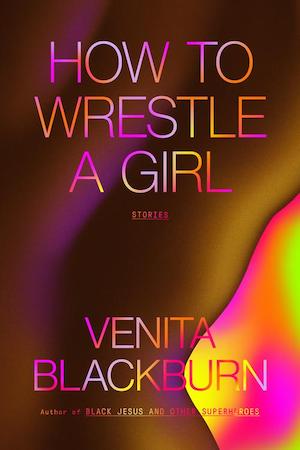
I became an admirer of Blackburn’s while working at SmokeLong Quarterly, one of the top literary journals that specialize in flash fiction. To me, she is one of those writers who has transcended the genre and placed it into the pathway of traditional fiction with her book Black Jesus and Other Superheroes, which was a finalist for the PEN/Bingham award for debut fiction, finalist for the NYPL Young Lions award and the recipient of the PEN America Los Angeles literary prize in fiction.

Divided into two parts, her new collection, How to Wrestle a Girl, extends the universe for two characters from Black Jesus but also explores new characters who are fighting to figure out how to navigate life as a girl, as a woman, and, often times, as queer person on the cusp of a transitional stage in their lives. The characters confront grief, sexuality, and uncertainty often with humor that works to undercut the emotions and make the moments feel even more true. 

I spoke with Blackburn via Zoom, of course, about flash fiction, of course, but also the young women of color she wrote this book for, and also Gen Z and what the “Zeds” are reading and writing these days.


TLC: How to Wrestle a Girl feels like two collections in one, and yet, also not that. Part I seems to be different and separate from Part II because Part II involves the same characters like a novella-in-flash or a novella-in-stories. But the parts share themes and a particular style and voice. Can you talk about the choice to combine these two parts in the same collection?

VB: All right, I’m going to spill all the tea for how this was designed. I don’t know if I’m supposed to be more dignified and keep mystery like it’s all very careful. 

Yeah, no vision, cloud, or whatever. I intended to write a novel-in-flash. That was my main goal when I sat down to write this, but I am very much a short story writer. I love the form. And also, I love flash fiction. So that too, it’s like a primary thing for me. 

So, all of the things that were written here in the book were written at the same time. And I kept focus on doing the novel-in-flash. But then other story ideas will come to me about similar situations, or a speech pattern, or some kind of idea, and I just had to honor it. I just got to do that. So, I will go write this 2000 word side story over the weekend, and just be with that—kind of like a meditation—and try to go back to the vision. 

I did feel very connected to this kind of exploration of girlhood. And I wanted to honor that with the two characters, the sisters that I was working with that were carryover characters from Black Jesus. I wanted to keep it going. But in the end, I had more stories. I had a hodgepodge of stories. And I was like, I know, they belong together? They are there and from this era of my mind, so I kind of see how I could arrange it. 

TLC: Yeah, I feel that sometimes you just gotta put it together in that document and then see what happens. 

There are so many topics here about events or themes that are, I don’t want to say “traumatic” but have very deep emotions, but with a distance. Some of that distance is through voice but also format. For example, the very gendered ways in which someone is being made fun of, or a grown man sending a dick pic to a young girl. Can you talk about writing such moments while not wallowing in the trauma of it?

VB: I think it’s part of how my mind works. I’m not a very melodramatic person. And I grew up with kind of a funny family. We do play with language, I’m kind of used to that. But still, tragedy is happening all the time. It’s just sort of how we look at it. 

This is the formula right for humor. If you combine sincerity and absurdity, you’re going to get hilarity. It’s just guaranteed. Like someone’s doing something weird, but they’re taking themselves seriously—it’s funny as hell. And that’s how I ended up sort of looking at tragedy. Like, wow, this is a mess. Yeah. Get here, and then I’m looking at what we’re doing in the midst of it. It’s just, yeah, sometimes you just have to take a step back, and kind of see the macro version of the world. And a lot of it is truly ridiculous. There’s also beauty, but a lot of it is just a total mess. And I think that is my natural kind of way of seeing things. 

And even though I only learned about this recently, I write about grief a lot. So a lot of loss, a lot of tragedy, and I feel that in my own personal life, it’s not a thing that you get over. It’s a thing that you just sort of exist with. And yeah, might have been coping, it’s sort of your living. And now this is this, this layer of your life, that is forever, but it doesn’t have to be miserable, it doesn’t have to be a telenovela. Or just like high drama. 

I do consider myself kind of a writer’s writer a lot. So I’m not going to sort of sit with the usual pattern of easy reads, quick, quick turns, or whatever. I’m more interested in form and language and the sounds and rhythms. And also alternative text. It’s not even experimental to me. If you’ve read people like Margaret Atwood, you know how form can look differently. And I’m interested in that. So I kind of think in those patterns of combining feelings and combining that we all share grief, but in a way with an eye that might be a little bit more unconventional.

TLC: I just tweeted something about the fact that your book is one of a few that I’ve been reading recently, where it’s like a collection of flash with some longer pieces in it versus a collection of long stories with a few flash in it. Amber Sparks’ And I Do Not Forgive You comes straight to mind when I think about this as well. What about flash that you truly enjoy? 

VB: I mean, I do love it. It’s been around for decades. And if you really think about it, even longer than that. But it’s still not quite normalized as much as I wouldn’t think so. 

I coordinated a flash form workshop for my university, for Fresno State, for the whole CSU system across California. I brought in a bunch of really talented flash fiction writers. I had Justin Torres and Rion Amilcar Scott, a bunch of them. And so they did this for two weeks for me. And I just was the coordinator. I just got to sit in the class and kind of take in the scene or whatever. And the students at the end, they told me, they had no idea what flash was. A lot of my other students that I’ve worked with in the grad program were saying that I introduced them to flash. Apparently, I’m the flash fiction propagandist of my time. 

This is the formula right for humor. If you combine sincerity and absurdity, you’re going to get hilarity. It’s just guaranteed.

How are you not loving this form? I mean, it’s really a way of learning structure. So it does help you think about the arc of things, and being easily accessible. You can visualize it clearly from a whole page of how one moment escalates into another. And also you can think about time in ways that you can’t think about as easily in a longer story because you’re forced to be very condensed. It can be a year. It can be a single moment. Or it could be generations. But that’s my favorite kind of flash, the kind that crosses an entire civilization or entire lifetime. It shows you how one sentence can just click into another and they have to work very, very hard over and over again, to do that, to show them the evolution of a character and I think it is magical. So I’m totally into it.

TLC: I’m trying to put my finger on what changed [in terms of the popularity of flash]? Do you have any sense of what has changed? What has made the general literary public more interested in this form than they were before? Because I remember when I first started writing — and I don’t know how you feel — but it was almost a shameful thing. Like “oh you write that.”

VB: You know, my former co-worker, but he’s my neighbor now, Joseph Cathar, he’s a novelist. He’s “I don’t get flash.” And no matter how, like whatever journals—I’ve just came out in a couple of pretty big ones like Harper’s and the NewYorker.com. And it is quite a big moment for flash fictions, for small stories, to kind of get that old school prestige, or whatever. 

But for me, it’s the poetry of it. 

Also, one of the obvious answers could be that we are just so declining intellectually, in terms of our ability to carry long narratives. Maybe, it might be that. I think it’s more so that people are starting to see the wonder that it’s possible within the form. And also there are writers that are willing to defy the expectations of the publishing industry. Like in my first collection, it didn’t do anything it was supposed to. They said you’re supposed to have nine stores or whatever, all relatively the same size, in a collection, that’s sort of a standard expectation. 

I did 22, all random sizes, or whatever. And I was like, you’re gonna send it out to a contest? And people were like, “okay, yeah, I like it.” So it’s a part of just the organic nature of what is working for the audience that exists at the time, and the willingness to push back against the expected norms of the industry that are sort of combining all maybe in the past 10 years to sort of see more of these types of collections. And also, it’s just not doing what collections are supposed to do. It’s just flowing on its own.

TLC: I remember reading this quote, and I can’t remember who said it, but it was about Sandra Cisneros’ House on Mango Street. And it was saying that vignettes—because that book is sort of vignettes, not necessarily flash flash, but I kind of think of them in the same way—is more reflective of the experience of a woman of color or person of color, rather than a traditional sort of narrative in that it captures life—especially microaggressions— and those moments where you can’t really put your finger on it, but you know, something important has happened. That flash is able to do that better than those sweeping, sort of Westernize narratives…

VB: And that’s a great part of the form like you could do the macro, which I really love, but you could do the micro that’s like all moment, in the day, or they only happened for two seconds, but it was just as piercing and devastating. That kind of interaction. Sometimes it’s small and people don’t notice it. It’s internal and flash allows writers to stretch that out. And in a reasonable scope. And yeah, that’s really cool. And it’s that undefinable genre, right? No more poems and fiction, it is its own kind of thing.

TLC: How to Wrestle A Girl is simultaneously a book that I can see someone my age reading and enjoying. But I also can see this being a book for a younger audience. It’s a book that, if I had had growing up, would have been really important to me, because it is about gay women of color. Was that your intended audience? If not, who did you intend to write this book for? Or were there different pockets of intended audiences? Were you thinking that maybe Part Two would be for someone else? And Part One will be for someone else? 

VB: Tyrese, you just gave me the biggest compliment. My dedication in the final copy is to “the mad mad girls.” Look, I did write for my former self. That thing where if I had a book when I was 16, what would that book look like? The one that would help me feel validated? Feel seen and entertained? And might be familiar and be able to laugh and all the weird things that I had, and I just didn’t have that book yet. You know, I love Toni Morrison, don’t get me wrong. But those are some heavy lifting. Beloved wasn’t for the teenage. Beautifully written. But you know, what would be the thing that I would have held on to? I sort of wanted to write that kind of book. So yeah, it is definitely meant for people that are sort of new to all life experiences, but also people that are familiar with things and might not have the language for it and really enjoy some truth bombs.

TLC: It definitely feels like a coming of age book.

You are a teacher and you work with college students, but you also conduct workshops. What are you seeing in terms of their interest and the things that they want to read and learn about that could affect the future of literary fiction, in general? Like, what are you seeing working with the public and these young folks?

VB: I call Gen Z, the Zeds. So the Zeds are really into witchcraft and astrology, and dystopian futures. So they are all about what the world is gonna look like—we’re a mess right now—rather than the sort of tumbling into it with this kind of chaotic, delirious sense of both joy and dismay. 

If I had a book when I was 16, what would that book look like? The one that would help me feel validated? Feel seen and entertained?

And it’s interesting to see. They’ve reached a kind of spiritual acceptance of chaos and dysfunction. They’re very puritanical about certain things. And then they can be very kind of rigid and certain philosophies and sort of a little bit didactic about the way they think the world should be or how we are, but it’s also very queer positive. 

And I’m interested, I’m fascinated with how they’re going to approach this. I’ve been talking about trans-trending terms or things like that, and it; just fascinating to see the queer positivity and all the different branches that it is turning into, and how much is sincere and how much of it is fear versus like trends. And that’s also fascinating.

TLC: What are you seeing when you do your workshops?

VB: So I’m seeing, like I said, witchcraft is coming up a lot. I’m a chair for a lot of thesis projects. So one is about a young girl who’s learning a lot of Wiccan processes and trying to figure out some psychological things that go into writing about anxiety, and how it manifests in odd ways and what they’re doing with their bodies in order to combat that. That’s interesting. 

The guys are writing a lot of violence. But I support it. I’m like, yeah, whatever you got to do. I work in a primarily Latinx kind of community, too. So there’s a lot of discussion about masculinity within that culture and sort of the expectations of femininity and the pressures. 

Also, I’m getting the usual from the undergrads, kind of mock Harry Potter stuff. So some things never change.

TLC: I’m here for it. I think I’m just ready for fiction to just not be so sad. And it’s funny, as I was reading your book, I was thinking about another book from a male writer who writes about male/male relationships in such violent ways. And I was just enjoying how the relationships in your book are just not that. They’re complicated, but they’re not antagonistic, if that makes sense. And I just felt like that was just so refreshing. I need more of that.

VB: And that’s true. Sometimes, like the violence, though, is not physical, it’s not external, the things that we encounter. If I am exploring some kind of violence, it probably is more psychological that I’m trying to work through. So you might look totally fine on the outside, you know, but there might be something else happening. 

And also there is this community. I really love the sisters, and I was just really drawn to that. I don’t have any sisters so it’s kind of my fantasy. They don’t really get each other, but they totally get each other and to think about femininity and the bonds that are not always disrupted, but also some that are.

A Master Class in Disrupting Realism and Making Magic

[Ed. Note: We also invite you to watch Marie-Helene Bertino’s master class on “Disrupting Realism,” with special guests Mira Jacob,  Mitchell S. Jackson,  Kristiana Kahakauwila, Tracy O’Neill, and Helen Phillips. The event is free, and we encourage donations to support Electric Literature’s mission to make literature more relevant, exciting, and inclusive, and to support future programming and articles like this one.]

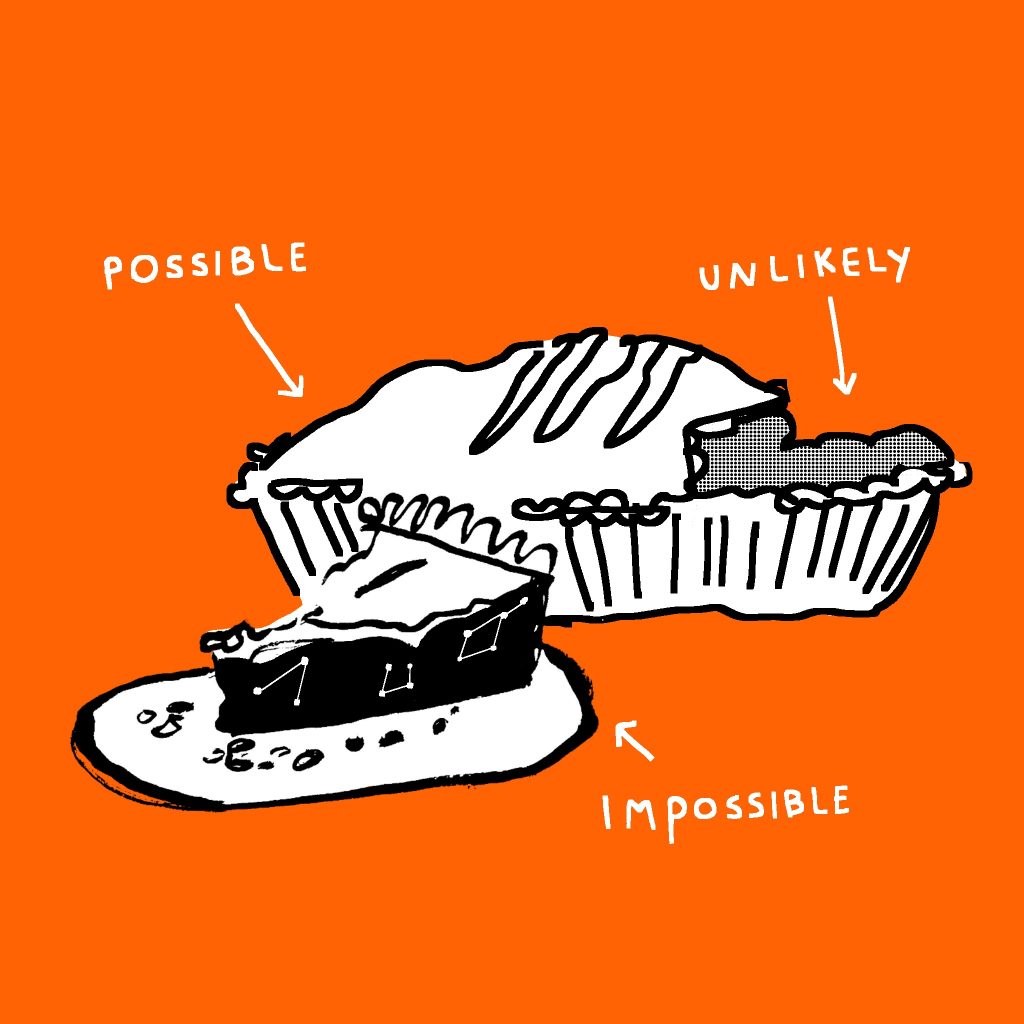
If you wish to make an apple pie from scratch, you must first invent the universe.

Carl Sagan

On Magic

WHAT IS IT?

After years spent agonizing whether it was worth money and time, I applied to an M.F.A. program for fiction writing where, during the first year, I was dismayed to find no class offerings outside the realm of realism. Those of us who wanted to stray beyond realism were not-so-subtly discouraged. One professor, upon encountering a vampire story in workshop, told the writer, “I’m not the reader for this kind of thing,” and remained silent for the rest of critique.

An enterprising sort, I wrote a petition that lobbied for a magic realism class, and after my classmates signed it, the administration agreed. A large number of students signed up across genre—fiction writers, poets, and playwrights. I was sleepless the night before class, excited to finally have answers to: What was magic realism? How could I write stories like Aimee Bender, who evoked emotion while being funny?

I assumed the administration would hire the utmost expert on magic and fiction. Gabriel García Marquez himself, if he were available. (Now that I’ve been teaching on the under-and-over graduate level for over a decade, I laugh at my naivete.) During their introduction, the assigned professor admitted that they did not know much about magic realism. They’d looked it up online and couldn’t find many good resources. 

Lacking academic guidance and aware of the stigma—a barely imperceptible curdling of expression when certain authors were mentioned—I set about figuring it out myself. 

American magic realism was often dominated by the affluent, usually white men and women, so I ventured outside America, to Japan, for example, where I met writers like Yōko Ogawa and Taeko Kōno on the page, and to film, where filmmakers like Agnès Varda and Federico Fellini didn’t seem to struggle under the stigma against breaking realism’s rules.

The working definitions and methods contained herein are imperfect. They are, however, mine. They are tools I’ve invented to classify work that falls within the realm of what I consider the uncanny. They are intended to provide ways to build the uncanny into a new practice or bolster an existing one.


PICASSO WAS TERRIBLE TO WOMEN

Once upon a time a man reproached Pablo Picasso for painting surrealistically. 

“Why can’t you paint more realistically?” the man said. 

Picasso said, “Show me what you mean by realistic.” 

The man pulled a photograph of his wife out of his wallet. Picasso looked at it and said, “So your wife is three inches tall, has no hands or legs and is black and white?”

As soon as we make a mark on a page, we seek to control space and time. Perhaps before, when we go to our preferred writing mechanism, the computer, the notebook, or even before, at the inciting moment when our imagination begins to morph a lived experience into a narrative, we are already manipulating, editing, changing. However, controlling time is impossible and, perhaps most excitedly, doomed to fail. 

There is no such thing as accurately representing reality on the page. What a relief! 

These tools and methods are meant for writers who stray outside realism, which is to say, all writers.


THIS ESSAY WILL NOT

This essay will not offer definitive terms of categorization. It will not enter the debate on what is and what is not magic realism, the surreal, the uncanny, fabulism, speculative fiction, sci-fi, fantasy, etc… Whatever time I’ve spent debating what one of these genres is or isn’t, has felt antithetical to the inventive and expansive nature of that genre. It has also taken me away from my work trying to map new terrain within it. 

My working definition, when I explain my writing to myself, is that at some point in one of my stories or novels, a law of physics is broken. That could mean anywhere from a singular, discreet instance to the story’s entire fabric (more on that later). This essay will remain focused from a craft perspective on how and why to effectively implement elements that break the laws of physics on the page.

Though my work has been described as “magical realism” by others, I tend to use the terms surreal and uncanny. 

If you are a teacher or editor or reviewer or arbiter of writing—if you are in any way in charge of a process of merit and distinction—that includes a piece of surrealist work, I hope you will use this essay to help you more effectively meet, evaluate, and reward the piece where it is.


WHY WE BREAK THE LAWS OF PHYSICS

Because we want to imagine ourselves out of our circumstances. Because we’ve been handed these stories by our ancestors and it is part of our culture. Because we are a member of a culture or class for whom it is radical to imagine a future. Addressing the lack of Indigenous and characters of color in science fiction literature on NPR, N.K. Jemisin said, “They were set in these so-called futuristic settings where we were the myth.” Perhaps we want to break the laws of physics because it’s fun, because we want to reach a particular emotional resonance unable to be accessed through conventional methods. Because we do not think using the supernatural elements is out of the ordinary. Because the supernatural is our ordinary and to write realism would be, for us, stranger. Perhaps we venture outside realism because to express our understanding of life, because removing the middleman of simile and making the figurative real feels more honest. 

Once, I became so happy so fast that I balled my hands into fists and was certain I was about to take flight. 

Why then can’t I write in a story: She flew?


WHY BREAK THE LAWS: On humor, a personal story

Yesterday, I heard a particular laugh from a man in his 60s or 70s that meant he was surprised that someone like me (small, a woman) had said something he considered to be funny. I’ve heard this laugh my whole life because my whole life I’ve 

  • a. made a lot of jokes
  • b. have looked this way

Maybe it shouldn’t, but it always pleases me to hear this laugh. And annoys me. Equal parts pleased and annoyed.

Though they are tall and muscular, my brothers also make a lot of jokes. We do this because we had an abusive father. 

Among his other faults, my father was a literalist who, like many literalists, described his humor as “dry.” Also like many literalists, he considered himself to be funny and wasn’t. 

A five-year old is unlikely to be approved for a home mortgage. Since we couldn’t move out or protect ourselves against my father, my brothers and I did the only thing available to us, we made light of him. This allowed us to stave off the unseen injuries of trauma long enough to reach the next, hopefully more peaceful moment. 

Here is a line from “Free Ham,” one of my first published stories, that still makes me smile:

“The next time I see you,” my father says. “I am going to back over you with my car.”

“You’re such a bad driver,” I say. “You’d probably miss.”

Humor also changed my father from a real-life man into a subject. Though it would not shield against depression and PTSD, this seemingly small but crucial shift created a buffer, enabling me to distance myself from what was happening to me. People who have experienced trauma describe this disorientation as akin to a dream state.

As an adult, I no longer need humor to physically survive. Yet, its origins remain in survival.

As I got older, the sense of humor that had its origin in survival procured me access to certain clubs that would have otherwise never accepted my poor, weird, fucked up, ethnic ass. Friend groups, party conversations, writing industries. Noticing how this ability acted as social lubricant, I cultivated it, studying comedians, memorizing whole monologues. The literary canon is relatively humorless. When I abandoned poetry (and it me) and began to write fiction in my 20s, there was a conscious moment in which I had to grant myself permission to be funny. 

I’ve never wanted to write about my personal life. I am writing about it now because I saw this video of Patrick Stewart hugging a domestic abuse survivor and realized there are people in abusive situations who might benefit from a similar kind of permission. 

As an adult, I no longer need humor to physically survive. Yet, its origins remain in survival.  

I use supernatural elements in my stories and novels because they most adequately render what I notice about memory, trauma, disability, class, ongoingness, and what we mean to each other. Many of my stories are in present tense with present tense flashbacks because of what I’ve noticed about life and memory, that to remember something feels like reliving it.

Humor and magic work similarly. They allow us to escape our circumstances, if only for the length of a joke, a transmogrification. When you undervalue either, you are privileging easy and direct expression and failing to understand that the construction of a joke or a supernatural element is an act of survival by the oppressed. 


Illustrations by Leanne Renee

JUDGES WITH ONLY ONE RULER

Those of you who’ve watched a dog show will be familiar with the Best in Show round, during which a judge stands in the center of a ring, surrounded by different breeds of dogs and their sensibly shoed owners. One by one, the judge asks each dog to run around before kneeling or, in the case of smaller dogs, lifting the dog onto a podium for closer inspection.

Dog show judges are required to be up to date on the specifications and qualities of every breed. How the slope of a Shih Tzu’s nose should slant, or how pointy a Pointer’s pointer should be. At any given time, the judge maintains a mental card catalogue of the perimeters of, as of this writing, 190 dog breeds. 

It is important to note that even in the Best of Breed rounds the judge does not evaluate the dogs against one another, but by how good they are at being themselves. In the Best of Show round, before judging a new dog, we can imagine the judge shifting their mental yardstick in order to measure the dog in front of them with the correct, breed-specific ruler. 

Imagine instead if the judge memorized only the specifications of the Standard Poodle. When judging a Yorkshire terrier, they’d declare, this dog is too short! It doesn’t have coarse, curly hair! It doesn’t seem at all like a dog I’d want in my male pattern baldness medication commercial! 

I read many reviews and hear many conversations and have sat in on many editorial meetings judged by people who prefer their fiction stay in the realm of what is “realistic.” When a gatekeeper faults writing for containing rule-breaking elements or for being written by someone who does not look like what they are used to, the gatekeeper is saying: You fail because you are not a Standard Poodle.

But, it is they who fail. Because they only know one ruler, one method of classification. 


CLASSIFYING MAGIC 

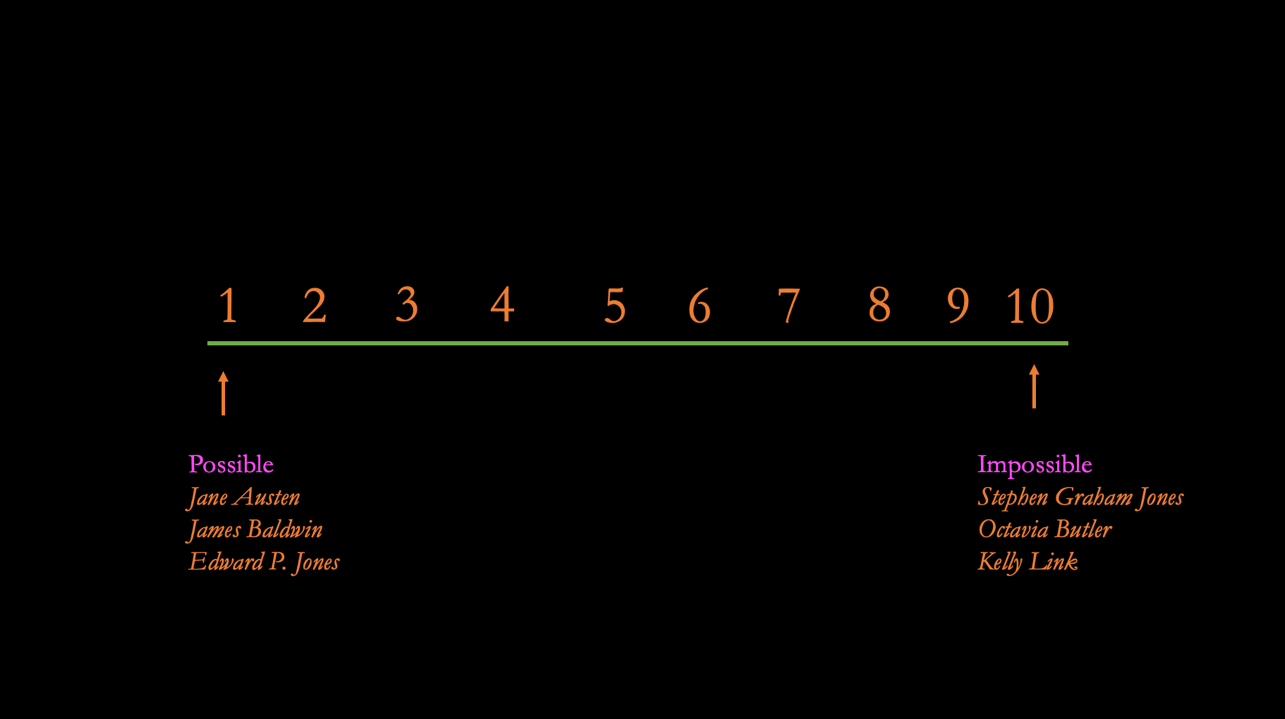
While I’m not interested in classifying pieces from a marketing perspective, I am deeply invested in identifying how they work as a guide to writing them. Because I was occasionally taught by teachers who seemed to have only one method of classification, I had to develop my own. Over the course of many years I developed this scale.

Text

Description automatically generated

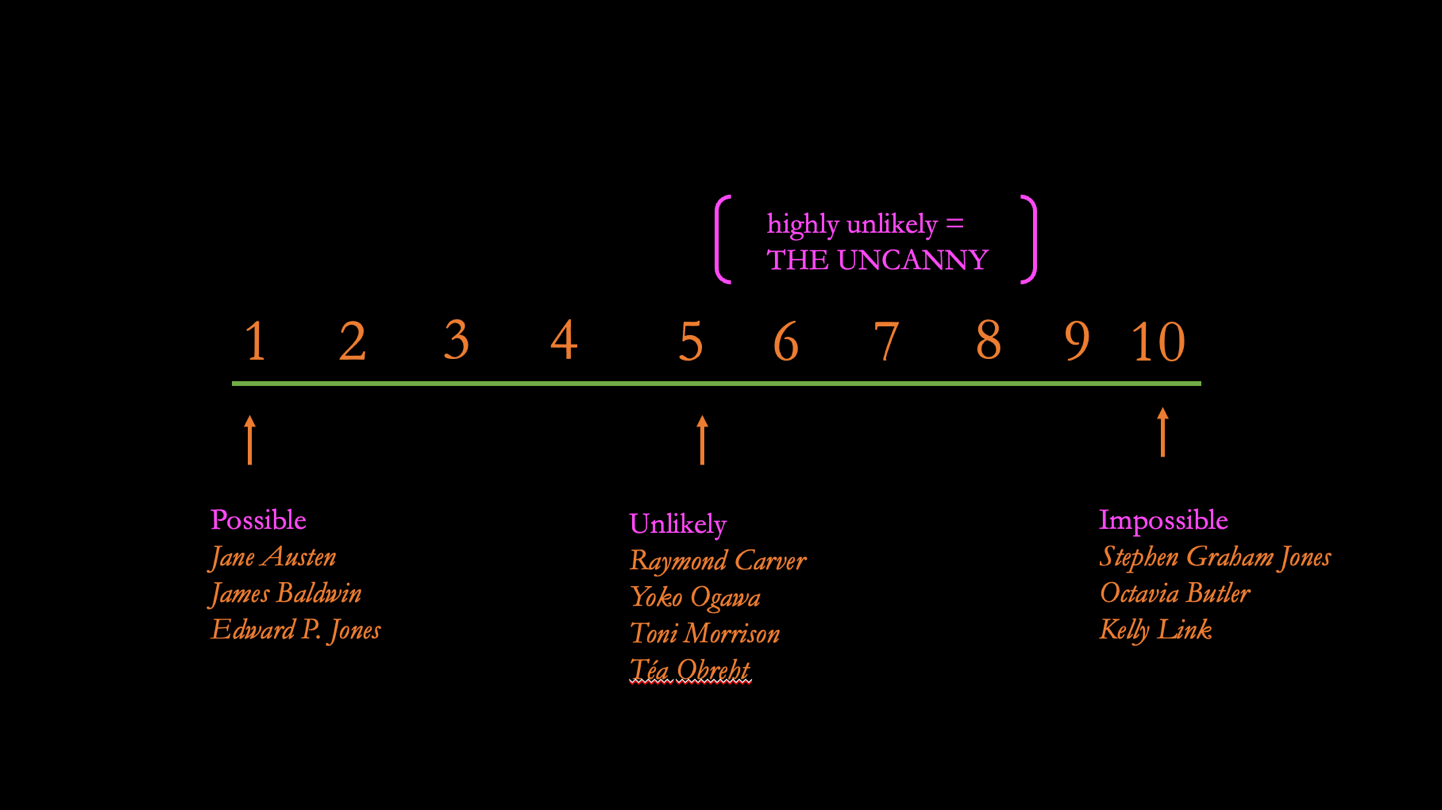
Imagine #1 is a story in which every single thing is possible (as much as it can be, remembering Picasso). And, #10 is a story where almost all if not 100% of the world is invented. #1 could be an Edward P. Jones novel, perhaps, and #10 might be “Blood Child” from Octavia Butler.

In the terrain around #5, things aren’t completely possible or completely impossible, they are highly unlikely. I consider the realm between numbers 5 and 10 to be The Uncanny. 

Timeline

Description automatically generated

This is where the work of some of my favorite writers resides. Yōko Ogawa, Ramona Ausubel, Toni Morrison, Lydia Davis, Joy Williams. In an Amy Hempel or Raymond Carver story, nothing technically impossible happens yet the ratio of known to the unknowing is so tilted toward the right that a feeling of unease grows. This unease is created by highly unlikely scenarios, omitting information other writers would deem necessary, and—especially in Hempel’s case—beginning stories in the middle of a thrust of thought or conversation. I teach them as surrealists.

Using this scale, however, we are still judging uncanny work in relation to the so-called “real.” The implication is still: This is or is not like the Standard Poodle. The time we spend weighing work against realism could be spent understanding and digging deeper into the possibilities of the uncanny.

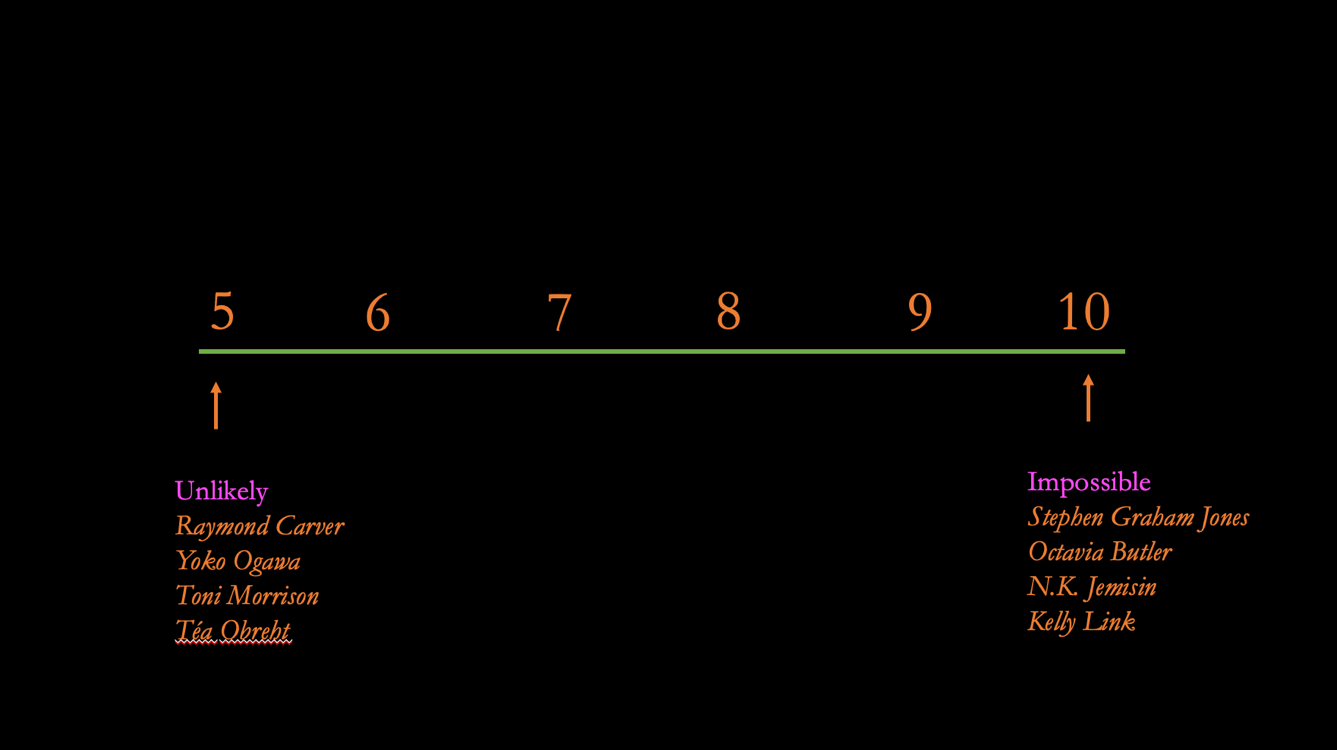
So, I mentally lop off numbers #1 to #4.99, saying goodbye to realist works as reference, and elongate the scale. 

Timeline

Description automatically generated

Instead of referencing work by how it is or is not like realism, thereby still making realism the focal point, we make the entire scale uncanny. We are then able to dig deeper into and discover new things about that terrain without the unhelpful tether to the so-called real.

If I’ve just written a story that hovers around 10, I tend to want to write a 6 or 7 next. If I’m struggling to see a piece clearly in revision, I’ll ask myself where it seems to want to lie on the scale. This helps me revise toward where the piece seems to be going, instead of where I’m normally trying to inelegantly push it.


HOW DO YOU SOLVE A PROBLEM LIKE MARIA?

A note about the rigidity of the scale. As it is meant to “classify” the unclassifiable, it should be noted that the term “classify” and “scale” is being used loosely, in order to make the idea of it visible and accessible to as many writers as possible. The scale points are deliberately vague and up for interpretation to allow for each writer to populate them with their own understanding. 

Can you accurately classify the surreal? 

How do you hold a moonbeam in your hand?


Illustrations by Leanne Renee

MESSING WITH TIME

As I wrote earlier, whenever we make a mark on a page, we seek to control time. Every decision regarding tense, person, and the unsexy but totally revelatory ordering of scenes unfurls a list of pros and cons. Present tense charges a scene with immediacy while sacrificing a bit of perspective. Past tense offers a buffering distance that can assist or hinder resonance. I ask my students (and myself) to begin thinking about what their personal relationship with tense and person will be.

Reverse chronology, when a story moves backwards in time, can be valuable for, among other reasons, supporting characters who wish to recede from a painful event. In Lorrie Moore’s “How to Talk to Your Mother,” a woman retreats year by year away from her mother’s death, literally reverting to childhood. Grief can be encountered meaningfully in this structure.

A time loop story presents an ongoing condition of entrapment. Time is repeated in a whole chunk (one day over and over), or in segments, or one discrete character or idea is repeated. The Invention of Morel, a novel that represents one of the most inventive examples, the idea of the loop is upended when an island of partygoers turns out to be a recorded, endless projection. Loop stories bring this con: even the repetition of a wild day becomes a pattern that can bore the reader. I find it necessary to upend the expectation of the repeated element after one revolution.

Time can diminish and expand based on the needs of the character. In Tobias Wolff’s famous short story “Bullet in the Brain,” a moment of death is prolonged for four pages. Time may be condensed, a family history being truncated to three sentences. Present, past, future, implied, summarized, “real,” and imagined time can aid in rendering the human experience. 

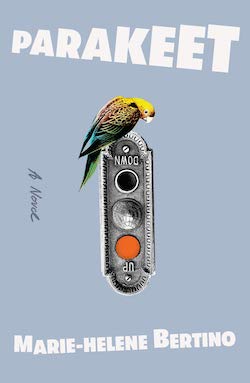
The measure of time my students have most trouble with is collapsed time—when all time is present. Virginia Woolf uses collapsed time in her page-long sentences, and my novel Parakeet contains at least three that do the same. These effects work best when meaningfully connected to philosophical reasoning. Parakeet chronicles a wedding week, in which, during several uncanny episodes, The Bride falls to metaphysical pieces. When she is experiencing trauma, her understanding of memory is overwrought by the simultaneous and her senses compartmentalize. Collapsed time blooms in this climate. In a chapter titled, “A Wedding is an Internet Where Everyone Sees Themselves,” a solitary moth flies through the wedding limo, essentially halting “real” time and connecting her past, present, and future selves. The moth is a needle, stitching together all-time.

Punctuation marks are the sous chefs of time. Periods halt it, em dashes intrude and infuse the main thought with drama, commas seek to order it, semi-colons dice it, etc… Parenthetical expressions and footnotes can contain entire narrative strands. With practice, if you assign music terms to punctuation, rests to page breaks, then with a cursory scan of a page of prose, you can hear a scene before you read it.


MESSING WITH SPACE/STRUCTURE

Structure is a container that supports meaning, but structure can be shaped like anything. In 2018 at Institute for American Indian Arts, the writer Kristiana Kahakauwila gave a craft talk called “Clocks, Questions, & Canoes: The Vessel as Story Structure.” In it she described how a story’s meaning can order itself into vessels as varied as voyaging canoes, flower petals, and hermit crabs.

Time also moves within a page’s white space. Page breaks, chapter endings, blank pages do not have to impede narrative movement. Vignettes and flash fiction seek to crystallize time while shuttling the reader back and forth through time in the negative space that connects them. From one section to another, ten minutes may have passed, or a century, or no time at all. While revising, I go through, for example, the implied time between each chapter’s ending and the beginning of the next and list the amounts. Sometimes when a book feels uneven it is because I’m asking the reader to shuttle too far into space too quickly, too many times. Page space is a time machine.


MESSING WITH RELATIVITY: A few writing prompts

  • Give an impossible person a possible job or task

In the movie A Girl Walks Home Alone at Night, against the charged setting of teenagerdom, a female vampire balances twin desires: blood and connection to an almost-equally troubled boy. 

  • Give an impossible person an unlikely job or task 

In Ramona Ausubel’s short story, “You Can Now Find Love,” Cyclops writes a personals ad, riffing and deepening what we know about that mythical creature and the vulnerabilities of dating.

  • Give an impossible person an impossible job or task (all Greek myth)
  • Give a possible/unlikely person a possible job or task

In Aimee Bender’s short story, “Loser,” a boy with a supernatural knack for finding lost items must find a young boy who’s been kidnapped. Bender meaningfully engineers the character’s supernatural ability to play against his big desire—by the end the reader realizes that the thing he’s lost he will never be able to find.

  • Give a possible/unlikely person an unlikely job or task (every Yōko Ogawa story)

In Yōko Ogawa’s “Sewing for the Heart,” a seamstress is commissioned by a cabaret singer who was born with her heart on the outside of her chest to sew a leather holding case to protect this vital organ. As is true in most Ogawa stories, it does not go as planned.

  • Give a possible/unlikely person an impossible job or task

In Manuel Gonzales’s short story, “The Miniature Wife,” a man accidentally shrinks his wife to Smurf size. Though he and his wife are both realistic, their predicament is surreal, and through it Gonzales is able to elucidate darker truths about marriage and partnership.


Illustrations by Leanne Renee

GUIDEBOOK TO BREAKING THE LAWS

There is normally a moment in revision when I realize I haven’t fully committed to the supernatural element. There is a hedging on my part, an unwillingness to believe in my concept. I’ve found that the supernatural element works best in a story when it is meaningfully connected to the interiority of one of my characters. In this way, I implicate it, make it integral. 

In revision I check my work by imagining the removal of the supernatural element. If the story can function without it, I have more work to do.

Building legend

Building out the supernatural element means placing it into a society and writing out the real-life entanglements that would occur. The examples are limitless; stories, rituals, news reports, histories, museums…These entanglements could stay on a local level or could get as big as the universe. In the aforementioned Aimee Bender’s story, “Loser” the boy who can find things becomes infamous in his neighborhood, where naysayers crop up alongside believers. Language and lore grow around his ability.

Who are the protectors and believers of your supernatural element? Who are the detractors? Does the supernatural element have unintended consequences that become their own systems with their own hierarchies?

A common villain in supernatural stories is society in the form of a mob. Vampires, cunning women, troubled seamstresses, and more, have found themselves violently pursued by a community that seeks to tame them. Perhaps this echoes the experience of the unconventional person growing up in suburbia. 

In the Director’s Commentary of the movie Edward Scissorhands, director Tim Burton says the truly macabre scenes are the ones set around so-called normal barbeques in suburbia. These scenes were based on his Santa Monica childhood, and he goes on to say he can’t imagine anything more horrifying than these kinds of parties. In direct relation to the suburb’s varying fear levels, Edward’s scissor hands are perceived as deformity, then ability, then, ultimately, threat. He goes from feared to loved to feared again to attacked and destroyed. It is no wonder that supernatural stories like Edward Scissorhands have been championed by disability advocates for its inclusive themes.

The mob holds the discerning, self-congratulatory mandate created by fearful Group. It can take the shape of Missoula, Montana, a bachelorette weekend, one ruthless editor. Even when classically appearing as the innocuous suburb, the mob represents the status quo that characters like Edward’s “deformities” violate. 

Engineering a useful tone

Gabriel García Márquez famously had trouble with the tone of One Hundred Years of Solitude. The published novel—a terrain in which ghosts are commonplace— is driven by a nonplussed narration, but in early drafts the arrival of each ghost was accompanied by narrative fanfare. The supernatural was reading outlandish and disruptive. Garcia Marquez said the tonal disagreement was solved when he remembered that his grandparents considered ghostly visitations as quotidian events, and the novel acquired its iconic matter-of-factness. 

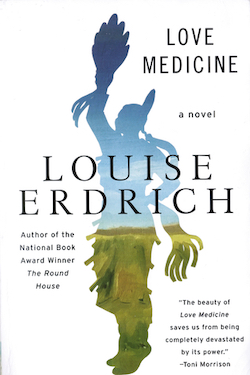
Labels are slapped on work that breaks the laws of physics, but for many of us, ghosts are not an event. Toni Morrison held similar sentiments regarding any “supernatural” elements found in her work. I think of this when reading Louise Erdrich’s first novel Love Medicine, where the dead seem to walk among the living with no fuss. Running beneath these ideas: the writer may not believe any of this is out of the ordinary.

Know what you’re in conversation with

Even supernatural elements bring reader expectations. It’s wise to know how everyone else has written about some of the more common ones so you can upend archetypes and patterns. For example, vampires have been done to death. (Pause for laughter.) Depending on the source, their mythology includes aversion to light (in some cultures the vampire turns to ash), toxic masculinity, death only by a stake through the heart, needing human blood to live. In the aforementioned film, A Girl Walks Home Alone at Night, the vampire lives in a depressed, crime-filled town in Iran. When the archetypes of the famous night dweller are seen through the new lens of a young woman feeling isolated in her teen years, new terrain is discovered in an old subject.

What are the common tropes of haunted houses, ghosts, werewolves, witches? I don’t believe there is anything that can’t be written in a new way.

Writing across experience

As in realistic writing, writers of the surreal must be respectful of existing systems of oppression. Certain myths and mythic creatures belong to closed cultures. For example, the rougarou is an Indigenous figure akin to the werewolf. Non-native writers wishing to participate in rendering it in story are writing into someone else’s lived experience and ritual. Afro-surrealism is an artistic form that Black artists use as an expression of survival and beauty. By definition, it cannot be created by non-Black artists. 

When considering writing across experience, the first question must be, Why must I do this? In which direction is the power dynamic going? If I were to write across my own experience, would I be participating in these systems of oppression? 

Engineer a character who would most benefit (or suffer from) the Supernatural Constraint/ Engineer a Supernatural Constraint that would most benefit or test your character

Addiction, like time loops, involves repeating the same behavior. I notice that many protagonists in time loop stories have self-defeating, narcissistic, or addictive natures. A useful narrator in a time loop story can be one who is ignoring something the structure is forcing them to relive.

To write a story in reverse chronological time, I ask myself what kind of character would be most opportunistically affected by that scenario? A grieving one? Perhaps one who wishes to leave their past behind? Perhaps one who desperately wants to forget a mistake? Reverse chronology can be a useful structure if a character wishes to distance themselves from an event.

Meaningfully dispense information

Many uncanny texts reveal themselves as uncanny in their first lines. Or, they subtly signal the questionable nature of reality within the first pages. This might be because readers aren’t always delighted (see: my Goodreads reviews (I won’t)) when the realistic story they thought they were reading suddenly contains a flatulent unicorn. An unseen contract to tell the “truth” feels violated. If withholding the supernatural element, it may be beneficial to ask, why? Does it help your story or is it to manufacture suspense that might be built more effectively another way? 


BREAKING THE LAWS OF PHYSICS WITHOUT BREAKING THE LAWS OF FICTION, WHICH ARE NON-NEGOTIABLE

The writer of the surreal is doubly charged to engineer their story to work on the literal and metaphorical levels, while reckoning with craft. Surrealism gets a bad reputation perhaps because readers worry that wild premise will flatten character and emotional resonance. The surrealist writer is still charged with developing complex, contoured characters who contain vulnerabilities and contradictions. Those characters are still charged with having big desires that force them to make decisions that put them in the path of other characters with their own desires. The line level is charged with being exact and surprising even when describing a supernatural character. Like many things, that’s the good and bad news.


OF MAGIC DOORS THERE IS THIS/ PORTALS

“…you do not see them even as you are passing through.” Charles Baxter refers to watershed moments in fiction as “one-way gates.” After a character passes through, they cannot return to the idea of themselves they held before. A kiss, a conversation, the mind of your brother-in-law, a wardrobe. Portal, portal, portal, portal. Anything can be a portal if a character or situation has changed after passing through it. When you adjust your way of thinking, every work of realism contains a portal. 


THIS ESSAY WILL 

Growing up, I received particular insight into the arbitrary nature of rules. My mother worked so many hours a week to support my brothers and me that she instilled mandates to take her physical place. I was not allowed to visit friend’s homes or go on sleepovers or overnight trips. It was her way to keep me safe. Many childhood structures seemed to impose maximum judgment while offering no substantive support or fun: The Roman Catholic Church, the suburbs, popular friend groups. Now, as an adult, I sometimes notice the same limiting in structures professing to be unconventional.

Sometimes rules originate from a desire to lessen the existential ache of the blank page. We fear what may happen if we are let loose in unhindered space. Rules provide helpful limits against which to creatively flourish, while ignoring the inevitability of death. However, fear cannot change the inevitable, it only hinders joy.

I wouldn’t allow my mother’s fear to prevent me from participating in life, so I began sneaking out of my bedroom window to meet up with boyfriends and friends who drove me out of the city. The particular combination of the radio and country roads at night was the most joy I’d known. As we drove past night meadows of sweetly feeding deer, each one lifted silently into the air. 

Books, Film, and TV to Inspire Surrealist Writing

In my essay, “On Magic,” published today on Electric Literature, I mentioned not being able to find much in the way of resources for work that fell outside of realism during my MFA. Below are some of the works that help me figure out how to write in the surrealist vein. It is meant to be a guide for anyone interested in beginning or enhancing their understanding of the uncanny. Like all lists, it is woefully incomplete, but is meant to be a loose guide to continue reading on the subject.

[Ed. Note: We also invite you to watch Marie-Helene Bertino’s master class on “Disrupting Realism,” with special guests Mira Jacob,  Mitchell S. Jackson,  Kristiana Kahakauwila, Tracy O’Neill, and Helen Phillips. The event is free, and we encourage donations to support Electric Literature’s mission to make literature more relevant, exciting, and inclusive, and to support future programming and articles like this one.]


Screenshot from “Russian Doll” on Netflix

Film/Television:

  • Eternal Sunshine of the Spotless Mind (For a few years I taught a class based on this film, one of the most successful reinventions of conventional love stories)
  • Cleo from 5 to 7
  • Reservation Dogs
  • What We Do in the Shadows
  • Russian Doll (Netflix)
  • La Dolce Vita 
  • A Girl Walks Home Alone at Night
  • Let the Right One In (both versions)
  • Paris is Burning
  • The Love Witch
  • Parasite
  • The Host
  • Beginners (collapsed time)
  • Jordan Peele’s Twilight Zone, Season One, Episode One, “Nightmare at 30,000 Feet”

Books:

Prerequisites: Adolfo Bioy Casares, The Invention of Morel and
Antoine de Saint-Exupery, The Little Prince


Stories:

  • Kazuo Ishiguro, “A Village After Dark”
  • João Guimarães Rosa, “The Third Bank of the River
  • L. Annette Binder, “Nephilim”
  • Toni Morrison, “Recitatif
  • Jim Shepard, “Proto-Scorpions of the Silurian
  • Raymond Carver, “Viewfinder,” “Why Don’t You Dance
  • Kelly Link, “Stone Animals
  • Kristiana Kahakauwila, “Thirty-Nine Rules for Making a Hawaiian Funeral into a Drinking Game” 
  • William Gass, “In the Heart of the Heart of the Country”
  • Lorrie Moore, “How to Talk to Your Mother”
  • Aimee Bender, “Loser”
  • James Baldwin, “Sonny’s Blues”

Non-Fiction:

Worshipping My Ass Doesn’t Make Me a Goddess

Becoming Amish by Rachel Ephraim

At age five people called me precocious, at twelve promiscuous, and now, at twenty, every Jim and Tom I walk by calls me Mamacita as if my ass could save the world. They say it like they are desperate for One Good Thing, as if my ass promises to take up room in their empty lives like an expensive couch in their dingy apartment. Something for them to press against, anyways. My boyfriend Joey says my ass is saving the world. He says it like, hey hot shit, if we go broke, we’ve got your ass. He says it like it’s a secret weapon I can pull out of my back pocket at any moment, and he isn’t wrong.

Already been down that road, I remind him, and then depending on whether or not he’s had a hard day at the station, he asks me to detail the highlights of my year at The Cha Cha Club in breathy whispers when all I want is to eat the egg salad I’ve just made while I leaf through The New Yorker.

I would go whole weeks longing to be a table, or a rock, or a little metal paperclip.

Why do you read that shit, he asks when he finds one of my magazines lodged between the Penny Saver and overdue bills. You think you’re someone else, don’t you? He rolls up the mail and whacks me lightly, a puppy in training.

Before we met, I was in a bad way, and I don’t mean doing all the stuff in the back room that can make a stripper rich. I mean I would go whole weeks longing to be a table, or a rock, or a little metal paperclip. Even after I moved into Joey’s apartment, even after I’d quit dancing, I couldn’t seem to shake old habits.

Mamacita, they still say as I run a few errands. I turn my head, take off my sunglasses, and ask where they eat their lunch. We go behind buildings, inside cars, into public restrooms.

“You’re pussy is perfect,” Anthony, or Mario, or Chuck will say. They will say anything.

“How perfect?” I ask.

“Like heaven.”

“Like a fucking Greek goddess.”

“Like a teenager’s.”

“Better than your wife’s?” I ask.

The good ones are practiced and say who? The first-timers look worried like I’ve babysat their kids or scrubbed their toilet. Like I’ve experienced their wife using that tone that’s brought us both here, the one where the wife knows everything and is exhausted by everyone else’s stupidity. Sometimes the men are so grateful they open up their wallets and unload every last bill. I let them be kind. It gives me a chance to take Roxy somewhere nice, somewhere we don’t belong where she can annoy me with questions about why I keep doing this shit. Depending on my mood, I might tell her to can it and enjoy her twenty-dollar shrimp cocktail, but sometimes I’ll put my hand on hers. Till my tits give up? Till the whole world stops telling little girls they are beautiful?

“You’re such a downer,” she says and then orders us both another Tito on the rocks, a drink we usually sip from a plastic cup but comes now in a glass tumbler. Roxy works at the local gardening center and it shows. She speaks with a big-picture long view and isn’t scared to deadhead a few feelings for the sake of a thick, full future. “Forget them,” she says. “There’s more for you if you can forget them.” We’ll make-out a bit on our way home, nothing big, just some feel-good vibes before we each go back to cockroaches fleeing the stovetop.

On a day where no one has looked at me, a day where I’ve emptied the bottle of mouthwash before noon because the gin’s all gone and I don’t know what else to do, I text Roxy. She comes over and tells me to quit being the stupidest person she’s ever met. It’s hard to explain my aching to transform into a lamppost or doorknob, so I say, “I wish I didn’t have a body.”

“He hurting you?”

How to tell her that shit hurts without anyone’s interference? I lie and make choking motions with my hands around my neck.

She puffs around the apartment and goes to the closet, rips some clothes off their hangers, and tosses everything in a garbage bag. We’ve done this dance once before, hiding from our boyfriends in some motel where we talk like sisters and then fuck like we’re praying the apocalypse would claim us already. Like, enough. Like, show us the worst thing so we can stop being scared.

But today we aren’t going to a motel; we are going to Roxy’s mother’s.

“Gladys doesn’t take bullshit,” Roxy says. “She’ll set you right.”

Gladys all but raised me while my own ma came and went, and I don’t want her to see me in this state. I’ve only seen Gladys angry twice before, once when Roxy fell off her motorcycle, and once after we’d thrown a party at her house while she’d been in the hospital for her heart. Both times, Gladys slammed her dimpled hand onto the nearest surface and told anyone who would listen that her daughter was a fucktard.

Before we leave, I dip my hand into the breadbox where Joey keeps the rent and slip the cash into my bra.


When we arrive at the tan ranch on Willowbrook, Gladys is on the porch in a mui mui fanning her cootch with a postcard.

I unfurl my body from the car, my legs shaky like a colt’s, but Roxy grabs a Bud Lite from the cooler next to her mom and begs me to drink it slowly. I sit cross-legged on the grass and pop the tab. The birds are talking in the birch tree, and I can see them set against the clouds, fragile and free.

“What’s wrong with her?” Gladys asks.

“She’s just tired,” Roxy says.

Gladys says, “We’re all tired.”

Sometimes, it’s hard to stomach that women aren’t being brought peeled grapes all day every day. It feels isolating thinking about all the work we must do just to stay sane, but then a fat woman with greasy hair says we’re all tired like she’s seen what I’ve seen and worse, and while it doesn’t make me feel better, it makes me feel like maybe some of us are in it together.

“Put her in Brian’s room,” Gladys says and gives me a wink. “You have two days, and don’t ask me for nothing.”

We go into the kitchen, and Roxy digs her hands into my bag and comes up with my phone. “Call him,” she says. “Tell him you’re not coming back. Not tonight, not ever.”

“It’s not like that,” I say. Joey’s the sort that gets to work on time, calls his mother, and occasionally throws a can of soup in the donation box. And yet.

“It is like that,” she says and squeezes my hand. Ever since eighth grade, Roxy’s been squeezing my hand. Sometimes, when I feel like it, I squeeze back. “We can leave,” she says. “You just say the word.”

“I have money,” I say. “Almost a thousand dollars.”

“Look at you,” she says, grinning. “Well, where are we going? What is it that you want?”

Truth be told, I just want to find a way to get ahead. Once, when I was in sixth grade, I won the school poetry competition. When the principal handed me the award in the cafeteria, she’d said into a microphone—a microphone!—that we’d all be seeing my name in print someday. But then seventh grade came, my tits and ass arrived, and the English teacher, Mr. Zaber, let me know with his hands that I possessed a different kind of potential.

Truth be told, I just want to find a way to get ahead.

Roxy stands, hands on hips. She’s been waiting a decade for me to declare myself.

“I’ve always dreamed of driving out to Pennsylvania and joining one of those Amish towns.”

“I’ll get the buggy ready,” she smirks.


After we eat some lunch, I tell Roxy I need a nap and step into Brian’s room, which hasn’t changed in years. Lots of motorcycle paraphernalia and broken electronics, but with odd feminine touches, as if Gladys tried her best to raise a boy without hard edges by slipping in an eyeleted dust ruffle and lace curtains. For the whole of eighth grade, until Brian went off to college, I’d sneak into his room when Roxy fell asleep. Brian welcomed me inside his closet, where he’d spread a blanket so the carpet couldn’t rub raw our thrashing bodies. It always looked like some makeshift camp site, as if the flashlight’s glow dancing off my body in playful rhythm was something I could stop wanting any moment I pleased.

I know I was young, but I never did anything with Brian I didn’t want to do.

After he moved out, he’d leave me little gifts in the closet. Once he left me a picture of him holding a kitten, another time a shot glass. The best: a gold-plated bracelet that turned my wrist green. The worst: a note that read I got nothing for you, kid. Even worse still: nothing. Last I heard Brian had taken a trip out west, and when I asked Roxy why, she’d looked at me as though no one around here ever needed an excuse to go any damn direction they pleased.

Now, I open the closet and graze my hand against Brian’s outdated, forgotten clothes. I’m fingering the toothy zipper of a cracked leather jacket when I see a little shoe box. I open the lid and find a bag of drugs, a hunting knife, and some photos of a tortoise the size of a boulder. There’s also some fireworks, nothing too big, just some Roman Candles and sparklers, but it reminds me of that Fourth of July smell—that summer moment where rain might come after a heatwave and make the air into a warm, soft beginning. Then, wrapped in a paper towel, there’s a studded strap-on, and I’m curious as to the occasion where Brian, with a dick of his own, ends up needing this.

My buzz is fading. I’m feeling soul-tired, feeling like going back to The Cha Cha Club, but I hear the front door slamming and then Joey’s voice in the hallway.

“Where’s she hiding?” Joey asks.

“I told you she’s not here.”

“You break it, you bought it!” Gladys shouts from the yard.

I can hear Joey going through the house until he’s in Brian’s room. The door to the closet is only half-way open, and I quietly move to the back to hide behind Brian’s funeral suit.

“Whatcha gonna do? Hit her again?” 

“Jesus, what’s she telling you?” Joey asks.

I’m wondering if it’s still possible for me to enter the room casually. Like, Oh hi! I was just thinking of you! Like, I wasn’t planning on being born, but oh well! I open the box again, the one with the drugs, and think maybe if I’m high enough, I can wait for Joey to wear himself out and go home. But maybe the knife is a better bet? Maybe I should take the lighter in my pocket and set off some fireworks? Instead, I fasten the strap on right over my jeans.

This is how Joey finds me: sober and dicked.

“What are you doing?” Roxy asks.

Joey tries to be mad. He tries so hard. He’s red in the face, and his fists are clenched, but he is speechless. He just keeps looking at my face and then my dick. He’s waiting for me to speak. I walk toward them, strutting a little, the rubber dildo flowing with the gyrations of my body, and I think of Brian, of all the things he once taught me about how to do the right thing in the wrong way.

“I’m not doing a thing,” I say.

Roxy laughs, and Joey—finding himself—grabs at my dick and pulls me forward to whisper in my ear. “I’m done messing around. Come home, now.”

I tell him I’m staying, and Roxy gives me the once over. Joey takes a step back, his hand releasing its grip on my shaft. His eyes rove my body, and when he meets my gaze, I try to send a psychic message: If I go back to our apartment, I’ll die.

Joey says, “Keep the cash,” says he doesn’t need it, doesn’t need me, but I know he’s just trying to find one last way to be kind.


After Joey leaves, I lay down on Brian’s bed while Roxy gets busy packing snacks from the kitchen. Gladys shouts, “Leave the chocolates!” and then we’re back in the car.

“Where are we going?” I ask, and Roxy looks at me like I’m nuts.

“Pennsylvania,” she says, and we head south. We take the scenic route and it becomes the kind of car ride that warrants a hand catching air out the window, the kind of telephone-wire-stretched-across-the-sky trip that makes a girl wonder what a life other than hers might look like. I imagine Roxy churning butter by candlelight. I imagine the clothes—dresses up to our necks—that we joyfully dirty making jams and then wash with a homemade lye until our hands grow rough. I imagine the smell of meat cooked on an open fire, the freedom of spending so much time outdoors that fireflies become a religion.

Who in God’s name will look at me when there are barns to raise and gardens to weed?

And yet, we’re not even half-way there and I’m bored out of my mind listening to the same five radio hits. I’ve counted and recounted the money and find myself wondering how long it will last. Who in God’s name will look at me when there are barns to raise and gardens to weed? In those frumpy frocks, who’s going to notice my ass?

“I don’t know, Rox,” I say. “It’s going to be hard to get work out here around all these decent people,” I joke.

“Don’t worry,” she says. “They’re always a job for a reliable woman.”

“Is that what we are?”

I picture bearded men gazing at my child-bearing hips, bearded men listening to my breathy whispers with the hope that I can discipline a child with grace. Roxy lets me go far off, to that place inside my mind that gets me in trouble, before she squeezes my hand. I squeeze back.

Yiyun Li on Starting a Virtual Book Club During the Pandemic

When I first meet a writer on the page, I pose a simple question: What don’t you ask permission for? In Yiyun Li’s case, the answer is her freedom. Individualism might seem inevitable for a woman who was born in China and whose early work responds to authoritarianism, but—reading Li—one senses that these are among myriad forces that have shaped such insistence. Dissent, evasion, what a person does when they are cornered, how a person refuses to be known and thus never contained—these have been Li’s obsessions over the last 20 years. 

Li was on the verge of becoming a doctor at 22, having immigrated to study immunology at the University of Iowa, when she decided instead to become a writer. In her nonfiction, she is in conversation with great thinkers like Søren Kierkegaard—though this feels true of her fiction as well. Yet beneath the intellectual grappling, there is great warmth. 

Li’s entire body of work—beginning in 2005 with her award-winning collection A Thousand Years of Good Prayers and followed by four novels and one very un-memoir memoir—might be understood as a dialogue with no plans for a last word. Li might be saying to us, “I am as mystified as all of you.” Not that she will be satisfied in this. Li continues to ask the questions most of us in our waking lives shy away from. This is true, especially of her recent work. Dear Friend, From My Life I Write to You in Your Life relays Li’s experience with suicidal depression and attempted suicide over a two-year period. Where Reasons End, her third novel, written over three months, occurs between a mother and her dead son. Li lost her own son, Vincent, to suicide in 2017. Must I Go is at its heart an accounting of grief and what remains unspoken. 

Any chance I get, I seek Li out as a teacher and master. Thousands do. At the start of the pandemic, when we were all befuddled, Li hosted a virtual book club on War And Peace through A Public Space. (Readers can join her this fall for the encore.) The experience, like all of Li’s writing, serves as a reminder that literature is a place where we meet, and if it cannot give solace, it can offer communion. 


Annie Liontas: Last year during pandemic, people from around the world joined you and A Public Space to read the epic novel War and Peace at 15 pages a day, and then tweeted about it. In the words of The Economist, “Thousands of isolated souls are on the same page.” What inspired you to make that offering?  

Yiyun Li: Part of the reason I chose War and Peace: even at the most difficult times of my life, I could read it 30 minutes a day. I knew from my experience that a solid structure always helps. That’s the most important thing, you just have to move from one day to the next. 

Certainly, Tolstoy would not have imagined me as his reader. He is flawed, as a writer, as a human being. I’ve been looking at his diaries—he got addicted to gambling, he lost all the money. But even as a flawed man, he could produce such a body of work. Let me put it this way: if I don’t judge him, I learn so much. 

At the beginning of the pandemic, I was thinking people would have a hard time, not knowing what we were going into. I actually imagined maybe ten, twenty readers would read with me. War and Peace was a big, big book that could move the days forward. What I learned for myself—having hundreds of readers commenting, all of a sudden I can see my own blind spots. I can see my own judgmental opinions about characters, with other readers coming from other angles—it’s just lovely!  It has taught me how people read the same text differently, but every reading is legitimate.

AL: Many readers discovered your fiction through The New Yorker, where you’ve been publishing since 2014. I assign “A Sheltered Woman” each semester, asking students to map one element (they graph Auntie Mei’s moods, what remains unsaid, “Where is baby?”). Like Auntie Mei, most of your characters resist confinement, perhaps because they cannot bear to be known. How do you get close to a character who is as intent on her own freedom as you are on yours?  

We do want to be known, but also we’re risking being misunderstood or misread. There is always that dichotomy, both wanting to be seen and also wanting to be invisible.

YYL: I do believe characters are like us. We do want to be known, but also we’re risking being misunderstood, or misread, or misinterpreted. There is always that dichotomy: both wanting to be known, wanting to be seen, and also wanting not to be known and to be invisible. You’re right, all of my characters share that.

That is the most fascinating thing about being a writer. My whole struggle with myself is no longer there. That tension between me and my characters—I push them, they push back—that’s the fun. It’s all about getting to know them better, being pushed away, coming back day after day. I can never say I know them a hundred percent, I just know them a little better after I finish a story.

AL: So how do you build intimacy with a character who keeps secrets? And once you’ve finished—once you are no longer looking in on your characters day after day—how do you carry your characters?  

YYL: I think the intimacy—it’s almost a competition of who can be more transparent. Characters are never transparent enough with us. But if I am transparent—which means I am nowhere, I am immersed completely in their lives—I feel they let their guard down at moments. We get attached to those moments when our characters are less opaque. Those moments, when they’re vulnerable or when they’re cracking a little, you squeeze yourselves into their lives a little better. Characters are like us, they don’t want to be known, but they have this desire, and sometimes the most difficult thing is they don’t want to admit—we don’t want to admit—that we’re grateful for being known. But we are. 

I don’t think I can carry all the characters. They go back to their lives. Sometimes I run into them in real life, and I think, Oh, I have written you before. How do I carry my characters? I think sometimes maybe they carry me!  

AL: Your family lived through three regimes in China, two world wars, two civil wars, famine, and revolution. When you were six, you were brought to a ceremony for an execution and recall seeing one of the prisoners, a woman, you still think of her hair. How did such images and stories—even the stories that perhaps went untold but could be felt—imprint on you?  

YYL: Those memories are about China, but they’re also about being a child and not knowing the world. To me, memory is about going back and making sense of what you’ve absorbed. As children, we don’t know what’s happening to us. For instance, if you’re six and you’re watching these things, there is no continuous narrative. There are only glimpses or fragments of images; someone said something to you that you can’t figure out.

Writing is about making the most sense out of the things that make no sense. All sorts of things—injustice, cruelties. It’s good to come back as an adult, as a writer, to sort those out. It doesn’t make the memory easier, but it brings the picture into sharper focus. 

AL: You write in English instead of Chinese. You’ve talked about this conscious decision as both liberation and “a kind of suicide.” How does writing in English help you reinvent or reclaim?

YYL: It’s about making every word a word. I don’t know if you have that experience with English, but I have that experience because I grew up with Chinese. Every time I write, I want to make sure every word carries meaning. Even cliches to other people are not cliches to me. I want to know the origins of the expression. People say water under the bridge. What bridge? What water? 

I do think that fascination with language is twofold. One, I want to express things as precisely as possible. And two, it’s the awareness that I will never get it right. I can get close, but I can never get every word to align perfectly. I cannot get the sentence to say exactly what I mean. I like that tension between myself and the language. I think that’s everyday struggle, but it’s also everyday joy. 

AL: Have you always felt that way? Or is this something you discovered along the way?

YYL: Yes—I would say it has changed. As a new person to the language, I didn’t even know my limit—I felt limitless. Which is an illusion, right? I was actually most limited when I first started. But I have written for twenty years, and the longer one writes the more one questions oneself. Every single word I put down, I look at it again. Language is no longer just a tool to tell the story, it’s part of the storytelling. 

AL: For much of your career, you’ve resisted being seen as an autobiographical writer. In recent years, you’ve called that impulse false. What did that lie grant you when it felt like a truth?  

Writing is about making the most sense out of the things that make no sense: injustice, cruelties.

YYL: For the longest time, I refused to be called autobiographical. Part of that instinct was to hide. This was a major motivation for me when I became a writer, which doesn’t make sense because when you write, you put your work out there—you put yourself out there for people to judge.

The first phase of my career was to find a good hiding place in the characters. Oftentimes, the characters were totally different from me—older man, older women. But you can only hide for so long!  It’s such a good lesson. You cannot hide forever. Hiding becomes a limitation to the work. At some point, I have to say, This is me, and this character has my experience.  

AL: Language seems maybe the worst place to try to hide, like a forest without any trees!

YYL: Isn’t that funny?  We’re trying to bare our souls while hiding!  

AL: I’m thinking of Lillia in your recent novel Must I Go. She is as much in conversation with those who have died as with those she will leave behind—most poignantly her daughter Lucy, who she lost to suicide. Lillia tells us that words are of no help to memory. “I keep people,” she says. “Not out of greediness…I keep people because I like living among them. They don’t always know that.”

How do you think of keeping? Is writing Lucy a way to keep Lucy alive?

YYL: Lillia has a lot of blind spots. She’s like one of her ancestors running to the Gold Rush, not knowing if there is a bear or a rattlesnake, just rushing forward. What makes life interesting is you can walk straight ahead but all those things that grab onto your shirt, your hair—they’re always going to be there. The other part of her is she does not allow herself to show she is vulnerable. She is grieving for this child all her life. The posthumous letters to her lover are really about grieving the daughter she doesn’t know well. 

Keeping people…that is such a good question. Maybe we should just write a story called “Keeping Lucy!” That’s all we can do for characters, keep them alive for a moment. It’s the same as a mother with a dead child. That urge—it’s why we love writing. The book is about record keeping, all these journals and diaries—and in life, we keep stuff, objects, pictures, whatever. But they’re all just approximations of keeping someone. You can never keep that person. We get as close as we can, keep a little bit, so not everything slips away.

AL: I understand that you interrupted writing this book to write Where Reasons End. You talk about the novel after your son’s death as the funniest book you’ve written about the saddest thing in your life. What did it give you, even as it only let you keep so much?

[The online book club] has taught me how people read the same text differently, but every reading is legitimate.

YYL: I was in the middle of writing Must I Go when Vincent died. I did wonder if I should give up the novel. I think my instinct was that I could not write it. It was an odd matching of Lillia’s life and mine. My mind got a little foggy, I couldn’t tell the difference between us. At that time, Where Reasons End felt like a book that needed to be written. I spent maybe three months on it. I remember talking to my agent. I said, This is a book that is never going to end. There are 16 parts, but I could write 60. She said, You’re right, you just have to decide when to finish it. The book ends here, but life does not end here. Ten years from now, I will probably still be writing that book. Afterwards, I realized of course I can write Must I Go. After Where Reasons End, it became obvious that Lillia was Lillia and I am me.

AL: What did it mean to you re-issue of W-3, Bette Howland’s 1974 memoir?

YYL: At the time of her hospitalization, Bette Howland was the mother of two young boys, and I’ve often felt an uncanny connection to her, as I had my own suicidal struggle and hospitalizations when my children were young. The experience she had written in W-3 felt close to mine—being a mother to young children and being a daughter to a complicated mother, finding time/space/energy/sanity to write, being on a mental ward with many people suffering for different reasons. What she wrote in that book, as I mentioned in the introduction, is something I couldn’t imagine myself writing, and yet she did. The reissue of W-3 means a lot to me, and I believe to many women artists who have struggled with similar issues. 

AL: You’ve said that it’s impossible to keep a novel clean while writing it, that you have to make a mess before you can clean it up. What advice about making messes can you give?  

YYL: War and Peace is a big mess! Hundreds of characters. But one thing that is very clear is the scaffolding—war, peace—a very arbitrary, solid structure. When I say make a mess, I don’t mean to make things complicated, rather to make the work complex, which comes from characters, emotional depth, intellectual depth. The best musicians don’t make complicated music, they make complex music.   

YYL: Is there anything about your work you’d like us to know, 20 years out?

AL: I am less impatient. Patience is always the best in writing. All of a sudden, I realize there are more stories to write!  There are more books to write!  

7 Books That Belong on the Literary Stunt Index

A while back I put together a Literary Stunt Index for Electric Lit, which garnered some responses from EL readers. Some of those responses were even positive! The negative ones, however, tracked to one of two primary complaints.

Complaint #1: “That isn’t an index, that’s a matrix.”

Rebuttal: Whoops! You’re totally right, it is more of a matrix; I am not great at graph taxonomy. That admission aside I am totally not going to rename it, both because it’s too late now and because the connotations of the word “Matrix” are more aligned with the iconic film trilogy than with charts.

Complaint #2: “Hey, I like [BOOK], why did you include it on this chart?”

Rebuttal: Hey, I probably like [BOOK] too! Or at least someone working out of the EL office at that time liked that book enough to finish reading it, otherwise how would we have known to add it to the index?

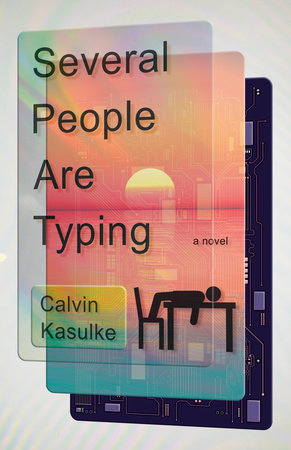
Several People Are Typing by Calvin Kasulke

A book’s presence on the Literary Stunt Index (that’s really more of a matrix) doesn’t mean it’s a garbage book; again, some of my favorite books are on that graph. Asserting a book has a stunt-y central conceit or device is a neutral observation, not a detraction—or I certainly hope that’s the case, anyway, because my debut novel, Several People Are Typing, is written entirely in Slack chats and definitely belongs somewhere on this chart. 

In lieu of updating the Index and having to photoshop a whole new chart, here are a few more titles with bold, audacious, or conceits that dominate the form and/or content of the book:

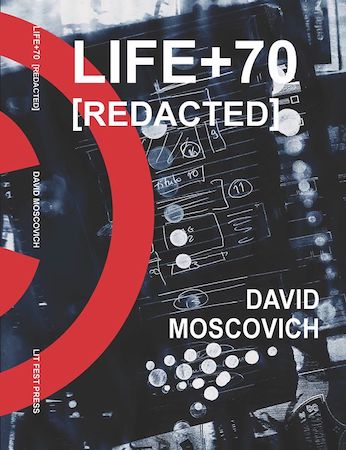
LIFE+70[REDACTED] by David Moscovich

The narrator, who is (probably?) David Moscovich, published an ebook online for the price of $249,999.99, which he admits was kind of high but was also kind of the point. A hacker managed to download the book without paying, as hackers are wont to do. Moscovitch manages to track down and contact the hacker, and the two correspond about the cybercrime and the value of the ebook which is not contained in this book *about* that ebook, though I can’t imagine I’d derive more pleasure from reading that highly exclusive ebook (if it ever actually existed) than I did from reading this one.

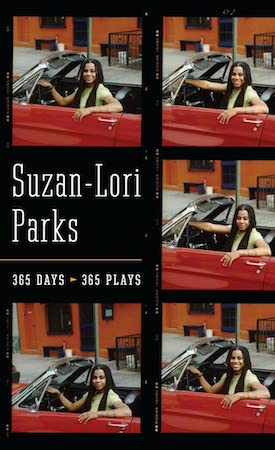
365 Days / 365 Plays by Suzan-Lori Parks

This anthology is precisely what it says on the tin: a collection of the 365 one-act plays that Parks, one of America’s greatest playwrights, wrote each day for a year. The collection is worth it for her introduction alone, but it’s a thrilling experiment to read—it’s a diary, a testament to a dedicated writing practice, and a collision between the one-act play and flash fiction, and a stunning display of Parks’s skills. Put this one firmly in the “flex” quadrant.

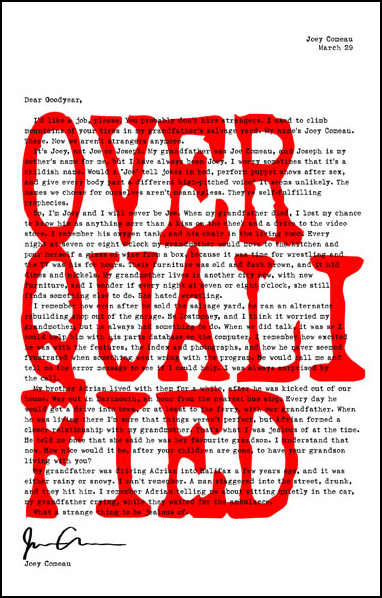
Overqualified by Joey Comeau

Readers of a certain age might know Comeau as the co-creator of A Softer World, though he’s written a number of books over the years across multiple genres. Overqualified is an epistolary novel written entirely in cover letters and I don’t wish to describe it in more detail, lest I spoil the experience of reading this book in one sitting and letting it transcend what you might imagine a book of cover letters can accomplish.

Found Audio by N.J. Campbell

A hallmark of the successful literary stunt is, I think, either going above and beyond the expected limitations of the book’s central conceit, or otherwise using the stunt-y premise as a distraction before surprising the reader with something they weren’t expecting, caught up as they were with your stunning ‘e’-less oulipo prose. Found Audio falls into the latter category. Campbell uses an overarching framework of, well, found audio to weave an adventure story that evolves into full-on fantasy. The more fantastical the story becomes the more crucial it is to unlock mystery of the recording; the more engaged the reader is with the mystery of the recording, the more urgent the need becomes to dive deeper into the stories contained within the tapes. Sometimes what appears to be a big swing is in fact a skillful sleight of hand; this is one of those times.

Blackass by A. Igoni Barrett

This one’s on the chart already but I’m entering it here a second time for emphasis. I mean, come on: “Furo Wariboko, a young Nigerian, awakes the morning before a job interview to find that he’s been transformed into a white man.” (Except for his ass.) It’s everything “Kafka in Nigeria” promises to be and more.

Artist Descending a Staircase by Tom Stoppard

This, too, is a play, but I’m a sucker for an interesting chronological conceit. Time itself is a staircase in Staircase, where we begin at the beginning of the end, then jump back in time to the beginning of the penultimate scene, etc. This continues until we reach the earliest event in the play’s chronology—the inciting event of the entire show—and then begin to move forward in time again, completing the second half of each of the first three scenes. The structure, then, plays out like so: D1, C1, B1, A, B2, C2, D2. It’s a mathematical way to break down one of Stoppard’s most affecting shows, but of course Stoppard’s usually at his best when his formal innovations align with the emotional worlds of his characters—and I’d argue Stoppard’s working at the apex of his powers with Staircase.

Confessions of the Fox by Jordy Rosenberg

Confessions of the Fox by Jordy Rosenberg

If you know, you know.

Why Did I Fail to Notice Race in “The Snowy Day?”

There is an error in The Snowy Day by Ezra Jack Keats that I didn’t see until some point reading it to our second child. On the fifth and sixth pages, Keats writes that Peter “walked with his toes pointing out, like this,” and then, “He walked with his toes pointing in, like that.” The footprints below the text are angled accordingly. In his bright red snowsuit, Peter stands at the far right, looking back over his shoulder, one of several quiet, thoughtful moments in this beautiful book. 

The Snowy Day by Ezra Jack Keats

But how could I have read over this so many times: The footprints in the picture are side-by-side, two-by-two. Peter didn’t walk. He hopped. (Curiously, the cover image of the book is also Peter looking back at his footprints, but those are alternating and facing forward, evidence of ambulation.) 

Why care? It wasn’t noticeable when I read right over it—and over and over it—to my oldest child. But Peter is a child who notices and reflects, which is much of what I love about this book, so I want to respond in kind, especially considering how loved this book has been—by us as a family, and as part of a wider readership. What made The Snowy Day a groundbreaking “first” when it won the Caldecott in 1963, and what makes it noteworthy on our bookshelves as a white family almost sixty years later, is that Peter is Black.  

I had noticed Peter’s race, and I imagine my kids did too, but we never talked about it. What I had been reading right over, and repeatedly, was what Peter’s race meant. Can it mean nothing? Clearly not—it is noteworthy and groundbreaking. Yet I was reading colorblind. Why? Was this what the author intended? 

The footprints in the picture are side-by-side, two-by-two. Peter didn’t walk. He hopped.

Keats was white. Born in Brooklyn in 1916 as Jacob Ezra Katz, he was the son of Jewish immigrants from Poland. As a young working artist, Keats was a muralist for the Works Progress Administration, a background illustrator for Captain Marvel comics, and, in WWII, a camouflage designer. In 1947, in response to anti-Semitism, he changed his name to Ezra Jack Keats and became an illustrator for newspapers, magazines, and eventually children’s books. “Then began an experience that turned my life around, working on a book with a black kid as hero,” he said, as recounted on the Ezra Jack Keats Foundation website. “None of the manuscripts I’d been illustrating featured any black kids—except for token blacks in the background. My book would have him there simply because he should have been there all along.”  

Diversifying children’s literature was a cause for Keats. His first book, which he co-authored with Pat Cherr in 1960, My Dog Is Lost!, stars Juanito as its main character, a Puerto Rican immigrant who speaks only Spanish. Of the twenty-two books Keats went on to write and illustrate, seven starred Peter and his family. Other recurring characters in Keats’ oeuvre are Archie and Amy, who are Black, and Roberto, who is Latinx. 

‘Then began an experience that turned my life around, working on a book with a black kid as hero,’ Keats said.

The diversity was much needed. In her landmark study “The All-White World of Children’s Books,” published in The Saturday Review three years after The Snowy Day was published, educator and scholar Nancy Larrick found that only 6.7% of children’s books published between 1962 and 1965 included a Black character, even in the background. 

In the sixty years since, progress has been made, but, alarmingly little, and only very recently. According to a study by Professor Sarah Park Dahlen, based on data from The Cooperative Children’s Book Center at the University of Wisconsin-Madison School of Education, 23% of children’s books published in 2018 “depicted characters from diverse backgrounds.” It was 14.2% in 2014, so it is encouraging to see the number go up, but for at least 20 years before this, according to Professor Philip Nel in his 2017 book Was the Cat in the Hat Black? The Hidden Racism of Children’s Literature and the Need for Diverse Books, it hovered around 10%. (Nel answers his question: Yes, the Cat in the Hat was Black, both in the visual language and themes of minstrelsy.) What should the number be? If it were to reflect the current U.S. population, it would be about 40%.
     

Scrutinizing an industry is one thing, but what do I offer my own kids? It’s important to my wife and me to talk to our kids about identity, including race. Books prompt and support these discussions. For example, The Colors of Us by Karen Katz celebrates the multiplicity and beauty of skin colors, centering on a child discovering what color to use in a self-portrait. (She decides on cinnamon; my youngest most recently settled on “peach.”) Other family favorites honor culture, like Bi-bim Bop! by Linda Sue Park, which includes a recipe for the Korean dish, and Feast For Ten by Catheryn Falwell, a counting book that features a Black family shopping and cooking. 

It’s important to my wife and me to talk to our kids about identity, including race.

In raising awareness of others, these books, visually and textually, also raise awareness of ourselves. Another recent favorite has been Bedtime Bonnet by Nancy Redd, who writes in her author bio that she was “inspired by the lack of resources” for her daughter about Black hair. The book begins, “In my family, when the sun goes down, our hair goes up!” In our family, it stays down, so, in addition to learning about wave caps and durags—it’s a resource for us, too—we talk about the care that different hair types require. It feels like part of a good foundation for conversations in the years ahead about all that hair represents, and has represented, in issues of identity. 

But back to my question in light of the statistics: what do I offer my own kids—in numbers? Just like not noticing Peter’s footprints, a true audit of my own bookshelf was something I had overlooked. 

My study was not terribly scientific. I took my tally by walking my fingers across book spines and pulling them half-way out one afternoon while I was watching my three-year old, and I know there’s at least one other box in the attic filled with books that I didn’t dig out. I mention these limitations to my research because this is how inequality in the 21st century can persist. For as much as I imagine myself to be forward-thinking in matters of parenting and social justice, while in the throes of everyday life, it is all too easy to slide into historical patterns of underrepresentation, if not complicit prejudice. Of the 426 picture books I counted, which we have accumulated for three kids over 13 years, 53 have a main character that is human and not white. I was fearing it would be something like 5, so I am relieved, but in terms of our proportions, it comes out to 12%, a very 20th-century library. 

The Snowy Day was a member of the 53 (I passed over our copy of The Cat in the Hat, blushing), but my audit raised further questions about how much, or how well, these books advance the causes of inclusion, equity, anti-racism—causes that motivate my attention. For example, I counted Taro Gomi’s lovely books, originally published in Japanese, but are people and culture of East Asia “represented,” in the sense of promoting diversity? Yes, I decided, compared to Emily’s Balloon by Komako Sakai, also translated from Japanese, in which Emily looks white (so I didn’t count it as part of the 53). 

As for Keats’ books, other than Juanito’s Spanish, the stories never call direct attention to ethnicity or race. His images do, but also not really: they show skin color, but not anything that would suggest culture or identity. If any identity is explicit in Keats’ stories of apartment-dwelling and alleyway adventuring, it is working-class urban culture. It is also noteworthy that none of his characters are identified as Jewish. Keats does take up religion in his 1966 book God is in the Mountain, but to make something of a universalist statement: it is an illustrated collection of passages from religious texts spanning the globe. 

If Keats sought to diversify picture books, it was to depict the ideal of the melting pot, and when The Snowy Day was published, reviewers were correspondingly colorblind. According to Kathleen T. Horning’s 2016 article for The Horn Book magazine, “The Enduring Footprints of Peter, Ezra Jack Keats, and The Snowy Day,” the book was widely and favorably reviewed, but only three publications acknowledged Peter’s race. The Saturday Review commented on race to dismiss it: “that the boy’s skin is brown is never mentioned in the text, so it is for all children.” This aspect of Keats’ work also drew criticism. While the civil-rights advocacy group the Council on Interracial Books for Children put Keats’ books on its recommended books list, it also criticized Keats for presenting children of color who might as well be white. 

The tension here is echoed in my own reading: is it a beloved family favorite because it never calls attention to race—Peter’s or ours? As Keats said of Peter, “he simply should have been there all along” in children’s literature, and I agree—we all agree—but only if he “might as well be” white?   

Is it a beloved family favorite because it never calls attention to race—Peter’s or ours?

Keats himself was outspoken about his cause of diversifying children’s literature—except for when he wasn’t. In his essay “The Right to Be Real,” published in The Saturday Review after The Snowy Day won the Caldecott, Keats writes that “[w]e are now entering a new era of children’s books,” one that will “relegate to the past the kind of books, both trade and text, in which an entire people and a great heritage have been deliberately ignored.” When he won the Caldecott for The Snowy Day, however, in his acceptance speech given a month before the 1963 March on Washington, he opts to deliberately ignore it. He suggests its significance in his concluding sentence—“I can honestly say that Peter came into being because we wanted him”—but he doesn’t once mention Peter’s race. 

This mixed messaging continues through today. Deborah Pope, Executive Director of The Ezra Jack Keats Foundation, which, among other initiatives to honor the artist, gives an annual award to promote diversity in children’s literature, told National Public Radio on the 50th anniversary of The Snowy Day that Keats didn’t mention Peter’s race in the book because it “wasn’t important. It wasn’t the point. The point is that this is a beautiful book about a child’s encounter with snow, and the wonder of it. […] Was he trying to make a ‘cause’ book, was he trying to make a point? No.” 

Again, before my attention gets fixed on what other people say and don’t say, do and don’t publish, I have to acknowledge that, in my countless readings of The Snowy Day as a white father to my white kids (Peter appears against a blanketing whiteness indeed), I had never talked about Peter’s race either. What would there be to talk about? It is, as Pope suggests, crafted as a universal story, which makes it doubly remarkable on our bookshelf: not only does this book star a Black child, this Black child represents universal childhood.  

…I had never talked about Peter’s race either. What would there be to talk about?

But if race is not acknowledged, if this “remarkableness” is not remarked upon, how visible, or present, is Peter? How present, or realized, is the childhood he represents? How present are we, when we read it? 

In all of our appreciation of The Snowy Day, the blizzarding wonder for me is in how race appears in the book, then disappears when it is reviewed, awarded, honored 50 years later, and when I continue to read it. It makes me further wonder whether, in our collective white mind, the feat was—and is—the appearance of race or its disappearance. It recalls Toni Morrison’s 1988 essay “Unspeakable Things Unspoken: The Afro-American Presence in American Literature”: 

I can’t help thinking that the question should never have been “Why am I, an Afro-American, absent from it?” It is not a particularly interesting query anyway. The spectacularly interesting question is “What intellectual feats had to be performed by the author or his critic to erase me from a society seething with my presence, and what effect has that performance had on the work?” 

My performance of reading of The Snowy Day, which is also a performance of parenting, is what gives importance to Peter hopping. 

I tried it myself, one snowy day last year. Crunch, crunch, crunch, my feet sank into the snow. While playing with my toddler after a new snowfall in the mostly white, suburban alleyway behind my duplex, I took twelve walking steps and looked back, then twelve hops and looked back. They made for very different moments of reflection. Walking allowed me to carefully place my footsteps; a dozen hops took the wind out of me. 

Here is where my mistake of not noticing is costly: I had always seen this moment as one of quiet introspection. I thought I knew what Peter was thinking and feeling, how he was looking and breathing. I thought I knew Peter, in other words, and that The Snowy Day knew Peter. But I don’t think we did. 

I thought I knew Peter, in other words, and that The Snowy Day knew Peter. But I don’t think we did. 

What else am I reading right over, and repeatedly? 

I have to stop modeling colorblindness, in the name of the universal, when I read this book—and really, any book. The avoidance of race amounts to its erasure, even as I honor its presence on my bookshelf. It models for my kids that, as white people, we talk about race when it is somehow advantageous, or called to our attention, as in (most of) our 53 books that feature a main character of color, but otherwise, we don’t have to worry about it, as in our other 373. 

And what of these other 373? Feast for Ten is a “raced” counting book; what about Counting Birds? The books about science? The narratives that star animals by Richard Scarry, Sandra Boynton, Mo Willems—they don’t “depict race,” but in what ways, or to what degree, do they express whiteness, the absence of color, a defaulted position of power? And in what ways do I reinforce, or recreate, our own defaulted position of power as a white family if I avoid thinking or talking about race when I read any of the 426 books my kids and I cuddle up and share? 

Perhaps a timeless virtue of The Snowy Day is that it offers a choice. I can “read colorblind,” a choice I had been making without noticing, or I can have a conversation about race with my kids, a conversation which, like Peter, also “simply should have been there all along.” I want to make the latter choice now; what I have been struggling with, simply, is how to start. 

I have faith in literature: a book this good teaches me how to read it, or in this case, to read it better. If there is not a clear and obvious way to address race in The Snowy Day, it’s my responsibility to find one. 

Peter himself is a model for learning. After he looks back on his footprints—made by hopping—he then learns about the snow and what to do in it, dragging his feet “s-l-o-w-l-y to make tracks,” and making snow angels and a “smiling snowman.” He also learns about himself in relation to others: “He thought it would be fun to join the big boys in their snowball fight, but he knew he wasn’t old enough—not yet.” Peter sits in the foreground, a snowball splattered on his torso. Apparently, he learned this the hard way. Peter also conducts two experiments. He hits a snow-covered tree branch with a stick, learning that snow then falls on his head, and upon returning home, puts a snowball in his pocket “for tomorrow.” 

“It will melt!” my toddler exclaims when we get to this page. She knows this not only because we’ve read the story countless times, but because last winter she replicated his experiment. 

She knows this not only because we’ve read the story countless times, but because last winter she replicated his experiment.

At the end the book, another snowy day begins, but this time there is a big difference. Instead of going out in the snow alone, “After breakfast he called to his friend from across the hall, and they went out together in the deep, deep snow.” The last page shows the two of them in the distance, walking away.

What else have I been reading over? 

“Do you know what this means,” I asked my daughter, under the covers for bedtime stories, “that his friend was ‘across the hall’?” For as much as the book is “universal,” here is a detail from Peter’s world, and Keats’, that places them—and us—in the world together. 

My daughter kept her thumb in her mouth and shook her head. I briefly explained what an apartment building was. To my memory, she had only been in two. She didn’t remember either. 

What else?

Another time, after reading the book at breakfast, I said to my daughter, “So, Peter has brown skin, like Doc McStuffins,” a current favorite cartoon. “What about Peter’s friend?” 

She looked. “His coat is brown.” 

“So, yes? Or we don’t know?” 

We both stayed quiet, looking. 

“Do we know it’s a boy? It only says ‘his friend.’”  

“I think he’s a girl.” She smiled. “I think he’s a boy.” 

Why did she switch back from “girl” to “boy”? Was it the force of the gendered pronoun? Was it her flexible toddler mind? Either way, there it is, on the very last page, the point of entry I had been reading over, and repeatedly. It’s Peter’s friend that can engage me in conversations about identity—beginning with our assumptions, and the question of whether we see ourselves alongside Peter or not. 

7 Books That Grapple With Memory and Loss

And suddenly you find yourself standing in a different corner of your home, another room perhaps, no longer certain of why you had come here in the first place, to get something perhaps—but what it was you can no longer recall, and so you stand a little while longer. Perhaps you partially retrace your steps, recrossing the threshold, replaying your thoughts as best you can, trying to substitute faithful reenactment for remembrance. At last, if the stars have aligned, it hits you—ah, scissors, I came here to get a pair of scissors…

For something we trust so implicitly, memory too often fails us. We forget faces, miss appointments, lose car keys. Luckily, our individual memories do not have a monopoly on our access to the past. We safeguard the vanished past with objects, texts, tools. In doing so we create a constellation of remembrance, an inscription of our past upon the present.

These questions—of the past, of history, of the fallibility of memory—loomed large in my mind as I researched and wrote The Thousand Crimes of Ming Tsu, a Western set in 1869 featuring a Chinese American protagonist fighting his way west. Tens of thousands of Chinese laborers worked for the Central Pacific Railroad Company; many died in the process. And yet in the celebratory Golden Spike photograph, commemorating the completion of the Transcontinental Railroad, not a single Chinese worker is visible. Though their presence has been until recently largely ignored, their memory has not vanished. Traces of their labor still linger today, exerting ghostly force over our lives.

These 7 books explore these questions of memory and loss through a variety of lenses—fiction, nonfiction, and poetry. They represent remarkable examples of differing approaches to the vast issue of how our pasts propagate forward into our present.

The Buried Giant by Kazuo Ishiguro

The Buried Giant by Kazuo Ishiguro

Published two years before he received the Nobel Prize in Literature, Ishiguro’s novel follows an elderly couple, Axl and Beatrice, as they move through a medieval Britain beset by an amnestic mist. With enormous difficulty, people remember: wars, lovers, children. Axl and Beatrice know they have a son, but struggle to remember much beyond this bare fact. They embark on a quest to find him once more, encountering relics, residues, artifacts of memories without remembrances. Ishiguro’s prose is rhythmic, placid, profound; this book took him ten years to write, and it may well stay with you for longer.

The River of Consciousness by Oliver Sacks

The River of Consciousness by Oliver Sacks

The neurologist Sacks, two weeks before his death in 2015, outlined a collection of essays on the human experience and science that was to become this book. In ten essays of varying length, Sacks interrogates subjective experience and personal identity using lenses ranging from botany to neuroscience. One of the essays, “Memory,” discusses remembrance and the fallibility of human recollection; alongside its peers in this collection of essays, however, and in the wake of his death, all of Sacks’s musings seem to point towards some larger set of questions, where science and philosophy begin to feather into one another. Sacks’s affable voice and unmistakeable brilliance shine throughout.

Garden Time by W.S. Merwin

A slim volume of immense power, and also the last collection of new poems Merwin published in his lifetime. In lucid, sparkling lines, Merwin raises the shadowed past and asks it to stay awhile, just for a moment longer. Garden Time is Merwin at his absolute best: humble, poignant, and shining with love for living, and remembering. The circumstances of the book’s creation share in its profundity—Merwin wrote these poems as his eyesight deteriorated, and when he was no longer able to see, he dictated poems to his wife, to whom the book is dedicated. 

The Housekeeper and the Professor by Yoko Ogawa, translated by Stephen Snyder

A housekeeper receives her new assignment: a brilliant mathematics professor who, 17 years prior, suffered anterograde amnesia after a serious car accident. His memory is intact up to the moment of his head injury; beyond that, for 17 years, he has lived in a moving window of 80 minutes of short-term memory. Being a clever man, however, he’s devised certain coping mechanisms—clipped to his suit are dozens of slips of paper, each reminding him of something he cannot remember. “New housekeeper,” reads one, accompanied by a little sketched portrait of the new housekeeper in question. The housekeeper and the professor, along with the housekeeper’s ten-year-old son, develop a friendship as close as it is strange. Rendered from the Japanese into an even-handed and clear English by Stephen Snyder, interspersed with mathematical formulae and diagrams, Ogawa’s novel deftly explores the limits of memory, personality, and care.  
The Glen Rock Book of the Dead by Marion Winik

In the space of 100 pages, Winik pays poignant and often funny tribute to people in her life who have died. The book is a masterclass in character. Winik resurrects these memorialized dead as epithets—an occupation, a demonym, a relation—and pairs them with finely-wrought prose portraits that run two or three pages at most. In terms of pure word count, this book can be easily finished in a single sitting; in terms of weight and breadth, however, you’ll want to slow down, read and reread, if only to give these remembered phantoms a little more space to breathe, a little more time to linger.

Dunce by Mary Ruefle

A finalist for the 2020 Pulitzer Prize, Ruefle’s Dunce hums with the tension between the intensity of living and the certainty of dying. In Ruefle’s lines the ordinary finds itself alongside the numinous. Lines seem to torque and shift imperceptibly along their length, one after another, their net effect transporting you from a holiday party to a contemplation of a single moment of absolute presence. With a rhythm and cadence that calls to mind the subtle, yet inexorable power of a river current, or an incoming tide, Ruefle generates moments of vertiginous delight and startling beauty against a backdrop of mortality and its affordances.

Baron Wenckheim’s Homecoming by László Krasznahorkai, translated by Ottilie Mulzet

For those who are already acquainted with Krasznahorkai, this is 700 pages of the Hungarian luminary at his most apocalyptic and most hypnotic. For those encountering him for the first time, a warning: Krasznahorkai’s writing is demanding. Single sentences run on for pages. A litany of commas and more esoteric combinations of punctation carve up streams of consciousness into a thumping rhythm of quip and rejoinder, observation and derision, lunatic phantasmagoria and mind-numbing banality.

The novel is ostensibly about the Baron Wenckheim, who returns to his childhood town in Hungary to escape his gambling debts. There, he hopes to reunite with his childhood sweetheart, a woman named Marika. Also in the mix are a professor leading his field in moss research, his daughter, a neo-Nazi biker gang, the staff of the local newspaper, and what might be the physical manifestation of evil itself on Earth. None of this really matters; Krasznahorkai’s free-flowing sentences and disregard for conventions are the main draw here, as he grapples with the political and the historical—that is to say, with what kinds of memories our present might become for our future. 
You Can’t Un-Swim a Fish

Reverse Takoyaki (How To Uncook An Octopus)

i.

Reverse salmon. How to un-swim a fish. 
Dewater it. The future unfolding a dead
octopus splashed back to life.

ii.

The journey of my diary
is always one-sided. I never could 
read that telling of the story,

of the present. I never could truly
go back to that day the three of us found a squid, 
and you called it a turtle. One-third of us
later calling it happiness.

iii.

All life from the ocean, is a sure thing. 
Even when time divides us, (please) 
laugh triumphantly and call them waves.

Sometimes, even at the grocery store in Newark,
a gale blows over, stronger than that tornado I saw in Ohio, 
carrying the memories of strangers
at sea. For this, I shall cry. Only this. 

iv.

I am waking from that dream
that another swimming history gave me.
Father, where am I? Says the old crab 
to his one and only sea.

v.

They will find him so far,
in another land. They will ask his name, 
and he will only whisper
from the sand of his dry mouth 
all the names of his fallen,
and ones that touched him gently.

Quintet For Harvard Square

i.

I am a grand thief tonight at Harvard Square. 
My hair will grow twice as fast,
like tendrils true at sea. My shadow mixes with twelve 
columns, stretched thirteen feet long each

way. To the new silhouettes made by streetlamp,
What does it mean to be the youngest student 
at the oldest school? Flicker, then sway.

ii.

Beautiful. The animals trade spots with the grass. 
Meanwhile, a hare crosses the long library,
unnoticed, with his hind legs faster than his front.

iii.

Sever Hall, with the dimly cast entrance, 
a huge square with only one hole,
like a trick, like a wall with a tunnel

drawn on it. Interesting to pick here to piss, 
but sometimes — we see so clearly
what is to be seen, only at dusk. 

iv.

Under the earth, the men's shoulders 
touch so briefly, like stars kissing,
and the lights color over two paintings of boats.

Someone remarks how odd it is, that so much was drunk
in thirst. How odd it is that this
is the happiness we've always had.

Later he reaches his hand up, without stretching 
to touch the old and scratchy ceiling
where one light had landed by accident. 

v.
 
At the pharmacy, I remember my shoplifting 
days. But it is past that now. When I see
how much security is watching the check-out, 
relief flushes through me.

I'll pay slowly, watching each coin 
drop into the hand of another.

The Top 10 Party Girls in Literature

From an age that was often too young to be anywhere, I found myself in closed-off rooms. They ranged from green rooms at concert halls to back rooms at parties. By the time I was 21, I had known my purpose in those spaces, how and why I was invited into them, and what was expected of me. I was a seasoned party girl who flitted in and out of metropolitan cities with seemingly few resources. People had seen me around. They would say, “Oh her, I’ve known her forever!”

The politics of the Party Girl have always been of interest to me, simply because of the way she moves within a world that warns her to be careful. To watch her behavior, her tone, her drink. She exists on a precipice of seeking out fun, when also too much fun, she’s warned, is dangerous. The prevailing image of the Party Girl has historically been white—of course, non-white Party Girls have existed, but how much space do we lend them in its canon? How much fun are they allowed to have? My characters come from a lineage of flappers, demimondaines, and society girls, where what unifies these archetypes is how they attempt to rise ranks with charm as their only currency.

Happy Hour by Marlowe Granados

My debut novel Happy Hour follows Isa Epley and Gala Novak, two young women in pursuit of pleasure at whatever cost—and usually on someone else’s dime. They traverse New York’s social scenes with disarming aplomb—wily, mischievous, and irreverent. Isa, being of Latinx/Asian descent, structures her delicate world of fun with a kind of alertness that her white counterparts need not have. Keeping sinister outcomes at bay, Isa gets away with it all. Her forebears are sometimes not as lucky. Each of these titles share a glittering character who pursues pleasure, freedom, and beauty in a world that does not want them to succeed. 

Mr. Right is Dead by Rona Jaffe

The titular novella in this collection follows a playgirl named Melba Toast who gathers men and gifts without a touch of malice, “She takes quick flights of fancy and quick flights across the country in quest of someone she had two dates with a month before.” The narrator is a willing accomplice to Melba’s schemes and comes to the realization that though she makes it look easy, a playgirl’s life is often hard work. 

Breakfast at Tiffany's by Truman Capote

Breakfast at Tiffany’s by Truman Capote

This list would be amiss without Holly Golightly. The glamorous call girl who left men wanting more. She has some of the best Party Girl pedigree—a secret marriage, a mob connection, and a casual grasp of French. I often find myself repeating her aperçus—“Certain shades of limelight wreck a girl’s complexion.” 

The Dud Avocado by Elaine Dundy

Dud Avocado by Elaine Dundy

Dundy’s protagonist Sally Jay Gorce feels like the original American in Paris. “I could have never got out of him a single fur, or a single jewel, or a jar of fresh caviar,” she says while contemplating how rich men are suspicious of those who orbit them and have lesser means. Djurna Barnes once wrote a short story called “The Woman Who Goes Abroad to Forget,” Sally Jay Gorce could very well be that woman. Dud Avocado is for those who need a beginner’s guide on how to live. 

House of Mirth by Edith Wharton

Lily Bart is, in a way, the martyr of Party Girls. A woman who loves the beauty and luxury of the world she grew up in only to be punished by the cruel mores of her very class. As she desperately tries to marry a man of means to cover her growing gambling debt (chic!), she is sabotaged at every turn and dies in poverty. 

Lote by Shola von Reinhold 

The search for extravagance and luxury lands this contemporary novel on my list. The protagonist Mathilda fixates on a photograph of a Black modernist poet and finds herself at an artist residency in the same town the poet was known to live. The novel displays the critical importance of tracing a history of decadence that has long been forgotten.

Gentlemen Prefer Blondes and But Gentlemen Marry Brunettes by Anita Loos

Gentlemen Prefer Blondes by Anita Loos

Two charming flappers cause mischief across New York, London, and Paris. Written in diary form with clever malapropisms sprinkled throughout and a faux-naïf narrator in Lorelei Lee, nothing bad could ever happen to these women, and that’s a design of their own making. 

100 Boyfriends by Brontez Purnell

Much like the fluid identity of a “Hot Girl”, the Party Girl lifestyle is an ethos, and nothing says Party Girl more than a roving landscape of lovers. Short, first-person vignettes follow the unnamed protagonist on a revelatory, queer misadventure meeting boyfriend to “boyfriend”.

Good Morning, Midnight by Jean Rhys

When I think of a Rhys novel, I envision scenes of a lone woman drinking Pernod at a café she can’t afford and gazing at shop windows for a dress she’ll spend the last of her allowance on. Good Morning, Midnight follows a middle-aged Sasha Jansen as she returns to Paris and is haunted by memories of a life that she’ll never return to. Rhys’s talent is in painting a scene that at turns is tragic, but cut through with moments of humor and lightness. 

Queenie by Candice Carty-Williams

After a long-term relationship detonates, Queenie Jenkins careens around London in a never-ending spiral of bad decisions and sexual foibles. Wrestling her mental health, heartbreak, and a prudent Jamaican British family, Queenie attempts the clumsy journey of trying to achieve independence through sexual encounters. 

The Chosen and The Beautiful by Nghi Vo

A retelling of The Great Gatsby from the eyes of Jordan Baker—this time queer and Vietnamese. Vo reinvents the Fitzgerald classic into one that is filled with magical realism and a recognizable decadence. For those that always thought Jordan was the unsung heroine.