Poetry, Flash Fiction, and Graphic Narrative for Every Holiday Experience

This list has everything your holiday season calls for. From sentient Christmas ornaments to grief calendars to tween angels, here’s a piece of short fiction, poetry, or graphic narrative for every holiday experience. 

For people who are trimming a tree: “We Live In a Tree for One Month Every Year” by Reina Hardy 

Ever wonder what your ornaments are thinking? This short story is told from the point of view of Christmas ornaments who get to see the light of day just once a year. 

For people who are traveling for the holidays: “A Failed Romanticism” by Bernadette Geyer

What is vacation except a passage of time? Geyer’s poem meditates on the way our homes change and remain the same when we leave them. 

For people who are going to church on Christmas: “Eugenie is Anointed” by Jackie Thomas-Kennedy 

Eugenie receives her call from God at the same time most people do: while making pork chops. As she eats a TV dinner with her stepmother and fishes a dead mouse out of the pool, Eugenie wonders why God would choose her to be an angel.

For people who are spending the holidays with their grown children: “Taxonomy” by Susan Leslie Moore 

Everything is secretly something else: constellations and condominiums and clocks and children. Moore’s poems look at motherhood, gentrification, and unexpected change.

For people who are spending the holidays without their parents: “Grief Log” by Venita Blackburn, illustrated by Bianca Alejos 

An exercise calendar becomes a grief planner in this illustrated piece. Everyone grieves differently, and some people prefer to chart their catharsis.  

For people who are throwing a holiday party: “Hospitality” by Shane Kowalski 

Hosting is hard work, mostly because you have to interact with other people. The host of this party has particularly difficult guests, but the party must go on!

For people who are throwing a holiday party and want an alternative to smalltalk: “Shitty Boyfriends of Western Literature: The Card Game” by Reina Hardy 

If you’ve always wanted to play parlor games, but you were born in the wrong century and have a healthy sense of irony, here’s the solution for you. A mix between a card game, a parlor game, and an improv exercise, players must successfully woo each other while pretending to be famous men from the western literary canon.

For people who are eating, but not cooking, with their families: “KFC, or the taste of success is—wait for it—tender on the outside, tough on the inside” by Stine An 

The food that means the most to us isn’t always home-cooked or luxurious: sometimes it’s KFC gravy or imitation crab meat. These poems explore the way food is transformed in the presence of family. 

For people receiving kitchen gadgets as presents: “Osterizer Classic Series 10 Cycle Blender” by Emily Everett 

This is a great story for people who read Amazon reviews for their tear-jerking emotional heft. Sometimes things that are blenders are also sad. 

For people who are staying home and looking out the window: “The Weather” by Bennet Bergman 

Are we really expected to get out of bed and leave the house every day? Bergman’s poem spends time indoors, watching the weather through windows. 

Today Only, Become a Member and Get a Free, Exclusive Enamel Pin

Last week, we offered our readers a free, exclusive [sic] pin if they signed up to be an Electric Lit member THAT DAY. You had less than 24 hours to jump on a deal that let you proudly, stylishly proclaim to the world that a) you’re an EL supporter, b) you’re like this on purpose, c) you’re a ruthless editor, or d) all of the above.

Well, if you missed out, good news: we’re doing it again. If you sign up to be an Electric Lit member before MIDNIGHT tonight, December 27, we’ll send you a free pin. Original post follows!


As you’ve probably noticed because we talk about it constantly, we’re trying to get 1,000 Electric Lit members to sign up before 2020 rolls around. And for an incredibly limited time (less than 24 hours!), if you pitch in to help us reach our goal, your membership will get you not only the usual perks but EXCLUSIVE SWAG.

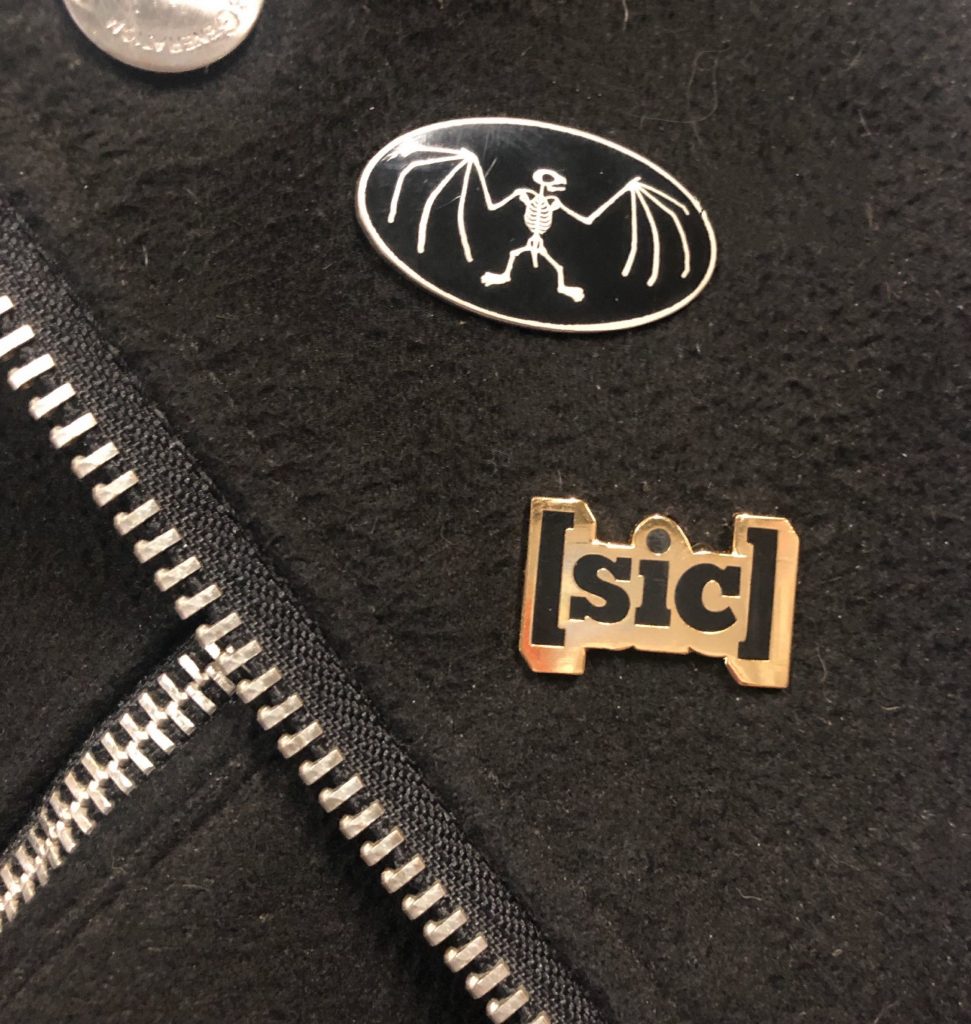
Sign up to be an Electric Lit member before the end of the day today, Tuesday, December 17 Friday, December 27, and we’ll send you one of our new [sic] enamel pins, designed by Stephanie Kubo, for free.* Nobody else has or can get these yet! 

Here it is on my coat! Good, right?

If you don’t know [sic], it’s often used as a piece of editorial shade that means “I didn’t misspell this, the other person did.” You might use it when, say, reporting on a Trump tweet. But what it really means is “thus,” as in, “this is not a mistake, this is how it was supposed to be.” In other words, you can finally tell the world that you’re like this on purpose in the pithiest, nerdiest way possible!

We’re already more than halfway to our goal, but that means we have nearly halfway to go. Join us, and you’ll get this exclusive merch to announce your new membership—and to tell people not to bother you because you’re supposed to be this way. For one day only, get down with the [sic]ness and help EL keep publishing into the next decade.

This offer is only good until midnight tonight, so don’t hesitate! Become a member today.

* U.S. only

Read More Women Literary Trivia Returns!

Test your knowledge of women writers with a fun pop quiz.

First Round

  1. Name the title and author of the first-ever science fiction novel.
  2. This Pulitzer-prize winner and Italian translator declared in 2015 that she is now only writing in Italian. Name this author.
  3. The 2018 Nobel laureate for literature is from which country?
  4. National Book Award nominee Camonghne Felix works as a strategist for which 2020 presidential nominee?
  5. This Minneapolis bookstore Birchbark Books specializes in Native American books, arts, jewelry, gifts. Who is the author who owns this bookstore?
  6. Born in the Western Ukraine to a Jewish family, this author and her family fled to Brazil during WWI. Name this author.
  7. Who is the only author to win the Hugo award for best novel for all three books of a trilogy?
  8. Virginia Woolf was part of which London-based group of intellectuals?
  9. Writer Elif Shafak faced the possibility of three years imprisonment for the crime of insulting which country?
  10. This historical fiction novel by Julia Alvarez is set during the Trujillo dictatorship and retells the story of the Mirabal sisters. Name the book and the country that it is set in.
  11. Alice Walker, Ann Patchett, Louise Gluck and A. M. Homes graduated from which historically women’s college? Hint: The college is now co-ed.
  12. Who is the first Black woman to win the Booker prize (formerly known as the Man Booker prize)?
  13. Name the title of this poem by Elizabeth Bishop. Hint: the title is in the structure.

September rain falls on the house.

In the failing light, the old grandmother

sits in the kitchen with the child

beside the Little Marvel Stove,

reading the jokes from the almanac,

laughing and talking to hide her tears.

Second Round: Match the writer to her male pen name

Writers: Alice Bradley Sheldon, Louisa May Alcott, Amantine Dupin, Mary Anne Evans, Charlotte Bronte, Karen Blixen, J. K. Rowling.

  1. Robert Galbraith:
  2. George Eliot:
  3. Currer Bell:
  4. James Tiptree, Jr.
  5. A.M. Barnard:
  6. George Sand:
  7. Isak Dinesen:

Picture Round

This graphic memoir chronicles the coming of age of a young girl during which 1979 revolution? Bonus point for naming the book.

Photo via Knopf Doubleday Publishing Group

Answers

First Round

  1. Frankenstein by Mary Shelley
  2. Jhumpa Lahiri
  3. Poland
  4. Elizabeth Warren
  5. Louise Erdrich
  6. Clarice Lispector
  7. N.K. Jemisin
  8. The Bloomsbury Group
  9. Turkey
  10. In the Time of the Butterflies, The Dominican Republic
  11. Sarah Lawrence College
  12. Bernardine Evaristo
  13. Sestina

Second Round

  1. Robert Galbraith: JK Rowling
  2. George Eliot: Mary Anne Evans 
  3. Currer Bell: Charlotte Bronte
  4. James Tiptree, Jr.: Alice Bradley Sheldon
  5. A.M. Barnard: Louisa May Alcott
  6. George Sand: Amantine Dupin
  7. Isak Dinesen: Karen Blixen

Final Round

The Iranian Revolution, Persepolis

Our Favorite Essays and Stories About Home

Holiday season is in full swing; most of us are replacing half our blood with eggnog, listening to Christmas music 24/7 whether we want to or not, and either hanging out with our (birth or chosen) families or pointedly declining to. No matter what you celebrate, or don’t, this is a time of year most associated with family and going home. So, whether you’re re-watching Home Alone for the 50th time in your reindeer pajamas or doing other secular non-Christmas-related activities, read some of the best short stories and essays we’ve published about home. 

Reading the Odyssey Far From Home” by Azareen Van Der Vliet Oloomi 

Not all of us have a home that we can return to, whether that’s because you’ve cut ties or because you never had one in the first place. For Oloomi it’s the latter, because of a lifetime of moving from place to place. In this essay she maps Odysseus’ quest back to Ithaca onto a desire to find a similar sense of home in South Bend, Indiana.

Given the disorienting cartography of my life, there isn’t a singular home for me to return to. I am from nowhere; or, perhaps, I am from a constellation of places which habits and social codes violently contradict one another, leaving me empty handed. That emptiness, though excruciatingly painful, has also allowed me to cultivate emotional and psychological dexterity, to embrace digression, and to comfortably linger on the shores of foreign cities on my impossible search for a place to call home. 

The Stories That Helped Me Embrace the Rural South” by Caleb Johnson 

In contrast, Johnson is deeply rooted in a sense of place—often misrepresented or rendered invisible in literature—that he always thought wasn’t worth claiming. As an adult he encounters the work of Larry Brown, which illuminates how wrong he was and proves that the South is worthy to be written about. 

But I loved [Larry Brown’s] book in an elemental way. Partly because Jessica had given it to me, but also because it struck a nerve. Here was a story set in a rural South I recognized, written by a man whose slight grin and neat mustache resembled my father’s. According to my limited understanding of art and who made it, Dirty Work shouldn’t have existed. Maybe that’s why I embraced it so.

The Good Hours” by Desiree Cooper  

How do you deal with the slow erosion of your neighborhood and your childhood home? Desiree Cooper wrestles with this heart-wrenching dilemma in her short story of a family watching as their neighborhood disappears around them.

There is a plague upon our house. It’s making the thin wallpaper curl, the tongue-and-groove floors moan. We have lost our grasp on tomorrow. We pretend to still have jobs as we come and go, waving at the neighbors. But we all know that this infection will spread. At least once a week during my walks, I see a new sign: “Bank Owned,” or “Auction.” Overnight, a white document appears on a neighbor’s front door. The opposite of lamb’s blood — a sign that God will not protect them.

Finding Community in a Queens Bodega” by Amy Brill 

Neighborhoods can be just as much a part of our home as our physical houses. There are also geographical touchstones where everyone in the neighborhood gather. For Amy Brill, the bodega by her house was essential in creating the sense of community that shaped her childhood. 

The walk to Tony’s, down Xenia Street in Corona, Queens, isn’t about the Pepsi or Doritos I say I need, or the milk or American cheese my mother sometimes sends me out for. The dim interior with its two crowded aisles, neon chip bags, array of snack cakes and obligatory slinking cat aren’t that compelling. It’s what’s going on outside that draws me. I can’t say what it’s like now, but in 1984, when I was fourteen and out on my own, that’s where the whole neighborhood hung out.

“Pedestrian” by Elisabeth Geier

Whether it manifests itself in watching bad rom-coms while eating ice cream or crying in the toilet seat section of your local hardware store, everyone deals with break-ups in their own way. This short essay deftly tackles the aftermath of starting to re-building a home for one when you thought you’d be making it with someone else. 

The dog and I walk to the hardware store in the snow like that first winter in Chicago when we were still young and brave. We were one and 22 then. We are 12 and 33 now. We need keys for the new place where we’re starting our new life, and snow makes newness feel safe. We slide down the sidewalk with that old sense of promise, two girls against the world, the city a glistening pearl at our feet.

You Should Never Go Home: Fiction and the Suburbs in Judy Blume and Karolina Waclawiak” by Jason Diamond

Two books separated by decades manage to tread familiar ground when it comes to the suburbs. This essay, too, treads the ground of a childhood growing up in the suburbs and an adulthood spent trying to avoid going back to them.

The suburbs were built to crumble. They’re places built on lies and kept up by blind eyes. Some fiction writers have explored this; maybe the most notable being John Cheever, who sometimes gets the tag “Chekhov of the suburbs.” But books like Wifey and The Invaders, although written and published with a few decades between them, don’t shy away from looking at what goes on behind closed doors. 

Addition” by Ben Hoffman

Are the strange elderly people who live in your home ghosts or just your in-laws? Our confused protagonist’s attempts to figure this out, consulting both a medium and his absentee wife on this dilemma, bring about more questions than answers. 

I began to hear funny noises coming from the addition we had built on our house: some whimpers, groans, some clattering. I did not investigate; in general I tried to avoid the addition. I was never clear on its purpose or what it had added. Then one afternoon an old man in a robe emerged from our laundry room carrying a basket. He nodded courteously, said “Excuse me,” and continued back down the hall to the addition, leaving a trail of white dust behind him.

“Jagatishwaran” by Chaya Bhuvanswar

Sometimes, home cannot be found in the house or the body. This narrator is confined to his room —believed to be suffering from an unnamed mental illness by his family. But he still strives to find moments of peace in a life that isn’t his own. 

I shelter myself from the house with second-hand screens, four of them, made of wood that looks better for the dust on it, less costly and more secure. I write after the others have gone to bed, hiding my diaries and papers during daylight hours. Sometimes their faces flash by me in the darkness, as if they were peering in rudely through a space between the screens. Even the trees in the garden move away from the house, as if in disgust. 


Before you go: Electric Literature is campaigning to reach 1,000 members by 2020and you can help us meet that goalHaving 1,000 members would allow Electric Literature to always pay writers on time (without worrying about overdrafting our bank accounts), improve benefits for staff members, pay off credit card debt, and stop relying on Amazon affiliate links. Members also get store discounts and year-round submissions. If we are going to survive long-term, we need to think long-term. Please support the future of Electric Literature by joining as a member today!

Forsaken by the Bitch Goddess at Year’s End

“Who Has Seen the Wind? by Carson McCullers

All afternoon Ken Harris had been sitting before a blank page of the typewriter. It was winter and snowing. The snow muted traffic and the Village apartment was so quiet that the alarm clock bothered him. He worked in the bedroom as the room with his wife’s things calmed him and made him feel less alone. His pre-lunch drink (or was it an eye opener?) had been dulled by the can of chili con carne he had eaten alone in the kitchen. At four o’clock he put the clock in the clothes hamper, then returned to the typewriter. The paper was still blank and the white page blanched his spirit. Yet there was a time (how long ago?) when a song at the corner, a voice from childhood, and the panorama of memory condensed the past so that the random and actual were transfigured into a novel, a story––there was a time when the empty page summoned and sorted memory and he felt that ghostly mastery of his art. A time, in short, when he was a writer and writing almost every day. Working hard, he carefully broke the backs of sentences, x‘d out offending phrases and changed repeated words. Now he sat there, hunched and somehow fearful, a blond man in his late thirties, with circles under his oyster blue eyes and a full, pale mouth. It was the scalding wind of his Texas childhood he was thinking about as he gazed out of his window at the New York falling snow. Then suddenly a valve of memory opened and he said the words as be typed them:

Who has seen the wind?
Neither you nor I:
But when the trees bow down their heads
The wind is passing by.

The nursery verse seemed to him so sinister that as he sat thinking about it the sweat of tension dampened his palms. He jerked the page from the typewriter and, tearing it into many pieces, let it fall in the wastepaper basket. He was relieved that he was going to a party at six o’clock, glad to quit the silent apartment, the torn verse, and to walk in the cold but comforting street.

The subway had the dim light of underground and after the smell of snow the air was fetid. Ken noticed a man lying down on a bench, but he did not wonder about the stranger’s history as he might have done another time. He watched the swaying front car of the oncoming express and shrank back from the cindery wind. He saw the doors open and close—it was his train—and stared forlornly as the subway ground noisily away. A sadness fretted him as he waited for the next one.

The Rodgers’ apartment was in a penthouse far uptown and already the party had begun. There was the wash of mingled voices and the smell of gin and cocktail canapés. As he stood with Esther Rodgers in the entrance of the crowded rooms he said:

“Nowadays when I enter a crowded party I think of that last party of the Due de Guermantes.”

“What?” asked Esther.

“You remember when Proust—the I, the narrator— looked at all the familiar faces and brooded about the alterations of time? Magnificent passage — I read it every year.”

Esther looked disturbed. “There’s so much noise. Is your wife coming?”

Ken’s face quivered a little and he took a Martini the maid was passing. “She’ll be along when she leaves her office.”

“Marian works so hard — all those manuscripts to read.”

“When I find myself at a party like this it’s always almost exactly the same. Yet there is the awful difference. As though the key lowered, shifted. The awful difference of years that are passing, the trickery and terror of time, Proust . . .”

But his hostess had gone and he was left standing alone in the crowded party room. He looked at faces he had seen at parties these last thirteen years — yes, they had aged. Esther was now quite fat and her velvet dress was too tight –– dissipated,  he thought, and whisky-bloated. There was a change —thirteen years ago when he published The Night of Darkness Esther would have fairly eaten him up and never left him alone at the fringe of the room. He had been the fair-haired boy, those days. The fair-haired boy of the Bitch Goddess — was the Bitch Goddess success, money, youth? He saw two young Southern writers at the window — and in ten years their capital of youth would be claimed by the Bitch Goddess. It pleased Ken to think of this and he ate a ham doodad that was passed.

Then he saw someone across the room whom he admired. She was Mabel Goodley, the painter and set-designer. Her blond hair was short and shining and her glasses glittered in the light. Mabel had always loved The Night and had given a party for him when he got his Guggenheim. More important, she had felt his second book was better than the first one, in spite of the stupidity of the critics. He started toward Mabel but was stopped by John Howards, an editor he used to see sometimes at parties.

“Hi there,” Howards said, “what are you writing these days, or is it a fair question?”

This was a remark Ken loathed. There were a number of answers––sometimes he said he was finishing a long novel, other times he said he was deliberately lying fallow. There was no good answer, no matter what he said. His scrotum tightened and he tried desperately to look unconcerned.

“I well remember the stir The Doorless Room made in the literary world of those days — a fine book.”

Howards was tall and he wore a brown tweed suit. Ken looked up at him aghast, steeling himself against the sudden attack. But the brown eyes were strangely innocent and Ken could not recognize the guile. A woman with tight pearls around her throat said after a painful moment, “But dear, Mr. Harris didn’t write The Doorless Room.”

“Oh,” Howards said helplessly.

Ken looked at the woman’s pearls and wanted to choke her. “It couldn’t matter less.”

The editor persisted, trying to make amends. “But your name is Ken Harris. And you’re married to the Marian Campbell who is fiction editor at —”

The woman said quickly: “Ken Harris wrote The Night of Darkness — a fine book.”

Harris noticed that the woman’s throat was lovely with the pearls and the black dress. His face lightened until she said: “It was about ten or fifteen years ago, wasn’t it”

“I remember,” the editor said. “A fine book. How could I have confused it? How long will it be before we can look forward to a second book?”

“I wrote a second book,” Ken said. “It sank without a ripple. It failed.” He added defensively, “The critics were more obtuse even than usual. And I’m not the best-seller type.”

“Too bad,” said the editor. “It’s a casualty of the trade sometimes.”

“The book was better than The Night. Some critics thought it was obscure. They said the same thing of Joyce.” He added, with the writer’s loyalty to his last creation, “It’s a much better book than the first, and I feel I’m still just starting to do my real work.”

“That’s the spirit,” the editor said. “The main thing is to keep plugging away. What are you writing now— if that’s a fair question?”

The violence swelled suddenly. “It’s none of your business.” Ken had not spoken very loudly but the words carried and there was a sudden area of silence in the cocktail room. “None of your Goddam business.”

In the quiet room there came the voice of old Mrs. Beckstein, who was deaf and sitting in a corner chair. “Why are you buying so many quilts?”

The spinster daughter, who was with her mother always, guarding her like royalty or some sacred animal, translating between the mother and the world, said firmly, “Mr. Brown was saying…” 

The babble of the party resumed and Ken went to the drink table, took another Martini and dipped a piece of cauliflower in some sauce. He ate and drank with his back to the noisy room. Then he took a third Martini and threaded his way to Mabel Goodley. He sat on an ottoman beside her, careful of his drink and somewhat formal.  “It’s been such a tiring day,” he said.

“What have you been doing?”

“Sitting on my can.”

“A writer I used to know once got sacroiliac trouble from sitting so long. Could that be coming on you?”

“No,” he said. “You are the only honest person in this room.”

He had tried so many different ways when the blank pages started. He had tried to write in bed, and for a time he had changed to long-hand. He had thought of Proust in his cork-lined room and for a month he had used ear-stoppers—but work went no better and the rubber started some fungus ailment. They had moved to Brooklyn Heights, but that did not help. When he learned that Thomas Wolfe had written standing up with his manuscript on the icebox he had even tried that too. But he only kept opening the icebox and eating. . . . He had tried writing drunk—when the ideas and images were marvelous at the time but changed so unhappily when read afterward. He had written early in the morning and dead sober and miserable. He had thought of Thoreau and Walden. He had dreamed of manual labor and an apple farm. If he could just go for long walks on the moors then the light of creation would come again—but where are the moors of New York?

He consoled himself with the writers who had felt they failed and whose fame was established after death. When he was twenty he day-dreamed that he would die at thirty and his name would be blazoned after his death. When he was twenty-five and had finished The Night of Darkness he daydreamed that he would die famous, a writer’s writer, at thirty-five with a body of work accomplished and the Nobel Prize awarded on his deathbed. But now that he was nearly forty with two books—one a success, the other a defended failure— he did not day-dream about his death.

“I wonder why I keep on writing,” he said. “It’s a frustrating life.”

He had vaguely expected that Mabel, his friend, might say something about his being a born writer, might even remind him of his duty to his talent, that she might even mention “genius,” that magic word which turns hardship and outward failure to somber glory. But Mabel’s answer dismayed him. “I guess writing is like the theatre. Once you write or act it gets in your blood.”

He despised actors—vain, posey, always unemployed. “I don’t think of acting as a creative art, it’s just interpretive. Whereas the writer must hew the phantom rock —”

He saw his wife enter from the vestibule. Marian was tall and slim with straight, short black hair, and she was wearing a plain black dress, an office-looking dress without ornament. They had married thirteen years ago, the year The Night had come out, and for a long time he had trembled with love. There were times he awaited her with the soaring wonder of the lover and the sweet trembling when at last he saw her. Those were the times when they made love almost every night and often in the early morning. That first year she had even occasionally come home from the office at her lunch hour and they had loved each other naked in the city daylight. At last desire had steadied and love no longer made his body tremble. He was working on a second book and the going was rough. Then he got a Guggenheim and they had gone to Mexico, as the war was on in Europe. His book was abandoned and, although the flush of success was still on him, he was unsatisfied. He wanted to write, to write, to write — but month after month passed and he wrote nothing. Marian said he was drinking too much and marking time and he threw a glass of rum in her face. Then he knelt on the floor and cried. He was for the first time in a foreign country and the time was automatically valuable because it was a foreign country. He would write of the blue of the noon sky, the Mexican shadows, the water-fresh mountain air. But day followed day—always of value because it was a foreign country—and he wrote nothing. He did not even learn Spanish, and it annoyed him when Marian talked to the cook and other Mexicans. (It was easier for a woman to pick up a foreign language and besides she knew French.) And the very cheapness of Mexico made life expensive; he spent money like trick money or stage money and the Guggenheim check was always spent in advance. But he was in a foreign country and sooner or later the Mexican days would be of value to him as a writer. Then a strange thing happened after eight months: with practically no warning Marian took a plane to New York. He had to interrupt his Guggenheim year to follow her. And then she would not live with him—or let him live in her apartment. She said it was like living with twenty Roman emperors rolled into one and she was through. Marian got a job as an assistant fiction editor on a fashion magazine and he lived in a cold-water flat—their marriage had failed and they were separated, although he still tried to follow her around. The Guggenheim people would not renew his fellowship and he soon spent the advance on his new book.

About this time there was a morning he never forgot, although nothing, absolutely nothing, had happened. It was a sunny autumn day with the sky fair and green above the skyscrapers. He had gone to a cafeteria for breakfast and sat in the bright window. People passed quickly on the street, all of them going somewhere. Inside the cafeteria there was a breakfast bustle, the clatter of trays and the noise of many voices. People came in and ate and went away, and everyone seemed assured and certain of destination. They seemed to take for granted a destination that was not merely the routine of jobs and appointments. Although most of the people were alone they seemed somehow a part of each other, a part of the clear autumn city. While he alone seemed separate, an isolate cipher in the pattern of the destined city. His marmalade was glazed by sunlight and he spread it on a piece of toast but did not eat. The coffee had a purplish sheen and there was a faint mark of old lipstick on the rim of the cup. It was an hour of desolation, although nothing at all happened.

Now at the cocktail party, years later, the noise, the assurance and the sense of his own separateness recalled the cafeteria breakfast and this hour was still more desolate because of the sliding passage of time.

“There’s Marian,” Mabel said. “She looks tired, thinner.”

“If the damned Guggenheim had renewed my fellowship I was going to take Marian to Europe for a year,” he said. “The damned Guggenheim—they don’t give grants to creative writers any more. Just physicists — people like that who are preparing for another war.”

The war had come as a relief to Ken. He was glad to abandon the book that was going badly, relieved to turn from his “phantom rock” to the general experience of those days—for surely the war was the great experience of his generation. He was graduated from Officer’s’ Training School and when Marian saw him in his uniform she cried and loved him and there was no further talk of divorce. On his last leave they made love often as they used to do in the first months of marriage. It rained every day in England and once he was invited by a lord to his castle. He crossed on D-Day and his battalion went all the way to Schmitz. In a cellar in a ruined town he saw a cat sniffing the face of a corpse. He was afraid, but it was not the blank terror of the cafeteria or the anxiety of a white page on the typewriter. Something was always happening—he found three Westphalian hams in the chimney of a peasant’s house and he broke his arm in an automobile accident. The war was the great experience of his generation, and to a writer every day was automatically of value because it was the war. But when it was over what was there to write about—the calm cat and the corpse, the lord in England, the broken arm?

In the Village apartment he returned to the book he had left so long. For a time, that year after the war, there was the sense of a writer’s gladness when he has written. A time when the voice from childhood; a song on the corner, all fitted. In the strange euphoria of his lonely work the world was synthesized. He was writing of another time, another place. He was writing of his youth in the windy, gritty Texas city that was his hometown. He wrote of the rebellion of youth and the longing for the brilliant cities, the homesickness for a place he’d never seen. While he was writing One Summer Evening he was living in an apartment in New York but his inner life was in Texas and the distance was more than space: it was the sad distance between middle age and youth. So when he was writing his book he was split between two realities—his New York daily life and the remembered cadence of his Texas youth. When the book was published and the reviews were careless or unkind, he took it well, he thought, until the days of desolation stretched one into the other and the terror started. He did odd things at this time. Once he locked himself in the bathroom and stood holding a bottle of Lysol in his hand, just standing there holding the Lysol, trembling and terrified. He stood there for half an hour until with a great effort he slowly poured the Lysol in the lavatory. Then he lay on the bed and wept until, toward the end of the afternoon, he went to sleep. Another time he sat in the open window and let a dozen blank pages of paper float down the six stories to the street below. The wind blew the papers as he dropped them one by one, and he felt a strange elation as he watched them float away. It was less the meaninglessness of these actions than the extreme tension accompanying them that made Ken realize he was sick.

Marian suggested he go to a psychiatrist and he said psychiatry had become an avant-garde method of playing with yourself. Then he laughed, but Marian did not laugh and his solitary laughter finished in a chill of fear. In the end Marian went to the psychiatrist and Ken was jealous of them both—of the doctor because he was the arbiter of the unhappy marriage and of her because she was calmer and he was more unhinged. That year he wrote some television scripts, made a couple of thousand dollars and bought Marian a leopard coat.

“Are you doing any more television programs?” Mabel Goodley asked.

“Naw,” he said, “I’m trying very hard to get into my next book. You’re the only honest person I know. I can talk with you . . .”

Freed by alcohol and secure in friendship (for after all Mabel was one of his favorite people), he began to talk of the book he had tried so long to do: “The dominant theme is the theme of self-betrayal and the central character is a small-town lawyer named Winkle. The setting is laid in Texas—my hometown—and most of the scenes take place in the grimy office in the town’s courthouse. In the opening of the book, Winkle is faced with this situation . . Ken unfurled his story passionately, telling of the various characters and the motivations involved When Marian came up he was still talking and he gestured to her not to interrupt him as he talked on, looking straight into Mabel’s spectacled blue eyes. Then suddenly he had the uncanny sensation of a déja vu. He felt he had told Mabel his book before—in the same place and in the same circumstance. Even the way the curtain moved was the same. Only Mabel’s blue eyes brightened with tears behind the glasses, and he was joyful that she was so much moved. “So Winkle then was impelled to divorce—” his voice faltered. “I have the strange feeling I have told you this before . . .”

Mabel waited for a moment and he was silent. “You have, Ken,” she said finally. “About six or seven years ago, and at a party very much like this one.”

He could not stand the pity in her eyes or the shame that pulsed in his own body. He staggered up and stumbled over his drink.

After the roar in the cocktail room the little terrace was absolutely silent. Except for the wind, which increased the sense of desertion and solitude. To dull his shame Ken said aloud something inconsequential: “Why, what on earth—” and he smiled with weak anguish. But his shame still smoldered and he put his cold hand to his hot, throbbing forehead. It was no longer snowing, but the wind lifted flurries of snow on the white terrace. The length of the terrace was about six footsteps and Ken walked very slowly, watching with growing attention his blunted footsteps in his narrow shoes. Why did he watch those footsteps with such tension? And why was he standing there, alone on the winter terrace where the light from the party room laid a sickly yellow rectangle on the snow? And the footsteps? At the end of the terrace there was a little fence about waist-high. When he leaned against the fence he knew it was very loose and he felt he had known that it would be loose and remained leaning against it. The penthouse was on the fifteenth floor and the lights from the city glowed before him. He was thinking that if he gave the rickety fence one push he would fall, but he remained calm against the sagging fence, his mind somehow sheltered, content.

He felt inexcusably disturbed when a voice called from the terrace. It was Marian and she cried softly: “Aah! Aah!” Then after a moment she added: “Ken, come here. What are you doing out there?” Ken stood up. Then with his balance righted he gave the fence a slight push. It did not break. “This fence is rotten— snow probably. I wonder how many people have ever committed suicide here.”

How many?

“Sure. It’s such an easy thing.”

“Come back.”

Very carefully he walked on the backward footprints he had made before. “It must be an inch of snow.” He stooped down and felt the snow with his middle finger. “No, two inches.”

“I’m cold.” Marian put her hand on his coat, opened the door and steered him into the party. The room was quieter now and people were going home. In the bright light, after the dark outside, Ken saw that Marian looked tired. Her black eyes were reproachful, harried, and Ken could not bear to look into them.

“Hon, do your sinuses bother you?”

Lightly her forefinger stroked her forehead and the bridge of her nose. “It worries me so when you get in this condition.”

“Condition! Me?”

“Let’s put on our things and go.”

But he could not stand the look in Marian’s eyes and he hated her for inferring he was drunk. “I’m going to Jim Johnson’s party later.”

After the search for overcoats and the tagged good-bys a little group went down in the elevator and stood on the sidewalk, whistling for cabs. They discussed addresses, and Marian, the editor and Ken shared the first taxi going downtown. Ken’s shame was lulled a little, and in the taxi he began to talk about Mabel.

“It’s so sad about Mabel,” he said.

“What do you mean?” Marian asked.

“Everything. She’s obviously going apart at the seams. Disintegrating, poor thing.”

Marian, who did not like the conversation, said to Howards: “Shall we go through the park? It’s nice when it snows, and quicker.”

“I’ll go on to Fifth and Fourteenth Street,” Howards said. He said to the driver: “Go through the park, please.”

“The trouble with Mabel is she is a has-been. Ten years ago she used to be an honest painter and set-designer. Maybe it’s a failure of imagination or drinking too much. She’s lost her honesty and does the same thing over and over—repeats over and over.”

“Nonsense,” Marian said. “She gets better every year and she’s made a lot of money.”

They were driving through the park and Ken watched the winter landscape. The snow was heavy on the park trees and occasionally the wind slid the banked snow from the boughs, although the trees did not bow down. In the taxi Ken began to recite the old nursery verse about the wind, and again the words left sinister echoes and his cold palms dampened.

“I haven’t thought of that jingle in years,” John Howards said.

“Jingle? It’s as harrowing as Dostoevski.”

“I remember we used to sing it in kindergarten. And when a child had a birthday there would be a blue or pink ribbon on the tiny chair and we would then sing Happy Birthday.”

John Howards was hunched on the edge of the seat next to Marian. It was hard to imagine this tall, lumbering editor in his huge galoshes singing in a kindergarten years ago.

Ken asked: “Where did you come from?”

“Kalamazoo,” Howards said.

“I always wondered if there really was such a place or a––figure of speech.”

“It was and is such a place.” Howards said. “The family moved to Detroit when I was ten years old.” Again Ken felt a sense of strangeness and thought that there are certain people who have preserved so little of childhood that the mention of kindergarten chairs and family moves seem somehow outlandish. He suddenly conceived a story written about such a man—he would call it The Man in the Tweed Suit—and he brooded silently as the story evolved in his mind with a brief flash of the old elation that came so seldom now.

“The weatherman says it’s going down to zero tonight,” Marian said.

“You can drop me here,” Howards said to the driver as he opened his wallet and handed some money to Marian. Thanks for letting me share the cab. And that’s my part,” he added with a smile. “It’s so good to see you again. Let’s have lunch one of these days and bring your husband if he would care to come.” After he stumbled out of the taxi he called to Ken, “I’m looking forward to your next book, Harris.”

“Idiot,” Ken said after the cab started again. “I’ll drop you home and then stop for a moment at Jim Johnson’s.”

“Who’s he–––why do you have to go?”

“He’s a painter I know and I was invited.”

“You take up with so many people these days. You go around with one crowd and then shift to another.”

Ken knew that the observation was true, but he could not help it. In the past few years he would associate with one group—for a long time he and Marian had different circles of friends—until he would get drunk or make a scene so that the whole periphery was unpleasant to him and he felt angry and unwanted. Then he would change to another circle—and every change was to a group less stable than the one before, with shabbier apartments and cheaper drinks. Now he was glad to go wherever he was invited, to strangers where a voice might guide him and the flimsy sheaves of alcohol solace his jagged nerves.

“Ken, why don’t you get help? I can’t go on with this.”

“Why, what’s the matter?”

“You know,” she said. He could feel her tense and stiff in the taxi-cab. “Are you really going on to another party? Can’t you see you are destroying yourself? Why were you leaning against that terrace fence? Don’t you realize you are––sick? Come home.”

The words disturbed him, but he could not bear the thought of going home with Marian tonight. He had a presentiment that if they were alone in the apartment something dreadful might come about, and his nerves warned him of this undefined disaster.

In the old days after a cocktail party they would be glad to go home alone, talk over the party with a few quiet drinks, raid the icebox and go to bed, secure against the world outside. Then one evening after a party something had happened—he had a blackout and said or did something he could not remember and did not want to remember; afterward there was only the smashed typewriter and shafts of shameful recollection that he could not face and the memory of her fearful eyes. Marian stopped drinking and tried to talk him into joining AA. He went with her to a meeting and even stayed on the wagon with her for five days—until the horror of the unremembered night was a little distant. Afterward, when he had to drink alone, he resented her milk and her eternal coffee and she resented his drinking liquor, In this tense situation he felt the psychiatrist was somehow responsible and wondered if he had hypnotized Marian. Anyway now the evenings were spoiled and unnatural. Now he could feel her sitting upright in the taxi and he wanted to kiss her as in the old days when they were going home after a party. But her body was stiff in his embrace.

“Hon, let’s be like we used to be. Let’s go home and get a buzz on peacefully and hash over the evening. You used to love to do that. You used to enjoy a few drinks when we were quiet, alone. Drink with me and cozy like in the old days. I’ll skip the other party if you will. Please, Hon. You’re not one bit alcoholic. And it makes me feel like a lush your not drinking—I feel unnatural. And you’re not a bit alcoholic, no more than I am.”

“I’ll fix a bowl of soup and you can turn in.” But her voice was hopeless and sounded smug to Ken. Then she said: “I’ve tried so hard to keep our marriage and to help you. But it’s like struggling in quicksand. There’s so much behind the drinking and I’m so tired.”

“I’ll be just a minute at the party—go on with me.”

“I can’t go on.”

The cab stopped and Marian paid the fare. She asked as she left the cab, “Do you have enough money to go on?—if you must go on.”

“Naturally.”

Jim Johnson’s apartment was way over on the West Side, in a Puerto Rican neighborhood. Open garbage cans stood out on the curb and wind blew papers on the snowy sidewalk. When the taxi stopped Ken was so inattentive that the driver had to call him. He looked at the meter and opened his billfold—he had not one single dollar bill, only fifty cents, which was not enough. “I’ve run out of money, except this fifty cents,” Ken said, handing the driver the money. “What shall I do?”

The driver looked at him. “Nothing, just get out. There’s nothing to be done.”

Ken got out. “Fifteen cents over and no tip—sorry—”

“You should have taken the money from the lady.”

This party was held on the walk-up top floor of a cold-water flat and layered smells of cooking were at each landing of the stairs. The room was crowded, cold, and the gas jets were burning blue on the stove, the oven open for warmth. Since there was little furniture except a studio couch, most of the guests sat on the floor. There were rows of canvases propped against the wall and on an easel a picture of a purple junk yard and two green suns. Ken sat down on the floor next to a pink-cheeked young man wearing a brown leather jacket.

“It’s always somehow soothing to sit in a painter’s studio. Painters don’t have the problems writers have. Who ever heard of a painter getting stuck? They have something to work with—the canvas to be prepared, the brush and so on. Where is a blank page––painters aren’t neurotic as many writers are.”

“I don’t know,” the young man said. “Didn’t van Gogh cut off his ear?”

“Still the smell of paint, the colors and the activity is soothing. Not like a blank page and a silent room. Painters can whistle when they work or even talk to people.”

“I know a painter once who killed his wife.”

When Ken was offered rum punch or sherry, he took sherry and it tasted metallic as though coins had been soaked in it.

“You a painter?”

“No,” said the young man. “A writer—that is, I write.”

“What is your name?”

“It wouldn’t mean anything to you. I haven’t published my book yet.” After a pause he added: “I had a short story in Bolder Accent—it’s one of the little magazines—maybe you’ve heard of it.”

“How long have you been writing?”

“Eight—ten years. Of course I have to do part-time jobs on the outside, enough to eat and pay the rent.”

“What kind of jobs do you do?”

“All kinds. Once for a year I had a job in a morgue. It was wonderful pay and I could do my own work four or five hours every day. But after about a year I began to feel the job was not good for my work. All those cadavers—so I changed to a job frying hot dogs at Coney Island. Now I’m a night clerk in a real crummy hotel. But I can work at home all afternoon and at night I can think over my book—and there’s lots of human interest on the job. Future stories, you know.”

“What makes you think you are a writer?”

The eagerness faded from the young man’s face and when he pressed his fingers to his flushed cheek they left white marks. “Just because I know. I have worked so hard and I have faith in my talent.” He went on after a pause. “Of course one story in a little magazine after ten years is not such a brilliant beginning. But think of the struggles nearly every writer has—even the great geniuses. I have time and determination—and when this last novel finally breaks into print the world will recognize the talent.”

The open earnestness of the young man was distasteful to Ken, for he felt in it something that he himself had long since lost. “Talent,” he said bitterly. “A small, one-story talent—that is the most treacherous thing that God can give. To work on and on, hoping, believing until youth is wasted—I have seen this sort of thing so much. A small talent is God’s greatest curse.”

“But how do you know I have a small talent—how do you know it’s not great? You don’t know—you’ve never read a word I’ve written!” he said indignantly.

“I wasn’t thinking about you in particular. I was just talking abstractly.”

The smell of gas was strong in the room—smoke lay in drafty layers close to the low ceiling. The floor was cold and Ken reached for a pillow nearby and sat on it. “What kind of things do you write?”

“My last book is about a man called Brown—I wanted it to be a common name, as a symbol of general humanity. He loves his wife and he has to kill her because—”

“Don’t say anything more. A writer should never tell his work in advance. Besides, I’ve heard it all before.”

“How could you? I never told you, finished telling—”

“It’s the same thing in the end,” Ken said. “I heard the whole thing seven years—eight years ago in this room.”

The flushed face paled suddenly. “Mr. Harris, although you’ve written two published books, I think you’re a mean man.” His voice rose.

“Don’t pick on me!”

The young man stood up, zipped his leather jacket and stood sullenly in a corner of the room.

After some moments Ken began to wonder why he was there. He knew no one at the party except his host and the picture of the garbage dump and the two suns irritated him. In the room of strangers there was no voice to guide him and the sherry was sharp in his dry mouth. Without saying good-by to anyone Ken left the room and went downstairs.

He remembered he had no money and would have to walk home. It was still snowing, and the wind shrilled at the street corners and the temperature was nearing zero. He was many blocks away from home when he saw a drug store at a familiar corner and the thought of hot coffee came to him. If he could just drink some really hot coffee, holding his hands around the cup, then his brain would clear and he would have the strength to hurry home and face his wife and the thing that was going to happen when he was home. Then something occurred that in the beginning seemed ordinary, even natural. A man in a Homburg hat was about to pass him on the deserted street and when they were quite near Ken said: “Hello there, it’s about zero, isn’t it?”

The man hesitated for a moment.

“Wait,” he went on. “I’m in something of a predicament. I’ve lost my money—never mind how—and I wonder if you would give me change for a cup of coffee.”

When the words were spoken Ken realized suddenly that the situation was not ordinary and he and the stranger exchanged that look of mutual shame, distrust, between the beggar and the begged. Ken stood with his hands in his pockets—he had lost his gloves somewhere—and the stranger glanced a final time at him, then hurried away.

“Wait,” Ken called. ”You think I’m a mugger—I’m not! I’m a writer—I’m not a criminal.”

The stranger hurried to the other side of the street, his briefcase bouncing against his knees as he moved. Ken reached home after midnight.

Marian was in bed with a glass of milk on the bedside table. He made himself a highball and brought it in the bedroom, although usually these days he gulped liquor in secret and quickly.

“Where is the clock?”

“In the clothes hamper.”

He found the clock and put it on the table by the milk. Marian gave him a strange stare.

“How was your party?”

“Awful.” After a while he added, “This city is a desolate place. The parties, the people—the suspicious strangers.”

“You are the one who always likes parties.”

“No, I don’t. Not any more.” He sat on the twin bed beside Marian and suddenly the tears came to his eyes. “Hon, what happened to the apple farm?”

“Apple farm?”

“Our apple farm—don’t you remember?”

“It was so many years ago and so much has happened.”

But although the dream had long since been forgotten, its freshness was renewed again. He could see the apple blossoms in the spring rain, the gray old farmhouse. He was milking at dawn, then tending the vegetable garden with the green curled lettuce, the dusty summer corn, the eggplant and the purple cabbages iridescent in the dew. The country breakfast would be pancakes and the sausage of home-raised pork. When morning chores and breakfast were done, he would work at his novel for four hours, then in the afternoon there were fences to be mended, wood to be split. He saw the farm in all its weathers—the snowbound spells when he would finish a whole short novel at one stretch; the mild, sweet, luminous days of May; the green summer pond where he fished for their own trout; the blue October and the apples. The dream, unblemished by reality, was vivid, exact.

“And in the evening,” he said, seeing the firelight and the rise and fall of shadows on the farmhouse wall, “we would really study Shakespeare, and read the Bible all the way through.”

For a moment Marian was caught in the dream. “That was the first year we were married,” she said in a tone of injury or surprise. “And after the apple farm was started we were going to start a child.”

“I remember,” he said vaguely, although this was a part he had quite forgotten. He saw an indefinite little boy of six or so in denim jeans . . . then the child vanished and he saw himself clearly, on the horse—or rather mule—carrying the finished manuscript of a great novel on the way to the nearest village to post it to the publisher.

“We could live on almost nothing—and live well. I would do all the work—manual work is what pays nowadays—raise everything we eat. We’ll have our own hogs and a cow and chickens.” After a pause he added, “There won’t even be a liquor bill. I will make cider and applejack. Have a press and all.”

“I’m tired,” Marian said, and she touched her fingers to her forehead.

“There will be no more New York parties and in the evening we’ll read the Bible all the way through. I’ve never read the Bible all the way through, have you?”

“No,” she said, “but you don’t have to have an apple farm to read the Bible.”

“Maybe I have to have the apple farm to read the Bible and to write well too.”

“Well, tant pis.” The French phrase infuriated him; for a year before they were married she had taught French in high school and occasionally when she was peeved or disappointed with him she used a French phrase that often he did not understand.

He felt a gathering tension between them that he wanted at all cost to wear through. He sat on the bed, hunched and miserable, gazing at the prints on the bedroom wall. “You see, something so screwy has happened to my sights. When I was young I was sure I was going to be a great writer. And then the years passed—I settled on being a fine minor writer. Can you feel the dying fall of this?”

“No, I’m exhausted,” she said after a while. “I have been thinking of the Bible too, this last year. One of the first commandments is Thou shalt have no other gods before me! But you and other people like you have made a god of this—illusion. You disregard all other responsibilities—family, finances and even self-respect. You disregard anything that might interfere with your strange god. The golden calf was nothing to this.”

“And after settling to be a minor writer I had to lower my sights still further. I wrote scripts for television and tried to become a competent hack. But I failed even to carry that through. Can you understand the horror? I’ve even become mean-hearted, jealous—I was never that way before. I was a pretty good person when I was happy. The last and final thing is to give up and get a job writing advertising. Can you understand the horror?”

“I’ve often thought that might be a solution. Anything, darling, to restore your self-respect.”

“Yes,” he said. “But I’d rather get a job in a morgue or fry hot dogs.”

Her eyes were apprehensive. “It’s late. Get to bed.”

“At the apple farm I would work so hard—laboring work as well as writing. And it would be peaceful and—safe. Why can’t we do it, Baby-love?”

She was cutting a hangnail and did not even look at him.

“Maybe I could borrow from your Aunt Rose—in a strictly legal, banking way. With business mortgages on the farm and the crops. And I would dedicate the first book to her.”

“Borrow from—not my Aunt Rose!” Marian put the scissors on the table. “I’m going to sleep.”

“Why don’t you believe in me—and the apple farm? Why don’t you want it? It would be so peaceful and—safe. We would be alone and far away—why don’t you want it?”

Her black eyes were wide open and he saw in them an expression he had seen only once before. “Because,” she said deliberately, “I wouldn’t be alone and far away with you on that crazy apple farm for anything—without doctors, friends and help.” The apprehension had quickened to fright and her eyes glowed with fear. Her hands picked at the sheet.

Ken’s voice was shocked. “Baby, you’re not afraid of me! Why, I wouldn’t touch your smallest eyelash. I don’t even want the wind to blow on you—I couldn’t hurt—”

Marian settled her pillow and, turning her back, lay down. “All right. Good night.”

For a while he sat dazed, then he knelt on the floor beside Marian’s bed and his hand rested gently on her buttocks. The dull pulse of desire was prompted by the touch. “Come! I’ll take off my clothes. Let’s cozy.” He waited, but she did not move or answer.

“Come, Baby-love.”

“No,” she said. But his love was rising and he did not notice her words—his hand trembled and the fingernails were dingy against the white blanket “No more,” she said. “Not ever.”

“Please, love. Then afterward we can be at peace and can sleep. Darling, darling, you’re all I have. You’re the gold in my life!”

Marian pushed his hand away and sat up abruptly. The fear was replaced by a flash of anger, and the blue vein was prominent on her temple. “Gold in your life—” Her voice intended irony but somehow failed. “In any case—I’m your bread and butter.”

The insult of the words reached him slowly, then anger leaped as sudden as a flame, “I— I—”

“You think you’re the only one who has been disappointed. I married a writer who I thought would become a great writer. I was glad to  support you—I thought it would pay off. So I worked at an office while you could sit there—lowering your sights. God, what has happened to us?”

“I— I—” But rage would not yet let him speak.

“Maybe you could have been helped. If you had gone to the doctor when that block started. We’ve both known for a long time you are—sick.”

Again he saw the expression he had seen before—it was the look that was the only thing he remembered in that awful blackout—the black eyes brilliant with fear and the prominent temple vein. He caught, reflected the same expression, so that their eyes were fixed for a time, blazing with terror.

Unable to stand this, Ken picked up the scissors from the bedside table and held them above his head, his eyes fixed on her temple vein. “Sick!” he said at last. “You mean—crazy. I’ll teach you to be afraid that I am crazy. I’ll teach you to talk about bread and butter. I’ll teach you to think I’m crazy!”

Marian’s eyes sparkled with alarm and she tried weakly to move. The vein writhed in her temple. “Don’t you move.” Then with a great effort he opened his hand and the scissors fell on the carpeted floor. “Sorry,” he said. “Excuse me.” After a dazed look around the room he saw the typewriter and went to it quickly.

“I‘ll take the typewriter in the living room. I didn’t finish my quota today—you have to be disciplined about things like that.”

He sat at the typewriter in the living room, alternating X and R for the sound. After some lines of this he paused and said in an empty voice: “This story is sitting up on its hind legs at last.” Then he began to write: The lazy brown fax jumped over the cunning dog. He wrote this a number of times, then leaned back in his chair.

“Dearest Pie,” he said urgently. “You know how I love you. You’re the only woman I ever thought about. You’re my life. Don’t you understand, my dearest Pie?”

She didn’t answer and the apartment was silent except for the rumble of the radiator pipes.

“Forgive me,” he said. “I’m so sorry I picked up the scissors. You know I wouldn’t even pinch you too hard. Tell me you forgive me. Please, please tell me.”

Still there was no answer.

“I’m going to be a good husband. I’ll even get a job in an advertising office. I’ll be a Sunday poet—writing only on weekends and holidays. I will, my darling, I will!” he said desperately. “Although I’d much rather fry hot dogs in the morgue.”

Was it the snow that made the rooms so silent? He was conscious of his own heart beating and he wrote:

Why am I so afraid

Why am I so afraid

Why am I so afraid???

He got up and in the kitchen opened the icebox door. “Hon, I’m going to fix you something good to eat. What’s that dark thing in the saucer in the corner? Why, it’s the liver from last Sunday’s dinner—you’re crazy about chicken liver or would you rather have something piping hot like soup? Which, Hon?” 

There was no sound.

“I bet you haven’t even eaten a bite of supper. You must be exhausted—with those awful parties and drinking and walking—without a living bite. I have to take care of you. We’ll eat and afterward we can cozy.”

He stood still, listening. Then, with the grease-jelled chicken liver in his hands, he tiptoed to the bedroom. The room and bath were both empty. Carefully he placed the chicken liver on the white bureau scarf. Then he stood in the doorway, his foot raised to walk and left suspended for some moments. Afterward he opened closets, even the broom closet in the kitchen, looked behind furniture and peered under the bed. Marian was nowhere at all. Finally he realized that the leopard coat and her purse were gone. He was panting when he sat down to telephone.

“Hey, Doctor. Ken Harris speaking. My wife has disappeared. Just walked out while I was writing at the typewriter. Is she with you? Did she phone?” He made squares and wavy lines on the pad. “Hell yes, we quarreled! I picked up the scissors—no, I did not touch her! I wouldn’t hurt her little fingernail. No, she’s not hurt—how did you get that idea?” Ken listened. “I just want to tell you this. I know you have hypnotized my wife––poisoned her mind against me. If anything happens between my wife and me I’m going to kill you. I’ll go up to your nosy Park Avenue office and kill you dead.”

Alone in the empty, silent rooms, he felt an undefinable fear that reminded him of his ghost-haunted babyhood. He sat on the bed, his shoes still on, cradling his knees with both arms. A line of poetry came to him. “My love, my love, my love, why have you left me alone?” He sobbed and bit his trousered knee.

After a while he called the places he thought she might be, accused friends of interfering with their marriage or of hiding Marian…

When he called Mabel Goodley he had forgotten the episode of the early evening and he said he wanted to come around to see her. When she said it was three o’clock and she had to get up in the morning he asked what friends were for if not for times like this. And he accused her of hiding Marian, of interfering with their marriage and of being in cahoots with the evil psychiatrist…

At the end of the night it stopped snowing. The early dawn was pearl gray and the day would be fair and very cold. At sunrise Ken put on his overcoat and went downstairs. At that hour there was no one on the street. The sun dappled the fresh snow with gold, and shadows were cold lavender. His senses searched the frozen radiance of the morning and he was thinking he should have written about such a day—that was what he had really meant to write.

A hunched and haggard figure with luminous, lost eyes, Ken plodded slowly toward the subway. He thought of the wheels of the train and the gritty wind, the roar. He wondered if it was true that in the final moment of death the brain blazes with all the images of the past—the apple trees, the loves, the cadence of lost voices—all used and vivid in the dying brain. He walked very slowly, his eyes fixed on his solitary footsteps and the blank snow ahead.

A mounted policeman was passing along the curb near him. The horse’s breath showed in the still, cold air and his eyes were purple, liquid.

“Hey, Officer. I have something to report. My wife picked up the scissors at me—aiming for that little blue vein. Then she left the apartment. My wife is very sick—crazy. She ought to be helped before something awful happens. She didn’t eat a bite of supper—not even the little chicken liver.”

Ken plodded on laboriously, and the officer watched him as he went away. Ken’s destination was as uncontrollable as the unseen wind and Ken thought only of his footsteps and the unmarked way ahead.

Could the Three Ghosts of Christmas Save the Scrooges of the Trump Era?

Every year at about this time, Americans gather together in the dark to tell ourselves the story of a rich and powerful man who has his heart broken and rebuilt by the spirits of Christmas. It’s an English story, but it has held this country rapt for centuries. It’s a ghost story, but it works to ease our fears, not raise them. And we are, at present, very afraid.

It’s mid-December, 2017, I’ve never been so acutely aware of the whims of old rich men with power over me, and I am thinking about “A Christmas Carol.”

The fantasy of ‘A Christmas Carol,’ that the hearts of the powerful can be magically changed, has never felt more seductive than it does this year.

In the current moment, there’s almost something degenerate about being moved by this overworked Victorian yarn. In other, more American Christmas stories, the populace — aided by the power of love or belief or whatever — bands together to defy their oppressors. But in this story, supernatural forces rip the oppressor from his bed, force him to confront himself, and use the magic of theater to turn him into some kind of twinkly proto-socialist. I happen to be a playwright, which means as a matter of doctrine I believe in the transforming power of a narrative in the dark, but this is going a little too far. Humbug, if you’ll pardon the reference.

Still, the story gets to me, sometimes in weird ways. A few days ago, former White House Press Secretary Sean Spicer posted a picture of FDR’s copy of “A Christmas Carol” on Instagram. He labeled it “FDR’s book of Christmas carols.” His apparent total ignorance of Dickens spurred joyous mockery from most of Twitter, but what I felt was a momentary pang of rapture. I was seized with a wild hope that he hadn’t read it—yet.

The fantasy of “A Christmas Carol,” that the hearts of the powerful can be magically changed, has never felt more seductive than it does this year — and it’s never been clearer that it’s a fantasy. Rich old men (and not so old) with boggling power are dismantling even the insufficient traditions of charity and care that we used to have. Can we imagine something — a ghost, a magic trick, a story — that would change their minds?


In his preface, Dickens writes, “I have endeavored in this Ghostly little book to raise the Ghost of an Idea which shall not put my readers out of humor with themselves, with each other, with the season, or with me. May it haunt their houses pleasantly, and no one wish to lay it.” Another thing about being a playwright is that you know a lot of theater people. And since a Christmas Carol, in one form or another (Burlesque, Klingon, etc.) is the most produced play in America, that means I know a lot of people who have worked to raise this particular Ghost of an Idea. Despite the parody versions, there is usually a strict traditionalism in these productions. Actors will gossip about who got which role, but no-one is expecting a new production to turn the world on its head. For an actor, “A Christmas Carol” is as reliable as weather.
Viewed in this light it is ridiculous. A man who has no right to be happy learns to be happy.

But what is this ghost? I’ve been thinking about what my friend Molly Brennan, (a noted Chicago clown currently playing Past in Chicago’s big traditional “Carol”), said, only a bit sarcastically, while celebrating her big new role: “Aren’t you happy the rich old white man is happy?” She was, I think, positing this as the story of a single soul’s conversion and redemption. Viewed in this light it is ridiculous. A man who has no right to be happy learns to be happy.

But no one identifies with Scrooge at the beginning — or even at the end. We are always among the sensible people that Scrooge cheats, stymies, and insults in the book’s opening pages, when he plays comedy villain to a succession of Christmas-loving straight men. Rereading those pages, I realized that Scrooge was not the busy, dismissive, repressed Englishman I remembered, but a flamboyant and witty asshole who is in markedly better mood after getting off a good zinger about decreasing the surplus population. In short, a troll. Dickens tells us in so many words that Scrooge likes the negative reactions he gets, and provides a typically vivid description of him edging down “the crowded paths of life,” scowling at strangers, owning the libs.

The mechanism of the story is not to bring us closer to him, but to bring him closer to us. It’s not about Scrooge being happy, it’s about him finally agreeing with the basic philosophy outlined by his nephew Fred in the first scene. As a child, this scene gave me the vague idea that Scrooge disliked Christmas—that he somehow objected to presents, or tinsel, or just the phrase “Merry Christmas” itself. But it’s not that. Scrooge disagrees with what Dickens makes Christmas represent. Fred lays it out plainly: “Christmastime is the only time I know of, in the long calendar of the year, when men and women seem by one consent to open their shut up hearts freely and to think of people below them as if they really were fellow passengers to the grave, and not another race of creatures bound on other journeys.

The mechanism of the story is not to bring us closer to Scrooge, but to bring him closer to us.

Our current Scrooges are actually big fans of the phrase “Merry Christmas” — only Christmas, of course, not “holidays” — but they still reject everything that, for Fred and Dickens, Christmas really means. The fantasy of “A Christmas Carol” is the fantasy that people who reject this worldview — what Dickens called his “Carol Philosophy” — can be taught to “open their shut up hearts” and recognize that we are all “fellow passengers to the grave.” This is not a concept alien to the Cratchits. Death stalks their hearth in the tragically cute form of Tiny Tim. But something about Scrooge — his wealth, his cussedness, his tedious childhood rich boy traumas — makes him consider himself exempt. Until, of course, the ghosts show him his final destination.

Grave of Scrooge. (Photo by Tom Oates)

Once Scrooge is brought into line with the Carol Philosophy, he fixes everything within his personal sphere of influence, implementing a living wage, universal Cratchit healthcare, and major wealth redistribution. Does it matter to the Cratchits if he does this out of fellow feeling or rank terror? Are they happy that the rich old white man is happy? (In the process, of course, he does become happy, but that’s not the point. Of course he’s happy. If we could all agree that no families should go bankrupt providing healthcare for sick children, we’d all be happy, wouldn’t we?)


There is evidence that “A Christmas Carol” was political from its inception. In 1843, Dickens, after reading a parliamentary report on child labor, wrote to the report’s commissioner with a plan for a pamphlet “An Appeal to the People of England, on behalf of the Poor Man’s Child.” He wrote again a few days later, teasing a different project: ”You will certainly feel that a Sledge hammer has come down with twenty times the force — twenty thousand times the force — I could exert by following out my first idea.”

He gave no details, but many people enjoy thinking that this is the origin of “A Christmas Carol” (even though it happened in March, months before he started writing it). It’s appealing to imagine Dickens stomping down the streets of London, feeling helpless and infuriated, planning a think piece and then pulling back, remembering his powers, deciding no, no: a story.

It is a story about a rich old man who changes, just as we would want such a man in our own world to change.

It is a story about a rich old man who is confronted by his place in the world, and changes, just as we would want such a man in our own world to change. The audience for “A Christmas Carol” is mostly Freds, hoping and hoping to get this narrative in front of a Scrooge. “I think I shook him,” says Original Fred, after standing up to his uncle with the full force of Dickens’ philosophy. And lo, Scrooge was shook.

Are there magic words that will summon Christmas spirits? Or at least give old men bad dreams? The question keeps us up late, writing, or walking the streets of the city (like Dickens did when he was racing to finish his story for a holiday printing), and I think it will for all the years to come.


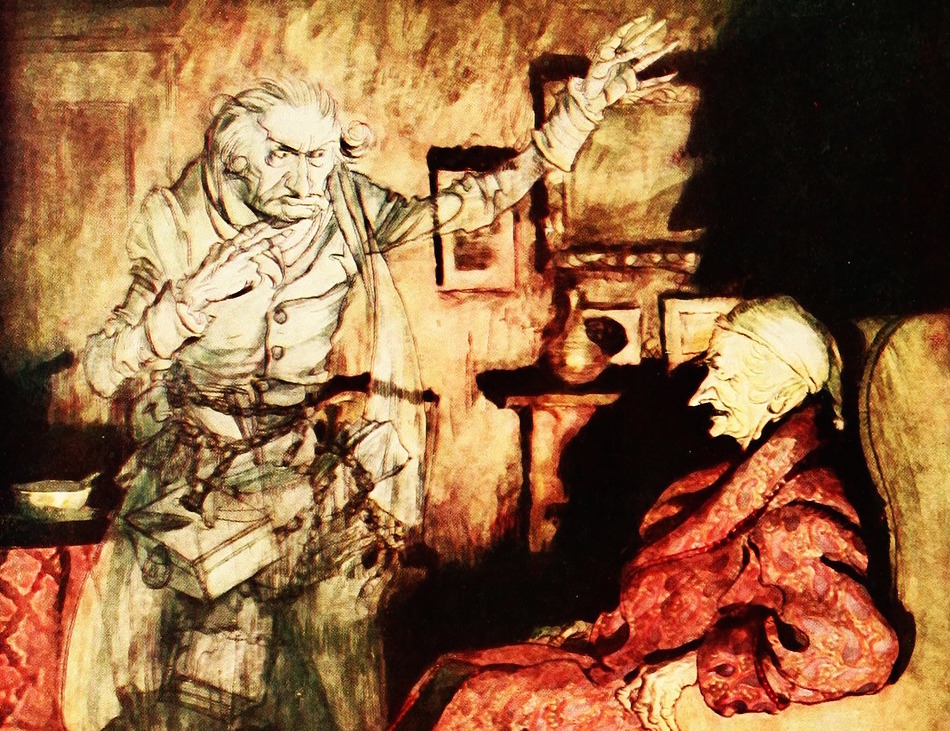
Dickens, not offering us a secret to take back the Senate or to rebuild the strength of the unions, did find magic words of a kind. Few stories are better at summoning grace on the page. If, like me, you’re not a believer, grace is the bone-felt knowledge that you are lucky to be alive, that out of the .04 percent of matter that can even interact with itself, you are part of the tiniest and most privileged fraction that can think, speak, and feel. The three spirits, who seem to respectfully acknowledge the “Christ” in Christmas as one does a well-regarded colleague who works in another department, are optimized to engage my atheistic idea of grace. Past, the white-haired recording angel, with its duty to treat each human existence as a precious history. Present, with its magical table of food, demonstrating life’s generosity. And Yet to Come, the kicker, here to remind you of the alternative.

Reading “Carol,” we remember that the earth is bountiful, and that humans are kind, gracious and capable. We remember that none of it — simply none of it — has to be this way. And we remember it for the same reason that that Scrooge does. We have been shown the alternative: the bony pointing finger, the stripped bed, and the grave. There is no buffer of wealth or luck or sociopathy that can make the specter of death a problem for other people. Scrooge is shown pity and love, and swears that he has learned his lesson, but he will not be done until knows fear — the hideous prospect of dying alone and hated. The spirits grab him from his insulated pile of wealth, and pull him down to our level, and we embrace him — a fellow passenger.

Are we comforted by this story because it tells us that such men can change, or because it reminds us that they can die?

Do the Scrooges of 2017 know about the alternative to life? Is the problem that they need to learn the fear of death, or that they are too afraid to acknowledge its possibilities? Are we comforted by this story because it tells us that such men can change, or because it reminds us that they can die?

Scrooge jumps out of bed in the morning, and asks what day it is and then he fixes all of his bullshit just like that. Why? Because it’s Christmas Day, and it is not too late. The spirits perform a little theater — the kind of thing I believe in, the kind of thing Dickens believed in, a story in a darkened room — and suddenly Scrooge is feeling exactly what we feel. Our fear. Our love. Our gratitude. It is almost Christmas. It is always almost Christmas. All it would take is one sleepless night, one story, one song to take us to that morning. I just want the spirits to come. I just want to have faith.

Originally published December 21, 2017

Our Favorite Essays About Rethinking Children’s Books

For a lot of people, a love of reading begins in childhood. But how often do we revisit our childhood favorites in adulthood? These essays take a second look at popular children’s literature from the eye of an adult: sometimes the result is positive, sometimes it’s uncertain, but it’s always clear that the books we read as children are powerful forces in shaping our personalities, interests, and understanding of ourselves. 

“Frog and Toad Are Queer Relationship Goals” by S.E. Fleenor 

Fleenor’s essay explains the love and understanding that is inherent in Frog and Toad’s relationship, and shows how queer people can apply these lessons in empathy to their own relationships.

Queer folks, and kids in particular, don’t often get to see this kind of simple, ordinary, yet extraordinary love between two characters who are men.

“How a Book Trilogy About Killing God Helped Restore My Faith” by Isabel Cole 

Although His Dark Materials by Phillip Pullman is well-known for its anti-religion stance, Cole reinterprets the books in a nuanced way. These books celebrate love and courage and the kind of divinity that comes from searching for the truth. Cole explains how Pullman’s trilogy gave her a powerful new understanding of faith by celebrating these ideals—and by killing God. 

In crafting a universe both godless and divine, Pullman freed me to see my own in exactly those terms.

“Anne Shirley Was the Best Friend a Queer Brown Boy Could Have” by C.E. Gatchalian 

Anne Shirley’s independence and strong will have made her a beloved character, but Gatchalian explores the ways that Anne’s outsider status inspired him as young, queer, Filipinx boy. In both the book and the 1985 TV adaptation, Gatchalaian uses Anne to understand his sexuality and identity.

I needed something to empower me, something to help me survive; and Anne Shirley came along at just the right time.

“These Middle-Grade Novels Are Some of the Most Formally Innovative Works of Our Time” by Elyse Martin 

A Series of Unfortunate Events by Lemony Snicket are more than just words on paper; Martin argues for the importance of Snicket’s postmodern use of the book as a physical object in segments where entire pages are printed black, or illustrations interact with the text. This essay explores the ways in which Snicket’s work goes beyond the written word, and inhabits the world of the reader. 

The books play around with the knowledge that they are books, in a sort of Barthesian jouissance, exploring and exploding literary codes. They are writerly texts.

“The Not-So-Hidden Racism of Nancy Drew” by Andrea Ruggirello

Nancy Drew is an American cultural touchstone, but that doesn’t mean she’s above criticism. In this essay, Ruggirello explores how Nancy Drew’s racism has been edited out of the books, and asks whether making something whiter really makes it less racist.

The ugliness of America’s racism is something that cannot be swept under the rug, yet without the proper context and guidance, particularly for children, the revival of these stories continues a cycle of pain and re-traumatization.

“I Saw Myself in Meg Murry Even Before She Looked Like Me” by Tajja Isen 

Seeing yourself in literature is powerful, but what exactly does it mean to be represented? And how much work should readers have to do to connect with a book? Isen writes about loving A Wrinkle in Time both as a young child reading a white main character, and after the film presented a biracial Meg Murry. 

All of a sudden, I was offered more than just a hero with whom I shared intellectual precocity and emotional intensity — I had one who shared my hair.

“The Children’s Book That Made Me Realize It’s Okay to Be Alone” by Niko Maragos

Rediscovering a favorite picture book as an adult leads Maragos to compare the lesson he took from the book as a child and the lesson the book is actually teaching. While he once understood the book to be about love, in adulthood he sees a more complicated meaning: one that exalts wonder above all else.

The lesson of Miss Rumphius that I’ve encountered all these years later is that our capacity for wonder is not a cavity that can only be filled, or even best be filled, with love.

“‘The Little Prince’ Helped Me Let My Childhood Die” by Melanie Bui Larsen

Larsen moves through time from her childhood to adolescence to budding adulthood and shares how her understanding of The Little Prince has shifted over time. This essay shows the ways in which magic follows us throughout our lives and stays with us even when we think it’s gone.

Some part of me was convinced that innocence, possibility, and awe were tied to a physical place — a place as far-flung as the most distant planet.


Before you go: Electric Literature is campaigning to reach 1,000 members by 2020and you can help us meet that goalHaving 1,000 members would allow Electric Literature to always pay writers on time (without worrying about overdrafting our bank accounts), improve benefits for staff members, pay off credit card debt, and stop relying on Amazon affiliate links. Members also get store discounts and year-round submissions. If we are going to survive long-term, we need to think long-term. Please support the future of Electric Literature by joining as a member today!

There Are Two Kinds of People: People Like My Boyfriend and People Like Me

Boyfriend

My boyfriend explained the plot of a TV show I had fallen asleep while watching. He said, “When people have emotional needs, that signals they’re weak and will lose in business.” People could either be successful and heartless or emotionally complex and doomed to failure, he explained. There were depths in him I had not previously noticed. When we met, he had been living with another woman and was more surprised than anyone when he suddenly left her. After this I lost interest in conventional plots.  

A podiatrist injected my ankle with novocaine and dug around with a scalpel. I said, “What’s the most unusual thing you have seen lately?” He said, “This,” pointing to the cactus spikes imbedded in my skin. The needles of a barrel cactus are barbed like the quills of a porcupine and move in only one direction, just like me when I met my boyfriend. The podiatrist found four bits of cactus encased in chunks of flesh and placed them in a jar. I said, “Why?” He said, “In case the insurance company needs proof.” I said, “Do you want to see other things wrong with my feet?” He said, “Not today.” 

My boyfriend still has feelings for the woman he left. The abruptness of his departure has left them turning in a revolving door. I try not to take this personally, but I think I should take it personally. After they broke up, my boyfriend and the woman did not become friends exactly. I don’t know what they became because I’ve never seen them together. I don’t know what to make of this relationship. I had a friend who was a go-go dancer. She told me about the costumes she wore: white for old men; red lace for Latinos; leather garters for bikers. She was saying everyone has a secret life. My boyfriend is careful to tell me when he has received a text message or an email from the woman he left and when they have arranged a meeting. It used to be dinners. Now, they mostly have lunch. There is always food involved and always he pays. He says he feels bad about causing her pain, but I think the loss of her causes him the same amount of pain. What’s in it for her? I think it is easier to love a person who isn’t there. I think he is lonely for her. I don’t blame him. I don’t blame anyone for being lonely for someone else. Loneliness is consoling, in that it reminds you you want something. Their relationship allows me a sort of freedom, too, but I think my secret thoughts are mostly about my boyfriend’s secret life.  

Today he said, “Getting together with you has certainly been the smoothest of my transitions.” A helicopter hovered overhead, and I couldn’t tell if he was joking. There has always been a third person in our relationship, and I wonder who is keeping this in play, and I am pretty sure it is my boyfriend, and I have to say it rekindles my delight in him to see how devious he can be. When I walk around our apartment and sink my hands into the soil of our plants, I’m happy no matter what comes next. I like leftovers. Things too good to finish. Things waiting on a road for a ride and a bed. The snort at the end of your laugh. A new restaurant has opened nearby with a French menu and a long bar.  

On the way to yoga the other day, I passed a man I had fallen out with. We were near where he lived. He smiled as if we were meeting on purpose and said, “Hello, Valerie.” I pulled out my ear pods and said, “Hello. I heard your mother died.” He waved his hand and said, “Yeah, it went on way too long,” as if to say she had exceeded her shelf life and not to spend my show of good manners on this turn in his life. I had mentioned his mother to annoy him. He looked fit. When people let go of me or I have let go of them but still have feelings for them, I hope they will shrivel in my absence, but they never do. We were standing under scaffolding. The city was not the city we had walked in for many miles over many years. I had never known where I stood with him, and I did not know if I missed him. I said, “Should we say hello on purpose another time?” He said, “Yes.” I didn’t think this would happen. I thought the petunias I had bought that morning might not make it through our next trip away, but that wasn’t a reason not to buy them. 

One day I went to the memorial for a woman I did not know and left with a packet of her ashes in a small silver envelope. People admired the dead woman more than they had loved her, it seemed. If you die and were awful, people lie at your memorial. If you die and you were wonderful, people can’t evoke you vividly because abrasiveness goes into us more deeply than light falling on a chair. I wondered if she would be missed. In truth we can walk out of the lives of people we have been attached to for years, and, conversely, we can return in memory again and again to a stranger we sat beside silently on a train. I carried the woman’s ashes in my pocket, not knowing where to scatter them. When I felt them in my pocket, I remembered my own death and dropped them. When Picabia was dying, Man Ray made a little painting and wrote on it that the show was not cancelled, but was merely an entreacte. Duchamp sent Picabia a telegram saying he would soon see him again. When you quiet your mind, what do you hear? What if I were to tell you you could have both? 

At the gym, the man who would become my boyfriend said, “What would you like to do?” I said, “I’d like to take you upstairs and throw you against a wall.” He said, “Do you want to stretch?” We sat on mats with our legs spread wide. I gripped his arms, and he held my waist. It was blustery out, and fat flakes whipped the gray air. I wondered if one day I would look back at this moment and find it thin. So far this has not happened.

What the Stars Have in Store for Writers This Winter

On December 21, the sun dips down to the Tropic of Capricorn. For those of us in the Northern Hemisphere, this is the winter solstice: the shortest day and the longest night of the year, the moment at which we start to regain minutes of daylight. The initiation of Capricorn season heralds the official beginning of winter. Saviors from many cultures come to us at the winter solstice; so, too, do CEOs and devils. This is a time of reflection, when everything seems to get quiet. The trick is realizing that this wintery energy is all about utilizing reflection to power external, structural, societal growth. 

In January, we move into Aquarius season, where we welcome the innovators, the scientists, the intellectuals. How will we use the structure we’ve built to change things for the better? This is the Aquarian question. Writers come to us in all seasons, but many of our rule-breaking legends are Aquarians: Toni Morrison, Audre Lorde, Virginia Woolf, Lord Byron, Langston Hughes, James Joyce, Colette, Angela Davis, Gertrude Stein, Kate Chopin, Edith Wharton. The list goes on. In February, we come, at last, to Pisces season: the final sign of winter in which our attention moves beyond our individual selves and toward the collective. But what does it all mean? We progress toward something greater than ourselves. Toward the spiritual, if that word means something to you, but also toward empathy. 

The eclipses come to us, here in the depth of winter, as the world around us teaches us how to cyclically die and rise again, a phoenix from the ashes, renewed. Eclipses are a time of challenge, of shedding; if we aren’t already doing the work, the eclipses will, most assuredly, do it for us, forcing what isn’t working in our life out and ushering new change in. Two eclipses—the first in December, the second in January—will set the tone for 2020, and offers each of us an opportunity, should we choose to take it. 

If you’re into learning more about the nitty gritty of what goes on every other week, you can sign up for my astrology newsletter, geared to writers and creatives.

Note: Depending on your time zone, the new moon solar eclipse in Capricorn may be on December 25 or 26. I will be using the date for an EST time zone here. 


Aries symbol

ARIES

For you, the season starts with a bang. The emphasis is on your career immediately, with a new moon solar eclipse in Capricorn lighting up your career and public image on December 26. There’s barely time to recover from the holidays, if you celebrate, because you’ve got to work on something big, babe. 

There’s a secret to eclipses: they are predictable. They happen every six months. The internet freaks out about them, but they are both a clearing and an opportunity. If you’ve been doing the work, you know exactly what is and isn’t working about your career, and you probably have a bead on the new opportunity that you really need to be pursuing. Eclipses usually only blindside us when we purposefully stick our heads in the sand. The same principle applies for January 10, when the full moon lunar eclipse in Cancer illuminates something about your home and family. 

You gather that there is a theme for you, with this eclipse series that will be hitting you all year long: it’s about that work-life balance, about the public and private, about job security and emotional security. This is the year that major patterns get sorted out.

Taurus symbol

TAURUS

You’re the first earth sign of the year that’s all about growing; Capricorn is the last earth sign of the zodiac year that’s all about what we grow with the proof of harvest. It’s just a different kind of work, and you are comfortable enough to not be thrown off by this energy. But with a Capricorn eclipse, well: there’s something more to learn here. And the eclipse ties in to learning, too. The new moon solar eclipse on December 26 is all about what you’re learning—and, possibly, publishing. It specifically hits your zone of adventure and higher education, but another layer here, for writers, is published work, so if you’ve got a book project you’re looking to get out in the world, this could be the start of something particularly potent. 

Remember that eclipses are cyclical. Again, you’re a Taurus: you understand how this works. Seed, plant, growth, harvest; rinse and repeat. Eclipses come through every six months to check in and, if need be, raze the field—but if you’re doing the work, you already know it’s coming. 

On January 10, there is a full moon lunar eclipse that also relates to your work. For you, the eclipses are going to be transforming your writing practice (and how it goes out into the world, through publishing) from the inside out. This eclipse is about releasing old work patterns, daily writing routines, that no longer work for you. How have you grown and changed over the last few years? What habits are just rote habits? What excites you? Check in with yourself, and find a way of working with your work rather than against it. 

Gemini symbol

GEMINI

The next year is going to entail a series of reality checks when it comes to your personal finances, as the eclipses light up your zones of money and value (the Cancer eclipse) and shared resources, which, incidentally, includes taxes (the Capricorn eclipse). This is a part of the work that you might have preferred to sweep under the rug: sending invoices, doing taxes, making a financial plan for yourself. 

First up: resources you share with other people. This might be joint projects, or contract situations. On December 26, the new moon solar eclipse in Capricorn presents you with opportunity: this is about what you’re beginning, the seeds you’re planting, the chance to get new stuff started. (Hire a new accountant!) 

And then, a whammy: a major reality check around how you deal with money, as it relates to your underlying sense of value. The full moon lunar eclipse in Cancer on January 10 is all about illuminating how your spending and saving patterns (even if the pattern is that there is no pattern) relate to your feelings about cash, about what you deserve, about how you grew up. It’s time to do some work.

Cancer symbol

CANCER

The tension between what you achieve as an individual and what you achieve in partnership: this is what the eclipses bring to your doorstep. Partnership is not just romantic; in this context, it strongly relates to business partnerships—with agents or clients, editors and longstanding writing groups, co-founders and anyone you are in contracted business with. This is a season about discovering what you bring to the table, and how others push you to grow in turn. 

First, the focus is on partnership: the joys and the challenges. There is the new moon solar eclipse in Capricorn on December 26, right after the holidays for those celebrating, bringing to light new opportunities, new growth. New. Lots of new. It’s not a time of year when we’re often looking for new, in spite of the emphasis on the new year and resolutions; job and income stability are strongly preferred right about now, thank you so much. But something is shifting, and you’d do well to consider it. 

Only a few weeks later, you go internal: the full moon lunar eclipse in your own sign of Cancer on January 10 is all about the layers of yourself that you’re shedding. Who have you been, and who are you becoming? Who is the person that you want to be? These are all relevant questions as you move into 2020, particularly potent ones that will stay with you throughout the year. 

Leo symbol

LEO

How do your unconscious patterns govern your daily routines? Conversely, how have you become more conscious about integrating spiritual practice and therapeutic work into your everyday, honoring the internal work as a necessary part of the work work? These questions come into the foreground as you move into eclipse season. 

On December 26, the new moon solar eclipse in Capricorn gives a jolt of new life to your everyday routines. This encompasses a wide range of things, from your health to your pets to going in to the office. This is about renewing the little details that make up the day, the connective tissue that is essential to holding things together. What have you been craving more of? Pay attention to your hunger, and feed it.

On January 10, the full moon lunar eclipse in Cancer inspires you to get quiet. Here, the focus is less on what you are initiating, and more on what you are releasing or completing; less on the external, and more on the internal. The work you’ve done in therapy, the work you’ve done in meditation, the work you’ve done in quiet conversation with yourself over the last year: what lessons are you taking into 2020, and what can you say thank you, next to? 

On February 9, a full moon in your own sign of Leo brings an aspect of self to the surface, for consideration and appreciation. Note what you are completing right now, and how it might connect to the new moon in Leo from summer 2019. 

Virgo symbol

VIRGO

Your relationship to your creativity and your community, and how and where your energy flows, is undergoing a major shift in this eclipse cycle. Where do you find inspiration? Who do you find inspiration with? Who energizes you? What energizes you? These are the questions at the forefront of this eclipse cycle. 

For the last few years, taskmaster Saturn and transformative Pluto have been working over your relationship to your creative energy (which also, incidentally, impacts your erotic energy). Expansive Jupiter recently joined them, and on December 26, a new moon solar eclipse puts major emphasis on what you are beginning in this part of your life. It’s time to take the lessons you’ve learned over the last few years and radically transform them into your latest project. 

Here’s the thing: your work has impact for the collective, even if you don’t believe it. The full moon lunar eclipse on January 10 lights up your community, your friendships, and your broader professional network. What projects are reaching completion here? What relationships, perhaps, to be released so that new ones can enter your life and nourish the rich new opportunities you are manifesting in 2020?

Also! Don’t forget, on March 9, you’ve got a full moon in your own sign of Virgo, encouraging others to see all that you’ve accomplished and helping you really relish and bask in how far you’ve come.

Libra symbol

LIBRA

What happens on the home front invariably impacts what’s happening in your career. The behind-the-scenes strains to become public; for you, this is the strain of eclipse season, as you struggle to maintain the balance—or resolve a tension—between the roots of your life and your expansive, long-term vision. 

You value your home and the people you call family, and the new moon solar eclipse in Capricorn on December 26 encourages a kind of new beginning on this front. You’ve been doing rigorous work around your nest—perhaps reshaping your values, perhaps even moving—and this offers the chance to start anew. 

But on January 10, the full moon solar eclipse comes in and reminds you that with new beginnings, there are also endings, releases, and completed cycles. Something has to give, and the something is in your career. You probably know what it is; perhaps it’s a long-time-coming end to a job or contract, or even something more ephemeral, like a goal. The point is, your values are changing, and how you want to show up for yourself and your people is also changing. This means that how you exist publicly in the world will change, too. And that’s okay.

Scorpio symbol

SCORPIO

Your writing routine and even what you publish is directly up for review with this eclipse cycle. (Yes, sometimes astrology is that specific.) You’re no bullshit, so let’s get straight to it.  

First up: your writing. The new moon solar eclipse in Capricorn on December 26 expands on the attention you’ve been giving this part of your life for the last few years; finally, a new cycle opens up. This could pertain to, literally, the subject of your work—the genre, the topic. But it could also be how you do the work that changes. There could be a fundamental change in your routine, the people you work around, or your environment that enables a breakthrough in your work. 

New shifts in your commitment to the work itself, of course, will change how and where it’s getting published. On January 10, a full moon lunar eclipse in Cancer invites you to a ritual of gratitude around the completion of a cycle. Perhaps this is you leveling up. Perhaps it’s you blessing a time that has now passed. Perhaps you are moving on from one way of being in the world, publicly, and are moving toward another. Regardless, we know that endings also open doors to new beginnings. Pay attention to what is changing in your relationship to publications around this time, and the weeks that follow. 

Sagittarius symbol

SAGITTARIUS

This eclipse season initiates new realizations around your money and resources. But that’s not about my writing! Here’s the thing: it is. Working writers are small business owners, and how we value ourselves ultimately impacts how we treat our wallets. For you, this next year is very much about getting right with your money.

It begins now, at the end of the year, with a new moon solar eclipse in Capricorn on December 26. You’re inspired to begin making money in a new way, but also probably saving money in a new way. This is about reevaluating your values and your underlying relationship to cash flow: what governs the input and output of this area of your life? Time to set some new intentions. (And follow through on new practices—like sending invoices!) 

The resources you share with other people, as well as taxes, are also up for review. On January 10, the full moon lunar eclipse in Cancer shines a light on anything that needs to get wrapped up. This is the end of a cycle: perhaps folks you have previously shared resources with are getting cycled out of your life. Stay flexible. 

Capricorn symbol

CAPRICORN 

Happy birthday, Capricorn! For you, the focus of this eclipse cycle is on how your identity impacts your work, and also on how your partnerships impact the work. 

This is your season, and the new moon of your season happens to be a new moon solar eclipse on December 26. This super potent energy invites a brand new cycle around issues that relate to your identity and how you put yourself out in the world. Who are you becoming? How does your identity play into your work, and how do you feel about the person that others perceive behind the work you do? This cycle has the potential to be wildly generative for you, and the seeds you put down now will grow to fruition if tended. 

The first major moon of the new year is a full moon lunar eclipse in Cancer on January 10, and it asks you to do some major work with your partnerships. How are your commitments potentially changing, growing, shifting in 2020? These might be contractual agreements with agents or writing partners; they might be looser agreements with longstanding editors or other folks you are in close companionship with. Our relationships are so much of the work, and inform so many behind-the-scenes cogs in the wheel that allow the rest of it to function. 

Aquarius symbol

AQUARIUS

We’re in the early days of winter, and you can feel your birthday season on the horizon. You’ve been doing radically vital work on yourself over these last few years, and whether you realize it or not, it has transformed your work and, indeed, your everyday life in profound ways. This eclipse season ushers in a new stage of that cycle.

You know that the work begins with you. Whether you’ve committed to therapy, spiritual healing, or work that has therapeutic benefits, like journaling or tarot reading, you’ve dug deep within yourself in recent years, finding reflective practices that help you center. These are necessary, not just for rest, but also for the work that’s getting done on the back burner of that brilliant brain of yours. On December 26, a new moon solar eclipse in Capricorn initiates a new cycle that helps you tap into all of this on an even deeper level. On some level, you start to realize what it’s all for. What it’s moving toward. The answers aren’t there yet, but you feel a sense of purpose.

Then, there is a realization of how this connects to the work you do in your everyday life. Perhaps the internal work helps illuminate issues in your routine, or even in your physical healthcare, that need to get flushed out, changed up, revitalized. On January 10, a full moon lunar eclipse in Cancer encourages you to get real about what needs to be released. And don’t forget, on January 24 there’s a new moon in your own sign of Aquarius. This brings life, energy, and attention your way. It’s all about you. Enjoy the energy boost!

Pisces symbol

PISCES

You’re a winter baby, too, and even though your birthday season isn’t for a few months yet, the work you do now during eclipse season will set you up for success by the time your solar return rolls around. The focus for you? The relationship between your community and creativity. 

You’ve been working on your boundaries around your community for the last few years. You may have let some folks go and even grown new friend groups or professional networks; this part of your life has been getting worked over. On December 26, a powerful new moon solar eclipse in Capricorn initiates a new cycle of growth, focused on community and friendship. The people you surround yourself with, when it comes to your work, is vital; are they supportive, or are they energy vampires? Do they believe in your passion, and can they communicate directly, or are they passive aggressive, letting jealousy eat away like rot? You don’t need that around you. Let the eclipse bring you new, healthy relationships.

Working in tandem, we have the full moon lunar eclipse in Cancer on January 10. Something big is getting released, but it may feel as gentle as a balloon pop. One creative cycle is ending, and now, another begins. Perhaps you’ve finished a project, or your relationship to a project is in a state of wild flux. It’s time to move through it, and embrace what creativity has for you on the other side. Also! A new moon in your own sign of Pisces on February 23 is bound to bring joyful, buoyant new opportunities your way. Mark your calendar. 

8 Fantasy Novels by Trans and Nonbinary Authors

Thank goodness the biggest-selling fantasy author of all time hasn’t thrown her lot in with a pack of weirdly genital-obsessed identity police! That would, after all, be an extremely weird choice, given how many great fantasy novels by trans and nonbinary writers you could read instead of giving money to a publicly transphobic billionaire, if there were one of those who was also an author, which again is just unrealistic! A billionaire author, imagine. Anyway, here are a few, in case you are seized with the desire to load up on trans fantasy, just for no reason.

Sarah Gailey, Magic for Liars

Good news: There IS a fantasy story set at a high school for wizards, a subgenre that previously did not exist! In Gailey’s fun mystery novel, a non-magical (there is no single word for this and never has been) detective investigates a murder at the elite academy where her sister teaches magic theory.

April Daniels, Dreadnought

Wouldn’t it be great to suddenly, magically have the body you always wanted? Not if you’re a trans teenager who isn’t ready for people to know. That’s what happens to Danny when she unexpectedly gains the powers of the late, beloved superhero Dreadnought. Suddenly she’s very obviously a girl, and not just a girl but a supergirl—and she’s fighting transphobic parents, normal teen problems, and supervillains at the same time.

JY Yang, The Black Tides of Heaven

Akeha and Mokoyo are twins whose mother is the head of a realm in conflict. Mokoyo has visions of the future, but Akeha has a clear understanding of what’s wrong with the world as it is, which drives them to join the rebellion against their mother’s cruel Protectorate—while their sibling stays behind.

Akwaeke Emezi, Freshwater

Sitting at the intersection of fantasy and literary fiction, Emezi’s debut novel about a woman inhabited by parasitic gods is simultaneously a work of magical realism and an autofictional account of mental illness.

Charlie Jane Anders, All the Birds in the Sky

In this Nebula-winning star-crossed-lovers story, magic and science are at war in an alternate-universe San Francisco and the scions of each side are old friends who are also falling for each other. The book follows the relationship between talented witch Patricia and tech prodigy Laurence from childhood through adulthood, including a stint for Patricia at a school for magic users (where DO people come up with this stuff!).

The Red Tree by Caitlin R. Kiernan

Caitlín R. Kiernan, The Red Tree

Caitlín R. Kiernan has been owning dark fantasy since the late ’90s—we had a couple dozen novels and short story collections to choose from here. In this one, a novelist living on an isolated farm becomes obsessed with a tree that’s been rumored to have sinister powers, and may have driven her home’s previous occupant mad.
Queen of the Conquered

Kacen Callender, Queen of the Conquered

Sigourney Rose is the heir of the deposed royal family in a country inspired by the U.S. Virgin Islands. She plans to use her supernatural powers—the ability to manipulate people’s minds—to exact vengeance on the colonizers who killed her family and stole her throne, but finds that stronger and more malign magic is standing in her way.

Cat Fitzpatrick and Casey Plett, Meanwhile, Elsewhere

Can’t choose? We hear you. Fortunately, Fitzpatrick and Plett have collected an anthology of genre fiction from other trans authors, so you can experience a full smorgasbord of fantasy (and sci-fi and even zombie) stories that explore alternate-reality ideas of gender.