Migration and all its ensuing discontentments obsess the work of Moroccan-American novelist and essayist Laila Lalami. In her debut, Hope and Other Dangerous Pursuits, Lalami offered us the fates of four Moroccans fleeing across the Strait of Gibraltar for Spain. The characters in her follow-up, Secret Son traverse the city of Casablanca and the boundaries of class. In her last novel, The Moor’s Account, a 2015 Pulitzer finalist, she elegantly imagined the journeys of Estebanico, the first black explorer of the New World, who was part of a real-life Spanish expedition to the Americas.
Purchase the book
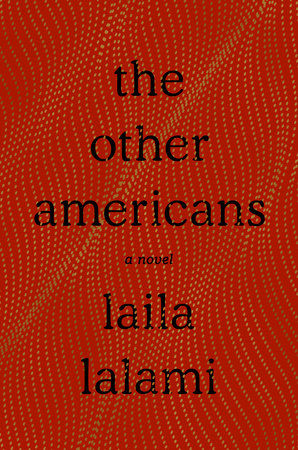
Lalami’s own trajectory began in the city of her birth, Rabat, Morocco. She moved to London for graduate school and then on to a PhD. in linguistics in Los Angeles, where she has lived for two decades. In her latest, The Other Americans, she explores immigration, in its many American iterations, through the mystery of a hit-and-run that takes the life of Driss, a Moroccan American immigrant.
I spoke to Laila Lalami about the white supremacist hiding in your office cubicle, the book that reminds her of Trump, and feeling like an impostor in is a sea of white faces.
J.R. Ramakrishnan: Your last novel, The Moor’s Account wandered the U.S. South and Mexico and told the epic story of Estebanico, the first black explorer of the New World. The Other Americans is mostly set in California, but offers a sweeping view of America with its nine narrators. How did the story come to you?
Laila Lalami: In the summer of 2014, I was on vacation when I heard that my father, who lives in Morocco, had taken very ill. It was this horrible, horrible scare but then he recovered. I’m very grateful, but the scare really brought home for me the fear that many immigrants have of being away from their loved ones. So that was the inspiration for having this woman come back home because something happened to her dad. In my story, he dies.
I also had a terrible bout of insomnia for a couple of years so I had one character have it too. Also that summer, there was a spate of hate crimes happening in the United States. The crime of a hit-and-run was interesting to me. You really would never know who did it. I thought that this element would help propel the story forward and the book took off from there.
JRR: I felt the geography of the police station–and later the Iraq of Jeremy’s flashbacks–quite acutely. I know you did some intense historical research for The Moor’s Account. How did you go about research for this novel?
LL: I learnt a lot about world building from the last book. You have to think about every detail and each one has to fit. Even though I didn’t intend on doing so much research for this one, I ended up doing quite a bit. I went on a ride-along with a sheriff’s deputy. I read a ton of books about the Iraq war. I talked to a district attorney. I spoke to a guy who was an expert on collisions to figure out things like what car would cause that kind of damage, where it would stop, and where it would it be able to make a left. I had learnt those (research) skills from the previous book and maybe I couldn’t help myself. It was fun to be able to do it with something contemporary and make the story more authentic.
JRR: Could you talk about place and why you decided to set this story in the Mojave Desert?
LL: I’ve always considered myself a big city person and the desert held no interest or attraction for me. Then about eight or nine years ago, my husband, who’s a huge hiker and into outdoors stuff, started going to the desert. I went with him one time and I was surprised at how much I responded to it. It’s so silent and so quiet. I really love that, especially because where I live is so noisy. Being there felt so freeing. I thought it might be interesting to set this book there because when people think of California, they think of the big metropolitan cities, LA or San Francisco but there is huge amount of space in between. It’s a California that’s not necessarily talked about a lot.
I’ve always been interested in what’s unseen. The landscape is one you don’t see all the time in fiction. Using the small town setting, I felt that I could play with the story, the characters, and have that sense of foreboding. For example, because it’s tiny community, the question becomes: what if it’s somebody that you know that committed the hit-and-run? It seemed like a very dramatically interesting place to do it.
You have these artistic spaces that are supposed to be full of liberal people, and then you show up and it’s really not diverse at all.
JRR: Your characters embody different types of immigrants. Which one do you feel closest to? I read that you came to America as an adult.
LL: They all represent for me a different aspect of the dislocation experience, not necessarily an immigrant one. The characters include someone fleeing political strife, an undocumented worker, and someone who’s moved from D.C. to the desert. Everybody in the book has had some kind of displacement, which really does mark your life and your sense of belonging and identity.
I do feel kinship with Nora because she’s an artist and she’s just trying to make it. But I’m not her because she was born here. Maryam, the mother, I really connect with as well. She’s someone who came here as an adult, and 20 years later, she’s starting to have misgivings about it. I can empathize with that because when you immigrate at young age, you don’t really think about the longer-term consequences. For example, in my case, my dad got sick and we had to pack up and go in a hurry. Each of the nine characters has something that I feel close to but Nora and Maryam would be the two characters who are the closest.
JRR: Nora is an artist–not the family’s first choice of profession. Would you talk about the immigrant children’s choices in the book? Perhaps also what you’ve experienced in choosing your path and how your family responded to it?
LL: My parents still live in Rabat. When I announced that I was going to be a writer they were not very thrilled about it, not in the least because at the time in Morocco in the 1980s, writers were getting into all kinds of political trouble. This wasn’t something that they necessarily welcomed. It took them a lot to accept it and now they are obviously huge fans.
Here in the U.S., in particular, the children of immigrants have a lot of pressure. They feel that their parents have sacrificed so much for them so there’s a sense that they’re living their lives not just for themselves but also a little bit for their parents. In the book, Salma, Maryam’s oldest child, is so eager fit into that and becomes a dentist. Outwardly, everything is going perfectly for her, but she’s going through a lot of trouble. Nora, who while she’s professionally doing what she loves and enjoys, she’s constantly running up against her mother’s disappointment. It’s just a tough thing. I don’t care if you’re an adult, but to feel that you are disappointing your parents is never an easy feeling.
JRR: Salma’s section, which is in the second person, was so compelling and especially, that line that ends it, “This is where the plane took you.” To me, the stereotypical immigrant American dream seemed most rotten with her. Did you know what her struggle, which I won’t spoil for those who haven’t read the book, was going to be from the start?
LL: I knew there was something going on with her but I wasn’t quite sure what it was. When the time came to write her, I wanted to try something different and decided on the second person perspective. As soon as I did, I became interested in her own journey and how different she was from her sister, who was born in America. As I started writing, I was like “Ah, it’s so obvious, it’s right there!”
It’s easy to look at Neo-Nazis in the news now and think that they’re monsters. But I’m much more worried about the one that’s working next to you in your office who is extremely likable.
JRR: Nora has chosen her own route and manages to stand up to her mother but we also see her struggling as a woman of color in the music world. She suffers from a version of imposter syndrome.
LL: I don’t know if you’ve had this experience but I’ve had it multiple times. Multiple times. I’ll give you an example. Last summer, I happened to be invited to a very fancy arts dinner. I walk in and the entire room is a sea of white faces. Everybody is looking at you and they look at you very curiously. These people are not mean or anything but it really brings home for you how utterly uniform certain spaces are. I think one of troubling things that I keep coming up against, at least for me, as a writer, is that you have these artistic spaces that are supposed to be full of liberal, open-minded people, and then you show up and it’s really not diverse at all. You don’t feel included so it can be very isolating. It’s not easy. A field like musical composition is an extremely male-dominated world. And then, on the top of that, Nora is a person of color. Writing her experience of this did not require a huge leap of imaginative empathy, let’s just put it that way.
JRR: I felt like A.J. was a white supremacist lite type. You offer us insight about his childhood and his abusive father. I had sympathy for the younger version of him.
LL: Portrayals of racists, particularly in popular media, are always very cartoonish. The racist becomes a monster and it’s very difficult to perceive him as a human being. In a way that’s dangerous because human beings contain that monstrosity. It’s very easy to look at the Neo-Nazis in the news now and think that they’re monsters. Of course, they are. But I’m much more worried about the one that you don’t see on television, the one that’s working next to you in your office who is extremely likable. But then one day they say something and you’re like, wait, what? It comes out of nowhere. To me, this is what is really scary because it’s very complicated and it’s not caricatural. And it can come at anytime.
With A.J., I wanted him to have that personal history. Just because he’s a racist doesn’t mean that he didn’t have a path or he doesn’t have a family. He gets to tell you another story. Also no one says, “Oh yes, I’m a racist and I’m a bad person.” It’s always: “Well, no, you have to hear my side of it.” He has his own reasons for doing what he’s doing. In capturing that character, particularly in the first person, I let him speak in his own voice and let the reader make the judgment.
JRR: Nora’s mother Maryam has a lot of hopes for Nora but she also wants Nora to find a sense of “home,” something Maryam says she herself given up on. Would you talk about this a little?
LL: For Nora, this is the only country she’s known so it is home. More than that, it’s this realization that there is no untroubled place. Everywhere is going to have its own issues. Staying in Oakland which is where she lives would not solve this. It’s patently untrue that the city is somehow much more open-minded than other places. Maybe on the surface, but it’s maybe not. I think she comes to a little bit of understanding towards her mother. She realizes that home is much more about people than it is a particular place.
Racism has been part of American history from the beginning.
JRR: Did you find writing this novel in this era of Trump more challenging because the issues with which you deal are very much in the news? You deal with intensities of America in your opinion pieces and essays too.
LL: I started working on this novel in 2014 during the Obama Administration. Don’t forget that in terms of immigration, Obama earned the nickname of “Deporter-in-Chief.” I just did an interview for the book where the reporter asked, “Is this Trump’s America?” I said, “No, this is America.” Trump has revealed a side of it but he is not the encapsulation of racism. Racism has been part of American history from the beginning.
One of the advantages of doing fiction is that it’s a long project that lasts several years. I pay attention to what is happening in the news but when I write fiction I use a very different approach. I suspend judgment. I’m really much more interested in people as people. I do try to separate fiction and non-fiction as much as possible.
LL: Comfort, maybe not, but there is a book that I think about a lot when I think about Trump: Gabriel Garcia Marquez’s The Autumn of the Patriarch. It is told in a communal voice and it talks about this head of state, a complete megalomaniac who comes up with the craziest edicts.
JRR: What are your favorite books about immigration?
LL: Let me just move to my bookshelves here. There’s Into the Beautiful North by Luis Alberto Urrea and Sigrid Nunez’s A Feather on the Breath of God, which tells the story of a Chinese-Panamanian father, his German wife, and their American-born children. V.S. Naipaul’s A House for Mr. Biswas has all the estate workers who come from India to the island. It’s so hard to pick just a few! I do like Jhumpa Lahiri’s first collection of short stories, The Interpreter of Maladies and Ha Jin’s The Bridegroom. There’s the work of Sandra Cisneros. All of it. Then, of course, they are a number of Arab American writers who have written about this, like Randa Jarrar and Rabih Alameddine. There’s Viet Thanh Nguyen’s collection of short stories, The Refugees, which more about displacement in general. And The Sympathizer is excellent.
In our series “Can Writing Be Taught?” we partner with Catapult to ask their course instructors all our burning questions about the process of teaching writing. This time, we’re talking to Lauren Wilkinson, author of American Spy.
The genesis of Wilkinson’s novel, she told Electric Literature in an interview, was a story where she started with the image of a suburban mom and then “put her into the craziest situation I could imagine, which was some men coming to kill her.” That’s one way character can inform your plot: come up with a character, put her in a situation, and let it run. But how do you generate, establish, and embellish that character? How do you help her set the plot in motion—and how do you make sure that her interior landscape doesn’t overwhelm what’s happening outside her head? Those are just a few of the questions that Wilkinson can help with in her six-week online workshop on character-driven plot, starting April 13.
What’s the best thing you’ve ever gotten out of a writing class or workshop as a student?
The thing I like best about fiction workshops is that democracy reigns. When the majority of a group tells me the same thing, it has always been productive for me to listen to that advice.
What’s the worst thing you’ve ever gotten out of a writing class or workshop as a student?
I haven’t gotten anything too bad out of a workshop—it’s not too difficult for me to ignore critique that doesn’t seem to work for me.
What is the lesson or piece of writing advice you return to most as an instructor?
“You’ve got to know the rules to break them.”
Does everyone “have a novel in them”?
Yes, I think so! Said with the caveat that extracting it with style and competence is a challenge that not everyone is up to.
Would you ever encourage a student to give up writing? Under what circumstances?
The only circumstances under which I would ever tell a student to give up—or at least stop temporarily—was if their zeal to write was causing them harm. That sounds dramatic. I just mean, like, if they were about to take on very serious student loan debt to work on a novel that I didn’t think would sell, I’d ask them to think it through.
What’s more valuable in a workshop, praise or criticism?
The criticism that you receive in a workshop is well-intentioned. A writer shouldn’t get used to that.
Criticism. But it’s tricky: the criticism that you receive in a workshop is well-intentioned. A writer shouldn’t get used to that. The criticism that you get after your book is published isn’t necessarily intended to help you.
Should students write with publication in mind? Why or why not?
I think students should write with publication in mind, but they should be aware that it’s much harder than it looks to judge taste and trends. So even more than writing with publication in mind, I think students should write with being interesting to someone else who doesn’t know them in mind.
In one or two sentences, what’s your opinion of these writing maxims?
Kill your darlings
Show don’t tell
Write what you know
Character is plot
This all sounds good to me! None of these maxims are more bullshit (or any less) than anything else writers are told.
What’s the best hobby for writers?
I was inspired by that Murakami essay about long distance running. In theory, I understand that they both demand stamina, so it’s a hobby that can inform your writing practice. In practice, I hate running.
What’s the best workshop snack?
Anything sweet or salty and plenty of it. I’m a big fan of eating my feelings.
She bought me T-shirts. They were similar to the shirts she wore, bright with colorful pop culture designs. The disembodied head of Indiana Jones floating among the clouds. A kazoo with a cursive disclaimer: Ceci n’est pas un kazoo.
It was August 2007, and we’d been dating for about two months. This was a long-distance relationship, Massachusetts to California; we wrote letters and emails, sent each other small gifts. With T-shirts she was making me over into someone else. Someone more fun and more casual, someone younger.
I was 30 years old. She was 37 and a successful writer, the author of novels, comics, and books for children. I’ll call her Cynthia.
Cynthia’s friends were writers and editors, musicians and show business people. When I visited LA, I went with her to parties, readings, conferences, dinners, shows. She seemed to know everyone.
I wanted to be a writer, too, and I was more than a little in awe of Cynthia, who wrote full time, who mixed and mingled at the intersections of Hollywood and the LA literati. I wore the T-shirts she gave me, even as I began to understand that she was grooming me for a particular role. Younger boyfriend. Hip nerd. Suitable match. I would become the right sort of character for this story, which was of course a love story, wild and daring.
We told it to one another in our letters. One of her first to me was written on the backs of sheet music pages. “I wonder if you are a dream,” she wrote. “Will you still want me in a month? Say yes. Say yes.”
Pillows
She was visiting me in Massachusetts when she threw away my pillows.
Not everything about my life was a perfect fit for our love story.
I had two jobs then, one with a small press, another working as an assistant to a local author. When Cynthia was visiting, she wrote at the apartment I shared with my younger brother, or at a coffee shop, or at the house of a mutual friend. I was at work when she put my pillows in the trash and replaced them with a new set. I felt a twinge of panic. She hadn’t mentioned the pillows, hadn’t suggested getting rid of them or asked if I would mind. But the pillows were old and lumpy, and probably in need of replacing. I told myself that she’d done us both a favor.
Later, I would come to see the pillows as the first casualties of the revision process. Not everything about my life was a perfect fit for our love story. Cynthia was showing me what belonged and what didn’t, what could stay and what would have to go.
The problem with the pillows was that I’d owned them before. They weren’t discarded so much as deleted. Written out of the story.
Loyalty Cards
The bigger problem, harder to excise, was my backstory. Since my early twenties, I’d been married to a woman I’d met at college. The marriage had fallen apart spectacularly, and now I was living apart from my estranged wife, seeking a divorce.
I think this was why Cynthia began to sign us up for joint cards at the local grocery stores. She told me that she wanted something official, even something so small as shared barcodes to swipe at the checkout aisle. And why not? I wanted to give her so much more. We could at least have this much together. Other cards followed, a collaborative paper trail. We traveled, we earned points. Later, Cynthia added me to her Netflix account.
Did she tell me about the AAA card? Maybe she did, and I forgot. When the 1986 Volvo wagon that I’d bought from a friend for a few hundred bucks finally stopped running, I coasted into an empty parking spot in downtown Amherst, called AAA to renew my membership, and had the car towed.
It was one of the first times I saw Cynthia angry, truly angry. Her anger was a grinding, white-hot thing, shifting her voice into a low growl. Her eyes went bright, her hands curled into fists. “Why did you renew your AAA card when I already added you to my account?”
I started apologizing before I fully understood what I’d done wrong. I tried to assure her that it didn’t mean anything.
“We’re supposed to be together,” she said. “We’re supposed to share these things.”
Our love story continued, but my past was under scrutiny, and so was everything I owned, everything that might recall the time before Cynthia and I met. In one of her letters, she wrote, “I cannot even remember a time when there wasn’t a you to love or to be loved by.” I was supposed to be following suit.
Bathrobe
The bathrobe was faded blue cotton, threadbare, torn in several places. Cynthia wanted me to get rid of it, but not because it was tattered and a size too big for me. It was because of the ghost tendrils.
She told me about her theory. Every object from a previous relationship, she said, is full of ghost tendrils. They snake out and cling to you, keep you from embracing the present. The ghost tendrils must be exorcized, their host objects destroyed.
Every object from a previous relationship, she said, is full of ghost tendrils. They keep you from embracing the present.
When I moved out of the house I’d shared with my wife, I’d taken very little. Books, my clothes, my computer. My new apartment was stocked mostly with old furniture and kitchenware donated by friends. Maybe this was why the few items I’d owned for more than a year stood out.
Cynthia told me about her friend, a dancer, who married an older man, a drummer who’d been married before. When the drummer and the dancer got together, Cynthia said, he piled up everything he’d owned with his wife and burned it. A testament to his devotion.
I didn’t want to burn my bathrobe. It didn’t remind me of my wife, but of my grandmother, who’d bought it for me when I left home for college.
“You owned it while you were with your wife,” Cynthia insisted. She pointed out dark stains along the bathrobe’s collar and shoulder. “What are these from? Your wife’s hair dye? Did she ever wear this when she dyed her hair?”
I didn’t know. But I did remember my grandmother driving me to our local department store. It was one of the last times I saw her outside her house.
In the end, I didn’t burn my things. I kept the bathrobe, but I kept it out of sight when Cynthia visited.
Later, a plant fell from the bathroom windowsill, its pot shattering in the tub. I learned from a friend that Cynthia admitted to hating the plant because it had come with me from my old place. Every time she saw it, she would nudge it closer to the edge, a fraction of an inch at a time.
Dog
I couldn’t hide everything. Couldn’t forget everything, couldn’t revise my past out of existence. Back in LA, we were having a picnic in Griffith Park when a puppy appeared beside our blanket. I played with the puppy for a minute, then ushered it back to its owners. I said something to Cynthia about how cute it was.
The brightness came to her eyes. “We’ll have some other kind of dog together,” she said. Her hands were in fists.
I quickly recognized my mistake. The puppy was a Chihuahua, and I’d had Chihuahuas with my wife. I tried to put Cynthia at ease, but soon she was raging, screaming at me for having admired the puppy. Now other people were watching and listening.
It’s a strange feeling, to be humiliated in public. Your body goes numb and you drift outside of yourself, watching the scene as others must see it. I saw a woman screaming at a man, a man who must have said or done something awful, something heinous to inspire such a reaction.
I saw a woman screaming at a man, a man who must have said or done something awful.
All I wanted was to stop the barrage. I thought of the tattoo on Cynthia’s wrist. She’d told me soon after we met that she got it with a previous boyfriend, and that she now had mixed feelings about it. Desperate, I asked her, “I don’t hold your tattoo against you, do I?” I regretted the words even as I spoke them. It was a shallow whataboutism, and it would lead us nowhere good. But I was still surprised by what came next.
Cynthia began scraping at the tattoo with her fingernails. “If I could get rid of this right now,” she growled, “I would.”
Streaks of red rose under her nails. I begged her to stop. Eventually she did, and for a moment she seemed dazed. My hands were shaking as I packed our things into bags. Soon we were walking together toward her car, but I felt lost and untethered. The others in the park whispered to one another as they watched us go.
Now I see that moment in the park as the birth of another story, one that would feed off our love story and eventually consume it. This new story was hungry and cruel, and ten years later, I’m still trying to escape it.
Movie
By the time I visited again, I’d sold my first novel. Cynthia welcomed me back to LA with open arms, with celebrations, with champagne. Something was different, though, and worse than it was before. She was on edge and angry. When I heard from my agent that Hollywood was interested in my book, it was like a switch being thrown.
Cynthia was driving with her hands tight on the wheel, swerving through traffic. An afternoon in late April, and we were on our way to see a movie. I knew something was coming, but I didn’t know what. Finally, outside the theater, she exploded. “All my friends have movie deals,” she screamed. “Everyone has a movie deal except me.” Then, as though the theater itself were responsible, she started kicking the wall.
People were staring, steering clear. It was like that day in the park again. It was also my 31st birthday. Cynthia kicked the theater until she hurt her ankle and had to hop away.
Later, she warned me off one film deal, saying that I was being taken advantage of. Other opportunities appeared, then fizzled; no movie was made. Most don’t, of course. But years later, a friend tells me that Cynthia has finally had her big break, that one of her stories is being adapted as a major film. The first thing I think, but do not say: I wonder if she feels better now. I wonder if she can finally stop kicking that wall.
Words
I was wrestling with a story I didn’t understand. What could I say or do that might loosen its grip? What could I give that would make Cynthia happy?
For hours at a time, in person when we were together and by video chat while apart, I tried to reassure her, to convince her of my admiration and my commitment. Again and again I professed my love, my devotion. She raged at me, unappeased and inconsolable. My attempts to de-escalate, to argue for not arguing, were often met with the same phrase: “I guess you’re just so fucking evolved.”
Sometimes she apologized. In a letter from April 2008, she wrote, “I just got off the phone with you an hour ago, I was terrible, my skin on inside out and gazing at my navel, unable to look up.” In another, from June, “I took us down a destructive path…. I would like to rebuild trust by showing you that I understand these things and to be consistent with my work on my jealousy and to not feel threatened by imaginary things.”
More often, she blamed me for her rage. If I were man enough, she said, I would be able to take it. If I were man enough, I’d have gotten that divorce by now.
Naively, I’d believed that my divorce would proceed quickly. My wife was in a new relationship—had been since before Cynthia and I met—and I thought she would want to resolve our situation and move on. But when she found out about Cynthia, and then about my novel, she refused to move forward. Worse, she started sending Cynthia harassing emails.
Meanwhile, my conversations with Cynthia grew circular and strange. I watched her construct a ghostly version of myself, one that I didn’t recognize. This other me was monstrous and terrible, a third person in the room who spoke with words I didn’t use, who thought in ways that were alien to me.
“You think I’m disgusting,” she said.
I insisted that I didn’t, that I’d never thought anything like this.
“But you just said it,” she said.
“What? When?”
“A minute ago. You said you think I’m disgusting.”
With minor variations, this conversation recurred at least a dozen times. And each time it did, that feeling again, of being separated from yourself, of floating outside your own body. You know that you didn’t speak those words. So what can you possibly say next? How do you keep speaking when you lack a common experience, even of the moment?
The story was being written around me, whether or not I contributed to it. I wasn’t disgusted. I was afraid.
Name
We were in Massachusetts again, at a dinner with a group of writers, when Cynthia told me that I could not publish my book under my name. “It’s the name you had while you were with your wife,” she said. “You have to change it.”
The owners of the small press I worked for were at the table. When Cynthia made her demand, I felt helpless. One wrong word, I knew, and her rage would consume the evening, in front of my employers, in front of other writers I was meeting for the first time.
The story was being written around me, whether or not I contributed.
Cynthia announced that I’d changed my name before. She said she saw documents proving that I had taken my wife’s last name. This wasn’t true. But if I had taken my wife’s name, I thought, wouldn’t that have been a fine and modern thing to do?
I didn’t say that, though. I was paralyzed and bewildered. I had no idea what documents she was talking about. Worse, I knew that it didn’t matter. She wanted me to change my name because my name linked me to my past. I was a character in her story, and she’d decided that this character needed a different name.
One of my bosses, overhearing, came to my aid. But Cynthia cut him off, slamming her fist on the table. Someone changed the subject, and we made it through the rest of the meal, though Cynthia barely spoke.
Once we were alone in the car, she tore into me. She told me that I was a liar, a coward. When I parked outside my apartment, she screamed and held one fist to my face. She wanted to know why I’d married my wife in the first place.
“Did you love her?” she asked.
If I said that I hadn’t, I would have been lying, proving Cynthia correct. I told her the truth. “Of course I loved her.”
Cynthia didn’t hit me. She screamed, leaned back in her seat, and kicked the windshield with both feet, again and again.
I hadn’t been able to buy a new car after my old station wagon broke down; this one was borrowed from the author for whom I worked as an assistant. I begged Cynthia to stop. She kept kicking. I fled the car and went inside, and she followed, pounding up the stairs, slamming doors, kicking things. I said nothing. I knew there were no right words.
When she got this mad, Cynthia wouldn’t allow me to sleep. That night, as the hours ticked by, she rattled the window shades by the bed every time I was about to drift off.
The next morning, exhausted, I went down to my borrowed car. I’d made plans with my sister: I was supposed to pick her up at her Smith College dorm and take her to the Jenny Holzer exhibit at MASS MoCA. That’s when I saw the foot-long crack in the windshield where Cynthia had kicked it.
Reasons
She is charismatic and passionate. She is brilliant and funny and odd and inspiring. She volunteers at libraries and schools. Like me, she loves trains, science fiction, video games, old movies. She shows me her city, takes me camping, takes me to the ocean, to the tar pits, to museums, to the Griffith Park observatory. I am scraping by financially, and she insists on paying our way so that we can travel together, attending conferences and writing retreats.
She writes me adoring letters, letters of apology, letters of hope and excitement for the future. She introduces me to extraordinary people who love and admire her. She brings me to another city, to meet her family, and they are welcoming and kind. I have never known anyone like her, and I want to hold on, to keep it together long enough to be entirely free for her.
If something is wrong, it’s probably my fault. I’m the one whose past is holding us back. If I’m man enough, I can make this work.
Enough
We were at her house and she was screaming at me. It was the fifth or sixth day of one of my visits. I’d timed my trip so I could join her at a book conference taking place in LA. I don’t remember why she was screaming. Maybe it was the time I’d moved too quickly through the grocery store, and she was angry because she’d wanted to enjoy shopping together. Maybe it was the time I listened to a song which she was convinced reminded me of my wife. Maybe it was the time I’d decided not to change my name.
If something is wrong, it’s probably my fault. I’m the one whose past is holding us back.
What I remember is the realization of something so simple and so startling that I said it aloud without thinking. “Not a single day has passed without this happening,” I said. “You’ve yelled at me at every day I’ve been here.”
She went quiet. She blinked. I watched her think it through, probably reviewing each of the previous days as I’d just done.
I felt a surge of hope. Maybe it was this simple. Maybe all I’d needed to do was present my point of view this plainly and clearly. Maybe now she’d see.
Instead, she started screaming again. It was my fault that she was this angry, she said. She wasn’t really like this. This wasn’t the real her. I had caused her to do this, to be this way.
Later that night, she was sobbing and miserable. I was supposed to stay for another two or three days, but all I could think was how badly I wanted to go home. In my mind, I was calculating how much it would cost to get a cab to LAX and change my flight.
Somehow, she guessed what I was thinking. “You hate it here with me,” she said. “You want to leave right now.” She looked desperate and still raw with rage. I was terrified of her.
“No,” I said, “I want to stay. I want to stay here with you.”
Friends
She started making plans to move east, to join me in Massachusetts. She told me that she wanted a baby—that if she didn’t become pregnant soon, it would be my fault that she would never have a child. She’d said this once before, a few months in. Now we’d been dating for about a year and I was broken down, hollowed out, exhausted.
It’s no secret that writers borrow from their lives to craft their fictions. The people we know, the people we are, the people we’ve been—pieces of each get snatched up by the work, reshaped and rearranged, patchworked into new life.
And it’s true, too, that we all sometimes organize our lives into stories. To make sense of senseless turns, to provide ourselves with purpose or structure, to simply relate to one another in the most basic of ways: “Hey, I’ve been there.”
What I experienced with Cynthia wasn’t story-from-life, and it wasn’t life granted the benefits of story’s sense or structure. It was life twisted into something dire and unrecognizable, something that could never be satisfied and never be granted rest. As the story grew stranger to me, I worked harder to bend myself to its shape, until I couldn’t bend anymore.
I’d had all those reasons for being with her, for staying with her. Now I was down to just one: fear. I was afraid of what she’d do if I left. I was afraid of how the story would go once I surrendered it to her completely. She had told a mutual friend about how she would characterize me if I left her: a monster.
Still, I went through with it. When she next visited, I told her it was over. To my surprise, she wasn’t violent. She didn’t scream. She said that we’d have to divide up our friends. We each needed people we could trust, she said. People we could confide in as we found our way forward.
I don’t remember whether I laid claim to anyone, but in later years, I would think a lot about that moment, about her insistence on divvying up everyone we knew. What I didn’t understand at the time was that it wasn’t really about friends. She was figuring out who the audience for her story would be.
Trains
She took a train to New York. We were still speaking by phone and chatting through online games. She wrote at a sandwich shop in the city, joining a group of other writers for their regular work sessions. My conversations with her were somber but civil. Over the phone, she sounded caring and thoughtful, even kind. I allowed myself to feel a small hope that we’d find new footing, reconnect on better terms.
Later, though, I learned that my worst fears were being exceeded.
Friends told me that Cynthia had commandeered that writing group, preventing the others from working. While she and I were playing Words with Friends, she was pounding the table and screaming. After each of our phone conversations, she returned to them, primed to explode again. A whole circle of writers—people whose work I admired, professionals with deadlines—were being held hostage by her rage.
As the story grew stranger to me, I worked harder to bend myself to its shape.
I remembered a train trip we’d once taken to Canada for a convention. She’d been furious with me—for which fault or infraction I no longer recall—and she spent the ride north from Hudson berating me while other passengers shifted uncomfortably in their seats or moved to other rows. By the time we reached the border, I felt ill, half-convinced that the agents who came aboard to inspect our passports would apprehend me as some kind of criminal.
Cynthia’s recriminations continued even after we left the train, stopping only once we reached the conference. Then, as she passed through the doors: a complete and sudden transformation. Among her colleagues she was professional, funny, easygoing. Only when we left the conference for our hotel did she swing right back, her anger burning white hot.
It seemed to cost Cynthia nothing to switch tracks this way, while I was left derailed and unable to keep up. Now it was happening again. Only this time, while I saw the easygoing version of Cynthia, the writers in New York were being treated day after day to her wrath.
Help
My friends advised that I break things off entirely. I shouldn’t even call Cynthia again, they said. Just write an email.
It felt low and terrible. I was frightened, still trying to think of ways to appease her. But I knew that my friends were probably right: another conversation would only restart the cycle. I wrote to Cynthia that we should not talk, write, or see each other.
Months later, I received a final letter from her, seven pages of invective, heavy with the scent of her perfume, as though she’d rubbed it into the paper. That character she’d built a story around came fully to life in those pages. He was the lowest abomination. “Heartless. Cruel…. this true you whose nature is so very dark and ugly.”
In that same letter, she made a glancing reference to what had driven me away, but in the end, she laid the blame at my feet. “I know that I had anger and I know that I had rage,” she wrote. “Under the circumstances of the situation that you heaped on me my rage was understandable. And my rage was forgivable. Jed I wish you had been man enough, honorable enough, present enough and generous enough to help me.
“You should have helped me.”
Solutions
For years, I was still trying to solve the mystery of her anger. Could I have helped her?
Maybe it was only ever about the divorce. If it had come through while we were still together, maybe all of Cynthia’s rage would have evaporated in a cloud of steam.
But maybe she wanted something I could never provide. Me without history, without a past. No ghosts, no memories, just an empty room for her to possess completely. A story to her liking.
Or maybe all she really wanted was to keep me in that desperate state for as long as possible. Searching for clues, for an answer that didn’t exist. Maybe the only solution to her rage was me, fumbling forever for ways to mollify her, failing again and again.
“I am a Chinese puzzle box,” she once wrote to me, part of an apology for an earlier bout of anger. “I am a chasm, a bat cave.”
Stories
A writer contacts me via Facebook, asking for a review copy of my first novel. The writer lives in LA. When I login to follow up, I find that she has vanished from my contacts.
She’s the first of many over the years. Cynthia peels people away from me, eroding support for me and my work. Booksellers, journalists, writers. She seems to know everyone.
Concerned friends call and write. “She’s trying to blacken your name,” one tells me. My name, the one she didn’t want me to use anymore? Cynthia is still trying to burn it away.
From a distance, she diagnoses me with a personality disorder. The demon she described in her final letter, the heartless manipulator, has duped all of his friends. Everything that happened, everything she did while we were together and in the fallout that followed—I am to blame.
We haven’t communicated in all this time, but social media feels like a minefield, and I’m mostly quiet there. She targets people who share my posts or write something about my work. Among my worst fears is running into her at a conference or some other professional space, but so far, that hasn’t happened.
For years I convince myself that soon she’ll move on. Instead, I bump up against her story again and again, and each time it’s grown bigger, more horrific. She finds ways to remind me that she’s keeping tabs. I come upon a short story of hers in a literary journal, its title plainly intended to echo the title of a story I’d written and published years before. Though I know it’s probably what Cynthia wants, I read it.
She has lifted details from my personal life—my failed marriage, my childhood home—and transfigured them, used them as raw materials for a bleak fable. Its cruel main character is that same distorted, monstrous version of me, akin to the one I watched her construct through those months of wrestling with ghosts.
Jaw
About eighteen months ago, my jaw stopped working right. The muscles were taut and sore, and I could barely open my mouth. I’d cut my hand on some rusted chickenwire while working in the backyard a few weeks before. Was this what lockjaw felt like? I made an appointment with my doctor.
Fear and shame had kept me silent for so long. She has been working for years to control the story of who I am.
The test came back negative—no sign of tetanus. Gently, my doctor suggested that I see a different kind of doctor. “I know someone who’s good with mind-body issues,” he said.
It took me several sessions with the therapist to start talking about Cynthia. Then we talked about that year a lot, and I remembered much that I’d set aside. Fear and shame had kept me silent for so long. Fear of judgement, because some might blame me for letting myself be bullied and intimidated. Fear of reprisal, because Cynthia is in a position of power in our community. Fear of not being believed, because she has been working for years to control the story of who I am.
Session after session, I failed to find a solution. Even if I understood what had happened, would could I do about any of this?
Finally, my therapist laughed. “You came in here because you could barely move your jaw,” he said. “I don’t want to read the signs too closely, but it’s obvious that you needed to speak. But you’re a writer, so what you need to do now is write.”
Lessons
When I teach creative writing, there’s sometimes a moment toward the end of classes when conversation shifts from writing to the writing life. How to get by, how to survive, how to navigate this odd community.
I often tell my students something along these lines: Be bold with your work. Take risks, take chances. But when making decisions about who to trust with your own self, please, please take care.
From Cynthia, I learned hard lessons. I learned that one’s own silence can serve as a tool in another’s hands. I learned that some people don’t see in silence a chance to make amends, but a chance to maintain control, and maybe to destroy.
With Cynthia’s notion of ghost tendrils in mind, I began this essay as an inventory. Of haunted objects, of things destroyed, of things that escaped the destruction. I thought that if I could catalog the memories, I might finally stop having nightmares, stop waking with a cold rush of panic and her voice in my head.
Is this how you sever yourself fully from someone who wanted to obliterate your past? From someone who still stalks seething at the borders of your daily living? I wanted an exorcism. I wanted out of this story. But the only way to stop serving as a character in someone else’s story is to tell your own.
So here’s something I’ve told no one. Sometimes, while Cynthia was holding her fist close to my face, while she screamed and made her threats, I wanted her to hit me. Wanted her to mark that line so brightly, so clearly.
Because at the time, everything else was hard to categorize. Words are what I know best, but I didn’t know the words for what was happening to me. If she’d hit me, maybe then I would have known what to call it.
The only way to stop serving as a character in someone else’s story is to tell your own.
I have the words now, and I have a story. Part of it goes like this. For a period of about a year, I was with someone who controlled me with threats of violence and self-harm. With public humiliations. With verbal assaults and name-calling, with the destruction of things I’d owned or borrowed. With sleep deprivation. With anger that could erupt at anytime, anywhere.
Sometimes I still can’t sleep. But maybe I can learn how not to be silent.
Neighborhood
That isn’t my only story, of course. I’ve just moved with my partner of eight years to a new town. She and I had been living in Amherst, in a big house with a group of artists, musicians, and writers. Now we have a little place of our own.
We take our dog Milton for walks in the neighborhood. Milton is about fifteen, one of the Chihuahua mixes I’d adopted with the woman from whom I’m now long divorced. When she and I ended our marriage early in 2009, we agreed that Milton would come to live with me.
All ancient history. To my partner and me, Milton is the dearest of pals. He doesn’t mean anything else; he’s just exactly everything he is.
As for this neighborhood, I want it to mean only good things for us. But at the back of my mind, a tickle of worry. The house we live in isn’t far from my old apartment, the one I rented with my brother during that year I spent with Cynthia.
I walk the dog past the old place, past the spot where Cynthia held her fist to my face and dared me to speak the truth. I feel only a glimmer of the old fear. Meanwhile, the dog is onto some new good smell, absorbed in the present. I let him lead the way from there.
Award-winning and acclaimed author Helen Oyeyemi has been dubbed a wunderkind, having published her first novel, The Icarus Girl, at 19. Several books later, she’s solidified herself as not only a picturesque storyteller but one who weaves the imagination in new ways, with no limitations on the scope of the story nor the paths of her characters.
Purchase the novel
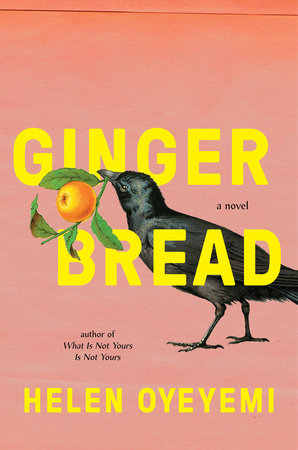
In Oyeyemi’s new novel, Gingerbread(Riverhead), she brings readers into the life of Harriet Lee: a single mother to Perdita, doting daughter to Margot, an isolated figure in some respects but one who can make people’s emotions erupt in unexpected ways with her special gingerbread recipe. While the Lees live a relatively average life in England, the story of how Harriet and Margot got there includes some twists and turns, evolving into a multilayered story of friendships, family, money, and the risks of keeping secrets—all shot through with the currency of gingerbread, a family staple for Harriet and her mother.
Oyeyemi balances this captivating read with jocularity and an open-hearted fondness for her characters and the places they inhabit. The bonds of love, admiration, and even jealousy surface—all relatable emotions in any reality. Harriet’s story takes the reader from her childhood home in Druhástrana—a place many do not believe exists—to the capitalist clutches of a distant family member hoarding young girls to play parts in a kind of warped Disneyland, and from there to the home of the dysfunctional and wealthy Kercheval family, another branch on her family tree, who have an estate where rooms can actually be moved at will.
With the elements of the fantastic as well as nods to the Brothers Grimm Hansel and Gretel story, Gingerbread remains utterly unique, utterly spellbinding, utterly Oyeyemi. She and I sat down to talk about the distinctions of this novel as well as her methodology in her creation of a new story.
Jennifer Baker: When it comes to the reaction to Gingerbread and your previous work, where you’re melding in kind of surrealist elements, do you find people focus a lot on the fantastical?
Helen Oyeyemi: They do. I don’t really know what to say about it. For me it’s just a style or mode. It’s just a way of telling the story. So separating out the elements like “this is strange and this is normal” doesn’t make sense to me. It’s sort of like going through your soup saying “this is a pea and this is a carrot.” It’s all together. It’s all part of the same thing. So I don’t see a need to comment on it particularly.
JB: For me, this book, and I don’t like to project this on authors, it’s such a family story. I’m completely into generational stories. That’s pretty much my hook. And I really related to the overarching idea of protection. If I’m using these kinds of thematic identifiers with the 3 women: where Perdita is trying to find the truth, Harriet’s searching for a subsection of another truth. And even Margot’s knowledge of a kind of truth and family being a mysterious entity. It really seems like this amalgamation of people trying to protect the people they love and then ends up hurting people.
Separating out ‘this is strange and this is normal’ doesn’t make sense to me. It’s like going through your soup saying ‘this is a pea and this is a carrot.’
HO: I see the family story, but for me, honestly, it was about Harriet. It was kind of this story of what was happening to her; I just sort of made a pact that I was going to get her through to the end and that she was going to be okay. I didn’t know if she was gonna be able to find the sort of acceptance she was searching for with her gingerbread. But I wanted to not leave the story until she was in some way able to move on to new questions. It wasn’t about resolving all of her issues, but shifting her attention towards the future. Because she’s always in some kind of anticipation of some future.
I guess the turning point in the book for me is when someone asks her if she has a future and she has no idea. And she thinks maybe she doesn’t, but she says, “Of course I have a future.” But she spends most of the book looking into the past so deeply that she doesn’t notice her present. [Her childhood best friend Gretel’s] role is definitely a reminder to Harriet to try and keep going forward. And to kind of enlarge her presence. And it’s as if [Gretel] doesn’t appear because she knows that if she did Harriet would just be stuck.
JB: I was literally writing about this, about my family living in the past. And you know, part of that is the trauma of the past. I don’t meant to project trauma onto this story at all. But I wondered if Harriet and the past: Is it a way to kind of try to resolve mistakes made if you just keep thinking about in a way? Or is it just this methodical way to stay in stasis and feel safe?
HO: I don’t know that she associates the past as safety, but I think that she does associate it with certainty, which is in some context the same thing or very similar. It’s that she knew what was going on even though as she tells it it may feel like “What is going on?” But Harriet knows. Even if we as readers and listeners don’t really get that. Druhástrana was a very strange place, but it was a place that made sense to her. And then she’s in this new place with this daughter who does all these things that she completely can’t understand.
JB: And there’s the members of the PTA she can’t immediately win over—
HO: —And she’s like, “Why don’t you like my gingerbread?” It’s very confusing to her. It’s very very confusing to her in the present. The past is at least this place where she knew that Gretel loved her gingerbread. She knew this was the role her family played in society—-even though it was a terrible role. At least she knew what was going on.
JB: Plus there’s this readability that Harriet always seemed to have. She kind of prides herself on being able to read these moments and also read the Kercheval family. I can kind of see that safety in it and that knowledge-base going. So how do you start with a character like Harriet and then bookend her with Margot and Perdita as you’re writing?
HO: It’s as if they kind they came to me imaginatively to try and support her or protect her. It comes back to protection again. To try and protect her. Even though it causes so many problems and they bully her. She’s trying so hard to take care of them. It’s this kind of difficult sort of scrum that they’re in. I honestly don’t know how those three make sense, but somehow they do. Maybe that’s the story of my family. These people are connected. And it’s broadly at that.
JB: Do you feel like with your writing family dynamics become a necessary element in the storytelling?
HO: Family does appear. I feel like it appears in different guises. I don’t know, if you asked me off the top of my head I wouldn’t say it’s the primary thing that I’m interested in. With every book I really stuff a lot in there and it’s definitely one of the things that I stuff in there. I wouldn’t say that it would come out on top. If I was talking about what was topmost, I think the questions about value got sort of attentive especially when Harriet’s money turned out not to be real. What are things worth to people and why some things seem more valuable for being homemade or for being personalized and others don’t. You know, just sort of weighing up those kind of matters. That would be topmost, but then there is so much in there as well.
JB: It’s so interesting you say that because then my mind goes back to all these scenes: The value of Harriet keeping her baby. The value of the Lees extracting themselves from the Kerchevals. The value of Margot and Harriet having their own place in the U.K.
HO: Right, like trying to buy dignity: what it costs and whether you can actually afford it. These kind of things or transactions that you make without physical currency.
JB: It feels like Harriet kind of sees things in the world as transactional though.
HO: She does and it’s all about being tied into her past. I mean she’s kind of raised as a unit on this farm for value. And so yeah there was a lot of “What can I add?” “What is my role here?” “How can I be valuable?”
JB: And that hits home in the beginning, too, because it’s about the transaction of what you can get from gingerbread. What her mother got from gingerbread and also her great great-grandparents got from it.
HO: Yeah, it’s just always been used that way. It is kind of sad. I’m not feeding people out of sheer generosity but feeding people to be fed in some way yourself.
JB: Wow, I’m reading it a whole different way.
HO: Well I’m thinking about it in a different way.
JB: May I ask if the consistency of discussing your books for a period of time affect you on a creative level? Is it “Okay, Gingerbread is done. I’ve talked about Gingerbread for six months. Next!”
HO: I have a whole bunch of notes and I’m actually about to start writing the new one. I’m so excited. I’m so looking forward to it. I’m not affected by it. Looking at the reviews is interesting. I always hope to see some perspective on what I’ve done is interesting. But for the most part it’s not that helpful, it’s like “She did this and this and that and I liked it or I didn’t like it.” And it’s like “Oh well, but it’s done.” And with the next book it’s gonna a whole different thing again.
JB: Considering how many books you’ve written have you been able to compartmentalize that as you’ve gone on? Or have you been able to do that from the outside?
HO: This is my seventh [book]. Every time that I start it kind of feels like it’s going to be impossible to finish.
JB: And you do it.
HO: Somehow, right? And time goes weird. Because all I do is write the book. That means that I don’t really have a sense of days and months and weeks and things.
JB: I wonder if that’s somewhat gratifying?
HO: It kind of feels as if you’re about to go into a trance for an indefinite period of time. You just don’t know what’s going to happen or who you’re going to be afterwards. But I’m also looking forward to it. It’s like a disappearance, like a transformational one.
JB: So that’s why you’re effective. The rest of us are on Twitter and Helen’s writing books.
HO: I [use Tumblr] a lot. What I like about Tumblr a lot is it’s very very very focused. So if someone has an art Tumblr it’s just full of art. There’s nothing about their life. It’s just these things. And same with books.
JB: So how are you feeling in general about Gingerbread and going out in the world and talking about it? I personally hope people don’t focus on the racial aspects. Jordan Peele’s movie is coming out and everyone keeps asking him, “So is this about race?”
Helen: Oh really?
JB: Yeah, because it’s a Black family. And he says “It’s not Get Out.”
HO: Get Out was a unique story, and I love that when he goes into the chamber and finds all of her pictures. I was like oh! But it’s so much more than that and it’s so much bigger than that. So far nobody has, but it’s very early days. We’ll see. I obviously don’t think it should be a thing. Based on how I’ve written it, it’s just like here’s just some people doing what they do.
JB: It’s so refreshing to read this and enter the story. I do think it’s not just a difference in cultures, but also perspectives of you’re going into the story and people are brown and that’s just what it is.
There’s no kind of description of “brown skinned Harriet” or emphasis on her skin tone.
HO: But it’s also not my conception of character. I would just prefer to work from the inside out. The things that I’m interested in about people… the things I find most real about people [are] the things that they hate. It’s weird. I always have a moment with my friends where they said something that shows how bad-tempered they are. And then I feel like I actually know you. And I’m working from there.
I always have a moment with my friends where they said something that shows how bad-tempered they are. And then I feel like I actually know you.
JB: That tone makes sense because I think Harriet focuses on those pieces. And it doesn’t become, “Oh, you’re a terrible person.” It’s “Oh, you always seem to placate to certain people.”
HO: Yeah, it’s all kinds of patterns of behavior are the way to know what’s going on with people. It’s a way of reading people. I’m not saying it’s the way but at least it’s a way.
JB: Do you think that’s a writerly trait? Reading people?
HO: Some writers. My favorite kind. I’m thinking Barbara Comyns is one of my favorite’s ever and I think that’s kind of her way. But also it’s a kind of strange sympathy for, not bad behavior, I just think she casts this view on all of the slightly underhanded things people do and she kind of looks at what they were trying to do, which is ultimately actually not bad. They were just trying to survive. Or trying not to hurt another person. It doesn’t excuse or forgive the dodgy behavior, but it just kind of gives you a broader arc.
I generally prefer to read older fiction, novels published anywhere from the late 18th century onward, books people are no longer talking about. Something about blowing the dust off a forgotten book makes me feel special, chosen, as if the author and I are the only people in on the same secret; that a good book long forgotten is, in reality, timeless. What may have started in my youth as a vain preoccupation with looking “smart,” with toting around a copy of Jakob Von Guten rather than, say, Bridget Jones’ Diary, has evolved into a genuine appreciation for reading both our dead literary giants and the quieter talents that nobody quite remembers.
Purchase the book
I’ve come to realize (without any intention) that most of my very favorite books are written by women, about women.
Nearly all of the women listed here enjoyed varying degrees of success in their lifetime. Some won prestigious prizes; nearly all wrote multiple best sellers. And yet, every one of these writers, of these books, can be considered forgotten. By ignoring these books we aren’t just ignoring our debt to what our female ancestors in this business did, but depriving ourselves of some of the smartest, funniest, most intelligent fiction to be read. Critics agreed, the public agreed, and yet good luck finding a copy. These novels, certainly these writers, deserve another reading. In this loud, politicized literary landscape, there is a real pleasure in curling up with a novel about our inner lives, about the way we lived then, and about how little of substance has really changed.
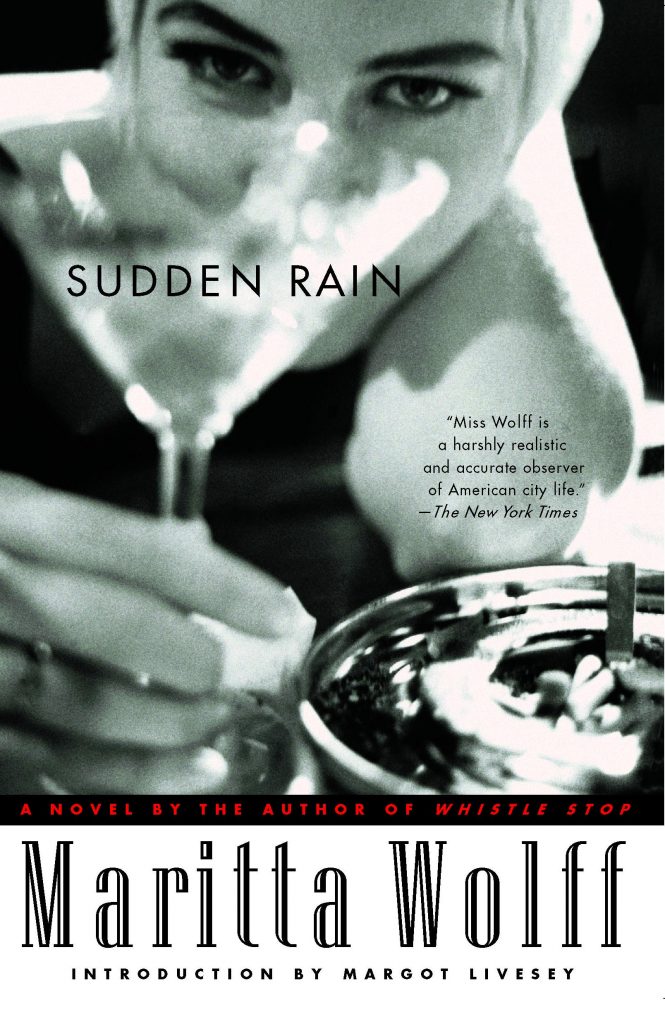
In 1972, the seventh and final novel from Maritta Wolff was literally put on ice. In a fit of anger, the critically celebrated and widely read author shoved the manuscript into her refrigerator and left it there for the last thirty years of her life. Wolff blazed onto the scene at twenty-two-years-old with Whistle-Stop; a novel Sinclair Lewis called “the most important novel of the year.” She went on to produce four more bestsellers over the next two decades. So what happened? Wolff despised publicity. When her publisher insisted she go on a promotional tour for Sudden Rain, Wolff refused, froze the manuscript and never wrote again. A strange story to be sure but what remains is a sort of time capsule, published posthumously to much acclaim, chronicling the inner life and domestic mores of the late 1960’s and early 1970’s. The novel follows three married couples over the course of one stormy weekend in Los Angeles. With a stunning ear for dialogue that echoes Dawn Powell, and an even keener grasp of human nature that recalls Theodore Dreiser, Sudden Rain is a novel ready to be re-heated and served.
Good Behavior opens with fifty-seven-year-old Aroon St. Charles politely killing her sick mother by feeding her a rabbit mousse. Is it murder, or good behavior? The magic of the entire novel lies in the disparity between what the reader knows, and what the reader thinks Aroon knows. This is no easy feat, and one that Keane pulls off with effortless grace.
Aroon, the “plain,” unmarriageable daughter of a devastatingly cruel Mummie and a “distracted” Papa, resides in her crumbling, Irish ancestral home, where bills have been “pushed into the drawer where they always went,” animals are treated with more deference than people, and the servants are tolerated with a contemptuous familiarity. If Aroon takes pride in anything, it is her manners, her good behavior. She knows how to behave because no matter what indignity she is forced to endure, good behavior must be maintained. The book is told from Aroon’s perspective, and she relays the brutal details of her upbringing with such shocking remove that the book, much like Our Spoons Came From Woolworth’s, or more recently, The Patrick Melrose Novels, draws its power from tiptoeing that delicate line between the nightmarish and the devastatingly funny.
Rejected as “too dark” by a publisher, Molly Keane did not enjoy the success of her eleventh novel (the first written under her real name) until she was in her late seventies, when the book was shortlisted for the Man Booker Prize. Keane lost to Salman Rushdie’s Midnight Children and the book, along with its author, have since slipped into obscurity.
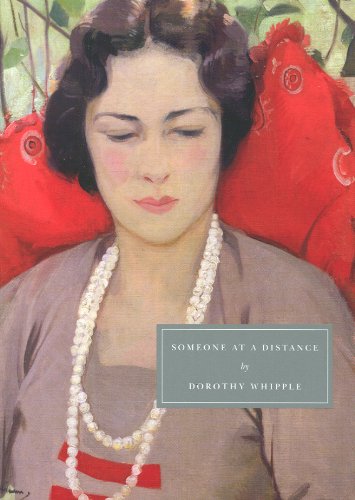
After a wildly popular writing career in the thirties and forties, Dorothy Whipple’s exceptional last novel, published in 1953, bombed. “Editors are all mad for action and passion now,” explained her publisher, when the book failed to get reviewed. Whipple gave up writing and died thirteen years later, believing her work was all but forgotten.
Someone At A Distance is atimeless story of the systemic destruction of a happy marriage by adultery. The magic here lies not in what happens, but how Whipple portrays what is lost. Much like Evan Connell’s Mr. and Mrs. Bridge, every pride, shame and humiliation the family endures can be felt as if it were a personal blow. Whipple’s meticulous depiction of the inner lives of her characters seems effortlessly drawn. Though Someone At A Distance was re-issued in 2008, I’m always surprised that more fans of Elizabeth Gaskell and Barbara Pym haven’t happened upon this absorbing novel.
Drawn from White’s own childhood experiences at convent school, this literary gem is a detailed portrait of a world as seductive as it is horrifying. Originally published in 1931, the power of this novel lies in its details and its paradoxes. Nanda, the nine-year-old protagonist, is sent to the Convent of Five Wounds by her beloved Catholic convert father. Obedient and clever, Nanda quickly adapts to the schools rigid conformity but is forever marked by the abuse she is forced to endure there. As you read, it slowly becomes clear that this is not a book about school or even Catholicism, but about human cruelty, mean and calculated, crushing innocence in the name of religion. In a piece written for The Guardian, Tessa Hadley explained “Something happened to (White) at that school, by all the biographical accounts, which marked her for life – obsessed her and damaged her. The experience prevented her from writing for years, but in the end it also gave her this small masterpiece of a novel, exquisitely poised between a condemnation of the school and a love letter to it.”
Before Jane Austen, there was Frances Burney. Evelina, published in 1778, is an epistolary novel; the drama told through the first person letters of the many characters involved in a young woman’s debut into London society. Much like Austen’s heroes (and those of the Bronte sisters after her), Evelina learns to navigate the complex layers of society and earn the love of a distinguished man. Sentimental? Possibly, but the dizzying, dark side of Georgian London has never so deftly illuminated the vulnerability of female innocence in a male-dominated culture.
Though Burney published the novel anonymously (to avoid censure from both her father and a public that disapproved of women who read and wrote novels) her identity was swiftly revealed and the book went on to achieve well-deserved success. Sadly, the book has fallen away. Burney’s gift for strongly delineated characters and satiric humor foreshadow such novelists of manners as Thackeray and Trollope.
I first met the character of Rhoda Manning in Gilchrist’s Victory Over Japan, which won the National Book Award in 1984. What a thrill to discover an entire collection devoted to Gilchrist’s most beloved character. Arranged in chronological order of Rhoda’s age—from eight to about sixty, the stories detailing Rhoda’s childhood and adolescence, when Rhoda is young and growing up with her brother during World War II, are certainly the strongest. Nonetheless, readers will delight in following this brassy redhead into an adulthood filled with pathos and gothic humor. With echoes of Eudora Welty and Flannery O’Connor throughout, Gilchrist’s writing sparkles and comes to life. Rhoda may not be the most likeable character, but her quest for freedom (or at least happiness) outside the prescribed rolesfor women is an addictive journey well worth taking.
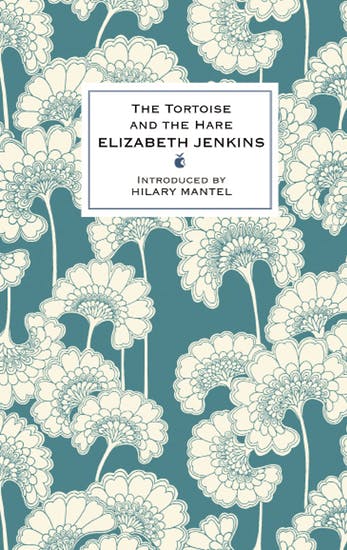
Jenkins mid-century tale of domestic drama and female sexuality is quietly heart breaking. The novel details the marriage of pretty and admiring Imogen Grosham to her older husband, Evelyn, a successful man of intimidating presence and authority. With the intrusion of their closest neighbor, the sporting Blanche Silcox, an elderly spinster, stout and capable, the marriage begins to unravel. Though Imogen seems to understand that her beauty and devotion never quite satisfied her husband, she, along with the reader, can’t possibly believe that Evelyn would be attracted to Blanche. But Evelyn discerns Blanche’s concealed sexuality, the presence of a serious woman who might be a true companion. When Imogen’s friend asks her if she’s sure she knows what men want, it’s quite clear that she does not.
The slow erosion of Imogen’s self-esteem as she comes to realize, too late, that Evelyn loves Blanche, is shattering. Perhaps the most astonishing achievement is that Jenkins manages to make us feel that Evelyn’s impatience with his wife, along with Blanche’s artful encroachment on their marriage, are somehow justified by Imogen’s wistful, passive suffering. Hailed by Hilary Mantel as being “as smooth and seductive as a bowl of milk,” this is a novel not to be shelved but to be savored and re-read.
I have a bit of a defect as a reader. I tend to judge all works solely on whether or not they’re funny. My favorite moment in Moby Dick comes fairly early on when Ishmael starts making fun of famed microbiologist Antonie van Leeuwenhoek:
Leuwenhoeck submits to the inspection of a shivering world ninety-six fac-similes of magnified Arctic snow crystals. I mean no disparagement to the excellent voyager (I honor him for a veteran), but in so important a matter it was certainly an oversight not to have procured for every crystal a sworn affidavit taken before a Greenland Justice of the Peace.
Purchase the book
Ha! Take that, father of microbiology, you dumb clown! Later on in the book we get this line about a mysterious sailor, “He announced himself as the archangel Gabriel, and commanded the captain to jump overboard.” I’m not even sure if that line is supposed to be funny, but it always gets a chuckle out of me. There are lots of other funny bits, but for me those two lines alone secure the novel’s status as a masterpiece. Other classics haven’t fared as well under my unwavering demand for jokes. A Farewell to Arms is pretty solidly a bummer except for the moment when Frederic tells his doctors to saw his leg off so he can wear a hook on it. And don’t even get me started on Cormac McCarthy’s The Road. I doubt I laughed once.
I think I speak for all discerning readers when I say that it can be frustrating when otherwise great books fall down on the giggle front. In fact, when I express this thought to other readers, I hear a lot of thembring up similar concerns. They say things like, “That book wasn’t trying to be funny” or “What’s the matter with you?” or “Please, stop shouting.” For all these reasons and more, I’ve decided to gather together a list of some of my favorite funny writing. These are all works that make me laugh without sacrificing quality or their status as high art. I’ve also tried to focus on pieces you may have missed, since I’m guessing we’ve all already read that Mark Twain story with the frog. I think it’s called something like “The Leaping Toad of Catsmooch County.” I’m not going to Google it and you shouldn’t either. But with any luck, there will be some fun surprises below.
Writers and readers everywhere recently mourned the planned shuttering of the beloved literary journal Tin House. This brilliant and absurd piece by Joy Baglio is a perfect example of why this loss has been so keenly felt. Baglio’s “Ron” appeared in issue 75 of Tin House. In this story, the universe keeps sending a young woman lovers who are all named Ron. What at first seems like a coincidence quickly develops into a half-cosmic, half-magical conspiracy. Baglio leans into the hilarious premise in an earnest, thoughtful way that both accentuates the humor of this story and gives it depth.
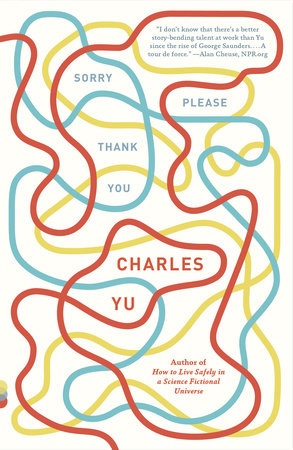
Few writers mix heart, spiraling creativity, and hyper intelligence as well as Charles Yu. So it almost seems unfair that he’s also funny. This short story from his collection Sorry Please Thank You is among my favorites. Yu gives us a correspondence between an individual and different versions of himself across parallel worlds. It starts as a casual interaction and soon kicks off into an echo chamber that questions the underpinnings of identity and existence. Yu tackles all of these issues while maintaining the familiar and funny tone of an email thread getting out of hand.
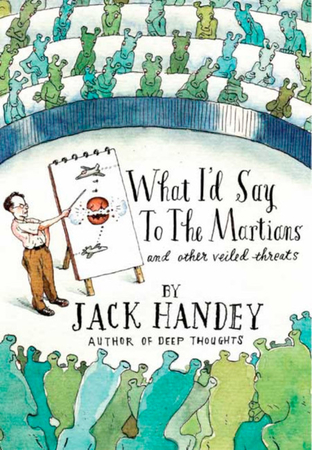
You might already be familiar with Jack Handey from his classic contributions to Saturday Night Live or his Deep Thoughts anthologies. You might be less familiar with his collection of stories and essays titled, What I’d Say to the Martians, which features some of the greatest and most ridiculous humor writing of all time. In the story “Einstein and Capone,” Handey chronicles a friendship between Albert Einstein and Al Capone with charming anecdotes like this one:
Their favorite joke was to have someone ask them which one was Capone and which one was Einstein, and they would both point at each other. They were a couple of slaphappy kids, going around slapping people. If you got slapped by Capone, there wasn’t much you could do about it. And if Einstein slapped you, you’d go, ‘Wow, slapped by Einstein.’
If you find that excerpt funny, then I agree with you. If you don’t find it funny, I’d probably grab this one from the library before buying your own copy.
This flash memoir is the opening piece of Beard’s celebrated collection, The Boys of My Youth. In this piece, Beard manages to capture all the awkwardness of preadolescence in under two pages. She describes being ten-years-old on a vacation with her family when she sees a group of teenagers start to drown in a river. In the moments before the teenagers are saved, Beard explains that she is frozen with embarrassment over the fact that teenagers are shouting at her. She details the event with her characteristically amazing prose and a self-effacing wit that elevates the memory of her own awkwardness until it’s universal.
P.G. Wodehouse was probably one of the greatest English prose stylists of the 20th century. He’s rarely credited as such because his prose was also funny and most of the people who publicly rate prose stylists are physically incapable of laughter. The complicated farces of Wodehouse’s stories are also half the fun, so I won’t spoil the plot of this classic Jeeves and Wooster tale. However, I will share this quick excerpt in which Bertie Wooster observes his friend being heckled at a music hall:
I don’t know why, but somehow I had got it into my head that the first thing thrown at Tuppy would be a potato. One gets these fancies. It was, however, as a matter of fact, a banana, and I saw in an instant that the choice had been made by wiser heads than mine. . . . The moment I saw that banana splash on Tuppy’s shirtfront I realized how infinitely more effective and artistic it was than any potato could have been.
Not that the potato school of thought had not also its supporters. As the proceedings warmed up, I noticed several intelligent-looking fellows who threw nothing else.
Lydia Millet is a genius and all of her books are worth picking up if you’re interested in the heights and possibilities of contemporary fiction. But out of all her books, Mermaids In Paradise, in which a couple on their honeymoon discover a lost race of mermaids, feels like the perfect delivery system for Millet’s amazing sense of humor and grand sense of adventure. The narrator, Deb, possesses a warmth and relatability that causes her incisive observations about our world to read like so much more than just satire. Mermaids in Paradise is an urgent communion with a voice that immediately feels like that of an old friend.
Do you wish Rimbaud had been funnier and had hung out at Wendy’s more often? Same here, friend. Same here. Enter Joe Wenderoth, whose novel chronicles the thoughts and obsessions of a nameless narrator memorializing his thoughts on Wendy’s comment cards over the course of a year. The narrator lives in a world of Sudafed, whiskey, Biggies, and Frosties. The resulting comment card prose poems are brilliant, hilarious, and occasionally (just a warning) shockingly pornographic.
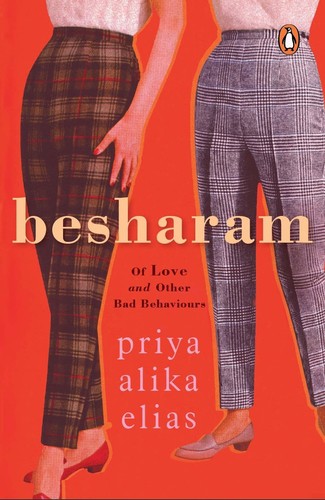
Shameless. This is a word every brown woman knows intimately. From my British home in Brighton to my Indian home in Goa, from Toronto to New York to Lahore, brown girls everywhere are constantly called “besharam.”
It doesn’t have the same ring in English, shamelessness shorn of its cultural specificity. Besharam is an accusation that cuts deep, in all directions. It means that you haven’t just brought shame upon yourself — through your choice in clothes, your too-loud laugh, your music taste — but also upon your family, your community, a sense of cultural honor. In 2011, when Delhi women organized a slut walk, they called it a besharmi morcha [protest]. They didn’t march as sluts, they marched as women without shame. The exact opposite of what a “good” brown woman is supposed to be.
Purchase the book
Priya-Alika Elias isn’t having any of it.
Elias’s debut book is a brown girl’s survival guide disguised as a memoir. Besharam: Of Love And Other Bad Behaviours covers far-ranging topics spanning rape culture, heartbreak, “aunties,” eating disorders, and the impossible weight of a brown body in a sea of whiteness. Set between America and India, Besharam is equal parts hopeful and heartbreaking, and despite its tenderness, calls forth the kind of rage that makes you want to set the world on fire. And I hope it inspires brown girls the world over to do just that.
In the run up to Besharam’s publication, Priya and I met over the internet to talk about white boys, self-love, Twitter, Asian parenting, and why it’s important for brown girls to stand up for each other.
Richa Kaul Padte: Priya, let’s start with white boys! Like you, I became an adult in a white country, and young men trying to chat me up would often say, “But you don’t look Indian.” They meant it as a compliment, and the worst part is that over time, I began to take it as a compliment too. In Besharam you write: “How can I describe the specific wound left left…by white men who say, ‘You’re attractive, for an (X ethnicity)’?…We know what happens to a wound when it festers.” What do you think is the result of these festering wounds? Because damn, do they fester.
Priya-Alika Elias: For me, it meant that I tried to shed my Indianness. Since white boys didn’t think Indian girls were attractive or cool, okay fine, I would no longer be Indian! Obviously I couldn’t rid myself of my identity so easily, but I stopped wearing Indian clothes or accessories. I made a conscious effort to not have any Indian friends. I never talked about India or Indianness. I was absurdly pleased when people mistook me for any other ethnicity.
It took me a long time to understand that white boys were not the universal arbiter of attractiveness.
It took me a long time to understand that white boys were not the universal arbiter of attractiveness, or to see any desirability in myself. I imagine it’s just as difficult for many brown girls abroad. As women, we are already so aware of our looks — and what role they play. As brown women, white boys can be immensely damaging to our self-esteem, to the point that we wish to cast off our fundamental identity.
RKP: Please let’s talk about Rupi Kaur. Clearly so many white people (and men of all ethnicities) resent her success. Like you point out, she outsold motherfucking Homer. And I love that you tie this success to how she constantly preaches self-love to brown girls. You write, “What do we brown girls know about self love? Who is teaching us to love ourselves?” What is it, do you think, about a self-confident brown woman that poses such a threat to the world?
PAE: The ideal brown woman is meek, restrained, “good.” From birth we are taught how to behave around other people, aren’t we? Even how to sit. There is a compliment in my native language, Malayalam: adakkam odakkum. It means “a good woman sitting in the corner, occupying as little space as possible.” We are designated a bother, a headache. “Shrink yourselves!” we are told.
Kaur’s poems defy that dictate. They tell young brown girls to be confident, and not to be afraid to take up space. Her poems speak freely about unruly bodies and taboo desires. Most importantly, they convey to young women that they do not need to seek approval from anyone besides themselves. This poses a tremendous threat to a world whose foundations are built on policing brown women. If we love ourselves, if we are convinced of our worth, what tools do they have to control us with?
RKP: In an essay titled “Wolves,” you and a friend are getting into a car at nighttime when two men come down the street. One approaches your friend, and is persistent even after she refuses to talk to him. You write, “For that moment, I am not myself. I walk forward…I push him. It is a hard push that says I am not afraid. I know at that moment I am not…I see fear in the man’s eyes and am delighted that I have the ability to cause fear.” Priya, I cried and cried from pride and joy when I read this story. And it makes me wonder: is this where systemic, unending violence at the hands of men has brought us? Delight at a rare and precious moment in which a woman can physically intimidate a man?
PAE: It was one of the more complicated moments of my life, emotionally speaking. I have never been an advocate for violence or physical aggression. However, in a world where women are targets of so much violence, there is an aching desire to make men see our fear. Even share it. I was completely, unabashedly proud of my ability to intimidate another human being, because he was a man.
Rape-revenge narratives, horror movies in which the Final Girl survives by killing men, these are all manifestations of that desire. So often, we feel powerless. Reading the news each day feels like an act of masochism (so many women being hurt by men). If only, for once, we could be the ones with power. It’s sad that the prospect is so intoxicating.
RKP: You’ve written a wonderful fable of sorts in the form of the essay “A Cautionary Tale for Brown Women,” in which a selfless, caring woman keeps giving away parts of herself to those in need. I think many of us have grown up seeing the women in our lives doing just this — wearing themselves thin, for children, husbands, in-laws, communities. It’s what you describe in a later essay as “an endless wellspring of care, love, and attention.” Should we be teaching selfishness to brown girls instead? Or is there a middle path somewhere, a caregiving that doesn’t suck us completely dry?
PAE: Hmm, I feel like we shouldn’t be teaching anyone to be selfish. My feminism is not “Let’s teach women to be more like men.” A world in which we all act like selfish men would be unsustainable. That being said, we do need to teach women that their needs take precedence. I think you said it — there needs to be a middle ground!
So many young brown women don’t think they have a right to put themselves first. They need to hear: “Please don’t sacrifice yourselves to make your communities happy. Nurture the people in your lives, but not at your own expense.” Equally important, brown men need to learn nurture. Young brown men have to shoulder some of that burden — that’s the only way forward.
So often, we feel powerless. If only, for once, we could be the ones with power.
RKP: Desi comedians often joke about how they’ve disappointed their parents by not becoming doctors or engineers. But this joke is often an unfunny cover story for the reality that you explore so unflinchingly in the essay “Counting Black Sheep,” which is about the countless South Asian teenagers who commit suicide under the weight of their families’ demands for “excellence.” Is this some sort of cultural disease infecting essentially all of Asia, and where do you think it stems from?
PAE: It’s the worst disease. It has such a high mortality rate across — as you say — all of Asia. Even when it doesn’t take lives, it breaks hearts. Pearl S. Buck once wrote, “Stories are full of hearts being broken by love, but what really kills a heart is taking away its dream, whatever that dream might be.” Think of all the aspiring artists, the singers, the young people who want to pursue anything slightly unconventional. We simply don’t allow them to do it. Why?
I don’t know, but I’m guessing part of it comes from a deep fear of difference. We aren’t individualists — Asian culture doesn’t value being “different” in the same way Western culture does. We are taught to respect tradition, and to endeavor to fit in. I think Asian parents genuinely believe there is only one path to success, and only one mode of “excellence.” They force their children into believing the same.
RKP: Priya, you and I went to school together for a while (!), but we only really got to know each other as adults — thanks to Twitter. And it made me smile that you listed your Twitter friends in Besharam’s acknowledgments page, because I did the same in my book. For me, the internet has been a crucial place to grow into myself. Do you think this is the case for many women of color, whose offline spaces are often tightly controlled and surveilled?
PAE: People meet me sometimes and say, “Wow, you’re so different from your online presence.” I think maybe they expect me to be as sharp and unforgiving and bold as I am online? But that’s why Twitter has been so great for me and for so many other women of color — it gives us a space to be who we can’t be IRL.
In real life, I can’t be irreverent to aunties. I can’t be sexual and unrestrained (even though I try!). For the longest time, I didn’t know who I was, because I didn’t have the space to experiment. I imagine it’s the same for many women of color — we get the chance to be free online, to try out things and personalities until we understand ourselves better.
As brown women, we are constantly exhorted to live for other people, and not for ourselves.
RKP: You write of A Little Stranger by Candida McWilliam, a novel featuring acute eating disorders, “I closed the book. It was too real; it made me feel sick.” This is very much what reading Besharam was like for me — and I mean that as a compliment! I felt a simultaneous relief and terror at knowing that if your book made me feel so seen, it would do the same for other brown girls. Am I right in saying that Besharam itself speaks from within this dichotomy — a sense of gratitude at not being alone, but also a sense of heartbreak that other brown women suffer similarly? Where do we go from here?
PAE: Thank you, I am so moved by your kind words. That’s exactly what I was trying to do.
I wrote Besharam because I felt a profound loneliness for so long. There was nobody to tell me “I feel this way too; this is why being a brown girl is hard.” Our culture encourages silence in women. We hear the eternal, pernicious, “What will people think?” Well, I’m tired of silence.
You are absolutely right: the book is written from that dichotomy. So many of us carry similar burdens, and that is heartbreaking. But the ultimate goal of speaking out is change — I think that once we feel a sense of sisterhood with each other, we can then try to make these burdens lighter for each other. As brown women, we are constantly exhorted to live for other people, and not for ourselves. Well, maybe we can subvert that teaching, and use it to help and stand up for other brown girls. That is my hope.
I have always gravitated toward works of horror, even at a young age. At first, I read whatever I could find on my parents’ bookshelves. John Saul. V.C. Andrews. Stephen King. They lit a fire in me, made me curious about all the things that might be out there. All the things we cannot prove. Ghosts hiding around corners. Monsters lurking in shadows.
As I got older, I began to appreciate a different sort of horror. Horror that made me interrogate the greater dangers we encounter in our day-to-day lives. The deeper evils that lie within us. What could be more terrifying?
If there is anything to inspire an even deeper dread within me, it’s stories that take already terrible events from real life and make them even more monstrous using the traditional elements of horror. Perhaps it’s because these stories hew so closely to reality, they almost seem to confirm the potentiality of dark magic and demonic creatures and other supernatural manifestations.
Here are 8 books that manage the balancing act of normalcy and impossibility in a way that is creepily satisfying.
Dan Simmons is known for the brand of horror that takes an event in history and twists it just slightly so that it becomes even darker. His most well-known work in this vein is The Terror, which takes the story of a ship on a doomed expedition through the Arctic in the mid-1840s to find the Northwest Passage—a story already filled with disease, starvation, and death—and adds in the possibility of something else unseen, something stalking them across the ice. The Terror was so popular, it was adapted for the small screen.
The myth of the changeling—a fairy child left in place of a stolen human child—ran rampant throughout medieval Europe. Perhaps it was so popular because it was such a convenient scapegoat for the afflictions that often beset children, diseases and disabilities that parents and medical professionals did not understand at the time. In some cases, even adults were accused of being changelings. One of the most well-known cases is Bridget Cleary who was killed in 1895 by a group of people that included her suspicious husband. In The Hidden People (a reference to the fairy folk), a man learns his cousin has been burned alive because her husband thought she was a changeling. When he arrives in town to investigate, he comes to wonder if there’s more than just silly superstition at play.
Victor LaValle has a knack for taking old folk tales and making them new. I adored his take on the changeling myth, in which he tracks trolls on their journey from Europe to America, from the past into the present. In explaining how changelings have come to be in America, he digs into the “why” behind their existence, and also suggests a level of complicity in the humans that had previously been assumed to be victims alone.
More than anything else, this novel is about la frontera, the U.S.-Mexico border. Rather than focusing in on a single historical moment or figure, this book uses six characters to tell the story of a shared Southwestern experience—with a dark twist. Among the six main characters are a child who turns cold-blooded after seeing his father killed; a young woman who progresses from performance art to murder; and a mother who begins to fear that the child in her womb may be something more sinister.
Alma Katsu’s latest book takes one of the deadliest occurrences in Western history—the catastrophic wagon train journey of the infamous Donner Party—and adds a supernatural twist. Starvation and eventually death causes the body count to rise. Members of the party are pushed to the brink, inevitably turning against each other. But as people begin to disappear, they start to wonder if something even more malevolent is at play.
In this graphic horror novel, Rodriguez places us in the midst of the Napoleonic Wars when, after an unsuccessful attempt to defeat the Russian army, his own military is forced to retreat. One unit is attacked by Cossacks during their journey homeward, but two survivors are able to elude the military warriors by fleeing toward an abandoned Slavic town—a place the Cossacks are unwilling to approach. But why? These men eventually come face to face with the Czernobog, a Slavic demon who proves to be a much more formidable opponent than the bloodthirsty warriors they only just barely escaped.
This classic horror is one of those books I can’t believe my parents let me read. At that point, having made me way through most of the books on their shelves, they’d probably resigned themselves to having a weird and morbid child. What difference would a bit of adult content make? As you likely already know, Blatty’s novel is about the demonic possession of a 12-year-old girl, and the attempted exorcism undertaken by two priests. What you may not know is that the book is based upon the true story of an actual exorcism. Wherever you stand on the legitimacy of demonic possession, by the end of Blatty’s novel, you’re forced to believe.
Once upon a time (the early- to mid-1800s), a Spanish serial killer known as the Wolfman killed several women and children so he could extract their body fat and use it to make soap. Some postulate that Süskind’s novel—about a perfumer’s apprentice who is obsessed with possessing the particular scent that exudes from virginal young girls—is based upon this monstrous true tale. Whatever the origin, Süskind pushes the story further, imbuing the scents his serial killer acquires with outsized powers.
As I write this, right up the road, students from my alma mater are leading the largest student-led occupation in the college’s history in protest of the school’s lack of support of low income students and students of color. A few weeks ago, on the other side of the world, thousands of teenagers gathered to protest government inaction regarding climate change. And years ago, in a town in the Midwest that the country had largely forgotten, young people started a movement to resist police brutality that changed the world.
Purchase the book
Lilliam Rivera’s Dealing in Dreams, then, is set in an environment that doesn’t seem so unlike our own. In a near-future dystopia, a people are ruled by a megalomaniac with seemingly unchecked power, whose narcissism is fueled by a lifetime of wealth and access. There are gross disparities in housing, employment, education and opportunity that allow a privileged few to thrive, but only at the expense of the most vulnerable among them. And young people must take to the streets to protect their people in ways that the adults around them have failed to do.
Dealing In Dreams explores violence, privilege and the complicated nature of power, and what it means when the future of a community rests in the hands of history’s most fearless radicals: young people.
Leah Johnson: You’ve said that you wanted Dealing in Dreams, to be a book like the ones you loved when you were a kid (violent and fast-paced), but to have girls be at the center of it. In knowing that, where did the book come from and grow to?
Lilliam Rivera: I wrote the book six years ago. I wrote a draft of it and it was because I just given birth to my second daughter, and at the time I didn’t have an agent or even my first book—none of that. So I was still in that process of trying to get published, and trying to be a published author. And when I had my second daughter a lot of people were like: “Oh, you’re going to have to shelve that dream!” And a lot of that was coming from women. So out of rage I wrote this book.
It was the kind of book that I would have wanted to have read when I was in high school. I wanted something violent, I wanted something that [felt like] The Outsiders. And I wanted it from the perspective of a young Latina. So I wrote a draft six years ago and I put it away, I didn’t look at it. And then I looked at it again two years ago when I signed my two-book deal. And I saw that it was still pretty relevant—a lot of the anger I had in there was still pretty palpable. In the last year it’s been through a lot of changes, drafts, rewrites, but it still made a lot of sense. Very of this moment, even if it was set in the near future.
When I had my second daughter, people said: ‘Oh, you’re going to have to shelve that dream of becoming a published author!’ So out of rage I wrote this book.
LJ: The book is also doing a lot of work in terms of radical feminism, race, class—the whole nine yards. These aren’t topics that a lot of people normally associate with YA—which I think is a gross, gross undersell of the genre. When you were writing, how did you think about tackling these issues, while also making them accessible to a young audience?
LR: For me, when I’m writing a young adult book, I’m always thinking about the bigger thing. For my first book, The Education of Margot Sanchez, I was obviously thinking about gentrification but also colorism within the Latino community. So then with this book, again, I felt that things were even bigger, or even more complicated.
I was really thinking about government-run medical experiments that have been done in Puerto Rico. I was reading about how they use medical trials in Puerto Rico on women when they were trying out their drugs. There were little lines that would be put in these newspaper articles that were dropped in there and no one is saying: “This is insane!” Like, it’s still happening.
And I thought about during that time it was the Women’s March going on, and it was all about the patriarchy, and down with the system, and men, and all this stuff. And I’m all about that too, but there aren’t any easy answers to any of this. I feel like for most of the time the women of color who are leading on the front lines are usually cast away at one point during that revolution. So all of those questions were circulating when I was revising the book.
LJ: I found it so radical that the defense of Mega City is in the hands of these badass young women. I don’t know that I even have a question except to say that that particular choice feels so powerful and so timely right now.
LR: I feel like we saw that, right? When I think of Black Lives Matter, I think of all those young people who were on the front lines. Even in Florida, after the shooting, all of the kids became the spokespeople for that. But before that, it was Black Lives Matter. It was the young leading that. I think people forget that it’s true that they have way more power.
I’m reading about the walkouts in LA in the ‘70s and ‘60s—all of the Chicanos who led those walkouts—and they were all high school students. It’s really powerful. It should be, it makes sense, for young people to be owning the city, owning the streets. Even if it is a little bit misguided at first, for Nalah and Las Mal Criadas they do have that power.
LJ: That sort of goes back to the last question as well, that it’s not super foreign that we’re going to make these topics “appropriate” or palatable to young people—because these are topics that young people are taking on in the streets everyday. So it feels fitting.
LR: Yeah, there’s definitely like this thing in young adult where people think: “Oh, we can only handle one issue in a book!” And I’m like, that’s not even realistic for anyone who’s living. Young people are dealing with multiple things on a daily basis. While also finding joy and also falling in love and all of those things. But also just dealing with major stuff. And so I was just trying to formulate that in a futuristic world where these girls really do have power, really do have unbridled violence, in a way where they don’t see much that’s like the “[traditional] girl.”
Most of the time women of color who are leading on the front lines are cast away during that revolution.
LJ: And this violence is not just tolerated by the matriarchy, but kind of similar to The Hunger Games, it’s encouraged by this power structure.
LR: I grew up loving to watch live boxing, and I follow a lot of the Puerto Rican fighters. So, to me, it’s tied to that type of performance. I can see the beauty of boxing, and the talent and skill, but I can also see how it’s so tied to poverty and also to uplifting someone and all of those things. And it’s disturbing. And all of that is tied into how I wanted to write about violence.
LJ: This whole book is upending stereotypes. One of my favorite choices of yours was to make men props in the way that women often are. Were the papi chulos sort of a middle finger to all of the male writers who’ve constructed nameless, faceless, attractive women over the years? I might be projecting.
LR: That’s amazing! I didn’t think about that, but maybe subconsciously? Honestly, the idea of boydegas and papi chulos came to me from this documentary I watched a long time ago and it was based in Japan and it was about these young, professional women who are able to rent out men. You go to a club and you can rent them out, and it was very specifically geared to young women. So I was totally fascinated by that, and I always thought about how I grew up a Menudo fan. And Menudo was like the boy band that always had new, fresh boys so that [the members] would stay forever young. So I thought about what that would look like in the future, when guys are put in that type of subservient role, and just become eye candy for the gangs. So yeah, I had a lot of fun writing those scenes.
LJ: I want to say how important this book feels to me. Even the way language functions here was something special. There is a lot of Spanish, but the book never slows down to explain it to non-Spanish speakers, it just expects us to keep up.
LR: It felt really important. For my first book, I described words and meanings more, and for this one I was just like no. I feel like I’m just going to do that from now on. This is the world, and you should either know the words and the lingo or you don’t. It felt really liberating to be able to do that. You’re entering this world, some of it’s familiar and some of it’s not, and that’s okay.
DON’T MISS OUT
Sign up for our newsletter to get submission announcements and stay on top of our best work.
YOUR INBOX IS LIT
Enjoy strange, diverting work from The Commuter on Mondays, absorbing fiction from Recommended Reading on Wednesdays, and a roundup of our best work of the week on Fridays. Personalize your subscription preferences here.