I f the Nobel Prize in Literature were a TV show, last year would have been the season it jumped the shark. The selection of Bob Dylan—Bob Dylan! Not even Leonard Cohen!—outraged some, confused everyone, and embarrassed the hell out of The New Republic’s Alex Shephard, who reported on the betting odds with a piece entitled “Who Will Win the 2016 Nobel Prize in Literature? Not Bob Dylan, that’s for sure.” Shephard hedged his bets this year, gamely including such literary luminaries as Kanye West and Bruce Springsteen on his list, albeit at no odds.
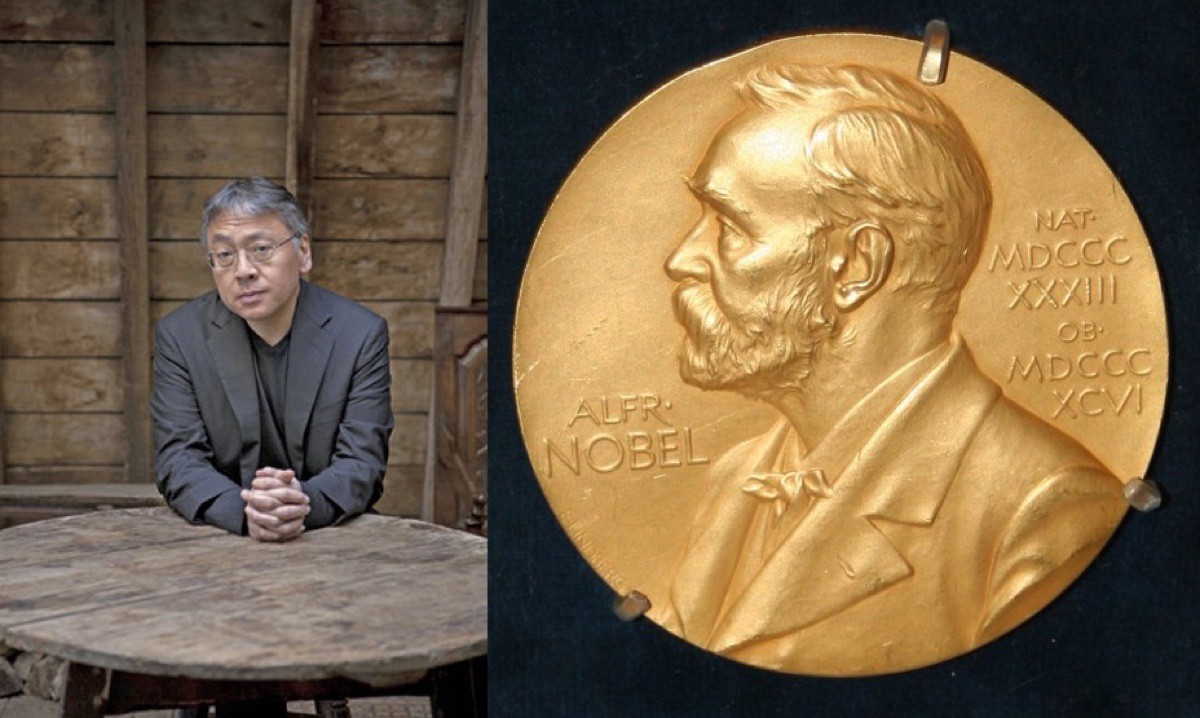
But if the Nobel Prize in Literature were a TV show, this year would be the season everyone assures you is worth sitting through last year to get to. Kazuo Ishiguro, the British novelist who won the Booker Prize in 1989 for his The Remains of the Day, isn’t exactly a surprising choice—by which I mean Americans have heard of him, and his work has even been made into a movie. Two movies! But it’s also just surprising enough. Ishiguro didn’t appear on the list of top betting odds; favorites included Kenyan novelist Ngugi Wa Thiong’o and Canadian national treasure Margaret Atwood. But he’s an undisputed master of the craft of fiction, a luminous writer praised by the committee for his “carefully restrained mode of expression” and “great emotional force.”
That tension—between restrained expression and great emotional force roiling beneath the surface—is especially characteristic of The Remains of the Day, Ishiguro’s best-known novel. The novel’s narrator and sole voice is an aging butler, so the restraint of the prose is also a form of character development; the experience of reading the novel is one of working down inch by inch through that reserve to touch the torrent of feeling it’s holding back. But the same tension appears in Never Let Me Go, in which a secluded and heavily supervised English boarding school turns out to have a dark secret, and An Artist of the Floating World, which like Remains of the Day is told through the reminiscences of a single flawed narrator considering—and concealing, and revealing—the worth of his life.
“I quite like language that suppresses meaning rather than language that goes groping after something that’s slightly beyond the words,” Ishiguro said in a 2015 interview with Electric Literature. “I’m interested in speech that kind of conceals and covers up. I’m not necessarily saying that’s Japanese. But I suppose it goes with a certain kind Japanese aesthetic; a minimalism and simplicity of design that occurs over and over again in Japanese things, you know. I do like a flat, plain surface where the meaning is subtly pushed between the lines rather than overtly expressed. But I don’t know if that’s Japanese, or if that’s just me.” Whether or not it’s Japanese in origin, the Nobel committee agrees that it’s global in impact. Maintaining the delicate balance between careful prose and emotional heft is a deft trick, and Ishiguro deserves to be recognized.
Plus, we’re all extremely relieved it wasn’t Bruce Springsteen.
Novel Gazing is Electric Literature’s personal essay series about the way reading shapes our lives. This time, we asked: What’s a book you read in secret?
I got my first paycheck in April of 1999. I was 15 years old. I decided I would buy a book.
My sister drove me to the local mall, and I walked into Waldenbooks and scanned the shelves. This was an auspicious occasion: the first earnings of my life. I believed in signs and wonders and wanted to make my own, so I needed to choose wisely. I wanted to possess a book that would define me. I wanted a manifesto. I wished to become a real person by way of something bold and mean and poetic.
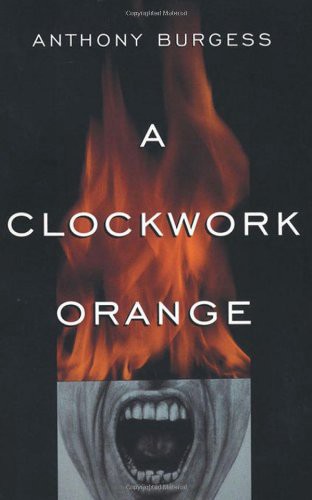
I did not have to search long. The book’s appearance on the shelf was almost audible, as if it were emitting a faint, hellish siren. On the cover were flames and a screaming mouth. The mouth’s teeth were crowded and stained. A Clockwork Orangeby Anthony Burgess.
I must have known I would not be allowed to keep it. I must have known. But I still bought the book, such was my desire to own it. I wanted to own this book and I wanted it to own me. The title was sinister yet playful, wholly mysterious. The cover promised great suffering, great truth.
I broke into a sweat as I paid for it. I was ready.
When I was born it was clear I would not amount to much in the physical fitness department. I was born with an orthopedic condition that was never definitively diagnosed but resembled osteogenesis imperfecta. My femurs were bowed and required surgical correction with plates and screws. My bones could break with the slightest pressure, and they did. I spent a lot of my early childhood in body casts and wheelchairs. So I knew early on that I would never be able to join the Marines like my dad, or play sports, or ride a bike, or even take gym class like other children.
My family and my church told me it was God’s plan that I was born different. I was weak in body but could be strong in spirit. I could be a shining example of godliness in a world that is sometimes cruel.
Instead, I chose to read. In elementary and middle school I often spent time separate from my peers because of medical issues, and I filled that time with books. Throughout my life, in sickness and in health, holing up somewhere private and reading a book has been my human equivalent of a dog dragging itself under the porch at its final hour, a self-comforting instinct.
My family and my church told me it was God’s plan that I was born different. I was weak in body but could be strong in spirit.
High school was better, but by then I had developed scoliosis. For two years I wore a Milwaukee back brace, which was humiliating in its own special way that I tried to ignore. I attempted, and failed, to ignore a lot of things. My parents were zealously protective of me. Their concern was partly due to my medical history, but much of it was a result of the conservative Christian values they followed. Television, music, and clothing choices were strictly monitored. No “weirdo” friends were allowed, though the definition of “weirdo” remained elastic and nebulous. My father was a history teacher at the rural public high school I attended, and he was renown for his disciplinarian ways. The student body totaled less than 400 at the time. I felt watched and I watched. I was a paranoid alien.
The first book I remember reading as a child is a floppy-cover Winnie the Pooh book, but the book that permeated my subconscious before that was the Bible. The Bible is probably to blame for my literary inclinations, what with phrases like,“For now we see through a glass, darkly,” and, “We shall not all sleep, but we shall all be changed, In a moment, in the twinkling of an eye…” But as a teenager, around the time I started my first job, I began questioning my religious upbringing. God’s marvelous plans seemed more and more suspect to me. I had learned zero lessons from my physical crucible. I was no more enlightened than anyone else.
Above all, I wanted to be normal, meaning cool, or eligible for coolness. But this was not to be. I had an acute awareness of my situation. I knew that my peers regarded me as somewhat pathetic. Most of my classmates had known me since kindergarten. Reinventing myself as a forceful character was impossible when everyone saw me as the runty kid bearing up valiantly under her special burden. No matter how smart or how snarky I became, to my high school peers I would always be Tiny Tim with his little crutch and Positive Mental Attitude. The thought horrified me.
No matter how smart or how snarky I became, to my high school peers I would always be Tiny Tim with his little crutch and Positive Mental Attitude.
So around this age of 15, I decided that if I could not be normal I would be grossly, misguidedly abnormal. And if I could not be abnormal in outward expression, such as in my clothing choices or friendships or speech, I would be privately, spiritually abnormal. Like my hidden bones, I would be invisibly vicious.
Books, I knew, would deliver me to this new state of being. They taught me about the world when the world was unavailable to me. I wanted to read something ugly, detestable. My own revulsion beckoned. I wanted to take a bath in the nastiness of humankind. I couldn’t help myself. It is hard to help the pull toward depravity once you’ve been immersed in the Bible. All that blood and glory. All that revenge and love and death.
When my sister and I arrived home from the bookstore my parents called a greeting to us from the living room. As I walked past, one of my parents saw that I held a shopping bag. They asked me what I bought.
I took the book out of the bag. My mother or father, I can’t remember which, lifted it from my hands.
I don’t know if my dad ever watched Stanley Kubrick’s A Clockwork Orange, but he apparently knew enough about it to know it contained rape scenes and murder. He and my mother were aghast. They were appalled by the book’s subject matter, of course, but more appalled that I had chosen it. That their daughter was interested in a book like this.
And this, dear reader, told me I had chosen correctly.
I was taken back to Waldenbooks, where I returned the novel. I did not get the chance to open it.
That experience confirmed some things. Firstly, that adults were easily alarmed. Secondly, that the written word was powerful.
That experience confirmed some things. Firstly, that adults were easily alarmed. Secondly, that the written word was powerful. I had always suspected as much, but to see up close what a guttural reaction a book — a book! an inert, inanimate object! — could get was exciting. Art was dangerous. It had the power to permanently taint you, to muddy up the mind. As I said, I was ready.
Thirdly, I learned that my strategy must be one of patience. I loved my parents and did not want to hurt them, a minor roadblock to my spiritual rebellion. I would bide my time. My lurking curiosity would be waiting.
I have been lucky. Except for the brittle teeth that followed me into adulthood, most of my physical ailments are over with for now. I can walk without aid or pain, and other than being short I think I look fairly regular. My strange skeleton has offered me a multi-year reprieve from pain and grief, though I know it can’t last.
I still hanker after transgressive literature. I still search out books that I hope will explain things to me: illness, death, suffering, unkindness. I like stories that are unafraid of these mysteries, and are unafraid of being mysterious.
But for all my teenage aberrant aspirations, I have led a boring life. I stayed in the local area. I got married. I used to be a librarian, for God’s sake. I was boring. I am boring. My outward expression remains benign. I can’t help but be a little disappointed by this fact. I was really counting on my malignant spirit to take me places. People are led to believe, even those who live with illness, that being born with medical issues makes one special or superlative in some way. It does not. Everyone is equally entitled to be an unremarkable human.
Everyone is equally entitled to be an unremarkable human.
Still, I have never shaken the feeling of otherness. No matter where I go, no matter what environment into which I assimilate myself, I remain a paranoid alien. Reading and writing continues to be an escape, a place where I may transcend this infinitely banal and infinitely wonderful life. And I continue to hoard words of all kinds, including my own. When I received my first acceptance for publication, I told no one for a few years. I eventually mentioned it to my husband. He reacted with pleasure and pride, and the moment was lovely.
After a few days, though, I was sorry I told him. That secret had been lending me power.
Two years passed. I was a senior in high school. At a used book sale I happened to find a paperback copy of A Clockwork Orange.. The pages were coarse and smelled of rancid peanut butter.
I bought it for $2, no receipt. I vowed to be smarter this time. I kept it in my locker at school during the week. When I brought it home over weekends, I stuffed it under my mattress between furtive readings.
The book did not disappoint. Alex, a kid who seemed very adult to me — it was hard to believe that any fictional teenager was ever my age — brutalizes people with his friends and is then incarcerated. Once the predator, Alex becomes the victim of political machinations, including “reconditioning,” or government-sanctioned torture. After many twists and turns, this conditioning is eventually reversed and, in return for the favor, he publicly endorses the government administration.
In this edition of the book, Alex, both the manipulator and manipulated, remains a bastard. He was an unabashed bastard all along. But so was everyone else.
When I finished the novel, I was mystified: whyhad my parents considered this book so dangerous? I understood it had rape and violence and murder in it. But it was fiction. And even as some wicked layer of me championed Alex’s perverse appreciation of art and independence, I knew the crimes he committed were heinous acts, just as I knew the torture the government inflicted upon him was a heinous act. I had sympathy for his victims. I judged him even as I rooted for him. The book talked to me and I talked back at it. I gloried in some parts and recoiled from other parts. I questioned my own reactions. In other words, I experienced A Book.
When we read we consult ourselves: What is the meaning of anything? Do we think what we think we think? Do we like what we think? Should we change what we think?
Years later I would reread the novel with the missing final chapter. The copy of A Clockwork Orange that I’d picked up at the library sale, it turned out, was the U.S. edition, meaning the final chapter of the novel featuring Alex’s reformation and social assimilation had been excised. I also read Burgess’s introduction, “A Clockwork Orange Resucked,” where he vents his spleen. He hated his own book and the popular attention it received. He loathed Kubrick’s adaptation. In a separate interview he confessed that he wrote the novel in three weeks to make a deadline. All of this behind-the-curtain pettiness makes the book seem even less dangerous now.
But I’d like to think that my first reading of A Clockwork Orange answered my original question of what makes a book dangerous. When we read we consult ourselves: What is the meaning of anything? Do we think what we think we think? Do we like what we think? Should we change what we think? The reader’s brain is led through a guided dream. I think of the Bible, perhaps the most dangerous book of all. How many people have challenged themselves against that text, lost themselves in that dream? Any other book before or since it seems laughably safe in comparison.
In the end, I donated my $2 copy of A Clockwork Orange to a library book sale a few months after I finished it. I probably could have kept it without a fuss. To my slow-motion surprise, I was discovering that my parents were human. Over the preceding two years they had become more flexible, less restrictive. The change was gradual. But they tried, and I could see them trying.
I gave the book away, anyway. I had possessed the book, and it had possessed me. I figured that my curiosity, a burning sickness that has never left me, had been cured.
The English restoration playwright William Congreve has the curious distinction of having written two famous lines, one of which is widely misattributed to Shakespeare and usually paraphrased, “Hell hath no fury like a woman scorned,” and the other most often misquoted as “Music hath charms to soothe the savage beast.” Both lines are from Congreve’s 1697 play, The Mourning Bride, and the bit about music actually reads: “Music hath charms to soothe a savage breast, To soften Rocks, or bend a knotted Oak.” While the more renowned William hardly needs two more quotable sayings added to his vast catalogue, music did often enter into his plays — its power to soothe (be it a troubled breast or beast) but also to bring about grief. In the opening of Act IV of Measure for Measure, which begins with a song, the Duke assures Mariana that “music oft hath such a charm / To make bad good, and good provoke to harm.”
The capacity for music to provoke harm and drive people mad goes back even earlier in Western literature, when Ulysses is advised by the goddess Circe, in Book 12 of Homer’s The Odyssey, about the Sirens. Sailing by the island of the Sirens, she warns, without being tied to the mast or having one’s ears plugged by wax, will guarantee that no man will ever see home, wife, or children again. “The high, thrilling song of the Sirens will transfix him, / lolling there in their meadow, round them heaps of corpses, / rotting away, rags of skin shriveling on their bones.” One wonders, just what were they singing?
In my novel, The Prague Sonata, music takes center stage as a young musicologist sets out on a quest to locate the missing parts of an eighteenth-century piano sonata manuscript and attempt to identify its composer. For all its sublime joys in the novel, music is also locked in a timeless dance with war and death. Any number of the composers and musicians who are conjured in the book — from Beethoven to Jimi Hendrix to “mad as a March hare” Schumann — paid dearly for their devotion to the musical Muses. And while thinking back over some of my favorite books in which music plays a central role I was struck by how many, whether fiction or not, leaned less toward the soothing than the dark side of music and musicians.
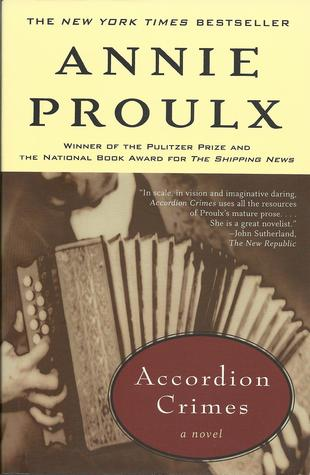
1. Annie Proulx, Accordion Crimes
The green accordion in this sweeping hundred-year narrative provides both the music and the metaphor centering Proulx’s epic of immigrant, often malignant, America. Characters with names like Przybysz and Salazar, Baby and Malefoot, are all at one point or another the owners of the accordion, originally transported in the late nineteenth century by its anonymous maker from Sicily to New Orleans, where he is murdered by an anti-Italian mob. A dizzying, bloody odyssey follows from Mississippi to Montana to Maine and beyond, in which those who own the accordion often encounter racism, hatred, mindless violence, and every so often a ray of gladness brought about by the increasingly dilapidated accordion (which meets its own sad fate in Florida in the book’s final pages). Just as migrants bring with them the richly specific melodies of their homelands, they inevitably, per Proulx’s unflinchingly dark vision of America, encounter those who would deny them their songs, their voices, often their very lives. All brought to life — and death — with the author’s own musically prodigal language.
2. Michael Ondaatje, Coming Through Slaughter
Employing his singular gifts as both a poet and fiction writer, Ondaatje offers a deeply moving, uniquely hybrid collage-style portrait of Buddy Bolden, sometime New Orleans barber at Joseph’s Shaving Parlor and first of the greatest jazz trumpet players, whose sui generis approach to the instrument influenced the likes of Louis Armstrong and King Oliver. In lyrical prose punctuated with documentary facts, Ondaatje evokes the sad life of a gifted, doomed man. Alcoholic, haunted, prone to disappearing, ultimately mad, Bolden was also an incandescent and legendary musician who preferred playing in the key of B-flat and died on November 4, 1931, in the East Louisiana State Hospital. There is only one surviving photograph of him with his jazz band, and there are no known recordings. While Bolden’s breakdown and institutionalization in 1907 may not be directly attributable to his bond with music — in fact, his trumpet probably saved him from himself for a time — it is interesting that during his many years in “the bug house” he stopped speaking and never played another riff, not even a note, on his trumpet.
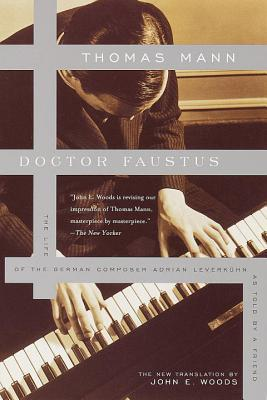
3. Thomas Mann, Doctor Faustus, The Life of the German Composer Adrian Leverkühn as Told by a Friend
Mann’s postwar masterpiece is one of those necessary epics, like The Magic Mountain, that must be read slowly, savored empathically, in order to fully experience the tragedy of Leverkühn’s syphilitic descent into madness and invalidism that is directly compensated by his exceptional ability to compose transcendent music. After contracting the disease from a prostitute during his only sexual encounter — his symbolic selling of body and soul — Leverkühn grows more ill while at the same time his music is increasing touched by genius. Mann doesn’t shy away from symbolic references to the Faustian deal many Germans made during the rise of the Third Reich, collectively trading their ethics to embrace the deadly extremist nationalism of Nazism. Just as in the original Faustian tale, deals cut with the devil inevitably come to bad ends. While his prose style may be a bit traditionally rigorous for some, the reward is that few other novelists command a greater knowledge of classical music than Thomas Mann.
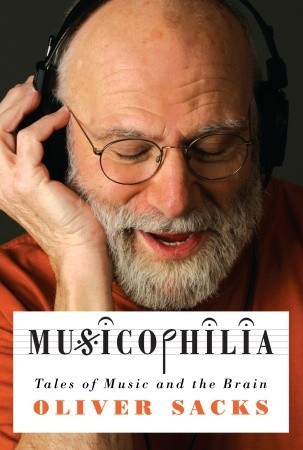
4. Oliver Sacks, Musicophilia: Tales of Music and the Brain
When the late, very great Oliver Sacks weighed in with one of his psycho-neurological collections of case studies centered on music a decade ago, I couldn’t put my hands on a copy fast enough. Like legions of others, I was fascinated by books like The Man Who Mistook His Wife for a Hat, An Anthropologist on Mars, and Awakenings, and now he’d written about a subject dear to my heart. Nor did he disappoint. Here was Silvia N., who suffered from musicogenic epilepsy, a syndrome in which music — in her case the Neapolitan songs from her childhood — provoked seizures cured by a partial temporal lobectomy. Here was Sydney A., a man with Tourette’s Syndrome who “lurched, jerked, lunged, yelped, made faces, and gesticulated exuberantly” upon hearing music on the radio. Here, too, were stories of Martin, whose childhood meningitis contributed to severe physical and mental disabilities, but also contributed to his becoming a musical savant who knew over two thousand operas (who’d have guessed there were so many in the first place?) as well as Bach’s cantatas. If you suffer from earworms — as I do, with sometimes near-pathological severity (I cannot listen to Rufus Wainwright, alas, without it sticking in my head for weeks) — Sacks has a chapter on that as well.
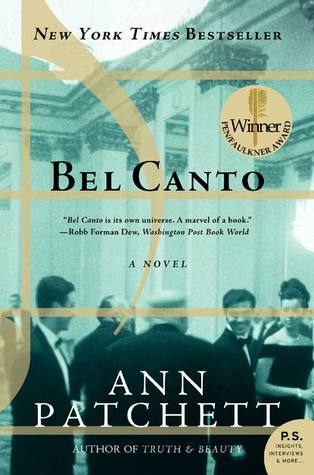
5. Ann Patchett, Bel Canto
The perils of being a famous musician are as inherent as they are various. While fans provide the means for a star-dusted performer to thrive, they also have the capacity, whether purposely or inadvertently, to put their idol in harm’s way. Patchett’s lyric soprano opera star, Roxane Coss, has doubts about accepting the invitation to perform at the birthday party of mega-rich electronics mogul Katsumi Hosokawa in an unnamed Latin American country that’s courting his investment, but the payday is irresistible. As her last aria rises to its conclusion, the lights in the vice-president’s palace abruptly go dark as Coss, Hosokawa, and the rest of the black-tie attendees find themselves swarmed by terrorists. The siege that ensues becomes a palpable opera itself — operas, including soaps, are woven throughout — as it stretches from days to months, enveloping its sizeable cast of captors and captives. Unexpected liaisons develop. Hidden talents are discovered. Violence is never far away (the author gives a particularly unflinching account of Coss’s diabetic accompanist’s death as his insulin runs out). When the siege does inevitably end, ensuing elements of romantic fantasy may dismay some readers, while enchanting others, but the hard edge of Patchett’s detailed portrayals preserve the darkness inherent in this music-saturated novel.
6. Robert Coover, “The Return of the Dark Children” (A Child Again)
Only Angela Carter rivals Robert Coover when it comes to rethinking, reviving, and retelling classic fables and fairy tales. With this adaptation of “The Pied Piper of Hamelin,” Coover takes an already grim cautionary tale and moves it to the gloomiest possible registers. The story begins, long after the piper has seduced all of Hamelin’s children away playing his “demonic flute,” with the reappearance of black rats “scurrying shadowily along the river’s edge and through the back alleyways.” The shortsighted, greedy townsfolk, who failed to pay their musically bewitching exterminator, now face a fresh ethical dilemma as a new generation of Hamelin kids are endangered once again. Hysteria grips the village, imaginations run amok. And a déjà vu choice must be made anew “between letting the children go, or living — and dying — with the rats.” Needless to say, as is too often the case with village elders, they opt for the inevitably expedient course of action. Sorry, children of Hamelin. And as for the future, the playing of music will be frowned upon and dancing discouraged. As if all the woes of the world were a piper’s fault.
Both jazz legend Miles’s autobiography and poet Quincy Troupe’s memoir, Miles and Me, which offers a disarmingly candid account of their Sturm und Drang relationship, unveil the demons, the mind-blowing contradictory behaviors, the self-confidence and self-hatred, and the very hard-earned genius of one of the greatest musicians of all time, jazz or otherwise. Bitches Brew wasn’t plucked out of thin air. None of Miles’s revolutionary work over the course of decades from the bebop-cool jazz of Kind of Blue to the fusion of Tutu came without profound personal costs. Miles’ drug and alcohol addictions, his distress over the blackness of his skin, his raging diabetes, his volcanic temper, his loneliness behind those wraparound shades — these are only a few of the monsters Miles battled, emerging triumphant on most counts while reinventing, over and over again, that singularly American kind of music: jazz. The biopic film treatment of Miles and Me, by the way, will reportedly be going into production in early 2018 with Michael K. Williams as Miles. I’m so there for that.
9. Lauren Belfer, And After the Fire
In The Prague Sonata, my protagonist recalls her mentor sternly lecturing, “More often than not, music means music. It’s not a poem about a tree. It’s not an essay about nematodes. It often stands for nothing greater or lesser than itself.” Whether one agrees with him or not, sometimes music can be a medium for communicating a message, and there is no guarantee that the message will be benign. In Lauren Belfer’s richly detailed novel, And After the Fire, a lost Bach cantata turns out to have been deliberately kept hidden for centuries after Bach’s eldest son, Wilhelm Friedemann, entrusts the manuscript to his talented piano student, the Jewish socialite Sara Itzig Levy. Shocked by its virulently anti-Semitic message, Sara hides the score and it remains hidden by generations of her family until, by chance, it is rediscovered in the present day. If Martin Luther was the father of the denomination to which Bach belonged — “be on guard against Jews,” Luther wrote in his essay “On Jews and their Lies” — Richard Wagner, one of Adolf’s favored German sons, took up the wicked cause. A bright book about dark hatreds.
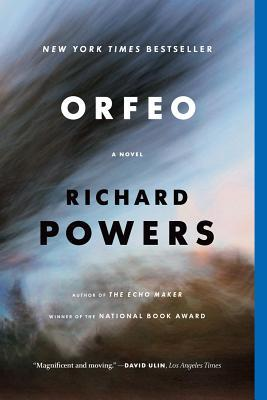
10. Richard Powers, Orfeo
Pity Peter Els. All this aging American composer of obscure avant-garde music ever wanted was to “break free of time and hear the future.” And if his innovative path to achieve this goal was to inscribe musical compositions in bacterial DNA at his homemade microbiology lab — where he uses, among other things, a salad spinner for a centrifuge and a rice cooker to distill water — then who would stand in his way? Well, for openers, two Homeland Security goons who show up at his door, looking like “counterfeit Jehovah’s Witnesses,” and begin questioning him, confiscating his equipment, and telling him not to go anywhere. The next day, as government investigators accompanied by a throng of media descend upon his abruptly quarantined house, Els decides to flee. Only a writer with Richard Powers’s rare imagination and technical dexterity could pull off the mad odyssey that follows. Dubbed the “Bioterrorist Bach,” Els unexpectedly finds himself an Internet sensation as he sets out on what is to be his final bit of performance art. When readers turn the last pages of Orfeo, they are fully aware that the Kafkaesque forces closing in on Els will not be deterred. It’s a good moment to remember that Olivier Messiaen’s Quartet for the End of Time was always one of Els’s favorite compositions but that he, unlike Messiaen, will not elude his personal apocalypse.
About the Author
Bradford Morrow is the author of eight novels, including Trinity Fields, The Diviner’s Tale, The Forgers, and now, The Prague Sonata. He is also the author of The Uninnocent, a short story collection. He is the editor of Conjunctions, which he founded in 1981. Morrow has received numerous awards and honors, including a Guggenheim Fellowship, O. Henry and Pushcart prizes, an Academy Award in Literature from the American Academy of Arts and Letters, and the PEN/Nora Magid Award for excellence in editing a literary journal. A Bard Center Fellow and professor of literature at Bard College, he lives in New York City. www.BradfordMorrow.com
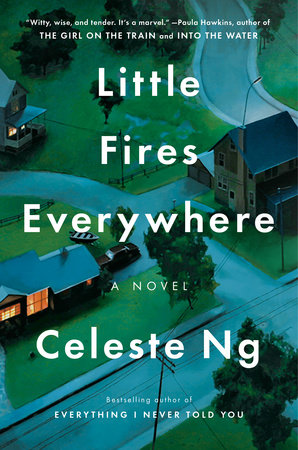
Like her best-selling 2014 debut, Everything I Never Told You, Celeste Ng’s new novel Little Fires Everywhere looks at communities and their complex, often fraught, relationship to identity. Ng focuses her thoughtful gaze on the kind of successful and self-satisfied hamlet found across suburban America — the type of place where fitting in requires not only the possession of certain attributes but the absence of others.
The community in Little Fires Everywhere is Shaker Heights, a real Ohio town (just ask Ng, who grew up there), created in 1914 by two railroad mogul brothers who envisioned a perfectly planned alternative to Cleveland’s city living. Rules abound, from town ordinances regarding the layout of the beautifully manicured cul-de-sacs to the unspoken decorums practiced by the idealistically progressive yet practically traditional society.
Into this landscape come Mia Warren, a photographer and free-spirit, and her bookish daughter Pearl. Mia has decided to pause their long-standing peripatetic lifestyle. They become tenants of the Richardsons, a wealthy, well-respected family that’s powered by the matriarch, Elena, a woman who seems to embody Shaker Heights itself. Though the four Richardson kidsare entranced by Mia and Pearl, Elena finds herself at increasing odds with her tenants. When a local white family gets into a contested adoption and custody battle over an abandoned Chinese American baby girl, lines are drawn in the sand.
Little Fires Everywhere feels especially resonant today, as much of our country struggles with the reality of living in ever-less homogenous environments. But what elevates the novel beyond timeliness is that Ng doesn’t stick to examining the obvious opponents to change. She asks hard questions of people who believe themselves to be progressive and pro-diversity yet show a caustic reticence to individuality and even an unacknowledged racism when they’re asked to open their arms or adjust their lives.
I had the pleasure of talking with Ng over email about writing the novel before Trump, the challenges of writing about your home town, and the things she loves about Twitter.
Carrie Mullins: Tell me about Shaker Heights. In the book, the town is a bit like Pleasantville, and I felt a lingering claustrophobia as we moved among the lovely, landscaped houses. Why did you decide to set the novel there?
Celeste Ng: The novel grew out of my desire to write about my hometown — so it couldn’t ever have been set anywhere else. I had been away from home for about a decade at that point, and I was at the stage where I started to look back on those formative hometown years with some clarity. I still remembered them clearly, but I had also come to see that many of the things I’d grown up with were unusual.
I touch on some of these things (which are at both ends of the keyboard, so to speak) in the novel itself: the obsession with order in the community, the fact that we were so focused on improving race relations that there’s a race relations group at the high school. But those are all really manifestations of a larger issue that is really what sets Shaker Heights apart, and which to me is the heart of the novel: the tension between the almost hippie-ish idealism and the almost anal fixation on regulating everything. It stretches back past the founding of the town to the Shakers who once owned the land — it’s practically in the soil.
CM: Are there challenges to writing about a place that you know so intimately?
CN: In writing about a real place, I felt a responsibility to try to be both accurate and fair. This is especially true because Shaker Heights is a place that I love even as I have reservations, and criticisms, of some aspects of it. I hope I wrote this book at the sweet spot where I could be truthful — like one of those magic eye pictures where you have to be at the exact right distance to see the image.
I hope I wrote this book at the sweet spot where I could be truthful — like one of those magic eye pictures where you have to be at the exact right distance to see the image.
CM: The novel — though not necessarily all the characters within it — is very cognizant of how money and status affects people’s attitudes towards race and identity. For example, Bebe, an impoverished immigrant, is treated very differently than Brian, the son of two professionals. With everything that’s going on with DACA and, well, our government at large, highlighting this intersection feels especially timely. Of course there’s a time lapse between writing a novel and it hitting the store shelves; has the current political environment changed how you think or talk about the book, or how you think it will be received?
CN: It’s absolutely changed how I see the book and how I suspect it will be received. I wrote it at a very different political time — about from fall 2015 to midsummer 2016 — and I had been thinking about it and the plot and the characters since 2009. So it wasn’t written with our current times in mind, but now, in the Trump era, I can’t help but see it in conversation with what’s happening in our country now.
I guess this says two things: first, that the meaning we see in a book is always influenced by where we, as readers, are at the moment we read it. When I reread books I loved as a teenager, for example, I interpret them very differently now that I’m an adult. But the words on the page haven’t changed — so the change has to be in me. The second thing is this: the book takes place in 1997, and the fact that it feels so relevant to our current time suggests we haven’t come quite as far in the past 20 years as we’d like to think.
CM: Speaking of current events, I’m one of the many fans of your Twitter account. I think I came on board for #smallacts and stayed for the mix of humor and candor that has gained you over 29,000 followers. As someone who is hopelessly inept at the posting side of Twitter (I’m basically a lurker) all I can ask is, 29k!? Is having that kind of presence exhilarating or anxiety-provoking? Does being so visible to your audience have any effect on your fiction writing?
CN: I love that you say you came on board for #smallacts — I’ve had followers say to me in the past few months, “I didn’t know you wrote a book, I thought you were just funny on Twitter!” Honestly, I don’t know how I ended up with so many followers, but I’m happy they’re here and hope they get something out of the randomness that is my Twitter feed.
Even now I don’t think I’ve quite gotten my head around the audience that I have there; it still amazes me that anybody wants to hear what I have to say. I try to think of it as thousands of people standing in my corner cheering me on. And I like to listen as much as I can there myself — my favorite things are when people share things they love (articles, pictures, pets) and when they tell stories about themselves or others. When I see what other people are talking and thinking about, I feel like my brain’s been enriched, like mixing compost into soil. At its best, Twitter reminds me how smart and funny and interesting and witty and weird and kind people can be — basically, that we’re all human and that humans are both loveable and fallible. I think that feeds my fiction as well.
CM: Both this and your first novel, Everything I Never Told You, are books that play with perspective. What interests you about coming at one event from multiple points of view?
CN: I didn’t plan for that to happen, but it’s true! I’ve always been interested in how we piece stories together, how we make sense out of the jumble of events that make up life. So an omniscient narrator is a natural move: the narrator is piecing things together just as the reader does, helping the reader make connections and hear resonances. I’m also fascinated by the hard fact that we can never perfectly communicate what we mean: we do our best with words and pictures and gestures, but there’s no direct way to take your thoughts or feelings or experiences and put them in someone else’s brain. There’s always going to be something lost in transmission. Which means to have any hope of seeing the full picture, we need to hear multiple perspectives.
There’s always going to be something lost in transmission. Which means to have any hope of seeing the full picture, we need to hear multiple perspectives.
CM: It’s the contested adoption of May Ling/Mirabelle that brings the characters’ individual perspectives together. The question of identity is an issue for any adoptee, but it’s magnified in a transracial adoption. What led you to choose and investigate this situation for a novel?
CN: I’d remembered hearing about a transracial adoption case when I was in high school that divided the Asian community, but wasn’t able to find out anything more about it. As soon as I remembered it, though, the basic questions it raised seemed to tie all the threads of the novel together: race, class, parenting, identity. Then, as I began to research high-profile custody battles, the story came more and more into focus, and I realized it belonged in the book.
CM: The ironic thing about this terrible situation — a baby is abandoned, then fought over in court — is that there is still so much love flying off the pages. It got me thinking about the challenges of capturing motherhood; how do you show how intense it can be, and how complicated, for a varied audience? Stories about motherhood are also often dismissed as ‘female’ narratives or even ‘chick lit.’ Do you ever worry about those labels or having to prove that the mother/child relationship is worthy of literature?
CN: It infuriates me that stories about motherhood — and women in general — are so often and so easily dismissed. They are so obviously worthy of literature that I don’t even know how to begin arguing this point.
It infuriates me that stories about motherhood — and women in general — are so often and so easily dismissed.
It wasn’t my specific intent to challenge that view, but I hope I wrote a book that acts as a counterpoint. But while we have to stay aware of — and vocal about — this issue, it’s ultimately an attempt to distract us from the work. I think of the Toni Morrison quote where she says that all of racism is an attempt to keep you from doing your work. Here it is, because it’s worth sharing in full: “The function, the very serious function of racism is distraction. It keeps you from doing your work. It keeps you explaining, over and over again, your reason for being. Somebody says you have no language and you spend twenty years proving that you do. Somebody says your head isn’t shaped properly so you have scientists working on the fact that it is. Somebody says you have no art, so you dredge that up. Somebody says you have no kingdoms, so you dredge that up. None of this is necessary. There will always be one more thing.”
The best thing we can do to change things, aside from pointing out the double standard wherever we see it, is to make good work about motherhood, work that’s so indisputably good that its value as literature is self-evident and undeniable. And I think people are doing that, so I hope this attitude is changing.
Danny Strong’s Rebel in the Rye opens with a shot of the trembling hands of J.D. Salinger as he tries to jot down something — anything — on the page. But, as we learn soon enough, the young writer is haunted by the trauma of having been deployed in World War II. His experiences abroad and at the camps have left him unable to revisit the character that he’d carried with him across the pond and back: Holden Caulfield.
By the time the movie ends, we’re offered a much more hopeful image: Salinger, decked out in his signature blue boilersuit, is typing furiously away, filling up page upon page with an ease that’s near-intoxicating. The fears (of failure, of being ignored, of being misunderstood, or worse yet, feverishly loved) have given way to a renewed sense of accomplishment. But it’s a sense of accomplishment that’s decidedly not tied to the promise of being published. Those pages will never be read, alas, by the public at large. At the heart of both images — a writer whose words have failed him, and a writer whose words overwhelm his every waking hour — is the romanticized ideal of the writer as a solitary figure, either fighting with or conversing with his muse. For many of us, this has been the quintessential image of our writer heroes — and one Salinger himself fully gravitated towards and endorsed. Despite some attempts to complicate the Great Man theory of writing, the film ultimately endorses the vision of Salinger as a solitary genius.
Based on Kenneth Slawenski’s biography of the reclusive author, the film tracks Salinger’s move away from the spotlight and away from the published page. And, as its initial images suggest, it puts front and center the fact that Catcher in the Rye was quite literally a post-war novel. Catcher’s battlefield birthplace was what originally drew Strong to the material. “When I got to the war [section in Slawenski’s book] — when I learned that Holden Caulfield was written by a veteran who had PTSD, it kind of blew my mind,” he said at a post-screening Q&A in New York City ahead of the film’s release “This idea that one of the most iconic novels of the twentieth century, that so many high school students read and it affects them profoundly decade after decade after decade, was written by someone who’d come out of one of the worst experiences of the 20th century — I thought, that was very beautiful, very profound.” In Strong’s film, Salinger’s experiences as a soldier mark the central narrative pivot of the writer’s life story. Rebel in the Rye tracks how the talented young Jerome David (played by Nicholas Hoult) went from being an obnoxious Columbia student with dreams of becoming a published author to a recluse who needs nothing more than his typewriter to feel fulfilled. With the war working as the catalyst for this transformation, Salinger’s near zen-like devotion to his writing emerges as palliative practice that helps him overcome his PTSD by urging him to look within, to anchor his process in and for himself.
Salinger has become a poster man (surely we couldn’t possibly refer to him as a “boy” in any sense) for the supposedly awe-inspiring writerly integrity he embodied until his death in 2010. Here was, after all, a writer who rebuked fame and found fulfillment in writing for himself. When a reporter at the Q&A asked Strong whether he could live like that, knowing anything he wrote would never be read by anyone else, he couldn’t help but rehash ready-made soundbites about what writers are supposed to cherish: the practice, never the result. A professional writer he said, isn’t a writer who gets paid for her work; “a professional writer is someone who writes every day whether you get paid or not.” Strong’s film is, he claims, an attempt to tell the story “of what it means to be a true artist,” someone willing to write and not make anything from it for the rest of their life. This is a particularly insidious vision of artistic creation — one that doesn’t question the privilege that Salinger and his Great Man narrative have come to represent. This facile view of art ultimately weakens the film, as it reduces it to little else than a portrait of an artist as a young (and independently wealthy) man.
Following its protagonist’s lead, Rebel in the Rye cannot help but embody not just Salinger’s increasingly individualist and self-absorbed notion of writing, but his overwhelmingly masculinist sensibility. While women in his life first encouraged his work (his mother, played here by Hope Davis, was an early supporter of her son’s sudden whim to become a writer), Salinger’s relationships with women as he grew older and more well-known are presented as mere stepping stones for his career. The heartbreak he feels when his youthful lover Oona O’Neill (yes, Eugene’s daughter, played by Zoey Deutch) marries Charlie Chaplin while he’s at war almost destroys him, but also helps fuel his ambition. Writing becomes a way to keep himself sane and plow through his sense of betrayal. Likewise, his first wife, a European woman who may or may not have been a Nazi (the film neither confirms nor denies the accusation, but does use it as a punchline to introduce the accented beauty), is a mere footnote to his return home. His second wife is supportive, if aloof, but is presented as a hassle once she asks him to do the absolute minimum when it comes to building their family together. All Salinger cares about is his writing (“I want my writing to be truthful,” he never tires of repeating to anyone who’ll listen) and he spends his years stripping away his life in order to accommodate an understanding of writerly devotion that required only him.
Rebel in the Rye cannot help but embody not just Salinger’s increasingly individualist and self-absorbed notion of writing, but his overwhelmingly masculinist sensibility.
A crucial part of that narrative arc was, implausibly enough, Salinger’s relationship with his Columbia professor and Story journal editor, Whit Burnett (Kevin Spacey). There is no way to tell the story of this Solitary Great Man, apparently, without giving due credit to one of the many men who gave him a leg up — even as the women who were just as crucial to Salinger’s success remain sidelined. Rebel in the Rye tracks Salinger and Burnett’s relationship from their playfully combative exchanges in the classroom and eventually through their personal and professional fallout, when Burnett disappoints the ambitious up-and-comer by failing to secure a publishing contract for what would end up becoming Salinger’s Nine Stories. Burnett is shown to be instrumental not only in championing Salinger’s earlier efforts, publishing his first story in Story, but in nurturing and improving the young writer’s work. He pushes Salinger to move away from letting his work be driven by his self-amused and cocky voice and find instead a way to let his wise-ass sensibility help tell a story. Driven by his desire to publish — anything, anywhere, but preferably in The New Yorker — Salinger learns to revise and edit his work; he buckles down and begins seeing the world around him (say, a scene at a bar where he feels out of place) in narrative rather than merely scenic terms; this is what yields the 21 year-old’s first published story, “The Young Folks.”
Burnett is also presented as the first to suggest that Holden Caulfield deserved a novel of his own. Catcher in the Rye, Strong’s film suggests, couldn’t have come together had Burnett not urged his young pupil to let go of his impatience when it came to writing, encouraging him to see his breakthrough novel as a marathon worth running — and a better use of his talent than the quick sprints he so enjoyed when writing short stories. Burnett’s encouragement is what led Salinger to take Holden with him when he crossed the Atlantic to fight in World War II, an experience that resulted in making the phony-hating protagonist a postwar cultural staple. Burnett sanded down the impetuousness that made young Salinger both an insufferable cad and the kind of wunderkind that lead people to dismiss his personal shortcomings as necessary elements of his genius.
If Burnett had not led the young writer to discover and embrace the beauty of editing and revision, the film suggests, we’d never have gotten as strong a version of Salinger’s work. It’s a lesson he only begrudgingly learned. When his agent, Dorothy Olding (Sarah Paulson) giddily tells him that The New Yorker is eager to publish a piece of his, she hesitates before adding, “they have some notes.” Salinger bristles at the thought, unable to see how someone else’s ideas could possibly enrich his own. It is only after he meets with the editors at their imposing Manhattan offices — and they promise him that he can pull the story if he thinks the changes ruin it — that he agrees to give it a shot. He is as surprised as anyone when he realizes that responding to feedback actually improves his writerly output.
Strong’s film truly comes alive in these scenes. Shots of Hoult, hunched over Salinger’s typewriter, feverishly cutting and marking his manuscript with a red pen are punctuated with Bear McCreary’s soaring score in the background. You can tell the actor/writer/director/producer (and co-creator of Fox’s Empire) cherishes that most sacred of writerly rituals: revision. By the time Salinger is done, he’s earned one of the most coveted publishing contracts in the United States — a first-look deal with The New Yorker — and, perhaps more importantly for a man obsessed with his own writerly identity, he’s produced a story he’s proud of. Sadly, anyone who knows Salinger’s story — the overnight success of Catcher; his increasing discomfort when meeting his super-fans; the decision to move away from the city, live in seclusion, and all but forsake his publishing career — this glorious celebration of the power of collaboration is short-lived. And though the revision scenes and the movie’s centering of Burnett display an interest in highlighting the collaborative nature of authorship, Rebel in the Rye is ultimately seduced by the idea that great writing is the product of a single lonely, brilliant mind.
Here lies a tortured genius finally left to his own devices and away from his biggest threats, his fans.
After all, the film must careen towards that final tableau where a now-at-peace (and divorced) Salinger can happily find serenity in writing. It is an insidious image on which to hang the Catcher in the Rye’s legacy, and yet one which feels unavoidable: here lies a tortured genius finally left to his own devices and away from his biggest threats, his fans.
In an early scene set in Burnett’s classroom, the affable teacher tells his students he’s leaving early that day, having been satisfied with the wisdom he’d imparted in the first few minutes of class. They can, he tells his students, do what they wish with their free time — like, say, writing, or masturbation. “Just be sure you know the difference,” he quips. Try as it might, the film’s final images, of a blissfully satisfied Salinger clanking away at his typewriter in his signature blue boilersuit in his secluded office, somehow do mistake the former for the latter — and all but endorses this hermetic vision of creation. This may look like writing, but it lacks a key aspect of that endeavor: the reader.
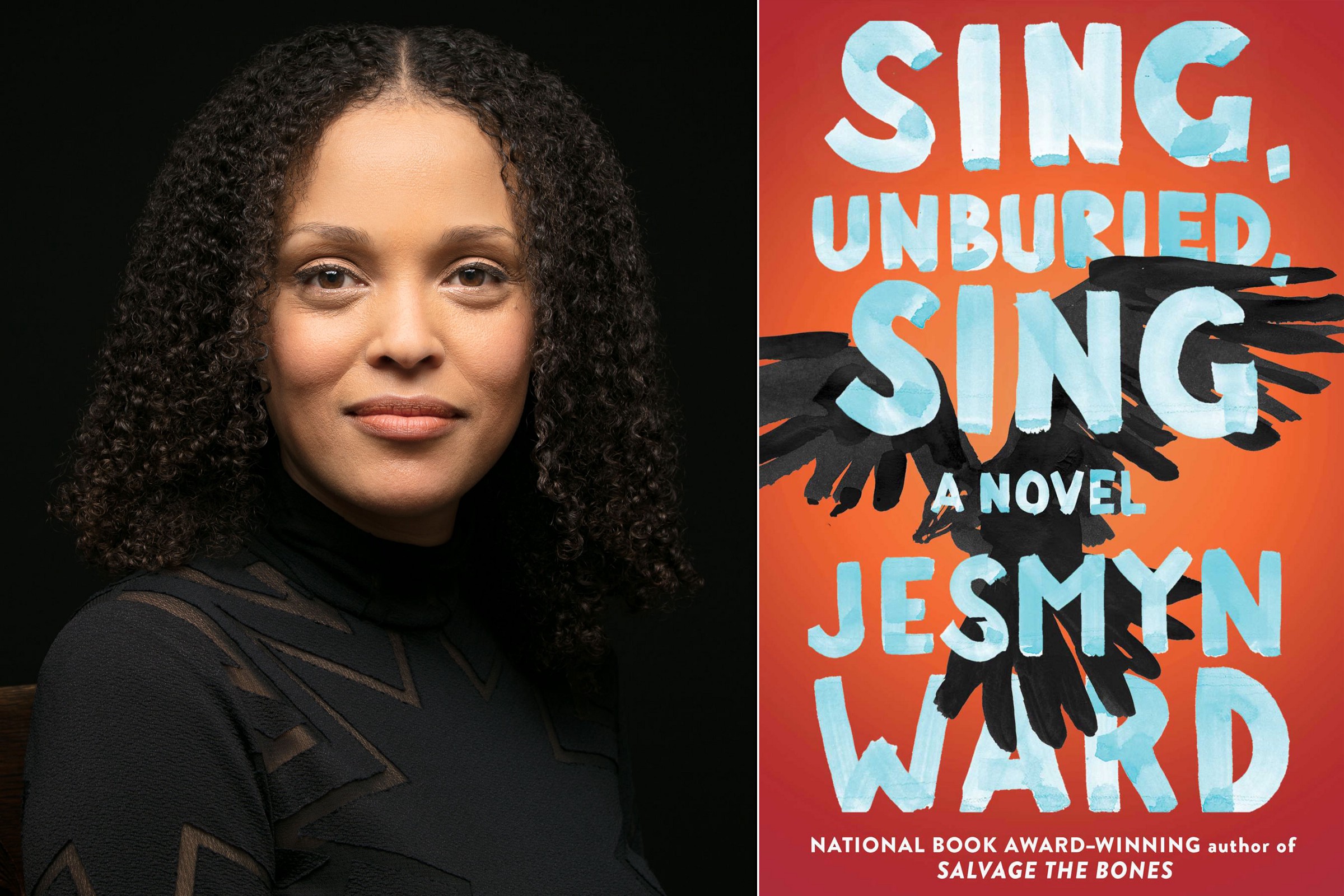
I t may be surprising to Jesmyn Ward that Sing, Unburied, Sing, her first novel since winning the National Book Award, is heralded as one of her most heart-rending and thought-provoking works to date. But to the fans who have been anticipating her next book, praise was to be expected. As with much of Ward’s work, the Black body features prominently in Sing, Unburied, Sing—in the relationships of parent and child, brother and sister, husband and wife, and, yes, the living and the dead. The themes Ward explores through characters and locale resonate so deeply that readers feel the thrum of loss, see the pathways to addiction, and understand how the past can haunt you despite your attempts at escape.
While on tour,Ward discussed her approach to the creative writing workshop, her thought process for creating characters that live on and off the page, and the work that went into her New York Times bestselling anthology The Fire This Time. Below is an excerpt of a longer interview with Jesmyn Ward. The full transcript and episode can be found on the Minorities in Publishing podcast site.
Jennifer Baker: Because your work is so lush and always invokes emotion, I wonder if you go over writing methods when it comes to helping your creative writing students find their process?
Jesmyn Ward: When I teach I attempt to expose them to as many contemporary writers as I can, because I think that often they come to me and they’re well versed in the classics but not really contemporary lit. So you know, I try to switch up my syllabus every semester and try to introduce them to new voices, so they can see what other writers who would be their contemporaries, what they’re writing, what they’re working on, what they’re thinking about. Of course my hope is that they read the work and then they find something in it that maybe that they like, that they find impressive, that maybe they want to emulate in their own work. One of the most important things that I teach them early on is that writing requires revision and that writing is a process. I teach undergrads and I think often undergrads don’t realize that. They think when you’re a writer, especially a creative writer, that you write something and it’s perfect and you hit send and it goes out to the world. They really don’t understand what a process it is and how there’s an entire group of people working together to revise your work, to refine your work, before it ever reaches an audience.
One of the most important things that I teach my students is that writing requires revision and that writing is a process.
JB: And do you ever broach the subject of the business or do you kind of concentrate on the craft itself?
JW: We mostly talk about craft in my courses, but I do always, on the last day of class or the next to last day of class, I just normally set that day aside for any questions that they might have about the business of being a writer and the business of publishing and then they can ask me anything. So we devote at least one class period to talking about the business of writing—talking about what it’s like to find an agent, what it’s like to work with an agent, what it’s like to work with a publishing company.
JB: I was thinking a lot about the discussion of motherhood you had with Lisa Lucas when you were at the Schomburg. And you have this juxtaposition in Sing, Unburied, Sing with Leonie as a very raw character. As a mother writing a character like Leonie and also writing Jojo and Pop and Mam, how do you converge upon getting them all on the page in such a way that you feel like you can step away and effectively say, “that’s what I was going for”? Or do you even recognize that’s what you were going for?
JW: I don’t know. I think that it is an organic process. I mean, I think that as I write, especially through the first draft, like the rough draft, that I’m discovering who the characters are, that they’re just taking on some kind of life on the page and off the page as I’m writing my way into the story.
Because the process of writing about them complicates them, and they do things that surprise me as a writer. So yes, I think that when I commit to writing a story, part of what I’m really focused on, part of what I’m committed to doing when I am interested in telling a story, is to bring all the characters to life in one respect or another and make them complicated and as human as I can on the page. And so they take on shape, but they continue to take on shape even after I’m done with the rough draft, so when I’m going back into a draft and then revising and revising, I’m still adding more dimensions. I’m still complicating them again and again and again, so it’s a continuous thing, right? It’s a continuous task to complicate my characters and to make them more human, more believable, more, more surprising, I think. Human beings are surprising in that you never fully know, you know? You never fully know a human being. So that’s why I think, for Sing, Unburied, Sing, that’s why I think that a 13-year-old boy, Jojo, that he can be learning how to be a man and that part of learning how to be a man is to suppress his emotions and stand up straight and to walk a certain way and to act a certain way in violent situations. But at the same time he can also care for his little sister and nurture his little sister and be very maternal in a lot of ways. And I think that that happened over multiple drafts of the work.
Part of what I’m committed to doing is to bring all the characters to life in one respect or another and make them complicated and as human as I can on the page.
JB: Is there an awareness of what is “expected” or the stereotypes or these assumptions made, especially about Black life, in your mind when you’re writing? Or are you able to block that out? Because I find that I’m often thinking about how not to do things, and that can actually inhibit the process.
JW: That’s an interesting question. I don’t think about what not to do. I really focus on the situation that the characters find themselves in, and I focus on the place where they’re from, and I take all of that with me to the text as I’m trying to understand who the characters are. Because those things, place and the circumstance, of course that influences them, that determines certain aspects of their personality. So yes, I think that’s what I really focus on. That’s what I think about. I try to always think in terms of positives instead of negatives. I try to think in terms of dimensions and adding dimensions and I want to add this, I want to do this, I want this person to look at the world and understand it in this prism. And that just works for me in my process, thinking about audience and about, perhaps, what they expect to see in my characters or what they understand of them that I can’t. I can’t do that. I have to forget all that, because it makes me so anxious, being aware of audience and what they might hypothetically want.
I think that Black children in America are not afforded the gifts of childhood. They’re not seen as children, they’re seen as threats.
JB: I don’t want to say it’s a theme, but I feel like this is true of Black life or at least maybe working-class Black life, is the need for the younger characters to grow up quickly. And I wonder if that’s kind of indicative of being a Black child in America. This was referenced in some of the essays in The Fire This Time. But also here with Jojo of that road trip they took, of the consistency of him having to be the adult when he is surrounded, theoretically, by adults.
JW: Yes, I think that’s true. I think that Black children in America are not afforded the gifts of childhood, you know. They’re not seen as children, like you said, they’re seen as threats. They’re seen as adults. That assumption there, that they can handle whatever burdens—there’s a thoughtlessness to it, right? Especially when I think about Leonie and the way that she treats her children, there’s a thoughtlessness to it. Childhood for her is not some sort of sacred space. She believes the world is a harsh place and so therefore Jojo should be aware of that fact and treated accordingly, from the time that he’s eight, nine years old. And I think that that assumption on her part, that that’s telling, and that’s symptomatic of our larger culture. I mean, not just like Black families and Black parents and, you know, Black parental figures, but also the culture as a whole. I think that for some more thoughtful Black parents, that’s a struggle that they have, you know, that’s something that they have to actively push back. They have to actively attempt to create this space where their children are just allowed to be children. But, when Tamir Rice is being murdered in a park by police for playing with a toy gun, and he’s, what, twelve years old, I mean, that’s harsh. How do you protect your children’s childhood when the world is doing everything it can to rob them of that childhood? It’s tough.
The cat has a tick in its neck. Even from this distance, Basim can see that. His glasses are the one thing he hasn’t lost yet. At times, he’s forgotten where he left his keys, misplaced his heart medication, lost his Sam’s Club membership card. He can’t afford to lose his glasses — without them, he can’t even see the numbers on the register.
“Here, kitty, kitty.” Basim clucks, crouches. The cat doesn’t seem afraid of anything. It hurries over to him, letting out a mewl that bounces and wobbles with each step. Basim strokes its white fur and glances past the end of his driveway, toward the red-faced bank barn, the pastured cows staring with slits for eyes from across the way. Up and down the country road — no one.
“Why did I open a music shop in a town this small? Huh, kitty?” The cat rolls over on its back, exposing the matted fur on its belly. The sun’s warmed the pavement, and the cat stretches itself out, lolling its body from side to side. Basim eyes the tick, nestled in the white fur.
“I’ll be right back.” Basim gets up and goes inside. The bell on the music shop door chimes. Sundays are always slow, no customers. Sundays are for listening to music and thinking.
Basim fetches a pair of tweezers from the bathroom and dips them in rubbing alcohol. When he comes back out, the cat’s still lounging on its back, running its tongue over the pads of one paw. It narrows its eyes at him as he emerges, the bell clanging behind him.
Basim holds up the tweezers. “Something for that pest,” he says. He kneels and runs his palm over the cat’s spine. The cat arches into his hand, stretching its legs and curling its tail. It seems friendly enough.
“Hold still, now.” He presses the tweezers to the cat’s neck. It doesn’t twist away. Basim tugs the wriggling tick from the animal’s fur and tosses it to the pavement. He crushes it with his shoe.
“There, now,” he says. The cat gets lazily to its feet and stares at him. “Go home, now.” It doesn’t move. Basim stands and brushes himself off. He pretends to ignore the cat, turning to take in his shop sign: Basim’s. How proud he was when he first opened, how proud he is now.
When Basim opens the shop door, the cat follows him.
“Suit yourself,” he says. He pushes the door open, and the bell chimes, trembles. Basim makes his way back behind the register and presses play on the CD he was listening to. The shop speakers thrum to life, releasing a plaintive woman’s voice. The cat slinks between the rows of CDs, jumps on top of the counter. It settles next to Basim, curling up for a nap.
“Do you like Umm Kulthum?” Basim strokes the cat’s bone-white back, the same color as Basim’s hair and stubbled mustache. “She reminds me of home,” he says, leaning his elbows on the counter. “Things were more simple then. My mother used to make kunafeh when things were slow and the weather wasn’t too damp. You know kunafeh? It’s a cheese pastry. You soak it in sugar syrup with a few drops of rose water.” The cat buries its head in its paws, blocking out the world.
The bell chimes again, and the cat raises its head. A boy walks in, his T-shirt tight with sweat against his shoulders. Basim searches his memory — has he seen the boy on his bike before? He can’t seem to remember anything these days. Basim lowers his head as the boy browses the rows of CDs, past the singles, the top twenties arranged by year, past classical and hip hop. He stops in front of the foreign music section, still as a ghost, hovering. Basim looks away, turns down the Umm Kulthum album two notches. The boy scans the names of tracks.
Basim’s CD skips — he’s had it over a decade, a souvenir from his last trip to his native Syria, before the cataracts and the beginnings of his failing memory made him stop traveling.
“You found my cat.”
Basim looks up and jumps, the hair on his arms twitching. The boy is standing directly in front of the counter. When did he get there? The boy’s a haunting.
“Your cat?” Basim adjusts his glasses and frowns down at the boy. “Oh — she came this morning. Had some trouble with a tick.”
“It’s a he,” the boy says. “Name’s Max.”
“Max, then,” Basim says. “You should take him home before he wanders off again.”
“This was my dad’s favorite song,” the boy says. “Didn’t see the album on the shelf.”
Basim frowns at the boy again, over the rim of his glasses. “It’s not for sale.” Annoyance rises like an itch, and Basim wishes the boy would choose something else and leave him to himself. Sundays are his only day to relax, the only day he can play what he wants in the shop. The music helps him remember the old times, the good times. He remembers his mother and his grandmother, the laundry lines crisscrossed over the streets of Homs, digging through baskets of dried lentils in the souq on early mornings. Sometimes Basim feels his memories are trapped between the notes of Umm Kulthum like sticky grains of rice in a colander. He worries that someday that will be the only place they remain, once they’ve all drained out of the holes in his aging mind.
The boy fidgets. He reaches for the cat, who rolls away from him. “Did you know my dad?” he asks. “We moved into the red house down the road, past the steer farm. Last year. He got me a bike, said I could ride it, now we moved out of the city.” He pauses. “Dad saw your signs in the window, the big foreign music section. Said you were the only other Syrian in the whole county.”
“He said what?” Something warm and agitated comes to life inside Basim, squirming like the many-legged tick. The months of keeping to himself, the feeling that no one understands. The war has destroyed most of Homs, he knows, though he never lets himself watch the newscasts when they air. He doesn’t want to see it as it is now, metal wall-supports sprouting like hair from fields of gray rubble, the sickening slant of cracked rooftops, a child’s plastic slippers mangled in the street. Basim wants to remember the city where he was born when it was still green, when the women laughed out stories, when the men clapped and danced at the tables outside the cafes.
“My dad’s from Homs,” the boy says. Sweat tracks from his earlobe to the collar of his T-shirt, uncovering a deep tan under a layer of dry Pennsylvania dust. “Was, I mean.”
“Was?”
“He died six months ago.” The boy reaches up again to pet the cat. The animal lets him, doesn’t move or even open its eyes.
Basim almost says, In the war? Instead he says, “What happened?”
“Heart attack.” The boy doesn’t even look up, says it as though it’s the name of a track on his favorite album, a line from a comic book. “Mom thought the fresh air would do him good, get him to exercise more. But then he was gone.”
Basim says, “I’m sorry.” He imagines the cat slinking out the door behind the boy, being alone in the shop again. He feels a pang like loneliness, though he doesn’t think he’s felt lonely in years. He thinks to himself that death changes a kid. He says, “I’ll give you the CD on one condition.”
The boy looks up, his hand still buried in the scruff of fur at the back of the cat’s neck. “What’s that?”
“You’ll come here tomorrow and listen to it with me.”
The boy smiles. Basim thinks of his bicycle in Homs, the way he used to lean it up against the wall of his parents’ apartment building, making sure the handlebars were in the shade so they didn’t get hot while he was inside. Inside him is a summer warmer and wider than any Pennsylvania has ever seen.
The boy extends his hand. “Nagib,” he says, “but you can call me Nate.”
Basim shakes his hand. He ejects the CD, places it carefully in its jewel case. He hands it to the boy. “Nate,” he says. “Tomorrow.”
The bell chimes. The white cat follows Nate out the door.
When Nate returns, he brings his cat. Basim is happy to see them in spite of himself, in spite of the fact that he misplaced his cordless phone just that morning. Basim gets a stool from behind the counter, and Nate settles on top of it on the other side, the cat between them. Basim puts on Umm Kulthum. She charges up with her voice like a cloud horse, rising on the wind. She repeats words, yearns like a caged bird.
“How much do you understand?” Basim asks.
“Some.” The boy seems quieter than the day before, less forthcoming. Basim lets him be. He closes his eyes, pictures his childhood to the music. A five-minute ride to his aunt’s, ten minutes to the spot his grandmother once told him used to house a communal oven when the city was filled with horses and caravans. The trellis of roses in their neighbor’s garden. Basim remembers being unable to fathom how old his grandmother was, being overwhelmed by the idea of generations stretching into generations, centuries of change.
“How long you lived here?”
Basim opens his eyes and smiles, tugging at his white mustache. “Oh,” he says, “many years. First twenty, then thirty, then forty years. I’ve lived longer in Lancaster County than in Homs.”
“Dad used to say it doesn’t leave you.”
“A very deep thought from such a small boy,” Basim says.
Nate is staring at him with those dark eyes, then flicks them away to the cat at the last second. “Max loved him,” he says. He massages the back of the cat’s neck, gently pulling on loose rolls of flesh. The cat yawns and purrs.
“Sometimes it’s good to talk about it,” Basim says.
Nate looks down and away, toward the rows of CDs. “Dad used to tell me about when he was my age, where he grew up.” He reaches into his pocket. “You seen what’s happened?” he asks. “There’s nothing left. Nothing.”
Basim squints while Nate taps and swipes at his phone. Images come up, video. Nate hands the phone to Basim. He holds it up to his face. He’s flying above the wreckage of some ancient city — no, these are apartment buildings, concrete walls, flat ceilings with satellite dishes clinging to them like thousands of ears.
“What is this?” Basim whispers.
Nate scratches the cat behind the ears. “Homs.”
A piece of Basim is carved out. It slips out under his ribs, red, inconsolable. That familiar pull of what is loved but slowly forgotten, the unbearable certainty that something beautiful has been snuffed out forever, like a piece of music erased, corrupted. Basim closes his eyes and imagines the walls painted again, bright as anything, turning slabs of brick and plaster to gold, rebar to ruby. Basim opens his eyes. The city bleeds his mother’s blood, his grandmother’s.
“Didn’t know if you’d already seen it,” Nate says.
“No.” Basim blinks, compares his memory to reality. For a moment, he’d felt lucid and whole, as though the past were more real than the present, as though a part of him had just laid his bicycle against his mother’s apartment wall. He shudders. That wriggling pain again, the sheer impossibility of hope, hard as granite. “How easy it is for things to break apart,” he says, and his old voice cracks.
Nate scoots his stool to one side, reaches his arm around the cat. The video stops. He takes the phone back and stuffs it in his pocket. Basim lets his head hang, his hands flat on the counter, listening to his breath. He shuts his eyes again. For the first time, he wishes he’d lost his glasses, wishes he could will himself to toss them down and smash the lenses so he only had to hear, rather than see.
Nate reaches over and sets one of his hands on the counter next to Basim’s, just touching his knuckles. They look at each other.
“Dad said the same thing,” Nate says. The cat stretches, rippling the muscles on its shoulder blades. “Said at least he remembered it the way it used to be. The taste of the rice, lentils. Olives. Kunafeh.”
Basim nods. “Kunafeh.” Clammy warmth spreads from Nate’s chubby fingers into Basim’s age-spotted hand. All around them, the rose of Umm Kulthum’s voice climbs the wall as though it were a trellis, and everything blooms.
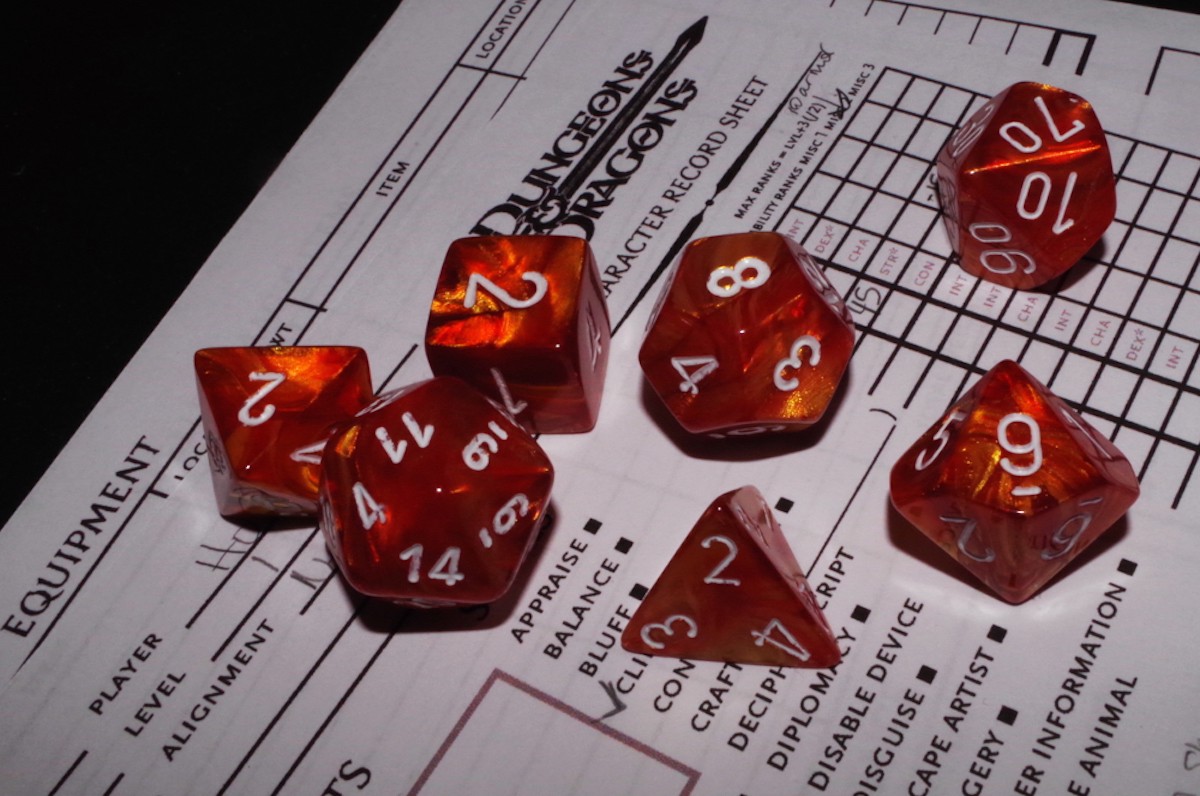
For decades, friends have collected in basements to fight zombies and goblins, find enchanted treasure, and save countless realms — armed only with paper and dice. This is Dungeons and Dragons , the roleplaying game that has swept nerddom by storm. But at its core, D&D is a device for storytelling, an oral tradition of collaboration and cooperation, crafting some of the most epic tales of the modern era.
Dungeons & Dragons (D&D for short) is a roleplaying game, meaning each player inhabits one character. Players improvise actions and invent plot while acting as their characters, rolling a die, usually a 20-sided die, to see if they are successful. Every character has strengths and weaknesses, which add or subtract numbers from the player’s dice rolls; a muscle-bound fighter may have an easy time picking up massive boulders, say, but they’ll ruin tense political negotiations with their low charisma. Embarking on adventures together, the party interacts with the world’s people and each other. They solve problems, fight evil, and discover treasure and knowledge. The game runs smoothly with the guidance of a Dungeon Master (or DM), who acts as the game’s referee and storyteller, maintaining the setting and world where the adventures happen and playing the role of the people in the world.
The producers of the D&D podcast Join the Party — Eric Silver (the DM), Amanda McLoughlin (moon elf rogue Inara Harthorn), Brandon Grugle (warforged barbarian TR8c), and Michael Fische, aka Fish (half-elf warlock Johnny B. Goodlight) — sat down to talk about the relationship between the game and novels, the fears behind writing and playing, and what D&D can do that that reading and writing can’t.
Amanda McLoughlin: Fish, did you play D&D as a kid?
Michael Fische: Kind of. My brother and I, before we knew it had a name, would sit in my bedroom and we would tell stories to each other. And I would make up, because I didn’t have dice, elaborate ways of inducing chaos to whatever story we were telling. So my brother’s character would walk down the trail in the woods and I would have a chart where I would close my eyes, move my hand, place it down on paper and that would be what happened.
Eric Silver: That’s some Betrayal at the House on the Hill shit. Oh god.
Brandon Grugle: I feel like if I played with my little brother, it would just be like, “Oh, you die, I win!”
MF: Oh no, don’t worry, he died a lot.
AM: Why was that a lot more fun than just telling a story?
MF: It kept both of us on our toes. It meant that, even if I wanted us to do something, it wasn’t guaranteed to happen. There were so many different possibilities — he would have to make up what his character was doing, and I had to be ready to deal with whatever craziness he started.
ES: Which is what I have to do now as our Dungeon Master!
MF: Right. The game evens the playing field between the story creator and story consumers. I think if you imagine the Dungeon Master to be an author and D&D players to be characters within the story, you see how D&D gives the characters a power that they wouldn’t have in any other story. Roleplaying game characters have more power over what’s happening and their own destinies than they ever would in a typical fiction story.
Roleplaying game characters have more power over what’s happening and their own destinies than they ever would in a typical fiction story.
AM: It’s the most extreme example of your characters coming to life as a writer. When you’re writing a narrative, you feel sometimes that your characters have agency of their own — like they’re going to make decisions for themselves. But, for me, it’s really freeing not to get particularly attached to one way of doing things. I always get so overwhelmed with possibility when I’m writing that I can’t commit to one setting. Or I commit to one, then get buyer’s remorse and try to introduce flashbacks or parallel universes to cram those unused settings in there.
BG: Oh yeah, me too. My favorite books as a kid were choose-your-own-adventure books where the ending was always unpredictable. That was built into the story. And that’s why I got really interested in D&D, because there’s no possible way for me to know what’s next. I can’t force my way into the story like that.
AM: When I played pretend with my siblings I was very prescriptive: “This is what you do now.” I was dictating how they were playing in the universe. But on the other extreme, I would also get bored working on theater shows where the same thing happened every night. Unlike actors, I don’t get the idea that you can discover new meaning every night. Actors’ know what to say next, but also kind of feel through that decision or revelation for the first time over and over again every performance. I would just get bored running the same lighting cues over and over again. But in D&D, when you all sit down together, you know nothing is going to go the way anyone thinks. We’re making the magic together. There isn’t a script to follow. It’s the best compromise between “Here is a blank page, good luck!” and “Here is a script you have to follow.”
MF: The more I’ve played D&D the harder it’s been to read fantasy books, because I could just be playing it instead! I could be plotting and making decisions as the DM or as a character, shaping the world to make it more interesting.
AM: And the dice are that crucial element of chance, making you introduce conflict. As a writer, I’m too soft-hearted to make characters suffer. I love them too much! I just can’t bring myself to do it! But in a game, it would be so boring for nothing to happen — though of course there’s no way nothing would happen, because the DM is going to keep the action moving along. Then chance is going to decide for you if things succeed or not. I love that it’s not up to me to decide if my character fails or succeeds at something. I can roll with the rolls — listen to the dice, adapt to the outcome, and figure out how to make it work within the story.
ES: I mean, writing fiction is scary. Not only for all the reasons that we’ve been saying, but because the entire narrative is in your hands. If I had the choice for my characters to tell me what they would want to do, that would be AMAZING. Playing D&D together is doing that — shaping the plot — as a collaboration. I love this idea that you’re playing within a structure of a game, but everyone is working together to create a story, even as enemies and conflicts are being thrown out in front of you.
You’re playing within a structure of a game, but everyone is working together to create a story.
BG: If authors could choose to have their characters come to life, wouldn’t they choose that every time?
ES: EVERY time. Your creation is your baby anyway. Give them actual human form and… Imagine interacting with some of these flat, two-dimensional characters in real life or in the game? The hero who is only good and sees morality in black and white would die in three days in the real world.
AM: Or you would be the most boring person at your session! We all want to make a great story and to entertain each other. I think that makes us make our characters act a little more like people than you would on a page. If someone acted to type, acted totally predictably, we would get bored. If I could predict what your character would do every time? That would be so boring!
BG: But it’s not just on one person to carry that story. Splitting up responsibility forces everyone to be better. When you put four people in a room who are trying to have the most fun and most exciting time, it forces everyone to be their best.
AM: Which is quite unlike sitting at your desk writing a story, hoping someone, someday, will find it exciting. In our games I know right away if a joke falls flat, and I know if I make an exciting choice when I see your faces light up. It is instantaneous feedback.
MF: And if we were playing the game and everything was just falling flat, we could close the book, come back a week later, and start a whole new campaign. It could even be something other than fantasy. But when you write a book or a script or a play, you won’t know for months or years if something’s good. That immediacy is important, and D&D lets us apply it to our storytelling. It just makes everything dynamic and fun.
AM: But we’re not hanging each other out to dry, either. It can be funny to watch someone scramble during an improv night, but not so much when you’re sitting at a table together. The more I play, the more I realize the best part of playing is when I’m not saying anything. The best part is watching it all unfold in front of me.
ES: Since no player is trying to impress an audience, everyone has their own ideas and goals coming in. It’s the collision of everyone’s thoughts that make this thing complex. Have you ever read a novel where you knew exactly what they were trying to get at on the first few pages? Like “Oh wow, this a really cool critique of capitalism.” (Everyone laughs) “I’m excited to read 300 pages about how capitalism is bad.” But when everyone’s ideas are coming together, trying to get what they want, that’s very beautiful. It challenges the story.
When everyone’s ideas are coming together, trying to get what they want, that’s very beautiful. It challenges the story.
AM: It’s also challenging to step into for the first time, though.
ES: There is a steep learning curve when you bring people in and try to get them to play D&D, or if people investigate it on their own because they saw it wherever. But it is no steeper than trying to start any other creative project. How many times have you written four or five pages and threw them out because they were trash? I’d much rather start a scary new project within a community that’s trying to get everything to gel together, because then at least you have something. I mean, it’s a little harder for us because our learning and growing pains are on microphone. But I’d much rather have growing pains than so many five- or ten-page chunks of novels I haven’t started.
MF: Right, you can mold the story into something else if it’s not working.
AM: The game can be tailor-made for you but also surprising at the same time. It’s not a boring book where I can’t get past the first chapter and try again and again, and I’m continuously bored. Like, if that’s the case in D&D, then I’ll run out of the castle and try to seduce the barmaid.
ES: CLASSIC AMANDA.
AM: Listen, guys, gotta borrow from real life to make good character choices.
ES: The stories we make also hold up later. It’s not just this insular thing that only the people around that table can enjoy. I don’t know if every D&D game would hold up as a novel since there’s so much acting involved, but fans can flock to other people’s games when they’re adapted in a smart way to auditory or visual mediums.
D&D requires you to imagine yourself in the stories you consume.
MF: The way technology is now, you can watch a group play on YouTube or listen to a real play podcast and then go play a game of your own later that afternoon.
AM: That’s a perfect point to end on. You can listen and get inspired and play that same afternoon, which is kind of open and daring. D&D requires you to imagine yourself in the stories you consume. It’s so natural to want to participate in the stuff that you think is awesome. That was so easy to do as a kid — every kid writes fan fiction of some kind, or plays pretend in the universe of their favorite movie, or dresses up like Buzz Lightyear at school. And this is, I wouldn’t say a grown-up way to do it… it’s just a more structured and communal way to play pretend and still challenge yourself. We’re maintaining that spirit of play and saying, yes, I have a right to shape the stories that I consume. It’s nothing but awesome.
Ready to try a game of your own? Listen to Join the Party’s Beginner Episodes (part 1 and part 2) to learn the basics before diving in yourself.
We have entered a period of spectacular bowing and scraping, in which White House staff compete publicly in stroking the ego of their flattery-addicted boss. Sucking-up takes a variety of forms, from petty compliment, to cloying flattery, to outright treachery. Our responses are just as varied — from impatience and annoyance to disgust and rage. Sycophancy combines with other vices — hypocrisy, lying, manipulation, and fraud — and intensifies them. The examples of bootlicking below list a few famous historical toadies as well as some books that offer brilliant accounts of sycophancy and its corrosive effects.
History’s Bootlickers
For his combination of all the worst elements of sycophancy, and his persistence in carrying out his program of flattery, Joseph Goebbels, Hitler’s Minister of Propaganda, would deserve first consideration. Goebbels’ propagandizing began with his leader. He initiated the “Heil Hitler” salute and insisted on the use of “Der Führer” as title. His letters are full of groveling praise — such as repeated testimonials that the experience of Hitler transformed his consciousness — and imagined scenes of glorious triumphs against various adversaries in which the Führer stands firm and unshakeable. Almost single-handedly, Goebbels created the prototype for subsequent versions of state-sponsored sycophancy.
The power of the state can also be marshaled in less pervasive demonstrations, as an incident from the Roman Emperor Caligula’s notorious rule reminds us. During an illness early in Caligula’s reign, a commoner vowed to give his own life if the emperor recovered. The man made his vow publicly, hoping through his extravagant offer to show his deep loyalty and to elicit a generous award for his avowal. Although Caligula did recover, the lickspittle’s tactic backfired spectacularly. Once back on his feet, Caligula chose to take the man at his word and ordered his execution. Quite the lesson that words should mean what they say. Death by sycophancy is hard to top.
The former Secretary of State Henry Kissinger showed great promise as sycophant from his earliest days as a graduate student at Harvard’s School of Government, where his fellow students, playing upon the “A” from his middle name, called him “Henry AssKissinger.” But in the Nixon administration, Kissinger became a world class sycophant. One need only recall his deplorable comment to Nixon after a meeting with Golda Meir in 1973, then prime minister of Israel. Meir had implored Nixon to ask the Russian government to allow more Soviet Jews to emigrate to avoid persecution. Nixon, intent on détente with the USSR, sought to avoid the request. Kissinger had a ready response: “The emigration of Jews from the Soviet Union is not an objective of American foreign policy. And if they put Jews into gas chambers in the Soviet Union, it is not an American concern. Maybe a humanitarian concern.” Truckling to the boss doesn’t get much uglier than this.
Saint-Simon’ Memoirs records an instance of truly astonishing sycophancy. His gossipy account of the Duke de Vendôme’s insolence includes a description of the duke’s morning routine. Upon rising the duke habitually took up his “chaise-persée” (a portable toilet), upon which he held court and received official visits for hours. Vendôme welcomed one supplicant, a bishop on ambassadorial duty for the Duke of Parma, in his usual style. During the interview, he rose, turned his back to the bishop, and wiped himself. Disgusted, the bishop refused to see him again. However, diplomacy is the art of finding a way. The bishop found the perfect substitute for the peculiar requirements of negotiation with the Duke: the super-serviceable Giulio Alberoni, who had risen from poverty though a series of clerical appointments. Alberoni, treated to the same display by Vendôme, had a ready reply: “O culo d’angelo” (roughly translated, “Oh, ass of an angel!”), and he “ran to kiss” the duke’s behind. His long career within the church and among European courts was assured.
Literature’s Toadies
History give us the spectacle of sycophantic excess, but literature teaches us how to think about it. Plutarch’s “How to tell a Friend from a Flatterer” sets out the nature of both the sycophant and the target, and he is unsparing to each. Sycophancy begins in the target’s self-love, which impairs his judgment. Because “everybody is himself his own foremost and greatest flatterer,” that is, complacent and trusting to his virtues, the sycophant need only second and celebrate this flatterer within. The sycophant, on the other hand, has “no nature, no abiding-place of character to dwell in.” He takes the shape of his target’s desires, ultimately leading “a life not of his own choosing but another’s, moulding and adapting himself to suit another.” Plutarch exposes the essential nullity of sycophants and in this essay offers nothing less than a flatterer’s playbook.
Charles Dickens’ David Copperfield provides one of literature’s most repulsive sycophants, the reptilian Uriah Heep. Dickens ensures readers will revile Heep by emphasizing his physical creepiness — he is cadaverous and lanky, with clammy hands and “sleepless eyes.” David feels slimed every time he encounters him. Initially a clerk in the employ of the lawyer Mr. Wickfield, Uriah Heep undermines his employer by weaponizing professions and displays of humility. Schooled in being “umble” by his father, Heep is always quick to affirm his lowly station and abase himself, no more so than when he invites the young David to tea. Working their young guest like a pair of tag-team wrestlers, Heep and his mother use every angle of perverse flattery to corkscrew information out of the boy. Mrs. Heep goes so far as to venture that “If I could have wished father to remain with us for any reason, it would have been that he might have known his company this afternoon.” To wish the return of a husband and parent from the grave to have tea with a twelve-year old boy surely registers high on any list of outrageous flatteries.
Chaplain to the bishop of Barchester, the duplicitous Obadiah Slope in Anthony Trollope’s Barchester Towers, epitomizes the lick up/kick down sycophant — fawning with the powerful, tyrannical with subordinates. In a campaign to become bishop himself, Slope flatters and consoles his way into the circles of the town’s best families and social coteries. Barchester’s “foolish women” readily listen to the twaddle he whispers into their ears, but not Eleanor Harding, one of his intended targets. Initially sympathetic, Eleanor denounces him as “an abominable, horrid, hypocritical man…the most fulsome, fawning, abominable man I ever saw.” Trollope exposes Slope’s every weasel-like move and hypocrisies with a satiric bite that makes this novel an irresistible read.
Lauren Weisberger’s The Devil Wears Prada explores the self-loathing endured by sycophants. Everyone who works at the fashion magazine Runway sucks up to its abusive editor, Miranda Priestly. The novel humorously exposes the sycophantic world that envelopes Miranda, who requires and ruthlessly enforces outrageous displays of ingratiation. Runway’s staff, fashion designers, restaurant owners all grovel before the diabolical Miranda. Here the “devil” seems to mete out just punishment for those willing to debase themselves in pursuit of some vacuous conception of access or success. The protagonist’s crushing humiliation is a perplexing act of self-nullification.
While the bargain struck by the sycophant — fleeting moments of vain gratification — often seems a losing proposition, the arrangement can at times have some advantage. In The Line of Beauty, Alan Hollinghurst presents a virtuoso suck- up in Nick Guest, a well-educated hanger-on in a rising conservative MP’s home. Hollinghurst brilliantly links Nick’s aesthetic sensibility to his abilities as a flatterer. Early in the novel Nick accompanies the family of a friend as they drive to a country estate. But while the family can be bored as they contemplate the visit, Nick is essentially on duty as resident sycophant. From the outside, one would be uncertain of Nick’s intentions. But upon arrival, Nick revels in the pleasures of an intense connoisseurship, tracing the beautiful surfaces of the estate, noting the details of its elegance and its rich evocation of architectural traditions. Nick is a flunkey but this seems the price of the ticket to the world of the rich and powerful. He savors the view, but he also relishes his intense response to it: Nick understands and enjoys what the family owns better than they do.
But for power of execution and depth of treatment, one must conclude with Shakespeare’s masterful account of weaponized sycophancy — his Othello. The play provides a catalog of strategies for ingratiation, subversion, and destruction, as Iago corrupts the mind of the noble Othello. No play shows the devastating personal consequences of sycophancy, or its intricate ties to other vices so starkly. The sycophant is capable of every fraud, every hypocrisy, every deceit. And no work of art evokes the mystery of sycophancy — its springs and sources in the character and life of the ingratiatory — so completely.
That’s not true, but I like the way it sounds. It finally lets me combine the words and the water, the sport and sexuality, that have made up my life, that have engulfed and carried me.
The first person to call me a lesbian was the mother of one of the girls on my swim team growing up. The girl lived up the hill and around the corner, and sometimes we carpooled together, inventing songs in the back seat. On hot days after early morning practices we wasted time watching educational cartoons, and hiding from her older brother and his guitar. Was that something like a crush?
One day, not so different from the rest, we decorated our plastic team water bottles with permanent marker. We wrote out all the usual slogans: Eat my BUBBLES! Swim FAST!! Kick BUTT!!! And, inside a heart, my neighbor wrote our initials, with a little plus sign nestled in between.
That was her crime. Or rather, my crime. Her mother called mine, after scrubbing off the marker with acid, and yelled. I didn’t learn about this phone call until years later, so I can only imagine how it went. “How dare you let your lesbian daughter in my house, in the locker room, in the pool with other girls?!”
In hindsight, the other odd comments she made over the years began to make sense. The time she accused my family of spying when we took the blind curve in front of their house too slowly. The time she told me I ate too much, and too often. The time her husband wouldn’t let me leave the table until I had finished everything on my plate. She wanted to keep us at arm’s length, to correct my behavior in front of her daughter so she wouldn’t turn out like me. It wasn’t my queerness (in all senses of the word) that was a problem, per se, but the idea that it might be catching.
It wasn’t my queerness (in all senses of the word) that was a problem, per se, but the idea that it might be catching.
This wasn’t the only incident with the team provoked by my version of girlhood. I stuck out. The other swimmers in the locker room wore designer brands, straightened their hair, put on makeup. I composed outfits entirely out of different shades of orange.
There’s me, maybe fourteen, in front of the computer after a long workout, having, for once, co-opted our dial-up connection. I got a chat invitation from a screenname I didn’t recognize, someone who said they were on the team with me. I accepted, and a few messages in, she said: “You have so many pubes, lol.” I demanded she reveal herself. “Who are you? How did you get my screenname?” After a few evasive answers, I got a message that said, “You’ve been tricked! This is a robot! The first few messages were programmed, but the rest has been computer generated!” The exclamation points made me cry even harder, as if the programmer took pride in this tool created for bullying. I vowed to renew my vigilance with shaving cream and a razor.
This was just one of many torments — the girls who lined up along the wall so I couldn’t climb out of the pool, the ones who told me they couldn’t imagine me dating — that served as a reminder that there’s more to competitive swimming than body meets water, more to being an athlete than physical practice.
You put on a gender-appropriate uniform. You rise for the national anthem. You chant fight songs. These little routines require patriotism and gender conformity and a healthy competitive spirit, as if a team were a training ground for the military. Was it possible, then, to be both an athlete and a queer, unkempt hair and all?
I grew up in Pittsburgh, home of the Steelers and their fiercely loyal fans. The first thing to greet visitors at the airport is a statue of Franco Harris, who I was taught at an early age made one of the most famous plays in football history, the Immaculate Reception. He sits right next to a statue of George Washington, who helped drive the French out of our city when it was just a Fort. Together they are presented as our city’s two great heroes, each responsible for putting us on the map in their own way.
Raised in this town, my sister became a convert. She followed their seasons, stayed up well past her bed time to watch their games, and jumped at the chance to go to a game, or, better yet, training camp.
Me, on the other hand? It wasn’t my thing. When the games came on and my sister started shouting at the TV, I would run upstairs to my room and shut the door. I did learn to speak passable football, but, when pressed, I can’t really explain what the Immaculate Reception actually is. I can’t name any of the players, either, except the ones who had been in the news for their off-field activities: Michael Vick. Ben Roethlisberger. Peyton Manning. Ray Lewis. They taught me from an early age that controlled bursts of on-field violence were often tied to real-life episodes.
I wasn’t surprised to learn recently that football has the highest number of convicted players at the professional and collegiate level of any sport, and nearly half of those are for violent crimes. That number doesn’t even include many of the names I can recognize, since many of those men were never convicted.
It’s no wonder that we have yet to see an active pro football player come out.
It’s hard to tease out the separate strands at play here — questions of race and class and the impact of fame go hand-in-hand with questions of gender. But there are traditional masculine ideals at the center of all this — a strong man who fights on the field like a gladiator and sometimes can’t shed that role at home; and a man on the other side of the screen, watching with a beer in hand. It’s no wonder that we have yet to see an active pro football player come out.
When I left the city of black and gold, I tried to find a different way to be an athlete, a swimmer, a body that moves through the water. I picked the college that had the best academics and the worst swim team.
Other teams in our conference opted for matching warm-up jackets, or even identical braids with matching hair ribbons, and they would emerge from the locker rooms clapping hands in unison like an approaching storm.
We couldn’t be bothered.
We tried to show up on time, but if class got in the way, we didn’t. We wore what we wanted, even if that was a hoodie that zipped up so far it covered your face. Sometimes, before a meet, we would ironically chant, “Fight fight for the inner light! Kill Quakers, kill!” And in preparation for the final meet of the year, we would dye our hair neon shades of pink and blue and green. We looked more like washed out clowns than gladiators.
I came out with the help of one of these teammates. We sat on deck icing our shoulders, discussing our crushes out of earshot of our coach, and she handed me the word lesbian like someone proffering half a sandwich at the misfits table. But we weren’t misfits, really. Or maybe everyone on the team had been one somewhere else, and now, finally, we were able to come together. No one cared about your grooming habits, or your sexuality. One year we had a lesbian coach, the first I had had in over a decade of competitive swimming, and several more teammates have come out after college.
That’s when I began to wonder, did swimming make me gay? Or rather, is there something queer about swimming?
Exhibit A: IGLA, the International Gay and Lesbian Aquatics association, is one of the biggest queer sports leagues in the world. I joined a team right after college, and it was a revelation to talk to so many queers with locker room horror stories. The men still lift up my arms to exclaim about my hair, but I take it as a sign of curiosity rather than scorn.
Exhibit B: Books by queer swimmers, most of them women, seem to be flourishing — The Chronology of Water by Lidia Yuknavitch, Find a Way by Diana Nyad, The Sea of Light by Jenifer Levin. It’s not just that the writers are queer. Their non-linear narratives are in opposition to the celebrity athlete memoir. Rather than claiming victories and extolling the value of hard work, they float, riding waves of memory and feelings churned up by the tides.
Their non-linear narratives are in opposition to the celebrity athlete memoir. Rather than claiming victories and extolling the value of hard work, they float, riding waves of memory and feelings churned up by the tides.
In her memoir, Lidia Yuknavitch writes, “All the events of my life swim in and out between each other. Without chronology. Like in dreams.” She calls this new timeline “the chronology of water” and employs it to tell her own life story. She touches on everything from first dates in the pool to being a member of Ken Kesey’s writing group to her difficult experiences with abuse, addiction, and miscarriage, rarely reverting to the actual lived order of things to tell the story.
Long-distance swimmer Diana Nyad’s memoir Find A Way tells the slightly more linear story of the sixty-year-old’s triumphant swim from Cuba to Florida. And yet water’s chronology carries her away right in the first chapter, where she pairs a scene from one of her failed attempts to complete the swim with a memory of standing on the beach at age nine with her mother, squinting toward Cuba. It was something she remembered while swimming. The lesbian swimmers in Jenifer Levin’s campus novel The Sea of Light also remember their pasts in the pool, and they show up every day not just to compete and to win, but in hopes of healing their traumas.
And then there’s Moby Dick. In all the myriad analyses of our Great American Novel, I don’t think anyone has come out and said it: Moby Dick is the greatest queer swimming book of all time. The homoerotic elements of the novel have been catalogued elsewhere — what I’m interested in is the swimming.
Sometimes it’s the whales, gliding through the vast ocean, and sometimes it’s the men, floundering, or even drowning. No matter who is doing it, the book is filled with gorgeous passages about creatures moving through water, and the narrative structure itself ebbs and flows, the ancestor of today’s swimming books. The repetition of sweltering mornings and endless stretches of water remind me of the routines of competitive swimming: early morning mist rising over the pool, countless laps swum over the same terrain, all that effort never taking me anywhere. And Melville’s digressions into the history of whaling? I know all too well that when faced with so much water and so much solitude, the mind will wander. Adrift, it’s easy to let the water carry you away from what it means to win and lose, to be strong, to be a man or a woman, or simply a body in the water.
Moby Dick is the greatest queer swimming book of all time.
Even with all this — the queer swim team and the queer books and the democracy of water — there’s something that keeps competitive swimming from truly being queer. It’s still a sport. There are still regulations and officials and registration fees. There are still young girls who police one another’s bodies, and their budding sexualities. How can something built on strength and competition and scrutinizing the body’s performance be queer?
It goes back to the decades-old question of what is at the heart of queer activism. Are we fighting for acceptance into the existing structures (marriage, the military, sports) or to dismantle those structures entirely? Even a queer sports league is recreating existing structure, albeit in parallel. This separatist revision of mainstream sports still leaves lots of folks on the outside: athletes of color, athletes with disabilities, transgender athletes, anyone who can’t pay the registration fees.
On summer mornings in New York City, and even into the late fall and early spring, you can spot little fluorescent globes bobbing in the water along the shores of Coney Island. Sometimes they appear in small pods, and sometimes there’s just one, making its determined way down the coastline. These are swimmers, but not like I’ve ever known. Clad in brightly colored caps to stand out against the blue gray of the waves, open water swimmers have left behind the confines of the pool, the rules and regulations, so that nothing stands between them and the thing they love.
I decided to join them a few years ago. On my first swim, I popped up every few minutes just to exclaim about the cold or because I thought I had seen a shark (or run into a jellyfish or, more likely, some bit of floating trash — a newspaper, a grocery bag, a used condom) or to gaze out at the Rockaways and hope I didn’t get swept away. I had never felt so small, so powerless. It was no longer an even 14 strokes from one end of the pool to the other. One hundred strokes could either take me from one jetty to the next, or nowhere at all, depending on the current. I emerged from the water with a green sea beard of algae on my face, and I was hooked.
I emerged from the water with a green sea beard of algae on my face, and I was hooked.
Just as the sport is upended, so are the unspoken rules of the community. It doesn’t matter who is fastest. To me, the kings and queens of the beach, our adult equivalent of the popular girls, are the ones who have completed the most impressive feats of endurance — they’ve swum MIMS, a marathon around the entire island of Manhattan, multiple times; they swim in the ocean in 40-degree weather; they know the tides and the currents. There’s no coach, no set workout, no fixed practice time. There are few six packs here, and little vanity. I shudder to think what my high school teammates might have said about the motley crew gathered on the beach, about our swim suits, about our faces, white with zinc.
And then I laugh to think that it doesn’t matter at all. If there is truly a queer version of my sport, this is it. Inherently gendered ideas of domination and victory are swept away, and something almost undefinable takes their place. There’s still discipline and rigor — it takes months of training to complete the more than 26-mile loop around Manhattan — but it’s hard to define what it’s all in pursuit of. Who is the opponent? Maybe it’s your own self, as you try to test the boundaries of your endurance, or maybe it’s the sea and all its elements. The salt, the currents, the cold.
Maybe it’s not about an opponent at all, but about the journey, and the encounters with the self that the solitude of the journey brings.
When I see these swimmers, when I swim among them, I think again of Moby Dick. One of the crew, off in pursuit of the white whale, falls overboard and nearly drowns. Down at the bottom of the ocean, he sees God’s foot upon the treadle of the loom.
Maybe it’s not about an opponent at all, but about the journey, and the encounters with the self that the solitude of the journey brings.
I read this passage in delight. To imagine! Words, and the very fabric of our existence, spun deep underwater on the ocean’s floor. No wonder I found the word lesbian by the pool. No wonder the water calls into question athlete and team and competition. Is it these words that bring us together in motion, or the mere fact that together we parse the warp and weft of the water?
If someone gave me a seat at the loom, I would weave new meanings into old words: Mermaid. Dolphin. Siren. Pod. Maybe I could be the one to invent the word for a group of mermaids, swimming close together, but each at her own pace.
DON’T MISS OUT
Sign up for our newsletter to get submission announcements and stay on top of our best work.
YOUR INBOX IS LIT
Enjoy absorbing fiction from Recommended Reading on Mondays, strange, diverting work from The Commuter on Wednesdays, and a roundup of our best work of the week on Fridays. Personalize your subscription preferences here.
Thank You!
Manage Consent
To provide the best experiences, we use technologies like cookies to store and/or access device information. Consenting to these technologies will allow us to process data such as browsing behavior or unique IDs on this site. Not consenting or withdrawing consent, may adversely affect certain features and functions.
Functional
Always active
The technical storage or access is strictly necessary for the legitimate purpose of enabling the use of a specific service explicitly requested by the subscriber or user, or for the sole purpose of carrying out the transmission of a communication over an electronic communications network.
Preferences
The technical storage or access is necessary for the legitimate purpose of storing preferences that are not requested by the subscriber or user.
Statistics
The technical storage or access that is used exclusively for statistical purposes.The technical storage or access that is used exclusively for anonymous statistical purposes. Without a subpoena, voluntary compliance on the part of your Internet Service Provider, or additional records from a third party, information stored or retrieved for this purpose alone cannot usually be used to identify you.
Marketing
The technical storage or access is required to create user profiles to send advertising, or to track the user on a website or across several websites for similar marketing purposes.